ICYMI Mason: Immigrants are this country’s best friend. Don’t forget it

One of the counter narratives to the current critique of immigration levels (which I share). And of course the equally simplistic rationales used to justify increased levels of permanent residents, and uncontrolled growth of temporary residents, have also come home to roost:

According to a study in The Lancet, by 2050, 155 of 204 countries (75.9 per cent) measured (including Canada) will not have high enough fertility rates to sustain population size over time. This will increase to 97 per cent of these same countries by 2100. “The new fertility forecasts underscore the enormous challenges to economic growth in many middle- and high-income countries with a dwindling workforce, and the growing burden on health and social security systems of an aging population,” the report states. “These future trends in fertility rates and live births will completely reconfigure the global economy and the international balance of power, and will necessitate reorganizing societies.”…

This brings me back to Canada and our national debate around immigration. Blaming a “radical, out-of-control NDP-Liberal government,” for current immigration numbers – as Mr. Poilievre has done – is nothing more than cheap sloganeering that ignores the complexity of the problem.

Source: Mason: Immigrants are this country’s best friend. Don’t forget it


Québec a dépensé 865 millions en cinq ans pour les étudiants français

Of note. Other countries also benefit from lower fees are listed in this Quebec government table:

Année après année, le contingent le plus nombreux d’étudiants étrangers arrive de France. Puisque ceux-ci paient les frais les moins élevés parmi les étudiants venus d’ailleurs, c’est Québec qui ramasse la facture : en cinq ans, 865 millions de dollars sont sortis des coffres de l’État pour eux. Les experts remettent néanmoins peu en question les ententes bilatérales qui établissent ce traitement de faveur, vu tantôt comme une politique d’immigration, tantôt comme une grâce diplomatique.

Entre 2019 et 2024, les Français ont formé autour du tiers des étudiants étrangers dans les cégeps et les universités du Québec, sauf en 2020, quand ils ont été surpassés par les Indiens. Les ententes avec la France ne datent pas d’hier : celle qui les exempte de droits de scolarité supplémentaires dans les cégeps a été signée en 1978 et n’a pas été renégociée depuis.

Les tarifs préférentiels ont été reconduits pour les étudiants universitaires en avril dernier. Les Français continuent de payer environ 9000 $ par année au premier cycle universitaire, contre un minimum de 20 000 $ pour les étudiants d’autres nationalités, et les mêmes droits de scolarité que les Québécois à la maîtrise et au doctorat.

Le ministère de l’Enseignement supérieur indique au Devoir que la « subvention nette » aux étudiants français se chiffrait à 187 millions en 2023-2024, et à entre 146 et 186 millions pour les années précédentes : ce qui donne un total de 865 millions depuis 2019. Mais l’on ne sait pas quel montant reviendrait dans les coffres sans les ententes bilatérales, car personne à Québec n’est en mesure de chiffrer précisément combien cette faveur coûte réellement au gouvernement….

Source: Québec a dépensé 865 millions en cinq ans pour les étudiants français

Immigration is key to ensuring the vitality of French in Canada 

A reminder that immigration has more than economic objectives although legitimate debate regarding impact on skill levels and expected economic outcomes and impact on productivity:

Francophone immigrants, many of whom are “young, gifted and Black,” are les forces de l’avenir that will ensure the future of French outside Quebec – a future that reverberates with the splendour of French with intonations of Franglais, Lingala, Wolof, Arabic and all other tongues of our shared reality.

Francophone immigrants are not just rebuilding our declining demographics; they are reweaving the tapestry of our Francophonie. What is “top talent,” after all, if not the people who rebuild a culture?

Source: Immigration is key to ensuring the vitality of French in Canada 

Clear majority of Canadians say there is too much immigration, new poll suggests

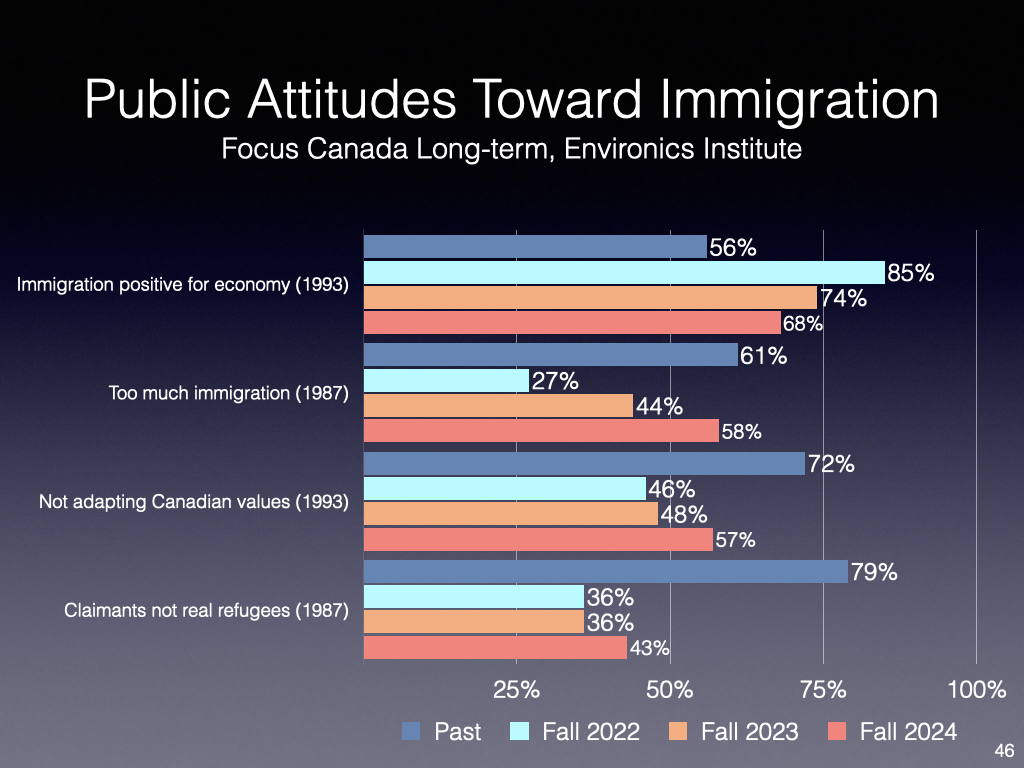
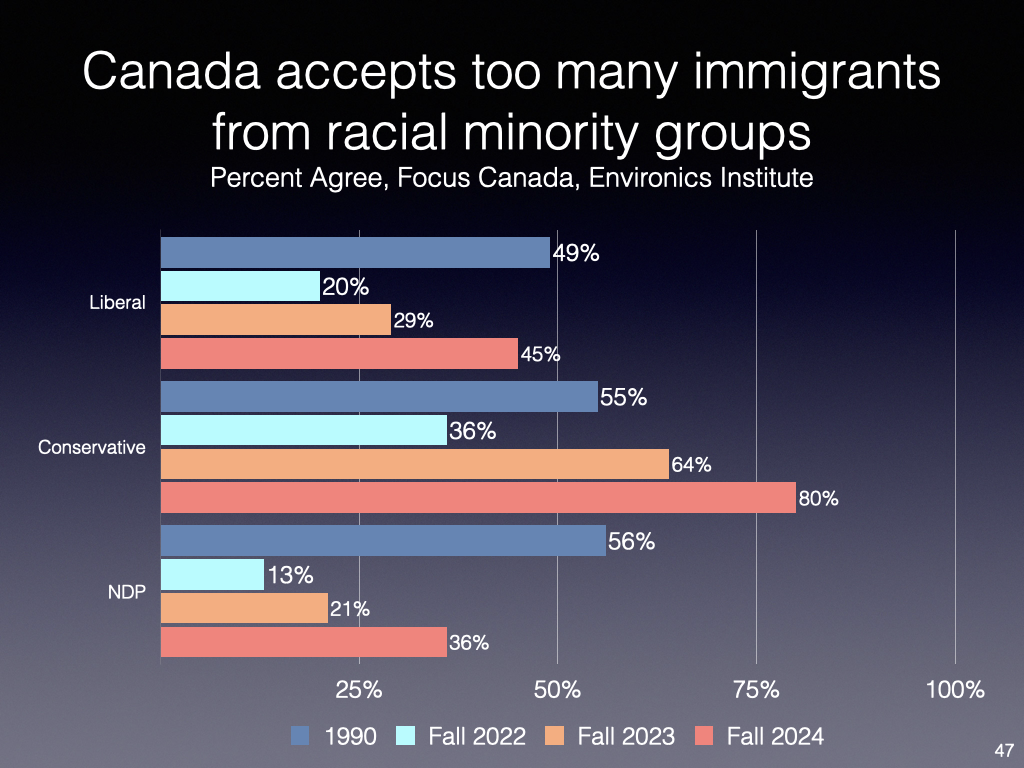
Clear continuing signs of an inflection point in attitudes, reflecting overly high levels of permanent residents and out of control temporary (students, foreign workers) along with impact on housing availability and affordability.

Recent reversals will take time to work through the system meaning that public opinion unlikely to revert to pre-2022 levels. Clear policy failure on the part of the federal government, along with provincial governments and advocates/lobbyists for high levels.

Reversion to 1990 attitudes or worse as per the summary charts below:

…..Keith Neuman, a senior associate with the Environics Institute, says his organization has consistently found a consensus that immigration was either positive for Canada or not a problem.

But he said Canadians have been growing more concerned about the volume of immigrants. “There are worries and concerns about immigration that we simply didn’t see two years ago to the same extent,” he said in an interview.

However, he said Canadians are not rejecting immigration entirely. “People still value the diversity. They still recognize the economic benefits. They understand that jobs need to be filled. Those things are still part of the general sentiment of the population for most people.

“But there are increasing concerns with how the system is being managed and the number of people coming.”

Among the findings of the researchers is a 10-point increase, to 21 per cent, in those who believe there is too much immigration because it is being poorly managed by government….

Source: Clear majority of Canadians say there is too much immigration, new poll suggests,

Clear majority of Canadians now say there’s too much immigration,


MPI: Immigrants and Crime in the United States

A reminder given the falsehoods in the USA election:

Immigrants in the United States commit crimes at lower rates than the U.S.-born population, notwithstanding the assertion by critics that immigration is linked to higher rates of criminal activity. This reality of reduced criminality, which holds across immigrant groups including unauthorized immigrants, has been demonstrated through research as well as findings for the one state in the United States—Texas—that tracks criminal arrests and convictions by immigration status.

A growing volume of research demonstrates that not only do immigrants commit fewer crimes, but they also do not raise crime rates in the U.S. communities where they settle. In fact, some studies indicate that immigration can lower criminal activity, especially violent crime, in places with inclusive policies and social environments where immigrant populations are well established….

Source: MPI: Immigrants and Crime in the United States

Opinion | Justin Trudeau’s immigration minister cracked down on Canada’s international student ‘racket’. Here’s what he wishes he’d done differently

Well worth reading. Some excepts of interest:

Terms of debate: “The issue is having the proper intellectual debate and not turning it into value statements about the race, colour, or creed of the people coming in, but also without painting people as racist when they express views you disagree with.”

International students: “The program had become a bit of a racket, and I probably should have acted sooner. My biggest mistake was to trust people for too long — to trust provinces and the institutions they regulate. Auditors general have said time and time again that Ontario and B.C. had to get a grip on things. Those are the two provinces where international-student placements had become a runaway train. And they were all promising something — permanent residency or Canadian citizenship — that was not guaranteed.”

Temporary Foreign Workers: “Largely hospitality. Go into a Tim Hortons, and you will see a lot of temporary foreign workers. When you take a step back, the questions you need to pose are, ‘How are we filling needs? Are we artificially depressing wages? How is an influx of temporary foreign workers contributing to that trend, particularly when you have a labour force already here?’ There will need to be further adjustments to the program, including in the availability of asylum seekers who have work permits. But we also don’t want to harm markets that are important to regional economies, like fish processing or food processing.”

Source: Opinion | Justin Trudeau’s immigration minister cracked down on Canada’s international student ‘racket’. Here’s what he wishes he’d done differently


Articles of interest over the past month

Need to get a life as during my vacation break monitored Canadian media and collated these articles that I found of interest. Likely missed some.

The ones I found most interesting:

Donald Wright: We are not going to build our way out of the housing crisis. The harsh reality… Along with Donald Wright: When it comes to where people want to live, Canada is a very small country, Donald Wright: Urban densification is not going to solve our housing crisis, Donald Wright: The first step in solving Canada’s housing crisis? Implement a non-delusional immigration policy. “I calculate that Canada will need to limit the number of new PRs and net increase in NPRs to an average of 175,000 per year between now and 2031. This is a significant reduction from the 640,000 per year average over the past five years.”

Jason Kenney’s biggest worry about the U.S. election: A potential deportation program. “If he was still immigration minister, Mr. Kenney would make changes such as beefing up the Safe Third Country Agreement and increasing the Canada Border Services Agency’s resources. “I would make it clear that Canada is an open and welcoming country, but you have to go through the normal legal process.”’ His overall take on the Liberal record in this interview: Trudeau has ‘catastrophically mismanaged’ immigration: Jason Kenney

Laura Wright | Canada’s fertility rate has plummeted. Maybe we shouldn’t care. Good call to recognize demographic realities and focus on how to re-examine existing programs in light of this trend, rather than merely trying to delay it through immigration.

Simpson: Blame the four fatal ‘I’s of Justin Trudeau for the lacklustre state of the Liberals. On immigration: “Historians of this period will look at cabinet records to figure out why the Liberals took the decisions they did that turned public opinion against immigration and the incumbent government. Was it the old Liberal reflex that immigrants usually vote Liberal so the more the merrier? Was it a response to those who proposed that Canada should become a country of 100 million people? Was it a response to business leaders who wanted more cheap labour? Was it the Liberal/liberal reflex to want to do good rather than to be smart? Was it a response to higher education institutions whose budgets were stressed by inadequate provincial funding and so needed foreign students whom they could charge higher fees? Was the push for record-high immigration needed to fill the gap of a declining birth rate? Was it that a party that had wrapped itself in self-virtue could not believe that a variation of what had happed in other Western democracies could not and would not happen here? Was it blind incompetence not to appreciate that driving up immigration and refugees to unprecedented numbers would produce a myriad of negative side effects and destroy what had been close to a consensus in favour of previous levels of newcomers?”

Clark: Marc Miller and a mea culpa makes a rare success. “Yet Mr. Miller has taken steps that have turned around the trend. It’s hard for governments to claim credit for acknowledging their big, bad mistakes, and fixing them. But in politics, that should be rated as a rare success.”

‘Alarming trend’ of more international students claiming asylum: minister. Belated recognition of the perverse incentives at play and the likely need for further corrective actions. Marc Miller Strikes Again provides HESA’s critique of federal actions and that fed-prov consultations should have possible to achieve comparable results. This will be the next shoe to drop in our broken immigration system, Tony Keller on Miller’s admission and the further increases in asylum claimants and overstays.

Schools Make Millions Offering Degrees That Double as Work Visas (USA). Not unique to Canada. “A record 24,000 foreign graduate students were enrolled in schools offering Day 1 CPT — or curricular practical training — as of fall 2022, according to a Bloomberg News analysis of the most recent available Department of Education data. At typical prices, tuition probably topped $240 million, Bloomberg estimates.”

Waterloo’s international graduates outearn Canadian-born students, paving the way for immigration policies, experts say. Coverage of Skuterud’s case study for University of Waterloo international students.

Urback: Canada is sleepwalking into a refugee crisis. We need to act now. Another highlighting of the consequences of lack of foresight and likely not listening to public service advice. “It’s not ideal that those legitimately seeking refuge in Canada may be denied the opportunity, but it’s a consequence of this government ignoring years of warnings. It cannot ignore these next ones.”

Lisée | Les difficultés temporaires de François Legault. “François Legault avait promis de mieux gérer l’immigration et d’y arriver dans le cadre fédéral. Force est de constater que, loin d’avoir réussi à « en prendre moins », son gouvernement a activement exacerbé la situation pendant plusieurs années, avant de réaliser, penaud, dans quel pétrin il avait contribué à plonger le Québec.”

Most Canadians say citizens who stay in high-risk conflict zones don’t deserve government protection: Leger poll. Not surprising and understandable. “Canadians of convenience.” Also Flight leaves Lebanon with about one-third of seats reserved for Canadians filled.

Chris Selley: For anti-Israel protesters, October 7 anniversary is an unofficial citizenship test. Yep. 

Combatting hate in Canada. Announcement of expanded funding for a variety of programs and initiatives ($273.6 million over six years, and $29.3 million ongoing) without, it would appear, any substantive change from the INSERT evaluation. Likely will be significantly cut back under a Conservative government.

Robert P. George: A Princeton Professor’s Advice to Young Conservatives. “Grievance identitarianism — be it of the left or the right — impedes the very thing a student is attending university to do: namely, think and learn. It turns a person into a tribalist, someone who, rather than thinking for oneself, outsources one’s thinking to the group.”

Allen | The wounds of October 7 cannot heal until there is peace. “I yearn for a Canada whose citizens can hold in their hearts sympathy and understanding for all those killed and maimed during this period. I wish that students on campus and Canadians more generally understood that both sides view themselves as victims and that each side bears some blame for the current crisis. I acknowledge that Palestinians have been under the yoke of an illegal occupation for over five decades and that this must end. Unfortunately, the fears and hatred generated by the Oct. 7 attack have made the task harder.”

John Ivison: Flag-burning Islamists in our streets would kill us with our own tolerance. “Hostilities may not have been declared, but if you don’t think Canada is in a fight for all it holds dear, you should watch the forces of radical Islam calling for the death of Canada on the streets of Vancouver, while holding the remnants of a burned Maple Leaf flag.”

Gopnik: The tragedy of our time is that antisemitism rises equally from the left and right. “Every person is a world in an agonizingly literal sense. Let’s recall that one of the few texts that passes complete from Jewish scripture to Islamic scripture is the injunction that “Whoever kills a soul, it is as if he had slain mankind entirely. And whoever saves one – it is as if he had saved mankind entirely.”

The Functionary: Interview with Peter Wallace. Thoughtful discussion between Kathryn May and Wallace. Some of my favourite quotes, good reading for those preparing for a Conservative government:

“We want people to trust government, but they really should be skeptical about what government does with authority and they really should push back on that.”

“We’re mystified (as to) why people can be upset with government, and I don’t think we should be. The reality is governments are often times incredibly intrusive.”

“It’s incredibly important to remember that today’s dissidents are often tomorrow’s heroes. We must be cautious about shutting people out of the policy process.”

“The public pays for what we do, and they have a right to see our work. We need to demonstrate our value and show that we are thoughtful and competent. So, let’s embrace that scrutiny.”

“We’ve got to have metrics to help us understand individually at a gut level what we’re doing with that money. We have to be satisfied before we advise an expense that it’s actually worth the opportunity cost, worth the fiscal cost.

Full list attached:

Colby Cosh: Lululemon’s sweetheart deal for temporary foreign workers

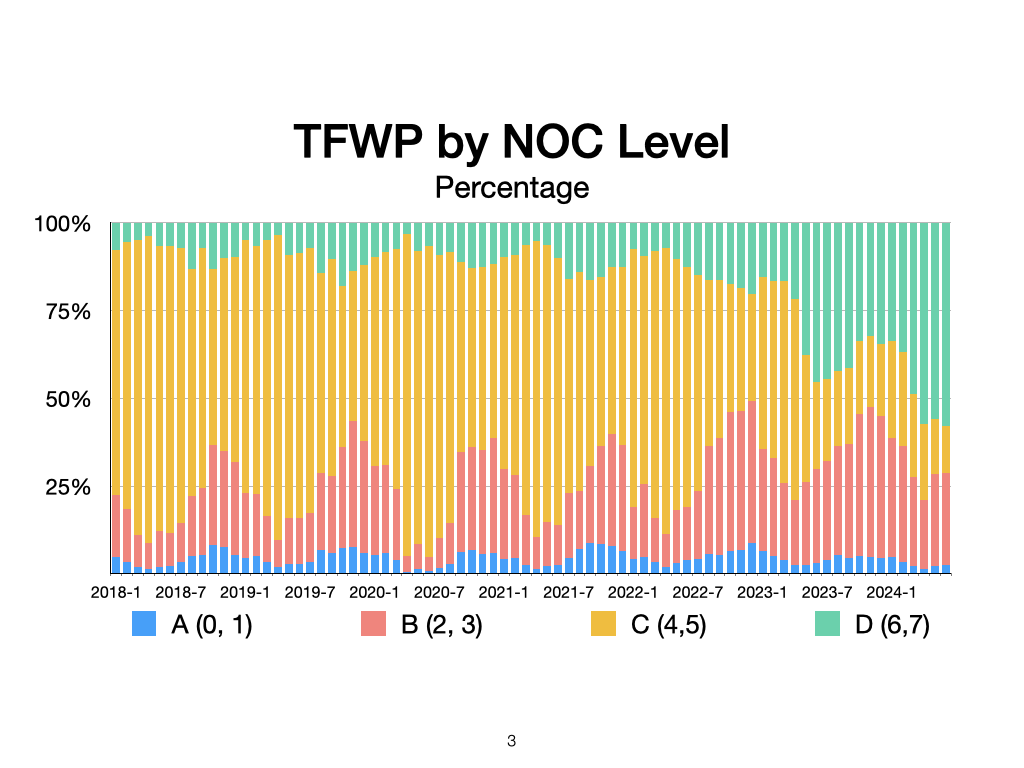
Of note. The vast majority of those hired under the TFWP are low-wage workers:

…It is easy to imagine that the decision to approve the permits was a no-brainer for B.C., Ottawa, and the federal ministers who quarterbacked the exemption. And, yes, Lululemon is a brand Canadians surely feel positive about, leaving aside that little blip with the terrible Olympics outfits.

But, you know, those positive feelings are surely strained just a tad when you hear about those jobs Lululemon couldn’t fill from the vast reservoir of educated and enterprising humanity that is the Lower Mainland of B.C. The company’s TFW exemption is allowing it to hire people for positions that no Canadian could conceivably fill, to wit: “graphic designers, advertising and marketing managers, computer systems managers, retail wholesale buyers, pattern-makers and industrial engineers.” This list includes some jobs I’ve seen friends move to Vancouver to do! Either things have changed a lot human-capital-wise out on the coast, or Lululemon just wanted a backdoor subsidy in exchange for maintaining its visible connection with Canada.

To be sure, companies have to fight their corner ferociously against the perpetual efforts of governments to drink their blood, but Vescera’s story observes that Lululemon also battled his team’s efforts to obtain documents about the exemption through the province’s freedom of information law. The company half-successfully tried to invoke the “harmful to third-party business interests” provision that is present in B.C.’s FOI law, along with those of most provinces. This, to me, is genuinely irksome practice—made worse because, although the Investigative Journalism Foundation received redacted documents, nobody will explain what third party’s interests are being protected, or why.

Indeed, I cannot fathom a reason for any “business interests” provision in any FOI law at all. The inherent danger in all dealings between businesses and governments are an overwhelmingly important reason for freedom of information law to exist. Allowing suppression of information on the grounds that some teat-sucking client of the state might be embarrassed or compromised is simply a license for the concept of FOI to be nerfed to death

Source: Colby Cosh: Lululemon’s sweetheart deal for temporary foreign workers

Todd: Little-known program dominates Canada’s massive guest-worker scheme

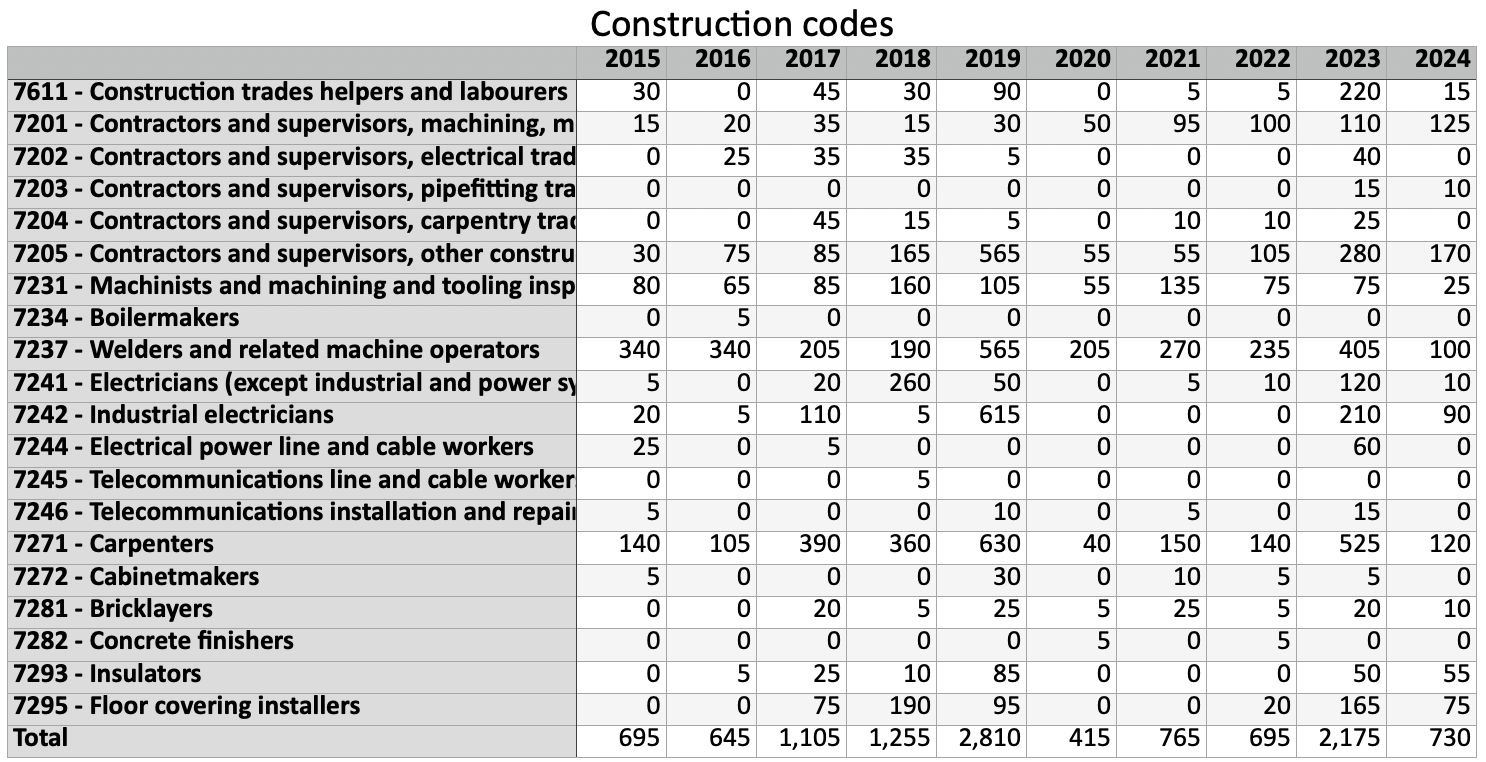
Unfortunately, Olsen didn’t check the data (Temporary Residents: Temporary Foreign Worker Program (TFWP) and International Mobility Program (IMP) Work Permit Holders – Monthly IRCC Updates – Canada – International Mobility Program work permit holders by province/territory, intended occupation (4-digit NOC 2011) and year in which permit(s) became effective). Had some time to look at the construction sector, highlighting that there has been an increase at the supervisory level (B):
Union leader Mark Olsen is frustrated Canadians know almost nothing about Ottawa’s international mobility program. And he’s afraid company bosses want it that way.

The program is the vast federal guest worker program that now brings by far the most newcomers into Canada — with more than one million in the country now.

It’s also the program that Olsen believes makes it most easy for employers to exploit guest workers, which in turn harms Canadian workers.

As the western manager of the Laborers International Union of North America, Olsen said that the international mobility program is drawing more than four times as many guest workers as the more discussed temporary foreign workers program.

Two weeks ago Prime Minister Justin Trudeau promised to modestly trim the temporary foreign workers program by up to 80,000 workers after protests that it was responsible for a high number of low-wage workers at a time of high unemployment among Canadian young people.

An Angus Reid Institute poll released Tuesday shows that 56 per cent of Canadians believe the Liberals are bringing in too many temporary workers, which they think is making it harder to access housing and obtain decent wages.

Olsen believes Trudeau’s gesture with the temporary foreign workers program is window-dressing. If the past is a guide, he said, the federal government and corporations will just use the decline of that program to funnel more foreign workers into the expanding international mobility program.

The government’s strategy, Olsen said, will continue to “institutionalize foreign worker exploitation, discrimination and abuse, distort the labour market, suppress Canadians’ wages and lead to a loss of training opportunities and jobs for Canadian workers, including Indigenous people and women.”

There is a need, Olsen said, for qualified people to come from other countries to work in Canada. That’s especially the case in Canada’s gigantic construction industry, which employs most members of the Laborers International Union of North America. But guest workers, Olsen said, must be invited to the country in a way that’s fair both to them and to Canadian workers.

The major defect in the international mobility program, Olsen said, is that, unlike the temporary foreign workers program, it doesn’t require Canadian employers to provide evidence to the government that they’re unable to find a Canadian to do the job.

“This has made the IMP (international mobility program) ripe for abuse of both the system and the temporary worker, and has fuelled explosive growth under the program,” said Olsen.

A second problem with the international mobility program is that employers are allowed to pay the foreign workers significantly less than they pay Canadians in the same job, whether they’re in the field of high tech, health care, retail or construction. That’s because bosses only have to commit to paying foreign workers a wage that is higher, even only slightly higher, than the median Canadian salary, which Olsen said is in the $23-an-hour range.

That leads to international mobility program workers often doing the same tasks as Canadian workers at far lower wages.

Obviously, Olsen said, the big wage disparity hands bosses an incentive to hire cheap labour through that program, rather than seek Canadian applicants.

“It results in employers paying substandard wages and often no benefits to foreign workers,” Olsen said in a joint memo with Eric Olsen, his brother, who is the political director for the western arm of Laborers International Union, which has about 400,000 members in the U.S. and 150,000 in Canada. “It also allows employers to pay Canadian workers less than the market would ordinarily require, distorting the market.”

The B.C. Building Trades this year put together a report on migration, with case studies showing how B.C. employers paid foreign workers much less than Canadians during construction of the Golden Ears Bridge, the Murray River mine project and the Canada Line.

Since 2015, the Liberal government has dramatically increased the number of temporary residents in Canada, to about 2.8 million. Immigration Minister Marc Miller said this year that nine per cent are in the temporary foreign workers program stream, 44 per cent are employed in Canada through the international mobility program category and another 43 per cent are foreign students, most of whom are allowed to work.

However, Mark Olsen is on to something when he worries ordinary Canadians have no idea about the country’s many guest worker programs — and the often crucial differences between them.

Canada’s migration system is complex and confusing. Even politicians, pundits and pollsters often make comments that suggest they mistakenly think the temporary foreign workers program is the only Canadian stream for “temporary” workers. It doesn’t help that the term, international mobility program, is itself fuzzy.

In the face of the public’s ignorance, which Mark Olsen believes companies capitalize on, the leaders of the Laborers International Union want to reform Canada’s guest-worker programs.

One top recommendation is that bosses using the international mobility program must prove there is a need for each guest worker. Such declarations exist with the temporary foreign workers program, when employers fill out a document called a labour market impact assessment.

And since news reports frequently arise about abuse and deception in regard to the rules of the guest worker system, the union says “there must be proper enforcement and significant penalties.”

In addition, union wants all foreign workers in Canada to “have the same rights as Canadian workers” and “be paid the same as Canadian workers in wages and benefits.”

It also recommends providing foreign workers “a pathway to Canadian citizenship.” As the union’s policy paper says: “If these workers are good enough to be invited here to build our country, they are good enough to stay and build their families and communities.”

In regard to these last two reforms, Mark Olsen acknowledged that there is sometimes resistance from members of his union.

Given changing public sentiment in Canada, that’s not surprising. One key finding in this week’s Angus Reid poll is that only 24 per cent of Canadians believe guest workers should be offered a route to citizenship.

Nevertheless, Mark Olsen said after he talks to members about the union recommendations on guest workers, they invariably end up embracing the union’s viewpoint, which he describes as “respect for all.”
Source: Little-known program dominates Canada’s massive guest-worker scheme

The Potential of Canada’s International Education Strategy: Evidence from the “MIT of the North”

Excellent case study and analysis by Mikal Skuterud and others that challenges Canada to adopt a strategic approach to international students and education focussing on quality, not quantity:

UWaterloo is best known for its academic programs in computer science, mathematics, and engineering, which has earned it the moniker the “MIT of the North.” Evidence that UWaterloo’s international student graduates struggle in Canadian labour markets relative to their Canadian-born counterparts graduating from the same academic programs with similar academic standing provides a direct test of the skill underutilization hypothesis. The evidence also offers critical lessons on whether policy efforts to realize the full economic potential of international students are best directed at augmenting employer hiring behaviour through DEI initiatives, for example, or at improving the attraction and selection of international talent and promoting skill formation, including language training.

Our main findings are:

1. Roughly 70 percent of UWaterloo’s international students transition to Canadian permanent residency (PR), twice the rate of international students at the national level. There is little difference in the transition rates of UWaterloo’s students with the highest and lowest academic achievement and little evidence that policy efforts since 2008 to ease foreign students’ Permanent Residents transitions has impacted UWaterloo graduates, unlike at the national level. This suggests these policies have primarily affected the immigration outcomes of lower quality graduates, including community college graduates.

2. Canadian-born students at the 95th percentile of the skill distribution leave Canada after graduation at twice the rate of Canadian-born students at the 5th percentile. While the best international students are twice as likely to outmigrate as the best Canadian-born graduates, there were five times more Canadian-born graduates of UWaterloo between 2005 and 2021. This implies that Canadian students have contributed more in absolute numbers to “brain drain” in recent years than international students at UWaterloo.

3. The average post-graduation earnings of UWaterloo’s international students not only exceed Canadian-born graduates of UWaterloo, but also Canadian-born university graduates nationally. Moreover, the earnings advantage of UWaterloo’s international student graduates has increased over time as the economic returns to degrees in technology and engineering, where UWaterloo’s foreign students are heavily concentrated, have increased relatively more.

4. Comparing students graduating at the same time from the same academic programs with similar academic standing, we find evidence of disparities in international students’ average earnings after graduation. The earnings gaps are largest for East Asian, especially Chinese-born graduates. They are also concentrated among academically weaker students and appear to be entirely explained by deficiencies in English language proficiency. The results provide no evidence consistent with the common belief that immigrants’ skills are underutilized in the Canadian economy. In fact, we find that measured skills are more important in determining the labour market earnings of foreign-born than Canadian-born graduates.

Overall, our analysis points to the potential of Canada’s International Student Strategy to boost economic growth. However, given the extent to which student outcomes vary by program of study and institution, realizing this potential requires prioritizing quality over quantity in foreign student admissions. Unfortunately, the Strategy has become preoccupied with growth, especially in the college sector.

We recommend redirecting the Strategy in two directions. First, IRCC needs to offer international students a single transparent pathway to economic-class immigration that relies exclusively on an enhanced Comprehensive Ranking System to select candidates with the highest expected future Canadian earnings. The success of the CRS in predicting immigrants’ future earnings can be enhanced significantly by adding applicants’ fields of study, school identities, and post-graduation earnings to the set of criteria used.

Second, Canada can do more to influence the choices that the world’s best and brightest students make themselves about where to study and settle after graduation. Options include using targeted tuition subsidies to attract exceptional prospective foreign students to the country’s top university programs in technology and engineering and income tax schemes to incentivize the highest quality graduates to work in Canada after graduation.

Source: https://clef.uwaterloo.ca/wp-content/uploads/2024/09/CLEF-074-2024.pdf