Québec impose finalement une connaissance du français aux travailleurs temporaires

A noter:

Un an et demi après l’avoir annoncé, le gouvernement de François Legault a finalement déposé jeudi un règlement pour exiger une connaissance minimale du français chez les travailleurs temporaires — ce qui pourrait « avoir un impact indirect sur la compétitivité des entreprises au Québec », convient-il.

Le 1er novembre 2023, la ministre caquiste Christine Fréchette, alors à l’Immigration, avait soutenu en conférence de presse qu’elle demanderait aux immigrants participant au Programme des travailleurs étrangers temporaires (PTET) de démontrer au renouvellement de leur permis de travail une maîtrise du français de niveau 4 à l’oral.

À l’époque, la ministre, qui est aujourd’hui responsable du portefeuille de l’Économie, avait décrit ce niveau de connaissance du français comme la capacité à « discuter avec [son] entourage » de « sujets familiers ». Selon les documents officiels du gouvernement, les immigrants qui maîtrisent le niveau 4 à l’oral comprennent « le sens général de conversations brèves liées à des activités ou à des situations courantes ».

Jeudi matin, environ 19 mois plus tard, le projet de règlement du gouvernement Legault a finalement été publié dans la Gazette officielle du Québec. Il impose comme prévu la connaissance du niveau 4 pour les participants au PTET, le programme de travailleurs temporaires géré par Québec.

Une exception est toutefois accordée aux employés du secteur de l’« agriculture primaire ».

Une mesure appliquée à compter de 2028

Même si le règlement doit entrer en vigueur cet automne, l’exigence ne sera toutefois imposée qu’à partir de 2028. Le projet de règlement prévoit des mesures transitoires qui feront en sorte de reporter de trois ans les premières évaluations de la compétence en français. L’actuel ministre de l’Immigration, Jean-François Roberge, s’est inspiré de la durée maximale d’un permis de travail, qui est de 36 mois, pour offrir ce coussin aux travailleurs.

Dans son projet de règlement, le ministre de la Coalition avenir Québec convient que ces « modifications […] pourraient avoir un impact indirect sur la compétitivité des entreprises au Québec ». « Comme les autres provinces canadiennes n’imposent pas d’exigence linguistique aux travailleurs étrangers temporaires, ceux qui voudront, après un séjour de trois ans, occuper des emplois dans les entreprises québécoises auront une exigence de plus à satisfaire », a-t-il indiqué.

« En revanche, une meilleure connaissance du français favoriserait l’intégration en milieu de travail et de vie des travailleurs, contribuant ainsi à pourvoir durablement les postes vacants tout en soutenant l’activité économique au Québec », a ajouté l’élu.

Le gouvernement québécois exige déjà une certaine connaissance du français de la part des immigrants économiques permanents….

Source: Québec impose finalement une connaissance du français aux travailleurs temporaires

A year and a half after announcing it, François Legault’s government finally filed a regulation on Thursday to require a minimum knowledge of French among temporary workers – which could “have an indirect impact on the competitiveness of companies in Quebec,” he agrees.

On November 1, 2023, the Caquist Minister Christine Fréchette, then at Immigration, argued at a press conference that she would ask immigrants participating in the Temporary Foreign Worker Program (PTET) to demonstrate a mastery of oral level 4 French at the renewal of their work permit.

At the time, the minister, who is now responsible for the Economy portfolio, described this level of knowledge of French as the ability to “discuss with [her] entourage” “familiar subjects”. According to official government documents, immigrants who master level 4 orally understand “the general meaning of brief conversations related to routine activities or situations”.

Thursday morning, about 19 months later, the Legault government’s draft regulation was finally published in the Official Gazette of Quebec. As expected, it requires knowledge of level 4 for participants in the PTET, the temporary worker program managed by Québec.

However, an exception is granted to employees in the “primary agriculture” sector.

A measure applied from 2028

Even if the by-law is due to come into force this fall, the requirement will not be imposed until 2028. The draft regulation provides for transitional measures that will ensure that the first assessments of French proficiency are postponed by three years. The current Minister of Immigration, Jean-François Roberge, was inspired by the maximum duration of a work permit, which is 36 months, to offer this cushion to workers.

In his draft by-law, the Minister of the Coalition avenir Québec agrees that these “changes […] could have an indirect impact on the competitiveness of companies in Quebec”. “As other Canadian provinces do not impose a language requirement on temporary foreign workers, those who want, after a three-year stay, to occupy jobs in Quebec companies will have one more requirement to meet,” he said.

“On the other hand, a better knowledge of French would promote the integration of workers in the workplace and life, thus helping to permanently fill vacancies while supporting economic activity in Quebec,” added the elected official.

The Quebec government already requires some knowledge of French from permanent economic immigrants….
Immigration minister defends sweeping new powers in border bill

Early tests for Minister Diab:

Immigration Minister Lena Metlege Diab is defending controversial new measures in the Strong Borders Act, such as giving her office the power to cancel immigration documents en masse and placing time limits for asylum seekers to make their applications.

“There’s a lot of applications in the system. We need to act fairly, and treat people appropriately who really do need to claim asylum and who really do need to be protected to stay in Canada,” Diab told CBC News.

“We need to be more efficient in doing that. At the same time, Canadians demand that we have a system that works for everyone.”

Introduced in the House of Commons on Tuesday, Bill C-2, the Strong Borders Act, is meant to protect Canadian sovereignty, strengthen the border and keep Canadians safe, according to the federal government.

The bill would make dozens of amendments to existing laws. Its proposed changes to the Immigration and Refugee Protection Act would force asylum seekers entering the country, including students and temporary residents, to make claims within a year.

The new law would also require irregular border crossers, people who enter Canada between official ports of entry, to make an asylum claim within 14 days of arriving in Canada.

And it would speed up voluntary departures by making removal orders effective the same day an asylum claim is withdrawn.

Groups such as the Canadian Association of Refugee Lawyers are raising concerns about these measures. 

“There are a few categories of people who may end up making a claim after they’ve been in Canada for more than one year for fully legitimate reasons,” said Adam Sadinsky, the group’s advocacy co-chair. 

He cited examples such as changes in government in someone’s country of origin, the breakout of conflict or their human rights advocacy in Canada placing a target on them. 

“They may now be in danger returning back home in a way that they weren’t when they first arrived,” he said. 

Federal government data shows some 39,445 asylum claimants processed by Immigration, Refugees and Citizenship Canada and the Canada Border Services Agency between January and April.

Sadinsky said if the government’s motivations are about clearing backlogs, it may be creating another problem. 

Asylum seekers who find their application rejected by the Immigration and Refugee Board of Canada can file appeals to the Refugee Appeal Division. However, shutting them out of the asylum route after a year could make them turn to the Federal Court of Canada for recourse instead, a body that has been public about its own courtrooms facing severe delays with immigration cases.

“It’s a lot more work for the court,” Sadinsky said, “when people start getting removal dates from Canada and they have to ask the court for motions for stays of removal from Canada.” 

Sadinsky suggested the government could have reduced backlogs by issuing blanket approvals for would-be asylum seekers from countries where Canada recognizes there is an imminent danger to sending them back, such as Taliban-controlled Afghanistan.

Public Safety Minister Gary Anandasangaree said Bill C-2, the Strong Borders Act, will ‘keep our borders secure, combat transnational organized crime, stop the flow of illegal fentanyl and crack down on money laundering,’ as well as ‘enhance the integrity and fairness of our immigration system.’ 

Speaking to journalists on Wednesday, Justice Minister Sean Fraser said the government needed to act, though he recognized courts are facing efficiency problems.

“We need to be able to do two things at once,” he said about changing the asylum system and reducing court backlogs.

Reached for comment, the office of the chief justice of the Federal Court said in a statement it would “simply hope that any potential impact on the court’s workload would be taken into account,” citing a previous amendment to immigration law under Stephen Harper’s Conservative government in 2010 that included four new court positions.

Mass cancellation powers

The Migrant Rights Network, an advocacy group, said it is alarmed about the government giving itself the ability to cancel previously issued immigration documents in large groups. 

“What this is, is setting up of a mass deportation machine,” said its spokesperson Syed Hussan. “Just go out and say we’re walking away from the Geneva Convention.” 

Diab said any mass cancellation decisions would be taken by the whole cabinet, not just her office, and they would not be done lightly.

“These are in exceptional circumstances, when you’re talking about mass cancellation or suspension,” she said. 

“For example, when COVID happened, we literally had applications coming in, and the system had no authority to suspend or cancel those applications … we could have health risks again. We could have security risks.” 

Bill C-2 is now moving through Parliament. The legislation would normally be studied by parliamentary committee next, though neither Diab nor Gary Anandasangaree, the public safety minister, could say which committee would pick it up.

Committees have not been named yet for this sitting and it is unclear if they will before Parliament wraps up for the summer at the end of June.

The Canadian Association of Refugee Lawyers said it intends to write a letter outlining its concerns to the federal government, and would hope to present at committee when the moment arrives.

Source: Immigration minister defends sweeping new powers in border bill

Urback: Is the U.S. still a ‘safe’ country for refugees? 

Valid question:

…Canada is now trying to make the process a little bit harder. This week, the Liberals tabled an omnibus bill that, among many other things, would render ineligible for asylum those who have been in Canada for more than a year (which addresses the spike in applications from international students who filed refugee claims after the government changed student visa rules in 2024), and would prohibit those who entered Canada via an irregular border crossing to file for refugee protection after 14 days. These are necessary changes that may help to bring Canada’s current four-year-backlog for refugee hearings down to manageable levels. But some people will still try….

But now, those without legal status in the U.S. are being picked up off the streets, thrown into detention centres and, in many cases, deported to third countries without a hearing. The Trump administration is doing that in defiance of court orders, as in the case of Kilmar Abrego Garcia, and resisting even the U.S. Supreme Court, which said that the government must “facilitate” the return of those deported in error. 

This matters for Canada because of the principle of non-refoulement under international lawwhich holds that refugees should not forcibly be returned to countries where they are likely to face cruel, inhuman, or degrading treatment. 

It used to be hard to argue that migrants sent back under the STCA would face that, but the case seems much easier to make now. Canada should prepare for another challenge to the STCA – and possibly, a different result. 

Source: Is the U.S. still a ‘safe’ country for refugees?

Québec songe à réduire les services donnés aux demandeurs d’asile

Ongoing positioning, not without legitimate concerns:

Québec menace de réduire graduellement les services offerts aux demandeurs d’asile si leur nombre n’est pas radicalement abaissé par Ottawa.

Le ministre de l’Immigration, Jean-François Roberge, qui déposait jeudi ses scénarios potentiels d’accueil des nouveaux arrivants pour la période 2026-2029, a révélé en conférence de presse qu’il n’excluait pas cette possibilité. « Si on est obligés de faire ces choix difficiles, nous les ferons », a-t-il dit, avant de convenir qu’il n’en était « pas là aujourd’hui ». « On ne veut pas se rendre là. »

Il y avait toujours plus de 180 000 demandeurs d’asile en territoire québécois au 1er janvier 2025, selon Statistique Canada. Et le gouvernement Legault commence à s’impatienter devant l’incapacité du fédéral à réduire ce nombre de moitié, comme il le demande depuis belle lurette.

« Je ne peux pas exclure que, éventuellement, si Ottawa ne fait pas le travail, bien, on soit obligés de revoir le panier de services », a-t-il soulevé. « Le statu quo n’est pas tenable, ni pour les services publics ni pour les finances publiques. »


Selon M. Roberge, « la balle est dans la cour d’Ottawa ».

Une « stratégie de négociation » ?

Au Québec, les demandeurs d’asile ont notamment accès à une série de services de santé, d’accès au logement et d’éducation. Le Programme régional d’accueil et d’intégration des demandeurs d’asile, le PRAIDA, leur permet par exemple d’accéder à des professionnels de santé et d’être suivis régulièrement. Certains d’entre eux touchent également une aide financière de dernier recours. L’an dernier, François Legault avait d’ailleurs exclu de leur couper ces prestations.

En 2024, les gouvernements Legault et Trudeau s’étaient entendus pour que 750 millions de dollars soient transférés dans les coffres du Québec afin d’accueillir les demandeurs d’asile en sol québécois.

Aux yeux du directeur général de la Table de concertation des organismes au service des personnes réfugiées et immigrantes, Stephan Reichhold, le ministre Roberge a adopté une nouvelle « stratégie de négociation » en ouvrant cette porte jeudi. « Ça n’a aucun sens », a-t-il souligné à l’autre bout du fil. « S’ils coupaient l’aide sociale aux demandeurs d’asile, ça veut dire qu’on se retrouve avec des campements sous la Métropolitaine. »

Ça me choque, cette sortie-là. Puis même [que le gouvernement] considère cette possibilité-là », a enchaîné la présidente de l’Association québécoise des avocats et avocates en droit de l’immigration, Stéphanie Valois, qui craint une « démonisation » des immigrants temporaires. « Ce ne sont pas les demandeurs d’asile qui sont responsables de la pénurie d’enseignants, il faut arrêter de les blâmer pour tout. »

Faible réduction des temporaires sous contrôle québécois

En matinée, le ministre de l’Immigration, Jean-François Roberge, avait soumis à consultation trois scénarios de seuils d’immigration à la baisse : un à 25 000 nouveaux arrivants permanents par année, un à 35 000 et un à 45 000.

Dans son cahier de consultation, le ministre prévoit par ailleurs une réduction graduelle sur quatre ans du nombre d’immigrants temporaires sous le contrôle de Québec. Si ces cibles sont respectées, le nombre d’étudiants étrangers et de participants au Programme des travailleurs étrangers temporaires passerait de 200 000 en 2024 à environ 175 000 en 2029, une réduction d’environ 13 % qui est bien plus limitée que celle qu’exige le gouvernement Legault du fédéral (50 %).

Jean-François Roberge a tenu à se justifier jeudi : les immigrants temporaires sous contrôle fédéral, comme les demandeurs d’asile, n’ont pas la même valeur pour le Québec que les travailleurs temporaires et les étudiants étrangers qu’il contrôle, a-t-il laissé entendre.

« C’est comme si [quelqu’un] disait : “on doit tous les deux couper quelque chose. Moi, je vais me couper les cheveux, puis vous, coupez-vous un bras. Mais c’est égal : on coupe chacun de notre bord.” C’est un peu ça quand on dit qu’on va comparer des travailleurs étrangers temporaires qui sont ici depuis trois ans, qui gardent une entreprise dans certains cas, puis un demandeur d’asile arrivé il y a quelque temps », a-t-il affirmé.

« Je m’excuse, mais ça n’a rien à voir, et je ne suis pas gêné de dire qu’on a des demandes beaucoup plus exigeantes en termes de réduction pour Ottawa », a indiqué M. Roberge.

Le gouvernement Legault soumettra ses orientations en immigration au test d’une consultation l’automne prochain, afin de décider quel scénario il priorisera d’ici 2029.

Source: Québec songe à réduire les services donnés aux demandeurs d’asile

Quebec threatens to gradually reduce the services offered to asylum seekers if their number is not radically reduced by Ottawa.

The Minister of Immigration, Jean-François Roberge, who on Thursday submitted his potential scenarios for welcoming newcomers for the period 2026-2029, revealed at a press conference that he did not rule out this possibility. “If we are forced to make these difficult choices, we will make them,” he said, before agreeing that he was “not there today”. “We don’t want to go there. ”

There were still more than 180,000 asylum seekers in Quebec territory as of January 1, 2025, according to Statistics Canada. And the Legault government is beginning to get impatient with the federal government’s inability to reduce this number by half, as it has been asking for a long time.

“I cannot rule out that, eventually, if Ottawa does not do the job, well, we will be forced to review the basket of services,” he said. “The status quo is not tenable, neither for public services nor for public finances. ”

According to Mr. Roberge, “the ball is in Ottawa’s courtyard”.

A “negotiation strategy”?

In Quebec, asylum seekers have access to a range of health services, access to housing and education. The Regional Program for the Reception and Integration of Asylum Seekers, PRAIDA, for example, allows them to access health professionals and to be monitored regularly. Some of them also receive financial assistance as a last resort. Last year, François Legault had also ruled out cutting off these services.

In 2024, the Legault and Trudeau governments agreed that $750 million would be transferred to Quebec’s coffers to welcome asylum seekers on Quebec soil.

In the eyes of the Director General of the Concertation Table of Organizations Serving Refugees and Immigrants, Stephan Reichhold, Minister Roberge adopted a new “negotiation strategy” by opening this door on Thursday. “It doesn’t make any sense,” he stressed on the other end of the line. “If they cut off social assistance to asylum seekers, it means that we end up with camps under the Metropolitan. ”

It shocks me, this exit. Then even [that the government] considers this possibility, “said the president of the Quebec Association of Immigration Lawyers, Stéphanie Valois, who fears a “demonization” of temporary immigrants. “It is not the asylum seekers who are responsible for the shortage of teachers, we must stop blaming them for everything. ”

Low reduction of temporary under Quebec control

In the morning, the Minister of Immigration, Jean-François Roberge, had submitted for consultation three scenarios of downward immigration thresholds: one at 25,000 permanent newcomers per year, one at 35,000 and one at 45,000.

In his consultation book, the Minister also provides for a gradual reduction over four years of the number of temporary immigrants under the control of Quebec. If these targets are met, the number of international students and participants in the Temporary Foreign Worker Program would increase from 200,000 in 2024 to about 175,000 in 2029, a reduction of about 13% that is much more limited than that required by the federal government (50%).

Jean-François Roberge wanted to justify himself on Thursday: temporary immigrants under federal control, such as asylum seekers, do not have the same value for Quebec as the temporary workers and foreign students it controls, he suggested.

“It’s like [someone] is saying, “we both have to cut something. I’m going to cut my hair, then you, cut off your arm. But it doesn’t matter: we cut each of our edge.” It’s a bit like that when we say that we’re going to compare temporary foreign workers who have been here for three years, who keep a company in some cases, then an asylum seeker who arrived some time ago,” he said.

“I’m sorry, but it has nothing to do with it, and I’m not embarrassed to say that we have much more demanding requests in terms of reduction for Ottawa,” said Roberge.

The Legault government will submit its immigration guidelines to the test of a consultation next fall, in order to decide which scenario it will prioritize by 2029.

Québec pourrait choisir un seuil d’immigration de 25 000 par année

Sharp contrast with the l’Institut du Québec recommendation of 90,000:

Le gouvernement Legault évaluera la possibilité d’accueillir 25 000, 35 000 ou 45 000 nouveaux arrivants par année à partir de l’an prochain. Des seuils d’immigration réduits qui s’accompagneraient d’une baisse du nombre de travailleurs temporaires à Montréal et à Laval.

Ces informations, d’abord rapportées mercredi après-midi par TVA Nouvelles et par Le Journal de Québec, ont été confirmées au Devoir de source sûre. Le gouvernement doit consulter des experts à ce sujet l’automne prochain, dans le cadre de la planification pluriannuelle de l’immigration, un processus prévu dans la loi.

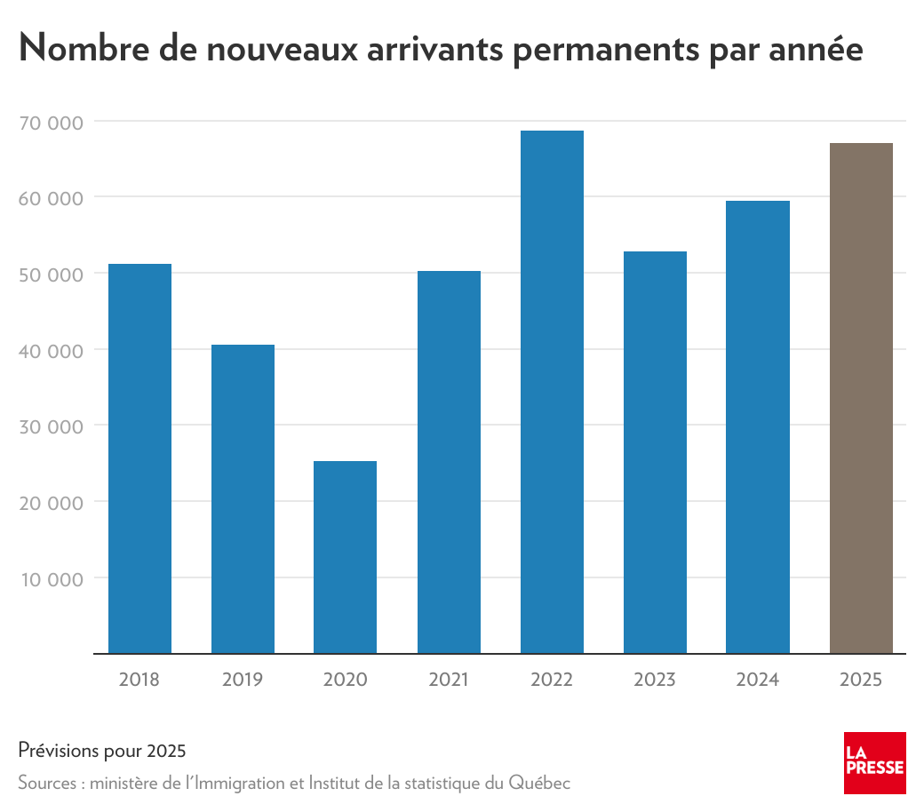
En octobre, le ministre de l’Immigration, Jean-François Roberge, avait déjà laissé présager des scénarios de cibles à la baisse. En 2025, le gouvernement évalue qu’il accueillera autour de 67 000 nouveaux résidents permanents. Québec pourrait donc réduire de plus de moitié ses seuils 2026-2029.

Pendant la campagne électorale de 2022, le premier ministre François Legault, qui cherchait alors à se faire réélire, avait dit qu’il serait « un peu suicidaire » pour le statut du français au Québec d’accueillir annuellement plus de 50 000 immigrants, la cible de son parti à l’époque. Depuis, le Québec a systématiquement dépassé ce nombre. L’an dernier, le ministre Roberge avait justifié ce surnombre en affirmant devoir réduire les listes d’attente en immigration — composées de personnes déjà établies au Québec en attente d’un statut permanent.

Dans un rapport paru mercredi, l’Institut du Québec a pour sa part plaidé pour une augmentation des seuils à 90 000. Cette hausse permettrait, selon le document, à plus d’immigrants temporaires d’obtenir un statut permanent, pour que les seuils soient réduits graduellement ensuite….

Source: Québec pourrait choisir un seuil d’immigration de 25 000 par année

The Legault government will assess the possibility of welcoming 25,000, 35,000 or 45,000 newcomers per year starting next year. Reduced immigration thresholds that would be accompanied by a decrease in the number of temporary workers in Montreal and Laval.

This information, first reported on Wednesday afternoon by TVA Nouvelles and Le Journal de Québec, was confirmed at the Devoir de source sûre. The government is due to consult with experts on this subject next fall, as part of the multi-year immigration planning, a process provided for in the law.

In October, the Minister of Immigration, Jean-François Roberge, had already suggested downward target scenarios. In 2025, the government estimates that it will welcome around 67,000 new permanent residents. Quebec could therefore reduce its 2026-2029 thresholds by more than half.

During the 2022 election campaign, Prime Minister François Legault, who was then seeking re-election, said that it would be “a little suicidal” for the status of the French in Quebec to welcome more than 50,000 immigrants annually, the target of his party at the time. Since then, Quebec has systematically exceeded this number. Last year, Minister Roberge justified this surplus by saying he had to reduce immigration waiting lists — made up of people already established in Quebec waiting for permanent status.

In a report on Wednesday, the Institut du Québec called for an increase in thresholds to 90,000. This increase would allow, according to the document, more temporary immigrants to obtain permanent status, so that the thresholds would then be gradually reduced….

Chris Selley: Liberals wrap much-needed refugee reform in a terrible privacy-invading package

Another commentary arguing C-2 asylum provisions are reasonable:

…This sure looks like an attempt to leverage Trumpian mayhem for the same purposes. It will and should be fought on those grounds.

It’s especially unfortunate because Bill C-2 also proposes to inject some relatively hardhearted sanity into our perennially out-of-control refugee system — changes that by rights would be debated on their own, without invoking Donald Trump’s name every 30 seconds, because these problems are not at all of the president’s making. For example, Bill C-2 proposes a one-year deadline for being in Canada, after which you won’t be able to apply for asylum, which is a clear response to the number of temporary residents trying to hang on in Canada using the refugee system. And it proposes expanding the Safe Third Country Agreement such that anyone crossing illegally from the U.S. would be ineligible to claim asylum, no matter how long they lie low upon arrival.

These are reasonable measures, completely in keeping with countries with far better human-rights records than Canada’s. Someone doesn’t just suddenly remember being persecuted after a year of not mentioning it. The principle of seeking asylum in the first technically safe country you arrive in may be unrealistic: no one willing to risk their lives for a better life in the United States or Canada is likely to settle on Mexico, considering the ordeals most refugees from Central America have already been through. But when a country like Canada accepts hundreds of refugee claims a year from the U.S and Europe, you know things have been taken to an extreme….

…Refugee advocates will argue, reasonably enough, that the solution for a self-styled humanitarian beacon like Canada would be to devote enough resources to the refugee-determination system such that we could adjudicate them quickly and efficiently. But no government ever, ever does that. We have a backlog of 280,825 asylum claims — roughly 0.7 per cent of the Canadian population.

Something has to give. And that something has absolutely nothing to do with Canadians’ IP addresses.

Source: Chris Selley: Liberals wrap much-needed refugee reform in a terrible privacy-invading package

Barutciski: The tightening of Canada’s asylum laws was an inevitability

Indeed, and overdue:

…This is a reasonable response that partially harmonizes the Canadian system with the U.S. system. As controversial as this may seem to some, harmonization is the only way Western countries such as Canada will be able to bring migration under control. 

Democratic governments are continuing to bleed support because they are unable to assuage populations that are justifiably anxious about uncontrolled migration; the Netherlands is just the latest example

Whether the asylum-related provisions in Bill C-2 become the law of the land will ultimately show how serious the new Liberal government is in correcting immigration policy mistakes made by and acknowledged by the previous prime minister and then-immigration minister.

Yet it is one thing to amend laws to restore Canada’s seriousness on the immigration file; it is another to actually enforce them. If Ottawa cannot incentivize the large population of overstayers to leave by themselves, it will need to enforce its own laws, potentially with large-scale removals of foreigners who are unlawfully present in Canada. 

The government could propose a humane yet realistic carrot-and-stick approach involving financial aid to help migrants return home combined with future eligibility for legal residence if they do return.

Even assuming the government can resolve this dilemma, it will then have to propose new amendments to address the unmanageable backlogs that remain for the country’s largest administrative tribunal. 

Indeed, the gravity of the challenge is illustrated by the fact that the IRB had already seen both its operating budget and number of employees more than double between 2015 and 2023. 

Deep reform of Canada’s asylum law will have to come sooner rather than later. Bill C-2 is a solid start.

Source: The tightening of Canada’s asylum laws was an inevitability

Immigration au Québec | Un rapport propose d’accueillir 90 000 résidents permanents par année

Of note:

La cible proposée dans ce rapport, publié ce mercredi, contraste fortement avec les intentions de Québec, qui examine trois scénarios pour l’immigration permanente, tous sous la barre des 50 000 par année, selon des informations obtenues par La Presse1.

Le Québec compte aujourd’hui plus de 615 000 personnes à statut temporaire, un record. Travailleurs étrangers, étudiants internationaux, demandeurs d’asile : leur présence a soutenu la croissance, mais a aussi mis sous pression les services publics, le logement et les capacités d’intégration.

Parmi eux, les travailleurs étrangers temporaires (TET), notamment ceux recrutés par les employeurs à l’international, s’installent majoritairement en région. Selon le rapport de l’IDQ, 81 % des TET vivent à l’extérieur de Montréal, où leur apport a permis à plusieurs localités de freiner le déclin démographique et de maintenir certains services essentiels.

Face à cette situation, l’IDQ propose une solution de transition : réduire progressivement les admissions temporaires, tout en offrant la résidence permanente à un plus grand nombre de personnes déjà sur le territoire.

Le rapport recommande d’admettre temporairement 90 000 immigrants permanents par an. Il s’agirait en grande partie de personnes qualifiées, diplômées, bien intégrées, qui vivent déjà au Québec.

Le but est de réduire le roulement de main-d’œuvre précaire et d’offrir une trajectoire claire à ceux qui ont démontré leur capacité d’intégration.

Deux vitesses

Le recours massif aux statuts temporaires, qui ne mènent pas automatiquement à la résidence permanente, a créé un système à deux vitesses. Les employeurs recrutent rapidement, parfois en dehors des filières économiques prévues, tandis que les personnes admises temporairement restent dans l’incertitude, souvent confinées à des emplois peu qualifiés et à bas salaire.

« Ces dernières années, on a vu un peu les limites de ce modèle. Accueillir beaucoup d’immigrants, s’ils ont de la difficulté à trouver un emploi ou s’ils occupent des emplois moins bien rémunérés ou qui ne répondent pas à leurs aspirations, ça fait grossir la taille de l’économie, mais ça ne crée pas nécessairement de la richesse », affirme Emna Braham, directrice générale de l’IDQ….

Source: Immigration au Québec | Un rapport propose d’accueillir 90 000 résidents permanents par année

Carney government introduces bill to beef up border security

Predictable criticism from refugee and immigration advocates who invariably either cannot ackowledge abuses of the system or come up with possible measures to deal with the same, beyond calling for more resources.

One nugget that should improve processing and service for citizenship is:

“Make it easier for IRCC to share client information between different IRCC programs (e.g. using permanent residence application data to process citizenship applications).”

My sense is that the immigration and asylum provisions will likely be supported by the Conservative opposition but there will likely be tensions within the Liberal caucus:

…The bill was immediately met with concerns about privacy, refugee rights and its omnibus aspect.

NDP MP Jenny Kwan said the bill should be “alarming” to Canadians and risks breaching their civil liberties, particularly for its changes on immigration.

“They are trying to create this illusion that Canada’s border is more secure in some way, but however, a lot of the components within the bill targets Canada’s own immigration policies and processes that has nothing to do with the United States,” she said, questioning why there were no measures specifically targeting illegal guns coming from the U.S., for example.

“There are lots of pieces that I think should be concerning to Canadians.”

Anandasangaree, a former human rights lawyer, defended seeking those new powers Tuesday.

“I worked my entire life in the protection of human rights and civil liberties. That’s a marquee part of the work that I’ve done before politics, in politics,” he told reporters.

“In order for me to bring forward legislation, it needed to have the safeguards in place, it needed to be in line with the values of the Canadian Charter of Rights and Freedoms, and I fundamentally believe that we have striked the balance that, while expanding powers in certain instances, does have the safeguards and the protections in place to protect individual freedoms and rights.”

Those safeguards include not allowing information on immigration to be shared with other countries unless permitted by the minister, as well as judicial oversight that would require a warrant except in “exigent” circumstances. 

The proposed legislation, which will require the support of another party to pass in the minority Parliament, is meant to address the surge of asylum-seekers and the ballooning backlogs in refugee applications. Anyone who first arrived Canada after June 24, 2020 would not be allowed to make a refugee claim after one year, regardless of whether they left the country and returned; irregular migrants who enter Canada from the U.S. between land ports of entry would also be denied the rights to asylum.

“They’re coming up with all of these various ways to basically turn the tap off, to actually make it a more restrictive process,” said Queen’s University immigration and refugee law professor Sharry Aiken.

“That will harm vulnerable people and deny some groups of claimants their right to accessing a fair hearing” by the independent Immigration and Refugee Board, Aiken said.

Canada has seen the number of asylum-seekers triple in less than a decade, from 50,365 in 2017 to 171,845 last year. As of April, the refugee tribunal has 284,715 claims awaiting a decision.

More international students, visitors and foreign workers are seeking asylum to prolong their stays in Canada after Ottawa clamped down on the runaway growth of temporary residents and reduced permanent resident admissions amid concerns of the housing and affordability crisis.

The Canadian Council for Refugees said the proposed asylum changes mirror the American approach, where borders are militarized and securitized as refugees and migrants are viewed as a security threat.

“Under international law, there is no time frame on the right to seek protection. Where we do find this precedent is in the U.S.,” said Gauri Sreenivasan, the council’s co-executive director.

Anandasangaree said those who are affected by proposed ineligibility rules for asylum could ask for an assessment by immigration officials to ensure they would not face harm if sent back to their country.

However, critics said that process is less robust than a full hearing by the refugee board, and this would simply pass the administrative burden to the already strained Immigration Department and the Federal Court.

“It could force many people who have no choice because they are under threat in their country or in the U.S. to live underground without status,” Sreenivasan warned.

Source: Carney government introduces bill to beef up border security

And Althia Raj questions who pressed for these changes (likely under development for some time by IRCC officials given the numbers and abuses):

….Those who work with refugees are also alarmed.

Prime Minister Mark Carney’s first piece of legislation pulls away the welcome mat for asylum seekers. It makes it nearly impossible for those who have been in Canada for more than a year, either as students, permanent residents, or temporary workers, and those who’ve snuck into Canada between land border crossings and have been here for more than two weeks, from having their asylum cases heard.

“A lot of people are going to get rejected because they’re not going to have an opportunity to explain for themselves why they would be in danger when they go back (home),” said Adam Sadinsky, an immigration and refugee lawyer with Silcoff Shacter in Toronto.

On Parliament Hill, the NDP’s Jenny Kwan described the law as “violating people’s due process and taking away people’s basic rights,” and also noted that it will drive people underground.

A problem that could be fixed by beefing up the immigration system — staffing and resources — will instead encourage those who are in Canada, and fear being deported to their home country, to stay here illegally. It will make it much more difficult for federal, provincial and municipal authorities to know who is living here, where they are, and what services they need. And it may simply move staffing and resource pressures away from the Immigration and Refugee Board toward the federal court, who will now hear more requests for stays to remain in Canada and for judicial review of unfavourable decisions.

On CBC, Anandasangaree said his “comprehensive bill” was directly linked with what is happening at the Canada-U.S. border, but it also “responds to … the mandate (Canadians) gave us on April the 28th.”

Does it? Are these the values that Canadians voted to uphold?…

Source: Opinion | Border bill primed to give Mark Carney’s government sweeping new powers. Who asked for this?

High immigration is worsening Canada’s economic problems, says [OECD] report

Not different to what Skuterud, Worswick and others have been pointing out over the past few years and more:

By overseeing one of the most dramatic immigration surges of modern times, Canada has cratered housing affordability, kneecapped productivity and concealed the true state of its economic growth, according to a new profile by the Organisation for Economic Co-operation and Development (OECD).

The OECD is a club of 38 countries that effectively comprise the developed world. Every two years, each member state receives a comprehensive “economic survey” prepared by OECD economists.

Canada’s most recent survey — published just last week — focuses in particular on the issues of housing affordability and worker productivity, two areas in which Canada now ranks among the worst in the developed world.

And in both instances, the OECD fingers record-high immigration as having made the problems worse.

“Rapid population growth has exacerbated previous housing affordability challenges,” reads the report, adding the blunt recommendation that “housing supply should keep pace with immigration targets.”

Similarly, the OECD warns that Canada has been packing millions of new workers into its labour force without any comparable increase in “productivity-enhancing investment.” With the economy thus remaining relatively stagnant, Canada’s workers are receiving an increasingly small share of the overall economic pie.

On top of this, the report notes that while Canada used to prioritize high-skilled immigrants such as doctors and engineers, its migration flows are now mostly comprised of low-skilled workers.

“The skill composition of recent immigration, which included many students and temporary workers, has also likely reduced average labour productivity,” it reads.

The OECD’s own stats have long shown that Canada is an outlier in the realm of housing affordability. The OECD’s most recent tally of the “price to income” ratio of Canadian housing shows that it is the highest of all their member states save for Portugal.

Over the last 10 years, Canada has also been one of the worst performers in OECD rankings of GDP growth per capita.

From 2014 to 2022, Canada’s rate of per-capita GDP growth was worse than any other OECD country save Luxembourg and Mexico.

Across those nine years, the average Canadian saw their share of overall GDP rise by just 0.6 per cent per year.

Canada’s “GDP per capita growth has lagged in recent years, particularly compared to its close neighbour, the United States,” wrote the OECD.

In the U.S., GDP growth per capita from 2014 to 2022 was nearly three times higher than Canada, at 1.7 per cent.

The report isn’t entirely downcast on Canada’s economic future. In a summary, the authors declare that Canada’s economy is “resilient” and endowed with “robust public finances.”

But the document is one of the first outside sources to detail the unprecedented surge of Canadian migration overseen by Ottawa in the immediate wake of the COVID-19 pandemic.

“Canada’s population grew rapidly, by 3.0 per cent in 2023 and 2.6 per cent in 2024. This is much faster than in other OECD countries such as the United States or countries in Europe,” it reads.

About six times faster, in fact. In 2023, the average OECD country grew by just 0.5 per cent.

This worked out to about one million newcomers entering Canada each year. At the beginning of 2022, the Canadian population stood at about 38.5 million. Now, it’s at 41.6 million, an increase of more than three million.

It’s a surge in voluntary population growth like few in history. Although other OECD members have experienced comparable population surges, at least in the short term, they’re usually the result of war or other displacements.

The report also confirms a phenomenon that Canadian analysts have been warning about since 2023: That Canada has been in a “per capita” recession for several years, with overall GDP only seeming to grow because of rapid population growth.

The injection of three million people has seemed to increase GDP, simply because all the newcomers are paying rent, buying groceries and increasing the amount of money circulating in the economy.

But on an individual basis, the average Canadians’ wealth and purchasing power has only been dropping.

The OECD report highlights this disparity with two duelling charts. On a measure of “real GDP,” Canada is able to keep up with the OECD average perfectly. But when ranked by “real GDP per capita,” Canada’s economic performance suddenly falls dramatically behind.

“GDP growth has been supported by high population growth,” according to a subtitle.

Prime Minister Mark Carney has recently highlighted the issue of diminishing Canadian productivity, saying in a speech last week that it was making “life unaffordable for Canadians.” Carney’s proposed remedy is to reduce internal trade barriers and embark on a series of “nation-building” projects.

The OECD noted that Canada has backed off the peak highs of its immigration intake, writing that the Liberal government “has adjusted and recalibrated its immigration targets … and population growth has since begun to slow.”

Nevertheless, even under these new figures, Canadian immigration is set to be far higher than its pre-COVID levels.

Canada’s 2025 immigration targets are still set to bring in more than one million newcomers this year, mostly in the realm of non-permanent residents. Under the federal government’s latest Immigration Levels Plan, this year will see 395,000 new permanent residents, 305,900 new international students and 367,750 new temporary workers.

Source: FIRST READING: High immigration is worsening Canada’s economic problems, says report