Tory leader Andrew Scheer promises more autonomy for Quebec on immigration, Coyne comments

As Coyne notes (Andrew Coyne: Shameless bidding war for Quebec votes is only going to get worse), the bidding war begins:

Quebec will be given more autonomy over immigration if the federal Conservatives win October’s election, party leader Andrew Scheer promised Monday. But he wouldn’t say whether he agrees that Quebec alone should determine how many immigrants it receives.

Premier Francois Legault campaigned on a promise to temporarily reduce annual immigration to Quebec, beginning this year. But almost one month into the new year, Prime Minister Justin Trudeau — an advocate of increased immigration to Canada — hasn’t said whether his Liberal government will help Quebec reach its goal.

Trudeau has said he is willing to continue discussions with Legault over his immigration demands, but he stresses his priority is to ensure Quebec has enough workers to fill widespread labour shortages across the province.

Speaking in Montreal at the end of a months-long consultation aimed at courting Quebec voters, Scheer promised “to ensure that Quebec has more autonomy” over immigration.

“Trudeau has had months to do something about (immigration), and what I’m saying is that come October, when I sit down with Mr. Legault, we will actually have actions and not just words, and not just meetings for the sake of meetings,” Scheer told reporters.

Legault says he’s concerned too many immigrants fail to learn French or leave the province soon after arriving. The premier, elected Oct. 1, wants to reduce immigration to address those issues.

Immigration has become a particularly sensitive topic in Quebec since 2017, when an influx of asylum seekers entering the province illegally from the United States began. Last year alone, 18,518 out of 19,419 — or 95 per cent — of RCMP interceptions of migrants crossing between official ports of entry occurred in Quebec.

Scheer said Canadians’ concerns over immigration “stem from the fact this government has completely lost control of the immigration file. We see a situation in Quebec where over 30,000 people have entered Canada illegally and the government — Justin Trudeau — has literally done nothing to stop that.”

Quebec controls roughly 70 per cent of immigrants who settle in the province every year, all in the economic migrant category. The remaining 30 per cent arrive through the family re-unification system or as refugees, two categories controlled by the federal government. Legault has stated he wants to reduce by 20 per cent the number of immigrants in all three categories.

Scheer on Monday declined to say whether he thinks Quebec should control all three categories of immigrants to the province. “I think if you have the right approach … you don’t need to have one party and one level dictating to the other. You work together in collaboration, understanding that Quebec has specific challenges, specific needs.”

Federal Intergovernmental Affairs Minister Dominic LeBlanc said last week he and other federal ministers will soon be meeting with their Quebec counterparts to discuss Legault’s plan to reduce immigration. But LeBlanc said that discussion will have to be “in the context of a broader discussion around labour shortages and … around asylum seekers and the appropriate compensation that the government of Quebec requires.”

The Conservatives sense an opening in the province due to turmoil inside the Bloc Quebecois. The sovereigntist party that once dominated federal politics in the province has been reduced to 10 MPs and last week elected a new leader, Yves-Francois Blanchet, by acclamation.

Last March, Scheer wrote an open letter to Quebecers in La Presse inviting people upset with the “incompetence” of Trudeau and tired of the “existential crises” of the Bloc to come over to his party. An aide said Monday Scheer is taking French lessons, and the Tory leader’s increased ease with the language was noticeable at the news conference.

Aside from promising more autonomy over immigration, Scheer said a Tory government would agree to Legault’s demand that Quebecers file a single tax return to be overseen by the Quebec government.

The Tory leader also promised to “offer incentives” to retirees who want to re-enter the work force, in order to help alleviate labour shortages. And he said a Conservative government would invest in infrastructure to prevent wastewater discharges into the St. Lawrence River and appoint a federal minister from Quebec to oversee economic development in the province.

Later on Monday Scheer was scheduled to attend an event at the campaign office for his candidate, Jasmine Louras, who is vying to replace former NDP leader Tom Mulcair in a Feb. 25 byelection in the Montreal riding of Outremont.

Yes, you can buy your way into U.S. citizenship

Not sure how this program is being affected by the Trump administration (85 percent of applications are from China and, like other investment immigration programs, has been dogged by questions of fraud and questionable value):

Yes, you can buy your way into U.S. citizenship The Globe and Mail It’s known as the ‘million dollar

It’s known as the “million dollar green card,” a visa program that gives wealthy people the ability to move to the United States by creating economic opportunities and employment there.

The EB-5 investor visa offers permanent U.S. residency and eventually citizenship when a person invests between US$500,000 and US$1-million in a new commercial enterprise that produces at least 10 full-time jobs.

The program is becoming popular among Canadians with financial means, experts say, from retirees who want to live for extended periods south of the border to families that eventually want their children to be able to study and work there.

But it’s important to understand the program’s rules, costs and timing, they warn, as well as to seek qualified advice about issues such as health care, estate and tax planning as well as payments associated with the Canadian exit and U.S. entry.

“You need to ask questions,” says Joe Kirkwood, a dual Canadian-U.S. citizen who is an immigration attorney and partner at Leibl & Kirkwood, a private law firm in San Diego that specializes in U.S. immigration law. Three-quarters of the firm’s clients are Canadian, he says, and about 10 per cent are getting EB-5 visas, an overall number that is “increasing for sure,” especially as retiring baby boomers often don’t have other ways to become U.S. residents. “You’re buying green card status.”

The U.S. Congress created the EB-5 Immigrant Investor Program in 1990 to help stimulate the country’s economy by attracting new business investment from abroad. It is administered by U.S. Citizenship and Immigration Services, a division of the Department of Homeland Security.

Up to 10,000 EB-5 visas are issued each year. Chinese nationals typically account for three-quarters of them, but Canada consistently ranks among the top 20 source countries. In 2017, according to U.S. State Department statistics, 55 EB-5 visas were issued to Canadian investors and family members.

Applicants can “fly solo,” Mr. Kirkwood says, making a direct investment of US$1-million in an eligible small business that creates at least 10 jobs and then actively managing it. Or they can passively invest US$500,000 in one of about 900 EB-5 regional centres, approved organizations designed to manage EB-5 investor funds and the immigration approval process. These centres finance or buy equity in job-creating capital projects in certain areas, typically smaller communities with high jobless rates.

For the first two years, EB-5 visa holders are granted conditional permanent-resident status in the United States. After 24 months of compliance with the program, they can apply to have the conditions removed. Dependent children under 21 and spouses get the same visa status as the primary EB-5 investor and receive their own green cards. All are eligible for U.S. citizenship five years after initial approval.

EB-5 funds have been used to build office towers, shopping malls, ski resorts, hospitals and film studios.

One of the bigger downsides for participants in the program is that their cash is locked up for perhaps five years, says Terry Ritchie, director of cross-border wealth services for Cardinal Point Capital Management Inc., a firm with offices in Canada and the United States that specializes in wealth management for people in both countries.

Mr. Ritchie says it’s critical for would-be EB-5 investors to look at their tax and estate planning structures, their other investments and the tax implications of leaving Canada.

He cautions that the program comes with a “a nuisance factor because you’re dealing with government.” For example there’s a lot of poking and prodding through your personal information and tax returns. “You’re laying bare your financials,” he says.

The visa applicant must also show evidence that the investment is being made with capital acquired lawfully, for example earnings from employment, private businesses, real estate, stocks and bonds, an inheritance or a gift.

It typically takes 18 to 20 months for applications to be processed, and the filing fee is US$3,675. Plans to update the program and increase the minimum investments required have been reported but not implemented. There have also been warnings that the program might be cancelled altogether.

Mr. Kirkwood suggests that Canadians exhaust other options for U.S. residency, such as family sponsorship or sponsorship by an employer, as it can take a significant amount of time and money to go the EB-5 route. Administrative fees for the EB-5 program can range from $30,000 to $50,000, with legal costs of around $25,000, he says, plus the cost of other professional and financial planning advice.

Entrepreneurs looking to live full-time in the United States, he notes, have other options, such as the E-2 investor visa, which requires a smaller investment in a business – say an outlay of US$150,000 to start a yogurt shop in Florida, for instance – but does not come with a green card and must be renewed periodically.

The principal residence of EB-5 visa holders must be in the United States, Mr. Kirkwood notes. Direct investors are expected to live in the same area as their project, in order to develop and manage the business, while passive investors can live anywhere in the country.

Another motivation for EB-5 investors is attendance at elite universities. For example, it may be easier for the children of EB-5 visa holders to ultimately get into an Ivy League school as a green card holder or dual citizen rather than an international student, and they might qualify for in-state tuition at universities. But Mr. Kirkwood warns that dependent children must be younger than 21 upon the initial program approval to qualify for green cards.

Source: Yes, you can buy your way into U.S. citizenship

USA: New Immigrants Are More Culturally Different than They Used to Be

Some interesting analysis using World Values Survey data. Largely reflects country of origin:

Native-born American concerns about immigration are primarily about how immigration will affect the culture of the country as a whole and, to a lesser extent, how the newcomers will affect the economy.  One’s personal economic situation is not a major factor.  It’s reasonable to assume that the degree of cultural difference between native-born Americans and new immigrants affects the degree of cultural concern.  Thus, Americans would likely be less concerned over immigrants from Canada or Singapore than they would be over immigrants from Egypt or Azerbaijan.

A large team of psychologists recently created an index of the cultural distance of people from numerous countries around the world relative to the United States.  The index is constructed from responses to the World Values Survey as well as linguistic and geographical distances.  Their index includes numerous different psychological facts such as individualism, power distance, masculinity, uncertainty avoidance, long term orientation, indulgence, harmony, mastery, embeddedness, hierarchy, egalitarian, autonomy, tolerance for deviant behavior, norm enforcement, openness, conscientiousness, extraversion, agreeableness, neuroticism, creativity, altruism, and obedience.  These are all explained in more detail in the paper.

Their paper has an index where lower numbers indicate a culture more similar to that of the United States while a higher number indicates a culture more distant from that of the United States.  As some extreme examples, Canada’s cultural distance score is 0.025 and Egypt’s is 0.24.

Using the cultural distance index, I calculated the cultural distance of the stock of immigrants in the United States in 2015 from native-born Americans.  I then compared the cultural distance of the stock to the cultural distance of the flow of immigrants who arrived in 2012-2015.  The immigration figures come from the Annual Social and Economic Supplement of the U.S. Census Bureau.  If the stock of immigrants in 2015 was more culturally similar to native-born Americans than the flow, then the recent flow is more culturally distinct.  If the stock of immigrants in 2015 was more culturally different from native-born Americans than the flow, then the recent flow is less culturally distinct.

Table 1 shows the results.  The immigrant flow in 2012-2015 is more culturally different from native-born Americans than the stock of immigrants was in 2015.  In other words, today’s newest immigrants are more different than those from the relatively recent past.  Relative to the stock, the cultural distinctiveness of the flow in 2012-2015 was greater by about one-fourth of a standard deviation.  In other words, the stock of American immigrants in 2015 was very culturally similar to people from Trinidad and Tobago (0.099) while the flow of new immigrants who arrived from 2012-2015 more similar to Romanians (0.11).

Table 1

Cultural Distance of Immigrants Relative to Native-Born Americans

Cultural Distance
Immigrant Stock 0.10
Immigrant Flow 0.11

Sources: WEIRD Index, ASEC, and author’s calculations.

There are a few problems with my above calculations.  First, those who choose to move here are likely more similar to Americans than those who do not.  There is obviously some difference in cultural values inside of a country as the average person does not choose to emigrate to the United States.  Second, American immigration laws likely select immigrants with similar cultural values through various means such as favoring the family members of Americans and those hired by American firms.  It’s reasonable to assume that foreigners who marry Americans and who are hired by American firms are more culturally similar than the average person from those countries.  Third, the cultural distance index only covers about two-thirds of the immigrant population in the United States.  It is possible that countries not on the list could shift the score significantly in either direction.

New immigrants to the United States are more culturally different than those of the past, but not by much.  This increase in the cultural difference of new immigrants could have had an outsized impact on Trump voters in 2016, but immigration overall is more popular with Americans than it used to be.

Source: New Immigrants Are More Culturally Different than They Used to Be

Trudeau offers to work with Legault on a temporary reduction in immigration levels

My sympathy for additional funding for asylum seekers is tempered by the fact that the current Canada-Quebec agreement means a further increase despite the drop:

Prime Minister Justin Trudeau demonstrated a new willingness to help Quebec Premier François Legault temporarily reduce immigration to the province by more than 20 per cent, even as Ottawa promotes higher immigration as the key to a stronger economy.

Mr. Trudeau and Mr. Legault discussed immigration issues Thursday during a private meeting in Sherbrooke, Que., where the federal Liberal cabinet is meeting for a three-day retreat.

Ottawa’s readiness to work with Quebec on its lower targets marks a change in tone for Mr. Trudeau, who had criticized the idea last month.

The two governments agreed that senior ministers will meet later this month in Gatineau to work out a plan. The discussions will also aim to reach a deal on compensating Quebec for its costs related to settling refugee claimants who have crossed into the province from the United States between official points of entry.

More than 90 per cent of the thousands of people who have crossed into Canada between official points of entry over the past two years have done so at Roxham Road in southwestern Quebec near Champlain, N.Y.

The Quebec government is seeking $300-million in compensation from Ottawa, but Mr. Legault said Ottawa is only offering to cover $140-million.

Federal Intergovernmental Affairs Minister Dominic LeBlanc, who was in Thursday’s meeting with Mr. Legault, told reporters that reducing immigration at a time when many Quebec businesses are facing severe labour shortages will be a challenge.

“Squaring that circle isn’t going to be easy,” he said. “We recognize that the Quebec government made a commitment in their election to temporarily reduce immigration levels in Quebec. Immigration in Quebec is a shared jurisdiction. It’s not like in my province of New Brunswick. There is a long-standing agreement that we want to respect between Canada and Quebec.”

Under the terms of a 1991 Canada-Quebec deal on immigration, federal funding to help Quebec integrate immigrants will rise even as the province’s total intake of immigrants declines.

The federal government announced in November that it will gradually raise Canada’s national targets for annual immigration to 350,000 in 2021, from 310,000 this year. It is not clear how Quebec’s reductions will affect Ottawa’s national targets.

Mr. Trudeau did not speak with reporters after meeting with Mr. Legault, but the Premier confirmed that further discussions on immigration will take place soon in Gatineau.

“He didn’t say no,” Mr. Legault said following his meeting with the Prime Minister, in reference to his list of demands related to immigration. “He said he was thinking about it. What we want is before bringing the targets back up in the next few years, that we put in place a French test and a values test.”

Federal Liberals are in Quebec this week to build support ahead of the October federal election. Polls suggest the Liberal Party could pick up seats in the province, which could help offset potential losses in other parts of the country.

Several ministers, including Mr. LeBlanc and Infrastructure Minister François-Philippe Champagne, recently toured parts of Quebec to meet with business leaders ahead of the cabinet retreat. They said the clear message is that skills shortages are a major problem.

“Businesses in Drummondville earlier this week told me they’re literally refusing contracts and not accepting sales because they do not have enough employees to properly complete the contract,” said Mr. LeBlanc. “So you can imagine the multiplier effect of that over time, on the economic growth in Quebec, which frankly is something that’s very important for the whole country.”

Mr. Legault said the temporary reduction in immigration – which would apply equally to three categories: economic immigrants, family reunification and refugees – will give Quebec time to ensure that it is bringing in people with the right skills. He also said Quebec wants to ensure its immigrants can speak French and support Quebec values.

Quebec announced in December that it will reduce the number of newcomers to 40,000 in 2019, a 24-per-cent reduction from 2018 levels.

Advocates for immigrants and refugees have called Quebec’s plan cruel. Mr. LeBlanc said last month that Ottawa was “disappointed” by Quebec’s new targets.

Source: Trudeau offers to work with Legault on a temporary reduction in immigration levels

How Taiwanese Think About Immigration

Some interesting research on yet another Asian country facing labour shortages and the need to address immigration needs and concerns:

Concerns about immigration remain a focal point in both American and European politics. The competing demands in Taiwan are familiar to those watching immigration debates elsewhere: the need for workers, especially unskilled workers, for jobs locals cannot or are unwilling to fill versus concerns about the political and social costs of migration. Meanwhile, immigrant workers in Taiwan frequently protest labor conditions.

According to the Ministry of the Interior’s National Immigration Agency, of the over 770,000 foreign residents in Taiwan, more than 90 percent are from Southeast Asia, and predominantly from Indonesia, Vietnam, and the Philippines. In 2017, Taiwanese married more Southeast Asian partners than partners from China. Despite government policies over time to increase ties with Southeast Asian countries as a means to be less economically ties to China, and discussion on immigration policy to encourage Southeast Asian skilled labor immigration to counter Taiwan’s brain-drain, such efforts have not been without controversy. For example, in December 2018 several Taiwanese universities were accused of skirting labor laws by recruiting Southeast Asian students for factory work under the questionable guise of internship programs, although many Indonesian students deny these claims. Another scandal concerned the disappearance of 152 of 153 Vietnamese touriststhat arrived in Kaohsiung, with only 67 located by early January, raising concerns of human trafficking.

Concerns about immigration largely focus on the often interrelated perceived criminal, economic, and cultural threats. For example, considerable research focuses on the ethnicity of immigrants vis-à-vis the citizen population and its impact on perceptions of market competition and negative views more broadly of immigrants (see here, here and here). In terms of individual-level factors, higher education consistently corresponds with more favorable views of immigration, while other scholars have found living abroad and contact with other cultures also positively impacting immigration views. Meanwhile, limited scholarly work addresses both either communities in Taiwan (see examples here and here).

I wanted to unpack whether evaluations of immigration differed in Taiwan based on two factors: immigration in general versus Southeast Asian immigration specifically and whether the focus is on skilled immigration. Considering that academics, political advisers, and marketers have long identified the role of framing and priming in influencing public perceptions, we would expect that relatively small differences in how immigration is presented would influence support, just as previous research on Taiwanese perceptions of free trade agreements, refugees, same sex marriage, diplomatic recognition, and President Donald Trump has shown.

If Taiwanese implicitly or explicitly distinguish between types of immigration, this should be evident when comparing perceptions of similarly worded survey questions. In particular, one would expect that if Taiwanese view Southeast Asian immigration as a criminal, economic, or cultural threat, a focus on Southeast Asian immigration should elicit stronger opposition than when asked about immigration in general. Similarly, if the concern is about unskilled labor and thus competition for jobs, a focus on skilled labor immigration would be expected to generate more positive views on immigration.

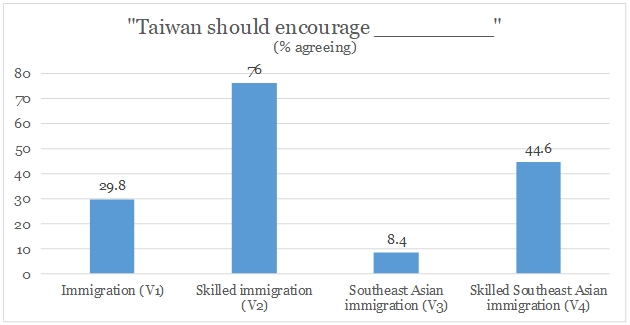
To address this, I conducted a web survey in November of 1,000 Taiwanese, surveyed via PollcracyLab at National Chengchi University. Respondents were randomly assigned to respond to one of four versions of a question regarding immigration and asked to evaluate it on a five-point Likert scale (strongly disagree to strongly agree):

Version 1: Taiwan should encourage immigration
Version 2: Taiwan should encourage immigration of skilled workers
Version 3: Taiwan should encourage immigration from Southeast Asian countries
Version 4: Taiwan should encourage immigration of skilled workers from Southeast Asian countries

The figure below shows the percentage of Taiwanese surveyed agreeing to each version of the survey. For simplicity, I combined those that agreed and strongly agreed. Here we clearly see that Taiwanese are more supportive of encouraging immigration when framed as skilled immigration, a 46.2 percent increase from the baseline of Version 1. However, support decreases by 21.4 percent from the baseline when simply focusing on Southeast Asian countries. Furthermore, while the version focusing on skilled Southeast Asian immigrants increased support compared to the baseline  by 14.8 percent, this is still far lower (31.4 percent) than support for skilled immigrants in general.

The figure below further makes it clear that Taiwanese are more favorable to skilled labor immigration and less favorable to Southeast Asian immigration. Support increased by 45 percent when skilled labor was mentioned compared to no mention at all, while support for immigration decreased by 26.6 percent when the focus was on Southeast Asian immigration rather than immigration in general.

Additional analyses controlled for a myriad of factors — age, gender, education levels, household income, political ideology, and party identification — with consistent results as those shown above. Overall the results sugest the extent to which Southeast Asian immigration generates a visceral reaction, one that is only partially overcome when the focus is redirected to skilled labor. However, it is unclear how to rectify these biases. With several hundred thousand children of Southeast Asian immigrants already in the Taiwanese elementary school system, ignoring this issue will only create larger identity concerns for Taiwan in the future.

Source: How Taiwanese Think About Immigration

Denmark Is Ramping Up Anti-Immigrant Measures and Rhetoric

Good overview:

On a cold December night, Inger Stojberg stood in an overlit auditorium in Vordingborg, eastern Denmark, and explained why the Danish government had chosen nearby Lindholm Island for its new detention center for rejected asylum seekers. Although she made it clear from the outset that the government would not revoke the proposal (and sure enough, it was approved three days later) one citizen after the next tried to convince her it was a poor decision, drawing on everything from its impact on property values and tourism to what it would mean for locals’ safety. But many in the audience of more than 700 thought something even more important was at stake. “I came tonight because I don’t think this is a decent way to manage these people,” said Marianne Rasmussen, a teacher from the nearby town of Præsto. “It’s not who we Danes are.”

Immigration became a thorny political issue throughout Western Europe in the wake of a record influx of migrants from the Middle East and Africa in 2015, but the split over Lindholm Island suggests the question has taken on unusual dimensions in Denmark. The prosperous Nordic country of 5.8 million stands out among its neighbors for its reluctance to integrate even comparatively small numbers of foreigners. It granted protection to 2,365 people in 2017, compared with Sweden’s nearly 28,000.

Despite a reputation for progressive politics, humanitarianism and a generous welfare state, Denmark has some of the most aggressive anti-immigrant policies in Europe. That has included taking out foreign-newspaper adverts warning potential migrants that they are not welcome, and authorizing police to seize cash and valuables from arriving asylum seekers to offset the cost of their maintenance. By pitting some of Denmark’s long-held values against others, the subject of immigration has not merely divided Denmark, but turned a demographic crisis into an existential one. What, these days, does it mean to be Danish?

Denmark received waves of guest workers from Turkey in the 1960s and ’70s, as well as refugees from the former Yugoslavia in the 1990s, and today immigrants and their descendants make up 8.5% of the population—projected to rise to 13.1% by 2060. Yet to an extent virtually unmatched in Europe, “Danes are quite polarized over immigration,” says Nils Holtug, director of the Centre for Advanced Migration Studies at the University of Copenhagen. “There’s a large part of the population that is welcoming and positive toward immigrants, and another large group that’s worried about them and wants very restrictive policies.”

Many of the country’s recent immigration initiatives seem to operate from the same principle. In the past year, the center-right government has passed a so-called burqa ban, even though fewer than 0.1% of Muslim women in Denmark wear veils, and a law requiring parents in neighborhoods designated as “ghettos” to submit their children to extra schooling in “Danish values.” From January, new citizens are required to shake hands with the official conducting the naturalization ceremony, regardless of their beliefs about physical contact with members of the opposite sex—a law perceived as targeting conservative Muslims.

Danish journalist and historian Adam Holm describes the initiatives as “deliberately hostile.” In other areas, Danish legislators tend to speak in the measured language of jurisprudence. “But the intent here, and people will say it outright, is ‘yes, we are doing this to frighten people away from Denmark.’”

Stojberg, a member of the same Liberal Party as the Prime Minister (and which forms part of the conservative bloc in parliament), has adopted an almost gleeful attitude toward migration restrictions. She celebrated the passage of the 50th anti-immigration law with a cake, posting a photo on social media, and published an editorial in a national newspaper in which she suggested that Muslims bus drivers and hospital workers who fasted during Ramadan might pose a safety risk to Danish society.

Urging Støjberg to go even further is the anti-immigrant Danish People’s Party (DF), which is the second largest party in parliament but does not hold any ministerial positions out of its own choice. The DF proposed the Lindholm Island idea. “We want to reduce the number of all foreigners in Denmark, not just refugees and asylum seekers, but people who come to work or go to school,” says Martin Henriksen, DF’s spokesperson for immigration. “We also want to revoke more of the asylum permits already granted, and send more people home.”

Some see Lindholm Island and other measures as an attempt to appeal to voters ahead of elections in June. “The right-wing government now in power is behind in polls, and so they will want to do something to increase their support,” says Holtug. “And the Social Democrats are tired of losing because of immigration, so their response, increasingly, is to also adopt restrictive policies.”

That’s not the only way right and left are coming closer together. Unlike in the U.S., where anti-immigrant platforms tend to align with conservative opposition to a government-sponsored safety net, the populist DF, like the center-left Social Democrats, seeks to protect generous welfare benefits that include free education through university, universal health care and ample unemployment insurance. “There’s a growing part of the political spectrum that sees a welfare state and a multi-cultural society as directly incompatible, or at least difficult to have side by side,” Holtug says.

The DF’s Henriksen, who believes Trump’s policies on immigration are “too weak,” echoes Holtug’s point. “America is a country founded on migration, but Denmark is not. We’re a small country, and what binds us is a common language, and a common set of traditions and values. If we let in a large number of foreigners with their own cultures, ours will be overwhelmed.”

A degree of plain old xenophobia contributes to this sentiment. But so too does a growing sense, even among more progressive sectors, that the country’s efforts at integration have not worked. “We’ve been very lax in requiring foreigners to learn Danish,” says journalist Holm by way of example. “Ten years ago I would have never uttered those words. But now I say, yes, this is Denmark, so if you want to be part of this society, please learn Danish.”

Yet he is troubled by the harsh measures and rhetoric adopted by his government as well as the sometimes blatant xenophobia that has made its way into public discourse. Recently he published an opinion piece, titled “The Denmark I’ve Always Feared,” in which he lamented the country’s turn away from tolerance and openness. “Enough is enough,” he says of his reasons for writing it. “This is not the Denmark I was brought up to believe in.”

In reality, Denmark already is a multiethnic society, and will become only more so in the future. Younger generations of Danes seem more comfortable with this than their elders. At a Dec. 10 rally in front of Copenhagen’s city hall to protest the Lindholm plan, Selma Solkaer, a 15-year-old student from nearby Roskilde, expressed her dismay that Danes could support it. “It’s shocking, especially when Denmark has always been such a big supporter of human rights,” Solkaer said.

At the rally, Natasha al-Hariri, a legal consultant on immigration, recalled her parents—Palestinians who came to Denmark from Lebanon in 1989—-telling her how welcoming Danes were. “Back then, we took in refugees because we accepted that they needed help,” she said, noting that parts of Danish society now fear eventually being outnumbered by refugees. She finds the upcoming elections especially nerve-racking. “Lindholm Island may just be an electoral tactic so the government can show it’s tough on immigrants,” she says. “But that’s what scares me to death—the idea that that’s what Danish voters want.”

In Vordingborg, Mayor Mikael Smed doubts that’s the case. Less than 5% of the population of Vordingborg, with its broad shopping street and neat houses, is foreign-born—a mix of Turks, Iraqis, and Syrians, among others. But most residents of the town, he says, consider the Lindholm Island plan “madness,” especially because another facility for the same ‘tolerated stay’ population already exists. “ I keep asking but no one in the government can explain to me why we need it.”

Although like other members of the Social Democrat party Smed’s position has evolved so that he now supports limiting the number of asylum-seekers and refugees admitted to Denmark, he also sees plenty of examples of successful integration, from his son’s best friend, whose parents came from Iraq, to a local program that trains foreign-born women to teach new arrivals the ins and outs of Danish society. He also believes that the Danish economy—including the vaunted welfare state—needs an influx of workers if it is to continue to prosper in the future.

But in the end, he justifies his opposition to the Lindholm Island plan with his own appeal to national values. “I recognize the number is important when we have to work on integrating people, and making them as much a part of our society as possible,” Smed says. “But I don’t think that placing people on an island and making the conditions as bad as possible for them is a part of Danish nature.”
Source: Denmark Is Ramping Up Anti-Immigrant Measures and Rhetoric

As Japan Tries Out Immigration, Migrant Workers Complain Of Exploitation

Some interesting, if disturbing, comparative data on trainees and some of the exploitation that some are facing as Japan slowly opens up to “guest workers”:

The wind howls and snow drifts around a house in Koriyama, in northeastern Japan’s Fukushima prefecture. The town is inland from Fukushima’s coastal areas that were devastated by the 2011 earthquake, tsunami and nuclear plant meltdown.

Inside the home, several Vietnamese laborers prepare dinner. The house is a shelter, run by local Catholics, for foreign workers who are experiencing problems in Japan.

One of the workers is surnamed Nguyen. He came to Japan in 2015 as part of a government program for technical trainees. He asked to use only his last name, as he doesn’t want his family in Vietnam to know what he’s been through.

He says he paid the equivalent of about $9,200 to a Vietnamese broker and signed a contract with a private construction company in Koriyama, Japan, to get on-the-job training as a rebar worker.

“I expected to come to a country more developed, clean and civilized than my own,” he recalls. “In my mind, Japan had many good things, and I wanted to learn professional skills to take home.”

Instead, he says he was ordered to do jobs such as removing radiation-contaminated soil from land around the Fukushima nuclear power plant.

“We were deceived,” Nguyen says, referring both to himself, and technical trainees in general.

He would not identify the company by name so as to avoid undermining negotiations he and a workers union are holding with the firm to get compensation.

He says the company issued him gloves and a mask, but not the kind of gear that would protect him against radiation. He did receive a radiation detector to wear, but only before safety inspectors paid a visit. He complained to the company, which ignored him.

Complicating matters, he had borrowed money from a bank and family members in Vietnam to pay the broker who helped him get to Japan.

“I wanted to sue my company, but I didn’t know how,” Nguyen explains. “I didn’t speak Japanese, or understand Japan’s legal system. So all I could do was be patient, and keep working to pay off the debt.”

Technical trainees like Nguyen now account for about 20 percent of the 1.3 million foreign laborers in Japan, according to government data cited by local media.

The Japanese government intends to bring in 345,000 more foreign workers in the next five years, to staff sectors including restaurants, construction, agriculture and nursing. Many will come from nations such as China, Myanmar, Vietnam and the Philippines.

Japan has both the world’s third-largest economy, and fastest-aging population. It also faces an acute labor shortage. Now, it is doing something previously unthinkable: allowing immigration — even as its prime minister denies it.

But advocates for the foreign workers warn that without an overhaul of the technical training program, many of the newcomers could be subjected to the same sort of exploitation Nguyen says he has experienced. Critics equate the training program with “slavery,” and deride it as the creation of labor without a labor force.

Most trainees are paid below minimum wage. They die of work-related causes at twice Japan’s overall rate, according to an analysis of government data by The Japan Times.

The problem of labor brokers using debt to enslave would-be immigrants is an element in human trafficking in many countries around the world.

The Japanese government has promised to crack down on unscrupulous brokers, establish 100 “consultation centers” where trainees can report abuses, increase Japanese language training for enrollees and generally strengthen oversight of the program.

But the U.S. State Department’s Trafficking in Persons report for 2018 says that, so far, Japan has failed to prevent brokers from holding technical trainees in “debt bondage,” and sometimes the authorities arrest trainees who escape from “exploitative conditions,” instead of helping and protecting them.

Many conservative opponents of immigration would prefer that foreign workers don’t stay in Japan after finishing the program.

Speaking before the Diet, Japan’s parliament, in October, Prime Minister Shinzo Abe denied that the country is opening its door to immigration.

“We are not considering adopting a so-called immigration policy,” he insisted. “To cope with the labor shortage, we will expand the current system to accept foreign workers in special fields. We will accept foreign human resources that are skilled and work-ready, but only for a limited time.”

Japan’s parliament, which is controlled by the ruling right-wing Liberal Democratic Party, passed Abe’s plan last month.

Shiro Sasaki, secretary-general of the Zentoitsu Workers Union, which represents some of the foreign workers, rejects Abe’s argument, and adds that Japan’s government is not facing up to the reality of immigration.

“Abe’s definition of an immigrant is someone who lives in Japan long-term, with family,” he says. “But by international standards, the trainees are immigrants. In this sense we can say that Japan is already an immigrant society.”

Sasaki says that opening Japan’s door to immigrants even a tiny crack is better than tricking them into coming.

He says Japan has never experienced mass immigration in modern times, and it has failed to assimilate those few immigrants it has taken in. He sees the whole issue as a test of character for this island nation.

“Japan has never been able to examine itself and define itself in terms of diversity,” he argues. “Now we must live with diversity, and every single Japanese person must think about it.”

Then again, Robert Dujarric, director of the Institute of Contemporary Asian Studies at Temple University in Tokyo, argues that Abe may have no choice but to reform by stealth.

“Immigration is unfortunately not popular even in countries like the U.S. … which historically have been nations that have been built on immigration. So obviously he’s not going to say: ‘Vote for me, I will bring in 10 million foreigners.'”

Many analysts compare the technical training program to Germany’s gastarbeiter or guest worker program of the 1950s-70s. It too took in laborers from poorer neighboring countries — particularly Turkey — but tried to limit workers’ stay in order to prevent immigration. But the cost of hiring and training temporary workers was too high.

Many workers stayed on, paving the way for Germany to see itself as a de facto immigration nation.

Current trainees like Nguyen may be eligible to remain in the country for up to five years on a new class of visas.

But Nguyen says that without decent pay and a chance to learn new skills, he has no interest in staying on.

Source: As Japan Tries Out Immigration, Migrant Workers Complain Of Exploitation

Why We Bear Witness: Speaking Uncomfortable Truths About Immigration

Good series of individual stories behind the numbers:

Of all the questions I get asked every day, the one that crystallizes just how simplistic and uninformed the conversation about immigration is this: “Why can’t you just get legal?”

You ask what you don’t know. When it comes to immigration, most Americans I’ve met across the country—online and offline, from people calling for my deportation to people who want me to stay—don’t know a whole lot. Even journalists who cover the issue struggle to report and frame it outside a largely partisan, pro/anti-immigrant lens, too often using loaded language (“amnesty,” “anchor babies,” “chain migration”) that limits knowledge rather than expands it.

The search for genuine dialogue—the need for complexity and nuance—is manifested to great effect in We Are Witnesses: Becoming an American. With this video series, The Marshall Project has carefully curated a selection of stories that demonstrate the multiple dimensions of what we refer to singularly as “immigration.” The straight-to-camera testimonies don’t fit the typical legal vs. illegal binary that characterizes much of the discourse. The stories they tell are not laden with “talking points” that signal deference to any ideology. They tell truths that challenge and illuminate our understanding of how we got to where we are.

Teofilo Chavez, an undocumented minor from Honduras.

A 14-year-old in Honduras swam across rivers in search of a better life. He learned that when Border Patrol catches a minor, they don’t return them to where they came from—they help them look for their relatives in the United States. “So, I started looking for the Border Patrol,” Teofilo Chavez says. “I basically gave myself to them.”

Born in South Korea, Youngmin Lo arrived in the United States on a student visa. He lost his legal status when he started working to support himself. “You’re not supposed to work on a student visa. Once you lose your status, it’s done,” said Lo, who has been undocumented for 12 years. Asian immigrants—arriving at airports, not at the southern border—constitute a growing undocumented population. An estimated one out of seven Asian immigrants is here illegally.

Alena Sandimirova couldn’t be herself in Russia, where lesbianism is akin to pedophilia. She dreamed of living in the United States and managed to obtain a visa to move here. When the visa expired, she decided to stay illegally before realizing she could apply for asylum. “The heaviest weight fell from my shoulders,” she said, recalling the moment she became an American citizen. “I can breathe, fully.”

Fleeing political persecution, the Villacis-Guerrero family—Juan, Liany, and their twin daughters—left Colombia, where Liany’s family was targeted for being active in politics. Her father was kidnapped and she feared for her daughters’ security. The twins qualified for the Deferred Action and Childhood Arrivals (DACA) program, which provides a two-year temporary reprieve from deportation. But after a routine annual check-in with immigration officers, Juan was detained and then deported. Liany was deported, too. “They built all of this for us,” says one of the twins. “Now, they have to go.”

No matter how many times I am asked, “Why don’t you just get in line?” I can only respond one way: For most of us, there is no line.

I’ve spent my life grappling with the dominant narratives that have defined immigration since arriving in the United States in 1993. Born in the Philippines, I was sent by my mother to live with her parents, both legal immigrants who became naturalized citizens, in Mountain View, California, when I was 12. I discovered that I was “illegal”—that’s what the media called us and still calls us—when I tried to get a driver’s license at age 16. My grandfather explained that he couldn’t find a way to bring me here legally, so he saved up $4,500, a huge sum for a security guard who lived paycheck to paycheck, to pay a smuggler who got me fake papers. Since that realization 21 years ago, I have been living in some kind of purgatory, subjected to rules I didn’t create, my circumstances limited by documents I do not have and laws that many Americans, who had the luck of being born into American citizenship, struggle to articulate. Telling my story—insisting on its specificity to illuminate what is universal—has been a source of liberation.

In that vein, I saw my own story reflected in the stories captured in this video series. The trauma of family separation. The need to create a home for yourself even if you don’t feel at home. The resilience that is a central part of becoming American, whatever “American” may mean to you.

The videos play as a kind of a fugue, playing off each other, composing a melody amidst the dissonance. After watching Lee Wang, a journalist-turned-immigration lawyer, explain how long-time permanent legal residents are dragged into the deportation system, we meet Jose Molina, who has lived in the United States since he was a year old. He’s a legal permanent resident who in the late 1990s was locked up for three years after being convicted of assault. Years later, as his wife, daughter, and son looked on, he was detained and faced deportation. “When ICE came to my door, I just couldn’t believe it,” Molina says. “I’m a permanent resident. I’m not undocumented. They handcuffed me at my home.”

As I watched David Ward, a former Border Patrol agent, talk about how immigration is “continually being exploited by people that just can’t follow the law,” I hoped he would watch the video of Paul Schmidt, a former immigration judge who interpreted the laws, deciding the fate of many immigrants and refugees. “There’s no doubt about the fact that I’ve made mistakes,” says Schmidt, who served from 2003 to 2016. “I probably have sent some people home that I should have allowed to stay, and I probably have allowed some people to stay that maybe weren’t telling me the whole truth, but I couldn’t figure it out.”

Together, this video series accomplishes a task we have largely avoided: having an uncomfortable but truthful conversation about immigration. James Baldwin, who often described himself as a “witness,” said that “nothing can be changed until it is faced.”

Let us face it, together.

Jose Antonio Vargas, the founder of Define American, is the author of “Dear America: Notes of an Undocumented Citizen.” For the release of We Are Witnesses: Becoming An American, The Marshall Project asked Vargas to reflect on how the film series explores the immigrant experience in America, including his own.

Source: Why We Bear Witness: Speaking Uncomfortable Truths About Immigration

Chris Selley: What — and who — comes after Rahaf Mohammed?

Appears the government overplayed its hand in its communication strategy, both with respect to the Ministerial welcome (all too tempting) and the ongoing (and understandable) gap between the welcoming rhetoric and actual numbers.

However, Ms. Alqunun’s social media sophistication and poise in her CBC interview is impressive:

If Canada were a proud and principled beacon unto the world’s most downtrodden, as so many so often claim, then one might have expected Rahaf Mohammed Alqunun to arrive at Pearson Airport in Toronto on Saturday with relatively little fanfare.

Canada resettles tens of thousands of refugees every year, after all, and many are fleeing circumstances just as horrific as the Saudi teenager’s abuse by her family. Canadian government officials are guarding Alqunun’s current whereabouts partly on grounds she might still be in danger even halfway around the world — an idea given credence by Dennis Horak, who was Canada’s ambassador in Riyadh until he was expelled over the summer.

Indeed, Saudi-Canadian relations are not in terrific shape just at the moment, thanks to our public rebukes of its treatment of activists, and granting immediate asylum to the world’s highest-profile Saudi refugee seems unlikely to help matters. One might very reasonably not give a damn about the House of Saud’s amour propre, but Ottawa would clearly prefer to repair those relations. Quite apart from anything else, it would give Canada more-than-zero leverage in lobbying on behalf of those activists — including imprisoned blogger Raif Badawi, whose wife is a Canadian citizen.

There were no good reasons to make a big show of Alqunun’s arrival, in other words, and plenty of good reasons not to. Furthermore, Justin Trudeau has been very clear about what he thinks of using refugees as political props. He was at his most thespian back in 2015 when it was alleged Stephen Harper’s office had been sifting through applications from Syrian asylum-seekers in search of potential photo ops.

“That’s DIS-GUST-ING,” Trudeau hissed at a campaign stop in Richmond, B.C. “That’s not the Canada we want; that’s not the Canada we need to build.”

In the end, though, there was Foreign Affairs Minister Chrystia Freeland with her arm draped around Alqunun, announcing that this “brave new Canadian” would not be taking questions. Luckily, Freeland herself had arrived equipped with some crimson talking points.

“I believe in lighting a single candle,” she said. “Where we can save a single person, where we can save a single woman, that is a good thing to do. … And I’d like to also emphasize, this is part of a broader Canadian policy of supporting women and girls in Canada and around the world.”

“Canada is a country that understands how important it is to stand up for human rights, to stand up for women’s rights around the world,” Trudeau chimed in.

It would be well-nigh impossible to argue against hearing, at the very least, Alqunun’s claim for asylum. But at this point, she is certainly also a political prop — a living symbol of the Liberal view of Canada’s place in the world, and an always-welcome opportunity for self-congratulation.

“We are demonstrating our moral leadership on the issue of gender equality,” University of Waterloo professor Bessma Momani wrote in The Globe and Mail. “It was another proud moment for Canada,” gushed Catherine Porter, The New York Times’ Toronto correspondent. It “further cement(ed) the country’s status as a bastion of refuge in a world where Western nations have become increasingly hostile to refugees,” the Times’ Twitter account effused.

“Any woman from Saudi Arabia should be able to make a credible case for asylum in this country based on the human rights abuses they endure there,” the Toronto Star’s editorial board averred. And on and on and on.

Saudi Arabia is a country of 33 million people. So no, not every woman there can claim asylum in Canada. I suspect the Liberals might balk at five high-profile claims in rapid succession. That’s what they do. The Liberals made a big show of resettling 25,000 Syrian refugees while various European nations accepted many multiples of that; now they brag about how accepting Canadians are of refugees relative to Europe, as if one didn’t largely explain the other. They denounce any worries about asylum-seekers crossing the border illegally as rank intolerance, while waving the new arrivals into an interminable and disastrously under-resourced queue.

There are millions upon millions of displaced people around the world in whom you might expect a giant, wealthy and mostly empty country that prides itself on resettling refugees to take an interest. They aren’t even on the radar. NDP MP Charlie Angus has a more realistic take on what Canada is: “Thousands languish in camps and Chrystia Freeland promotes sale of death machines to Saudis as children die in Yemen,” he tweeted in response to Freeland’s airport press conference. “Foreign policy must be more than smug theatre,” he added.

Well, there’s the rub: Must it?

Canadians of all political stripes take inordinate pride in objectively modest contributions to all manner of global problems. There is nothing inherently disreputable in feeling pride when your country does the right thing — but only if you insist that your country does the right thing continually, coherently and consistently once the warm, fuzzy feeling fades away. Once she’s settled, if she is inclined to remain in the public eye, Rahaf Mohammed Alqunun might be the ideal person to hammer that point home.

Source: Chris Selley: What — and who — comes after Rahaf Mohammed?

Australians do not want any more migrants: ANU poll

The annual Scanlon Mapping Social Cohesion Surveys provides a more nuanced of immigration related public opinion, but still showing 43 percent believing the number of immigrants is too high:

Support among Australians for a growing population is crumbling amid fears of overcrowded cities and homes priced out of the reach of ordinary people, a new survey by the Australian National University has revealed.

As both the Morrison government and Shorten opposition consider their own approaches to population policy in the run-up to this year’s election, the ANU poll found just three out of 10 Australians believe the nation needs more people.

A similar poll conducted in 2010 found support for a growing population at 45 per cent.

The 15 percentage point fall was driven by a huge drop in support among male voters who in 2010 showed majority support for a bigger Australia. Male support has now fallen to 38.4 per cent.

In 2010, 38.5 per cent of female voters backed a growing population but this has now fallen to 28.2 per cent.

Over the past year, the nation’s population has grown by 390,500 of which 61 per cent was from net overseas migration.

But with growing public concern about Australia’s immigration intake, the government is considering a reduction in the current cap of 190,000. The planned intake for the 2019-20 financial year, to be set in the April budget, is expected to be closer to 160,000.

Already, Prime Minister Scott Morrison has signalled a reduction in the number of migrants brought into the country, saying he had heard “loud and clear” that city roads were clogged, “the buses and trains are full”.

It appears much of the drop in support for more Australians has been driven by issues in our major cities which have largely absorbed the 2.5 million increase in the nation’s population since 2010.

Almost nine out of 10 surveyed agreed that the high cost of housing was a reason to limit Australia’s population growth. Eighty-five per cent also believed the nation’s cities were over-crowded and there was too much traffic.

Another concern among those surveyed was around labour shortages.

About 90 per cent of those quizzed agreed that Australia should “train our own skilled people, not take them from other countries”.

Lead researcher Nicholas Biddle said with two-thirds of Australians believing the country has enough residents, the lived experience of many people was influencing their view towards immigration.

“Australians are more likely to support population growth if it increases our skills base, mitigates the impacts of an ageing population and increase our economic prosperity,” Associate Professor Biddle said.

“But they do not want population growth to cause crowding, affordability or job security issues nor at the expense of our natural environment.”

The poll was conducted late last year, just as house prices were falling in most major capital cities with Sydney property down by more than 11 per cent.

The poll is at odds with an Ipsos poll taken in October last year for the Sydney Morning Herald and The Age which showed 52 per cent of respondents backing the idea of keeping or increasing the number of immigrants. Forty-five per cent supported a reduction in the nation’s migrant intake.

Responding to the ANU poll, Coalition voters were the least likely to support a higher population while Greens voters were the most open to the idea, but even amongst them support was less than 50 per cent.

People aged between 25 and 34 showed the highest support for more Australians, at more than 41 per cent. The lowest support was among people aged between 45 and 54, at less than 25 per cent.

The survey also found large differences based on ethnic background.

Just a quarter of Australian-born people supported a larger population, almost half the rate of those born in a non-English speaking country. Just under 40 per cent of those from an English-speaking nation backed a larger population.

The government is considering a way to encourage immigrants to live in rural and regional areas, with some country towns crying out for skilled workers. The poll showed this was more popular among urban Australians than those living in areas that would be home to new residents.

Support among Coalition and Greens voters for the policy was about 75 per cent but among Labor voters it was 10 percentage points lower.

Professor Biddle said while the survey showed growing opposition to migration, those quizzed were not driven by cultural issues.

He said there was substantially more support for migration on the grounds of broadening Australia’s cultural diversity, almost double the rate for those who believed the nation was already too culturally diverse.

According to Professor Biddle,  Australians had a series of serious concerns about a growing population.

“Australians need to be convinced that traffic and house prices won’t increase unduly, that there will be limited effects on the environment, and that Australia’s existing workforce will still receive adequate training,” he said.

Source: Australians do not want any more migrants: ANU poll