Articles of interest over the holidays – China

The order from Chinese officials was blunt and urgent. Villagers from Muslim minorities should be pushed into jobs, willing or not. Quotas would be set and families penalized if they refused to go along.

“Make people who are hard to employ renounce their selfish ideas,” the labor bureau of Qapqal, a county in the western region of Xinjiang, said in the directive last year.

Such orders are part of an aggressive campaign to remold Xinjiang’s Muslim minorities — mostly Uighurs and Kazakhs — into an army of workers for factories and other big employers. Under pressure from the authorities, poor farmers, small traders and idle villagers of working age attend training and indoctrination courses for weeks or months, and are then assigned to stitch clothes, make shoes, sweep streets or fill other jobs.

These labor programs represent an expanding front in a major effort by China’s leader, Xi Jinping, to entrench control over this region, where these minorities make up about half the population. They are crucial to the government’s strategy of social re-engineering alongside the indoctrination camps, which have held one million or more Uighurs and Kazakhs.

Source: Inside China’s Push to Turn Muslim Minorities Into an Army of WorkersInside China’s Push to Turn Muslim Minorities Into an Army of WorkersThe Communist Party wants to remold Xinjiang’s minorities into loyal blue-collar workers to supply Chinese factories with cheap labor.

The first grader was a good student and beloved by her classmates, but she was inconsolable, and it was no mystery to her teacher why.

“The most heartbreaking thing is that the girl is often slumped over on the table alone and crying,” he wrote on his blog. “When I asked around, I learned that it was because she missed her mother.”

The mother, he noted, had been sent to a detention camp for Muslim ethnic minorities. The girl’s father had passed away, he added. But instead of letting other relatives raise her, the authorities put her in a state-run boarding school — one of hundreds of such facilities that have opened in China’s far western Xinjiang region.

As many as a million ethnic Uighurs, Kazakhs and others have been sent to internment camps and prisons in Xinjiang over the past three years, an indiscriminate clampdown aimed at weakening the population’s devotion to Islam. Even as these mass detentions have provoked global outrage, though, the Chinese government is pressing ahead with a parallel effort targeting the region’s children.

Source: In China’s Crackdown on Muslims, Children Have Not Been Spared


Articles of interest over the holidays – Immigration

2020 Developments

Millions of new Canadians will arrive through Canada’s various immigration programs during the new decade and several expected policy updates will help to pave the way in 2020.

Here’s a look at some of the notable developments that we can expect over the next 12 months both in Canada and beyond that could help shape the future of Canadian immigration policy.

  • Early 2020: Parents and Grandparents Program changes expected

  • 2020-2022 Immigration Levels Plan Announcement by March

  • Ottawa’s commitment to regionalization is undeniable

  • Will citizenship fees be waived in 2020?

  • Watch out for Great Britain and the United States

Source: https://www.cicnews.com/2019/12/canadian-immigration-in-2020-expect-a-big-year-for-provincial-and-regional-immigration-programs-1213412.html

Family Reunification

The Liberal government is postponing the next round of its widely criticized family reunification program while it looks into developing a new intake process, according to a statement from Immigration, Refugees and Citizenship Canada.

The program allows Canadian citizens and permanent residents to apply to bring grandparents and parents to Canada. Critics have called the selection process unfair since all of the online application spots were snapped up in just minutes earlier this year.

In its Monday statement, Immigration Canada said it’s delaying the 2020 round as it works on a new intake system.

“This means that the opportunity to express interest in sponsoring a parent or grandparent will not take place on Jan. 1, 2020,” reads the statement.”Further information about the expected launch date and 2020 intake process will be available in the new year. This will give all interested sponsors the same opportunity to submit an interest-to-sponsor form and a fair chance to be invited to apply.”

Source: Parent and grandparent reunification program reopening postponed as Liberals look at new system, Federal government suspends popular immigration sponsorship program

Rural and Northern Immigration

Todd on what we learned about immigration in 2019

Migration continues to shape the political futures of Britain, the U.S., parts of Europe and beyond.

But in English-speaking Canada, except for concern about irregular migrants from the U.S. crossing the border, discussion of the complex issues surrounding migration remains muted.

Regardless, migration continues to shape the country — especially in light of Justin Trudeau raising migration levels to among the highest per capita in the world. In 2019 Canada brought in a record 350,000 immigrants, plus a larger-than-ever number of international students and guest workers.

Here are five things we learned about migration this year in Canada:

  1. Foreign capital impacted housing

  2. International-student exploitation occurred

  3. Quebec put migration at the top of its agenda

  4. China loomed larger

  5. Labour force had winners and losers

Source: Douglas Todd: 5 things we learned about migration in 2019

Asylum Seekers

A new refugee law heralded as a way to reduce the number of irregular migrants arriving in Canada from the U.S. has had little impact, according to Canadian government data obtained by the Star.

Immigration statistics show some 400 asylum claims have been deemed ineligible since June 21, 2019, when the rule was introduced to prevent refugees from seeking protection in Canada if they have made similar claims in other countries.

Ottawa had hoped the strategy would deter would-be refugee claimants from crossing into Canada from the U.S.

The number of ineligible cases is a drop in the bucket of the 12,000 claims made by irregular border-crossers from January to September 2019. Ottawa previously did not track asylum seekers who had made claims in other countries and so the new policy did not set a target. However, 400 is much lower than what was anticipated by even migrant rights groups who were critical of the policy change.

“We were surprised to see the low number. It is not clear how the (policy) helps by denying refugees access to the Immigration and Refugee Board,” said Janet Dench of the Canadian Council for Refugees. “From our perspective, this is for the government to send the message that you are not welcomed here and we don’t want you here.”

Source: New asylum laws to restrict flow of migrants from U.S. yield few results

Iranian Asylum Seekers

The number of Iranians seeking asylum in Canada has almost tripled in recent years, even before open military conflict exploded this week between the U.S. and the increasingly damaged Middle Eastern country.

About one in 20 Iranians who obtain visas to fly into Canada as tourists, guest workers or international students have been applying for refugee status, according to a redacted immigration department document obtained under an access-to-information request.

More than 125 Iranians applied each month for asylum in Canada in early 2019, according to the internal report. And for the past 18 months Iranians have made up by far the largest cohort wanting protection on the West Coast of Canada, reports the B.C. Refugee Hub Bulletin.

Iranian asylum seekers in B.C. far surpass the next largest source countries for would-be refugees, which are Mexico, Afghanistan, Colombia and Nigeria. An average of 65 Iranians a month last year sought political refuge while in B.C., which has a strong Iranian-Canadian population on the North Shore and in Coquitlam.

Source: Douglas Todd: More than 125 Iranians were applying each month for asylum in Canada in 2019

Immigrant women in tech (British Columbia)

Women who are new immigrants in B.C. have an especially difficult time finding jobs in the tech sector, according to a Vancouver-based diversity and inclusion expert.

Vancouver is the third-largest tech hub in Canada. But only 18 per cent of tech workers there are women, according to a report by Commercial Real Estate Services Canada.

Jobs in STEM (science, technology, engineering and mathematics) industries are predicted to grow over the next decade. But only 50 per cent of immigrants found jobs in their field of study in B.C. last year, according to a 2019 Vancity report.

The organization Immigrant and International Women in Science runs workshops to help immigrant women better integrate themselves into the Canadian tech industry.

Source: Why immigrant women are struggling to get work in Vancouver’s tech hub

Japan

Sasaki added that tightening immigration control is needed to cope with misuse of the refugee system.

Japan saw a sharp rise in asylum-seekers after a 2010 revision granted work permits to applicants who had been waiting longer than six months for screenings. But the revision caused a steep increase in applicants ineligible for work permits.

After the Justice Ministry introduced a stricter process in January 2018, the number of asylum-seekers dropped to 10,493 from 19,629 the year before. Only 42 people were granted refugee status in 2018, with another 40 granted humanitarian protection.

The ministry also took measures to speed up the screening process.

“The refugee system has been established to swiftly grant asylum to people who need protection but … in recent years, the number of people misusing the system has risen and the problem is still prevalent,” Sasaki said.

“In the screening process, officers are overloaded with applications submitted by foreigners coming with the intent to stay in Japan for financial reasons, which hinders proceedings for asylum-seekers who meet the requirements of the Refugee Convention.”

In recent years, Japan has been cracking down on illegal immigrants. Many get prolonged detention, and some have resorted to hunger strikes.

Source: Japan’s immigration chief optimistic asylum and visa woes will improve in 2020

Malaysia

A Holistic Plan on Enforcement Against Illegal Immigrants will be launched next year to combat in a comprehensive manner the influx of illegal immigrants in the country.The plan is aimed at ensuring that Malaysia achieves zero illegal immigrant in the set period through the strengthening of governance and existing enforcement work system.Home Minister Tan Sri Muhyiddin Yassin said the holistic plan entailed strategic cooperation between various ministries and related agencies based on firmer law enforcement and more effective action.He said the flood of illegal immigrants should be tackled through firmer enforcement and legal action so that such a scenario would not remain a national issue which has a negative impact on the country’s social and legal aspects.

Source: Home minister: Malaysia to adopt holistic plan to stem influx of illegal immigrants | Malaysia

Korea

The ruling Democratic Party of Korea (DPK) is preparing to introduce more policies to improve immigrants’ rights in the lead-up to the general election next April hoping to attract voters of multicultural backgrounds.

The DPK’s committee on multiculturalism has suggested recently the party unveil various election promises related to the rights of immigrants including the establishment of a presidential body on multiculturalism so that the body can serve as a control tower to tackle relevant social issues, according to sources. The pledges also include expanding support for undocumented immigrant children, easing the work permission system for foreigners, giving teachers and public servants mandatory education on multiculturalism, improving welfare systems for multicultural families and establishing an overall marriage policy for immigrants. Above all, the committee is planning to introduce laws to give diaspora groups living in Korea support in welfare and jobs which includes a plan to establish a help center for those people.

“As there is no control tower on multiculturalism in the government, similar policies exist between governmental organizations, meaning some taxes are being used redundantly,” said Hong Mi-young, chairwoman of the DPK’s committee on multiculturalism.

Source: DPK to create more multicultural policies for general election


Up to a quarter of Russian immigrants to Israel may have left after receiving passports

“Citizens of convenience:”

Thousands of immigrants to Israel from the former Soviet Union may have come only to receive an Israeli passport before moving back abroad.

The Hebrew weekly Makor Rishon reported that a cottage industry of companies promising expedited Israeli citizenship, and the passport that comes with it, have sprung up in Russia since the passage of a law allowing new immigrants to receive the travel document within the first three months of their aliyah.

For many in the post-Soviet world, an Israeli passport is considered as desirable as a European Union passport is to Israelis. Russian fixers have started advertising that they can help prospective “olim” obtain “Israeli citizenship within two days” for a cost of thousands of euros.

Under certain circumstances, the paper reported, the three-month period can be shortened to as little as a day, and some immigrants have even been able to receive their passports without having to leave Ben Gurion International Airport.

Based on data from Israel’s Ministry of Immigrant Absorption, Makor Rishon estimated that approximately 8,500 emigres from the former FSU have come just for the passport before immediately leaving the country. One Jewish Agency official estimated that about 25 percent of the immigrants came for a passport and “left the country immediately after receiving it.”

Approximately 10,500 Russians and 6,400 Ukrainians made aliyah in 2018, which was the first year that the majority of new immigrants were not considered Jewish under halacha, or Jewish religious law.

Source: Up to a quarter of Russian immigrants to Israel may have left after receiving passports

The Liberal government’s foreign policy cop out

The has been a continuing refrain over the last 20 to 30 years that Canada needs a  “muscular” foreign service and an infusion of funding to strengthen the foreign service. Yet no government, Liberal or Conservative, has done so given domestic priorities (including trade).

So while it is valid to make these arguments, it would be far better to be more focussed on specific areas where the current foreign service should focus on than pining for something that no government is likely to consider.

And of course, a major factor behind the success and public support for our immigration system is precisely due to it focussed on economic class immigrants, where self-interest comes most into play:

Every October, Canada invades Istanbul in a way that might seem downright crass to Canadian sensibilities. The city’s historic Beyoglu district, one of its richest and most liberal, home to hundreds of bars, restaurants, galleries, clubs and, at one time, the Canadian consulate, transforms into a red and white extravaganza, its cobblestoned alleyways adorned with posters announcing the yearly Canada Edu Days fair.

Now, if the fair feted Canada’s contributions to the world—multiculturalism, cooperation, tolerance—there would be no need for this column. Canada would be, finally, touting all those things that are increasingly, in a world infected by authoritarianism and self-interest, disappearing.

Instead, the fair does what Canada seems to do best in the world: poaching talent. As the name implies, Canada Edu Days is about studying in Canada. Every year, it pairs up Canadian colleges with thousands of young dreamers eyeing a way out of Turkey’s deteriorating economy and its socio-political morass.

That’s great; Canada needs talent, and Turkey’s remarkably talented youth are in desperate need of opportunities. But in and of itself, it’s also a feature of Canada’s failure to act responsibly at a historically critical moment: Rather than bringing what makes Canada great to the world when the world needs leadership, it is capitalizing on the chaos, siphoning off valuable human resources like a war profiteer.

This is the dark side of Canada’s pollyannaish self-image. We are great in large part because we have an immigration system that prioritizes talent over desperation. We can retreat at times of global uncertainty because we have valuable resources and a relatively small population.

But retreat should not be an option in a world where men like Donald Trump, Xi Jinping and Jair Bolsonaro are ascendant. Nor should waiting and hoping that these agents of self-interest will magically disappear and the world will go back to normal. Experts warn that is simply not going to happen. Canada should not be trying to save the world order as it was but helping to shape the world order as it will bewhen the dust finally does settle.

The Liberal government, like past governments, appears unwilling to take on that task.  If the Throne Speech was any indication, Canada’s role in the world will figure even less prominently than it has in the recent past. All the pretty words reinforced what has become the defining feature of the Liberal government on the world stage: It talks in the modernist voice about grand narratives—global peace and harmony, equality and justice—but fails to appreciate the postmodern reality of fragmentation and discord.

What we need is boldness. Canada’s foreign service is in shambles; it needs urgent reform and an infusion of funding. The Liberals may not have created the problem, but they have failed to address it and that failure has had consequences. As Jennifer Welsh, the Canada 150 research chair in Global Governance and Security and director of the Centre for International Peace and Security Studies at McGill University, told me in July, the Liberal government’s foreign policy has been “ineffective” in many cases because it lacks the “deep relationships” needed in a world where traditional alliances are unravelling.

“An operating principle of our foreign policy should be that we have to form relationships around particular issues with countries where we believe we have enough common ground to advance things together,” she said. “In the current environment, that is going to require not necessarily the usual suspects.”

Without a muscular foreign service, there is no developing those relationships. Foreign policy becomes what Daniel Livermore, senior fellow at the University of Ottawa’s Graduate School of Public and International Affairs, calls “government by PMO directive”.

“That was very much the case under Harper,” he says. ” The PMO decides something and then says to Global Affairs here’s what we’re going to do. There has been a lot more pushback from Global Affairs under Trudeau but it hasn’t been nearly strong enough.”

The problem, Livermore adds, is fundamental to the department. It lacks the “bench strength” to “offer an entirely different vision of how to do foreign policy.”

For a country like Canada, a middle power with limited heft in the world, knowledge is essential. Middle powers have to carefully pick and choose their moments and identify issues where they feel they can have a measurable impact. But instead of taking up the challenge, the Liberals have retreated into a defensive posture.

Canada should prioritize more engagement with the world at every level, from leadership to the grassroots. Here in Istanbul, it seemed a few years ago that something was about change after the Canadian consulate was shifted to a shiny new office tower in the Levent business district. It was an improvement from the dingy apartment Canada used occupy in Beyoglu, where one woman and her cat would greet visitors with listless stares. It felt as if the new consulate would be more active, more dynamic, more forward leaning.

But the early signs were there of a different kind of shift. Heavy security greeted visitors to the office tower. The C-suite feel also portended the growing Canadian dependence on trade-based diplomacy. Canada would engage with CEOs and business leaders from its perch high above Istanbul’s frenetic streets but at the expense of understanding the mood of the people.

Wouldn’t it be great if instead of a student recruitment fair, Istanbul was painted red red and white with posters announcing the opening of a Canadian cultural centre? Or a multiculturalism festival? Or an art exhibition? Wouldn’t it be great if Canada’s engagement with the world included talking to young people on the streets, the same young people who are now protesting in Hong Kong, Chile and Iraq?

That kind of engagement would mean beefing up our foreign service with people who can speak local languages, who are comfortable leaving the confines of our cozy diplomatic missions and getting their hands dirty. It would mean being bold.

Source: The Liberal government’s foreign policy cop out

Changes in outcomes of immigrants and non-permanent residents, 2017 Text – Selected

The latest. Some encouraging trends:

Immigrants admitted to Canada in 2016 reported a median entry wage of $25,900 in 2017, the highest recorded among immigrants admitted since 1981. Although the entry wages of recent immigrants have increased over the past few years, their income remains lower than that of the overall Canadian population. The Canadian Income Survey estimated the Canadian population’s median wage at $36,100 in 2017.

When immigrants arrive in Canada, they face a number of challenges, such as getting their credentials recognized, being able to speak one of the official languages and acquiring Canadian work experience. However, the longer immigrants live in Canada, the more their income increases and, for some, their income reaches the level of the overall Canadian population.

This analysis uses new data from the Longitudinal Immigration Database (IMDB), which comprises information on permanent and non-permanent (temporary) residents, including asylum claimants. It presents the type of information that can be extracted from the IMDB and its outputs to better understand how the socioeconomic situation of these individuals has evolved.

Recent immigrants have higher entry wages and more work experience prior to admission than before

Over the past 10 years, the median entry wage of immigrants, one year after admission, in 2017 constant dollars, has increased from $20,400 for the 2007 admission year to $25,900 for the 2016 admission year (+27%).

Not all immigrants face the same challenges after admission. Those who had work experience in Canada upon admission reported the highest median entry wages. For the 2016 admission year, income one year after arrival was $39,800 for study and work permit holders, and $38,100 for work permit holders only. These wages are comparable with those of the entire Canadian population. For immigrants who had no experience prior to admission, or who had a study permit only, incomes were $19,900 and $12,500, respectively.

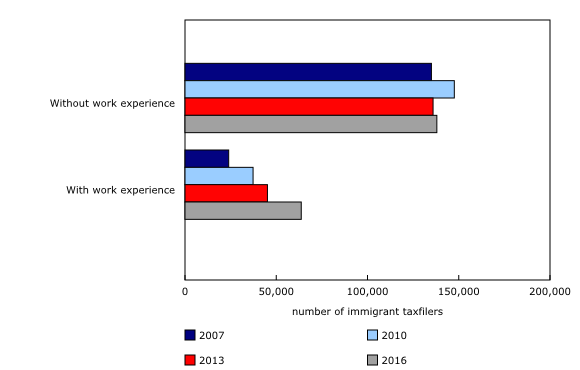
In recent years, an increasing number of non-permanent resident permit holders are transitioning to permanent residence. The observed growth in entry wages can be partly accounted for by differences in income between immigrants with pre-admission work experience in Canada and immigrants without such work experience. From the 2007 admission year to the 2016 admission year, the number of immigrant taxfilers one year after arrival who had work experience in Canada increased by 166%, while the number of immigrants without work experience rose 2%.

Chart 1  Chart 1: Number of immigrant taxfilers one year after admission, by admission year and work experience in Canada prior to admission
Number of immigrant taxfilers one year after admission, by admission year and work experience in Canada prior to admission

Chart 1: Number of immigrant taxfilers one year after admission, by admission year and work experience in Canada prior to admission

Immigrants who hold at least a pre-admission study permit have stronger wage catch-up in the 10 years after admission

Overall, immigrants’ wages increase with the number of years since admission and, for some, their wages eventually reach that of the overall Canadian population ($36,100). For example, the median wage for immigrants admitted in 2007 increased from $20,400 in 2008 to $33,500 in 2017, an increase of 64%.

Wage catch-up factors include pre-admission work experience, which facilitates integration through increased knowledge of official languages and the development of professional networks in Canada, among other things. In 2017, immigrants admitted in 2007 who had held both a study permit and a work permit prior to admission had the highest median wage (up 81% to $63,800), and their wage exceeded that of immigrants who held only a work permit (up 36% to $48,100) and that of Canadians as a whole. The median wage of immigrants admitted in 2007 who held only a pre-admission study permit increased significantly over 10 years (up 163% to $37,600) and now exceeds the median wage of immigrants without pre-admission experience (up 72% to $30,700).

Chart 2  Chart 2: Median wage of immigrants admitted in 2007, 1 year and 10 years after admission, by pre-admission experience
Median wage of immigrants admitted in 2007, 1 year and 10 years after admission, by pre-admission experience

Chart 2: Median wage of immigrants admitted in 2007, 1 year and 10 years after admission, by pre-admission experience

The median wage for asylum claimants increases with length of residence in country

Asylum claimants are individuals who request refugee protection in Canada. Because of their situation, they face many challenges in terms of economic integration. Even after their refugee claim is accepted, asylum claimants have lower median wages than other immigrants with pre-admission experience.

According to a Statistics Canada article on asylum claimants published earlier this year, the number of claimants fluctuated from 2000 to 2018 and reached over 50,000 in 2017 and 2018. Asylum claimants are relatively young. Of those who arrived in 2017, 39% were younger than 25 years of age, while 14% were aged 45 or older.

The median entry wage for asylum claimant taxfilers refers to their income one year after they submitted their refugee claim. Among those who claimed refugee status from 2006 to 2016, the median wage fluctuated between $10,900 and $16,000. As with immigrants, the median wage of asylum claimants increases with each additional year spent in the country. Therefore, the median wage for those who submitted a refugee claim in 2006 was $14,100 in 2007 and $28,600 in 2017.

There are significant differences in income among the top 15 countries of origin for asylum claimants. Among asylum claimants in 2012 who filed taxes in 2017, the highest median wages were reported by claimants from Sri Lanka ($31,600), Somalia ($30,700) and Nigeria ($30,700). Claimants from Afghanistan ($18,200), Iraq ($17,300) and China ($14,300) reported the lowest median wages.

Economic immigrants and their dependants stay more frequently in their province of admission when they have pre-admission work experience

Reasons for immigrating to Canada can influence the likelihood of immigrants to remain in their province of admission over time. For example, family class immigrants come to Canada to be closer to their loved ones, while economic immigrants are selected based on their ability to contribute to the Canadian economy.

In 2017, 86% of immigrant taxfilers admitted in 2012 filed a tax return in their province of admission. The provincial retention rate was highest among family-sponsored immigrants (93%) and slightly lower among refugees (87%). For economic immigrants and their dependants, the retention rate was 82%. However, for these immigrants, the rate was higher among those with a pre-admission work permit only (90%) than among those with no pre-admission experience (81%).

How to improve Canada’s Parents and Grandparents immigration program in 2020

Interesting proposal by Kareem El-Assal for a Parents and Grandparents Human Capital Pilot:

January has typically marked the opening of the window for immigrants to express their interest in sponsoring family under Canada’s Parents and Grandparents Program, or PGP.

However, given the challenges Canada has had managing the PGP and the recent federal election in October, it remains unknown as to when the PGP intake window will open in 2020 and what the application process will look like.

This provides an opportunity to think of innovative solutions that could help improve the PGP. For instance, the federal government might consider launching a new Parents and Grandparents Human Capital Pilot.

PGP costs and benefits

Canada is keeping its PGP intake target stable at about 21,000 people under its 2019-2021 Immigration Levels Plan.

The PGP accounts for only six per cent of all newcomers to Canada because its economic benefits are not as strong as Canada’s other social immigration streams.

It is more beneficial to Canada’s economy to welcome spouses and other dependents, as well as refugees, who tend to arrive at a younger age and will contribute more in working hours and taxes than the average parent and grandparent. The time these former groups spend working in Canada will help to subsidize the health care they will require later in life, whereas parents and grandparents arrive in Canada at ages when they need health care the most, even though they will have yet to contribute in taxes.

There is, however, an economic justification for welcoming parents and grandparents. They provide child care, which enables their families to save money and earn more income by working extra hours. They also help to supplement the household income by working in Canada themselves. This helps us understand why data from the 2016 Census show that immigrant families tend to have nearly identical homeownership rates (69 per cent) and household incomes as Canadian-born families (CAD 85,000 annually).

We must also take into consideration the PGP’s social benefit: strong families are the bedrock of Canadian society.

Frustration abounds

Given that some 100,000 people tried to access a request to sponsor form in January 2019, vying for just 21,000 PGP spots, pleasing everyone is an impossible task and the PGP process has inevitably become a source of widespread frustration.

The federal government has recognized the limitations of the different approaches that it has tried to process PGP applications. It previously operated a first-come, first-served model where it would review applications in the order in which they were received. By 2011, this had produced a backlog of about 165,000 PGP applications. Processing times were over five years which meant that unfortunately, some parents and grandparents passed away before their application could be reviewed.

To tackle the backlog, Canada announced in 2011 that it would temporarily freeze new PGP applications and increased its PGP intake target from about 15,000 annually to 25,000 people in 2012 and 2013, before reducing it to the current target.

In 2017, the federal government introduced a lottery system for the PGP. Interested sponsors had 30 days to submit an expression of interest and the government then randomly selected candidates and invited them to apply to sponsor family.

While this approach was innovative, it had several limitations. Applicants were uncertain if their family member would ever make it into Canada. There were also applicants who were not serious about sponsoring their parents or grandparents—some of them were randomly selected but they never went ahead and submitted an application, regrettably causing delays for the federal government and more genuine candidates.

The federal government returned to a first-come, first-served approach in January 2019. The government set a date and time when the PGP Interest to Sponsor form would be made available online and accepted the first 27,000 submissions. This approach again proved problematic as more than 100,000 people tried to access the form at the same time and the submission period lasted about 10 minutes before the quota was met. Many could not access the form and others that did could not complete it on time, leading to renewed criticism of the process.

Federal government should not be afraid to innovate

We can expect another revamped version of the PGP in 2020. Since the demand to sponsor will continue to exceed the number of available spots, managing the PGP to everyone’s satisfaction will never be possible. But recent lessons provide us with a roadmap of how the federal government can proceed prudently.

First, dropping the expression of interest approach in favour of a return to an application-based model would solve a key headache for the government. This move would require giving stakeholders advance notice of when the application window will open so they can prepare their documentation. When the window does open, the federal government needs to give sponsors a reasonable amount of time to submit an electronic or paper-based application. To avoid overburdening the system, the federal government can increase efforts to attract genuine candidates by requiring that they pay the sponsorship fee in full upfront.

Second, the federal government can adjust its immigration levels based on the number of applications it receives. This would require more flexibility to, say, welcome up to an additional 10,000 PGP in certain years to ensure a reasonable processing standard (e.g., within three years).

Third, it can continue to promote its Super Visa that enables parents and grandparents to visit Canada multiple times for a period of up to 10 years. The Super Visa has been criticized for requiring these individuals to obtain private health insurance, which may be unaffordable for some families, but it at least provides families with certainty that they will be able to reunite with their loved ones. Moreover, encouraging greater use of the Super Visa would take the pressure off the PGP.

Fourth, the federal government can explore other innovative approaches to managing the PGP. Despite the criticism of its efforts to better handle the PGP in recent years, a key reason why Canada’s immigration system is so successful is the federal government’s willingness to find new solutions to longstanding challenges, such as managing backlogs. The introduction of the Express Entry system in January 2015 is a case in point.

Parents and Grandparents Human Capital Pilot

One innovation for consideration is introducing a human capital-based approach to managing some PGP applications. The federal government could launch an Economic Class pilot whereby parents and grandparents who are younger in age and have higher levels of education, work experience, and English or French proficiency would get first preference. The pilot would complement the existing PGP Family Class stream and the Super Visa.

One of the reasons the pilot would be novel is that candidates under federal Express Entry-managed programs receive fewer points once they hit a certain age (a candidate gets no points for their age once they turn 45).

Under the Parents and Grandparents Human Capital Pilot, the federal government could welcome up to 2,750 principal applicants per year (the maximum number allowed under a pilot). This figure would likely be more in the neighbourhood of 3,500 parents and grandparents per year since a share of principal applicants would be accompanied by their spouses.

This idea may be unpopular since critics could argue the PGP exists to strengthen Canadian society, not its economy. But this pilot could at least expedite processing for individuals who meet its criteria and would reduce the number of applications submitted to the PGP, which would help to improve PGP processing times.

Moreover, it is an idea that would be easier to sell to the Canadian public. Previous federal government research has indicated the PGP has less public support than other immigration streams. This is likely due to the perception the PGP has little economic benefit and is a burden to the health care system.

However, by bringing in parents and grandparents who are younger and possess stronger human capital, the federal government could make the argument that such individuals are more likely to contribute to the labour market as workers and could help subsidize the health care they will eventually need in Canada.

The future of the PGP in 2020 remains uncertain. The only certainty is it will remain difficult for Canada to manage a program with some 100,000 people vying for just 21,000 spots.

Source: How to improve Canada’s Parents and Grandparents immigration program in 2020

Liberal Platform and Mandate Letter Comparison: IRCC and Diversity, Inclusion and Youth

Now that the mandate letters are out, went through the letters for Ministers Mendicino and Chagger, supplementing with other Ministers as needed (e.g., Justice, Public Safety, Innovation). The following table contrasts the platform commitments with the mandate letters, with no major surprises or omissions.

The most striking point was the relatively large number of Minister Chaggar’s commitments, although many are shared with other Ministers.

Hope you find this helpful and welcome any comments.

Liberal Platform and Mandate Letters 2019 – Immigration and Diversity Related

Wealthy Singapore Faces Rising Opposition To Immigration

Seeing more articles on immigration debates in Singapore:

Singapore’s Changi Airport has commenced a six-month trial under which Singaporeans returning home will no longer need passports to clear customs – rather their identities will be verified by iris and facial recognition technology.

This “contactless” form of identification is considered a faster and smoother way of processing arrivals compared to the old passport-and-thumbprint method.

Changi Airport processed some 65.6 million passengers in 2018, a 5.5% jump from the prior year.

However, while Singapore is seeking to make returning citizens more comfortable at airport customs, the city-state is grappling with rising opposition to immigration. As in parts of the West, immigrants are being blamed in Singapore for driving down wages and increasing other living costs.

Proponents of immigration say foreign workers are needed as Singapore ages.

Leong Chan Hoong, an associate professor at the Singapore University of Social Sciences, told World Policy Review that immigration is important to sustain Singapore’s long-term economic performance, “as it is a rapidly aging society with one of the lowest fertility rates in the world.”

Indeed, the government indicated the percentage of citizens at least 65 years of age jumped from 9.9% in 2009 to 16% in 2019. This figure is projected to increase to about 23.7% in 2030.

“Immigration helps to moderate the impact of aging and low birth rates in our citizen population, and keeps it from shrinking over the longer term,” the Prime Minister’s Office Strategy Group said.

However, Leong also said that immigrants are seen by many Singaporeans “as taking away jobs and other resources and eroding Singapore’s cultural identity. There also exists a perception, he added, that Singapore’s political leaders “shows favoritism toward immigrants at the expense of native-born Singaporeans.”

About 40% of Singapore’s 5.7 million residents are immigrants, hailing primarily from China, India, Bangladesh, Malaysia, Philippines and Indonesia.

While the overall population has increased slightly since 2014, the number of permanent residents and nonresidents has  actually remained relatively stable over that period.

As of June 2018, Singapore had a population of about 5.64 million – comprised 3.47 million residents, 520,000 permanent residents, who have the most privileges as citizens but can’t vote nor hold office, and 1.64 million nonresidents, who typically are work permit holders, students, foreign domestic workers and other dependents.

Leong noted that since the 2011 election, the government has pacified anti-immigrant elements in the society by, among other things, making “a sharper legal distinction between citizens, permanent residents and migrant workers that made it harder for noncitizens to access public benefits.

For example, Singapore has reduced the issuance of “employment passes” – which are granted to foreign professionals, managers, executives and technicians – to an average of 3,000 between 2014 and 2017, versus a peak of 32,000 in 2011.

While public demonstrations are rare in the city-state, a  gathering assembled at the Speaker’s Corner in Hong Lim Park in early November to protest the Singapore-India Comprehensive Economic Cooperation Agreement – a free trade agreement signed in 2005. Protesters contended this agreement makes it too easy for Indians with professional degrees to immigrate into Singapore, thereby hurting Singaporean citizens.

Gilbert Goh, the organizer of the protest, wrote on Facebook: “Singaporeans, it is time to stand up for your rights to a reasonably good job in our own country — we must always adhere to the Singaporean-first slogan and that employment must be given to a local first before we ever consider a foreigner.”

A recent report on Singapore’s housing market in Bloomberg noted that “with the local labor market hitting a soft patch, and amid rising clamor for a “Singaporean First” employment policy, tight controls on immigration are likely to remain in place through 2020.”

There appears to exist a specific focus on new arrivals from India, many of whom are regarded as unwilling to integrate.

John Solomon. a historian at National University of Singapore, said some Singaporeans are concerned about Indians transferring their caste system.

“Whether or not new immigration from India is indeed bringing about a gradual revival in caste identities in Singapore, the growth of this perception has manifested itself in popular xenophobic stereotypes about the new Indian migrant as an exporter of atavistic and backward social ideas,” he wrote.

Kumaran Pillai, publisher of The Independent News, said new Indian migrants tend to “have their own enclaves” and “they hang around and move in their own circles, … [and] rarely mix and talk with locals.”

Pillai added that many new Indian immigrants are better educated than native Singaporeans and carry an arrogant attitude.

“They’re perceived as a bit uppity, those in management positions. It’s not caste, it’s class consciousness,” Pillai said.

Source: Wealthy Singapore Faces Rising Opposition To Immigration

After Stephen Miller’s white nationalist beliefs outouted, Latinos ask, ‘where’s the GOP outrage?’

Good question but yet not surprising:

It wasn’t the content of White House adviser Stephen Miller’s leaked emails that shocked Rep. Veronica Escobar, a Democrat from El Paso, Texas, but the silence of her Republican colleagues that has followed.

Miller is the architect of President Donald Trump’s hardline immigration policies that have separated children from parents,forced people seeking asylum in the U.S. to wait in Mexico under squalid conditions, instituted the Muslim ban and poured money from the military into border wall construction. The administration is currently under fire for the deaths of migrant children and teens who have died while in government custody.

In a trove of emails provided to the Southern Poverty Law Center, a civil rights group, Miller cited and promoted white nationalist ideologies of white genocide, immigrants as criminals and eugenics, all of which were once considered fringe and extreme. White nationalists embrace white supremacist and white separatist views.

Three weeks after the emails were made public, Miller still is in the White House. Only Democrats have called on the White House to rid itself of white nationalism.

“It really has been jarring (that) the president’s enablers and Republicans have not stood up and said, Mr. President, this is unacceptable,” Escobar said in an interview. “I would implore my Republican colleagues to join us in calling for Stephen Miller’s resignation,” she said.

MIller’s ideology has wide reach, consequences

Escobar represents El Paso, where a gunman opened fire in a Walmart on Aug. 3, killing 22 people and injuring 26.

Police have said the suspect in the El Paso shootings told them his target was “Mexicans.” They also said he posted an anti-immigrant, anti-Latino screed that stated the attack was a “response to the Hispanic invasion of Texas.” Some of the language in the screed is consideredsimilar to words used by the president and state leaders.

After the shootings, Trump condemned white supremacy and said “hate has no place in America” but did not mention that Latinos were targeted or that the victims were predominantly Latino in his speech.

Miller is more than helping reshape immigration policy.

With Miller’s assistance, the administration is “doing an end run around Congress to dismantle every aspect of the immigration system” through executive actions and gutting regulations and replacing them with their own, said Doug Rand, an immigration policy adviser in the Obama White House and cofounder of Boundless Immigration, which uses technology to help immigrants obtain green cards and citizenship.

“Believe it or not, it’s possible to be to the right of President Trump on immigration, and that’s where Stephen Miller has spent his whole career,” Rand said. “He idealizes the 1924 law that banned immigrants from just about everywhere but Western Europe, and he is pulling every lever he can find throughout the federal government to accomplish the same outcome.”

Escobar has asked the Department of Homeland Security to audit its policies to determine which were influenced by Miller “to show the motivations of the administration’s immigration policies and shed light on the people that help craft them.”

Separately, 107 members of Congress signed a letter to Trump demanding he fire Miler.

“A documented white nationalist has no place in any administration, and especially not in such an influential position,” the Democratic congressional members said in the letter.

There also are several petitions calling for Miller’s resignation, including one started by Rep. Alexandria Ocasio-Cortez that had more than 130,000 signatures as of this week.

Miller previously worked for former Sen. Jeff Sessions, R-Ala. — who served as Trump’s first attorney general — before joining the Trump campaign.

More tolerance for intolerance?

That he persists reflects a change in what the country and political leaders are willing to tolerate under a Trump administration.

At the start of the year, House Republicans removed Rep. Steve King, R-Iowa, from committee assignments after he said in an interview with The New York Times: “White nationalist, white supremacist, Western civilization — how did that language become offensive?”

When he said in 2013 that young immigrants had calves the size of cantaloupes, King drew condemnation from throughout the party, including from Rep. Mario Diaz-Balart and former Rep. Ileana Ros-Lehtinen, both Florida Republicans. King has been repeatedly re-elected and is a Trump ally.

Diaz-Balart, Sen. Marco Rubio, R-Fla. and Sen. Ted Cruz, R-Texas, the three most senior Latino Republicans in Congress, either didn’t respond or declined to comment on the calls for Miller’s resignation.

Rubio and Diaz-Balart, both from immigrant families, have a moderate record on immigration. Miller even targeted Rubio in emails to get negative stories written about him by Breitbart. Rubio’s response has been that he knew Miller wasn’t a fan of his immigration policies.

The White House did not respond to requests for comment. The White House has defended Miller in previous statements to media, raising Miller’s Jewish background in that defense.

Ocasio-Cortez dismissed that defense in an interview with MSNBC’s Chris Hayes saying “the color of your skin and the identity you are born with does not absolve you of moral wrong.”

“I don’t think any public servant should weaponize their identity in order to advance white nationalist ideas. Period. Punto. I don’t care who you are,” Ocasio-Cortez said. Having Miller at the helm of U.S. immigration policy means policies “will become more fascistic and we cannot allow that to be us,” she said.

A rise in violent, white supremacist extremism

In his emails, Miller makes clear the esteem he holds for another period in the country, when President Calvin Coolidge signed the Immigration Act of 1924 that severely restricted immigration from certain parts of the world. Coolidge is admired by white nationalists, according to the SPLC.

The act was the nation’s first comprehensive restrictive immigration policy that established the Border Patrol.

After being told that Fox radio host Mark Levin has said there should be no immigration for several years “for assimilation purposes,” Miller responds:

“Like Coolidge did. Kellyanne Conway poll says that is exactly what most Americans want after 40 years of non-stop record arrivals,” according to emails posted by SPLC. Conway is an adviser to Trump.

In referencing the 1924 act, Miller is “harkening to an era of racial violence,” said Monica Muñoz Martinez, author of “The Injustice Never Leaves You: Anti-Mexican Violence in Texas.”

FBI statistics released in November showed an increase in hate crimes and violence against Latinos.

In a September report, the Department of Homeland Security said while the country still faces threats from foreign terrorist organizations, “unfortunately, the severity and number of domestic threats have also grown.”

The agency said there has been a “concerning” rise in attacks by people motivated by racially and ethnically motivated violent extremism, including white supremacist violent extremism, anti-government and anti-authority violent extremism and other ideologies.

White supremacist violent extremists can generally be characterized by hatred for immigrants and ethnic minorities, often combining these prejudices with virulent anti-Semitism or anti-Muslim views, the DHS report states.

In a Sept. 6, 2015, email, Miller suggested Breitbart write about “The Camp of the Saints,” SPLC reported. The novel’s theme is the end of white civilization by migrants who arrive from India.

Kathleen Belew, an expert on the white-power movement, said in an interview with NPR that Miller’s citation of the book is “clear evidence that this is a person who is immersed in trafficking in white nationalist ideology.”

“Voters across the country, constituents across the country who see their leaders standing in silence in the face of unprecedented racism and bigotry at the highest levels of government in our generation, they need to look at themselves in the mirror and ask themselves: Is this acceptable?” Escobar said.

Source: After Stephen Miller’s white nationalist beliefs outouted, Latinos ask, ‘where’s the GOP outrage?’

The Chinese Roots of Italy’s Far-Right Rage

Good long read and analysis of populism and the far right. Always better to have some fears for the future than not:

Like everyone in her family and most of the people in the factories where she labored in this town nurtured by the textile trade, Roberta Travaglini counted herself an unwavering supporter of the political left.

During her childhood, her father brought her to boisterous Communist Party rallies full of music, dancing and fiery speeches championing workers. When she turned 18, she took a job at a textile mill and voted for the party herself.

But that was before everything changed — before China emerged as a textile powerhouse, undercutting local businesses; before she and her co-workers lost their jobs; before she found herself, a mother of two grown boys, living off her retired parents; before Chinese immigrants arrived in Prato, leasing shuttered textile mills and stitching up clothing during all hours of the night.