Tech reaction to UK’s upcoming immigration rules

Reactions of interest:
The aim of the system is to allow skilled talent from outside the UK access to the UK job market, while also ending free movement of labour and giving the UK more control over its boarders.
Home secretary Priti Patel said: “We’re ending free movement, taking back control of our borders and delivering on the people’s priorities by introducing a new UK points-based immigration system, which will bring overall migration numbers down. We will attract the brightest and the best from around the globe, boosting the economy and our communities, and unleash this country’s full potential.”

So, after Brexit presented itself as a huge concern for IT skills and recruitment, what will the new system mean for technology skills and recruitment in the UK?

Points-based system

The new points-based immigration system will award points to applicants based on certain criteria, such as skills, qualifications, salaries, professions and the ability to speak English. It will apply to both EU and non-EU citizens seeking to work in the UK.

The government’s policy statement outlining the new systemsaid it is geared towards giving priority to talented, skilled individuals, such as “scientists, engineers, academics and other highly skilled workers” to enter the UK.

In an analysis of the announcement, trade body TechUK said: “At the heart of the policy statement is science, technology, engineering and maths (STEM) talent with explicit mention made of the need to attract those with specific STEM skills. For the tech sector, there are many elements in the policy paper that we can welcome. For example, removing the arbitrary cap on talent and the decision to cease use of the Resident Labour Market Test, both of which will allow the sector to continue to thrive.”

But TechUK also said salary is not necessarily an indicator of skill, and criticised the lack of clarity about how an applicant’s English language skill will be assessed.

For a general work visa, all applicants will be required to have a job offer to enter the UK, with a minimum salary threshold of £25,600.

In some cases, points will be tradeable, and so some exceptions will be made when it comes to the salary threshold, for example if the applicant is a researcher in a STEM subject with a relevant STEM-based PhD degree, or is on the shortage occupations list which will be reviewed by the Migration Advisory Committee (MAC), the minimum salary threshold will be reduced to £20,480.

Applicants will need 70 points to be granted a visa.

The current Global Talent route for highly skilled workers, which until recently was known as the Tier 1 Exceptional Talent route, will also be expanded in January 2021 to cover EU citizens as well as those outside the European Economic Areas (EEA), allowing very talented people to enter the UK without a job offer if they reach the requirements for a visa and are endorsed by a relevant competent body. Rules around this type of application were recently adapted to make it easier for people with a STEM background to apply.

Tech Nation, the body responsible for endorsing and processing applications through this route for the digital technology sector, said the changes to the Global Talent route will help the UK’s digital sector continue to attract digital talent from around the world.

Pointing out that demand for tech jobs has grown in recent years, Tech Nation said the Tech Nation Tier 1 Exceptional Talent visa had seen a 44% rise in applications in 2019, and had endorsed more than 1,200 applications since it was launched in 2014.

Gerard Grech, chief executive of Tech Nation, said: “Last year saw the UK attract 33% of all European tech investment and a 44% rise in visa applications for digital technology expertise from over 50 countries. Today’s announcement of expanding the route to include deep science and research expertise and abolishing the cap will help ensure the best and brightest talent can continue to contribute to the UK’s thriving digital tech sector.”

Since the UK voted to leave the EU, emphasis has been put on ensuring the country develops its own technology talent pipeline to prevent the UK falling off a “tech talent cliff edge”.

Russ Shaw, founder and CEO of Tech London Advocates and Global Tech Advocates, said the new rules raise more questions than answers.

“A Brexit transition leaves us at a crossroads and the points-based immigration system outlined by the Home Office is potentially leading us down the wrong path,” he said. “The latest proposal sends the wrong message to the international tech community, dissuading overseas workers from setting up in the UK.

“While it is encouraging to see the introduction of a lower salary cap for the Tier 2 visa – an issue the tech community has been consistently arguing for – many problems remain unsolved.

“How are we ensuring that companies are fully equipped and supported to adapt to this new system? Where are the new, more affordable and revised routes for Tier 1 applicants and sponsors? What are we doing to retain international talent, particularly students who have come to the UK to study and want to transfer from Tier 4 student visas to Tier 2 visas?”

Tier 2 visas are the current route for skilled workers who already have a job offer to apply to come to the UK.

Shaw said the Brexit decision in 2016 had further exacerbated an existing talent gap, “showing a tangible impact in a drop in the number of Tier 2 visa applications”.

The Brexit vote also led to a record number of EU workers choosing not to stay in the UK.

Shaw added: “Although we are early in the transition period, the new system unfortunately provides more questions than answers by jeopardising the status of London, and the UK more broadly, as a premier global tech hub.

“Talent is the lifeblood of any thriving innovation centre. For the UK to lead on the world stage, attract investment and grow the best companies, the government must revise its plans and send a more positive message to international tech talent that the UK is open to them.” 

Automate and digitise

Whereas the previous immigration system for people wanting to work in the UK required applicants to have a degree-level qualification, applicants now only need to be qualified up to A-level or equivalent. The hope is that this will give the UK labour market access to a larger pool of skilled workers.

There will also be a points-based system to ensure people from around the world, both inside and outside the EU, can attend UK universities as long as they have an offer from an approved educational institution, can support themselves financially, and speak English.

But the government has also announced there will be no visa route for low-skilled workers who want to enter the country for low-skilled, low-paid jobs.

It claimed that 70% of the current EU workforce would not meet the requirements for the new points-based route, and said there should be a reduction in the number of immigrants in the future.

The government report said: “We will not introduce a general low-skilled or temporary work route. We need to shift the focus of our economy away from a reliance on cheap labour from Europe and instead concentrate on investment in technology and automation. Employers will need to adjust.”

TechUK’s analysis said this encouragement to “automate and digitise processes” in a bid to reduce reliance on low-skilled labour could save time and money, but warned that the 10 months the UK has to prepare for the new immigration laws is not long enough.

“The UK absolutely does need to make greater use of digital technologies in the workplace – they save time, money and will increase productivity and growth,” said TechUK. “But the implementation of these new technologies takes time and requires a change in culture at the leadership level and an acceptance from the workforce. Ten months doesn’t seem all that long.”

Looking at the tech sector from a hardware manufacturing perspective, Bev White, chief executive at the Harvey Nash Group, said: “This system could have an impact on the tech sector in other parts of the value chain. For instance, UK manufacturers producing tech products, and their associated components, will find it more difficult in the future to resource the workers that assemble these products.”

Cost for startups

Highlighting some of the costs currently associated with applying for a non EEA visa, TechUK said many smaller businesses currently cannot afford overseas talent, or find visa application processes complex.

Dom Hallas, executive director at not-for-profit Coadec, said the new rules “will restrict the ability of startups to hire talent from outside the UK”, and although dropping the cap on skilled labour and removing the resident labour market test are steps in the right direction, he said there is a “long way to go”.

“There is currently a lack of information on what this policy means in practice,” said Hallas. “Coadec has always been clear that the visa process needs speeding up if startups aren’t able to hire EU citizens with ease. The government has today pledged to reduce the time it takes for work visas to be granted to eight weeks. That’s better, but not good enough – we need to make it faster.

“The lack of clarity, the costs of the system and the continued crippling bureaucracy can only damage startups. There is still so much to do to protect our ecosystem – if you want to help do it, let us know.”

While conceding that the new rules may allow skilled tech talent access to the UK job market, Daumantas Dvilinskas, CEO of fintech startup TransferGo, said the “principles underpinning the policy” could cast the UK in a bad light.

“While technically the new immigration rules might allow technology talent through, we have to think through the wider implications of this,” he said. “We are asking the world’s best and brightest to prove their worth by arbitrary standards of value set by the British government, based on language skills, academic performance and income. In doing so, we are implicitly saying that people who don’t meet those criteria don’t have value to Britain.

“As a company, this isn’t how we think. We were founded by immigrants, for immigrants. We are built on diversity. We believe in constant learning and growth and helping people get skilled through experience, not just expecting them to arrive with perfect skills.”

Many tech experts still feel there are unanswered questions about the new immigration rules, although the government has said the system may have to be adjusted over time.

Harvey Nash’s White said that although there will be “winners and losers” when the new system is put in place next January, the overall message is a good one.

“This system sends a positive message that Tech UK’s doors are wide open, and that tech companies can continue to access highly skilled talent from all over the world, and at the same time the UK will need to continue to work hard at developing its ‘brand Britain’ reputation as an international destination for the world’s top talent,” she said.

“Overall, we expect the tech sector to come out fairly unscathed from this new system. There may even be upside in the fact that we can more easily reach talent in new markets. We’ve been very lucky that our country has been traditionally seen as a highly desirable place to develop tech skills. It’s so important that we continue to be seen in that light.”
Source: Tech reaction to UK’s upcoming immigration rules

As Trump Barricades the Border, Legal Immigration Is Beginning to Plunge

In other words, a legal and regulatory wall, less a physical one. Good overview of the cumulative changes:

President Trump’s immigration policies — like travel bans and visa restrictions or refugee caps and asylum changes — have begun to deliver on a longstanding goal: Legal immigration has fallen more than 11 percent and a steeper drop is looming.

While Mr. Trump highlights the construction of a border wall to stress his war on illegal immigration, it is through policy changes, not physical barriers, that his administration has been able to seal the United States. Two more measures were to take effect by Monday, an expansion of his travel ban and strict wealth tests on green card applicants.

“He’s really ticking off all the boxes. It’s kind of amazing,” said Sarah Pierce, a policy analyst with the Migration Policy Institute, a nonpartisan research group. “In an administration that’s been perceived to be haphazard, on immigration they’ve been extremely consistent and barreling forward.”

The number of people who obtained lawful permanent residence, besides refugees who entered the United States in previous years, declined to 940,877 in the 2018 fiscal year from 1,063,289 in the 2016 fiscal year, according to an analysis of government data by the National Foundation for American Policy. Four years ago, legal immigration was at its highest level since 2006, when 1,266,129 people obtained lawful permanent residence in the United States.

Although the data provides only a glimpse of the effect of Mr. Trump’s agenda, immigration experts said it was the first sign of a decline that coming policies are most likely to exacerbate. Those include the wealth tests, which will be imposed on immigrants applying for green cards from both inside and outside the United States.

Around two-thirds of the immigrants who obtained permanent legal status from 2012 to 2016 could be blocked from doing so under the new so-called public charge rule, which denies green cards to those who are likely to need public assistance, according to a study by the Migration Policy Institute.

The numbers reflect the breadth of the Trump administration’s restrictionism, and they come as record low unemployment has even the president’s acting chief of staff, Mick Mulvaney, confiding to a gathering in Britain that “we are desperate, desperate for more people.”

But the doors have been blocked in multiple ways. Those fleeing violence or persecution have found asylum rules tightened and have been forced to wait in squalid camps in Mexico or sent to countries like Guatemala as their cases are adjudicated. People who have languished in displaced persons camps for years face an almost impossible refugee cap of 18,000 this year, down from the 110,000 that President Barack Obama set in 2016.

Family members hoping to travel legally from Iran, Libya, Syria, Yemen, Somalia and Venezuela were blocked by the president’s travel ban.

Increased vetting and additional in-person interviews have further winnowed foreign travelers. The number of visas issued to foreigners abroad looking to immigrate to the United States has declined by about 25 percent, to 462,422 in the 2019 fiscal year from 617,752 in 2016.

But two more tough policies were to take effect by Monday. The expansion of Mr. Trump’s travel ban to six additional countries, including Africa’s most populous, Nigeria, began on Friday, and the public charge rule, which effectively sets a wealth test for would-be immigrants, was to start on Monday. Those will reshape immigration in the years to come, according to experts.

The travel and visa bans, soon to cover 13 countries, are almost sure to be reflected in immigration numbers in the near future. Of the average of more than 537,000 people abroad granted permanent residency from 2014 to 2016, including through a diversity lottery system, nearly 28,000, or 5 percent, would be blocked under the administration’s newly expanded travel restrictions, according to an analysis of State Department data.

But the public charge rule may prove the most consequential change yet.

Before Monday, immigrants were disqualified from permanent resident status only if they failed to demonstrate a household income above 125 percent of the federal poverty line, a threshold set by Congress. Now, immigration officials will weigh dozens of factors, like age, health, language skills, credit score and insurance as well as whether an applicant has previously used public benefits, to determine if the applicant is likely to use them in the future. One factor that could also count against an applicant is the mere fact of applying for a green card, a Catch-22 that has been a key criticism from immigration advocates.

Even before the policy went into force, it discouraged immigrants and citizens in immigrant families from seeking public assistance they qualify for, such as Medicaid, food stamps, free or reduced-price school meals or housing help, according to immigration analysts.

“Data suggest that millions of people, including U.S. citizens, have already pulled out of safety net programs they’re legally entitled to, based on fear of the public charge rule — even though it doesn’t apply to them and never will,” said Doug Rand, a founder of Boundless Immigration, a technology company in Seattle that helps immigrants obtain green cards and citizenship. “That’s not a ‘chilling effect’ — that’s a fraud upon the American people.”

The State Department’s enforcement of a far more limited form of the public charge rule in recent years may offer insight into how aggressively the Homeland Security Department is likely to use the new policy. In 2016, the last year of the Obama administration, 1,076 immigrants were found to be ineligible for visas under the rule. In 2018, 13,450 were, according to State Department data.

As the State Department moves forward on Monday with the expanded public charge rule, the wealth test will be applied to green card applicants both inside and outside the United States.

Broadening the rule has been a long-sought after goal of the White House and specifically, the president’s senior adviser Stephen Miller, who admonished career officials for taking too long to enforce the policy.

After the Supreme Court on Friday lifted an injunction that blocked the policy in Illinois, the White House praised the plan the next day.

“This final rule will protect hardworking American taxpayers, safeguard welfare programs for truly needy Americans, reduce the federal deficit,” it said in a statement, “and re-establish the fundamental legal principle that newcomers to our society should be financially self-reliant and not dependent on the largess of United States taxpayers.”

Other more subtle steps have also helped trim the number of immigrants arriving on American shores, such as requiring in-person interviews for most immigration visas and a proposed 60-percent increase in citizenship fees for most applicants.

Tara Battle, 42, a nurse in Chicago, now finds multiple policies are burdening, if not outright dividing, her family. After meeting Daberechi Amadi Godswill, a Nigerian, in 2016 while on vacation in Gambia, Ms. Battle struck up a relationship and they married in 2018.

Since then, Ms. Battle, who supports a 12-year-old daughter on a $35,000 annual salary, said she and Mr. Godswill had spent around $1,000 on lawyer and processing fees, trying to bring him to the country. She believed she had taken the last step when she submitted her financial documents on his behalf this month.

Then her lawyers told her Mr. Trump had banned immigration from Nigeria. She said she would wait to see if the president lifted the ban, but if he does, she is likely to be saddled with much higher processing fees.

“Everything is up and running, the ball is already rolling. Why is it now on hold?” Ms. Battle asked in exasperation. “They’ve already done the background checks. They already did everything. The money, the fees, everything’s paid for.”

There is little sign that Mr. Trump will relent. He is already using his immigration agenda to incite supporters as the election nears. While the administration recorded 36,679 arrests at the border last month, slightly up from the 33,657 arrests in January 2016, the president has been celebrating an eight-month decline in border crossings since a surge of Central American families approached the border last year.

He has built only about 120 miles of his border wall, but his administration quelled last year’s surge with a less visible policy known as the Migrant Protection Protocols, which have forced roughly 60,000 migrants to wait in Mexico as their immigration cases are processed in the courts. That measure, as well as a deal with Guatemala to deport asylum seekers to the Central American country, has virtually ended asylum along the southwestern border.

“They want literally millions of people to flow into our country,” Mr. Trump said of Democrats at a recent tribute for members of the Border Patrol union. “And of those millions of people, tremendous numbers of them, are people you don’t want in this country.”

Mr. Mulvaney struck a different tone to a crowd of several hundred during a question-and-answer session with the Oxford Union in Britain, a tape of which was obtained by The New York Times.

“We created 215,000 jobs last month,” he said. “We are running out of people to fuel the economic growth.”

One aspect of Mr. Trump’s stringent immigration policies has not happened yet: The president has not deported “millions” of immigrants, as promised this year. Immigration and Customs Enforcement agents arrested about 143,000 immigrants in the country from October 2018 to September 2019, 10 percent fewer than the previous fiscal year and the lowest level since Mr. Trump took office.

The administration has tried to change that trend by threatening retaliation against localities that embrace the policies of so-called sanctuary cities. Tactical units from Border Patrol have been deployed to assist ICE agents. Mr. Trump took aim at those cities, including New York, in his State of the Union address, claiming they allowed “dangerous criminal aliens to prey upon the public.”

Representative Bennie Thompson, Democrat of Mississippi and the chairman of the Homeland Security Committee, said that the president’s aggressive immigration measures had actually put people in danger. The “zero tolerance” policy to prosecute parents caught illegally crossing the border, he said, led to thousands of children being separated from their parents.

“By any reasonable measure that’s not success,” he added. “That’s abject failure.”

Source: Trump Barricades the Border, and Legal Immigration PlungesTrump Barricades the Border, and Legal Immigration PlungesPresident Trump’s border wall is being built, but a raft of policy changes is more responsible for stemming the flow of immigrants into the country.

In Newfoundland and Labrador, a demographic crisis gets worse

Of note:

As Newfoundland and Labrador struggled for decades to keep people from leaving, it could count on one thing: at least St. John’s would keep growing.

Between the 1991 and 2016 census years, the province lost nearly 50,000 people (9 per cent), but the capital region grew by about 34,000 (20 per cent). Thousands may have moved west, but many others migrated from rural areas to St. John’s, part of a broader wave of urbanization seen across the country.

Recently, however, that trend has hit the skids. Over the 12-month period ending in mid-2019, population growth stalled in the St. John’s area, after a meagre gain the previous year, according to recent Statistics Canada data. St. John’s was the only census metropolitan area (CMA) in the country that didn’t see its population rise.

The stagnation amounts to another setback for Newfoundland, which is coping with a demographic crisis of rapid aging and little immigration, along with debt-addled public finances that could desperately use an infusion of new, young taxpayers.

The trend serves as a big risk for the province’s economy, including weaker consumption and labour shortages that hinder the growth potential for homegrown companies.

“[A] deteriorating demographic situation will continue to limit the economy’s momentum in the years ahead,” Royal Bank of Canada economist Ramya Muthukumaran said in a research note.

RBC projects inflation-adjusted gross domestic product for Newfoundland to grow just 1.1 per cent in 2020, while Toronto-Dominion Bank expects a gain of only 0.7 per cent.

“We need a sense of urgency to grasp the issue now, before it’s too late,” said Tony Fang, a Memorial University professor who researches the province’s demographics. “It’s about time to do something quite dramatic.”

For now, the outlook appears bleak. Under a medium-growth scenario, the province’s population will ebb to 460,000 people by 2043, a decline of 65,000 (12.4 per cent) from 2018, according to a Statscan projection published in the fall. There is no scenario in which the province doesn’t lose tens of thousands of residents.

Of late, Newfoundland is afflicted by a familiar story: More people are moving out to other provinces than are moving in. Newfoundland’s net interprovincial loss accelerated to 4,500 people in the most recent year, the largest outflow since 1998-99. More than 3,000 moved to Alberta – the largest number in seven years – despite that province’s own oil-induced economic woes.

The story was much the same in St. John’s. The CMA – which includes the city, along with surrounding places, such as Conception Bay South and Mount Pearl – saw a net loss of 2,600 people to other provinces. That was the largest outflow in Statscan data going back to 2006-07.

The out-migration overshadows a rising intake of immigrants. Newfoundland added 1,850 permanent residents in 2019, up 64 per cent from 2015. In doing so, the province surpassed a government target to bring in roughly 1,700 immigrants a year by 2022.

Even then, immigration is decidedly modest. Newfoundland still has the lowest intake of immigrants by province, both in raw numbers and adjusted for population.

Making things tougher, Newfoundland and its Atlantic peers struggle to hang onto newcomers. Among those admitted to Canada in 2011, only 51 per cent remained in Newfoundland five years later, according to a Statscan analysis of tax filers. That was the third-lowest retention rate by province.

“People who are not able to find a job leave the province, and international immigrants are not looking into a province with high unemployment rates,” said Parisa Mahboubi, senior policy analyst at the C.D. Howe Institute.

Labour troubles are nothing new. While the jobless rate has drifted lower, to 11.9 per cent, it remains easily the highest of any province. Meantime, the number of employed people barely changed in 2019, based on average annual data from the Labour Force Survey. In many ways, stagnation is the norm; the number of employed men, for instance, is roughly the same as four decades ago.

Newfoundland is also hamstrung by challenging finances. While the province is running a sizable surplus for the 2019-20 fiscal year, which includes an infusion of federal cash via the new Atlantic Accord agreement, with $2.5-billion booked now, but flowing to the province over decades. Take that away, and the province’s deficit is close to $1-billion – worse than initially thought, on account of a prolonged shutdown at the Hibernia offshore oil field last year.

The province is increasingly weighed down by debt. On a per-capita basis, Newfoundland had nearly $30,000 in net debt in the last fiscal year, the highest of any province. Still, the provincial Liberal government has committed to a balanced budget – a plan that hinges, in part, on restrained spending in the coming years.

Citing constrained budgets, Ms. Muthukumaran said “there aren’t many growth avenues left for the province.”

The solution, Prof. Fang said, must include higher immigration. To keep the population growing, and thereby shore up the province’s tax base, immigration should be ramped up to at least 1 per cent of the population, or 5,000 people annually, he said.

“The only way out is immigration.”

Source: In Newfoundland and Labrador, a demographic crisis gets worse

Immigrants built Britain. Now their Conservative children are disowning them

Not unique to UK (e.g. Betraying their heritage: Trump’s immigration functionaries fail to understand the lessons of the Italian-Amer). In one sense, can be seen as integration:

There are few people who have done more work for recent Conservative immigration policy while not actually being in government than Sajid Javid’s father. In fact, he’s doing two jobs at once. The first is to advertise that the Tories are now the party of social mobility: Javid senior was a bus driver. The second is to be invoked constantly as a defence against charges of Conservative racism and Islamophobia – as a Muslim man, born in Pakistan, who migrated to the UK in the 1960s.

Once this brownwashing is complete, Javid senior plays one final role, with a biblical twist – he is to then be denied by his own son. The route that brought him here – paving the way to his son’s spectacular rise through the City and the government – has been blocked. Under new migration policies, Javid senior would not have been allowed in.

The new policies effectively close Britain’s borders to all those classed as unskilled workers and those who cannot speak English at a certain level. When Javid was asked, in 2018, if he was sad about supporting laws that would have barred his own father, he replied that he was “very optimistic about our future because … we will remain the global-outlook nation that welcomes people from across the world.” Just not people like his father. Last week Priti Patel was a little more blunt when she conceded that her parents, Indians from east Africa, would no longer be welcome. “This is the point,” she said. “We are changing our immigration policy to one that’s fit for purpose for our economy, based on skills.”

Source: Immigrants built Britain. Now their Conservative children are disowning them

Home Office’s immigration boss quit ‘after run-ins with Priti Patel’

More chaos at the UK Home Office?

Bullying allegations engulfing the home secretary, Priti Patel, have intensified as it emerged that “major run-ins” had forced the resignation of one of her department’s most senior civil servants on immigration.

Union sources have revealed that “uncomfortable” demands by Patel had prompted Mark Thomson, the director general of UK Visas and Immigration and HM Passport Office, to announce his departure just weeks after her appointment.

Mick Jones of the Public and Commercial Services Union (PCS), the largest trade union for Home Office staff, said that Patel’s approach to various immigration issues had led to Thomson’s resignation.

“He’s indicated to our reps that it was mainly because they had had major run-ins. It was clear that [Patel] had come in and was trying to do things that they [Home Office officials] just weren’t comfortable with and [Thomson] sort of said ‘I’m off then’.”

Source: Home Office’s immigration boss quit ‘after run-ins with Priti Patel’

Douglas Todd: SFU prof spotlighted foreign ownership in Vancouver 30 years ago

A reminder of how long the issue has persisted and how the political level missed the impact:

“I’ve always had a problem with the media not following the money.”

That’s from Simon Fraser University professor emeritus Donald Gutstein, who more than 30 years ago shone a spotlight on how foreign capital was flooding into Vancouver’s real estate market.

In the late 1980s, Gutstein began poring through Metro Vancouver’s land title office and discovered a tremendous volume of capital was flowing out of increasingly wealthy Asia into B.C. real estate.

The river of money was partly a consequence of Vancouver’s Expo 86, which featured the pavilions of 54 nations and sparked boasts about the city becoming “world class.” That seemed to inspire a host of politicians to head off on “trade missions” around the world to woo investment, which, alas, mostly went into Canadian real estate.

“The investors were just doing what they were invited to do,” says Gutstein, now 81. He emphasizes that the foreign-trade-mission-crazed politicians of recent decades came from every stripe — federal Conservative and Liberal and provincial Social Credit, NDP and Liberal.

Politicians welcomed foreign capital because it “is an easy way to boost your economic numbers,” Gutstein says. But the trouble is most of the money just pumped up the cost of real estate, especially when much of it at the time was funnelled into existing buildings.

After writing Vancouver Inc. in the 1970s to reveal the power developers have over politicians, Gutstein explained the globalization phenomenon in 1990 in The New Landlords: Asian Investment in Canadian Real Estate. It was preceded by a 1998 feature in Vancouver Magazine headlined ‘Hong Kong Money.’

Both grew out of Gutstein’s exhaustive work revealing how financiers like Stanley Ho, David Lam, Charles Tang, S.H. Sung, Geoffrey Lau and others had been buying up B.C. and Canadian towers and houses.

Gutstein discovered Social Credit cabinet minister Grace McCarthy had sold the former Expo 86 lands, which made up one sixth of downtown Vancouver, to Hong Kong billionaire Li Ka-shing for what was even then an astonishingly cheap sum, $8 per buildable square foot. Gutstein also uncovered 20 major Greater Vancouver hotels had been sold in one year, and 15 involved offshore, mainly Asian money.

A specialist in teaching documentary research methods in SFU’s communications department, Gutstein says he was never accused of being “xenophobic.”

Perhaps it was because “I was just following the money to see what happens.” A few journalists, such as The Vancouver Sun’s Elizabeth Godley and the late CBC Radio talk-show host Peter Gzowski, covered The New Landlords. Godley’s piece explained Gutstein’s conviction it would have been far better if offshore investors had instead supported Canada’s manufacturing industries, which would have provided jobs and social stability.

Even though Gutstein escaped personal attack for his research, he now realizes some journalists in the 1990s who tried to cover how Hong Kong, Singapore, Chinese, Japanese and Malaysian capital was pouring into Canadian real estate were accused of being “racist” by developers and their supporters. It induced reporters and editors to move onto other subjects.

Gutstein himself also shifted onto other social critiques in the mid-1990s, after noticing a lack of mainstream interest in the real-estate fallout from Expo 86. He’s since written books about corporate propaganda, Stephen Harper and how the internet undermines democracy.

He’s never, unlike many “progressive” people today, been particularly focused on identity politics, which can emphasize the interests of ethnic, sexual and gender groups over the common good. “I’ve always been more interested in politics and economics and who benefits from the decisions governments make.”

Gutstein acknowledges some disappointment his findings of three decades ago didn’t resonate more with media outlets and what people today call “influencers,” because he is convinced foreign capital was a key reason Metro Vancouver’s housing prices are now among the most unaffordable in the world.

He credits a former UBC business professor, Michael Goldberg, with explaining how a trans-Pacific family-based culture of wealth turned urban Canada into a global real estate market in the 1980s and beyond. “Whistler was already there, and so were parts of West Vancouver and the west side of Vancouver. Local people were not in that market anymore. It was being dominated by investors from all over the world, who already owned real estate,” he says.

“They would use their holdings to buy more real estate. And that put the price of real estate out of the reach of local people in Vancouver. Nowadays, the price of Vancouver real estate is not determined, by any stretch of the imagination, by people who live and work here. It’s determined by this global market, by people who might have property in France and Hong Kong and London.”

Philosophically, Gutstein worries about how capitalism and democracy can coexist. They won’t, he says, if politicians spend their energy trying to please rich people and big business while overriding the interests of the majority of citizens.

He believes the housing crises in Vancouver, Toronto and Victoria could have been forestalled by politicians if journalists and academics had consistently followed the impact of foreign capital — and not waited until a handful began doing so about six years ago, eventually prompting the B.C. NDP and others to act.

Gutstein has no trouble with B.C.’s speculation and vacancy tax, for instance, since it’s designed in part to restrain so-called “satellite” families who invest in property with wealth earned abroad, where it isn’t subject to Canadian income tax. “The money is not really making a financial contribution to the country, so it makes sense to capture the benefit (the buyers obtain) in a tax,” he says.

Though retired from teaching at SFU, Gutstein is still in the game. His most recent book is titled The Big Stall: How Big Oil and Think Tanks are Blocking Action on Climate Change in Canada.

To Gutstein, the climate-change issue central to The Big Stall may even be bigger than skyrocketing Canadian real-estate prices. But that doesn’t mean taking action on one front cancels out doing so on the other.

Asked three decades later if he might have been a prophet without honour in his own country in regard to The New Landlord’s warnings about the dangers of mass foreign investment in Canadian real estate, Gutstein modestly answers: “Possibly.”

Source: Douglas Todd: SFU prof spotlighted foreign ownership in Vancouver 30 years ago

UK’s expensive visa fees ‘could deter NHS staff and scientists’

Supply and demand theory would suggest the higher costs will have an impact on the numbers and attractiveness of the UK as an immigration destination:

The UK’s “sky-high” visa fees could deter vital NHS staff and the “brightest and best” scientists that Boris Johnson wants to attract with his new immigration policy, experts have warned.

Nurses, lab technicians, engineers and tech experts who currently flock to the UK from the EU may not be able to afford to do so if the prime minister’s proposed immigration overhaul becomes law.

At £1,220 per person, or £900 for those on the shortage occupation list, the fees are among the highest in the world – and this is before charges for using the NHS and costs for sponsoring employers are taken into account.

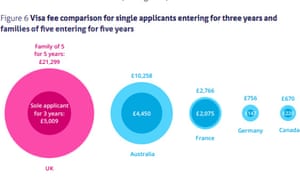
Comparisons with fee structures in other countries, published by the Institute for Government (IfG) thinktank, show that a family of five with a five-year work visa for one individual would have to pay £21,299 before they could enter in the country.

This includes the annual £400 health surcharge that must also be paid upfront per person. This is double the fee charged by Australia and about 30 times the amount charged by Canada, where it costs just over £10,000 for a family for five years. Germany charges £756 for entry for a family of that size.

The fee comparisons are equally stark for individuals. A single person who wants to come to the country will be charged up to £3,220 for five years. If they want to move to the UK with a spouse, the cost would rise to £6,500 for a five-year work stint.

UK visa fees compared with other countries
UK visa fees compared with other countries Photograph: Institute for Government

This compares with Canada, which charges £220 for an individual visa for three years; Germany, which charges £147; and France, which charges £2,075, according to the data supplied to the IfG. Luxembourg charges €50 (£42) for a visa and€80 for a residents permit.

Source: UK’s expensive visa fees ‘could deter NHS staff and scientists’

And on the gender impacts:

The British government’s plan for a post-Brexit immigration overhaul was designed to wean the economy off its reliance on cheap foreign labor. But in the process, women’s groups warned on Thursday, women will suffer disproportionately.

The new points-based system will give precedence to occupations in which women are underrepresented, favor male migrants over female and deepen gender inequality, according to the Women’s Budget Group, an independent network that promotes gender equality.

“The new immigration system roundly fails to understand the lived experience of women, many of whom are prevented from accessing paid work by the weight of unpaid work — caring for children, older people and those with disabilities — that successive governments rely upon them to do,” said Sophie Walker, the chief executive of the Young Women’s Trust, a British feminist organization.

Under the new rules, which will be implemented next January, applicants will be required to receive a job offer with a salary of at least 25,600 pounds, about $33,300. The salary threshold will be lower in special cases where there might be a shortage in skills, such as in nursing.

By and large, however, that requirement will work against women, who are more likely to work in sectors like home and senior care that are relatively poorly compensated, even though the skill levels of such women are relatively high, women’s advocates say.

“Care workers’ average annual salaries stand at just £17,000, not because care work is ‘low-skilled,’ but because the work force is 80 percent female and therefore undervalued and underpaid,” says Mandu Reid, the leader of the Women’s Equality Party.

Imposing the salary requirement would mean “shutting out care workers, piling pressure on women to take on yet more unpaid care, and widening the existing social care gap between need and provision,” she said.

Women are also four times more likely than men to leave paid work to shoulder unpaid caring responsibilities for children and older relatives. This is one cause of the gender pay gap and gender inequality, the Women’s Budget Group found.

As a result of these inequities, major industries like food production, hospitality, health and social care that rely on female migrant workers are likely to see staff shortages after the new measures are put into place.

In the points-based system, the government gives top priority to scientists, engineers, academics and graduates in science, technology, engineering and mathematics, or STEM, once again to the detriment of women because of the gender disparities in those professions.

“There is a great emphasis on wanting to attract scientists to the U.K. under the new system, but it is another well-known fact that women are underrepresented in the sciences,” said Adrienne Yong, a lecturer in law at the City Law School in London.

“That the U.K. will give a Ph.D. in STEM subjects 10 more points than Ph.D.s in other subjects already puts women on a back foot,” she said, “as there is already a problem with female students doing STEM subjects, much less continuing further education to a doctoral level with that specialism.”

On Wednesday, the cabinet minister responsible for migration policy, Priti Patel, suggested that around eight million “economically inactive” people in Britain could be trained to fill such shortages, but experts say that many of those people are women who are already providing full-time care for children and families.

“It feels like they just want us to fill the badly paid jobs while the men and foreigners will get the higher-paying jobs,” said Amy Pears, a mother of three who left her job as a professional caregiver and went on benefits in 2015 because she could not afford child care. “My mother is disabled, so between her and the three children I have my hands full.”

The Women’s Equality Party says that without substantial government investment in child and elder care, women are put into a position where they simply cannot work.

“These shortsighted plans are in fact more likely to exacerbate the shortages in formal care, leaving it to women to pick up unpaid and increase the number of ‘economically inactive’ full-time carers,” Ms. Reid said.

Women’s groups warned that shutting out foreign workers would put more pressure on women who are already in Britain, particularly caregivers.

“Without extra colleagues from abroad, U.K. carers are going to have even less time to do the job they’re employed to do and offer people the dignity they deserve,” Ms. Walker said. “This policy makes it an inevitability that this exhausted system will come under further strain, while female family members will increasingly be expected to pick up the pieces as the system continues to erode.”

Ms. Pears said that many of her European friends and former colleagues, who played important caregiving roles, would be locked out of the new system because they did not qualify for the salary threshold or education qualifications.

“These people are carrying a huge burden for our country, and the truth of the matter is we need them,” she said. “Without them we are putting our services at risk.”

Source: Women Will Be Hit Hard by U.K.’s New Immigration Rules, Experts WarnWith its minimum salary requirements, the new system would particularly affect female migrants, who tend to cluster in lower-paid occupations.By Ceylan Yeginsu

Reducing immigration will not stop America’s rising diversity, Census projections show

Good long analysis:

Immigration has become a dominant issue in America, as the Trump administration continues to curtail the flow of both legal and undocumented immigrants. Now, newly released Census Bureau population projections through the year 2060 provide an assessment of what differing levels of immigration would mean for the nation’s demographic future. These are the first projections in more than a decade that lay out how changing immigration flows would impact the nation’s future population size, its race-ethnic makeup, and its age structure.

The projections show that the current level of immigration is essential for our nation’s future growth, especially in sustaining the younger population. Moreover, despite suggestions to the contrary from the administration, lowering immigration levels further will not keep the nation from becoming more racially and ethnically diverse. Even if the number of migrants was reduced to zero, the percentage of the population that identifies as a nonwhite race or ethnic group would continue to rise.

IMMIGRATION IS ESSENTIAL TO COUNTER SHARP DECLINES IN GROWTH

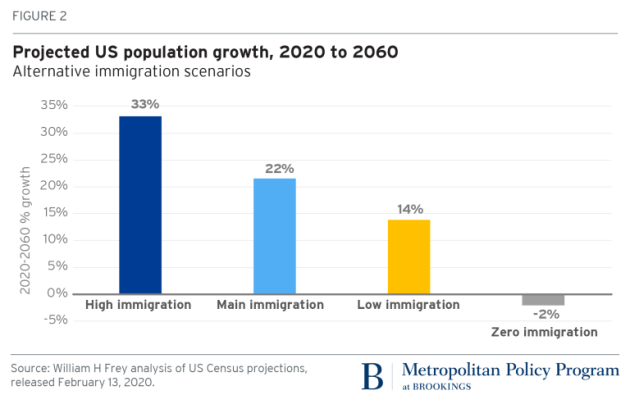
Just how much do different immigration levels affect future U.S. population growth? The new census projections through 2060 provide four scenarios about immigration [1]. The one used in existing census projections is termed the “main” scenario, and assumes that immigration to the U.S. will follow the trends seen from 2011 to 2015. The other three scenarios are: 1) a “high immigration” scenario, which assumes a 50% increase in immigration going forward; 2) a “low immigration” scenario, which assumes a roughly 50% decrease; and 3) a “zero immigration” scenario, which assumes no new immigration to the U.S., but does allow for out-migration from the country.

The projected populations over the 40-year period between 2020 and 2060 indicate a wide range of outcomes. The “main” immigration scenario would lead to population growth of 22%, from 333 million to 404 million. This is less than half of the 46% growth observed over the previous 40-year period, and reflects the fact that—compared to the past—the nation’s aging population will be experiencing higher death rates and more modest fertility rates.

Fig1

Fig2

The results of the three alternative scenarios are varied. The 2060 U.S. population size in the high-, low-, and zero-immigration scenarios is 447 million, 376 million and 320 million, respectively—representing growth rates of 33%, 14%, and -2%. In the zero-immigration scenario, the population begins to decline in 2035 due to a combination of more deaths than births and that emigration from the U.S. would not be countered by immigration into it.

Zero immigration would be demographically unsustainable and unlikely to occur. However, even the low-immigration scenario would lead to tepid population growth rates—in the range of 0.2% to 0.3%—over the final 20 years of the projection period.

DIVERSITY WILL RISE UNDER ALL IMMIGRATION SCENARIOS

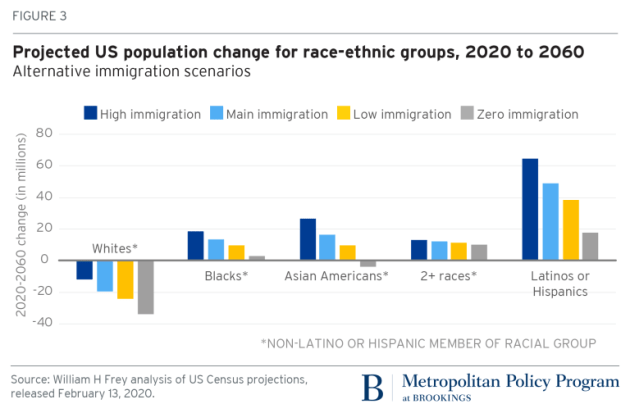
Much of the current political discourse equates immigration with a rise in racial and ethnic diversity. While it is true that a large share of immigrants are people of color (especially those arriving from Latin America, Asia, and Africa), the new projections show that the U.S. will continue to become more racially diverse under all migration scenarios, even with zero additional immigration.

A major reason for this is the aging and projected decline of the population of whites who do not identify with another race or ethnic group. In 2018, the median age of this population was 44, compared to 38 for the nation as a whole, 29.5 for the Latino or Hispanic population, and 21 for those of two or more races. With a rising number of deaths compared to births, the older white population will experience a natural decrease in all projection scenarios, which immigration flows will not counter.

Fig3

The other race-ethnic groups will show mostly positive population contributions over each projection scenario. The largest will occur for the Latino or Hispanic population, which will increase between 18 million and 64 million over the 40-year period, depending on the scenario. Births from existing Latino or Hispanic residents will lead to a natural increase in this population even under low- and zero-migration scenarios.

All other race and ethnic groups contribute to projected population gains with the exception of Asian Americans, whose size is reduced under the zero-immigration scenario. In this case, Asian emigration from the U.S. is not countered by a natural increase. It is noteworthy that in both the low- and zero-immigration scenarios, persons identifying with two or more racial groups contribute more to projected population gains than Black or Asian American residents.

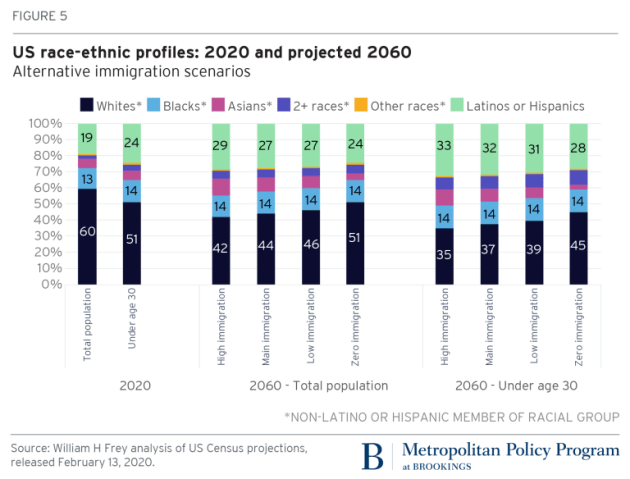
No matter the scenario, the U.S. will experience a rise in the share of the total population that identifies as a nonwhite race or ethnic group.

Fig4

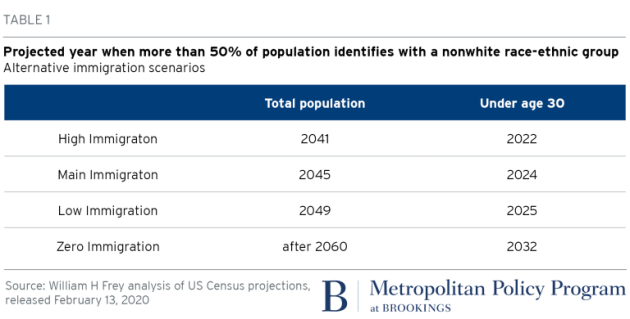
Table 1

Fig5

As previously reported, the “main” immigration scenario shows that in 2045, more than 50% of the U.S. population will identify as a nonwhite race or ethnic group, rising to 56% in 2060. In the high-immigration scenario, the 50% tipping point occurs in 2041; in the low-immigration scenario, it is 2049. Even in the zero-immigration scenario, the share of the U.S. population that identifies as a nonwhite race or ethnic group will rise to 49% by 2060.

Because all nonwhite race and ethnic groups are, on average, younger than white residents, their shares of the under-30 population are even larger than for the population as a whole. More than half of the under-30 population is projected to identify with a nonwhite group by the year 2024 in the main immigration scenario; in 2022 for the high-immigration scenario; and in 2025 for the low-immigration scenario. In the zero-immigration scenario, the share of the under-30 population that identifies as a nonwhite race or ethnic group exceeds 50% in 2032 and all years thereafter.

While shrinking in size, the white population is projected to comprise a larger share of the total population than any other single racial or ethnic group in all scenarios. The next largest group in all projections is the Latino or Hispanic population, which is projected to comprise around a quarter of the total population and roughly 30% of the under-30 population by 2060. 

IMMIGRATION IS NEEDED TO BOLSTER YOUNGER POPULATION GROWTH

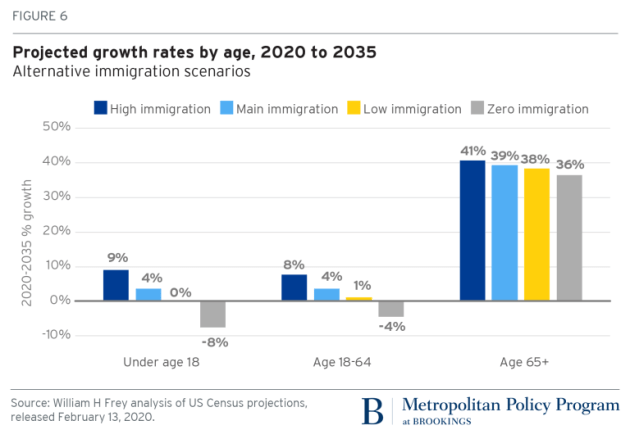
The aging of the U.S. population over the next decade will be propelled by the large baby boomer generation entering its senior years. Meanwhile, the younger population will be growing far more tepidly. This aging will be especially acute over the 2020 to 2035 period—as a result, immigration will make an important difference in how much the nation’s youth (under-18) and primary labor force (ages 18 to 64) populations grow.

Fig5

Under the high-immigration scenario, the youth population would grow by 9% and the labor force population would grow by 8% from 2020 to 2035. Both populations would grow by a modest 4% if current immigration patterns persist. A low- or zero-immigration scenario, however, would lead to stagnating growth or declines for these populations, while the 65-and-older population experiences a projected growth rate exceeding 36%.

The short-term implications of lower immigration levels could lead to noticeable labor force shortages. The longer-term impact is increased age dependency: the extent to which the retirement-age population will be dependent on younger workers for support. In 2020, the old-age dependency ratio (a measure of age dependency found by dividing 65-and-older population by the 18- to 64-year-old population) is 28. But as the population ages over the next 40 years, and age dependency rises, immigration will make a difference. In 2060, the dependency ratio can vary from 39 (under the high-immigration scenario) to a whopping 48 under the zero-immigration scenario. The latter would mean there would be only two working-age persons for every retiree.

THE NECESSITY OF IMMIGRATION TO THE NATION’S FUTURE

The Census Bureau’s alternative population projections make plain that continued immigration at current levels—at a minimum—is necessary to maintain the nation’s growth. With a rapidly aging native-born population, immigration will ensure growth—especially among the youth and labor force populations. Any appreciable lowering of immigration levels will lead to tepid national population growth, potentially negative growth in the youth population, and extreme age dependency.

It is also important to note that the nation will continue to become more racially and ethnically diverse under all immigration scenarios. This is a function of the country’s already large and youthful nonwhite populations, and the projected aging and decreased size of the white population.

Any political rhetoric suggesting that reduced immigration will make the nation “whiter” flies in the face of demographic evidence. In fact, the main reason the United States is growing more rapidly than most other industrialized counties stems from its healthy immigration levels over the past four decades. The Census Bureau’s projections suggest that similar or higher immigration levels will be necessary for the nation to grow and prosper in the decades ahead.

Source: Reducing immigration will not stop America’s rising diversity, Census projections show

Immigrants Flock To Canada, While U.S. Declines

From Forbes:

New data show the number of people immigrating to Canada increased by 26% between 2015 and 2019, and is projected to rise higher as the country seeks to overcome the aging of its workforce – a serious problem in all Western nations. In the United States, legal immigration fell by 7% between FY 2016 and FY 2018, and is expected to decline even more sharply due to Trump administration policies.

Canada has announced plans to increase the number of immigrants it accepts each year. “To further ease the challenges of a shrinking labor force and an aging population, our new multi-year immigration levels plan sets out the highest levels of permanent residents that Canada will welcome in recent history,” according to Minister of Immigration, Refugees and Citizenship Ahmed Hussen. By 2021, Canada is expected to increase legal immigration to 350,000 a year, a rise of 78,165, or 29%, from the 2015 level of 271,835.

The big Canadian immigration news in 2019 was the number of Indians who became permanent residents in Canada increased from 39,340 in 2016 to 85,585 in 2019, a rise of more than 117%, according to a National Foundation for American Policy (NFAP) analysis of Immigration, Refugees and Citizenship Canada data. “Canada is benefiting from a diversion of young Indian tech workers from U.S. destinations, largely because of the challenges of obtaining and renewing H-1B visas and finding a reliable route to U.S. permanent residence,” said Peter Rekai, founder of the Toronto-based immigration law firm Rekai LLP, in an interview. (See here.)

In 2019, India was the leading country of citizenship for immigrants to Canada, with more than twice as many immigrants as China, which had 30,260 immigrants in 2019, in second place. Third was the Philippines, with 27,815 immigrants. Nigeria was fourth, with 12,595, and the United States had the fifth most immigrants to Canada, with 10,800.

Even though Trump officials have claimed an affinity for Canada’s immigration system, that is not the case when it comes to immigration levels. As a percentage of each country’s population, Canada admits approximately three times as many immigrants as America. Trump administration-supported bills in Congress would have reduced legal immigration to the U.S. by up to 50%.

A new U.S. Census report highlights the importance of immigration to America’s long-term prospects. “Higher international immigration over the next four decades would produce a faster growing, more diverse, and younger population for the United States,” concluded the Census report.

“We desperately need immigration to keep our country growing and prosperous,” according to William Frey, a Brookings Institution demographer and author of several books examining Census data. “The reason we have a good growth rate in comparison to other developed countries in the world is because we’ve had robust immigration for the last 30 to 40 years.”

The numbers show the United States is headed in the opposite direction from Canada on immigration. Legal immigration to the U.S. fell by 7% between 2016 and 2018, illustrating the impact of Trump administration policies on legal immigration. The administration’s public charge rule, the travel ban and diminished refugee admissions are expected to reduce the annual level of legal immigration by a much greater amount, which will slow labor force growth in the United States and mean lower long-term economic growth for Americans.

It appears the debate about the difference between the U.S. and Canadian immigration systems is not about establishing a points system but whether to offer opportunity to more legal immigrants as in Canada or to face a decline and slower growth as in the United States.

Factbox: Reaction to Britain’s new immigration rules

Good overview of some of the key reactions (largely business-related):

The British government has outlined a new immigration system to manage the flow of workers into the country and replace existing rules from Jan. 1 2021, when Britain will no longer be subject to European Union regulations.

Here is some reaction to it.

Confederation of British Industry

“Several aspects of the new system will be welcomed by business, particularly abolishing the cap on skilled visas, introducing a new post-study work visa for overseas students, and reducing the minimum salary threshold from 30,000 pounds ($38,982),” said director general Carolyn Fairbairn.

“Nonetheless, in some sectors firms will be left wondering how they will recruit the people needed to run their businesses. With already low unemployment, firms in care, construction, hospitality, food and drink could be most affected.”

British Chambers of Commerce

“Companies are already investing heavily in home-grown talent across the UK, but critical labour shortages mean firms will still need access to overseas workers at all skill levels,” said BCC director general Adam Marshall.

“The new points system must be able to respond quickly to changing market needs, and the application process must be radically simplified.”

UKHospitality, which represents Britain’s hospitality sector.

“Ruling out a temporary, low-skilled route for migration in just 10 months’ time will be disastrous for the hospitality sector and the British people. Business must be given time to adapt,” said UKHospitality CEO Kate Nicholls.

“These proposals will cut off future growth and expansion and deter investment in Britain’s high streets. It will lead to reduced levels of service for customers and business closures.”

British Retail Consortium

“Although we welcome the reduction in the salary threshold, it is disappointing that the government has not understood the needs of the economy and the vital contribution of workers supporting the operation of warehouses, food factories and city centre stores,” said Tom Ironside, BRC director of business and regulation.

National Farmers Union

“We have said repeatedly that for farm businesses it is about having the full range of skills needed – from pickers and packers to meat processors and vets – if we are to continue to deliver high quality, affordable food for the public. Failure to provide an entry route for these jobs will severely impact the farming sector,” said NFU President Minette Batters.

Unison, the union which represents care workers.

“These plans spell absolute disaster for the care sector. Care doesn’t even get a mention in the home secretary’s plans,” said Unison assistant general secretary Christina McAnea.

Royal College of Nursing

“We are concerned that these proposals from the government will not meet the health and care needs of the population,” said Donna Kinnair, CEO and general secretary of the RCN.

“They close the door to lower-paid healthcare support workers and care assistants from overseas, who currently fill significant numbers of posts in the health and care workforce.”

Opposition Labour Party

“This isn’t an ‘Australian points-based system’, which is a meaningless government soundbite. It’s a salary threshold system, which will need to have so many exemptions, for the NHS, for social care and many parts of the private sector, that it will be meaningless,” said shadow home secretary Diane Abbott.

Food and Drink Federation

“We have concerns about access to those potential employees who won’t qualify through these ‘skilled’ routes such as bakery assistants, meat processors, and workers essential to the production of huge array of basic foodstuffs such as cheese, pasta, and sausages,” said FDF policy manager Mark Harrison.

Source: Factbox: Reaction to Britain’s new immigration rules