Has Brexit affected the way Britons think about immigrants? The recent ‘national mood’ on immigration

Interesting analysis of immigration-related public opinion data and Brexit:

Back in 2018, I wrote a piece showing how British public opinion on immigration had changed since the 1980s by analysing responses across waves of repeated, high-quality research surveys carried out in Britain. Then, the research showed that British opinions toward immigrants and immigration had been softening dramatically over the last decade since a peak in public hostility around 2010.

Recently I was able to update this information with a plethora of new results from the British Election Study (BES), the British Social Attitudes (BSA) survey, and the European Social Survey (ESS) which were fielded over the past two years. Figure 1 below shows what has changed since then, and how the new information has impacted the model’s estimation of the ‘national mood’ about immigration.

The line represents the proportion of survey respondents in each year answering negatively when faced with questions regarding their views on immigrants and immigration. The grey line running through the middle of the plot cuts the y-axis at 50% – half of the population having negative feelings toward immigration, with the other 50% holding a more positive perspective. The aggregation is carried out using Jim Stimson’s dyad-ratios calculator, which is able to standardise different survey measurements on the same topic. From this, individual survey items can be ‘blended together’ into a single series, such as above. (The code to run Stimson’s calculator in R can be found on my GitHub repository).

What the updated data shows is that the dramatic decline in anti-immigrant sentiments, which had reached a peak (in the study) around 2010, has continued up to the conclusion of the decade. According to the data analysed in this study, a majority of the British public now have positive views toward immigrants and immigration.

When I posted these results on Twitter, they became the subject of quite some discussion among various Brexit tribes (bot supporting and against), with much conversation surrounding the impact that Brexit (and specifically, the campaign) may or may not have had on feelings toward immigrants in this country. It is toward this debate that I wish to turn the rest of the article – namely, did Brexit cause an increase in anti-immigrant hostility in Britain?

Firstly, the evidence is quite clear that neither the Brexit campaign nor Brexit itself has caused any increase in negativity or hostility toward immigrants or immigration in the aggregate sense. There is nothing in the public opinion data, presented here or indeed elsewhere, that I have seen which would support the hypothesis that Brexit has unleashed some kind of wave of anti-immigrant hostility when we look at the nation as a whole.

However, the emphasis above is intended and important. There is nothing to say that just because aggregate levels of hostility toward immigration among the British public have declined, that there could not have been a simultaneous hardening or strengthening of negativity since Brexit among those with deep-rooted, very hostile opinions about foreigners in Britain. Both of these things could be true. Similarly, this measurement is not one of racism, or individual experiences/incidents of racism or indeed discrimination on the grounds of immigrant (origin) status.

Finally, Brexit might not have caused a rise in aggregate anti-immigrant hostility, but there is also little evidence to suggest that it caused this drop. For one, attitudes have been softening since 2010, and Brexit comes right in the middle of this near-linear decline. That said, the rate of decline has clearly accelerated since 2016, so perhaps there is some merit in the suggestion the Brexit vote may have ‘released some frustration’ regarding policy/control over matters of immigration among the population.

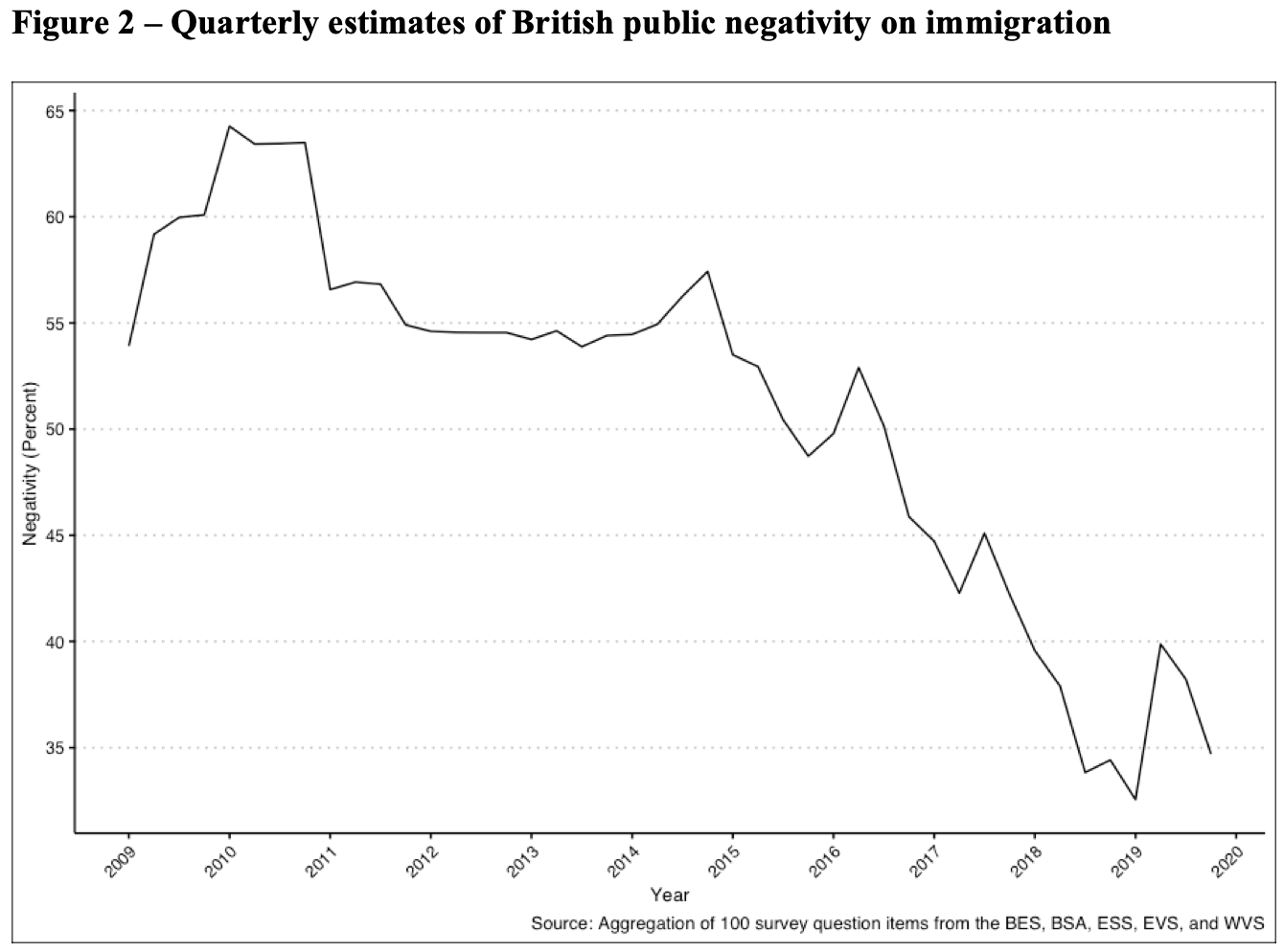
Inspecting the quarterly data also gives us some further, more nuanced insight into what the various narratives around Brexit might have done to attitudes surrounding immigrants and immigration. Figure 2 shows a more detailed snapshot of Figure 1, with 100 survey items analysed from 2009 to 2019.

Note: the mean level of sentiment here has shifted downward from in Figure 1, where the series included here and other series stretching back further into time anchor the overall trend line around 5-10% higher.

Here we see in greater detail the average decline in negativity from the turn of the last decade, with the peak around 2010 followed by something more resembling a jagged mountain face than a cliff edge. The sharp, short-term peaks in anti-immigrant mood as we travel down the ten-year slope are seemingly clustered around important electoral events surrounding Brexit: the 2014 European Elections won by UKIP, the build-up to the referendum itself in 2016, the General Election in 2017 where Theresa May sought a parliamentary majority for her Brexit plan, and then the 2019 election campaign featuring Boris Johnson’s pledge to “get Brexit done”.

Are these moments of intense scrutiny and pressure on Brexit producing these little sparks of negativity among the British public? It seems reasonable to think so – around these moments, media coverage and political commentary around immigration (specifically in relation to the EU) intensifies, parties actively campaign against the current immigration regime, and voters may be connecting immigration closer to their voting intention than they otherwise might, and respond to survey questions accordingly.

Whatever the case, what is certain is that these moments of upturn in the data do not last long. Once the moment passes, the decline in negativity continues – and even arguably picks up pace. Furthermore, given that margins of error apply to these aggregated figures just as much as they do to individual polls, the various quarterly spikes within the last ten years could just be statistical noise.

So, did Brexit cause an increase in anti-immigrant hostility in Britain? There is little evidence in the public opinion data analysed here to suggest that it did – particularly in the medium term. Did it, on the other hand, cause a big increase in positivity? Again, I would argue that it did not. Brexit has coincided with a plummet in British negativity about immigration, the start of which proceeded Boris Johnson’s successful attempt to pass a Brexit deal through the Commons, the referendum itself, and Nigel Farage’s electoral successes in the early 2010s.

In short, I would say that Brexit has not much at all to do with what Britons think about immigration.

Source: Has Brexit affected the way Britons think about immigrants? The recent ‘national mood’ on immigration

Quebec relies on hundreds of asylum seekers in long-term care battle against COVID-19

The irony given all the Quebec (and elsewhere) rhetoric regarding irregular asylum seekers:

Sarah watches her four-year-old daughter jump around a play structure she’s not allowed on because of the pandemic.

They’re just happy to be outside.

For eight days, Sarah — an asylum seeker from Haiti who crossed the U.S. border into Quebec at Roxham Road three years ago — was bedridden in their small Montréal-Nord apartment, her body feverish and aching.

It had started with some coughing and a slight fever she had tried to brush off at first. Her manager at the private long-term care residence in Ahuntsic where she works as an orderly wasn’t happy when she’d asked to stop working, for fear of bringing the infection home to her asthmatic daughter.

Then more symptoms appeared. She was nauseous, and the cough and fever got worse. A test a couple days later confirmed she had COVID-19.

Now on the mend, three weeks after testing positive, Sarah says: “I’m proud. I was on the battlefield.”

Sarah’s refugee claim was rejected after her first hearing, then again on appeal. Her only hope at staying in the country now is to be granted residency on humanitarian grounds, a process for which she began the application before the pandemic.

Given her precarious immigration status, CBC has agreed not to identify her by her real name.

Sarah is far from the only asylum seeker working on the front lines of the COVID-19 pandemic.

Many ‘guardian angels’ are asylum seekers

Marjorie Villefranche, executive director of Maison d’Haiti in Montreal’s Saint-Michel district, estimates that about 1,200 of the 5,000 Haitian asylum seekers the organization has helped since 2017 have become orderlies.

Frantz André, who helped found the Action Committee for People without Status, an advocacy group that helps asylum seekers settle in Montreal, says there are many more who’ve flown under the radar.

Asylum seekers make up a large portion of the “guardian angels” Quebec Premier François Legault has praised in his daily briefings — the orderlies, or préposées aux bénéficiaires (PABs), working in long-term care homes — who have no guarantee they’ll be allowed to stay in Canada.

“As quickly as they can, they want to find a job — and they’re being directed to jobs that no one else wants to do: the caregivers, PABs, security agents,” André said.

Without status, on the front lines

He and other refugee advocates have been calling on the Canadian government to allow asylum seekers already in the country to stay.

Many of them are hired by temp agencies, which offer people eager to work easy access to the labour market. For seniors’ homes desperately short of staff, the agencies are a source of cheap labour, but they operate with little government oversight.

The workers are often shuffled from facility to facility — a practice Quebec’s public health director, Dr. Horacio Arruda, has acknowledged is contributing to the spread of COVID-19 in long-term care centres, known in the province as CHSLDs.

André says the long hours they put in make the workers more prone to catching the virus and spreading it to their families.

He says it explains why Montréal-Nord, a low-income neighbourhood filled with newcomers, has the highest number of cases in the city.

“When you’re tired, you don’t eat well. You will go back home, and there’s four, five, six and sometimes seven people living in a [one-bedroom]. The chances of the people catching it, the family catching COVID-19, is greater than anywhere else,” André said.

It is also difficult for orderlies working for agencies to adhere to the province’s request that they work in only one long-term care residence, because accepting shifts wherever they’re asked to go is the only way to cobble together full-time work.

Another woman CBC spoke with works part time for a private residence and part time for an agency providing home care. Bouncing between visits to patients’ homes and shifts at the long-term care residence increases the risk of spread, but the woman said she feels she has no choice.

Problematic use of agencies predates pandemic

Long-term care homes have long been reliant on temp agencies to fill staffing holes — and the people the agencies sign on are most often women and newcomers to Quebec.

“Even before the pandemic, they had a lot of trouble finding people to do the orderly work,” said Prof. Nicolas Fernandez, a specialist in the relationship between health-care workers and patients who teaches family and emergency medicine at Université de Montréal.

“The short-term solution is to go to agencies.”

The reliance on temp agencies puts additional stress on CHSLDs struggling to contain outbreaks, said Fernandez, who has also served as a translator for asylum seekers.

CBC reached out to both federal and provincial departments requesting statistics on PABs, including how many are asylum seekers. Quebec’s Labour and Immigration ministries said they did not collect that information.

The Health Ministry didn’t provide a breakdown either, but offered up figures showing the vast majority of PABs are women — 34,821 of 42,340 in both private and public facilities. The average salary in 2019 was $40,551.

Fernandez says the job of a PAB is gruelling and crucial: they are the backbone of CHSLDs.

From the moment they wake up, most residents require extensive care — at least three hours a day — to have qualified for a bed.

“In order for the person to feel cared for, and not just a number, you need someone who is going to be there every day,” he said.

‘There’s no stability’

Sarah worked for two agencies to gain work experience after she finished her PAB course last year. She hated it — travelling as far away from Montreal as Saint-Jean-sur-Richelieu, in the Montérégie, a 50-minute commute made longer by the stops the agency’s van made to pick up other workers.

“There’s no stability. Every time, you’re sent to a different place. It gets really stressful,” she said.

For the past couple of months, Sarah has worked in the same private long-term care facility in Ahuntsic.

She loves her work. She likes helping and caring for people. It’s a far cry from the job she had in Haiti, working with a sports organization, but she hopes to be able to stay in Canada and work her way up in the health-care field, possibly becoming a nurse.

In the midst of this crisis, Sarah hopes the federal government recognizes how much asylum seekers have contributed to Canadian society and finds a way for them to stay.

“I hope the government will hear our calls, hear our voices.”

Group wants special immigration program

Those calls grew louder on Thursday, with a community group devoted to the rights of Haitians who crossed into Canada in 2017 asking the provincial and federal governments to implement a special immigration program for those working in CHSLDs.

“We find it hard to believe that these guardian angels may be expelled from the country once the battle is won,” the Concertation haïtienne pour les migrant.es said in an open letter.

“We are counting on your leadership to make a humanitarian gesture to these citizens who are fighting alongside us every day.”

Immigration, Refugees and Citizenship Canada responded to a CBC inquiry about whether the federal government was considering giving asylum seekers already in Quebec special status.

A spokesperson said in an emailed statement that the government would stick with the current process.

“Our immigration system continues to be based on compassion, efficiency and economic opportunity for all, while protecting the health, safety and security of Canadians,” spokesperson Shannon Ker wrote.

Source: Quebec relies on hundreds of asylum seekers in long-term care battle against COVID-19

They hoped for jobs and to immigrate to Canada. For international students, the pandemic has dimmed that hope

Will be interesting if the government relaxes the one-year requirement given COVID-19 and if so, how and under what conditions:

The dream of becoming a Canadian was within reach for Joyce de Paula until COVID-19 hit in March. All she needed was four more months.

Instead, that dream is now shattered after she was laid off as a marketing analyst, just four months shy of the one year of Canadian work experience she required to be eligible for permanent residence in Canada.

The Brazilian woman is among tens of thousands of former international students whose immigration plans are now in limbo because they are running out of time to secure a job in the midst of massive layoffs and an economic slowdown due to the coronavirus pandemic.

“There are hundreds and hundreds of us, but there is nothing we can do,” lamented de Paula, 28, who graduated from Centennial College with a postgraduate certificate in market research and analytics last May before landing a 12-month contract with Dufflet Pastries in July.

Studying in Canada has become a shortcut to immigration in recent years, with Ottawa putting more emphasis on Canadian education and work experience in the selection process.

Those who graduate from a Canadian college or university are granted a postgraduate work permit that lasts between one and three years, depending on the duration of their academic programs.

Immigration candidates must have at least one year of Canadian work experience before their work permits expire in order to get the bonus points for their applications. Anything short of that threshold won’t count.

Attaining the coveted permanent residence status should have been smooth sailing for de Paula, who would’ve had her 12-month experience under her belt when her work permit expires in August.

“It’s so hard to get any job now. Who is going to hire someone with a work permit expiring in four months?” asked de Paula, who has started an online petition urging Ottawa to extend the postgrad work permits of international graduates affected by COVID-19. The petition has already collected more than 1,270 signatures.

Phil Lao, who just finished the one-year construction project management postgrad program at London’s Fanshawe College in April, said the window for getting a relevant job in his field is narrowing.

“For many of the international students, our end goal is permanent residence. This is very disconcerting and we need more time to wait out the storm,” said the 29-year-old, who has an undergrad degree in architecture from the Philippines and earlier this month started working in a factory assembling respiratory equipment like nebulizers and inhalers. “This is so stressful.”

The pandemic has also wreaked havoc for international students seeking internship opportunities, which many had hoped could lead to jobs upon graduation.

Ashton Samson, also from the Philippines, was supposed to start a placement at a visual effects studio in Toronto in late March, but it was cancelled. Now, he has finished the visual effects and editing for contemporary media program at Fanshawe without any Canadian experience.

He said most productions have shut down their offices and there are few job openings even in graphic design, something he used to do in the Philippines.

Some graduating international students have chosen to take more courses or enrol in another program to buy time to delay applying for a postgrad work permit, but Samson said he has already spent $28,000 studying here — including $17,000 in tuition — and has no money left.

“The pressure is immense,” said the 24-year-old. “We have invested so much in this country that we hope Canada can see our effort and help us in any way it can. We just need to buy more time.”

Marcelo Moraes, who completed his postgrad certificate in digital media content strategy at Humber College in April, was fortunate enough to secure a paid co-op placement at the school, but said trying to find a job will be a tall order even after the pandemic is over, let alone for someone on a work permit.

“I have sent out more than 70 resumes. Everyone is putting their hirings on hold,” said the 46-year-old Brazilian, who has years of experience in assessing, implementing and managing media content strategies. “It’s a challenging job market. COVID just makes everything that much more difficult.”

For Meenal Devgan, going back to school is not an option because she is already on her work permit, which is only given out to an international student once.

The 28-year-old, who has a degree in legal studies from India, enrolled in the human resources management program at Conestoga College in Kitchener in 2018 and started a job as a restaurant supervisor last August before her layoff on March 22. She has since applied to 100 jobs, but is still unemployed.

“This is a big deal for our future. It is not our fault that businesses are closed,” said Devgan, whose work permit expires in August. “A lot of people are in the same boat. We have no options. I just hope immigration (officials) can count our layoff time toward our permanent residence applications.”

Source: They hoped for jobs and to immigrate to Canada. For international students, the pandemic has dimmed that hope

Fisher: The Liberals promised more immigration by 2021. Can that still happen?

Starting to see more articles like this although Fisher isobviously not familiar with the available data or with the immigration program in general although his call for a discussion is a reasonable one.

However, his suggestion that the COVID-19 aftermath may lead to a 90 percent drop is fanciful as no major Canadian political party, federally or provincially, would support such major drop.

(IRCC has been releasing monthly data for a number of years now so we should start to see emerging trends in a few months, the monthly data is typically released after two months):

Justin Trudeau‘s government has not yet told Canadians whether or how it intends to keep its long list of pre-COVID-19 promises.

One signature pledge was to take in 350,000 immigrants a year by 2021, or about one per cent of the population annually. That commitment was made in October 2018. At that time Canada was welcoming 310,000 newcomers a year.

Where does that major undertaking on immigration stand now, given that virtually nobody who is not already a citizen or resident of Canada has been allowed into the country for nearly two months? Or that Canadian embassies and immigration offices have almost all been closed or placed on greatly-reduced hours with much smaller staffs since sometime in February with little likelihood of much about that changing soon?

Official figures about immigration don’t tend to be released until one or two years after the fact, so it is guesswork trying to figure out how many newcomers Canada has welcomed this year or how many are in the pipeline. Surely, though, given that there are far fewer flights from overseas and that the required interviews and medical and security checks are clearly not taking place with most of the world shut down, there will be far fewer of these folks arriving this year. Because the immigration process is chronically slow and a maze for most potential immigrants, it is possible that there will be even fewer of them next year, too.

There is little public information available to help puzzle out the future of immigration to Canada during and after troubling times. But charts showing historical immigration numbers that were published by Statistics Canada five years ago may be instructive.

Whatever the boasts of the Harper and Trudeau governments about their openness to immigration, the fact is that immigration to Canada reached a peak of just over 400,000 people a year more than a century ago under then prime minister Sir Robert Borden. It then dropped to less than 40,000 a year for 15 years from the beginning of the Depression until the end of the Second World War under the Conservative and Liberal prime ministers, R.B. Bennett and Mackenzie King.

Considering this data and the grave current economic and logistical complications, if the current pattern mirrors the experience of the Depression, it is not too much of a stretch to suggest that what looms is a drastic drop — as much as 90 per cent — in immigration for several years.

There is no argument here about the merits of immigration, which I strongly support. It is about how many newcomers Ottawa now envisages Canada accepting and whether the public, faced with serious personal economic distress caused by unemployment and savings that have been wiped out, will be as supportive of immigration today or in, say, 2022 or 2023, as it was before the coronavirus pandemic disrupted lives and created so much uncertainty about the future.

It was the Mulroney government that decided to greatly increase the number of foreigners let into Canada. The policy was subsequently embraced by the Martin, Chrétien and Harper governments and expanded a bit further by the Trudeau government.

Recent immigrants, like generations of immigrants before them, have almost always been good for Canada. It is a generalization, but most of these settlers — if I may use a not so fashionable 19th and 20th-century term — have a reputation for working hard, often at jobs that those already lucky enough to be Canadians won’t do.

The newcomers help the economy by paying federal, provincial and municipal taxes. Their need for housing has pushed up the value of real estate, especially in the immigrant-magnet cities of Vancouver and Toronto (although a case can be made that this has sometimes been a mixed blessing).

The presence of so many immigrants can only be good for a country where the spectre of depopulation has become real since many couples who can trace their Canadian roots back decades or centuries have become famously uninterested in having more than one or two kids.

Besides, the points system used to decide who qualifies to come to Canada has attracted many highly educated, highly motivated immigrants. The longstanding family sponsorship program has been a boon to, well, families. The legal refugees that Canada has taken in have helped people otherwise trapped in hellish situations. It has also given a little relief to poor countries such as Jordan and Lebanon that have unfairly had to bear far too much of the refugee burden.

But as during the Depression, Canada’s economic landscape has shifted dramatically in the past couple of months. The federal deficit for this year alone could be $252 billion. Similarly, big deficits are a prospect for 2021 and 2022. And the books of several provinces are worse than those of Ottawa.

The federal government has been very busy with the coronavirus. It is, after all, an epochal event.

But increased immigration was a strong theme as well as a firm promise of Trudeau’s government. The current pandemic should not prevent the immigration minister and senior department officials — who have lots of time on their hands since few new immigration applicants are being processed — from sharing their thoughts with Parliament and Canadians about how the COVID-19 shock has informed and affected their thinking and planning.

It is not too soon to start a national discussion about how many immigrants Canadians, their elected leaders and various business and ethnic communities think the economy and job market can digest.

Source: COMMENTARY: The Liberals promised more immigration by 2021: Can that still happen?

Douglas Todd: COVID-19 lockdown triggers foreign-student flight from Canada

Good article by Todd and likely more realistic than the overly optimistic International students determined to study in Canada despite coronavirus, with some initial data highlighting the difficulties facing the current business models of universities:

Jenny Kwak, an international student from South Korea, remembers in March how four of five young people in her university dorm packed their luggage and just disappeared.

“They went home to China, India, the Philippines, Brazil, the U.S. — you name it,” said Kwak, a 21-year-old arts student interviewed on the large empty campus of the University of B.C., which last year enrolled more than 17,000 international students.

It’s hard to forecast how many international students will return, either to Canada or other nations. But the mass exodus of foreign students is brewing into a crisis for colleges and universities in the West that rely on their high fees to hire faculty and staff and construct new edifices.There were 642,000 foreign students in Canada at the end of 2019, double the number of five years earlier. International students account for 20 per cent of post-secondary enrolment in Canada, where many politicians view them as essential to the country’s economic expansion.

Foreign-students programs around the Western world will take “a massive hit” from the coronavirus, says Oxford University professor Simon Marginson, director of the Centre for Global Higher Education.

Post-secondary schools can expect at least 12 months of “abnormal conditions” from the COVID-19 pandemic, with at least five years before global student mobility recovers, says Marginson, whose centre is a partnership of 14 major universities.

Many smaller private colleges, especially those that rely almost entirely on foreign-student fees, will likely collapse, predict higher education specialists Philip Altbach, of Boston College, and Hans de Wit, from the Netherlands. Large respected universities, many of which continue to draw taxpayers’ dollars, will likely survive.

Even though the state of affairs will be different for each nation, Altbach and de Wit say global competition will become fiercer for what will remain of what was until last year the 5.2 million students studying abroad, the largest cohort coming from China.

There are lessons to be culled from the contrasting ways the leaders of Canada and Australia — which take in the most foreign students per capita, including from China — are responding to the dramatic exit of so many.While Canada’s immigration department and schools are not providing much information on how many foreign students have left or may not come back because of the pandemic, Australia’s politicians are more frank. They say many of the 720,000 foreign students in the country have left, in droves.Australia’s acting immigration minister says 300,000 people on study visas (and temporary work visas) departed since January. And a former senior immigration official in Australia, Abul Rizvi, predicts one-quarter more foreign students and workers will depart by year’s end.

It’s not surprising. Australian Prime Minister Scott Morrison told non-Australians to return to their home countries if they could not financially support themselves during the coronavirus crisis. Like most nations, he did not offer wage subsidies to foreign nationals.Politicians in Australia and elsewhere are worried international students will compete for jobs with the millions of citizens who have been frozen out of work due to COVID-19. And a segment of Australians appreciate the departure of many could lead to reduced house and rental costs.In contrast, Canada is more generous to foreign students.

Prime Minister Justin Trudeau’s government has quietly confirmed foreign students with a SIN number can apply for the Canadian Emergency Response Benefit (CERB), which gives up to $2,000 a month to residents of Canada who have lost their jobs because of COVID-19.The government also removed the 20-hour-per-week limit on how much international students could work during their term. Ottawa will now allow them to work unlimited hours if it is with an essential service. In B.C., foreign students also receive subsidized government medical care.Unfortunately, in Canada it’s almost impossible to obtain solid data on how many students have left Canada or don’t intend to return. Immigration, Refugees and Citizenship Canada told Postmedia it doesn’t keep “exit” information. And media officials from both UBC and Simon Fraser University said their numbers don’t indicate any change, adding they won’t speculate about the fall.

Canada stopped issuing study visas on March 18, but will let anyone who had a visa before then return. The only data the immigration department offered about how COVID-19 has affected study visa holders comes from before Canada locked down.That data shows, during January and February, when COVID-19 was exploding out of Wuhan in China, the number of students from China applying for Canadian study visas dropped by almost half — to 5,164 from 9,495, compared to the same period a year earlier. Applications from South Korean also fell sharply.The decline in study visa applications is a sign of a more permanent trend for the next five years, according to Marginson. He warned student movement patterns will shift for East Asians, with fewer opting for North America, Western Europe, the U.K. and Australia — and more deciding to stay closer to home and study in Japan, South Korea or China.

How Canada and Australia will handle their foreign-student relationship with East Asian countries, especially China, will be telling. At the end of 2019, Australia had 212,000 students from China and Canada had 142,000.But while Australia is not afraid to talk bluntly to China, including about wanting an international investigation into how COVID-19 broke out in Wuhan, Canada’s Liberal government stays silent about China’s transgressions.Ottawa goes out of its way to encourage international students because its aim, rarely discussed, is to give them preferential treatment as future permanent residents, moving into Canadian jobs and housing.

Since the impact of foreign students on Canada’s cities is profound, one would hope the country’s public officials would be more transparent about a strategy that is now seriously in jeopardy.

Source: Douglas Todd: COVID-19 lockdown triggers foreign-student flight from Canada

Douglas Todd: Time to end ‘honour system’ in Quebec’s immigrant-investor scheme

Good reminder of the scam that is the Quebec immigrant investor program and good for Richard Kurland for obtaining and analyzing the data that highlights just how much it is a scam.

Just as Quebec unduly benefits from the 1991 immigration accord that provides Quebec with greater funding per immigrant than other provinces, one that remains a fixed percentage of total settlement funding, irrespective of Quebec immigration levels, meaning that as Quebec decreases its immigration intake under the Legault government, the imbalance increases.

And good for the Conservatives under Jason Kenney for cancelling the federal program. When I analyzed citizenship data by immigration category, the lowest incomes (LICO prevalence) were reported by business immigrants as shown in the chart below (grouped under “Entrepreneur etc):

It’s time for Ottawa to end the honour system that allows nine of 10 wealthy immigrants to renege on their promise to live in Quebec.

Federal immigration officials have released information showing 91 per cent of the tens of thousands of applicants approved by Quebec’s Immigrant Investor Program in recent years have been exploiting a loophole in the plan, which critics consider a “cash-for-passport” scheme.

The Quebec program’s glaring flaw also illustrates a wider problem for the country and its provinces, says Vancouver immigration lawyer Richard Kurland.That is, Ottawa does not seem interested in trying to make all would-be immigrants to Canada follow through on residing in their declared “intended province of destination.” There are taxation measures that could be introduced, Kurland said, that could ensure more immigrants follow through on their stated commitments.

Even though Quebec’s immigrant-investor program is set to re-open this summer, after being temporarily suspended to deal with a backlog of more than 5,000 applications, critics don’t want to see it start up again under the same rules.

“There are two reasons Quebec’s program has been a failure, leading to abuse of the system,” says Burnaby immigration lawyer George Lee, whose clientele is predominantly from China.“It’s freezing cold in Quebec in the winter, so (many) people from Asia find the weather intolerable,” said Lee.

“Secondly, language-wise, there’s a problem. Most people in China learn English rather than French. As a result, many of Quebec’s investor immigrants don’t ever even fly into Montreal or Quebec City. They just use the Quebec program as a bridge to get to English-speaking cities in Canada.”

Kurland, who obtained six years of recent data on the more than 25,000 investor immigrants and family members who have never fulfilled their stated promise to reside in Quebec, said a simple new tax measure would likely stop the exploitation.

All Ottawa has to do is delay granting permanent resident status to newcomers to Quebec (or any other province) until they file an income tax return as a resident of their declared province of destination, said Kurland, who has frequently travelled to Ottawa to advise Parliament on immigration policy.For his part, Lee realizes that residents of Canada have mobility rights under the Charter of Rights and Freedoms. But, like Kurland, he believes Ottawa could find ways to go further to ensure compliance to regional residency commitments than a misused honour system.

Lee worries Quebec doesn’t want to reform its immigrant-investor program.

“Quebec’s happy with the scheme,” he says, because the province gets substantial amounts of money injected into its coffers without having to provide new arrivals and their families with taxpayer-funded medical care, social services and education.The data obtained by Kurland under an access to information request shows that in 2017 only 342 of the 5,015 people approved under Quebec’s investor category actually had a primary residence in the province.

In 2018, just 518 of the 6,064 people approved were found to be living in Quebec. And up until October of last year, only 528 of the 4,136 approved were residing in the that province.


This chart shows over six years how nine of 10 applicants and their dependents approved as permanent residents under Quebec’s immigrant-investor program did not reside in Quebec. (Source: Immigration, Refugees and Citizenship Canada, via Richard Kurland)

The investor scheme has not been the only immigration program that provides unusually large financial benefits to Quebec. Because of a 1991 funding accord, Ottawa also provides Quebec with roughly four times as many taxpayer dollars to settle each of its immigrants as B.C., Ontario and several other provinces receive.

Meanwhile, an internal federal immigration document, also obtained by Kurland, acknowledges growing criticism of “golden-passport” schemes such as the one that remains in Quebec, the only Canadian province ever granted separate immigration powers.

The Immigrant, Refugees and Citizenship Canada report from 2019 reveals that four of five of the foreign investors who give or loan various amounts of money to a Pacific Rim country (or its regional jurisdictions) in return for a visa or passport are from China.

Most such investors simply want “peace of mind, a way out when the home country is experiencing turmoil,” says the IRCC report, which grew out of an international conference in Miami on “citizenship-by-investment programs.”

The immigration report refers to how the federal Conservatives cancelled Canada’s long-running national investor-immigrant program in 2014. The government of the day found few of the wealthy applicants ever invested in businesses in Canada or paid a significant amount of federal income tax.

Source: Douglas Todd: Time to end ‘honour system’ in Quebec’s immigrant-investor scheme

International students determined to study in Canada despite coronavirus

One survey. We shall see what the numbers show in the fall, both with respect to existing students as well as new ones.

But hard to see how the call for international students to access the Canada Emergency Student Benefit (CESB) would be supported by the government as called for by David Dingwal, president of Cape Breton University, given the likely outcry by many Canadians struggling through the pandemic and the other supports provided:

Most aspiring international students in a recent survey say the coronavirus pandemic is not stopping them from pursuing their post-secondary education abroad.

That being said, many would still prefer the face-to-face study experience over online learning, according to the survey conducted by international education specialists at IDP Connect, the B2B division of IDP Education.

Some 69 per cent of the 6,900 international student applicants surveyed intend to commence their studies as planned. Only five per cent said they would no longer continue studying. Most of the participants were from India, China, and Bangladesh, among other Asian countries, who were interested in pursuing study in Australia, Canada, United Kingdom, United States, and New Zealand.

The majority of people said they would prefer to defer their study plans until face-to-face classes were available, mainly because the online option lacks the international exposure most were hoping to gain.

The CEO of IDP Connect, Simon Emmett, noted that just over half of participants, 54 per cent, would be willing to defer their studies up to 12 months or less before pursuing other options.

“Thirty-one per cent of respondents stated they would be willing to start their course online and move to face-to-face learning at a later date, but by far the greatest preference was to defer to January 2021 if this meant face-to-face learning would be possible,” Emmett said in a media release.

Based on the results, IDP recommended that post-secondary institutions provide clarity on how and when face-to-face teaching will resume, and to prepare for large cohorts of students commencing face-to-face studies from January to May, 2021.

Survey participants got to rank destination countries on a scale of 1-10 based on their pre-conceived perceptions.

Though Australia and Canada were the preferred destination countries of the overwhelming majority of participants, Canada was highly regarded for its welfare of international students, and the economic stability of the nation. Canada was also seen as having the least prohibitive travel restrictions.

University activity as provinces loosen coronavirus restrictions

As Canadian provinces start pulling back coronavirus measures, some universities are also opening their facilities.

McGill University in Montreal, Quebec, will commence the first stage of its phase-in to operation on May 11, allowing some on-campus researchers to go back to work. Researchers will be required to follow the university’s directives, which includes adhering to safety protocols, being prepared to shut down in case of changes at the institution or government level, among others.

The Université du Québec à Montréal is also welcoming back researchers.

The University of Prince Edward Island will also allow researchers, faculty, and graduate students to conduct research on campus as of May 25. They are also allowing some key staff and the management team to meet on campus, while encouraging social distancing and working from home when possible. The second phase is set to begin June 15, upon evaluation of the first phase, where they may expand the number of people allowed on campus. The third phase, another expansion, is scheduled to begin August 1, where they will prepare for the fall academic semester.

How Canadians are helping international students

Canada is helping international students a number of ways such as increasing the number of working hours allowed from 20 to 40 for certain occupations, and opening up the Canada Emergency Response Benefit to them, which provides recipients $2,000 per month. Quebec will automatically extend the Quebec Acceptance Certificates of international students if they are set to expire before December 31, 2020.

For those international students who still fall through the cracks, advocates are pressuring the federal government to do more. David Dingwall, president of Cape Breton University in Sydney, Nova Scotia, recently called on the federal government to open up the Canada Emergency Student Benefit (CESB) to international students as well as Canadian students. Introduced in late April, the CESB will provide up to $1,750 in monthly income assistance to eligible students, but international students are excluded from the program.

“Eligibility for the Canada Emergency Student Benefit is aligned with the Canada Student Loans Program in that it is aimed at Canadian citizens and permanent residents,” a spokesperson with Employment and Social Development Canada wrote CIC News in an email.

Though Dingwall’s media release said the student benefit “acknowledges the contributions that [Canadian] post-secondary students make to our country,” he also said “it fails to recognize the contributions that international students make to Canada.”

Nova Scotia was home to 11,817 international students in October, 2019, according to the Association of Atlantic Universities.

“The impact on our small province is enormous,” Dingwall said in the release. “I am confident that Universities Canada and its members will continue to advocate for our international students.”

Source: International students determined to study in Canada despite coronavirus

USA: Immigration Review Could Lead To New H-1B Visa Restrictions

Which would likely benefit Canada and possibly other countries:

The Trump administration may soon propose another set of immigration restrictions, this time on H-1B visas for foreign-born scientists and engineers. Some observers view these public displays of limiting immigration as an effort to deflect criticism of the administration’s handling of the coronavirus pandemic. Before enacting new measures, analysts recommend the administration take into account the restrictions on H-1Bs already in current law, including the low annual limit for new H-1B petitions, and the high denial rates imposed by U.S. Citizenship and Immigration Services (USCIS). The latest data show H-1B denial rates are at record levels.

On April 22, 2020, the Trump administration issued a presidential proclamation that suspended the entry of most new immigrants for at least 60 days and ordered a 30-day review to recommend additional measures on temporary visas. Following the review, observers expect new restrictions on H-1B visa holders, F-1 students and others. A new restriction could take the form of suspending the entry of anyone on an H-1B visa coming from outside the country and/or imposing new conditions on their entry that would be difficult to satisfy.

Due to USCIS policies, the H-1B category remains highly restrictive, say attorneys, and the data support this contention. Denial rates rose from 6% in FY 2015 to 30% in the first quarter of FY 2020 for new H-1B petitions for initial employment, according to a new National Foundation for American Policy (NFAP) analysis. (H-1B petitions for “initial” employment are primarily for new employment, typically a case that would count against the H-1B annual limit.) In FY 2019, the denial rate for initial employment was 21%, while the rate was 24% in FY 2018, between 3 to 4 times higher than the FY 2015 denial rate (i.e., prior to the Trump administration.)

All 25 companies with the most approved new H-1B petitions saw their H-1B denial rates for initial employment increase from FY 2015 to the first quarter of FY 2020. (See Table 2.) Even large technology companies that had denial rates of only 1% in FY 2015 experienced much higher denial rates for H-1B petitions for initial employment in the first quarter of 2020: Amazon’s denial rate was 16%, Google’s was 14%, Facebook’s was 8% and Apple’s H-1B denial rate was 8%. Data for additional quarters will tell us how long this trend persists.

“As in earlier fiscal years, the highest denials rates are for companies that provide information technology or other business services to American companies,” according to the NFAP report. “The data indicate USCIS has established a different standard for deciding cases for companies that provide information technology (IT) services. This is the case even though, as attorneys point out, immigration law does not indicate a different standard for adjudications based on the type of firm or the location work will be performed.”

In the first quarter of FY 2020, the H-1B denial rate for initial employment increased by 20 percentage points or more compared to FY 2015 for 12 major companies that provide IT services or other business consulting services. Many of these and other companies hit by high denial rates are U.S. companies. (Data show the use of H-1B visas by Indian-based companies has declined significantly in recent years, see here.)

People who follow technology trends like Everest Group CEO Peter Bendor-Samuel say by providing technical talent many high-skilled foreign nationals and companies that offer services increase the competitiveness of American companies. “Digital transformations and digital platforms are just starting to take off and, as we look into the near future, the current skill shortages are going to grow as the demand for digital and IT skills explodes,” said Bendor-Samuel. “If this administration wanted to harm U.S. competitiveness, then restricting access to this vital labor would be an excellent approach.”

Advanced analytics and cloud computing are two elements of digital transformation. “Digital transformation is the integration of digital technology into all areas of a business, fundamentally changing how you operate and deliver value to customers,” explains the Enterpriser’s Project. “A business may take on digital transformation for several reasons. But by far, the most likely reason is that they have to: It’s a survival issue for many.”

Replacing outdated legacy information technology systems is a key element of digital transformation, notes the Enterpriser’s Project, which points out, “Often, it’s more about shedding outdated processes and legacy technology than it is about adopting new tech.” This sometimes leads to poorly managed transitions. “In a handful or so of cases in past years, H-1B visa holders were blamed for layoffs after some foreign nationals came on-site to manage the transition to new contracts – contracts that went out for bid and, industry professionals note, would have resulted in layoffs or at least a transfer of personnel whether or not the entity awarded the contract employed some H-1B visa holders,” notes the NFAP analysis. “In retrospect, these cases should have been recognized as attempts by companies to undertake digital transformations, transformations that unfortunately can leave longtime employees trained primarily on legacy systems in untenable career situations. Ongoing training efforts for such employees before being placed in these situations would offer the best career protection.”

Judges have ruled against several USCIS policies that have contributed to high denial rates, targeting restrictive agency interpretations of what qualifies as an H-1B specialty occupation, an employer-employee relationship and whether an H-1B employee must list all future work or contracts.

The March 10, 2020, decision in ITServe Alliance v. L. Francis Cissnawould allow any company that believes an H-1B petition was denied in a way ruled unlawful by Judge Collyer’s opinion to file a case in the District of Columbia, notes Jonathan Wasden of Wasden Banias, LLC. (See here.)

Following the 30-day review, the administration could recommend moving forward with an H-1B regulation already on the agenda (but not issued) that would: “[R]evise the definition of specialty occupation . . . revise the definition of employment and employer-employee relationship . . . [and] propose additional requirements designed to ensure employers pay appropriate wages to H-1B visa holders.”

Policymakers often ignore that due to a low annual limit, current immigration law already significantly restricts companies and their ability to employ high-skilled foreign nationals in technology fields. For the past 18 fiscal years, employers have exhausted the annual supply of H-1B visas due to those limits.

Under U.S. law, companies collectively can only use, in effect, 85,000 new H-1B petitions a year – an annual limit of 65,000 and an exemption of 20,000 from that limit for foreign nationals with a U.S. advanced degree. To put that number in perspective, 85,000 new H-1B petitions equals 0.05% of the U.S. labor force of 165 million.

In March 2020, employers sent in registrations for approximately 275,000 foreign-born professionals for the H-1B lottery – more than three times the annual limit of 85,000. That indicates the demand was at least 190,000 scientists, engineers and other professionals beyond current law, and likely would be higher if one included demand that might arise in later months.

It’s worth noting the sectors hardest hit by the economic downturn – airlines, hotels and restaurants – employ few H-1B visa holders. H-1Bs are typically the only practical way to hire a foreign national to work in the United States long-term. (H-1B professionals selected in the March lottery cannot start work until October 1, 2020, or later.)

A study by economists Giovanni Peri, Kevin Shih, Chad Sparber and Angie Marek Zeitlin looked at the last recession and discovered that denying the entry of H-1B visa holders due to the annual limits harmed job growth for U.S.-born professionals. “The number of jobs for U.S.-born workers in computer-related industries would have grown at least 55% faster between 2005-2006 and 2009-2010, if not for the denial of so many applications in the recent H-1B visa lotteries,” concluded the economists.

The Trump administration appears poised to enact new restrictions on foreign-born engineers and the ability of international students to work in the United States after graduation, even though the president has stated he favors “merit-based” immigration and these are the most highly skilled people admitted to America. Economists note the way to recover from an economic downturn is to attract more investors, entrepreneurs and highly productive individuals – not to drive them away to other countries.

Source: Immigration Review Could Lead To New H-1B Visa Restrictions

Interior ministry: Aliens Act amend aimed at protecting Estonian residents

As @JeffHemlin noted, Estonia’s population has been shrinking for the past 20 years making it harder to understand the economic rationale for the move:

Wednesday saw the so-called cluster law passed recently by the Riigikogu come into effect. One of the key bills in the package was amendments to the Aliens Act which requires third-country citizens without work to leave the country, Ruth Annus, head of the interior ministry’s citizenship and migration policy department, says that the main purpose of the amendment is to protect Estonian citizens and residents in the labor market, particularly the agricultural sector.

The changes just come into force only affect migrant workers, meaning those who are neither citizens nor residents, and are third-country nationals, i.e. non-EU, EEA or Swiss Confederation citizens, and who work in Estonia on a temporary basis.

Such individuals who have a long-term visa or visa-free stay for the purpose of employment who lose their jobs must find new employment “within a reasonable time,” or leave the country, Annus said in a press release issued Thursday morning.

A list of changes can be found at the bottom of this article.

Not directly related to emergency situation

The amend, while it formed part of the raft of laws issued in response to the coronavirus pandemic, is permanent and will not change when the emergency situation ends, Annus said. Nonetheless, unemployment rose from 14,000 to 50,000 since the emergency situation was declared, Annus said.

Restrictions on cross-border movement in the wake of the pandemic have also hampered employers from taking on additional foreign labor as springtime approached.

The amend will mitigate the risk of foreigners who lose their jobs in Estonia remaining in the country, or the Schengen Zone as a whole, “without purpose”, she said. Her reasoning for this was that foreigners staying in Estonia or elsewhere in the EU may also commit other offenses.

The move will also protect Estonians and residents of Estonia in the labor market, she said.

In practice the change mostly affects the agricultural sector, and comes with a transitional period intended to help employers to adapt to the new situation and find suitable employees among the Estonian population, Annus said.

Anecdotal evidence from agricultural sector

According to Annus, farmers have said several times in the media that they have had large numbers of candidates for vacancies over quite some time, many of them without direct experience.

A beauty worker reportedly started working milking cows at the start of the emergency situation (declared on March 12-ed.), fulfilling a long-held desire in so doing, and two music students came back to Estonia during the pandemic, and applied for a job on a local farm.

While further details of these cases were not provided, Annus said they were certainly not the only examples.

At the same time, such posts were best suited to Estonians, she said.

“The Estonian person is smart and adaptable. I am sure that in the current situation, employers and job seekers will find each other better, and the Estonian people will appreciate working in agriculture more.”

As reported on ERR News, rural affairs minister Arvo Aller (EKRE) was of the same mind as Annus on the issue, seeing as many Estonians entering the agricultural sector as possible, including students and school children.

Farmers who have recently spoken to the media about the situation have said agricultural work cannot be done by just anybody but needs to be done by people with experience. They have also said many Estonians do not want to relocate away from cities and their families to work in the countryside.

President criticized changes

On Monday, President Kersti Kaljulaid criticized amendments to the Aliens Act saying it is not reasonable to change visa terms mid-way through.

“The amended terms and conditions affect already issued visas too. The legislature must develop rules for workers entering Estonia from non-member states, but lawmaking should rely on the principle of legal clarity. So, if the country has issued visas pursuant to particular terms and conditions, it is not reasonable to retroactively amend them. A confident country does not operate like this,” she said.

The president emphasized these conditions would remain in force even after the crisis period which would later hinder businesses and economic recovery.

“This will make the difficult situation that so many companies already find themselves in even more complicated. The issue has been raised both by separate businesses and business umbrella organisations. Several industry sectors now have the crucial need to engage foreign staff, especially qualified workers and seasonal labourers from abroad, and this need must be addressed if we want to keep the economy and family income growing. Thus, applying additional foreign labour force restrictions will only increase the economic decline in Estonia and prevent the recovery of our economy and expansion of employment options,” Kaljualid said.

Statistics: Who will be most affected?

Last month ERR News asked the Ministry of the Interior which sectors and how many people would be most affected by the changes.

A spokesperson for the ministry said: “It is not possible to say how many people in Estonia will lose their jobs in the nearest future because of the crisis in economy caused by COVID-19 disease.

“There are 18,540 valid short-term employment registered as the state of 6th of April. This is not the number of foreigners actually temporarily staying in Estonia right now, but the number of foreigners who have right to work here on short-term basis.”

The spokesperson also gave ERR News a breakdown of the top 5 sectors which visas have been issued to, which is displayed below. Of the top five, most short-term registrations have been issued in the construction sector and the least in agriculture.

Aliens Act amendment facts

  • Short-term migrant workers in Estonia can work under general conditions for a maximum of 12 months out of 15 months, or in seasonal work for 9 months out of 12 months.
  • Employers must register short-term employment of a migrant worker with the Police and Border Guard Board (PPA).
  • Agricultural employers can retain workers hired and in Estonia by March 17, until July 31.
  • After July 31, temporary migrant workers have one month to arrange their departure from Estonia, though the PPA will assess each case on its individual merits.
  • Migrant workers whose maximum permitted period of short-term employment has already been reached and who are not continuing to work in agriculture must leave Estonia as soon as possible.
  • Visas will not be revoked overnight, though an alien currently jobless will be given a “reasonable” amount of time (generally taken to be one month-see above) to either find a new employer or arrange to leave the country.
  • If departure is not possible at present while the emergency situation continues and borders are closed, the alien has 10 days to leave the country once the situation is declared closed. The current expiry date for the emergency situation is May 17.
  • Those affected should approach their home country’s foreign mission in Estonia for assistance, Annus said.
  • Current employers can also provide assistance to help third country nationals return home once their contract is up.

Source: Interior ministry: Aliens Act amend aimed at protecting Estonian residents

France should send home more illegal immigrants, says report

Interesting reference to Canada and recommendation to adopt a more selective immigration approach as per Canada:

A new report by the national auditor has recommended that France “modernise” its immigration policy and increase the number of deportations of illegal immigrants, saying it could learn from Canada’s immigration system.

The Cour des Comptes (in its role as an auditor of government action) says France’s immigration system needs an update.

The report examines the government’s efforts to ensure controlled immigration, respect the right of asylum and foster the integration of immigrants already living in France.

It concludes there is a need for “more realistic and tangible objectives”.

Asylum applications

The time frame for registering asylum applications set by the government has, for some years, been tighter than the legally binding time frame, according to the authors of the report.

The auditors said the government had deliberately shortened the registration time limit in the belief that a speedier processing of asylum applications would deter unfounded claims for asylum.

But the report singles out the so-called “accelerated applications” which are supposed to be processed within 15 days but in reality can take 121 days.

Expulsion of illegal immigrants

The audit judged the government’s attempts to send illegal immigrants home as “not very effective” and suggests “the necessary money and resources” must be made available “to increase the number of assisted departures of illegal immigrants”.

France receives fewer legal immigrants than other major western countries, says the report, which is critical of what it judges to be unnecessary bureaucracy for immigrants.

The auditor notes that in 2018, of immigrants granted residency in France, 75 percent were given the right to remain for one year but nearly all of those who then applied for an extension were successful.

To improve the system, the Cour des Comptes recommended more frequently granting residency rights for longer periods and allowing automatic extensions when reasonable.

Quotas

The report advocates a more selective immigration system, intended to fill gaps in the job market, and looks to the Canadian system as a model.

It proposes experimenting with a quota system to allow greater numbers of people to fill jobs in sectors in need.

Interior Miniser Christophe Castaner gave a lukewarm response to the idea, suggesting its recommendations were more suited to a country with serious shortages of labour.

“That is not the situation here. In France, we need to ensure there is work for those already living here, whether they are French or foreign”, he asserted.

Source: France should send home more illegal immigrants, says report