India; ‘Hard to predict when immigration companies will start functioning’

The view from the “immigration industry” in India, similar to the spoken or unspoken fears of the “immigration industry” in Canada:

The dreams of thousands of youngsters of the region to study abroad will take time to take wings as uncertainty, caused by the rising number of Covid-19 cases throughout the world, prevails everywhere. With high commissions dysfunctional and restrictions imposed by almost all countries in the world and international air services suspended due to the Covid pandemic, the companies providing overseas solutions and consultations to people are suffering huge losses. In an interview with Ajay Joshi, Sumit Jain, Director of Jain Overseas, shares how the visa consultants are struggling to sustain in the market these days. Excerpts:

How has the lockdown impacted your business?

The lockdown has greatly affected the IELTS and immigration businesses. Till last year, the growth in the number of visa applicants from Punjab had outpaced throughout the country, but owing to the Covid pandemic, the business of the immigration industry has been reduced to nearly 10 per cent. Even if students aspiring to study abroad want to appear for their IELTS exams to improve their score, the IELTS coaching is not possible as such coaching centres have shut down their shops for some time.

Do you expect your business to pick up in the near future?

Looking at the situation, it’s really hard to predict when our businesses would resume or start gathering pace. Immigration business is primarily dependent on IELTS, so until immigration companies start functioning again, consultancy services would barely give any profit. Besides, we are also dependent on resumption of VFS centres and high commissions for approval. Online documentation wouldn’t be possible due to the uncertainty over the promotion of Class XII and graduation students.

Have you paid salaries to workers during the lockdown period?

Jain Overseas has its head office in Jalandhar and regional offices in Chandigarh, Himachal Pradesh, Haryana and other cities. To survive in the market, salaries were paid every month to our staff. Staff of around 120 people work in Jalandhar but there were no lay-offs, however, their salaries were deducted to 10-20 per cent.

What are the lessons you have learnt from the lockdown as a businessman?

Undoubtedly, the lockdown has taught many things. We have become more tech-savvy. We realised the value of digitalization and how it can be a saviour in any crisis situation. For the expansion of our business, we utilised the lockdown period to upgrade our Enterprise Resource System (ERP). Also, my team and I observed that with the help of digital media we can get more productivity in lesser time. Workforce can be used in multiple tasks for making deals or client engagement. Through online conferencing we reached out to our clients sitting miles away. In future also, travelling could be reduced through virtual session and meetings.

What is the share of online trading in your profession?

Our share of online trading is limited. We reach out to clients or gain profits through social media and websites. We increase budget for that and get a good response.

Do you consider the current crisis as a challenge or an opportunity?

Definitely, the pandemic situation is more of a challenge. Instead of wasting our time in pondering over it, we worked on how to bring out the best from it. We are devising new plans and strategies and drawing out plans on how we can approach our target audience in future.

What are your expectations from the government?

Considering immigration as the growing industry, the government needs to support it. Amid financial loss, tax benefits should be given to us. As we have to take care of our staff, rents should be waived. We are losing money every day.

COVID-19 Immigration Effects: Some early data

I have been working with Dan Hiebert of UBC and Howard Ramos of UWO on a project to understand the short and medium term effects of COVID-19 on immigration (permanent and temporary residents), settlement services and citizenship.

Pending the specialized operational data sets from IRCC, we have been looking at the publicly available numbers on open data.

This deck highlights the dramatic impact as noted by others but with more detail.

https://www.linkedin.com/posts/andrewlgriffith_covid-19-immigration-effects-key-slides-activity-6682724191990530049-ms5k

We plan to update and refine this each month, with greater analysis and depth once we have the specialized datasets.

Concerns about scientist immigration to the US have amplified during the COVID-19 pandemic

From the trade publication, Chemical & Engineering News:

The COVID-19 pandemic has caused research disruptions and career delays for many chemistry graduate students and postdoctoral scholars worldwide. But in the US, scientists were already worried about the effect that President Donald J. Trump’s administration is having on the flow of people coming into the country to study or work. Some are concerned that the pandemic is making that situation worse.

In the US, concerns about immigration have amplified

International student applications to the US have declined since Trump took office, according to the Council of Graduate Schools. The drop in applications is something that most experts attribute to anti-immigrant rhetoric from the administration.

The White House has moved beyond rhetoric during the pandemic. On June 22, Trump issued a temporary ban on H-1B and other non-immigrant visas often used by companies and universities to hire international scientists, including postdocs. He also extended a previous order that halted processing of some green card applications for permanent residency.

BY THE NUMBERS: INTERNATIONAL SCIENTISTS IN THE US

1.6 million

Number of international scientists studying or working in the US as part of the Student and Exchange Visitor Program in 2018, down 1.7% from 2017

70,000

Science, technology, engineering, and mathematics students working in the US through an Optional Practical Training visa extension in 2018, up 8% from 2017

36%

Proportion of chemistry doctoral degrees awarded to students on a non-immigrant visa, out of a total of 2,810 degrees awarded in 2018

189

Scientists alleged by the US National Institutes of Health to have violated foreign-influence reporting rules since 2018; of these, 82% were Asian and 14% were white

54

Scientists who resigned or were dismissed from their jobs since 2018 because of alleged violation of US National Institutes of Health foreign-influence reporting rules

Sources: US Immigration and Customs Enforcement, National Science Foundation, and National Institutes of Health

In addition, Trump has issued a vaguely-worded executive order limiting visitors associated with China’s “military-civil fusion strategy.” He also shut down some flights from China to the US. In Congress, a billsponsored by several Republicans would stop immigration from China altogether. Those moves could have a significant impact on scientists’ ability to get visas at the same time that closed borders and consulates along with canceled flights are keeping them from traveling.

Schools outside the US are taking advantage of the resulting uncertainty, says University of Chicago chemistry professor Weixin Tang. One example she has seen: a Hong Kong university is advertising for PhD students and postdocs, even though it isn’t their usual hiring season. “They’re opening up slots to recruit students and postdocs who were scheduled to come to the US,” she says. In addition,

In addition, attacks on Chinese scholars are of particular concern to scientists given the large numbers of students and postdocs in science fields, including chemistry, who historically have come to the US for training. Contributing to the unease are the US Department of Justice’s efforts to prosecute scientists who collaborate with China, an initiative started as part of a larger US-China trade war.

Peter Kilpatrick, provost at the Illinois Institute of Technology (IIT), says his school has seen declining enrollment from China. The Chinese government does overreach in its technology-gathering efforts, he says, but “the vast majority of the people in China are not associated with the government, and they’re not responsible for espionage and [intellectual property] theft, etc. So the question is where do you draw the line? How do you parse who to throw the doors open to and who to say ‘We need to be careful.’ ”

Many universities are particularly concerned about rumored threats to optional practical training (OPT), which allows students and postdocs to extend their student visa to do internships or work in the US. For science, technology, engineering, and mathematics (STEM) students, visas may be extended up to 3 years under OPT. Trump has so far not restricted OPT extensions, although he could still do so in the future.

At IIT, loss of OPT would be a threat to the institution itself, Kilpatrick says. The school relies on tuition from its large number of master’s degree programs.

“If OPT goes away, we lose all of our international students. I mean, what would be their motivation for coming?” he asks. Many people come to the US because they can combine getting a degree with the chance to get work experience and gain connections in the US. Without that, it could be “the death knell for higher education in this country,” Kilpatrick says.

Chuan He, a University of Chicago chemistry professor, says loss of OPT “would be a pure disaster.” OPT provides a critical opportunity at a key time in international scientists’ careers for them to transition from one job to another, and it is vital to keep highly trained students with critical skills in the country, He says. “We want them to stay, right?”

Computational and theoretical chemist Varun Rishi used OPT to work as a postdoc after he got his PhD at the University of Florida: first at Virginia Tech and then, since October 2019, at the California Institute of Technology.

Source: Concerns about scientist immigration to the US have amplified during the COVID-19 pandemic

Demonstrators rally against Quebec’s updated immigration reforms

CAQ continues to struggle with immigration issues, most notably with international students and their transition to permanent residency, reinforcing Quebec being a less attractive destination for international students:

Protesters in Montreal and around the province gathered Saturday to denounce upcoming reforms to a Quebec program that fast-tracks immigration for foreign students and temporary workers.

The reforms, announced in late May, mark the Coalition Avenir Québec government’s second attempt to adjust the Quebec Experience Program after it backed down on a first set of changeslast fall.

Those changes were criticized as disorganized and poorly thought out by opposition parties and decried as unfair by students and other members of the public. Simon Jolin-Barrette, the immigration minister at the time, eventually said the reforms had been a mistake.

On Saturday, demonstrators — who marched from Mont-Royal Park to Quebec Premier François Legault’s office in downtown Montreal, as well as others in Quebec City, Sherbrooke, Trois-Rivières and Rouyn-Noranda —  said the new reforms still compromise the future of international students and temporary workers.

“They are totally unjust and unfair to international students like me who just graduated,” said Carla Trigoso, who is from Peru and studied sociology at McGill University. “There are no acquired rights for us. We are terribly, terribly disappointed with the changes in general.”

Quebec Liberal Party MNA Kathleen Weil was one of several opposition members at the demonstration. She said the program, which she introduced as immigration minister in the Charest government, was the envy of many other jurisdictions.

“We created this rapid immigration route because we wanted to retain this talent,” she said of the program, known by its French acronym PEQ. “We compete with the world to attract them. We’re regressing with this reform. We’re not looking at human beings with their full potential.”

Quebec’s new minister of immigration, Nadine Girault, who was appointed to the position on June 22, declined an interview request from Radio-Canada. Her office said it will take some time to properly take over the reform file.

The reforms are nonetheless expected to come into effect soon.

Among other things, the reforms add or increase work experience requirements for applicants. Foreign students, who previously did not need work experience in addition to completing their studies, now do: two years of full-time work for those with a professional diploma and one year for those who complete a university degree or technical diploma.

“Now a diploma in Quebec is not enough to integrate someone,” said Thibault Camara, an organizer with Quebec Is Us Too, one of the groups behind the demonstration.

Trigoso said meeting the work experience conditions would be exceptionally difficult “now that we’re in the middle of an economic crisis and a world pandemic.”

Temporary workers will have to work more to qualify. Until now, one year of work experience was required, but the reforms raise the requirement to the equivalent of three years of full-time work over 48 months.

Camara said his group was also concerned about certain jobs being removed from eligibility altogether.

“All the préposés and all the truck drivers, for example, they aren’t part of the Quebec of tomorrow because of this reform,” he said.

The reforms also impose new requirements around French-language knowledge and increase the processing time for applications from less than a month to six months. Opponents to the reforms want Quebec to maintain the shorter time for applicants who were already in the province.

Source: Demonstrators rally against Quebec’s updated immigration reforms

@JohnIbbitson Our competitive advantage: Canada hasn’t completely gone off the deep end

My vote for the best slogan to attract highly talented and skilled immigrants:

At the moment, Canada enjoys the unique competitive advantage of being the only major developed, English-speaking country that hasn’t gone crazy.

As a result, once the pandemic travel restrictions are lifted, we should be able to attract many thousands of the world’s most skilled and talented workers, making Canada a global leader in the next generation of the knowledge economy.

The United States suffered yet another self-inflicted wound this week, when President Donald Trump suspended all new work visas – including the H-1B visa used to recruit foreign workers in the technology sector – until the end of the year.

“America is making a pretty big mistake here, and Canada and our tech sector are going to be the beneficiaries of that,” said Yung Wu, chief executive officer of the MaRS Discovery District, a high-tech incubator in Toronto.

“The thing that fuels the entire innovation economy and ecosystem is talent,” he said in an interview. “When you starve the supply of talent, your innovation and tech ecosystem wither.”

Talent might have been having second thoughts about moving to the U.S. even before the latest visa restrictions. America in the age of Trump is not a welcoming place. The rampant racism, the toxic polarization, the collapse of competence revealed by America’s mishandling of the COVID-19 pandemic, the protests and clashes with police – who would want to move there right now?

Great Britain is not much better. The decision to leave the European Union was economically destructive, driven in part by a deeply ingrained resentment of foreigners felt by some Britons. The country’s per-capita death rate from COVID-19 is one of the worst in the world – almost three times as high as Canada’s – offering further evidence of Britain‘s declining competence and confidence.

“With the U.S. and the U.K. going crazy, sideways, whatever you want to call it … if you’re a highly skilled individual who doesn’t happen to be American or English, where are you going to go?” asks Dan Breznitz, chair of innovation studies at the Munk School of Global Affairs. The answer, he says, is Canada. “And that’s great.”

We are far, far from perfect. The police killing of George Floyd in Minneapolis has forced Canadians to confront anti-Black and anti-Indigenous racism in this country. My English settler culture has much to answer for.

But there is much to be proud of as well, including the hundreds of thousands of immigrants Canada welcomes each year. The federal and provincial governments actively encourage high-technology workers and students to come to and stay in Canada. The closing of American and British doors gives us the chance to bring in even more.

Our companies may never pay as well as the big players in Silicon Valley. But our cities are diverse and peaceful, our education system is one of the best in the world, and the pandemic proved how superior the Canadian health care system is to the American. Such things may matter more to newcomers today than they did even a few months ago.

We need every one of those who will come. Before the pandemic, analysts predicted more than 200,000 technology jobs would go unfilled in the tech sector in 2021. Canada competes with the United States for tech-skilled workers from other countries, and we have been decidedly No. 2.

But now the United States has taken itself out of the running. Even if presumptive Democratic nominee Joe Biden defeats Mr. Trump in November, it will take years to undo the damage. And America’s deep divisions will remain.

The key, for Mr. Wu, is for Canadian governments to recruit even more aggressively for workers in the life sciences, advanced manufacturing, energy transition, clean tech and agri-tech sectors. Mr. Breznitz would like to see governments investing directly in individuals and companies.

At the same time, we should hope the U.S. gets its mojo back. Canada’s tech sector is joined at the hip to the American tech sector. “They need to be strong for us to be strong,” said Mr. Wu. Every future in which the United States does not lead is a bad future for Canada.

But while we wait for the United States to recover, perhaps we can take advantage of the situation by luring more of the brightest and best.

In these times, apart from February, what’s not to love about Canada?

Source: https://www.theglobeandmail.com/politics/article-our-competitive-advantage-canada-hasnt-completely-gone-off-the-deep/

Express Entry mid-year 2020 report: The Coronavirus Impact

Some good analysis and data here. The degree to which those invited will come, of course, remains to be seen once the travel restrictions relax.

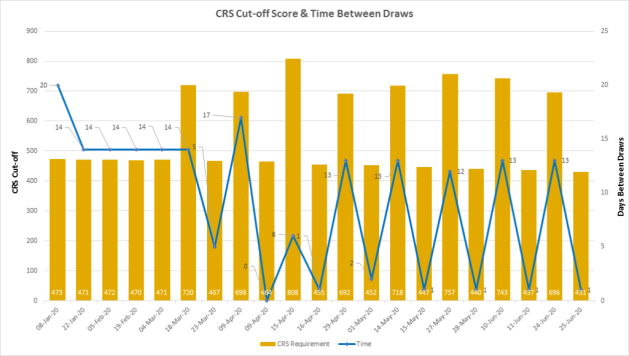
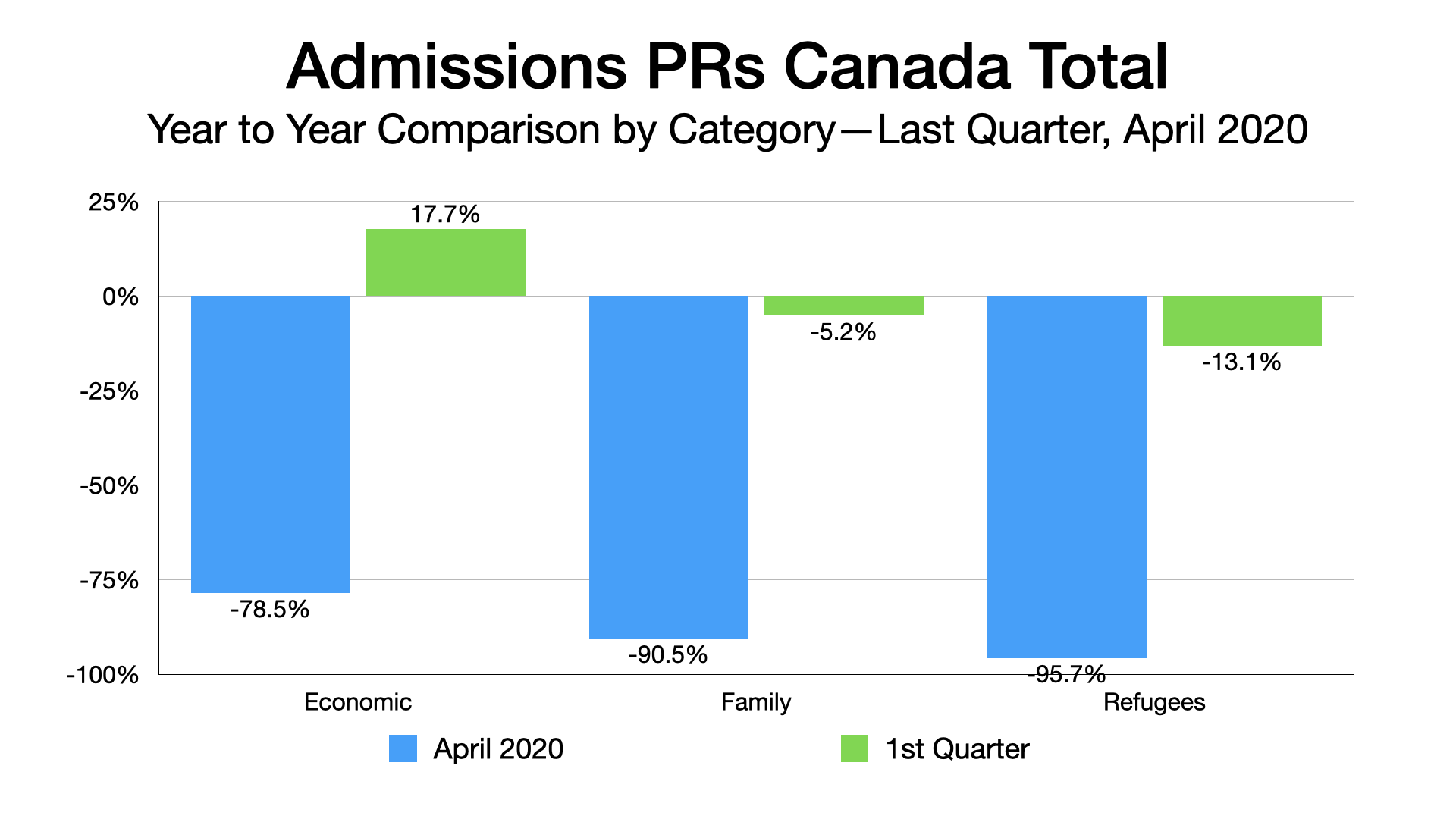
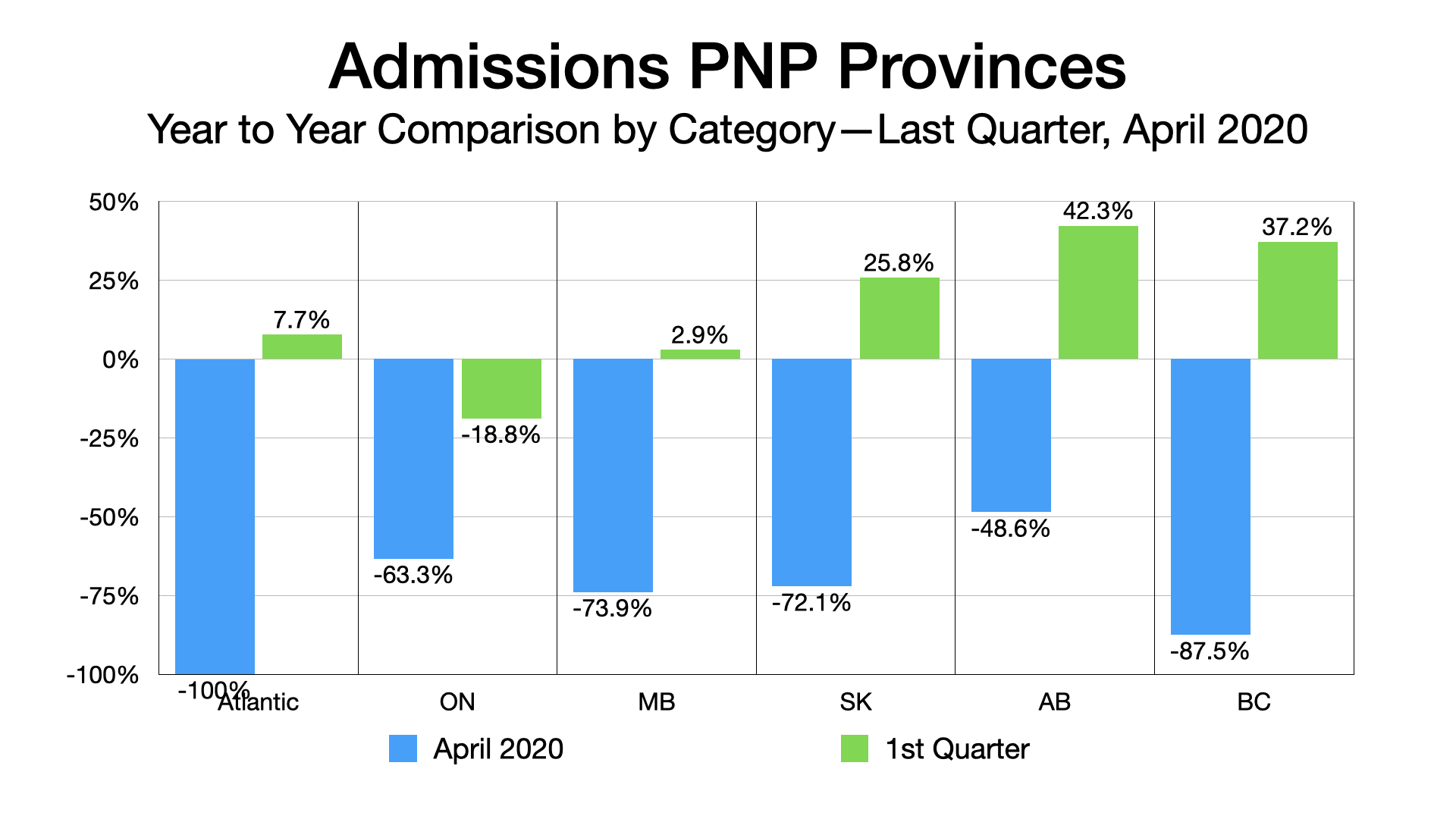
The following charts show the dramatic drop in actual admissions for the three immigration categories as well as a separate view for PNPs:

The first half of 2020 has been unlike any other period in the history of Express Entry. Canada saw both the largest and smallest Express Entry draws ever as a result of the coronavirus pandemic.

Immigration, Refugees and Citizenship Canada (IRCC) held the biggest Express Entry draw ever on February 19, inviting 4,900 candidates in a single draw.

A few weeks later, on March 12, the new immigration minister, Marco Mendicino, announced that Canada would welcome over one million immigrants by 2022, many of whom would arrive through Express Entry.

Just a few days later, March 18 would change many things for hopeful Canadian immigrants. Coronavirus was becoming a bigger threat within Canada, and so the federal government closed the border to most foreign travel. The future of Express Entry was up in the air.

Find out if you are eligible for any Canadian immigration programs

More Express Entry draws during pandemic

It was quickly established that Canada would continue to hold Express Entry draws, and Minister Mendicino said that immigration would be key to economic recovery.

Express Entry draws changed significantly. The all-program draws, which includes candidates from the Foreign Skilled Worker Program (FSWP), Federal Skilled Trades Program (FSTP), and Canadian Experience Class (CEC), were no longer held every two weeks. Instead, two draws would be held within days or hours of each other. One would target Provincial Nominee Program(PNP) recipients, and the other would only invite people from CEC. These draw pairings would take place roughly every two weeks.

As a result, there have been 21 draws held as of today, including the June 25 Express Entry draw. Last year, 2019, there were 12 draws held in the same time frame.

However, more Invitations to Apply (ITAs) have been issued this year compared to the same time last year.  This year 49,900 ITAs have been issued in the first half of 2020, whereas 2019 saw 41,800 ITAs issued at the mid-year point.


The differences in PNP and CEC draws

PNP draws would always be smaller than CEC draws, and they would have higher Comprehensive Ranking System (CRS) score requirements.

This is because a provincial nomination automatically gives candidates an extra 600 points in addition to their human capital score. The lowest CRS requirement of a PNP draw this year was 692 on April 29. This means, without the nomination, recipients only needed a human capital score of at least 92 in addition to the requirements of the PNP that awarded them the nomination.

The smallest Express Entry draw ever was a PNP draw that issued 118 ITAs on April 15. It also had the largest CRS cutoff of the year at 808. This is still not the biggest CRS requirement of all time, which was 886 in the first Express Entry draw ever on January 31, 2015.

CEC candidates must have at least one year of skilled work experience in Canada, meet the Canadian Language Benchmark (CLB) required in their field, and live outside of the province of Quebec.

Express Entry draws that targeted CEC candidates this year were comparatively bigger and had much smaller CRS requirements.

FSWP and FSTP candidates were not drawn unless they had a provincial nomination. IRCC said they are prioritizing programs like CEC and PNP for the number of candidates that are currently in Canada.

IRCC has not said when FSWP and FSTP candidates will once again be included in Express Entry draws.

Nonetheless, Express Entry candidates currently outside of Canada who do not have Canadian work experience or a Canadian job offer are still receiving ITAs through Express Entry-linked PNP draws.

Express Entry-linked PNP draws

Alberta has held a total of 11 Alberta Express Entry Stream draws so far this year, at least six of them took place after the March 18 travel restrictions went into effect. Candidates invited on the latter dates had to be in Canada at the time of their nomination, as part of Alberta’s temporary measures against coronavirus.

B.C. continues to hold draws weekly, though certain draws were affected by business closures resulting in some occupations being left out of draws. Candidates were invited from both the Express Entry BC and Skills Immigration categories

Manitoba started off the year with the first PNP draw on January 2. In total Manitoba has held 12 draws so far, with seven of them taking place during the travel restrictions. A number of Express Entry candidates were invited in each draw.

Nova Scotia has held two Labour Market Priorities draws. The first inviting Express Entry candidates who could demonstrate French and English proficiency, among other eligibilty criteria. The second invitation round was for candidates who had work experience in nursing.

Ontario has held eight draws that invited Express Entry candidates, most of them during the travel restrictions. There were also two Express Entry Human Capital Priorities stream draws, and two Tech draws. Invitation rounds for candidates who may be eligible for the French Speaking Skilled Worker, and Express Entry Skilled Trades streams happened within one day of each other on two occasions.

Prince Edward Island normally follows a predetermined schedule for its PNP draws, however due to coronavirus, draws were re-scheduled in March, April, May and June. The draws they have held so far targeted Express Entry candidates who worked in essential services such as healthcare and trucking.

Saskatchewan has held five Express Entry-linked draws this year. The province is allowing some flexibility for nominees and applicants who are unable to submit completed applications, or whose circumstances had changed due to coronavirus.

Express Entry in the next half of 2020

A lot will be determined before the end of the month, as the current travel ban restrictions are in effect until June 30. Prime Minister Justin Trudeau is due to make the announcement in the coming days.

In a new TV interview, minister Mendicino reiterated that Canada will continue to rely on Express Entry and other streams to welcome global talent from all over the world.

Source: Express Entry mid-year 2020 report: The Coronavirus Impact

Donald: Give us your wired masses, yearning to breathe free

Intriguing idea of Scott Gilmore (have seen similar suggestions from India and Europe):

Two historic developments have aligned to create a momentary and monumental opportunity for Canada.

First, we are weathering a global pandemic that has dramatically changed the way the world works. Suddenly, we are all discovering that the technology exists to allow many of us to work remotely, and to continue to be effective doing so. In fact, experts are predicting a sizeable portion of the workforce will choose not to return to the office when this is over.

At the same time, a tide of nationalism has risen in many western countries such as the United Kingdom and the United States. There, governments are making it increasingly difficult for immigrants to arrive or to stay.

For example, President Donald Trump signed an executive order that cancels the H-1B visa category, which permits highly skilled workers, who have already been offered a job by an American company, to live and work in the United States. American economists and CEOs are horrified at the decision. Without these well-trained immigrants, Silicon Valley would still be pastureland.

And here is Canada’s golden opportunity: we should immediately offer residency to all 85,000 holders of H-1B visas, permitting them to live in Canada while they work remotely for their current employers in the United States.

The benefits to Canada are numerous and obvious. To begin with, this would not take any existing jobs from Canadians. There are legitimate (albeit mostly misplaced) concerns that our current unemployment crisis would be exacerbated by increased immigration. Holders of this visa would be permitted to remain only if they have a full-time job in the United States (or another foreign country) that can be performed remotely.

It would give Canada an instant boost in revenue. These new arrivals might be working in the U.S., but they’d be paying their taxes and spending their paycheques here. Our services industry is in desperate need of a boost, and with international travel facing a long recovery, relying on foreign tourism will not be enough. We can replace that by effectively transplanting billions in household spending that is currently rooted south of the border.

This new visa class would be a tremendous boost to our pool of creative and productive talent. Canada has traditionally been a runner up when it comes to attracting the world’s best and brightest. This has gradually been changing, but this new visa could accelerate the shift. We would inject some of the world’s brightest minds into our cities, and if the visa provided a pathway for citizenship, we could hold on to that talent and all the benefits it would bring.

As many public policy experts, demographers, economists and others have pointed out, we need more Canadians. We have an ageing population that will produce relatively less tax revenue to support a growing number of elderly people. And if we want to achieve our full potential, we need a critical mass of talented citizens to do so. This is an argument that has been best made by Globe and Mail writer Doug Saunders in his recent book ‘Maximum Canada’. This visa class is one of the easiest paths towards that goal. The U.S. government has basically pre-screened all these immigrants, vetted them for security and health issues, confirmed they are employable, and socialized them to living in a western democracy. We should be paying Washington for the privilege of taking these people off their hands.

This visa would be an obvious blessing for the would-be immigrants. Unwelcome in the U.S. and facing unemployment, they will be greeted warmly here and allowed to continue to do their work and even remain in the same time zone. What’s more, they will benefit from Canada’s high quality of life, and excellent (but improvable) health-care system.

They will also discover that the American Dream has moved north. Compared to the United States, Canada now has higher rates of employment, education and homeownership. We even have longer lives and more vacation days. And while working from home is not ideal, all of our major cities now have ample shared workspace facilities.

This visa is even good for American employers. First and foremost, they get to keep their talent. And, they would no longer have to pay extravagant health insurance costs. Even Donald Trump would welcome this move. In his mind, out of sight is out of mind and these would be just one less class of immigrants to worry about.

We could call this an IWFC: an International Work From Canada visa and offer it to more than just H-1B candidates. If someone has a high paying job in Paris that they can do on their laptop from Montreal, why wouldn’t we want them to do so? It is a new world, and we need to look at it from a new angle. As the global workforce shifts to tele-commuting, the idea of living in Whistler while managing a marketing team in San Jose is not only possible, it is logical.

If Canada were to seize this opportunity, we would have to do it fast. Other countries are likely considering something similar. Who wouldn’t? And, the American election is just months away. The political landscape could shift, and this incredible pool of talent might be allowed to remain in the U.S. Let’s act before then, let’s bring them home to Canada, before someone else puts out their own welcome mat first.

Source: Donald: Give us your wired masses, yearning to breathe free

Trump’s Freeze On H-1B Work Visas Disproportionately Affects Indians

Given the number of articles I have been seeing in Indian media, not surprising:

The Trump administration’s latest freeze on certain types of work visas, designed to protect American jobs during the COVID-19 crisis, is having a disproportionate effect on workers in India.

The executive order, signed Monday by President Trump, extends a ban on green cards issued outside the United States and adds several types of work visas to the freeze, including the H-1B visa for skilled workers. Last year, 72% of those visas were granted to Indians.

The change means tens of thousands of Indians who planned to come to the U.S. this year will have to scrap or delay their plans.

On Tuesday, Sunny Kumar Hirpara awoke in India to news of a temporary ban on his exact type of visa.

“I woke up at like 5 o’clock in the morning, and I saw the messages. I almost started crying,” Hirpara says.

Hirpara, 26, earned a master’s degree in the U.S. and landed a job as an electrical engineer in Irvine, California. In March, he returned to India to visit his parents and to convert his student visa to an H-1B, sponsored by his company. Then the pandemic hit. His paperwork was delayed.

“I’m sad that I invested five years studying in the U.S. and preparing for a job there,” says Hirpara.

Last year, nearly 280,000 Indians were granted H-1B visas or renewed them. New ones are capped at 85,000 annually. The process is now frozen through Dec. 31, 2020.

In some cases, families separated by the pandemic now face more time apart. Social media is flooded with pleas to lawmakers from H-1B holders who temporarily left the U.S. and worry they won’t be allowed back.

Many have advanced degrees and work for U.S. tech giants. Google CEO Sundar Pichai tweeted that he’s “disappointed” by Trump’s order. He was once an H-1B recipient from India.

“We as a country have been such a vibrant economy and society because of our ability to draw talent from around the world,” Nisha Biswal, president of the U.S.-India Business Council, tells NPR. “If we stop, I think that will adversely impact our ability to be at the top.”

India’s IT industry association called the freeze “misguided & harmful” and urged the U.S. government to shorten restrictions to 90 days. Some Indian IT companies with employees in the U.S. will also be affected.

Others, though, suggest that the visa freeze could be a boon to Indian companies, and even to the government.

“This is a fantastic opportunity,” Vikram Ahuja, co-founder of Talent500, a recruitment firm in the southern Indian city of Bengaluru, told India’s NDTV channel. He said working from home — now common during the pandemic — could change how tech companies hire.

“The world is changing, and I think as long as great companies seek great talent, then location and physical proximity becomes irrelevant,” Ahuja said.

He said H-1B visa holders could even still work for U.S. companies, but from home in India — thus paying into Indian tax coffers instead of U.S. ones.

Source: Trump’s Freeze On H-1B Work Visas Disproportionately Affects Indians

The theory of immigrants and foreign investors driving Canada’s property market is about to be tested

Yes indeed although interestingly the article focusses almost exclusively on the high end of the market, not the middle class suburbs which are home to so many immigrants:

Christine Zhu, a Toronto-based realtor, has not facilitated a single purchase or sale on homes since the start of the COVID-19 pandemic. Her clientele are almost exclusively Chinese nationals whose kids are either already international students in Canadian universities and high schools in Ontario, or are looking to begin school this fall.

In a regular spring market, she would have processed at least eight sales every month, mostly condominium units that Chinese parents would purchase for their children, in addition to numerous rentals. This season she’s spending her days on the phone with landlords, negotiating on behalf of students who have gone back to China, and have no idea when they will return, leaving their leased apartments vacant.

“One of my clients went back to China for Chinese New Year, and didn’t come back because there were no flights. He’s been paying for so many months, so the mother asked me if I can help negotiate with the landlord,” Zhu said. “This landlord was nice, he gave a 30 per cent discount. That’s the best I could do.”

There are approximately 640,000 international students in Canada — over 50 per cent of them are Chinese and Indian nationals who make up a significant part of the rental market in Canada’s largest cities. In a typical summer season, tens of thousands of new foreign students, landed immigrants and non-permanent residents looking for work arrive in Canada, seeking some kind of housing, either to rent or buy.

But with international travel frozen, multiple realtors and housing experts the Financial Post spoke to over the course of the week say that the lack of the usual immigration and travel pattern is starting to have a noticeable impact on the housing markets of Toronto and Vancouver. In particular, vacancy rates are rising in downtown rental markets, pushing prices lower, while luxury homes that usually attract rich foreign investors are struggling to be sold leading to price drops or, in some cases, court-ordered sales.

“Net migration numbers have fallen off pretty sharply, and the vast majority of non-permanent resident newcomers fall into the rental market. We’re likely to see vacancy rates go back up, but more likely rents are going to flatten out even more,” said Robert Kavcic, senior economist at BMO Capital Markets.

In April, the numbers of permanent residents admitted to Canada declined by 80 per cent from the year prior — just 4,140 were processed and admitted compared to 26,900 in April 2019, according to Immigration, Refugees and Citizenship Canada.

In Toronto, condo rentals are on the decline, falling 2.2 per cent on average from April 2020 to May 2020, according to data from apartment hunting site PadMapper. In Vancouver, one-bedroom apartments decreased 5.6 per cent and two-bedroom units decreased 15.8 per cent, the largest decline across the country, May 2020 data from Rentals.ca showed.

Kavcic believes the decline is partly attributed to immigration, but it’s still too early to quantify.

Razia Husein, a Toronto realtor whose clients comprise mostly wealthy foreigners or permanent residents residing abroad, says that she’s had trouble selling downtown condo units that some investors would buy in bulk in a typical year.

“I sell 8 to 10 units, either pre-construction or newly built, to one buyer (in different properties). Some are from India, some are from the United Kingdom, some are from Trinidad. I tell my clients to not put all their eggs in one basket.”

This year, Husein says she’s trying to facilitate sales on the phone, but it’s proving to be difficult. “They need to get on a plane and come and see a unit, or see the area. So I’m just doing a lot of rentals right now, I usually manage these investors’ properties, and find them renters,” she added.

When home prices skyrocketed in Toronto and Vancouver in early 2017, the prevailing notion was that foreign money was driving price increases, prompting provincial governments of both cities to slap a 15 per cent foreign buyers’ tax on purchases.

But a January 2019 report released by Statistics Canada using data from the Canadian Housing Statistics Program found that changes in property prices could not really be associated with any specific socio-demographic or economic factor.

Immigrants, for example, owned proportionally fewer single-detached houses than Canadian-born owners in both cities, but in Vancouver, immigrant owners had larger homes in more expensive neighbourhoods. Just 4.95 per cent of single-detached properties were owned by immigrants in Vancouver, while in Toronto that number was 4.71 per cent. In both cities however, immigrants owned more condominium units than Canadian-born owners.

“This idea that foreigners are the reason for our housing prices going up, is going to be tested out right now. There are no flights, and so the rich investors that went away for the winter, they’ve not come back. Yet, I see the market for single-detached houses is roaring right now,” said a real estate agent in Toronto whose clients are mostly high networth Iranians.

But David Chen, a realtor with the Vancouver-based boutique real estate firm Stilhavn Real Estate Services, whose clients are primarily from mainland China, notes a different trend in the wealthy community of West Vancouver that he attributes to the travel freeze — mansions worth $5 million or more are struggling to be sold because rich foreign investors are not available to go house shopping at the moment.

“Local buying and selling has picked back up and is strong. But in West Vancouver, we’re seeing the biggest price drop in years. It’s not unusual to see court sales for some of the bigger homes — it used to be maybe one in 200 homes in West Vancouver were sold through the court system, but now that’s about one in 80,” Chen said.

Between April 2020 and May 2020, the average home price in West Vancouver fell from $2.8 million to approximately $1.7 million, although it seems to have picked back up recently. Six-bedroom homes, that were worth more than $4 million just six months ago, are now averaging at $2.2 million, according to data from MLS, crunched by the real estate site Zolo.ca.

Local builders, according to Chen, build huge mansions for foreign buyers who usually make their purchases in the spring or summer months, but demand has fallen this season.

There’s scant Canadian data available on foreign buyers recent purchasing habits, but information from the Chinese-based website Juwai.com, estimated that in the first quarter of 2020, Chinese nationals made 26.5 per cent fewer buyer enquiries on Canadian property than in the fourth quarter of 2019. In Toronto, Chinese buyers made 34 per cent fewer enquiries on real estate in the first quarter of 2019.

Whether or not the immigration effect on Canadian real estate — though still anecdotal — will last, is a question that Zhu believes relates in some part to how the Canadian government will deal with the pandemic going forward.

She operates a WeChat account with roughly 500 Chinese parents whose kids are international students in Canada and their primary concerns have been the way in which Canada has responded to the virus.

“The mothers are scared. For many of them, this is their only child studying abroad,” Zhu said. “In China, they feel COVID-19 is being handled well, and Canada is next to the United States which for some of them causes worry.”

In terms of death count, Canada has had roughly double the number of COVID-19 related deaths compared to China, according to official numbers from both countries’ governments. While there have been new surges of the virus in and around Beijing, the Chinese government, at least based on public information, appears to have effectively controlled the spread by rapidly boosting testing and contact tracing.

Chen says some of his clients from mainland China have held off on purchasing condos in Vancouver because of concerns that a shared building ventilation system could be a COVID-19 related risk. “They are just going to wait it out for now, at least until flights from China resume,” he said.

BMO’s Kavcic believes that ultimately the housing markets of Toronto and Vancouver, Canada’s two most expensive cities, will be driven less by the behaviour of foreign buyers, newcomers and international students and more by the tension between demand and availability.

“This is a very unique shock. It has pulled people out of the market. Listings have come down as quickly as sales have. So the question is how much pent-up demand versus pent-up listings will there be when things go back to normal?”

Source: The theory of immigrants and foreign investors driving Canada’s property market is about to be tested
Ibbitson: Tens of thousands of Canadians won’t be born due to COVID-19

Some serious thinking needs to be done regarding alternatives to solely relying on immigration to address the aging demographics, as immigration alone, even at higher levels, won’t eliminate the trend.

One or two missed years won’t make much of a difference in the longer term, and a too quick return to the existing plan, at a time when large segments of our economy will likely take a number of years to recover, is setting up immigrants for failure.

Previous recessions have resulted in worse economic outcomes for immigrants that arrive during downturns:

One of the worst long-term consequences of the COVID-19 pandemic for Canada will be the tens of thousands who won’t be born, a loss to this country’s future.

To make up for that loss, and for the immigrants who were unable to come to Canada this year because of the lockdown, the federal government would need to increase its immigration target beyond 400,000 next year and in future years, which may be politically and logistically impossible.

The lost potential population – the work not done, goods not consumed, taxes not paid – will be felt for decades to come.

The Brookings Institution, a Washington think tank, released a report this month that concluded “the COVID-19 episode will likely lead to a large, lasting baby bust.”

Like most developed nations, the United States has a fertility rate well below the 2.1 children per woman needed to sustain the population. (The U.S. fertility rate is 1.7; Canada’s is 1.5.) Women are choosing to have fewer children, and to delay their first child until their late twenties or their thirties. (The mean age at which a woman has her first child in the U.S. is 27; in Canada, 29.)

Economic uncertainty can cause a woman to put off having her first child even longer, which may lead to her having fewer children than she originally intended. Examining past recessions and recoveries, the Brookings study found that “a one percentage point increase in the state unemployment rate led to a 0.9 per cent reduction in the birth rate.”

More than simple economic calculation is at work. “Economic pressures and uncertainty cause enormous pressure and stress within households and relationships,” said Judith Daniluk, professor emeritus at University of British Columbia, where she specializes in women’s sexuality and reproductive health.

“Surviving, much less rebounding from, this type of economic and existential crisis is challenging and takes time,” she told me, which can lead to “some women being unable to bear a child when they have regained their economic and relational footing, or in having fewer children than they had hoped.”

Based on projected unemployment levels resulting from the coronavirus lockdown, and a drop in fertility that accompanied the Spanish flu pandemic of 1918-19, the Brookings study concluded that “we could see a drop of perhaps 300,000 to 500,000 births in the U.S.” in 2021.

Since Canada has about one-tenth the population of the United States, and the unemployment rate is similar (13.3 per cent in May in the U.S.; 13.7 per cent in May in Canada), we can expect to lose on the order of 30,000 to 50,000 babies next year – the equivalent of West Vancouver (population 42,694) or Belleville, Ont. (population 50,720) in the number of babies not born.

The fewer babies that are born each year, the more immigrants who are needed to replace them. The alternative is a shrinking and aging population, with too few workers and taxpayers available to fill vacant jobs, to power the economy through consumption, and to support the pension and health-care needs of the elderly.

The Trudeau government had planned to welcome 341,000 permanent residents this year and 351,000 in 2021. But with the year half over, and immigration essentially frozen through border closings, Immigration Minister Marco Mendicino faces a difficult choice when he presents his immigration update this fall.

To prevent an overall drop in immigration, he will have to increase next year’s intake to compensate both for immigrants who didn’t arrive in 2020 and for babies not born.

But a target between, say, 400,000 and 500,000 would strain the resources of the department and of settlement services, and intensify protests from those who believe Canada is bringing in too many newcomers as it is.

Compensating for lost intake could be staggered over several years. Even so, we may be forced to accept that many thousands of people who should be with us in the years to come won’t be.

“That will be yet another cost of this terrible episode,” the Brookings report concludes.

To limit that cost, this Liberal government should do everything within its power to bring in as many new Canadians as it possibly can in the years ahead.

Source: https://www.theglobeandmail.com/politics/article-tens-of-thousands-of-canadians-wont-be-born-due-to-covid-19/