Inside Trump’s Immigration Order To Restrict Chinese Students

Reading this interview, one has the impression that this is more virtue signalling to the base rather than addressing legitimate security concerns, like so many of the Miller/Trump immigration policies:

On May 29, 2020, Donald Trump issued a presidential proclamation aimed at restricting the entry of graduate students and researchers from China. It is the latest immigration action to make it more difficult for foreign-born individuals to live, work or study in the United States.

In the 2018-19 academic year, there were 272,470 undergraduate and graduate students from China enrolled at U.S. universities, 84,480 of whom were in a graduate-level science and engineering program, according to the Department of Homeland Security. China is the number one source of international students to the United States.

To better understand the new policy and its implications, I interviewed Jeffrey Gorsky, senior counsel at Berry Appleman & Leiden LLP and former Chief of the Legal Advisory Opinion section of the Visa Office in the U.S. Department of State.

Jeffrey Gorsky: The proclamation bars the entry of or the issuance of visas to Chinese students to the United States who are in “F” or “J” status in graduate-level programs and who are or had been associated with PRC (People’s Republic of China) entities involved with the PRC’s “military-civil fusion strategy.” The proclamation defines that strategy as “actions by or at the behest of the PRC to acquire and divert foreign technologies, specifically critical and emerging technologies, to incorporate into and advance the PRC’s military capabilities.”

The proclamation also calls on the State Department to consider using its visa revocation authority to revoke previously issued visas in this category and directs the State Department and Department of Homeland Security (DHS) in the next 60 days to review possible immigration measures for other immigrant and non-immigrant visa classifications to deal with this issue.

The proclamation, which applies to persons in graduate-level programs, does not indicate whether the restrictions will apply to students seeking to enter the United States to work under post-graduation Optional Practical Training (OPT).

The most significant portion of this proclamation may be the part calling on the State Department to consider revoking visas. The State Department has practically unlimited legal authority to revoke a visa – the law says the Secretary of State may revoke a visa in his discretion at any time. The State Department will often revoke a visa if there is any concern about immigration eligibility, requiring the affected person to reapply so that the case can be fully vetted. The State Department may now follow up with widespread revocation notices, which will not affect people in the U.S. but would bar students outside the U.S. from returning until they receive a new visa.

Anderson: What should a Chinese student inside the United States do if they or their institution receive a notice that a visa has been revoked?

Gorsky: A visa revocation will prevent the student from traveling into the United States but will not have any effect on the student’s legal immigration status in the U.S. When students are admitted into the United States, they are given at the border a legal authorization to remain so long as they properly maintain their student status. Students are normally admitted at a port of entry for “duration of status.”

A visa is a travel document – it allows them to travel and apply to enter the United States, and is only for travel. If an individual’s visa is revoked, then he or she cannot travel back to the United States, but the authorization the individual received when first entering the country is not affected by the visa revocation as long as the person maintains student status. Although in theory a visa revocation can be used as the basis to put someone in removal proceedings, that authority is rarely used because it can be challenged in court.

Anderson: What is the best advice for current Chinese students and researchers who are already in the United States?

Gorsky: As long as the students remain in the U.S. in valid student status they should not be affected by the revocation even if the student receives a revocation notice.

Anderson: What do you think will be the practical impact of this policy on Chinese graduate students who apply for visas?

Gorsky: For students in valid status in the United States this will have little practical impact if they do not leave the country, for the reasons discussed earlier related to duration of status.

For those outside the country, if you are a graduate student from China currently not in the United States, at present (and this is not related to the new proclamation) you cannot apply for a visa now because visa processing has been suspended worldwide due to Covid-19 concerns.

Anderson: Once visa processing resumes, if the presidential proclamation remains in effect, what could a graduate student from China attempting to obtain a new visa to study in a science or engineering program in the United States expect?

Gorsky: The State Department has not issued guidance on how it will implement the new restrictions. It is likely consular officers will deny at the time of the interview those applications they determine meet the criteria cited in the proclamation and put any other questionable but not clearly deniable case into “administrative processing” while the case is sent for interagency clearance.

This will likely result in a significantly higher denial rate as well as more processing delays as the additional cases sent in for clearance clog up the interagency clearance system. Given the strict time frames of academic semesters, even delays in processing could effectively preclude students from beginning (or continuing) an academic program.

Anderson: In June 2018, the State Department started limiting the validity of student visas for Chinese nationals in graduate programs in what the department defined as sensitive subjects to one year, as opposed to the normal five-year validity. How does this new proclamation differ from existing U.S. visa policy?

Gorsky: This will be a much blunter tool than the current policy. There has been a longstanding procedure in place to vet and screen out students who present concerns about the transfer of sensitive technology.

U.S. immigration law contains a provision that renders ineligible for a visa or admission to the United States any alien who a consular or immigration officer knows or has reason to believe seeks to enter the United States to engage solely, principally or incidentally in any activity that violates or evades any law prohibiting the export from the United States of goods, technology or sensitive information. The State Department has an interagency clearance program in place called the “MANTIS” clearance process to determine whether students are involved in programs related to the Technology Alert List (TAL).

The broader language of the proclamation, which applies even to students who had minor and decades-old associations with PRC entities, could affect students who would otherwise be cleared in the MANTIS process and unnecessarily restrict access to the United States of talented students who make important contributions to U.S. academic institutions and America as a whole.

Anderson: What authority did the president use to issue the proclamation?

Gorsky: The president relied on his authority under section 212(f) of the Immigration and Nationality Act (INA), which authorizes him to bar the entry of foreign nationals by proclamation upon a finding that their entry would be detrimental to U.S. interests, and similar authority under INA section 215(a). It is the same authority that he has used for multiple travel bans. This administration’s extensive use of the 212(f) authority, which has existed since 1952 (similar authorities date back to the Alien Enemies Act of 1798), is unprecedented.

Anderson: Do you expect the proclamation to have an impact on U.S. universities and employers?

Gorsky: The impact will be somewhat limited in that it will not affect current students. The worldwide suspension of visa processing remains in effect, and it is not clear whether the State Department will resume processing in time to bring in new students in general. If visa processing is resumed, this will have a significant impact on the entry of new graduate students from China.

Anderson: Do you think by blocking some number of Chinese graduate students this proclamation will protect U.S.-made technology or, as some critics say, be more likely to harm efforts in America to innovate and produce important research?

Gorsky: There is already a longstanding program in place to vet potential students based on concerns over the transfer of sensitive technologies. This proclamation will exclude persons from the United States based on past or minor associations with PRC entities even if the individuals pass the interagency clearance process.

The proclamation will damage the exchange of knowledge and talent. It may inhibit the ability of the PRC to access some technology that may have military implications but the Chinese military will have other sources in other countries. America will lose out on a valuable talent pool and the financial and scientific contributions these students make to U.S. universities and the United States.

Source: Inside Trump’s Immigration Order To Restrict Chinese Students

Canada immigration intake expected to fall by half due to COVID-19

RBC report is getting some well-deserved attention. Will have better sense of likely numbers once we have a few months data but estimates appear reasonable, as well as regions and programs more affected:

Canada’s annual immigration intake is expected to decline in 2020 by half from last year’s levels as a result of the global pandemic, raising concerns over the impact on the country’s newcomer-fuelled economy.

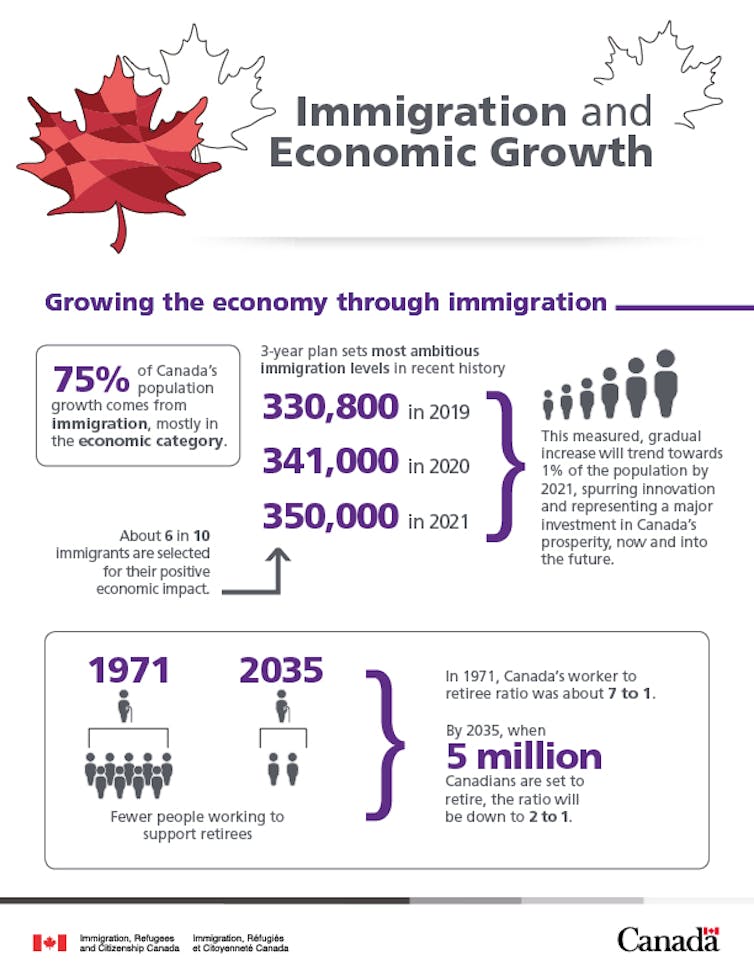
Canada welcomed 341,000 permanent residents in 2019 and was set to usher in another 370,000 this year, but that number is forecast to be down by as many as 170,000, according to a RBC report released Friday.

First-quarter immigration data on arrivals all indicated drastic decreases in the number of permanent residents, migrant workers and international students.

“The disruption will reverberate across the economy, given our reliance on immigration for labour-force growth and to offset Canada’s aging demographic,” warned the analysis by RBC senior economist Andrew Agopsowicz.

“Among the potential casualties: industries with labour shortages, urban rental and housing markets, and university budgets. Canada will need a younger and growing population to maintain growth and support the unprecedented expansion of the fiscal deficit that came in response to the crisis.”

In March, Ottawa had set a target to bring in 370,000 new permanent residents this year, up from 341,000 in 2019. Just days after the announcement, concerns about the spread of COVID-19 prompted the federal government to impose travel restrictions.

Although these health and safety measures only started in Canada in mid-March, the impacts of the pandemic on immigration had already been felt in other parts of the world, resulting in the disruption of visa services and travels.

These early immigration numbers may be an indication of what is to come as the global pandemic is expected to last through at least this fall, if not longer:

  • Permanent resident entries were down 30 per cent in March versus a year earlier.
  • Temporary foreign worker admission in the agricultural sector fell 45 per cent in March from a year earlier.
  • The number of students entering on study visas fell 45 per cent in March from a year earlier.

“If these restrictions last all summer, we expect to see 170,000 fewer permanent residents entering the country in 2020 than planned — all in a year in which Canada was supposed to welcome a record number of newcomers,” said the report.

“While temporary foreign workers are exempt from entry restrictions, fewer are coming. The overall number of TFWs entering Canada in March was down 35 per cent versus the same month last year. In the agriculture sector — where they represent a key source of labour — the drop was an even sharper 45 per cent.”

Agopsowicz cautioned that Canada’s international education sector is also taking a huge hit, with fall enrolments expected to be down sharply amid travel restrictions and a broad, possibly permanent shift to remote learning.

In 2018 alone, international students pumped $21.6 billion into schools, communities and the broader Canadian economy.

At University of Toronto, for instance, international enrolments has doubled since 2010 to 25 per cent of the student body. If just one-fifth of its foreign students opt not to study in Canada this year, said the report, it could mean a shortfall of around $200 million on a $3 billion budget.

“That reduction could also hurt the small businesses and landlords who depend on these students for revenue,” it said. “A decline in foreign students could also affect what’s been an important source of new permanent residents.”

Canada’s immigration selection system has increasingly favoured international students, with their Canadian academic credentials and work experience. In 2019, some 11,000 new permanent residents had previously studied in Canada.

Last year, Canada’s population grew by 1.6 per cent or 580,000 people, with immigrants accounting for more than 80 per cent of the growth, said the report. While 30 per cent of the overall population is at least 55, only 8 per cent of immigrants are.

“Even before the pandemic, Canada relied on immigration to offset the fiscal challenge posed by an aging population,” the report noted. “With the tab of fighting COVID-19 already nearing $160 billion, Canada needs a growing labour force more than ever.”

Source: Canada immigration intake expected to fall by half due to COVID-19

UK could offer ‘path to citizenship’ for Hong Kong’s British passport holders

Canada may well have to prepare for a return to Canada of Canadian expatriates, whether of Hong Kong or other ancestry, as well as a likely increase in immigration demand as the situation continues to deteriorate as it appears unlikely China will change course:

The UK could offer British National (Overseas) passport holders in Hong Kong a path to UK citizenship if China does not suspend plans for a security law in the territory, UK Foreign Secretary Dominic Raab says.

It comes after China’s parliament backed proposal that would make it a crime to undermine Beijing’s authority.

There are fears the legislation could end Hong Kong’s unique status.

China said it reserved the right to take “countermeasures” against the UK.

Foreign ministry spokesman Zhao Lijian said the UK and China had agreed that holders of British National (Overseas) – or BNO – passport should not enjoy UK residency.

“All such BNO passport holders are Chinese nationals and if the UK insists on changing this practice it will not only violate its own stance but also international law,” he added.

There are 300,000 BNO passport holders in Hong Kong who have the right to visit the UK for up to six months without a visa.

Mr Raab’s statement came after the UK, US, Australia and Canada issued joint condemnation of Beijing’s plan, saying imposing the security law would undermine the “one country, two systems” framework agreed before Hong Kong was handed over from British to Chinese rule in 1997.

The framework guaranteed Hong Kong some autonomy and afforded rights and freedoms that do not exist in mainland China.

China has rejected foreign criticism of the proposed law, which could be in force as early as the end of June.

Li Zhanshu, chairman of the parliamentary committee that will now draft the law, said it was “in line with the fundamental interests of all Chinese people, including Hong Kong compatriots”.

What did Raab say?

British National (Overseas) passports were issued to people in Hong Kong by the UK before the transfer of the territory to Chinese sovereignty in 1997.

Announcing the possible change in policy, Mr Raab said the six-month limit on stays in the UK for BNO holders would be scrapped.

“If China continues down this path and implements this national security legislation, we will remove that six month limit and allow those BNO passport holders to come to the UK and to apply to work and study for extendable periods of 12 months and that will itself provide a pathway to future citizenship,” he said.

The BBC’s diplomatic correspondent James Landale says that in Beijing might not mind if some pro-democracy campaigners escape to the UK, but the flight of talented wealth creators would be of concern.

Some MPs want the UK to go further and offer automatic citizenship. Conservative MP Tom Tugendhat, chairman of the foreign affairs select committee, said BNO holders should have an automatic right to live and work in the UK.

The government has in the past rejected calls to give BNO holders in Hong Kong full citizenship.

Last year more than 100,000 people in Hong Kong signed a petition calling for full rights. The government responded by saying that only UK citizens and certain Commonwealth citizens had the right of abode in the UK and cited a 2007 review which said giving BNO holders full citizenship would be a breach of the agreement under which the UK handed Hong Kong back to China.

However in 1972 the UK offered asylum to some 30,000 Ugandan Asians with British Overseas passports after the then-military ruler Idi Amin ordered about 60,000 Asians to leave. At the time some MPs said India should take responsibility for the refugees, but Prime Minister Edward Heath said the UK had a duty to accept them.

What other reaction has there been?

Shadow Foreign Secretary Lisa Nandy earlier said the UK had to be more robust with Beijing.

Referring to the security law, she told the BBC: “This is the latest in a series of attempts by China to start to erode the joint declaration which Britain co-signed with the Chinese government when we handed over Hong Kong, and protected its special status.”

“We want to see the UK government really step up now,” she said.

Former Foreign Secretary Jeremy Hunt said the UK should bring together a coalition of countries to avoid a tragedy in the territory.

He told the BBC: “This is definitely the most dangerous period there has ever been in terms of that agreement.

“With our unique legal situation, Britain does have a responsibility now to pull together that international coalition and to do what we can to protect the people of Hong Kong.”

On Thursday Prime Minister Boris Johnson’s official spokesman told a Westminster briefing: “We are deeply concerned about China’s legislation related to national security in Hong Kong.

“We have been very clear that the security legislation risks undermining the principle of one country, two systems.

“We are in close contact with our international partners on this and the Foreign Secretary spoke to US Secretary [Mike] Pompeo last night.”

He added: “The steps taken by the Chinese government place the Joint Declaration under direct threat and do undermine Hong Kong’s high degree of autonomy.”

On Wednesday, Mr Pompeo said developments in Hong Kong meant it could no longer be considered to have “a high degree of autonomy” from mainland China.

This could lead to Hong Kong being treated the same as mainland China under US law, which would have major implications for its trade hub status.

Source: UK could offer ‘path to citizenship’ for Hong Kong’s British passport holders

COVID-19 can’t be used as an excuse to limit skilled immigration

More commentary in the US business press on the risks to the US economy of restrictions on high-skilled immigration (H-1B and OPT:

Memorial Day is an excellent opportunity to celebrate the contributions immigrants have made to America. However, worrying news has emerged that the Trump administration plans to limit highly skilled immigration in an attempt to goose employment.

Such a policy shift would not only be deleterious to our nation, but an ill-founded solution to spiraling unemployment.

From the earliest days of the republic, immigrants have been vital to our national identity. Hot dogs andhamburgers are products of immigrants, and immigrants have played a part in founding iconic American companies like Google, Tesla, and Uber. But now, the administration and some lawmakers are using the coronavirus crisis as an excuse to tear down programs that have helped bring talented workers and students to the U.S., where they are crucial contributors to our economy.

The two most prominent programs being targeted are H-1B visas and Optional Practical Training, or OPT. H-1B visas allow U.S. employers to temporarily hire foreign workers in occupations that require specialized knowledge and skills, with stays ranging from three to six years. OPT allows foreigners with student visas to work in the U.S. following graduation for periods between one and three years, depending on their field of study.

Restricting these programs could have an enormous impact on the tech and engineering fields. Many leading U.S. companies were founded by immigrants and depend upon these programs to employ talented international students and workers. About 18% of the entire labor force is foreign-born, with one in four STEM workers being an immigrant, according to an American Immigration Council analysis of American Community Survey data.

Furthermore, more than half of startups with revenues of $1 billion or higher have immigrant founders or cofounders, according to a National Foundation for American Policy study. And immigrants or children of immigrants are responsible for founding or cofounding 45% of 2019’s Fortune 500 companies, per New American Economy.

International students, who make up over 5% of American university students with more than 1 million studying here, contributed about $45 billion to the U.S. economy in 2018, according to the Institute of International Education.

Our health care system will also be at risk from a policy change. The pandemic has highlighted the role of health care workers in our society, so limits on highly skilled immigration could have fatal consequences for Americans.

Colleges are already fearing the impact of COVID-19 on enrollments and endowments; we are simply not in a financial position to reject qualified students who dream of studying and working in our nation.

To be sure, some schools operate as irresponsible “visa mills” that trade a substandard education for work opportunities in the U.S. But that problem can be solved by not extending H-1B and OPT authorization to students from those colleges and universities.

COVID-19 has had a devastating impact on all of us, but this crisis should not be used as an excuse to allow xenophobia to stifle our future growth. The U.S. has been and always should be a nation of immigrants. Now more than ever, we must remember the importance of immigration, which has fueled technological ingenuity and economic productivity for our entire history, shaping America’s character as a symbol of freedom and innovation.

Welcoming highly skilled and talented foreign students and workers is our best path to promoting employment of native-born Americans. We need great minds from all corners of the world to preserve America’s technological prowess, social diversity, and economic vitality. Preserving the H-1B and OPT programs will benefit us all.

Source: COVID-19 can’t be used as an excuse to limit skilled immigration

After slashing immigration, Quebec turns to immigrants to fill shortage in long-term care homes

Welcome and needed change:

Immigration Minister Simon Jolin-Barrette, who cut immigration levels during the CAQ’s first yearin power, has announced a plan to recruit immigrants to work as orderlies in the province’s long-term care homes.

“The needs are immediate,” Jolin-Barrette said at a news conference Thursday.

The pilot project to bring in 550 experienced health-care workers is part of a series of reforms to the Quebec Experience Program, or PEQ, which provides foreign students in the province and temporary workers with a fast track to permanent residency.

Since 2013, Quebec has only recruited 115 orderlies through the PEQ — a program which Jolin-Barrette tried to reduce last year as part of his immigration cuts but was forced to roll back after a flurry of criticism.The province’s long-term care institutions, known by their French initials as CHSLDs, have been short-staffed for years and face the prospect of an even more acute shortage in the fall, when experts believe a second wave of COVID-19 infections is likely to hit.The Canadian military has said it will pull soldiers from the homes before then.

Legault aims to recruit Quebecers, too

On Wednesday, Premier François Legault presented a plan to hire 10,000 more CHSLD employees by the fall.

The government is offering prospective employees $21 per hour to take a three-month training program over the summer.

If they complete the program, the trainees’ starting salary will be $26 per hour — which works out to $49,000 a year. The orderlies, known in French as préposés aux bénéficiaires (PABs), provide much of the daily care in CHSLDs.

“The problem of the préposés aux bénéficiaires is not from yesterday. It exists for years and years and years,” said Marguerite Blais, the minister responsible for seniors,Thursday.This isn’t the first time Blais has promised to address the worker shortage. In 2019, she announced a plan to hire 30,000 orderlies over the next five years.Blais now suggests people in fields like aerospace who find themselves out of work might be tempted to take on a new line of work in long-term care homes.

Blais echoed Legault, who on Wednesday asked “all Quebecers that can to consider it very seriously.”

Facing criticism over the crisis in long-term care homes, Seniors’ and Caregivers’ Minister Marguerite Blais vows to protect vulnerable people 0:43

The vast majority of orderlies in CHSLDs are women — 34,821 of 42,340 in both private and public facilities. Their average salary in 2019 was $40,551.

The Health Ministry did not immediately return a request for a breakdown of how many of those employees are recent immigrants.

Plan for asylum seekers in the works

Hundreds of orderlies are asylum seekers working on temporary visas while they await a final ruling on their refugee applications.

While the province says it has no record of the total number of asylum seekers working in CHSLDs, the Maison d’Haiti in Montreal’s Saint-Michel district estimates that about 1,200 of the 5,000 Haitian asylum seekers the organization has helped since 2017 have become orderlies.

Legault had previously rejected the idea of giving any kind of preference to asylum seekers and others without status working in essential jobs during the pandemic. But there have been growing calls for him to recognize their contribution, including a rally last weekend and a petition backed by the NDP.

Earlier this week, the premier said he will now consider giving asylum seekers who work in CHSLDs a chance to stay in the province by applying as economic immigrants — the class of immigration that Quebec controls.

Legault said he asked his immigration minister to look at the situation of those workers, on a case-by-case basis, as a way of saying “thank you.”

Jolin-Barrette said he is looking into the matter and is in discussions with the federal government, which oversees refugee applications.

As for the program to attract new immigrants to Quebec to work as orderlies, full details will be announced later, along with plans to advertise in foreign countries.

Source: After slashing immigration, Quebec turns to immigrants to fill shortage in long-term care homes

For a sobering account of just how bad the situation is, see this account:

Dear Premier François Legault,

I am inviting you to leave the safe confines of your office and join me on the front lines of what even you have described as a “national emergency.” Come spend a day with me inside a long-term care home, known in French as a CHSLD.

As a journalist who covered Quebec politics before heading to law school, I learned about the challenges facing this province’s elder care system long before the pandemic. And I know you, like all politicians, were aware, too.

I volunteered to work because you asked people to step up. For the past five weeks, myself and many others who answered your call have been working as assistant patient attendants, a paid position, at one of the Montreal CHLSDs hit hard by COVID-19.

I have been stunned, shocked and moved. I am asking you to come see first-hand what is happening. It will change the way you view this crisis and elder care forever. I know, because that is what happened to me.

You would, of course, wear the full ensemble of personal protective equipment: medical mask, plastic visor, gloves and gown, as we do every day to protect ourselves and our residents. On a regular day, these layers can suffocate. Imagine how we have felt during this week’s heat wave, without air conditioning. Yes, there may be air conditioners in common areas, but on the floor where I worked earlier this week, it wasn’t on.

If you joined us, you would see that our seniors are currently receiving the bare minimum level of care. Where I work, assistant patient attendants, like me, patient attendants, and soldiers are constantly feeding, changing diapers and washing. Nurses provide medication. Doctors are on hand during the day, often moving between floors.

But nothing else is happening beyond moving residents from their bed to their wheelchair — and sometimes, even that does not happen.

You could watch how a Canadian Forces soldier, who has traded in a uniform for scrubs, gently feeds a elderly woman who needs total help, carefully and patiently placing each spoonful of food in her mouth.

You could help wash a resident’s hair — hair that has not been washed in weeks.

You would hear how we try to console and reassure a distraught resident who has just received a positive COVID-19 diagnosis. You would see the thick, bright red tape I have to unroll to mark a huge X beside her door to indicate that her room is now a hot zone, while the resident sobs in the background.

You would learn how to prepare the body of a deceased resident with a sheet of white plastic for travel to the morgue. And then you would pack that resident’s personal belongings into garbage bags, label them with a Post-It note and pile them in a maintenance closet.

You would try to explain to residents with varying degrees of dementia when this will all be over, and why their loved ones can’t visit them. After 11 weeks of this crisis, repeating “it’s going to be all right” (ça va bien aller in French) starts to lose its punch.

You would see how a team of people tries to figure out where to place red, yellow and green tape on the floor of a hallway to indicate hot, caution and safe zones to prevent further infection.

We called that floor “the jungle,” a reference to the steps and care we have to take when travelling between positive and negative areas so as to not contaminate residents who are negative. Despite our best efforts, every resident on that floor was infected by the end of the week.

You would see how some of the problems that started this crisis are creeping back. For example, last week on one of my floors, there was only one patient attendant available for 33 residents. Luckily, four of assistant patient attendants were on hand to help.

Above all, you would see people from all walks of life, soldiers, and staff giving their all to make a difference in this humanitarian crisis.

I never thought I would see, in Canada, the kind of desperation, fear and anxiety that I have seen in the eyes of our elders. And it is only by spending time on the front lines that you will be able to feel the true weight of this ongoing tragedy.

Sincerely,
Ryan Hicks

Douglas Todd: Canada, Australia take different tacks on immigration amid COVID crisis

We have an understandable tendency to compare Canada with Australia.

Yet the Australian political culture is different in terms of language and tone, with its conservatives being more to the right in general than Canadian conservatives.

Moreover, Australia, unlike Canada, was forced to develop an (imperfect) culture of accommodation, given the large French speaking minority. Both countries, of course, share a common and difficult history with their Indigenous populations.

But under both Liberal and Conservative governments, Canada has generally favoured higher levels of immigration and greater openness to minority accommodation.

So while I expect the economic fallout will force the Liberal government to reduce immigration levels somewhat, I would expect this to be more modest than in Australia. And it is noteworthy that the Conservatives are not (yet) calling for any major pause or reduction. But we shall see how this plays out::

I’m not alone in attending social events in this country where the conversation turns much more easily to American politics than Canadian.

Donald Trump. Nancy Pelosi. Mike Pompeo. Joe Biden. Alexandria Ocasio-Cortez. Anne Coulter. Bernie Sanders. The list of strong personalities goes on. It’s not surprising subdued Canadians become fixated on the take-no-prisoners politics of the U.S.

But it could be more relevant for Canadians to compare and contrast how leaders are responding to COVID-19 and its implications in a more similar English-language country, despite it being geographically farther away than the world’s largest economic power.

Like Canada, Australia is a middle power with a reasonably healthy parliamentary democracy, as well as shared British roots (French in Canada as well) and a significant Indigenous presence. Multiculturalism flourishes in both countries, where more than one in five residents are foreign-born. We have similar populations: Australia contains 25 million people, Canada 35 million.

Canada and Australia — more than the U.S., which takes in one-third the number of immigrants per capita — have relied on large numbers of immigrants as well as foreign students and workers on visas to expand their economies, educational systems and housing markets.

Like Canada, however, Australia’s economy has been severely battered by the lockdown .

Australia lost 594,300 jobs in April, its largest fall on record, and now has an unemployment rate of seven per cent. Canada lost almost two million jobs and has seen unemployment balloon to 13 per cent. The economies and housing markets of both countries are shaking.

Yet Australia’s elected leaders are sharply diverging from those in Canada in how they’re responding to the pandemic at a policy level, especially regarding migration.

With a degree of frankness rarely heard from Ottawa, Australian Prime Minister Scott Morrison said he expects immigration to fall by 30 per cent by the end of the summer.

The Australian PM went on to forecast immigration levels would plunge by a breath-taking 85 per cent in the fiscal year ending in the summer of 2021.

Morrison acknowledged the decline will be a shock to his traditionally immigration-friendly country. But he suggested Australians ought to get used to lower levels.

In the last two years Australia accepted 470,000 new immigrants, while Canada welcomed 616,000. The two countries’ multi-ethnic populations have in the past roughly agreed on immigration policy.

A YouGov poll found Canadians and Australians have been more open to high in-migration rates than citizens of most nations. Even though 38 per cent of Canadians and 46 per cent of Australians said last year they want to reduce the number of incoming migrants, roughly a quarter wanted the rate to stay the same and another quarter hoped levels would be hiked.

Yet the two countries are now talking and acting much differently in regards to the future of migration. Unlike Australia’s prime minister, Canada’s Justin Trudeau has not speculated about possible intake levels. His immigration minister, Marco Mendicino, simply said this month that robust in-migration must continue in the aftermath of COVID-19 travel bans.

But questions are arising about whether the higher immigration targets the Liberals released in early March — of 341,000 new permanent residents in 2020, 351,000 in 2021 and 361,000 in 2022 — are sustainable, taking into account sweeping unemployment.

“Given that the economic crisis will linger long after the health crisis has passed, can Canada accommodate an additional one per cent of immigrants and refugees added to our population in the foreseeable future,” asked Conservative immigration critic Peter Kent. Mendicino promised only that he would provide an update on migration targets in the fall.

The two countries are also diverging on non-permanent residents. Australia’s acting immigration minister said 300,000 people on study visas and work visas have already departed the country and another one-quarter are expected to go. They are leaving in part because Morrison, who leads the centre-right Liberal-National Coalition government, told non-Australians, including a record 720,000 international students, to return to their home countries if they could not financially support themselves during the coronavirus crisis.

Across party lines Australian politicians are expressing worries about how future immigrants, foreign students and guest workers will compete for jobs with the upwards of a million Australians who have been frozen out of work, at least temporarily, due to COVID-19.

Senator Kristina Keneally, a spokeswoman for the opposition Labor party, recently called for a reduction in migrant numbers after the pandemic, saying the country’s historic reliance on immigration to boost growth has hurt some workers and inflated housing prices.

“When we restart our migration program, do we want migrants to return to Australia in the same numbers and in the same composition as before the crisis? Our answer should be no,” Keneally wrote in a much-discussed May 3 opinion piece in the Sydney Morning Herald .

“Our economic recovery must help all Australians get back on their feet, and to do that we need a migration program that puts Australian workers first,” said Keneally, adding that Morrison’s government had “cynically” created one of the largest migrant labour forces in the world, of 2.1 million temporary workers.

In contrast to Australia’s politicians, Ottawa is hoping to keep immigration levels high and retain as many international students and guest workers as possible.

To convince tens of thousands of temporary foreign workers to continue assisting Canadian farms and long-term care facilities, the Liberal government recently began making it easier for them to get permanent resident status.

Worried about a drastic drop in the country’s record 645,000 fee-paying international students, Ottawa removed the cap on how many hours most can work each month. It also made it possible for foreign students to keep their study visas even if they are not in the country.

Last week, in addition, the Liberals changed policy so that up to a million foreign students, refugees and guest workers could apply for the government’s Canada Emergency Response Benefit (CERB) of $2,000 a month without providing proof of a work permit .

Despite so many longstanding similarities between the two countries in regards to the complexities of migration policy, the leaders of Australia and Canada are now taking opposite approaches in the devastating wake of COVID-19.

In effect, Canada and Australia have turned themselves into living laboratories, engaging in different social experiments. We will be better able to evaluate their theories once the test results come in.

Source: Douglas Todd: Canada, Australia take different tacks on immigration amid COVID crisis

Impact of economic consequences of COVID-19 on Canadians’ social concerns – Immigrant status

From the StatsCan online panel on immigration status:

In addition to education, other factors are associated with the social concerns of Canadians. In particular, immigrants are more likely than the Canadian-born to worry about the social impacts of the pandemic (LaRochelle-Côté and Uppal 2020). This analysis supports these earlier findings because—even after all other factors were taken into account—immigrants still worried more than the Canadian-born. Furthermore, immigrants were more than twice as likely as people born in Canada to be worried about the potential of violence in the home.

Source: https://www150.statcan.gc.ca/n1/pub/45-28-0001/2020001/article/00025-eng.htm

High-Skill Immigration Restrictions Expected Soon From Trump

Negative longer term impact on US companies and economy, and short-term benefit for Canada in terms of attracting the highly skilled. Will be interesting if the Republican senators mentioned below show some backbone:

Showing no sense of irony, the Trump administration is celebrating the expected launch of a SpaceX rocketship at the same time Trump officials plan to restrict H-1B visas, the same type of visa the founder of SpaceX, Elon Musk, used to begin working in the United States. The new regulatory actions against employers will come days after the White House issued an executive order on “regulatory relief” for businesses.

An H-1B visa is typically the only practical way for a foreign national to work long-term in the United States. However, several sources have confirmed the Trump administration will soon implement new restrictions on H-1B visa holders and international students, intracompany transferees and likely even the spouses of high-skilled professionals.

An analysis of immigration law and regulations, as well as recent administration actions, leads to the conclusion a combination of methods will be used to implement the restrictions.

Blocking New H-1B and L-1 Visa Holders: The April 22, 2020, presidential proclamation suspended the “entry” of most immigrants. (H-1B visa holders are not immigrants; they have temporary status.) The word “entry” appears more than a dozen times in the proclamation. That is because attorneys note a president’s authority under Section 212(f) of the Immigration and Nationality Act can be used against the “entry” of people, as opposed to actions inside the country. “A proclamation issued under 212(f) may only restrict the entry of foreign nationals,” according to the law firm Berry Appleman & Leiden. “It may not be used to deny a petition to change or extend status, or to deny an application to adjust status.”

Given that limitation, a new presidential proclamation may suspend the entry of H-1B and L-1 visa holders, or achieve a similar result by imposing new conditions on their entry. Administration officials have discussed preventing the entry of H-1B visa holders who are not paid at the highest wage level – Level 4 – under the U.S. government’s prevailing wage criteria, even if the individual is applying for their first job. A National Foundation for American Policy analysis concluded such a requirement would become burdensome by creating exceptionally high minimum wages for H-1B visa holders: more than $254,000 a year for a financial manager in New York City, $144,165 annually for a biochemist in Chicago, including post-docs, and $172,640 for a software developer in Silicon Valley.

L-1 visa holders are multinational executives or managers, or employees with “specialized knowledge” transferred into the United States. The job protection arguments around L-1 visa holders are puzzling, since such individuals already work for the company. Preventing their entry will discourage businesses, particularly multinational companies, from investing more in the United States. Why invest in America if the U.S. government will not let you transfer your employees into the United States?

“Preventing businesses from transferring their highly talented workers into the U.S., even temporarily, will limit their ability to do critical scientific research, build new product lines, generate economic growth and create new jobs,” said Jon Baselice, executive director for immigration policy at the U.S. Chamber of Commerce, in an interview.

Using Regulatory Authority for H-1B, OPT, L-1 and H-4 Spouses: To impose new restrictions affecting international students, L-1 intracompany transferees and H-1B visa holders and their spouses the administration would need to use regulatory authority, which may include issuing regulations that have been on the agenda for months or years.

A rule on H-1B visas already on the Trump administration’s regulatory agenda would “revise the definition of specialty occupation . . . and revise the definition of employment and employer-employee relationship.” That regulation may now be issued. The topics in the potential regulation overlap with a recent settlement between U.S. Citizenship and Immigration Services (USCIS) and the business group ITServe Alliance that overturned 10 years of policies restricting employers and H-1B visa holders. (See here.)

The administration continues to target Optional Practical Training (OPT), which allows international students to work for 12 months, usually after graduation, and 24 additional months in science, technology, engineering and math (STEM) fields. A summary of a rule proposal on the agenda states: “ICE [Immigration and Custom Enforcement] will amend existing regulations and revise the practical training options available to nonimmigrant students on F and M visas.”

Any action against Optional Practical Training could be labeled “temporary” or a “suspension,” yet even that would make it more difficult for U.S. universities to convince international students they should study in America, particularly when countries such as Canada continue to be so welcoming. On May 14, 2020, the Canadian government announced significant flexibility for international students, including preserving the ability to work after graduation. (See here.)

An item on the regulatory agenda for L-1 visas would “propose to revise the definition of specialized knowledge, to clarify the definition of employment and employer-employee relationship and ensure employers pay appropriate wages to L-1 visa holders.” There is nothing in the immigration statute about a wage requirement for L-1 visa holders.

For years, the Trump administration has placed a proposed rule on the regulatory agenda to rescind an existing regulation that allows many spouses of H-1B visa holders to work – called H-4 EAD (employment authorization document). The administration could issue the rule.

In a recent government filing to oppose a group’s lawsuit against the current H-4 EAD regulation, the Trump administration made what appears to be a damaging admission: “Save Jobs’s claim of irreparable harm relies on the H-4 Rule eliminating or significantly reducing employment opportunities, meaning that the number of available information-technology jobs would significantly decline due to the H-4 Rule. But this relationship has not been shown to be ‘certain’ and ‘actual,’ rather than merely ‘theoretical.’” In other words, there is little evidence the spouses of H-1B visa holders harm U.S. tech professionals.

What type of regulations would the administration issue? William Stock of Klasko Immigration Law Partners thinks issuing a 212(f) proclamation that prevents the reentry of international students on Optional Practical Training who leave the U.S. would have an immediate but limited effect.

In an interview, Stock said it is more likely the Department of Homeland Security (DHS) would issue an interim final rule eliminating or significantly restricting OPT or STEM OPT. “An interim final rule can have an immediate effect, but can only be issued in limited circumstances and it’s not clear that a court would hold they exist here,” he said. “If that happens, schools and interest groups will go to court right away and say the rule change cannot be done as an interim final rule, and have a stronger case than if the agency had done notice-and-comment rulemaking.” He notes a court struck down an interim final rule from the Bush administration on STEM OPT, though it was given time to go through the notice-and-comment process and issue a new rule.

An interim final rule allows a rule to take effect almost immediately and would change only if an agency believes public comments justified it.

Another option, raised by Berry Appleman & Leiden (BAL), is the administration would issue “temporary final rules” in potentially multiple areas, including OPT, H-1B, L-1 and H-4 EAD. “[A]gencies are required under the Administrative Procedure Act (APA) to provide the public with adequate notice of a proposed rule followed by a meaningful opportunity to comment on the rule’s content,” according to a BAL policy update. “That process normally takes 12-18 months. However, an agency may issue a rule without prior notice and opportunity to comment when the agency for ‘good cause’ finds that those procedures are ‘impracticable, unnecessary, or contrary to the public interest.’ Put simply: the government may, under certain situations, issue a regulation that is effective immediately. In the past month, DHS has relied on that exception to the APA multiple times to issue Temporary Final Rules.”

“A Temporary Final Rule must of course be temporary, and statutes outside of immigration law limit temporary final regulations to three years,” according to BAL. “The recent H-2B and H-2A Temporary Final Rules are valid for three years and 120 days, respectively.”

William Stock provides a guidepost: “One way to tell whether the immigration hardliners win their battle with the pro-business advocates in the administration will be to see whether any changes to summer student employment, the F-1 OPT program and other temporary work visas are ‘temporary final rules’ or ‘interim final rules.’ Both types of rule changes skip the formalities and public involvement required for new regulations, but as the name implies, ‘temporary’ final rules have an expiration date while ‘interim’ final rules just change the rules without public comment. If DHS enacts substantial limitations to temporary work visa rules by ‘interim final rule,’ it will be a sign that the hardliners have won in getting the president to authorize long-term changes without public comment, using the pandemic as their excuse and opportunity.”

Analysts believe the administration may use justifications for new immigration restrictions that are contrived. Recent data from the Bureau of Labor Statistics indicate the unemployment rate in computer occupations declined between January and April 2020 – and it makes little sense to institute permanent (or semi-permanent) immigration changes in response to temporary economic problems caused by a health crisis. Analysts see little justification for the types of immigration changes being discussed, particularly since the president and top economic advisers have promised the economy will improve significantly by the fall or summer.

On May 27, 2020, a group of Republican senators, led by Senators Lindsey Graham and John Cornyn, wrote a letter recommending the president take a reasonable approach on temporary visas by putting aside the easy populist messages some have urged and focusing instead on the need for foreign-born workers who can aid the recovery, help businesses and complement U.S. workers. The senators correctly noted not all sectors of the economy have been equally affected by the fallout from pandemic lockdowns and social distancing.

Many in the business community fear that those in the administration who are “pro-growth” and supportive of immigration have numerous issues to worry about, while those most opposed to immigration, such as White House adviser Stephen Miller, spend nearly every waking hour focused on denying opportunity to as many foreign-born people as possible. They fear in a fight between the zealous and the moderate, the zealous will win, harming America and its future for years to come.

Source: High-Skill Immigration Restrictions Expected Soon From Trump

Integration, Diversity and Inclusion: My Overview Deck, updated for 2019

This overview deck on immigration, integration, citizenship and multiculturalism has been updated with 2019 data.

A few sample slides, full deck via link below:

Integration – General Deck 2020

@DouglasTodd Three reasons why rents suddenly dropped in Metro Vancouver

Very good article by Todd regarding the COVID-19 immigration related impacts on rental rates:

The advertised rent for a two-bedroom apartment has plunged by 15 per cent in the city of Vancouver, one of the biggest drops in Canada, as COVID-19 makes its bewildering way through the economy.

Many of the more than 800,000 tenants across Metro Vancouver were riveted when Rental.ca posted the city’s rent-price declines last week. The average rent demanded for a two-bedroom apartment in the city of Vancouver dropped by almost $450, to $2,478 a month.

But why, exactly, have Vancouver and Toronto and their suburbs been slammed?

“A lack of immigration, a decline in international students, a decline in short-term contract employment, and continued affordability concerns because of job losses are to blame,” said Ben Myers, president of Bullpen Research, an affiliate of Rental.ca, in a commentary.

All of which makes sense. But it needs unpacking.

Vancouver and Toronto are subject to some of the same COVID-19 forces — tremendous job loss and swelling household debt — that weakened countless rental markets in the world because of lockdown.

But Metro Vancouver and Toronto also contain some of the world’s highest proportions of foreign-born residents — immigrants and especially temporary residents, such as international students and guest workers. Most are young. And most rent.

That makes these two large Canadian metropolises more vulnerable to global migration patterns and to Canada’s clampdown on its international border, which has abruptly cut inbound flows of people to a trickle.

That lead Paul Danison, another analyst for Rental.ca, to go so far as to imagine the tenants of Vancouver and Toronto possibly being dug out of the hole they have found themselves trapped in: Rental-vacancy rates of less than one per cent.

“Imagine if you can, Toronto and Vancouver with a healthy three per cent vacancy rate, and rents falling by the end of the year rather than rising. A few months ago, that would have been laughable,” said Danison.

“But because of COVID-19, Canada will have less immigration, fewer international students and, with the border closed, not nearly as many seasonal and part-time workers. All typically are renters.”

Several factors are at play.

Tighter borders means landlords who once offered costly short-term rentals, like those on Airbnb, have been hammered in attractive cities like Vancouver, whose economies rely more than most on travellers.

Short-term rental providers have been moving their often-stylish apartments to the long-term rental market, which has been increasing supply, offering tenants more choices.

Rohana Rezel, a housing advocate and past candidate for Vancouver city council, is part of a group monitoring Craigslist and other real-estate forums. They’ve discovered short-term rentals are “collapsing” and hundreds of units are now switching to long-term rentals.

“People offering their places for rent on Craigslist are now blatantly saying it used to be an Airbnb. They’re boasting it was rated five stars,” says Rezel, who adds that many such landlords started off charging outlandish long-term rents, which they were forced to slash.

As in many cities around the world, many owners in Vancouver and Toronto are also feeling pressure to somehow off-load their homes, either because they have lost wages or are going into deeper debt. But they’re in a bind, because it’s no longer a house-seller’s market.

The Canada Mortgage and Housing Corporation, Moody’s and other analysts are predicting double-digit house price declines over the next year or two. So some would-be sellers are trying to wait out the downturn by renting their places, thus also increasing supply.

Thirdly, and perhaps most distinctly for a desirable cosmopolitan city like Vancouver, there are strong indications many of the region’s young temporary residents (foreign- and Canadian-born) have climbed on planes and headed home, often to live with their parents.

That means a hefty drop in demand for rental suites.

A CMHC analyst, Andrew Scott, has found an astonishing 46 per cent of Metro Vancouver residents between the ages of 18 and 44, the group most likely to rent, have been non-permanent migrants — a ratio almost unheard of in other parts of the world.

Until recently, at least 100,000 international students have been living and working in Metro Vancouver, plus another 50,000 so-called “international mobility” employees and temporary foreign workers.

“Many temporary residents just packed up and left,” says Rezel, a high-tech professional who first came to Canada from Sri Lanka as a graduate student.

Like me, when Rezel visits the city’s restaurants, pubs and cafés, he says he often asks friendly servers and others about themselves. Four times out of five such hospitality staff invariably answer that they are in Canada on study or work visas.

As colleges and universities began in March to offer their courses only on the internet and most service jobs disappeared overnight, a large portion of these intrepid young people were compelled to leave behind the country and their rental apartments. Rezel’s Japan-born wife, who is involved in her expatriate community in Vancouver, said that’s what happened in her circle, too.

Who knows when or if most of these temporary residents will return?

All of which goes to suggest Metro Vancouver’s suddenly lower rental rates are likely to remain so for at least the medium term.

Source: Douglas Todd: Three reasons why rents suddenly dropped in Metro Vancouver