Keller: Trump wants to deport millions. What impact will that have on Canada?

Legitimate concern:

…Which brings us back to Canada. Over the last two weeks at the main border crossing south of Montreal, more than 1,500 people drove up and asked the Canada Border Services Agency for asylum. Under the STCA, most of those people will likely be quickly returned to the U.S. There are some narrow exemptions, but beyond them, the STCA is clear. It is designed to stop people coming from the U.S. to make an asylum claim. 

The foundation for the STCA is that the U.S. is a “safe” country for refugee claimants. It’s a rule-of-law country, just like Canada, that treats refugee claimants humanely and according to the rule of law, just like Canada. The Supreme Court of Canada upheld the STCA on that basis.

But things can change. Look who’s in the White House. Look what he’s doing.

A court challenge arguing that the STCA should be struck down because the U.S. is no longer safe might succeed some day, but not soon. It would take years to work its way through the courts, by which time who knows who will be in the White House, or what U.S. immigration policy will be.

But Mr. Trump has the power to rip up the agreement right now, or ignore it, if he wants to. So far, we’ve seen no evidence of any intent to do that. Nor have we seen signs of wanting to load up buses bound for the Canadian border. The administration is offering people $1,000 to self-deport, but it’s not sending them anywhere in particular.

By 2024, Texas had spent US$148-million busing migrants to blue states. That sounds like a lot of money, until you notice that in the new U.S. budget, there’s US$165-billion for immigration enforcement, including US$75-billion for ICE. 

The Trump administration is putting in place the conditions for a massive forced displacement of people. And we’re the next-door neighbours.

Source: Trump wants to deport millions. What impact will that have on Canada?

Judge halts non-binary person’s deportation to the U.S. as Trump dismantles trans rights

Conditions have changed and assessments need to be updated but with nuance:

A Federal Court judge halted a non-binary American’s deportation from Canada pending review. Advocates say the ruling sets “an important precedent” for 2SLGBTQ+ immigrants and refugees coming to Canada from, or through, the U.S.

…Jenkel was scheduled to be deported from Canada this month. But a Federal Court judge issued a stay of removal, arguing the immigration officer who examined their case failed to take into account their role in caring for their fiancé, or the “current conditions for LGBTQ, non-binary and transgender persons” in the U.S.

Advocates for 2SLGBTQ+ migrants say this could set a precedent for other cases like Jenkel’s, and help change the way Canada’s immigration system deals with applications from the U.S.

Immigration, Refugees and Citizenship Canada (IRRC) declined to comment on Jenkel’s case, citing privacy concerns.

…Deportation order ‘failed to reflect the current reality’

Jenkel was ordered to be deported on July 3 after an initial risk assessment determined they didn’t face a credible threat in the U.S.

But Justice Julie Blackhawk halted that deportation, pending review. In her ruling, she wrote Jenkel’s risk assessment was “flawed and unreasonable.”

That’s because the immigration officer conducting the review used outdated information — a government dossier on the United States that was last updated in January 2024, says Jenkel’s lawyer.

“It’s a marked recognition that the conditions have deteriorated … since the Biden administration has left office,” Sarah Mikhail, of Smith Immigration Law in Toronto, told As It Happens host Nil Kӧksal.

“These changes are significant enough that, when assessing trans and non-binary individuals’ circumstances in Canada, this is something that needs to be taken into consideration.”

Source: Judge halts non-binary person’s deportation to the U.S. as Trump dismantles trans rights

Immigration fuels Atlantic Canadian ‘economic renaissance,’ authors argue

Of note. In talking to friends who know Atlantic Canada, reasonably accurate picture although much of the growth is in the urban centres, not rural Atlantic Canada, who also note that governments and others have made considerable efforts to prepare the host population to understand the value of immigration:

Canada is struggling with the effects of an unprecedented immigration boom: Housing shortages, youth unemployment, overtaxed social programs and more.

But in Atlantic Canada, those irritants are largely overshadowed by a much different story: the transformation of moribund and stagnant economies that made the region Canada’s poor cousin.

The authors of a new book detail the dramatic improvements newcomers are bringing to the East Coast — and argue this is no time to swerve. They argue only for a more strategic immigration policy, one that reflects the region’s economic needs.

In Toward Prosperity, The Transformation of Atlantic Canada’s Economy, former pollster Don Mills and economist David Campbell highlight how increasing immigration in the past five years has boosted the economy of a stagnant region with the oldest population in the country.

“Provincial governments across Atlantic Canada have finally understood the implications for an aging population and the need for population growth: all four provinces in the region now have population growth strategies, with immigration as a core focus of those strategies,” they write.

Nova Scotia seeks to double its population to two million by 2060, and New Brunswick, where the population was pegged at 854,355 last year, is aiming for one million people within the decade, according to their 2025 book published by Halifax-based Nimbus.

“Most of the region’s largest municipalities now have their own population growth strategies as well,” Mills and Campbell write. “All these population strategies acknowledge the critical role of immigration to drive labour force and population growth.”

Last year, after three years of especially rapid growth in Canada’s immigration population, the Liberals under Justin Trudeau announced they were reducing the number of permanent residents admitted to the country by 21 per cent. Earlier this year, Prime Minister Mark Carney pledged to cap the total number of temporary workers and international students to less than five per cent of Canada’s population within two years.

Conservative Leader Pierre Poilievre this month called for “very hard caps” on the number of newcomers allowed into the country. He told reporters the country has struggled to integrate newcomers and he wants to see more people leaving than coming in “while we catch up.”

“We have millions of people whose permits will expire over the next couple of years, and many of them will leave,” Poilievre said. “We need more people leaving than coming for the next couple years.”

In 2022, the Canadian population rose by over a million people for the first time in history — and then kept growing faster. According to Statistics Canada, the population reached 40,769,890 on Jan. 1, 2024. That was an increase of 1,271,872 people in a single year — a 3.2 per cent jump, marking the highest annual population growth rate in Canada since 1957.

In an interview, Mills said Atlantic Canada needs smarter and targeted immigration.

“I believe in growth under control,” Mills said. “It got a little out of hand under the Trudeau Liberals. They opened the gates too quickly and it really hurt the housing market and put strains on our health-care and education systems for sure.”…

Source: Immigration fuels Atlantic Canadian ‘economic renaissance,’ authors argue

Rempel Garner: 50K+ jobs to foreign workers in Q1. Why?

Interesting list of which companies and organizations, and for which occupations, had approved LMIAs (Rempel Garner neglects to mention Kenney’s earlier mistake and rhetoric regarding expanded access for Temporary Foreign Workers but his correction was both quick and efficient).

The chart below shows the overall shift to lower skilled occupations, particularly a greater shift to the lowest skill levels, with some correction in the latter half of 2024:

The Q1 List of Shame

To illustrate the dysfunction, consider these (few) examples (there are many, many more, and I encourage you to look through the list yourself):

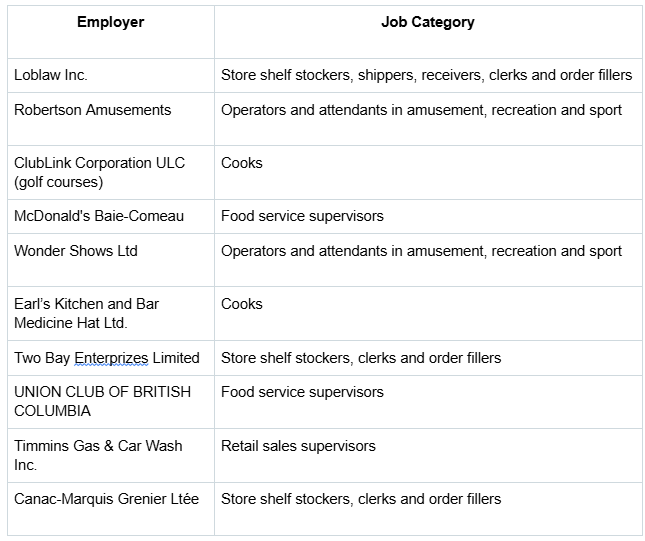
Companies and public sector entities that got approved to hire entry-level and food services labour:

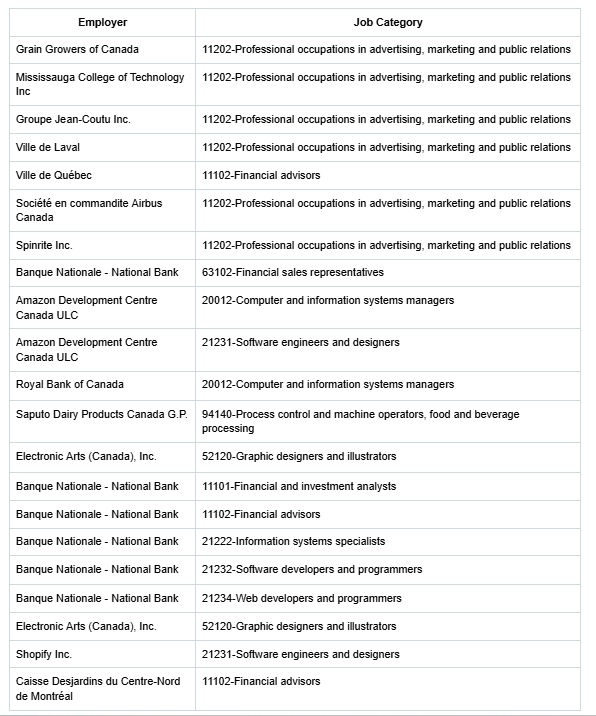
Companies and public sector entities that got approved to hire white collar jobs with TFWs (my personal favourite here is the Grain Growers of Canada(a lobby group) receiving a positive LMIA decision for a communications position….come on guys, for real??):

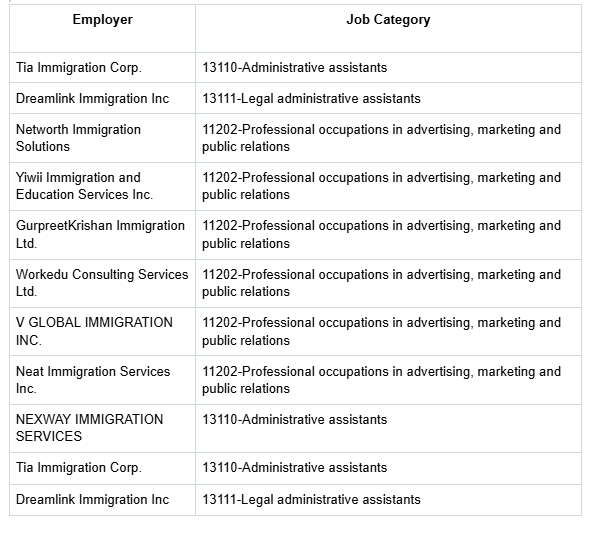
Immigration consulting firms that often help companies get approved for TFWs got approved for TWFs too:

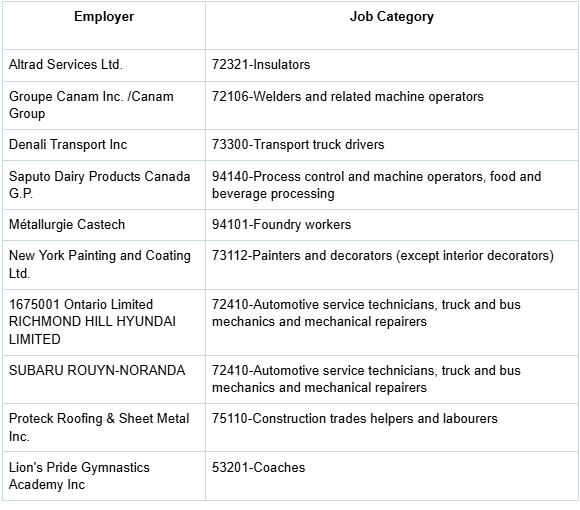
Companies that got approval to fill trades jobs with TFWs:

The arguments that many companies most commonly use to justify their use of the TFW program (particularly the low-skilled stream) are that:

  • Canadians don’t want to do the work
  • That only a foreigner could do the job, or
  • That government benefit programs often prevent people from taking jobs. 

In many cases, these arguments wouldn’t pass the smell test for an ordinary Canadian, so they shouldn’t for the Liberal government either.

In reality, outside of a very few regions where unemployment levels significantly defy the current national rate of 6.9%, and in certain segments of the seasonal agricultural industry, many of these jobs can and should go to available Canadians. And, there won’t be change unless the Liberals stop buying into bunk arguments for temporary foreign labour and find ways to reform the program, or, as the case may be, incent Canadians to work. Wages that aren’t suppressed by an open floodgate of low skilled temporary foreign labour would probably be a good place to start.

Ironically, on that front, all the Liberals had to do upon taking office in 2015 was not bend to the will of powerful corporate lobbyists clamouring for the reversals of program changes made by the former Harper Conservative government. I was in cabinet at the time and remember the gnashing of teeth and wailing from employers that were accused of seriously abusing the program.

Nonetheless and to his credit, Jason Kenney, as Minister of Employment and Social Development, introduced major reforms to the TFW program and LMIA process in 2013 and 2014. In 2013, key changes included requiring employers to pay temporary foreign workers at prevailing wages, introducing processing fees for LMIA applications, extending job advertising periods to recruit Canadians first, and adding scrutiny on outsourcing impacts. The 2014 overhaul was more comprehensive: it imposed a 10% cap on low-wage foreign workers per worksite (phased in from higher limits), barred low-wage hires in regions with unemployment above 6%, limited low-wage worker stays to two years, introduced moratoriums in sectors like food services, boosted inspections and fines for violations, and split the TFW program from the International Mobility Program to reduce overall reliance on foreign labor, leading to an 80% drop in low-skilled approvals.

Source: 50K+ jobs to foreign workers in Q1. Why?

Documents used to assess asylum cases fail to account for Trump’s edicts, advocates say

Valid point:

Canada’s Immigration and Refugee Board is assessing refugee claims using outdated briefing documents about the U.S. that fail to mention President Donald Trump’s edicts on mass deportations and detention, as well as his orders rolling back the freedoms of non-binary and trans people. 

Lawyers representing refugee claimants and migrants facing deportation from Canada are calling for an urgent update for the official package of documents on conditions in the U.S. 

National documentation packages are used by the IRB, an independent body that considers asylum claims. 

The packages, which include briefing materials from a variety of sources about conditions in different countries, are also used by Immigration Department staff to help assess the risk posed to foreign nationals facing deportation. 

The U.S. package of documents was last updated in January, 2024, when Joe Biden was president. 

Lawyers warn that failure to update the U.S. file could lead to flawed decision and more challenges of decisions in court, leading to even bigger backlogs of immigration cases. 

Immigration lawyer Yameena Ansari, whose client, a young transgender American, filed an asylum claim with the IRB last month, warned that the outdated file creates a “dangerous blind spot” for adjudicators. She said claimants “are being assessed against an artificial version of the United States − one that no longer exists.”

“That can lead to wrongful decisions, and potentially life-threatening deportations,” she said. “The IRB’s documentation must reflect the current reality on the ground.”…

Source: Documents used to assess asylum cases fail to account for Trump’s edicts, advocates say

French: ‘Superman’ Is MAGA Kryptonite

Good post:

Think for a moment of the immigrant experience. If you’re a child, you come without your consent. You find yourself in a place that you’ve never known. Even if you’re an adult, and you want to make America your home, you start out in a state of isolation and vulnerability.

Is it any wonder that new immigrants often create or seek out ethnic enclaves? From the Irish and Italian quarters of cities in the 19th century to the barrios of the 20th and 21st centuries, immigrants can ease into their new life by holding onto remnants of the old.

We look at immigrants and often demand that they assimilate. Be like us, we say. Conform to our culture. And that’s usually an easy ask — after all, adult immigrants want to be here. They want to participate in American life. For children, assimilation tends to happen quickly. Immigrant children who grow up in America quickly become more American than they are Mexican or Nigerian or Polish.

Assimilation doesn’t mean abandonment. There are millions of patriotic Americans who are also proud of their national heritages. When the waters of the Chicago River turn green on St. Patrick’s Day, we celebrate with Irish Americans. Should Mexican Americans experience any less joy on Cinco de Mayo?

When I served in Iraq, I served with immigrant soldiers who expressed pride in their homelands but fought in one uniform under one flag, and no one in our squadron ever questioned where their ultimate loyalties lay.

But if we ask immigrants to assimilate, then our nation has its own obligation. We must adopt them. If we want immigrants to love us, then it is our sacred obligation to love them back. Nations can’t love immigrants like adoptive parents love their children, but there is a parallel — a nation can tell a person, “You are one of us.”

That doesn’t mean that we open our borders to anyone who wants to come. Of course we should regulate the flow of immigrants into our country. Too many people arriving too quickly can overwhelm social services, strain local economies and create the conditions for rivalry and conflict that destabilize our politics.

But our default posture should be one of open arms. We should take immense pride that people want to come here. And we should welcome as many as we can reasonably absorb. This is our national heritage, marred though it is by sometimes-long periods of backsliding….

Source: ‘Superman’ Is MAGA Kryptonite

Opinion | Canada’s immigration system, once admired for its fairness and balance, has drifted into crisis

Hard hitting critique, not unjustified:

…Worse still, Ottawa’s enforcement mechanisms have faltered. The federal government acknowledged that Canada may now have up to 500,000 undocumented residents. Tens of thousands of people overstay visas each year without consequence. A system that overlooks such lapses is not generous — it is negligent. It jeopardizes the very trust on which public support for immigration depends.

Support for immigration still runs deep in Canada, but it’s not without limits. Canadians value immigration when it’s fair, focused and transparent. But when the system starts to look porous or easily gamed, confidence frays. And everyone pays the price: the immigrant who played by the rules, the patient waiting for a family doctor, the student without housing or work, and the community stretched thin.

Canada needs immigrants. We need health care workers in rural hospitals, care aides in long-term care homes, and early childhood educators across the country. But meeting those needs doesn’t require a floodgate — it needs a funnel. One that matches admissions to housing, health care capacity, and real labour demand.

Prime Minister Carney now holds the mandate — and the moment — to restore credibility to Canada’s immigration system. That means criminal vetting must be immediate and enforceable. Study permits must be tied to accredited programs with proven pathways to employment. Intake levels must be scaled in line with infrastructure and economic absorption capacity. And Ottawa must publish clear, transparent audits showing how homes, hospital beds, and transit systems will match future growth.

Fixing immigration is not a peripheral policy. It is the first test of whether the new government is prepared to govern for results rather than optics. The promise of immigration lies not in how many arrive, but in how many thrive. It lies in our ability to match aspiration with capacity, and compassion with competence.

Because if we can admit 17,000 people with criminal convictions, yet leave skilled, law-abiding applicants in limbo — and push even the most qualified newcomers into survival jobs — then something is deeply broken. And if we don’t fix the system now, we risk losing not just public trust, but the very foundation of a nation built on rules, trust, and earned opportunity.

Dr. Debakanta Jena is a first-generation immigrant, Chief of Orthopedic Surgery at Medicine Hat Regional Hospital and Assistant Professor at the University of Calgary.

Source: Opinion | Canada’s immigration system, once admired for its fairness and balance, has drifted into crisis

Nécessaires ou trop chères, les missions de recrutement à l’étranger ?

Wonder whether any comparable analysis in other provinces:

Alors que Québec instaurait déjà des resserrements à l’immigration temporaire, le même gouvernement a continué à dépenser des millions pour embaucher à l’étranger lors des Journées Québec. Des mesures de recrutement existent toujours dans d’autres ministères, pendant que l’avenir de ces missions du ministère de l’Immigration, de la Francisation et de l’Intégration (MIFI) fait encore l’objet d’une étude.

Québec et Ottawa ont tour à tour gelé les embauches de travailleurs temporaires à bas salaire il y a près d’un an. Le ministre québécois de l’Immigration, Jean-François Roberge, a annoncé en novembre que les missions de recrutement seraient mises sur pause aux fins de « cohéren[ce] avec [les] objectifs de réduction des résidents non permanents », indique aujourd’hui son cabinet.

Encore essentielles pour certains, « du gaspillage » pour d’autres, les missions gouvernementales à l’étranger n’ont finalement été suspendues qu’en janvier 2025. L’an dernier, elles auront coûté plus de 5 millions de dollars pour recruter 762 travailleurs, dont près de 1 million au sein du MIFI.

De toutes les embauches, le MIFI ne sait dire combien de personnes ont réellement atterri au Québec et occupent les emplois visés.

« Ce qu’on faisait et qu’on continue à faire, c’est du travail chirurgical pour répondre à des besoins précis pour des travailleurs qualifiés », explique Stéphane Paquet, président-directeur général de Montréal International, « pas pour aller chercher du cheap labor ». La région de Montréal et de Laval a beau être soumise à un gel de l’embauche à bas salaire, ces besoins « n’ont pas disparu, au contraire » : de tous les postes vacants au Québec, trois sur cinq se trouvent dans l’agglomération montréalaise, rappelle-t-il.

La situation de la Capitale-Nationale et de Chaudière-Appalaches « reste particulière », avec des taux de chômage plus bas que la moyenne provinciale, ce qui crée des « tensions sur l’emploi », ajoute Carl Viel, président-directeur général de Québec International.

Les deux organisations et Drummond économique ont vu leur financement gouvernemental, d’un total d’environ 4,3 millions de dollars, prendre fin le 31 mars dernier. Ils ont alors dû remercier plus d’une dizaine de personnes.

« Le besoin existe malgré les restrictions de nature parfois politique », soutient aussi Anthony Chiasson-Leblanc, consultant réglementé en immigration et cofondateur d’Equinox World. Il dénonce toutefois que le MIFI « se soit improvisé recruteur » et « prenne la place du privé » dans un marché où l’expérience sur le terrain est cruciale.

Il croit que ce n’est pas aux « deniers publics » à payer pour le recrutement, ou du moins pas dans cette formule des Journées Québec, « où il y a beaucoup de pertes d’efficacité », dit-il. M. Chiasson-Leblanc mentionne à ce titre des publicités mal ciblées et des rencontres tenues dans des endroits éloignés des bassins réels de recrutement, par exemple.

Ce n’est pas la première fois que ce recrutement est perçu comme un « double discours », selon ses mots. Ou en tout cas comme un « paradoxe », comme mentionné par le Conseil du patronat en 2023 quand Le Devoir a révélé que Québec investissait des dizaines de millions de dollars pour trouver des travailleurs à l’étranger.

Fluctuations importantes

Le succès de telles journées semble aussi à géométrie variable. Au Mexique, en mai 2024, l’opération aura coûté 5359 $ par embauche ; d’autres missions, respectivement en Colombie et au Maroc, n’ont dépensé que 80 $ ou 225 $ en moyenne par travailleur recruté, apprend-on dans le Cahier explicatif des crédits 2024-2025.

Certains événements de recrutement se sont tenus exclusivement en ligne, notamment en Europe, où 139 435 $ ont été dépensés en frais de promotion pour quatre jours. Ces frais « comprennent les honoraires de l’agence de publicité et les dépenses liées aux achats médias », précise par courriel le MIFI.

Aux yeux de certains recruteurs privés, cette publicité est un coup d’épée dans l’eau. « La meilleure façon de trouver est à travers un réseau de contacts établis et avec des recruteurs locaux », poursuit M. Chiasson-Leblanc.

« Oui, c’est sûr que le chiffre d’embauches a de l’importance, mais les employeurs ne cherchent pas tous le même type de candidats ou de niveau d’expertise », souligne Stéphane Paquet, qui veut décourager toute comparaison des missions.

Les démarches étant parfois longues, certaines embauches pourraient ne pas être comptabilisées dans les statistiques « à la fermeture des livres », répond le MIFI.

Québec International parle aussi d’une « planification sur plusieurs années », qui permettait par exemple à des candidats à l’excellent profil professionnel d’améliorer leur français d’une année à l’autre.

Confiance

Les trois organisations assurent que les fonds publics étaient utilisés à bon escient. « Ce n’est pas le gouvernement qui recrute, ce sont les entreprises. On restait un service d’accompagnement », fait valoir le p.-d.g. de Montréal International. L’organisme recrute à l’étranger depuis 2010, et l’appui du MIFI lui permettait d’avoir « une meilleure vitesse de croisière » et de coûter moins cher aux entreprises elles-mêmes.

Ces trois agences de promotion économique ont par ailleurs prévu des missions du même genre que les Journées Québec, notamment à Paris en novembre prochain, mais, cette fois, sans appui financier du MIFI.

« C’est important pour nous de maintenir les liens avec les différentes autorités sur les territoires », note Carl Viel, comme le Pôle emploi en France.

Le sceau gouvernemental donnait aussi l’assurance de faire affaire avec « des tiers de confiance », poursuit-il.

Anthony Chiasson-Leblanc rejette l’argument, rappelant que des campagnes frauduleuses utilisant les noms « Journées Québec » ou « Recrutement Santé Québec » ont même été orchestrées. À ses yeux, la confiance se bâtit dans un processus à plusieurs au moyen d’entrevues préalables et, le cas échéant, d’un test de compétence effectué « directement sur la machinerie » une fois la personne sur place.

Le gouvernement de François Legault demande au fédéral de réduire de 50 % le plafond de certaines catégories de résidents non permanents. Le ministre Roberge a récemment demandé à son homologue fédérale d’appliquer une « clause de type grand-père » aux compagnies en région, une revendication de longue date des associations d’affaires.

La décision sur l’avenir des Journées Québec « sera prise en temps et lieu » après les consultations de l’automne prochain sur la planification pluriannuelle, nous signale le cabinet du ministre de l’Immigration.

Les changements successifs et rapides en matière d’immigration, dont les restrictions de l’immigration permanente, commencent à ternir la réputation du Québec à l’étranger, croit Stéphane Paquet. « Plusieurs grandes sociétés vont décider de faire venir les travailleurs ailleurs qu’ici, comme à Toronto ou dans une autre ville de l’Amérique du Nord. »…

Source: Nécessaires ou trop chères, les missions de recrutement à l’étranger ?

While Quebec was already introducing tightening of temporary immigration, the same government continued to spend millions to hire abroad during the Quebec Days. Recruitment measures still exist in other ministries, while the future of these missions of the Ministry of Immigration, Francisation and Integration (MIFI) is still under study.

Quebec City and Ottawa have in turn frozen the hiring of low-wage temporary workers almost a year ago. Quebec’s Minister of Immigration, Jean-François Roberge, announced in November that recruitment missions would be paused for the purpose of “coherence with [the] objectives of reducing non-permanent residents,” his office said today.

Still essential for some, “waste” for others, government missions abroad were finally suspended only in January 2025. Last year, they will have cost more than $5 million to recruit 762 workers, including nearly 1 million within the MIFI.

Of all the hirings, MIFI cannot say how many people have actually landed in Quebec and occupy the targeted jobs.

“What we did and continue to do is surgical work to meet specific needs for skilled workers,” explains Stéphane Paquet, President and CEO of Montreal International, “not to get cheap labor.” The Montreal and Laval region may be subject to a freeze of low-wage hiring, but these needs “have not disappeared, on the contrary”: of all the vacancies in Quebec, three out of five are in the Montreal agglomeration, he recalls.

The situation in the Capitale-Nationale and Chaudière-Appalaches “remains particular”, with unemployment rates lower than the provincial average, which creates “tensions on employment,” adds Carl Viel, President and CEO of Quebec International.

The two organizations and Drummond économique saw their government funding, totalling about $4.3 million, ended on March 31. They then had to thank more than a dozen people.

“The need exists despite sometimes political restrictions,” also says Anthony Chiasson-Leblanc, regulated immigration consultant and co-founder of Equinox World. However, he denounces that MIFI “has improvised as a recruiter” and “takes the place of the private sector” in a market where field experience is crucial.

He believes that it is not up to “public money” to pay for recruitment, or at least not in this formula of Quebec Days, “where there are many losses in efficiency,” he says. Chiasson-Leblanc mentions poorly targeted advertisements and meetings held in places far from the actual recruitment pools, for example.

This is not the first time that this recruitment has been perceived as a “double speech”, in his words. Or at least as a “paradox”, as mentioned by the Employers’ Council in 2023 when Le Devoir revealed that Quebec was investing tens of millions of dollars to find workers abroad.

Significant fluctuations

The success of such days also seems to be of variable geometry. In Mexico, in May 2024, the operation will have cost $5359 per hiring; other missions, respectively in Colombia and Morocco, spent only $80 or $225 on average per recruited worker, we learn in the 2024-2025 Explanatory Book of Credits.

Some recruitment events were held exclusively online, especially in Europe, where $139,435 was spent on promotional fees for four days. These fees “include the fees of the advertising agency and expenses related to media purchases,” says the MIFI by email.

In the eyes of some private recruiters, this advertisement is a stroke of the sword in the water. “The best way to find is through a network of established contacts and with local recruiters,” continues Mr. Chiasson-Leblanc

“Yes, it is certain that the number of hirings is important, but employers are not all looking for the same type of candidates or level of expertise,” says Stéphane Paquet, who wants to discourage any comparison of missions.

As the procedures are sometimes long, some hirings may not be counted in the statistics “at the closing of the books”, answers the MIFI.

Québec International also speaks of “multi-year planning”, which allowed, for example, candidates with an excellent professional profile to improve their French from one year to the next.

Trust

The three organizations assure that the public funds were used wisely. “It’s not the government that recruits, it’s the companies. We remained a support service, “says the CO of Montreal International. The organization has been recruiting abroad since 2010, and the support of MIFI allowed it to have “a better cruising speed” and to cost less to the companies themselves.

These three economic promotion agencies have also planned missions of the same kind as the Quebec Days, especially in Paris next November, but this time without financial support from MIFI.

“It is important for us to maintain links with the various authorities in the territories,” notes Carl Viel, like the Pôle emploi in France.

The government seal also gave the assurance of doing business with “trusted third parties,” he continues.

Anthony Chiasson-Leblanc rejects the argument, recalling that fraudulent campaigns using the names “Journées Québec” or “Recruitment Santé Québec” have even been orchestrated. In his view, trust is built in a multi-personal process through prior interviews and, if necessary, a proficiency test carried out “directly on the machinery” once the person is on site.

François Legault’s government is asking the federal government to reduce the ceiling for certain categories of non-permanent residents by 50%. Minister Roberge recently asked his federal counterpart to apply a “grandfather-like clause” to companies in the region, a long-standing demand of business associations.

The decision on the future of the Quebec Days “will be taken in due course” after next fall’s consultations on multi-year planning, the Office of the Minister of Immigration tells us.

Successive and rapid changes in immigration, including restrictions on permanent immigration, are beginning to tarnish Quebec’s reputation abroad, believes Stéphane Paquet. “Several large companies will decide to bring workers elsewhere than here, such as in Toronto or another city in North America. “…

Poilievre says Canada needs ‘more people leaving than coming’

Of note:

Conservative Leader Pierre Poilievre says for the next couple of years “we need more people leaving than coming” into Canada.

On Monday, Poilievre was asked by Global News to clarify his June comments calling for “severe limits on population growth.

“In order to fix the problem we’ve got to put very hard caps on immigration levels. We need more people leaving than coming for the next couple of years,” said Poilievre at a news conference in Ottawa. “So our country can actually catch up.”

 Poilievre said this move could help housing, health care and jobs “catch up,” but he did not elaborate on how he would ensure more people leave the country.

“We’ve had population growth of roughly a million a year under the Liberals while we barely built 200,000 homes. Our job market is stalled and yet we are adding more people to the workforce,” said Poilievre.

“Our young people are facing generational highs in unemployment because the jobs are, multinational corporations are giving jobs to low wage temporary foreign workers.”…

Source: Poilievre says Canada needs ‘more people leaving than coming’

And the Globe editorial commenting on his remarks:

…Mr. Poilievre would take a different approach by applying a “hard rule” in which population intake does not exceed the growth in the housing stock, the job market and the availability of doctors.

There is merit to that approach, although the emphasis should be on using permanent residency as a tool to ease shortages of specific skills, such as doctors. The focus of any effort to reduce the weight of migration on housing and social services should be squarely on temporary residents. 

Re-establishing public confidence in the immigration system means restricting temporary foreign workers to areas where there simply aren’t Canadians able and willing to take a job, such as in the agriculture sector. Permits for other businesses should, for the most part, be denied. If those firms cannot operate without the subsidy of indentured labour, then they do not have a viable business model.

Federal and provincial governments must return the international student program to its former role of recruiting highly qualified students from around the world who will make excellent candidates to become permanent residents once they graduate. As this space has repeatedly argued, those students should be limited to on-campus work.

And the government must follow through on its proposals to end the abuses of the asylum system.

Mr. Poilievre’s proposed formula needs work, but the idea is at least a recognition that immigration targets in recent years have been arbitrary – and a big part of the reason that Canadians are losing faith in the system.

Source: Let’s focus on the right fix for immigration

Krugman: Making Immigration Great Again

Good take:

…In any case, however, it seems to me that the lie is beginning to unravel as it becomes clear that ICE is having a really hard time finding violent immigrants to arrest.

According to the Miami Herald, only around a third of the people being held in “Alligator Alcatraz” — a cute name, but it’s a concentration camp, pure and simple — have any kind of criminal conviction.

Why aren’t they rounding up more undocumented criminals? Because that would be hard work, and anyway there aren’t that many of them. Morris did a back-of-the-envelope calculation suggesting that there may in total be only around 78,000 undocumented immigrants with criminal records, and 14,000 convicted of violent crimes. Meanwhile, Stephen Miller is demanding that ICE arrest 3,000 people a day. Do the math, and you see why they’re grabbing farm workers and chasing day laborers in Home Depot parking lots.

So Americans may be turning on Trump’s immigration policies in part because they’re starting to realize that they’ve been lied to. But an even more important factor may be that more native-born Americans are beginning to see what our immigrants are really like, rather than thinking of them as scary figures lurking in the shadows.

It’s a familiar point that views of immigration tend to be most negative in places with very few immigrants and most positive in places where there are already many foreign-born residents. You can get fancy about why that’s true, but I would simply say that if you live in a place like New York, where you’re constantly interacting with immigrants, they start to seem like … people.

And the Trumpies — for whom, as Adam Serwer famously observed, the cruelty is the point — are inadvertently humanizing immigrants for Americans who don’t have that kind of daily experience. The nightmarish ordeal of Kilmar Abrego Garcia has probably done more to highlight the humanity of immigrants, documented or not, than any number of charts and tables. And while some Americans are instinctively cruel, most are, I believe, instinctively decent.

Will the public backlash against Trump’s immigration policies force ICE to stand down? Probably not, although the courts may at least slow the mass arrests. Business may also have a say, as labor shortages disrupt agriculture, construction and more.

In any case, however, harsh anti-immigrant policies are looking like a political loser, not a winner.

Source: Making Immigration Great Again