Canada must process applications for children’s immigration in six months: advocates

Of note:

Ottawa should establish a standard of six months to reunite newcomers to Canada with their children, as many refugee and immigrant families now wait years, says a national advocacy group.

The long wait is unacceptable, especially for children who are separated from both parents, said Janet Dench, executive director of the Canadian Council for Refugees.

She said parents who have been forced to flee as refugees end up in many cases leaving their children with a grandparent, another family member or even a neighbour in their home countries.

Source: Canada must process applications for children’s immigration in six months: advocates

Home Office handling of Windrush citizenship claims ruled ‘irrational’

More on Windrush:

The Home Office’s handling of some Windrush citizenship applications has been irrational and unlawful, the high court has ruled in a judgment that will prevent the department from refusing citizenship to Windrush-generation applicants due to minor, historical convictions.

The court was ruling on the case of Hubert Howard, who was repeatedly denied British citizenship over the course of a decade, despite having lived in the UK since he arrived from Jamaica at the age of three in 1960.

The Home Office sought to deny him citizenship, despite the 59 years he had spent continuously in the UK, because of a number of minor convictions, most of them committed in the 1970s and 1980s – none were serious enough to trigger a jail sentence. He was still fighting for naturalisation from his intensive care bed as he was dying in hospital in October 2019.

Source: Home Office handling of Windrush citizenship claims ruled ‘irrational’

At a Vancouver forum, experts see immigration adding fuel to the overheated big-city housing market

No surprise:

Spring is in the air and the outlook is cheery for the next couple of years, according to pundits who spoke at the Vancouver Real Estate Forum held online last week

The opening remarks were delivered by Canadian Imperial Bank of Commerce deputy chief economist Benjamin Tal. His tone was far more encouraging than his talk last fall, in which he predicted the next six months would “not be very pretty,” with a housing market that would slow by winter. The housing market, however, did not slow. It only gained momentum. Last week, Mr. Tal said he sees a quick economic recovery – with Canadians sitting on piles of savings accumulated in the pandemic and immigration numbers greater than predicted, both of which will add more fuel to the already overheating housing market.

And he estimates around 60,000 to 70,000 non-resident Canadians, most of them living in Hong Kong, will return.

“We are starting to see this money coming into real estate in Vancouver and Toronto,” he said.

Anthem Properties chief executive officer Eric Carlson, who spoke as part of a panel, and other industry members also forecasted a roaring market thanks to increased immigration.

“[Immigration] numbers will be up in 2022, almost like the way they were pre-COVID. But it will take time to get up,” Mr. Carlson said. “In 2023, they will be higher; 2023 will be a rock concert of immigration. It’s going to be phenomenal. It’s going to completely mess up housing affordability.”

Mr. Tal says the economic fallout from the pandemic is deep, but narrow. Low-income jobs were wiped out, but high-income earning jobs actually increased.

“This is the first recession in Canadian history [in which] personal income has gone up. Crazy, but that’s exactly what we’ve seen.”

As a result, the income gap is even wider than it was prior to the crisis. That will increase the need for affordable housing.

“I see purpose-built rental as the solution,” Mr. Tal said. “I see a situation in which you are 35 years old and you are married with two kids, renting, and there is nothing wrong with [that]. When we develop this mentality, this way of thinking, I believe the affordability channel in the Vancouver market will be open in a very dramatic way.”

As for those who were lucky enough to make more money in the past year, the only obstacle getting in their way of spending it is access to the COVID-19 vaccine. A lot of people have saved a bundle, which will play a role in the recovery.

“This has major implications, because you have high-income individuals keeping their jobs and their income is rising, but they are not spending.

“We are sitting on a mountain of cash. I estimate that individuals are now sitting on roughly $100-billion of extra cash, more than they need. This is money that is sitting in chequing and savings accounts, collecting nothing, and those people are willing and able to spend that money the minute that they have the green light. Believe me, all those people are dying to go to restaurants but they are not willing to die doing so, and so they are waiting.”

The question becomes, what to do with all those savings? With interest rates as low as 1.3 per cent, mortgage broker Andrew Wade said borrowed capital is too cheap to even think about paying off the home. He’s seeing a “major surge” in Canadians buying vacation properties in Canada. However, he’s also seeing spending behaviours that are making him nervous. It’s common to see bidding wars on houses where people are making subject-free offers up to $300,000 above asking price, Mr. Wade said.

“This scares me,” he said. “I advise explicitly against this if the buyer is depending on borrowed funds.”

Mr. Wade is not so sure there is a “mountain of cash” available to most Canadians, who need to think about the high cost of future retirement and other costs. Also, the new stress test for uninsured mortgages goes up to 5.25 per cent on June 1, which will reduce a buyer’s borrowing amount by about 4 per cent, he says. That should help address a market that might not be sustainable, particularly on purchases of more than $1-million. Another trend he is seeing is homeowners tapping into their equity to afford their lifestyle. If there’s a market correction, he advises his clients to remember that, “cash is king.”

Real estate industry veteran Rudy Nielsen concurs. Mr. Nielsen, founder of the NIHO Land & Cattle Co. Ltd., says he always keeps available cash, even if it’s earning next to nothing. Mr. Nielsen generally agrees with Mr. Tal’s outlook, but he adds that there are a lot of people struggling, too.

“Some people do have a lot of money in their bank account, yes, and some are living month-to-month. Lots of people are hurting out there.”

For a long time, Mr. Nielsen was B.C.’s largest owner of private property, with about 500 properties at his peak. He started out logging properties, and then bought acres of ranch land and farms, office buildings, even entire towns. He’d sell properties in the towns on a lease-to-own basis.

In the 1970s, he’d built a real estate empire and then in 1981 he got caught in the crash, when interest rates soared to 17 per cent, and he owed $1.8-million. He rebuilt the empire, and he says he learned some lessons, such as not to over-leverage like he’d done when he was young. Today, at 80, the appraiser, developer, landowner and outdoorsman has downsized to about a dozen large properties, including 700 acres of farmland in the north only accessible by helicopter.

His advice is to invest for the long term.

“Some of the properties I’ve sat on for 30 years, but my returns are incredible, in the thousands of per cent,” Mr. Nielsen says.

He believes in investing in mortgage investment corporations, which he admits are “a little risky” because they are mostly investments in second mortgages, and foreclosures are always a possibility. But the returns he’s getting are 9 per cent to 10.5 per cent, he says.

“And I still keep some properties. I am patient and I sell as I see fit.

“The way I look at my land is, it’s my second bank.”

He advises people who’ve saved some money and who are starting out to buy recreational property that they will use, which will be worth a lot more by the time they retire. He tells the story of meeting a young family a decade ago in Williams Lake. They had sold off their Maple Ridge home to buy acreage with a few holiday cabins to rent out, with less income but less stress. He sees a trend like that happening now.

“I’ve always done good in land. Right now, I’ve been in business since 1964 and I’ve never seen more demand for land than I have right now. … We are selling everything we’ve got. We are getting good prices. There is a line up of people wanting the next piece.”

Source: https://www.theglobeandmail.com/real-estate/vancouver/article-at-a-vancouver-forum-experts-see-immigration-adding-fuel-to-the/

#COVID19 #Immigration impact: February update

My latest monthly update.

The trend of increased transitions from temporary to permanent residents continued in February and given recent policy and operational changes (lowering of Express Entry minimum CRS score, recently announced targets for healthcare and other essential workers, international students) this trend will likely continue for the balance of the year.

All of these changes, advisable or not, will help the government achieve (or partially achieve) its 2021 target of 401,000 new immigrants. 

Moreover, these changes should also address the imbalance between the higher skilled, who transition at a higher (and increasing rates) and the lower skilled, with lower transition rates).

Interestingly, IMP data now shows a large percentage of “Other IMP Participants.” Typically, this was less than 50 per month but jumped to over 3,000 in February, perhaps due to delayed coding against the individual programs.

In contrast to the relative return to traditional levels of new immigrants, the number of new citizens remains much lower than pre-COVID, from an average of about 21,000 in 2019 to an average of about 6,000 from June 2020 when the program was restarted.

Web statistics show an increase of interest compared to last year for all programs save citizenship. 

Douglas Todd: Quebec to get 10 times more than B.C. and Ontario to settle immigrants

Almost an annual event, criticism of the Canada-Quebec immigration accord’s unbalanced funding arrangement, one that becomes more unbalanced as immigration to the rest of Canada continues to outstrip immigration to Quebec:

Quebec will be handed roughly 10 times more taxpayer dollars from Ottawa to settle each one of its immigrants than B.C., Ontario, Alberta and the other provinces.

The pandemic is further distorting an already lopsided and increasingly bizarre three-decade-old accord with Ottawa that this year will provide Quebec with roughly $20,000 to support each new permanent resident to the province.

Meanwhile, each new permanent resident set to move to B.C. will be allocated only about $1,800 in settlement services, which include language training, assistance with housing and job counselling.

Immigration, Refugees and Citizenship Canada settlement allocations show, in addition, that Ontario will be handed about $2,000 this year to support each of its new immigrants.

“If I were the other provinces, I would be really, really angry about it,” says Stephan Reichhold, who heads the umbrella organization that oversees 150 settlement agencies in Quebec.

“The other provinces can complain. They can make public statements that it’s not fair,” Reichhold said, explaining that the ever-widening transfer disparity is rooted in a funding formula embedded in the 1991 Canada-Quebec immigration accord.

The upshot of the accord is that Quebec, despite reducing its immigration levels two years ago, will nevertheless be handed a whopping $650 million to help settle the 30,000 to 35,000 new permanent residents it expects in 2021.

Meanwhile, the settlement allocations show all the other provinces and territories combined are this year scheduled to receive $741 million to help integrate about 370,000 new permanent residents, based on Ottawa’s target, which is a record 401,000 immigrants for 2021.

B.C. is set to receive only about $109 million, even while it is projected to take in more than 65,000 new permanent residents, about twice as many as Quebec.

Ontario, which normally takes in 45 per cent of all immigrants to Canada, will be transferred just $372 million, far less than Quebec.

It all adds up to mean, said Reichhold, that Quebec, which accepts only one-tenth of the country’s new immigrants, will receive almost as much transfer money as the other nine provinces and three territories combined.

Vancouver-based Chris Friesen, chair of a national umbrella association that represents immigrant serving agencies across the country, said the gross imbalance in immigrant-support payments is yet another reason he and others are calling for a national dialogue, possibly a royal commission, into the country’s immigration policies.

Friesen, who is also director of the Immigrant Services Society of B.C. that supports refugees, said the Quebec-Canada formula constantly escalates the proportion of transfer funds going to Quebec. As a result the province will actually receive $58 million more to settle permanent residents this year than last year — despite taking in fewer  immigrants than it did in 2019 and 2020.

Even though the provinces have a moral right to protest their poor treatment, Quebec’s Reichhold doubted it would do much good.

That’s because the Canada-Quebec immigration accord, which prime minister Brian Mulroney signed in 1991, gave unique immigration powers and generous transfer payments to the province, mainly to appease a then-surging sovereigntist movement. The other provinces do not have anywhere near the same level of influence over immigration, which is constitutionally in the hands of Ottawa.

Quebec, because of the accord, has long raked in more money per immigrant from Ottawa than the other provinces. In 2019, Quebec received about $11,000 for each of the roughly 40,000 permanent residents it accepted. That compared to about $2,400 each for immigrants to B.C. and Ontario.

This year, because of both COVID-19 border restrictions and Premier Francois Legault’s campaign promise to further reduce immigration levels, the money gap continues to grow wider than ever. Quebec expects only about 30,000 to 35,000 new permanent residents in the province this year, said Reichhold, who noted that Legault’s government announced Wednesday it is considering upping its target to 50,000 in 2022.

Despite the unfairness of the transfer system, Reichhold said Quebec can always use the federal money. And he was pleased to see that Legault is directing two to three times more of Ottawa’s funding into immigration services than the previous Liberal premier, Philippe Couillard, who mostly shovelled it into general revenue.

“Legault has really raised the amount that goes into language training and other resources,” said Reichhold. Asked if he thought other provinces should get as much money per capita as Quebec for settlement services, Reichhold laughed and said, “Can you imagine the amount? It would cost three to four billion dollars.”

Quebec’s immigration program is unique in the world in the way it gives so much control to a regional jurisdiction, Reichhold said.

Quebec also has its own distinct immigrant-investor program, which had for years been bringing in about 4,000 rich newcomers from around the world, mostly Asia. Nine out of 10 don’t stay in Quebec, but instead move to Toronto or Vancouver. Reichold said the program, which critics call a “cash-for-passport scheme,” is not taking new applicants, as it deals with a backlog.

The media outside Quebec don’t often look at how the immigration system works, or its dramatic anomalies, because most English-language journalists show little interest in francophone Quebec, said Reichhold. For that matter, he said, most Quebeckers don’t understand immigration policy either.

The public’s overall ignorance is one of the reasons Friesen, along with Jean McRae of Victoria, B.C., and Victoria Esses of London, Ont., are calling for a national inquiry into Canada’s convoluted immigration policies, which are produced closed doors. That includes Ottawa’s announcement in October that its objective is to admit over 1.2 million new permanent residents between 2021 and 2023, the most ever.

Although a recent poll found Canadians are among the most welcoming people in the world to immigrants, Friesen, MacRae and Esses said the public’s “lack of control and generalized uncertainty can easily stoke anti-immigrant and anti-immigration sentiments. Involving Canadians in an informed consideration of how Canada’s  future immigration programs and policies should be structured will work to dampen these effects.”

It may be possible to forgive Canadians for not comprehending what’s actually going on in Quebec or elsewhere in regard to immigration policy. Still, it would be prudent to avoid being naive.

Source: https://vancouversun.com/business/douglas-todd-quebec-to-get-10-times-more-than-b-c-and-ontario-to-settle-immigrants

Quebec will raise immigration quotas, minister confirms

Looks like more catch-up for 2020 decline than an increase in planned levels:

Quebec will have no other choice but to significantly increase its immigration quotas, says the province’s minister on the file, Nadine Girault.

Girault said Thursday that the pandemic has suddenly slowed down the entry of newcomers to Quebec while it continues to grapple with severe labour shortages in several sectors.

Though she refuses to give precise numbers for the moment, Girault reported a “shortfall of nearly 17,000 or 18,000 people” immigrating to the province in her planning. 

Quebec received barely 25,000 immigrants in 2020, while the Legault government had expected to receive between 43,000 and 44,000.

The CAQ government significantly reduced immigration quotas when it came to power, cutting the target for total newcomers to around 40,000 for 2019, compared to some 50,000 annually under the previous Liberal government.

The goal of this reduction was, according to the slogan of the time, “En prendre moins, mais en prendre soin,” meaning “take less, but care for it better.”

Quebec then forecast annual growth that should have brought this threshold back to around 50,000 in 2022.

QUEBEC MUST DO A CATCH-UP

The pandemic, however, flouted these plans.

“Two years ago the situation was very, very different from what we are experiencing today,” said Girault during a joint announcement with Montreal Mayor Valerie Plante on funding newcomers’ integration into the city.

Citing a “deficit for 2020” in terms of immigration, Girault said Quebec “wants to catch up to these thresholds and we also want, as we said from the start three years ago, [to] increase the thresholds precisely because we wanted to welcome them better, integrate them better.”

The comment suggested the catching-up would be added to the increase already planned.

$24 MILLION TO GREET NEWCOMERS IN MONTREAL

The agreement with Montreal provides for investments of $24 million over three years, funded equally between Quebec and the city, to facilitate the integration of new immigrants.

Roughly 70 per cent of immigrants who arrive in Quebec settle in Montreal. One of the goals of financial assistance is francization or integrating them into French-speaking life, authorities say.

“The reality of the metropolis presents challenges in terms of francization and integration,” said Girault. “If we want to ensure the survival of this francophone character of Montreal, we must take great strides so that immigrants can be part of the solution.”

Girault also pointed out in passing that her government had added $70 million to the francization effort in the last budget, bringing the total to $170 million.

Plante said the agreement “will give us the means to pursue our actions to promote [newcomers’] integration, their inclusion and their full participation in Montreal society.”

The sums will go to around 100 organizations, to support the completion of nearly 200 projects.

Source: Quebec will raise immigration quotas, minister confirms

The race for Canada’s special, one-time permanent-residence program is flooding English-language test providers

Hmm. Someone should have anticipated that this change could result in this problem:

It’s the most sought-after test for any prospective skilled immigration applicant in Canada at the moment and Braxton Rayan is racing against time to secure the earliest spot possible.

With 90,000 spots up for grabs under a new one-time special program offering a pathway to permanent residence, international graduates and essential migrant workers see what they feel is the best chance to make their immigration dreams come true.

However, to qualify, they must meet the language-proficiency requirement and many are now scrambling to book one of the two mandatory language tests — CELPIP and IELTS — as soon as possible amid the third wave of COVID-19, when spaces at test centres are limited.

“We are grateful for this opportunity, but everybody wants to write the test at the same time and we’re all struggling to get a date for the test,” said Rayan, 20, an international student from Sri Lanka in television broadcasting at Seneca College.

“We are all in a rush to get our language test done, but we have limited time because they cap the intake. Once the intake is full, the immigration program shuts down.”

Last Wednesday, Immigration Minister Marco Mendicino announced the time-limited immigration pathway to grant permanent residence to 40,000 recent international graduates, 20,000 temporary foreign workers in health care and 30,000 in other essential occupations.

Applications open May 6 and close on Nov. 5 or once the target is reached. So far, Rayan has only managed to book the CELPIP or Canadian English Language Proficiency Index Program test for June 17 and fears he could lose an edge to those who can get a test date sooner.

The sudden surge of interest in the English-language tests has overwhelmed the test providers in Canada, crashing their websites following the immigration minister’s announcement.

CELPIP put out a tweet warning people about the “technical difficulties” of its test registration system, and shut down its phone lines “due to the volume of requests.”

“With Immigration, Refugees and Citizenship’s new program, we know that people seeking a pathway to permanent residency are eager to meet their requirements in time for the start of the application period on May 6 and, as a result, we experienced a significant increase in web traffic,” said Betty Chan, vice-president of operations of Paragon Testing Enterprises, which delivers CELPIP in Canada.

“With over 60 test centres across Canada, we can accommodate a growing number of test takers, especially as we expand our availability to meet the current demand.”

Chan said CELPIP had neither advance knowledge of the new immigration program nor could anticipate the extra demand as a result of the announcement last week.

This week, additional CELPIP sittings have been added the next four weekends in a couple of dozen Canadian cities, up to May 16. Tests have been scheduled on “traditionally less popular days” with new times including 8 9:30 and 10 p.m. at some locations.

IELTS Canada, which stands for International English Language Testing System, also reported technical challenges with its booking system in Canada due to the large volume of people looking to book tests.

“We are working hard to add extra test dates and speaking slots. Please continue to check our webpage,” British Council Canada, an owner of the test, said on Twitter on Tuesday.

Akshay Kumar, who graduated from Niagara College’s law clerk program last year, said international graduates must pass a minimum English proficiency to be admitted to a Canadian academic institution. The admission standard is higher than what’s required under the new pathway.

However, IELTS and CELPIP test scores are only considered valid by Canadian immigration officials for two years from the date of issuance of results. Many people who qualify for the new immigration pathway and had already taken the tests have had their test results expire.

“You need to be able to read, write and speak English in order to get admission. If you’re not proficient in English, how are you supposed to graduate from a Canadian college or university?” asked the 26-year-old from India, who has an undergraduate law degree from England.

“I’m not alone. Many of my friends also have trouble logging on (the test websites) and booking a test. It’s fully booked till September. They should waive the language test requirement for those who had taken the test and already graduated from designated institutions.”

On Tuesday, Kumar and others started an online petition raising concerns about the availability of the language tests and the risks of contracting COVID-19, given both IELTS and CELPIP must be taken in person at a designated test centre.

On social media, the immigration department directs applicants’ inquiries about the availability of the tests to the test operators.

Source: The race for Canada’s special, one-time permanent-residence program is flooding English-language test providers

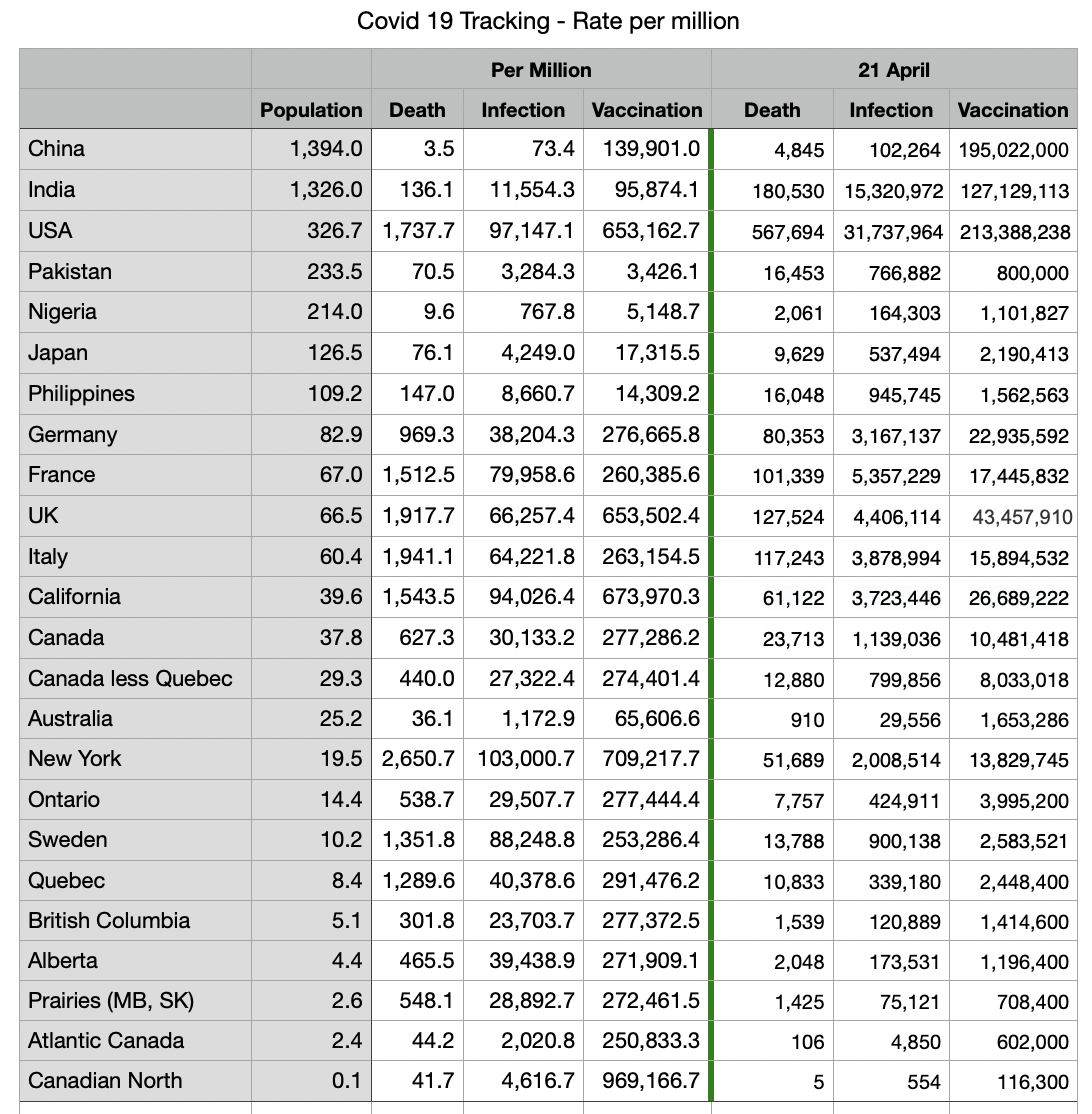
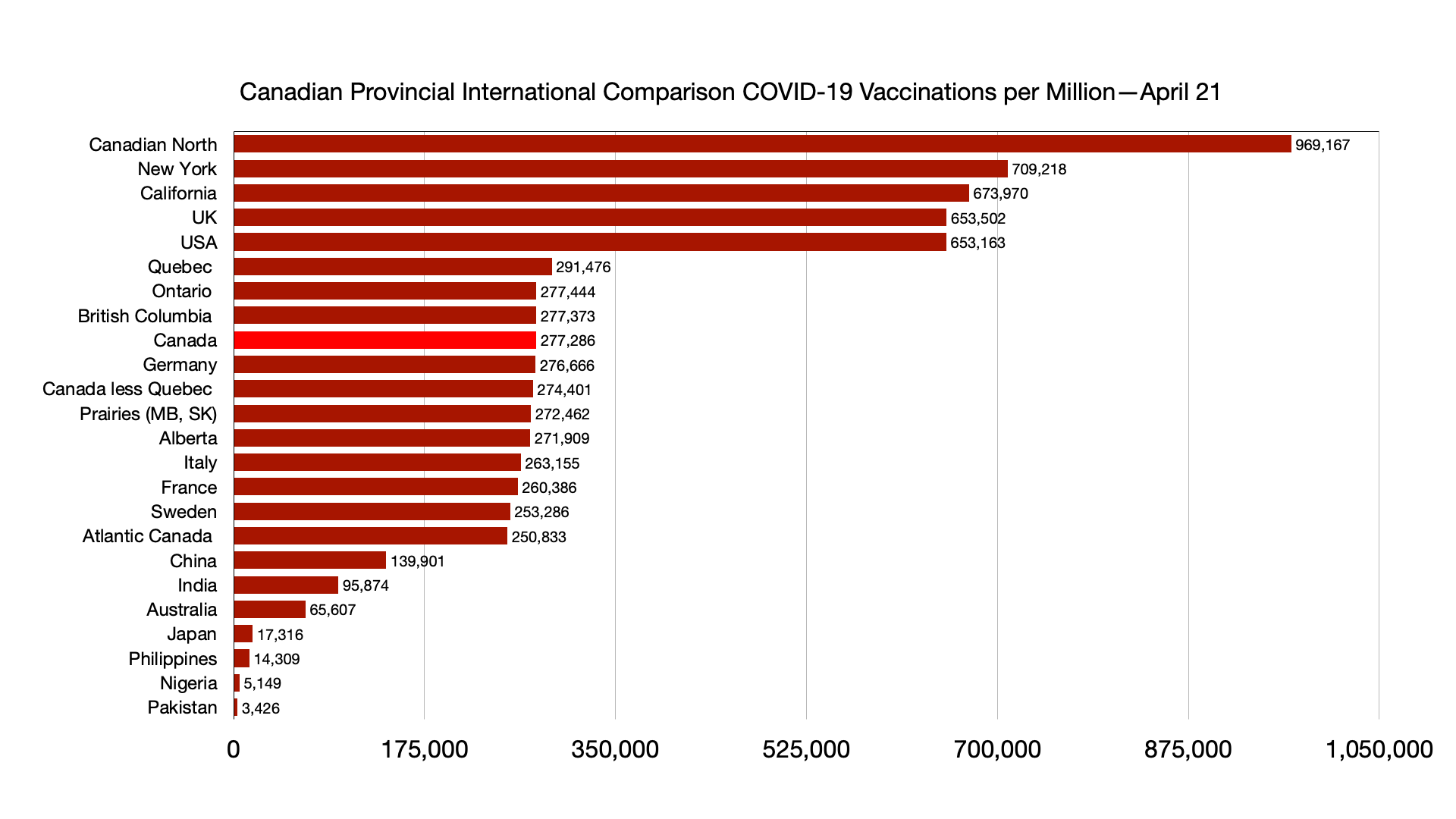
#COVID-19: Comparing provinces with other countries 21 April Update

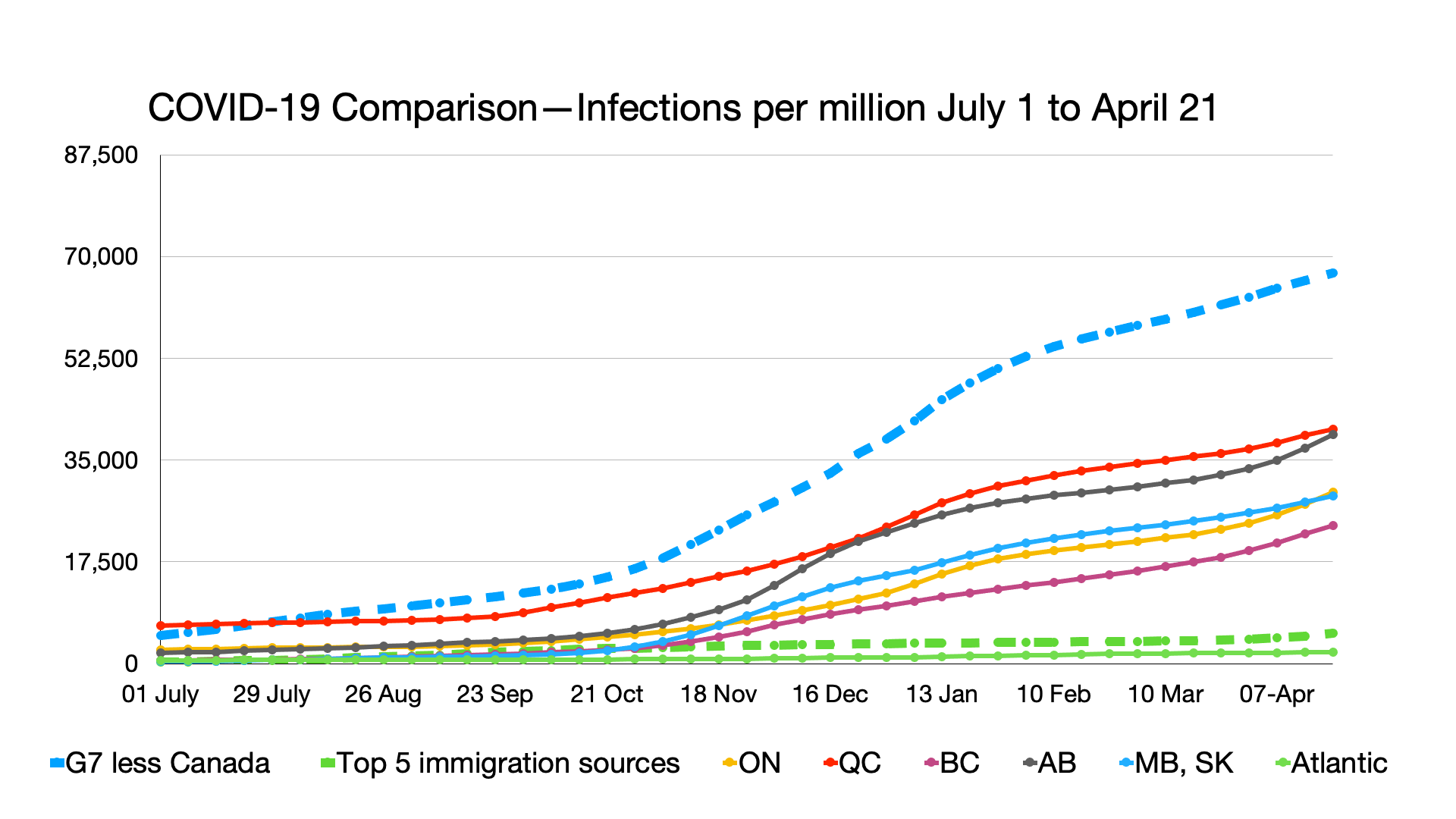
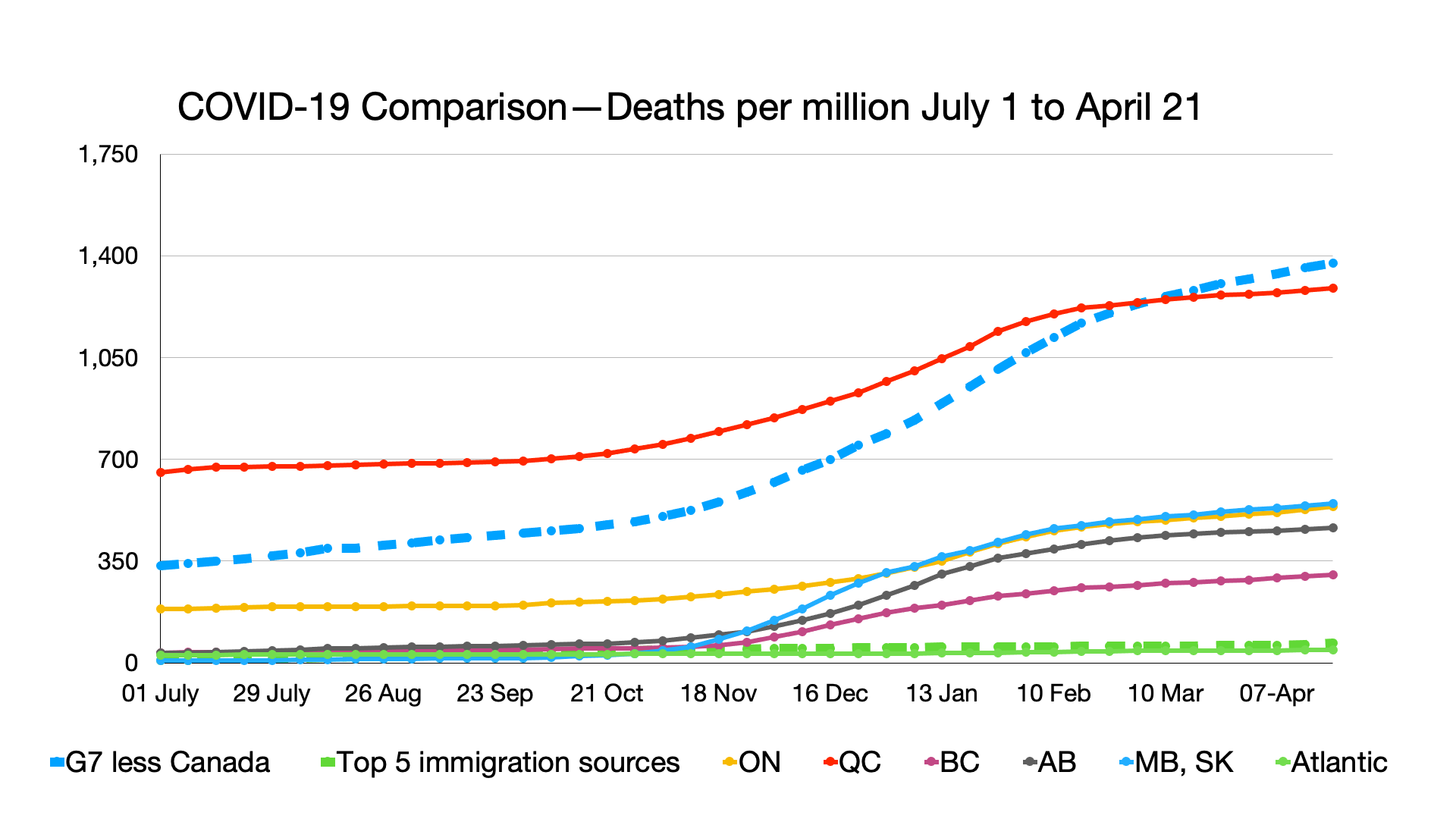
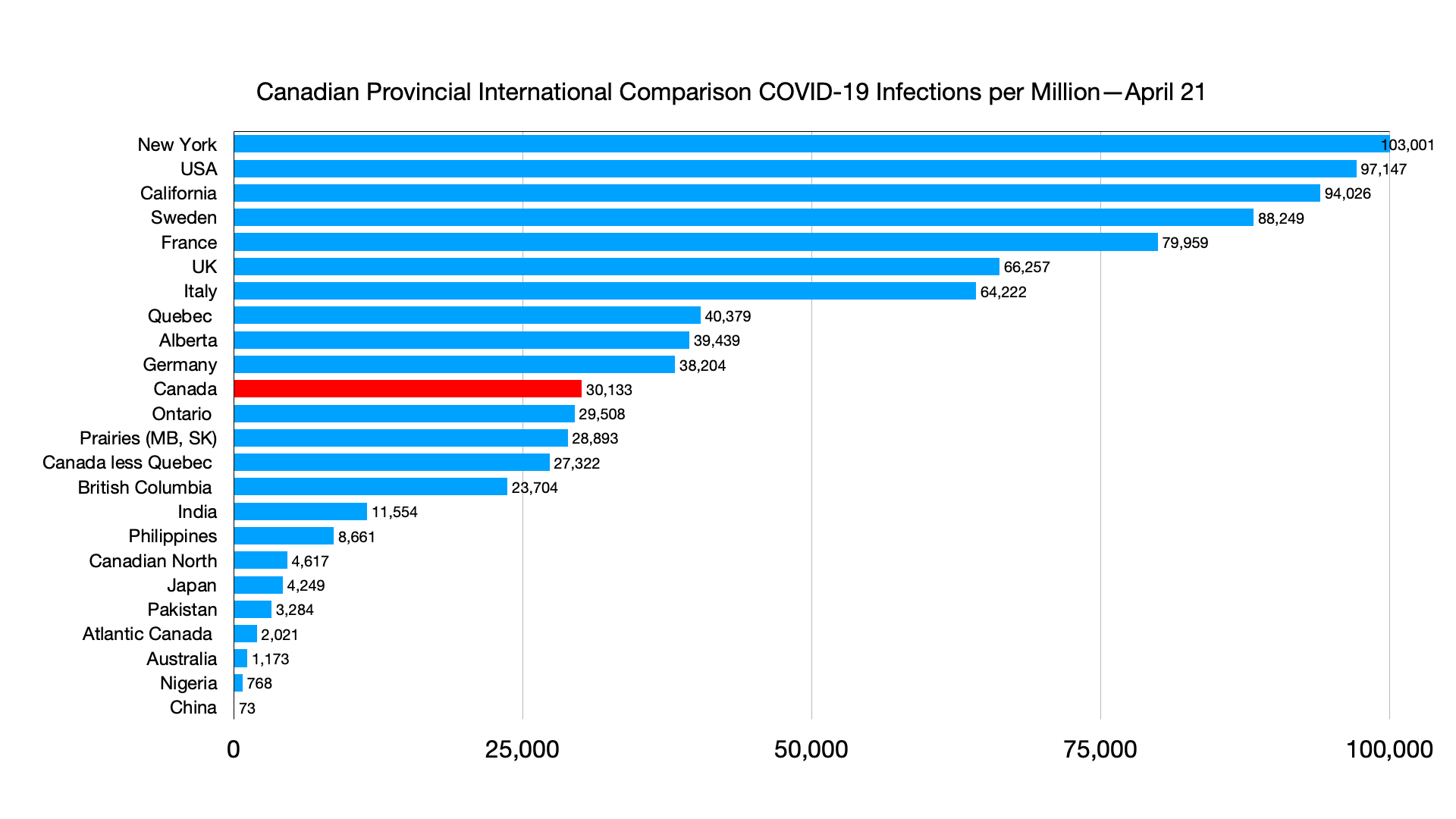
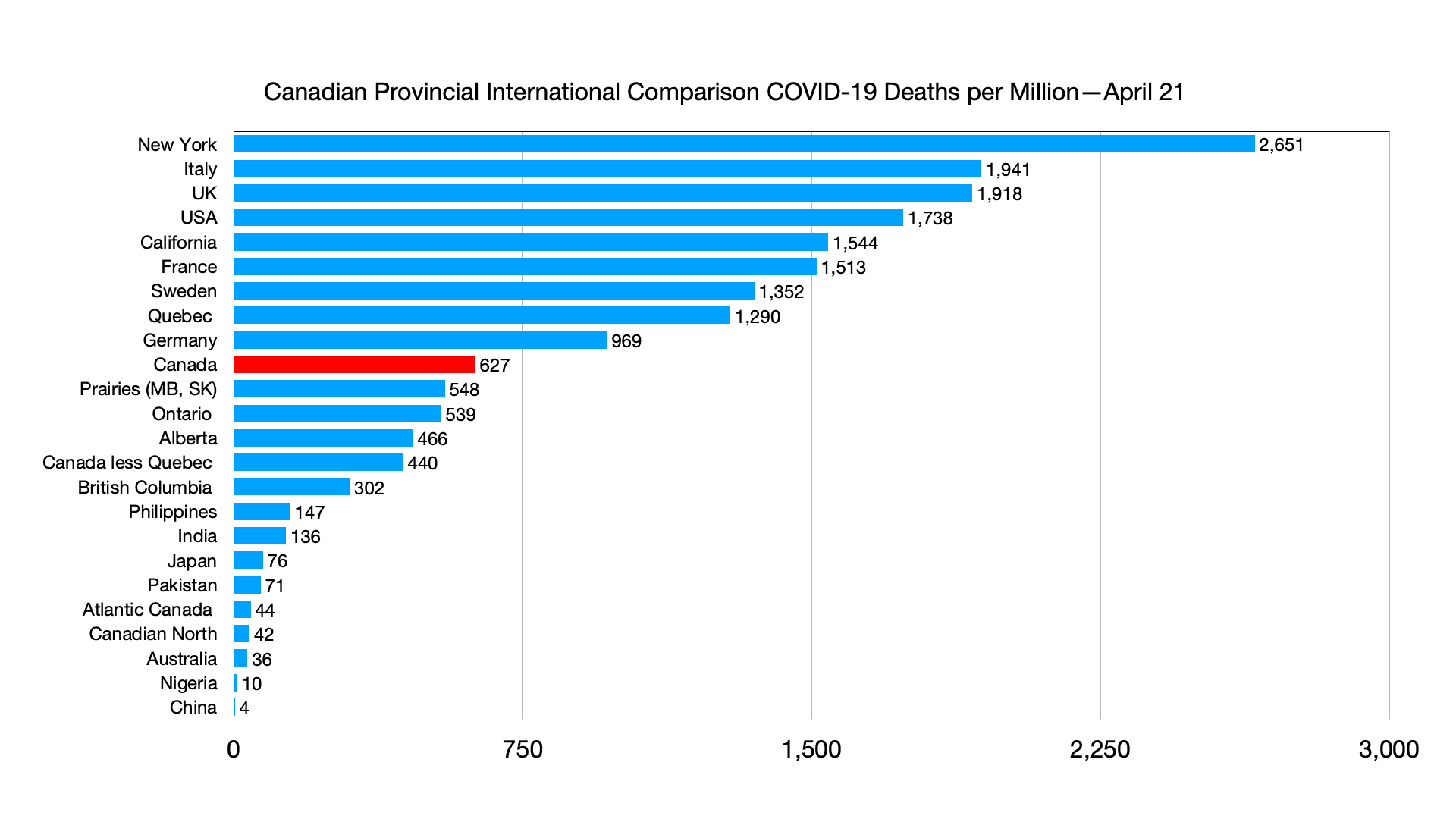
The latest charts, compiled 21 April as the third wave has started.

Vaccinations: Overall, Canada and most provinces continue to be comparable to EU countries.

Trendline charts

Infections per million: Recent spikes in Ontario and Alberta are more apparent.

Deaths per million: No major changes save for Italy now ahead of UK.

Vaccinations per million: Vaccination rates in Canadian provinces increasing more quickly than overall G7 less Canada countries. Increases among immigration source country reflect China and India mass vaccination roll-out.

Weekly

Infections per million: Surge in Ontario means province has more infections than Prairies.

Deaths per million: Italy ahead of UK.

India is grappling with rapid increase in cases which will likely show-up in their relative ranking over the next few weeks:

Authorities said hospitals in the Indian capital of Delhi would start running out of medical oxygen by Wednesday as Prime Minister Narendra Modi said the country faced a coronavirus “storm” overwhelming its health system.

Major government hospitals in the city of 20 million people had between eight and 24 hours’ worth of oxygen while some private ones had enough for just four to five hours, said Delhi’s deputy chief minister, Manish Sisodia.

“If we don’t get enough supplies by tomorrow morning, it will be a disaster,” he said, calling for urgent help from the federal government.

Mr. Modi said the federal government was working with local authorities nationwide to ensure adequate supplies of hospital beds, oxygen and antiviral drugs to combat a huge second wave of the COVID-19 pandemic.

“The situation was manageable until a few weeks ago. The second wave of infections has come like a storm,” he said in a televised address to the country, urging citizens to stay indoors and not panic amid India’s worst health emergency in memory.

“The central and state governments as well as the private sector are together trying to ensure oxygen supplies to those in need. We are trying to increase oxygen production and supply across the country,” he said.

Mr. Modi faces criticism that his administration lowered its guard when coronavirus infections fell to a multimonth low in February and allowed religious festivals and political rallies that he himself addressed to go ahead.

India, the world’s second-most populous country and currently the hardest hit by COVID-19, reported its worst daily death toll on Tuesday, with large parts of the country now under lockdown amid a fast-rising second surge of contagion.

The health ministry said 1,761 people had died in the past day, raising India’s toll to 180,530 – still well below the 567,538 reported in the United States, though experts believe India’s actual toll far exceeds the official count.

“While we are making all efforts to save lives, we are also trying to ensure minimal impact on livelihoods and economic activity,” Mr. Modi said, urging state governments to use lockdowns only as a last resort.

One local hospital with more than 500 COVID-19 patients on oxygen has enough supplies for only four hours, Delhi’s Health Minister Satyendar Jain said late on Tuesday.

Tata Group, one of India’s biggest business conglomerates, said it was importing 24 cryogenic containers to transport liquid oxygen and help ease the shortage in the country.

The U.S. Centers for Disease Control and Protection has said all travel should be avoided to India, while British Prime Minister Boris Johnson cancelled a visit to New Delhi that had been scheduled for next week, and his government said it will add India to its travel “red list.”

Several major cities are already reporting far larger numbers of cremations and burials under coronavirus protocols than those in official COVID-19 death tolls, according to crematorium and cemetery workers, the media and a review of government data.

Delhi reported more than 28,000 fresh infections on Tuesday, the highest daily rise ever, with one in three people tested returning a positive result.

“The huge pressure on hospitals and the health system right now will mean that a good number who would have recovered, had they been able to access hospital services, may die,” said Gautam I. Menon, a professor at Ashoka University.

On Tuesday, the health ministry reported 259,170 new infections nationwide – a sixth day over 200,000 and getting closer to the peak of nearly 300,000 seen in the U.S. in January.

Total coronavirus cases in India are now at 15.32 million, second only to the U.S., with epidemiologists saying many more infectious new variants of the virus were one of the main factors behind the latest surge in cases.

Source: https://www.theglobeandmail.com/world/article-new-delhi-running-out-of-medical-oxygen-as-india-grapples-with/

Budget 2021: Immigration and Multiculturalism/Anti-racism

Overall, significant increases in immigration and multiculturalism/anti-racism program spending, with the relevant budget section excerpts below. Encouraging that IRCC’s IT infrastructure modernization (GCMIS) received multi-year funding.

Most coverage to date has focussed on IRCC and immigration (see CIC news summary below).

What’s not there:

  • Citizenship fee elimination: The government has apparently decided not to implement its 2019 election commitment to waive citizenship fees; and,
  • International students: No measures to assist universities and colleges deal with the fall in revenues and other impact.

Some highlights of the multiculturalism/anti-racism measures:

  • $172 million over five years, starting in 2021-22, with $36.3 million ongoing, to Statistics Canada to implement a Disaggregated Data Action Plan that will fill data and knowledge gaps. 
  • $200 million to establish a fund to combat anti-Black racism and improve social and economic outcomes in Black communities.
  • $126.7 million over three years to prevent racism and discrimination in health-care systems. This funding will support patient advocates, health system navigators, and cultural safety training for medical professionals.
  • $75 million over five years, and $13.5 million ongoing, to the RCMP to combat systemic racism through new recruitment and training processes, community engagement and other measures.

CIC News summary:

The Canadian government has just tabled its first Budget since 2019.

This major announcement usually takes place in the first quarter of each year, however it did not take place last year due to the coronavirus pandemic.

The Canadian federal budget receives a lot of attention domestically since it contains the policy priorities the government will pursue, the government’s spending and revenue projections, as well as an overview of the state of the Canadian economy.

Today’s Budget is of added importance for several reasons. It is the first in two years due to the unprecedented times we are living in. Moreover, the ruling Liberal party has a minority government, and is rumored to be considering calling an early election in 2021, which means it may need to rely on the Budget to convince Canadians to give them a majority.

Sometimes, the Budget contains major Canadian immigration policy announcements.

For example, Budget 2014 proposed terminating the popular federal Immigrant Investor Program and Entrepreneur Program. That same Budget outlined that the federal government would invest millions of dollars to ensure that Express Entrywould successfully launch in January 2015.

Here are the immigration priorities outlined in Budget 2021. It is important to note that these are proposals and the Budget needs to win the approval of the majority of Parliament for the Liberals to go ahead and pursue these priorities. It is likely that Parliament will pass this Budget since defeating it would trigger an election— an outcome that Canada’s federal parties likely do not want while the country continues to fight the coronavirus pandemic.

Nearly $430 million to modernize IT infrastructure

Perhaps the most important immigration proposal in the Budget is a nearly $430 million investment the federal government would like to make to modernize its information technology (IT) infrastructure. The Budget calls for the investment to replace the Global Case Management System (GCMS), which is used to manage immigration applications. The purpose of the investment, according to the Budget, includes allowing the federal government to respond to higher levels of foreign national arrivals in the future, better security, and improved application processing.

Reforms to Express Entry

The Budget notes that the federal government has an eye towards reforming Express Entry. The government would like to give the immigration minister more authority to “select those candidates who best meet Canada’s labour market needs.” What these changes may entail are not specified in the Budget.https://9c6b1105c6868e5597d2724aa137db10.safeframe.googlesyndication.com/safeframe/1-0-38/html/container.html

Express Entry is the main way that Canada selects economic class immigrants. It accounts for about one-quarter of all the immigrants Canada welcomes each year.

Enhancements to the Temporary Foreign Worker Program

The Budget calls for some $110 million in additional spending over the next three years on the Temporary Foreign Worker Program (TFWP). The spending will go towards providing information and support to vulnerable foreign workers, increased inspections of employers to ensure they are treating foreign workers well, and improving service delivery to vulnerable workers so they can obtain open work permits if they have been abused by their previous employers in Canada.

Supporting Racialized Newcomer Women

Newcomer women sometimes face barriers to employment in Canada due to factors such as developing English or French skills, lack of Canadian experience, lack of affordable child care, and discrimination. The Budget proposes an additional $15 million in spending over the next two years to build on existing initiatives aimed at helping to improve the employment outcomes and career advancement of newcomer women.

Accelerated Pathways to Permanent Residence

Budget 2021 references the new immigration programs launched by Immigration, Refugees and Citizenship Canada (IRCC) last week to provide accelerated permanent residence pathways to essential workers and international graduates this year. Some 90,000 individuals living in Canada will be able to begin to apply for permanent residence beginning on May 6.

Source: https://www.cicnews.com/2021/04/budget-2021-what-it-means-for-canadian-immigration-0417836.html#gs.ynuthh

Budget immigration and multiculturalism/anti-racism sections

Immigration section

Diversity is our strength, including as a source of our economic strength. Net immigration contributed to half of Canada’s average GDP growth from 2016 to 2019, and nearly three quarters of its growth in 2019.

As our workforce ages, immigration ensures the Canadian economy continues to grow, that we attract more top talent and investment capital, and that we continue to create good jobs. Welcoming immigrants is an important part of Canada’s recovery.

A well-functioning immigration plan also enriches our communities, reunites families, and provides protection to asylum seekers and refugees.

Budget 2021 puts forward proposals that would ensure Canada stays competitive with its international partners and is prepared to take advantage of the resumption and growth in global travel, post-pandemic. The federal government also recognizes that Quebec shares responsibility for immigration and that certain initiatives will not apply to applicants seeking to reside in Quebec.page218image56412192

Delivering a Modern Immigration Platform

  • The digital infrastructure that supports Canada’s immigration system must be responsive and sustainable to ensure public confidence and support growing visitor, immigration, and refugee levels. A secure, stable, and flexible enterprise- wide digital platform that protects people’s information will improve application processing and help Canada remain a destination of choice.
  • Budget 2021 proposes to invest $428.9 million over five years, with
    $398.5 million in remaining amortization, starting in 2021-22, to develop and deliver an enterprise-wide digital platform that would gradually replace the legacy Global Case Management System. This will enable improved application processing and support for applicants, beginning in 2023.

Enhancing the Temporary Foreign Worker Program

  • For over 50 years, temporary foreign workers have been coming to Canada to help meet the needs of businesses. Recently, the pandemic has highlighted the critical role that these workers—the vast majority of whom are racialized and precariously employed—play in Canada’s economy, particularly at the farms that feed Canada and the world.
  • To build on recent actions taken in 2020 to support temporary foreign workers affected by COVID-19, the Government of Canada will continue to protect our most vulnerable and isolated workers, ensuring their health, safety, and quality of life are protected while working in Canada. To this end, Budget 2021 proposes to provide:
  • $49.5 million over three years, starting in 2021-22, to Employment and Social Development Canada, to support community-based organizations in the provision of migrant worker-centric programs and services, such as on-arrival orientation services and assistance in emergency and at-risk situations, through the new Migrant Worker Support Program.
  • $54.9 million over three years, starting in 2021-22, to Employment and Social Development Canada and Immigration, Refugees and Citizenship Canada, to increase inspections of employers and ensure temporary foreign workers have appropriate working conditions and wages.
  • $6.3 million over three years, starting in 2021-22, to Immigration, Refugees and Citizenship Canada, to support faster processing and improved service delivery of open work permits for vulnerable workers, which helps migrant workers in situations of abuse find a new job. The government has zero tolerance for any abuse of workers.page219image56589760page219image56587680page219image56587472page219image56589136

Supporting Racialized Newcomer Women

  • Many newcomer women face multiple barriers to employment, including language, lack of Canadian experience, and in some cases gender- and race- based discrimination. In Budget 2018, the Government of Canada launched a three-year pilot to support employment-related services for racialized newcomer women, such as networking opportunities, employment counselling, and paid work placements.
  • Budget 2021 proposes to provide $15 million over two years, starting in 2021-22, to Immigration, Refugees and Citizenship Canada to extend the Racialized Newcomer Women Pilot initiative, which will continue to improve their employment outcomes and career advancement.

Accelerated Pathways to Permanent Residence

  • Canada’s immigration system is critical to supporting the economic recovery. That is why the Government of Canada recently announced the introduction of time-limited pathways to permanent residence for foreign nationals already in Canada. This includes recent international graduates and workers in essential occupations, such as health care or other critical sectors. These pathways would not only help retain the talent of those already in Canada, but would also recognize the significant contribution to Canada—and personal sacrifice—these workers have made during the pandemic. In Quebec, which shares responsibility for immigration, this initiative will not apply.

Streamlining Express Entry

  • Canada’s Express Entry system has been in place since 2015. It has a track record of bringing in highly skilled immigrants who succeed in Canada’seconomy and society. These newcomers fill needs in our economy that are critical for our growth and create shared prosperity for all. StreamliningCanada’s Express Entry system will allow the government to ensure our immigration system responds to Canada’s growing economic and labour force needs and help Canada reach its 2021-2023 Immigration Levels Plan.
  • The Government of Canada intends to propose amendments to the Immigration and Refugee Protection Act to provide the Minister of Immigration, Refugees and Citizenship Canada with authority to use Ministerial Instructions to help select those candidates who best meet Canada’s labour market needs from among the growing pool of candidates who wish to become permanent residents through the Express Entry System.

Multiculturalism/Anti-racism

7.1 Fighting Systemic Racism and Empowering Communities

Systemic racism can have devastating consequences for the well-being of Canadians. Violence, harassment, discrimination, exclusion from opportunities, and myriad expressions of unconscious bias deny Canadians their freedoms and fair treatment. A more equitable and inclusive society demands all Canadians come together to address racism in all its forms and make permanent and transformative changes.

In the 2020 Fall Economic Statement, the federal government announced a series of policies and programs to fight against systemic racism and empower racialized communities. These were early steps.

Budget 2021 takes the next steps towards long-term, foundational change. Canada can and will do more to support racialized communities, improve understanding of racial inequities and barriers, build a more diverse and inclusive federal public service, and work with partners to build a more equal and just future.

Strengthening the Canadian Race Relations Foundation and Helping Communities Respond to an Increase in Racism

The COVID-19 pandemic has had an unequal impact on Canadians, with the increase in reports of harassment and attacks against Asian Canadians being an especially disturbing trend.

The work to address systemic racism is ongoing and must be done alongside engaged and knowledgeable partners. Their invaluable on-the-ground knowledge, experiences, learned best practices, and networks are crucial in the work to create foundational change. And their efforts can effectively bring Canadians together in the common purpose of building a fairer, safer, and more equal Canada where all are free from discrimination.

The Canadian Race Relations Foundation is a Crown corporation created in 1996, as part of the Japanese Canadian Redress Agreement. The foundation has a quarter century of history working to eliminate racism, reaffirm the principles of justice and equality for all in Canada, and uphold the principles of the Canadian Charter of Rights and Freedoms. Over the past year, the foundation has focused on supporting specific racialized communities impacted by dramatically rising cases of racism. In Vancouver, for example, there has been a 700 per cent increase in reported cases of anti-Asian racism since the pandemic began.

Budget 2021 proposes to provide $11 million over two years, starting in 2021-22, to expand the impact of the Canadian Race Relations Foundation. This investment would allow the Canadian Race Relations Foundation to scale up efforts to empower racialized Canadians and help community groups combat racism in all its forms. This investment will also enable the foundation to facilitate initiatives like the establishment of a national coalition to support Asian Canadian communities, and create a fund to support all racialized communities directly impacted by increasing acts of racism during the pandemic.

All Canadians should feel safe and be free of discrimination. Sadly, certain people are at risk of racially motivated violence, threatening their personal safety and the security of their communities.

Budget 2021 proposes to provide $2 million in 2021-22 to Public Safety Canada to enhance its Communities at Risk: Security Infrastructure Program. This program helps protect communities at risk of hate-motivated crimes, by providing not-for-profit organizations such as places of worship, schools, and community cultural centres with funding to enhance their security infrastructure.page228image56375312page228image56369904

Supporting Black Canadian Communities

Events over the last year have shone a light on the complex and unique lived realities of Black Canadians. Data show that Canada’s Black population remains one of the most disadvantaged, with a higher prevalence of low-income households, lower employment rates compared to the Canadian average, as well as a much higher likelihood of discriminatory treatment at work.

COVID-19 has only exacerbated these inequities linked to anti-Black racism, and many Black Canadian communities, and the organizations that support them, are increasingly vulnerable to economic hardship.

To continue to support the work of community organizations that empower, advocate for, and lift up Black Canadians:

Budget 2021 proposes to provide $200 million in 2021-22 to Employment and Social Development Canada to establish a new Black-led Philanthropic Endowment Fund. This fund would be led by Black Canadians and would create a sustainable source of funding, including for Black youth and social purpose organizations, and help combat anti-Black racism and improve social and economic outcomes in Black communities.

Budget 2021 proposes to provide $100 million in 2021-22 to the Supporting Black Canadian Communities Initiative at Employment and Social Development Canada.page229image56261872page229image56258128

The Supporting Black Canadian Communities Initiative

The Supporting Black Canadian Communities Initiative is administered by Employment and Social Development Canada. The program supports capacity-building of Black-led non-profit organizations so they can better serve Black Canadian communities.

Organizations that recently received funding include:

  • Black Wellness Cooperative of Nova Scotia (Bedford, Nova Scotia): This organization provides expertise, knowledge, and training to promote health, wellness, and fitness among the African Nova Scotian and Mi’kmaq communities.
  • Association Francophone de Brooks (Brooks, AB): 90 per cent of the francophone community of Brooks is of African origin. This organization offers activities for young people, community celebrations, and social activities for families in the francophone community of Brooks.
  • Youth Stars Foundation (Montréal, QC): This organization supports vulnerable youth populations, including Black youth, by offering a variety of programs and workshops that use the arts, sports, dance, and music to foster life skills, promote self-esteem, and strengthen interpersonal skills.

Mobilizing the reach and expertise of community-based organizations is an important tool for empowering Black communities and confronting systemic economic barriers. It also ensures that federal investments best serve the needs of their communities. New research published by the Network for the Advancement of Black Communities and Carleton University found that Black- led and Black-serving charities receive significantly less grant funding than other charities in Canada.

Better Data for Better Outcomes

For every Canadian to reach their full potential, we need to properly understand the circumstances in which people live and the barriers they face. We cannot improve what we cannot measure.

At present, Canada lacks the detailed statistical data that governments, public institutions, academics, and advocates need in order to take fully informed policy actions and effectively address racial and social inequities. From a detailed understanding of demographic trends to economic and employment data, Statistics Canada has a vital role to play in providing the evidence-based foundation upon which good, effective policies can be built—policies that bring the impacts on marginalized groups into the heart of decision-making.

Journalists and researchers have long worked to tell the stories of where and why disparities in our society exist—whether among racialized groups or the power gap that exists between men and women that leads women’s careers to stall. Better disaggregated data will mean that investigative efforts or research projects like this will have more and better data to analyze.

Budget 2021 proposes to provide $172 million over five years, starting in 2021-22, with $36.3 million ongoing, to Statistics Canada to implement a Disaggregated Data Action Plan that will fill data and knowledge gaps. This funding will support more representative data collection, enhance statistics on diverse populations, and support the government’s, and society’s, efforts to address systemic racism, gender gaps—including the power gaps between men and women—and bring fairness and inclusion considerations into decision making.

Building on other investments in Budget 2021, this provides a combined $250 million over five years to Statistics Canada, ensuring Canada has the data it needs to make evidence-based decisions across priorities including disaggregated data, health, quality of life, the environment, justice, and business and the economy.page230image56253344

To modernize Canada’s justice system, support evidence-based policies, and ensure accountability within the criminal justice system, the government needs to update and fill gaps in its collection and use of data.

Budget 2021 proposes to provide $6.7 million over five years, starting in 2021-22, and $1.4 million ongoing, to Justice Canada and Statistics Canada to improve the collection and use of disaggregated data. This is part of ongoing efforts to address the overrepresentation of Indigenous peoples and racialized groups in the justice system.

Comprehensive academic research enhances our understanding of the causes of discrimination, the impact of oppression on Canadians and our communities, and strategies to support greater justice, equity, and accountability.

Budget 2021 proposes to provide $12 million over three years, starting in 2021-22, to the Social Sciences and Humanities Research Council to fund academic research into systemic barriers facing diverse groups. This research will help inform actions to address social disparities related to race, gender, and other forms of diversity.

Making the Public Service More Diverse

Canadians should have confidence that their public sector workforce is representative of the communities it serves. In the 2020 Speech from the Throne, the government committed to implementing an action plan to increase diversity in hiring and appointments within the public service.

Budget 2021 proposes amendments to the Public Service Employment Act to affirm the importance of a diverse and inclusive workforce and avoid biases and barriers in hiring.

Source: https://www.budget.gc.ca/2021/report-rapport/toc-tdm-en.html
Japan’s proposed immigration law revisions deal fresh blow to refugees

Of note:

While Japan accepts very few refugee applications annually, legal changes designed to crack down on what the government says are abuses of the asylum process are expected to make it even harder for genuine refugees to find shelter in the country.

Japan has been criticized by the U.N. High Commissioner for Refugees for accepting only around 1 percent of applications it receives. In 2020, it certified just 47 people as refugees out of the 3,936 applications lodged.

Moradi, an Iranian who fled to Japan in 2007 and declined to give his full name, was granted refugee status last year after winning a case at the Tokyo High Court to conclude a 13-year legal struggle. He filed a total of three applications and two lawsuits.

“I felt like I was reborn after spending so many days just enduring. I plan to live in this country for the rest of my life,” he said through a Japanese interpreter.

The 56-year-old converted from Islam to Christianity and said he would be considered an apostate and could even face execution if he returns to Iran. Moradi now lives in Saitama Prefecture with his Iranian wife, who he later brought to Japan, and works full-time at a recycling company.

According to the Japan Federation of Bar Associations, of those who were recognized as refugees by Japan between 2010 and 2018, about 9 percent, or 19 people, had applied multiple times.

But Japan’s parliament on Friday started deliberations on a bill that aims to amend the immigration law so that foreigners can be deported after they have applied for refugee status three times.

As of January 2020, there were around 82,000 foreigners illegally overstaying in Japan. Some 10,000 repatriate annually after receiving deportation orders but about 3,000 stay in the country each year, making repeated asylum applications as deportation procedures are automatically halted for people claiming refugee status.

Tomoko Uraki, a lawyer representing Moradi, said the revisions could result in the deportation of refugees who, like her client, should be protected.

“People who would be recognized as refugees in other countries are not being recognized in Japan, but that part of the law is not being revised,” she said.

Shogo Watanabe, a lawyer who specializes in helping people from Myanmar apply for refugee status, notes that none of the 2,000 Myanmarese who applied for asylum in the past three years was approved.

“It is clearly wrong to push through a provision allowing deportation after the third application before carrying out the proper practice of refugee recognition,” he said.

In a joint statement dated March 31, a group of United Nations’ experts called on the Japanese government to review its proposed revisions, saying they failed to meet international standards from the standpoint of human rights.

The bill lacks provisions specifying a maximum detention period and instead contains penalties for foreigners who refuse to return to their countries of origin, including up to one year in prison for those who physically resist while on an airplane.

Source: Japan’s proposed immigration law revisions deal fresh blow to refugees