JAYME POISSON: Hi everyone, I’m Jayme Poisson.
[Music: Theme]
JP: So over the last week or so, the debate over Canada’s immigration policy has really come to the forefront. In Alberta, Premier Daniel Smith has promised to put a series of restrictive new immigration policies to provincial referendum. In a televised speech on Thursday, she drew a straight line between immigration and the province’s finances.
SOUNDCLIP
DANIELLE SMITH: Although sustainable immigration has always been an important part of our provincial growth model, throwing the doors wide open to anyone and everyone across the globe has flooded our classrooms, emergency rooms and social support systems with far too many people far too quickly.
JP: Smith went on to suggest a number of measures that would limit access to both education and health care for some newcomers, like charging temporary residents to access services or setting up a one year residency requirement before anyone who isn’t a citizen or permanent resident can qualify for provincial support programs. And then on Tuesday, Conservative leader Pierre Poilievre brought forward a motion that would compel the federal government to review and restrict the services that asylum seekers get. Critics have said both moves are sowing hate and division and amount to scapegoating immigrants. And this is all happening at a time when, according to polling from the last couple of years, popular support for more immigration is on the decline. My guest today is someone who is uniquely positioned to talk about the proposed changes in immigration policy. Jason Kenney is the former United Conservative Party Premier of Alberta. Prior to that, Kenney spent nearly two decades in federal politics and was a cabinet minister under Stephen Harper’s Conservative Party. He spent years working on the Immigration and Multiculturalism file and was widely credited for shifting the support of new Canadians from the Liberals to the Conservatives. Mr. Kenny, thank you so much for coming on to the show.
JASON KENNEY: Pleased to be here.
JP: So Alberta Premier Daniel Smith said on Thursday night that immigration was, quote, “out of control”, that federal policies put unsustainable pressure on provincial programs like health care and education. Do you agree with the Premier?
JASON KENNEY: Yeah, I think all of those things are true. Now, it has gotten somewhat under control over the past year or so, as the federal government has sharply reduced intake for foreign students and temporary foreign workers. But still, I think their levels are totally out of whack with our capacity to integrate people. I always used to say, as Canada’s longest serving minister of immigration for five years, that if we wanted to maintain broad support for and successful outcomes of immigration, we had to be very conscious about ensuring the success of integration. And that the levels did not get out of whack with our ability to settle people, find housing for them, ensure their proper integration in the employment market. And also we need to be aware of, it’s harder to measure, but we need to be aware of the intangible qualitative factors around integration. You know, we don’t want to end up in a society that is characterized by very thick ethnic enclaves as opposed to one of social cohesion. So that’s, these are things that we all have to be conscious of. And there should be space for, I think, a broad public debate. I think it’s wrong to suggest concerns about extraordinarily high levels of immigration and pointing out some of the social and practical stresses. I don’t think any of that is racist if it’s done in good faith.
JP: Critics who work in these fields education, health care, they say that these issues are long running. I was just reading that the last hospital built in a major city like Edmonton was in 1988. ER physician and former MLA Raj Sherman, who served on the province’s Health Quality Council, said that in ’92, Alberta had a population of 2.7 million and had 11 thousand 7 hundred staffed hospital beds. Today, there are 8 thousand 8 hundred beds serving 5 million Albertans. Is it really fair to be blaming rising immigration rates for what critics say is a lack of capacity planning?
JASON KENNEY: Well, I think there’s a bit of sophistry in those numbers. For example, if you look at inflation adjusted or real per capita health care expenditures, Alberta is generally run above the growth of population and inflation as the health care budget has ballooned and for most of the past 40 years has been held in Alberta, has been more expensive public health insurance than in other provinces. So, look, I must tell you that in coming out of Covid, when I was the premier, several of my colleagues were hammering the table, demanding large increases in temporary foreign workers, foreign students to provide tuition to their colleges and universities and immigration levels overall. And I said to them, colleagues, as the only person around here with expertise in immigration policy. I warn you to be careful what you ask for, because we are already facing very significant strains in our housing market, in health care and a in a fragile economy as we exit Covid. And the idea of flooding the population, you know, with millions of newcomers, we do not have the capacity to settle is going to create huge negative downstream effects. And, I mean, I had the same warning for the Trudeau government when it decided to double the intake of permanent residence and then let loose on the temporary foreign worker and student programs. I think it was entirely predictable that this would, you can’t, I’m sure there’s just no practical way that you can add enough capacity in housing, healthcare and education, etc… to accommodate intake levels that we experienced under the Trudeau government.
JP: You know, the government, though, has drawn down on those programs, right? So why call for all of these changes now?
JASON KENNEY: You know… well, first of all, I’m not endorsing any particular changes. What I’m articulating, what I’m trying to argue for here is a realistic immigration policy. That’s evidence driven, that is aligned with our country’s capacity to integrate, which we cannot integrate infinite immigration. For me, for those who are in total denial about the stress placed on social services, the labour market, I guess, I would ask them, what’s their… do they think there’s a limit? I think the question answers itself. There are practical limits to our generosity. We are a very generous country. We should be an open and welcoming country, but our openness cannot be unlimited. And particularly when we have a legal and a moral obligation to provide a high quality of life for Canadians and newcomers who are already here. And I will… you know, I think it’s important in this context to stress that new Canadians are as or more likely than native born Canadians to call for lower levels of immigration. Why? Because they tend to be the folks who are most acutely affected by the housing shortage, by the health care shortage, by the huge new competition, particularly in lower skilled employment in the labour market, competition from foreign students and temporary foreign workers, amongst others. So look, let’s not go back to some, I think really a braindead dichotomy, false dichotomy in this debate that either you’re pro-immigration and therefore no, in favour of no reasonable limits or you’re an anti-immigrant racist. Let’s figure out a pragmatic, sensible middle ground, as we had, frankly, in Canada for a very long time before Trudeau’s, I think, incompetent, naive and ideologically informed mis-administration of immigration.
[music]
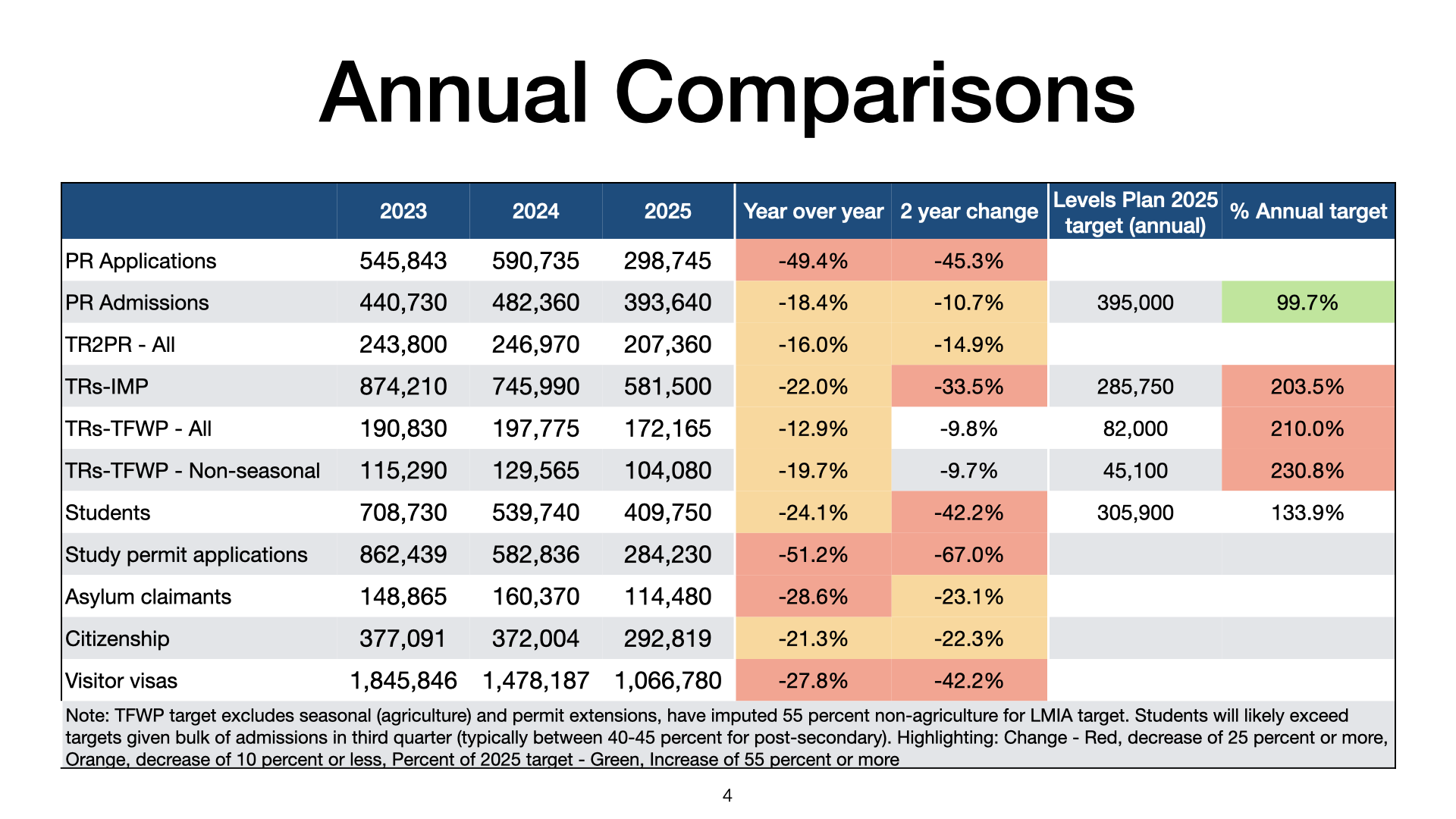
JP: The current number under the Carney government, which has now been in power for a year, is 3 hundred and 80 thousand permanent residents this year. This is lower than previous years, right? Is this too high a number?
JASON KENNEY: It’s much higher than previous years. If you… I mean, the Harper, Harper government, we averaged about 2 hundred and 60 thousand permanent residents. And if you want me to be totally truthful about that, I thought that was probably a bit too high. I saw some of these concerns a long time ago emerging, and I wouldn’t have lowered it radically, but somewhat, to put this in context, when Pierre Trudeau was prime minister in his last term. Canada hit a big recession in 1982. His view was the very pragmatic, traditional Canadian view, up to fairly recently, was that there is no sense in inviting newcomers to join a country with high unemployment, when Canadians were already struggling for work. And so he reduced levels by 40 per cent, 40 per cent from like 120 thousand to 80 thousand in 1982. What the Carney government has done is to take Trudeau’s, like 420 thousand permanent residents target to reduce it to 380 thousand, that’s virtually meaningless. When you look at the huge overhang from the Trudeau catastrophe, including something like 3 million temporary residents who came here primarily on work permits and study permits, who are either overstaying, seeking a renewal of their visas, trying to jam in to the permanent residency stream. A huge part of this is not merely a quantitative, it’s also qualitative. By which I mean we used to have what was widely regarded across the world as something of a model human capital immigration system through the point system for selecting economic immigrants. But right now, because of these mistakes, if you are a… I have a friend, a Brazilian friend who’s a pediatric oncologist, 35 years of age, speaks four languages, literally a model immigrant. You know, he would be making much higher than average incomes, providing critical health services, contributing massively for his entire life, zero integration challenge cannot get into Canada through the point system. But if he was, he had come here as a foreign student with a work permit in a fast serve restaurant who maybe spoke, barely spoke either official language, he would now have a higher chance of getting permanent residency in Canada. We have taken our human capital model and turned it on its head. And that’s also going to have a lot of problematic downstream effects.
JP: I just want to come back to this critique that, you know, the primary reason why people are feeling these stressors is because of poor governance, right? Not immigration. So like when it comes to education, for example, in Alberta, there is a clear downward trend in per student funding in the province. Our own colleagues gathered data around this for the years between 2015 and 2022. So again, like is it fair to lay issues around classrooms on immigration? Is it really immigration that’s causing this?
JASON KENNEY: Earlier, I said we should avoid a false dichotomy in this debate, and you’re presenting that false dichotomy again when there are serious problems, social or public policy problems, they’re very rarely a single cause. But I will remind you, I mean, what you’re articulating there or what you’re reflecting is I think that the lazy, totally predictable script of the teachers unions and the left broadly, which is you need to spend infinite money on these programs. The teachers unions and that lobby, of course, said it wasn’t enough. There was scarcity. You know, maybe there is an argument that the government, that Alberta needs to spend more on, on education. But that argument does not acknowledge that there is a problem with completely untethered population growth and demand. Population growth is, in principle, a good thing. I mean, look I’m the guy who launched the “Alberta is Calling campaign” to encourage Canadians to think about moving to a place with the lower cost of living and lower taxes, etc… And because population growth has been a key driver of Alberta’s modern economic diversification, but it has to be a manageable and realistic population growth so the public services can keep up with it, the labour market can keep up with it, and we don’t end up with a kind of anti-immigrant backlash that is now appearing in Canadian politics.
[music]
JP: The current premier is really laying the blame for these problems that Albertans are facing at the feet of immigration. And do you think that she’s wrong there? Do you think that she’s putting way too much emphasis on what’s causing these problems?
JASON KENNEY: I think it’s a primary driving factor, it’s not the only one, but there was zero regard from the Trudeau government about what impact these extraordinary levels would have. Now Alberta, because of its more prosperous economy and higher paying jobs, etc… on average, you know, we have higher incomes. For those and other factors it has tended to attract a large number of the overall intake of immigrants to Canada. Certainly as primary immigrants but also we get a lot of secondary migration of newcomers who arrive, let’s say Toronto, Vancouver and when you put all that together, it does impose large pressure. Now, I do think until not long ago, Premier Smith was in favour of some of those very high levels. She always used to lobby me. When she was at the CFB and as leader of the Wildrose Party to, for example, loosen the temporary foreign worker program, and I think that she was calling for more immigration and faster population growth until recently. But, you know, that’s just context to say, I think she recognizes that this has placed unsustainable pressure on the system. And it’s right to want to correct that. I’m not sure that a referendum is necessary to… I haven’t even looked at all of that that’s being proposed here.
JP: You know, you’ve talked about this “Alberta is Calling” campaign a few times already where you yourself invited people to come to the province. And so wasn’t that pressure from the Premier welcome? I guess what I’m trying to get out here is, like the Premier herself said that she wanted 10 million people in Alberta by 2050. Right. Just two and a half years ago.
SOUNDCLIP
DANIELLE SMITH: So I’ve said, let’s have an aggressive target to double our population. I’m going to put this out there because I’ve said that in the throne speech. I want people to understand how important that is. We have to be that bastion of liberty, and people are going to want to come here, and we want to embrace them, and we want to be able to build this place out so that we can actually have the political clout in Alberta that we deserve, because right now, we’re being treated as a junior partner by Ottawa, and if we end up with the strongest economy, we’ll double our oil production…
REPORTER: So you want to go from, rough numbers, you probably know the number better than me. 4.7 million, roughly.
DANIELLE SMITH: We’re almost at 5 million.
REPORTER: Okay. So you want to double it to 10 million?
DANIELLE SMITH: Yeah, I do you.
JP: You were calling for more people to come to the province. So, like, is it fair to just invite a bunch of newcomers to come, only to say a couple of years later that they’re to blame for health care and education being stretched, stretched too thin?
JASON KENNEY: That’s a rhetorical trick you just played there.
JP: Ok fair. You know, I think the premier is, the current premier is certainly, seems to be saying that from her speech.
JASON KENNEY: There’s a difference between blaming irresponsible planning of immigration levels, which I think characterizes the Trudeau government and blaming those who came through the program. Look sure there are, and I’ve been commenting quite strongly on people on the, I think, extreme right who are trying to exploit this frustration by blind blaming immigrants. I don’t hear responsible Canadian elected leaders doing that. And I will say what, you know, the optimal approach for a dynamic, prosperous province like Alberta is a population growth that’s manageable. And no, when I launched the “Alberta is Calling” campaign, it was part of a larger effort to restart the Alberta economy after we’d been through several years of decline and stagnation. And we had been hemorrhaging people, capital, jobs, businesses. And we were seeing net outmigration, to me that was a great concern. And so to turn that around and to get back to diversifying our economy, I thought it was important that we invite people from across Canada and their skills to come to Alberta, of course, within reason. But what, you know that… when you have like… What I was looking for, what we had was net interprovincial migration to Alberta of like 20 thousand to 25 thousand manageable numbers, I think. But when Trudeau comes in and starts like opened up the floodgates, that is, that’s ridiculous. And by the way, I’ll tell you, I was the only premier around the Council of the Federation predicting that this would happen with those kinds of policies. It’s not just Alberta. You shouldn’t, with respect, I don’t think you should be focusing on this as an Alberta issue. It is a Canadian problem.
JP: I take your point. But if I could just focus on. Alberta just a little bit longer because I know this is something that you have so much knowledge about. You know, I was looking at some data from the Canadian Energy Centre from a few years ago, and it was pointing to how as of 2019, immigrants represented over 35 per cent of all employment in the oil and gas industry. And so could the policy changes that Smith is asking Albertans to vote on in the fall have a negative effect on the economy? You know, don’t places like Banff and Lake Louise and Jasper, for example, rely heavily on seasonal and temporary foreign workers to sustain their tourism dependent economies?
JASON KENNEY: Like, I’m not entirely sure what the question is, because we do need and want immigration, and I do think that is the position of the government of Alberta. I don’t speak for them, and I, I don’t think there’s a call for zero immigration. I think there’s a call for reasonable levels. By the way, some of the things that you, I haven’t had time to listen to that speech, but if you suggest…
JP: Let me give you an example…
JASON KENNEY: If you suggest that people shouldn’t… If she’s suggesting people should not qualify for welfare on their first year of arrival in Canada, that seems to be entirely reasonable. In fact, when I was the federal immigration minister, I was asking provinces to adopt that policy to help reduce the pull factor for false asylum claims, which is another thing that’s run completely out of control thanks to total mal-administration by the Trudeau government. One of the reasons why we have, until recently, been one of the only developed democracies with a broad cross partisan pro-immigration consensus, is because of the powerful founding myth of immigration in Canada. You know, the Ukrainian pioneers, to the northern prairies and so on, who built much of western Canada. We think about that immigration myth. We think of people who came here with a deep sense of personal responsibility, not of entitlement. God knows they didn’t show up in Canada expecting a gold plated public services and welfare payments upon arrival. And I think, frankly, many Canadians are observing and many new Canadians are observing that that has become too often the case with, for example, failed asylum claimants. So whether it comes to the interim federal health program, which is run out of control, welfare payments and so forth, I do think limiting access to some of those things, demonstrating that newcomers are contributing to the country is critical, not just for our economy, not just to reflect fiscal limits, but also to reinforce and rebuild public support for immigration. If we want to avoid a politics characterized by what we’re seeing across the Western democracies, where Nigel Farage is leading in the polls in the U.K. and now one nation is in a tie to lead in Australia. These are all xenophobic, anti-immigrant, pro remigration quote, unquote parties. If we don’t have a degree of, you know, bring back some rigour into our system and realistic levels, I fear that that kind of politics will emerge in Canada.
JP: Do you think that it’s responsible to put these kind of questions in a referendum? You know, this is very complex policy. Governments have to take in a lot of factors. The economy, you know, interprovincial migration, I mean, you brought many of them up today. Do you do you think that these kind of questions should be decided upon in a referendum?
JASON KENNEY: I do think that direct democracy has, can have a salutary role in a system like ours occasionally on very big questions like constitutional, proposed constitutional amendments. We did that in Alberta under my government with equalization. I think it’s you know, if you’re going to do that, you should probably in my case, we put that in our platform. So we had a mandate to in turn put that one simple, clear, very consequential issue on the ballot. I don’t think that normal policy changes require a referendum, or frankly, I don’t think that a referendum is the most desirable tool for normal policy changes. I will tell you that, you know, I overhauled Canadian immigration policy in between 2008 and ’13, in virtually every respect, I think improving it. Most people, I think, would agree. We did that without referenda, obviously. We did a total overhaul of the asylum system, for example, of the skilled worker program, all of the programs, and we did that without referenda. So it’s, I think what’s required is leadership here at all levels of government, because if we want to maintain the positive aspects of immigration in Canada, and we restore a broad cross partisan pro-immigration consensus and keep at the margins these extremist racists who are trying to exploit the current frustration, then we need to get back to a properly rules based, well-managed, pragmatic system that’s in line with our ability to absorb newcomers.
[music]
JP: On the federal level. Conservative leader Pierre Poilievre is introducing a motion that will call on the government to, quote.
SOUNDCLIP
PIERRE POILIEVRE: Force a review and a cutback in benefits to asylum claimants to ensure that non-citizens and non-permanent residents do not get superior health benefits than Canadians. Second, it would ensure that those asylum claimants who are here and have been rejected. Only get lifesaving emergency care and not special care. And third, it would ensure that judges give the full sentence and allow for a complete deportation of foreign nationals who are non-citizens that commit crime in our country.
JP: This just came out, but Ottawa is already requiring sponsored refugees and asylum seekers to co-pay for their health coverage starting in May. They are already moving on some of this. So is this really necessary or do you think that this also might be about riding a wave of political sentiment here?
JASON KENNEY: I think it’s absolutely necessary. And it’s frankly, well behind the public sentiment that my advice to Mr. Poilievre, like 2 or 3 years ago, was that, I could see where the public was going on these issues. I reiterate that that public sense of frustration and even a sense of injustice at some of these abuses of our generosity includes large numbers, a majority of new Canadians who see it most closely, who see the fake asylum claims. If you’ve waited for five years or so to come into Canada legally, through the front door, through our properly managed immigration systems, and you see other people crashing in here through a fake asylum claim, getting welfare, public housing, supplementary health benefits that you don’t get as they try to delay endlessly their removal from Canada. That undermines the integrity of our system. So no, I think he’s absolutely right. And he’s basically calling for policies that the Harper government had implemented, which included ending access to anything but emergency care insurance for failed asylum claimants. Why? Because they have no legal right to be in Canada.
JP: You know, we have seen the courts threaten to overturn the Harper government’s attempts to cut refugee health care. Back when you were in the federal government. I think that’s what you were just talking about. And the court called the move cruel and unusual, especially since, as the judge pointed out, that it affects children who were brought to this country by their parents. And I wonder how you would respond to that.
JASON KENNEY: Well, I would respond by saying it’s not refugee healthcare for people whose refugee claim has been rejected as invalid. It’s supplementary insurance for illegal migrants who are illegally residing in Canada, subject to removal. So you know, and there’s a whole suite of benefits that are still extended to… That the Trudeau government extended effectively, which has created a draw factor. So, you know, and by the way, when you say that… you said earlier that sponsored refugees are required to have a partial coverage or partial payment now, a co-pay, they’ve introduced that. That’s fair. Now when the privately sponsored…
JP: And that is being critiqued to, I should say, as cruel as well. There are people…
JASON KENNEY: Of course. Of course. Everything’s cruel if you’re on the hard left. The, you know, the privately sponsored refugee program is a well-managed program. I expanded it by moving selection over from the government assisted program because these are usually community, usually faith groups, starting with the Vietnamese boat people in 1979, ’80, who gets sponsored into Canada. And the sponsor, the sponsor takes on board any responsibility for their income, support, housing, etc…, not the taxpayer and the sponsors are involved in the successful integration of those newcomers. I think that’s a model where you actually have a sense of personal and community responsibility, and not just Canada as the world’s hospital or the world’s welfare program.
JP: I just want to move to the kind of broader consensus debate around immigration right now. As we wrap up, you know, after Danielle Smith’s speech last week, Rachel Notley wrote on social media, “the Premier is sowing hate and division to distract from the fact that her government is the real culprit”. But are you worried that this and kind of, other kind of language that we’re hearing from politicians across the country could ratchet up racism and hate towards immigrants. That, for example, if people are reasonably angry about their mother being stuck in an emergency room for 24 hours, that they might direct that anger towards immigrants.
JASON KENNEY: Well, you know, I think very few Canadians would blame an immigrant for that. But if you’re Canadian and you can’t get access to health care, and you observe that under the Trudeau government, several million people were added to the population in a very short period of time. You’re not stupid. You’re going to make a correlation and say, we need a sensible, pragmatic immigration policy. There is a choice between that very Canadian common sense response and nativistic racism. Okay. And I do think we have to call out the nativism and the racism as I do all the time. We also have to acknowledge that irresponsible immigration policies that drive population growth completely out of line with our capacity to provide services and ends up with, with a high…. By the way, the high levels of very low skilled folks that came in under Trudeau, as opposed to the more highly educated people of the past, are also driving down per capita GDP. It’s not just about access to health care, it’s about our prosperity as a country. So Canadians have every right to see that correlation, to object to it, to call for, I think, a significant reduction in levels until we can get this back into equilibrium.
[music]
JP: Just on your point that we need to kind of call out racist or nativist language. I’d be interested to get your thoughts on some remarks made on social media last week by Bruce McAllister, the executive director of Smith’s Calgary office. He said, quote, unsustainable mass immigration into Canada fills him with, quote, profound disgust. He went on to say, quote, why import from nations with failed systems when our Judeo-Christian heritage and principles have worked so well here? And is this the kind of language that you think needs to be called out?
JASON KENNEY: Yeah, I think that kind of language is at best unhelpful and I… not the kind of language I would ever use. And I think that’s, again…
JP: Are you concerned that he’s still there? I mean he works there, he’s pretty high up.
JASON KENNEY: That’ll be for his boss to decide. I really try to avoid second guessing my success rate. I think as a general rule, it’s not a desirable thing to do, but if you’re asking about those kinds of sentiments, I think that that’s where you can take, I think, well-founded anxiety and opposition to irresponsible immigration policies, and that there is a kind of language that can start to bleed that into nativist rhetoric. And I think we all have to be very alert to that.
JP: You know, just to end this conversation, you have alluded to this throughout our conversation. You were raising concerns last week about the way that immigration is being debated, because the director of the Canadian anti-immigration group, the Dominion Society, this guy named Daniel Tyrie, did an interview with the online news outlet Juno News. And in it, he advocated for re-migration, which is defined as the forced removal of immigrants and refugees based on race or ethnicity. Here in Canada, it’s pushed forward by a range of groups that have been classified by the Canadian anti-hate network, for example, as part of the country’s white nationalist movement. And Candice Malcolm, who did that interview, also made clear that she does not endorse what he says, and she did push back on his views during the interview. But she argued that Tyrie’s views should be part of civic debate, that it’s crucial to widen the boundaries of what’s considered acceptable to debate.
SOUNDCLIP
CANDICE MALCOLM: I want to hear more voices. I want to hear from more Canadians. I want to hear what real Canadians think. And I’m trying to open the window so that it’s wider. So there’s a wider range of what is acceptable to talk about. As a conservative, I’m also trying to shift the window to the right, because I think part of the biggest problem in this country is that it leans too far left. It has been for a long time.
JP: Where do you draw the line on what is acceptable and helpful debate about immigration and what’s not, and what are the consequences of not drawing a line?
JASON KENNEY: Well, the consequence of not drawing, of not drawing the line is mainstreaming or destigmatizing, outright racist sentiments, which I think thankfully are pretty marginal in Canada but they are real and they exist. This guy is advocating to take immigration to zero for at least 10 years, to have the forcible deportation of every legal permanent resident in Canada, which means all these people we invited to come here, who followed the laws, are paying their taxes, where most of them settled here for some years. And he’s also calling for the deportation of many citizens who are not quotes “heritage Canadians”, which I can only take to understand the descendants of white European Canadians. I don’t know if he includes Indigenous Canadians whose ancestors have been here for millennia as “heritage Canadians”. This stuff is obviously toxic. It’s crazy. And I have a more particular concern as a lifetime conservative activist that if, if and when this stuff comes from the right, it has to be called out on the right, it has to, there has to be a function of political hygiene in every party and every movement. And I’m in a position where I can, where I am doing that very vigorously, because I’ve seen where that kind of sentiment has taken us in other parts of the Western world. I will just add, as I’ve said before, I think it’s important that that the Daniel Tyrie’s of the world have more sway and purchase in a potential constituency because of the catastrophic mismanagement of immigration in the past few years. And this is something I predicted for years, for 10 years as Minister of Multiculturalism for Canada, 5 years as immigration minister, that if we want to maintain Canada’s broad public support for immigration, we have to maintain a system with which, with realistic, manageable levels, successful integration outcomes focus on social cohesion as opposed to ethnic enclaves and division. Focus on high human capital in our economic immigration. And the consistent application of fair rules, even if sometimes it seems hard headed. If you don’t have a system like that, you create space for Nigel Farage, Marie Le Pen, the AFT, for Pauline Hanson in Australia, for Daniel Tyrie and Maxime Bernier in Canada.
JP: Okay. Jason Kenney, thank you very much for this.
JASON KENNEY: Thank you.
[Music: Theme]
JP: All right, that is all for today. I’m Jayme Poisson. Thanks so much for listening. Talk to you tomorrow.

 Multicultural Meanderings