Staffing cuts strain Justice Department

Confirms other reports (e.g., Justice Canada chops research budget by $1.2-million), and provides additional explanation for the large number of cases lost by the Government. An amusing, if sad, contrast between the comments of former officials and the everything is fine assurance from the political and bureaucratic levels:

Separately, in the Public Safety Department, lawyers were given just one week to draft a new law on parole, according to Mary Campbell, who retired last year from her job as the department’s director-general of the corrections and criminal justice directorate.

By her count, 30 bills on justice, sentencing and corrections are either currently before Parliament or were given royal assent in June. She likened the legislative development process to a sausage factory.

“When you’ve got a pace that says, ‘Keep the sausage machine going,’ you’re going to get errors,” she said in an interview.

Jason Tamming, a spokesman for Public Safety Minister Steven Blaney, said the government has passed more than 30 measures to get tough on crime. “Our Members of Parliament work very hard to pass the best legislation to keep our communities safe,” he said. “We expect our civil servants to do the same.”

The Justice Department, in an internal report on the criminal policy section released on its website, did not use the colourful language that Ms. Campbell did. But it spoke of lowered morale as research and statistics staff have been cut from 35 to 17, between 2008-09 and 2012-13. It said 81 per cent of the department’s lawyers said the quality of their work has suffered because of the short timelines they must meet.

However, when contacted directly, a Justice Department spokesperson said it is important to note that the criminal policy section is achieving its objectives and the government has a high degree of satisfaction with its work.

David Daubney, a former senior bureaucrat in the Justice Department who retired in 2011, said the purpose behind the research staffing cuts is obvious. “They don’t want to encumber their minds with the facts,” he said of the government. “We always at Justice prided ourselves as being ‘stewards of the criminal law.’ We were seen as the go-to place for the facts and research on criminal policy, justice and corrections. That’s certainly no longer the case.”

He said morale has dropped as advisers conclude the government doesn’t want their advice. At a recent retirement party, an assistant deputy minister he wouldn’t name “confirmed that they’re not bothering to put as much background data as they used to into anything going into the minister’s office or into memoranda to cabinet.”

In the 2010 C-37 Citizenship Act revisions, we only had three weeks to draft legislation which my staff and the lawyers were concerned about.

Not sure how much time was given to the drafting of the recent C-24 Citizenship Act comprehensive changes, but the Canadian Bar Association did comment on what they considered poor quality drafting (may be sniping between lawyers but I also found the changes hard to follow):

The government has an opportunity to improve the poor drafting in the current Act. However, Bill C-24 uses excessive cross-referencing within the Act and to previous citizenship legislation to the point of near incoherence. This results the legislation being inaccessible to the public as well as many public servants, politicians, lawyers, and judges, delayed processing times for citizenship applications and an increased backlog, and an increased burden on Canadian courts. Plain language drafting is in the interest of all parties.

Staffing cuts strain Justice Department – The Globe and Mail.

Tony Clement hatches open government plan: Goar | Toronto Star

Evidence vs. rhetoric, or Government irony at play:

Here is the oddest part: this is the second phase of Clement’s open government project. Phase 1 ended in 2012. According to Clement it succeeded in enhancing accessibility and transparency. The evidence suggests otherwise:

Complaints to Canada’s information commissioner were up 30 per cent last year. Suzanne Legault warned parliamentarians that the public’s right to know is worryingly fragile.

Parliamentary committees attempting to scrutinize government spending were denied access to essential facts and figures. When MPs persisted in delving into federal expenditures, the Tories adjourned the hearings.

The parliamentary budget officer was also stymied. Ministers withheld departmental documents and bureaucrats ignored his requests. At wits’ end, Kevin Page threatened to take the government to court.

Members of the media, who act as the public’s eyes and ears in Ottawa, were barred from speaking to cabinet ministers. They had to settle for anodyne statements approved by the Prime Minister’s Office PMO tweeted or emailed by Tory aides.

In Clement’s defence, he did download 172,000 government documents on a new Open Data Portal . An additional 100,000 have been now been posted.

Tony Clement hatches open government plan: Goar | Toronto Star.

Statistics Canada rushing to redo July job numbers

More bad news re StatsCan regarding its having to redo job numbers:

The incident will add fuel to a continuing debate over the quality of the federal government’s labour market data, which, economists contend, has generally been more volatile in recent years.

Peter Buchanan, senior economist with CIBC World Markets, said the error reinforces the fact that markets and policy makers need reliable information.

“Obviously, this does add to concerns on that front,” he said. “Good data is essential to steer the economic ship in the right direction.”

Federal departments – including Finance Canada – have recently used alternative private sector surveys based on Internet job postings to produce job vacancy statistics. That approach led to criticism after the Parliamentary Budget Officer pointed out that the government’s claim of rising job vacancies was almost entirely due to methodological problems associated with using job postings on the classified site Kijiji.

Partly as a response to that criticism, the government announced in June that it would give Statistics Canada an additional $14-million a year starting next year to produce a new job vacancy survey and a new survey on wages.

One of my doctors commented, regarding the cancellation of the Census, that  “there is nothing more costly than ignorance.” The government is paying the price for not having valued good quality data and statistics.

Statistics Canada rushing to redo July job numbers – The Globe and Mail.

Canadians pay 42% of income in tax — more than they spend on food, shelter, clothing combined | National Post

Unfortunately, all too typical of shallow economic analysis, aligned with ideology.

Of course, one can and should always question value for money with respect to taxation, as well as reviewing the need for government intervention and programs.

But an increase in the share of taxation from 33.5 percent in 1961 (pre-medicare) to 41.8 percent in 2013 without a corresponding analysis of the change in government services is the kind of sloppy “stop the gravy train” Rob Ford unsubstantiated bumper sticker.

A more serious approach would be to compare the increase in program spending with the increase in programs and services, and focus the discussion on whether or not the existing policy rationales and needs are still appropriate:

“Telling people that almost 42% of their income goes on taxes, that’s the first important takeaway. Then people can say, ‘Hold on, that’s one area that can be scaled back.’ We want to start that conversation and this is the data to do that,” he said.

Given that incomes have increased substantially since 1961, it’s inevitable taxes would also rise in terms of the amounts paid, but tax rates have increased because governments provide a wider range of services.

Since 1961, the average family’s tax bill rose by 1,832%, dwarfing increases in the costs of housing, clothing and food.Last year, the average family earned $77,381 and paid $32,369 in total taxes, or 41.8%. Food, shelter and clothing ate up another 36.1%.

For 1961, the numbers were $5,000 in income, $1,675 on taxes (33.5%) and food, shelter and clothing 56.5%.

Canadians pay 42% of income in tax — more than they spend on food, shelter, clothing combined | National Post.

L’Écosse, une inspiration pour les indépendantistes, selon Drainville

Quite an amusing read, Drainville praising the approach of the Scottish nationalists in their referendum, given that it is based on a clear, short question, developed in cooperation with the national government, all anathema to the PQ:

L’ancien ministre responsable des Institutions démocratiques et «parrain» de la défunte Charte des valeurs a été charmé par la façon dont les Écossais mènent la campagne. Il a entre autres observé que les tenants du Oui dépassaient largement la base militante du Parti national écossais, la formation indépendantiste dirigée par le premier ministre Alex Salmond.

«La société civile a pris en main ce référendum, des groupes et des citoyens ont décidé de le prendre en main. La campagne du Oui est largement décentralisée, très terrain, très près des gens, cest ce que jai observé», a-t-il relaté.

Le processus référendaire écossais est aussi une affaire de collaboration entre le gouvernement central britannique et le Parlement dÉdimbourg.

…..La limpidité de la question référendaire et la transparence totale entourant la date de la consultation populaire devraient éclairer les débats au sein du mouvement souverainiste québécois, selon M. Drainville.

L’Écosse, une inspiration pour les indépendantistes, selon Drainville | Martin Ouellet | Politique québécoise.

Finance Canada survey finds Canadians at odds with Conservatives’ priorities

Interesting but not necessarily surprising. Those Canada’s Economic Action Plan ads may have not been as good value for money, let alone for taxpayers:

Public-opinion research for the federal Finance Department suggests key government policies are out of step with Canadians’ priorities, including the Northern Gateway project.

Members of focus groups consulted prior to the February budget had “little enthusiasm” for the proposed bitumen pipeline to the British Columbia coast — even those who said they support the controversial project.

And among the 12 groups consulted — from Coquitlam, B.C., to Bridgewater, N.S. — the economy itself was not a top-of-mind concern.

Rather, the groups spontaneously raised education, health care, pensions and veterans as their key issues.

They also called for more processing and refining of Canada’s oil resources at home, and to do so in a more environmentally safe manner.

The findings of the January focus groups, commissioned from NRG Research Group, suggest the Harper government’s central policy themes — trade and the economy, with an emphasis on energy exports — are resonating less with ordinary Canadians.

http://www.ipolitics.ca/2014/07/20/finance-canada-survey-finds-canadians-at-odds-with-conservative-government-priorities/ (pay wall)

Coyne: Conservatives’ incoherence really shows with Charter of Rights discontent

Good column by Coyne on the Courts, the Conservatives and recent cases:

“Judges don’t always get it right,” colleague Ivison observes. No, they don’t — neither do politicians, if you’ve noticed. But governments have lots of options in the face of an inclement ruling. They can redraft the law, for starters: It’s usually possible to preserve its purpose while removing the offending provisions. Beyond that? Amend the constitution. Appoint better judges. Make the case for a more restrained theory of jurisprudence. Change how the law is taught. Conservatives used to pride themselves on taking the long view of things.

Meantime, if Conservative MPs are so concerned about the powers of Parliament being usurped, I suggest they look closer to home. As defenders of Parliament, they’d be a lot more convincing had they not spent the past many years meekly surrendering one ancient Parliamentary prerogative after another, not to the courts, but to a far more voracious usurper: the executive.

Or if it’s the courts they’re worried about, there’s a simple way to remove them from the equation: Stop passing laws that are so clearly and flagrantly in violation of the Constitution see, for example, the prostitution bill. Insist, as the political scientist Emmett Macfarlane has suggested, that ministers screen bills for charter compatibility before introducing them in the House. Better yet, have committees of Parliament do the same.

As things stand, MPs seem content to abdicate this responsibility to the courts, so they can pick fights with them later. “Why elect people and pay them to do something the courts are doing,” Miller grumbles. Why, indeed.

Coyne: Conservatives’ incoherence really shows with Charter of Rights discontent.

‘Mental Prisons,’ the Public Service and Gilles Paquet

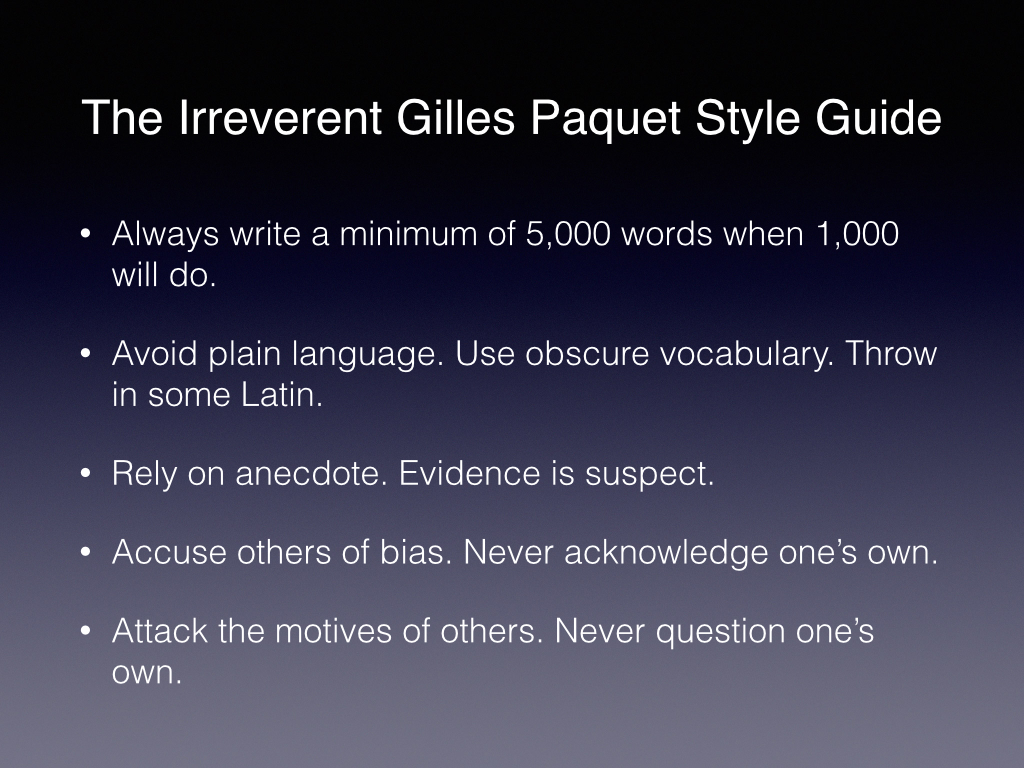
In the spirit of Paquet's call for the "highest and best use of irony and irreverence" and "methodological and intellectual cruelty."

In the spirit of Paquet’s call for the “highest and best use of irony and irreverence” and “methodological and intellectual cruelty.”

My review of Gilles Paquet’s Super-Bureaucrats as Enfants du siècle in the Hill Times:

Ralph Heintzman provoked considerable debate in his Canada 2020: Renewal of the Federal Public Service arguing for an independent, arms-length public service. Ruth Hubbard countered it with The real problem with the public service, arguing that the real problem is competency, not the relationship between the political and bureaucratic levels. Maryantonett Flumian reminds us that politicians are elected, officials are not, and they have to implement government priorities as long as they do not break the law in How public servants support democracy: a response to latest Canada 2020 study.

Gilles Paquet adds his voice in Super-Bureaucrats as Enfants du siècle, which, while focused on officers of Parliament, casts his critique more broadly.

Paquet’s language, as always, pulls no punches. The “tribe” of super-bureaucrats form an “oligarchy.” They have a “sense of superior expertise and total infallibility.” They are agents of “counter-democracy” and impose their “technocratic and ideological views … usurping the role of elected officials.”

Officials practise “active or passive disloyalty” and are guilty of “sabotage.” The “fairy tale” of political reliance on anecdotes versus official reliance on anecdotes led to a “destructive … misuse of power,” which “translated in subterranean efforts to block, derail, or deflect the efforts of fairly able politicians.”

But apart from the tone, what is Paquet’s argument?

That super-bureaucrats, starting with officers of Parliament, but including adjudicatory bodies and the courts, have largely usurped the authority of the government and Parliament through “mandate creep with gusto.”

Their ideology or “diktats of indiscriminate compassion” allow them to portray themselves on the “side of the angels” while pursuing an “unlimited increase of the resources dedicated to the bureaucracy.”

“Super-bureaucrats and higher courts judges have often made unwarranted claims based much more on hubris than on superior competence, and couched in drama-queenesque rhetoric …”

Media and academics have been “defending tooth and nail the sacredness of the super-bureaucrats.”

Other critiques of officers of Parliament have been expressed more in terms of the diminished role of Parliament than of deference to the government (Donald Savoie).

But let’s take Paquet’s argument at face value that the super-bureaucrats and others, including “low-level bureaucrats” like he mentioned, have been actively undermining the government.

I wrote Policy Arrogance or Innocent Bias: Resetting Citizenship and Multiculturalism as more critical of the public service than the government because I felt that we had failed in our role to provide neutral and impartial advice.

We did not acknowledge our ideological and value biases, our evidence base was too slanted towards these biases, and we clung to a narrow interpretation of risk.

But the government also shares some responsibility. It arrived to government with a stronger ideological focus, one that often coloured its perception of evidence and preference for anecdotes (e.g., labour market shortages), and its willingness to discount risk (e.g., recent number of Supreme Court defeats).

But more fundamentally, Paquet is arguing for little or no constraints upon the government of the day.

He devalues the balance that officers of Parliament, adjudicatory bodies, and the courts provide in a context where Parliament no longer plays that role, given increased partisanship, expanded use of time allocation, and omnibus legislation. These trends predate the Conservative government, but have expanded under it.

Moreover, Paquet is also silent on the government’s silencing of those whose statutory role requires them to be a watchdog (e.g., starting with Linda Keen) or kills bodies that provide independent advice (e.g., National Round Table on the Environment on the Economy).

And does he really believe that the original version of Bill C-23, the Fair Elections Act, should not have been challenged?

Reading this paper alongside his companion article, On Critical Thinking, one is struck by just how much Paquet, so critical of others being trapped by their “mental prison,” falls into the same trap.

Is he as mindful of his own biases, ideology, and assumptions as he accuses others of “disingenuity, sophistry, and bullshit?”After all, all three can be found in the left, centre, and right-wing versions of conventional wisdom.
Heintzman’s Canada 2020 report continues to provoke debate (pay wall)


Federal government turning to Dragons’ Den to shake up policymaking

Interesting. Is this part of transition planning for a future government that may be more willing to loosen the reins?

Or is it more “make work” given that we have a government that, for understandable – if not necessarily justifiable – reasons, prefers to limit discussion and debate, and reduce the independence of watchdogs.

How much latitude does the government want bureaucrats to have, given their perception, not completely unfounded, of our biases?

Will future governments bring us “back to the good old days” (which were not so good anyway) or not?:

According to the briefing documents, some of the innovative policy ideas the government is looking to test as pilot projects could include using social media or other tools to engage or consult the public, end users and others to help inform policy development; or creating a “tiger team” to address specific, time-limited objectives.

Other examples of possible pilot projects include using open data, such as launching a challenge to design apps, or innovative “social finance instruments” to help address social problems.

The deputy ministers’ committee was created in November 2012 and originally called the DMs’ “committee on social media and policy development.” It was initially mandated to consider links between social media and policymaking, including new models for policy development and public engagement.

As of December 2013, the committee was asked to move beyond social media to examine trends and new technologies to help improve and transform policy development.

Yet, the rise of social media and its impact on how government communicates its messages and develops policy remains a concern to the government, according to the documents.

“Many governments around the world are seeing their authority decrease as autonomous networks of citizens and stakeholder groups emerge, decreasing the impact of governments on public policy. Concurrently, the public is becoming less deferential to authority,” the documents note.

The changes in ease of access to information and data are “effectively undoing governments’ monopoly on policy analysis,” says the briefing material.

“Social media is fundamentally changing the nature of citizen-state relations. Citizens increasingly expect democratic governments to be transparent, participative, responsive, and to provide customizable and digital services,” the documents say.

“The speed of social media interactions puts pressure on government to develop quick and coordinated responses, which can conflict with longer-term policy and communications planning and priority setting.”

Federal government turning to Dragons’ Den to shake up policymaking | Ottawa Citizen.

Canadian charities in limbo as tax audits widen to new groups – Politics – CBC News

Not quite sure whether the list below passes the “smell” test of being neutral and completely free of political direction:

“CRA audits occur at arm’s length from the government and are conducted free of any political interference. Our government is committed to ensuring that our tax system is fair for all Canadians.”

The tax agency acknowledges it has been auditing the political activities of a variety of charities whose work focuses on animal welfare, poverty, education, religion, health, human rights and others.

Canadian charities in limbo as tax audits widen to new groups – Politics – CBC News.