Perception of politicization of the public service is a problem for Liberals | Ottawa Citizen

Not unexpected to hear this kind of criticism from the opposition, as well as the more-balance assessments from others:

The appointment of Matthew Mendelsohn, who helped write the Liberal election platform, as a senior-ranking bureaucrat is a “clear, unprecedented and blunt” politicization of Canada’s non-partisan public service, says former Conservative cabinet minister Jason Kenney.

Kenney said the previous Conservative government — which had a rocky and sometimes hostile relationship with the bureaucracy — would have been vilified if it “plunked” such a key election player into the top ranks of the Privy Council Office (PCO).

“The real shocker here is his appointment to a No. 2 position in the PCO, the summit of the entire public service,” said Kenney in an interview. “A fellow who worked as a partisan political Liberal on the election campaign … I don’t think there is any precedent for this.”

That perception has dogged the Liberals since Mendelsohn was appointed in December as a deputy secretary in the PCO to head a new “results and delivery” secretariat to ensure election promises are tracked and met.

Results and delivery are big priorities for the Liberals and the public service has a lousy track record at both. By all accounts, Mendelsohn is working hard to get buy-in from ministers, deputy ministers and departments on creating a “delivery culture” in government.

And there seems little debate Mendelsohn is qualified. He is an academic, founding director of the Mowat Centre, an Ontario think-tank, a former deputy minister of several provincial portfolios; an associate cabinet secretary in Ontario and a one-time public servant.

But his bona fides include a leave from the Mowat Centre to work on the Liberal platform and help pen Prime Minister Justin Trudeau’s mandate letters for ministers.

He is also part of the Dalton McGuinty-Kathleen Wynne brain trust that has joined the Trudeau government.

He worked with Queen’s Park veterans Katie Telford, now Trudeau’s chief of staff, and Gerald Butts, his principal secretary. (Mendelsohn’s wife, Kirsten Mercer, was Wynne’s justice policy adviser who moved to Ottawa to become chief of staff for Justice Minister Jody Wilson-Raybould but has since been replaced.)

“The closer you fly to the action the bigger the risk of being branded,” said David Zussman, who holds the Jarislowsky Chair in Public Sector Management at the University of Ottawa. He was recruited into PCO to help lead the Jean Chrétien government’s massive program review.

Zussman also cautions the government has to be careful about the perception that it is too Ontario-centric when staffing ministers’ offices.

“They need a national perspective in ministers’ offices and they have to be careful about that. They could all be meritorious appointments but if they all come from the same place they are not as valuable to ministers as people who come from across the country,” he said.

Ralph Heintzman, a research professor at University of Ottawa, was a harsh critic of the Tory government for politicizing the public service particularly for using government communications to promote party interests.

Heintzman, a key player in writing the public service’s ethics code, feels Mendelsohn’s appointment is within bounds. He was tapped as a policy expert for the platform but wasn’t a candidate or campaign worker.

But perception is reality in politics and Heintzman said Mendelsohn had “sufficient involvement” with the Liberals that the government will now have to be sensitive to all future appointments.

“The very fact the appointment created a perception, fair or not, creates a new situation for the Liberals in the future because it will have to be very sensitive about any future appointments from outside the public service to make sure those impressions aren’t reinforced,” said Heintzman.

That could pose a problem for a government that is anxious to renew the public service and bring in new talent and skills to fill many policy and operational gaps.

The public service has long been criticized for monastic and a “closed shop.” In fact, former PCO Clerk Janice Charette made recruitment, including bringing in mid-career and senior executives, one of her top three priorities.

Source: Perception of politicization of the public service is a problem for Liberals | Ottawa Citizen

From a different angle, Geoff Norquay, a former staffer to former PM Mulroney, argues for greater movement between the two spheres:

We learned this week that a significant number of public servants have been joining ministerial offices in the new Liberal government.

The knee-jerk reactions of some Conservative commentators were predictable enough: “It absolutely feeds into the perception that the civil service favours the Liberals, and that the public service is becoming more political,” said Michele Austin, a former chief of staff to two Harper government ministers.

I believe these reactions are wrong, for several reasons.

Canada has a non-partisan public service, but people have been crossing back and forth between the public service and political offices for many years. It used to be a normal process and it’s not necessarily a bad thing. Actually, it’s a good thing.

Until the Harper era, these movements were openly acknowledged and positively sanctioned, because people from ministers’ offices wishing to cross over to the public service were given a priority for hiring in the bureaucracy.

As part of his effort to close “revolving doors,” Stephen Harper put a stop to the priority system. That was a mistake. Once it has worked through its top priorities, I hope the new government considers bringing the priority system back.

Ministers’ offices are the nexus where the public service and politics meet. They are the place where political judgments are applied to bureaucratic recommendations, where political desires meet practical realities, and where executive decision-making confronts the art of practical execution.

Far too often, these two sides operate as non-communicating solitudes. When relationships between ministers’ offices and the public service become strained, it’s usually because they don’t understand each other’s motivations, priorities, imperatives and constraints.

Many of these tensions and frustrations can be made more manageable if public service recommendations to ministers are more politically sensitive, and if requests and instructions from the political level are tempered by respect for bureaucratic considerations.

open quote 761b1bCreativity comes from your ability to see the different and conflicting sides of complex issues, and apply what you’ve learned from one field to the challenges of another.

The odds of this happening are much better if at least some people making these calls, and negotiating the interface, have experience on both sides. That’s certainly been my experience through more than forty years of working in and around provincial and federal governments.

Trudeau’s blurring the line between ministries and the public service. Good for him.

Trudeau on Trump: Not ‘smug’, Mr. Kenney — just sensibly alarmed: Kheiriddin

Tasha Kheiriddin on Trudeau’s comments and Jason Kenney’s reaction:

Some criticized Trudeau’s remarks as ungracious. “Regrettably smug comment by PM Trudeau,” sniffed Jason Kenney on Twitter, “re our American friends, who help to defend Canada & our interests globally.” The American Spectator’s Aaron Goldstein called Justin Trudeau “smug and condescending just like Obama.”

But Trudeau wasn’t being smug. He was speaking truth to power, or power-in-waiting — at a time when many in the U.S. would do well to listen. Like his father, Trudeau pointed out something about Americans that Americans are seldom going to notice themselves — that they are all too often oblivious of the interests and experiences of the people with whom they share the planet. The elephant won’t crush the mouse out of malice — but he might do it out of ignorance.

In Trump’s case, the ignorance is wilful — even celebrated by those who profess it. Anti-elitism has combined with racism to fuel Trump’s rise. Malicious verbal — or physical — attacks are visited on those who disagree with him. The ends aren’t justifying the means this time, because the ends have nothing to do with protecting American values or interests. They’re all about Donald Trump — what he wants, the lies he’s willing to tell to get what he wants.

Trump’s campaign carries all the hallmarks of tyranny — towards other nations, towards the American people themselves. And it won’t help Americans defend themselves … or us.

Trudeau on Trump: Not ‘smug’, Mr. Kenney — just sensibly alarmed

Nine new MPs came to Canada as refugees or from current or past war zones |

Good profile of the backgrounds of this group of MPs:

Nine newly-elected MPs in the 42nd Parliament, which is considered the most diverse crop of MPs in Parliament’s history, came to Canada either as refugees or fled from war-torn countries.

Out of the nine, according to research conducted by John Chenier, former editor of <em>The Lobby Monitor</em> and now editor of ARC Publications, four came to Canada as refugees from war zones or suffered persecution and five immigrated to Canada from current and past troubled zones such as the Middle East or Pakistan.

The four MPs who came to Canada as refugees are: Liberals Arif Virani (Parkdale-High Park, Ont.) from Uganda; Gary Anandasangaree (Scarborough-Rouge Park, Ont.) from Sri Lanka; Maryam Monsef (Peterborough-Kawartha, Ont.) from Afghanistan and Ahmed Hussen (York South-Weston, Ont.) from Somalia.

The five first-generation immigrants from current and past danger zones include: Liberal MP Faycal El-Khoury (Laval-Les Iles, Que.) from Lebanon; Liberal MP Iqra Khalid (Mississauga-Erin Mills, Ont.) from Pakistan; Liberal MP Salma Zahid (Scarborough Centre, Ont.) from Pakistan; Liberal MP Eva Nassif (Vimy, Que.) from Lebanon, and Conservative MP Ziad Aboultaif (Edmonton Manning, Alta.) from Lebanon.

In total, there are 40 MPs from all parties who were born outside of Canada, according to Parliament of Canada website and research conducted by <em>The Hill Times</em>. Of these, 29 are Liberal, eight are Conservatives, two are NDP, and one from the Green Party.

Source: Nine new MPs came to Canada as refugees or from current or past war zones |

Canadian Heritage shows how public service seeks to foster innovation

Good initiative and equally good debate about its utility (I had tried equally to institute the Google 20 percent time set-aside – without much success):

As part of a push in the bureaucracy to find new ways to work, Canadian Heritage is one of a dozen departments taking a page from Google and letting employees spend up to 20 per cent of their time working on temporary projects outside their usual job descriptions and the usual procedures.

Deputy minister Graham Flack said the initiative – called “micro-missions” – was developed to bring some flexibility to the rigid organization of departments.

“The theory behind micro-missions is, in government, it’s actually very difficult with our traditional HR systems to move people around,” Mr. Flack said.

Mr. Flack also chairs a committee of top bureaucrats who work on new ideas, and the group invites junior employees to join their discussions to get fresh ideas and a better view on the ground.

“We operate in a very hierarchical organization, and sometimes [we have] to give them a reality check,” said Francis Nolan-Poupart, a 27-year-old policy analyst at Employment and Social Development Canada, who sits on the committee.

But just because an idea worked for Google does not mean it will work for the government – or even for other tech companies. Konval Matin, the director of culture at Shopify in Ottawa, and Anna Lambert, the director of talent acquisition, said their company – a rising star in Canada’s tech world – tried giving employees time every week for special projects, but it just did not work.

“We realized you would get so enthralled in your day-to-day that you wouldn’t actually set aside the 20-per-cent time,” Ms. Matin said.

Marianne Hladun, an executive who leads the Public Service Alliance of Canada’s young-worker file, said the union has some concerns that projects might just add work for already stressed employees.

“In a lot of cases, people are just trying to keep their heads above water,” Ms. Hladun said. “In some departments, which I believe Canadian Heritage falls into, … people are doing special assignments but they’re not being compensated at appropriate levels. That’s a bit of a concern to us.”

Leaders at both the political and bureaucratic level have warned that many areas of the federal public service are suffering from poor workplace environments that are hampering service delivery and the mental health of the work force. In her final annual report last year as the top bureaucrat in Ottawa, Janice Charette said there was an urgent need to create a “healthy, respectful and supportive work environment.”

Donald Savoie, a professor at the Université de Moncton and a leading expert on public administration, said he thinks some of the innovative projects are just “band aids” that do not fix deeper problems affecting morale in the public service. “For a government to say, we’re going to have hackathons, or collaborative events, or spaces, that, my friend, is the easy part. The much more difficult part is redefining the role of the public service so that it would resonate.”

Shopify holds townhalls on Fridays where employees are encouraged to share what they are working on, and talk about what is going well and what is more challenging than expected – just as Canadian Heritage tried to do with its pizza lunch.

Ms. Matin of Shopify said even the executive team takes part occasionally – and the exercises have been good not just for morale, but also for productivity as workers from different teams pick up tips from each other.

“The stuff that’s really easier said than done is the trust and the autonomy,” Ms. Matin said. “Not being afraid of letting people experiment and try new things and potentially fail. But the cool thing is, let them fail, let them talk about it.”

Traditionally, the public service is not known for taking risks. Mr. Brison acknowledges the potential for failure as more public institutions and individuals are empowered to try new things and make more decisions on their own. As a political leader, he could be held responsible if something goes wrong. But he says that is part of pushing the public service to do better.

“The only way to avoid ever making any mistakes is to do nothing,” he said.

Source: Canadian Heritage shows how public service seeks to foster innovation – The Globe and Mail

Diversity in political backrooms still lacking

My piece in The Hill Times:

The Liberal government included in its mandate letters to all ministers a “commitment to transparent, merit-based appointments, to help ensure gender parity and that indigenous Canadians and minority groups are better reflected in positions of leadership.”To recall, the Prime Minister appointed a Cabinet with gender parity (15 each of men and women) and almost 17 per cent visible minority ministers (four Sikh and one Afghan Canadian).

Gender parity was not attained for parliamentary secretaries (12 positions out of 35 or 34 per cent) or other leadership positions such as whips and House leaders, visible minority parliamentary secretaries are over-represented (nine positions or 24 per cent) in relation to their share of the voting population (15 per cent).

Given this commitment and action, is the Liberal government also applying diversity and inclusion to its hiring of political staff? What about the official opposition?

To assess this, I looked at the Prime Minister’s Office (59 total positions and 12 senior staffers), the Leader of the Official Opposition’s office (OLO, 23 positions), and ministerial offices (senior staff defined as chief of staff, directors of communications, policy, issues and parliamentary affairs, along with press Secretaries, total number of 101 positions filled at time of writing).

Sources for the data include the regular ‘Hill Climbers’ updates in The Hill Times, other relevant press articles, and the imperfect Government Electronic Directory Services (GEDS). Gender and visible minority status were identified through names, LinkedIn profiles, biographies and photos where available.

From a gender perspective, women are under-represented at the senior level in PMO (one-third), but close to 40 per cent for all 59 PMO staffers. OLO has slightly lower representation of women (30 per cent). For minister’s offices, the percentage of chiefs of staff is slightly less than the overall per cent of close to 40 per cent who are women.

Visible minorities are consistently under-represented, save for the overall numbers in PMO (15 per cent). OLO and senior ministerial office staff all range between four to seven per cent, less than half of the percentage of visible minority Canadian citizens, with chief of staff visible minority representation slightly higher at 10 per cent.

While I have focused on gender and visible minority status, diversity includes of course other dimensions such as regional diversity (many, if not most Liberal staffers come from, or have worked in, Ontario and Toronto), sexual orientation, religion, education etc. R. Paul Wilson’s A Profile of Ministerial Policy Staff in the Government of Canada provides the best most recent analysis of the different aspects of diversity among staffers under the Conservative government October 2012 to June 2013.

Does this matter? In many ways, it does not. Gender parity in Cabinet and relatively strong Parliamentary Secretary representation set the tone for the government and Parliament.

Being a political staffer may not necessarily lead to a direct path to becoming a future MP. Staffer experience is not necessarily perceived as an asset in local riding associations or to the broader public. Staffers may be asked by the party to be its flag-bearer in unwinnable ridings. The most famous example of a staffer becoming an MP is, of course, former Prime Minister Harper, who was a staffer to Reform Party leader Preston Manning among other positions.

All three major parties were able to recruit an impressive number of visible minority candidates (women less so).

However, staffers play an important role in government (and opposition) decision-making. Having a diversity of backgrounds and experience generally helps inform decision-making.

The Liberal government’s commitment to diversity and inclusion, so well executed at the public level for both women and visible minorities, is lacking in the backrooms, particularly for visible minorities. Given the role that staffers play in preparing ministers for debates and discussions, this may impact on the degree to which the overall diversity and inclusion agenda is implemented.

http://www.hilltimes.com/opinion-piece/2016/03/02/diversity-in-political-backrooms-still-lacking/45495&nbsp;

Cities of Migration and Metropolis Conferences this week

Will be busy at the conferences so little blogging for the balance of the week. I will post the deck presentations I will be making on the 2015 Elections and Visible Minorities and on Citizenship: Finding the New Balance later this week.

Diversity on parliamentary committees: Does it matter? | My piece in The Hill Times

Diversity_on_parliamentary_committees__Does_it_matter____hilltimes_comMy piece in The Hill Times (excerpt):

If we look at the overall committee membership of 288 members in both the 25 House of Commons and three joint Senate-Commons committees (some MPs are members of more than one committee), only 21.2 per cent are women, significantly lower than the overall 26 per cent of women MPs.

For visible minorities, however, committee representation largely matches overall Commons representation at 14.6 per cent, just marginally under the number of visible minorities who are Canadian citizens. Indigenous peoples committee representation is less than their share of the population (3.1 compared to 4.3 per cent).

Looking at individual committees, only the Access to Information, Privacy and Ethics and Industry, Science and Technology committees have no women members. Veterans Affairs, Agriculture and Agri-Food, Environment and Sustainable Development, Fisheries and Oceans, Official Languages, National Defence, Physician-Assisted Dying have no visible minority members.

Women are predictably over-represented in Status of Women (nine out of 10 members) and visible minorities are similarly overly represented in Citizenship and Immigration (seven out of 10 members).

Source: Diversity on parliamentary committees: Does it matter? | hilltimes.com

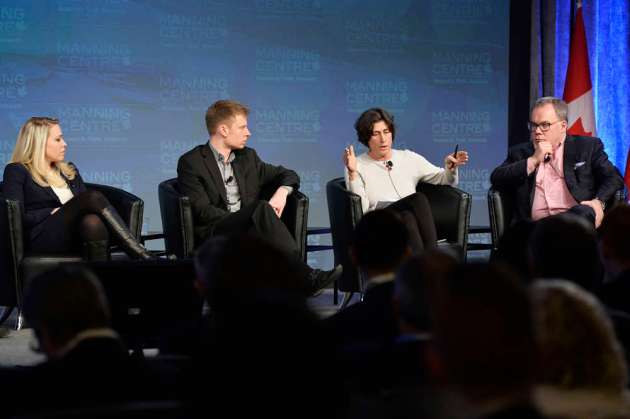
At the Manning conference, identity politics continue to torment the Conservatives

Interesting. Conservatives really need to come to terms with this given just how much their outreach strategy to ethnic voters collapsed in ridings with strong visible minority populations, as well, it appears, being offside mainstream Canadian values:

Toronto Star columnist Chantal Hébert was blunt about the mini existential crisis the conference was exposing.

CTV Journalist Mercedes Stephenson, Sun Media Journalist Anthony Furey, Journalist Chantal Hebert and MacleanÕs Journalist Paul Wells take part in a panel during the Manning Centre Conference in Ottawa on Friday, February 26, 2016. iPolitics/Matthew Usherwood

“Why did Justin Trudeau win the niqab debate on an issue he should’ve lost (according) to the polls? Because his stance on the niqab debate, which is a policy stance, goes to who the Liberals are. You could set your clock on Justin Trudeau saying what he said about the niqab,” she said.

“I look at your party and the niqab, and I don’t know who think you are. If you can, explain it….There are issues that brand a party beyond tone. And before you set out, you need to decide who you are.”

Back in the other room, where Scott-Marshall was explaining the results of their survey, she spoke of a type of free association exercise where participants were asked what words came to mind when they heard Conservative.

There were some positives, but also negative descriptors in line with what Weston had heard at peoples’ doors: “Old, outdated, and mean.”

When the survey drilled down further into how Canadians felt about common terms in the political vernacular — liberal, progressive, democrat, centre, independent, left-of-centre, socialist, conservative, libertarian, radical — they got a strong negative reaction to “conservative”.

“The most common negative reaction is to the word radical, not surprising probably. Although the second most common negative reaction is actually to the term conservative.” Scott-Marshall said.

“Just over a third of Canadians, 36 per cent, say they have a negative response to the term conservative when they hear it. And only 20 per cent say they have a positive response. Something to bare in mind just in terms of maybe negative…baggage that’s being associated with the term Conservative now.”

At the Manning conference, identity politics continue to torment the Conservatives

StatsCan — Reasons for not voting in the federal election, October 19, 2015

Voter Turnout 2015-2011 Elections.001Good overview. Overall striking that turnout rates for longer-term foreign-born citizens are virtually identical to the Canadian-born, and that the gap between more recent citizens shrunk between elections, perhaps reflecting opposition to a number of the citizenship and immigration changes made by the previous government.

Extract from the StatsCan report below:

By immigrant status, the largest increase was among immigrant Canadians with citizenship who had been in Canada for 10 years or less, as their turnout rate went up from 56% to 70%. The turnout rate for immigrant Canadians with citizenship who had been in Canada for more than 10 years increased from 71% to 76%. Among Canadian-born citizens, the rate also increased, up from 70% to 78%.

Source: The Daily — Reasons for not voting in the federal election, October 19, 2015

Meet Sir Michael Barber, the political delivery man: Wells

Good profile of the delivery guru, advising the Government.

Given the ambitious nature of the Government’s platform, and the likely need to make some difficult choices given fiscal and other realities, will be interesting four years hence to see what worked and what did not:

Since he left the Blair government, Barber has honed these ideas into what he calls “deliverology,” the art of ensuring governments meet their goals. He’s become a global consultant spreading the gospel of deliverology to governments as far-flung as Australia, the Punjab, the U.S. state of Maryland, and to Ontario under the province’s former Liberal premier Dalton McGuinty. When a large number of McGuinty-era Ontario staffers moved to Ottawa to work for the Trudeau Liberals, Michael Barber could not be far behind.

And so it came to pass that, during a three-day retreat for Trudeau’s cabinet in St. Andrews, N.B., in late January, Barber was in the room with the ministers for almost the entire time. Trudeau has appointed Matthew Mendelsohn, the former director of an Ontario think tank, as a senior public servant responsible for “results and delivery.” Mendelsohn’s job is modelled on the position Barber held with Blair.

Perhaps it is no surprise that Barber, the object of such ardent affection and attention from the new Trudeau crew, is equally impressed with this young Canadian government. “What they were saying was, ‘We know that often, including in the Blair case, it took a whole term for a new government to learn the disciplines of delivery and then get it right in the second term,’ ” Barber told Maclean’s. “ ‘But we want to get it right the first time.’ ”

The obstacles facing any new government are well-known. First, the usual constant barrage of unforeseen events. Second, the pressure to come up with new ideas rather than checking to see how the old plans are working out. Tony Blair was a sucker for a new idea. In his new book How to Run a Government, Barber calls Blair’s first-term administrative style “government by spasm.”

The alternative to spasm is an attempt to install a routine. A new government asks itself a series of basic questions. “One is: What are the priorities?” Barber asks. “The second is: If you succeeded in delivering a given priority, how would you know? What would success look like in 2019, at the end of this mandate?” The third question is, “How would you know at any given moment you’re making progress toward your goals?” This leads a delivery-oriented government to develop a set of indicators—usually publicly available and thus, if they’re heading in the wrong direction, acutely uncomfortable for the government. How many kilometres of roads have been paved to date, how many megatonnes of carbon went into the atmosphere, that sort of thing.

“It’s not tremendously exciting, but it’s really important, getting the priorities, the definitions of success, the trajectories, the data, the routines to monitor progress, and then the ability to solve problems as they arise,” Barber said. “Because however good you are at planning, you’re not going to get it right. The real world never works out exactly as you anticipate. So having routines to correct and adjust the plan all the time is important.”

One element that helped bring Barber and Trudeau together is a common sense that ambition should not be a bad word in government. “There are times when doing little seems to work, and underpromising and overdelivering seems a good option,” Barber said. “But that’s certainly not the analysis of the Trudeau government, and certainly not the prospectus that they put to the Canadian people during the election. They said, ‘Actually, Canada needs big change, we want to build an inclusive, diverse Canada, we want some renewal of faith in democratic institutions, we want to reduce climate change, we need a big infrastructure upgrade.’ These are big challenges.”

Source: Meet Sir Michael Barber, the political delivery man