Governor in Council Appointments – 2016 Baseline diversity

GiC Baseline 2016.010With the overall Government commitment to diversity and inclusion in all appointments, this deck provides a detailed analysis of the more the 1,300 current GiC appointments.

Governor in Council Appointments – 2016 Baseline

Mr. Trudeau: Don’t be so quick to brag about Sikhs in your cabinet – Ramesh Thakur

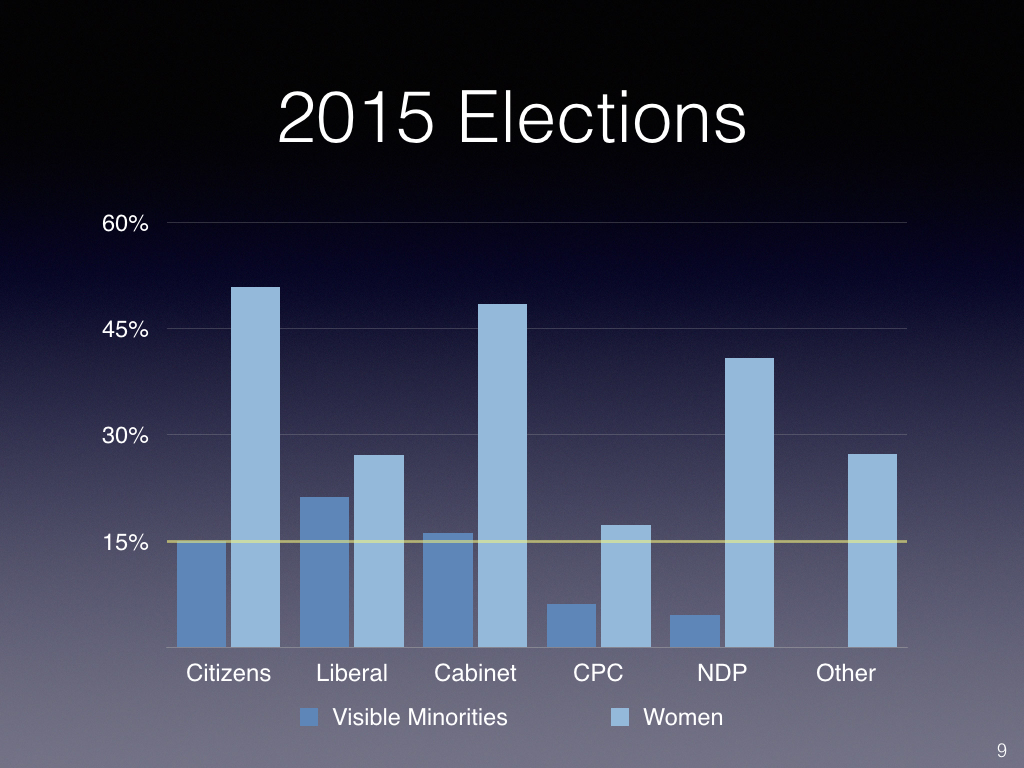
The latest complaint regarding the number of Sikhs in Cabinet (the selection of Parliamentary Secretaries somewhat addressed under-represented groups – see my deck Big Shift or Big Return? Visible Minority Representation in the 2015 Election for the numbers):

India is an exemplar par excellence of power sharing and political accommodation in a multi-ethnic, multireligious society. In a country where 80 per cent of the people are Hindus, at one point the heads of government, state and army were a Sikh, Muslim and Sikh respectively; and the real power behind the throne was an Italian-born Catholic widow. Diversity and pluralism have no better champion. At the official White House banquet hosted by U.S. President Barack Obama for India’s Prime Minister Manmohan Singh – a Sikh – on Nov, 24, 2009, a glittering new dimension of Indian soft power was in evidence with the presence of many Indian and Indian-American women from the political, business, literary, cultural and educational worlds.

Sikhs make up under 2 per cent of India’s population, so two Sikhs in Mr. Modi’s cabinet is a better reflection of India’s diversity than four in Mr. Trudeau’s is of Canada’s demographic makeup. In fact the Congress Party, not Mr. Modi, needs a reckoning on Sikhs. After Indira Gandhi’s assassination by Sikh bodyguards in 1984, 3,000 Sikhs were slaughtered in a pogrom often orchestrated by senior Congress leaders, including more than 2,000 killed in the nation’s capital. One of the extraordinary features of modern Indian history is how Mr. Modi was demonized internationally for his alleged role in the anti-Muslim riots of 2002 in Gujarat but the Congress Party escaped global odium for its role in the worse atrocities of 1984. It is hard to see how there can be closure for the victims’ families until such time as there is criminal accountability for those events.

Moreover, any mention of Sikhs in the context of Indo-Canadian relations inevitably rakes up ugly memories from three decades ago, when Canada seemed to be home to a large number of separatist Sikh extremists.

On June 23, 1985, Air India flight 182 was blown up over the Irish Sea en route from Montreal to Delhi via London, killing all 329 people on board. Most were Canadian citizens of Indian ancestry. This was the first bombing of a 747 jumbo jet, the deadliest plane bombing, the deadliest attack involving an aircraft until 9/11 in New York and remains the biggest mass murder in Canadian history. The perpetrators are believed to have been Sikh terrorists, although the subsequent trials were less than satisfactory.

All in all, what may have been a lighthearted quip by Mr. Trudeau is fraught with hidden dangers and best avoided in future.

Source: Mr. Trudeau: Don’t be so quick to brag about Sikhs in your cabinet – The Globe and Mail

Why won’t the Liberals act on Harper’s overreach on appointments? Baar and Russell

Valid points by Carl Baar and Peter Russell (a former and excellent professor of mine):

One of the lingering excesses of the Stephen Harper government has remained largely unaddressed: awarding appointments for positions that would not be vacant until after the Oct. 19, 2015, federal election.

To the astonishment of many of our colleagues in political science and law, 49 order-in-council appointments were adopted by the Conservative cabinet from Nov. 27, 2014, to July 28, 2015 – all before the dissolution of Parliament – even though the effective dates of the orders were after Oct. 19, 2015, and in one case not until Jan. 1, 2019.

Of these, 48 were reappointments of existing members of agencies, boards and commissions, typically for fixed terms of two to five years, paying salaries as high as $200,000 a year or more.

The one new appointment was to the National Energy Board, for a seven-year term that began on Nov. 23, 2015 – a month after the election was over, and continues until Nov. 22, 2022.

We know of no constitutional principle that allows a government to fill vacancies that do not exist until after the end of its mandate – in this instance, when those vacancies occur after an election has been held.

The search for comparable events has been instructive if not troublesome. Last fall, elections in Poland led to the defeat of its previous government. The new government rescinded five appointments made by its predecessor to the country’s Constitutional Tribunal. That tribunal subsequently ordered three of those appointees reinstated, but declined to reinstate the other two because their positions were not vacant until after the new government came into power.

In Florida, the term of a member of its Supreme Court expired on Jan. 1, 1999, the same day governor-elect Jeb Bush was scheduled to take office to replace a Democratic incumbent. The situation was resolved when the two party leaders agreed on a single appointee to fill the vacancy.

Surely in Canada, with a system of government based on principles of responsible government and democratic accountability, this kind of overreach – making appointments that become effective beyond a government’s democratic mandate – is just as unacceptable as in other democracies.

….Our constitutional system is bulwarked by a set of “unwritten” principles or conventions to ensure that official conduct is consistent with the underlying spirit of our written Constitution.

One advantage of having unwritten conventions is that they can change and be adapted to new challenges to our constitutional order. However a disadvantage is that when unexpected abuses of power occur, there is no easily identified convention to apply.

Thus, for example, there is a caretaker convention that requires government to act with restraint between the time Parliament is dissolved and the newly elected parliament meets. Restraint means carrying on with the day-to-day governing of the country but without taking new policy initiatives or making important appointments.

The caretaker convention emerged in 1896 when Conservative prime minister Charles Tupper, after his defeat in the election but before the summoning of Parliament, presented the governor-general, Lord Aberdeen, with a long list of appointments. The governor-general refused to sign the more important appointments, including those to the Senate and the Supreme Court of Canada. When the House of Commons met after the election, the new prime minister, Wilfrid Laurier, supported the governor-general’s refusal and no member of Parliament supported Tupper.

What we need now, in 2016, is for a member of Parliament to challenge the Harper government’s overreach appointments, and get the same kind of support as Laurier received for challenging Tupper’s attempt to make unconstitutional appointments.

In that way, Canada will establish a constitutional convention that a government cannot make order-in-council appointments to positions that will not be open until after an election.

Source: Why won’t the Liberals act on Harper’s overreach on appointments? – The Globe and Mail

Trudeau picked some smart people for the Senate. That could be a problem. – Christopher Waddell

Valid questions regarding the impact of the new Senate appointees (I believe, however, better to have accomplished and capable individuals than not):

It would be foolish to question the calibre of the people Prime Minister Justin Trudeau has appointed to the Senate. They’re all highly accomplished in their fields.

But their backgrounds and accomplishments shouldn’t obscure two fundamental questions:

Now that they’re there, what are they supposed to do? And who do they represent in doing that?

There is, of course, the old chestnut about the Senate being the chamber of “sober second thought”, reviewing legislation that comes from the elected members of Parliament. Is that the sort of work these new senators — and the others who have recently declared themselves to be ‘independent’ — will content themselves with for the rest of their days in the upper house?

Sober second thought has its value — but this is a particularly accomplished group. No washed-up politicians or party bagmen getting a taskless thanks here; Trudeau’s appointments include a prominent judge, a champion paralympian, a former university president and the former editor-in-chief of La Presse. How long will they be satisfied with a job that requires them to think without acting? Is the Senate to become a glorified think tank?

The logical outcome of sober second thought is action — amending or rejecting legislation. Is that what Trudeau wants these senators to do? And who does the government believe the senators should represent in the event they do decide to overrule the elected members of Parliament?

Do Canadians want a more activist Senate composed of people who, while accomplished, have no democratic mandate to act? Do we want to see anyone who was not elected to office regularly rejecting or amending legislation passed by elected representatives? If so, on what basis should they do that? Their personal opinions? The views of others? If so, whose views?

Source: Trudeau picked some smart people for the Senate. That could be a problem. – iPolitics

Kelly McParland: Trudeau’s first senate appointees are exactly the sort of people you’d expect Liberals to appoint

Valid points by McParland but one can have general values and experience ‘alignment’ while also having a measure of independence. And notably, he criticizes the general orientation of the appointees rather than taking issue with their individual qualifications.

But the degree with which they may or may not exercise their independence may be seen not just in their review of Government legislation but on the nature and tone of debates in the Senate and its committees:

Still, you’d think there would be at least a smidgen of curiosity about the latest appointees. They’re the first by the new prime minister, the first in three years (since former prime minister Harper gave up in disgust and quit appointing anyone at all), the first under the Liberals’ heralded new arm’s-length advisory council, the first to be appointed entirely as independents, and the opening wave in the Liberals’ proclaimed plan to de-partisan the benighted second chamber.

Surveying the names on the Liberal list of appointees, two thoughts spring to mind. 1. The Liberals appear to have concluded that the best way to escape the sort of Senate controversy that engulfed the Tories is to make the process as boring as humanly possible. 2. Having achieved that, they’ve used public ennui to appoint exactly the sort of people you’d expect Liberals to appoint.

To get the apathy ball rolling, Trudeau’s government announced in January it had appointed a three-member committee to advise it on potential appointees. It had three permanent members: a federal bureaucrat and two academics, plus “ad hoc” members from provinces with vacancies. The first ad hoc advisers included another bureaucrat, the head of a native women’s group, the head of a Quebec doctor’s organization, an athlete, a singer and the head of a charity.

It duly sent some names to Ottawa, from which Trudeau picked his chosen seven: the head of his transition team, a former Ontario NDP cabinet minister, an academic, an “expert on migration and diversity”, a Paralympic athlete, a federalist journalist from Quebec and the head of the Truth and Reconciliation Commission into residential schools.

Since the Liberals claim all new senators have to be non-partisan, we’ll have to assume all these people assured the prime minister of their independence, though, looking at the list, it’s not hard to guess they skew pretty much to the left. Not a lot of closet Tories in that group. As my colleague John Robson put it, the list is so predictable of a Liberal government it might have been selected by an affirmative action random-elite-candidate-generator.

And what else would you expect? Examine the membership of the advisory committee and you notice it’s heavy with people paid from the public purse, or dependent on government for grace and favour. Who else would they put forward but Canadians who reflect their own background: public servants, academics, friendly faces, administrators, reliable interest groups and members of other Liberal-friendly operations. They don’t reflect Canada so much as they reflect the Liberals’ view of Canada: people like them; people you see in the salons of Ottawa, people who will be sympathetic to Liberal aspirations and the Liberal way of doing things. Even if, under Trudeau’s directive, they have to promise not to call themselves Liberals.

Source: Kelly McParland: Trudeau’s first senate appointees are exactly the sort of people you’d expect Liberals to appoint

Diversity and Inclusion Agenda: Impact on the Public Service, Setting the baseline

My article in The Hill Times, slightly updated:

The Liberal government included in its mandate letters to all ministers a “commitment to transparent, merit-based appointments, to help ensure gender parity and that Indigenous Canadians and minority groups are better reflected in positions of leadership.”

While the focus is clearly with respect to political appointments, this commitment will likely extend to the senior ranks of the public service in a renewed emphasis on diversity. Deputy minister appointments are made by the Prime Minister upon the recommendation of the Clerk of the Privy Council. While the Foreign Affairs Minister recommends  ambassadorial appointments or equivalent, largely reflecting public service recommendations, the Prime Minister approves. The PM also has the power to select candidates for high-profile positions. ADM appointments in Canada, on the other hand, are by the public service only. All positions at this level are bilingual.

With this in mind, I have established the baseline for the current representation of women and visible minorities that will allow tracking of progress over time.

Overall, the Public Service is reasonably diverse with respect to women (54.1 percent), visible minorities (13.2 percent compared to the 15 percent who are Canadian citizens) and Indigenous Canadians (5.1 percent). For the executive ranks, women are almost at parity (46.1 percent) but visible minorities are under-represented (8.5 percent) as are Indigenous Canadians (3.7 percent). All figures are from the Treasury Board Secretariat report, Employment Equity in the Public Service of Canada 2013–14.

To determine representativeness, the government applies a labour market availability (LMA) benchmark (i.e., “the share of designated group members in the workforce from which the employers could hire”).  For ADMs and other members of the EX category,  the respective LMA is 45 percent for women, 7.5 percent for visible minorities and 4.5 percent for Indigenous Canadians.

Arguably, a more appropriate measure of inclusion is derived from comparison to the overall share of the population (or, in the case of visible minorities, the percentage of those who are also Canadian citizens – 15 percent).

However, these aggregate numbers — both actual and LMA — do not give a detailed sense of diversity within the senior ranks of the public service, defined as deputy and assistant deputy ministers (DM and ADM or equivalent).

Ministers and Parliamentary Secretaries are relatively diverse (41 percent women, 21 percent visible minority men or women).  The question is how diverse are those public servants at senior levels, with whom they work.

My information sources are reasonably accurate. For the 85 Deputies, their Associates and equivalents, public sources such as GEDS (the government electronic contact database), the Parliamentary website, cross-checked with PCO Deputy Committee lists, were used for both Deputies and Associate Deputies. This data does not include any of the recent changes announced by the Prime Minister.

For ADMs, Treasury Board Secretariat (TBS) provided official statistics for the 282 officials at the EX-4 or 5 rank for the 2013-14 year in the core public administration (77 organizations),  along with estimated labour market availability.

For senior heads of Mission (HoM), Global Affairs Canada provided a list of the 16 missions whose Ambassadorial and High Commissioner positions are currently classified at the EX4-5 level (these are a subset of the overall ADM numbers).

Some of these positions are over-filled by people at the DM level (e.g.,  Jon Fried at the WTO) or former politicians (e.g., Lawrence Cannon in Paris, Gordon Campbell in London, and Gary Doer in Washington). This data predates the announcement of the two Ambassador-designates in Washington and the UN (New York), both men replacing men.

While the data for gender is reliable, data for visible minorities is less so, given that official reports rely on self-reporting and that there are limits to using names and photos to identify visible minority status. However, this methodology is also used with respect to MP diversity.

Election 2015 and Beyond- Implementation Diversity and Inclusion.001What does the data show? As seen in the chart above, representation of women is relatively close to gender parity, save for Ambassadors and their equivalents (Heads of Mission and other ADM-equivalent officials abroad).

However, visible minorities are less than half of the percentage of those that are Canadian citizens (15 percent) or in the House of Commons (14 percent).

The ‘all EX’ category has more junior executive positions (EX1-3) and thus the greater diversity in these feeder groups suggests that over time, diversity  at more senior levels should naturally increase.

The public service may feel compelled to take a more active approach given the Government’s commitment.

Likely early tests of the Government’s commitment to increased diversity will occur as deputy ministers retire and are replaced along with changes to Heads of Mission over the course of the year.

13 new Deputies have been named to date by the Prime Minister including 6 women (46 percent, reflecting in part the four women: appointed on International Women’s Day!) and one visible minority (8 percent). Future appointments will indicate whether this portends a trend.

By tracking this on an annual basis, along with changes to ADM ranks, progress can be assessed.

Diversity and inclusion agenda: impact on the public service

Rudy and McKinney: Making government information more accessible

Valid points and practical suggestions made by Bernard Rudny of Powered by Data, a project of Tides Canada, and James McKinney.

My experience is mixed with respect to data requests.

Some departments (CIC/IRCC) have established procedures and protocols to access data, and have been very forthcoming in my requests (apart from the Comms folks who refused to provide polling data in spreadsheet form!).

TBS was similarly forthcoming with respect to diversity among ADMs but PCO was not able (or unwilling) to provide the public information on the more than 1,300 GiC appointments in spreadsheet form (like any database, this should be easily exportable):

ATI is simultaneously an invaluable and cumbersome system. Any record that is requested must be manually reviewed, regardless of how innocuous it may be, which makes the process slow and inefficient.

Consider a common example: you request a spreadsheet from a federal department. Its contents are neither confidential nor controversial. Under the present system, that spreadsheet will be printed, reviewed, scanned, then mailed to you as a PDF file on a CD-ROM. The whole process takes weeks, months or even years. By the time it’s complete, any functionality the spreadsheet had as a digital document — like being able to search for text, or add up the numbers in a column — is gone. Instead, you’re dealing with a low-grade image of something that was once useful data that could be searched and sorted.

This is a 20th-century approach to information. It treats every “record” like a paper document. That’s appropriate in some cases, but in the era of the Internet and databases, it’s out of step with the times. The alternative is to release information pro-actively — not just in response to requests — and to use formats that preserve the value of digital data. True openness is about eliminating barriers to access and going out of your way to publish open data.

To be fair, there has been some good news on that front: the Treasury Board Secretariat has done a laudable job of creating an open data program and the 2014 Directive on Open Government included a commitment to being open by default.

If the federal government is going to become more open, it needs to be transparent about the progress it is making

So where do we go from here? How can the government build trust and make progress on this issue? The first step is to inventory all the information of value the federal government holds. Canada has already committed to creating that inventory under the open government directive, but it’s not required to happen before 2020. Speeding up the process is essential.

As we write this, more than 245,000 datasets are available through the government’s open data portal. That’s an impressive number, but it raises a question: how many are still closed? The number is likely in the millions, but ultimately unknown. Without it, there’s no meaningful way to measure the progress being made.

Moreover, some federal departments have been better about releasing information than others. Of the open datasets mentioned above, about 236,000 come from Natural Resources Canada. Aboriginal Affairs and Northern Development, meanwhile, has released two datasets, Public Safety has released one. Inventories would help assess which departments need more help to open up their information.

Completing this inventory of information sooner rather than later would provide other benefits. Once the inventory is available, stakeholders — including researchers, communities, non-profit organizations and businesses — can provide informed input on what data to release first. That allows government departments to prioritize the opening of information that will enable positive social and economic impacts.

No one expects “open by default” to be implemented overnight. There are many steps to take — from reforming the ATI system to dealing with Crown copyright — and the road is long. Some information will also need to be kept within government for reasons of privacy and security.

Source: Rudny & McKinney: Making government information more accessible | National Post

Trudeau appoints seven new senators: Diversity and inclusion in this first batch

The first batch of Senate appointments provide initial confirmation of the Government’s intent to diversity and inclusion in appointments. The chart above contrasts appointments by previous Prime Ministers with those made Friday (former PM Martin made no appointments during his short tenure).

Prime Minister Harper made many visible minority Senate appointments, partially as part of its engagement strategy with new Canadian voters and to address representation gaps elsewhere.

In addition to the large share of women appointed, the presence of one visible minority, one Indigenous person, and one person with disability (although given her accomplishments, hard to consider Chantal Petitclerc as such), the regional balance of these initial appointments include three from Ontario and two each from Quebec and Manitoba.

The real challenge for the Government will be less with respect to these high profile announcements but the more mundane Governor-in-Council appointments that will be made over coming years (about 1,500 positions, currently just over 1,300 filled) and the range of judicial appointments that will emerge in coming years:

Prime Minister Justin Trudeau is appointing the head of his transition team and six other Canadians to the Senate in the first injection of fresh blood to the scandal-plagued institution in three years, sources said.

Mr. Trudeau is set to announce on Friday that he is calling on Peter Harder, a retired senior bureaucrat and high-level corporate adviser, to be the Liberal government’s leader in the Senate. In addition to Mr. Harder, the six new senators will be:

  • Raymonde Gagné, former president of Manitoba’s Université de Saint-Boniface;
  • Frances Lankin, a minister in the former Ontario NDP government and a national security expert;
  • Ratna Omidvar, an expert on migration and diversity, and executive director at Ryerson University’s Global Diversity Exchange;
  • Chantal Petitclerc, a champion Paralympic wheelchair racer and Team Canada chef de mission at the Rio Paralympic Games;
  • André Pratte, an award-winning editorial writer and federalist thinker from Quebec;
  • Murray Sinclair, a retired Manitoba judge and former chair of the Truth and Reconciliation Commission into residential schools.

Mr. Harder will face the tough task of moving government legislation through a fractious Senate in which the Liberal Party has no control over any other members. Still stinging from a recent spending scandal, the institution is also set to release on Monday a final report on the expenses claims of 14 senators who challenged the Auditor-General’s call for reimbursements.

Mr. Trudeau’s six other appointees will be expected to act as independent-minded legislators, as the Prime Minister aims to eliminate partisanship in the upper chamber and improve its reputation.

The Senate is currently composed of 42 Conservative senators, 26 Liberal senators (who are not part of the Liberal caucus of MPs) and 13 non-aligned senators.

Source: Trudeau set to appoint seven new senators – The Globe and Mail

Women to outnumber men on Ottawa’s influential council of economic advisers

Another sign of the Government’s commitment to diversity and inclusion:

Women will outnumber men on what could turn out to be the most influential group of people around Prime Minister Justin Trudeau and Finance Minister Bill Morneau.

The Canadian Press has learned that Morneau will unveil the federal government’s new advisory council Friday – a team that will help draw up a plan designed to get Canada’s economy out of a rut.

In total, the lineup of business and academic leaders will include eight women and six men.

The advisers, who will be paid a salary of $1, are responsible for helping the government prepare a long-term growth strategy that will be released by the end of the year.

The council members’ names are being made public just days before the release of the Liberal government’s first budget.

The budget, to be tabled next Tuesday, is expected to spell out much of Ottawa’s plans to spend billions of dollars on measures – such as infrastructure – aimed at boosting the country’s productivity and economic growth.

Last month, Morneau announced that the advisory council would be chaired by Dominic Barton, the global managing director of consulting giant McKinsey & Company.

At the time, Morneau said council members would meet with him regularly and provide advice “on concrete policy actions to help create the long-term conditions for economic growth focused on the middle class.”

The council will also include prominent business figures such as Canada Pension Plan Investment Board president and CEO Mark Wiseman and Michael Sabia, CEO of the Caisse de depot et placement du Quebec, the province’s largest pension fund manager.

Other council members:

  • Elyse Allen, president and CEO, General Electric Canada
  • Katherine Barr, general partner, Mohr Davidow Ventures
  • Jennifer Blanke, chief economist, World Economic Forum
  • Kenneth Courtis, chairman, Starfort Investment Holdings
  • Brian Ferguson, president and CEO, Cenovus Energy Inc.
  • Suzanne Fortier, principal and vice-chancellor, McGill University
  • Carol Anne Hilton, CEO, Transformation
  • Carol Lee, CEO and co-founder, Linacare Cosmotherapy Inc.
  • Christopher Ragan, associate professor of economics at McGill University and chair of the Ecofiscal Commission
  • Angela Strange, partner, Andreessen Horowitz
  • Ilse Treurnicht, CEO, MaRS Discovery District

“I look forward to working with the council members, whose diverse backgrounds and impressive expertise will inform our work as we develop and implement a strategy that will build on the foundation we will lay with budget 2016,” Morneau said in a statement.

One visible minority by my count.

Source: Women to outnumber men on Ottawa’s influential council of economic advisers – The Globe and Mail

Non-partisan to partisan: Federal politicians pluck their staff from the civil service

Growth in political staffers 2000-15.001Some useful Treasury Board stats subject of the article below by David Akin, captured in the chart above, showing a correlation in the earlier years of the Conservative government between growth in staffers and growth in the public service (see my earlier article Diversity in political backrooms still lacking):

To fill as many as 500 partisan political jobs on Parliament Hill, the Justin Trudeau government has been dipping into the non-partisan civil service — just like the Stephen Harper government before it and the Paul Martin and Jean Chretien governments before that.

Though Harper did make a rule change about this revolving door, the system continues to be set up in a way that helps those who jump to partisan jobs go back to the civil service if the government of the day changes.

Those scooping up jobs as chiefs of staff, press secretaries, or policy advisors in ministers’ office can request an unpaid leave-of-absence, a request that is usually granted. It may not guarantee their old job if they leave politics, but it usually guarantees an equivalent job.

It also counts just as much towards a pension as the non-partisan service.

Plus the new jobs in politics usually come with a big raise.

A minister’s chief of staff can earn up to $180,000 a year. A press secretary can earn up to about $108,000.

There were 559 of these partisan staff in the last year of the Harper government.

While Conservatives are just as likely to use this revolving door as Liberals, Harper said in the 2006 election campaign that a “Liberal” civil service would act as a check on any Conservative government if only because Liberals have, since the Second World War, been in office more than the Tories.

The civil service, naturally, objects to that observation.

“It is an overarching and utmost priority of the Government of Canada to manage the public service with integrity and in accordance with existing polices and collective agreements,” said Kelly James, a spokesperson for the Treasury Board, the federal department that manages human resources policies.

The last time the Liberals were in charge, Liberal political staff had an inside track on non-partisan civil servant jobs. So long as they met the basic requirements for an open civil service position, they got the job — along with the employment security and pension opportunities.

Harper changed that, eliminating the preferential treatment.

There’s no data tracking the partisan/non-partisan revolving door, though long-time Parliament Hill watchers have seen at least a handful of Martin/Chretien era partisan staffers back in that role after spending the Harper decade in a civil servant jobs.

Source: Non-partisan to partisan: Federal politicians pluck their staff from the civil service