Liberals issue openness directive, scrap most Access to Information fees

Very good first start (for those responsible for my pending ATIP requests, please note and process accordingly):

The Liberal government is immediately waiving all fees associated with access to information requests — apart from the $5 application charge.

It is also telling federal agencies to make information available in the format of the requester’s choice, such as handy data spreadsheets, wherever possible. [one of my and other’s biggest peeves]

The measures are included in an interim directive on openness from Treasury Board President Scott Brison.

Brison told a Commons committee studying changes to the access law Thursday the steps represent early progress on Liberal commitments for reform.

He said the openness directive is guided by the principle that government information belongs to the people it serves and should be open by default.

It also emphasizes that providing access is paramount to serving the public interest.

The Access to Information Act allows people who pay $5 to ask for everything from expense reports and audits to correspondence and briefing notes. Departments are supposed to answer within 30 days or provide valid reasons why they need more time.

However, the system has been widely criticized as slow, out of date and riddled with loopholes that allow agencies to withhold information rather than release it. The law has not been substantially updated since it took effect almost 33 years ago.

The Liberals plan to introduce legislation late this year or in early 2017 to implement several other short-term changes to the law based on election campaign commitments. They promise a full review of the Access to Information Act once the initial bill passes and every five years thereafter.

“This act is out of date,” Brison told MPs on the committee. “We never want to be in this place again.”

Brison said the next wave of measures would:

  • Give the information commissioner, an ombudsman for requesters, the power to order release of government information — something she cannot do now;

  • Ensure the act applies appropriately to the offices of the prime minister and his cabinet members, as well as administrative institutions that support Parliament and the courts;

  • Address the issue of frivolous and vexatious requests so that the purpose of the act is respected;

  • Improve government performance reporting on Access to Information.

Source: Liberals issue openness directive, scrap most Access to Information fees – The Globe and Mail

Census needs to reflect modern reality about gender | Toronto Star

I am sure StatsCan is already thinking about this in the context of the 2021 Census and the best means to do so (may just be an “other” category:

After 10 years, the long-form Canadian census is back. Young Canadians, primed by a decade of digital media saturation, flocked online in droves so large we took down the website.

It makes sense — and it’s not just false enthusiasm as we collectively do our duty because “it’s the law.” A generation used to sharing its descriptive statistics online (finding friends, networking, dating) would intuitively understand the benefit of the census. Understanding the sociodemographic landscape helps us know and better service ourselves. And after all, that’s what millennials want: a fairer and more representative social democracy.

Yet, as Canadians fill out the census, some gawk at the glaring anachronism of the gender binary, the idea that there are two mutually exclusive genders: males and females, who occupy distinct cultural, social, and sexual roles.

But we know this isn’t true. The recent media awakening to transgender people (Laverne Cox, Caitlyn Jenner, Jazz Jennings) is evidence that gender variance has gone mainstream.

If we recognize men and women who identify with the genders they were assigned at birth (cisgender) and we recognize men and women who do not identify with their assigned gender (transgender), then surely we agree this difference is worth recording.

As my friend quipped, “Well, they’re not asking about gender. They’re asking about sex!” His point reflects the growing awareness about gender as the patterns of behaviour and expression associated with its respective sex categories. This is good. It shows a recognition of people whose self-concepts do not match the gender assigned them at birth.

…Despite a variety of new ways to capture gender variation in the population, this simple two-step approach takes us miles further than the two-option approach of the 2016 Census:

  1. Do you identify with the gender you were assigned at birth? Yes / No / Not sure / Prefer not to say
  2. Please indicate your current gender: Male, Female, Non-Binary, Intersex, Other (please describe):

As the 2016 census has done with its categories for race, we must open up how we assess gender. I know it seems hard, but let’s no longer pretend we cannot do better.

Source: Census needs to reflect modern reality about gender | Toronto Star

The census is back with a swagger

Good account of the restoration of the Census (like other data nerds, disappointed only received the short form):

Once Justin Trudeau’s party swept into power on Oct. 19, people in the know quietly warned the Liberal transition team that if they were going to restore the census, they had to act quickly. Wayne Smith, the chief statistician, even showed up for his transition briefing brandishing a hard copy of the census. Three weeks after the election, with an announcement from freshly minted Minister of Innovation, Science and Economic Development Navdeep Bains that the mandatory long-form was back, Plan A was a go.

This week, the furious preparations of the agency over the last several months come to fruition: May 10 is census day, when Canadians raise their hands to be counted. The voluntary National Household Survey that replaced the long-form census in 2011 ended up being neither the pointless disaster its staunchest critics had envisioned, nor the perfectly useful replacement its proponents predicted. It had serious limitations that caused 1,100 small communities to vanish off the statistical map; it produced a few weird findings that simply didn’t look right; and it made looking for change over time all but impossible. It did, however, offer a serviceable snapshot of the country. Now that StatsCan is returning to a mandatory long-form census—and in a hurry—the question is what will become of the evolving national portrait that underpins everything from people’s bus routes and commuter highways to their children’s schools and where they can grab groceries on their way home from work.

What was once the driest and most esoteric of citizen duties—the statistical backbone of the country that, frankly, most people were oblivious to—became an unlikely flashpoint in 2010. That July, then-prime minister Stephen Harper axed the mandatory long-form census, arguing it was inappropriate to compel citizens to answer questions about their education, work, ethnicity and housing, among other topics. Critics of the move—they were nearly unanimous among those who use census data, including researchers, municipal planners and community organizations—insisted that a mandatory census was the only way to get an accurate picture of who Canadians are and what they need.

Source: The census is back with a swagger

Elizabeth May: Top Level Of Public Service ‘Contaminated’ From Harper Years

Whoa there. While she is right to flag that the transition may be hard for some senior public servants, all understand their public service role is to serve the government of the day. Those that are uncomfortable doing so will likely retire or be moved to a less important position.

And inertia, common to all bureaucracies, is different from resistance:

Green Party Leader Elizabeth May is calling for all the top senior public servants to be removed from their current jobs because, she says, they are tainted from the Harper years and resisting change.

“It’s awkward as a person in politics, you don’t want to single out public servants,” May said. “But it can’t escape note that the deputy minister for trade negotiated the Trans-Pacific Partnership, the deputy minister at Environment Canada was Harper’s lead negotiator at Copenhagen blocking climate action…

“The deputy ministers advising [Public Safety Minister] Ralph Goodale were okay with C-51, so was the deputy minister at the department of justice,” May added.

It’s not about the public service being partisan, May told reporters Wednesday during a press conference highlighting Prime Minister Justin Trudeau‘s six months in office.

“But it’s clear that the top level of the public service is contaminated by their role in the last 10 years.”

“In my opinion, right now, there is a level of resistance against change,” May said, pointing to examples of a press release and advice from bureaucrats at the department of international trade and the Canada Revenue Agency. “There is, to put it mildly, inertia in the system.”

The Green Party leader said she isn’t accusing public servants of being Harper cheerleaders or secret Conservatives but rather she is suggesting there is a problem afoot because the deputy ministers still in place are at ease with the decisions they made during the last government.

“I’m not accusing the civil service of wishing they had Stephen Harper back. They are non-partisan. But after 10 years, it takes a while to make the shift,” she said.

“It’s not really possible to imagine that there is no loyalty to the action that you’ve personally undertaken as a senior civil servant,” May added. “There is pride in accomplishments. Logically, they were doing the right thing ‘cause their job as civil servants is to follow what they are instructed to do by the political side of government.”

Source: Elizabeth May: Top Level Of Public Service ‘Contaminated’ From Harper Years

Diversity among federal and provincial judges

This article appeared originally in IRPP’s Perspectives:

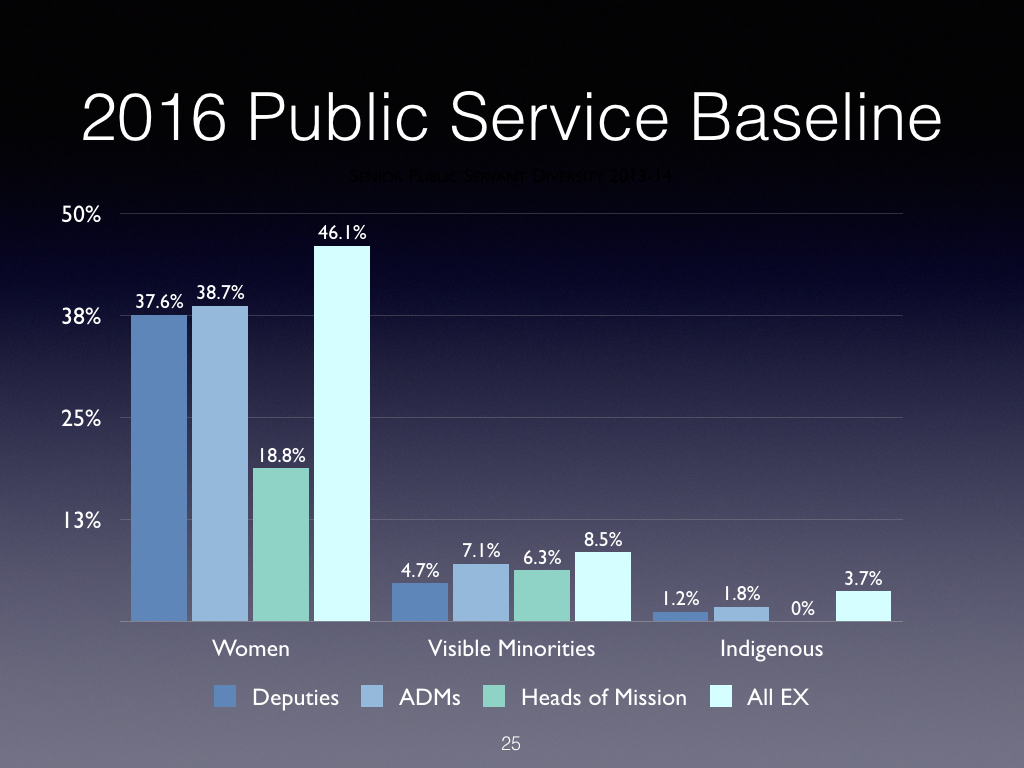
With the federal government’s general commitment to increased diversity in appointments, and Justice Minister Jody Wilson-Raybould’s current review of the judicial appointment process, there needs to be a baseline of information about the current diversity situation in order to measure implementation of these commitments.

Overall, women, visible minorities and Indigenous people are under-represented among the over 1,000 federally appointed judges (65 are in federal courts, the balance are in provincial courts). There is a similar but less pronounced pattern of under-representation among the over 700 provincially appointed judges.

Does this matter given that judges by are expected to be objective, impartial and neutral? Their legal education, training and experience prepare them for this end. However, judges are human and, like all of us, they are influenced by their past experiences, influences and backgrounds. We know from Daniel Kahneman (author of Thinking, Fast and Slow) and others that no one is completely neutral and bias-free, even if the judicial process does represent “slow” or deliberative thinking, and thus greater objectivity, rather than “fast” or automatic thinking. Diversity of background and experience is another way to improve neutrality in decision-making.

Moreover, given the over-representation of some groups who are tried in the courts, such as Black people and Indigenous people, a judiciary in which these groups are significantly under-represented risks being viewed as illegitimate to those communities. The current debate over murdered and missing Indigenous women and police carding practices exemplify this risk.
Figure 1 highlights the extent of this under-representation: there are no visible minority or Indigenous judges in the Supreme Court and Court of Appeal, no visible minority judges in the Federal Court and no Indigenous judges in the Tax Court. In all the courts except for the Supreme Court, women are significantly under-represented.

Judicial Diversity 2016 - DRAFT.009Figure 1

If we look at federally appointed judges to provincial courts (figure 2), the picture is slightly better in terms of both visible minority and Indigenous judges, but in both cases the representation is significantly lower than these groups’ population shares. In the superior courts/Queen’s Bench women are particularly under-represented, but they are better represented when the representation is compared with that of the federal courts.

Judicial Diversity 2016 - DRAFT.010Figure 2

The picture for provincially nominated judges to provincial and territorial courts (figure 3) varies by province, but overall the provinces resemble each other in their under-representation of these groups. The Atlantic provinces, with the exception of Nova Scotia, have no visible minority or Indigenous judges. In the North, despite the large Indigenous population, there are no Indigenous judges. Quebec has relatively few visible minority judges and no Indigenous judges. Saskatchewan and Manitoba, despite their large Indigenous populations, have relatively few Indigenous judges.

Judicial Diversity 2016 - DRAFT.012Figure 3

In the next series of charts federally and provincially appointed judges are compared for each under-represented group, by province, starting with women (figure 4). Here there is no overall trend: the federal and provincial appointment of women is similar in British Columbia, Manitoba, Nova Scotia, and Newfoundland and Labrador; in Saskatchewan, Quebec, Prince Edward Island and the North, provincial appointment of women is higher; and in Alberta the appointment of women is significantly lower, given the relatively large share of part-time and supernumerary appointments that are men (about a third of full-time judges are women).

Judicial Diversity 2016 - DRAFT.013Figure 4

Looking at visible minorities (figure 5), when we compare federal and provincial appointments by province, we see a trend in all provinces except Saskatchewan: provincial judicial appointments are more representative of their populations than federal nominations, although visible minorities are still significantly under-represented.

Judicial Diversity 2016 - DRAFT.014Figure 5

Lastly, with respect to Indigenous appointments (figure 6), we see the same pattern: provincial appointments are more representative of provincial populations than federal appointments in all provinces and territories, except, surprisingly, in the North, where there are no Indigenous territorial judges.

Judicial Diversity 2016 - DRAFT.015Figure 6

Looking at senior judges (chief and associate-chief justices), there are no federally appointed visible minority or Indigenous judges, and there are only a handful number of provincially appointed senior judges (figure 7).

Judicial Diversity 2016 - DRAFT.011Figure 7

While judicial diversity is low, particularly for visible minorities and Indigenous people, the number of visible minority lawyers continues to increase. Figure 8 presents the proportions of visible minority lawyers aged 25-64 Canada-wide and in the largest provinces, which gives an idea of the size of the pool that can be drawn from. Given that visible minorities are, in general, younger than the general population, visible minority lawyers are also likely to be younger and, therefore, the percentage who would be aged 45 years old or older, the usual age people are considered for these positions, would be lower.

Judicial Diversity 2016 - DRAFT.016.pngFigure 8

As part of its review of the judicial appointment process, the Office of the Commissioner for Federal Judicial Affairs should expand the existing information on the gender of judges and include visible minorities and Indigenous people. With this information, the government could be held to account for its diversity and inclusion commitments, and it would be easier to track its progress over time.

The provinces and territories that do not already do this should do so, and they should use Ontario’s annual reports on appointments as a model, ensuring that the annual reports cover the overall diversity of the entire bench.

*A few notes on methodology. The federal government publishes statistics on gender but not on visible minority or Indigenous appointments. All provinces except Alberta and Saskatchewan indicate gender through the use of “Mr.” or “Madam” justice (the departments of justice provided the number of women judges). Gender information is thus complete.

To identify visible minority and Indigenous origin name checks, appointment announcements and, when available, photos and biographies were used. All provincial judicial councils or departments of justice were approached (only Ontario reports publicly but Saskatchewan, Quebec and Nova Scotia provided the breakdowns used). The Canadian Bar Association, national and regional branches, and law societies were approached and a number of individual lawyers also helped improve the quality of the data collected. I believe this provides a reasonable assessment of current diversity.

The Government Could Be Appointing Indigenous Members To Canada’s Pipeline Regulator – BuzzFeed News

What diversity and inclusion means for Governor in Council appointments, an early example:

The Canadian government is signaling that it’s going to appoint Indigenous members to the board that decides on pipeline projects.

The move would shake up the composition of the National Energy Board, which is dominated by former oil and utility company executives.

As was first reported by Blacklock’s Reporter, Natural Resources Minister Jim Carr told a committee last week that the NEB “has to be composed of individuals who better reflect the diversity of Canada.”

CPAC / Via cpac.ca

“The National Energy Board should be more reflective of the diversity of the country, including and particularly Indigenous cultural background and perspective,” Carr told the Indigenous and Northern Affairs committee.

Carr said the same applies to the temporary members the government plans on appointing to help review the Energy East proposal.

“Through the appointment of new temporary members to the board [we know] that Indigenous background issues are important,” Carr said.

Carr was speaking in the context of the Liberal government’s promised reforms of the NEB. Before the federal election, Justin Trudeau promised to “put some teeth” back into the regulator, the Canadian Press reported.

Carr’s ministerial mandate letter instructed him to reform the NEB so that its members have better knowledge of Indigenous issues, among other things.

The NEB has been criticized for its lack of diversity and failing to sufficiently consult the communities, including Indigenous ones, that would be affected by proposed pipelines.

“We’re opening up the important reform of the National Energy Board and environmental assessments in Canada generally speaking to what we hope is a robust, important Canadian chat about that,” Carr said.

He said the government will be announcing the permanent reform process “in the next while.”

Source: The Government Could Be Appointing Indigenous Members To Canada’s Pipeline Regulator – BuzzFeed News

Liberals should beware ‘deliverology’ guru: Rick Salutin

Rick Salutin’s contrary note to deliverology, not without merit for the caution it brings (similar note to David Reevely’s: Ontario’s experience shows serious flaws in ‘deliverology’ governance):

For me, the scariest signal yet sent by the Trudeau government was bringing English “deliverologist” Sir Michael Barber, to their Alberta cabinet retreat, to tell them how they’re doing. They imported a British con man who was a perfect accessory during the Blair years, and — now that slippery Tony is gone, replaced by the rawer, more authentic Jeremy Corbyn — he moves on to the colonies. Barber has delivered his spiel in Australia, the Punjab and Maryland. Are we impressed to be in that company?

It’s an early warning sign that the Trudeau folk are starting to believe their own BS. I’m not particularly against BS, everyone in power deploys it; the danger point comes when you start gulping it yourself and not just spooning it out to others. That’s when the vultures start swanning around the retreats.

CBC’s Terry Milewski interviewed colleague Rosie Barton, who was on site, re: the scam. Rosie seemed dubious but said the Brit told his marks they were doing rawther well. Terry, sounding like a true rube, i.e., someone who has no idea that’s what he is — or a candidate for Private Eye’s pseuds corner — said he counts on Rosie for hip terms like deliverology. It’s about as fresh as the 500 channel universe. I happen to own a copy of Barber’s Deliverology 101, from 2011. I won’t say I read it, it’s not really meant for that, but I sort of flapped through it once. It’s loaded with charts, checklists, bullet points: nobody reads these things but they’re meant to make you feel like a practical, can-do type, not someone who wastes time on books — a profile rife in the upper regions of education administrators, who happen to be Barber’s natural habitat.

I’ve avoided defining deliverology because it doesn’t actually exist. It’s just mouthfuls of verbiage. Barber told Paul Wells of Maclean’s, at an earlier cabinet retreat, that he’d been recruited to “the prime minister’s delivery unit” in order to rescue Blair’s government. “It’s not tremendously exciting, but it’s really important, getting the priorities, the definitions of success, the trajectories, the data” — I should’ve said gobfuls of verbiage. You could do a close analysis of his language to show how vacuousness is literarily constructed but it seems to hypnotize people like Wells, who views himself as deeply skeptical. If a Canadian talked in such vapours, Wells would shred him. What is it — the accent?

But of course, as Donald Savoie notes extensively, a lot of what government is good at is “mouthfuls of verbiage.”

Source: Liberals should beware ‘deliverology’ guru: Salutin | Toronto Star

Liberals won over Muslims by huge margin in 2015, poll suggests

No surprise, given the Conservative party’s use of identity politics in the election and explicit anti-Muslim messaging.

Chris Cochrane’s (UofT Scarborough) exit poll analysis of the election results, presented at Metropolis this spring, shows even stronger support among Canadian Muslims, close to 80 percent:

Muslim Canadians voted overwhelmingly for the Liberal Party in last year’s election, helping Justin Trudeau secure the majority government that nine out of 10 of Muslims believe will help improve relations between themselves and other Canadians, according to a new survey.

The poll of Muslim Canadians also found widespread support for the right to wear a niqab during a citizenship ceremony and a large degree of opposition to the anti-terrorism legislation known as Bill C-51, two hot-button issues that may have cost the Conservatives dearly in the last federal election.

The Environics Institute polled 600 Muslim Canadians between November 2015 and January 2016, asking a number of questions related to identity and religious issues, in addition to more politically themed questions.

Of those who said they had voted in the 2015 federal election, 65 per cent reported voting for the Liberals, with 10 per cent saying they voted for the New Democrats and just two per cent for the Conservatives.

Another 19 per cent of Muslim respondents refused to say how they had voted.

How Muslims voted in the last federal election

The Liberals did particularly well among Muslims in Quebec and those who are Canadian born. The NDP did slightly better among younger Muslims than it did among older Muslims.

These numbers mark a shift away from the NDP and Conservatives compared with 2011. An Ipsos Reid exit poll of voters in 2011 found that 46 per cent of Muslim Canadians had voted for the Liberals, with 38 per cent having cast a ballot for the NDP and 12 per cent for the Conservatives.

Source: Liberals won over Muslims by huge margin in 2015, poll suggests – Politics – CBC News

What government is good at, and how it can improve: Donald Savoie

Great summary of his book by the author.

While I found his provocative diagnostique largely convincing in laying out some inconvenient truths, his policy recommendations are relatively undeveloped, reinforcing ironically one of his main insights/critiques of the upstairs/downstairs nature of those who manage policy (or analyze it) and those who serve Canadians directly:

Being good at managing the blame game matters a great deal in the Ottawa bubble and in the national media, but less so elsewhere. Adding oversight bodies and rules and regulations has made the federal public service not only thicker but also more Ottawa-centric. Other than opposition politicians calling for still more oversight, no one is happy with the incessant calls for more rules and regulations. Morale in the federal public service has plummeted and surveys reveal that citizens are unhappy with the quality of public service.

One can only applaud the Clerk of the Privy Council’s recent call for public service to be better at taking risks, delivering front-line services, and producing change and making it stick. To give life to this call, the government will have to revisit the many layers of oversight bodies and accountability requirements put in place over the past 15 years. Unless this is done, management reform efforts in the federal government will continue to give the appearance of change, while actually standing still.

Was pleased to see my book, Policy Arrogance or Innocent Bias: Resetting Citizenship and Multiculturalism, cited for its examples of the political level asserting its control over policy.

Source: What government is good at, and how it can improve – The Globe and Mail

Legal misstep lets Catholic Church off hook for residential schools compensation – The Globe and Mail

Legally off the hook but ethically? Morally?

A miscommunication by a federal lawyer allowed the Catholic Church to renege on its obligation to try to raise $25-million to pay for healing programs for the survivors of Indian residential schools.

Of that amount, the Church raised only $3.7-million, and a financial statement suggests less than $2.2-million of that was actually donated to help former students cope with the trauma inflicted by the residential schools.

The legal misstep occurred when Ottawa was pressing the Church to pay the entirety of a related cash settlement stemming from the Indian Residential Schools Settlement Agreement, the largest class-action deal in Canadian history.

The failing fundraising effort by the Church, which represented almost a third of its obligation under the settlement, was playing out as the Truth and Reconciliation Commission was travelling the country hearing gut-wrenching stories about what occurred behind the walls of the institutions that operated in Canada for more than 100 years.

The landmark settlement agreement required 50 Catholic groups that ran the schools, known in court documents as the Catholic entities, to pay a combined $79-million for their role in the abuse.

Of that, $29-million was to be paid in cash, most of which was to flow to a now-closed Aboriginal Healing Foundation. Another $25-million was to be donated in unspecified “in kind” services. And an additional $25-million was to be raised for healing programs through the “best efforts” that the entities could make at fundraising.

In an attempt to make the Catholic Church pay the full amount of the $29-million cash settlement, the government inadvertently released it from any obligation it might have had to continue with a dismal fundraising campaign.

“When you have a deal, it needs to be implemented,” said Bill Erasmus, the National Chief of the Dene Nation who handles the residential schools file for the Assembly of First Nations. “So the Church should be paying up. The church agreed there were harms. That’s why people were to be compensated.”

But, as of last summer, the Catholic entities were legally off the hook.

In a March 19 letter to Ron Kidd, a concerned citizen from British Columbia who has been following this case, Andrew Saranchuk, an assistant deputy minister within the Indigenous Affairs department, explained that a court settlement reached on July 16, 2015 “released the Catholic entities from all three of their financial obligations under the settlement agreement, including the ‘best efforts’ fundraising campaign, in exchange for a repayment of $1.2-million in administrative fees.”

This result, Mr. Saranchuk went on to explain, “was due to miscommunications between counsel regarding the nature and extent of the settlement being discussed.”

Source: Legal misstep lets Catholic Church off hook for residential schools compensation – The Globe and Mail