The Government Could Be Appointing Indigenous Members To Canada’s Pipeline Regulator – BuzzFeed News

What diversity and inclusion means for Governor in Council appointments, an early example:

The Canadian government is signaling that it’s going to appoint Indigenous members to the board that decides on pipeline projects.

The move would shake up the composition of the National Energy Board, which is dominated by former oil and utility company executives.

As was first reported by Blacklock’s Reporter, Natural Resources Minister Jim Carr told a committee last week that the NEB “has to be composed of individuals who better reflect the diversity of Canada.”

CPAC / Via cpac.ca

“The National Energy Board should be more reflective of the diversity of the country, including and particularly Indigenous cultural background and perspective,” Carr told the Indigenous and Northern Affairs committee.

Carr said the same applies to the temporary members the government plans on appointing to help review the Energy East proposal.

“Through the appointment of new temporary members to the board [we know] that Indigenous background issues are important,” Carr said.

Carr was speaking in the context of the Liberal government’s promised reforms of the NEB. Before the federal election, Justin Trudeau promised to “put some teeth” back into the regulator, the Canadian Press reported.

Carr’s ministerial mandate letter instructed him to reform the NEB so that its members have better knowledge of Indigenous issues, among other things.

The NEB has been criticized for its lack of diversity and failing to sufficiently consult the communities, including Indigenous ones, that would be affected by proposed pipelines.

“We’re opening up the important reform of the National Energy Board and environmental assessments in Canada generally speaking to what we hope is a robust, important Canadian chat about that,” Carr said.

He said the government will be announcing the permanent reform process “in the next while.”

Source: The Government Could Be Appointing Indigenous Members To Canada’s Pipeline Regulator – BuzzFeed News

Liberals should beware ‘deliverology’ guru: Rick Salutin

Rick Salutin’s contrary note to deliverology, not without merit for the caution it brings (similar note to David Reevely’s: Ontario’s experience shows serious flaws in ‘deliverology’ governance):

For me, the scariest signal yet sent by the Trudeau government was bringing English “deliverologist” Sir Michael Barber, to their Alberta cabinet retreat, to tell them how they’re doing. They imported a British con man who was a perfect accessory during the Blair years, and — now that slippery Tony is gone, replaced by the rawer, more authentic Jeremy Corbyn — he moves on to the colonies. Barber has delivered his spiel in Australia, the Punjab and Maryland. Are we impressed to be in that company?

It’s an early warning sign that the Trudeau folk are starting to believe their own BS. I’m not particularly against BS, everyone in power deploys it; the danger point comes when you start gulping it yourself and not just spooning it out to others. That’s when the vultures start swanning around the retreats.

CBC’s Terry Milewski interviewed colleague Rosie Barton, who was on site, re: the scam. Rosie seemed dubious but said the Brit told his marks they were doing rawther well. Terry, sounding like a true rube, i.e., someone who has no idea that’s what he is — or a candidate for Private Eye’s pseuds corner — said he counts on Rosie for hip terms like deliverology. It’s about as fresh as the 500 channel universe. I happen to own a copy of Barber’s Deliverology 101, from 2011. I won’t say I read it, it’s not really meant for that, but I sort of flapped through it once. It’s loaded with charts, checklists, bullet points: nobody reads these things but they’re meant to make you feel like a practical, can-do type, not someone who wastes time on books — a profile rife in the upper regions of education administrators, who happen to be Barber’s natural habitat.

I’ve avoided defining deliverology because it doesn’t actually exist. It’s just mouthfuls of verbiage. Barber told Paul Wells of Maclean’s, at an earlier cabinet retreat, that he’d been recruited to “the prime minister’s delivery unit” in order to rescue Blair’s government. “It’s not tremendously exciting, but it’s really important, getting the priorities, the definitions of success, the trajectories, the data” — I should’ve said gobfuls of verbiage. You could do a close analysis of his language to show how vacuousness is literarily constructed but it seems to hypnotize people like Wells, who views himself as deeply skeptical. If a Canadian talked in such vapours, Wells would shred him. What is it — the accent?

But of course, as Donald Savoie notes extensively, a lot of what government is good at is “mouthfuls of verbiage.”

Source: Liberals should beware ‘deliverology’ guru: Salutin | Toronto Star

Liberals won over Muslims by huge margin in 2015, poll suggests

No surprise, given the Conservative party’s use of identity politics in the election and explicit anti-Muslim messaging.

Chris Cochrane’s (UofT Scarborough) exit poll analysis of the election results, presented at Metropolis this spring, shows even stronger support among Canadian Muslims, close to 80 percent:

Muslim Canadians voted overwhelmingly for the Liberal Party in last year’s election, helping Justin Trudeau secure the majority government that nine out of 10 of Muslims believe will help improve relations between themselves and other Canadians, according to a new survey.

The poll of Muslim Canadians also found widespread support for the right to wear a niqab during a citizenship ceremony and a large degree of opposition to the anti-terrorism legislation known as Bill C-51, two hot-button issues that may have cost the Conservatives dearly in the last federal election.

The Environics Institute polled 600 Muslim Canadians between November 2015 and January 2016, asking a number of questions related to identity and religious issues, in addition to more politically themed questions.

Of those who said they had voted in the 2015 federal election, 65 per cent reported voting for the Liberals, with 10 per cent saying they voted for the New Democrats and just two per cent for the Conservatives.

Another 19 per cent of Muslim respondents refused to say how they had voted.

How Muslims voted in the last federal election

The Liberals did particularly well among Muslims in Quebec and those who are Canadian born. The NDP did slightly better among younger Muslims than it did among older Muslims.

These numbers mark a shift away from the NDP and Conservatives compared with 2011. An Ipsos Reid exit poll of voters in 2011 found that 46 per cent of Muslim Canadians had voted for the Liberals, with 38 per cent having cast a ballot for the NDP and 12 per cent for the Conservatives.

Source: Liberals won over Muslims by huge margin in 2015, poll suggests – Politics – CBC News

What government is good at, and how it can improve: Donald Savoie

Great summary of his book by the author.

While I found his provocative diagnostique largely convincing in laying out some inconvenient truths, his policy recommendations are relatively undeveloped, reinforcing ironically one of his main insights/critiques of the upstairs/downstairs nature of those who manage policy (or analyze it) and those who serve Canadians directly:

Being good at managing the blame game matters a great deal in the Ottawa bubble and in the national media, but less so elsewhere. Adding oversight bodies and rules and regulations has made the federal public service not only thicker but also more Ottawa-centric. Other than opposition politicians calling for still more oversight, no one is happy with the incessant calls for more rules and regulations. Morale in the federal public service has plummeted and surveys reveal that citizens are unhappy with the quality of public service.

One can only applaud the Clerk of the Privy Council’s recent call for public service to be better at taking risks, delivering front-line services, and producing change and making it stick. To give life to this call, the government will have to revisit the many layers of oversight bodies and accountability requirements put in place over the past 15 years. Unless this is done, management reform efforts in the federal government will continue to give the appearance of change, while actually standing still.

Was pleased to see my book, Policy Arrogance or Innocent Bias: Resetting Citizenship and Multiculturalism, cited for its examples of the political level asserting its control over policy.

Source: What government is good at, and how it can improve – The Globe and Mail

Legal misstep lets Catholic Church off hook for residential schools compensation – The Globe and Mail

Legally off the hook but ethically? Morally?

A miscommunication by a federal lawyer allowed the Catholic Church to renege on its obligation to try to raise $25-million to pay for healing programs for the survivors of Indian residential schools.

Of that amount, the Church raised only $3.7-million, and a financial statement suggests less than $2.2-million of that was actually donated to help former students cope with the trauma inflicted by the residential schools.

The legal misstep occurred when Ottawa was pressing the Church to pay the entirety of a related cash settlement stemming from the Indian Residential Schools Settlement Agreement, the largest class-action deal in Canadian history.

The failing fundraising effort by the Church, which represented almost a third of its obligation under the settlement, was playing out as the Truth and Reconciliation Commission was travelling the country hearing gut-wrenching stories about what occurred behind the walls of the institutions that operated in Canada for more than 100 years.

The landmark settlement agreement required 50 Catholic groups that ran the schools, known in court documents as the Catholic entities, to pay a combined $79-million for their role in the abuse.

Of that, $29-million was to be paid in cash, most of which was to flow to a now-closed Aboriginal Healing Foundation. Another $25-million was to be donated in unspecified “in kind” services. And an additional $25-million was to be raised for healing programs through the “best efforts” that the entities could make at fundraising.

In an attempt to make the Catholic Church pay the full amount of the $29-million cash settlement, the government inadvertently released it from any obligation it might have had to continue with a dismal fundraising campaign.

“When you have a deal, it needs to be implemented,” said Bill Erasmus, the National Chief of the Dene Nation who handles the residential schools file for the Assembly of First Nations. “So the Church should be paying up. The church agreed there were harms. That’s why people were to be compensated.”

But, as of last summer, the Catholic entities were legally off the hook.

In a March 19 letter to Ron Kidd, a concerned citizen from British Columbia who has been following this case, Andrew Saranchuk, an assistant deputy minister within the Indigenous Affairs department, explained that a court settlement reached on July 16, 2015 “released the Catholic entities from all three of their financial obligations under the settlement agreement, including the ‘best efforts’ fundraising campaign, in exchange for a repayment of $1.2-million in administrative fees.”

This result, Mr. Saranchuk went on to explain, “was due to miscommunications between counsel regarding the nature and extent of the settlement being discussed.”

Source: Legal misstep lets Catholic Church off hook for residential schools compensation – The Globe and Mail

Canadians living abroad should be allowed to vote: Editorial | Toronto Star

I disagree.

Long-term (over 5 years) expats may or may not remained connected to Canada (the various imperfect data sources I am looking at present a varied picture) but most  do not pay Canadian taxes and are disconnected from the day-to-day issues (e.g., healthcare, transit) that often drive elections and voters:

The rule used to deny the vote to Canadians who have lived abroad for longer than five years actually dates back to 1993. But it was only enforced by the government of former prime minister Stephen Harper after 2007. The decision was based on a claim that it was unfair to give equal voice to Canadians living abroad and those who live in the country because expatriates won’t live with the consequences of their choice.

It’s a flawed argument and one rejected by most other democracies, which place fewer restrictions on expatriates. Canadians abroad who are passionate about this country’s affairs — to the extent that they’re determined enough to vote — should have a say in the affairs of their homeland.

Given the vast information resources available online and the ease of international travel, Canadian expats can easily keep up to date with what’s going on at home. And their opinions have real value. Indeed, it can be argued that it’s in the national interest to allow these well-travelled and typically well-educated citizens a hand in the political process.

As reported by The Canadian Press, the constitutionality of existing law is being challenged by plaintiffs Jamie Duong and Gillain Frank, both Canadians working in the United States. Frank, from Toronto, teaches at Princeton University, and Duong, of Montreal, works at Cornell.

They won before the Ontario Superior Court in 2014; lost when the government appealed last July; and then took the matter to the Supreme Court of Canada, which has agreed to hear their case.

The court would do well to overturn an unfair law and bring Canada’s rules more in line with international practice.

Britons living abroad are allowed to cast a ballot if they’re citizens and had registered to vote within the last 15 years. Americans can vote all their lives, regardless of where they happen to live. And Italy goes so far as to set aside seats in parliament specifically to be filled by citizens living abroad.

It’s estimated that more than a million Canadians living outside the country are blocked from voting by the current rule. That constitutes a large-scale disenfranchisement and it’s manifestly unfair. If these people want a say in the affairs of their homeland they should be allowed to have it, regardless of how long they’ve been away.

Source: Canadians living abroad should be allowed to vote: Editorial | Toronto Star

Canadians’ response to refugee crisis, niqab debate showed ‘who we really are,’ GG says

Although the Twitterverse correctly noted that the political aspect of these remarks is inappropriate for a Governor General, nevertheless hard to disagree with the substance:

Gov. Gen. David Johnston says he was initially worried that the niqab debate and the tone of the discussion about the Syrian refugee crisis during the election would hurt Canada’s reputation as a fair and inclusive society.

Johnston made the comments in an exclusive interview with CBC chief correspondent Peter Mansbridge for The National, explaining that ultimately he was reassured by the way Canadians responded.

“Look at the outcome of those two, quote, crises,” Johnston said. “Look at how Canada has managed the Syrian refugee crisis in an exemplary way.

“And look at the debate with respect to the niqab. I think Canada showed its strength, that that should not be, should not sidetrack us from who we really are.”

Johnston added that even though the niqab debate has passed he remains concerned about the possible introduction of ideas that would hurt Canada’s reputation.

“I continue to worry about any initiatives that would cause us to be small-minded, and to lose that sense of A, inclusiveness, B, fairness, C, equality of opportunity,” Johnston said, while warning against any sense of complacency.

“I think we must work constantly to overcome that and to have the larger view, but I’m very optimistic that those voices, those ideas are by no means scarce in Canada. I find them abundant,” he said in the interview airing tonight on The National.

Source: Canadians’ response to refugee crisis, niqab debate showed ‘who we really are,’ GG says – Politics – CBC News

Canada can do better on getting more women elected, 60th place in world right now

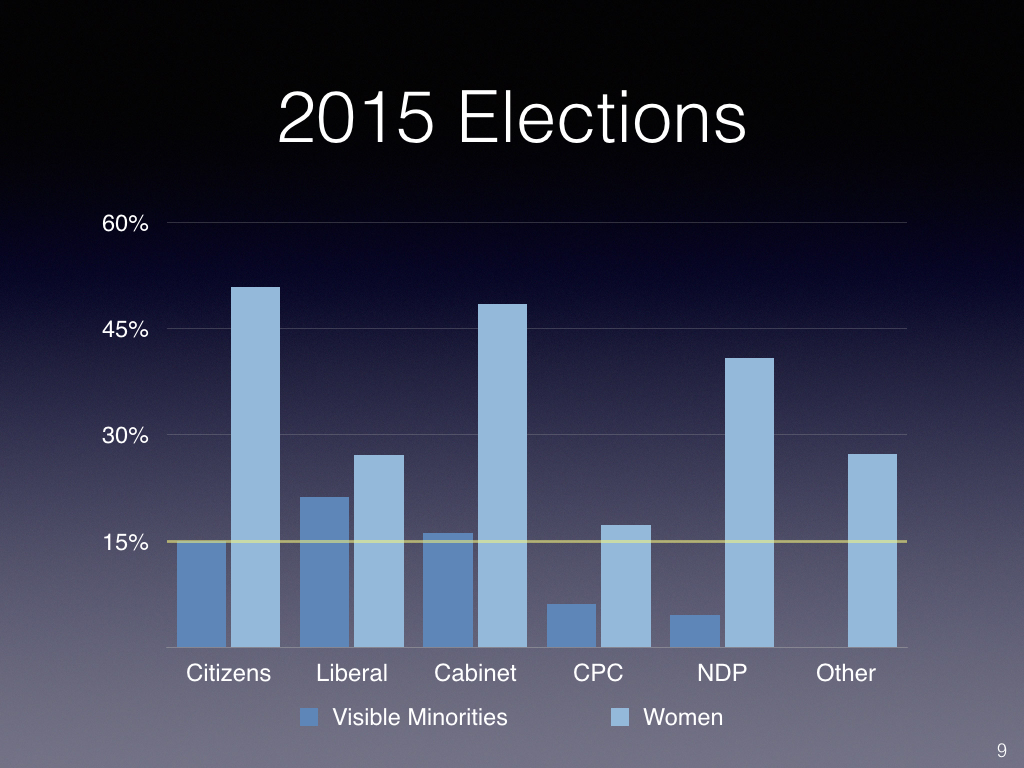
Election 2015 - VisMin and Foreign-Born MPs.002Nancy Peckford and Grace Lore of EqualVoice argue for a gender-based lens with respect to evaluating electoral reform proposals. Women who are now more under-represented than visible minorities, where all parties have made major and successful recruiting efforts:

But, it is crucial to understand that “proportional representation” is not one thing and neither is “women’s political representation.” Proportional representation systems vary widely in how individuals become candidates, how votes are cast, and how those votes are translated into seats. UBC political scientist Grace Lore, and EV’s senior researcher, has just finished a multi-country study of electoral systems in Europe and North America with a specific focus on their effect on women’s representation. The data from that research strongly reveals that while the number of women elected is an important indicator of success, so is the ability of these women to act to represent their constituents, including women.

In ‘closed list’ PR systems, parties determine a set list of pre-approved candidates and voters simply pick a party and, de facto, accept the list of candidates in the ordered that is proposed by the party. In ‘open list’ systems, voters have the opportunity to indicate preferences between candidates. In some countries that use open list proportional representation, voters can even indicate a preference for candidates from multiple parties. Like open list proportional systems, alternative vote systems give voters the chance to rank parties instead of just indicating their top choice.

These are not minor or mechanical details—they matter greatly to how one participates in the democratic process. The nuts and bolts of each system also shape the role of parties and the choices available to voters, including the possibilities for women’s political representation. Some features of electoral systems, whether based on proportional representation or not, lead to the election of a greater number of women, while potentially reducing women’s capacity to represent women’s and other interests once they are in office. Other features improve the power of individual women to have influence, but do not maximize the possibilities for the sheer number of women elected. Lore’s extensive research of electoral systems on two continents and 15 countries underscores that if women representatives are more beholden to a political party for their election (versus having a direct relationship with constituents), their lack of independence frequently prevents them from effectively advocating on behalf of other women.

In short, proportional representation is neither necessary nor sufficient to ensure women’s equal representation. Political culture matters significantly, i.e. voters and parties need to seek more women to appear on the ballot and create the conditions for their participation. More women also need to choose politics as the place to dedicate their time, energy, and skills. If we do not also tackle other systemic barriers, including inequality in access to political resources and the uncertainty of the nomination processes, we cannot count on this happening. These concerns can and should be part of the electoral reform discussion. Revisiting the rules around financing and timing of nomination races are two key areas where there is much room for improvement.

Canada can do better than its current 60th place in the global community for its representation of women. Open discussion around electoral reform provides us all—voters, parties, MPs, and organizations, with an opportunity to take action. Action, however, must be thoughtful and evidence based. A consideration of the impacts on women in politics should be incorporated at every stage of the process—from broad principals to basic mechanics.

Source: Canada can do better on getting more women elected, 60th place in world right now |

Conservative MP Deepak Obhrai: New Rules Turning Tories Into ‘Elitist And White-Only’ Club

Interesting – and a major risk for the party given the importance of new Canadian voters:

A longtime Conservative MP is blasting his own party for becoming an “elitist and white-only” club.

Calgary MP Deepak Obhrai, the dean of the Tory caucus, told The Huffington Post Canada he is deeply frustrated by new rules the party imposed earlier this year that raised the annual Conservative membership fee to $25 — “the highest of any party” — and set the entrance fees for leadership contestants at $100,000. 

deepak obhrai

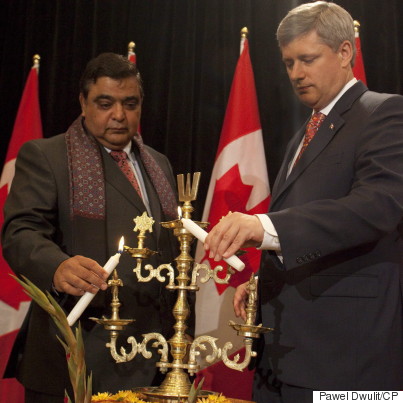
Deepak Obhrai and former prime minister Stephen Harper celebrate Diwali by lighting a candle on Parliament Hill on Oct. 8, 2009. (Photo: Pawel Dwulit/Canadian Press)

“Since we lost power in 2015, I have become very concerned about the direction my party has taken,” he told HuffPost over the phone on Thursday.

“These actions, in my view, have disenfranchised a vast majority of Canadians. Newcomers, immigrants, low-income Canadians, and those economically challenged will be turned off and walk away because they can’t afford these high fees…

“What is concerning me is that, unfortunately, [the Conservatives] will be seen as an elitist and white-only party,” he said.

Ethnic communities’ outreach

Since his election in 1997, Obhrai said he’s been working his “butt off” to bring immigrants to the party, a job that was subsequently taken on with great fanfare by former cabinet minister Jason Kenney. Success in connecting with ethnic communities culminated in the Tories’ majority election win in 2011, Obhrai said.

But that work has been dropped as a priority for the Conservatives under the leadership of party president John Walsh, Obhrai said. He added that the party has lost touch with grassroots members and pointed out that the caucus was not consulted.

“This party has become a party that is seen [to be only] for like rich people, I ask why? Why only for those who can afford it? Why the rich?

“For a family of four, it’s like asking them to give $100, and then also asking them to give through a credit card, which many don’t have. I have had these problems and my EDA [electoral district association] passed a motion telling the national council that we are unhappy with these rules,” the Calgary MP told HuffPost.

Source: Conservative MP Deepak Obhrai: New Rules Turning Tories Into ‘Elitist And White-Only’ Club

Almost 300 people nominated under new senate appointment process

Senate Appointments - with nominations.001Strong level of diversity among those nominated to fill Senate vacancies in Manitoba, Ontario, and Quebec. But Quebec had a surprising low-level of nominations: only 39 compared to Manitoba’s 51 and Ontario’s 194:

Almost 300 Canadians were nominated to become the first senators appointed under Prime Minister Justin Trudeau’s new process aimed at turning the Senate into a less partisan, more independent chamber of sober second thought.

Trudeau named seven new senators last month, all chosen from a short list of 25 recommended by a newly created, arm’s length advisory board.

In its first report on the fledgling process, the board says it received 284 nominations from a host of groups representing a broad cross-section of Canada’s diverse population.

The nominees were 49 per cent female, 51 per cent male; 10 per cent identified themselves as indigenous, 16 per cent as visible minorities and four per cent as disabled.

The board’s first batch of recommendations were for vacancies in Quebec, Ontario and Manitoba.

Overall, 72 per cent of the nominees were anglophones but the vast majority of nominees for the open Quebec slots were francophone.

However, the report suggests interest in the new Senate appointment process was lowest in Quebec: just 39 nominations were to fill vacancies in that province, compared to 51 for Manitoba and 194 for Ontario.

Source: Almost 300 people nominated under new senate appointment process – Macleans.ca