How the Big Red Machine became the big data machine: Delacourt

As someone who likes playing with and analyzing data, found Delacourt’s recounting of how the Liberals became the most data savvy political party interesting:

The Console, with its maps and myriad graphs and numbers, was the most vivid evidence of how far the Liberal party had come in its bid to play catch-up in the data war with its Conservative and NDP rivals. Call it Trudeau 2.0. Just as the old Rainmaker Keith Davey brought science to the party of Trudeau’s father in the 1960s and 1970s, the next generation of Trudeau Liberalism would get seized with data, science and evidence in a big way, too.

And in the grand tradition of Davey, Allan Gregg and all the other political pollsters and marketers who went before them, this new squad of strategists set about dividing Canada’s electoral map into target ridings, ranked according to their chances of winning in them. In a 21st-century-style campaign, though, the distinctions would be far more sophisticated than simply “winnable” and “unwinnable” ridings. Trudeau’s Liberals divided the nation’s 338 electoral districts into six types, named for metals and compounds: platinum, gold, silver, bronze, steel and wood.

Platinum ridings were sure bets: mostly the few dozen that the Liberals had managed to keep in the electoral catastrophe of 2011. Gold ridings were not quite that solid, but they were the ones in which the party strategists felt pretty certain about their prospects. Silver ridings were the ones the Liberals would need to gain to win the election, while bronze ridings, the longer shots, would push them into majority government territory. Steel ridings were ones they might win in a subsequent election, and wood ridings were the ones where the Liberals probably could never win a seat, in rural Alberta for instance.

The Console kept close track of voter outreach efforts on the ground, right down to the number of doorsteps visited by volunteers and what kind of information they had gathered from those visits — family size, composition, political interests, even the estimated age of the residents. By consulting the Console, campaigners could even figure out which time of day was best for canvassing in specific neighbourhoods or which voters required another visit to seal the deal.

When the Liberal team unveiled the Console to Trudeau, he was blown away. He told his team that it was his new favourite thing. He wanted regular briefings on the contents of the program: where it showed the Liberal party ahead, and where fortunes were flagging and volunteers needed to do more door-knocking. Actually, he wondered, why couldn’t he be given access to the Console himself, so that he could consult it on his home computer or on his phone while on the road?

And that, Trudeau would say later, was the last he ever saw of the Console. “My job was to bring it back, not on the analysis side, but on the connection side — on getting volunteers to go out, drawing people in, getting people to sign up,” Trudeau said. Clearly he was doing something right on that score — Liberal membership numbers had climbed from about 60,000 to 300,000 within Trudeau’s first 18 months as leader.

Volunteers for the party would learn — often to their peril — that the leader was fiercely serious about turning his crowd appeal into useful data. Trudeau wasn’t known for displays of temper, but the easiest way to provoke him was to fall down on the job of collecting data from the crowds at campaign stops. Few things made Trudeau angrier, for instance, than to see Liberal volunteers surrounding him at events instead of gathering up contact information. “That was what I demanded. If they wanted a visit from the leader they had to arrange that or else I’d be really upset,” Trudeau said.

Source: How the Big Red Machine became the big data machine | Toronto Star
Non-citizen voting in local elections is long overdue: Cole

Desmond Cole on municipal voting for non-citizens. While I understand this position, have never been convinced by the arguments in favour of municipal voting, as most of these also could be applied to provincial and federal voting (e.g., healthcare and education provincially, EI and employment programs federally).

Given that Canadian citizenship is relatively accessible (apart from the fees!) in contrast to many European countries, simpler and more effective from a political integration perspective to encourage and facilitate citizenship, with the full range of voting rights:

Immigrants are the backbone of Ontario’s economy and the source of much of its growth. Our government deems newcomers fit to live, work, invest and raise families here, but somehow unfit to make electoral decisions about the laws and regulations that govern their lives. Sheesh.

While municipalities all over the world allow at least some non-citizen residents to vote in local elections, Ontario’s politicians have long seemed afraid to follow suit.

Interestingly, our provincial political parties allow non-citizens to buy party memberships and to vote in partisan leadership contests. Ontario PC leader Patrick Brown allegedly signed up more than 40,000 new party members during his recent leadership bid, many of them from so-called “cultural communities” (i.e. black and brown first- and second-generation immigrants). His campaign didn’t ask if all these folks were Canadian citizens — it wasn’t deemed a relevant factor to their ability to partake in that democratic process.

Canadians seem increasingly supportive of allowing some non-citizens to vote in municipal elections. City councils in Toronto and North Bay have formally asked the province to enfranchise non-citizens who have obtained permanent residency; officials in Halifax, and in five municipalities in New Brunswick, have made the same request of their respective provincial governments.

This was what I hoped for all those years ago with I Vote Toronto and in retrospect I am only sorry I didn’t push the threshold even further than permanent residency.

Before 1988 in Ontario, you didn’t have to be a citizen to vote. You had to reside or hold property in the municipality where you planned to vote; Nova Scotia allowed non-citizen British subjects to vote in local elections until 2007.

The need to vote and the benefits of being able to do so — for permanent residents, foreign workers, students and undocumented people — are just as critical for new immigrants as they are for citizens. Premier Kathleen Wynne’s Liberals should acknowledge this and extend the municipal franchise to all non-citizen residents.

Source: Non-citizen voting in local elections is long overdue: Cole | Toronto Star

Stephen Gordon: The damage the Tories did with the census won’t be easily undone

Stephen Gordon on the possible long-term damage to the Census:

The census is only useful if (approximately) everyone co-operates. The same goes for lots of other things: carpool lanes, anti-littering bylaws and jury duty, to name three. The nature of collective action problems is that it’s never in one’s individual rational interest to take part in the solution; it’s better to simply free ride off the efforts of others. This is why one of the core tasks of government is to enforce participation — and this means imposing penalties for not co-operating.

This is where social capital comes in — or social trust, or social cohesion, or whatever you want to call it. It’s not feasible to governments to micromanage their citizens and enforce their co-operation in their daily activities, even if they wanted to. To a very great extent, the smooth functioning of society relies not on government enforcement, but on people’s willingness to go along with the rules, so long as they believe that everyone else is obeying them as well. Everything depends on a willingness to trust strangers, and to reward their trust in you.

It’s worth dwelling on this point, because one of the most debilitating consequences of the Conservatives’ time in office has been the creation of a constituency for whom the census is now a highly-politicized symbol, instead of being a neutral instrument for good governance. While the government can force co-operation, this isn’t the same as restoring mutual trust.

You can’t expect people to take your concerns seriously if you won’t do the same for them. To the extent that their concerns are about privacy, the most promising way of restoring that lost trust is to demonstrate the extent to which concerns about privacy are taken seriously, and to show some flexibility on the details. For example, questions about religion have been dropped from this year’s census questionnaire.

Social capital is difficult to build, and easy to destroy. The former Conservative government demolished a big chunk of our social capital when it blew up the census, and it will take time and effort to restore it. Posting selfies with census forms can’t hurt, and just might help.

Source: Stephen Gordon: The damage the Tories did with the census won’t be easily undone | National Post

Justice system can’t wait for judicial appointments review, say judges

Judicial Diversity 2016 - DRAFT.010The fine balance of doing a review – generally a good idea to ensure comfort with the process and alignment with governmental priorities – and the operational requirements of filling positions (see my analysis of current judicial diversity Diversity among federal and provincial judges):

Since being appointed justice minister and attorney general six months ago, Jody Wilson-Raybould has not appointed a single judge. There are at least 46 vacant seats on the bench of federally-appointed superior courts, with British Columbia and Alberta each short 10 judges.

In addition, every judicial advisory committee from Toronto to Newfoundland and Labrador was disbanded last fall when their terms expired. Judicial advisory committees assess the qualifications and merits of those who apply to be a judge and recommend applicants to the minister.

“It would be much better to continue those committees until they’re replaced. That would be a fairly simple situation to an unacceptable hiatus,” Wittmann told CBC News.

Appointments to JACs and the bench are made by the minister in close collaboration and consultation with his or her judicial affairs adviser — a crucial role that has also not yet been filled.

“The minister is working to staff this position as soon as possible,” said Michael Davis, director of communications for Wilson-Raybould, in response to several inquiries by CBC News.

Lorne Sossin, dean of law at York University’s Osgoode Hall, calls that surprising and concerning.

“It’s not an emergency in the way a forest fire or a flood is, but it is building to that point that it’s creating really negative consequences on the ground,” said Sossin. “If you have those vacancies for so long a period of time, it’s again putting extra stress and strain on those who are in the system. It creates backlogs and access-to-justice concerns.”

Wilson-Raybould is, without a doubt, among the busiest cabinet ministers. Prime Minister Justin Trudeau gave her a lead role on several important and pressing files, such as legislation to permit physician-assisted dying, a federal inquiry into murdered and missing indigenous women and legalizing marijuana.

“So, there’s lots of different priorities but I don’t think those are any excuses to not have a timely set of benchmarks being met on something as critical as judicial appointments,” said Sossin.

Judicial appointments process under review

According to the minister’s office, the hold up is an overall review of the judicial appointments process.

“A review of the entire judicial appointments process is ongoing, based on principles of openness, transparency, merit, and diversity. The minister is committed to achieving a greater degree of diversity within the Canadian judiciary, so that it will come to truly reflect the face of Canada,” her office said in a statement.

Judicial advisory committees are also subject to that review. CBC News asked her office whether Wilson-Raybould is interested in tinkering with the makeup of the councils, as the previous government changed the rules to require each committee to have a representative with a background in policing.

“(The minister is) aware of the need to get the Judicial Advisory Committees up and running in a timely manner. However, it is important to ensure that this is done in a considered way, given the important role these committees play,” her office said.

‘What should happen is some appointments ought to be made by the executive branch of government. That’s their job.’-Alberta Court of Queen’s Bench Chief Justice Neil Wittmann

“I regret there is nothing we can add as processes are under review at the moment,” Davis added later, when asked for an update on the process so far, including the mandate, scope and timeline for completion.

But Chief Justice Wittmann isn’t so sure.

“I’m not aware of a review actually occurring. I’m aware of the minister’s position that she wants a review to occur,” he said.

Source: Justice system can’t wait for judicial appointments review, say judges – Politics – CBC News

PS must step up recruitment to offset exodus of retiring baby boomers

Good overview of the latest Clerk’s report on the public service. Parts I found more interesting below, with the culture change the hardest challenge, along with harassment, a perennial issue:

Wernick’s report clearly indicates there will be no single plan when the task force releases its final report.

Rather, each department will develop its own “action plan” rather than shoehorn a master set of rules on all departments. That’s because the nature of federal workplaces varies wildly from white-collar office jobs to employees working in call centres, on Coast Guard ships, in prisons or the military.

Those plans will focus on changing culture with leadership, training, support for employees and managers, and then measuring the impact of those changes.

Wernick’s report noted that the last public service survey showed that harassment, discrimination and lack of empowerment are key barriers to a “respectful” workplace.

“These types of behaviours must be addressed,” he said.  “There is no place for them in society or in the workplace. Every manager and every employee is accountable.”

On the policy front, Wernick has taken exception to critics who argue the public service lost its policy-making skills over the Conservative decade.

His report, however, says the way policy is developed has to be modernized and a policy community project is underway to strengthen policy-making in a rapidly changing world.

“It will be important never to return to a time where policy was developed in splendid isolation from the operations and services that implement it, or the people affected by it. Nor should policy be developed in silos and stovepipes. All of the important issues facing Canada are broad and multi-faceted.”

Source: PS must step up recruitment to offset exodus of retiring baby boomers | Ottawa Citizen

Liberals issue openness directive, scrap most Access to Information fees

Very good first start (for those responsible for my pending ATIP requests, please note and process accordingly):

The Liberal government is immediately waiving all fees associated with access to information requests — apart from the $5 application charge.

It is also telling federal agencies to make information available in the format of the requester’s choice, such as handy data spreadsheets, wherever possible. [one of my and other’s biggest peeves]

The measures are included in an interim directive on openness from Treasury Board President Scott Brison.

Brison told a Commons committee studying changes to the access law Thursday the steps represent early progress on Liberal commitments for reform.

He said the openness directive is guided by the principle that government information belongs to the people it serves and should be open by default.

It also emphasizes that providing access is paramount to serving the public interest.

The Access to Information Act allows people who pay $5 to ask for everything from expense reports and audits to correspondence and briefing notes. Departments are supposed to answer within 30 days or provide valid reasons why they need more time.

However, the system has been widely criticized as slow, out of date and riddled with loopholes that allow agencies to withhold information rather than release it. The law has not been substantially updated since it took effect almost 33 years ago.

The Liberals plan to introduce legislation late this year or in early 2017 to implement several other short-term changes to the law based on election campaign commitments. They promise a full review of the Access to Information Act once the initial bill passes and every five years thereafter.

“This act is out of date,” Brison told MPs on the committee. “We never want to be in this place again.”

Brison said the next wave of measures would:

  • Give the information commissioner, an ombudsman for requesters, the power to order release of government information — something she cannot do now;

  • Ensure the act applies appropriately to the offices of the prime minister and his cabinet members, as well as administrative institutions that support Parliament and the courts;

  • Address the issue of frivolous and vexatious requests so that the purpose of the act is respected;

  • Improve government performance reporting on Access to Information.

Source: Liberals issue openness directive, scrap most Access to Information fees – The Globe and Mail

Census needs to reflect modern reality about gender | Toronto Star

I am sure StatsCan is already thinking about this in the context of the 2021 Census and the best means to do so (may just be an “other” category:

After 10 years, the long-form Canadian census is back. Young Canadians, primed by a decade of digital media saturation, flocked online in droves so large we took down the website.

It makes sense — and it’s not just false enthusiasm as we collectively do our duty because “it’s the law.” A generation used to sharing its descriptive statistics online (finding friends, networking, dating) would intuitively understand the benefit of the census. Understanding the sociodemographic landscape helps us know and better service ourselves. And after all, that’s what millennials want: a fairer and more representative social democracy.

Yet, as Canadians fill out the census, some gawk at the glaring anachronism of the gender binary, the idea that there are two mutually exclusive genders: males and females, who occupy distinct cultural, social, and sexual roles.

But we know this isn’t true. The recent media awakening to transgender people (Laverne Cox, Caitlyn Jenner, Jazz Jennings) is evidence that gender variance has gone mainstream.

If we recognize men and women who identify with the genders they were assigned at birth (cisgender) and we recognize men and women who do not identify with their assigned gender (transgender), then surely we agree this difference is worth recording.

As my friend quipped, “Well, they’re not asking about gender. They’re asking about sex!” His point reflects the growing awareness about gender as the patterns of behaviour and expression associated with its respective sex categories. This is good. It shows a recognition of people whose self-concepts do not match the gender assigned them at birth.

…Despite a variety of new ways to capture gender variation in the population, this simple two-step approach takes us miles further than the two-option approach of the 2016 Census:

  1. Do you identify with the gender you were assigned at birth? Yes / No / Not sure / Prefer not to say
  2. Please indicate your current gender: Male, Female, Non-Binary, Intersex, Other (please describe):

As the 2016 census has done with its categories for race, we must open up how we assess gender. I know it seems hard, but let’s no longer pretend we cannot do better.

Source: Census needs to reflect modern reality about gender | Toronto Star

The census is back with a swagger

Good account of the restoration of the Census (like other data nerds, disappointed only received the short form):

Once Justin Trudeau’s party swept into power on Oct. 19, people in the know quietly warned the Liberal transition team that if they were going to restore the census, they had to act quickly. Wayne Smith, the chief statistician, even showed up for his transition briefing brandishing a hard copy of the census. Three weeks after the election, with an announcement from freshly minted Minister of Innovation, Science and Economic Development Navdeep Bains that the mandatory long-form was back, Plan A was a go.

This week, the furious preparations of the agency over the last several months come to fruition: May 10 is census day, when Canadians raise their hands to be counted. The voluntary National Household Survey that replaced the long-form census in 2011 ended up being neither the pointless disaster its staunchest critics had envisioned, nor the perfectly useful replacement its proponents predicted. It had serious limitations that caused 1,100 small communities to vanish off the statistical map; it produced a few weird findings that simply didn’t look right; and it made looking for change over time all but impossible. It did, however, offer a serviceable snapshot of the country. Now that StatsCan is returning to a mandatory long-form census—and in a hurry—the question is what will become of the evolving national portrait that underpins everything from people’s bus routes and commuter highways to their children’s schools and where they can grab groceries on their way home from work.

What was once the driest and most esoteric of citizen duties—the statistical backbone of the country that, frankly, most people were oblivious to—became an unlikely flashpoint in 2010. That July, then-prime minister Stephen Harper axed the mandatory long-form census, arguing it was inappropriate to compel citizens to answer questions about their education, work, ethnicity and housing, among other topics. Critics of the move—they were nearly unanimous among those who use census data, including researchers, municipal planners and community organizations—insisted that a mandatory census was the only way to get an accurate picture of who Canadians are and what they need.

Source: The census is back with a swagger

Elizabeth May: Top Level Of Public Service ‘Contaminated’ From Harper Years

Whoa there. While she is right to flag that the transition may be hard for some senior public servants, all understand their public service role is to serve the government of the day. Those that are uncomfortable doing so will likely retire or be moved to a less important position.

And inertia, common to all bureaucracies, is different from resistance:

Green Party Leader Elizabeth May is calling for all the top senior public servants to be removed from their current jobs because, she says, they are tainted from the Harper years and resisting change.

“It’s awkward as a person in politics, you don’t want to single out public servants,” May said. “But it can’t escape note that the deputy minister for trade negotiated the Trans-Pacific Partnership, the deputy minister at Environment Canada was Harper’s lead negotiator at Copenhagen blocking climate action…

“The deputy ministers advising [Public Safety Minister] Ralph Goodale were okay with C-51, so was the deputy minister at the department of justice,” May added.

It’s not about the public service being partisan, May told reporters Wednesday during a press conference highlighting Prime Minister Justin Trudeau‘s six months in office.

“But it’s clear that the top level of the public service is contaminated by their role in the last 10 years.”

“In my opinion, right now, there is a level of resistance against change,” May said, pointing to examples of a press release and advice from bureaucrats at the department of international trade and the Canada Revenue Agency. “There is, to put it mildly, inertia in the system.”

The Green Party leader said she isn’t accusing public servants of being Harper cheerleaders or secret Conservatives but rather she is suggesting there is a problem afoot because the deputy ministers still in place are at ease with the decisions they made during the last government.

“I’m not accusing the civil service of wishing they had Stephen Harper back. They are non-partisan. But after 10 years, it takes a while to make the shift,” she said.

“It’s not really possible to imagine that there is no loyalty to the action that you’ve personally undertaken as a senior civil servant,” May added. “There is pride in accomplishments. Logically, they were doing the right thing ‘cause their job as civil servants is to follow what they are instructed to do by the political side of government.”

Source: Elizabeth May: Top Level Of Public Service ‘Contaminated’ From Harper Years

Diversity among federal and provincial judges

This article appeared originally in IRPP’s Perspectives:

With the federal government’s general commitment to increased diversity in appointments, and Justice Minister Jody Wilson-Raybould’s current review of the judicial appointment process, there needs to be a baseline of information about the current diversity situation in order to measure implementation of these commitments.

Overall, women, visible minorities and Indigenous people are under-represented among the over 1,000 federally appointed judges (65 are in federal courts, the balance are in provincial courts). There is a similar but less pronounced pattern of under-representation among the over 700 provincially appointed judges.

Does this matter given that judges by are expected to be objective, impartial and neutral? Their legal education, training and experience prepare them for this end. However, judges are human and, like all of us, they are influenced by their past experiences, influences and backgrounds. We know from Daniel Kahneman (author of Thinking, Fast and Slow) and others that no one is completely neutral and bias-free, even if the judicial process does represent “slow” or deliberative thinking, and thus greater objectivity, rather than “fast” or automatic thinking. Diversity of background and experience is another way to improve neutrality in decision-making.

Moreover, given the over-representation of some groups who are tried in the courts, such as Black people and Indigenous people, a judiciary in which these groups are significantly under-represented risks being viewed as illegitimate to those communities. The current debate over murdered and missing Indigenous women and police carding practices exemplify this risk.
Figure 1 highlights the extent of this under-representation: there are no visible minority or Indigenous judges in the Supreme Court and Court of Appeal, no visible minority judges in the Federal Court and no Indigenous judges in the Tax Court. In all the courts except for the Supreme Court, women are significantly under-represented.

Judicial Diversity 2016 - DRAFT.009Figure 1

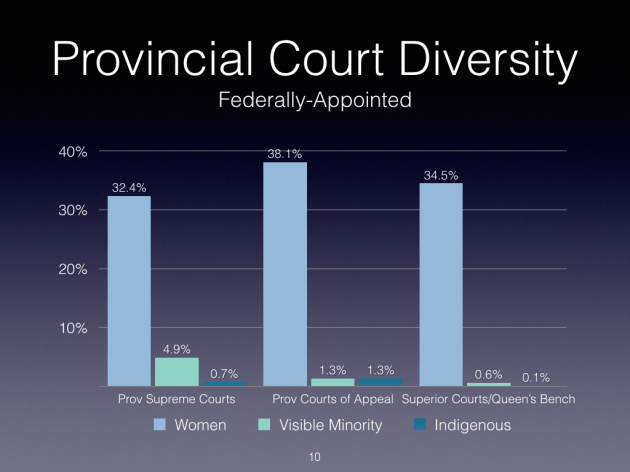
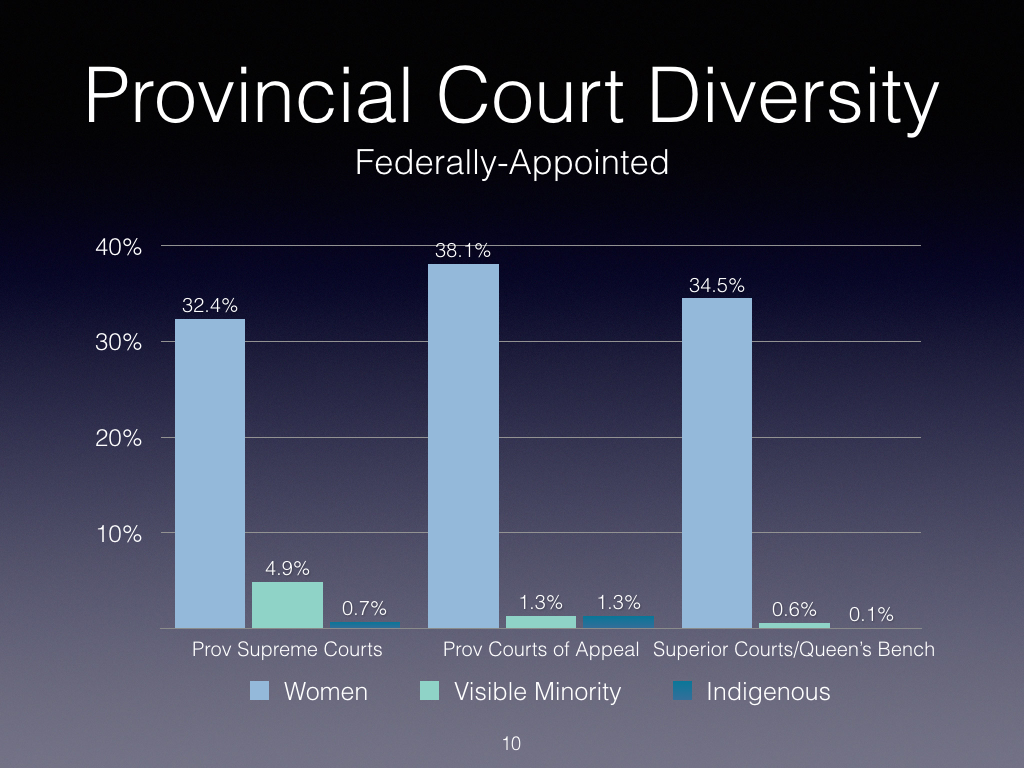
If we look at federally appointed judges to provincial courts (figure 2), the picture is slightly better in terms of both visible minority and Indigenous judges, but in both cases the representation is significantly lower than these groups’ population shares. In the superior courts/Queen’s Bench women are particularly under-represented, but they are better represented when the representation is compared with that of the federal courts.

Judicial Diversity 2016 - DRAFT.010Figure 2

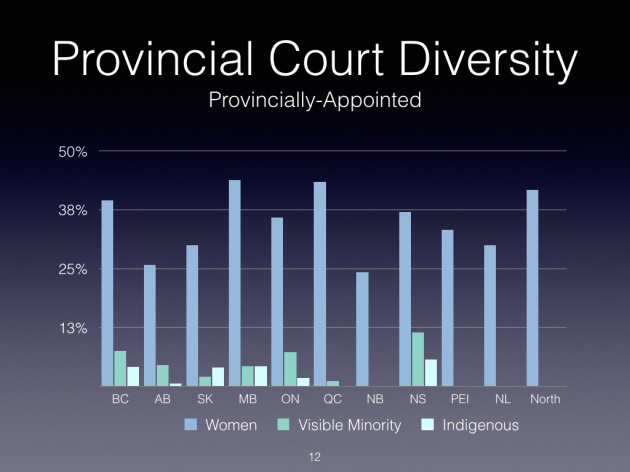
The picture for provincially nominated judges to provincial and territorial courts (figure 3) varies by province, but overall the provinces resemble each other in their under-representation of these groups. The Atlantic provinces, with the exception of Nova Scotia, have no visible minority or Indigenous judges. In the North, despite the large Indigenous population, there are no Indigenous judges. Quebec has relatively few visible minority judges and no Indigenous judges. Saskatchewan and Manitoba, despite their large Indigenous populations, have relatively few Indigenous judges.

Judicial Diversity 2016 - DRAFT.012Figure 3

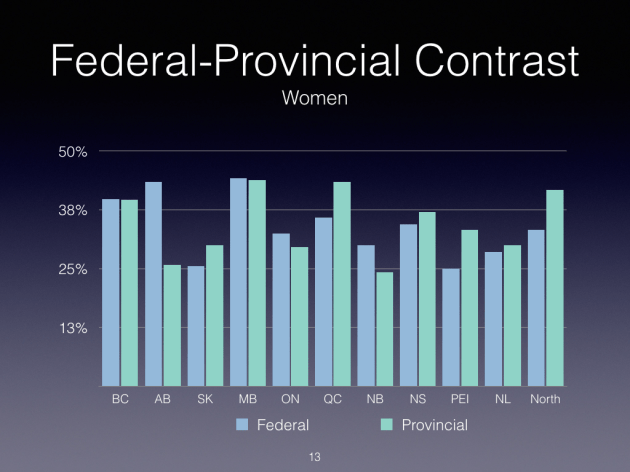
In the next series of charts federally and provincially appointed judges are compared for each under-represented group, by province, starting with women (figure 4). Here there is no overall trend: the federal and provincial appointment of women is similar in British Columbia, Manitoba, Nova Scotia, and Newfoundland and Labrador; in Saskatchewan, Quebec, Prince Edward Island and the North, provincial appointment of women is higher; and in Alberta the appointment of women is significantly lower, given the relatively large share of part-time and supernumerary appointments that are men (about a third of full-time judges are women).

Judicial Diversity 2016 - DRAFT.013Figure 4

Looking at visible minorities (figure 5), when we compare federal and provincial appointments by province, we see a trend in all provinces except Saskatchewan: provincial judicial appointments are more representative of their populations than federal nominations, although visible minorities are still significantly under-represented.

Judicial Diversity 2016 - DRAFT.014Figure 5

Lastly, with respect to Indigenous appointments (figure 6), we see the same pattern: provincial appointments are more representative of provincial populations than federal appointments in all provinces and territories, except, surprisingly, in the North, where there are no Indigenous territorial judges.

Judicial Diversity 2016 - DRAFT.015Figure 6

Looking at senior judges (chief and associate-chief justices), there are no federally appointed visible minority or Indigenous judges, and there are only a handful number of provincially appointed senior judges (figure 7).

Judicial Diversity 2016 - DRAFT.011Figure 7

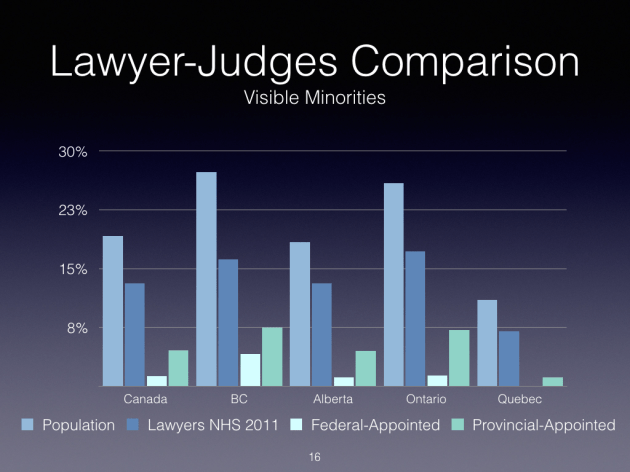
While judicial diversity is low, particularly for visible minorities and Indigenous people, the number of visible minority lawyers continues to increase. Figure 8 presents the proportions of visible minority lawyers aged 25-64 Canada-wide and in the largest provinces, which gives an idea of the size of the pool that can be drawn from. Given that visible minorities are, in general, younger than the general population, visible minority lawyers are also likely to be younger and, therefore, the percentage who would be aged 45 years old or older, the usual age people are considered for these positions, would be lower.

Judicial Diversity 2016 - DRAFT.016.pngFigure 8

As part of its review of the judicial appointment process, the Office of the Commissioner for Federal Judicial Affairs should expand the existing information on the gender of judges and include visible minorities and Indigenous people. With this information, the government could be held to account for its diversity and inclusion commitments, and it would be easier to track its progress over time.

The provinces and territories that do not already do this should do so, and they should use Ontario’s annual reports on appointments as a model, ensuring that the annual reports cover the overall diversity of the entire bench.

*A few notes on methodology. The federal government publishes statistics on gender but not on visible minority or Indigenous appointments. All provinces except Alberta and Saskatchewan indicate gender through the use of “Mr.” or “Madam” justice (the departments of justice provided the number of women judges). Gender information is thus complete.

To identify visible minority and Indigenous origin name checks, appointment announcements and, when available, photos and biographies were used. All provincial judicial councils or departments of justice were approached (only Ontario reports publicly but Saskatchewan, Quebec and Nova Scotia provided the breakdowns used). The Canadian Bar Association, national and regional branches, and law societies were approached and a number of individual lawyers also helped improve the quality of the data collected. I believe this provides a reasonable assessment of current diversity.