House more diverse, but still has a long way to go – The Hill Times Editorial

While hard to disagree with the overall tenor of this editorial, the more interesting aspects of Kai Chan’s in-depth work is less with traditional diversity – women, visible minorities, foreign-born, Indigenous peoples – is with respect to the lack of occupational, age, education etc where some of the differences between parties are striking.
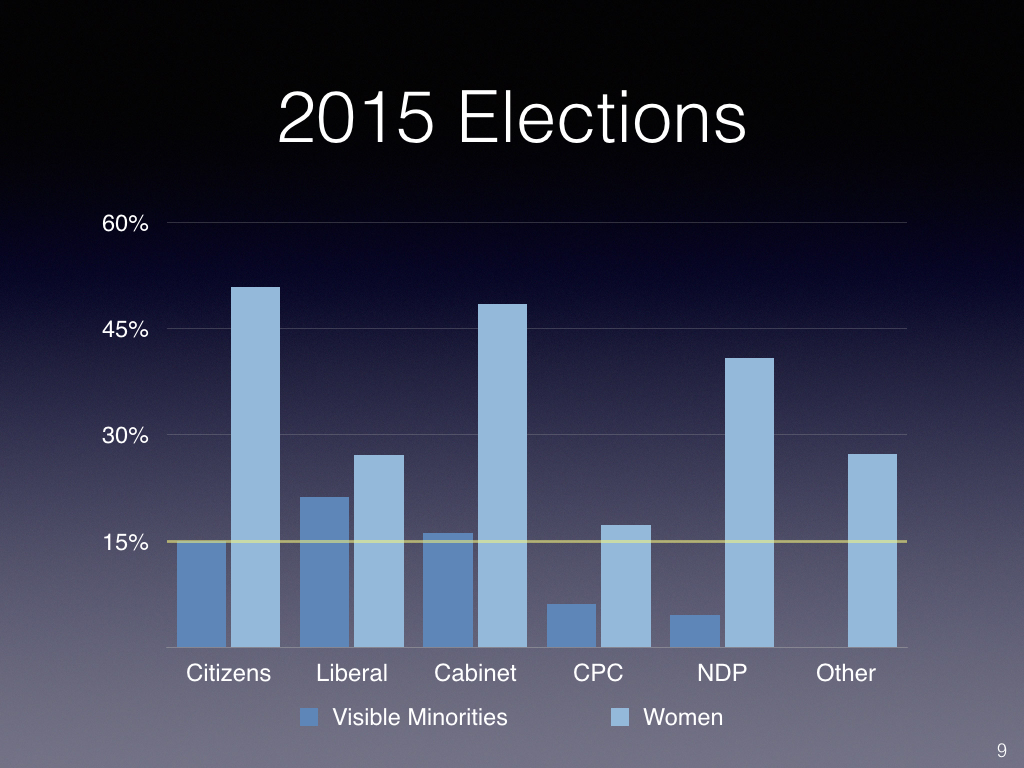
Election 2015 - VisMin and Foreign-Born MPs.002

Note: Baseline for visible minorities is 15 percent, those who are Canadian citizens

The Hill Times conclusion only focuses on the former and is silent on the latter:

As The Hill Times reports in this week’s issue, this is one of the most diverse House of Commons in Canadian history, but it still has a long way to go to reflect Canada’s diverse population. More work must be done to elect more women, more indigenous peoples, more visible minorities, and more people with diverse educational and professional backgrounds. The House is still too white, too male, and too English.

According to research by Canadian expatriate economist Kai Chan, who has a PhD in economics from New Jersey’s Princeton University and is a self-described “data-junkie,”of 338 MPs elected in the last general election, the average group in the House is 50-59; the most common professional background is law; and the most studied subject is politics. Some 104 MPs, or 30 per cent of MPs, are bilingual; 47 MPs, or 13 per cent, were born outside Canada; and there are 88 female MPs, or 26 per cent of the House. Of the 47, or 14 per cent of MPs who were born outside Canada, 11 were born in India, six in the U.K., and four in Lebanon. Out of the 291 MPs, or 86 per cent of the House, born in Canada, 28 MPs were born in Montreal, 25 in Toronto, and 12 in Winnipeg.

According to the 2011 National Household Survey, of Canada’s 32.8 million total population, 6.2 million, or 19 per cent, are visible minority Canadians, including 1.5 million South Asians, 1.3 million Chinese Canadians and about 945,665 black Canadians. The Filipino population numbers 619,310, Latin American 381,280, Arab 380,620, Southeast Asian 312,080 and West Asian 206,840. And the total aboriginal population is 1.4-million.

“Canada is such a diverse country, it’s good to get all different voices,” Mr. Chan told The Hill Times. “It’s especially good because we live in a globalized world, and for Canada to really capitalize on its demographic dividend, we really should have all those people at the table.”

Canadians elected 60 lawyers, 47 consultants, 43 professors, 42 business people, and 41 executives. Some 63 MPs studied politics, 60 studied law, 27 studied business and 27 studied economics. Some 199 prefer English and 35 prefer French only.

In the education category, a total 136, or 40 per cent of MPs, have bachelor’s degrees; 75 MPs, or 22 per cent, have master’s degrees; and 30 MPs, or eight per cent, have PhDs. And 81 MPs have secondary or lower levels of education. The Liberals lead the pack with 22 MPs who have doctorates, followed by the Conservatives with five MPs who have doctorates, the NDP two and Bloc one MP. Of the MPs who have secondary or lower education, the Conservatives have the highest with 42 MPs, followed by the Liberals with 27, the NDP eight and the Bloc four MPs. The Liberals are far ahead of other parties when it comes to MPs who have master’s or bachelor’s degrees with 47 and 82, respectively. In the Conservative caucus, 14 MPs hold their master’s and 31 their bachelor’s. On the NDP side, 12 MPs have their master’s and 19 MPs have their bachelor’s degrees. Some 32 MPs attended the University of Toronto, 22 McGill University in Montreal, and 16 went to Queen’s University in Kingston.

Hopefully, all political parties will make a much stronger effort to recruit more candidates who are underrepresented in the House right now, including more visible minorities, more women, more indigenous peoples to run in the next election. Canada is a diverse country. It’s time that diversity was better reflected in the House.

Source: House more diverse, but still has a long way to go – The Hill Times – The Hill Times

Sweating the details at Shared Services: What it will take to reset it

Good article capturing some of the major differences between the public and private sector, and why large-scale IT projects are so hard to do well in the former:

It’s not just that its top mandarins lack knowledge and interest in IT. It’s that the entire procurement system and its political overseers suffocate rather than expedite the rollout of large IT projects.

This is messy stuff — software underpinning data centres and telecommunications networks evolves constantly. Upgrading applications across dozens of federal departments inevitably produces conflicts. Programmers and their managers must be free to resolve them — and to drop approaches that aren’t working. The job demands constant testing and feedback at a very micro level.

Shared Services’ first chief operating officer, Grant Westcott, had nearly four decades of experience in government and the private sector — where he was instrumental in consolidating IT systems at the Canadian Imperial Bank of Commerce. But at Shared Services, nearly every move he made was constrained.

At CIBC, Westcott would have been given a budget, a mandate and left alone to get on with it. Had his projects been late and run over budget, it’s unlikely he would have lasted there nearly a decade. In the event, Westcott and his team streamlined the bank’s telecommunications systems and collapsed 22 data centres into just two, trimming CIBC operating costs significantly.

However, the federal government doesn’t allow for this sort of flexibility. Procurement documents contain page after page of technical requirements for programmers and IT consultants. The projects are over-engineered, in other words, in a usually forlorn effort to mitigate most conceivable risks.

Budgets and timelines are spelled out in meticulous detail — even though relatively little is known during the earliest stages about how projects will actually progress. And, of course, there is often extensive cabinet oversight of projects that are costly, late or affect government websites. Which is to say, most of them.

According to experts hired to do these projects, what is needed are wins — IT projects that succeed. And the best way to make these happen is to start with small steps — manageable projects or parts of projects that work. The more of these that Shared Services can string together, the more other federal departments will be willing to let it handle.

This would also make things much easier for Shared Services president Ron Parker — instead of continually revising deadlines for his agency’s main projects, he would be able to point to services actually being performed. Far more satisfying — assuming his people can get things done.

Source: Sweating the details at Shared Services: What it will take to reset it | Ottawa Citizen

Donald Trump could happen in Canada. It’s already begun. – Macleans.ca

Some good analysis and questions regarding the resilience of Canadian politics to Trump-style politics, focussing on the ugliness in the Alberta PC leadership campaign and the Leitch/Blaney campaign approaches.

Starting with Charlie Gillis:

The question, say experts, is whether support for such ideas could galvanize into a Trump-style movement. Ice-breakers like Blaney and Leitch are exploiting the same rural-urban cultural divide that Trump did in the U.S., acknowledges Clark Banack, a Brock University political scientist who studies populist movements. But the kind of anti-elitist discontent that moves votes is seldom seen in Canada outside the West, Banack notes, and when it arises elsewhere, it tends to be short-lived. “We have sporadic examples of people emerging for a short time around a specific issue,” he says, citing Rob Ford’s rise to the Toronto mayoralty on the strength of working-class, suburban anger. “But overall, Canadian political culture is less susceptible to populism than American political culture.”

Another mitigating factor: the relative absence in Canada of a dispossessed working class in a mood to punish its leaders. David Green, a professor at the University of British Columbia’s Vancouver School of Economics, believes Trump’s support base of white men with no college degree would be hard to replicate in this country because the commodities boom sustained Canada’s blue-collar workers, even as the financial crisis crushed the dreams of their counterparts in other countries. Between 2003 and 2015, he notes in a forthcoming paper, mean hourly wages for Americans with a high school education or less fell by six per cent; for the same demographic in Canada, they climbed eight per cent. The effect, he says, was to slow the growth of the economic gap that has fed voter rage in the U.S., the U.K. and parts of Europe. Last year, our top 10 per cent of earners made 8.6 times on average what the bottom 10 per cent pulled in—a ratio that, while high, falls beneath the OECD average and far below the U.S. ratio of 19 to one.

But all that could change, Green warns, if oil prices remain low—especially if the housing market weakens at the same time. The country’s residential construction boom, he notes, has maintained job centres around the country’s large cities, putting more than a few displaced oil patch employees to work. “What do you do with that set of less-than-university-educated guys—the demographic that switched over to Trump?” Green asks. “That’s a potentially worrying connection.”

More so, agrees Banack, if you have a high-minded central government that overlooks their misfortune while pursuing its own pre-occupations. Running against Ottawa, he notes, is a time-tested stratagem for populist movements in Canada, and these days, few national governments are more closely identified with the globalist program of trade, labour mobility and climate-change action than Justin Trudeau’s Liberals. Something like Trudeau’s promised national carbon tax, which will be felt keenly in the West, could be enough to trigger a populist insurgency in Alberta, he says, though it’s safe to assume the federal Conservative party would do everything it could to stop such a movement, given the outcome of the Reform party experiment: “Another vote split, and you could forget about a Conservative federal government for another 10 or 15 years.”

Maybe, but experienced political players are no longer sure economic logic and conventional political calculus are in force. Carter, the Alberta strategist, notes that the online communities where so-called “alt-right” voters congregate—Facebook groups, or conspiracy-fuelled sites like Infowars—don’t traffic in that sort of information. In its place: a strain of fanaticism typified by the onslaught that ran Jansen off the PC stage, which Carter believes is sure to spread. “I don’t know if it’s Trump or social media or just belief that they’re correct that gives a sense of permission,” he says. “But this is not normal.”

Gary Mason in the Globe picks up similar themes:

The Premier and her party are now sitting at 14 per cent in the polls. The party receiving the most support in recent public opinion surveys is the Progressive Conservatives, the same entity Mr. Kenney plans to destroy if he wins the leadership. He wants to build a new political organization that Wildrose members will feel comfortable joining as part of an overarching bid to unify conservative forces in the province.

Either way, Alberta seems to be preparing to make an ideological course correction.

There’s little doubt the rise of Donald Trump has emboldened many in the province. One of those would appear to be Derek Fildebrandt, a Wildrose MLA and one of the most powerful conservative voices in Alberta.

He has little patience for the likes of Ms. Jansen and others complaining about online trolls and provocateurs. “Hypersensitive, politically correct, victim-as-virtue culture is creating a leadership class of wimps,” he wrote in a tweet that could have been sent out by The Donald himself. “People are sick of it.”

After Mr. Trump was elected, Mr. Fildebrandt tweeted: “The biggest lesson that we should learn from the election of Trump: smug, condescending political correctness will spark a backlash.”

I’m not sure what is happening in Alberta, but on almost any level it’s not good. Trump-style politics could well be making its way north of the border. At the end of the day, however, society gets the politicians it deserves.

Source: Not so progressive: Trump-style politics seep into Alberta

Social Media’s Globe-Shaking Power – The New York Times

Good long read by Farhad Manjoo on the increasing influence of social media and some of the implications:

As the technology industry came to grips in the last week with the reality of a presidential election that did not go its way, many in Silicon Valley landed on the idea that widespread misinformation spread online was a primary factor in the race’s outcome.

On Monday, both Google and Facebook altered their advertising policies to explicitly prohibit sites that traffic in fake news from making money off lies. That’s very likely a worthwhile fix, even if it comes too late. The internet has loosened our collective grasp on the truth, and efforts to fight that dismaying trend are obviously worth pursuing.

Yet it would be a mistake to end this investigation at fake news. In fact, the dangers posed by fake news are just a symptom of a deeper truth now dawning on the world: With billions of people glued to Facebook, WhatsApp, WeChat, Instagram, Twitter, Weibo and other popular services, social media has become an increasingly powerful cultural and political force, to the point that its effects are now beginning to alter the course of global events.

The election of Donald J. Trump is perhaps the starkest illustration yet that across the planet, social networks are helping to fundamentally rewire human society. They have subsumed and gutted mainstream media. They have undone traditional political advantages like fund-raising and access to advertising. And they are destabilizing and replacing old-line institutions and established ways of doing things, including political parties, transnational organizations and longstanding, unspoken social prohibitions against blatant expressions of racism and xenophobia.

Most important, because these services allow people to communicate with one another more freely, they are helping to create surprisingly influential social organizations among once-marginalized groups. These ad hoc social movements range widely in form, from “alt-right” white supremacists in the United States to Brexiters in Britain to ISIS in the Middle East to the hacker collectives of Eastern Europe and Russia. But each in its own way is now wielding previously unthinkable power, resulting in unpredictable, sometimes destabilizing geopolitical spasms.

“You now have billions of people on the internet, and most of them are not that happy with the status quo,” said Ian Bremmer, the president of the Eurasia Group, a research firm that forecasts global risks. “They think their local government is authoritarian. They think they’re on the wrong side of the establishment. They’re aggrieved by identity politics and a hollowed-out middle class.”

Many factors accounted for Mr. Trump’s win: middle-class economic anxiety in the industrial Midwest; an inchoate desire for some kind of change in the national direction; and some mix of latent racism, xenophobia and sexism across the electorate. But as even Mr. Trump acknowledged in an interview with “60 Minutes” aired Sunday, social media played a determining role in the race.

In the past, Mr. Bremmer said, the concerns of Mr. Trump’s supporters might have been ignored, and his candidacy would almost certainly have foundered. After all, he was universally written off by just about every mainstream pundit, and he faced disadvantages in money, organization and access to traditional political expertise. Yet by putting out a message that resonated with people online, Mr. Trump hacked through every established political order.

“Through this new technology, people are now empowered to express their grievances and to follow people they see as echoing their grievances,” Mr. Bremmer said. “If it wasn’t for social media, I don’t see Trump winning.”

For people who like an orderly, predictable world, this is the scariest thing about Facebook; not that it may be full of lies (a problem that could potentially be fixed), but that its scope gives it real power to change history in bold, unpredictable ways.

But that’s where we are. It’s time to start recognizing that social networks actually are becoming the world-shattering forces that their boosters long promised they would be — and to be unnerved, rather than exhilarated, by the huge social changes they could uncork.

This should come as no surprise. In a way, we are now living through a kind of bizarro version of the utopia that some in tech once envisioned would be unleashed by social media.

Over much of the last decade, we have seen progressive social movements powered by the web spring up across the world. There was the Green Revolution in Iran and the Arab Spring in the Middle East and North Africa. In the United States, we saw the Occupy Wall Street movement and the #BlackLivesMatter protests.

Social networks also played a role in electoral politics — first in the ultimately unsuccessful candidacy of Howard Dean in 2003, and then in the election of the first African-American president in 2008.

Yet now those movements look like the prelude to a wider, tech-powered crackup in the global order. In Britain this year, organizing on Facebook played a major role in the once-unthinkable push to get the country to leave the European Union. In the Philippines, Rodrigo Duterte, a firebrand mayor who was vastly outspent by opponents, managed to marshal a huge army of online supporters to help him win the presidency.

The Islamic State has used social networks to recruit jihadists from around the world to fight in Iraq and Syria, as well as to inspire terrorist attacks overseas.

And in the United States, both Bernie Sanders, a socialist who ran for president as a Democrat, and Mr. Trump, who was once reviled by most members of the party he now leads, relied on online movements to shatter the political status quo.

Why is this all happening now? Clay Shirky, a professor at New York University who has studied the effects of social networks, suggested a few reasons.

One is the ubiquity of Facebook, which has reached a truly epic scale. Last month the company reported that about 1.8 billion people now log on to the service every month. Because social networks feed off the various permutations of interactions among people, they become strikingly more powerful as they grow. With about a quarter of the world’s population now on Facebook, the possibilities are staggering.

“When the technology gets boring, that’s when the crazy social effects get interesting,” Mr. Shirky said.

One of those social effects is what Mr. Shirky calls the “shifting of the Overton Window,” a term coined by the researcher Joseph P. Overton to describe the range of subjects that the mainstream media deems publicly acceptable to discuss.

From about the early 1980s until the very recent past, it was usually considered unwise for politicians to court views deemed by most of society to be out of the mainstream, things like overt calls to racial bias (there were exceptions, of course, like the Willie Horton ad). But the internet shifted that window.

“White ethnonationalism was kept at bay because of pluralistic ignorance,” Mr. Shirky said. “Every person who was sitting in their basement yelling at the TV about immigrants or was willing to say white Christians were more American than other kinds of Americans — they didn’t know how many others shared their views.”

Thanks to the internet, now each person with once-maligned views can see that he’s not alone. And when these people find one another, they can do things — create memes, publications and entire online worlds that bolster their worldview, and then break into the mainstream. The groups also become ready targets for political figures like Mr. Trump, who recognize their energy and enthusiasm and tap into it for real-world victories.

Mr. Shirky notes that the Overton Window isn’t just shifting on the right. We see it happening on the left, too. Mr. Sanders campaigned on an anti-Wall Street platform that would have been unthinkable for a Democrat just a decade ago.

Now, after Hillary Clinton’s loss, the way forward for Democrats will very likely be determined as much by collectives on Facebook as by elites in Washington — and, as a result, we’re likely to see more unlikely candidates and policy positions than we would have in the past.

The upshot is further unforeseen events. “We’re absolutely going to get more of these insurgent candidates, and more crazy social effects,” Mr. Shirky said.

Mr. Trump is just the tip of the iceberg. Prepare for interesting times.

Shared Services Canada: How politics sabotaged the government’s grand IT plans | Ottawa Citizen

A good long read by James Bagnall regarding Shared Services Canada and the failure of officials and politicians to anticipate, understand and manage the risks involved. Sobering read:

But Shared Services and Phoenix have something in common — a botched introduction caused, it appears, by deep flaws in how government operates. In both cases, cabinet ministers and bureaucrats underestimated complexity and risk. In this, they were hardly unique — it was the scale of the misjudgment that set the federal IT agenda apart.

Standish Group, a Boston-based consulting firm, has been tracking the performance of IT projects since the mid-1990s — with surprisingly little variation in results. The consultants last year examined 50,000 projects worldwide, including government and private sector. About 30 per cent of these efforts succeeded — that is, they were on time, on budget and produced a payoff. Roughly half the projects ran into difficulty and nearly 20 per cent failed outright. The larger and more complex the project, the higher the rate of failure.

Carol Bellringer, the auditor general for the B.C. government, last month offered three key reasons why IT projects fail: Government departments, she said, lack in-house expertise; they attempt “overly ambitious” programs; they justify the latter through “incomplete” business cases.

All three elements were present at the launch of Shared Services. Most of the responsible bureaucrats were not trained in IT, yet were tasked with remaking on the country’s electronic infrastructure. Many also lacked experience in project management with a heavy IT component.

“I don’t know how many times I heard from deputy ministers that they didn’t understand information technology,” said a senior Shared Services official, “They didn’t like IT and they hoped never to see anything to do with IT for the rest of their career.”

Yet it is a group of deputy ministers — the ones in charge of the most IT-intensive departments — who determine the shape and scope of large IT projects. And when it came to launching Shared Services — the centrepiece of the government’s online renewal — the already high risks were exacerbated by a political agenda that stripped it of the capital necessary to get the job done.

It will likely end up costing taxpayers a fortune to set things right again.

A government data centre in Ottawa.
Detail from one of the many legacy data centres in the National Capital Region.JULIE OLIVER /  POSTMEDIA

It had seemed so simple in the beginning. The idea for Shared Services emerged from the Conservatives’ fifth budget, tabled March 4, 2010. The themes were clear: The economic recession was over; it was time to regain control of government spending.

One aspect of the strategy — little noticed at the time — was the launch of a “comprehensive review” of government spending on administration and overhead expenses. This should have offered easy pickings: Federal government employment was near high tide; and most departments and agencies had expanded rapidly.

Daniel Jean, the deputy secretary to the cabinet of the Privy Council Office, was picked to run the review, making it a big deal. The PCO is home to 950 bureaucrats who provide advice to cabinet and the Prime Minister’s Office, and oversee the development of the civil service.

Jean reported directly to Wayne Wouters (pronounced “Waters”) — the clerk of the privy council and the government’s top bureaucrat. Among the members of the review helping out Jean were Benoit Long, a senior manager seconded from the office of the government’s chief technology officer, and Liseanne Forand, then chief operating officer of Service Canada. The latter department offers Canadians online access to pensions and employment insurance.

The administrative services review was carried out in secret, typical PCO modus operandi. Its members roamed the bureaucracy, collecting information and searching for ways to consolidate or standardize how things were done. Some departments were already moving down this path.

…Information technology offered an even richer vein of potential savings. For half a century, computer networks and software applications had multiplied willy-nilly as individual departments and agencies looked after their own needs. The result was a patchwork of incompatible, higher-cost systems. Standardizing common, basic technologies such as email, data storage and telecommunications seemed logical.

It had been tried before. But attempts to centralize the buying of high-tech gear and services had failed, largely because federal departments were allowed to opt out. Most did so. They did want to give up control of their IT networks to a central agency.

The PCO determined this time would be different. The prime minister had the authority to create a new federal department through a simple cabinet approval known as an order-in-council. Most departments, including a reluctant Canada Revenue Agency and Department of National Defence, would be forced to carve out a significant portion of their IT groups and budgets — about 40 per cent on average — and hand them over to Shared Services.

Crucially, the move would not be subject to scrutiny by Parliament. And so Shared Services was born on Aug. 3, 2011.

Speed was demanded of the agency from the start. Minutes of meetings involving senior Shared Services staff are studded with references to “tight schedules” and the “urgency” of getting projects done.

Part of that had to do with the sheer age of the government’s infrastructure. The hardware was in danger of breaking down and the underlying software for many applications was so old that suppliers such as Microsoft, PeopleSoft and Adobe had stopped supporting it.

The faster Shared Services could install new networks, the less money it would be forced to throw at solving the problems caused by older technology.

But that wasn’t the only reason Shared Services was pressed for time. Senior Shared Services officials said the Conservatives were eager to see cost savings, and impressed upon them the importance of securing an early win.

The PCO framed the upgrade in simple terms: Consolidate, modernize and reap the savings. And Shared Services would have nearly a decade to get it done. By 2020, the thinking went, the government of Canada would be able to offer its citizens secure, online services that would be the envy of the world; and Shared Services would be a magnet for attracting the best and the brightest employees in government.

But cabinet — and to some extent the PCO — failed to account for the complexity. They were proposing to create a new organization using bits and pieces from other departments and loading it up with a series of mandates on a tight schedule. The entire production was fraught with risk.

“They had articulated the problem and come up with an organizational response (in the form of Shared Services),” an independent adviser to the PCO said in an interview, “but they completely underestimated the scale.”

Source: Shared Services Canada: How politics sabotaged the government’s grand IT plans | Ottawa Citizen

Reforms to the Superior Courts Judicial Appointments Process: Diversity element

The operative paragraph on diversity, including reporting:

To promote diversity, the new JACs will be mandated with identifying outstanding jurists from a wide range of backgrounds and practice areas, with a view to having a judiciary that reflects the diversity of Canadian society. JACs will be supported in this task by the diversity-related training provided to members noted above. The collection and publication of statistical data on judicial applicants and appointees will provide transparency and enhance accountability with respect to progress towards a more diverse bench.

Source: Reforms to the Superior Courts Judicial Appointments Process – Canada News Centre

Trudeau shakes up PS top ranks with more young blood (diversity numbers)

With these appointments, the overall DM diversity numbers for the 39  appointments are: 43.6 percent women, 7.7 percent visible minorities:

Prime Minister Justin Trudeau shook up the senior ranks of Canada’s public service with another sweep of promotions for younger executives who are poised to take over as the leaders of the next decade.

The latest round of appointments reflects Privy Council Clerk Michael Wernick’s push to rejuvenate the top ranks of the bureaucracy with a better mix of youth and experience. The prime minister is responsible for all senior appointments but they are typically made on the advice of the clerk.

Wernick has said managing a “generational turnover” is his top priority as the last wave of baby boomers, who dominated the face and character of public service for decades, retires. In speeches, he has exhorted the baby boomers to “move on” and make way for the next generation of leaders.

Friday’s shakeup included three promotions into the ranks of deputy minster and three assistant deputy ministers into associate deputy minister jobs. All are about age 50 — either in their late 40s or early 50s — positioning them for the top posts over the decade. Last year, the average age of deputy ministers was about age 58.

As one senior bureaucrat said, “It looks like 50 is the new 60.”  The public service has aged over the years, including its senior executives compared to the 1970s and ‘8os when the public service grew rapidly and it wasn’t unusual for executives to get their first deputy appointments in their 40s.

The Trudeau government has made more than 30 senior public service appointments, and a significant number have been younger appointments than in previous years or were recruited from outside the public service.

This round of promotions includes: Paul Glover, the associate deputy minister of health, becomes president of the Canadian Food Inspection Agency; Timothy Sargent, associate deputy minister of Finance, is promoted to deputy minister at International Trade; and James Meddings, assistant deputy minister at Western Economic Diversification Canada, moves to the top job at Federal Economic Development Agency for Southern Ontario.

Glover replaces CFIA president Bruce Archibald, who is retiring. Sargent is taking over from Christine Hogan, who was recently named the new World Bank Group executive director for Canada, Ireland, nine Caribbean countries, Belize and Guyana.

Similarly, Meddings replaces Nancy Horsman, who is the new International Monetary Fund executive director for Canada, Ireland, nine Caribbean countries and Belize.

Doug Nevison becomes the European Bank for Reconstruction and Development executive director for Canada, Morocco, Tunisia and Jordan.

The Trudeau government’s appointment of two women — Horsman and Hogan — to the world’s main economic boards is part of its push to ensure Canada’s representatives abroad reflect gender parity and the wide diversity of Canada. About 45 per cent of Canada’s diplomatic postings are now held by women.

Other moves in the Friday round of appointments included Chris Forbes, the associate deputy minister at Agriculture who moves to Finance as one of the department’s two associate deputy ministers. Rob Stewart, assistant deputy minister at Finance, moves up to the associate deputy minister position responsible for G7 and G20.

Nada Semaan, executive vice-president at Canada Border Services Agency (CBSA), moves to Agriculture as associate deputy minister, and Kristina Namiesniowski, an assistant deputy minister at Agriculture, takes over Semaan’s position at CBSA.

Today, more than one-third of the executive cadre are over age 55, with 400 of them over 60. About 46 per cent of all public service executives are over age 50. The average deputy minister is 58; associate deputy minister 54, assistant deputy minister 53.7 and directors and directors-general 50.

Along with the drive to infuse more young talent into the executive jobs, Treasury Board president Scott Brison is committed to making the public service more millennial-friendly to attract more youth.

Source: Trudeau shakes up PS top ranks with more young blood | Ottawa Citizen

Justice minister announces 24 new judges in effort to end national shortage

Finally, the announcement of the new process for selecting federally-appointed judges. No real surprise given the ministerial mandates letters. Still nothing (yet) and regular reporting:

The Liberal government has announced a new judicial appointment process that emphasizes gender and racial diversity.

One of the key changes unveiled on Thursday specifies that governments and independent legal groups that pick the members of the committees that screen candidates “will be asked to take into account the need to ensure [the committees] are representative of the diversity of Canada,” according to a justice department backgrounder. All members of the screening committees will get training on diversity, unconscious bias and assessment of merit, the backgrounder says. A federal agency will keep track of the demographic makeup of applicants. Until now, applications have been tabulated only by gender, not race.

As part of the process, applicants will have to fill out more detailed application forms than they do now. In these forms, applicants will detail their abilities in Canada’s two official languages, and they may be tested on their proficiency.

Another set of modifications will undo changes the Harper government made to the process. The Conservatives had put a police representative on the judicial advisory committees that screen judges for federally appointed courts (such as provincial superior courts, the Federal Court and Tax Court). They had also taken away the vote of a judge on those committees, which had given the federal appointees a voting majority. And the Conservatives had taken away the judicial advisory committees’ ability to “highly recommend” applicants; they could only recommend (or not). The government will remove the police representative, return the vote to the judge and re-establish the “highly recommended” category.

Applicants who applied under the previous process will have to re-apply, but on Thursday, the government announced the appointments of 24 judges under the existing process.

The Liberals have come under fire from the legal community because they appointed just 15 judges in their first year in power, during which judicial vacancies reached 61. That’s more than at any time during Stephen Harper’s decade in power, records show. When Mr. Harper stopped appointing judges in the summer of 2015, before the federal election, there were a little more than a dozen vacancies.

Backlogs in criminal, civil and family cases have risen in some provinces, especially in Alberta and Nova Scotia.

Source: http://www.theglobeandmail.com/news/national/liberals-to-unveil-new-judicial-appointment-process-undo-changes-made-by-harper/article32454733/

And the announcement of 24 judicial appointments:

After months of criticism for not acting fast enough to appoint much-needed judges across the country, Justice Minister Jody Wilson-Raybould announced 24 judicial appointments Thursday.

“We have moved to fill urgent judicial vacancies by drawing on existing lists of recommended candidates,” the minister said in a statement. “The government is confident in the outstanding quality of these appointees and their dedication to delivering just outcomes for Canadians.”

Justice system can’t wait for judicial appointments review, say judges

Trudeau government has backlog of more than 300 appointments

Of the 24 new appointees, 14 are women and two are Indigenous. (No visible minorities are mentioned but need to doublecheck).

Source: Justice minister announces 24 new judges in effort to end national shortage

And for the list (I will be doing an analysis later as am travelling):

Source: http://news.gc.ca/web/article-en.do?nid=1140619 (separate links by Federal Court and Provincial Courts)

Glenn Gould offers lessons for Apple, and Ottawa, on innovation

Interesting piece (have seen earlier articles on Gould’s influence at Apple but not with this angle to the current Canadian innovation strategy policy discussions):

Institutionalizing the nebulous concept of innovation won’t be easy. Jobs himself faced a similar challenge when he was diagnosed with a cancerous tumour in his pancreas in 2004, forcing him to contemplate a day when he would no longer be able to terrorize Apple’s designers and engineers. In 2008, he quietly began laying the groundwork for Apple University by hiring Joel Podolny, the dean of Yale’s school of management. “The idea was to take what is unique about Apple and create a forum that can impart that DNA to future generations of Apple employees,” a former Apple executive told the Los Angeles Times in 2011. “No other company has a university charged with probing so deeply into the roots of what makes the company so successful.”

[Joshua] Cohen’s presentation on Gould is just one of several he gives at the university, where he’s now employed full-time. It’s part of a series called  “The Best Things”—a reference to a remark that Jobs once made about “trying to expose yourself to the best things that humans have done, and then try to bring those things into what you’re doing.” His first presentation in the series was about New York’s Central Park, which was designed by landscape architect Frederick Law Olmsted to show that America could create beautiful, natural public spaces that rivalled the best of Europe. Gould, by contrast, created a thing of beauty by reinterpreting the baroque work of a German composer who was widely seen as a touch old fashioned, even by his contemporaries.

Equally as compelling for Apple employees is Gould’s forward thinking attitude about technology. Gould once told an interviewer in 1966 that live audiences were a “force of evil” because pleasing them took precedence over his pursuit of perfection. “I really thank God that I’m able to sit in a studio with enormous concentration and do things many times, if necessary,” he said. “I think a whole new role has been opened in this way.” Bob Ezrin, the Canadian music producer known for his work with Pink Floyd, Lou Reed and Taylor Swift among others, (and, to a different demographic, for sparking a Twitter war earlier this year with rapper Kanye West), says Gould was way ahead of his time. “He was the first guy to edit classical performances,” he says. “That was just anathema to the classical world. Edit multi-track recordings? This was stuff that was only beginning to happen in popular recording because performers couldn’t do it all in one take.”

If it all sounds a touch pedantic for a company that builds smartphones, recall that Jobs credited part of the original Mac’s success on his decision to study calligraphy at Reed College in Portland, OR. “If I had never dropped in on that single course in college, the Mac would have never had multiple typefaces or proportionally spaced fonts,” he said during a 2005 commencement address at Stanford. “And since Windows just copied the Mac, it’s likely that no personal computer would have them.” This is also a man who once said, shortly before his death, that great technology by itself wasn’t sufficient to make great products: “It’s technology married with the liberal arts, married with the humanities, that yields us the results that make our hearts sing.”

At its core, Cohen says Apple’s mission is indeed to develop products that should be built, not finding a way to shoehorn every piece of new technology into people’s lives, wanted or not. “They [Apple products] enable people to do things that are good to do,” he says, adding it’s not all that different from Gould’s effort to create a moment of pure musical bliss. “You’re trying to do something that’s great and animated by a big idea,” says Cohen. “But what makes it great is there’s an important human good at stake in it.”

It sounds straightforward enough. But it’s remarkable how many tech firms allow the cord to wag the computer. Google, for all its success, is frequently guilty of packing unnecessary functions into its products, making them unnecessarily difficult to use. An Apple University professor apparently once used a Google TV remote control as an example of what not to do at Apple, according to the Times. It had no fewer than 78 buttons. Meanwhile, other up-and-coming tech giants often seem more interested in disrupting entrenched industries than they are in serving their customers. The increasingly heated debate over short-term rental platform Airbnb is a case in point, with some arguing it’s contributing to a housing crisis by convincing landlords it’s more profitable to rent to tourists than tenants.

So what, if anything, can Ottawa learn from Gould as it seeks to implement its “Innovation Agenda?” He obviously didn’t have much to say about the value of “innovation clusters” or the appropriate tax policy when it comes to stock options. But, Cohen says, he’s confident Gould wouldn’t think much of trying to replicate, pixel for pixel, Silicon Valley’s stunning success.  “Gould himself would say, almost in these words, ‘There’s no point performing something that’s been performed a thousand times before unless you do it differently,’” Cohen says. At the same time, however, the secret to Gould’s success was his dogged insistence to make sure what he did was worth doing, and that he did it to the best of his abilities—even if some thought he was being completely unreasonable in the process. Says Cohen: “That kind of comes with the territory of doing something that’s different and truly great.”

Advocates for minority Supreme Court judge disappointed by Trudeau’s pick

Understandable reactions but equally understandable that the government chose to give priority to regional representation and bilingualism.

However, it will be more important to assess the diversity of future appointments to the lower courts, which I expect will include visible minorities and Indigenous peoples (as did with the initial 15 appointments).

And nice to see my IRPP article, Diversity among federal and provincial judges – Policy Options,  continues to provide useful background data:

The Liberal government may have made history by nominating a Newfoundlander to Canada’s top court — but disappointed advocates say a more critical opportunity has been missed to add racial diversity to Canada’s predominantly white judiciary.

“It’s another white male . . . It’s the exact thing we’ve been doing for years,” said Koren Lightening-Earle, president of the Indigenous Bar Association, adding she would have been “borderline happy with any person of colour.”

Prime Minister Justin Trudeau announced Monday that Justice Malcolm Rowe from Newfoundland and Labrador has been nominated for the Supreme Court of Canada. If formally named to the court, it will be a historic first for the province.

However, scholars and aboriginal jurists had hoped Trudeau’s new selection process might set aside the constitutional convention of regionally based appointments, and focus on putting an aboriginal or black judge into the job.

Lightening-Earle said while Newfoundlanders and Labradorians have waited a number of decades for a representative on the court, aboriginal Canadians have deeper historic claims to a place in the judiciary.

“They (Newfoundland and Labrador residents) have been waiting a long time, but we’ve been waiting a little bit longer,” she said.

Lightening-Earle said in a telephone interview a rare opportunity has been missed, and indigenous lawyers are wondering why they bothered applying to the government’s advisory board for the position.

A report in Policy Options magazine estimated earlier this year that just one per cent of Canada’s 2,160 judges in the provincial superior and lower courts are aboriginal, while 3 per cent are racial minorities — prompting a Dalhousie University law professor to describe the Canadian bench as a “judiciary of whiteness.”

Robert Wright, a black social worker who has served on a Nova Scotia board that recommends judicial appointments, said the announcement is a disappointment given the Trudeau government’s earlier signals it might adjust the system.

“There are an increasing number of Canadians who . . . are not caught up in what I call the historical regional nature of the various Canadian identities we used to focus on,” he said in a telephone interview from Halifax.

Wright argues the principle of diversity that lies beneath appointing people from different regions needed to be shifted to recognize the increasing number of Canadians from diverse ethnic and racial backgrounds.

He said as a black Nova Scotian he would have been content to see a black person from any part of the country elevated to the bench, and he also would have been very pleased if an aboriginal judge was appointed.

Wright and Lightening-Earle say the country is losing out on the opportunity to gain from indigenous perspectives on everything from constitutional issues to sentencing to the factors that lead to crime.

Jeffery Hewitt, a legal scholar at the University of Windsor, said he doesn’t accept arguments that there may be a lack of qualified candidates.

“Tell us who applied. Give us the list. Talk to us about . . . whether there were any indigenous people in there?” said Hewitt, a Cree who has provided legal advice to First Nations.

A spokeswoman for the federal Justice Department said the independent advisory board that recommends candidates to the prime minister’s office “will be reporting on this information one month from (an) appointment.”

Hewitt said he’s hopeful that going forward, the Liberals will make more appointments to the superior courts in the provinces.

In Quebec, the Policy Options study noted three visible minority judges out of more than 500, despite bar society figures showing more than 1,800 of its roughly 25,000 lawyers identify themselves as being from visible minority groups. The province said it doesn’t keep figures.

In Ontario, one of the few provinces where the judicial advisory body keeps figures on the lower court appointments, there were 24 visible minority judges out of 334 judges, even though one quarter of the province’s overall population identifies as a visible minority.

There are no visible minorities on the bench in Newfoundland and Labrador, which by constitutional convention was the likeliest province to be tapped for the next Supreme Court of Canada appointment.

Source: Advocates for minority Supreme Court judge disappointed by Trudeau’s pick | Toronto Star