Reforms to the Superior Courts Judicial Appointments Process: Diversity element

The operative paragraph on diversity, including reporting:

To promote diversity, the new JACs will be mandated with identifying outstanding jurists from a wide range of backgrounds and practice areas, with a view to having a judiciary that reflects the diversity of Canadian society. JACs will be supported in this task by the diversity-related training provided to members noted above. The collection and publication of statistical data on judicial applicants and appointees will provide transparency and enhance accountability with respect to progress towards a more diverse bench.

Source: Reforms to the Superior Courts Judicial Appointments Process – Canada News Centre

Trudeau shakes up PS top ranks with more young blood (diversity numbers)

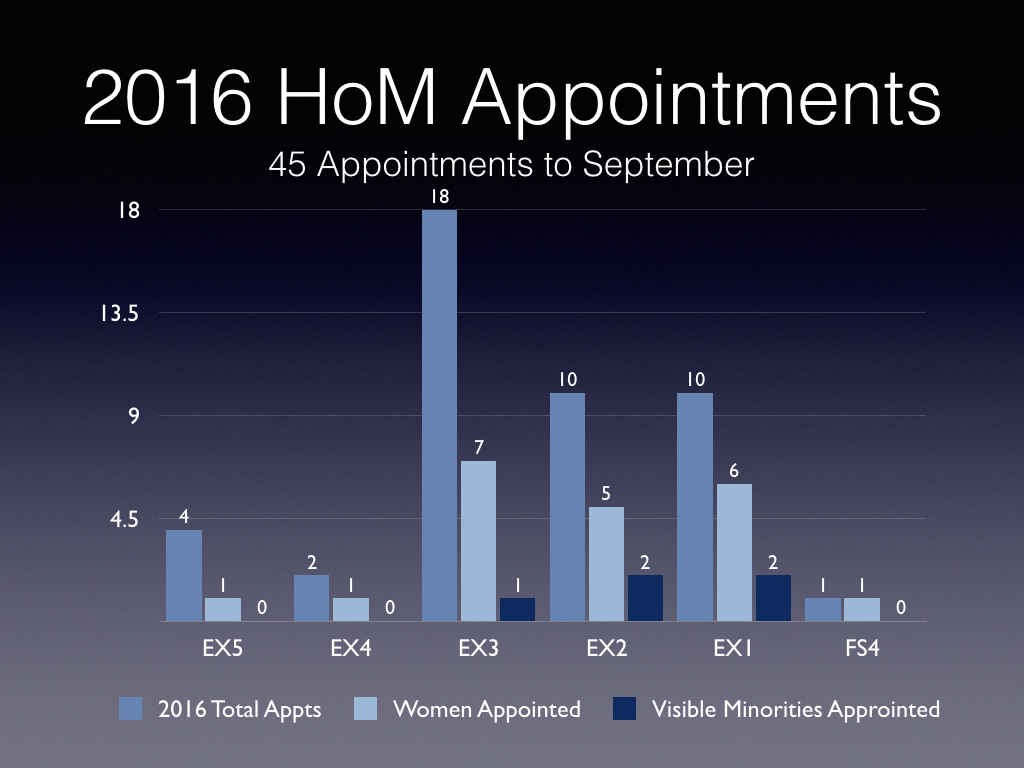
With these appointments, the overall DM diversity numbers for the 39  appointments are: 43.6 percent women, 7.7 percent visible minorities:

Prime Minister Justin Trudeau shook up the senior ranks of Canada’s public service with another sweep of promotions for younger executives who are poised to take over as the leaders of the next decade.

The latest round of appointments reflects Privy Council Clerk Michael Wernick’s push to rejuvenate the top ranks of the bureaucracy with a better mix of youth and experience. The prime minister is responsible for all senior appointments but they are typically made on the advice of the clerk.

Wernick has said managing a “generational turnover” is his top priority as the last wave of baby boomers, who dominated the face and character of public service for decades, retires. In speeches, he has exhorted the baby boomers to “move on” and make way for the next generation of leaders.

Friday’s shakeup included three promotions into the ranks of deputy minster and three assistant deputy ministers into associate deputy minister jobs. All are about age 50 — either in their late 40s or early 50s — positioning them for the top posts over the decade. Last year, the average age of deputy ministers was about age 58.

As one senior bureaucrat said, “It looks like 50 is the new 60.”  The public service has aged over the years, including its senior executives compared to the 1970s and ‘8os when the public service grew rapidly and it wasn’t unusual for executives to get their first deputy appointments in their 40s.

The Trudeau government has made more than 30 senior public service appointments, and a significant number have been younger appointments than in previous years or were recruited from outside the public service.

This round of promotions includes: Paul Glover, the associate deputy minister of health, becomes president of the Canadian Food Inspection Agency; Timothy Sargent, associate deputy minister of Finance, is promoted to deputy minister at International Trade; and James Meddings, assistant deputy minister at Western Economic Diversification Canada, moves to the top job at Federal Economic Development Agency for Southern Ontario.

Glover replaces CFIA president Bruce Archibald, who is retiring. Sargent is taking over from Christine Hogan, who was recently named the new World Bank Group executive director for Canada, Ireland, nine Caribbean countries, Belize and Guyana.

Similarly, Meddings replaces Nancy Horsman, who is the new International Monetary Fund executive director for Canada, Ireland, nine Caribbean countries and Belize.

Doug Nevison becomes the European Bank for Reconstruction and Development executive director for Canada, Morocco, Tunisia and Jordan.

The Trudeau government’s appointment of two women — Horsman and Hogan — to the world’s main economic boards is part of its push to ensure Canada’s representatives abroad reflect gender parity and the wide diversity of Canada. About 45 per cent of Canada’s diplomatic postings are now held by women.

Other moves in the Friday round of appointments included Chris Forbes, the associate deputy minister at Agriculture who moves to Finance as one of the department’s two associate deputy ministers. Rob Stewart, assistant deputy minister at Finance, moves up to the associate deputy minister position responsible for G7 and G20.

Nada Semaan, executive vice-president at Canada Border Services Agency (CBSA), moves to Agriculture as associate deputy minister, and Kristina Namiesniowski, an assistant deputy minister at Agriculture, takes over Semaan’s position at CBSA.

Today, more than one-third of the executive cadre are over age 55, with 400 of them over 60. About 46 per cent of all public service executives are over age 50. The average deputy minister is 58; associate deputy minister 54, assistant deputy minister 53.7 and directors and directors-general 50.

Along with the drive to infuse more young talent into the executive jobs, Treasury Board president Scott Brison is committed to making the public service more millennial-friendly to attract more youth.

Source: Trudeau shakes up PS top ranks with more young blood | Ottawa Citizen

Justice minister announces 24 new judges in effort to end national shortage

Finally, the announcement of the new process for selecting federally-appointed judges. No real surprise given the ministerial mandates letters. Still nothing (yet) and regular reporting:

The Liberal government has announced a new judicial appointment process that emphasizes gender and racial diversity.

One of the key changes unveiled on Thursday specifies that governments and independent legal groups that pick the members of the committees that screen candidates “will be asked to take into account the need to ensure [the committees] are representative of the diversity of Canada,” according to a justice department backgrounder. All members of the screening committees will get training on diversity, unconscious bias and assessment of merit, the backgrounder says. A federal agency will keep track of the demographic makeup of applicants. Until now, applications have been tabulated only by gender, not race.

As part of the process, applicants will have to fill out more detailed application forms than they do now. In these forms, applicants will detail their abilities in Canada’s two official languages, and they may be tested on their proficiency.

Another set of modifications will undo changes the Harper government made to the process. The Conservatives had put a police representative on the judicial advisory committees that screen judges for federally appointed courts (such as provincial superior courts, the Federal Court and Tax Court). They had also taken away the vote of a judge on those committees, which had given the federal appointees a voting majority. And the Conservatives had taken away the judicial advisory committees’ ability to “highly recommend” applicants; they could only recommend (or not). The government will remove the police representative, return the vote to the judge and re-establish the “highly recommended” category.

Applicants who applied under the previous process will have to re-apply, but on Thursday, the government announced the appointments of 24 judges under the existing process.

The Liberals have come under fire from the legal community because they appointed just 15 judges in their first year in power, during which judicial vacancies reached 61. That’s more than at any time during Stephen Harper’s decade in power, records show. When Mr. Harper stopped appointing judges in the summer of 2015, before the federal election, there were a little more than a dozen vacancies.

Backlogs in criminal, civil and family cases have risen in some provinces, especially in Alberta and Nova Scotia.

Source: http://www.theglobeandmail.com/news/national/liberals-to-unveil-new-judicial-appointment-process-undo-changes-made-by-harper/article32454733/

And the announcement of 24 judicial appointments:

After months of criticism for not acting fast enough to appoint much-needed judges across the country, Justice Minister Jody Wilson-Raybould announced 24 judicial appointments Thursday.

“We have moved to fill urgent judicial vacancies by drawing on existing lists of recommended candidates,” the minister said in a statement. “The government is confident in the outstanding quality of these appointees and their dedication to delivering just outcomes for Canadians.”

Justice system can’t wait for judicial appointments review, say judges

Trudeau government has backlog of more than 300 appointments

Of the 24 new appointees, 14 are women and two are Indigenous. (No visible minorities are mentioned but need to doublecheck).

Source: Justice minister announces 24 new judges in effort to end national shortage

And for the list (I will be doing an analysis later as am travelling):

Source: http://news.gc.ca/web/article-en.do?nid=1140619 (separate links by Federal Court and Provincial Courts)

Glenn Gould offers lessons for Apple, and Ottawa, on innovation

Interesting piece (have seen earlier articles on Gould’s influence at Apple but not with this angle to the current Canadian innovation strategy policy discussions):

Institutionalizing the nebulous concept of innovation won’t be easy. Jobs himself faced a similar challenge when he was diagnosed with a cancerous tumour in his pancreas in 2004, forcing him to contemplate a day when he would no longer be able to terrorize Apple’s designers and engineers. In 2008, he quietly began laying the groundwork for Apple University by hiring Joel Podolny, the dean of Yale’s school of management. “The idea was to take what is unique about Apple and create a forum that can impart that DNA to future generations of Apple employees,” a former Apple executive told the Los Angeles Times in 2011. “No other company has a university charged with probing so deeply into the roots of what makes the company so successful.”

[Joshua] Cohen’s presentation on Gould is just one of several he gives at the university, where he’s now employed full-time. It’s part of a series called  “The Best Things”—a reference to a remark that Jobs once made about “trying to expose yourself to the best things that humans have done, and then try to bring those things into what you’re doing.” His first presentation in the series was about New York’s Central Park, which was designed by landscape architect Frederick Law Olmsted to show that America could create beautiful, natural public spaces that rivalled the best of Europe. Gould, by contrast, created a thing of beauty by reinterpreting the baroque work of a German composer who was widely seen as a touch old fashioned, even by his contemporaries.

Equally as compelling for Apple employees is Gould’s forward thinking attitude about technology. Gould once told an interviewer in 1966 that live audiences were a “force of evil” because pleasing them took precedence over his pursuit of perfection. “I really thank God that I’m able to sit in a studio with enormous concentration and do things many times, if necessary,” he said. “I think a whole new role has been opened in this way.” Bob Ezrin, the Canadian music producer known for his work with Pink Floyd, Lou Reed and Taylor Swift among others, (and, to a different demographic, for sparking a Twitter war earlier this year with rapper Kanye West), says Gould was way ahead of his time. “He was the first guy to edit classical performances,” he says. “That was just anathema to the classical world. Edit multi-track recordings? This was stuff that was only beginning to happen in popular recording because performers couldn’t do it all in one take.”

If it all sounds a touch pedantic for a company that builds smartphones, recall that Jobs credited part of the original Mac’s success on his decision to study calligraphy at Reed College in Portland, OR. “If I had never dropped in on that single course in college, the Mac would have never had multiple typefaces or proportionally spaced fonts,” he said during a 2005 commencement address at Stanford. “And since Windows just copied the Mac, it’s likely that no personal computer would have them.” This is also a man who once said, shortly before his death, that great technology by itself wasn’t sufficient to make great products: “It’s technology married with the liberal arts, married with the humanities, that yields us the results that make our hearts sing.”

At its core, Cohen says Apple’s mission is indeed to develop products that should be built, not finding a way to shoehorn every piece of new technology into people’s lives, wanted or not. “They [Apple products] enable people to do things that are good to do,” he says, adding it’s not all that different from Gould’s effort to create a moment of pure musical bliss. “You’re trying to do something that’s great and animated by a big idea,” says Cohen. “But what makes it great is there’s an important human good at stake in it.”

It sounds straightforward enough. But it’s remarkable how many tech firms allow the cord to wag the computer. Google, for all its success, is frequently guilty of packing unnecessary functions into its products, making them unnecessarily difficult to use. An Apple University professor apparently once used a Google TV remote control as an example of what not to do at Apple, according to the Times. It had no fewer than 78 buttons. Meanwhile, other up-and-coming tech giants often seem more interested in disrupting entrenched industries than they are in serving their customers. The increasingly heated debate over short-term rental platform Airbnb is a case in point, with some arguing it’s contributing to a housing crisis by convincing landlords it’s more profitable to rent to tourists than tenants.

So what, if anything, can Ottawa learn from Gould as it seeks to implement its “Innovation Agenda?” He obviously didn’t have much to say about the value of “innovation clusters” or the appropriate tax policy when it comes to stock options. But, Cohen says, he’s confident Gould wouldn’t think much of trying to replicate, pixel for pixel, Silicon Valley’s stunning success.  “Gould himself would say, almost in these words, ‘There’s no point performing something that’s been performed a thousand times before unless you do it differently,’” Cohen says. At the same time, however, the secret to Gould’s success was his dogged insistence to make sure what he did was worth doing, and that he did it to the best of his abilities—even if some thought he was being completely unreasonable in the process. Says Cohen: “That kind of comes with the territory of doing something that’s different and truly great.”

Advocates for minority Supreme Court judge disappointed by Trudeau’s pick

Understandable reactions but equally understandable that the government chose to give priority to regional representation and bilingualism.

However, it will be more important to assess the diversity of future appointments to the lower courts, which I expect will include visible minorities and Indigenous peoples (as did with the initial 15 appointments).

And nice to see my IRPP article, Diversity among federal and provincial judges – Policy Options,  continues to provide useful background data:

The Liberal government may have made history by nominating a Newfoundlander to Canada’s top court — but disappointed advocates say a more critical opportunity has been missed to add racial diversity to Canada’s predominantly white judiciary.

“It’s another white male . . . It’s the exact thing we’ve been doing for years,” said Koren Lightening-Earle, president of the Indigenous Bar Association, adding she would have been “borderline happy with any person of colour.”

Prime Minister Justin Trudeau announced Monday that Justice Malcolm Rowe from Newfoundland and Labrador has been nominated for the Supreme Court of Canada. If formally named to the court, it will be a historic first for the province.

However, scholars and aboriginal jurists had hoped Trudeau’s new selection process might set aside the constitutional convention of regionally based appointments, and focus on putting an aboriginal or black judge into the job.

Lightening-Earle said while Newfoundlanders and Labradorians have waited a number of decades for a representative on the court, aboriginal Canadians have deeper historic claims to a place in the judiciary.

“They (Newfoundland and Labrador residents) have been waiting a long time, but we’ve been waiting a little bit longer,” she said.

Lightening-Earle said in a telephone interview a rare opportunity has been missed, and indigenous lawyers are wondering why they bothered applying to the government’s advisory board for the position.

A report in Policy Options magazine estimated earlier this year that just one per cent of Canada’s 2,160 judges in the provincial superior and lower courts are aboriginal, while 3 per cent are racial minorities — prompting a Dalhousie University law professor to describe the Canadian bench as a “judiciary of whiteness.”

Robert Wright, a black social worker who has served on a Nova Scotia board that recommends judicial appointments, said the announcement is a disappointment given the Trudeau government’s earlier signals it might adjust the system.

“There are an increasing number of Canadians who . . . are not caught up in what I call the historical regional nature of the various Canadian identities we used to focus on,” he said in a telephone interview from Halifax.

Wright argues the principle of diversity that lies beneath appointing people from different regions needed to be shifted to recognize the increasing number of Canadians from diverse ethnic and racial backgrounds.

He said as a black Nova Scotian he would have been content to see a black person from any part of the country elevated to the bench, and he also would have been very pleased if an aboriginal judge was appointed.

Wright and Lightening-Earle say the country is losing out on the opportunity to gain from indigenous perspectives on everything from constitutional issues to sentencing to the factors that lead to crime.

Jeffery Hewitt, a legal scholar at the University of Windsor, said he doesn’t accept arguments that there may be a lack of qualified candidates.

“Tell us who applied. Give us the list. Talk to us about . . . whether there were any indigenous people in there?” said Hewitt, a Cree who has provided legal advice to First Nations.

A spokeswoman for the federal Justice Department said the independent advisory board that recommends candidates to the prime minister’s office “will be reporting on this information one month from (an) appointment.”

Hewitt said he’s hopeful that going forward, the Liberals will make more appointments to the superior courts in the provinces.

In Quebec, the Policy Options study noted three visible minority judges out of more than 500, despite bar society figures showing more than 1,800 of its roughly 25,000 lawyers identify themselves as being from visible minority groups. The province said it doesn’t keep figures.

In Ontario, one of the few provinces where the judicial advisory body keeps figures on the lower court appointments, there were 24 visible minority judges out of 334 judges, even though one quarter of the province’s overall population identifies as a visible minority.

There are no visible minorities on the bench in Newfoundland and Labrador, which by constitutional convention was the likeliest province to be tapped for the next Supreme Court of Canada appointment.

Source: Advocates for minority Supreme Court judge disappointed by Trudeau’s pick | Toronto Star

President Obama explains the difference between Silicon Valley and the real world – Recode

To be noted:

The final thing I’ll say is that government will never run the way Silicon Valley runs because, by definition, democracy is messy. This is a big, diverse country with a lot of interests and a lot of disparate points of view. And part of government’s job, by the way, is dealing with problems that nobody else wants to deal with.

So sometimes I talk to CEOs, they come in and they start telling me about leadership, and here’s how we do things. And I say, well, if all I was doing was making a widget or producing an app, and I didn’t have to worry about whether poor people could afford the widget, or I didn’t have to worry about whether the app had some unintended consequences — setting aside my Syria and Yemen portfolio — then I think those suggestions are terrific. (Laughter and applause.) That’s not, by the way, to say that there aren’t huge efficiencies and improvements that have to be made.

But the reason I say this is sometimes we get, I think, in the scientific community, the tech community, the entrepreneurial community, the sense of we just have to blow up the system, or create this parallel society and culture because government is inherently wrecked. No, it’s not inherently wrecked; it’s just government has to care for, for example, veterans who come home. That’s not on your balance sheet, that’s on our collective balance sheet, because we have a sacred duty to take care of those veterans. And that’s hard and it’s messy, and we’re building up legacy systems that we can’t just blow up.

Source: President Obama explains the difference between Silicon Valley and the real world – Recode

‘There seems to be a paralysis’: Trudeau government has backlog of more than 300 appointments

Almost a year in, one would expect more vacancies to have been filled, given the overall policy – greater diversity – is clear. But I can also see the wish to ensure that the details of the policy and its implementation are addressed first.

One of the key things to look for is the degree of transparency in political appointments, with comparable employment equity reporting to the public service and federally-regulated sectors (telecoms, banking, transport). Currently for judges, only gender is tracked. For other GiC appointments, while gender has been tracked comprehensively for 25 years (as has official languages), there has been little systemic tracking of the other groups (visible minorities, Indigenous peoples, persons with disabilities).

And in some cases, there has been backsliding: the GiC appointment index (top view) has less information than previously, requiring more looking at the individual organizations than before.

For my baseline study, see my short ebook, “Because it’s 2015 …” Implementing Diversity and Inclusion, available either in an iPad/Mac version (iBooks) or Windows (pdf) Version.

Prime Minister Justin Trudeau and his cabinet have accumulated a backlog of more than 300 appointments that are due to be filled, a CBC News investigation has found.

Almost 20 per cent of governor in council (GIC) appointments, which include roles with Crown corporations, port authorities, agencies and tribunals, are currently vacant or occupied by a Conservative appointee whose term is past its expiry date.

Overall, 170 GIC positions are listed as vacant. Another 116 are past their appointment’s expiry date but the incumbent has been allowed to remain in the role until he or she is either replaced or renewed.

Currently, 61 federally appointed judge positions are vacant, including one seat on the Supreme Court of Canada.

In the Senate, 20 per cent of the 105 seats are empty. The government has pledged to fill the 21 spots “by the end of the year.” Three more senators are due to retire in January.

Taking a toll

In some cases, incumbents have been temporarily renewed only a day or two before their appointments were set to expire because the government had not yet launched the process to find a replacement.

For example, Graham Fraser’s appointment as commissioner of official languages, which was set to expire Sunday, was extended Thursday for two months. The government has yet to issue a job posting to find his successor.

The backlog has taken a toll on the operations of some boards and government bodies.

The CRTC hasn’t been able to hold a planned hearing on French music since November because it doesn’t have the necessary three French-speaking commissioners.

The parole board, where 21 per cent of positions are currently vacant, says it’s being stretched, with its remaining part-time board members putting in additional hours to ensure the work is done.

Alberta judges warned a Senate committee in late September that the 61 vacant judge positions could affect court proceedings, saying the province’s justice system is so backlogged they are now setting trial dates for 2018. Last week, an Edmonton judge stayed a murder charge against Lance Matthew Regan, citing delays in bringing the case to trial caused in part by the backlog in Alberta’s justice system.

‘Overwhelmed’

Liberal government insiders privately point to the Prime Minister’s Office and the Privy Council Office as the source of the problem, saying “the centre” has been “overwhelmed.”

The government is confident the problem will be resolved soon. It says the backlog was caused in part by the decision to overhaul the appointments process and bring in a more open, balanced, merit-based system. The new system is now up and running and vacancies are being filled, officials say.

Source: ‘There seems to be a paralysis’: Trudeau government has backlog of more than 300 appointments – Politics – CBC News

Sean Fine of the Globe focusses on the impact on the court system:

While Prime Minister Justin Trudeau is considering his first appointment to the Supreme Court of Canada – a vacancy became available on Sept. 1 – the shortage of lower-court judges may make it difficult for some jurisdictions to meet constitutional guarantees of timely criminal trials.

In July, the Supreme Court of Canada set a deadline of 30 months in superior courts (such as the Court of Queen’s Bench) from the time a charge is laid until the trial is completed. In Calgary, the wait is now just short of 15 months – 63 weeks – to schedule a trial of five days or more. (It can take months from the time a charge is laid until a trial is scheduled.) The situation is about the same in Nova Scotia, where the Supreme Court is now booking criminal trials of five days or more for next fall.

Civil trials, too, face long delays, which Chief Justice Wittmann said is especially hard on families seeking resolutions to legal problems. The lead time to schedule a civil or family trial of five days or more in the Court of Queen’s Bench in Calgary is now 138 weeks – bookings are being accepted for April, 2019. The Court of Queen’s Bench is Alberta’s top trial court, and it has seven vacancies and 59 full-time judges in office, according to the Office of the Commissioner for Federal Judicial Affairs. The province’s Court of Appeal has two vacancies and 12 full-time judges in office.

In Nova Scotia, the Supreme Court (the top trial court) has five vacancies and 31 full-time judges in office. The Court of Appeal has one vacancy and seven judges in office.

“On rare occasions in the past we’ve had to cancel matters. However, this is the first time we’ve had to send out multiple letters the month before suggesting that trial dates be rescheduled due to the shortage of judges,” Jennifer Stairs, the communications director for the Nova Scotia judiciary, told The Globe in an e-mail.

“That’s very difficult on the lawyers and on the litigants who are anxious to have their matters heard.”

B.C. has eight vacancies and 82 judges in office on its Supreme Court, and three open spots and 12 judges in office on its appeal court. Five-day criminal trials are available in January, 2017, while five-day civil trials, other than motor-vehicle actions, can be booked from August, 2017, onward. Dates for five-day motor-vehicle action trials are fully booked for the next 18 months, according to Superior Courts communications officer Bruce Cohen.

The Canadian Bar Association, representing the country’s legal profession, is also upset at the delays in appointing judges.

“We are very concerned. Ongoing judicial vacancies have created significant delays in the court system. These delays have a serious impact on separating families and their children, on criminal justice, on business in Canada,” CBA president René Basque said in an e-mail.

Canadian courts languish as vacancies on bench remain unfilled

Glass ceiling still in place for British Columbia public sector employees

Unfortunately (or fortunately, depending on the perspective), there is no equivalent federal ‘sunshine list’ on all public sector salaries.

british-columbia-public-service-2011

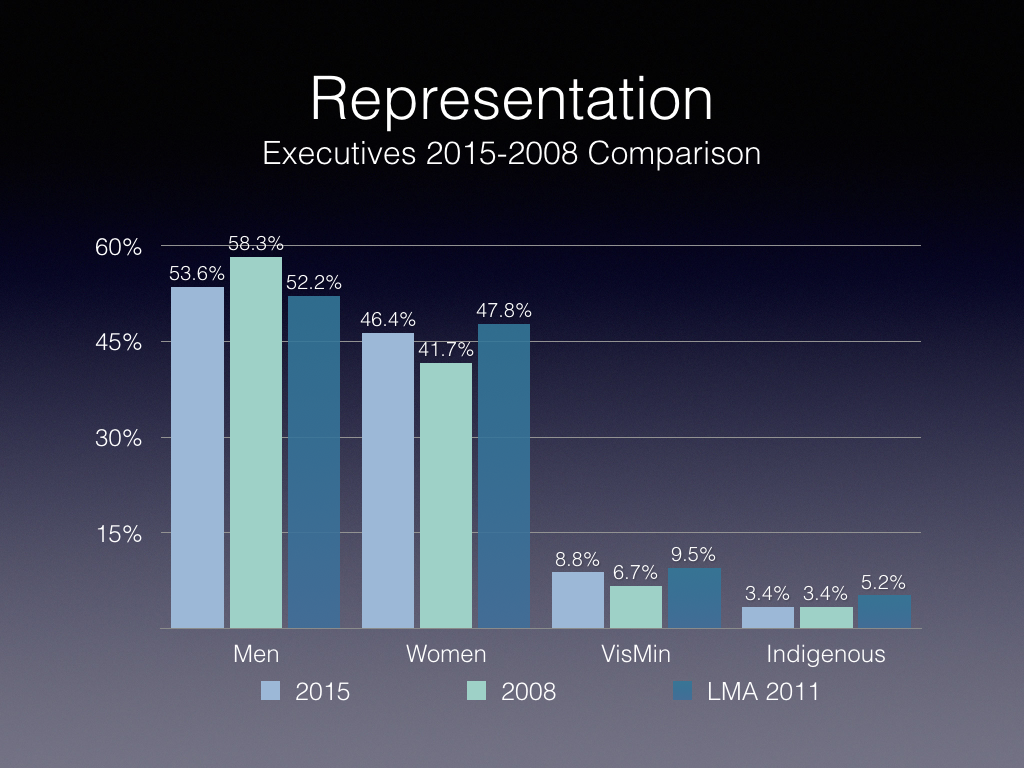
However, we do have data on federal Deputy and Assistant Deputy Ministers (for women, 2016 baseline 37.6 percent women and 4.7 percent visible minorities for deputies, 40.8 and 7.2 percent for ADMs). DM appointments by the current government are close to gender parity at 46.9 percent women.

My analysis of GiC appointments showed less representation of women and visible minorities, and a similar gap to British Columbia between senior and junior appointments for crown corporations and administrative tribunals:

GiC Baseline 2016.014

Prime Minister Justin Trudeau may have introduced a gender-balanced cabinet “because it’s 2015,” but that equality does not extend to public servants in B.C., where the vast majority of the highest-paid employees are men.

An analysis of The Sun’s exclusive public sector salary database reveals that of the 200 highest-paid public employees in B.C., during 2014 or the 2014-15 fiscal year, 70 per cent were men and 30 per cent were women. That increases to 77 per cent male when the field is narrowed to the top 100 (By contrast, 94 of the 100 highest-paid corporate executives in 2015 were men, according to Business in Vancouver.)

“There’s an old saying: the higher, the fewer, with respect to women,” said Barbara Arneil, head of the University of B.C.’s political science department. “We have what I think are structural, systemic reasons why women are not reaching the top of their profession, whether that is in the university, whether that’s in government, whether that’s in the private sector. And we’re wasting very good resources.”

Search The Sun’s exclusive public sector salary database.

The Sun analyzed the top 200 public-sector earners in this year’s database, which contains salary information for nearly 77,000 employees, and the top 50 earners in six of the seven sectors: B.C. government, Crown corporations, health authorities, local government, school districts, and colleges and universities. The Sun did not include municipal police in this analysis because forces generally withhold many names to protect undercover officers. The Sun relied on first names for this gender analysis, checking Internet profiles in cases where only a first initial was provided or the name was ambiguous.

The gender divide is most pronounced at colleges and universities, where men represented 41 of the top 50 earners, or 82 per cent, in the 2014-15 fiscal year. But because the University of B.C. accounts for 45 of the top 50 highest-paid employees in the sector in the province, these findings really only reflect that institution. At the University of Victoria, for example, five of the 10 highest-paid employees are women.

Pay equity is an issue UBC takes seriously, university spokeswoman Susan Danard said in an emailed statement.

“Compensation is affected by several factors, including the depth of experience and accomplishment that a faculty or staff member brings with them when they are first hired, and the length of employment with UBC, with people paid more as they progress in their careers,” she said. Faculty and area of specialization are also factors that affect pay equity, she said, noting specialists and top doctors in the faculty of medicine are often the highest paid given the demands and complexity of their jobs.

Source: Glass ceiling still in place for public sector employees | Vancouver Sun

Daphne Bramham picks up on issue:

Canada’s failure is in providing women the opportunities to fully participate in the economy. Not only does Canada lag the Nordic countries, it trails countries like the United States, Namibia, Mongolia, Belarus, Thailand and Burundi.

It’s because women don’t have equal opportunities, Canada’s overall gender ranking dropped to 30th in 2015, down 11 places from 2014.

Among the more troubling findings in the Sun’s gender analysis of B.C. public-sector wages is that the 25 universities and colleges have the fewest women in top-paid positions — only nine among the top 50. Of those, five work at the University of British Columbia.

The excuses/reasons are the usual ones. Prime career-building years coincide with the prime reproductive years and Canadian mothers continue to bear the largest share of the caregiving for both children and aging parents.

Even though 58 per cent of these institutions’ graduates are women, missing are the supports for those young women to succeed in academe. It’s all the more disappointing because post-secondary institutions are supposed to be places of innovation and change, not laggards.

What’s not surprising is that the health services authorities account for the most women on the top-earners’ list with 59; 35 of whom are at the Provincial Health Services Authority.

For more than a decade, the majority of medical school graduates have been women. Among the professionals in the B.C. government, women account for nearly 90 per cent of the nurses and nutritionists and three-quarters of the social workers and counsellors.

But that may be change for the worse because catching up wage-wise isn’t as simple as more women working in traditionally male jobs. When women do that, the pay scale drops. That’s what sociologist Paula England at New York University concluded after analyzing U.S. census data from 1950 to 2000.

When biologists went from being predominately men to women, England found that wages fell 18 percentage points (even accounting for changed value of the dollar over time). When workers in parks and camps went from mostly men to mostly women, the median hourly wages dropped 57 percentage points.

It’s because when women do the work, England told the New York Times, “It just doesn’t look like it’s as important to the bottom line or requires as much skill.”

Daphne Bramham: Few women in B.C. public sector’s top ranks, …

Brampton council says no to electoral reform despite ethnic mismatch with residents | Toronto Star

The gap between representation at the municipal level and other levels of government has been an issue for some time (all federal MPs and provincial MPPs from Brampton are Indo Canadians, over reflecting their share of the population and the first-past-the-post system).

Ranked balloting may be part of the solution but there are likely other factors involved, including the lack of political parties at the municipal level:

On Wednesday — as a federal debate on the issue draws near and with new Ontario legislation that gives cities the option of ranked balloting — Brampton council voted 11-0 against the idea. Meanwhile, Canada’s first-past-the-post electoral method is being used by fewer and fewer democratic nations around the world because it’s recognized as a system that too often puts people in power despite their having little voter support.

“Each city councillor in Brampton has the support, on average, of less than 4 per cent of the city’s voters, yet they’re making decisions that affect the entire city,” says Pat McGrail, chair of Fair Vote Peel, who made a presentation to council Wednesday, advocating for a ranked ballot system whereby candidates would need the support of a majority to get elected.

Brampton councillors who responded to the Star said they voted against ranked balloting because voters might find the system too confusing. It works by allowing voters to rank at least three top candidates (cities can opt to allow more candidates to be ranked on each ballot). The candidate who receives the least first place votes is eliminated in each round and their votes are redistributed until one candidate has a majority.

But critics point to research that shows the current first-past-the-post system often leads to municipal councils that do not accurately reflect the ethnic diversity of cities. In Brampton close to 70 per cent of the city’s residents are visible minorities. Only one out of eleven members of city council is a visible minority.

“That’s not just a Brampton problem,” says Dave Meslin, an expert on the subject who is authoring a book on electoral reform and has helped with the federal government’s current public consultations on the issue being conducted in every riding across Canada. He says Canada is now alone in its use of first-past-the-post for every level of government. “The lack of diverse representation on municipal councils is a glaring problem across Ontario.”

He points to U.S. research that shows ranked balloting in cities has significantly improved representation that more accurately reflects the electorate. Vote splitting, where an incumbent can rely on a concentrated base of supporters, while a number of other candidates fight for the remaining voters — often the vast majority — is something that can’t happen with ranked balloting, Meslin says.

In the 2014 municipal election, of all winners, Brampton Coun. Martin Medeiros received the least number of votes — 4,188, or 22 per cent of the votes cast in his ward. He beat Shan Gill by 100 votes. There were 15 candidates in total who ran for the council seat Medeiros now occupies. With a city-wide turnout of 36 per cent of eligible voters, applying the same rate, Medeiros received the support of about 7 per cent of eligible voters in his ward.

He did not respond when asked to comment on his decision not to support ranked balloting.

The provincial government was asked if its new legislation under Bill 181, which gives cities the option of using ranked balloting for elections, falls short because it leaves the ultimate decision to the very politicians who might get defeated by the new system.

“We feel that municipalities are responsible levels of government and are in the best position to make decisions in the best interest of their communities,” said Ministry of Municipal Affairs spokesperson Conrad Spezowka.

McGrail says low voter turnout is another problem with first-past-the-post. “The central problem of first-past-the-post is divide and conquer while appealing to your base. People become so disenfranchised they don’t even bother to vote.”

Sukhjot Naroo, a Brampton resident and co-founder of the social network Brampton Beats, which has almost 4,000 members who focus on municipal issues, says he doubts Brampton council will accurately reflect the city’s population as long as vote splitting continues. He lists an increasing number of issues accompanying Brampton’s rapid demographic shift, from zoning for places of worship to funding for a variety of culturally specific activities, that don’t get proper representation on council.

“Everyone on council will benefit from vote-splitting. The incumbents don’t want change. They’re just trying to protect the status quo. Out of eleven votes, not one even considered ranked balloting. Not even Gurpreet Dhillon, the only South Asian member of council, because he now has his base of supporters and can grow that through his growing political connections.”

Dhillon did not respond to questions emailed to him.

Toronto’s Katherine Skene says she’s dismayed, but not surprised by Brampton’s 11-0 vote. “I would hope that councils, before voting on the issue, there would be broad public consultation to find out what the voters actually want.”

Skene is co-chair of the Ranked Ballot Initiative of Toronto, where councillors last year voted 25-18 against a provincial option to allow for ranked balloting, a reversal of that council’s earlier position to bring ranked ballots about. Mayor John Tory supported the idea during his election campaign and maintained his support in last year’s vote.

Source: Brampton council says no to electoral reform despite ethnic mismatch with residents | Toronto Star

Nova Scotia’s towns and cities elect more diverse candidates

Nova Scotia is the most diverse province of Atlantic Canada (9 percent visible minorities, the largest group being Black Canadians):

Lindell Smith set out to start a conversation about diversity at Halifax city hall this summer, and it seems people listened: the 26-year-old has now become the first African Nova Scotian elected to city council in 16 years.

“People from all communities went out and voted. The numbers show … something different is needed,” Smith said after Halifax’s municipal elections wrapped up over the weekend. “When someone comes in and starts asking questions, people realize, ‘We don’t know why we still do it that way.’”

Towns and cities across Nova Scotia made modest gains in diversity with the results of municipal elections on Saturday, but Smith and others note the province still has a long way to go.

Smith decisively won a seven-way race for the city’s north-end district with about 52 per cent of the vote.

 The 26-year-old will be the first black city councillor elected since 2000—when Graham Downey, the only other visible minority member to serve in Halifax regional council since its inception in 1996, lost the seat Smith now occupies.

“For the black community, it’s like we have somebody who’s at the leadership table,” Smith says. “It’s almost this sigh of relief like, ‘Wow, it took this long.’ ”

Smith’s predecessor, outgoing councillor Jennifer Watts, did not seek re-election in the north-end district. She expressed hope this election would change the composition of the then all-white, three-quarters male and “predominately older” council to better reflect the city it serves.

Despite having a more diverse roster of candidates this year—including seven visible minorities and the city’s first openly transgender candidate—Smith was the only member of a previously unrepresented group to get elected. Meanwhile, the number of female councillors in City Hall shrunk from four to two.

“It’s great that we have someone who’s not of European descent and is not over fifty, but we need to have all different voices,” Smith says.

In Kentville, about an hour’s drive west of Halifax, political newcomer Sandra Snow defeated outgoing mayor Dave Corkum with 70 per cent of the vote. The retired military aviation contractor looks forward to leading a council with four of its seven seats occupied by women.

“Women tend to lead from the heart,” Snow says. “I think when we’re discussing issues, there will be a lot more collaboration around the table.”

It’s a sight that would make former Kentville mayor Gladys Porter proud, Snow says. Porter became the first woman in the Martimes to be elected mayor 70 years ago, and after 11 years in office, went on to serve as the first female member of Nova Scotia legislature.

“We still have a long while to go,” Snow says. “A woman has a very busy life … and often we don’t prioritize ourselves first and we don’t prioritize the fact that maybe we do have political ambitions.”

Wolfville saw the gender balance in its Town Hall shift dramatically with women clinching five out of six council seats.

Source: Nova Scotia’s towns and cities elect more diverse candidates – Macleans.ca