Is Kellie Leitch for real? When the Tory insider pushes her Trump-light message, who’s listening?

Good long read by Richard Warnica on Kellie Leitch’s leadership strategy, and the degree to which there is a ‘market’ for her use of identity politics, both within the party and the country more generally. Her campaign is a bit of a litmus test of Canadian resilience to xenophobia and anti-immigration messages:

Her appeal, then, is to a narrower slice of the Trump constituency, one engaged more by identity issues and immigration than economics and jobs. The question for Leitch is whether there are enough of those voters to carry her to victory in the Conservative race, let alone in a general election.

Pollsters and analysts from all three major parties are generally skeptical, though few rule out the idea entirely. Many see her values campaign more as a tactical attempt to stand out in the early going of the race than a genuine expression of belief. “She’s running against the mainstream, which helps her get headlines and raise money in the short term,” said Brad Lavigne, a longtime senior NDP campaign official. “But the bet is the short-term exposure that she’s getting now will come to haunt her if she were to win, because there is not a significant audience for this among general election voters.”

That’s not to say there is no constituency at all for that message in Canada. Compared to Europeans and Americans, Canadians are still relatively open to things like foreign investment, immigration and multiculturalism, according to pollster Frank Graves, the president of Ekos Research. But that support is not as strong as it once was, and it’s been going down for years. “A lot of people think Canada doesn’t have the same forces that produced Trump or Brexit,” Graves said. “It absolutely does. They’re a little bit muted, but they’re here.”

That audience is also disproportionately concentrated among Conservative supporters, the people Leitch needs to capture the leadership. Graves polled Canadians on support for Trump in November. A significant majority of Liberal, NDP, Green and Bloc supporters disapproved of the job he was doing as president-elect. But a majority of Conservative supporters — 57 per cent — approved. So when the Leitch team flicks at Trump’s themes or parrots his campaign, they aren’t necessarily poisoning the well, at least not the one they need to drink from right now.

Tim Powers, a longtime Conservative strategist and outspoken Leitch critic, believes at the very least she could use the Trump message to sell memberships. “I probably have responded as strongly as I have because I believe that they have the potential to win by playing off fears and discontent and misunderstandings,” he said. “I think I’m not alone in that. There is still a good portion of Canadian society that harbours an older, traditional version of the country. And some of that traditional version is good and some of it is not so good.”

There are also those in other parties who will admit, quietly, that Canadians of all stripes are not nearly as allergic to nationalist anti-immigrant messages as some would like to pretend. One senior Liberal said the party’s own internal polling shows that Canadians on the whole don’t love immigration, and that even on the refugee issue that captivated and helped turn the last election in the Liberals’ favour, the polling was pretty mixed.

Lietaer believes Leitch may find particularly fertile ground for her message in Quebec, where debates over cultural values, immigration and assimilation have raged for years. The Conservative Party actually won more votes and more seats in Quebec in 2015 than it did in 2011. Many attribute that marginal bump, concentrated in the Quebec City region, to the prominence of the debate over the niqab in the campaign.

“A student of mine told me, a few months later, that he had been working as an election worker and he said that the words at the end of the campaign were “niqab, niqab, niqab,” said Louis Massicotte, a political scientist at Laval University. “The general feeling here was that it was a good idea for the Conservative candidates to raise this issue.”

All of that said, the general consensus among the dozen or so strategists, pollsters and party insiders interviewed for this story, was that while Leitch may find an initial, vocal audience for her anti-Canadian values and anti-elite message, her potential for long-term growth is probably limited. “I don’t see what the second ballot strategy is here, because it’s such a polarizing issue,” said Lietaer.

Indeed, several strategists suggested Leitch’s best hope is to win on the first ballot, an exceedingly difficult task in a race with 14 candidates, a preferential ballot and an arcane system of dividing points between all of Canada’s 338 ridings. For Leitch, that job will be made even harder by the fact that, according to multiple Conservative sources, her campaign strategy has offended wide swaths of the party.

“Among the rank and file of the party, and frankly anybody I talk to in the party, anybody I know in the party, everybody is really, really right pissed off at her for doing this,” said Yaroslav Baran, who ran communications for Stephen Harper’s 2004 Conservative leadership campaign. Officially neutral at the time of his remarks, Baran announced his support for Michael Chong, one of Leitch’s rivals, this past week.

Source: Is Kellie Leitch for real? When the Tory insider pushes her Trump-light message, who’s listening? | National Post

No exceptionalism please, we’re Canadian: Mark Kingwell

Good piece against Canadian smugness:

Here’s the basic argument. Canada, unfettered by what Michael Ignatieff condemned as “ethnic nationalism,” has carved out a whole new way of being a country.

It is post-national. Its banking system is centralized and immune from wacky market fluctuation. Its health-care system is impeccably public. And above all, its immigration policy is tolerant and open-minded, making for the truly multicultural polity that provokes the world’s envy.

Now, far be it for me to dispute this vision. In fact, it is so familiar that some of us have been touting it lo these many long years. Back in 1999, I wrote a book that defended Canada’s postnational advantages and suggested we should be proud of our transcendence of the tired narratives of identity based on bloodline or ideology. I wasn’t the only one: Richard Gwyn and John Ralston Saul, plus a few other familiar names, made their own versions of the argument.

Right now, the advocates are slightly younger (and cooler) Canadian intellectuals, such as Stephen Marche (in The Walrus) and Charles Foran (in The Guardian). In a country as small as this one, it can be no surprise that I count these two men as friends. It happens that I also claim friendship with Andrew Potter, a former graduate student, who mocked Mr. Foran’s Guardian article on his Twitter feed, even as he is about to convene a serious conference on the topic of exceptionalism that features still more friends.

To repeat: It’s a small country. Maybe that’s the true exceptionalism in play here? Anyway, stories about how we are unique, paired with push-back replies, feel to me like those predictable-as-the-weather Canadian weather stories, where writers deplore the inability of once-staunch Canadians to deal with cold and snow. Were we ever really so robust that -30 C temperatures and a blizzard were just, you know, a lark? I doubt it.

I likewise doubt the new tales of exceptionalism, which have the feeling of a national theodicy. You remember the idea: Theodicy is the claim that God’s will is inevitably working itself out in this world, never mind all signs to the contrary. We may confront vast stretches of misery and suffering, but that is all part of the plan! As the refrain goes, paraphrased from the philosopher Leibniz, everything is for the best in this best of all possible worlds!

After the 1755 Lisbon earthquake, which devastated the city and killed thousands of innocents, Voltaire was moved to lampoon this sad, evil idea. His satire Candide (1759), a kind of proto-novel, remains one of the essential texts in the literature of enlightenment and good sense. The young protagonist, Candide, is a devotee of the new Leibnizian philosophy; his outrageous misfortunes, bravely borne, eventually force a change of mind.

Canadian exceptionalism is the new Leibnizian philosophy. The reasons for this are instructive, even if the argument itself is suspect.

We might note, first, that the term itself is tainted – another borrowing from the expansive republic to the south. U.S. exceptionalism is the covering-law theory that assumes the United States, different from all other countries, can do no wrong and brook no objection. Mr. Trump’s call to “Make America Great Again” (#MAGA) is just the most recent expression of this perpetually self-renewing delusion.

Worse, though, is the self-congratulation contained in the position. Don’t get me wrong: This is a great country, and I would not choose to live anywhere else. But I don’t think we Canadians have any special purchase on justice, diversity or fellow feeling. This is not the best of all possible countries, as recent arrivals and indigenous peoples will certainly attest. We are as rife as anyone else in intolerance, bigotry and ignorance.

Unless and until we confront these facts about our political life, tales of exceptional virtue will continue to strike a sour note. Sorry, friends.

Source: No exceptionalism please, we’re Canadian – The Globe and Mail

2017 Cabinet Shuffle

election-2015-and-beyond-implementation-diversity-and-inclusion-024The above chart contrasts the original 2015 Cabinet with the changes announced Tuesday by the Prime Minister (will update when parliamentary secretary changes are announced to replace those who were promoted to minister).

Gender parity remains, visible minority representation increases to 20 percent, no change in the number of persons with disabilities, with only one Indigenous minister compared to two in the original Cabinet (Hunter Tootoo was later removed).

The choice of a neophyte Minister for Immigration, Refugees and Citizenship, Ahmed Hussen, is not without risk given the complexities and politics of the department’s issues (as Monsef’s difficulties attest).

Hussen is the third immigration minister to have been an immigrant, the first visible minority and non-European. (Joe Volpe, born in Italy,  and Sergio Marchi, born in Argentina but of Italian ancestry, are the previous ones). As most of Canada’s current immigrants are visible minorities, he will bring that perspective and experience with him to the portfolio, as well his experience on security and radicalization issues.

Like McCallum, his riding is majority visible minority (54 percent compared to McCallum’s 82 percent) but with a different mix: York South-Weston is 21 percent Black, 9 percent Latin American whereas Markham-Thornhill is 35 percent Chinese, 31 percent South Asian.

Look forward to seeing the mandate letters for Minister Hussen (and others) to see if any new commitments compared to former Minister McCallum (largely achieved or in progress – list below):

  • Lead government-wide efforts to resettle 25,000 refugees from Syria in the coming months.
  • As part of the Annual Immigration Levels Plan for 2016, bring forward a proposal to double the number of entry applications for parents and grandparents of immigrants to 10,000 a year.
  • Give additional points under the Entry Express system to provide more opportunities for applicants who have Canadian siblings.
  • Increase the maximum age for dependents to 22, from 19, to allow more Canadians to bring their children to Canada.
  • Bring forward a proposal regarding permanent residency for new spouses entering Canada.
  • Develop a plan to reduce application processing times for sponsorship, citizenship and other visas.
  • Fully restore the Interim Federal Health Program that provides limited and temporary health benefits to refugees and refugee claimants.
  • Establish an expert human rights panel to help you determine designated countries of origin, and provide a right to appeal refugee decisions for citizens from these countries.
  • Modify the temporary foreign workers program to eliminate the $1,000 Labour Market Impact Assessment fee to hire caregivers and work with provinces and territories to develop a system of regulated companies to hire caregivers on behalf of families.
  • Lead efforts to facilitate the temporary entry of low risk travelers, including business visitors, and lift the visa requirement for Mexico.
  • Work with the Minister of Justice and the Minister of Public Safety and Emergency Preparedness to repeal provisions in the Citizenship Act that give the government the right to strip citizenship from dual nationals.
  • Eliminate regulations that remove the credit given to international students for half of the time that they spend in Canada and regulations that require new citizens to sign a declaration that they intend to reside in Canada.

It’s time to walk away from Shared Services Canada: Smith

Wayne Smith’s strongest critique yet, and yet one likely to be listened to, given the investment of funds and political/bureaucratic capital in Shared Services:

One might argue that it is rational to starve the legacy infrastructure in order to invest in what is seen as the target infrastructure. This might be true if there was actually a comprehensive and fully costed plan with a known (and near) end date. In fact, no one knows how long the transformation will take or what it will cost but we’re looking at decades and billions of dollars, not a year or two and millions of dollars. The legacy infrastructure cannot survive for that long a time without renewal. As the government’s experience with its new web site demonstrates, SSC’s direct cost for the hardware infrastructure will be dwarfed by the costs incurred in the 43 client departments as they modify their systems to make them transportable to the new infrastructure. This need to transform systems will make this a long-haul project indeed.

From the client departments’ perspective this deepening morass is further complicated by the lack of any acceptable governance arrangements around their relationship to SSC. Shared Services Canada is not accountable to its clients. Nowhere is it set down what obligations SSC has to its clients in respect of the base budget already transferred. Cash-starved SSC takes advantage of this situation by constantly redefining, to its own advantage, those things that it is expected to pay for. One of the more egregious examples was the reversal of an earlier Shared Services Canada commitment that it would accept responsibility to expand capacity in line with natural growth in requirements of client departments. So client departments, at the same time they are looking for massive amounts of money to transform systems to work in SSC planned new data centres, find their IT budgets being eaten away by unjustified and unaffordable SSC charges for hardware services. Departments with large budgets and a tendency to surplus funds annually might be indifferent (it’s not their money) but smaller, tightly run departments may find themselves in serious financial difficulty.

Can SSC turn this situation around? One needs only look at the steady stream of failures and ballooning costs of more modest government IT initiatives (Phoenix, Canada.ca web site, SSC’s own stalled email system) as well as the planning to date of SSC itself to conclude this is unlikely. And there are more centralization projects in the pipeline. One is reminded of Albert Einstein’s famous quip about insanity being defined as doing the same thing over and over again and expecting different results.

Sometimes what looks like a better outcome on paper is unattainable. Sometimes a collection of human-scale solutions well-integrated into their environments is ultimately more robust and more efficient overall than the grand, massive scheme. There are better things to spend money on than breaking things that work. The government would be better-advised to back away from this initiative, re-think it (look at New Zealand for a more robust approach) and not move forward again until it has a complete, well-programmed and fully costed plan.

So, Canadians should watch the 2017 budget for any new infusion of funds into Shared Services Canada. The government invested hundreds of millions in the 2016 budget to bail out the SSC initiative, but this sum was nowhere near enough. Government IT operations remain at risk and transformation is largely stalled. This is not short term pain for long-term gain, this is an ever-deepening money pit.

Source: It’s time to walk away from Shared Services Canada – The Hill Times – The Hill Times

More than 2,700 Canadians applied to be senators – diversity analysis

senate-working-deck-016For those interested in employment equity and diversity reporting, this first report provides a model for future reporting on judicial and other GiC appointments.

While I have some quibbles – the reference number for visible minorities should be the percentage of those who are also Canadian citizens (15 percent), not the age adjusted workforce population as they have appeared to use (17.8 percent), a breakdown of the ethnic/cultural groups self-identified would be helpful, along with some methodology notes – this is really a good and comprehensive report.

Of course, this report does not include other aspects of diversity such as education, work and the like.

By way of comparison, the 28 Senate appointments of PM Trudeau were comprised of 16 women (57 percent, higher than the 40 percent of applications), six visible minorities (21 percent, slightly lower than the 25 percent who applied) and two Indigenous persons (7 percent, twice that percentage of those that applied).

Hopefully, this will serve as a template for future reporting on the diversity of GiC appointments, including judges:

The independent board that advised Prime Minister Justin Trudeau on a recent round of Senate appointments says 2,757 people applied to be senators when the Liberal government went looking to fill vacancies for seven provinces.

Canadians were invited to apply when nominations were opened in July to fill 21 spots in the upper chamber. The independent advisory board that reviewed the applications is part of Trudeau’s plan to reform the Senate.

According to the advisory board’s first report, 60 per cent of applicants were male and 68 per cent selected English as their first language.

Twenty-five per cent identified as a visible minority, 13.6 per cent described themselves as indigenous and four per cent as LGBT.

“We were very pleased with the number of applications received, as well as with the calibre of individuals who put their names forward as part of the open application process,” the board writes.

The board says that “nearly 750 national, provincial and local organizations” were also contacted to encourage applications.

Applicants were screened by board members to identify “a list of priority candidates who … best met the merit-based criteria.” The prime minister was then provided with a list of five candidates for each of 20 vacancies, with additional names passed along to fill an unexpected opening for Manitoba.

“Recommended candidates were not prioritized; the proposed candidates were listed in alphabetical order,” the board explains. “The advice to the prime minister included a short synopsis to highlight the merits of each of the recommended candidates, as well as more detailed information from their candidacy submission.”

The board also clarifies that the prime minister’s choices for appointment came from their recommendations.

“We were very pleased that the prime minister made his recommendations to the Governor General from the list of candidates that we had provided to him,” they write.

The total cost for the advisory process so far is estimated to be approximately $900,000.

Maryam Monsef, minister of democratic institutions, also announced on Wednesday that the federal government has opened applications to fill another six vacancies: three in Nova Scotia, two in Ontario and one in New Brunswick.

Source: More than 2,700 Canadians applied to be senators – Politics – CBC News

Report of the Independent Advisory Board for Senate Appointments – Permanent Process (July to November 2016)

How do the feds track diversity of appointments? – Policy Options

My latest, analyzing what PCO ATIP documents reveal about their tracking of GiC diversity, with my usual series of charts, including 25 year series data with respect to women’s representation:

As I have been taking a closer look at diversity in Governor in Council and judicial appointments, the gaps in the available data have become much clearer. Documents I received under the Access to Information Act revealed that while the Privy Council Office (PCO) has been systematically tracking representation of women and French/English speakers in these appointments, there has been limited tracking with respect to the other employment equity groups, that is, Indigenous peoples, visible minorities and persons with disabilities.

A number of the documents appear to reveal a certain scramble to prepare this data for the incoming Liberal government.

Source: How do the feds track diversity of appointments? – Policy Options

2 federal tribunals make high-speed internet access a job condition

Understandable requirement even though some will protest:

Two tribunals have begun making home access to high-speed internet a prerequisite for dozens of well-paid federal government appointments, despite the fact it could disqualify many Canadians living in rural and remote areas of the country where high-speed internet isn’t available.

The Social Security Tribunal and the Veterans Review and Appeal Board have both recently added high-speed internet access to the list of criteria for those seeking the lucrative appointments, which come with salaries ranging from $108,200 to $127,200 for full-time positions, and between $540 and $635 a day for part-time positions.

“You must work from your home office in Canada and have access to high-speed internet,” say the conditions of employment for the Social Security Tribunal, which resolves disputes involving employment insurance, the Canada Pension Plan and Old Age Security.

Candidates expected to work in urban centres

The requirement appears to have been added in recent months. A similar notice of openings for the tribunal in June 2015 said candidates might have to work from home but did not require high-speed internet access.

The Social Security Tribunal has dozens of full-time and part-time members, including several vacancies at the moment.

On Wednesday, the CRTC ruled that access to high-speed internet should be a basic service across Canada. It said two million Canadian households lack access to proper internet service.

The Veterans Review and Appeal Board, which resolves disputes over disability benefits decisions made by Veterans Affairs Canada, also has this requirement.

Spokeswoman Alexandra Shaw said successful candidates for the board are expected to work in one of six urban centres across Canada and to work from home because the board’s only administrative offices are in Charlottetown, Prince Edward Island.

“Members need high-speed internet to maintain a reliable connection to the secure systems that give them timely access to veterans’ documents in order to prepare for hearings and produce decisions,” she wrote. “The board provides members with cellphones with additional hotspot connectivity.”

Source: 2 federal tribunals make high-speed internet access a job condition – Politics – CBC News

As Trumplethinskin lets down his hair for tech, shame on Silicon Valley for climbing the Tower in silence – Recode

Quite an amazing take-down by Kara Swisher:

When I call these top leaders — of course, it has to be off the record — I get a running dialogue in dulcet tones about needing to cooperate and needing to engage and needing to be seen as willing to work together. Also that Trump means very little of what he says out loud — which I will now officially dub the Peter Thiel take-it-seriously-not-literally defense. And they assure me that they will say what they really think behind closed doors where no one can hear it but each other.

This, even though it will be a certainty that Trump will tweet the whole thing with his doubtlessly warped take of the proceedings. My only hope is that often-erupting Tesla and SpaceX’s Elon Musk — who is also now attending — will also erupt when he realizes the farce he has agreed to be part of.

Or maybe I don’t get it because I am of the old school that when something smells fishy, there is probably a dead fish somewhere to be found. But to my ear, it’s a symphony of compromise, where only now and then a sour note sounds from someone who breaks from the platitudes they are spewing.

Like one tech leader who suddenly stopped mid-sentence about how to really make deals, Kara, because the truth just had to be out. “Trump is just awful, isn’t he? It makes me sick to my stomach,” the leader agonized, as a real thinking person would. “What are we going to do?”

Well, to start, realize again that you have the smarts and invention and the innovative spirit to do whatever you like. Realize you have untold money and power and influence and massive platforms to do what you think is right. Realize that you are inventing the frigging future.

Instead, you’re opting to sit in that gilded room at Trump Tower to be told fake news is a matter of opinion and that smart people aren’t so smart and that you need to sit still and do what they say and take that giant pile of repatriated income with a smile.

Or you can say no — loudly and in public. You can resist the forces that are against immigrants, because it is immigrants who built America and immigrants who most definitely built tech. You can defend science that says climate change is a big threat and that tech can be a part of fixing it. You can insist we invest in critical technologies that point the way to things like new digital health inventions and transportation revolutions. You can do what made Silicon Valley great again and again.

When I could get no really substantive on-the-record statements from the tech leaders, I pinged investor Chris Sacca, because I knew he would not let me down.

“It’s funny, in every tech deal I’ve ever done, the photo op comes after you’ve signed the papers,” he said. “If Trump publicly commits to embrace science, stops threatening censorship of the internet, rejects fake news and denounces hate against our diverse employees, only then it would make sense for tech leaders to visit Trump Tower.”

He added: “Short of that, they are being used to legitimize a fascist.”

The fascist line is vintage Sacca, who always likes to kick up a shitstorm. But thank god someone is willing to do it, because that is what I thought Silicon Valley was all about.

Not any longer, it seems. Welcome to the brave new world, which is neither brave nor new. But it’s now the world we live in, in which it’s Trump who is the disrupter and tech the disrupted.

Source: As Trumplethinskin lets down his hair for tech, shame on Silicon Valley for climbing the Tower in silence – Recode

New task force aims for diverse public service where everyone feels welcome

tbs-ee-2015-analysis-007Above slide shows how diversity has changed 2008-15 for executives, slide below for non-executives.

tbs-ee-2015-analysis-006Would be interesting to see the agenda and how it evolves over time, particularly expanding diversity beyond the four employment equity groups:

It’s important not only for the federal public service to be comprised of a fair representation of Canada’s various kinds of people, but also that these employees feel comfortable in their surroundings, says the head of Canada’s largest public service union.

Robyn Benson, president of the Public Service Alliance of Canada (PSAC), said this is among the reasons the Joint Union/Management Task Force on Diversity and Inclusion has been established.

“We, as a union, have great concerns about our workplaces and whether the workplaces are safe for our members, whether or not they are harassment-free, whether or not there is violence in the workplace,” she said. “We wanted to make sure we were part of ensuring that the workplace was safe.”

She added: “While we strive to hire individuals who fall within the equity groups (aboriginals, visible minorities, people with disabilities, and women), you need to not just hire them; you need to provide a workplace where they are safe, where there is no harassment, where there is no violence, where they can be engaged in all levels of the public service, and certainly where there’s accommodation for people with disabilities.”

The new task force includes representation from the following unions: PSAC, the Professional Institute of the Public Service of Canada (PIPSC), the Canadian Association of Professional Employees (CAPE), and the Professional Association of Foreign Service Officers (PAFSO). It also has members from management of the Treasury Board of Canada Secretariat, Correctional Services, Public Safety, Agriculture, and Public Services, as well someone from the Association of Professional Executives of the Public Service of Canada (APEX).

Larry Rousseau, PSAC’s vice-president for the national capital region and co-chair of the task force’s steering committee, echoed the idea that it’s not just about quotas, but making sure those working for the government are comfortable in their surroundings.

“The way to make sure that people feel respected is that they feel included in the processes, in the decision-making, and just the overall work of the public service,” he said. “It’s one thing to have diversity in the workforce. It’s what you do with it that is going to be very, very important.”

Margaret Van Amelsvoort-Thoms, the Treasury Board’s executive director of people management and the other co-chair of the task force’s steering committee, said: “We want every employee to be able to bring their whole self to work, and so [the task force] is the strategy that says, ‘How do we do that and make this an inclusive workplace.’ ”

Mr. Rousseau said one of the task force’s objectives will be defining what diversity is. The federal government already has policies intended to ensure that women, aboriginals, visible minorities, and people with disabilities are adequately represented in the public service. He said preventing discrimination and harassment of people in the LGBTQ community is another issue that has emerged as something all employers should strive for.

Ms. Van Amelsvoort-Thoms added that other demographic factors, such as age, where people are from geographically, and their family structure, can also be part of the conversation about diversity.

The task force was modelled on the Mental Health Joint Task Force that was established in March 2015 under the former Conservative government and continues to function.

Ms. Benson described the roots of this newer Task Force on Diversity: “[Treasury Board President Scott] Brison and I had a discussion several, several months ago about the work around diversity and inclusion. We thought it would be good to construct committees that look like our Mental Health [Task Force],” she said, adding that the Mental Health Task Force “has worked really well.”

While the government didn’t officially announce the Task Force on Diversity until late November, it’s been quietly in operation since September.

Ms. Van Amelsvoort-Thoms said part of the work so far has been doing an “environment scan” of what various employers, in both the private and public sectors, are doing in terms of diversity and inclusiveness. She said the federal government is behind some sectors in its approach to this issue, while it’s ahead of others.

Mr. Rousseau made note of the technology sector, which he said during the 1990s boom years realized the practical benefits of staff diversity and how it brings an array of different perspectives to achieving business goals.

Source: New task force aims for diverse public service where everyone feels welcome – The Hill Times – The Hill Times

Government appointments and diversity – Policy Options

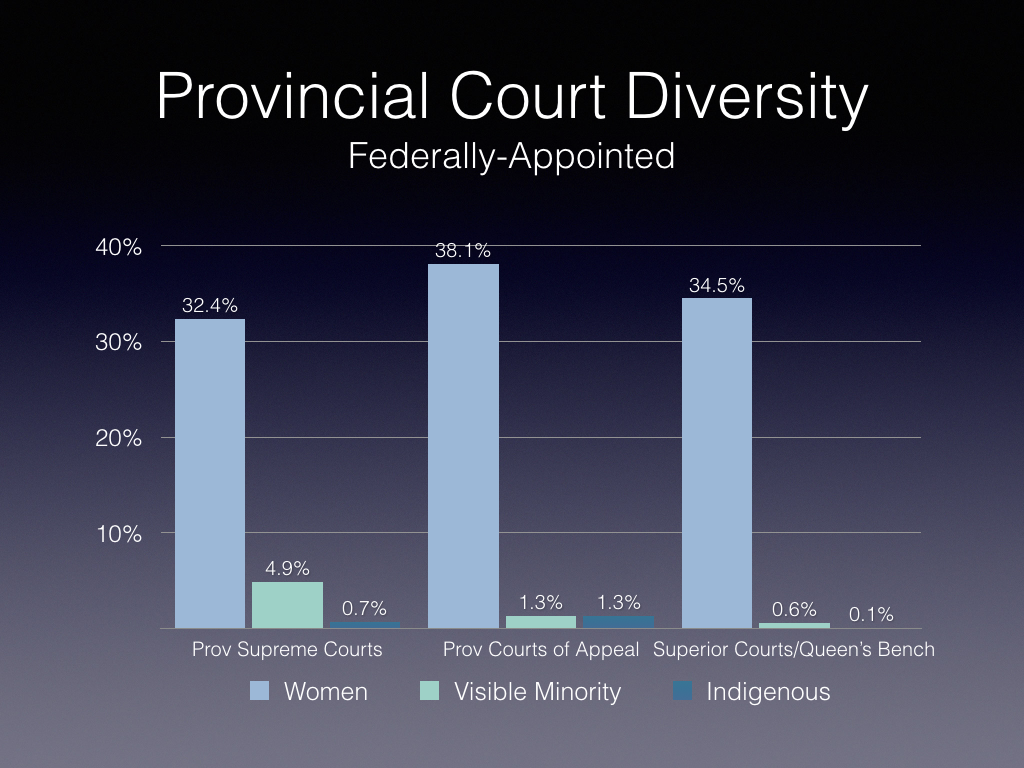
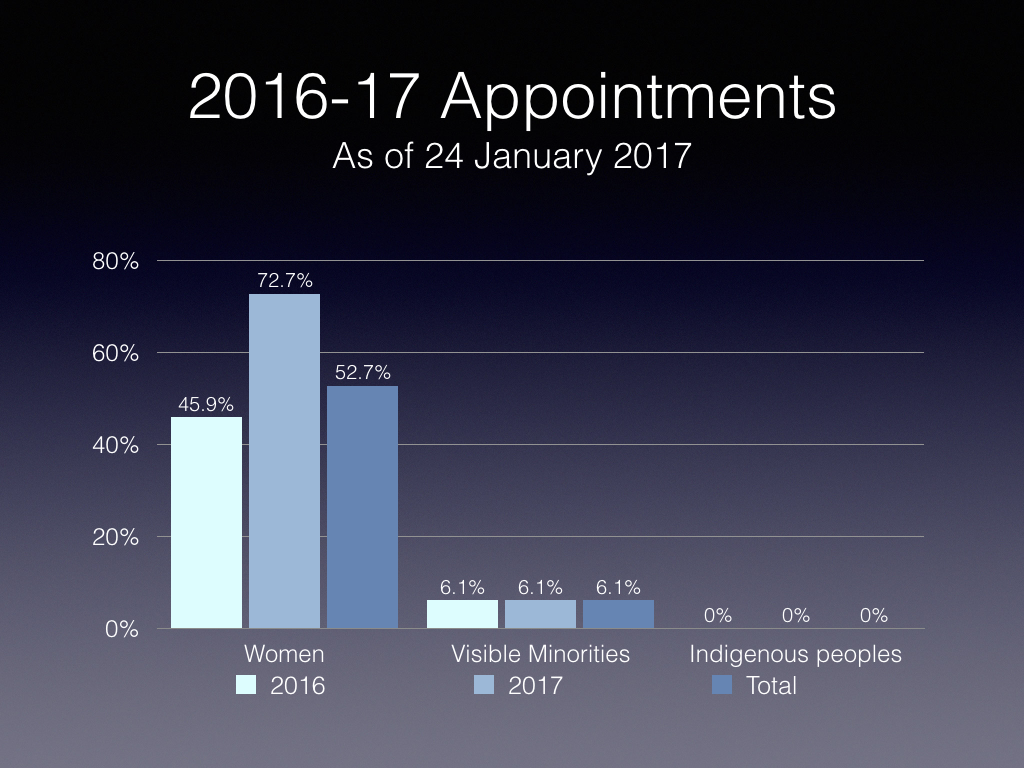
election-2015-and-beyond-implementation-diversity-and-inclusion-042My latest piece in Policy Options, reporting on the Liberal government’s commitment on increasing diversity in government appointments (political, deputy minister, judges and heads of mission) – spoiler alert, it largely has.

Source: Government appointments and diversity – Policy Options