How do the feds track diversity of appointments? – Policy Options

My latest, analyzing what PCO ATIP documents reveal about their tracking of GiC diversity, with my usual series of charts, including 25 year series data with respect to women’s representation:

As I have been taking a closer look at diversity in Governor in Council and judicial appointments, the gaps in the available data have become much clearer. Documents I received under the Access to Information Act revealed that while the Privy Council Office (PCO) has been systematically tracking representation of women and French/English speakers in these appointments, there has been limited tracking with respect to the other employment equity groups, that is, Indigenous peoples, visible minorities and persons with disabilities.

A number of the documents appear to reveal a certain scramble to prepare this data for the incoming Liberal government.

Source: How do the feds track diversity of appointments? – Policy Options

2 federal tribunals make high-speed internet access a job condition

Understandable requirement even though some will protest:

Two tribunals have begun making home access to high-speed internet a prerequisite for dozens of well-paid federal government appointments, despite the fact it could disqualify many Canadians living in rural and remote areas of the country where high-speed internet isn’t available.

The Social Security Tribunal and the Veterans Review and Appeal Board have both recently added high-speed internet access to the list of criteria for those seeking the lucrative appointments, which come with salaries ranging from $108,200 to $127,200 for full-time positions, and between $540 and $635 a day for part-time positions.

“You must work from your home office in Canada and have access to high-speed internet,” say the conditions of employment for the Social Security Tribunal, which resolves disputes involving employment insurance, the Canada Pension Plan and Old Age Security.

Candidates expected to work in urban centres

The requirement appears to have been added in recent months. A similar notice of openings for the tribunal in June 2015 said candidates might have to work from home but did not require high-speed internet access.

The Social Security Tribunal has dozens of full-time and part-time members, including several vacancies at the moment.

On Wednesday, the CRTC ruled that access to high-speed internet should be a basic service across Canada. It said two million Canadian households lack access to proper internet service.

The Veterans Review and Appeal Board, which resolves disputes over disability benefits decisions made by Veterans Affairs Canada, also has this requirement.

Spokeswoman Alexandra Shaw said successful candidates for the board are expected to work in one of six urban centres across Canada and to work from home because the board’s only administrative offices are in Charlottetown, Prince Edward Island.

“Members need high-speed internet to maintain a reliable connection to the secure systems that give them timely access to veterans’ documents in order to prepare for hearings and produce decisions,” she wrote. “The board provides members with cellphones with additional hotspot connectivity.”

Source: 2 federal tribunals make high-speed internet access a job condition – Politics – CBC News

As Trumplethinskin lets down his hair for tech, shame on Silicon Valley for climbing the Tower in silence – Recode

Quite an amazing take-down by Kara Swisher:

When I call these top leaders — of course, it has to be off the record — I get a running dialogue in dulcet tones about needing to cooperate and needing to engage and needing to be seen as willing to work together. Also that Trump means very little of what he says out loud — which I will now officially dub the Peter Thiel take-it-seriously-not-literally defense. And they assure me that they will say what they really think behind closed doors where no one can hear it but each other.

This, even though it will be a certainty that Trump will tweet the whole thing with his doubtlessly warped take of the proceedings. My only hope is that often-erupting Tesla and SpaceX’s Elon Musk — who is also now attending — will also erupt when he realizes the farce he has agreed to be part of.

Or maybe I don’t get it because I am of the old school that when something smells fishy, there is probably a dead fish somewhere to be found. But to my ear, it’s a symphony of compromise, where only now and then a sour note sounds from someone who breaks from the platitudes they are spewing.

Like one tech leader who suddenly stopped mid-sentence about how to really make deals, Kara, because the truth just had to be out. “Trump is just awful, isn’t he? It makes me sick to my stomach,” the leader agonized, as a real thinking person would. “What are we going to do?”

Well, to start, realize again that you have the smarts and invention and the innovative spirit to do whatever you like. Realize you have untold money and power and influence and massive platforms to do what you think is right. Realize that you are inventing the frigging future.

Instead, you’re opting to sit in that gilded room at Trump Tower to be told fake news is a matter of opinion and that smart people aren’t so smart and that you need to sit still and do what they say and take that giant pile of repatriated income with a smile.

Or you can say no — loudly and in public. You can resist the forces that are against immigrants, because it is immigrants who built America and immigrants who most definitely built tech. You can defend science that says climate change is a big threat and that tech can be a part of fixing it. You can insist we invest in critical technologies that point the way to things like new digital health inventions and transportation revolutions. You can do what made Silicon Valley great again and again.

When I could get no really substantive on-the-record statements from the tech leaders, I pinged investor Chris Sacca, because I knew he would not let me down.

“It’s funny, in every tech deal I’ve ever done, the photo op comes after you’ve signed the papers,” he said. “If Trump publicly commits to embrace science, stops threatening censorship of the internet, rejects fake news and denounces hate against our diverse employees, only then it would make sense for tech leaders to visit Trump Tower.”

He added: “Short of that, they are being used to legitimize a fascist.”

The fascist line is vintage Sacca, who always likes to kick up a shitstorm. But thank god someone is willing to do it, because that is what I thought Silicon Valley was all about.

Not any longer, it seems. Welcome to the brave new world, which is neither brave nor new. But it’s now the world we live in, in which it’s Trump who is the disrupter and tech the disrupted.

Source: As Trumplethinskin lets down his hair for tech, shame on Silicon Valley for climbing the Tower in silence – Recode

New task force aims for diverse public service where everyone feels welcome

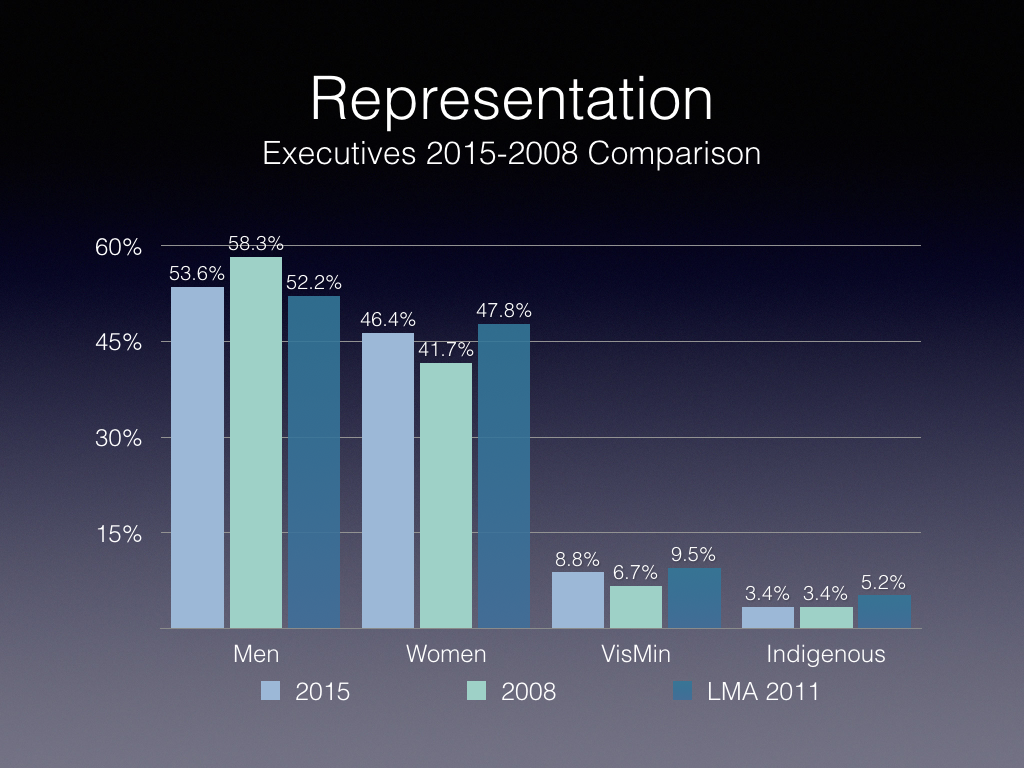
tbs-ee-2015-analysis-007Above slide shows how diversity has changed 2008-15 for executives, slide below for non-executives.

tbs-ee-2015-analysis-006Would be interesting to see the agenda and how it evolves over time, particularly expanding diversity beyond the four employment equity groups:

It’s important not only for the federal public service to be comprised of a fair representation of Canada’s various kinds of people, but also that these employees feel comfortable in their surroundings, says the head of Canada’s largest public service union.

Robyn Benson, president of the Public Service Alliance of Canada (PSAC), said this is among the reasons the Joint Union/Management Task Force on Diversity and Inclusion has been established.

“We, as a union, have great concerns about our workplaces and whether the workplaces are safe for our members, whether or not they are harassment-free, whether or not there is violence in the workplace,” she said. “We wanted to make sure we were part of ensuring that the workplace was safe.”

She added: “While we strive to hire individuals who fall within the equity groups (aboriginals, visible minorities, people with disabilities, and women), you need to not just hire them; you need to provide a workplace where they are safe, where there is no harassment, where there is no violence, where they can be engaged in all levels of the public service, and certainly where there’s accommodation for people with disabilities.”

The new task force includes representation from the following unions: PSAC, the Professional Institute of the Public Service of Canada (PIPSC), the Canadian Association of Professional Employees (CAPE), and the Professional Association of Foreign Service Officers (PAFSO). It also has members from management of the Treasury Board of Canada Secretariat, Correctional Services, Public Safety, Agriculture, and Public Services, as well someone from the Association of Professional Executives of the Public Service of Canada (APEX).

Larry Rousseau, PSAC’s vice-president for the national capital region and co-chair of the task force’s steering committee, echoed the idea that it’s not just about quotas, but making sure those working for the government are comfortable in their surroundings.

“The way to make sure that people feel respected is that they feel included in the processes, in the decision-making, and just the overall work of the public service,” he said. “It’s one thing to have diversity in the workforce. It’s what you do with it that is going to be very, very important.”

Margaret Van Amelsvoort-Thoms, the Treasury Board’s executive director of people management and the other co-chair of the task force’s steering committee, said: “We want every employee to be able to bring their whole self to work, and so [the task force] is the strategy that says, ‘How do we do that and make this an inclusive workplace.’ ”

Mr. Rousseau said one of the task force’s objectives will be defining what diversity is. The federal government already has policies intended to ensure that women, aboriginals, visible minorities, and people with disabilities are adequately represented in the public service. He said preventing discrimination and harassment of people in the LGBTQ community is another issue that has emerged as something all employers should strive for.

Ms. Van Amelsvoort-Thoms added that other demographic factors, such as age, where people are from geographically, and their family structure, can also be part of the conversation about diversity.

The task force was modelled on the Mental Health Joint Task Force that was established in March 2015 under the former Conservative government and continues to function.

Ms. Benson described the roots of this newer Task Force on Diversity: “[Treasury Board President Scott] Brison and I had a discussion several, several months ago about the work around diversity and inclusion. We thought it would be good to construct committees that look like our Mental Health [Task Force],” she said, adding that the Mental Health Task Force “has worked really well.”

While the government didn’t officially announce the Task Force on Diversity until late November, it’s been quietly in operation since September.

Ms. Van Amelsvoort-Thoms said part of the work so far has been doing an “environment scan” of what various employers, in both the private and public sectors, are doing in terms of diversity and inclusiveness. She said the federal government is behind some sectors in its approach to this issue, while it’s ahead of others.

Mr. Rousseau made note of the technology sector, which he said during the 1990s boom years realized the practical benefits of staff diversity and how it brings an array of different perspectives to achieving business goals.
Source: New task force aims for diverse public service where everyone feels welcome – The Hill Times – The Hill Times

Government appointments and diversity – Policy Options

election-2015-and-beyond-implementation-diversity-and-inclusion-042My latest piece in Policy Options, reporting on the Liberal government’s commitment on increasing diversity in government appointments (political, deputy minister, judges and heads of mission) – spoiler alert, it largely has.

Source: Government appointments and diversity – Policy Options

Census still vulnerable to political meddling, says former chief

More on Statistics Canada and the proposed changes to make it more independent but according to Wayne Smith, the former Chief Statistician, not fully.

Unlikely that any government would give StatsCan full independence and I remember a lively Cabinet discussion on some aspects of the 2001 Census:

The federal government’s bid to protect Statistics Canada from political interference has a significant oversight that exposes the census to the possibility of government meddling, says Canada’s former chief statistician.

Wayne Smith, who resigned abruptly from the agency in September, said newly introduced legislation doesn’t change the parts of the Statistics Act that give cabinet control over the content of the questionnaire.

That leaves the census – used by governments to plan infrastructure and services – vulnerable to the sorts of changes the Conservatives imposed in 2011 by turning the long-form census into a voluntary survey, Smith said.

“That’s a major flaw in this bill,” he said. “The government brought this bill in because of the census, but it’s failing to deal with the census.”

Smith described the bill as a first step towards broadening the agency’s authority over how information on all types of subjects is collected, analyzed and disseminated, shifting that authority away from the minister.

Innovation Minister Navdeep Bains, the minister responsible for Statistics Canada, would retain the right to decide what information Statistics Canada collects, including directing the agency to collect data on emerging areas like renewable energy. The bill also gives cabinet the ability to make methodological changes, such as making mandatory surveys voluntary as the Conservatives did with the 2011 census.

Source: Census still vulnerable to political meddling, says former chief

Tory leadership hopeful Chris Alexander mentions Rachel Notley at speech and crowd chants ‘lock her up

His political and personal judgement is in question.

Sharp contrast between John McCain showing leadership in 2008 when responding to a similar angry crowd by saying “I have to tell you. Sen. Obama is a decent person and a person you don’t have to be scared of as president of the United States.”

And the sheer hypocrisy, given his complaints about being subject to hateful tweets in last week’s CBC At Issue panel:

Federal Conservative leadership hopeful Chris Alexander says he didn’t stop a crowd calling for Alberta Premier Rachel Notley to be locked up because politicians need to listen to constituents.

The former immigration minister was speaking at a rally against the provincial NDPs’ planned carbon tax Saturday when protesters began the “Lock her up” chant popularized during president-elect Donald Trump’s campaign.

“I totally disapprove of that particular chant. I don’t think it’s fair. I don’t think it’s the right thing to say at a rally or elsewhere, and that’s why I didn’t join it,” Alexander said Sunday.

The Edmonton rally was organized by Rebel Media, an online news and right-wing opinion outlet, and video of the incident was posted on Twitter by the website’s Alberta bureau chief Sheila Gunn Reid.

The video shows the ralliers start by chanting “Vote her out,” but as they grow louder, the message changes.
As they chant “Lock her up,” Alexander smiles and appears to gesture in time with the chant, nodding along.

Someone can be heard shouting, “That’s enough! That’s enough!” in the background, and as Alexander smiles and nods, the camera turns to face the crowd.

At no point in the video does Alexander stop the protesters or say anything about their chant.

“You don’t pick it up in the video, but I started to say the words in time with them, ’Vote her out,’ and then the next point I made was about the ballot box,” he said. “I expressed my disapproval by talking about something completely different: voting. I think that was pretty clear.”

Source: Tory leadership hopeful Chris Alexander mentions Rachel Notley at speech and crowd chants ‘lock her up’ | National Post

Interest in public service jobs has increased since Trudeau’s election – Macleans.ca

Of note:

Not only is enrollment up in public administration fields of study, but now experts say there’s a new enthusiasm among students.

“Let me be blunt. It was miserable under the Harper government,” says Robert Shepherd, a Carleton University professor and president of the Canadian Association of Programs in Public Administration. “Nobody wanted to be there. Our numbers dropped off for [programs] connected to the federal government. It was hard to attract students.”

Now Ottawa seems to be investing in its public service employees, and Trudeau’s big budget means greater job opportunities. So while some might attribute the reason for students’ renewed enthusiasm to a “sunny ways” Prime Minister, the spike in interest for public policy and administration programs isn’t always altruistic.

Shepherd credits the sputtering economy as a common thread he hears from students looking for public service work. “[Students] see government as being a relatively stable way to anchor themselves,” he says. “Back in the 1980s, that’s what I was thinking too. The economy sucked and I saw government as having a stable career.”

While the current crop of students are not thinking about a 35-year career with a pension at the end, the Baby Boomers who did see retirement beckoning. “We’ll be in a market where we’ll need a lot of people in a hurry,” says Michael Wernick, clerk of the Privy Council of Canada. “We’re not hiring clerical people, because that stuff is pretty much automated. We’re looking for people with social media and acute management skills.”

That’s not to say everyone is jumping at available jobs. Shepherd remembers a job posting for the CRTC recently hitting his desk, which he sent out to various universities asking them to send back names of interested students. The response? Crickets.

“Where demand is outstripping supply is in the area of regulatory public policy. I’m thinking places like the CRTC, Food Inspection, Health Canada,” Shepherd says. “If you said to students there are good jobs in a regulatory agency, they look at you as though, “Why would I want to do that?’ ”

Source: Interest in public service jobs has increased since Trudeau’s election – Macleans.ca

Influential Chinese-Canadians paying to attend private fundraisers with Trudeau [investor immigrant angle]

Sigh … One of the better initiatives of the Conservative government was shutting down the business immigrant program after evaluations showed just how flawed it was and just how few benefits it provided Canadians.

And of course the broader ethical issue of such fundraising – paying for access – remains:

Mr. Chan was at the most recent Trudeau fundraiser, which was held on Nov. 7 at the West Vancouver mansion of B.C. developer Miaofei Pan, a multimillionaire from Wenzhou province who immigrated to Canada a decade ago. More than 80 guests got their pictures taken with Mr. Trudeau at the $1,500 per ticket event, including Mr. Chan.

Mr. Pan told The Globe and Mail he lobbied the Prime Minister to make it easier for well-heeled investors from China to come to Canada. He said he told Mr. Trudeau the program put in place by the former Conservative government was “too harsh.”

In exchange for permanent residency, rich immigrants must invest $2-million and are subject to strict audits.

“If they don’t do business over two years here, they cannot stay or they have to leave the country. So I wanted the Prime Minister to know that is not a very merciful policy towards these people because they want to invest or stay,” Mr. Pan said. “It’s all about investment that Canada needs. I have friends, and [they are] wealthy people, who want to stay and invest.”

A Chinese government agency in Mr. Pan’s hometown that builds ties with and keeps tabs on expatriate Chinese, supplied photos of the Trudeau-Pan event to media in China. The Foreign and Overseas Chinese Affairs Office of the Wenzhou People’s Government promotes China’s interests abroad, according to former Canadian diplomat and China expert Charles Burton.

“That is an agency of the Chinese Communist Party,” Mr. Burton told The Globe and Mail. “The fact that the photos appeared in the [Wenzhou Metropolis Daily] in China suggests that the people who participated in that activity must have been tasked by the Chinese state to try and promote the Chinese position with influential people in Canada. In this case, our Prime Minister.”

Mr. Pan is honorary chair of a Chinese-Canadian organization that is an unabashed backer of Beijing’s territorial claims in the South China Sea and East China Sea.

In 2012, he was part of a campaign by overseas Chinese groups to rally public support for the Chinese government’s position in a dispute with Japan over islands in the East China Sea that are close to key shipping lanes, bountiful fishing grounds and possible petroleum reserves.

That year, Mr. Pan was quoted in the Macau Daily newspaper saying his organization, the Canadian Alliance of Chinese Associations, had “declared its stand in newspapers” and that “overseas Chinese were responsible for defending China’s territorial integrity.”

In 2015, the Canadian Alliance of Chinese Associations held a symposium at which speakers backed Beijing’s assertion of title to islands, reefs and banks in the South China Sea, and issued a statement saying it “strongly supports the Chinese government’s defence of sovereignty over the South China Sea.”

The Prime Minister’s Office and the Liberal Party kept the Nov. 7 fundraiser confidential. Neither the PMO nor the party website noted the event. At the time, Mr. Trudeau was in Vancouver to announce a new marine strategy.

“The party has … been clear that not every event is on the party’s national website, while it’s important to note that the Liberal Party of Canada is still the only major federal political party that maintains an active online events listing in any form at all,” party spokesman Braeden Caley said in an e-mail. “All fundraising by the Liberal Party of Canada fully complies with all Elections Canada rules and regulations for political fundraising.”

The Liberal Party would not provide The Globe and Mail with a list of attendees. Mr. Pan said all the guests were his friends, and all are Canadian citizens.

Source: Influential Chinese-Canadians paying to attend private fundraisers with Trudeau – The Globe and Mail

Government consistently fails to fix mistakes, Auditor-General says [need for citizen-centred program delivery]

Strong condemnation, widely noted. Despite the many years and efforts with respect to performance management and reporting, shows just how entrenched the government remains in measuring process and outputs, rather than results for citizens.

And ‘deliverology’ is unlikely to change this, as it is easier to track political commitments met, than actual benefits and outcomes for citizens.

During my time at Service Canada, we spent considerable time and effort to develop service strategies that aimed to place the citizen at the heart of service delivery, not the program management. There was considerable resistance from the various program branches, who were more comfortable, given the nature of accountabilities, to operate within silos. The slide below highlights the nature of change proposed, with the left showing the program and service maze, the right showing a more citizen-centric way of organizing programs.

ssso_implementation_plan_-_scmb_dec_2005_-_v5_08dec2005_e_scmb

Canada’s Auditor-General says the federal government must adjust the way it does business after a broad evaluation in which he says departments fail to consider whether their services actually benefit Canadians, cannot stay ahead of emerging trends and do not correct inadequacies even after they have been pointed out.

In marking the midpoint of his 10-year term, Michael Ferguson used his fall report to take an unusual step back from the assessments of specific programs to point to more systemic problems. Parliament, said Mr. Ferguson, uses his reports to learn about things that have gone wrong but does not ensure that changes are made to set them right.

“What about programs that are managed to accommodate the people running them rather than the people receiving the services?” asked Mr. Ferguson. “I am also talking about problems like regulatory bodies that cannot keep up with the industries they regulate, and public accountability reports that fail to provide a full and clear picture of what is going on….”

Departments and agencies work in silos, he said, failing to learn from what others outside, or even inside, their own organizations are doing.

“Our audits come across the same problems in different organizations time and time again. Even more concerning is that, when we come back to audit the same area again, we often find that program results have not improved,” said Mr. Ferguson. “In just five years, with some 100 performance audits and special examinations behind me since I began my mandate, the results of some audits seem to be – in the immortal words of Yogi Berra – ‘déjà vu all over again.’ ”

For instance, said Mr. Ferguson, many past audits have revealed the government’s lack of focus on Canadians who are the end users of its services.

And that trend continues in a new study of the Beyond the Border Action Plan which was introduced in December, 2011, to enhance security and the flow of goods and people across the Canada-U.S. border. Five years and $585-million later, the departments and agencies involved cannot show how the measures that were part of the plan have made Canadians safer or accelerated the movement of either trade or travellers.

“We found that, where performance indicators were developed,” says the audit, “they measured whether activities and deliverables were completed, not the resulting benefits.”

Source: Government consistently fails to fix mistakes, Auditor-General says – The Globe and Mail

His full message is also worth reading beyond the excerpt below and soundbites above:

In the interest of assisting our still-new Parliament in carrying out its oversight role and of helping government “do service well,” I believe there is value in looking back over the body of work produced by the Office of the Auditor General of Canada. This is a way to identify those issues that show up in audit after audit, year after year, and sometimes persist for decades.

These problems include departments and agencies struggling to work outside their silos, either to learn from what is happening within their organizations, or more broadly, to learn from what their external counterparts are doing.

And what about programs that are managed to accommodate the people running them rather than the people receiving the services? What about programs in which the focus is on measuring what civil servants are doing rather than how well Canadians are being served? In such cases, the perception of the service is very different depending on whether you are talking to the service provider or to the citizen trying to navigate the red tape.

I am also talking about problems like regulatory bodies that cannot keep up with the industries they regulate, and public accountability reports that fail to provide a full and clear picture of what is going on for a myriad of reasons—such as systems that are outdated or just not working, or data that is unreliable or incomplete, not suited to the needs, or not being used. Our audits come across these same problems in different organizations time and time again. Even more concerning is that when we come back to audit the same area again, we often find that program results have not improved.

Lack of focus on citizens

In our system of government, Parliament makes the rules, departments and agencies carry out the wishes of Parliament, and citizens receive the services. At least, that is the way the system is designed. Over the years, our audit work has revealed government’s lack of focus on end-users, Canadians.

Message from the Auditor General