Majority of Canadians worry about domestic terrorism, according to new survey

Results are not that surprising, given recent events, and given that civil liberties rarely do well in public polling.

But encouraging that people recognize the importance of prevention and the contributing role of mental illness and marginalization:

Almost two-thirds of Canadians believe homegrown terrorism is a serious issue, but most do not perceive a threat from radicalized individuals in their communities, according to a new survey.

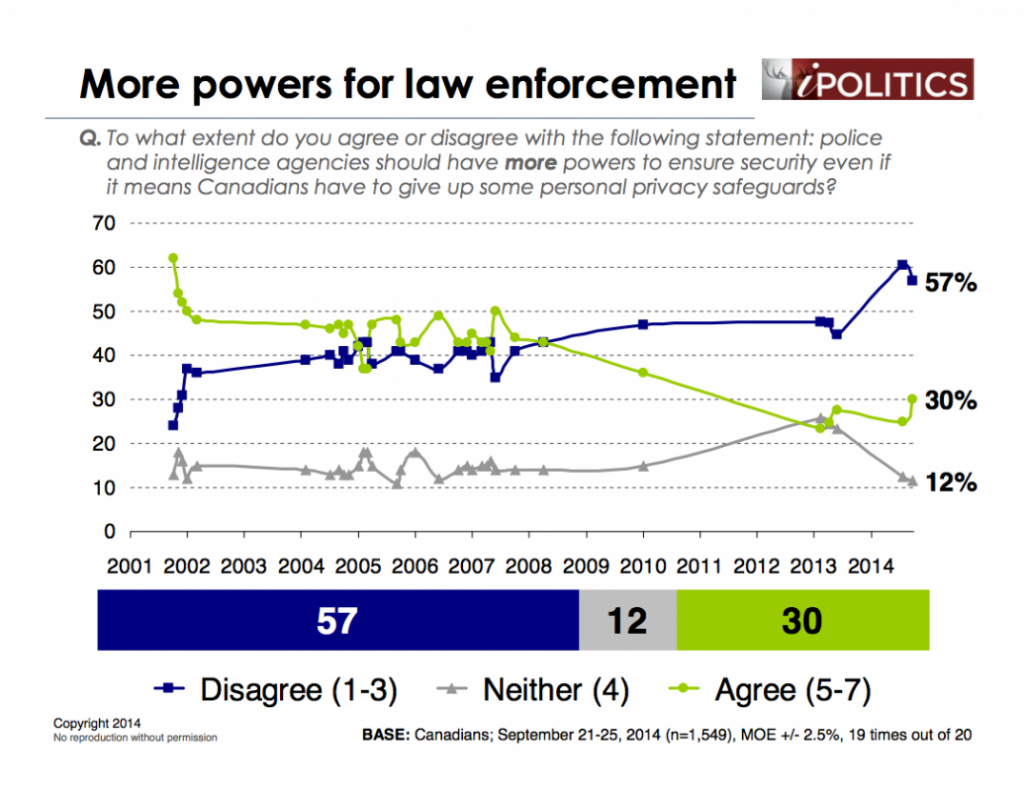
The national poll, conducted in the wake of deadly attacks on Canadian soldiers, found that just over half of respondents supported new anti-terror legislation that would boost the powers of Canada’s spies. Another 22 per cent said the government should go even further, suggesting they have not been swayed by civil liberties concerns.

At the same time, those surveyed recognized that there are many factors behind radicalization — religion, mental illness and marginalization — and seemed open to a range of preventative measures, not just punitive ones.

“People are sensitive to the fact this is a complex issue that requires a comprehensive approach,” said Christian Leuprecht, a security expert at the Royal Military College of Canada and Queen’s University.

Majority of Canadians worry about domestic terrorism, according to new survey.

‘Cloud of misperception’: Canadians don’t know their country as well as they think, online survey finds

Cloud_of_misperception__Canadians_don’t_know_their_country_as_well_as_they_think__online_survey_finds___National_PostNot terribly surprising:

Canadians might think they know a lot about other Canadians, and about Canada itself. But Canadians are profoundly confused, at least according to the results of a recent Ipsos Reid global survey, The Perils of Perception. The survey asked Canadians to answer a number of questions about Canada, and then compared their answers to the facts. And the facts, as revealed below, show that the Canada Canadians think they know, is a Canada that doesn’t exist.

“Canadians are flying blind in a cloud of misperception,” said John Wright, a senior spokesperson for Ipsos. “So let’s try and clear some things up.” The good news: we are most certainly not alone. People around the world get their countries wrong too.

‘Cloud of misperception’: Canadians don’t know their country as well as they think, online survey finds | National Post.

Canadian attitudes toward immigrants conflicted, CBC poll says

Despite the headline, overall confirmation of general welcoming attitude towards Immigration and multiculturalism. Some highlights:

  • 79 percent comfortable with employing or working for someone of different ethnicity;
  • 30 percent believe immigrants take jobs away from Canadians (meaning 70 percent don’t);
  • between 60 and 75 percent comfortable with being in a relationship with someone of another ethnicity;
  • between 70 and 85 percent are comfortable with neighbours of different ethnicity.

Canadian attitudes toward immigrants conflicted, poll says – Canada – CBC News.

The Powerpoint of the complete results is here:

CBC Discrimination Poll November 7 2014

The EKOS poll: Fear fades — values endure

Ekos - Law Enforcement and TerrorismFrank Graves of Ekos on public opinion regarding the threat of terrorism:

  • Virtually all responses made by Western governments to the threat of terrorism in the 21st century have been deemed failures in hindsight. Almost universally, the public sees these past interventions as having yielded nothing but a more dangerous world.
  • Overwhelmingly, Canadians want to see their leaders re-think their reliance on military and security-oriented approaches to the terrorist threat, in favour of approaches more in keeping with our core values as a nation.
  • Canadians have lost faith in the security agenda which says the problem can solved by restricting civil liberties even further, and want to see our leaders place more emphasis on the traditional tools of diplomacy and development.

The EKOS poll: Fear fades — values endure (pay wall)

Canadians in the dark about immigration numbers: survey

Not surprising that people don’t know the actual immigration figures. Common to many policy areas that most people don’t follow too closely and large numbers are fairly abstract in any case.

Government messaging walks the fine line between reassuring its base, and the broader public, that it is addressing fraud and the risk of over-dramatizing the extent of fraud (e.g., birth tourism) and thus contributing to reduced public confidence:

Ignorance of the facts, however, didn’t stop most of the 3,016 participants polled by Harris/Decima from answering when asked whether there were too many, too few or about the right number of immigrants coming to Canada every year.

Twenty-six per cent said there were too many, 10 per cent said too few and 52 per cent said the number was about right. The rest said they didn’t know.

After they were told the actual number admitted each year, the number who said there were too many jumped to 36 per cent. Nine per cent said too few immigrants were admitted, while 48 per cent thought the number was about right.

When asked if Canada should increase, decrease or maintain its immigration intake over the next five years, nearly half favoured the status quo, about one-third advocated a decrease and 15 per cent wanted immigration levels to rise.

Luc Turgeon, a University of Ottawa political scientist who has studied public attitudes toward immigration, said he wasn’t surprised by the widespread ignorance of actual immigration levels.

“In numerous countries it has been proven that people have no idea how many immigrants their countries are letting in,” he said.

Turgeon said the Conservative federal government has “sent a number of signals” to reassure its base that it’s keeping a close eye on people admitted to Canada.

Those signals include tightening the rules for refugees, making it more difficult for refugees to access publicly funded health care and hinting that changes are in the works to the live-in caregiver program.

Canadians in the dark about immigration numbers: survey | Ottawa Citizen.

Consumers More Borderless Than Multinationals – New Canadian Media – NCM

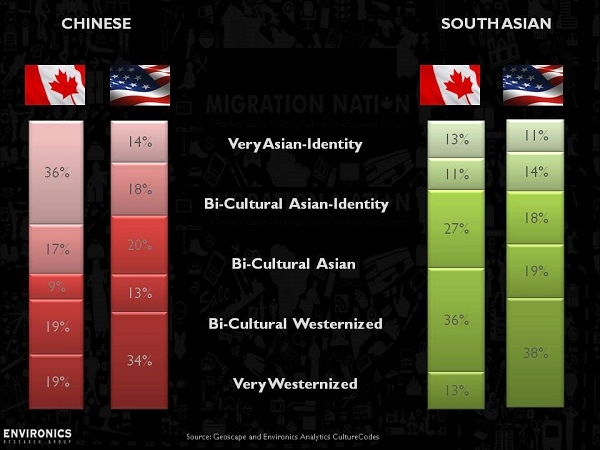
Environics Canada USFascinating market research and comparison between Canadian and American acculturation models and behaviours by Robin Brown of Environics.

The cliché of the melting pot versus the cultural mosaic appears to still apply, at least for those of Chinese and South Asian origin (two of the largest communities in Canada):

Our recent research compared Chinese and South Asian Americans and Canadians’ level of acculturation using Geoscape and & Environics Analytics CultureCodes see graph. These analytical tools classify the population into five categories of acculturation based on their home language, knowledge of English/French and period of immigration. We found much higher levels of acculturation in the U.S. than in Canada for both groups. This results from a number of factors, including the “melting pot” vs. multicultural culture of each country. Of course, this means that these populations will differ and marketing efforts to reach them must navigate that difference.

But, understanding the diasporas may not be the biggest challenge faced by multinationals. The current reality for many multinationals is that many of their consumers are in some respects more global than they are. There may be good business reasons why an Asian Canadian cannot find Nescafe iced coffee here in Canada, but consumers are not aware or don’t care about the constraints of separate business units, tariffs and supply chain logistics. They are connected globally and informed of products and services that are used by their ethnic diaspora across the world.

Consumers More Borderless Than Multinationals – New Canadian Media – NCM.

Finance Canada survey finds Canadians at odds with Conservatives’ priorities

Interesting but not necessarily surprising. Those Canada’s Economic Action Plan ads may have not been as good value for money, let alone for taxpayers:

Public-opinion research for the federal Finance Department suggests key government policies are out of step with Canadians’ priorities, including the Northern Gateway project.

Members of focus groups consulted prior to the February budget had “little enthusiasm” for the proposed bitumen pipeline to the British Columbia coast — even those who said they support the controversial project.

And among the 12 groups consulted — from Coquitlam, B.C., to Bridgewater, N.S. — the economy itself was not a top-of-mind concern.

Rather, the groups spontaneously raised education, health care, pensions and veterans as their key issues.

They also called for more processing and refining of Canada’s oil resources at home, and to do so in a more environmentally safe manner.

The findings of the January focus groups, commissioned from NRG Research Group, suggest the Harper government’s central policy themes — trade and the economy, with an emphasis on energy exports — are resonating less with ordinary Canadians.

http://www.ipolitics.ca/2014/07/20/finance-canada-survey-finds-canadians-at-odds-with-conservative-government-priorities/ (pay wall)

La peur des immigrants, une tendance au 450?

Interesting and somewhat surprising study on Quebec francophones who feel culturally threatened by immigrants and new Canadians. Suburban dwellers feel more threatened than those in the regions, likely reflecting less diversity than in Toronto’s 905 equivalent:

Pourcentage des francophones qui se sentent culturellement menacés par les immigrants:

  • Montréal 37 %
  • Couronne Nord 47 %
  • Rive-Sud 43 %
  • Régions éloignées 41 %

La peur des immigrants, une tendance au 450? | Hugo Pilon-Larose | Montréal.

Younger Canadians hold more negative views about religious groups – CRRF

Further to an earlier release of the CRRF and ACS Survey on Religion, Racism and Intergroup Relations in Canada Shows Differences in Attitudes Among Anglophones, Francophones and Other Groups, a further release pertaining to attitudes to religious diversity by age group. Remarkably consistent across religions, except for Muslims:

Table 1: Negative attitudes towards certain groups, according to age groups
 Negative Opinion

Total

18-24

25-34

35-44

45-54

55-64

 Muslims 44% 43% 45% 40% 43% 40%
 Jews 19% 24% 25% 20% 15% 15%
 Protestants 15% 24% 23% 14% 15% 8%
 Catholics 19% 25% 25% 22% 18% 13%
 Atheists/Agnostics 21% 14% 18% 21% 21% 22%
 Religious 31% 36% 33% 31% 31% 27%
 Immigrants 24% 24% 27% 24% 30% 16%
 Aboriginals 26% 26% 26% 25% 29% 22%

Younger Canadians hold more negative views about religious groups

Whereas on diversity in general, young people are more supportive than older age groups, as another relatively recent study by ACS shows:

Do you have a very positive, somewhat positive, somewhat negative or very negative opinion of Canadian Multicultural Policy
Total 18-24 25-34 35-44 45-54 55-64 65 + French English Other
TOTAL positive 58% 74% 61% 61% 56% 54% 47% 48% 60% 67%
Very positive 15% 34% 18% 15% 10% 12% 8% 8% 14% 26%
Somewhat positive 43% 40% 43% 46% 46% 42% 39% 40% 46% 41%
TOTAL negative 35% 14% 29% 33% 35% 39% 50% 45% 32% 28%
Somewhat negative 23% 7% 19% 24% 25% 25% 33% 29% 22% 18%
Very negative 12% 8% 10% 9% 11% 14% 17% 16% 10% 11%
I prefer not answering 7% 11% 10% 6% 9% 7% 3% 7% 8% 5%

Younger Canadians Believe Multiculturalism Works; Older Canadians, Not So Sure 

I expect a further breakdown by region (urban vs rural, QC vs ROC), cross-referenced to more broad-based attitude polling, may cast more light, or it may simply reflect that younger people, in general, may be less religious.

No surprise, and consistent with other surveys, distrust of Muslims is higher than other religions (they did not ask about Sikhs which generally “rate” between Muslims and other religions). There may be a link between the categories “religious” and Muslims, given perceptions of more religious fundamentalism or conservatism.

Like all polling, one question leads to another …

Maytree Survey Research Reveals Canada’s Attitudes towards Citizenship

While over two years old, this survey, conducted by Maytree, the Institute for Canadian Citizenship, the CBC and Royal Bank, is nevertheless interesting, as it indicates that in general Canadian citizenship policies are working and little appetite for change.

As the Government moves forward with revision to the Act, it will be interesting whether the debate reflects these findings or not.

Maytree New Survey Research Reveals Canada’s Attitudes towards Citizenship » Maytree.