New Canadians take Oath of Citizenship at ceremony tied to Capital Pride

Noteworthy:

As about 50 people became Canadians at a special citizenship ceremony held at the Horticultural Building at Lansdowne Park Thursday morning, 25-year-old Roksana Hajrizi and her mother, Celina Urbanowicz, looked on from the just outside the area cordoned off for officials, volunteers, celebrants and their friends and families.

They watched as Bibiane Wanbji, who six years ago left her husband in Cameroon and brought her four children to Canada to find a better life, smiled at the vastness of the world that had just opened up to her. Having a Canadian passport, Wanbji explained, means she can travel just about anywhere. She hasn’t seen her extended family and friends back in Cameroon since coming to Canada, so that’s a definite destination. So, too, are the U.S. and Cuba, and “the city of love” that she’s always wanted to visit: Venice. “It’s like a passport for the world.”

And although she’s been in Canada for six years already, Thursday’s ceremony left Wanbji feeling a bit different, she said, that she has “more to give in this country, to contribute to build the country.”

Hajrizi and her mother watched, too, as 50 new Canadians, including Haguer Abdelmoneim and her children, Mahmoud, 10, and Youssef, 5, sang their new national anthem. They and Abdelmoneim’s husband came from Egypt in 2014 “for a better education for the kids” and “for a better community to grow in.”

They didn’t just choose somewhere other than Egypt, she added; they specifically chose Canada. “We like the values. It’s a very inclusive country, very welcoming to newcomers.”

Another “new” Canadian, Saiful Azad, who arrived on Canada’s shores from Bangladesh 21 years ago, agrees. “A lot of people don’t understand how important it is to be a Canadian citizen and the opportunities that are given to you here,” he said. “I don’t believe the U.S. is the land of opportunity; I believe Canada is.”

Like Wanbji, Azad, who operates a Greek on Wheels franchise in Hunt Club, cherishes his new-found ability to travel as much as his right to vote. “When you’re a Canadian citizen, people look at you differently and treat you differently. Everyone thinks that Canada is a great country, and I think they’re right.

“People who live here and want to be Canadian citizens should pursue that.”

Thursday’s event was unlike most citizenship ceremonies in that it was one of about 75 sponsored each year by the Institute for Canadian Citizenship, a national not-for-profit charity that promotes active and inclusive citizenship.  As at other ICC-hosted citizenship ceremonies, this one opened with intimate roundtable discussions at which soon-to-be Canadians were engaged in conversations with other community members.

A lot of our soon-to-be Canadians have had long journeys and long stories in getting here,” said ICC chief executive and former Ottawa-Centre Liberal MPP Yasir Naqvi just prior to the start of the ceremony, “so we want to talk a little about that. But most importantly we want to talk about what the journey is going to be like after they become Canadian citizens. How are they now going to contribute to the building of Canada? We want to promote active citizenship.”

Thursday’s ceremony was also co-hosted by Capital Pride, a first for both organizations.

“It’s an opportunity for our community and the candidates for citizenship to engage in dialogue about what our community is about and what the experience of being 2SLGBTQ is,” said Capital Pride founding director Sarah Evans. “A lot of newcomers, and even established immigrants, don’t always know a lot about the 2SLGBTQ community, so it’s a good opportunity to build that awareness.”

As she watched from the sidelines, Roksana Hajrizi was keenly aware. Describing herself as a “proud lesbian,” she attended Thursday’s ceremony partly in support of Capital Pride, and also to congratulate those being sworn in as new Canadians. “I am proud and happy for those who are Canadians today,” she said, “and I hope that one day my family and I could be citizens of this great country.”

Truth be told, Hajrizi already feels very much Canadian. She was just three years old when she and her family — her mother, father, Ismet Hajrizi, and younger sister, Camila, arrived in British Columbia from war-torn former Yugoslavia almost 23 years ago. She even has two brothers born in Canada: Sebastrijana, 22, and Daniel, 19.

But she, her mother and sister are living in Canada without official status, in constant anxiety that they will be deported. They are Roma — her mother a Polish Catholic Roma, her father a Yugoslavian Muslim one. Romas are not welcome in most places, she says, and gay ones even less so.

The United Nations’ Office of the High Commissioner for Human Rights has noted the discrimination that Roma people face worldwide, an Anti-Gypsyism expressed by “violence, hate speech, exploitation, stigmatization and the most blatant kind of discrimination.”

Hajrizi’s family was denied refugee status, and now she fears for her life and the lives of her sister and mother if they’re forced to leave the country. In 2008, her family, except for her brothers, was scheduled for deportation but was given a reprieve.

Still, Hajrizi’s father, she says, despite being a Serbian citizen, was deported in June to Kosovo, where he lives in a garage with no papers. She, with no birth documents herself, worries that it’s just a matter of time before she and her mother and sister will suffer similar fates, that she will never get to be on the other side of Thursday’s ceremony, that despite living in Canada for very nearly her whole life, she will never know what citizenship is like.

“I believe in my heart that I’m Canadian. I believe in my heart that my sister is Canadian. I believe my mother and farther are also Canadian. We’ve been here for 23 years and our roots have spread through Canadian soils. We have given our time, our compassion, our love, our kindness to our community, to our city. People who know us know that we are a good family.

“My family is being ripped apart,” she said. “My father was taken from us, and now my mother is next. But we will fight to stay in Canada.”

Source: New Canadians take Oath of Citizenship at ceremony tied to Capital Pride
Unrest in Hong Kong fuels speculation of spike in ‘re-return migration’ to Canada

Largely anecdotal at this point in time but credible:

As riot police clashed with protesters in Hong Kong in recent days, it focused attention on the estimated 300,000 Canadian passport holders — most of them Hong Kong-born — who live in the port city and fuelled speculation of a surge in “re-return migration” back to Canada.

Hong Kong observers say they had already begun to see an uptick in the phenomenon of so-called “re-returnees” — those who moved from Hong Kong to Canada in the 1980s or 90s, returned to Hong Kong and are now back in Canada — beginning around 2014 and expect the recent political turmoil will accelerate it.

“Back in the 1990s, their parents moved to Canada because they worried Hong Kong one day would be a city of China. Right now, their worries have been actualized. … China has undermined the autonomy of Hong Kong. The next generation are making the same decision as their parents did,” said Kennedy Wong, co-investigator of an unpublished UBC study on re-returnees.

Hong Kong serves as a key trading hub in Asia for Canadian products and ranks third as a destination for Canada’s export of financial, engineering and other professional services.

In addition to shared business interests, Canada also has deep-rooted historical ties with Hong Kong. During the Second World War, the then-British colony was the first place Canadian troops fought a land battle. They suffered great casualties against the Japanese — 290 died in combat, nearly 500 were wounded and another 264 died as prisoners of war.

“There has been a long and strong ties between Canada and Hong Kong,” said Leo Shin, a professor of Chinese history at UBC.

While there was some migration from Hong Kong to Canada in the 1950s and 60s, the numbers swelled to about 380,000 from the mid-1980s to mid-1990s in advance of the handover of Hong Kong from British rule back to China. Many families did not, however, completely cut off ties to their homeland as evidenced by the “astronaut family” phenomenon, in which the breadwinner — typically the father — spent the bulk of his time overseas.

In the handover’s aftermath, fears subsided as China established a “one country, two systems” model of governing that allowed Hong Kong to maintain its economic and political autonomy. As a result, there was an outflow of migration of these now-naturalized Canadian citizens back to Hong Kong in the 1990s through the mid-2000s.

Many of those returning to Hong Kong had Canadian university degrees, weren’t married yet, and had the luxury of mobility. From their point of view, going back to Hong Kong was a no-brainer — the economy was booming, opportunities for climbing the corporate ladder were plentiful, and their Canadian schooling and English skills meant higher salaries. Many Canadian-born citizens of Chinese descent joined this outflow to Hong Kong — driven not only by job prospects but also a desire to connect with their ancestral homeland.

The fact they all carried Canadian passports offered peace of mind, Wong said. If things went sideways in Hong Kong, they could always come back to Canada.

“You can pick Canada or Hong Kong,” he said.

In 2011, the Asia-Pacific Foundation released a study that estimated the number of Canadian citizens in Hong Kong to be around 300,000 but possibly as high as 500,000 — making the Canadian diaspora in Hong Kong the largest outside of the United States. Most were naturalized Canadians; only 16 per cent were thought to be Canadian-born.

The study was based on the results of a phone survey of more than 500 Canadian citizens in Hong Kong.

Forty-six per cent of respondents said they considered Canada home “sometimes” or “all the time,” while 37 per cent said they “never” consider Canada home. Reflecting the push-pull dilemma facing many of these residents, about one-third said they would most likely return to Canada within five years.

And that’s what started to happen, experts say, citing a number of triggers.

In 2012, an idea was floated to introduce in Hong Kong’s public school curriculum civics courses intended to promote greater patriotism and identification with mainland China. The idea was panned by critics who worried about “brainwashing” and was ultimately scrapped.

But it sowed fear, observers say, about growing influence of Chinese politics in education, the economy and other sectors.

“They started to be more sensitive and aware of these things,” Wong said.

As part of his study on re-return migration to Canada, Wong interviewed about 20 people who had decided to settle in Vancouver and Toronto. One interviewee said the decision was tactical. “After 2008, the whole political situation has been getting worse. … And you can see how they (the government) wanted our children to be raised … to learn about something that is nonsense, or to learn to be a robot.”

That sort of fear intensified in 2014 when Beijing was accused of trying to interfere with the electoral process in Hong Kong, sparking protests that came to be known as the “Umbrella Movement.”

On top of the changing political climate, many in Hong Kong have been returning to Canada for personal reasons. Some are raising young families or nearing retirement age and prefer the quieter Canadian lifestyle over the chaos of Hong Kong, which has become notorious in recent years for overcrowding in hospitals and kindergarten classes. Some also have aging parents living in Canada.

“I told myself clearly that (if I make this decision), I am at a point of no return. Because I want to get settled in a place,” said another interviewee in the study.

While there is no hard data to show the number of re-returnees, there is anecdotal evidence to suggest it is on the rise. When the UBC alumni association in Hong Kong held a paid seminar at the start of this year titled “Thinking of Moving Back to B.C.?” more than 70 people showed up, higher than expected.

In June, the South China Morning Post cited census data to show that the number of Hong Kong-born people in Canada had been steadily declining since 1996 but then increased from 209,775 in the 2011 census to 215,750 in the 2016 census. The newspaper attributed the increase to the new phenomenon of “double reverse migration.”

In recent weeks, as violent clashes between police and pro-democracy demonstrators — upset over a proposed bill that would’ve allowed for the extradition of Hong Kongers to face trial in China — have intensified, observers have speculated that the turmoil is likely to fuel more departures.

“We can tell obviously people are not just worrying about democracy. They’re worrying about the freedoms that Hong Kong people have been enjoying,” said Miu Chung Yan, a UBC professor of social work who worked with Wong on the re-return migration study.

Wong said he has friends who have lived in Hong Kong all their lives but who have recently expressed interest in having a “working holiday” in Canada. “The push factor is much higher,” he said.

Migration consultants in Hong Kong have similarly been reporting sharp increases in young people inquiring about emigrating to other parts of Asia, Australia, the United States and Canada.

One of them, John Hu, told Global News this week the number of inquiries he’s received has doubled.

“Before June, when we answered calls, they were thinking about immigration,” he said. “But now, we are taking calls from people who are already determined to migrate.”

Source: Unrest in Hong Kong fuels speculation of spike in ‘re-return migration’ to Canada

Trump Again Says He’d End Birthright Citizenship

More identity politics:

President Donald Trump said Wednesday he was looking “very seriously” at ending the right to citizenship for babies born to non-U.S. citizens on American soil.

Trump spoke to reporters as he departed the White House for a speech in Louisville, Kentucky. He said birthright citizenship was “frankly ridiculous.”

“We’re looking at it very, very seriously,” he said.

This isn’t the first time Trump has claimed he’d do away with it — he said something similar in October.

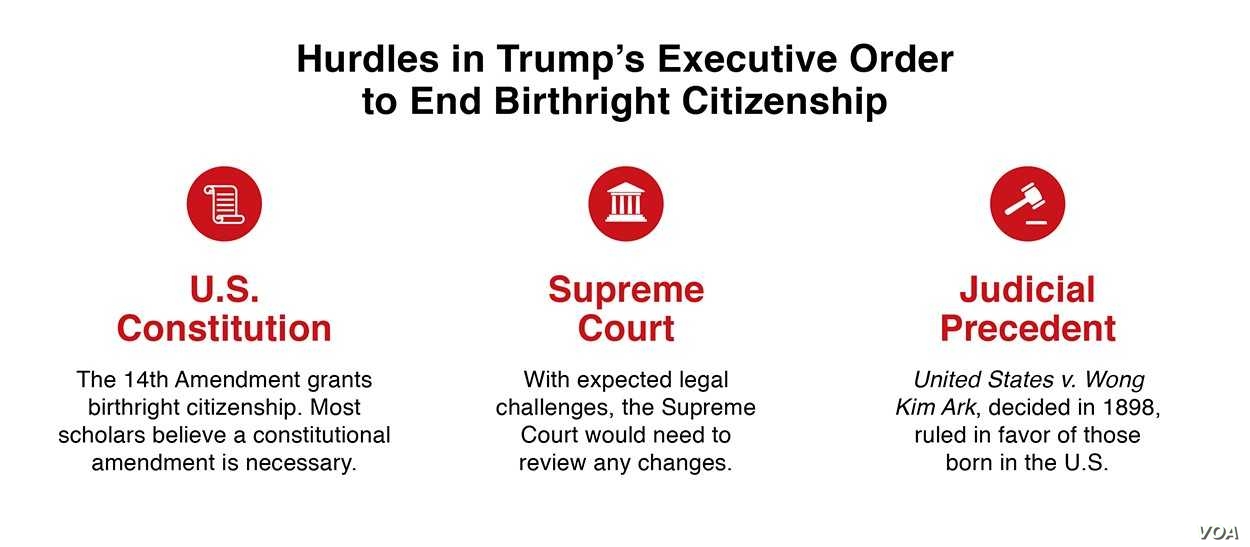
But the citizenship proposal would inevitably spark a long-shot legal battle over whether the president can alter the long accepted understanding that the 14th Amendment grants citizenship to any child born on U.S. soil, regardless of a parent’s immigration status.

Hurdles in President Trump's executive order to end birthright citizenship
Hurdles in President Trump’s executive order to end birthright citizenship

Executive order

James Ho, a conservative Trump-appointed federal appeals court judge, wrote in 2006, before his appointment, that birthright citizenship “is protected no less for children of undocumented persons than for descendants of Mayflower passengers.”

But Trump has said he was assured by his lawyers that the change could be made “just with an executive order” — an argument he has been making since his early days as a candidate, when he dubbed birthright citizenship a “magnet for illegal immigration” and pledged to end it.

There are no figures on how many foreign women travel to the U.S. specifically to give birth. The Center for Immigration Studies, a group that advocates for stricter immigration laws, estimated that in 2012 about 36,000 foreign-born women gave birth in the U.S., then left the country.

Places like Florida have seen in a boom in so-called “birth tourism.” Every year, hundreds of pregnant Russian women travel to the United States to give birth, paying from $20,000 to more than $50,000 to brokers who arrange their travel documents, accommodations and hospital stays. Sizable numbers of women from China and Nigeria also come to the U.S. for the same reason.

Immigrant detention

Trump’s comments Wednesday came as the administration continued to make immigration changes pushed by his hard-line advisers that have been in the works for months. On Wednesday, the Department of Homeland Security announced it had moved to end a longstanding federal agreement that limits how long immigrant children can be kept in detention. The decision will almost certainly lead to a legal battle over the government’s desire to hold migrant families until their cases are decided.

The rule also follows moves last week to broaden the definition of a “public charge” — a burden to the U.S. — to include immigrants on public assistance, potentially denying green cards to more immigrants. There was also a recent effort to effectively end asylum altogether at the southern border.

Source: Trump Again Says He’d End Birthright Citizenship

‘Jihadi Jack’ and the folly of revoking citizenship: Macklin

Understandably, Macklin is the most quoted expert on citizenship revocation:

The British government has just stripped Islamic State recruit Jack Lettsof his United Kingdom citizenship.

In one sense, the move was unsurprising. The U.K. has been the undisputed leader in reviving banishment as punishment for “crimes against citizenship,” deploying it primarily against those deemed threats to national security.

The country’s Home Secretary favours stripping citizenship of nationals already abroad, which has the convenient effect of circumventing legal accountability and human rights impediments to deportation.

The mildly surprising feature of the U.K.‘s decision is that it has opted to make Letts Canada’s problem. Letts is currently being held in a jail in northern Syria after being captured by Kurdish forces in 2017.

Letts’ father is a Canadian citizen and, therefore, his son is a Canadian citizen by descent. As a result, the U.K. can deprive him of citizenship without rendering Letts stateless because he will remain a citizen of Canada.

With limited exceptions, international law prohibits rendering people stateless, though the U.K. plays fast and loose on that front. It strips citizenship from those who are dual citizens as well those who are not, but whom the Home Secretary speculates could, in the future, possibly obtain citizenship from some other country.

It doesn’t much matter to the U.K., really. Once discarded, the former citizen might be executed by drone strike, transferred elsewhere for prosecution or persecution or detained indefinitely by non-state armed forces. Wherever they go, it won’t be back to Britain, and whatever happens to them, they are someone else’s problem. That’s what makes citizenship deprivation, in the language of the British law, “conducive to the public good.”

No espionage or treason

Why another country should bear sole responsibility for a citizen that the U.K. disavows is an interesting question. These are not classic instances of espionage or treason, where the historic narrative underwriting stripping citizenship was that the individual betrayed one state in the service of the other state.

Shamima Begum, a British citizen who joined the Islamic State as a 19-year-old in 2015, was not working for Bangladesh in Syria. Jack Letts was not a Canadian spy.

I speculate that the British government has, until Letts, traded on a tacit understanding that British Muslims with brown skin inherently “belong” less to the U.K. than to some other country where the majority of people are Muslims with brown skin — even if they were born in Great Britain and have never even visited the other country of nationality.

On this view, stripping citizenship merely sends the targets back to where they “really” come from. Citizenship deprivation thus delivers an exclusionary message to all non-white, non-Christian British citizens that their claim to U.K. membership is permanently precarious, however small the literal risk of citizenship deprivation.

Indeed, British legal scholar John Finnis explicitly flirted with a similar idea a few years ago by proposing the “humane” expulsion of all Muslim non-citizens from Britain.

The Letts conundrum

But Letts is white, his parents are middle class and Christian in upbringing (though secular in practice). His other country of citizenship, Canada, is also predominantly white and Christian in origin.

Canada is a staunch British ally, an important diplomatic and trading partner and a G7 member. Queen Elizabeth remains the formal head of state in Canada.

The illogical underpinning of citizenship deprivation now emerges clearly, shorn of implicit appeals to racism, Islamophobia and colonial arrogance. Letts is no more or less a risk to national security in Canada than the U.K. In no sense does Letts “belong” more to Canada than to the U.K., the country where he was born, raised, and that formed him.

The world is not made safer from terrorism when the U.K. disposes of their unwanted citizens in Canada, Bangladesh or anywhere else. The very phenomenon of foreign fighters testifies to that.

Claims that “citizenship is a privilege, not a right” or that the undeserving citizen forfeits citizenship by his actions is flimsy rhetoric intended to distract from the grubby opportunism that motivates citizenship revocation.

The U.K. does this not because it enhances the value of citizenship or makes the world safer from terrorism. It does it because it can.

If the British government thinks stripping citizenship is a good way for a state to respond to the challenges of national security, it must think it’s a good idea for all states. So imagine that Canada also had a citizenship revocation law. In fact, Canada’s Conservative government did enact such a law in 2014 (inspired by the U.K.), though it was repealed by Prime Minister Justin Trudeau’s Liberal government in 2017.

Here is the scenario: Letts, ISIS foreign fighter, is a citizen of the U.K. and of Canada. Neither country wants to claim him. Each has the possibility of revoking his citizenship as long as Letts is not rendered stateless.

The result?

Race to the bottom

An arbitrary race to see which country could strip his citizenship first. To the loser goes the citizen — maybe Canada, maybe the U.K.

This every-state-for-itself race to the bottom is the antithesis of co-operation in a global struggle against radicalizaton and terrorism; one need not be schooled in game theory to recognize it as counterproductive parochialism. Once states contemplate the possibility of being on the receiving end of citizenship stripping, the tactic doesn’t look quite so clever.

Until now, the U.K. has targeted individuals whose other state of nationality lacked the resources or diplomatic heft to challenge the British practice under international law. Maybe it’s time for Canada to step up, and to work with other countries, to pressure the U.K. and other states to abandon citizenship revocation as a means of disavowing “bad citizens.”

The Letts case reminds us that citizenship revocation policies can bite back. Any country that seeks to dispose of their citizens in this way may some day be a disposal site for other countries. If human rights aren’t enough of a reason to abolish citizenship revocation, and undermining global co-operation isn’t enough either, perhaps self-interest can tip the balance.

Source: ‘Jihadi Jack’ and the folly of revoking citizenship

Citizenship [by investment] scheme risks are flagged in EU terror report

Not surprising:

A report about EU-wide money-laundering and terrorism financing risks has again zeroed in on citizenship schemes like the one operated in Malta.

The controversial scheme, introduced by the Labour government after sweeping to power in 2013, allows passport buyers access to an EU passport against payments and investments totalling over €1 million.

Misuse of such schemes, which the European Commission notes are deliberately marketed as a means of acquiring EU citizenship, together with all the rights and privileges associated with it, create a range of risks for the EU.

The Commission’s report was highlighted on the Financial Intelligence Analysis Unit’s website this month.

Among the risks identified by the Commission are the possible infiltration of non-EU organised crime groups, as well as money-laundering, corruption and tax evasion possibilities.

Just last week, Identity Malta, the government agency that runs the scheme, confirmed it had initiated the process to withdraw the Maltese citizenship of Mustafa Abdel-Wadood, who has pleaded guilty to fraud and money-laundering in the US.

Another passport recipient, Chinese national Liu Zhongtian, was recently indicted in the United States amid allegations he avoided paying $1.8 billion in aluminium tariffs.

Concern about lack of transparency and governance of the schemes

The Commission says risks associated with citizenship schemes are exacerbated by cross-border rights associated with EU citizenship or residence in a member state. There is also a concern about lack of transparency and governance of the schemes.

Malta’s scheme has been criticised by the Opposition and international bodies for failing to clearly identify who has bought their passport.

Another problem with EU citizenship schemes identified by the Commission is that the procedure of screening applicants is often outsourced to private companies, where there is a permanent risk of conflict of interest and corruption.

It also raises fears that competition between European Union countries could result in a race to the bottom over standards of due diligence and transparency.

In a direct reference to Malta’s scheme, the Commission says Maltese citizenship is popular with wealthy Russians. Saudi Arabians have also invested in the scheme.

It says one Maltese passport buyer, Waleed al-Ibrahim, chairman of the Middle East Broadcasting Centre, was arrested in November 2017 as part of a corruption purge.

The government insists the scheme complies with the highest standards of due diligence.

Source: Citizenship scheme risks are flagged in EU terror report

Chris Selley: With Jihadi Jack, Britain gives Canada a taste of its own medicine

Good column by Selley. Nails country responsibility:

On Sunday we learned that Jack Letts, known in the British press as Jihadi Jack, is no longer a British subject. Then-home secretary Sajid Javid and then-prime minister Theresa May reportedly approved stripping the alleged ISIL fighter of his citizenship as one of their administration’s final acts and it seems they didn’t even send a telegram. Instead Letts was informed by an ITV News crew interviewing him at the Kurdish prison where he has been held for two-and-a-half years. Now, some fear, he will eventually wind up in Canada: He holds citizenship through his parents.

“Justin Trudeau must assure Canadians today that he isn’t trying to bring Jihadi Jack back to Canada,” Conservative public safety critic Pierre Paul-Hus said in a statement, calling it “naïve and dangerous” to think “anyone who signed up to fight with ISIS can be reformed.”

Paul-Hus does not exaggerate Prime Minister Justin Trudeau’s remarkable rhetorical commitment to rehabilitating ISIL fighters. “Someone who has engaged and turned away from that hateful ideology can be an extraordinarily powerful voice for preventing radicalization in future generations and younger people within the community,” he told CTV’s Lisa LaFlamme in 2017. The Liberals didn’t just revoke the Conservative law allowing dual-citizen terrorists and traitors to be stripped of their citizenship; they made a big, principled show of it. “A Canadian is a Canadian is a Canadian,” Trudeau would gravely intone, explicitly asking audience members to put themselves on the same level as Zakaria Amara, the Toronto 18 ringleader who lost his citizenship under the Conservatives and got it back under the Liberals.

The talking point is altogether ridiculous — Canadian citizenship is stratified according to criteria as basic as whether it can be passed on to foreign-born children — but like it or not, it was a brave stance.

The Liberals seemed less proud of Canadian consular officials making contact with Letts, refusing to comment when CBC got hold of audio tapes and transcripts of their meetings last year. Perhaps that’s because Letts said he would be happy to relocate to a Canadian prison if it would get him out of his current accommodations. Since then, Foreign Affairs seems to have lost interest in his situation entirely. Now, weeks out from an election, the Conservatives have been served a soft-on-terror talking point on a silver platter.

This case hardly illustrates the wisdom of the Conservative and British approaches

To their credit, neither Paul-Hus nor party leader Andrew Scheer has suggested this is a legislative problem. “(Letts is) in prison now and that’s where he should stay. I won’t lift a finger to bring him back to Canada,” Scheer said in a statement on Monday. Perhaps surprisingly, Paul-Hus wouldn’t even confirm to the National Post that a Conservative government would reintroduce the citizenship revocation provision.

Conservative partisans have been more than happy to draw the link, however.

“Under Stephen Harper, dual nationals could be stripped of their Canadian citizenship if they were convicted of terrorist offences. Justin Trudeau changed that law,” the pro-Conservative advocacy group Canada Proud tweeted. “So now, Canada is stuck with this ISIS terrorist.”

Letts hasn’t been convicted of anything, but he could theoretically have lost his citizenship under a different section of the law allowing the minister to seek revocation if he “has reasonable grounds to believe that a person … served as a member of an armed force of a country or as a member of an organized armed group and that country or group was engaged in an armed conflict with Canada.”

This case hardly illustrates the wisdom of the Conservative and British approaches, however. Public Safety Minister Ralph Goodale quite rightly accused the Brits of attempting to “off-load their responsibilities” — Letts was born, raised, educated and lost the plot on British soil. Canada would be no better off at this point with the Conservative-era law in place: It only applied to dual citizens, and Letts is no longer one of those. From a hawk’s perspective, the best-case alternative scenario would be that we had denationalized Letts first, leaving Britain holding the bag. This would arguably be fairer, but surely a never-ending game of terrorist tag with our foreign allies — You’re it! No givebacks! — is a pretty lousy excuse for a national security strategy.

As annoyed as Canadians are right now with the prospect of helping or even housing this cretin, that’s precisely as annoyed as the Conservative legislation was sure to make other countries. That those countries might more often be Jordan or Egypt or Saudi Arabia than the United Kingdom does not redeem the exercise — rather, it raises the question of why we would want any more terrorists running around those countries instead of under close watch here at home. I happen to agree with Trudeau that dealing with our own trash is the right moral and ethical thing to do. But morals and ethics aside, purely as a practical matter, it strikes me as the only sensible approach.

Source: Chris Selley: With Jihadi Jack, Britain gives Canada a taste of its own medicine

And it appears that the Conservatives have no plans to re-introduce citizenship revocation should they win the election:

Mr. Letts’s case has refuelled a debate in Canada over dual citizens convicted of terrorism.

Former prime minister Stephen Harper passed a law in 2014 that gave Canada the power to revoke the citizenship of dual nationals who had been convicted of terrorism, treason or espionage. The Trudeau government reversed the law in 2017 after campaigning on the slogan “a Canadian is a Canadian is a Canadian.”

Despite Mr. Scheer’s opposition to repatriating Canadian foreign fighters, his office said the Conservatives “would not re-introduce grounds for the revocation of Canadian citizenship that relate to national security.” The Conservatives did not explain why Mr. Scheer would not reinstate the law.

Legal experts say the former law, if re-introduced, would likely lead to a legal challenge on the grounds that it would create a two-tier citizenship system.

Audrey Macklin, a law professor and chair in human-rights law at the University of Toronto, said these kinds of citizenship revocation laws encourage an “arbitrary race to see who could strip citizenship of dual nationals first.”

“It’s hard not to recall that Canada had such a law inspired by the U.K. itself but now it finds itself on the receiving end of another state’s practice. It just reminds us that this is a parochial, unhelpful, kind of grubby response,” Prof. Macklin said.

Australian citizenship law change affecting New Zealanders, high commissioner says

Tens of thousands of long-term residents could fail the new test, triggering the deportation process, a parliamentary inquiry heard on Monday.

The new migration rules will give the minister or his or her delegate a new discretionary power to cancel a visa if a person is convicted of certain offences, punishable by a maximum of two years in jail.

Offences include assault, using or possessing weapons, sex crimes or breaching an apprehended violence order.

A person will fail the character test if convicted of one of these offences, regardless of the actual length of the sentence imposed.

The test will also apply retrospectively, meaning the offence to trigger the reconsideration could have occurred decades ago.

New Zealand high commissioner Dame Annette King told the Senate’s legal affairs committee 2014 changes to visa rules which lowered the threshold for cancellations on character grounds had incurred a “disproportionate” impact on Kiwis living in Australia.

New Zealanders made up 10 per cent of the foreign born population but 50 per cent of deportations.

By comparison, only 1 per cent of New Zealand’s deportations were Australians.

“We don’t believe our community is less safe than Australia’s,” Dame Annette said.

She said Australia’s tightening migration rules had “become a rub and corrosive to our relationship”.

She urged the government to revert to the pre-2014 rules.

“If that is not possible we would like special consideration of New Zealanders living in Australia, because of the relationship, it is not like any other relationship,” Dame Annette said.

The Law Council of Australia also raised concerns that previous expansions of the power had not only led to more deportations, but greater ministerial intervention.

The number of via cancellations on character grounds rose by 1400 per cent between 2013 and 2017, the council said,

“The character test expansions have led not only to more cancellations but also a greater use of the minister’s personal powers, not only through section 501 but also through section 195A, which enables the minister to grant visas to detainees even where a section 501 cancellation has taken place,” its submission said.

“This is an inefficient use of ministerial time. Detainees must remain in prolonged detention while the department and the minister consider such matters.”

But Department of Home Affairs officials said the new rules were required to set an “objective, transparent” threshold for visas to be cancelled.

“I’d like to be clear that the consequences of not meeting this subjective threshold is that there would be further consideration of a discretionary power to refuse or cancel a visa where a non-citizen is convicted of a designated offence,” acting first assistant secretary of the immigration policy division, Michael Willard said.

“It’s important to note the conviction itself does not result in the automatic cancellation of the visa or a refusal of the visa and there’s a separate process for consideration of using this discretion that delegates or the minister would undertake.”

Head of the community protection division, Sachi Wimmer, said while it was impossible to say how many of Australia’s 1.9 million permanent visaholders would be captured by the changes, the department was bracing for an increase in referrals.

Source: Australian citizenship law change affecting New Zealanders, high commissioner says

‘Naïve and dangerous’: Conservatives blast Liberal policy after U.K. strips ‘Jihadi Jack’s’ citizenship

Of the many articles on Jack Letts, I picked this one, given the Conservative’s implementation revocation provisions is C-24. During parliamentary hearings on C-24 (and the subsequent repeal under the Liberals in C-6), the risk of “beggar the neighbour” approaches between countries was raised by Audrey Macklin among others.

So no surprise that it has happened, and from an overall security perspective, offloading a suspected terrorist to another government, does not increase security. That Britain did so, when Letts only has a formal connection to Canada, having been raised and grown-up in the UK, only makes it worse.

Conservative leader Scheer did not include citizenship issues when he unveiled his immigration policy a few months ago:

The Conservatives on Sunday renewed their condemnation of the Liberal government’s position on citizenship rights for terrorists, following news that U.K. officials had stripped former ISIL member Jack Letts — known as “Jihadi Jack” — of his British citizenship.

Conservative public safety critic Pierre Paul-Hus did not commit to overturning a policy introduced by Prime Minister Justin Trudeau in 2015 that would prevent Canada from making a similar move, but said the Liberal government must fight to keep Letts out of the country. 

“The idea that anyone who signed up to fight with ISIS can be reformed is naïve and dangerous to the safety of Canadians,” Paul-Hus said in a statement on Sunday. Justin Trudeau must assure Canadians today that he isn’t trying to bring Jihadi Jack back to Canada.”

Public Safety Minister Ralph Goodale on Sunday confirmed reports that the United Kingdom had revoked Letts’ citizenship, saying in a written statement that Canada was “disappointed” by the move, and accusing Britain of trying to “off-load their responsibilities.”

The move means that if Letts is deported, he would become the sole responsibility of Canada.

The issue might have set off a behind-the-scenes diplomatic row between the two countries, according to media reports and private emails from Canadian consular officials unearthed by the National Post. It could also refuel debate over whether Ottawa should be allowed to revoke dual citizens of their status as Canadians if convicted of terrorism, treason or espionage.

Letts, who was dubbed “Jihadi Jack” by British media, is being held by Kurdish forces in northern Syria. The longtime U.K. resident, now 24 years old, converted to Islam at a young age and eventually left the country to join the extremist organization, eventually settling in the ISIL stronghold of Raqqa. He was arrested and imprisoned in 2017.

His entire family are dual British-Canadian citizens, including his father, John Letts, who was born in Ontario, and his U.K.-born mother, Sally Lane.

In June, Letts’ parents were found guilty of funding terrorism after they wired their son money in a bid to help him escape an ISIL-controlled region of Syria.

The court heard that a member of Letts’ mosque in the U.K. had warned the parents that their son might have been radicalized, and that they should take away his passport as a way to protect him. But Letts and Lane reportedly ignored the advice and bought him a plane ticket to Jordan in 2014 for a “grand Middle East adventure,” according to one recollection of events.

According to media reports, Letts became known to authorities after a spate of violent Facebook posts, in which he said he would “happily kill each and every one” of the members of a British military regiment of which a former schoolmate was a member.

There is no clear evidence whether Letts personally carried out any violent acts during his time with ISIL.

Citing private emails from Global Affairs Canada, the National Post reported last October that Canadian consular officials had been in contact with Letts’ parents for months. The officials went as far as to discuss possible escape routes for Letts out of Syria, and assured his parents they were “working diligently on your son’s file,” according to the emails.

But their tone shifted abruptly in early 2018, the emails show, leading the family to believe that British officials had struck down those efforts behind closed doors.

The diplomatic spat could refuel a long-standing debate in Canada. Because international law prevents governments from making anyone “stateless,” only people with two passports can have their citizenship stripped.

In 2014, former prime minister Stephen Harper amended the Citizenship Act to allow Canada to strip the status of any dual citizen who is found guilty of terrorism, among other things. The Liberal government under Trudeau reversed that decision in a bill that passed through the Senate in 2017.

Some experts say efforts by Britain are counterproductive and run afoul of human rights laws.

“I think there’s a real question here as to whether Britain is violating international law by doing this, and whether Canada could seek to hold the U.K to account,” said Audrey Macklin, a human rights law professor at the University of Toronto.

Macklin said moves to render people stateless can in turn stymie efforts to snuff out terrorist organizations.

“If you are serious about global co-operation in combatting terrorism, you would realize that citizenship stripping is inimical to that,” she said. 

Trudeau is due to meet the new British prime minister, Boris Johnson, at a Group of Seven meeting in France that starts on Aug. 24.

British Foreign Secretary Dominic Raab met Canadian Foreign Minister Chrystia Freeland in Toronto earlier this month. The two ministers discussed Letts during the visit, yesterday’s statement from Goodale’s office said.

“While we are disappointed in their decision, we do not conduct tit-for-tat diplomacy. Canada and the U.K. continue to work closely together on a number of issues, including the situation in Hong Kong,” the statement added.

Source: ‘Naïve and dangerous’: Conservatives blast Liberal policy after U.K. strips ‘Jihadi Jack’s’ citizenship

Sensible commentary by Doug Saunders:

The Easter Sunday atrocities in Sri Lanka have not only brought horror to the island’s tiny, impoverished Christian community and threatened an end to the country’s decade of unsteady peace. They’ve also struck fear in the governments and security agencies of many countries, including Canada, which have been struggling to deal with a steady trickle of their citizens seeking to return home from Syria and Iraq.

We don’t know whether reports are true that two or more of the Sri Lankan terrorists had gone to Syria to fight with the terrorist army that calls itself Islamic State (also known as ISIS, ISIL and Daesh), and returned after that organization’s self-proclaimed caliphate was crushed and defeated last year. It is clear, however, that the attacks are linked to a desire among some of that organization’s former fighters to bring revenge to their own countries.

There are currently several hundred European, U.S. and Canadian alleged IS fighters being held in northern Syria by the Kurdish-led Syrian Democratic Forces (the number of Canadians may be as low as 10). Whether they should be returned to their home countries is the subject of an intense international debate.

Some have suggested stripping them of their citizenship – which was a legal option, rarely if ever applied, under Stephen Harper’s Conservative government – thus making them the responsibility of some other country. Others wonder why we should be responsible for investigating and trying Canadians who allegedly have committed grave crimes abroad; in other circumstances, they’d be tried and sentenced in the place where their crimes took place.

But they are, ultimately, our problem. They aren’t foreign – almost all the Canadians accused are Canadian citizens born here to Canadian families, and their radicalization took place here, in the dark corners of Canadian society. To attempt to dump them on another country, or on a poor and struggling Kurdish-led Syrian democracy movement that has already been betrayed by Canada and its allies, would be both immoral and dangerous.

There are good reasons why nobody is eager to see them returned. The probability of any returned foreign fighter committing violence is low – a 2015 study found that only 0.2 per cent of returned fighters, or one in 500, had been charged with terrorism offences. The return of IS fighters has not produced the wave of attacks that many had anticipated. But the few who do maintain their violent commitments are noted, in the words of a study published last year by the United Nations Security Council, for their “increased lethality, both as attackers and as attack planners,” making them responsible for “some of the most lethal terrorist attacks.”

But the flaw in the citizenship-stripping approach becomes apparent when you take a close look at those who have dual citizenship, and would therefore be eligible.

Typical of them is Syrian detainee Jack Letts, who holds both Canadian and British citizenship. Neither Canada nor Britain wants him back. Political leaders in both countries have suggested revoking his citizenship – and thus dumping his case, and the considerable security and justice costs associated with his case, on the other country.

As a result, he waits in Syria. If he is guilty of atrocities or war crimes – and simply being a member of IS could qualify as one – neither country is willing to expend the investigative and judicial resources to prove it and bring him to justice. If he is innocent, as he claims, neither country is willing to try to clear him.

The Kurds have made it clear that they do not want hundreds of people such as him on their hands. Ilham Ahmed, a leader of the Kurdish-led SDF, says it is straining their resources just to hold people such as him. “We have provided the support we can by arresting them and detaining them in prisons, but who is going to take them to court?” she told the Financial Times. “Who is going to [be] carrying out the prosecution?”

Another horrific news story this month illustrated the risk of not taking these people back. Germany is currently trying a 27-year-old woman from Lower Saxony known as Jennifer W. for allegations that she, as an IS “morality policewoman” in Syria, tortured a 5-year-old Yazidi slave girl to death. Prosecutors consider themselves lucky to have found a phone containing what they say are incriminating messages.

If kept in Syria or foisted on another country, she would never have been charged. Trials such as hers are expensive, difficult and risky, but the expense is necessary, and the risk would be greater if these people were left at large. Some of them may be the world’s worst people, but they are our people. If they are truly to be brought to justice, or at least kept under watch so they pose less danger, it is far more likely to happen here.

Source: Canadian extremists returning from Syria are a big problem – but they’re our problem

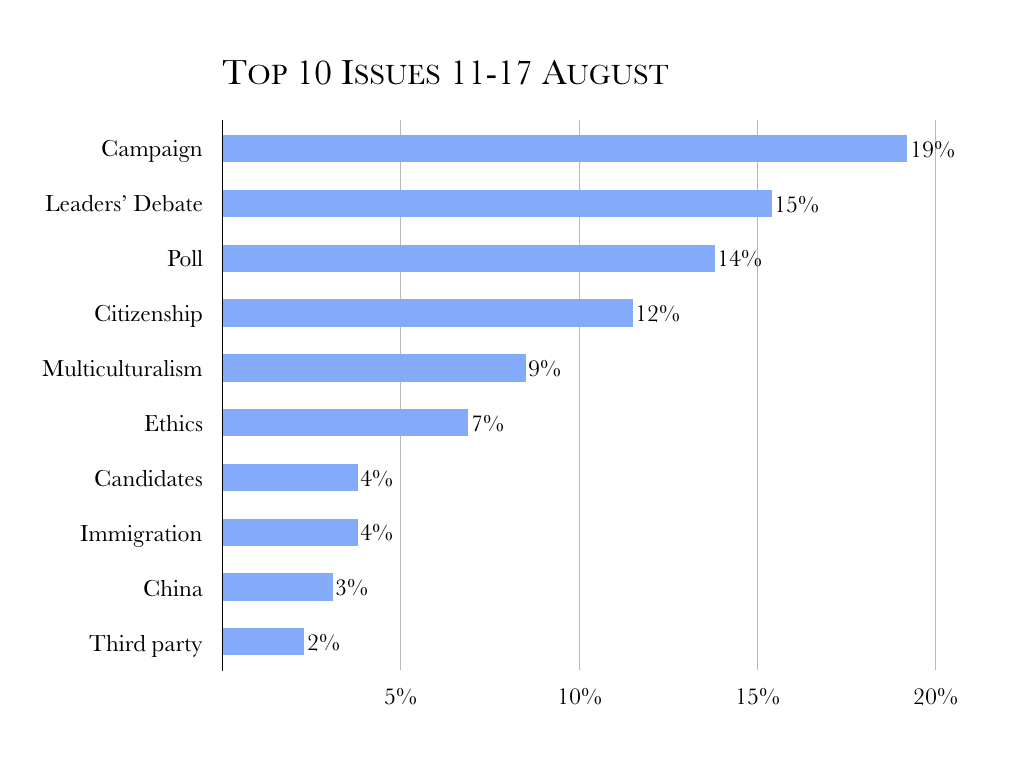
Ethnic Media Coverage 11-17 August

Latest weekly analysis of ethnic media coverage. For the analytical narrative, go to diversityvotes.ca Ethnic media election coverage 11-17 August 2019:

Canadians in Hong Kong urged to vote in federal election with an eye on party policies toward territory and China

Interesting that virtually all of the advocates quoted are non-Chinese Canadians. The one Chinese Canadian quoted makes the most sensible comment that his vote won’t be this single issue.

Given the large number of Canadian expats in Hong Kong, Richmond BC was a possible example where Chinese Canadian expats could influence the election result in that riding.

We will see whether the indefinite extension of voting rights for expats results in a significant increase in expat voting (only 15,603 registered in 2015 of whom 10,707 valid votes cast):

 As Hong Kong wrestles with its worst political crisis in years, Andrew Work wants the hundreds of thousands of Canadians living there to know they have a new chance to help elect a government in Ottawa that will represent their interests.

Mr. Work, president of the Canadian Club in Hong Kong, is organizing a voter-registration drive to urge some of the estimated 300,000 Canadians who live in the city to cast their ballots in the coming federal election in Canada. Previously, Canadians who had lived outside Canada for more than five years were barred in theory from voting under legislation from the early 1990s, That law was only loosely enforced. In response to a Harper government’s attempt to enforce that law, however, the Supreme Court ruled this January that all non-residents have the right to vote, no matter how long they have lived elsewhere. The Liberal government also passed legislation last December extending voting rights to all non-resident citizens.

“I am sure for some people, they will very much have [Hong Kong’s political turmoil] on their mind as they would look carefully at Canadian policies towards China and Hong Kong as part of their voting calculation,” Mr. Work said in an interview from Hong Kong.

“Ten years ago, that wasn’t the case. Now that Hong Kong is on the front page of newspapers everyday around the world, including Canada, Canadians of all types will have Canada’s policy on their mind.”

Ghislain Desjardins, a spokesman for Elections Canada, Asia, said earlier this week that there are 628 voters registered on the International Register of Electors in 198 different electoral districts. The agency doesn’t have country-specific numbers.

Hong Kong has been racked by months of protests by demonstrators angry at what they see as the Chinese government’s increasing incursion into the semi-autonomous territory’s affairs.

Barrett Bingley, originally from Victoria, now works as the North Asia sales director for The Economist in Hong Kong. He said the protests are having a devastating effect on the people who work for him.

“I have many staff who I worry about now,” he said. “I had staff who had been tear gassed; staff who were not protesting who were tear gassed … We have staff who are experiencing psychological issues. We have to make sure they’re well taken care of.”

When casting his vote in the Canadian election, he said he’ll be considering which political leader is willing to take a strong stand to protect the “one country, two systems” philosophy that China promised when it took possession of the territory from Britain in 1997. The arrangement allows Hong Kong its own laws for 50 years.

The recent weeks’ increasing violence in Hong Kong have made him concerned about his and his family’s safety. He said both Australia and British consulates sent representatives to Hong Kong’s airport, where some of the latest demonstrations took place. He said the Canadian consulate should be doing more to safeguard its citizens.

Instead, Mr. Bingley said he has been watching the Canadian government “say virtually nothing” on the issue except for a “soft statement” made by the Prime Minister Justin Trudeau earlier this week.

On Monday, Mr. Trudeau told the media that the government is “extremely concerned” about the situation in Hong Kong and called on Beijing to be “careful and respectful” in its handling in this crisis.

“We need to see the local authorities listening to the very serious concerns brought forward by Chinese citizens and their concerns around the decisions that the local authorities in Beijing have taken,” he said.

Mr. Bingley said he prefers the statement issued by Conservative Leader Andrew Scheer, who wrote on Twitter: “As Beijing amasses troops at the Hong Kong border, now is the time for everyone committed to democracy, freedom, human rights, and the rule of law to stand with the people of Hong Kong, including the 300,000 ex-pat Canadians. Now, and in the coming days, we are all Hong Kongers.”

Montreal-born Jean-Christophe Clement has been living in the city for a decade and has participated in the protests. The employee of a finance software vendor, 49, recently registered to vote and said a federal party’s position on what’s happening in the region would “almost entirely set the tone” for his voting decision.

He said he would cast his vote for a politician who is “in support of the protection of rule of law and democracy in Hong Kong.”

Although escalating tensions in the city haven’t affected his daily life much, he said the China’s People’s Armed Police exercising in Shenzhen, on the border with Hong Kong, worries him.

“My concern would be PLA comes in and there’s martial law.”

Paul Evans, professor in the School of Public Policy and Global Affairs at the University of British Columbia, said Mr. Scheer’s invocation of Cold War imagery of Berlin and the rallying cry of democracy, human rights and the rule of law will likely appeal to some.

But from his own experience in Hong Kong, he said people in the region are more realistic about the limited options that the territory has operating in its Chinese context, and the ability for other countries to have an impact.

For some other Canadians in Hong Kong, candidates’ domestic policies will weigh more in their votes.

Nathaniel Chan, who grew up in Toronto, said politicians’ positions on the Hong Kong issue have “no bearing” in his ballot.

“I think when we vote in a national election, it should be mostly about the standard of living for people in Canada or policies that affect all Canadians.”

Mr. Desjardins of Elections Canada said they sent 857 ballot kits to international electors in Asia during the last election, but the agency does not provide data on the number of ballots returned, for security reasons.

The agency conducts outreach through a small digital ad campaign targeting electors abroad, according to Mr. Desjardins, and also places posters at embassies and consulates with information on voting.

It’s not enough, Mr. Bingley said.

“What hasn’t been in Hong Kong so far though is there hasn’t been a campaign by the federal government, by the consulate to get Canadians registered and to explain how to do it,” Mr. Bingley said.

“There needs to be concerted information campaign of how to do this.”