Ethnic media election coverage 22-28 September
2019/09/30 Leave a comment
Latest weekly analysis of ethnic media coverage. For the analytical narrative, go to Ethnic media election coverage 22-28 September:

Working site on citizenship and multiculturalism issues.
2019/09/30 Leave a comment
Latest weekly analysis of ethnic media coverage. For the analytical narrative, go to Ethnic media election coverage 22-28 September:
2019/09/28 Leave a comment
Yet another article based upon the latest CIHI data, highlighting some payment issues:
Birth tourism needs to be curtailed by the federal government as the Canadian health care system is “struggling to meet the needs of our own citizens,” says Dr. Kathleen Ross, president of Doctors of B.C.
Births by non-residents seeking to get instant Canadian citizenship for newborns now accounts for about a quarter of all deliveries at Richmond Hospital, according to the latest federal data, but the issue is not getting any attention from political parties even with the federal election in full swing.
In the past six months, Ross has delivered two babies to birth tourists at Royal Columbian Hospital and in both cases, they left the hospital without paying her fees. Ross would not disclose which country the patients came from but said they have ignored multiple invoices sent “after the fact” to the addresses they supplied. The physician fee for vaginal deliveries ranges between $600 and $1,500.
B.C. hospitals ask for deposits when non-residents register, $13,300 for a caesarean section and $8,200 for a vaginal delivery. But those fees are for hospital costs only and physicians who work on a fee for service basis, as do many of those who deliver babies, have great difficulty collecting their separate fees from birth tourists. Occasionally, hospital lawyers have to sue foreign patients in a bid to be paid.
Ross said it is clear that some birth tourists have “no intention” to pay their bills and doctors in many provinces are starting to talk about how to address the problems. She said the federal election campaign is a perfect time to start talking about the fact that if Canadian citizenship weren’t so easy to obtain in such a way, it is doubtful the numbers of birth tourists would be going up the way they are.
“We’re at a crisis, a tipping point, so it’s really important that some higher authority takes this on,” Ross said. “Hospitals and doctors have no option but to provide service. We can’t turn people away if they are sick, injured, or in labour.”
The federal Conservatives flirted with a potential clampdown on birth tourism in the past and the current Liberal government has said it was studying the matter, but no leader has commented during the current campaign about potential changes.
Data for the last fiscal year provided by the Canadian Institute for Health Information (CIHI) shows that eight of the top 10 most popular hospitals for non-resident births are in Ontario, with the other two in B.C. Births to non-resident mothers, a category which also includes international students and other non-permanent residents who are expected to pay for their medical and hospital services, are also growing in frequency in Alberta.
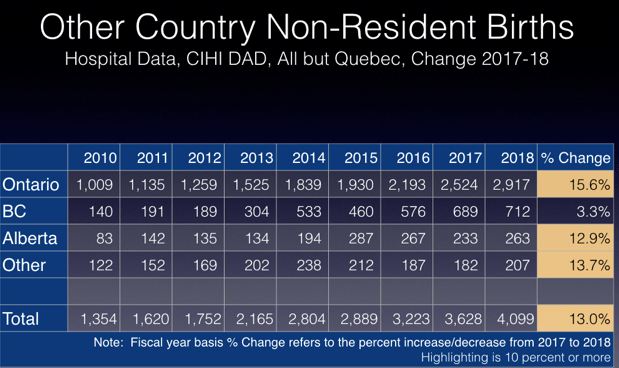
Across Canada, CIHI hospital discharge data shows there were 4,099 births to non-residents in 2018/19 (excluding Quebec), compared to 3,628 the year before. While the number has been increasing every year for the past decade at least, non-resident births still account for only about two per cent of all births in Canada.
However, at Richmond Hospital last year, they accounted for 23.1 per cent of all births and at St. Paul’s Hospital in downtown Vancouver, they accounted for 10.3 per cent of all births.
Andrew Griffith, a fellow at the Environics Institute and the Canadian Global Affairs Institute, said 454 non-resident women delivered babies at Richmond Hospital in 2018/19 and 139 women gave birth at St. Paul’s Hospital. And the number of babies may even be higher than the number of women because some deliveries involve multiple babies.
Griffith noted that across Canada, non-resident births rose 13 per cent in the last fiscal year, a rate that is higher than both immigration and overall population increases. The number of non-resident births in B.C. rose 3.3 per cent overall; at St. Paul’s, they rose by 12.9 per cent from 2017/18 to 2018/19 and at Richmond Hospital, the increase was 5.6 per cent. At one hospital in Ontario, the increase was as much as 49 per cent.
Griffith said it is too early to say whether Ontario and Alberta are going to supplant B.C. as the favoured destinations for birth tourism.
“In general, I prefer to have two years of data before knowing whether this is a shift or simply a one-year anomaly. But it is significant I think that Richmond seems to have stabilized,” he said, adding that it has traditionally accounted for nearly three-quarters of all non-residents births in B.C. Indeed, there are numerous websites marketing services to Chinese women and dozens of birth houses in Richmond, catering to the needs of women coming here to have their babies.
An Angus Reid poll done early this year showed that 64 per cent of Canadians were opposed to granting automatic Canadian citizenship to babies born to birth tourists and an almost equal proportion wanted to see laws changed.
Source: Birth tourism needs to become an election issue, says president of Doctors of B.C.
2019/09/25 Leave a comment
Not seeing much resonance outside of Richmond and it does not appear that the CPC is wedded to its policy resolution given their immigration critic Michelle Rempel’s comments (Michelle Rempel Garner on Twitter: “3/ I would hope that all …https://twitter.com › michellerempel › status):
On the streets of Richmond, an immigration topic on people’s lips for years has been “birth tourism.”
The practice — where pregnant women travel to a foreign country to give birth, thereby guaranteeing their baby automatic citizenship — has been rising steadily in the city, whose hospital is considered “ground zero.”
Under Canadian immigration law, birthright citizenship is law. But some in the city say people are increasingly taking advantage.
One woman, Kerry Starchuk, has made it her mission to bring an end to birth tourism. She has submitted two online petitions to the federal government since 2016, arguing more needs to be done to clamp down on the practice.
“It is undermining our citizenship,” she said. “Everyone comes through the front door and they work very hard to come here. This is undermining the system.
“People are lying to border guards and not saying why they’re coming here, and coming to stay at places that are unregulated. If we want a healthy community, everyone needs to contribute to being on board.”
Starchuk says several homes in Richmond are being advertised on Chinese websites and Instagram accounts as so-called “baby houses,” where families can rent rooms in advance of their hospital visit.
“We have given the wrong messages by not addressing the issue, so now there are even more operators bringing birth tourism into Richmond,” she said.
Starchuk’s first petition was sponsored by Alice Wong, the longtime Conservative MP for Richmond Centre, and gained more than 8,800 signatures — 5,100 of which came from B.C.
A second petition in 2018 was signed over 10,800 times, again with a majority coming from B.C.
That petition’s sponsor was Liberal MP Joe Peschisolido, whose riding of Steveston-Richmond East sits just east of Richmond Hospital and contains several neighbourhoods where “baby houses” have popped up.
“Birth tourism undermines both the integrity of our immigration system, as well as the integrity of our health care system,” he said. “It’s a business, but it’s an illegitimate business.
“What you have are unscrupulous businesspeople who are making money off our generosity … and that has to stop.”
The petition called on Ottawa to not only declare it doesn’t support birth tourism and study its full extent and effects, but also move towards policies that would dismantle businesses that promote the practice.
Peschisolido says the government in the process of adopting all three of those requests, but admits it’s taking time.
“We have to quantify it and come up with numbers to see what it is, what’s occurring, what kind of problems are involved,” he said. “Then we have to come up with a plan to shut down the industry, and that’s what we’re in the process of doing.”
Numbers increasing
While Statistics Canada data has reported relatively small numbers of births by nonresidents based on birth registrations — just 313 across Canada in 2016 — new studies have shown birth tourism could be much more widespread.
A 2018 Policy Options study that looked at the number of births through hospital discharge data from the Canadian Institute for Health Information (CIHI) found 3,223 cases that same year, more than five times the number from Statistics Canada.
Andrew Griffith, a fellow of the Canadian Global Affairs Institute who was behind the report, says that number has only continued to increase, to 3,628 in 2017 and 4,100 in the last fiscal year, which ended in March.
“That represents a 13 per cent increase year over year, which is quite significant,” he said, while noting the number still represents less than two per cent of all births in Canada.
Griffith acknowledged the data includes all births to nonresidents, including those temporarily living in Canada on student visas, and it’s difficult to tell in each case whether birthright citizenship was a motivating factor.
The CIHI information shows while B.C. may actually lag behind Ontario in the number of births to nonresidents — 689 in 2017, compared to more than 2,000 in Ontario — Richmond Hospital continues to outpace all other hospitals in the country.
In 2017-18, the B.C. hospital saw 469 births to nonresident mothers, accounting for more than 21 per cent of all births there. The next closest figure comes from Scarborough and Rouge Hospital in Ontario, with 163 nonresident births, representing 9.5 per cent of total births at the hospital.
Griffith’s report recommended financial action against nonresidents attempting birth tourism to discourage it, such as hospitals requesting substantial deposits from nonresidents.
Peschisolido says all options are being considered, but pointed to a $52-million government investment meant to help RCMP crack down on “baby houses” as a “good first step.”
Campaign issue
An Ipsos poll conducted in January for Global News found more than half of Canadians surveyed either tend to agree or strongly agree that Canada is too welcoming to immigrants.
In March, an Angus Reid Institute poll suggested 64 per cent of Canadians disagree with the country’s birthright citizenship laws, with 60 per cent calling for stricter laws against birth tourism.
But responses to Starchuk’s two petitions have suggested Ottawa has no plans to get rid of the law, despite admitting birth tourism is a problem that needs addressing.
“While there may be instances of expectant mothers who are foreign nationals who travel to Canada to give birth, requiring that a parent be a citizen or permanent resident in order for their child to acquire citizenship through birth in Canada would represent a significant change to how Canadian citizenship is acquired,” then-immigration minister John McCallum said in response to the 2016 petition, which was ultimately rejected.
Current Minister of Immigration Ahmed Hussen made similar points in response to the 2018 petition, but pledged to study the issue more closely.
Peschisolido, who was first elected to the new Steveston-Richmond East riding in 2015, says he plans to make the issue a key promise in his re-election bid.
“If I’m blessed and fortunate enough to be re-elected … I’m going to be pushing very hard to not only undermine birth tourism, but ultimately stop it and eliminate it,” he said.
Conservative candidate Kenny Chiu and Green candidate Nicole Iaci did not make themselves available for interviews.
At their most recent convention, Conservative Party members vowed to bring an end to birth tourism.
In a statement, NDP candidate Jaeden Dela Torre said the problem is concerning as it related to the health care system, but said any policies that crack down on birth tourism must come with careful considerations.
“We must not use this issue as a way to divide Canadians and fan the flames of racism and xenophobia,” she said.
“We’re reviewing all facts to come up with a fair and compassionate solution that protects health care services for all Canadians.”
Starchuk says she’s been in touch with many of the candidates, but has yet to see the action that Peschisolido has promised.
“I don’t trust anyone right now, because nothing has been resolved,” she said. “It’s a growing issue, but I haven’t seen anyone do anything.”
Source: major issue in the lead up to the Canadian elections
2019/09/25 Leave a comment
??:
Armenian Prime Minister Nikol Pashinyan talked about the idea of repatriation during a meeting with the Armenian community in Los Angeles.
“I would like to talk about the idea of a big repatriation. Today many Armenians already return to Armenia. Today we released statistics, which is being made from time to time. Compared to 2015 the positive balance of Armenia’s border crossings increased by 32 times. But I want to speak about the great repatriation, stating that living in Armenia doesn’t mean living just physically. Living in Armenia also means to live with Armenia, and I believe that most of you have always lived in Armenia and today as well live in Armenia because I see and know that you live with Armenia and this is the most important. But on the other hand I want to state that living in Armenia doesn’t mean to be physically in Armenia for 12 months a year or in general in the 21st century living in any country doesn’t mean to constantly live in the same place for 12 months a year”, the PM said.
He stated that in the contemporary world many people, especially the successful people spend most of the year in travel. “And I want to address a message to our compatriots: great repatriation means, for instance, to live physically in Armenia definitely for a month, two months a year. Today the real estate prices significantly increase in Armenia and Yerevan, and having a house in Yerevan, Armenia, means to make a very good and reliable investment, and every Armenian who does not yet have a house in Armenia should have one. Repatriation means to have a business in Armenia, and the most important is to have a citizenship of Armenia. Every Armenian should have a citizenship of Armenia.
Source: Every Armenian should have a citizenship of Armenia – Pashinyan on repatriation
2019/09/25 Leave a comment
Of note:
IT is not difficult to guess that Aisha and Anis are sisters. They share a striking physical resemblance reflecting the Malay origin of their mother and Mauritian origin of their father.
Yet, it takes a bureaucrat to disrupt the unity of nature’s order.
For Anis is a Malaysian citizen, while Aisha, her older biological sister, has been struggling to obtain a citizenship without success.
Their mother, Siti Haniza, shook her head as she narrated the bureaucratic trauma she underwent trying to get her daughter to be granted her birth-right — which is to be registered as a Malaysian.
Her mistake, as an official had explained to her, was firstly to deliver their first child in Mauritius, and then having failed to fly 3,000km to South Africa to register her birth within the first month of her child’s birthday.
That was where the nearest Malaysian consul was located.
Unspoken in that narrative was her mistake of marrying a non-Malaysian and having children with him. That same situation would not have happened if Aisha’s father had been a Malaysian and her mother a non-Malaysian.
The rules and regulations of citizenship are gender-biased and discriminatory to Malaysian women. According to the Campaign for Equal Citizenship, Siti is not alone and her ordeal is shared by thousands of other Malaysian women.
The campaign, led by the Foreign Spouses Support Group, had raised awareness about this dismal situation by cataloguing real-life examples from around the world.
For Malaysian men with non-Malaysian wives who deliver in foreign lands, they need only notify the nearest Malaysian embassy for their children to be granted the necessary citizenship documents.
In contrast, Malaysian women with non-Malaysian husbands in similar situations would have to clear a higher standard by applying for their children to be recognised as citizens.
There is no guarantee that their child would be deemed a citizen.
The Campaign for Equal Citizenship documents the negative effects of such discrimination on Malaysian women.
It is highly stressful and disrupting to family life when family members have to undergo uncertainties with respect to the ability to enter the country and travel.
Or when husbands are separated from their wives and children for extended periods as a result of the bureaucratic process.
Children are denied access to services and job opportunities, while family relations become difficult to maintain and become brittle.
When asked about this apparent double standard, Siti responds firmly, “No matter where she was born, my daughter is every inch as Malaysian as I am.
“She comes from a long and illustrious family of civil servants who have served passionately and diligently to build the Malaysia that we are so proud of today.”
She continued, “Her forefathers were freedom fighters who fought against colonialism and suffered for it. Yet, my country has not reciprocated this legacy with empathy nor compassion.”
Malaysia is currently one of only 25 countries globally, and one of four countries in the Asia-Pacific region, which has discriminatory citizenship laws.
Malaysia does not recognise mothers as equal parents by law, as the Federal Constitution expressly provides that children born overseas to married Malaysian fathers are entitled to citizenship by operation of law (Article 14(1)(b) but is silent on children born overseas to Malaysian mothers.
Consequently, the process for registering children born overseas as Malaysian citizens is far more arduous for Malaysian women, making them feel like second-class citizens.
This law is deeply rooted in patriarchy which allows for sexist attitudes that influence the applications process.
These women are expected to follow their husband’s citizenship, live overseas and not enjoy the option for their children to choose their nationality.
Yet such a law is out of sync with the reality of Malaysian women today.
Malaysian women are among the most educated in the region, with high rates of labour participation and they play important leadership roles in both the public and private sectors.
Malaysia’s impressive economic transformation could not have been achieved without the important contributions of her women. Yet the country is unable to recognise this by discriminating against her bloodline.
Because of the painful experience with her first-born, Siti decided to deliver Anis in Malaysia and use her family network to ensure that her second daughter’s birth right to citizenship was not denied.
She now has two daughters with two different nationalities.
Siti laments: “It pains me to realise that Aisha would not be able to continue the family tradition of joining the civil service and serve Malaysia.”
She is also concerned that Aisha’s employment prospects would be significantly constrained without her Malaysian citizenship.
In May 2018 Malaysia showed the world that it had the capacity to change, to remove the kleptocrats ruining the country, in order to make the country a better place for all its citizens.
This sense of inclusivity needs to be extended also to Malaysian women and their genetic right to determine the citizenship of their children.
2019/09/24 Leave a comment
The scam continues:
Greek Cyprus rakes in 914 million euros annually by awarding citizenship to so-called investors, the second most lucrative golden visa program in the European Union, despite strong concerns voiced by EU leadership over its vetting methods.
Berlin-based Transparency International said in a report in October 2019that the Greek Cypriot administration had raised 4.8 billion euros from its golden visa scheme. According to the report, only Spain raises more annually with Spain 1 billion euros per year from applicants.
German journalist Michael Martens of the Frankfurter Allgemeine Zeitung put Greek Cyprus’ earnings at a higher figure, reporting Sunday that the administration had earned over 6.5 billion euros in the past five years.
The visas give purported investors the right to settle in any EU country and have been criticized as a gateway to Europe not only for the super-rich but also for money launderers and other exploiters. The Greek Cypriot scheme is particularly lenient in its requirements of applicants.
Within the EU, only Greek Cyprus, Bulgaria and Malta do not require physical residency or any other connection to the country to grant citizenship to so-called investors – in violation of EU law, according to the European Council.
Only Greek Cyprus and Portugal do not ask applicants about the source of their wealth, despite the large quantities of money involved in the process.
In January, the European Commission published a report expressing concern over Greek Cyprus’ citizenship scheme, stating that the lack of thorough checks on applicants endangered the EU’s financial and physical security.
“These schemes are of common EU interest since every person that acquires the nationality of a Member State will simultaneously acquire Union citizenship. The decision by one Member State to grant citizenship in return for investment, automatically gives rights in relation to other Member States, in particular free movement and access to the EU internal market to exercise economic activities as well as a right to vote and be elected in European and local elections,” the report wrote.
It criticized the schemes as being “deliberately marketed and often explicitly advertised as a means of acquiring EU citizenship.”
The report listed the main areas of concern regarding Greek Cyprus to be lack of security checks on applicants, insufficient monitoring against money laundering and tax evasion, and lack of transparency about how the scheme is run.
The Organisation for Economic Co-operation and Development (OECD) had also cited Greek Cyprus’ golden visa scheme as high-risk for abuse of international tax rules in a November report.
The Greek Cypriot administration responded in February to the report by promising more thorough checks on applicants and adding the requirements of a Schengen visa and rejection of applicants that have been rejected by other EU states. It also said 75,000 euros from each applicant would go to “research and development” and that other funds would be allotted for an affordable housing scheme for Greek Cypriots.
However, the Greek Cypriot administration admitted that the program has not done much toward its professed goal of attracting investors to Greek Cyprus. Greek Cypriot Finance Minister Harris Georgiades revealed in February that the scheme has only contributed 1.2% of 13 percentage points to the economic growth of Greek Cyprus in the past three years.
The golden visa system in EU states has been criticized for providing an easy route for oligarchs and the super-rich, and even leading to a money laundering and other exploitations. The cost of citizenship from an EU state varies depending on the country, but the average price is 900,000 euros.
Source: Greek Cyprus makes nearly 1B euros annually on golden visas
2019/09/23 Leave a comment
Latest weekly analysis of ethnic media coverage. For the analytical narrative, go to Ethnic media election coverage 15-21 September:

2019/09/20 Leave a comment
While the practice is legal, it was the fraud in visa applications that committed her.
Seems like there may be similar opportunities to examine the practices of birth tourism consultants in Richmond and elsewhere:
A Chinese woman has pleaded guilty in the US to federal charges of running a “birth tourism” scheme for Chinese nationals who paid so their children would be born American citizens.
Dongyuan Li admitted her company assisted wealthy Chinese nationals in getting to the US to give birth.
Ms Li would give clients training on how to bypass US immigration control and hide their pregnancies.
She amassed more than $3m (£2.4m) in wire transfers.
Ms Li, who is due to be sentenced in December, could face up to 15 years in jail.
What was the scheme?
Ms Li admitted that between 2013 and 2015, her company You Win USA Vacation Services would charge Chinese nationals – including government officials – between $40,000 and $80,000 for coaching in how to have a baby in the US.
With that came the benefits of American citizenship.
On its website, the company boasted more than 500 customers. It said that being American was the “most attractive nationality” and it would ensure “priority for jobs in US government”.
Ms Li told clients to initially fly from China to Hawaii due to the belief it would be easier to get past US customs. From there they could fly to Los Angeles where they would be housed in apartments.
She also admitted that the clients were coached on how to get through the US consulate interview in China, including by falsely stating that they were going to stay in the US for two weeks.
In reality, they planned to stay for up to three months to give birth.
What are the charges?
Ms Li pleaded guilty to one count of conspiracy to commit immigration fraud and one count of visa fraud.
As part of her plea deal with federal authorities, Ms Li gave up assets including $850,000, her house worth more than $500,000 and several Mercedes Benz cars.
Why was it illegal?
While it is not illegal to visit the US and give birth, making false visa claims is.
Authorities said Ms Li was promoting the benefits of having babies in the US, which would include helping to get family members immigration rights.
US President Donald Trump has talked of revoking birthright citizenship.
2019/09/20 Leave a comment
Appears to be over-reach given lack of due process:
Home Affairs Minister Peter Dutton has introduced legislative changes making it easier to cancel the citizenship of dual nationals convicted of terror offences.
“This bill is designed to protect the integrity of Australian citizenship, to ensure that we have the necessary powers to keep Australians safe,” he told the lower house on Thursday.
The proposal gives the minister discretionary powers to sever a dual national’s Australian ties if they have rejected their “allegiance” to the nation.
2019/09/19 Leave a comment
Elections Canada says it is on track to see the number of expats it initially expected to register and to take advantage of new rules that allow Canadians living abroad to vote no matter how long they have been out of the country.
—-
With Canadians living abroad now able to vote no matter how long they have been outside the country, Canada’s chief electoral officer says Elections Canada expects 30,000 expats to register, but he is urging expats to register soon.
Chief Electoral Officer Stéphane Perrault said after a January 2019 Supreme Court ruling that expats now have the right to vote in federal elections no matter how long they have lived outside the country, the agency predicts about 30,000 voters to take advantage of the opportunity. With now just over a month until election day on Oct. 21, the agency has seen “just above 20,000 who have registered,” he told reporters on Tuesday at a press conference at the National Press Theatre in Ottawa.
Previously, non-resident citizens could not vote if they lived out of the country for more than five years.
“It’s hard to know exactly how many Canadians are living abroad—the estimate is between one to two million,” Mr. Perrault said. “At this point, it seems the numbers are what we thought.”
But Mr. Perrault urged those living away from home to register to vote sooner rather than later.
“If you look at the next week or 10 days, it’s pretty much the final stretch for most Canadians abroad to register because of the time it takes for them to return their ballots,” said Mr. Perrault.
As for election-readiness, Mr. Perrault said Elections Canada is expected to recruit 300,000 people to work the polls across the country and he encouraged Canadians who are at least 16 years of age to apply to work at polls.
“That is a very significant workforce,” he said. “I’d never say recruiting 300,000 people is not a challenge.”
This year, Mr. Perrault said, voting hours for advance polls will span four days and have extended hours of 9 a.m. to 9 p.m. from Oct. 11 to Oct. 14.
Mr. Perrault also said the agency is also reinforcing its efforts to reach younger and first-time voters, opening 121 offices at 109 post-secondary campuses spanning 86 electoral districts.
A 2015 pilot project saw 39 campuses host a similar service and more than 70,000 electors cast their votes.
Source: Elections Canada expects 30,000 expat voters in this election, Perrault says

Click image for book purchase

 Multicultural Meanderings