Election 2019: Party Platform Immigration Comparison

With all party platforms out, it is now possible to compare the written policy commitments of each party. 

While each party leader has made additional commitments on the campaign trail (e.g., Conservative Party of Canada leader Scheer on maintaining current Liberal immigration levels, New Democratic Party leader Singh pledging additional funding for Quebec integration and settlement services), this analysis looks only at the official party platforms, as these will form the basis of any future government “report card.”

In general, differences among the four main parties are a matter of nuance as all accept ongoing large numbers of immigrants, programs to facilitate integration, straight forward  pathways to citizenship  and the multicultural reality of Canada. 

The only major dissent from that overall consensus is from the People’s’ Party of Canada. The Bloc québecois’ narrow focus on Quebec issues is reflected in virtue signalling its intent to table private members’ bills that assert or seek to expand Quebec’s jurisdiction in immigration.

Party platforms reflect commitments, which are both concrete and “virtue signalling” to their respective bases and voters that they wish to attract.

The Conservative platform on immigration is sparse, with commitments that reflect their main focus on management of immigration, particularly the irregular arrivals at Roxham Road. This is balanced by their commitment to remove the cap on privately sponsored refugees while clarifying priorities for refugee selection (implicitly downplaying the UN Refugee Agency role). Commitments that reflect more strongly concerns of their base include banning values tests for Grant and Contribution programs (Canada Summer Jobs program) and re-opening the Office for Religious Freedom. 

The platform is silent on high profile issues previously raised in opposition such as M-103 on Islamophobia and other forms of racism and discrimination and their opposition to the UN’s Global Compact for Migration.

The lack of meaningful commitments on immigration levels and mix, citizenship and multiculturalism would provide a Conservative government considerable policy and program latitude should it form the government. The PPC picks up on some of issues the Conservatives dropped, along with prohibiting birth tourism and an overall hard-tone on immigration.

The Liberal platform is stay the course on immigration levels and most other policy areas. Apart from the major announcement of eliminating citizenship application fees, the platform places greatest emphasis on multiculturalism-related issues, whether it be with respect to diversity of appointments, anti-racism and anti-hate strategies, and resources to counter international far-right networks, including additional funding. The platform is silent on family reunification, the Temporary Foreign Worker Program, refugees, and integration.

The NDP and Green platforms are to the left of the Conservative and Liberal platforms. Of the two, the NDP platform is the more coherent. In the event of a minority government, the almost “laundry list” approach in both platforms would provide some areas of agreement, but not their call to abolish the Safe Third Country Agreement with the USA.

Neither major party has chosen to make immigration the big issue that was predicted at the start of the campaign, reflecting that both parties need to win a substantial part of the immigrant and visible minority vote to win the election. So while there are differences in tone and substance,  these have been relatively downplayed in their respective platforms, campaign language notwithstanding.

This table (Election Platforms 2019 Comparison) highlights party positions on immigration (levels, mix, Temporary Foreign Workers, refugees, irregular asylum seekers), integration, citizenship and multiculturalism.

Immigration levels: The Conservative platform is silent on immigration levels. The Liberal platform continues the current trajectory of “modest and reasonable” annual increases along with making the Atlantic Immigration Pilot permanent and establishing a Municipal Immigration Pilot. The NDP platform states that levels should reflect labour market needs.

The Green platform commits to regularize the status of illegal (non-regularized status immigrants) and improve the pathway to permanent residency for international students and Temporary Foreign Workers.

The PPC platform proposes a cut of between 50 and 70 percent of current immigration levels, along with the addition of in person interviews to assess the “extent to which they align with Canadian values and societal norms.” The PPC also proposes increased resources to Canadian Security Intelligence Service (CSIS), Royal Canadian Mounted Police (RCMP) and Immigration, Refugees and Citizenship Canada (IRCC) for the interviews and more thorough background checks.

Immigration mix:  While the Conservative, NDP and Green platforms all promise to speed up family reunification, particularly for parents and grand-parents for the Conservatives and NDP and children for the Greens, the PPC platform calls for abolishing family reunification for parents and grand-parents. The Liberal and Bloc platforms are silent.

The NDP platform calls for faster reunification of caregivers with their families. The Green platform calls for a “robust system” to assess the education and training credentials against Canadian standards prior to arrival along with clear explanations for professionals and an improved pathway to permanent residency for international students and Temporary Foreign Workers.

The PPC proposes to adjust the point system to increase the percentage of economic class immigrants.

Temporary Foreign Workers:  While the Conservative platform commits to match employment backgrounds to employment needs of companies that rely on TFWP, the Green platform calls for the replacement of Temporary Foreign Workers by increased immigration. The PPC platform calls for limiting numbers and ensuring they are only temporary. Both the NDP and Green platforms call for increased regulation of immigration consultants. 

The Liberal and Bloc platforms are silent.

Refugees: While the Conservative platform commits to the elimination of the cap for privately sponsored refugees, the PPC calls for relying solely on private sponsorship, accepting fewer refugees, no longer “relying” on the UN for refugee selection, and taking Canada out of the UN Global Compact for Migration.

The Conservative platform places priority on genocide survivors, LGBTQ+ refugees, and internally-displaced persons while the PPC platform places priority on persecuted religious minorities (e.g.,  Christians, Yazidis) in majority Muslim countries.

The NDP program calls for increased support for refugee integration. The Bloc calls for a moratorium on deportations to countries in conflict or where the life of a refugee would be in danger. The Liberal platform is silent.

Asylum seekers (Safe Third Country Agreement): While the Conservative platform calls for closing the loophole in the STCA that allows irregular arrivals between official border crossings, the Liberal platform states that it will work with the USA to “modernize” the Agreement. The NDP, Greens and Bloc call for its termination. 

The PPC would declare the whole border an official port of entry , deport irregular arrivals,  and fence frequently used border crossings like Roxham Road.

The Conservative platform commits to speed up refugee processing by deploying Immigration and Refugee Board judges to common arrival points and speed up deportations by hiring an addition 250 CBSA agents. The Green platform calls for the establishment of a Civilian Complaints and Review Commission for CBSA. The Bloc platform calls for the hiring of additional IRB members in Quebec to adjudicate claims.

Integration (settlement services): The Conservative platform commits to continue supporting settlement services while the Green platform calls for increased funding for language training through earmarked transfers to the provinces. The platform also calls for increased funding to multicultural organizations to provide language and other services. No other party makes integration commitments.

Citizenship: The Liberal platform commits to eliminate citizenship fees (currently $630 for adult applications). The Green platform commits to address the remaining cases of “lost Canadians” while the PPC platform commits to change the Citizenship Act to make birth tourism illegal.

Multiculturalism: The Conservative platform commits to end values tests for government G&C programs (e.g., the Summer Jobs program) and to reopen the Office of Religious Freedom.

The Liberal platform promises to continue improving the diversity of GiC appointments and senior levels of the public service. The Anti-Racism Strategy will be strengthened through doubling funding, along with increased G&C funding. The platform commits to improve the quality and amount of data collection regarding hate crimes. An additional $6 million over three years will be provided to the Centre for Community Engagement and Prevention of Violence along with resources to counter the rise of international far-right networks and terrorist organizations.

Both the Liberal and NDP platforms commit to hold social media companies accountable for hate speech.

The NDP platform has the longest list of commitments including: ensuring all major cities have dedicated hate crime units; the convening of a national working group to counter online hate; funding for anti-gang projects to deter at-risk youth from joining gangs or becoming radicalized; a ban on carding by federal law enforcement and working to end carding in all jurisdictions; and a national task force to develop a roadmap to end over-representation of Indigenous and visible minorities in prison populations, along with an African Canadian Justice Strategy.

The Green platform commits to improving the integration into the multicultural fabric, assisting cultural organizations to obtain charitable status, amending the Anti-Terrorism Act and Public Safety Act to require that formal charges be brought against all those detained and lastly, investigating allegations that Canadian officials cooperated with foreign agencies known to use torture.

The PPC platform commits to repealing the Multiculturalism Act and eliminating funding that promotes multiculturalism.

The Bloc platform focusses exclusively on Quebec jurisdiction questions: opposing any federal intervention in Bill 21 and laïcité; strengthening relations with immigrant communities;  private member bill “virtue signalling” with respect to exempting Quebec from the Multiculturalism Act; banning offering or receiving public services with face covered; having citizenship applicants living in Quebec demonstrate knowledge of French; and making federally regulated sectors (banks, transport, communications) located in Quebec subject to Bill 101.


Ethnic media election coverage 29 September to 5 October

Latest weekly analysis of ethnic media coverage. For the analytical narrative, go to Ethnic media election coverage 29 September to 5 October: UPDATE

Andrew Coyne: You can’t be leader of one country and pledge allegiance to another

Apart from the hypocrisy (which many politicians are guilty), it is the sheer obliviousness.

It is not like the situation in Australia, where a number of politicians found out inadvertently there were considered dual citizens. Andrew Scheer filed annual US tax returns as required by US law.

On the second part of Coyne’s commentary, his questioning the concept of dual citizenship is more theoretical than practical. One can make his arguments but one has to be aware of the practical implications, not to mention the political impracticalities.

For some immigrant groups, travel back to their country of origin to visit family or for business can only be done on the country of origin, Iran being an example. So ending dual citizenship would have a real impact on those who immigrated from such countries.

While largely not an issue for MPs and Ministers, I agree with Coyne’s arguments that leaders should not be dual citizenship for symbolic and practical reasons.

In Andrew Scheer’s case, would the public be comfortable with a dual American-Canadian negotiating NAFTA or other bilateral agreements? Even if only from a perception perspective?

If hypocrisy is the tribute vice pays to virtue, virtue must be feeling awfully flattered of late.

Hardly had we digested the news that Justin Trudeau, for all his attempts to tar opponents as racially insensitive troglodytes — certainly next to his own exquisitely sensitive self — had made something of a hobby of dressing up as a black or brown person, when we learned that Andrew Scheer, though he and his party had been quick to criticize other party leaders for being dual citizens, was guilty of the same offence himself.

Well, no, the two situations are not quite the same, are they? For while everyone agrees that wearing blackface is deeply wrong, everyone seems equally agreed that there’s nothing wrong with someone being a citizen of two countries — not even a prime minister. “Over a million Canadians hold dual citizenships,” a Liberal spokesperson began in response. “It’s part of what makes Canada great.”

The problem, rather, was that Scheer had failed to make public that he was one of those over a million Canadians, had indeed been “caught hiding” his involvement in part of what makes Canada great, “even as he was ridiculing others for holding dual citizenship.” The issue, then, was not that he had done something inherently shameful — like, say, dressing in blackface — or even that he had hidden this wholly unshameful fact. The issue was that he was a hypocrite.

And so he is — a flaming one. If he has not made quite the same career out of his personal opposition to dual citizens that Trudeau has made of his opposition to racism, he and his party certainly made hay out of the dual French and Canadian citizenship of former governor general Michaelle Jean, former Liberal leader Stephane Dion, and former NDP leader Thomas Mulcair. Just on a level of basic competence: how on earth did he imagine this would not come out?

So all right, he’s a hypocrite — as are those who shrugged at their cases but seem very exercised about his. But beyond the hypocrisy, what is the substance of the issue? Are we right to assume there is nothing wrong with dual citizenship, only with hypocrisy? I don’t think so — as I said then, and as I repeat now.

It’s not wrong on a personal level: none of these leaders have done anything wrong, nor have their million semi-compatriates. It’s the law that’s wrong. It is wrong that Canada values its citizenship so cheaply that it allows it to be held simultaneously with another (or indeed any number of others: the arguments for dual citizenship apply equally to treble or quadruple citizenship). And it’s more wrong that it cannot bring itself even to ask of those who seek to lead it that, at a minimum, they should renounce all other allegiances.

To be a citizen of a nation is not like being a subscriber to a magazine, something you can collect or discard at will. It implies a reciprocal relationship, not only a set of privileges (like the right to vote) but also of obligations — to obey the law, to pay your taxes, even in some cases to serve in war. Mostly, it implies membership in a community — the obligations it entails are not what we owe the state, but what we owe each other.

We agree, as citizens, to throw in our lot with each other, to make sacrifices for each other, to put each other first. It is not possible to maintain an equal obligation to another national community — to put both “first” is a contradiction in terms. Elsewhere this is well understood. In countries as diverse as Denmark and Japan, the condition of acquiring a second citizenship is that you give up your first.

Dual citizenship should not be mistaken for pluralism, or openness. It is to Canada’s great credit and advantage that we welcome so many to join us, from all over the world, as it is that we do not expect them to conform to some rigid official identity. We should do everything we can to make it possible for newcomers to acquire Canadian citizenship. All we should ask in return is that it be their only one.

Or if that seems too much, can we at least ask that of those who would lead us? For as much as dual citizenship raises questions about what it means to be a citizen, it does so even more at the level of leadership — at least, if leadership means anything more than mere administration. In any political community, especially in a crisis, a leader must be able to rally the people to his side, to inspire them to make difficult choices, take necessary risks, sometimes to make painful sacrifices.

If they are to do that, if they are to follow where he leads, they must believe he is loyal to them, and to them only. They are unlikely to be willing to make the sacrifices he demands of them if he cannot himself make so elemental a sacrifice as to cast his lot with them — if not irrevocably, then at least exclusively. The notion that a prime minister, in particular, might make laws for one country while being subject to the laws of another — to the point, in Scheer’s case, of being eligible for the draft — is frankly bizarre.

Membership in a community should have meaning. The parties know this: you cannot be a member of one political party if you are a member of another. Why do they treat Canadian citizenship less seriously? Why do we?

Thousands of Canadians in Hong Kong can vote. So we polled them

Meaningless clickbait polling given methodology. Only reliable data in article is the number of expats who have registered to vote:

Within the context of political unrest in the city and new rules for expat voting for this election, new polling by Mainstreet Research for iPolitics suggests Conservative support is strong among Canadians living in Hong Kong.

In a first for the polling firm, Mainstreet surveyed Canadians who live abroad on which federal party they would vote for in this election.

The English-language poll was conducted between Sept. 23 and Oct. 1 using the method of “river sampling,” which draws on respondents to take a survey based on advertisements placed online. It received responses from 640 Canadian citizens, 18 years of age or older, living in Hong Kong.

Among leaning and decided voters in the poll, 57 per cent of respondents said they support Andrew Scheer’s Conservatives. Justin Trudeau’s Liberals received the support of 23 per cent of respondents while Maxime Bernier’s People’s Party was backed by 10.8 per cent.

Jagmeet Singh’s NDP received six per cent support, while three per cent of respondents said they backed Elizabeth May’s Greens.

Mainstreet cautioned that no margin of error can be associated with non-probability sampling, where individuals in a population are not given an equal chance of being selected to participate in the poll. The survey is nevertheless intended to represent the adult population of Canadians residing in Hong Kong.

Elections Canada’s figures show 2,015 Canadians have registered to vote in Hong Kong as of Sept. 29.

Roughly 300,000 Canadians reside in the city — making it the site of Canada’s second largest diaspora after the United States, according to figures reported by the Toronto Star.

Many Canadians in Hong Kong have family roots in the city. There is also a strong number of Canadians working for multinational businesses in the Asian financial hub.

Quito Maggi, president and CEO of Mainstreet, said his interest in polling Hong Kong stemmed from efforts by a pro-Conservative group in the city to register voters. He said online river sampling allowed Mainstreet to target the region.

“While I have no way of knowing if the sample is representative, it’s still very interesting as a measurement,” Maggi said.

iPolitics spoke to organizers of the group, called Canadian Conservatives in Hong Kong, who said the political situation and how federal parties are reacting is a top-of-mind issue for Canadians in the city.

Hong Kong has seen months of pro-democracy demonstrations that have posed a serious challenge to its pro-Beijing government and China’s tightening grip on the semi-autonomous city’s affairs. These gatherings have often seen violence. On Tuesday, a teenage protester was shot in the chest by police — the first such use of live ammunition on a demonstrator.

The organizers of the Conservative group, which isn’t affiliated with the federal party, said votes from abroad can be influential if they are tallied in battleground ridings.

A Supreme Court ruling in January struck down a law banning expats who have not lived in Canada for more than five years from voting, effectively guaranteeing Canadians residing abroad voting rights.

In total, 38,401 Canadians abroad have signed up to vote in the federal election as of Sept. 29, exceeding the prediction of 30,000 made by the agency.

Source: Thousands of Canadians in Hong Kong can vote. So we polled them

Amid Hong Kong’s unrest, a pro-Conservative group seeks to rally expat voters

More on CPC outreach in Hong Kong:

Amid political turbulence rocking Hong Kong, a pro-Conservative group is seeking to get out the expat vote in the city where an estimated 300,000 Canadians reside.

The recently-formed Canadian Conservatives in Hong Kong held two voter registration events at a bar in the city on Sept. 7 and 8, including on a day when pro-democracy protests shut down nearby streets. The group had also done online outreach in both English and Cantonese and drawn on the support of volunteers.

Organizers of the group, Canadians Brett Stephenson and Barrett Bingley, also enlisted the help of former foreign affairs minister John Baird for their two events as its special guest. The gatherings were advertised on the Conservative Party’s website but the group is unaffiliated.

For months, Hong Kong has seen large demonstrations that have posed a challenge to mainland China’s tightening grip on the semi-autonomous city. On Tuesday, during protests coinciding with China’s National Day, a teenage protester was shot in the chest by police.

Bingley, a senior director at The Economist Group by day, said political unrest in the city, as well as new liberalized voting rules for expats, are drawing their attention toward Canadian politics.

“It has to do with the election coming while there is this massive unrest happening in Hong Kong and people are looking to find a leader and a party who is going to stand up for them,” Bingley said in a phone interview last week.

“This year is not only when Canadians abroad are able to vote. There is a great desire by Hong Kong people to vote in the Canadian election this time.”

Amid that heightened interest, Bingley said their room-packed events were able to help register about 250 people. It was not only Conservatives attending but other Canadians wanting to vote. The Canadian Club in Hong Kong also hosted its own voter sign-up event on Sept. 20, with more than 200 people gathering.

The Supreme Court ruled in January that Canadians who have lived abroad for more than five years can vote.

Elections Canada’s figures show 1,588 Canadian voters have registered in Hong Kong as of Sept. 22. Voter registration abroad has now exceeded 31,000.

Canadians in Hong Kong consists of many Cantonese speakers with family in the city, as well as those working for multinational businesses.

Stephenson, a director at the Asia Business Trade Association working on Asia-Pacific trade, said Canadians who attended the events brought up issues including foreign policy, immigration and business concerns.

But the top issue was Hong Kong’s political situation and how federal parties will approach it.

Canadian Conservatives in Hong Kong’s logo. Photo courtesy of the group.

Stephenson believes the Tories are more inclined to support Hong Kong and the protection of the ‘one country, two systems’ model envisioned in the 1984 Sino-British Joint Declaration. That treaty spelled out, upon return to China’s rule in 1997, civil freedoms and a degree political independence for the city — something protesters say Beijing has moved to erode.

Stephenson said Scheer is the only federal leader to have “spoken up very forcefully” for Hong Kong. He pointed to an August tweet where Scheer said “now is the time for everyone committed to democracy, freedom, human rights and the rule of law to stand with the people of Hong Kong.”

On the contrary, Stephenson said he has only seen “timid” responses from Foreign Affairs Minister Chrystia Freeland and Prime Minister Justin Trudeau.

“I think a lot of Hong Kongers don’t feel Canada under the Liberals have stepped up and said anything that would help them in this struggle,” he said.

The Hong Kong protests occur as Canada-China relations remain sour over the detention of two Canadians in China widely seen as punishment for the Vancouver arrest of a Huawei executive in December.

In August, Freeland issued a joint statement with her EU counterpart urging restraint amid “a rising number of unacceptable violent incidents.” That statement prompted China’s embassy in Ottawa to issue a response accusing her of “meddling in Hong Kong affairs and China’s internal affairs.”

But so far during the campaign, Hong Kong’s unrest and other foreign policy issues have received scant attention from all party leaders.

Stephenson said parties’ attention toward expat votes could increase if they observe any influence on key swing ridings, particularly in the Greater Toronto Area and Metro Vancouver.

That sentiment was echoed by Baird, now a consultant with much of his work centred in Asia. Bingley said the former Harper minister, who was in town the weekend of their events, had told the audience their votes especially matter if they are being tallied in battleground ridings.

Interest abroad may mean more groups like theirs spring up, but Bingley said their creation is barely novel. Existing already are expat organizations that support the U.S. Republicans, the Australian Liberal Party and U.K. Conservatives.

“What we’re doing is very much within the mainstream of centre-right parties,” he said.

“It’s just that because Canadians couldn’t really vote from abroad up until the Supreme Court changed the rules. There was no infrastructure to do this. So it feels strange to Canadians and yet is actually not strange at all.”

From his observation, there are no Liberal or NDP groups in the city.

The group will have to be mindful of Elections Canada’s third-party rules, which require Canadians spending more than $500 on regulated activities during the campaign to register with it. Agency spokesperson Natasha Gauthier said whether voter registration events are considered a third-party activity depends on the facts and context of each situation.

Conservative spokesperson Simon Jefferies told iPolitics that the group isn’t affiliated with the party but nevertheless agreed to host a webpage for its event.

Bingley said Canadians in Hong Kong live the impact of the world’s geopolitical challenges that aren’t being discussed enough in this election.

“They need to be addressed by leaders, and one of the biggest is the rise of China.”

Source: Amid Hong Kong’s unrest, a pro-Conservative group seeks to rally expat voters

Opinion: Applying for US Citizenship Should be Free

Ironically, just as the Liberal platform came out promising to eliminate citizenship fees, saw this US advocacy piece:

It shouldn’t cost a cent for an immigrant to apply for United States citizenship. Here’s why:

After residing in the United States with their green card for five years (or many more), having “good moral character” and maintaining limited travel, immigrants visit us so we can assist with preparing their application and prepping them for their interview. While the thousands of immigrants come to our Citizenship Department at CASA in Maryland, meet ALL of the requirements for citizenship, more than half of them cannot afford the exorbitant price tag that comes along with applying. It’s wrong.

Over the last 34 years, the fee for naturalization has risen exponentially from $35 in 1985 to an incredible $725 to apply today. With the fee on the rise, many eligible immigrants fear that they will never be able to apply for citizenship in their lifetime. The message that we are sending to our immigrants is clear: sure, you can become a citizen…if you can afford it. In alignment with President Trump’s recent attack on poor immigrants with the passing of the recent public charge ruling, the fee itself discriminates against low-income folks who should be able to naturalize easily.

It’s important to note that the $725 fee doesn’t come close to the total financial burden in actual costs that immigrants have invested in the process. Many applying are also paying hundreds of dollars for English classes, U.S. history and government classes, legal fees, transportation fees, and are already sacrificing chunks of their paychecks when taking off from work to complete the process.

Why do green card holders want to get their citizenship? Because it grants them a long list of benefits from voting in elections for candidates that represent their interests to having access to better jobs and overall better economic prosperity. Additionally, with the administration’s heinous language and policies on immigration, even immigrants who are residing in the U.S. legally fear for deportation more than ever, though they have a right to U.S. citizenship after meeting the requirements.

The bottom line is this: Money should not be a barrier to U.S. citizenship.

Many people argue that these immigration fees are necessary, since the United States Citizenship and Immigration Services (USCIS), the agency that processes citizenship applications, doesn’t get funding directly from the government. But perhaps, this is a signal that Congress should allocate taxpayer money to cover citizenship processing fees.

Applying for citizenship should cost nothing. As U.S. Sen. Robert Menendez (D-N.J.) mentioned in a recent interview in regard to his proposed bill to increase access to fee waivers, “Citizenship promotes integration, civic responsibility, and a sense of community, which ultimately benefits all Americans.”

There are currently fee waivers available for low-income immigrants that an applicant can apply for based on their income level, their receipt of means-tested benefits, or financial hardship. However, the income-based requirement, that requires applicants to prove their income was at or below 150 percent of the Federal Poverty Guideline, doesn’t begin to scratch the surface of those who are in need.

I personally know many families who take out personal loans to afford the fee. Keep in mind that nearly half of the US population doesn’t have just $300 to cover an unanticipated expense.

To make things worse, USCIS has recently proposed to stop granting waivers for applicants who currently receive means tested benefits like Medicaid. In other words, USCIS has basically decided that only their office can determine whether a person needs assistance or not – despite state benefit granting agencies assessing need-based eligibility for years.

To those who are eligible for citizenship, apply now if you want to have a chance at voting in the 2020 election. Many local and state governments and non-profit organizations have temporary solutions to assist green card holders with the fee. For example, Montgomery County has partnered with CASA to provide ascholarship for residents of the county applying for citizenship. Other organizations like the Coalition for Humane Immigrant Rights (CHIRLA) and other members of the National Partnership for New Americans, are working hard to come up with solutions to make the fee more affordable for applicants. But this cannot be a permanent solution.

As a country, this cannot be how we treat people who have sacrificed everything to be here and who have contributed so deeply, both culturally and economically, to the core of our country. The physical and emotional cost of immigrating to a new country is high enough. When it comes to the brotherhood and sisterhood of our American family, a majority of immigrants, to us, are already United States citizens. Now it’s time for Congress to lift the financial hardship and make it possible for them to act as full citizens.

Source: Opinion: Applying for US Citizenship Should be Free

Hongkongers tap Irish immigration investment scheme amid unrest

Targeted investor immigration program. Will be interesting to see the results and evaluations. Does seem better approach than some of the more passive citizenship-by-investment or immigration investment programs:

Ireland’s underserved property segments of nursing homes and social housing have opened up avenues for foreigners to qualify for the country’s fast-track residency scheme, and wealthy Hongkongers are eyeing the investment scheme as the city reels from its worst political crisis.

Dublin offers four options under the Immigrant Investor Programme (IIP) for those seeking to live and work in Ireland. The first two options are investing in companies that build social housing or nursing homes, which require a minimum 1 million each for at least three years. The other two options are donations of 500,000 to a public project and a 2 million investment in any real estate investment trust listed on the Irish Stock Exchange.

The interest has been substantial enough for Irish developer Bartra Capital to set up shop in Hong Kong following record-high inquiries it received from Hongkongers about the immigration scheme when social unrest in the city started to escalate in July.

“In the last seven to eight weeks, I’d say I’ve met between 80 and 100 clients in Hong Kong,” said James Hartshorn, director of Asia at Bartra. “Prior to that we had signed two to three Hong Kong clients.”

Henry Chin, head of research for Asia-Pacific, Europe and the Middle East at CBRE, said that there is an opportunity for investors to specialise in the development of social and affordable housing considering that affordability is challenging in the Irish market.

Source: Hongkongers tap Irish immigration investment scheme amid unrest

Opinion: Canada shouldn’t welcome birth tourists

Two columns the same day in the Globe on birth tourism. Always nice to see some of my analysis provoking more public discussion:

Starting with the stronger piece by health reporter, André Picard:

Birth tourism is the name given to the practice of pregnant women travelling to Canada from other countries – predominantly China – to give birth. They do so because children born on Canadian soil automatically become Canadian citizens.

The children, known as passport babies, can eventually benefit from lower university tuition, visa-free travel to many countries, and even sponsor other family members to become citizens. For wealthy Chinese nationals, it’s a golden ticket out of a country with a repressive regime.

But the practice raises the question: Should Canadians hospitals – unwittingly or not – be selling citizenship?

Until recently, birth tourism was viewed as a marginal issue. Statistics Canada reported that, out of 383,315 births in 2016, only 313 babies were born to mothers who don’t live in Canada. But anecdotal reports suggested the real number of passport babies was much higher.

Andrew Griffith, a fellow at the Canadian Global Affairs Institute, did a deep dive into data from the Canadian Institute for Health Information and foundthere were 3,223 births by non-residents in Canadian hospitals in 2016, excluding Quebec.

That number has since jumped to 4,099 in 2018.

Some of those births could be international students or temporary residents working in Canada, but there is no question the large majority travelled with the express purpose of giving birth in this country.

In B.C., Richmond Hospital alone had 453 births by non-resident mothers last year, 23 per cent of all births. Mackenzie Health in Richmond Hill, Ont., had 229 birth tourists, 13.3 per cent of its births.

Birth tourism is not cheap – roughly $60,000, including hospital fees and a three-month stay in a “birth house,” facilities that have sprung up, mostly around hospitals in suburban Vancouver and Toronto.

There are more than two dozen birth houses in Richmond, B.C. alone. Brokers in China widely advertise the benefits of giving birth in the “maple syrup kingdom,” and collect hefty commissions.

Kathleen Ross, president of Doctors of B.C., recently spoke out about the practice, saying it is straining hospital resources and putting doctors in an impossible position.

While it would be unethical for a doctor to not assist a woman giving birth, some, such as Dr. Ross, have been stiffed by clients who didn’t pay. (An obstetrician is paid between $600 and $1,500 for a birth but they must collect privately if a patient is not covered by medicare.)

Hospitals also had problems collecting from birth tourists. The South China Morning Post reported on the case of the “million-dollar baby,” a patient who had a complicated birth and racked up costs totalling $312,595, then skipped town. Last year, Vancouver Coastal Health Authority sued Yai Xia, alleging she now owes $1.2-million with interest dating back to 2012.

Most hospitals now demand upfront payments, ranging from $8,000 to $15,000. Whether the parents pay or not, the passport babies still have Canadian citizenship. Canada is only one of about three dozen countries in the world which grants birthright citizenship – automatic citizenship to anyone born on Canadian soil. This has been the practice since 1947.

The government of Stephen Harper considered changing the law but determined it would result in too many unintended consequences. Canadians generally use birth certificates to access government services; if citizenship was in question, they would require passports, and 40 per cent of Canadians don’t have a passport.

Birth tourism rankles the public because it feels like cheating. Both Liberal MP Joe Peschisolido and Conservative MP Alice Wong have tabled petitions in the Commons demanding change. It’s not a coincidence that they both represent ridings with large immigrant populations. Newcomers appreciate the difficulty obtaining and the privilege of citizenship.

The answer is not to toss out the jus soli (right of the soil) principle that is part of Canada’s heritage, but to address the specific challenge posed by birth tourism.

The way to do that is to adopt visa restrictions – denying visas to women who are coming to Canada expressly to give birth, and to crack down on both brokers and birth houses. We could also go the way of Australia, which modified its laws so that citizenship was granted only if one of the parents was a citizen or permanent resident, or the child lives at least 10 years in the country.

Neither Canadian identity nor the Canadian health system is threatened by birth tourism. The central issue is fair play: Canada should remain a welcoming country but not one whose citizenship is for sale.

Source: Opinion: Canada shouldn’t welcome birth tourists

Political columnist Konrad Yakabuski:

No one was surprised to learn that Donald Trump was wrong when he declared that the United States is “the only country in the world” that grants birthright citizenship. The U.S. President rarely lets the facts get in the way of an opportunity to score political points on the backs of immigrants.

Unsurprisingly, he was also wrong in suggesting he could revoke U.S. birthright citizenship, which is entrenched in the U.S. Constitution, with the simple stroke of his own pen. But on the eve of midterm elections that will determine control of the U.S. Congress, stoking outrage toward illegal immigrants who give birth on American soil is par for the course for Mr. Trump.

Unfortunately for Canada’s Conservatives, who adopted a resolution at their August convention calling for an end to “birth tourism” in this country, Mr. Trump’s outburst now risks tainting our own debate about birthright citizenship. Even before the U.S. President evoked ending birthright citizenship in his country, opponents seized on the passage of the Tory resolution to score points of their own. New Democratic Leader Jagmeet Singh attacked the “division and hate” peddled by Conservatives. Prime Minister Justin Trudeau’s principal secretary, Gerald Butts, accused the Tories of seeking to “strip people born in Canada” of their Canadian passports.

To be clear, any attempt by the Conservatives to scapegoat certain immigrants for political gain should be condemned. But so should Liberal and NDP attempts to tar the Tories with labels they don’t deserve merely for raising concerns about a phenomenon that undermines the integrity of our immigration laws. Birth tourism, the practice of foreign women coming to Canada to have their babies merely to obtain a Canadian passport for their offspring, is by all accounts a real and growing problem. Is it a big enough problem to warrant an end to birthright citizenship here? Unfortunately, we don’t have good enough data to know. Statistics Canada data on births to non-resident mothers provide an incomplete picture and conflict with evidence reported by hospitals.

In the United States, birthright citizenship emerged as a constitutional principle in the wake of the U.S. Civil War to ensure that freed slaves were entitled to all the rights and privileges of white citizens. It is rooted, hence, in that country’s long struggle against slavery and racial discrimination. Any attempt to deprive those born on American soil of U.S. citizenship would not only require a near-impossible constitutional amendment, it would needlessly reopen old wounds.

In Canada, the issue is not nearly as fraught with symbolism as it is south of the border. Birthright citizenship is a feature of our immigration law, not the Constitution, and can be changed with an act of Parliament. What’s more, federal lawyers recently argued that Canadian citizenship could not be claimed by the Canadian-born children of Russian spies, insisting that even this Liberal government believes the principle of birthright citizenship has its limits.

In most cases, foreigners who travel to Canada to give birth are not desperate, nor are their children at risk of becoming stateless, since they would inherit their parents’ citizenship, anyway. Most appear willing to pay hefty non-resident medical fees to have their babies delivered at Canadian hospitals or stay at for-profit “birth houses” catering to Chinese tourists.

Canada would not be the first country to end birthright citizenship, in part to end the practice of birth tourism. Several developed countries, including Australia, have done so in recent decades. As Canada becomes one of the last “rich” countries outside of the United States to grant automatic citizenship to those born on its soil, we should expect the incidence of birth tourism to increase in the future. That suggests we need to be prepared to have this debate, sooner or later.

The August Conservative resolution called for legislation to eliminate birthright citizenship “unless one of the parents of the child born in Canada is a Canadian citizen or permanent resident of Canada.” Leader Andrew Scheer insisted the policy was aimed strictly at ending “abuse” of our immigration laws, adding: “Conservatives recognize that there are many Canadians who have been born in Canada by parents who have come here to stay and have contributed greatly to our country. I will not end the core policy that facilitates this.”

It would be premature to change our immigration laws before we evaluate alternatives, such as stricter visa requirements, to prevent birth tourism. Ottawa also needs to collect better data to determine the scope of the problem. But we should not let the spectre of Mr. Trump stop us from having a debate about our immigration laws that, if we wait too long, could become inevitable.

Source: Opinion: Canada shouldn’t welcome birth tourists

Liberal promise to wipe out citizenship fees would cost $100M a year

Not much media coverage or commentary to date:

The Liberals are promising to eliminate the application fee for Canadian citizenship, removing what some immigrant advocates have called a key barrier for many newcomers.

Tucked in the party’s platform released Sunday is a promise to make the path to citizenship “more affordable.” The estimated cost is $400 million over four years.

“Becoming a citizen allows new immigrants to fully participate in Canadian society and the process of granting citizenship is a government service, not something that should be paid for with a user fee,” the platform reads. “To make citizenship more affordable, we will make the application process free for those who have fulfilled the requirements needed to obtain it.”

The processing fee is now $530, which was hiked from $100 by the previous Conservative government. There is also a $100 “right of citizenship” fee.

Cost is considered a hurdle for many newcomers hoping to become Canadian citizens, especially low-income refugee families.

The Canadian Council for Refugees (CCR) has pressed the government to eliminate it.

Added costs for citizenship

“The application fee is only one of the costs people have to assume — for example, many people have to pay for a test to prove they speak English or French well enough,” said CCR executive director Janet Dench.

Andrew Griffith, a former senior immigration official and author on immigration issues, said while he has long railed against the “steep” increase brought in by the Conservatives, he doesn’t see the need to eliminate fees entirely.

Becoming a citizen benefits Canada in terms of improved integration and participation and benefits the citizen with the right to a Canadian passport and voting rights, he said. Griffith said a fee of $300 would reflect that balance.

Shouldn’t be free

“Waiving the fees completely, at a cost of some $100 million a year, is excessive and will likely be perceived as political positioning to attract immigrant voters, rather than being evidence-based,” he said.

“To my knowledge, no Western country offers free citizenship.”

According to Elections Canada, there were 337,265 Canadian citizens added to the national register since the 2015 election.

In 2017, the Liberals loosened some rules around citizenship. They reduced the length of time that would-be citizens must be physically present in Canada. They lowered the age range for language and knowledge requirements. The fee remained the same.

In a statement to CBC, Ahmed Hussen, the immigration minister who is seeking re-election as an MP, said the promise stems from consultations on how to improve the system.

“We heard from groups across the country who have said that the prohibitive fees were stopping families from finally becoming Canadian. Currently, the cost of applying for citizenship for an average family of four is almost $1,500,” he said.

Source: Liberal promise to wipe out citizenship fees would cost $100M a year

CIC news also covered the platform commitment:

Analysis: Why the Liberals are proposing a Municipal Nominee Program and free citizenship applications

Liberal Platform: Commitment to abolish citizenship fees

I am still wading through to Liberal campaign platform, and will do a comparative analysis of the immigration, citizenship, multiculturalism and diversity commitments of all parties.

As someone who has long advocated for lowering citizenship fees, it was a pleasant surprise to see the Liberals addressing the excessive fee increases imposed by the previous Conservative government in 2014-15 (from $100 to $530 for adults, plus $100 “right of citizenship” fee of $100).

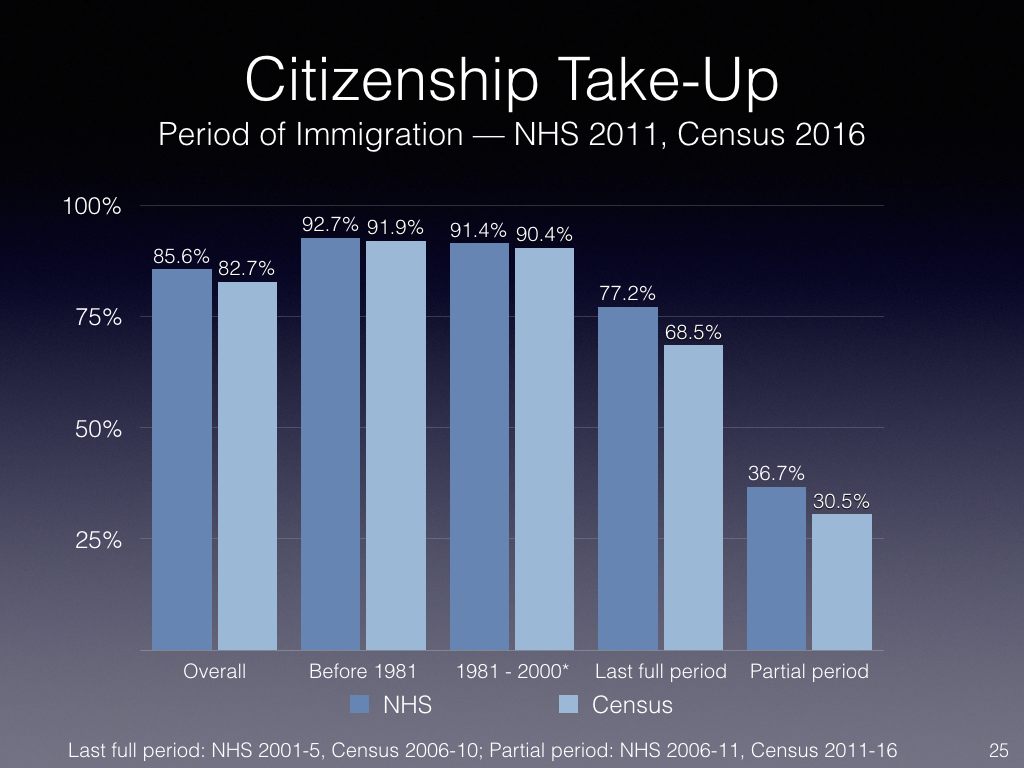
The net result has been a decline in the number of people applying for and obtaining citizenship, although the decline also reflected policy changes under the Conservatives, since reversed by the Liberals (residency back to 3 of 5 years, language and knowledge testing ages back to 18-54).

The chart below best captures the decline, comparing the last full census period citizenship take up, showing a decline from 77.2 to 68.5 percent.

My analysis of census data did show a positive correlation between income and citizenship take up (What the census tells us about citizenship)

However, while some will welcome the complete elimination of the fees, I always advocated for a reasonable balance between the societal benefits (political integration and participation) and private benefits (right to enter Canada and voting rights). Given IRCC data showing a processing cost of around $530 (2010-11), an adult total fee of $300 would have represented an appropriate balance between public and private benefits.

By eliminating the fees, the platform will most likely be perceived as political positioning with immigrant voters.

“A More Affordable Path to Citizenship

We will make applying for Canadian citizenship free for permanent residents.

With the right supports, immigrants are able to get to work, help build up our communities, and grow our local economies in short order. But arriving in Canada is just the first step on a long journey to citizenship.

Becoming a citizen allows new immigrants to fully participate in Canadian society, and the process of granting citizenship is a government service, not something that should be paid for with a user fee. To make citizenship more affordable, we will make the application process free for those who have fulfilled the requirements needed to obtain it.

Costing:”

Making applying for Canadian citizenship free for permanent residence (sic)

75

101

105

110

Note: IRCC Departmental plan 2019-20shows “Citizenship funding from 2019–2020 to 2021–2022 ranges between $61.4 million and $63.9 million.” This suggests  the Liberals are anticipating a significant increase in the citizenship take-up rate, not just one reflecting the increase in the number of immigrants.