Immigration officials are beginning gradually to resume in-person services after the pandemic forced many programs to shut down, frustrating immigrants whose lives were put on hold.
Immigration, Refugees and Citizenship Canada (IRCC) shut down immigration tests and citizenship ceremonies in March to protect the health and safety of staff and clients. The department started offering some virtual services over the last few months. Starting this week, it is opening in-person services by appointment only.
“This testing phase will allow us to assess our protocols and procedures and ensure the safety of our staff and our clients. The lessons learned will help us plan for reopening services more widely in the future,” says the IRCC’s website.
Limited services being offered at specific locations include citizenship, services related to permanent residence, asylum claims and biometrics.
Clients must wait for government officials to schedule appointments before visiting an IRCC site and should not call IRCC to try to arrange a date themselves, the department says.
William Ojeda and his family have waited an agonizing three years to renew their permanent residency, a time frame he said is unreasonable. They are now unable to re-enter Canada from Mexico.
“Being unable to be in Canada, and the uncertainty and anxiety of almost three years checking the IRCC website pretty much daily after the initial reasonable delay, and worrying for the well-being of my kids has been really, really hard,” he wrote in an email from Guadalajara.
Odeja, his wife and their eldest daughter were born in Mexico, while his two younger daughters were born in Canada and are citizens.
‘Three years lost’
“We have never broken a law … we live, by choice, by Canadian written and social laws and yet we feel treated as second class immigrants,” he said.
“If the decision is favourable, of course, it would be a happy ending and all the uncertainty, anxiety and fear will blur over time. If negative, it would be all for nothing, with three years lost on our life plan, which is in Canada.”Ojeda said the delay in processing his file predated the pandemic. COVID-19 has created a bigger backlog in many cases, however.
Conservative immigration critic Raquel Dancho said she’s heard from countless families affected by what she calls the “administrative ineptness” of IRCC.
“The lack of a plan throughout the pandemic has failed refugees and immigrants who wish to come to Canada,” she said.
“The Liberals have failed to ensure a fair and compassionate immigration process for the world’s most vulnerable. Frankly, it’s unacceptable and those that depend on the immigration system deserve better.”
NDP MP Jenny Kwan said MP offices have been “inundated” with immigration applicants’ desperate pleas for help. She said several of her MP colleagues have reported that immigration cases consume up to 90 per cent of their constituency casework.
“It’s apparent that there has been little to no movement on IRCC offices resuming their work up to now. The limited capacity of the restart will still mean that too many people are still just going to be stuck in the system with ongoing delays,” she said.”People are still being asked to continue to put their lives on hold. Is it a wonder that families desperate to reunite with their loved ones feel that their cries for help are just falling on deaf ears? The problems with the backlog are so deep that this limited restart will do little to reassure those stuck in the system.”
Efforts to speed up processing
Mathieu Genest, spokesperson for Immigration Minister Marco Mendicino, said the department has been adapting its systems to speed up the processing of applications while protecting the health and safety of staff, clients and Canadians. IRCC has prioritized applications from Canadians and permanent residents returning to Canada, as well as people performing essential services.
Staff now have more resources and streamlined processes for working remotely, he said.
“The expansion of the resumption of in-person services will depend on the results of and lessons learned during this pilot, as well as regional health guidelines, available capacity and virtual alternatives, among other considerations,” he said.
IRCC has introduced safety measures at its locations — including a self-assessment questionnaire that must be completed before an appointment and again before entering the premises.
All employees and clients are required to wear masks, maintain physical distance and follow signs directing the flow of foot traffic. People who appear ill will have to reschedule their appointments.
Arguments will be heard Wednesday in an ongoing birthright citizenship case being appealed in the U.S. Court of Appeals for the 10th Circuit.
Lawyers for the U.S. Department of Justice will argue in the appeals court to reverse a ruling in Fitisemanu v. United States, which recognized that individuals born in U.S. territories have the same right to citizenship as those born in the 50 states or the District of Columbia, a release from Equally American stated.
Lead plaintiff John Fitisemanu was born in American Samoa – a U.S. territory since 1900. For the last 20 years he has been a taxpaying, U.S. passport holding resident of Utah. However, based on a discriminatory federal law, he is labeled a “national, but not a citizen, of the United States.”
In December, a district court recognized that he is a natural-born U.S. citizen. The next day, Fitisemanu registered to vote. But because the district court later stayed its ruling pending appeal, Fitisemanu will be unable to vote in November unless the district court’s ruling is affirmed by the 10th Circuit.
“With an important election around the corner, I am hopeful the 10th Circuit will act quickly so that I will finally be able to vote,” Fitisemanu said in advance of the argument. “All my life I’ve met my obligations as an American, it is time I’m able to exercise my rights as a citizen.”
Note the value-type questions, most being more broadly focussed with one, arguably, being more targeted (readers to judge which one!):
Australia’s citizenship test is getting its first update in more than a decade, with a focus on Australian values.
Announcing the changes on Thursday – which marks Australian Citizenship Day – Acting Minister for Immigration, Citizenship, Migrant Services and Multicultural Affairs, Alan Tudge said: “Our Australian values are important. They have helped shape our country and they are the reason why so many people want to become Australian citizens”.
The new questions, which will be included on Australian citizenship tests from 15 November, “require potential citizens to understand and commit to our values, like freedom of speech, mutual respect, equality of opportunity, the importance of democracy and the rule of law,” Mr Tudge said in a statement.
“We are asking those who apply for citizenship to understand our values more deeply before they make the ultimate commitment to our nation.”
What kind of questions will be on the new test?
The updated citizenship test will comprise of 20 multiple choice questions, including five new questions on Australian values. The applicant will be required to correctly answer all five of the questions on values, with a mark of at least 75 per cent overall, to pass the test.
There will be no changes to the English language or residency requirements for citizenship.
Examples of questions in the new values section include:
Why is it important that all Australian citizens vote to elect the state and federal parliament?
Should people in Australia make an effort to learn English?
In Australia, can you encourage violence against a person or group of people if you have been insulted?
Should people tolerate one another where they find that they disagree?
In Australia, are people free to choose who they marry or not marry?
In Australia, is it acceptable for a husband to be violent towards his wife if she has disobeyed or disrespected him?
Do you agree that men and women should be provided equality of opportunity when pursuing their goals and interests?
Should people’s freedom of speech and freedom of expression be respected in Australia?
These aren’t the exact questions in the test and answers will be multiple choice.
An updated version of the Australian Citizenship: Our Common Bond resource will also be made available online to assist those preparing for the test.
Before Covid-19 connections and money could buy almost anyone the right to live pretty much anywhere they wanted.
The industry known today as CRBI—citizenship and residence by investment—began in 1984 in the Caribbean island of St. Kitts and Nevis, which offered a passport to foreigners who “invested substantially” in their economy. Today, more than half of the world’s 193 countries will trade citizenship or residency for cash. The industry is worth up to $25 billion a year and has spawned a new class of self-styled global citizens. But it’s also attracted criticism from those who say passports-for-purchase turn democracies into havens for criminals and facilitate money laundering and tax evasion.
The pandemic has led to unprecedented border closures and travel restrictions. Experts say that’s helped the CRBI industry grow but it’s also shaking it up, as high net worth individuals turn away from traditionally prized passports like the US and towards countries with high-quality healthcare systems.
London-based CRBI advisory firm Henley & Partners saw a 49% increase in enquiries in the first two quarters of 2020 compared to the same period last year. A competing advisory firm, Arton Capital, saw a dip in interest in the first quarter of the year as the pandemic spread in Asia. But enquiries rebounded and have increased 25% since April according to founder Armand Arton.
The CRBI industry was growing before the pandemic, thanks to demand from wealthy individuals in developing countries like India or Nigeria, whose economic growth has outpaced their diplomatic clout, “which is what bestows visa-free travel on citizens,” explains Paddy Blewer, public relations director for Henley & Partners.
A millionaire from oil-rich Gabon, for example, needs to apply for a visa to enter Europe’s Schengen zone. But that process can take up to 60 days and evidence suggests that Schengen visa applications from Africa are more likely to get rejected. Instead, a second citizenship from a Caribbean nation would guarantee them visa-free access to Europe for $150,000. That’s merely a “rounding error” for Blewer’s clients, who typically have about $6 million of assets under management.
Because of Covid-19, Blewer and Arton say investors are looking for countries who are perceived to have dealt with the pandemic better than others. That applies to Germany, Portugal, Australia, and New Zealand. Essentially, if people can work remotely from anywhere in the world, says Blewer, they are asking themselves one question: If another pandemic comes around, “where would they prefer to be?”
Finally, more Brits, Canadians, and Americans, whose passports are among the most valuable in the world, are becoming CRBI applicants. Henley & Partners reports “a dramatic 100% increase in enquiries from US citizens in the first six months of 2020,” which Blewer attributes to economic instability and a poor handling of the coronavirus. US citizens aren’t getting ready to leave en masse, he says, but they’re looking to hedge their bets. In September, a US passport holder could only travel visa-free to 86 countries, down from 171 last year.
“What we have seen with the pandemic is a complete change in the power of a passport,” Arton says.
The citizenship-by-investment industry broadens its marketing to include those from developed countries:
The massive volatility driven by Covid-19 has pushed the steady growth in investment migration into overdrive, with a nearly 50% increase in enquiries overall as the pandemic coursed around the globe in the six months to June 2020 compared to the same period last year. While the surge in interest shown by citizens of emerging economies such as India and Nigeria is somewhat predictable, a fascinating turn of events is the growing attention from nationals of leading developed nations. Most notable is America, with a dramatic 100% increase in enquiries from US citizens in the first six months of 2020 compared to the same period in 2019, along with significantly greater interest shown by Canadians and UK citizens.
“The tumultuous events of 2020, including the unplanned pause during the Great Lockdown, have resulted in people reconsidering how they wish to conduct their lives and — for those fortunate enough — choosing where they want to live by opting for investment migration,” says Henley & Partners CEO Dr. Juerg Steffen. “The relentless volatility in terms of both wealth and lifestyle has resulted in a significant shift in how alternative residence and citizenship are perceived by high-net-worth investors around the world.”
In terms of the total number of enquiries made in the first six months of 2020, Indian nationals outstripped all other nationalities by a long stretch. Henley & Partners received 96.5% more enquiries from Indian nationals than Nigerian nationals, who were placed second, followed by Pakistan and, startlingly, the US.
Several countries that host investment migration programs rank high on prominent indexes such as the 2020 Global Peace Index (GPI), the World Bank’s 2020 Ease of Doing Business ranking, and Deep Knowledge Analytics’ Covid-19 Regional Safety Assessment ranking. For those seeking the comfort of an alternative residence option in times of crisis, New Zealand comes out on top, impressively ranking 1st in both the GPI and Ease of Doing Business index and 2nd in the Covid-19 Regional Safety Assessment ranking. Other secure alternatives for high-net-worth families are Singapore, which ranks 7th in the GPI, 2nd in the Ease of Doing Business index, and 10th in the Covid-19 Regional Safety Assessment ranking, and Australia, which ranks 13th, 14th, and 6th in the three indexes, respectively.
In terms of alternative citizenship options in Europe, Austria is the top option, ranking 4th in the GPI, 27th in the Ease of Doing Business index, and 8th in the Covid-19 Regional Safety Assessment index, while Montenegro ranks 69th, 50th, and 83rd in the three indexes, respectively. The GPI omits the Caribbean small-island nations, but St. Lucia ranks 93rd in the Ease of Doing Business index and 127th in the Covid-19 Regional Safety Assessment ranking, making it the Caribbean investment migration program of choice for high-net-worth individuals.
“Once ‘nice-to-have’ assets of convenience and privilege that enhanced travel freedom and provided vacation or second homes, alternative residence and citizenship have rapidly become ‘must-have’ essential assets, not just to survive, but to thrive in the 21st century,” says Henley & Partners Group Head of Sales Dominic Volek, who points out that 19 of the G20 nations offer some form of mechanism to encourage inward investment in exchange for residence rights. The 20thmember is the EU, and 60% of EU member states offer investment migration options.
More findings from Pew (Canadian polling shows some similar divides but not to the same extent):
During the 2016 presidential campaign, supporters of Donald Trump and Hillary Clinton disagreed over nearly everything, including the extent to which Black adults in this country are disadvantaged because of their race and women because of their gender.
Today, these differences are even wider among voters who support Trump and those who back Joe Biden.
Across a range of political values – around race, gender and family, immigration and religion – there are stark contrasts between voters who support Trump and those planning to vote for Biden in November.
On some, such as attitudes about immigrants’ impact on American society, the differences between Trump and Biden supporters, while large, are no larger than the gap between Trump and Clinton voters four years ago.
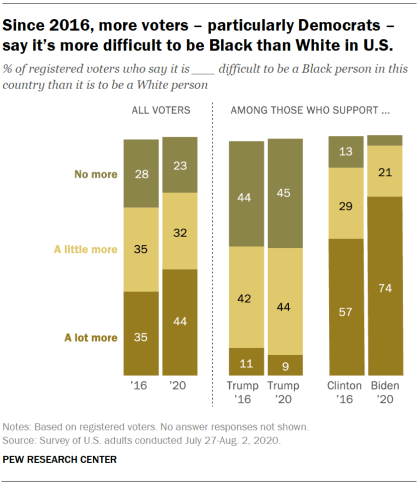
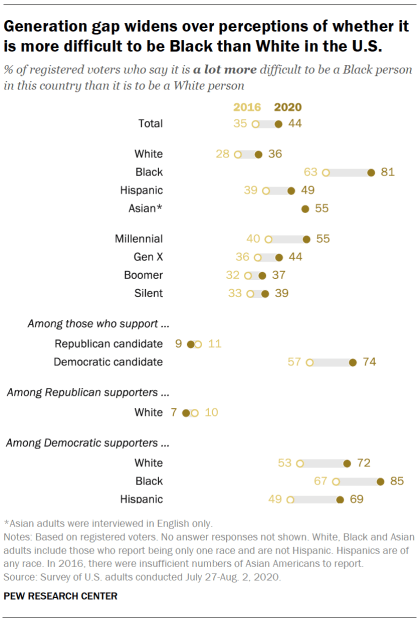
But in opinions about race and gender, in particular, the divides are much wider. Among all registered voters, 44% say it is a lot more difficult to be a Black person than a White person in this country; 32% say it is a little more difficult, while 23% say it is no more difficult. The share of voters who say it is a lot more difficult to be Black has increased 9 percentage points since 2016.
This change has come entirely among supporters of the Democratic candidates: 74% of Biden supporters say it is a lot more difficult to be Black than White, while a smaller majority of Clinton supporters (57%) said this in 2016. Among Trump supporters, there has been virtually no change since 2016. Currently, 9% say it is a lot more difficult to be Black than White; 11% said this four years ago.
Thus the gap in opinions between Trump and Biden supporters in views of whether it is a lot more difficult to be Black (65 percentage points) is considerably larger than the difference between Trump and Clinton supporters in 2016 (46 points).
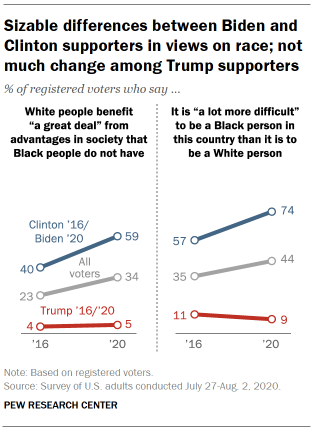
Biden supporters today also are more likely than Clinton supporters four years ago to say that White people benefit a great deal from advantages in society that Black people do not have. Currently, 34% of all registered voters say White people benefit a great deal from advantages that Black people lack, up from 23% in July 2016.
Again, the increase has come only among supporters of Democratic candidates: 59% of Biden supporters say White people benefit a great deal from societal advantages that Black people do not have. Fewer than half (40%) of Clinton supporters said this four years ago. Just 5% of Trump supporters say White people have a great deal of unfair advantages, which is virtually unchanged from 2016 (4%).
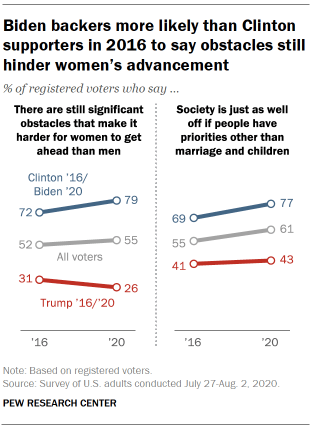
The survey by Pew Research Center, conducted July 27-Aug. 2 among 11,001 U.S. adults (including 9,114 registered voters) on the Center’s American Trends Panel, also finds growing divergence between the two camps on attitudes about gender and family: Biden voters today are now somewhat more likely than Clinton voters were to say women continue to face obstacles that make it harder for them to get ahead than men, while Trump supporters are now somewhat less likely to say this than they were in 2016.
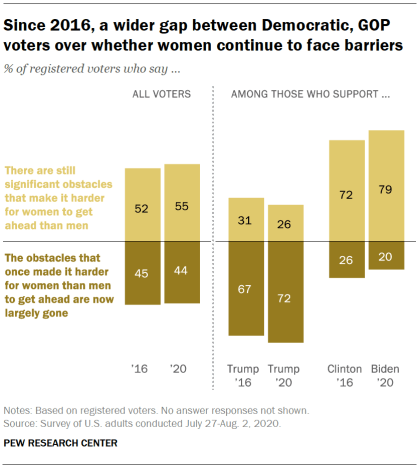
Opinion among all voters has changed little on whether women continue to face obstacles that make it harder for them to get ahead than men. Currently, 55% say there are still significant obstacles that make it more difficult for women than men to get ahead; 44% say the obstacles that once made it harder for women to get ahead are now largely gone.
Among Biden supporters, 79% say women still face significant obstacles that make it harder for them to advance; a smaller majority of Clinton supporters (72%) expressed this view in 2016. By contrast, a somewhat smaller share of Trump supporters express this view today (26%) than did so four years ago (31%).
While stark divides between Trump and Biden supporters are evident on two other themes that were central to the 2016 campaign – views of immigrants and Islam – these divides are roughly comparable to the divides seen between Trump and Clinton voters in 2016.
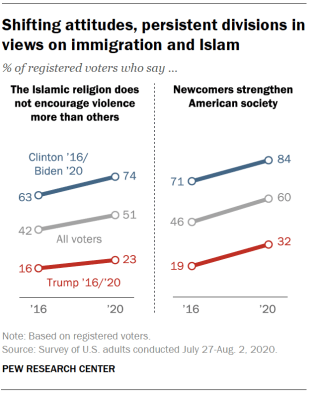
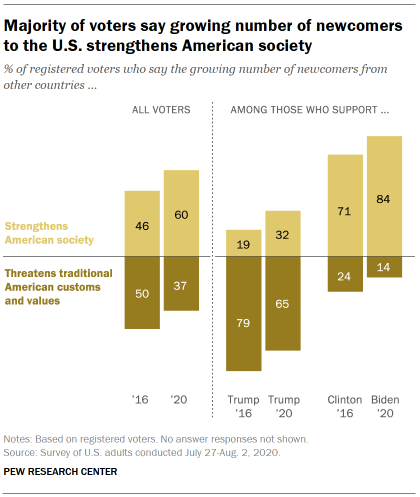
An increasing share of registered voters – Trump and Biden supporters alike – say the growing number of newcomers to the country strengthens American society. In the new survey, 60% say this, while 37% say this threatens the nation’s customs and values. In 2016, opinion was divided: 50% said increasing numbers of newcomers to the U.S. were more of a threat to American customs and values, while 46% said they strengthened society.
Only about a third of Trump supporters (32%) say immigrants do more to strengthen society, but this is a 13 percentage point increase from 19% in 2016. Biden supporters are more likely than Clinton supporters four years ago to say the growing number of newcomers strengthens society (84% vs. 71%).
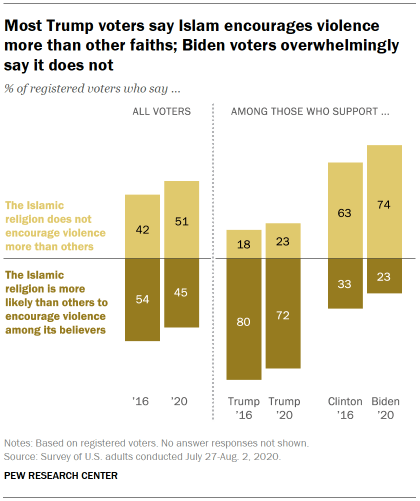
There also has been a shift across both the Republican and Democratic coalitions in views of whether Islam is more associated with violence than other religions. Today, 51% of voters say the Islamic religion does not encourage violence among its believers more than other religions, while 45% say it does. Four years ago, a 54% majority said Islam was more likely than other religions to encourage violence among its followers.
Most Trump supporters (72%) continue to associate Islam with violence, though the share saying this has declined 8 points since 2016. An even larger majority of Biden supporters (74%) than Clinton supporters (63%) say Islam does not encourage violence more than other religions.
Biden, Trump coalitions diverge over perceptions of structural racism
Overall, 44% of Americans now say that it is a lot more difficult to be a Black person in the U.S. than it is to be a White person, while 32% say it is a little more difficult and 23% say it is no more difficult. The share saying it is a lot more difficult to be Black than White is now 9 percentage points higher than it was in the summer of 2016.
But while overall views have shifted, the shift has come exclusively from within the Democratic coalition. The attitudes of Trump supporters today look very similar to attitudes of Trump supporters four years ago: 45% of Trump voters now say that it is no more difficult to be a Black person in the U.S. than to be a White person, while 44% say Black people have it a little more difficult. Only about one-in-ten Trump supporters say that Black people have it a lot more difficult than White people.
Biden’s backers, on the other hand, are substantially more likely today than Clinton’s backers were in 2016 to say that it is a lot more difficult to be Black than White (74% today vs. 57% in 2016).
But while overall views have shifted, the shift has come exclusively from within the Democratic coalition. The attitudes of Trump supporters today look very similar to attitudes of Trump supporters four years ago: 45% of Trump voters now say that it is no more difficult to be a Black person in the U.S. than to be a White person, while 44% say Black people have it a little more difficult. Only about one-in-ten Trump supporters say that Black people have it a lot more difficult than White people.
Biden’s backers, on the other hand, are substantially more likely today than Clinton’s backers were in 2016 to say that it is a lot more difficult to be Black than White (74% today vs. 57% in 2016).
Younger cohorts and those who support Democratic candidates for president have shifted most in these views over the past four years. White voters and those who support Trump have moved least.
In 2016, there were only modest generational differences on the question of whether it is more difficult to be Black than White. There is currently a wider generational gap on this question – with a majority of Millennial voters (55%) saying this compared with 44% of Generation X voters, 37% of Boomer voters and 39% of Silent Generation voters.
Across racial and ethnic groups, growing shares now say it is more difficult to be Black than White in the country, though the overall change is more pronounced among Black voters than White or Hispanic voters. However, this largely reflects the partisan leanings of these groups. Within the Democratic coalition the shift has been similar across racial and ethnic groups.
The pattern of opinion on the question of whether White people benefit from societal advantages Black people do not have is largely parallel, with a larger share of voters now saying that White people benefit a great deal from advantages in society that Black people don’t have. While Biden’s supporters are substantially more likely to say that White people have advantages than Clinton supporters were in 2016 (59% today, 40% then), just 5% of Trump supporters say this today – little different than the 4% who said this in 2016.
Though both Black and White voters are now more likely to say White people benefit from societal advantages than they were in 2016, there remain wide racial differences in these views – even taking partisanship into account. About eight-in-ten Black Biden voters (81%) say White people benefit a great deal from advantages that Black people don’t have, up from 64% among Clinton’s Black supporters in 2016. By comparison, about half (51%) of White Biden supporters currently say this, up from 29% among White Clinton supporters in 2016.
Views about gender and family increasingly divide the coalitions
Overall, a narrow majority of voters say that women today still face significant obstacles that make it harder for them to get ahead than men (55%), while fewer (44%) say that obstacles that once made it harder for women to get ahead are now largely gone.
These overall views are little changed from 2016, but the already wide gap between the Democratic and Republican coalitions is now even wider.
Today, 72% of Trump voters say that obstacles that once made it harder for women are now largely gone, up from 67% in 2016. By contrast, just 20% of Biden voters currently say this – a modest decline from the 26% among Clinton voters in 2016.
Women supporters of each candidate remain somewhat more likely than men to say that significant obstacles still exist for women, but the political divide in these views is far greater than the gender gap.
When asked about societal priorities around family, voters are somewhat less likely to say that society is better off if people make marriage and having children a priority than they were four years ago (36% today, 42% in 2016). As was the case in 2016, a slim majority of Trump’s voters this year say this (55% today, 57% in 2016). But Biden voters are slightly more likely today to say that society is just as well off if people have priorities other than marriage and children than Clinton voters were in 2016 (77% today, 69% in 2016).
While stark divides remain over immigration, a smaller share of both GOP and Democratic voters see newcomers as a threat to American values
In 2016, some of the largest issue divides between Trump and Clinton supporters were around attitudes about the nation’s growing racial and ethnic diversity and immigration. These views had been some of the key distinguishing characteristics of Trump’s strongest supporters in his path to the GOP nomination earlier that year.
As in 2016, there continue to be stark differences in these views – but these gaps have not been growing, and voters across the political spectrum have shifted in a more liberal direction in this domain.
In 2016 voters were about evenly divided in the share saying that the growing number of newcomers strengthens American society (46%) and the share who said they threaten traditional American customs and values (50%). Today, six-in-ten American voters (60%) say that newcomers strengthen American society and 37% say they threaten traditional customs and values.
Supporters of both major party candidates this year are more likely than 2016 supporters to have positive views of immigrants to the United States, but the gap between supporters of the Republican and Democratic candidates is little different than it was four years ago. Today, more than eight-in-ten Biden supporters (84%) say the growing share of newcomers in the U.S. strengthens American society, up from 71% among Clinton supporters in 2016. By comparison, a much smaller share of Trump supporters (32%) view immigration as strengthening society. Still, that is up from just 19% among Trump supporters in 2016.
Views of Islam largely divide the Trump-Biden coalitions
The trajectory on views about Islam is similar to that of newcomers from abroad.
Four years ago, a narrow majority (54%) of voters said that Islam was more likely than other religions to encourage violence among its followers. Today, the balance of opinion has shifted in the other direction, with 45% of voters saying that Islam is more likely to encourage violence and 51% saying it does notencourage violence more than other religions.
As was the case with attitudes about immigration, the gulf between Trump voters and Biden voters remains as wide as it was four years ago between supporters of Clinton and Trump, even as views in both coalitions have shifted.
Today, roughly three-quarters of Biden backers (74%) say Islam does not encourage violence more than other religions, up from 63% of Clinton’s supporters in 2016.
By contrast, just 23% of Trump’s supporters reject the assertion that Islam is more encouraging of violence than other religions, while 72% say Islam is more likely to encourage violence than other religions. In 2016, fully 80% of Trump supporters said Islam encouraged more violence.
Certainly, Canada has performed worse than Australia, with only about 7,000 online ceremonies, or about one-tenth of Australia’s (the issues regarding online testing, as highlighted by those in the article, are more complex given integrity concerns):
Six months after the federal government cancelled citizenship tests due to COVID-19, many immigrants say they fear a growing backlog in the citizenship queue will delay indefinitely their goal of becoming Canadians.
Before the pandemic hit, the entire citizenship process took an average of 12 months. Now, applicants say they have no idea when in-person tests will resume — and they’re calling on the federal government to hold online or physically distanced exams.
Myrann Abainza came to Canada from the Philippines as a live-in caregiver in 2009 and was joined by her husband and two daughters six years later.
Her family was on track to obtain citizenship when COVID-19 struck. Frustrated by the delay and a lack of information from Immigration, Refugees and Citizenship Canada (IRCC), she said the government should find a way of holding in-person tests that respect public health guidelines.
“If schools are reopening, why not?” she said.
“It is very important for me because I’ve been waiting for this for a very long time. It’s my dream. It’s my dream to become a Canadian citizen.”
IRCC’s website states that as of March 14, all citizenship tests, re-tests, hearings and interviews are cancelled due to the pandemic. Citizenship ceremonies were also halted at that time but have resumed since as virtual events.
IRCC told CBC News it is looking at alternatives to provide citizenship tests but offered no timeframe.
Immigration department ‘considering options’
“The department is reviewing operations and considering options for resumption of services, which could include online citizenship tests,” said department spokesperson Beatrice Fenelon.
Tests and interviews are critical steps that must be completed before someone can become a Canadian citizen. Citizenship allows a newcomer the right to vote and obtain a passport, and also gives many a sense of security and permanent belonging.
Basel Masri, who arrived in Canada as a refugee from Turkey after fleeing conflict in his home country of Syria, is one of those whose path to citizenship has been stalled by the pandemic.
Like many of the citizenship applicants CBC contacted for this story, Masri checks the status of his application through an online portal every day — only to learn that his file is still “in process.”
Masri said much of his anxiety is due to a lack of information coming from IRCC.
“Is it going to be for two years now, the processing time? Nobody knows,” he said.
“All the time you think about your application, you think about your passports, you think about your citizenship, you think about so many things. You think about your family.”
A push for online tests
Now that IRCC has started virtual oath-taking ceremonies, Masri said it should be able to securely administer online citizenship tests.
According to figures provided by IRCC, nearly 7,000 online oath ceremonies have been conducted since the pandemic struck, with more than 17,500 people being sworn in as new citizens.
The department is now ramping the number of oath ceremonies and allowing multiple participants in each event, to reach a target of 2,000 new citizens per week. In 2019, an average of 4,738 new citizens were sworn in every week at in-person ceremonies, according to IRCC.
Vancouver-based immigration lawyer Zool Suleman said the global pandemic has slowed down immigration processing times across the board.
While in-person citizenship tests might be possible, he said, officials would have to take precautions to keep the test-takers and the staff administering the tests safe and comfortable.
But delivering a virtual test would be even more challenging, since IRCC would have to verify the identity of the person taking the test and ensure that the answers aren’t being provided by a third party.
Many people have argued that if schools and universities can operate virtually, citizenship tests could also be held online. But Suleman said the stakes are particularly high with the citizenship test.
Risks with virtual tests
“I think an online test would be considered risky for Canada immigration because it leads to a very important right for people when they become citizens,” he said. “So there would be some concern that there would be an abuse of any kind of non-secure process.”
Ottawa-based immigration lawyer Julie Taub said the technology is there to conduct virtual tests, but agreed that IRCC would need to take steps to ensure the integrity of the process.
“It’s hard to find a foolproof way if you do it online to ensure they’re not cheating,” she said.
Taub said many of the delays in the immigration process are caused by staff working from home due to the pandemic. She said that’s led to much frustration among immigrants attempting to access services.
Olga Lenchenko has been in Canada for six years. She arrived from Ukraine when her husband accepted a job as an accountant.
Their citizenship test was scheduled for the end of March, then cancelled due to COVID-19.
She said she has mixed feelings about the situation. She said she understands the health threat posed by the coronavirus but she feels the lack of movement on testing is unfair.
“It’s been six months and we haven’t received any updates. It is very hard emotionally to be in limbo,” she said.
“We’ve been dreaming about the day we become citizens. Now, all the thrill is gone.”
More British Columbia media coverage of birth tourism, following a recent poll and my release of the CIHI data:
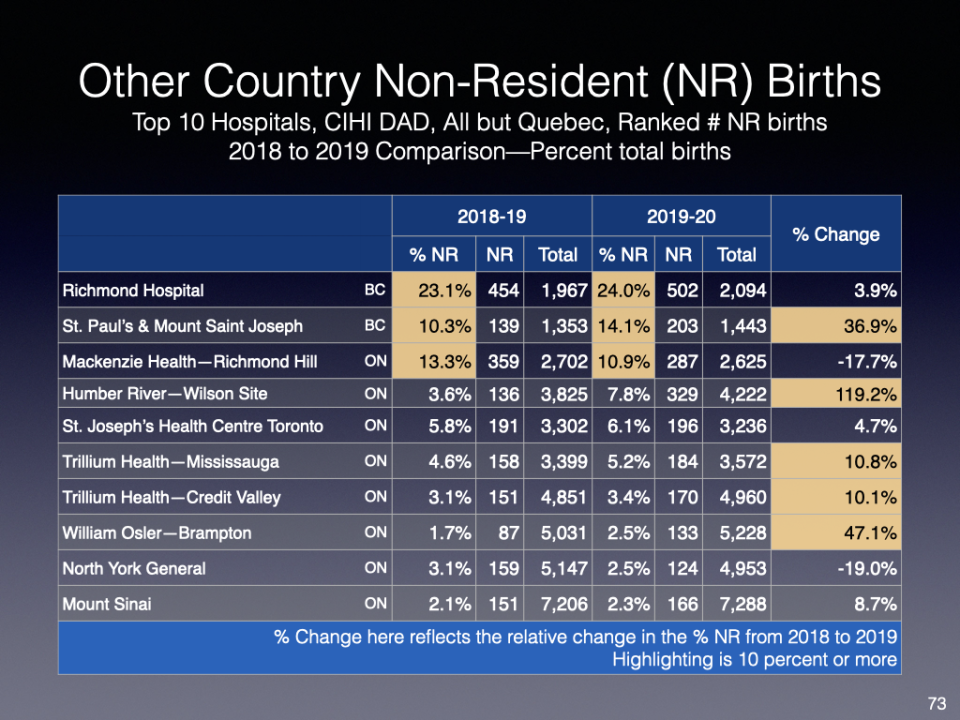
One in four births taking place at Richmond Hospital involve an international mother, according to new statistics.
So-called “birth tourism” is a controversial phenomenon in which expectant mothers from other countries come to Canada for the purpose of accessing a Canadian passport for their newborn babies and skipping the standard immigration processes.
“It’s perceived as an abuse of birthright citizenship,” said Andrew Griffith, a former director of Immigration Refugees and Citizenship Canada who is currently a fellow at the Environics Institute.
“Birthright citizenship was really designed for people who moved to Canada, who immigrated to Canada, gave birth to their children, so their children would automatically have Canadian citizenship,” Griffith said. “It was never designed for a world where you could stay in a birth hotel or a hostel, give birth and fly back to your country of origin.”
Over the last couple of years, Griffith has been collecting numbers from the Canadian Institute for Health Information, which compiles data from hospitals across the country, excluding Quebec.
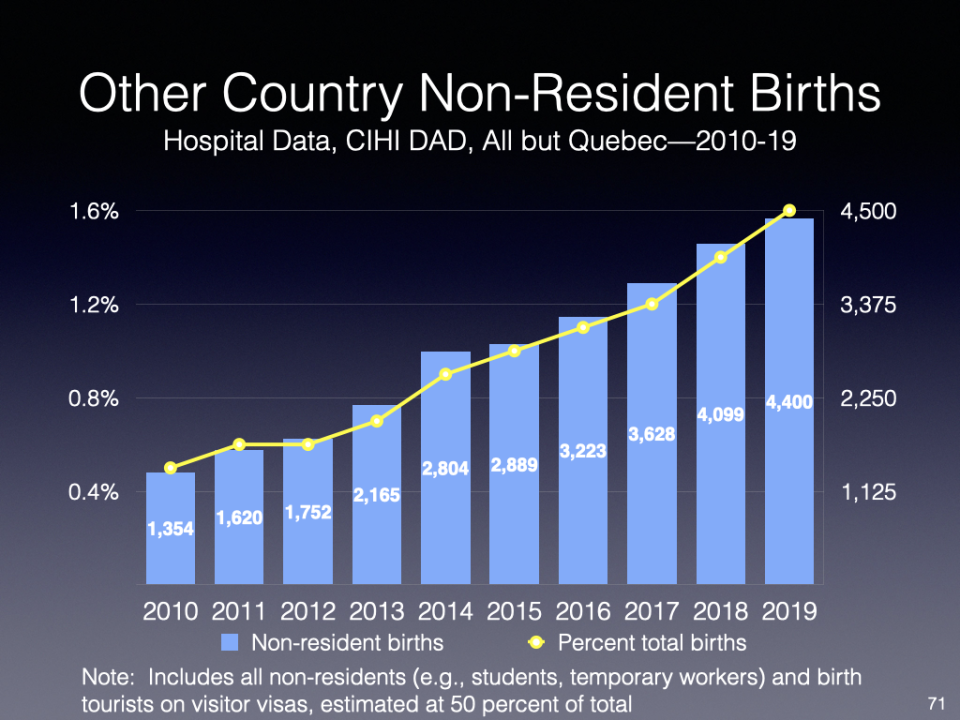
A chart Griffith created shows a 10-year trend of births by non-residents and reveals an upward curve of the practice.
Griffith notes that the term “non-resident,” in this data can also refer to international students and foreign workers. He estimates birth tourists account for roughly half of the non-resident births.
The new numbers show the 2019-2020 fiscal year and don’t include the majority of the months during the COVID-19 pandemic.
They reveal that births by non-residents made up 24 per cent of the deliveries at Richmond Hospital, a slight uptick from the year before.
The numbers jumped by more than a third for St. Paul’s and and Mount Saint Joseph hospitals in Vancouver, where non-residents made up 14 per cent of the total births.
“What I find interesting is that I haven’t seen really any similar outcry in any other community – even in those centres where there seems to be fairly high numbers of non-resident births – and I’m just not quite sure why that is, because it seems like the focus always is on Richmond,” he said.
Politicians from all three levels of government in Richmond have been pushing Ottawa to do more to stop the practice.
“We just feel that that is not fair, it really degrades the citizenship that we all enjoy,” said Richmond Mayor Malcolm Brodie.
He said the municipal government has been advocating that birth tourism be addressed, but those requests seem to have fallen on deaf ears.
“We can insist that those practices that are operating a business to house the birth tourists have a business licence. There’s not all that much more that we can do, other than keep highlighting the problem,” Brodie said.
Jas Johal, the BC Liberal MLA for Richmond-Queensborough, said the province can step in by increasing fees for international mothers to discourage the practice, but the responsibility lies with the federal government.
“One out of four children born at our hospital are foreign nationals – that’s not a hospital anymore, it’s a passport mill,” he said. “If you’re coming here to have a child on a tourist visa, well, guess what? That application for citizenship is null and void. A simple change like that would probably reduce, and probably eliminate, birth tourism in Canada.”
The two Conservative members of parliament for the area, Kenny Chiu and Alice Wong, have also voiced their objection to the practice.
Chiu’s office has been encouraging people to write letters to the immigration minister and offering to help deliver them.
A recent survey also found a majority of people would like the federal government set up a committee to address birth tourism.
CTV News Vancouver reached out to Immigration Refugees and Citizenship Canada regarding birth tourism, but did not receive a response before deadline. This story will be updated if a response is received.
And the poll from Researchco that prompted the coverage (IMO, questions are tendentious and leading, and the methodology is not that rigorous:
Many B.C. residents are tuned into the practice of birth tourism in Canada and most want the federal government to launch an investigation into it, a new poll suggests.
According to a survey conducted by Research Co., 49 per cent of B.C. residents have been following media coverage of birth tourism – a practice of travelling to a specific country for the purpose of giving birth and securing citizenship for the child.
Canada is one of fewer than three dozen countries that follow the practice of citizenship based on birthplace and some – including Australia and Britain – have modified or ended automatic birthright citizenship in recent years
“Residents of British Columbia are more likely to be paying attention to this issue, partly because of the situation that has unfolded in the city of Richmond,” said Mario Canseco, president of Research Co., in a news release.
“Almost half of British Columbians (49 per cent) are following stories about ‘birth tourism,’ compared to just 34 per cent of Albertans.”
But most B.C. residents polled don’t have favourable views of the practice.
According to the survey, 77 per cent of British Columbians say they feel birth tourism can be unfairly used to gain access to Canada’s education, health care and social programs. Meanwhile, 64 per cent worry that birth tourism could displace Canadians from hospitals.
Additionally, 67 per cent of those polled feel birth tourism “can degrade the value of Canadian citizenship,” while 71 per cent agree with the statement that the practice of granting birthright citizenship may have made sense at one point, “but now people have taken advantage of existing rules.”
With that, 82 per cent of B.C. residents said they agree with the federal government establishing a committee to investigate the extent of birth tourism in the country. Just eight per cent disagreed with the idea, while 12 per cent said they weren’t sure.
According to the nation-wide poll, however, support for a new approach to birthright citizenship in Canada is highest in Manitoba and Saskatchewan at 66 per cent. Alberta follows at 60 per cent, with B.C. standing at 56 per cent hoping for new regulations.
Results are based on an online study conducted from Aug. 28 to Aug. 30, 2020, among 1,000 adults in Canada. The margin of error—which measures sample variability—is plus or minus 3.1 percentage points, 19 times out of 20.
Will see with the final version is, and the degree to which it has any nuance or not (the question below, given its absence of any discussion of reasonable accommodation, suggests unlikely):
If there’s a clash between a religious so-called law and a parliamentary law, which trumps the other?
That’s just one example of the new types of questions which will appear in the slightly updated citizenship test from November this year as aspiring Austrlaians face a tougher vaules test amid challenges to address social cohesion and foreign interference.
Acting Immigration, Citizenship, Migrant Services and Multicultural Affairs Minister Alan Tudge said on Friday that the questions are being inserted to address “our liberal democratic values as opposed to kids facts”.
A new booklet guide will be released to inform people of the changes to the multiple choice test.
Understanding that language acquisition is important for social cohesion and belonging, Mr Tudge announced last week that permanent residents and citizens with poor English skills would be given unlimited language classes but he said there are no plans to introduce an English language test as part of the citizenship process.
Mr Tudge said the questions will be easily understood by anyone who has been in the country for a period of time and who shares Australian values.
One of the (intended) effects of Trump administration policies:
On a Wednesday morning in late February, Annie Johnson Benifield was already through the doors of the M.O. Campbell Education Center, in Houston by 5:30 a.m.
The occasion was a once-a-month naturalization ceremony, where anywhere between 1,700 to 2,600 legal permanent residents swear a 140-word oath in order to become U.S. citizens. The ceremony wouldn’t begin until later in the morning, but Benifield and the 40 or so volunteers from the League of Women Voters (LWV) had arrived early to set up.
The League is the official registration partner for many naturalization ceremonies across the country. And before the pandemic, these events happened frequently, taking place once, or sometimes twice, each month at U.S. Citizenship and Immigration Services (USCIS) field offices as well as some federal courthouses. The League had predicted that, in 2020, it would interact with up to 200,000 new citizens and their family members in 1,000 events across the country.
The Houston chapter specifically had an 85 to 90 percent success rate in new voter registrations, for an annual average of 30,000 new voters, according to Benifield. But this year, with the widespread interest in the presidential elections, she thought registrations might crack 40,000.
“I was getting excited and feeling giddy about it,” she told FiveThirtyEight, “but COVID-19 had a different plan.”
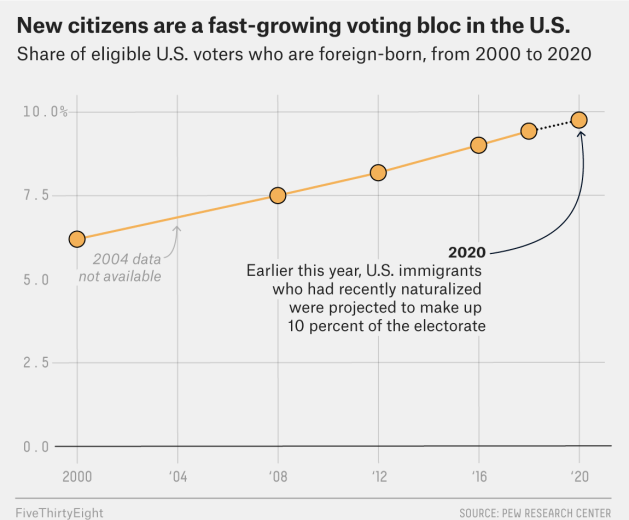
Newly naturalized citizens are one of the fastest-growing voting groups in the United States. In February, the Pew Research Center published a report that found that 23.2 million naturalized citizens would be eligible to vote in November’s presidential elections, making up a record 10 percent of the total electorate. And according to a February analysis by the National Partnership for New Americans (NPNA), a coalition of immigrant advocacy organizations, 860,000 new Americans were expected to have naturalized by November before the pandemic brought things to a halt.
But not all eligible voters actually vote, and naturalized Americans have historically trailed native-born Americans at the polls.1 In 2016, for example, 54 percent of naturalized citizens voted in the general election compared with 62 percent of native-born citizens. According to studies, one explanation is an element that could be missing again this year: voter registration. It’s not a lack of desire to participate, the study finds, but rather it’s an unfamiliarity with how or where to register, registration deadlines, and language issues. Once these barriers are overcome and new Americans are registered, they tend to vote at the same rates as native-born members of their demographic group.
Take someone like Raz Ahmadi, a new U.S. citizen from Afghanistan. For the past five years, he has worked as an organizer registering voters and advocating for progressive environmental policies in Virginia. And this year, after completing the naturalization process, which had been interrupted by COVID-19, in mid-July, Ahmadi will finally be able to cast his own ballot.
Though he has already been involved in politics, Ahmadi says that being able to actually participate is a whole new feeling for him. Being “empowered to vote, mentally, it gives you a lot of power,” he says. “It just personalizes a lot of things. Now you’re more involved in the community.”
But even before COVID-19, the wait time for citizenship applications had hit new highs under the Trump administration. According to USCIS numbers, the naturalization process averaged 8.8 months in 2020, compared with 5.6 months in 2016 and a peak of 10.3 months in 2018,2 though in some cases, it could take up to three years.
COVID-19 exacerbated this delay. On March 18, USCIS temporarily shut down all public-facing activities, including interviews for visas, asylum and naturalization as well as oath ceremonies. The agency did not make plans for virtual alternatives, bringing much of U.S. immigration to a halt.
For each day that USCIS remained closed, 2,100 potential new voters would be disenfranchised, according to a frequently cited report by Boundless, an immigration-services company co-founded by an Obama administration official.
USCIS field offices reopened on June 4 and prioritized in-person oath-swearing ceremonies. Some field offices held drive-through ceremonies, while others held more frequent, but smaller, indoor or outdoor ceremonies. By the end of July, the agency says that it has cleared the backlog of 110,000 oath ceremonies delayed by its closures, as well as an additional 7,905 oath ceremonies not scheduled before the pandemic.
Still, these 7,905 new naturalizations in July represent a twelve-fold decrease than the typical 95,850 naturalizations completed each month. So even though in-person oath ceremonies are continuing, “the fact of the matter was that there was already a backlog of people waiting to be naturalized,” says Jeanette Senecal, who oversees voter-engagement programs at the League of Women Voters, “so unless USCIS is both increasing the number of people who are getting naturalized at each one and offering more ceremonies, there’s really no way they can make that up.”
From the outset of USCIS’s closure, a diverse group of bipartisan policymakers, immigration lawyers, community advocates, and third-party voter-registration organizations like the League of Women Voters have called on USCIS to follow in the footsteps of other federal government agencies in moving activities online. In June, the USCIS Ombudsman’s Office, a small, independent office in the Department of Homeland Security that appeals specific immigration cases and suggests improvements for USCIS, weighed in, calling remote oath ceremonies, held via video teleconferencing, “a legally permissible and operationally feasible solution” for the agency in the short term and a potential long-term solution to “increase efficiencies” in its annual report to Congress.
But still, the USCIS rejected a virtual option. Spokespeople told FiveThirtyEight repeatedly, both before and after the Ombudsman’s report, that “the statutory language mandated by Congress contains certain requirements that are logistically difficult for USCIS to administer naturalization oaths virtually or telephonically.”
USCIS says that they’ve taken steps to clear the backlog in oath ceremonies, but these ceremonies are not the only steps in the naturalization process that are delayed.
Sarah Pierce, a policy analyst with the Migration Policy Institute, calls USCIS’s emphasis on clearing the backlog in oath ceremonies “really misleading” because it wasn’t just oath ceremonies that were paused during this time. “It was also interviews, which meant that naturalization applications weren’t being processed,” said Pierce. She added that unless USCIS was also trying to expedite processing of naturalization applications, there was “no way” the agency was going to be able to naturalize the same number of people by the election.
Dan Hetlage, a USCIS spokesperson, told FiveThirtyEight that the agency has also “prioritized rescheduling interviews for naturalization and adjustment of status that were postponed,” but as of early August, immigration lawyers I spoke with said that their clients had not been contacted to schedule naturalization interviews.
There are currently 315,000 naturalization applicants awaiting their interviews, which on average occur two months before an oath ceremony, according to a Boundless analysis. In two months it will be October, which is the deadline for voter registration in many states. That means an unknown but likely significant number of those 315,000 applicants will not naturalize soon enough to register by October and vote in November.
It’s not just USCIS that has changed as a result of the pandemic. A recent report from the Migration Policy Institute cataloged 63 executive actions undertaken by the Trump administration since March that have further restricted immigration.
Pierce, who co-authored the report, says that these changes represented some of the Trump administration’s “boldest actions on immigration to date” that, in some cases, they had long been pushing but had been unable to achieve. This includes a travel ban on 31 countries, the end of asylum at the southern border, and the suspension of immigration for many family- and employment-based categories as well as four temporary-worker programs.
“During an unprecedented pandemic, which includes both public health and economic crises, you would expect immigration to take a backseat,” says Pierce, “but rather, the opposite has been true.”
When USCIS offices reopened on June 4, organizations like the League of Women Voters scrambled to help with voter-registration efforts. Benifield, from LWV-Houston, recalls reaching out multiple times to the local field office. “We were prepared to go and set up in the parking lot … if they allowed us,” she said.
In the end, her persistence paid off. “The branch chief … agreed that we could actually bring cards” for officials administering the naturalization ceremony to give out. The League cannot be on-site to register applicants directly because of the continued threat the pandemic poses, but they can drop off folders containing voter-registration packets to the local field office to be distributed at the socially distant ceremonies. USCIS is legally mandated to provide, at a minimum, voter-registration forms at each naturalization ceremony.
Benifiled said she was glad they could distribute materials, but she remained unsure how effective this form of voter registration would be. “Clearly, it will not be 30,000 like … last year.”
This is affecting the League’s activities across the country. “Spring and summer are usually really busy seasons for voter registration, but especially in presidential years, we usually see massive increases… [in] naturalization ceremonies,” says Senecal, from the League’s national office.
Volunteers understand the public health prerogatives that prevent them from conducting registrations in person, especially since many are older and at higher risk for COVID-19, but many, like Benifield, are concerned about the effect on registration numbers and broader civic engagement.
“The opportunity cost is not just registration,” adds Senecal, “it’s also voter education.”
At a basic level, in-person voter registration provides necessary information in native languages, says Nancy Xiong, the communications director for Hmong Innovating Politics, a California-based nonprofit that aims to increase civic participation among Southeast Asian Americans.
Native language materials are essential, since many new citizens, especially in already marginalized communities, have challenges with English. Even when they are provided with translated voting materials, Xiong adds, these materials “may not always be helpful because county/state offices do a word-to-word translation, without much context.”
This can create the perception that these communities are uninterested in politics, leading to “big campaigns never or rarely contact[ing] the Southeast Asian community,” Xiong says, even though 92 percent of the 310,000 Hmong Americans are citizens, one of the highest rates among Asian Americans, and 45 percent are eligible to vote. And this perpetuates a cycle of disenfranchisement, at the very moment when immigrant voters might be especially incentivized to vote, if previous elections in which immigration was a hot topic are any indication. In 2008, presidential candidate Mitt Romney’s suggestion that immigrants should “self-deport” and hardline views on DACA, for example, have been linked to a jump in voter registrations between 2008 to 2012.
Sundrop Carter, the executive director of the Pennsylvania Immigration and Citizenship Coalition (PICC), which partners with the Philadelphia USCIS field office as its official third-party registration organization for naturalization ceremonies, told me part of the problem is that: “[B]y definition new Americans have no voter history.” As a result, she said, they’re often bypassed by most get-out-the-vote efforts. “New voters … they’re just invisible.”
This is despite the fact that in many battleground states, like Pennsylvania, where Carter is based, as well as Michigan, Florida and Nevada, the number of new Americans who are eligible to vote now is larger than the margin of victory in the 2016 elections, according to the June 2020 report from the NPNA. “Newly naturalized citizens could help to sway the outcome of national elections,” says Diego Iñiguez-López, the NPNA’s policy and campaigns manager. But more importantly, he adds, “what’s at stake is the political empowerment of newly naturalized citizens … and for the democratic ideals of this country to be fully realized and exercised.”
Community organizations have always tried to fill in the gap — and this year, just as the need for their services ramp up, COVID-19 has made them more difficult to deliver.
Hmong Innovating Politics (HIP), in California, and the nonprofit Bonding Against Adversity in Houston, which works mostly with Latin American immigrants, are doing their best to adapt by moving their activities online. HIP has switched to a text-messaging platform, which uses current friends-and-family circles to encourage contacts to register to vote. Bonding Against Adversity, meanwhile, has expanded another SMS-based communications platform to provide real-time immigration application help, and plans to restart an online version of their 14-session “citizenship college” civic-education program and application workshops in August.
Meanwhile, LWV-Houston members have paid for a QR code that brings up voter-registration information, which it is sharing on signs and, for a while, in person at public libraries, community and faith-based organizations, protests and even a taco chain restaurant.
But still, many organizations are afraid that some of the most vulnerable communities, who already feel left out of the political process, will fall through the gaps. “A lot of the communities that we work with have elementary education, are not computer-savvy, and don’t speak good English,” says Mariana Sanchez, a co-founder of Bonding Against Adversity. That’s why she says in-person registration and education is essential.
But the pandemic has put these in-person services on pause, and as a result, the applicants who need the most support are unable to access it.
COVID-19 shows little evidence of slowing down. By June, hospitals in states like Texas that had avoided the early wave of infections were warning that hospital beds were close to full, and in-person voter-registration activities, which the League of Women Voters had just restarted alongside USCIS’s reopenings, were put on indefinite pause.
In the meantime, smaller oath ceremonies continue, with USCIS spokespeople emphasizing their adherence during the ceremonies to public-health guidelines, including masks and social distancing. But it is not clear if USCIS has any contingency plans in place for alternatives to in-person activities.
The potential of more stay-at-home orders at a local level is also a possibility, which would affect which activities USCIS could continue. Guam’s USCIS office, for example, was shut down for a week as the territory’s COVID-19 case count led the governor to issue orders to shelter in place. Hetlage, the USCIS representative, did not respond to a specific question on contingency plans but reiterated that virtual oath ceremonies weren’t possible.
This has many immigration advocates perplexed. “Almost every business, school district, university and government agency across the country has made adjustments to keep their organizations — and the country — moving,” says Eric Cohen, the executive director of the Immigrant Legal Resource Center, an advocacy group. “Why should USCIS be any different?”
The question represents an ongoing frustration: Yes, there is an unprecedented public-health crisis, but there is also a human-made immigration crisis stemming from the administration’s policies and USCIS’s decision-making during the pandemic.
“It’s hard to look at the actions the administration has taken that result in decreased immigration, and not think that there was some intent there, especially when you’re talking about an administration that is historic in its stance on legal immigration.” says Pierce, of MPI, on whether the immigration agency’s decision-making could be political. Beyond the 63 actions taken during the pandemic, Pierce’s report identified over 400 executive actions by the Trump administration taken in the past four years that have shifted the immigration system toward removing suspected undocumented immigrants, and away from processing applications for naturalization and legal immigration.
It stands in stark contrast with the second night of the Republican National Convention, when Trump naturalized five new citizens at the White House in a prerecorded video. The president welcomed them to “a family comprised of every race, color, religion and creed united by the bonds of love,” as he said in his concluding remarks. “We are one people sharing one home, saluting one great American flag.”
USCIS representatives did not respond to a request for comment on whether the five were given voter-registration forms, as required by law.
Since early summer, USCIS has warned that if it does not receive $1.2 billion in emergency funding, the agency would furlough 13,000 workers – 70 percent of its workforce — and slow or pause many immigration processes. On August 25, after months of back-and-forth, Congress and USCIS reached an agreement that would avoid the furlough.
That agreement would not, however, avoid further delays in processing, as Joseph Edlow, deputy director for policy at USCIS, told The Washington Post: “Averting this furlough comes at a severe operational cost that will increase backlogs and wait times across the board, with no guarantee we can avoid future furloughs.”
In an effort to increase its financial sustainability, USCIS will increase fees by an average of 20 percent across the board, and more than 80 percent for naturalization applications. For groups like Bonding Against Adversity and Hmong Innovating Politics, which were already under-resourced before the pandemic, these changes will only add to their immediate workload.
Sanchez says she’s already received more inquiries from people who want to apply for citizenship before application fees for naturalization increase. “The immigration laws are so difficult,” says Sanchez, that “the only way, for some of the people we serve to help their families is through citizenship…and voting.”
But USCIS is making the process more difficult. That’s why the NPNA sees naturalization delays as an issue of voting rights.
“It’s part of the larger anti-immigrant agenda that the Trump administration has pursued over the last few years,” says Iñiguez-López. “Keep immigrants feeling unwelcome, keep them afraid, keep them intimidated, and keep them away from knowing and asserting their rights, including their right to vote.”
In other words, while these would-be citizens are trying to follow the rules of the U.S. immigration system to naturalize and effect change through the established democratic processes, the system has itself become the barrier.



 Multicultural Meanderings