Minister Fraser participates in Citizenship Week ceremony – Some updated data

Of course, the Minister and supporting documentation picks the most favourable timeline and is silent how the program largely shut down in 2020. That being said, IRCC has ramped up the program and if they are able to maintain the rate of 3,000 per month as stated, the backlog will decline:

Citizenship Week is an opportunity for Canadians across the country and around the world to show pride in our history, culture and achievements.

Today, the Honourable Sean Fraser, Minister of Immigration, Refugees and Citizenship, attended a virtual citizenship ceremony, wrapping up another successful Citizenship Week. The ceremony, hosted in partnership with the Institute for Canadian Citizenship, saw 25 new Canadians invited to take their Oath of Citizenship.

During the ceremony, the Minister spoke about the significance of citizenship, the rights and freedoms it affords, and the important responsibilities that come with it. He also acknowledged the individuals and families waiting to become citizens, and that IRCC is taking action so they can achieve this dream as soon as possible.

IRCC is working hard to process a large volume of citizenship applications, and has been taking steps to improve its operations. As a result, Canada exceeded its citizenship goals for 2021-2022, with over 217,000 new Canadian citizens, and is planning to welcome even more in 2022-2023.

IRCC has also been modernizing and increasing its services for people who want to become Canadians. On November 26, 2020, we launched a new platform that made Canada one of the first countries in the world to offer citizenship testing online. IRCC also adapted quickly to COVID-19 restrictions by introducing virtual ceremonies in April 2020. Thanks to these measures, we are now inviting more people to tests and ceremonies than we were able to do before the pandemic.

Becoming a Canadian citizen is a significant milestone in a newcomer’s immigration journey, and we will continue our efforts so that as many as possible can reach this goal. Supported by additional funding from the 2021 Economic and Fiscal Update, IRCC will continue its efforts to reduce application inventories accumulated during the pandemic.

Quote

“I am proud to be Canadian, and it is always a great honour to participate in welcoming new members to our Canadian family. This week has been a chance to reflect on everything that being Canadian means—the freedom for individuals to live as their authentic selves, the connections to our beautiful landscapes and the chance for everyone to reach their full potential no matter their background. I am thankful every day to be Canadian, and I encourage everyone to reflect on what being Canadian means to them.”

– The Honourable Sean Fraser, Minister of Immigration, Refugees and Citizenship

 Quick facts

  • The citizenship ceremony is the final step to becoming a Canadian citizen. During the ceremony, participants accept the rights and responsibilities of citizenship by taking the Oath of Citizenship, which is administered by a citizenship judge.
  • Canada’s first citizenship ceremony was held 75 years ago, on January 3, 1947, at the Supreme Court of Canada.
  • In June 2021, the Oath of Citizenship changed to recognize the inherent and treaty rights of Indigenous peoples.
  • Canada has one of the highest naturalization rates in the world, with about 85% of newcomers becoming citizens.
  • The Citizenship Application Tracker was launched in May 2021 to help clients stay up to date on the status and any required next steps for their citizenship applications.
  • IRCC has also launched online application processes for some clients looking to apply for a grant of citizenship, get proof of citizenship or search citizenship records.
  • From the launch of IRCC’s new online testing platform on November 26, 2020 to April 30, 2022, almost 310,000 people have taken citizenship tests, and IRCC is able to invite about 5,000 applicants per week to complete the test.
  • Between April 1, 2020 and April 30, 2022, more than 300,000 people took the Oath of Citizenship in almost 14,000 ceremonies using a virtual platform. The Department is inviting on average about 3,000 applicants per week to participate in citizenship ceremonies.

UK: Home Office makes £240m selling #citizenship to children

Not the first article I have seen on this money making scheme:

The Home Office has made more than £240m in profit from children caught in citizenship limbo since 2010, the New Statesman can reveal.

An exclusive analysis of registrations of children as British citizens has revealed that the department is making £640 per child by charging people far more in fees than an application costs to process. The figures show an estimated total surplus of almost £211m since 2010, which when adjusted for inflation comes in at more than £240m.

That total is likely to be an underestimate, because it only includes successful applications, not those of children who weren’t granted citizenship. The Home Office was contacted for comment, including on this number, but has not responded.

Under British law, since 1981, being born in the UK does not automatically entitle a child to citizenship. In the cases of some children whose parents have a certain immigration status, their families have to apply for citizenship for them. Currently it costs £1,012 to register a child as British, but Home Office documents show that the “unit cost” – the official estimate of how much an application costs the department – is only £372.

The analysis shows that fees for child registration have consistently outpaced costs. In 2010 it cost the Home Office £208 to register a child as British, but it charged people £470. Since then, fees have gone up 115 per cent, but unit costs have only risen 79 per cent.

The number of children registering as British has fallen over the last decade. In 2010 there were 48,659 successful registrations. In 2016 there were 30,799 and the last 12 months of data shows only 27,674 registrations. This trend suggests high fees may be putting people off applying, which may restrict people from living full lives, as the New Statesman reported in February. The children would not have a passport so would not be able to go on school trips abroad, for example.

The rising profit margin means the Home Office has consistently made more than £2m every quarter, even though the number of registrations has dwindled. Just 5,065 children registered as British in the third quarter of 2021, but that was still enough to make £3.2m – more money than when 10,586 children registered in the first quarter of 2012.

“Exploiting the need for people to formally register their British citizenship as a way to make money is shameful,” said Solange Valdez-Symonds, chief executive of the Project for the Registration of Children as British Citizens. She added that for many children, who were born and grew up in the UK, the fees effectively deprive them of their citizenship rights altogether, “leaving them alienated and excluded in their own country”.

The High Court ruled in 2019 that the government had set the fees without proper regard for children’s rights, a ruling that was confirmed by the Court of Appeal in 2021. In February this year, however, the Supreme Court concluded that parliament was entitled to allow the government to set the fees so high, so it would be up to MPs and peers to change that.

Source: Exclusive: Home Office makes £240m selling citizenship to children

Minister Fraser celebrates Citizenship Week

Yet another missed opportunity to release the revised citizenship guide! Understand the guide has been ready and approved for some time.

No surprise on elimination of citizenship fees given not in Budget 2022.

Don’t understand the reference to “Most recently, these amendments include broadening the interpretation of “citizenship by descent” to be more inclusive for families.” as the first generation limit has not been change, although Bill S-245 has been approved in the Senate but has not reached first reading in the House:

The Honourable Sean Fraser, Minister of Immigration, Refugees and Citizenship, today issued the following statement to mark the start of Citizenship Week, which runs from May 23 to 29, 2022:

“Today, I join Canadians from coast to coast to coast to mark the beginning of Citizenship Week. This week is a chance to celebrate what it means to be Canadian—from the rights we enjoy, to the responsibilities we share, to the diversity that makes us a strong and proud nation.

“This year, we marked the 75th anniversary of the first Canadian Citizenship Act. The passage of the Act, which was later replaced with the Citizenship Act in 1977, was a monumental moment in Canadian history that shaped the identity we share today. In the days that followed, Canada held its first-ever citizenship ceremony, establishing a formalized rite of passage that millions of new Canadians have taken part in since.

“Canada is known around the world as a country that respects and celebrates our differences. As we have grown, we have amended our Citizenship Act so that it reflects our values and promotes an inclusive society. Most recently, these amendments include broadening the interpretation of “citizenship by descent” to be more inclusive for families. They also include establishing a new Oath of Citizenship that recognizes the inherent and treaty rights of First Nations, Inuit and Métis peoples, and the obligation that all citizens have to uphold the treaties between the Crown and Indigenous nations. We are committed to ensuring that the tragic parts of our history are not forgotten, as we continue on the path of reconciliation.

“Canadian citizenship holds so much significance and meaning. For some, it represents the achievement of a dream and the promise of a new life. For others, it is an innate and unbreakable bond to the beautiful country we call home.

“For all of us, citizenship remains a commitment not only to Canada, but to our fellow Canadians. Whether volunteering for a community project, helping out a neighbour in need or welcoming newcomers to our country, I encourage all Canadians to look for ways to take part in building a strong, inclusive and prosperous Canada—this week and every week.”

Source: Minister Fraser celebrates Citizenship Week

Israel: Shaked withdraws bill to revoke Israeli citizenship from terrorists

Of note:

Interior Minister Ayelet Shaked (Yamina) on Sunday backtracked on her plan to pass a bill that would revoke the citizenship of Israeli citizens who commit terrorist acts. The bill Shaked has promoted is based on a bill once put forth by MKs Avi Dichter and Orit Strock.

Shaked retracted the legislation after discussions between her representatives and Justice Ministry officials, who said the bill would not hold up in the High Court of Justice.

The bill stipulated that any Israeli citizen who participates in hostile terrorist activity and receives monetary support from the Palestinian Authority will be stripped of his or her Israeli citizenship. The purpose of the proposed legislation is to prevent the PA from paying Israeli citizens who perpetrate attacks.

Shaked has vowed on several occasions over the course of her tenure as head of the Interior Ministry to pass the bill into law. Officials in her circle, however, as stated, said the Justice Ministry made it clear in recent preliminary discussions that the High Court of Justice would reject the bill as it is currently worded, and that the State Attorney has no intention of defending it once an appeal against it is submitted to the Supreme Court.

Instead of revoking citizenship, Shaked now intends to promote legislation that would revoke pension payments to Israelis who have been convicted of terrorist acts. This, even though a similar law exists and is already partially implemented. Shaked is also exploring the possibility of downgrading the citizenship status of convicted Israeli terrorists, although at this point the legislative process is awaiting a High Court ruling on the matter, which is expected within the next two months.

Strock, who is a member of the Religious Zionism Party, slammed Shaked for withdrawing the legislation, saying the “excuse of oppositionist jurists doesn’t hold water. The person who twice torpedoed the bill in the Knesset without once mentioning oppositionist jurists – can’t now hide behind the ‘jurists.’ The reason this life-saving law isn’t being brought forth is the fact that this government is only surviving right now because of the mouth-to-mouth resuscitation it is receiving from the Ra’am party and [Joint Arab List MK] Ahmad Tibi. Everyone realizes this, even the terrorists, as well as their victims. It’s sad, concerning, and disgraceful.”

Source: Shaked withdraws bill to revoke Israeli citizenship from terrorists

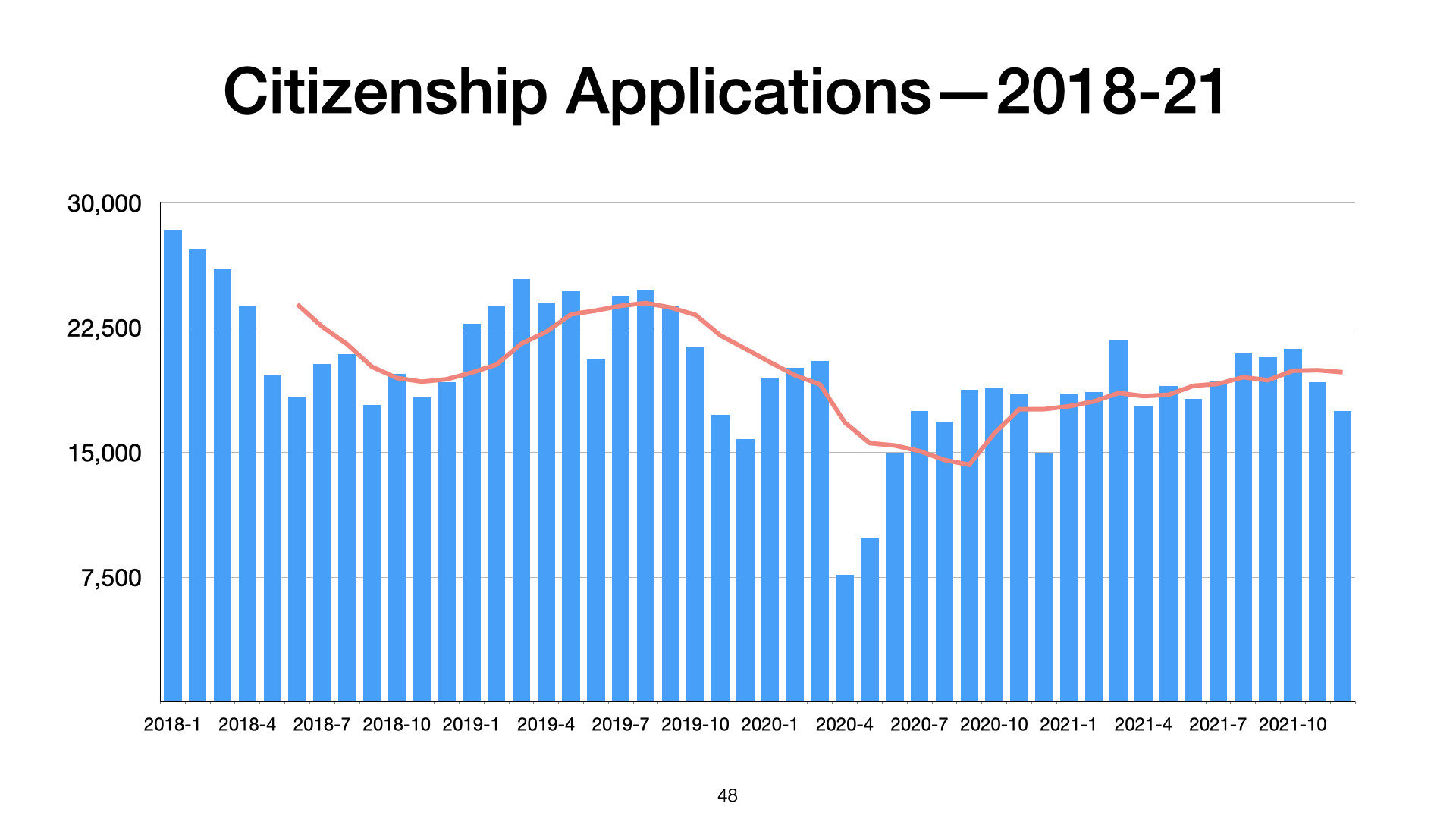
Citizenship applications full-year 2021 operational data

IRCC released the full 2021 data on the number of applications for citizenship. Given the delays in IRCC entering application data in GCMS (for both Permanent Residents and citizenship), this three-month old data reflects an accurate number.

The month-by-month overview:

With the full-year data, I can now update the overview chart of the impact of COVID-19 on the range of immigration-related programs 2021-18 (How the government used the pandemic to sharply increase immigration), showing that applications declined by 10.3 percent compared to new citizens, 37.6 percent.:

The average for applications in 2021 was about 19,000 monthly, with small variations.

Given current processing trends, an average of 31,000 for the first quarter, IRCC should be able to continue chipping away at the backlog of 400,000 (April 11-12) unless applications increase significantly.

Lastly, my standard chart, comparing applications, new citizens and new Permanent Residents:

Institute for Canadian Citizenship makes Canoo [Cultural Access Pass] available to Permanent Residents

Significant move, expanding access to Canoo to Permanent Residents during their first 5 years in Canada, not just new citizens within one year of becoming a citizen.

From their announcement:

Thanks to generous donors large and small, 2 million Permanent Residents will now have free VIP access to our country’s best culture and nature attractions from the get-go. There is no better way to prove to immigrants that Canada values and respects them – to make them feel truly and completely at home. 

We also added spectacular new benefits to Canoo, including big discounts with Air Canada, film festival memberships, sports tickets, concerts, shows, classes, kid-friendly activities, volunteering, and so much more. 

Canoo is now a one-stop-shop for becoming Canadian, not just in your passport, but in your heart.

Commodification of EU citizenship: Will the EU ban ‘golden passports’?

More on EU debates and tightening:

Europe is not quite the same since Russia’s invasion of Ukraine. European reaction to the war is in many ways strengthening the old seams of the EU project and, since its outbreak, one of the moral contradictions facing EU member states in recent years, the sale of citizenship, is now being tackled with much greater consensus.

Following the 2008 financial crisis, which hit southern European economies particularly hard, a number of countries, such as Portugal in 2012 and Spain in 2013, decided to set up schemes to enable the purchase of residence visas for “international investors”, that is, third-country nationals with sufficient purchasing power to secure the right to reside in the EU against payment, providing them with the key to full European citizenship within just a few years. Greece, Ireland, Italy, Malta and Cyprus soon went down the same route. They were followed not long after by the Netherlands, Bulgaria, Estonia, Latvia and even Luxembourg.

In countries such as Bulgaria, Malta and Cyprus, these ‘golden visa’ programmes, technically known as ‘residence by investment’ schemes (RBI), were accompanied by the so-called ‘golden passport’ programmes, which speed up the whole process and offer direct access to ‘citizenship by investment’ (CBI). After years of pressure from Brussels, Bulgaria and Cyprus have committed to ending CBI. Malta, however, has not, so it is still possible to buy an EU passport within a matter of a year.

“The main beneficiaries of both systems have been Chinese oligarchs and Russian oligarchs,” Spanish MEP and former justice minister Juan Fernando López Aguilar, who chairs the European Parliament’s Committee on Civil Liberties, Justice and Home Affairs, tells Equal Times. In many cases, he insists, “they are mafiosi and corrupt individuals who launder the wealth, illicitly acquired in their countries of origin, by buying the privilege of residing in Europe and acquiring property in Europe, which has nothing to do with investment, and much less with creating jobs – all they have to do is buy mansions, yachts and real estate, which is what they do.”

RBI programmes were defended at the time as a way of attracting investments into countries such as Spain and Portugal.

“In both cases they were adopted at the time of conservative governments, which [against a backdrop of economic crisis] introduced legislative measures to, in practice, make money from granting residence rights, even though they are not linked to any actual investment and there are no checks on that investment. So we are clearly faced with issues that impact on European money laundering legislation,” the MEP summarises.

In October 2020, at the request of the European Parliament, the European Commission referred Malta and Cyprus to the European Court of Justice, alleging that their CBI programmes violated several fundamental articles of EU law.

The European Parliament also called on the Commission in March 2022 to prepare legislation banning ‘golden passports’ (CBI) across the EU and to set very strict conditions on ‘golden visa’ (RBI) schemes, with “stringent background checks” on applicants. And, adds López Aguilar, “with mandatory checks against all the databases shared by the EU-LISA agency, which reports regularly to the committee I chair, so that not only people who acquire this residence permit, but also all their direct first-degree relatives can be examined, and with the express obligation to consult and notify all member states, so that they can raise objections [on a case-by-case basis] to any person seeking residence in another member state.”

Investment migration and due diligence

These schemes are not, however, a European invention. There is a whole network of companies specialising in advising wealthy individuals interested in paying for a visa or residence permit in the 30 or so countries around the world that offer them, from small island nations in the Caribbean to economic giants such as the US, the UK and Canada, where the first such programmes were launched in 1986.

It is from Canada that Eric Major, the ‘father’ of the Malta Individual Investor Programme originally hails. Now a founding member and CEO of one of these firms – Latitude RCBI Consultancy – he assured Equal Times that these CBI schemes are a very useful tool for small or economically distressed countries, and that it would be senseless to disregard that.

Major defends the Maltese CBI scheme as an example of how best to regulate so-called “migration by investment”, a global market that generated 21.4 billion euros between 2011 and 2019 through CBI and RBI schemes.

“The US is still the country that approves the most ‘golden visas’ at around 10,000 people a year, while Portugal approved about 1,500 last year, Spain about 1,000,” says Major. “Depending on the size of the family being considered, the cost (of Maltese citizenship) will typically range between €900,000 at the low end, and €1.2 to €1.3 million.” It is “an injection to the National Development and Social Fund,” he adds, which finances “schools, roads and hospitals”. Malta, he explains, receives some 400 applications a year, of which around 250 are approved. “That is around 250 families; that means less than 1,000 people a year. And in the grand scheme of things, that’s 1,000 people who give on average a million euros each. So, you have an island nation that receives €200 million a year with this programme and that is particularly transformative for a small country, and all the more so in a post-Covid world.”

For Major, whose views are fairly representative of those of the Investment Migration Council, what MEPs are raising “are absolutely acceptable issues and need to be addressed”, as “some countries are doing better than others”. He argues that Malta offers an example of what could be satisfactory controls, which were inspired by practices in the banking sector. He refers to this as “four-tier due diligence”, whereby the state has to verify the good moral character of the applicants and the provenance of the funds provided through recourse to international banking databases, the law enforcement agencies of the countries in which they have resided and reports from firms specialising in data verification and risk analysis – all paid for by each applicant as part of the conditions of the programme.

For the European Parliament, however, this is not enough. “Malta and Cyprus keep in place these tools that are supposed to attract foreign investment but [they] have inevitably led to corruption and the laundering of illicitly obtained capital, without the slightest doubt,” says López Aguilar, who hopes that the ECJ will ultimately invalidate these programmes “based on their incompatibility with European law.”

For citizenship scholar Dimitry Kochenov, professor at the Institute of Democracy at the Central European University (CEU) in Budapest, the possibility of such a ruling is not so clear. As he explains to Equal Times, in Europe “citizenship has always been regulated, by default, at the national level, and there is no legal basis for regulating it at the supranational level”, so he does not believe that CBI programmes could be banned. “With residence, it is different, because there is a legitimate legal basis in the treaties by which the EU can legislate to harmonise residence rules and laws in the member states.”

Kochenov, himself a Dutch citizen of Russian origin, fears that the European Parliament’s measures against Russian beneficiaries of these programmes may be counterproductive. “The majority of the oligarchs on the sanctions list did not receive their European passports by investment, because there are plenty of other fully lawful ways,” he explains, as seen with Roman Abramovich, who became Portuguese based on his descent from the Sephardic diaspora. And then there are those who “have acquired citizenship in Europe, or the Caribbean, or elsewhere, because they wanted to escape Putin’s regime rather than support it,” such as Pavel Durov, the creator of the messaging app Telegram, who after refusing to collaborate with the FSB was able to flee Russia by buying citizenship of the Caribbean micro-state of Saint Kitts & Nevis. In 2021, he also acquired Emirati and French citizenship.

“To say that every person who comes from Russia and naturalises in the EU is potentially suspect ignores the simple fact that Russia is not a democracy” and that “many of the people who flee the country need to naturalise elsewhere because there is simply no other way”, so “naturalisation precisely enables their fight with the regime and their opposition to the war in Ukraine”, insists Kochenov.

López Aguilar believes that “this has to be filtered on a case-by-case basis, with all the guarantees required,” so that no one can make wrongful claims. The European Parliament’s intention is not to act against legitimate migration, but to close the door to international criminals and corrupt individuals who have been exploiting these schemes in the EU. And the war is acting as “an accelerant” in this regard, prompting the European Commission to strongly defend and adopt the EP’s proposals to strictly regulate ‘migration by investment’. “If we want to hurt Putin, we have to hurt the Russian oligarchs,” he concludes. “And if we want to hurt the Russian oligarchs, we have to put an end to this.”

Source: Commodification of EU citizenship: Will the EU ban ‘golden passports’?

Liew: We must not allow stateless people to be made outsiders

Long article on statelessness reflecting her family experience and subsequent research in Malaysia, outlining the hardships and issues involved.

The Canadian examples she cited are less clear cut than stated.

In terms of data, about 80 stateless persons per month were granted permanent residence in Canada during the pre-pandemic years of 2018 and 2019, with no data on those becoming citizens on open data:

Growing up, my immigrant father used long-winded lectures to punish me. He would sit me and my siblings down and implore us to imagine what it was like to grow up like him. As we rolled our eyes, he would reiterate that because of our fortunate position in life, we shouldn’t throw it away with our misbehaviour, our relaxed attitude about our school work or lack of work ethic.

My father’s life story seemingly fits into the Canadian migrant narrative. He came as a young economic migrant, sponsored his spouse and several siblings, worked in blue-collar jobs and raised a family. But I never felt like my father’s story was typical. No one around me had the same kind of migration story. I had never heard of anyone being stateless other than members of my family.

My father was born stateless in Brunei, a country that did not and still doesn’t give citizenship to Chinese people born within its territory. A person is stateless when they have no citizenship whatsoever. People who are stateless are homeless in some respects, with no country claiming them as their own. Some may have permanent residence or temporary residence, while others have no immigration status at all.

They live in limbo because without permanent legal status such as citizenship, it is like having no legal identity. Without this, simple things many of us take for granted, such as opening a bank account or getting a driver’s licence, are just aspirations. More significant consequences include the inability to go to school or access health care. Some stateless people suffer severe consequences such as arrest, detention, deportationmental-health issuesexploitative working conditions and poverty.

As a child, I didn’t really understand the term “stateless.” At first, I thought my father meant he wasn’t given a birth certificate. This is a frequent occurrence for stateless people – the lack of documentation that registers their birth, name and legal standing. But it is more than the lack of the piece of paper that my father was referring to. It was how one could be made invisible, disposable and foreign in a country one considers their home.

My father was able to escape a life of limbo and vulnerability by immigrating to Canada. When I was younger, I thought his story was fantastical, unique and obscure. Years later, after practising immigration law and becoming a law professor, I started to see not only frequent occurrences of statelessness but a growing community of scholars writing about the topic.

The United Nations High Commissioner for Refugees estimates that more than 10 million people around the world are stateless. The very nature of statelessness makes it impossible to know precisely how many people are stateless, and the number could be much higher given that it is governments doing the counting and stateless people have very good reasons to hide. Statelessness is not just an issue in developing countries, but exists everywhere, even in Canada and the United States.

It was its pervasiveness that led me to go back to where my family has roots to try to get a better understanding of why statelessness exists. I spent a few months in Malaysia, where there is a significant stateless population and a robust advocacy community supporting stateless people. Over chili crab in Kota Kinabalu, in a humid community centre in Klang, in the waiting room of a government registrar in Penang, and even in the air-conditioned malls of Kuala Lumpur, I met stateless people, their families, lawyers, paralegals, members of parliament, and advocates with community and non-governmental organizations.

In one meeting with a lawyer in a beautiful office of a commercial law firm in Kuala Lumpur, she showed me a file that had the client’s name on it. It was the same as my last name, Liew. At a registration rally in Penang, where 60 stateless people and their families attempted to submit citizenship applications, I sat at a table with Chinese fathers who spoke my mother tongue, Hokkien, and told me their children could not attend school because they were stateless. One father told me, “How can they tell me my own child is a foreigner when I am not!”

In these multiple encounters, I had an out-of-body sensation that I was peering into an alternate universe where I was stateless. I saw my name on legal files and documents, and I saw my own father sitting at the table with other fathers. Indeed, had my father stayed in Southeast Asia, I would be stateless today.

As an academic, I gathered firsthand accounts on how the legal system in Malaysia has failed stateless people. But behind the law is a system in place that is stacked against certain ethnic groups.

My research gave me an understanding of how vestiges of British colonial law, administrative systems and government led to the development of a racialized notion of citizenship in postcolonial Malaysia. This can be found in its constitution and other laws and is being implemented through the discretionary power of front-line clerks reviewing citizenship applications.

I saw the role that administrative and legal decisions had in creating foreigners out of kin. The starkest example was when a stateless woman told me that her citizenship was taken away at a government counter simply because she didn’t “look Malaysian.”

People who had long-standing, genuine connections and bonds with a country were nevertheless made to be outsiders. I saw, in my research, that even though one could be born in a particular country, of parents who were citizens of that country, who lived their entire life there speaking the language and performing the customs, it might not be enough. For some, if your face doesn’t look like the dominant race, you may never belong, and never be granted the coveted status emblematic of belonging – citizenship.

Months later, when I returned to Canada, I started to see the same trends in the cases I had long taught in my immigration law class. The same colonial tools were reproduced in our legal systems to claim a person as not being a citizen of Canada.

Perhaps the most glaring example was Deepan Budlakoti, who was born in Canada in 1989. The case centred around Canada’s Citizenship Act excluding birthright citizenship from those born of persons who were in the country for diplomatic reasons. The central question was whether Mr. Budlakoti’s parents could be considered employed by a foreign government at the time of his birth.

The facts are murky since a former diplomat confirmed Mr. Budlakoti’s parents quit before he was born and a doctor affirmed his parents worked for him at the time of his birth. But the federal government unearthed paperwork showing the diplomatic status of Mr. Budlakoti’s parents was valid at the time of his birth. Canadian courts have accepted the version of facts that Mr. Budlakoti’s parents, who were cooks and cleaners, were employed by the Indian embassy at the time of his birth and therefore he was excluded from acquiring citizenship by being born in Canada.

The Federal Court of Appeal found this despite the fact that Mr. Budlakoti lived in Canada all of his life and had in the past acquired a Canadian passport. Notably, the court denied such a decision would make Mr. Budlakoti stateless, finding that he may qualify for citizenship under the laws of India. This was despite the fact that in attempting to deport Mr. Budlakoti, Canada has not been able to deport him to India since it has denied he is a citizen of India.

Other cases involved stateless refugee claimants whose applications were denied because they had the mere opportunity to gain citizenship somewhere. One notable example is the case of Chime Tretsetsang, a stateless refugee from Tibet who was denied refugee protection in Canada on the flimsy notion that he could possibly obtain citizenship in India. Indeed, the court in this case refused to consider Mr. Tretsetsang stateless and maintained that he could obtain Indian citizenship despite no assurances given by India and no evidence that citizenship would be granted.

In my research, the common thread I have pulled in many cases of statelessness in Malaysia and Canada is the idea that people can be made to be foreigners even where there is little to no evidence they are citizens of another country – or even non-citizens of a country they claim to have membership in.

The mere possibility that they could be citizens of another country is all that legal decision makers have relied on. This is astonishing given the kinds of evidence people need to provide to prove anything in court. These legal findings – that persons are not stateless and are foreign citizens – are based on nothing but pure speculation.

There is a global trend where certain racialized groups will always be considered foreign, other, stranger. This is in the absence of concrete proof that they are citizens of other states. It may also contradict established facts that these people may have deep bonds with Malaysia or Canada. Such ties include birth within the territory, parents or grandparents who have permanent residence or citizenship, years of residence within the country, fluency of the language and cultural customs of the dominant culture of the state, and an absence of affinity or connections to other foreign states. These are factors long recognized in international law as demonstrating citizenship.

As I explored the legal barriers and consequences, as well as the political and social implications of how we treat stateless people, what stayed with me most was how statelessness made people feel and what it did to their conception of their own identity and where they belong.

I found stateless people exhibited a dual personality. At times they were insecure of their place and feared offending anyone around them. They exhibited a perpetual need to please, assimilate and demonstrate that they could blend in. At other times, they displayed a sharp knack for surviving, being resourceful and resilient, manifesting a stubborn insistence that they are citizens in all but name.

They were eloquent, intelligent advocates and a force that governments could not ignore or brush under the rug. I started to appreciate the performances my father carried out and the fear that still seeps out with his parental but cautionary comments to me today to not draw too much attention to myself.

While my father was able to meet the then-requirements for economic immigration to Canada, he has never forgotten the instability and uncertainty he felt as a stateless person. For the millions who remain stateless, many have no legal recourse to obtain any immigration status anywhere. Scores of stateless persons are children born into countries that refuse to treat them like kin, and they suffer when they are denied schooling, health care, jobs and even a home.

It is an urgent time to be talking about statelessness because the very act of making people stateless and declaring they are foreigners is used as a tool in troubling postcolonial contexts including the genocide of the Rohingya people in Myanmar, and the stripping of citizenship from millions of Muslims in Assam, India.

We must challenge the default position that we should necessarily trust those around us and the state in telling us who are members of our community. And we need to start conversations to find productive ways to welcome home our fellow citizens, and be critical about how a person is cast as a stranger, other and foreigner.

Jamie Chai Yun Liew is a lawyer based in Ottawa and the author of the novel Dandelion.

Source: We must not allow stateless people to be made outsiders

CIMM Citizenship delays call for Minister to appear [before end May]

Will be interesting to see the response, and the degree to which information is forthcoming:

Given that significant delays in citizenship applications (over two years) risk disenfranchising Canadians who are waiting for their citizenship in order to vote, and this issue is particularly urgent in light of the June 2nd Ontario provincial election, the government should move quickly to address this issue so that all Canadians who are eligible for citizenship and who choose to apply are able to participate fully in our democratic life. In light of the situation, the committee requests the Minister appear before the committee for two hours by May 27, 2022 to outline actions taken and further actions intended.

Source: https://www.ourcommons.ca/DocumentViewer/en/44-1/CIMM/meeting-21/minutes

Canada immigration backlog exceeds 2M, applicants in limbo

Latest numbers (mid-April). One of the ironies of IRCC’s move to monthly reporting for most data sets (welcome improvement), is that data on inventory (neutral term that includes backlogs) was dropped from public data tables:

Canada continues to be one of the top destinations for immigrants around the world. But the increasing backlogs, exhausting processing times and lack of communication and transparency are causing mounting frustrations among those seeking their Canadian dream.

According to data from Immigration, Refugees and Citizenship Canada (IRCC) published by the immigration news website CIC News, the backlogs have increased to more than 2 million applications across all categories in April, compared to 1.8 million in March.

CTVNews.ca received over 100 responses to our callout from people caught up in this backlog, from those facing delays in visa processing times to those waiting to become permanent residents.

Source: Canada immigration backlog exceeds 2M, applicants in limbo