La crise des passeports aboutira-t-elle à une action collective?

Unlikely that there will be a class action given the unlikelihood of success according to the experts cited:

Billets d’avion inutilisables, frais d’annulation d’hôtels, vacances gâchées : les voyageurs frustrés de ne pas avoir reçu leur passeport à temps pourraient-ils intenter une action collective contre le gouvernement fédéral pour se faire indemniser ? Des juristes consultés par Le Devoir estiment qu’un tel recours est possible, mais non sans embûches.

Il est évidemment possible de poursuivre en justice le fédéral, ce qui a déjà été fait à de multiples reprises, établit d’emblée le professeur de droit public de l’Université de Sherbrooke Guillaume Rousseau.

Il rappelle toutefois que, pour utiliser cette procédure spéciale qu’est l’action collective, il faut franchir une étape supplémentaire par rapport aux autres manières d’intenter une poursuite : celle de l’autorisation. Un juge se penche alors sur le dossier et vérifie s’il satisfait aux critères permettant aux personnes s’estimant lésées de procéder « en groupe ». Si oui, le magistrat donne le feu vert à la poursuite, qui peut aller de l’avant.

Le juge ainsi appelé à autoriser une action collective doit par exemple se demander si elle convient à la situation. On peut penser ici qu’elle serait préférable à des centaines ou à des milliers de poursuites individuelles, souligne le professeur Rousseau.

Mais pour avoir gain de cause, il faudra que les voyageurs qui ont subi des dommages (certains d’entre eux ont annulé leur voyage à grands frais ou ont manqué des jours de travail pour faire la file, même la nuit, afin d’obtenir le précieux document de voyage) prouvent que le fédéral a commis une faute.

En droit public, il y a faute quand une personne adopte un comportement qui s’écarte de celui de la personne raisonnable. « Ici, le gouvernement a-t-il agi comme un bon administrateur ? » demande le professeur Rousseau. En d’autres mots, est-il fautif de ne pas avoir eu assez d’employés pour traiter les nombreuses demandes de passeport déposées quand les restrictions sanitaires ont commencé à être levées ? Devait-il allouer plus de ressources au bureau des passeports ? Ou encore embaucher plus d’employés — et plus tôt — en prévision de la reprise des voyages internationaux ?

L’« argument pandémique »

Une telle action collective « n’est pas gagnée d’avance, mais ce n’est pas non plus impossible », juge Me Anne-Julie Asselin, avocate au sein du cabinet Trudel, Johnston et Lespérance, qui pilote de nombreuses actions collectives au Québec.

Selon elle, « la difficulté majeure du dossier » est de prouver la faute de l’État fédéral. Me Alexandre Brosseau-Wery, avocat associé chez Kugler Kandestin, est un peu plus optimiste : « Cela pourrait, à première vue, être un bon recours. »

Mais tous deux soulèvent la même embûche : pour justifier ses ratés et ses retards, l’État pourrait soulever comme moyen de défense la pandémie, qui a envoyé en congé de maladie bon nombre de ses employés et qui l’a forcé à affecter certains d’entre eux à d’autres tâches. Sans oublier la pénurie de personnel qui sévit un peu partout.

Cet « argument pandémique » a déjà été soulevé par plusieurs défendeurs devant les tribunaux ces derniers temps, rappelle Me Asselin. Mais deux ans plus tard, l’argument est-il toujours valable ? Les tribunaux pourraient y être moins réceptifs avec le passage du temps. Et puis, il y a quand même des choses qui auraient pu être prévues par le gouvernement, dit l’avocate.

Me Brosseau-Wery est du même avis : « On peut concevoir que, s’il avait agi diligemment et de manière proactive, il aurait pu mettre en place le nécessaire pour répondre à la demande plus élevée », et respecter ses propres normes et délais de traitement des passeports. De plus, c’est le gouvernement fédéral lui-même qui a levé certaines des restrictions de voyage, ce qui a mené à une forte demande pour ce document officiel.

Un autre argument fort pourrait être utilisé contre le fédéral, avance le professeur Rousseau : l’article 6 de la Charte canadienne des droits et libertés, qui prévoit que « tout citoyen canadien a le droit de demeurer au Canada, d’y entrer ou d’en sortir ». 

Empêcher un citoyen de voyager à l’extérieur des frontières pourrait « être constitutif de faute. » Et quand il est question de droits protégés par la Charte, les tribunaux ne sont pas très réceptifs à des excuses du type « problèmes administratifs », ajoute-t-il.

Témérité et immunité

Par contre, Me Asselin signale que des avertissements sur le site Web du gouvernement enjoignaient aux voyageurs de ne pas acheter de billets d’avion sans avoir leur passeport en main. Cela n’exonérerait peut-être pas entièrement le fédéral, mais pourrait possiblement mener à un partage de responsabilité, estime-t-elle : Ottawa pourrait plaider que l’achat de billets était téméraire. La ministre fédérale du Développement social, Karina Gould, a elle-même soulevé cet argument.

À cela, certains pourraient répliquer qu’à une certaine période, le bureau des passeports ne traitait que les demandes des voyageurs qui avaient un vol partant dans les 48 heures.

Il y a aussi une difficulté supplémentaire quand on poursuit le gouvernement : toute la question de l’immunité dont bénéficie l’État dans certaines circonstances, rappelle Me Brosseau-Wery. Le tribunal doit déterminer si la situation dommageable résulte d’une décision politique (par exemple, dans le cas d’une piste cyclable, décider ou non de la construire) ou opérationnelle (l’entretien de ladite piste afin qu’elle soit sécuritaire), illustre-t-il.

Car l’État bénéficie d’une immunité relative quant à ses décisions de nature politique, sauf en cas de mauvaise foi.

La limite entre une décision de nature politique ou opérationnelle est toutefois souvent difficile à établir, juge l’avocat. Mais cette immunité, si elle est applicable, peut jouer en faveur du gouvernement et faire échec à la poursuite, renchérit Me Asselin.

Source: La crise des passeports aboutira-t-elle à une action collective?

Tatour: Israel can now strip away 48 Palestinians’ #citizenship

Of note, even if reference to broader “ethnic cleansing” is overstated:

Last week, in a precedential decision, Israel’s Supreme Court ruled that the state had the power to revoke the citizenship of a person convicted of offences that amounted to “breach of loyalty”, even if the person would become stateless as a result and in violation of international law.

The decision deliberated on the case of Alaa Zayoud, a Palestinian who holds Israeli citizenship. In October 2015, Zayoud rammed his car into a bus station and stabbed three Israelis. In 2017, a year after his conviction, the minister of interior notified Zayoud of his intent to revoke his citizenship, in accordance with the Citizenship Law.

The importance of this decision cannot be overstated. Its implications are grave and will be seen in the near and far future

The administrative court in Haifa approved the decision. Zayoud appealed and the case ended up in the Supreme Court.

In its decision, the Supreme Court determined that: “No constitutional defect in the arrangement that allows the revocation of the citizenship of a person who committed an act that constitutes a breach of loyalty in the State of Israel, such as: an act of terrorism; an act of treason or serious espionage; or the acquisition of citizenship or the right of permanent residency in a hostile state or in hostile territory.

“This is so, even if as a result of the revocation of his citizenship, the individual becomes stateless, provided that if the individual becomes stateless, the interior minister must grant him a status of permanent residence in Israel or another designated status.”

The importance of this decision cannot be overstated. Its implications are grave and will be seen in the near and far future. This decision has created a legal path for revoking the citizenship of the 48 Palestinians (also known as Palestinian citizens of Israel), a stepping-stone in Israel’s efforts to advance the ethnic cleansing and expulsion of Palestinians.

‘Terrorist intent’

On a practical level, the court has cleared the way for what would become the routine denaturalisation of Palestinians with Israeli citizenship, making them vulnerable to deportation, something Israel has long aspired to.

The decision to substitute citizenship with a so-called permanent residency status might enable individuals to continue to have access to some social services, but it strips them from the utmost protection that citizenship is designed to grant: the right to remain at home.

Israel knows that to make 48 Palestinians vulnerable to expulsion, it has first to revoke their citizenship. The court’s decision facilitates just that.

And it is Israel and its security services who define what constitutes a “breach of loyalty”, which according to the Citizenship Law creates the grounds for revoking citizenship. At the moment, Israel defines a “breach of loyalty” based on Israel’s Counter-Terrorism Law, which permits it to classify different offences as terrorist acts.

Israel routinely applies “terrorist intent” when it comes to Palestinians. For example, in the aftermath of May 2021’s Unity Intifada, Israel arrested thousands of Palestinians and filed indictments against hundreds of protesters, with 167 of them charged with terrorist offences, based on the Counter-Terrorism Law.

Following the Supreme Court’s recent decision, all of them face the threat of having their citizenship revoked. Palestinians know all too well what this could potentially mean: expulsion from their homeland.

The act of revoking citizenship would leave the affected Palestinians stateless. Israel already made all Palestinians stateless in 1948 with the nullification of Palestinian citizenship under the British Mandate. Many Palestinians remain stateless. The Palestinians who remained after the Nakba (the Catastrophe) in 1948 received Israeli citizenship in the first two decades of the state.

Now Israel is threatening to make them stateless again.

Although this decision clearly violates international law, the court still determined that it was constitutional to denaturalise Palestinians, stating – falsely – that the condition of statelessness could be remedied through the extension of “permanent residence in Israel or another designated status”.

A secret plan

The experience of Jerusalemites teaches us that there is nothing permanent in “permanent residence” when it comes to Palestinians. Since 1967, Israel has regularly revoked the residence of Jerusalemites, effectively banning them permanently from their city and homes. So far, over 15,000 residencies have been revoked, as part of the ongoing effort to eliminate Palestinians from the city.

Israel has never made peace with the existence of its Palestinian citizens. It pursued plans for the mass expulsion of 48 Palestinians in its first decade. The Kafr Qasim massacre of October 1956, in which the army executed 51 Palestinians, was part of a larger secret plan, called Operation Hafarperet, to oust the Palestinian population from the Little Triangle.

In addition, in the early 1950s, Israel attempted to advance a plan for the expulsion of 10,000 Palestinians from seven villages in the Galilee, as well as other plans for the resettlement of Palestinians in Argentina and Brazil.

The quest to expel Palestinians persisted. It re-emerged in the Israeli public and political landscape during the 1980s with the rise of Meir Kahane, an American-born ultra-Orthodox nationalist rabbi, and his fascist party, Kach. Kach advocatedthe denaturalisation of Palestinian citizens and their transfer, as well as the expulsion of Palestinians in the occupied 1967 territories.

Proposed plans to reduce the number of Palestinian citizens are now an integral part of the Israeli mainstream political discourse

Since the 2000s, there have been significant efforts to make the citizenship of Palestinians more easily revocable. Proposed plans to reduce the number of Palestinian citizens are now an integral part of the Israeli mainstream political discourse and are supported by most of the Israeli public.

We have seen calls to demand that 48 Palestinians sign an oath of allegiance to the Israeli state as a Jewish state; the adoption of the Nation-State of the Jewish Peoplein 2018; and the advancement of what is known as the “population exchange” plan– the planned transfer of Little Triangle villages and their estimated 300,000 residents to the Palestinian state against the will of the Palestinians in these areas.

Instrument of sumud

In an alarming development, in recent years Israel has been revoking the citizenship of Palestinian Bedouins in the Negev in an apparent test case for a wider project of denaturalisation of Palestinian citizens. In 2010, the Ministry of Interior began a review of the citizenship status of the Bedouin.

Its report concluded that thousands of Bedouin had been erroneously registered as citizens. Subsequently, Israel denaturalised hundreds of Bedouin in the Negev, rendering them stateless.

It is no coincidence that Israel began with the Bedouin – the most vulnerable and marginalised population among 48 Palestinians.

It is no secret that Israel wants to see all Palestinians, including 48 Palestinians, vanish. Even though the latter were granted Israeli citizenship, Israel sees 48 Palestinians as guests whose presence is not only undesirable, but always conditional.

Israel sees in their citizenship a gesture, not a right – and gestures can always be undone – as articulated by Israel’s former transport minister, Bezalel Smotrich: “We are the landlords of this land. This land has belonged to the Jewish people for thousands of years. God did promise us all of the Land of Israel, a promise he kept. We’ve just been the most hospitable people in the world since the days of Abraham and so you’re still here. At least for now.”

We need to see it for what it is: Israel is working step by step to create legal paths for making denaturalisation, and thus the expulsion, of 48 Palestinians possible. For 48ers, Israeli citizenship has been an instrument of sumud or steadfast perseverance.

It guarantees – for the most part – their continued presence in their homeland. For 48 Palestinians, citizenship means survival.

Source: Israel can now strip away 48 Palestinians’ citizenship

Aging South Korea turns to immigration

Notable shift:

The Ministry of Justice will open a bureau to facilitate immigration as South Korea struggles to cope with falling birth rates and an aging population.

After briefing President Yoon Suk-yeol on Tuesday morning, Justice Minister Han Dong-hoon told reporters that the plans for a central bureau overseeing policies relating to immigration will begin to take shape over the remaining year.

Since taking office in May, Han has said that during his term, he would make it his mission to institute an immigration-friendly system within the government. “Building forward-looking, effective immigration policies is critical for the country’s future,” he said.

The ministry is trying out new programs for attracting and retaining immigrants.

One of them is a “fast-track” path to citizenship and residence for highly-skilled applicants, set to open in October. Another is a “region-specific” visa to encourage foreigners to settle in regions with steeper population declines.

The ministry will also set out initiatives for removing barriers for children of immigrants in accessing education, health care and other social services.

In the same briefing, Han said the ministry plans to crack down on serious, widespread crimes in South Korea, as prosecutors are about to lose their powers to investigate and prosecute most crimes. Once the Democratic Party of Korea-backed laws come into effect in September, prosecutors can no longer be involved in the investigations of the crimes that they prosecute.

He said the ministry will zero in on crimes targeting vulnerable populations such as minors and women. Child maltreatment surveillance will be increased. Power-based sexual violence will be dealt heavier penalties. GPS tracking anklets will be used on those convicted of stalking.

More investigations will be encouraged against corporate and white-collar crimes such as tax evasion, as well as fraud rings perpetuating phishing and cryptocurrency scams, he added.

Han said key goals of the ministry under his leadership would be establishing a judicial system that is adaptive to future challenges; criminal justice collaboration with police and concerned ministries to reduce violence and corruption; and promotion of human rights and a victim-centered approach in the administration of justice.

Source: Aging South Korea turns to immigration

How a Canadian lawyer is helping the growing number of ultra-rich looking to exit China

Interesting profile of Canadian immigration lawyer David Lesperance who specializes in business immigration.
Remain unconvinced that governments can design investor immigration or citizenship programs for the ultra-rich that provide meaningful benefits to Canada and Canadians as both the previous federal program, Quebec’s current program and programs of other countries largely demonstrate:
When a Chinese-Canadian billionaire faced a closed-door trial last month, four years after being snatched from Hong Kong, the event did not go unnoticed among China’s wealthy entrepreneurs.
It was the latest sign that they could be next as Beijing pushes down on the country’s most affluent business people, says a Canadian lawyer whose unique practice focuses on building back-up plans for “ultra-high-net-worth” individuals.
That nervousness is fueling a growing and urgent interest in leaving mainland China or Hong Kong, says David Lesperance.

The number of very-rich business people based in the region contacting him for help in getting out has tripled in the last couple of years, he says, as President Xi Jinping consolidates power, eliminates opponents and tightens his grip on once-free-wheeling Hong Kong.

And they tend to be wealthier, often worth billions, people who had been entrenched where they were until recently.

“These are clients who realize the chances of getting caught have increased dramatically — to not a will but a when question,” said Lesperance. “That group has now for the first time really contemplated ‘I’m going to have to leave some day. There is definitely a wildfire.’”

“We’ve been very busy since the beginning of the year.”

The resulting flight of “golden geese” could be an economic boon for the countries where they land. Canada is definitely among the mix of possible destinations but governments here should do more to attract the rich fleeing China — and their fortunes, said the lawyer

But luring such migrants is not without controversy. Ottawa’s investor immigrant program was actually cancelled in 2014 because of what the then-Conservative government said were an array of problems. Those immigrants had to fork out a relatively tiny investment, paid less taxes here, on average, than nannies, spent little time in Canada, and often learned neither English or French, critics said.

So far, China has not seen a major exodus of its richest citizens. It’s still home to 626 billionaires, second only to the United States’ 724, according to Forbes.

But Lesperance is not the only advisor noticing a growing trend among China’s wealthy to move at least their money out of the country.

Increasing numbers are parking assets in Singapore via the city state’s “family office” system, according to a survey in March by CNBC. Jenga, one of the firms that handles such transfers, told the news outlet it had seen demand double in just the previous 12 months.

Lesperance seems to come by the work honestly, having been raised in an almost borderless environment himself. A native of Windsor, Ont., his father worked in the auto industry across the river in Detroit and two of his siblings were born in a hospital there, giving them instant dual citizenship

He says his practice — which combines immigration and taxation advice — is divided about equally between clients in China/Hong Kong, the Middle East and the United States. He’s now based in Poland, where he can fit clients from multiple time zones into his daily schedule.

Many of Saudi Arabia’s wealthy are worried about Crown Prince Mohammed bin Salman rising to the throne when his father, the king, dies. In the U.S., clients looking to decamp are divided between those who fear Democrats will boost taxes on the wealthy, and others who worry about a sharp shift to the right if the Republicans regain power nationally.

But the case of China highlights the dramatic changes Xi has wrought since coming to power in 2012, and the shifting role of business tycoons in the nominally Communist country.

Anxieties began with the 2019 proposal of an extradition treaty from Hong Kong to China, said Lesperance. It has increased as Beijing tightened the screws on Hong Kong, introducing a widely criticized National Security Law, imprisoning dissidents including media mogul Jimmy Lai and curbing the limited amount of democracy in the city’s government.

And there have been further scares on the mainland. Beijing recently quashed the thriving private-education industry and applied new pressure on the high-tech sector. Jack Ma, billionaire head of the Alibaba technology conglomerate, disappeared for months in 2020 and 2021 after he publicly criticized Chinese regulators, as an IPO for his Ant Group was suddenly axed.

Other moguls have also disappeared mysteriously. Xi’s announcement of a “common prosperity” program to more evenly spread wealth across the Chinese population has further put the very rich under pressure. Many China experts speculate that such campaigns are also about eliminating rivals to the Party’s — and Xi’s — power and control.

And then there is Xiao Jianhua, the Chinese born-and-bred Canadian citizen who was taken from his home in a Hong Kong hotel in 2017, surfacing just recently for a hasty, secretly held trial in China on unclear charges. His family in Toronto is still waiting to hear the verdict.

The case is “often cited” by clients who fear they could similarly run afoul of the government, said Lesperance. His bottom-line advice is that they prepare in advance for just that happening, rather than wait and see if things turn bad.

“You want to prevent the problem and avoid the wildfire, as opposed to trying to put it out after your house is on fire.”

Lesperance tells clients they must focus on moving both “ass and assets” — finding a place for their money and themselves and their family. That means deciding on a new home that works both “at the board table and the breakfast table,” somewhere the children can get a good education and the entrepreneur can keep running his or her business.

Popular destinations include Australia, New Zealand, the U.K., the U.S. and this country.

To get into Canada, those wealthy migrants can set up a subsidiary of their business here and obtain work permits as corporate transfers. Provincial “nominee” programs provide a pathway to permanent residence but they’re a “dog’s breakfast,” said Lesperance.

He recommends Ottawa revive the investor immigrant class, with reforms to address past issues. That could include requiring the person to provide a clear financial benefit to Canada, a system to weed out money launderers and other “undesirables,” strict application of tax laws, and imposing a large fee to cover the cost of processing those and other applications, the lawyer said. With all of it done in a clear, timely way.

“The thing to remember is that Canada is in competition for these Golden Geese and must present an opportunity which is competitive with all the other countries which are also trying to get this group.”

Source: How a Canadian lawyer is helping the growing number of ultra-rich looking to exit China

New evidence disputes Trump administration’s citizenship question rationale

No suprise:

Previously unreleased internal communications indicate the Trump administration tried to add a citizenship question to the census with the goal of affecting congressional apportionment, according to a report issued Wednesday by the House Committee on Oversight and Reform.

The documents appear to contradict statements made under oath by then-Secretary of Commerce Wilbur Ross, who told the committee that the push for a citizenship question was unrelated to apportionment and the reason for adding it was to help enforce the Voting Rights Act.

The nearly 500 documents include several drafts of an August 2017 memorandum prepared by a Commerce Department lawyer and political appointee, James Uthmeier, in which he initially warned that using a citizenship question for apportionment would probably be illegal and violate the constitution, the report said.

Source: New evidence disputes Trump administration’s citizenship question rationale

Canada’s immigration backlog grows to 2.7 million people

As always, canadavisa.com provides a valuable service sharing the detailed numbers one backlogs (it appears I was too charitable with respect to citizenship in my May update):

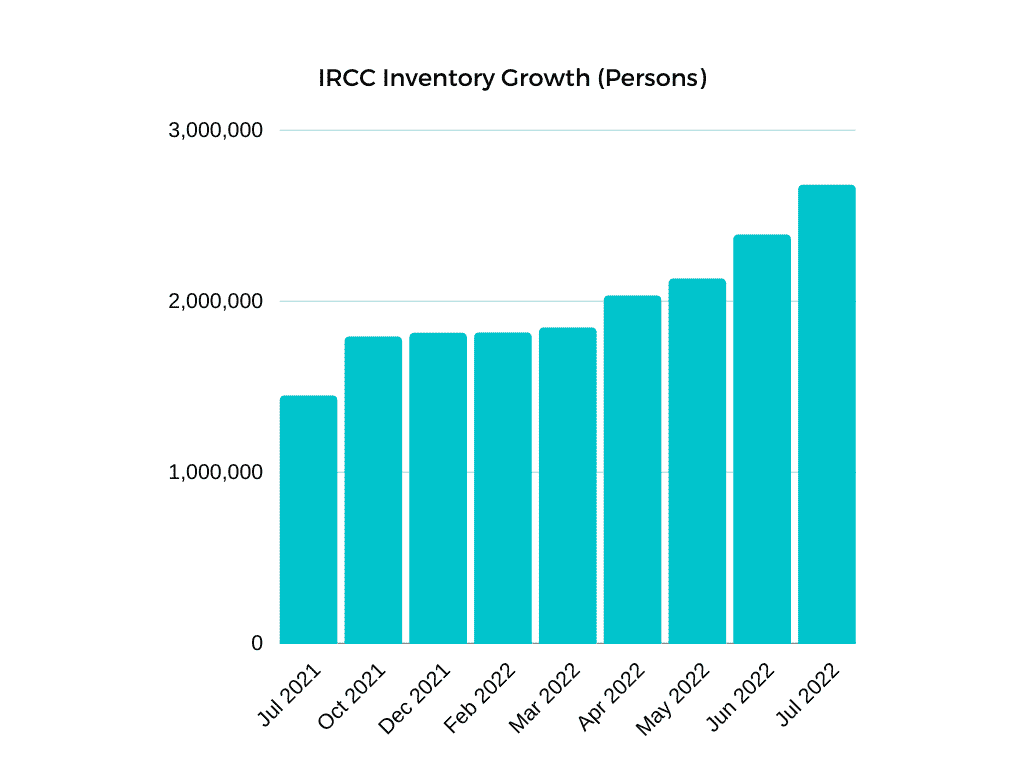
Canada continues to struggle with its immigration applications as its inventory now stands at some 2.7 million people.

This represents a growth of nearly 300,000 people over the past six weeks.

The backlog has nearly doubled over the past year and nearly tripled since the start of the pandemic.

It has progressed as follows since last July:

The citizenship inventory stands at 444,792 applicants as of July 15, compared to 394,664 on June 1.

The permanent residence inventory stands at 514,116 people as of July 17, compared to 522,047 as of June 6.

On July 17, the temporary residence inventory stood at 1,720,123 people, compared to 1,471,173 persons, also as of June 6.

CIC News made this data request to Immigration, Refugees and Citizenship Canada(IRCC) on June 30 and received the data on July 18.

Express Entry draws resume due to backlog reduction

A total of 51,616 Express Entry applicants are waiting on decisions as of July 17, a significant reduction from the 88,903 reported when comparable was available on March 15.

The reduction in Express Entry backlogs means IRCC can once again hold all program draws, and processing times for new Express Entry applicants are back to the six-month standard. On July 6, IRCC held its first all-program draw since December 2020.

Family class inventory is up slightly

The overall inventory of family class applicants is up to 118,251 persons compared to 112,837 persons on June 6.

The Spouses, Partners and Children Program inventory has increased compared to early June. It stands at 68,159 persons compared to 67,929 persons last month. The figure for July was found by adding Spouses and Partners to Children and Other Family Class for the purpose of comparison.

The Parents and Grandparents Program (PGP) has seen another increase. It is now at 47,025 persons compared to 41,802 persons. IRCC has yet to announce details on its plans for the PGP 2022.

Discover if You Are Eligible for Canadian Immigration

Summer backlog growth is normal, to an extent

The temporary residence inventory has increased by nearly 250,000 persons compared to June 6.

Increases were observed in the number of applicants for study permits, temporary resident visas, visitor records, work permits, and work permit extensions.

The growth of IRCC’s backlog is normal to an extent over the summer months. More people look to obtain temporary resident visas to visit family and friends during the warmest time of the year in Canada.

In addition, many international students who complete their studies in the spring go on to apply for Post-Graduation Work Permits (PGWP), which is Canada’s largest work permit category.

Most international students also submit their study permit applications in the months leading up to the start of Canada’s academic calendar. This results in Canada usually welcoming over 200,000 new international students leading into September each year.

The main exception is the Canada-Ukraine Authorization for Emergency Travel(CUAET), which Canada introduced in March to provide Ukrainians with the opportunity to relocate following Russia’s invasion. Since March 17, IRCC has received 362,664 CUAET applications, causing its backlog to swell.

However, the overall growth of the backlog, a nearly three-fold increase since the start of the pandemic in March 2020, highlights ongoing challenges with Canada’s immigration system. It is a function of IRCC continuing to welcome new applications throughout the pandemic even though its processing capacity was limited for large stretches of 2020 and 2021.

The department is now playing catch-up and is taking steps such as hiring additional processing staff and looking to invest in technological upgrades.

Meanwhile, other arms of the federal government have taken notice of Canada’s immigration application challenges.

In May, the Canadian Parliament’s Standing Committee on Citizenship and Immigration (CIMM) began a study on the backlogs. It will result in a public study containing recommendations for improvement.

In June, Prime Minister Justin Trudeau created a federal task force to address backlog challenges. It is made up of a group of federal ministers, who will make recommendations to address issues that are causing the delay in application processing. The goal is to create both long-term and short-term solutions that will clear the backlogs and improve the quality and speed of services.

Inventory in tables

The following tables show more details on IRCC’s inventory.

Citizenship Inventory

Application type Persons as of July 15, 2022
Grant 387,368
Proof 57,424
Total Citizenship Inventory 444,792

Immigration Inventory

Immigration Category Persons as of July 17
Economic Class 211,903
Family Class 118,251
Humanitarian & Compassionate / Public Policy 29,848
Permit Holders Class 16
Protected Persons 154,098
Total Immigration Inventory 514,116

Express Entry Inventory

Immigration Category Persons as of July 17
Canadian Experience Class (EE) 5,195
Federal Skilled Workers (EE) 18,127
Skilled Trades (EE) 369
Provincial/Territorial Nominees (EE) 27,925
Total Immigration Inventory 51,616

Family Class Inventory

Immigration Category Persons as of July 17, 2022
Children & Other Family Class 9,147
FCH-Family relations – H&C 3,067
Parents and Grandparents 47,025
Spouses & Partners 59,012
Total Family Class Inventory 118,251

Economic Class Inventory

Immigration category Persons as of July 17, 2022
Agri-Food Pilot Program 765
Atlantic Immigration Pilot Programs 2,380
Atlantic Immigration Program 33
Canadian Experience Class (EE) 5,195
Canadian Experience Class (No EE) 109
Caring for Children 60
Federal Entrepreneur 4
Federal Self Employed 4,502
Federal Skilled Workers (C-50) 123
Federal Skilled Workers (EE) 18,127
Federal Skilled Workers (Pre C-50) 23
High Medical Needs 7
Home Child Care Pilot 18,191
Home Support Worker Pilot 6,912
Interim Pathway Measure 767
Live-in Caregiver 931
Provincial/Territorial Nominees (EE) 27,925
Provincial/Territorial Nominees (No EE) 35,599
Quebec Entrepreneur 281
Quebec Investor 11,115
Quebec Self Employed 94
Quebec Skilled Workers 24,570
Rural and Northern Immigration Pilot 1,118
Skilled Trades (EE) 369
Skilled Trades (No EE) 2
Start-up Business 1,309
TR to PR 51,392
Total Economic Class Inventory 211,903

Humanitarian and Compassionate Inventory

Immigration Category Persons as of July 17, 2022
HC & PH class-ADM Dependant Person Overseas 44
Humanitarian & Compassionate Straight 3,067
Humanitarian & Compassionate with Risk or Discrimination 47,025
Public Policy With RAP 59,012
Public Policy Without RAP 118,251
Total H&C Inventory 5,341

Permit Holders Inventory

Immigration Category Persons as of July 17, 2022
Permit Holders Class 16
Total Permit Holders Inventory 16

Protected Persons Inventory

Immigration Category Persons as of July 17, 2022
Blended Visa Office-Referred 150
Dependants Abroad of Protected Persons 26,628
Federal Government-assisted Refugees 33,531
Privately Sponsored Refugees 71,076
Protected Persons Landed In Canada 21,770
Quebec Government-assisted Refugees 943
Total Protected Persons Inventory 154,098

Temporary Residence Inventory

Application type Persons as of July 17, 2022
Study Permit 196,729
Study Permit Extension 35,482
Temporary Resident Visa 903,971
Visitor Record 90,195
Work Permit 313,710
Work Permit – Extension 180,036
Total Temporary Residence Inventory 1,720,123

Source: Canada’s immigration backlog grows to 2.7 million people

New Zealand launches new immigration visa category, opens from September | Mint

Higher threshold than most, along with focus on active not passive investment:

To attract experienced, high-value investors to invest in domestic businesses, the New Zealand government has created a new investor migrant visa category. The new Active Investor Plus visa category will replace the existing Investor 1 and Investor 2 visa categories. Eligibility criteria for New Zealand’s Active Investor Plus visa category includes a minimum $5 million investment and only 50% of that can be invested in listed equities.

“We have so many fantastic businesses in New Zealand that are making a real name for themselves in the global marketplace. Our Government has a goal to support these businesses to grow into even more successful global brands, and updating our investor visa settings is a key part of our strategy to attract high-value investors,” Economic and Regional Development Minister Stuart Nash said.

Source: New Zealand launches new immigration visa category, opens from September | Mint

Citizenship-by-Investment: Henley Global Citizens Report 2022 Q2 Press Release

Always interesting to see where the money is going. Canada is on the list for the start-up visa program, which is distinct from most of the other programs listed in terms of being based more on actual investment than just residence (but look forward to an eventual IRCC evaluation to see how effective it is):

“A tsunami of private capital has left Russia and Ukraine, the UK has lost its wealth hub crown, and the US is fading fast as a magnet for the world’s wealthy, with the UAE expected to overtake it by attracting the largest net inflows of millionaires globally in 2022, according to the latest Henley Global Citizens Report, which tracks private wealth and investment migration trends worldwide.

The Q2 report released today by international residence and citizenship by investment advisory firm Henley & Partners exclusively features the latest projected 2022 net inflows and outflows of US dollar millionaires (namely, the difference between the number of HNWIs who relocate to and the number who emigrate from a country) forecast by New World Wealth. The firm is the only known independent wealth research company systematically tracking international private wealth migration trends over the past decade. The HNWI migration figures focus only on people with wealth of USD 1 million or more and who have truly moved — namely, those who stay in their new country more than half of the year.

As expected, Russia has suffered the biggest emigration of millionaires over the past six months, with forecast net outflows of 15,000 by the end of 2022 — a massive 15% of its HNWI population and 9,500 more than in 2019, pre-pandemic. Russia’s invasion is in turn driving a steep spike in outgoing HNWIs from Ukraine, which is predicted to suffer its highest net loss in the country’s history — 2,800 millionaires (42% of its HNWI population) and a net loss of 2,400 more than 2019. No country-specific figures are available for 2020 and 2021 owing to Covid-related lockdowns and travel restrictions.

Top 10 countries gaining and losing millionaires in 2022

Forecast figures in the Henley Global Citizens Report show the top 10 countries in terms of net inflows of HNWIs in 2022 will be the UAE, Australia, Singapore, Israel, Switzerland, the US, Portugal, Greece, Canada, and New Zealand. Large numbers of millionaires are also expected to move to ‘the three Ms’: Malta, Mauritius, and Monaco. On the flip side, the 10 countries where the highest net outflows of HNWIs are predicted are Russia, China, India, Hong Kong, Ukraine, Brazil, the UK, Mexico, Saudi Arabia, and Indonesia.

Dr. Juerg Steffen, CEO of Henley & Partners, says HNWI migration was a rising trend over the past decade until, understandably, it dipped in 2020 and 2021 due to the Covid-19 pandemic. ‘The 2022 forecast reflects an extremely volatile environment worldwide. By the end of the year, 88,000 millionaires are expected to have relocated to new countries, 22,000 fewer than in 2019 when 110,000 moved. Next year, the largest millionaire migration flows on record are predicted — 125,000 — as affluent investors and their families earnestly prepare for the new post-Covid world, with an as yet-to-be revealed rearrangement of the global order, and the ever-present threat of climate change as a constant backdrop.’

Andrew Amoils, Head of Research at New World Wealth says HNWI migration figures are an excellent barometer for the health of an economy. ‘Affluent individuals are extremely mobile, and their movements can provide an early warning signal into future country trends. Countries that draw wealthy individuals and families to migrate to their shores tend to be robust, with low crime rates, competitive tax rates, and attractive business opportunities.’

UK and USA – the mighty are falling

According to the latest data, destinations that traditionally attracted wealthy investors are losing their luster. The UK, once touted as the world’s financial center, continues to see a steady loss of millionaires, with net outflows of 1,500 predicted for 2022. This trend began five years ago when the Brexit vote and rising taxes saw more HNWIs leaving the country than entering for the first time. The UK has suffered a total net loss of approximately 12,000 millionaires since 2017.

The appeal of another financial giant, the US, is also dwindling fast. America is notably less popular among migrating millionaires today than pre-Covid, perhaps owing in part to the threat of higher taxes. The country still attracts more HNWIs than it loses to emigration, with a net inflow of 1,500 projected for 2022, although this is a staggering 86% drop from 2019 levels, which saw a net inflow of 10,800 millionaires.

Commenting on the geopolitics of millionaire migration in the Henley Global Citizens Report, award-winning journalist Misha Glenny says private wealth growth is bound to remain anemic in the US this year as political unpredictability looms. ‘In November, the mid-term elections are likely to return a Republican House and possibly the Senate, too. With culture wars between Democrats and Republicans mounting once more with the leaked decision of the Supreme Court to overturn the Roe vs. Wade ruling on abortions, some fear we are entering another period of dramatic instability such as that which characterized the Trump years. As a consequence, some high-net-worth investors will doubtless think twice before committing their wealth to the Americas.’

The UAE’s stellar ascent as a wealth hub

By contrast, the UAE has become the focus of intense interest among affluent investors and is expected to see the highest net influx of HNWIs globally in 2022, with 4,000 forecast — a dramatic increase of 208% versus 2019’s net inflow of 1,300 and one of its largest on record. This mirrors the country’s remarkable rise in the Henley Passport Index rankings over the past decade as it focused on attracting tourism and trade by implementing a succession of mutually reciprocated visa waivers. The UAE is now doing the same with its competitive, agile approach to adapting immigration regulations to attract private wealth, capital, and talent.

Glenny says affluent Russians seeking to escape the impact of the devastating Western sanctions on their country have started to move to the UAE and Israel in large numbers. ‘An underlying pattern was already detectable in advance of the invasion of Ukraine. Well before the imposition of sanctions on the Russian banking system, there was a tsunami of capital leaving the country, largely prompted by the increasingly capricious governing style of President Vladimir Putin and his demands of loyalty made on middle-class and wealthy Russians. They have now come under further pressure from many Western countries, such as Britain, where they had previously made their homes.’

Israel, Australia, New Zealand, Singapore among the big winners 

As Glenny points out, net HNWI inflows are on the rise in Israel, with a figure of 2,500 forecast for 2022 — a significant increase of 79% since 2019.

Long-term high performer Australia consistently attracts large numbers of HNWIs. New World Wealth estimates that over 80,000 US dollar millionaires have moved to the country over the past 20 years. In 2022, the net inflow is expected to be 3,500 — the second-highest globally. Neighboring New Zealand is expected to receive a net inflow of 800 HNWIs in 2022, and Asia’s prime hub of affluence, Singapore, continues to attract millionaires, with net inflows of 2,800 expected — a prolific 87% increase compared to 2019’s figure of 1,500.

Commenting in the Henley Global Citizens Report, FutureMap founder and international bestselling author Dr. Parag Khanna says, ‘Globalization is not dead — and certainly not from the perspective of Asia, where inward capital flows are rising on the back of a post-Covid reopening and genuine investments across the region in productive capacity. With multiple factory floors, multi-trillion-dollar economies, rapid urbanization, a rising middle class, and surging technological penetration, Asia’s continued ascent remains the major economic story of our age.’

China, Hong Kong (SAR China), India, Brazil among the biggest losers 

Wealth emigration is beginning to hurt in China, with net outflows of 10,000 HNWIs expected in 2022. Amoils says, ‘General wealth growth in the country has been slowing over the past few years. As such, recent outflows of HNWIs may be more damaging than in the past. China’s deteriorating relationships with Australia and the US are also a major long-term concern.’

In Hong Kong (SAR China) HNWI departures continue albeit at a slower pace, with projected net millionaire outflows of 3,000 in 2022 (a 29% drop compared to 2019). Brazil’s millionaire exodus is intensifying with net outflows of 2,500 HNWIs predicted — up 79% compared to 2019. India is expected to suffer a net loss of approximately 8,000 HNWIs in 2022, up 14% since 2019 when the net loss was 7,000. However, India produces far more new millionaires than it loses to migration each year.

Commenting on wealth growth projections in the Henley Global Citizens Report, Prof. Trevor Williams, former Chief Economist at Lloyds Bank Commercial, says emerging economies are forecast to boom in the next decade. ‘As the world economy grows, economies in Africa, Latin America, and elsewhere in the Global South are catching up with high-income economies. And as this report shows, they will see a more significant number of millionaires and billionaires in the next decade. For example, the number of HNWIs in Sri Lanka is forecast to increase by 90% by 2031, while India and Mauritius’s millionaire growth is forecast at 80%, and China’s at 50%, compared to 20% in the USA and 10% in France, Germany, Italy, and the UK.’

Relentless uncertainty fuels demand for investment migration 

Henley & Partners received the highest number of investment migration program enquiries on record in the first quarter of 2022 — an increase of 55% compared to the previous quarter, which was itself record-breaking. The top four nationalities currently driving demand are Russians, Indians, Americans, and Brits, and for the first time ever, Ukrainians are in the top 10 globally.

The Portugal Golden Residence Permit Program remains the most popular program in 2022, followed by the St. Kitts and Nevis Citizenship by Investment Program. Next is Canada, with the Canada Start-Up Visa Program the fastest way for entrepreneurs and wealthy individuals to access Canadian residence and the North American market. Rising in popularity this year is the Greece Golden Visa Program, and last in the top five is the Antigua and Barbuda Citizenship by Investment Program.

Dominic Volek, Group Head of Private Clients at Henley & Partners, says historically, many wealthy individuals acquired residence rights or citizenship without moving to those countries. ‘Recent turmoil is causing this to shift — more investors are considering relocating their families to other countries for a range of reasons, from safety and security, to education and healthcare, to climate resilience and even crypto-friendliness. It is important to note that nine of the top ten countries for forecast net HNWI inflows in 2022 host formal investment migration programs, which encourage foreign direct investment in return for the right to reside or citizenship. Investors can now see the value of diversifying their domicile portfolios as the ultimate hedge against both regional and global volatility.’

The Henley Global Citizens Report also features regional insights by investment migration industry leaders representing seven key markets: the AmericasEurope and the UKAfrica, the Middle EastSouth AsiaEast Asia, and Southeast Asia and Oceania alongside expert commentaries by notable private wealth industry leaders such as Albert S. Yeo, President of BDO Private Bank Inc. (Philippines), Bijal Ajinkya, Partner in the Direct Tax, Private Client and Investment Funds Practices of Khaitan & Co (India), Yannick Archambault, Partner and National Leader of the KPMG Family Office in Canada, Matthias Ribback, who manages multi-asset portfolios for US clients of Vontobel Swiss Wealth Advisors AG, Murray Sarelius and Michelle Zhou from KPMG China, Ladi Runsewe, Founder and Chief Executive Officer of UR Family Office (UFO) in Nigeria, Ayuli Jemide, founder of DETAIL Commercial Solicitors (Nigeria), Tim Searle, Chairman of Globaleye (Dubai), and Giles Maynard, Senior Financial Advisor and Regional Manager at Carrick Wealth in South Africa.”
Source: Henley Global Citizens Report 2022 Q2

Zelenskyy responds to petition demanding mandatory test for obtaining Ukrainian citizenship

More on the citizenship petition and reaction, particularly touchy given Russian weaponization of citizenship and efforts to destroy Ukrainian identity and citizenship:

The document was registered on the presidential website on May 23 by Vitaliy Kapustyan, and so far it has already garnered over 25,000 signatures – the number required for a mandatory response from the head of state

The author of the petition demands the introduction of a comprehensive examination for obtaining citizenship in Ukraine. It should consist of a test on the Ukrainian language, the history of Ukraine, knowledge of the Constitution, and the national anthem.

It notes that the exam does not exempt candidates for citizenship from providing other necessary documents, but that the test should be an integral part of the process of acquiring citizenship.

“The Armed Forces of Ukraine, volunteers, and all concerned Ukrainians are doing everything possible to preserve the integrity of Ukraine,” the author of the petition stated in the explanatory note.

“Being Ukrainian is a privilege and at the same time a responsibility. In addition to the set of documents, candidates must show their respect and genuine interest in acquiring Ukrainian citizenship.”

In response to the petition, President Zelenskyy noted that one of the requirements for obtaining Ukrainian citizenship by foreigners is the level of command of the state language. This is determined by the National Commission on the Standards of the State Language, which sets the appropriate test.

At the same time, the requirements for obtaining citizenship do not include passing tests on the history of Ukraine and Ukrainian legislation.

“The issue of introducing a mandatory exam for acquiring Ukrainian citizenship will require legislative regulation,” the president said.

He explained that the government of Ukraine ensures the implementation of policy in the spheres of education and science, the comprehensive development and functioning of the state language in all spheres of public life throughout the territory of Ukraine, the implementation of state legal policy, and regulates migration processes.

“That’s why I ask Prime Minister of Ukraine Denys Shmyhal to look comprehensively into the issues raised in the electronic petition,” Zelenskyy said.

“The author of the electronic petition will be informed about the results of consideration of the issues raised.”

As scandal erupted in Ukraine on June 3, after adviser to the Minister of Internal Affairs Anton Gerashchenko announced that Russian journalist Aleksandr Nevzorov and his wife Lidia had received Ukrainian citizenship.

Public opinion was divided, with some criticizing the granting of citizenship. There are no other recent decrees on the granting of Ukrainian citizenship on the website of the President of Ukraine.

It is also not known whether Nevzorov took a test on the level of his proficiency in Ukrainian.

Source: Zelenskyy responds to petition demanding mandatory test for obtaining Ukrainian citizenship

Russia: Rules Related to Russian Citizenship for Ukrainian Citizens Updated

Citizenship policy as part of military strategy:

The Russian government updated the rules related to the Presidential Order that simplified the procedure for Ukrainian citizens seeking Russian citizenship. Now, children, spouses and parents of Ukrainian citizens are eligible for the relaxed process (previously only main applicants were eligible). Additionally, applicants now only need to show a migration card (or any other document confirming that the foreign citizen crossed the Russian border legally), whereas previously they had to prove residence in Russia, proof of income in Russia and knowledge of the Russian language. Lastly, foreign citizens without an address registered in Russia can file documents in any region where they reside in Russia.

Source: Russia: Rules Related to Russian Citizenship for Ukrainian Citizens Updated