What a recent court ruling on Canada’s Citizenship Act means for ‘lost Canadians’

Useful and reasonable analysis and we will see if the government chooses to appeal or not on the basis of the reasoning used:

In December 2023, Ontario’s Superior Court determined that what’s known as the “second-generation cut-off rule” in the federal Citizenship Act violates the Canadian Charter of Rights and Freedoms by discriminating on the basis of national origin and sex. 

The second-generation rule was adopted in 2009 under Stephen Harper’s Conservative government

It limited Canadian citizenship to the first generation born abroad in an effort to create a clear and simple rule, and, according to Diane Finley, the minister of citizenship and immigration at the time, to “protect the value of Canadian citizenship by ensuring that our citizens have a real connection to this country.”

The concern with connection makes sense. Members of a political community — citizens — should have a relationship to that community. But what does connection mean, and how do we know when it exists? 

Secure claim to citizenship?

Canada, like many other countries in the world, uses birth as a proxy for connection. If you’re born in Canada or you’re born abroad to a parent who’s a Canadian citizen, you too are a citizen. 

In many cases, birth appears to offer a secure claim to citizenship since the facts of someone’s birth are generally unassailable. But as the second-generation cut-off rule demonstrates, governments can shift the legal meaning of those circumstances with significant repercussions.

The Bjorkquist et al. v. Attorney General of Canada case heard in Ontario in December involves seven families. Their children were born abroad and denied Canadian citizenship because their Canadian parent or parents were also born abroad. 

In each family, the parent has lived in Canada for many years, views Canada as their home and/or intends to return to Canada if they aren’t currently living here. The parents, all Canadian citizens, argued their inability to pass on their citizenship to their children, despite their connection to Canada, imposed second-class citizenship status upon them. The court agreed. 

Back when the law was changed, the House of Commons Committee on Citizenship and Immigration unanimously endorsed the second-generation cut-off. Effectively, the clause was the cost for passing a larger package of reforms to the Citizenship Act.

For several years, people known as the “lost Canadians” — those who have fallen through the cracks of complex citizenship law — had been advocating for changes that would address discriminatory provisions in the act. 

These people considered themselves Canadians, but had been denied citizenship because of their age, and/or the sex and marital status of their Canadian parent at the time of their birth. 

For example, prior to 2009, a child born abroad before Feb. 15, 1977, to a Canadian woman married to a non-Canadian would not be entitled to Canadian citizenship. The reform package removed the sex and wedlock status of the Canadian parent as conditions for citizenship for children born abroad after Jan. 1, 1947, when Canada’s first Citizenship Act came into force. 

Inconsistently enforced

Another challenge leading to those reforms was a requirement that second-generation children born abroad affirm their citizenship by the age of 28. They also had to demonstrate one year of residency in Canada immediately prior to applying or some other substantial connection to the country.

In practice, though, many Canadians born abroad were unaware of this provision, and it was inconsistently enforced.

Limiting citizenship to the first generation born abroad offered a simple, if blunt, solution to this problem. Parliamentarians were also assured that an expedited immigration sponsorship processwould address situations like those faced by the Bjorkquist et al.families. 

Unfortunately, that process has proven unreliable — so much so, in fact, that the judge in the Bjorkquist case described it as “error-riddled, highly discretionary, and inequitable in …application, and as such … unsatisfactory.”

It’s clear that the second-generation cut-off rule excludes children whose parents have a demonstrable connection to Canada, and who have a high likelihood of being connected to Canada as well. So how might that connection be established? 

Parliament is currently considering Bill S-245, that would amend the Citizenship Act. Its original draft proposed reinstating the second-generation affirmation and one-year residency requirement. 

It now includes an amendment requiring a more rigorous connection test, drawing from Canada’s requirements for permanent residency. The Canadian parent of a child born abroad would need to have lived in Canada for 1,095 days (three years) in total prior to the birth of their child. 

Relying on proxies

In this way, the Citizenship Act could address concerns about what Finley referred to as “endless generations living abroad”that spurred the creation of the second-generation cut-off rule in the first place. As well, Canadians would be able to pursue opportunities around the world while maintaining their connection to Canada.

Ultimately, what’s at issue is what’s considered the threshold for citizenship. Canada doesn’t require citizens or those claiming citizenship to pass civics tests or commit to substantive engagement in governing. Instead, it relies on proxies like birth, residency and time since they appear less vulnerable to political manipulation.

These proxies may be imperfect. Yet the Bjorkquist case suggests that when thoughtfully constructed, they can ensure Canadian citizenship is bestowed upon those whose attachment and contributions to Canada are real.

Source: What a recent court ruling on Canada’s Citizenship Act means for ‘lost Canadians’

Ukraine-Russia war: Putin #citizenship decree violates children’s rights, Ukraine says – BBC

Of note and yes it does:

Ukraine has condemned a decree signed by President Putin making it possible to confer Russian citizenship on Ukrainian children moved to Russia.

Last March, the International Criminal Court issued an arrest warrant for President Putin over Russia’s policy of forced child deportations.

The Ukrainian foreign ministry called the decree illegal.

However, Russia insists it is moving the children out of harm’s way.

On 4 January Russian President Vladimir Putin signed a citizenship decree expediting Russian citizenship to foreigners and stateless people.

The Ukrainian foreign ministry singled out the passage saying that orphaned Ukrainian children or those deprived of parental guardianship can be fast-tracked to Russian citizenship by way of a presidential decision, or after a request by the institution holding them.

The decree states that a citizenship application for such a child can be submitted by their legal guardian or the head of a Russian organisation responsible for the child.

The Ukrainian foreign ministry sees this as Russia’s attempt to solve its own demographic crisis, describing it as a violation of Ukrainian and international laws and children’s rights.

The decree is yet more evidence of Russia’s policy of forced assimilation of Ukrainian children, and crimes against Ukraine in general, the ministry added.

Ukraine’s Commissioner for Human Rights, Dmytro Lubinets, says Moscow is granting citizenship to the children so that they are not regarded as Ukrainians who have been transferred to Russia.

The Ukrainian authorities have identified over 19,000 Ukrainian children who have been deported to Russia since the beginning of the full-scale invasion in February 2022.

Only 387 children have been brought back so far, according to the Ukrainian national database Children of war.

In November 2023, the BBC’s Panorama TV programme revealed that a political ally of Mr Putin adopted a child seized from a Ukrainian children’s home.

Sergey Mironov, the 70-year-old leader of a Russian political party, is named on the adoption record of a two-year-old girl who was taken in 2022 by a woman he is now married to, according to documents seen by Panorama.

In March, the International Criminal Court issued an arrest warrant for Mr Putin for alleged war crimes in Ukraine. The ICC said he was responsible for for unlawful deportation of children from Ukraine to Russia.

Maria Lvova-Belova, Russia’s commissioner for children’s rights, was hit with the same charges. ICC Prosecutor Karim Khan said children could not be “treated as spoils of war” and that it was possible Putin could stand trial.

Source: Ukraine-Russia war: Putin citizenship decree violates children’s rights, Ukraine says – BBC

Russian antiwar activist could lose Canadian citizenship bid over conviction abroad – CBC.ca

Appears to be a case of operational staff ignoring or not considering the context and expect that CBC coverage will provoke a needed rethink. Makes no sense and would be curious to know whether this is an isolated instance or being applied more broadly to similar cases.

From a process point of view, Kartasheva flagged this conviction in writing as part of her application and thus no misrepresentation. Why IRCC missed this, only to notice at the ceremony, reflects sloppiness at best. Should have been addressed before rather than this humiliating treatment of Kartasheva and, more broadly, of IRCC’s processing:

A critic of the Kremlin could be barred from obtaining Canadian citizenship because she has to prove to immigration officials here that it isn’t a crime in Canada to criticize the Russian army.

Maria Kartasheva, who has lived in Ottawa since 2019, has been convicted under a Russian law passed shortly after the invasion of Ukraine which bars “public dissemination of deliberately false information about the use of the Armed Forces of the Russian Federation.”

Kartasheva says she was surprised Russian prosecutors pursued her over two blog posts she wrote while living in Ontario.

But what was most jawdropping for the 30-year-old was when a Canadian officiant motioned for her to step aside in the middle of her citizenship ceremony last spring, just moments before she was supposed to swear her allegiance to the Crown.

“I felt betrayed because I was hoping I was safe here in Canada,” said Kartasheva, who’s a tech worker in the national capital.

Under Canadian immigration rules, if an applicant is charged with a crime in another country that could be indictable under Canada’s Criminal Code, their application can be revoked or refused. …

Source: Russian antiwar activist could lose Canadian citizenship bid over conviction abroad – CBC.ca

Articles I found interesting during the holidays

As always, lots of articles on immigration with a continuing stream of voices raising concern regarding current levels of permanent and temporary migration. The National Bank flagged an economic contraction, per capita GDP basis also noted by TD, driven partly by an immigration-fuelled populations increase (Canada’s high immigration is driving down per-capita GDP: report). 

Tristin Hopper correctly noted that the immigration surge cancels out every Liberal housing promise and then some: Canada’s biggest immigration surge in 70 years, while Konrad Yakabuski, citing the Bank of Nova Scotia (« L’immigration est excessive. Point à la ligne ») argues that L’immigration [est] le talon d’Achille de Justin Trudeau. Brian Lilley notes that  Canada has added more than 1 million people and counting in 2023, it’s unsustainable. Meanwhile, while Canada has massive growth, South of the border it is only an uptick, Immigration fuels uptick in US population growth.

Tony Keller continues his series of critiques on immigration, arguing for drastic cutbacks in the number of low-skilled temporary workers, sharp cuts in the number of international students and ending the right of students to work while in school, Can we talk about immigration?

Cam Clark notes that the “failure to control the unplanned boom in temporary residents … is already undermining one of Canada’s great strengths: public support for immigration,” Liberals risk aiding Trump-style politics with temporary-resident failures. Julia Malott observes that the  International student influx exposes the selfish greed of universities, although she fails to note provincial policies failures, particularly in Ontario, that have driven universities in this direction.

Minister Miller continues his tendency of being much more frank than any of his predecessors (“I’m trying to target the effect of a system that’s run a bit rampant for far too long…), signalling that he will ‘rein in’ number of temporary foreign workers.

Le Devoir had a good explainer on current policies and debates in Quebec, Comment parler d’immigration en famille sans se fâcher, along with flagging ongoing IRCC operational issues, Délais à IRCC: Des milliers de réfugiés privés de voyager, même dans l’urgence.

The Star also had a good comparative explainer, Canada, the U.K. and Australia all face immigration challenges. Why Canada’s going a different way. The question is, of course, should Canada go a different way!

Immigration advocates Naomi Alboim, Audrey Macklin and Anna Triandafyllidou argue that Canada’s program to legalize undocumented migrants should be simple and comprehensive forgetting that simple and comprehensive are oxymorons in immigration policies given the practicalities and politics.

Rita Trichur wrote an interesting article on the strengths and weaknesses of TD’s racial equity audits, noting that auditors with racial expertise, comprehensive coverage of all business aspects and be public.  TD Bank’s racial equity audit offers lessons for other public companies

On citizenship, the first generation cut-off for transmission of citizenship was struck down by the courts (‘Lost Canadians’ win in Ontario court as judge ends 2 classes of citizenship – CBC.ca), with Chris Selley: ‘Lost Canadians’ beat Ottawa in court over Charter violations that never should have happened. Not as straightforward a change. Most of the plaintiffs had a route to citizenship for their children, albeit not as convenient as an automatic one. Will see if the government appeals (it should IMO as the decision opens the door to automatic transmission across multiple generations).

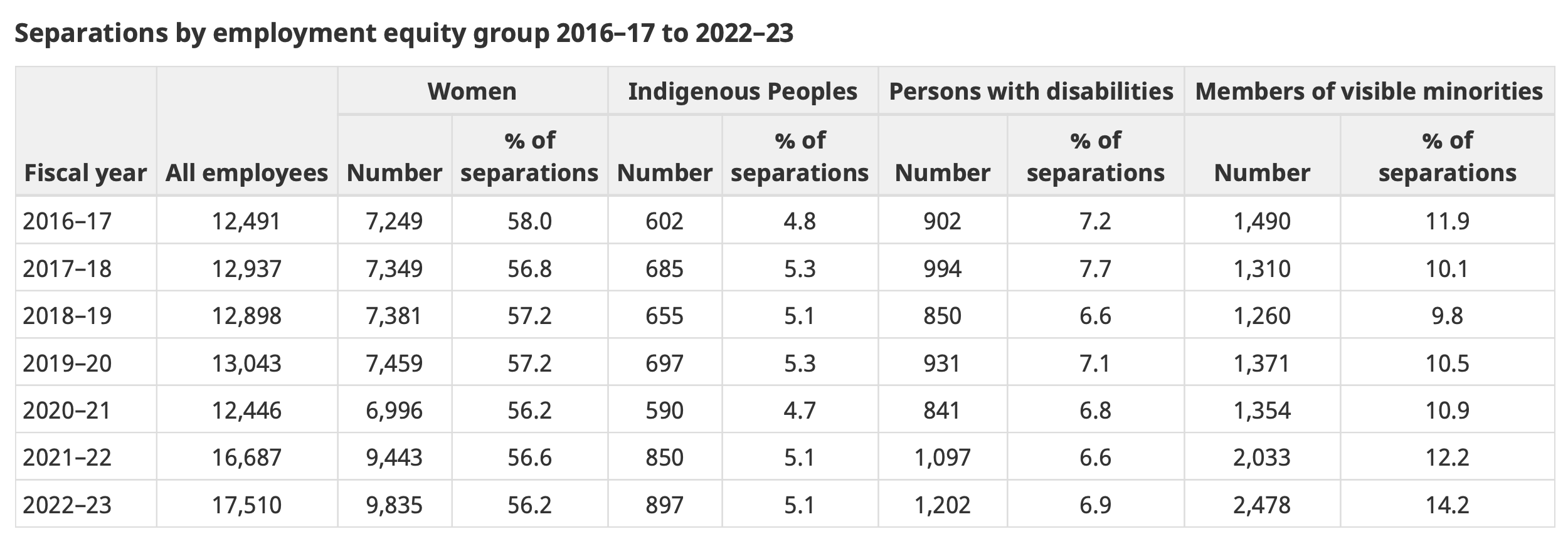
The release of the government’s Employment Equity Act Review Task Force late 2023 provides insights into the government’s thinking given that it set the terms of reference for the review and related consultations. The government has already signalled its support for the terminology changes of Indigenous peoples and racialized people, along with creation of a new designated group for 2SLGBTQI+ and the separation for Blacks from the overall racialized people group. While the former addresses a long-standing gap, the latter appears driven more by political considerations given the paucity of evidence presented in the Task Force Report in contrast to other groups, as my earlier analysis of hiring, promotion and separation rates demonstrate.

Meanwhile, from the right, Peter Shawn Taylor argues that It’s Time to Abolish the Absurd (and Slightly Racist) Concept of “Visible Minorities”

Interesting article by Pamela Paul on how social media disadvantages Blacks and Hispanics, who spend more time on social media than whites, Does Social Media Perpetuate Inequality?

Looking back on 2023 and forward to 2024

Best wishes to all for 2024.

The major development this year has been a sharp reversal in attitudes towards immigration, given the ongoing increases until 2025 of permanent residents and the much larger increases in temporary workers and international students and the consequent impact on housing avilability/affordability, healthcare and infrastructure. 

When I first started raising these and other concerns some five years ago (reviewing Doug Saunders Maximum Canada) and subsequent articles), I was largely a voice in the wilderness. But now, it seems that every week there is another article pointing out the fallacies and problems with the current approach, with virtually all polls showing a significant drop in public support.

Federal and provincial governments, business stakeholders, organizations like Century Initiative and other immigration advocates have largely been caught flat footed by this change given their almost ideological fixation an aging population, their particular interests, and a blindness to broader implications.

While the federal government scrambles to adapt to public concerns on housing, none of the overdue changes to increase housing will have a material impact before the next election. 

The one area I expect to see a meaningful rethink in 2024 is with respect to international students and the “puppy mills” of private colleges to use Minister Miller’s words. Whether the government will similarly restrain or cap temporary foreign workers will be another test of whether it is more attuned to general public and productivity concerns or to business interests in having a larger labour pool for lower skilled workers, along with other special immigration interests.

Most of my time this year was spent on citizenship issues, analyzing citizenship operational data to better understand the declining naturalization rate, opposing the proposed self-affirmation of the citizenship oath and my annual update on birth tourism (non-resident self-pay). 

The petition I launched to oppose the change to the oath and for a return to more in-person ceremonies along with related commentary by others received largely a non-response by the government although it remains to be seen whether they will implement the proposed regulatory change (Minister Miller appears more aware of the importance of citizenship meaningfulness than his predecessor).

Other areas included analysis of employment equity hiring, promotion and separation data, indicating that the government continues to make progress in increasing the representativeness of the public service, annual update of Order of Canada diversity, and a census-driven analysis of riding level demographic, economic and social characteristic.

Next year will likely be more of the same given some of the annual data that I follow. While I will continue my monthly statistical updates, will trim some of the data that has proven less significant (e.g., web traffic) or overtaken by events (e.g., RCMP interceptions given expansion of the STCA).

Top 10 Posts on www.multiculturalmeanderings.com

Articles and citations

Citizenship 

Citations

Immigration 

Citations

Multiculturalism, Diversity and Employment Equity

Citations

Political Representation 

Citations

Birth tourism is rising again post-pandemic

My latest annual update:

The COVID-19 pandemic provided the perfect natural experiment to assess the extent of birth tourism in Canada.

Dramatic declines of 50 per cent compared with the pre-pandemic 2016-20 average occurred in 2020 and 2021 in the number of “non-resident, self-pay” births. That was followed by an overall increase of 53 per cent in 2022 compared with the 2020-21 average, although the 2022 figure is still far below the 2019 peak.

This partial return to growing numbers highlights the need for the government to make good on its 2018 commitment to get a better handle on the extent of birth tourism, and to go so far as to consider an amendment to the Citizenship Act.

Figure 1 captures the steady increase prior to the pandemic and the sharp fall thereafter. Last year’s increase to 3,575 non-resident births from the pandemic average of 2,339 occurred in all provinces.

Table 1 compares non-resident births in 2011-15 and 2016-20 with those in subsequent years.  The increase over these five-year periods contrasts with the sharp decline in 2020-21 and the sharp reversal in 2021-22, both of which were particularly notable in British Columbia. Compared to the 2019 high, the number of non-resident births has rebounded to 63 per cent of pre-pandemic levels.

There is no comparable U.S. post-pandemic data because since January 2020, the U.S. no longer issues visas “for birth tourism (travel for the primary purpose of giving birth in the United States to obtain U.S. citizenship for their child).”

Because there is no health-specific code for women travelling to Canada on visitor visas for birth tourism, the broader non-resident self-pay code is used. However, this includes international students, about half of whom are covered by provincial health plans, and other temporary residents.

Overall visitor visas in 2022 largely rebounded to pre-pandemic levels. The number of temporary workers has increased significantly. However, this varies by country.

Overall visitor visas for Chinese nationals used to be one of the major groups for birth tourism, but they have fallen dramatically. Chinese government travel-related restrictions are likely a significant factor in the reduction in Chinese birth tourists.

The percentage of non-resident births fell from 1.6 per cent of total births in 2019 to 0.7 per cent in 2020 and 2021, but it rebounded to 1.0 per cent in 2022. About 50 per cent of non-resident births are estimated to be birth tourists.

Table 2 provides a view of the impact of COVID-19 on non-resident births for the 10 hospitals in Canada with larger percentages of non-resident births. Since the dramatic fall during the pandemic, non-resident births have increased in most hospitals.

British Columbia’s Richmond Hospital was once the epicentre of birth tourism with its supportive “cottage industry” of “birth hotels.” In 2019-20, non-resident mothers made up 24 per cent of its births. But it fell sharply in this category during the pandemic and has rebounded only to four per cent in 2022. It’s now fourth in the Top 10.

The new No. 1 and No. 2 are Toronto’s Humber River Hospital, with 10.5 per cent of all births being non-residents and Montreal’s St. Mary’s with 9.4 per cent. Humber River is also the only hospital that showed an overall increase compared to pre-pandemic period.

There is a need for more hospital-level studies such as the one in Calgary that found about one-quarter of non-resident women who gave birth in the city in 2019-20 were from Nigeria. The study also estimated the cost to Alberta taxpayers.

The development of links between Canadian immigration data (e.g., immigration program and category) and Canadian Institute for Health Information (CIHI) health data on medical services should allow for greater precision about the number of women giving birth while on visitor visas and those under other temporary resident categories.

Is birth tourism about to return now that travel restrictions have been lifted?

Birth tourism in Canada dropped sharply once the pandemic began

Hospital stats show birth tourism rising in major cities

Overall, the federal government has not followed up on its 2018 commitment to “better understand the extent of this practice as well as its impacts” following the first release of the non-resident self-pay numbers and related media attention. The 2021-22 decline understandably reduced political interest and pressure in addressing the issue.

Given current and planned increases in immigration, it is highly unlikely that the government will act because the number of non-resident births is basically a rounding error compared to overall immigration of 500,000 a year by 2025.

However, as visitor visas largely reverted in 2022 to pre-pandemic levels, it is no surprise that non-resident births, including birth tourism, have increased. The government should resume work to clarify the issue. In particular, it should link immigration and health data to improve understanding of immigration and health issues, including birth tourism. As numbers of non-resident births can be expected to increase further, greater precision regarding the components of non-resident births would inform possible policy and program responses.

A 2019 Angus Reid survey found that 64 per cent of those Canadians surveyed would support a change in the law so that citizenship is not conferred on babies born here to parents on tourist visas.

Policy and operational questions remain about whether birth tourism warrants an amendment to the Citizenship Act, visa restrictions on women intending to give birth in Canada, or other administrative and regulatory measures to curtail the practice.

Visa restrictions would be difficult to administer and regional administrative and regulatory measures might encourage hospital and jurisdiction “shopping.”

So the cleanest approach would be an amendment to the Citizenship Act that would require one parent to be a citizen or permanent resident of Canada. That is the situation in Australia.

Should the Conservatives form a government after the next federal election, they may well decide to revisit the issue of birth tourism given that the Harper government pressed the issue in 2012 only to back off.

A note on methodology 

The data is from the CIHIs discharge abstract database, more specifically non-resident self-pay” category in the responsible for funding program (RFP), as well as totals for hospital deliveries.

The overall RFP data includes temporary residents on visitor visas, international students, foreign workers and visiting Canadian citizens, and permanent residents. Quebec has a slightly different coding system, but CIHI ensures its data is comparable. Data for Quebec hospitals is not provided through CIHI and thus the larger Montreal area hospitals were approached directly.

Ottawa-area hospitals were not included given the number of diplomatic families likely being a substantial portion of non-resident births. Declines in non-resident births at Trillium-Credit Valley Hospital in Mississauga, Ont., led to that hospital falling off the Top 10 list.

Health coverage for international students varies by province, but most of them are covered by provincial health plans. This is not the case in Manitoba and Ontario, as well as for some students in Quebec if their country of origin does not have a social-security agreement with Quebec. The pre-pandemic baseline is the five-year average 2016-20.

Mackenzie Healths woman and child program moved from Mackenzie Richmond Hill Hospital to Cortellucci Vaughan Hospital when it opened to the community in June 2021.

Source: Birth tourism is rising again post-pandemic

‘A lot of these women had no idea what they got into’: inside the world of birth tourism – The Guardian

Looking forward to seeing the doc.

Of note that birth tourism to the USA appears to have dried up given the impact of Trump and COVID travel restrictions along with anti-Chinese and American sentiment in both directions (my latest analysis of Canadian numbers, out shortly, will confirm a similar decrease with respect to Chinese birth tourism to Canada):

It started a decade ago, when Leslie Tai, who lives outside San Francisco, heard from a woman she’d met in Beijing and who told her that she was staying for a few months in Los Angeles. Tai’s friend was evasive about the purpose of her visit, until the pair finally had a video call and Tai watched her friend oil a round belly on camera. “She said, ‘I have a surprise for you,’” Tai recalled. “‘I’m having an American baby.’” Tai, who knew that her friend came from a poor family and was dating a wealthy older artist in China, asked if he had friends in southern California. “And she was like, ‘No, honey, you don’t need friends to do what I’m doing.’”

She was part of the birth tourism industry, which boomed during the Obama years, when scores of pregnant Chinese women of means invested in package deals that cost anywhere from $30,000 to $100,000 and granted buyers the ability to fly across the world and stay for three months at a facility that catered to expectant mothers looking to score US citizenships for their children or skirt the one-child policy that was the law in China until 2015.

Tai, a Chinese American documentary film-maker, wasted no time embedding in the group home where her friend was waiting out the final days of her pregnancy, alongside a handful of other expectant mothers. “I got kind of obsessed with this idea of how on the outside, it’s just nondescript suburban tract housing, with palm trees everywhere, but then behind closed doors there’s this whole world with multiple families living in close quarters and all in this crazy intense situation of waiting to have a baby,” she said.

Securing subjects’ permission was not easy for Tai. “I started asking my aunties and uncles like, do you know anybody who is involved in this industry? They were all like, yeah, actually, my cleaner, or our nanny from when our kids were children ended up working in one of these maternity hotels,” she recalled. Tracking down subjects and winning over their trust took an enormous amount of care and strategy. “Even though what they were doing was not illegal, they had reservations, so it was not like I came in like guns blazing.” Tai’s English fluency proved a valuable resource as she pursued mothers-to-be, nannies, drivers and cooks to grant entry to their private world and anchor the vignettes in her film. “I made myself of service because actually, when they saw me, they were like, ‘Oh my God, you speak English. Can you help me call PG&E?’” She had given similar help to her friend, who did not speak English, in the delivery room.

Nearly 10 years in the making, Tai’s entrancing and heartrending film How to Have an American Baby provides viewers insider access to a phenomenon that took place behind closed doors and on Chinese websites where brokers offered pregnant women package deals as if they were cruise holidays. Money-hungry operators offered help obtaining visas and lining up rooms at specialized facilities. There were enormous industrial maternity hotels, as well as private Beverly Hills homes and boutique group homes where up to five women at a time waited out their births and holed up for the 30-day postpartum quarantine that is a Chinese tradition. Then, more often than not, they returned to China.

“By and large, the majority of the women that were coming were simply coming to evade the one-child policy,” Tai said. Some, though, were mistresses, as Chinese law did not allow unmarried mothers to give birth in public hospitals until earlier this year. Sales agents knew how to tap into maternal anxieties, playing up the supposed advantages of US citizenship. “There’s a lot of misinformation that the customers are receiving,” Tai said. “They think that there’s universal healthcare. They think that there’s universal education. It’s sold as a really good investment, but they’ve been lied to.” Babies born in the US have the right to declare their American citizenship at age 18, and apply for green cards for their families when they turn 21. “There was a sentiment of: who knows what the world is going to look like in 18 years? If China goes to hell, what if America goes to hell, whatever, they have two passports.”

Tai’s film is less concerned with policy than offering a textured portrait of the day-to-day, minute-to-minute experience that the mothers went through. The exteriors are mostly shot at night on suburban streets of southern California and the interiors sit with women bathing their babies or microwaving cups of tea while they wait to go into labor. A meditative quality pervades the work, which weaves several vignettes together into a broader portrait of women navigating a terrifying life phase in a strange land. “A lot of these women had no idea what they got into,” Tai said. “It’s almost like they were sold on the pretty pictures of this vacation and then when they come here, they realize: ‘My family’s not here, and I’m having a baby. Oh, my God, I’m sequestered with a bunch of pregnant women. Plus there’s all the drama living in the suburbs. It’s like Real Housewives from hell.”

While many of the visitors enjoyed daily meal deliveries and shopping excursions, they were surrounded by people who saw them as financial marks. The doctors in the film offer all-cash birthing options (vaginal for $3,000 or caesarean for $5,000) with the tenderness of night market vendors hawking ripoff handbags. Tai captured a maternity hotel worker saying about the residents: “If you become too friendly they will use you. The more you give them, the more they complain.”

The birth tourism world underwent major upheaval over the course of filming and editing, to the point where Tai said her film was “like a time capsule”. With the rise of Trump and the travel restrictions around Covid, and anti-Chinese and anti-American sentiment flying in both directions, the phenomenon has come to a standstill.

Tai had her own changes as well, namely, the birth of a baby this past January, a few weeks before the world premiere of her film at a festival. “I definitely took a lot of lessons from watching all these births, like making sure I was set up with the right support,” she said.

And now she is in what she called “double postpartum mode”, watching both her baby and film find their footing in the world. While the film has a jaw-dropping concept at its core, the bulk of the footage focuses on the mundanity and emotion that color the days leading up to and following childbirth, as well as the terror and ecstasy of labor itself. (There is a birthing scene more honest and beautifully gruesome than any video they’ll show you at birth class.) Tai’s ambition for her movie is strikingly tender. “I want to fight for the moving image that allows you to really sink into the humanity of the people, regardless, and even in spite of, how controversial the situation is,” she said.

Source: ‘A lot of these women had no idea what they got into’: inside the world of birth tourism – The Guardian

COVID-19 Immigration Effects – October 2023 update

Regular monthly data update.

Highlights:

Percentage of former temporary residents transitioning to permanent residency partially bouncing back after September (from 32 to 39 percent, 2023 January to August average 65 percent). Year to date: 404,000 of which 212,000 are former temporary residents.

Temporary residents (IMP): Year to date 757,000 compared to 484,000 in comparable 2022 period

Temporary residents (TFWP): Year to date 172,000 compared to 124,000 in comparable 2022 period

Asylum claimants continue to grow significantly, reflecting easing of visa requirements and other factors: Year to date 117,000 compared to 70,000 in comparable 2022 period. Unclear whether visa exemption for Mexico will remain tenable given sharp increase and rumblings in US border states regarding increasing arrivals from Canada: Year to date 22,000 compared to 12,000 in comparable 2022 period.

The number of new citizens remains strong, largely driven by virtual ceremonies being the default option (almost 90 percent of new citizens participated in virtual ceremonies). Year to date: 317,000 largely the same as the comparable 2022 period. 

Highlights on slide 3.

Articles of interest: Citizenship

Starting up my blog again, highlighting some of the articles I found of interest.

Past Imperfect: J. L. Granatstein’s prescient warning

Agree, both the good and the bad:

Also regrettable is that Granatstein did not offer a more pointed rationale for learning hist­ory. He argued that an understanding of the subject was “the prerequisite of political ­intelligence” but without going further. The cost of not knowing history is much deeper, in my view. It creates a real disquiet and robs the community of its ability to find nuance in any dispute. Indeed, one could argue that the incoherence of a vast array of policy areas in this country — from cultural and global affairs to housing and homelessness — can be explained only by a general loss of historical consciousness.

To talk historically about any episode — a court case, a medical issue, a construction problem, even a love dispute — is to inquire about “what really took place last time.” It ­naturally invites subtlety, attention to context, and storytelling that can lay the groundwork for compromise. It calls for clarity in sequencing events and necessarily examines what’s behind the story: “Well, we didn’t have the tools” or “Our thinking was wrong” or “We simply didn’t know.” It can build respect and, not least, modesty. But it can also bridge solitudes and open the road to cooperation, better understanding, and perhaps even reconciliation and forgiveness. No one who studies history seriously can be insensitive to the anxieties and cruelties of humanity or unimpressed by its resilience, ­creativity, and kindness.

But that sort of discipline has been evacuated from popular culture. For over a dozen years now, history departments have seen their student numbers decline. Consequently, new hires are even rarer than before. Governments seldom consider the failures and successes of previous policies; museums dedicated to the past are shrivelling without money for new exhibits and programs. Historians, terrified of being misunderstood, refuse to engage in public debates that could bring nuance to policy issues. Canada is not in a state of post-nationalism but is rather a place of hiber‑nation — a country that has fallen asleep and forgotten its past.

This is dangerous. Historical awareness bolsters democracy and democratic instincts. Take away history and you undermine the ability to discuss, to debate, and to share knowledge on how things evolved. Without such skills and knowledge, democracy as we know it will wither and die

Source: Past Imperfect: J. L. Granatstein’s prescient warning

Local citizenship judge wins Community Impact Award – Thorold News

A reminder of the power of in-person ceremonies:

The ceremonies to which she is referring are citizenship ceremonies. For just over five years Ivri has been a citizenship judge with Immigration Refugees and Citizenship Canada. In an average week in this role she swears in between 1,200 and 1,500 new Canadians.

In the relatively short time that she’s been one of nine judges in the Niagara and Hamilton offices of the department, she has welcomed more than 100,000 newcomers to Canada. Besides her family – husband Eldean and children Elijah, Zachariah, Ezekiel and Michaiah – she says it’s the most rewarding thing she’s ever done.

Ivri herself comes from an immigrant family. Her mother Valerie came to Canada to visit an uncle in 1967, leaving behind her husband Roosevelt and their son back in Jamaica. On leave from her job as a customs officer there, Valerie went to a Canadian immigration office to extend her visa. An officer there suggested she instead apply for citizenship, so she did.

Source: Local citizenship judge wins Community Impact Award – Thorold News

Shawn Taylor: Are Immigrants Falling out of Love with Canada? (And is it Because We Feel the Same?)

Overly negative but not without merit:

The evident decline in Canada’s citizenship rates may say more about the attitudes and habits of existing Canadians than those of newly-arriving immigrants. The federal bureaucracy’s failure to meet its own published service standards is certainly a self-inflicted wound. As is the proposal to solve this problem by eliminating much-loved citizenship ceremonies. The effect of both situations is to debase the perceived status of Canadian citizenship by emphasizing the transactional over the transformational. Then there’s the Roxham Road debacle, which offers migrants the opportunity to illegally sneak into our country via a dead-end road rather than at a regular border crossing and still be recognized as refugee claimants, with all the official support and standing this entails. If Canadian citizenship is supposed to be so valuable, it seems foolish to further cheapen the reputation of the entire immigration system in this way.

Beneath these obvious failures of governance and policy, however, lurks an even deeper and more insidious problem. As Bernhard explains, becoming a citizen is akin to joining a team with all other Canadians. A “club,” so to speak, that is exclusive to those who wish to be identified as Canadian and who intend to participate in its promotion and maintenance by voting and performing other civic duties. If we accept such an analogy, then it clearly matters how we advertise and promote this club to new members. So what sort of stories do Canadians tell about their own country these days? And do they amount to an effective marketing strategy?

 “The story of Canada that our major institutions tell has increasingly become one that focuses on only the most negative aspects of our country, such as oppression, racism, discrimination and dispossession,” observes Christopher Dummitt, an historian at Trent University’s School for the Study of Canada in Peterborough, Ontario. Common examples of this new tendency are factually-dubious claims, often from officially sanctioned sources, that Canada has committed and continues to commit genocide against the Indigenous population, is systemically racist towards black people, was once a slave country, and on and on. “It is a deliberate distortion of our actual history,” says Dummitt in an interview.

This sense of national self-loathing has become so encompassing that official multiculturalism, once billed as an unquestionable Canadian value, is now considered evidence of an “unjust society premised on white supremacy,” as two University of Calgary education professors absurdly argued last year. Even professed supporters of Canadian identity, such as ICC co-founder Ralston Saul, now casually declare that “Canada has failed on many fronts.” As for how such a perspective might work as a branding exercise, Dummitt says, “If the story about Canada is that it was an institutionally corrupt nation beset by the original sin of colonialism, then why would anyone want to become a citizen of that?”

Dummitt has been pushing back against the now-pervasive narrative that Canada is, at its core, morally bankrupt. In 2021 he organized a rebuttal signed by many eminent Canadian historians condemning the Canadian Historical Association’s (CHA) unilateral declaration that Canada’s treatment of Indigenous peoples was “genocidal.” In making such a claim, Dummitt’s rebuttal stated, the CHA was “insulting the basic standards of good scholarly conduct.” He has also spoken out against the practice of tearing down statues honouring Canada’s founding fathers, and is currently fighting Toronto’s plans to scrub the name of 18th century British parliamentarian Henry Dundas from its streets and public squares on the (entirely bogus) assertion that he was an ally to the slave trade. “We need to call out these nonsensical claims,” Dummitt states determinedly. “And we need politicians who are willing to celebrate the Canadian nation in diverse ways.”

With this sort of self-hatred being expressed by current citizens, is it any wonder immigrants are having second thoughts about joining Club Canada

Peter Shawn Taylor is senior features editor at C2C Journal. He lives in Waterloo, Ontario. 

Source: Are Immigrants Falling out of Love with Canada? (And is it Because We Feel the Same?)

Is Portugal’s Golden Visa Scheme Worth It?

No:

On Nov. 7, the same day that Portugal’s Prime Minister António Costa resigned amid corruption allegations pertaining to lithium contracts, federal officers in Brazil raided the Portuguese Consulate in Rio de Janeiro.

The Brazil raids were not connected to the Lisbon investigation, a spokesperson said. Instead, according to Brazilian police, they were part of a separate investigation into the falsification of documents in collusion with applicants seeking Portuguese visas and citizenship. Since the 1990s, amid periods of economic downturn and social instability, large numbers of Brazilians have struck out for Portugal. When the country began its “golden visa” program in 2012, wealthy Brazilians became the second largest group to take advantage of it.

Portugal’s golden visa grants European Union access to foreigners in exchange for investment. From its inception in the wake of the 2008 global financial crisis, it has faced backlash, and the criticism has only grown more vocal in recent years. Chiefly, it is blamed for contributing to a severe housing crisis that has made affordable housing unattainable for most Portuguese.

In early October, Costa’s Socialist government finally passed a law that took aim at the issue, removing the real estate investment pathway from the golden visa program. Previously, people who invested in a qualifying property worth at least 280,000 euros (about $305,000) were eligible. The change, almost a year in the making, has ricocheted around the world of global elites, many of whom had come to regard Portugal as a foothold into Europe. Although more than 30,000 foreigners have benefited from Portugal’s golden visa, its benefits for the Portuguese themselves are less clear.

Source: Is Portugal’s Golden Visa Scheme Worth It?

German State Saxony-Anhalt: No citizenship without supporting Israel’s existence 

Hard to see how this will work in practice:

The decree instructs authorities to pay close attention to whether an applicant exhibits antisemiticattitudes and states that “obtaining German citizenship requires a commitment to Israel’s right to exist.”

In a letter to local authorities, the Saxony-Anhalt state Interior Ministry said naturalization is to be denied to foreigners who engage in activities directed at Germany’s liberal democratic order as outlined in the country’s Basic Law. The denial of Israel‘s right to exist and antisemitism are included among such activities.

Local authorities have been instructed to deny an applicant’s naturalization request if they refuse to sign the declaration. A refusal is also to be documented in the individual’s application filing for future reference.

Source: German state: Citizenship applicants must support Israel

(Non) Response by the Minister of Immigration, Refugees and Citizenship to petition e-4511 on “citizenship on a click”

To be charitable, the lack of specifics in this response to the specific calls in the petition could reflect ongoing policy and program work and thus could be seen as a process response. Or, to be cynical, it may simply reflect IRCC’s general undermining the meaningfulness of citizenship by focussing on operation requirements above all (my suspicion):

Signed by (Minister or Parliamentary Secretary): PAUL CHIANG, M.P.

Immigration, Refugees and Citizenship Canada (IRCC) continues to explore the use of an online tool that could enable the self-administration of the Oath of Citizenship (the Oath) in some circumstances. Extensive analysis is underway to assess various options for implementation, particularly surrounding the client experience journey, measures related to the integrity of the process and an ongoing commitment that citizenship ceremonies remain an important part of Canadian tradition. Additionally, the Department continues to reflect on the feedback received from Canadians, which will be incorporated into the assessment of options and decisions on a way forward.

The Department introduced video ceremonies in April 2020 as a means of adapting to the COVID-19 pandemic in order to enable the Department to allow the flexibility for clients to take the oath in a safe and secure environment. Video ceremonies continue as a stream of service delivery and have proven to be an important tool for reducing processing times for applicants and increasing the number of candidates that can take the Oath each month. As we have learned: video ceremonies can also accommodate both larger groups of individuals per ceremony than in-person events; allow for participation of applicants from rural areas; and, bring together new Canadians from across the country for their citizenship ceremony. From January 1, 2023 to September 30, 2023, the Department has held on average 50 in-person ceremonies and 224 video ceremonies per month with an average of 79 and 135 invited participants per event, respectively. This has resulted in 276,540  new citizens, exceeding pre-COVID levels.

A number of factors are considered when scheduling ceremonies, including operational demands, the availability of presiding officials and appropriate venues. While citizenship ceremonies are primarily scheduled on weekdays and during working hours, the Department will occasionally schedule after regular business hours or on weekends and public holidays. The Department does hold ceremonies outside of core operational hours, but these events are considered on a case-by-case basis for significance, public interest and operational capacity. For example, the Department hosted several citizenship ceremonies across the country on Canada Day.

While the Department has made strides in returning to the 12 month service standard for the granting of citizenship, further modernization efforts will enable faster processing times as well as improved client service. In 2023, IRCC launched a review of Canada’s immigration system, and has spent the last few months meeting with stakeholders and receiving feedback from people who use the immigration and citizenship system, and others who have creative ideas on how to improve it. In hearing the strengths and challenges of current immigration and citizenship programs, policies and services has helped to inform where we need to go in the future and the steps we will need to take to get there.

New capabilities are planned via a modernized operating platform—such as an online single window portal into immigration programs, enhanced automation and digital self-service—and will transform the way we do business up to and including in the citizenship process. It will speed up processing and improve program integrity, while making the immigration to citizenship journey clearer and more human-focused for clients. Additionally, the portal will allow applicants to access all of IRCC’s programs and services and to interact with the Department. It will offer a more positive and personalized experience to those looking for information, applying for programs and services, and checking for updates on the status of their application(s).            

Although the new platform and portal will bring rapid and real enhancements, we have not been waiting on them to improve on what we do; we have made strides since 2020 with the introduction of electronic citizenship applications (e-applications), online citizenship tests, online application tracker to monitor progress, electronic certificates (e-certificates) of Canadian citizenship, and video citizenship ceremonies. These advancements have shown results. In July 2022, the Department had a citizenship grant inventory of 381,859 applications and a processing time, from application received to the client taking the Oath of Citizenship, of 26 months. By September 2023, the grant inventory had been reduced to 247,931 applications, and the processing time had improved, lowering to 17 months.

Canadian citizenship is a valuable status and the Department will ensure the Citizenship Program continues to modernize the process.

Source: https://www.ourcommons.ca/petitions/en/Petition/Details?Petition=e-4511

The petition made 4 specific calls which largely were unanswered or treated seriously:

  1. Abandon plans to permit self-administration of the citizenship oath; (word salad language likely meaning no plans to abandon)
  2. Revert to in-person ceremonies as the default, with virtual ceremonies limited to 10 percent of all ceremonies; (Rejected, no commitment to provide ongoing data on percentage of ceremonies that are in person or virtual although past numbers for January-September 2023 provided)
  3. Focus on administration and processing efficiencies prior to citizenship ceremonies, where most frustrations are; and (Mentioned but not in terms of overall focus)
  4. Explore evening and weekend ceremonies to improve accessibility along with more flexible scheduling management. (Addressed but on exceptional basis, no plans to extend practice)