Will the federal government go ahead with a one-click citizenship oath?

Of note, MP Kwan predictable in her discounting the history and meaningfulness of citizenship. Presume she prefers weddings, funerals and graduations and the like to be in person, given the stronger sense of connection and belonging compared to virtual. But becoming Canadian? Meh:

A petition to stop the federal government from allowing new Canadians to take their citizenship oath by clicking a button online is set to be tabled in Parliament.

The petition (Petition (e-4511), which was launched in July of this year, garnered more than 1,500 signatures. It was backed by the Conservative Party’s Critic for Immigration, Refugees and Citizenship, Tom Kmiec.

In a statement released last month, Kmiec said the measure would “cheapen” the citizenship oath by reducing it “to a click on a website or an app as if citizenship were no more than consenting to terms in a contract.”

In February, the Liberal government announced it was planning to allow for self-administered citizenship oaths. The proposed process would permit aspiring new Canadians to log onto a secure online portal to administer their citizenship instead of attending an in-person or virtual ceremony with other successful citizenship applicants.

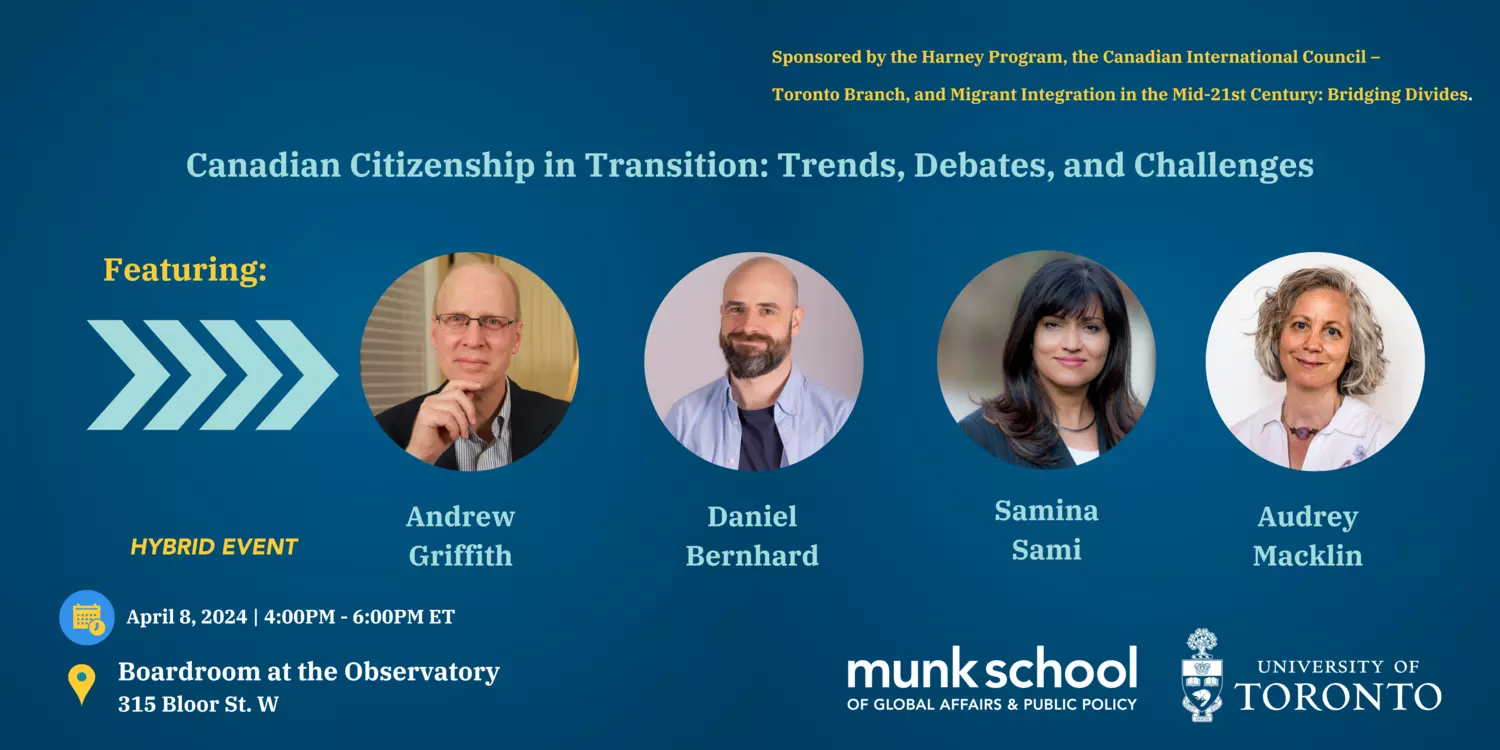
Andrew Griffith, a former director general at Immigration, Refugees and Citizenship Canada (IRCC), started the petition to maintain the citizenship ceremony as an important milestone in the Canadian immigration journey. Griffith, who attended many ceremonies as part of his previous role, says they are an important way of marking a critical step for new citizens. “Citizenship is not just a mechanical process of getting a driver’s licence. It’s making a decision to come to Canada, to contribute to Canada and to vote in Canadian elections. [Citizenship ceremonies] really give a sense of belonging and inclusion.”

The petition further called on the government to “revert to in-person ceremonies as the default”, limiting virtual ceremonies to only 10 per cent of the overall total. It also urged the government to explore more evening and weekend ceremonies to make them more accessible and flexible for attendees.

Claudio Chalom, who recently became a Canadian citizen after arriving from Brazil six years ago, said while he would have preferred having his citizenship ceremony in person, he still appreciated the chance to do it online and thinks other new Canadians should have the opportunity to do the same. “I think we should still have some sort of ceremony to mark the celebration of this special moment,” he said, describing his own experience as “emotional”. “It was a moment we won’t forget in our lives.”

The one-click citizenship proposal was initially introduced by former Minister of Immigration, Refugees and Citizenship, Sean Fraser, to reduce backlogs in the immigration system. The government said the move to self-administered citizenship would cut processing time by three months and eliminate the need to take time off work to attend ceremonies. The new minister Marc Miller said the government is still considering moving forward with the proposal.

Canada’s immigration system has recently seen record numbers of new immigration and visa applications, rising to nearly 2.3 million in July. The latest IRRC data from September shows citizenship and spousal sponsorship applications currently face a 19 to 24 per cent backlog. IRCC aims to keep backlog at 20 per cent or less.

IRCC projections suggest backlogs are expected to drop over the coming months, although there is a chance they could continue into 2024.

Jenny Kwan, the New Democratic Party’s Critic for Housing, Immigration, Refugees and Citizenship, said her party supports the Liberal government’s proposal as it allows for more flexibility for new immigrants with different needs. Attending the ceremony, she said, can be hard to schedule for some.

She pointed to her own family’s experience. Her family came to Canada from Hong Kong when she was a child and lost income as a result of having to take the day off to take their citizenship oath in person. “When we became citizens, both my parents had to take time off work, and we were a low-income family. And that was a very stressful situation that my parents were faced with.”

She said this is why she supports moving to a move flexible system: “Everybody’s circumstances are different. What is important is to ensure that there is flexibility and options made available for people so that they can choose the most appropriate option for themselves. I don’t think there is strictly one way to do it.”

The federal government solicited feedback on the proposed amendments to the citizenship regulations earlier this year, and almost 700 people responded. Two-thirds of those who voiced their opinions disagreed with the government’s proposal. Opposition was particularly strong among Canadian-born citizens and immigrants.

However, strong support for the proposed changes came from citizenship applicants facing delays in the system, with at least 66 per cent indicating they would prefer to allow for citizenship online.

The petition (e-4511) is set to be debated in the coming months.

Katrya Bolger, Local Journalism Initiative Reporter, New Canadian Media

Source: Will the federal government go ahead with a one-click citizenship oath? – Yahoo News Canada

Akshay Kumar reveals why he got Canadian citizenship in the first place – Hindustan Times

Former “citizen of convenience,” Indian film star Akshay Kumar:

For several years, Akshay Kumar had Canadian citizenship. He faced backlash over it, and this year became an Indian citizen. He has now spoken about the matter.

Actor Akshay Kumar, who earlier had Canadian citizenship, has opened up about why he had opted for it in the first place. Speaking with news agency ANI, Akshay revealed that he took the step because his films ‘were not doing well at one time’ and he gave 13 to 14 flops”. Akshay often faced criticism over his Canadian citizenship. On Independence Day this year, the actor had announced that he was now an Indian citizen. (Also Read | Akshay Kumar gets Indian citizenship, shares proof on Twitter)

Akshay on becoming a Canadian
Akshay told ANI, “I became a Canadian because my films were not doing well at one time and I gave 13 to 14 flop films. At that time, my friend used to live in Canada and he said you come here and we will work on something. My friend had offered me that we would do cargo business together. I said okay my films are also not going well and a person has to work, no matter where he is. When I started living in Toronto, I got a Canadian passport. In between that, two films were left for release. After the two movies got released it became a big superhit. I told him that I was going back. Then I got more films and reached here today. But I never thought people got a hold of it, it was just a travel document. I just pay my taxes, and I am the highest taxpayer.”

Akshay on Indian citizenship

Speaking on getting Indian citizenship, he said, “For 9 to 10 years I didn’t go there. It’s a very nice place and one of my best friends is there. I decided that I should take my citizenship. It was just a coincidence that I had received a letter on 15th August that I had got citizenship. But it is not just a passport, it is your mind, it is your heart, it’s your soul that has to be Indian. What is the point if I do have an Indian passport but my soul mind and heart are not Indian?”
Akshay got Indian citizenship this year
Earlier, Akshay had shared a picture of his official government documents, proving that he has finally got his Indian citizenship. “Dil aur citizenship, dono Hindustani (Heart and citizenship, both Indian). Happy Independence Day! Jai Hind,” Akshay had captioned the post.

Akshay had spoken about backlash in 2019
Akshay has faced a lot of criticism on social media platforms for holding Canadian citizenship in the past. In 2019, after receiving backlash for his Canadian citizenship, Akshay issued a statement on his official X (formerly known as Twitter) account, stating that he does not understand the negativity around the subject.

Source: Akshay Kumar reveals why he got Canadian citizenship in the first place – Hindustan Times

Revealed: thousands who bought ‘golden passports’ through Dominica’s $1bn scheme – The Guardian

Good detailed analysis and example of how these programs invariably attracting nefarious characters:

The Caribbean state of Dominica has sold citizenship to thousands of individuals including a former Afghan spymaster, a Turkish millionaire convicted of fraud and a former Libyan colonel under Muammar Gaddafi, the first detailed examination of the country’s controversial “golden passports” scheme has found.

The findings are from Dominica: Passports of the Caribbean, an investigation by the Guardian and 14 other international news organisations, in partnership with the Organized Crime and Corruption Reporting Project(OCCRP).

Dominica’s golden passports scheme – one of the world’s biggest – has according to official declarations raised more than $1bn (£822m) through its citizenship by investment scheme since 2009.

Its passports are in demand around the world, and a series of international agreements ensure its citizens travel visa-free to 140 countries, including most EU member states.

However, until now, the names of the individuals who have paid the price tag of at least $100,000 (£82,000) a head to acquire Dominican nationality – in many cases without setting foot on the island – have been difficult to obtain.

By working with the Government Accountability Project, a US-based advocacy group that scoured archives and libraries across the Caribbean for copies of official public documents, and by reviewing leaked material, the project was able to compile lists of names of thousands of people who became citizens.

The first ever tally of names published in Dominica’s official government gazette shows an island state with a population of just over 70,000 has granted citizenship to 7,700 individuals since 2007 – although our research suggests there may be thousands more. Some were naturalised through immigration or marriage, but the vast majority bought their citizenship.

Any government has the legal right to set its own standards on who becomes a citizen. And for many people living under oppressive regimes, a second nationality can provide security. Names that appeared to be of Iranian, Chinese and Russian heritage were among the largest groups of people who became citizens.

For individuals from these countries, a Dominica passport can also mean less red tape when crossing borders, doing business or opening a bank account abroad.

Some of the findings raise questions about the transparency and governance of the scheme, and some are potentially embarrassing for Dominica.

One buyer had publicly been accused of war crimes before obtaining citizenship, while another had been a colonel and senior security official under Muammar Gaddafi. Citizenship by investment applicants are barred if they have a criminal record but, in one example, a buyer appears to have been jailed for fraud before he secured citizenship. Others have run into trouble since acquiring Dominican citizenship, including one named on Interpol’s wanted red list.

Dominica has become heavily reliant on selling citizenship to fund its public services, with this source of income accounting for about half of all government revenues.

Concerns about the scheme have led to consequences for natural-born Dominicans. The UK government in July stopped visa-free travel from Dominica and four other countries.

Dominica’s government did not respond to detailed requests for comment. However, the prime minister, Roosevelt Skerrit, who has overseen the expansion in citizenship sales since taking office in 2004, defended the programme during press conferences on 18 September and 3 October, apparently in response to this investigation.

He said: “We have professed to have a robust system that we go through in different layers of due diligence, and if somebody were to become a citizen of today and tomorrow morning the person goes and does something and finds himself in problem with the law, you can’t blame the programme for that.”

Skerrit compared the Dominica scheme to the US’s green card, which gives permanent residency rights. He said nobody blames the US when people commit crimes after it grants residency.

He also made a series of outlandish and false claims that reporters on the investigation had been paid by opposition politicians in Dominica to try to “destroy” the scheme, and likened reporters to arsonists and “terrorists”.


Dominica’s national archives are housed in a modern concrete structure, set among the pastel-painted colonial buildings of the small town of Roseau, the island’s capital. Here, string-bound issues of the weekly Dominica Official Gazette can be found.

The gazette is the only official public source of information about the thousands of individuals who have become Dominican citizens. Published only on paper, with no official digital copies, the information the gazettes contain is not easily accessible.

Last year, the Government Accountability Project took action to improve transparency. It viewed dozens of gazettes from libraries, private collections and from the University of the West Indies in Jamaica, and drew up a list of every naturalised citizen from 2007 to 2022.

Other names were found in documents leaked from a hotel developer licensed to accept passport buyers as investors

Among the names brought to light is that of Asadullah Khalid, who served as governor of two provinces of Afghanistan, as the country’s spy chief, and latterly as defence minister. He held these senior positions during the years of turmoil after the invasion by the US and allies in 2001, until the Taliban took over in 2021.

Khalid has been accused by UK and Canadian officials of responsibility for human rights abuses, including allegations, widely reported in 2012, that there was a torture chamber under his guest house. He obtained citizenship in 2017, at a time when these allegations were already public.

The allegations against Khalid have never been tested in court. He has previously said there was no evidence for allegations that were “just propaganda”. Khalid did not respond to requests for comment.

Another investor was Sasi Milud Sasi Grada, a former colonel under the Gaddafi regime in Libya.

Grada obtained citizenship in 2015, having fled Libya after the civil war that overthrew Gaddafi, before returning. In a telephone interview, Grada said although he knew Gaddafi personally from the 1960s onwards, when they trained in the military together, he did not discuss politics with Gaddafi. He said he left the military in 1989 at the rank of colonel, before running government security for facilities such as banks, universities and oilfields until the civil war.

Under Dominican regulations, citizenship by investment applicants are barred if they have a criminal record. However, one individual seems to have been able to purchase citizenship despite appearing to have a conviction for fraud.

The Turkish businessman and former government minister Cavit Çağlar bought citizenship in 2011, seven years after he was given a prison sentence and a fine for fraud relating to Interbank, a bank he owned until it was taken over by Turkish regulators in 1999. In 2010 his sentence was suspended, and reduced to one year and nine months in prison, as well as a fine, the Turkish newspaper Hürriyet reported.

In a 2019 interview, Çağlar said he served nine and a half months in prison, and that he was not a criminal. A representative of Çağlar’s newspaper company, Olay, said he did not wish to comment when approached by the Guardian and OCCRP.

Others appear to have run into trouble after obtaining their passports.

One investor who has faced allegations of wrongdoing since obtaining citizenship is Mehdi Ebrahimi Eshratabadi, an Iranian wanted in Iran for alleged fraud, according to an Interpol red notice.

Eshratabadi, who also goes by the name Tony Newman, obtained Dominican citizenship in 2015. His lawyer described Iran’s addition of him to Interpol’s wanted list in February 2020 as an “abuse of red notice system by the Iranian” government. The lawyer said he was vigorously denying allegations by the Iranian regime and is defending himself in criminal proceedings in Iran.

Oday Nadir Abdulkareem al-Quraishi, an Iraqi, obtained a Dominican passport in 2012, before moving to Dubai, according to previously leaked property records. In 2016, media reports alleged that, while working as an engineer at an Iraqi-state owned oil company, he had accepted bribes between 2009 and 2011 to steer lucrative contracts to clients of Unaoil, an oil services company. The following year Iraq issued a warrant for his arrest in connection with the allegations.

He denied any wrongdoing, and said he left Iraq because of “security and ethnic problems” and “long before any of this start[ed]”. By email, he said he would settle the matter “once the security situation and the time is appropriate”.

Kyle Davies, a leading player in cryptocurrencies, appears to have obtained a Dominican passport in 2009. He co-founded the Three Arrows Capital hedge fund in 2012. However, the fund collapsed in 2022, one of a string of financial failures caused by the crash in cryptocurrencies, leaving investors claiming losses worth billions of dollars.

Teneo, the liquidators of the fund, said in a statement last month that Singapore had issued a “committal order” for four months in prison for Davies for failing to cooperate with the liquidation process, “but his whereabouts remain unknown at this point in time”.

Contacted by the Guardian, Davies’s lawyers criticised the liquidators. They did not address questions about his citizenship.


Golden passport and residency schemes have multiplied in recent years. Dominica’s scheme is one of the cheapest, requiring a direct donation of $100,000 to the government or an investment of $200,000 in a government-approved real estate project.

A former French and then British colony, located in the eastern Caribbean, Dominica gained independence in 1978. Since 1993, it has sold citizenship. Sales began to really take off after 2015, when a treaty signed with the EU guaranteed its citizens visa-free travel in the Schengen area for up to 90 days a year.

Anti-corruption campaigners and politicians have long expressed concerns about golden passport regimes.

Eka Rostomashvili, the campaigns lead at Transparency International, an anti-corruption watchdog, said: “It’s no secret that visa-free travel to the EU and the UK has been one of the main selling points of the Caribbean citizenship by investment programmes. Both the EU and UK have had their fair share of troubles with such schemes, leading several EU countries and the UK to completely shut down their [own] programmes.”

The UK scrapped its golden visa scheme last year, while Cyprus stopped selling citizenship in 2020.

However, golden passports play a central role in Dominica’s economy. The country’s leaders say the money is needed to replace its once dominant banana exports, damaged by changes in trade rules.

Revenues – estimated at more than $1bn since 2009 – have become the main source of income for the Dominican government, helping to fund schools, healthcare and other public services.

Defending the scheme at last month’s press conference, Skerrit said it “underwrites a significant part of economic and social development” on the island, and “has been used to build thousands of homes, improve healthcare, help with national security, help you diversify the economy and grow the economy in agriculture and tourism, with the building of hotels”.

Revenues – estimated at more than $1bn since 2009 – have become the main source of income for the Dominican government, helping to fund schools, healthcare and other public services.

Defending the scheme at last month’s press conference, Skerrit said it “underwrites a significant part of economic and social development” on the island, and “has been used to build thousands of homes, improve healthcare, help with national security, help you diversify the economy and grow the economy in agriculture and tourism, with the building of hotels”.

Source: Revealed: thousands who bought ‘golden passports’ through Dominica’s $1bn scheme – The Guardian

Petition e-4511 – Opposing self-affirmation of the #citizenship oath “citizenship on a click” – Final number

The chart below breaks down the final count of 1,549 signatures. No significant change but small overall uptick. Less than I would have hoped but the petition and related commentary and media did increase the visibility of the proposed change and perhaps prompt some reflection at political and official levels.

Thanks to all who supported this petition.

Ottawa reviewing virtual citizenship ceremonies as petition calls on government to pull the plug – CBC News

Latest article on “citizenship on a click.” Petition closes today at 3 pm:

Source: Ottawa reviewing virtual citizenship ceremonies as petition calls on government to pull the plug – CBC News

Proud to be Canadian: Families reflect following Canadian citizenship ceremony in Battleford

Good example of why in person ceremonies matter:

Nearly 40 people from nine different countries became Canadian citizens Thursday at a special Canadian citizenship ceremony held at Battleford’s Alex Dillabough Centre.

Annette McGovern, executive director at the Battlefords Immigration Resource Centre said the day couldn’t have gone better, with a great turnout all around.

“I thought it was fantastic; everything went really well, and the people were so impressed to have received their certificate in person and be able to celebrate with other people,” she said.” It was just a fantastic turnout with really great people.”

Marking the first time a citizenship ceremony has been held in person in the Battlefords since before the COVID-19 pandemic, Manmeet Randhawa was among those receiving his Canadian citizenship, along with his family, after first moving to Canada from India in 2009.

“There was some struggle [over the years], but we found it very good to be a part of this country and now we are very happy that we are citizens here, it’s a great moment,” Randhawa said.

While currently residing in Saskatoon, the family made the trip to the Battlefords for Thursday’s event so they could share in the ceremony with others, something Randhawa said they felt was an important aspect of the experience.

“They gave us two options, to either do online or in person, so we chose in person because we need the emotions we can feel at the ceremony,” he said, letting out a smile. “That’s why we travelled all the way from Saskatoon to Battleford for this ceremony and we are very happy to be here, it was a great time.”

Leah Grace Robles and her family, who are from Manila – the capital of the Philippines – were also among those making a dream come true with Thursday’s citizenship ceremony.

Having moved to Canada about a decade ago, Robles said that her younger brother is now approaching his 18th birthday and her family decided it was time they became official Canadian residents, something she too had felt was important to do together.

“My dream [was] doing it with the whole family,” she said with a smile. “I am a real Canadian now, and it is very different if you have your citizenship, it is a different feeling… I am more proud [than ever] right now.”

When asked what it is about Canada that brought the family overseas, Robles said it was the opportunity life in the country presents.

“Firstly, it’s the chance for us to be together for a long time,” she said. “And to be honest, the education, the health system, and the future of their kids – speaking on behalf of my parents – that is the most important thing for them.

“The blessing [of] having this and being with your family is the most important thing.”

Source: Proud to be Canadian: Families reflect following Canadian … – battlefordsNOW

COVID-19 Immigration Effects – July 2023 update

Regular monthly data. Unfortunately, Permanent Residents source country not updated on open data and web data for study permits also not available.

‘Accidental’ Americans’ launch lawsuit for refund on cost of renouncing U.S. citizenship – NBC News

Of note. Remember all the traffic complaining about FATCA and the cost of renunciation so no surprise that some of those who paid the higher fee are suing:

The price of being an American who lives abroad is often an accent that sticks out, jokes about culinary inferiority and sometimes even issues opening a bank account or buying a home.

But for some former citizens, the price to renounce that status has long been steep. Now many of them want refunds, filing a class-action lawsuit Wednesday to try to get their money back.

It marks a new stage in a yearslong battle by “accidental Americans” — U.S. citizens who neither live in the country nor have any real ties to it but must still pay taxes to Uncle Sam — to reduce the costs they face.

The $2,350 that Rachel Heller paid to renounce her citizenship years ago was almost equivalent to her monthly salary.

The State Department announced Monday it would be dropping the fee back down to $450, the amount it used to charge until 2014. Heller, a Netherlands resident and one of the lead plaintiffs in the lawsuit, wants a refund of the difference.

‘Like a divorce’

Heller is one of 30,000 former U.S. citizens, according to the Accidental American Association, which is organizing the lawsuit and calling for a change in the tax system.

Unlike most countries, the United States imposes a citizenship-based taxation system, irrespective of where a person lives or works.

“It was far more complicated for people living overseas. And the threatened fees if you did it wrong or left something off by mistake were so high that I got really paranoid about trying to do it myself,” Heller, 61, told NBC News in a telephone interview.

So in 2015, the former teacher turned travel writer decided she couldn’t keep spending the $1,100 every year on her accountant to file her U.S. taxes and declare her entire personal life to a country she had left in 1997.

She went to her nearest embassy in Amsterdam, near the city she had emigrated to, for a brief but final visit that left her in tears as she gave away her U.S. passport.

“It felt like a divorce, but it was by somebody you love but someone who’s not good for you,” said Heller, who grew up in Connecticut and moved to the town of Groningen, Netherlands.

“Accidental” Americans began coming to the attention of U.S. tax authorities some decades ago.

In 2010, Congress enacted the Foreign Account Tax Compliance Act, or FATCA, to crack down on tax evasion by Americans with financial assets abroad after a Swiss bank scandal showed U.S. taxpayers hid millions of dollars overseas. The law requires foreign banks to report on financial accounts held by U.S. citizens to the IRS.

As a result, many of these Americans learn they may owe taxes in the U.S. for services they’ve never received, after getting contacted by banks in countries where they live and are tax-compliant.

The State Department started imposing a fee for Americans to renounce their citizenship in 2010, and in 2014 increased it from $450 to $2,350 — one of the highest in the world — citing a “dramatic increase” in applications that required more resources.

The proposed reversal to $450 was in line with the cost of other services provided abroad, it said in a Federal Register notice Monday.

The State Department did not immediately comment on the lawsuit.

“Rather than resolving the causes of what leads individuals to renounce American nationality (FATCA law & Citizenship-Based Taxation), the State Department has preferred to put up barriers to limit the constant increase in renunciation requests,” said Fabien Lehagre, president of the Accidental Americans Association.

But it’s not just the taxes that have forced an increasing number of Americans to quit their citizenship, including Heller’s 25-year-old son, Robert.

A financial burden

“It was becoming clear that the banks were going to make things more and more difficult for us,” Heller said.

Some banks around the world would refuse services such as opening accounts, home loans would become tougher, and the paperwork the diaspora had to endure skyrocketed. Experts say that was because the cost of complying with FATCA ultimately fell on the banks, which became increasingly reluctant to serve Americans.

Any mistake while filing the required forms could come with fines amounting to thousands of dollars, meaning that having dedicated accountants just for American taxes was more and more necessary.

“For a lot of Americans, the hassle of being an American from a day-to-day financial being, it’s just not worth it. You’ve got interest penalties and even criminal penalties,” said David Lesperance, a managing partner at the Gibraltar-based law firm Lesperance & Associates.

“You’ve got full U.S. tax liability. Income, gift, estate, everything,” he said.

Amid these hurdles a record number of U.S. citizens have chosen to become expatriates.

IRS data showed that more than 1,300 people renounced their U.S. citizenship between January and June.

Lesperance said he has seen an unprecedented increase in the number of his clients wishing to give up their citizenship, and sometimes even the process fee is not the biggest hurdle.

The actual costs could balloon up to thousands, he said, as many struggle to even get an appointment with an embassy in the country they live in and are forced to travel to other countries.

Many who finally go through this process do so reluctantly.

Esther Jenke was completing her master’s degree in Nebraska when she met her German husband in 1994. Together they decided to move to Hamburg, Germany, the same year.

But it wasn’t until 2017 that she became fully aware of her tax obligations. She had already started thinking about retirement plans but her nationality got in the way.

“It was extremely difficult because the banks didn’t want me as an American client. Many of them refused to take me. So we put our investments in my husband’s name,” Jenke said.

The house they bought after saving up for years could be taxed too if they sold it, she said.

“I felt so angry that my own country was forcing me to give up my citizenship just to have a financially sound retirement,” Jenke said. She ultimately renounced her citizenship in 2018 at the Frankfurt Embassy.

“I feel much more free now. I can focus on my life in Germany without the U.S. hanging over my head,” she added.

Source: ‘Accidental’ Americans’ launch lawsuit for refund on cost of renouncing U.S. citizenship – NBC News

Barker: Oath of citizenship is archaic and needs to go away – Smithers Interior News

One could argue that the proposed shift to “citizenship on a click” through self-affirmation of the oath will likely lead to more proposals like this. Presumably, Barker would not argue for reduced residency, knowledge and language requirements.

While unclear from his op-ed, unclear whether he has ever attended a citizenship ceremony with the reciting the oath (and he doesn’t even reference the current oath with its reference to Indigenous treaties):

Recently Marc Miller, Canada’s new immigration minister, reiterated that adding the option for new citizens to take their oath of citizenship with the click of a button was still on the table.

I’ve got an even better idea for the minister.

Do away with the oath of citizenship altogether.

It is a pointless exercise at best and demeaning to our new co-citizens at worst.

First of all, by the mere act of forcing this upon new citizens, we are effectively making them second-class citizens. Canadians by birth don’t have to take the oath, nor should we have to, nor should naturalized ones.

And the oath, to put it bluntly, sucks.

“I swear (or affirm) that I will be faithful and bear true allegiance to His Majesty King Charles the third, King of Canada, His Heirs and Successors, and that I will faithfully observe the laws of Canada, and fulfil [sic] my duties as a Canadian citizen.”

I wouldn’t take this oath, would you? Maybe, if the reference to Charles was removed, but even then, why should I? My right not to is protected by the Constitution.

Secondly, there is no specific consequence for breaking the oath. There are plenty of consequences for committing crimes, which, in essence, amounts to breaking the oath, but the Crown can’t add an additional charge of breaking the oath of citizenship.

And even if you do break the law, thereby effectively breaking the oath, they can put you in jail, but they can’t revoke your citizenship. They can’t do that to citizens by birth and they can’t do it to naturalized citizens either.

There is only one provision for revoking citizenship and that is if it was obtained by false representation, fraud or knowingly concealing material circumstances.

Interestingly, the same applies to renouncing your citizenship. In other words, the minister can say, ‘no, you cannot renounce your citizenship, because you are doing so under false pretenses.’

New citizens have to go through a lot of rigamarole for years to obtain citizenship. When they are naturalized, they know more about their roles and responsibilities as citizens than most of the rest of us do and are obligated to “faithfully observe the laws of Canada” and fulfill their duties as citizens by becoming citizens.

Taking an oath is redundant.

Finally, the very second a new citizen takes the oath and becomes a citizen, it is perfectly legal for them to disavow it, or at least the offensive parts of it (i.e., pledging allegiance to the King and, even worse, his unnamed successors).

The oath is an archaic practice that just needs to go away.

Source: Oath of citizenship is archaic and needs to go away – Smithers Interior News

Petition e-4511 – Opposing self-affirmation of the #citizenship oath “citizenship on a click” – Signatures to October 3, one week to go

The chart below breaks down the 1,534 signatures as of 3 October by province. No significant change but small overall uptick.

And if you haven’t yet considered signing the petition, the link is here: https://petitions.ourcommons.ca/en/Petition/Details?Petition=e-4511

Petition closes 10 October.