Breaking taboo, Jerusalem Palestinians seek Israeli citizenship | Reuters

Interesting choices that Palestinians are faced with:

In East Jerusalem, which Israel captured from Jordan during the 1967 Middle East war and later annexed, a move not recognized internationally, issues of Palestinian identity are layered with complexity.

While Israel regards the east of the city as part of Israel, the estimated 300,000 Palestinians that live there do not. They are not Israeli citizens, instead holding Israeli-issued blue IDs that grant them permanent resident status.

While they can seek citizenship if they wish, the vast majority reject it, not wanting to renounce their own history or be seen to buy into Israel’s 48-year occupation.

And yet over the past decade, an increasing number of East Jerusalem Palestinians have gone through the lengthy process of becoming Israeli citizens, researchers and lawyers say.

In part it reflects a loss of hope that an independent Palestinian state will ever emerge. But it also reflects a hard-headed pragmatism – an acknowledgement that having Israeli citizenship will make it easier to get or change jobs, buy or move house, travel abroad and receive access to services.

Israeli officials are reluctant to confirm figures, but data obtained by the Jerusalem Institute for Israel Studies indicates a jump over the past decade, rising from 114 applications in 2003 to between 800 and 1,000 a year now, around half of which are successful. On top of that, hundreds have made inquiries before the formal application process begins.

Interior Ministry figures obtained by Reuters show there were 1,434 applications in 2012-13, of which 189 were approved, 1,061 are still being processed and 169 were rejected. The remainder are in limbo.

Palestinians who have applied do not like to talk about it. The loyalty oath is not an easy thing for them to sign up to and becoming a naturalized Israeli – joining the enemy – is taboo.

“It felt bad, really bad,” said a 46-year-old Palestinian teacher who took the oath a year ago. Despite her reservations, she knew it was right for stability and career prospects.

Breaking taboo, Jerusalem Palestinians seek Israeli citizenship | Reuters.

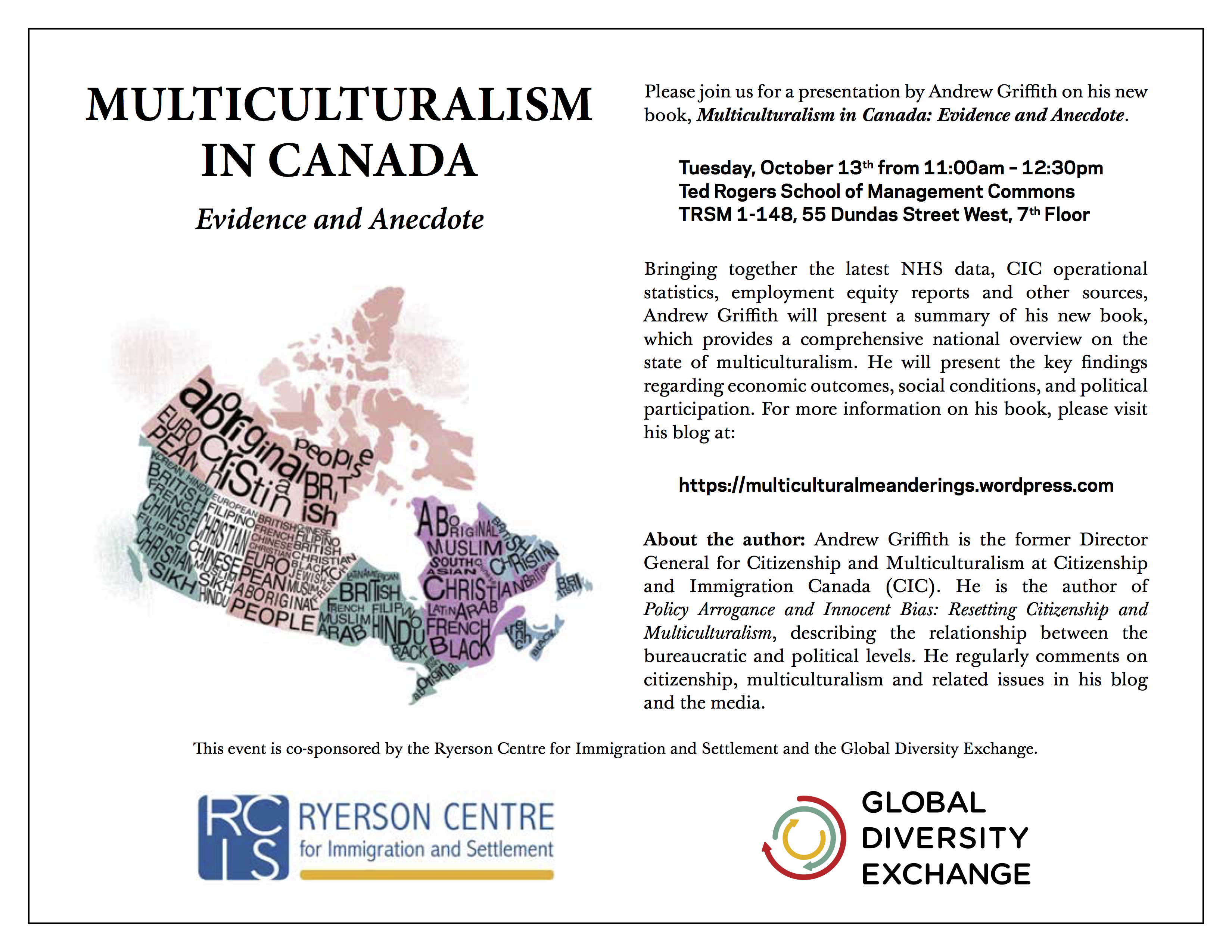
Multiculturalism in Canada: Evidence and Anecdote – Now Available

For those interested, the pdf version of my book is now available here at Canadian $3.99. I have also posted some Excerpts.

Book information sheet can be found here.

The print-on-demand version will be available in the next few weeks.

Kelly McParland: Donald Sutherland is from Canada the same way Mike Duffy is from PEI

Good piece by McParland:

The Appeal Court’s reasoning is sound.

“Permitting all non-resident citizens to vote would allow them to participate in making laws that affect Canadian residents on a daily basis but have little to no practical consequence for their own daily lives,” wrote Justice George Strathy.

The decision notes that allowing long-term expats to vote would violate a “social contract” that binds Canadians to laws that they have played a hand in creating.

This makes absolute sense. For every fervent patriot like Sutherland, who presumably lives in the U.S. due to the demands of his acting career, there are tens of thousands, of passport-holders who barely give Canada a thought. At the time the five-year rule was introduced, Canada was in the process of handing out thousands of passports to “investors” who wanted it mainly as a hedge against turmoil in their home country. If you recall, one of Stephen Harper’s earliest international acts as prime minister was a dramatic evacuation of Canadian passport-holders from Lebanon during a confrontation between Israel and Hezbollah forces. It was great theatre, except Canadians learned that thousands of those affected proved to be Lebanese citizens who had met the minimum standards for a Canadian passport before returning home, hanging on to the Canadian document in case of just such an emergency. They knew little about Canada, but without the five-year rule, 50,000 of them would have had the right to vote.

Lebanon is far from the only country where that’s the case. The Vancouver Sun reported in 2013 there were 350,000 residents of Hong Kong holding Canadian passports, and that Asians continue to leave the country in large numbers after completing the minimum requirements. Immigration experts acknowledged many never intended to stay and were merely taking advantage of Canada’s traditional generosity with its citizenship.

The five-year rule may be an inconvenience for Sutherland, who comes across as far less arrogant and self-important than fellow Canadian Neil Young, who prefers jetting into the country just long enough to demand Alberta cripple its economy by getting out of the oil business, before jetting back to California. But both are Canadian the same way Mike Duffy is from Prince Edward Island: it might be where they came from, but it’s not where they live. Even Canada’s Senate now understands that difference.

Kelly McParland: Donald Sutherland is from Canada the same way Mike Duffy is from PEI

And Professor Orwin making a similar point about the link between residency and voting:

Yes, the Charter of Rights proclaims voting a basic right of citizenship. But how far does that right extend? As we’ve already seen, only to the boundaries of one’s riding of primary residence. This is an essential feature of our system. It’s the sacred democratic right of Fort McMurrayites (and conversely of downtown Torontonians) that outsiders not be permitted to vote in their riding. Our representative must be ours, and no one else’s. So while Canadian citizenship may be a necessary condition of voting in a given election, it’s obviously not a sufficient one. This is why it’s mistaken to claim that by denying an expatriate the vote, we are stripping her of anything enjoyed by other Canadians. Rather it’s that by permitting her to vote the current law grants her a right denied to other Canadians. Yes, for five years and no more, but she should be grateful for those years, recognizing (having read this column) just what an anomaly she enjoys.

It’s not just in granting five years of electoral amnesty that the present law is quite generous. It is also so in offering expatriates a varied menu of possible electoral residences. They may choose their last previous Canadian address; but they also enjoy other options equally ungrounded in reality. Let’s face it, once Ms. Choi has decided to live abroad, it is the merest fiction to deem her still resident in my riding. As the years pass this fiction grows ever more glaring, and my neighbours and I increasingly testy. Who is this annoying phantom who pretends to live in our riding and insists on voting there? What does she know or care of our local concerns?

 If I can’t vote in your riding, why should expats vote in mine? 

I’m Canadian – and I should have a right to vote – Donald Sutherland

He forgets that US citizens also have to file US tax returns:

Did you know that? If you don’t live here all the time you can’t vote. Americans who live abroad can vote. They can vote because they’re citizens! Citizens! But I can’t. Because why? Because I’m not a citizen? Because what happens to Canada doesn’t matter to me? Ask any journalist that’s ever interviewed me what nationality I proudly proclaim to have. Ask them. They’ll tell you. I am a Canadian. But I’m an expatriate and the Harper government won’t let expatriates participate in Canadian elections.

But the broader question, for every Donald Sutherland and those like him, there are many more that have a lessor connection to Canada. And there is no way that I can think of that could consistently apply a “connection to Canada” in an administratively fair and efficient manner.

I’m Canadian – and I should have a right to vote – The Globe and Mail.

Cohen: Canada’s ambition deficit

Andrew Cohen captures it (building on his earlier book, The Unfinished Canadian):

This costs money, and we are cheap. Our new ethic is low taxes, in which a cloying federal government returns money to Canadians, as it did last week in child benefits, rather than make hard decisions for the public good. Or, governments ask Canadians to approve tax increases in referendums, as in British Columbia, evading responsibility for governing.

Today’s deficit is no longer about money. It’s about ambition.

Cohen: Canada’s ambition deficit | Ottawa Citizen.

Jason Kenney s’invite dans la circonscription de Maria Mourani: Targeting citizenship ceremonies to “shop for votes”

This takes “shopping for votes” too far. Having citizenship ceremonies for one particular community, religious or not, takes away the power and symbolism of new Canadians of different origins and faiths, coming together to join the “Canadian family.”

Undermines all the messaging on integration and the building of bridges between communities, one of the key objectives introduced by Kenney in 2009-10:

Le ministre de la Défense et du Multiculturalisme, Jason Kenney, poursuit sa conquête des appuis des communautés religieuses. Il s’est aventuré à Montréal dimanche, dans la circonscription de la députée Maria Mourani, Ahunstic-Cartierville, en tant qu’invité d’honneur de la cérémonie de citoyenneté de l’évêque catholique Ibrahim M. Ibrahim.

Contrairement aux cérémonies qui réunissent habituellement des dizaines de nouveaux citoyens canadiens devant un juge de la citoyenneté, l’événement avait été organisé exclusivement pour l’évêque par sa communauté, à la cathédrale Saint-Sauveur Melkite. C’est lors d’une messe que Mgr Ibrahim a prêté le serment de citoyenneté canadienne, devant Jason Kenney, qui a joué le rôle de juge de la citoyenneté. La paroisse était pleine à craquer et M. Kenney a été mis à l’honneur, sur un fauteuil au centre de l’allée principale.

Même si les conservateurs n’ont pas la cote à Montréal, le ministre Kenney réussit habilement à tisser et à conserver des liens avec des communautés religieuses de la métropole. La communauté arabe catholique de Montréal ne fait pas exception.

Dès son entrée dans la cathédrale, M. Kenney a salué chaleureusement l’évêque Ibrahim en arabe, puis a poursuivi la discussion en anglais. Il n’en était pas à sa première visite.

Interrogé par Le Devoir, l’évêque n’a pas caché sa proximité avec le ministre, qu’il connaît depuis 2005. « C’est un ami de la communauté. Il est proche des arabes », a-t-il lancé.

Jason Kenney a dit avoir bon espoir que la communauté de cette église, constituée en bonne partie de Québécois d’origine libanaise, appuiera son parti aux élections de l’automne. « Une communauté entière ne vote jamais de façon unanime, mais nous croyons que beaucoup de Canadiens d’origine libanaise ont des valeurs conservatrices. »

L’évêque connaît aussi la députée Maria Mourani, qui est d’origine libanaise comme lui. Il ne souhaite pas choisir de camp pour les prochaines élections. « Maria Mourani fait partie de notre communauté, mais nous ne sommes pas des politiciens. Nous sommes en faveur de tout le monde », a-t-il indiqué au Devoir.

Would be interesting to know whether CIC provided any advice on the wisdom of community-specific citizenship ceremonies in general, and this one in particular.

Jason Kenney s’invite dans la circonscription de Maria Mourani | Le Devoir.

Are you Canadian enough to vote? – Mark Kersten

Another one of the series of arguments allowing for unlimited voting rights for Canadian expatriates, including having MPs representing overseas constituencies:

Rather than pursuing inward, regressive policies, the government could think creatively. Instead of constructing barriers to democratic participation, what a progressive government could, and should, do is to create a handful of members of Parliament to directly represent Canadians who live abroad. France and Italy already have parliamentarians who represent their respective diasporas. Why not have MPs on Parliament Hill to represent the unique interests and diversity of Canadians living abroad? Surely that could only enrich our democracy.

The arguments of many proponents of extending voting rights to expats have relied on the view that it is unfair to strip voting rights from any tax-paying Canadians living abroad. The assumption is that if you’re contributing money to federal tax coffers, you should be allowed to vote. This may be intuitively persuasive, but there is a danger in taking this argument to its logical extreme. If it were, homeless citizens or some retirees could lose the vote. Paying more taxes surely doesn’t make you “citizen plus,” a better citizen than others. Canadian citizenship, as spelled out in the Charter, is not transactional. We don’t have to buy it.

Still, it is inescapable that the prohibition on long-term Canadian expats to vote in federal elections creates a bifurcated form of citizenship. All Canadian citizens are equal, but if only those living in Canada are allowed to vote, then some are more equal than others.

And while the advocates are all too quick to trot out anecdotes of Canadian expatriates who are connected to Canada in a meaningful way, one could equally draw up a list of those who are not, and likely also find some evidence to buttress the claim that most are not. The tiny number of Canadian expatriates who vote under the current 5-year limit (see Reframing the debate over expat voting: Russell and Sevi, Globe editorial) is illustrative.

Are you Canadian enough to vote? – The Globe and Mail.

Government seeks to revoke Canadian citizenship of convicted terrorist Misbahuddin Ahmed

And then there were two. The focus (so far) is on those who have been convicted in Canadian courts (which avoids all sorts of due process issues with respect to those convicted overseas):

Pakistan-Canadian Ahmed, 32, is serving 12 years at Warkworth, a medium-security prison in Ontario.

A third accused was acquitted of the one conspiracy charge against him and charges against the fourth man were dropped.

“Misbah knows about this and instructed me to do whatever is possible to prevent the revocation of his citizenship,’ said lawyer Ertel. “We intend to challenge the legislation and oppose this in every way.

“Like many Canadians I’m no fan of the draconian legislation or the apparent lack of restraint in its application,’ he added.

Ahmed now has 60 days to respond to the government’s application.

When he sentenced Ahmed, Ontario Superior Court Justice Colin McKinnon said he was convinced that Ahmed had renounced his terrorist inclinations.

He refused to impose a maximum sentence, meaning Ahmed could apply to the parole board for early release after serving one-third of his sentence.

“But for the fact that Mr. Ahmed has been convicted for terrorism offences rather than some other serious offence,” said the judge, “he would likely be considered an appropriate candidate for a conditional (non-custodial) sentence.”

He rejected the prosecutions request for a 20-year sentence saying it would be an “injustice.”

Ahmed, a former Ottawa Hospital diagnostic-imaging technician and the father of three young daughters was convicted of conspiracy to facilitate terrorism and facilitating terrorism. He was acquitted of a more serious third charge of possessing an explosive device.”

Crown prosecutors say Ahmed’s sentence is too lenient and are appealing.

Ahmed, for his part, is appealing the sentence on the grounds it is too harsh.

Government seeks to revoke Canadian citizenship of convicted terrorist Misbahuddin Ahmed | Ottawa Citizen.

Reframing the debate over expat voting: Russell and Sevi, Globe editorial

Reframing_the_debate_over_expat_voting_-_Macleans_caTwo contrasting views on expatriate voting.

The first, by Peter Russell (a former excellent and insightful professor of mine) and Semra Sevi (who has written before Canadian expatriates should never lose the right to vote), provides useful data on the number of expatriates who actually vote.

The number, as shown above, is minuscule compared to the estimated almost three million Canadian expatriates. The article also has the following international comparisons:

The five-year limitation, as opposed to some other limit, is overly drastic and Canada’s provision is not comparable with similar democracies around the world.

Americans living outside of the country have the right to vote no matter how long they have been abroad providing they pay taxes. The right to vote expires in the United Kingdom after 15 years abroad. To put this into perspective, this is three times longer than what Canada permits even though Canada is part of the Commonwealth.

Australian citizens abroad are allowed to vote so long as they intend to return to Australia within six years. After six years, citizens can renew their status by making an annual declaration of their intention to return “at some point” thereby voting for an indefinite period. In New Zealand, there is a three-year limit but the clock restarts every time citizens visit the country. Moreover, New Zealand extends the right to vote to non-citizen residents from other Commonwealth countries.

The United Kingdom extends similar voting rights to citizens of Commonwealth countries and citizens of the Republic of Ireland. The five-year limit in Canada is an arbitrary number and is unnecessarily onerous. On the surface, it is a year less generous than Australia, but Australians can renew their status by expressing a mere intent to return to the country “at some point” in the future. Canadians, on the other hand, need to resume residency to regain their right to vote abroad.

The right to vote is a fundamental right of citizenship that is protected by the Charter and does not depend on place of residence. The five-year limitation does not conform to the 21st-century demands of globalization. While there is currently an NDP-sponsored bill to repeal the provision that limits voting rights for Canadians abroad as unconstitutional, it is possible that the unconvincing judgment of two Ontario appellate judges could be overturned on appeal to the Supreme Court of Canada—but, alas, not in time to restore democratic rights to the close to a million and a half Canadians living abroad for the fall election.

Reframing the debate over expat voting – Macleans.ca.

Expatriate Voter TurnoutThe Globe editorial takes, correctly in my view, takes the opposite view:

We think the decision is the right one, for three reasons.

First, because our electoral system, based as it is on residence in a particular electoral district, assumes a connection between residence and voting, governors and the governed.

Second, because we live in a world of national borders and laws that do not apply extraterritorially, which means the lives of non-resident Canadians are largely not governed by Canadian law. As Ontario Chief Justice George Strathy put it, “permitting all non-resident citizens to vote would allow them to participate in making laws that affect Canadian residents on a daily basis, but have little to no practical consequence for their own daily lives.”

And third, because reasonable people can disagree, reasonably, over how long a citizen should reside outside of Canada before having her vote suspended. Should the limit be five years? Ten? Two generations? Never? The practical question of setting reasonable limits is best left where the Ontario Court of Appeal left it, in the hands of Parliament.

The Canada Elections Act says that Canadian citizens are entitled to vote in the riding in which they typically reside. However, the Act also says that Canadian citizens living abroad for more than five years cannot vote. There are exceptions for people sent overseas in service to the country, such as members of the Armed Forces.

All of which is not unreasonable. Justice Strathy noted that “residence is a determinant of voter eligibility in all provinces and territories.” If you move from Nova Scotia to Alberta, you can’t continue voting in Nova Scotia in perpetuity.

He also pointed out that “residence is a requirement of the electoral laws of the other Westminster democracies. The U.K., Australia and New Zealand limit the voting rights of non-resident citizens to those temporarily resident abroad.” The maximum time overseas before one loses the vote is 15 years in Britain, six years in Australia and three years in New Zealand. Canada’s current law is fair.

 No, Canadians living abroad shouldn’t get to vote 

Long-term Canadian expats lose right to vote, court decides

Good call and passes the common sense test.

In a split decision, the Court of Appeal overturned a ruling that had restored the right of more than one million long-term expats to vote.

Canada’s “social contract” entails citizens submitting to laws because they had a voice in making them through voting, the ruling states.

“Permitting all non-resident citizens to vote would allow them to participate in making laws that affect Canadian residents on a daily basis but have little to no practical consequence for their own daily lives,” Justice George Strathy wrote for the majority court.

“This would erode the social contract and undermine the legitimacy of the laws.”

Strathy said the relevant part of the Canada Elections Act aimed to strengthen the country’s system of government. While it infringed on the rights of the expats, he said, the infringement is reasonable and can be justified in a free and democratic society.

Two Canadians living in the United States — Montreal-born Jamie Duong and Toronto-born Gillian Frank — launched the constitutional challenge, arguing the five-year rule was arbitrary and unreasonable. Both argued they had only left for educational and employment opportunities and still had strong attachments to Canada and a stake in its future.

In May last year, Superior Court Justice Michael Penny threw out the voting ban, noting that mass murderers have the right to cast ballots but long-term expats who care deeply about the country do not. Penny also said expats could well be subject to Canadian tax and other laws.

The Appeal Court said Penny’s judgment was clouded by the government’s assertion that expats “do not have the same connection” to Canada as residents.

“This caused the debate to be cast as whether non-resident citizens were worthy of the vote,” said Strathy. “As a result, he overlooked Canada’s democratic tradition and the importance of the social contract between Canada’s electorate and Parliament.”

Long-term Canadian expats lose right to vote, court decides – The Globe and Mail.