#Citizenship Act C-6 Changes: Hearings Start April 12

The first Citizenship and Immigration Standing Committee hearing took place April 12. The Minister made a summary introduction to allow more time for questions (and given he was somewhat late).

The Minister did indicate in his responses to questions that while his focus was on implementing platform and mandate letter commitments, he made the general point that he was open to considering amendments in response to the NDP’s question regarding the lack of judicial hearings in cases of revocation for misrepresentation.

Government-side questions were a mix of softball (e.g., time for C-6 to be implemented) and those that likely reflected constituent concerns with respect to knowledge and language testing, along with some that probed the rationale for certain policy choices (e.g., 3 year minimum residency rather than 2). Some MPs were better at having internalized their questions, others stuck more closely to their written material.

Surprisingly, the proposed repeal of citizenship revocation for terror or treason received comparatively little attention from the Conservatives, with the Conservative immigration critic (Michelle Rempel) focussing on the elimination of language assessment for 55-64 year olds and the possible impact on the economy, leaving it to another Conservative to question the proposed repeal, mentioning the restoration of citizenship to the convicted terrorist Zakaria Amara,  (“a terrorist is a terrorist is a terrorist”).

The Minister made his standard reply: all Canadians, whether sole or dual nationals, should be treated the same (“a Canadian is a Canadian is a Canadian”), and that the Canadian legal and penal systems were more appropriate ways to deal with terrorists.

My summary notes:

Language: No disagreement among all parties on the importance of language competency to integration and citizenship. The Conservatives focussed on the reduced age requirements to 18-54 from 14-64 and the possible impact that would have on labour market participation and outcomes. They suggested a better approach was more emphasis on language training.

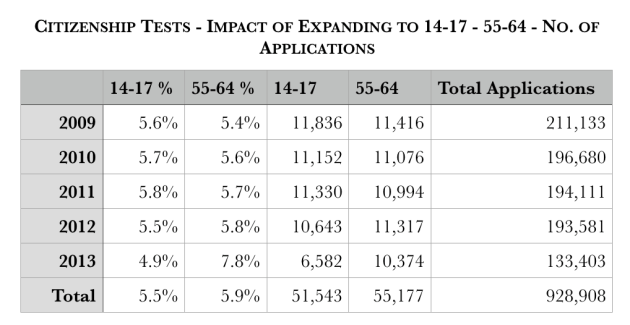
The Conservatives also asked whether any economic analysis had been done on the impact of this change for 55-64 year olds and the answer was no, the Minister retorting that none was carried out when the Conservative government increased the requirement. The Minister also responded that the number of 55-64 year olds was 8 percent of the number of applicants  (data provided to me by IRCC for earlier years shows a smaller number but they may have used 2014-15):

Citizenship Test Age Change ImpactSurprisingly, the Conservatives spent some time on the younger cohort affected (14-17 year olds) despite the fact that they would have all (or virtually all) been in school for 3-5 years and thus be competent in English or French (I always suspected this was a ‘backdoor’ way to ensure civics education).

The NDP focused more on the level of resources for language training, citing examples of reduced funding and wait times. The response was to emphasize the current high levels of funding for language training and additional funding for Syrian refugees. They also asked a number of technical questions regarding the level of language required (CLB-4 – basic).

Some Liberals noted that some constituents worried about the citizenship test, particularly the 55-64 year olds and asked how many people are likely to apply without the test and these worried. Officials replied that it is difficult to isolate factors, there were a number of reasons, including some dual citizens may not want Canadian citizens, but referred to the historic 85 percent naturalization rate (recent rate is significantly lower).

Knowledge test: There were a number of questions regarding the knowledge test and what happened when an applicant failed. The Minister and officials noted that the first time pass rate was 87 percent. Those who failed could write the test a second time, boosting the overall pass rate to slightly above 90 percent. Those who failed a second time could have a hearing before a judge, leading to another few percent to the overall rate. Subsequently, officials noted that typically the time to retake the test is between 2-4 weeks.

The NDP also noted some of the difficult and ‘tricky’ wording of the knowledge questions. The Minister acknowledged the point and stated that the revised citizenship guide would be written in a manner to be more comprehensible to more people.

Citizenship guide: Liberal side asked questions of planned revising of citizenship guide and degree to which the Charter would be emphasized and questions regarding religious rights. Officials noted that much of the content of the guide is prescribed by regulations (history, society, rights and responsibilities).

Physical presence requirement: Raised by Liberal MPs for cases of those working overseas with families in Canada, the Minister reiterated that citizenship required physical presence, that we did not want ‘citizens of convenience’ acknowledging that there were some hardships but nevertheless maintaining the requirement.

Fees: The NDP raised the issue of the steep increase of fees in 2014/15: from $100 to $530. Minister responded by saying that neither the platform nor mandate letter referred to fees but that he did not preclude looking at fees in the future.

Revocation (misrepresentation): The NDP raised the removal of judicial review as noted by the CBA, leaving revocation at the discretion of  the Minister. The Minister responded by stating that the Committee would hear from the CBA and that he was open to amendments in this area.

Processing times/Service standards: Liberal members raised the issue of processing times. The Minister gave credit to the previous government for a number of measures that have allowed IRCC to meet a processing time of 12 months (later officials indicated this was with respect to 80 percent of complete applications as of 1 April 2015 – incomplete ones are not counted).

International students pre-permanent residency credit: Minister reiterated measure to restore 50 percent credit for pre-permanent residency time for international students and also review possible improvements to Express Entry to make it easier for students, something that he intended to do that was not in his mandate letter. Some government members asked whether consideration would be given to more than 50 percent with the response being that 50 percent was deemed to be reasonable.

Refugee pre-permanent residency time: Chair asked whether consideration would be given to granting pre-permanent residency time to refugees or humanitarian cases. Officials noted that credit was only provided once refugees had been confirmed as protected persons and Minister added as general principle, government should not credit illegal time in Canada, only legal.

Lost Canadians: NDP raised that there were remaining cases and that the first generation limit remained an issue. IRCC officials explained the provisions of prior legislation (C-37 and C-24), that avenues were available for particular cases not addressed along with stateless persons.

Seizure of documents in cases of fraud. Conservatives asked for examples and officials indicated passports with entry and exit information. There were questions regarding the degree to which officials would have discretion with officials replying that this would be based on ‘reasonable grounds,’ with the details to be spelled out in regulations.

There was a long side discussion on the legitimate issue raised by the Conservatives regarding changes in the way that MP citizenship (and immigration) enquiries were going to be handled compared to the earlier direct channel of the Ministerial Enquiries group, leading to a Conservative motion, supported by the NDP, that officials brief the Committee prior to C-6 moving forward. Defeated on party lines although the request for a briefing (if not the timing, holding C-6 hearings in abeyance) appeared reasonable.

Europe under siege: Good long read by Paul Wells

Good long read by Wells on the radicalization and other challenges in Europe. Where he ends up of note:

All of which suggests, to me, that the long-term solution to the urban terror of ISIS is not to shut down borders, banish newcomers, bulk up the surveillance state and out-tough the murderers. Certainly there is a market for that prescription. On a Monday night several days after the Brussels bombings, a gang of thick-necked soccer hooligans descended on the square in front of the Bourse, tearing down peacenik banners and picking fights with passersby who seemed, in the eye of the roving strongmen, excessively eager to make nice with Islamists. The police finally saw the counterprotesters off with water cannon. There will be plenty of politicians offering the marchers their brand of tough medicine in the next election, in Belgium and across Europe. There have been for decades.

But if Islamism is vying for the attention and affection of distracted and dissolute kids, whether second-generation rebel sons of moderate Muslims or slapdash converts from Christianity or atheism, then it is not in the West’s long-term interest to try to out-tough the killers. Rather it is to sap the appeal of terror and murder by ensuring, consistently over the long term, that another way of life really does look better.

On that score, I daresay that Europe, for all its strains and its frequent inanity, is doing well. On a bad day you could almost sell the notion that EU and ISIS are funhouse-mirror images of each other: polyglot, border-skipping multinational operations that operate in defiance of history, logic or human nature. But the comparison flatters ISIS and cheats Europe. The foreign fighters who have streamed to Raqqa to join the jihad have as often recoiled in horror as they have been embraced as useful recruits. The murders of innocent dozens in Paris, including Muslims, have badly undercut the appeal of ISIS in the French-speaking world. Cédric Mas, a French analyst, has pointed out that the latest issue of Dar al-Islam, the French-language ISIS propaganda magazine, devotes an unprecedented amount of space to defensive arguments for its terror attacks in Europe—and contains no long-term forecasts about the organization’s future. It is as if, at the moment of its apparent triumph, ISIS has found itself thrown on the back foot among its own clientele.

Europe, meanwhile, is Europe, revelling in its history and culture, refining its admittedly clumsy policing, learning from error. And not incidentally, living as a rich, compelling community—richer in many places, in important ways, than Brussels.

On Monday at a conference organized by the European Policy Centre think tank, Thomas Fabian, the deputy mayor of Leipzig, described the policies his German city of 500,000 people has adopted to integrate the more than 5,000 migrants who moved there last year. The newcomers are distributed throughout the city, including in affluent neighbourhoods, instead of being left in ghettos, Fabian said. The newcomers are obliged to take German lessons. Each family is assigned a city social worker to check in now and again, but for the most part newcomers are encouraged to leave their homes to visit doctors and other services, to strengthen their personal responsibility and self-reliance. The goal of it all, Fabian said, is to make sure the newcomers join Leipzig’s broader community, a community whose residents, 300 years ago, included Johann Sebastian Bach.

This is a better way to act. It is more fulfilling and will, over time, be more attractive. By coincidence I arrived in Brussels on the same Thalys train route, from Amsterdam through Brussels to Paris, on which three vacationing Americans subdued Ayoub El-Khazzani eight months ago. No guard rifled through my bag as I boarded, and the train did not stop at the border between the Netherlands and Belgium.

In my car was an American family. The mother read aloud to her three sons from a Harry Potter book for the duration of the two-hour trip. A society where family, community, technology and security can co-exist that well—most of the time, never perfectly—is stronger than it looks. Stronger than it has been made to feel this year. In the long-term battle between Europe and its assorted tormenters, keep betting on Europe.

Source: Europe under siege

Citizenship workshop @ImmigrationCBoC: Points of interest

Good workshop panel, with Charlie Foran and Arghavan Gerami joining me, with each of us covering different aspects.

Two points of interest for me that arose in the questions and discussion:

  • The impact of the physical presence requirement on internationally mobile professionals and business people. One CEO made the persuasive case that this requirement precluded citizenship for those based in Canada but whose frequent travel abroad meant they were not able to meet the minimum number of days in Canada requirement; and,
  • A former citizenship judge picking up on this point, noted the reduced role of judges in decision-making meant that the lack of days could not be balanced against the overall contribution such individuals made. The lack of discretion, introduced to provide greater consistency in decision-making (a valid policy and program objective), had consequences for this small but significant group.

Physical presence was introduced to address those who only had a legal residence or presence in Canada but who lived abroad, with the main examples being from Hong Kong and the Gulf countries.

Some early consultations and discussion on residency requirements suggested that making it four out of six years (being changed to three out of five years in C-6) would provide reasonable flexibility for those whose work took them outside Canada (e.g., truckers, pilots and a number of professions), while balancing the need to have the meaningful experience of Canada that came from living here.

I suspect that additional consultations and analysis would provide better data on how many people are affected, or potentially affected, with consequent reflection on whether policy and program adjustments are required.

Given the nature of the Conference Board audience, many of the plenary sessions focussed, directly or indirectly, on questions of business or investor immigration. Most of these speakers were advocates, given the nature of their organization or business, and largely ignored the body of evidence that previous programs had not generated significant economic returns.

One panelist even praised the Quebec model, despite the common knowledge that many if not most business investors in Quebec left, with Chinese investors in particular largely ending up in British Columbia, and who also advocated for a citizenship investor program similar to Malta and Cyprus.

Will be interesting to see if these comments on citizenship and business and investor immigration make it into the Conference Board’s immigration action plan and, if so, the precise nature of the recommendations.

ICYMI: Ankara’s citizenship plan for Syrian refugees raises Kurdish worries

The politics of citizenship:

Turkey’s Kurdish lawmakers say the government’s decision to gradually grant citizenship to over 3 million Syrian refugees in the country’s Kurdish cities can disturb the population makeup of the area and incite ethnic tensions.

“We support efforts to embrace and help the refugees but the government’s plan is not assistance, it is part of a wider political game to strengthen its roots here,” said Mahmoud Togrul, a member of parliament from the pro-Kurdish Peoples’ Democratic Party (HDP) in the city of Entab.

Togrul believes Ankara is exploiting the refugee crisis, and by giving voting rights to the Syrian migrants it plans to secure votes ahead of the 2019 elections.

“Most of the Syrians will choose to stay in Turkey and that will be decisive in the coming elections,” he said.

According to the Turkish law, applicants will be granted citizenship after five years of residence in the country. This makes the bulk of the Syrian refugees eligible candidates for Turkish citizenship in the coming years, and able to vote in the next elections.

Official data also show that nearly 152,000 children have been born in Turkey whose parents came as refugees from Syria.

Ankara has said by getting citizenship, the refugees will have brighter prospects in the labor market and reduce the overall migration to Europe.

As part of an agreement with the European Union, called the Facility for Refugees in Turkey, Ankara will be receiving 6 billion euros over the next three years and resume the EU membership talks that stalled in late 2000.

Critics say giving millions of refugees citizen status will serve the strategic plans of the ruling Justice and Development Party (AKP).

“There will be over 1 million new voters in the 2019 elections if the government goes through with the proposal, which will in turn change the outcome of the elections,” said lawmaker Erdogan Toprak from the opposition Republican Peoples’ Party (CHP), quoted by Turkish daily Hurriyet.

Toprak said the government plans to create settlements for the refugees with the financial help it will receive from the EU, influencing the demographic development in the southeast where Kurds are in the majority.

The majority of the Syrian refugees in Turkey are of Arab origin, along with large numbers of Kurdish and Turkmen asylum seekers.

“What is strategically important for the government is the bordering areas connecting Kurdish lands in Syria, Iraq and Turkey, which Ankara wants to influence by placing the refugees’ families there,” said Kurdish author Fehim Ashiq.

Source: Ankara’s citizenship plan for Syrian refugees raises Kurdish wor

Citizenship Deck and Statistics Update: Conference Board Immigration Summit Presentation

Will be presenting today this updated and tightened version of the Metropolis deck presented a month ago with the full 2015 operational data. Overall trends remain the same: current pass rate remains about 90 percent and the trend of declining naturalization remains.

Citizenship – Conference Board April 2016

ICYMI: Hollande cancels plan to strip French citizenship in terrorism cases – The Boston Globe

Welcome pull-back, even if prompted more by politics than substance:

President François Hollande of France announced Wednesday that he was withdrawing a proposal to strip French citizenship from dual nationals convicted of terrorism, ending a months long debate that convulsed his governing Socialist Party, dominated political discussion after the November terrorist attacks and led to the resignation of the justice minister.

The idea, originally endorsed by right-wing parties and adopted by Hollande three days after the deadly attacks Nov. 13, drew furious opposition on the left in France, even though all sides agreed it was largely symbolic and would have little practical effect in combating terrorism.

But the proposal highlighted a growing split within the Socialist Party, between those who favored a tough law-and-order approach in the wake of the attacks that killed 130 people, and those worried that the government would be impinging on civil liberties.

Critics on the left complained that the plan would create two classes of citizens, saying it recalled the dark days of the World War II collaborationist government in France, which rendered hundreds of Jews stateless.

France is still under a state of emergency imposed after the attacks, and the police have conducted thousands of raids and put hundreds of suspects under house arrest.

Last week, after the Brussels bombings March 22, officials identified a possible terrorist attack in the “advanced stages” of planning, according to the French interior minister, Bernard Cazeneuve, and announced the arrest of a suspect with links to one of the November attackers.

On Wednesday, however, Hollande said he was pulling back from the citizenship proposal that had become the most intensely debated measure in a bill to overhaul the Constitution. The reversal is likely to reinforce among many voters what pollsters say is Hollande’s reputation for indecision.

Hollande blamed members of the right-wing opposition, which controls the Senate, for his decision.

“I take note that part of the opposition is against all constitutional revision,” he said. “I deplore, profoundly, this attitude, because we must do all we can, under the current serious conditions, to avoid divisions.”

Hollande also abandoned a proposal to create a constitutional provision for declaring a state of emergency, even though it had garnered broad support across the political spectrum.

Hollande’s government had slightly backtracked on the citizenship proposal in January, largely to mollify his critics on the left, in deciding that the bill would not contain any language explicitly referring to dual citizens.

The lower house, the National Assembly, where Socialists are in the majority, approved an amended bill that extended the measure to all French citizens, regardless of how many passports they held.

But the Senate insisted on sticking to the original idea and restricting the proposal to people with dual citizenship, with its leaders saying that the creation of stateless individuals was a “red line” they would not cross. With a presidential election scheduled next year, analysts interpreted the move as a way of dealing yet another blow to an already weakened Hollande.

Source: Hollande cancels plan to strip French citizenship in terrorism cases – The Boston Globe

Citizenship and Immigration Canada finds passport lost for 13 years

Fortunately, a very rare occurrence, but why should it have taken so long, and why were previous MPs not able to ‘encourage’ officials to find it?

A woman whose passport was lost in the depths of a federal department for over a decade is finally on her way to becoming a permanent resident.

“It has cost us so much heartache,” said Janina Ibarra. “I haven’t seen my mother in 11 years and I have not been able to go back.”

Ibarra came to Canada 17 years ago from Sri Lanka, which was in the midst of a civil war at the time. She says she had hoped to stay as a refugee.

Before her refugee case was settled, Ibarra met and married a Canadian citizen, and he applied to sponsor her for permanent residency status.

As part of that process, 13 years ago Sri Lanka sent her passport to Citizenship and Immigration Canada — but it went missing, leaving her with no official residency status in Canada.

Ibarra says for the past two years she has been under a deportation order she was told could be enforced at any time, which would mean leaving behind her husband and their two children.

The situation put her and her family in a precarious position — emotionally and financially — leaving them to rely on their community for support.

“There were times we would have money thrown in our mail slot,” she said. “At the end of the day it really was the benevolence of our church and church friends.”

Note buried in file

After the federal election last fall, Ibarra decided to ask her new MP Harjit Sajjan for help.

She got the answer she was hoping within three weeks. Buried in a half-metre-tall file was a note that said the passport had been archived by the government at least five years ago, if not longer, and where to find it.

Ibarra’s sponsorship application is on track for the first time since 1999. She says she hopes to have her permanent residency by late summer.

In the meantime, she’s looking for answers from the federal government for the years of her life she feels were put on hold waiting for her paperwork to get processed.

Source: Citizenship and Immigration Canada finds passport lost for 13 years – British Columbia – CBC News

Canadian Language Benchmark Test Nightmare – Immigroup

One of the implications of the change in to pre-application assessment of language introduced in 2010 or 2011 as a means of streamlining processing based on advice from the Operations people.

I didn’t fully grasp the implications at the time (my bad!) but since then a number of these anecdotes have emerged (a Danish friend of mine, having worked in Silicon Valley and Ottawa for many years, had to pay $200 or so for his test despite obviously being fluent given his work history).

The end result is that for a number of people, Canadian citizenship costs $630 in government fees plus about $200 or more for language assessment, higher than comparator countries like Australia:

IRCC is asking that I take either a French exam which would cost me $460 or an English exam which would cost me $299. Why the difference in price? Why is it that I have to take a French exam when I graduated with a BA Honours French from a recognised university in Canada? The test is plainly highway robbery! Not only am I fully bilingual, I have also studied French since kindergarten and the best part of it is that I am a French teacher who has been working in a language school for a year and seven months now, teaching government employees the language (oral, written and comprehension at all levels)! On top of this $460 for the exam, I will also be required to pay $475 for the PR fee.

Source: Canadian Language Benchmark Test Nightmare – Immigroup – We Are Immigration Law

ICYMI: Stateless Prince George man one step closer to citizenship

No longer falling through the cracks:

Qia Gunster is one step closer to being Canadian.

The 20-year-old Prince George man has lived in B.C. since he was a baby, but has never been recognized by his country.

As a “stateless person,” Gunster has been unable to get government identification, which means he couldn’t legally work, drive a car or travel.

But this week, Citizenship and Immigration Canada granted Gunster permanent resident status and he will finally be able to get a driver’s licence. He will also be able to get a social insurance number, so he can work and pay taxes.

He won’t be able to apply for Canadian citizenship for another four years.

“It’s pretty awesome — my whole outlook on the future has changed,” Gunster said Thursday.

“It makes everything easier.”

Gunster was born in Arizona, but his mother didn’t register his birth and when he was 18 months old, she crossed the border into B.C. with him. She left her baby in McBride, east of Prince George, where he was raised by a friend of a friend.

Being without ID wasn’t a significant problem until he finished high school. With help from a large circle of supporters, Gunster was able to earn a living. He is partway through his apprenticeship as an electrician and has found employers willing to pay in cash.

But Gunster still faced many limitations. He needed a birth certificate even to begin the process of applying to the federal government for citizenship.

The school principal got involved, and his adoptive families tried to help. Even the local MP contacted Arizona government officials in an attempt to get Gunster a birth certificate.

Despite stacks of paperwork, and a DNA test proving he is the son of an Arizona resident, the state has refused to issue the document.

Late last year, Michelle Quigg, a lawyer with North Vancouver-based Access Pro Bono, got involved with Qia’s case. She succeeded in getting Gunster permanent residency status, but she intends to press the government to grant him citizenship sooner under a section of the Immigration Act that allows it for “exceptional circumstances.”

Gunster, meanwhile, is making plans. He is going to get his driver’s licence and apply for jobs as an electrical apprentice at any company who’s hiring. He can go to a bar and no longer worry about being asked to prove his age. He can apply for a credit card.

“When you’re stateless, the options are so limited — you can’t work unless you know the right people,” he said.

“Basically I was stuck in a black hole that I couldn’t get out of, and now I have a world of opportunities.”

ICYMI: Liberals cheapen citizenship | Chong

Gordon Chong, former Toronto municipal councillor, criticizes most aspects of the changes to the Citizenship Act announced by Minister McCallum (like all such critiques, ignores that McCallum maintained and added to integrity measures introduced by the Conservatives):

But this new soft-headed federal government wants to demonstrate its soft-heartedness by easing the rules to obtain our most treasured commodity, citizenship.

But should newcomers self-segregate and be functionally illiterate in English and French?

Should we establish a multitude of solitudes in addition to our “two solitudes”?

Should we discourage newcomers from “throwing their lot in with us”, as former federal court judge Francis Muldoon described unconditional commitment to Canada?

We need Canadians of conviction, not Canadians of convenience!

If citizenship is to be made irrevocable, a true “until death do us part” contract — unlike the Order of Canada, or an Olympic medal — then we should make the requirements reflect the unalterable nature of that contract.

Serious standards should be de rigueur.

When Paul Martin Sr. brought in Canada’s first Citizenship Act in 1947, he did not do so lightly.

He had visited the battlefields of Europe and solemnly recognized the contributions of French Canadians and others, including Japanese Canadians, Chinese Canadians, Italian Canadians and German Canadians, even though some were not recognized as “Canadians” in the same way as those of British descent.

Martin Sr. corrected that glaring oversight because so many had volunteered to fight for Canada — some on the battlefields, others in intelligence gathering — in World War II.

By 1947, Chinese inhabitants of Canada could finally vote.

In my family, there had been a dichotomy before that.

My British mother could vote, but my Chinese father could not!

The then Liberal government thought Canadian citizenship sufficiently precious that five years of residency was required prior to applying — with no flexible interpretations of “residency”.

In the 1960s, the residency requirements were shortened to three years with a looser interpretation of “residency”, to accommodate the business interests of those with international ties.

As their families were settling in, the business class immigrant (usually the husband] could leave the country and still be considered a “resident” because he had established a residence in Canada.

Our new-age Liberals are now proposing a change in the requirements for someone to be physically present in Canada from four out of six years to three out of five.

Why? The present rules are hardly onerous when granting something so valuable.

How much is Canadian citizenship worth? How much are we willing to devalue it? How soft-headed are we going to be?

Admittedly, revoking citizenship is challenging.

However, if the federal government is determined to keep dual citizenship, then those convicted of terrorism or other treasonous crimes against Canada should face the death penalty.

One way of extracting a seed of good from the psychotic nihilism that permeates terrorism would be to harvest the organs of convicted terrorists sentenced to death for transplantation and medical research.

Some faint-hearted souls may think this extreme. Many Canadians will not.

Serious, hard-headed, utilitarian leadership is the sine qua non for this debate. Who will lead it?

If patriotic Canadians willingly sacrifice their lives fighting terrorism, should traitorous Canadians not have to sacrifice theirs?

Then our policy will truly be once a Canadian, always a Canadian, irrevocably, right up to, “until death do us part!”

Source: Liberals cheapen citizenship | Chong | Columnists | Opinion | Toronto Sun