Interesting interview with Zunera Ishaq, the woman at the heart of the niqab citizenship controversy:
How did it come to pass that the so-called “liberal” media, and prominent Canadian feminists, championed the 29-year-old suburban Toronto woman who insisted on wearing in a civil ceremony one of the world’s most provoking symbols of patriarchy?
What background was missing from the debate over the niqab?
I was able to obtain Ishaq’s responses to some of these questions this week.
Ishaq told me she respects Mulcair and Trudeau for defending her niqab, and for standing for multicultural “choice” and tolerance.
She went out of her way to say she also respects Harper, “who created all the mess. He was following his conscience.”
Our telephone conversation revealed a woman who inhabits a world of paradoxes, which the Oxford Dictionary defines as “seemingly absurd or self-contradictory propositions.”
On one hand, the famous 29-year-old Sunni Muslim sounded libertarian and morally relativistic, emphasizing “every person is free to live in a way in which he or she feels is right.”
On the other hand she also seems the opposite. She is ultraconservative on segregation of the sexes, homosexuality, abortion, obeying Islamic commands and women being “unclean” during menstruation.
As niqabs become more common in Canada — a regular sight on campuses, including the University of B.C. — it’s worth understanding the apparent contradictions associated with defending this stark symbol of gender inequality.
Since Ishaq was often portrayed as standing up for all Muslim women, it’s important to note hundreds of millions of Muslims around the world, and the majority of the 1.1 million Muslims in Canada, disapprove of the niqab.
Ishaq said she respects the many Muslims who disagree with her. That includes the imam at another Metro Toronto mosque who, not knowing she was present, criticized her for insisting on wearing the niqab.
Women rarely wear the niqab in most Muslim-majority countries, where scarves covering the hair or no headdress are more common. Niqabs have been banned in some Muslim countries, because they were used in crimes and terrorist attacks.
Ishaq’s religiously torn homeland of Pakistan, which she and her family were preparing this week to visit, is one of the few countries where Pew Research found support for the niqab, with 32 per cent saying women should cover their faces.
Only a few hardline Muslim leaders, including in Saudi Arabia, require women to wear long black abayas and press for them to cover their faces.
“Saudi Arabia has chosen that law,” Ishaq said, in one of repeated references to the supreme value she places on “choice,” including at the political level.
“I would not say that it’s wrong. I would not say it’s exactly right in Islam. So I would not like to comment.”
She agreed Islamic tradition advocates only personal “modesty.” And she acknowledged nothing in the Qur’an mandates women covering their faces.
“I do not feel that Muslim women who do not wear the niqab are lesser than me. What I’ve done is my choice, another opinion.”
Ishaq also called homosexualitya “choice,” which goes against the predominant understanding among gays and lesbians.
“Being a Muslim, it’s my view that homosexuality is not the right thing. But I have to tolerate it, without discrimination and without hatred. I have no issues with people who are homosexual. That’s their choice. But I definitely do not think it’s right.”
In addition to the obligatory thanks to all, and his plea for civility and thoughtful deliberations, Kenney’s remarks on Canada worth noting, and consistent with his time in office:
As a last word about this country, which we all serve—this magnificent country with limitless potential—as I worked as minister of immigration, citizenship, and multiculturalism and welcomed refugees to this country, I was reminded of the words of Desmond Morton, a great Canadian historian and a former NDP candidate. He said that Canada is made up of people who have been on the wrong side of history. That includes our first nations at the time of European contact.
That also includes French Canadians at the time of the conquest and Acadians, with the great upheaval and the tragedy of what happened to them.
It includes the United Empire Loyalists; English Canada was founded by refugees, including some of my ancestors, who came here from the American Revolution. It includes those who saw Canada as the North Star through the Underground Railroad, who escaped slavery in the United States to achieve freedom in this country, sometimes with the scars of slavery on their backs. There were the Highland clearance Scots, who founded Cape Breton. There were the famine Irish, including some of my ancestors—and members can see that the Kenneys have recovered from the famine. There were Jewish victims of the pogroms before the Second World War, in the early 20th century, and the victims of the Shoah, who came after the Second World War. There were the eastern Europeans, the men in sheepskin coats who fled political oppression to pursue new opportunities in settling the Canadian Prairies; the Hungarians of 1958; the Czechs of 1968; and the Vietnamese of 1979. With the Chinese premier here today, we should also remember the Uyghurs and Tibetans and Falun Gong practitioners and those who stood at Tiananmen Square. There are so many others right to this day: the Syrian refugees whom we welcome; the 25,000 Iraqi refugees who came through a program that I established; the gay Iranians and men and women of all backgrounds. All of them in their own way were losers of history, yet by becoming Canadian they have become winners of history.
All of those people would have cause to live in a spirit of bitterness and recrimination but, instead, have decided not to forget their tragic past, to remember and memorialize it but move forward with hope in the future, as Canadians with a common sense of responsibility for one another.
I close my two decades in this place by quoting the words of former prime minister Diefenbaker, when he introduced the Canadian Bill of Rights. In expressing a sentiment that applies to all of those losers of history who have built one of the greatest countries of history, he stated:
“I am a Canadian, a free Canadian, free to speak without fear, free to worship God in my own way, free to stand for what I think right, free to oppose what I believe wrong, free to choose those who shall govern my country. This heritage of freedom I pledge to uphold for myself and all mankind.”
The German Green party has called on the government of Angela Merkel to fast-track the applications of Britons wishing to become German citizens in the light of the UK’s vote to leave the EU.
Volker Beck, a leading member of the party, told the Bundestag that Germany should “send a signal that Britons belong to Europe and to Germany” by allowing the “swift and straightforward naturalisation” of British citizens.
A heated debate in the German parliament on Friday revealed the extent to which the Brexit vote and the uncertainty surrounding Britain’s future relationship with the European Union continues to vex and anger German politicians across the spectrum.
Beck said that 5,000 Britons had received German citizenship last year and there were many others who wished to apply among the more than 100,000 other UK citizens living in the country. But many were not eligible, he said, because they had not lived in the country for the eight years the current law recommended or were not earning the level of income required to prove they could support themselves.
Beck called on the German government to “change its spots” and create a “modern citizenship law” that would allow people to hold more than one citizenship. Currently, this is only possible in exceptional cases.
Once Britain leaves the EU, Britons would be unable to become German citizens without first renouncing their British citizenship, hence the Greens’ attempts to speed up the process that would allow Britons to become German and remain British.
But the proposal was met with stiff resistance by politicians from chancellor Angela Merkel’s conservatives.
Stephan Mayer of the Christian Social Union called Beck’s proposal “treasonous” and accused him of “pushing a policy of the forced Germanisation of Britons in Germany”.
He said that any discussion concerning Brexit was “premature and pointless, as long as the negotiations [regarding the conditions of exiting the EU] are still ongoing”.
“For the time being we need to view the issue with typical British dispassion,” he told parliament.
He said British citizens already “get all the rights they need here, apart from being able to vote”.
But Rüdiger Veit of the Social Democrats (SPD) hit back. “It’s not about a forced Germanisation of Britons; it’s to do with the fact they’re very welcome here and it would be a happy situation if as many of them who want to beome German citizens did,” he said.
Tim Ostermann, who is MP for Herford in North Rhine Westphalia, a base for the British forces in Germany until last year, said he had not received any complaints from British citizens who had chosen to stay in the area that they had had any difficulties in acquiring citizenship.
“I never heard from any ex-British soldiers that they had any problems,” he said, calling the Greens’ proposal “an overreaction”.
Always worth noting the Aga Khan’s comments on multiculturalism, diversity and pluralism:
“One enormous challenge, of course,” observed the Aga Khan, “is the simple fact that diversity is increasing around the world. The task is not merely learning to live with that diversity, but learning to live with greater diversity with each passing year.” The Aga Khan fully recognizes the frustrations of the pluralism story. The challenge, he noted, was that as we become aware of the diversity of the world we live in and come into contact with people who are different than us, difference becomes a source of conflict rather than an opportunity. “We talk sincerely about the values of diversity, about living with complexity. But in too many cases more diversity seems to mean more division; greater complexity, more fragmentation, and more fragmentation can bring us closer to conflict.”
It is not just proximity that creates this awareness, and often tension. Technology and media, while seemingly bringing us together, recognized the Aga Khan, often pull us apart, feeding ignorance and insularity. The antidote, however, isn’t ignoring difference. “We often hear in discussions of Global Citizenship that people are basically alike. Under the skin, deep in our hearts, we are all brothers and sisters – we are told – and the secret to a harmonious world is to ignore our differences and to emphasize our similarities. What worries me, however,” said the Aga Khan “is when some take that message to mean that our differences are trivial, that they can be ignored, and eventually erased. And that is not good advice. In fact, it is impossible.”
“Pretending that our differences are trivial will not persuade most people to embrace pluralistic attitudes. In fact, it might frighten them away. People know that differences can be challenging, that disagreements are inevitable, that our fellow-humans can sometimes be disagreeable,” he continued.
Too often people think that embracing the values of Global Citizenship means diluting or compromising one’s own bonds to country or peoples. This is not the case emphasized His Highness. Rather, “the call of pluralism should ask us to respect our differences, but not to ignore them, to integrate diversity, not to depreciate diversity. The call for cosmopolitanism is not a call to homogenization. It means affirming social solidarity, without imposing social conformity. One’s identity need not be diluted in a pluralistic world, but rather fulfilled, as one bright thread in a cloth of many colours.”
How one goes about achieving this is no easy task. He ended the evening with a recipe-of-clarity-and-wisdom in charting a future for global citizenship: “a vital sense of balance, an abundant capacity for compromise, more than a little sense of patience, an appropriate degree of humility, a good measure of forgiveness, and, of course, a genuine welcoming of human difference.”
More on the ‘Lost Canadians’ issue and the few remaining cases.
While one can always do more to communicate changes – and there were efforts to do so – it is not surprising that some people only become aware when they are confronted, through renewing a passport or moving back to Canada:
The [retention provisions of the 1977 Citizenship Act] law was drafted in the 1970s out of concern that citizenship could be passed along indefinitely to generations abroad who were less and less connected to Canada, said Audrey Macklin, a law professor at the University of Toronto.
Macklin said it wasn’t necessarily unfair, at least in theory, to require someone twice removed from being born in Canada to prove a connection to the country.
The problem, though, was rooted in the government’s inability to identify and inform those people that their citizenship would “evaporate” if they didn’t take specific steps to retain it, she said.
Lindsay Wemp, a spokeswoman with Citizenship and Immigration Canada, said in an email that the immigration minister can offer discretionary citizenship in extraordinary circumstances on a case-by-case basis.
Funk said she contacted Minister John McCallum’s office in July and has yet to receive a response.
Citizenship statuses on ‘narrow hinge’
Donald Galloway, a University of Victoria law professor, said he didn’t think the government has taken the necessary steps to let people know “the narrow hinge” their status was hanging on.
“I think it’s quite shocking to live in a country where the government creates these byzantine rules and says ‘Well, it’s up to you to know the details,'” he said.
The release of IRCC citizenship and other statistics for the first half of the year provides an indication of what the overall 2016 numbers of permanent residents and new citizens will likely be.
The chart above, year-to-year comparison, shows the expected drop (41 percent) in the number of new citizens following IRCC’s success in 2014 and 2015 in eliminating the backlog (from a high of 323,000 in 2012 to 59,000 on 30 June 2016).
The more significant news is the dramatic drop in the number of people applying for citizenship (63.9 percent), mainly reflecting the sharp increase in citizenship fees from $100 (plus $100 right of citizenship fee) before February 2014 to $530 in 2015 (the right of citizenship fee remained unchanged).
To a lessor extent, some of the 2014 changes to the Citizenship Act in C-24, such as the extension of language and knowledge testing to 55 to 64 year olds, also played a role.
If this trend continues, there will only be about 70,000 applications in 2016, compared to about 130,000 in 2015.
Of concern is that IRCC did not appear to have seriously considered the possible impact of this increase in fees when advocating successfully for an exemption to the User Fees Act and its requirements for full public consultations.
“An important assumption made in the monetized analysis is that the fee increases are not anticipated to affect the demand for citizenship. The last census (2006) reports that 85% of eligible immigrants received Canadian citizenship, or approximately 228,000 individuals. The CBA assumes that the fee increase will not impact the naturalization rate as the value placed on obtaining citizenship is very high and the benefits associated with obtaining citizenship far outweigh the fee increases. Thus, the number of applications expected per year is not anticipated to fall following an increase in the fees.”
Hard to believe that such a categorical assumption could be made, in contravention of basic economics and the realities of many low-income and refugee immigrants. Pure assertion, no real evidence. It mischaracterizes the Census number, which includes all the foreign-born (about six million), not just recent immigrants whose naturalization rate is significantly less.
Approval rates increased slightly to 92.1 percent from 91.4 percent.
Processing time continues to decline from 21 months during FY 2015-16 to 18 months in the latest quarter (April-June 2016), helped by the declining number of applications.
A cynic might suggest that the previous government, in addition to implementing many of the administrative changes and business process simplification needed to reduce future backlogs, put into place a number of measures that effectively reduced demand for citizenship as part of the their objective of making citizenship “harder to get and easier to lose.”
The increase in the number of new permanent residents reflects the increase in levels for 2016.
One minor irritation with the datasets of Opendata: for citizenship, IRCC has moved from calendar to fiscal year reporting unlike for permanent and temporary residents, where it remains on a calendar year basis.
While it is possible to correlate the calendar and fiscal years, IRCC should be consistent for all its data sets. While I prefer the calendar year basis given that it allows to track longer term trends consistently, I can also understand the rationale for fiscal years, given the linkage to planning, budgeting, and reporting.
But please pick one or the other and stick to it!
Note: Revisions to application numbers can occur given incomplete applications are returned to the applicant without being entered into the database. When these are subsequently resubmitted with the missing information, they are dated and counted from the date of the original application. It is unlikely, however, that any revisions will alter significantly this trend.
I always find these puff pieces advertising citizenship for sale revealing:
“We congratulate the Government of the Republic of Cyprus, and more particularly the Ministries of Interior and Finance, for their prudent work which took into consideration industry requirements and standards, the sensitivities, psychology and motives of the investors, the need for transparency and the need for ease of assessment of the applications.”, commented Armand Arton, President of Arton Capital, a leading global financial advisory specialised in investor programs for residence and citizenship.
Under the new program, it is no longer needed to form groups of 5 or more investors, the upper threshold on the required investment for single applicants has been halved to €2.5 million, more safeguards for the investors are introduced, while main applicants can secure citizenships for dependent parents.
The redesigned program seeks to retain the exclusive nature of the Cypriot passport, currently ranked 12th by the Passport Index. The speed of processing remains one of its unique features, currently unmatched by other EU countries competing to attract foreign direct investments such as Malta, Portugal, Hungary or Bulgaria. Within 3 months, qualified investors can be granted Cypriot citizenship approval, which makes it the fastest CIP in Europe. The speed, simplicity and the inclusion of dependent parents are the driving indicators of Cyprus’ updated ranking on the Arton Index, the industry benchmark of global citizen programs, where it scores 74 points, out of 100 and claims the pole position by a EU country.
Cyprus places an emphasis on the genuine ties with investors, ensuring that they maintain a permanent housing unit bought at a minimum of €500,000+VAT and held for the duration of their lifetime. The immediate needs of applicants are also addressed, as citizenship applicants are given a Residence Permit until they secure their passport.
“The new changes, Cyprus’s unique geographic location, Mediterranean climate and sound economic recovery provide ideal investment opportunities for new citizens of Cyprus,” added Arton.
Given that the economy of Cyprus is setting new records in recovery and is now an example of sound economic management, investors are expected to keep flocking to the island in increasing numbers. Values of property aimed at the local market have been stabilized, while the values of high-end, seaside properties geared toward the foreign market have been rising right through the crisis.
“The Government clearly aims toward further reduction in the unemployment rate, which has been deescalating sharply over the past months, and a reduction in non-performing loans, which are gradually becoming less of a problem.“, Arton concluded.
With offices in Cyprus and around the world, Arton Capital have been quietly driving the industry innovation through its sough-after sovereign advisory practice, vast certified partner network and bespoke investor relations.
While I don’t believe that the numbers show that birthright citizenship abuse is so widespread (certainly not in Canada), it is not surprising that there are some institutions and consultants that ‘market’ birthright citizenship.
In general, better data collection and regulatory approaches are needed before abandoning birthright citizenship:
Donald Trump called attention to abuses of birthright citizenship for children of illegal immigrants early on in the Republican primary and a story out of New Jersey shows just how right the GOP nominee is on the issue.
A New Jersey hospital is tempting pregnant women in Russia to come to America to deliver their babies, and for a paltry sum of $10,000 or less, not only will they get superior medical care, but their children are born American citizens with all the privileges that come with it, Fox News reported.
“Childbirth in New York is the best investment in the future of your family!” reads the Russian-language AmeriMama website.
The “AmeriMama” program at Meadowlands Hospital Medical Center, first reported by NJ Spotlight, is part of a lucrative and controversial business called “birth tourism,” the practice of soliciting pregnant women from other countries to deliver their children in the U.S. — automatically making them American citizens — before they return home.
But the Secaucus, N.J., hospital has taken it to a brazen new level, say immigration experts.
For fees ranging from $8,500 to $27,500, the Russian-language website for AmeriMama promised to secure citizenship papers, passports, and travel visas for the baby, according to NJ Spotlight, which reported on the program in August.
The Center for Immigration Studies says this may be the first American for-profit hospital to openly market U.S. citizenship.
“They claim they’re selling their hospital services, but the unspoken benefit of this is that the child gets a U.S. passport and U.S. citizenship,” explained Jessica Vaughan, the center’s director of policy studies.
“This is essentially U.S. citizenship up for sale,” she added. “And this is the first time I’ve seen a hospital itself market to this customer base.”
The AmeriMama website and its Facebook page were removed soon after being exposed last month by NJ Spotlight.
Interesting example of the statelessness and its impact:
A little girl’s desire to go to school exposed the cracks of citizenship laws in Cuba and South Africa. The girl, now 8, was deemed stateless until a court ordered the South African government to grant her citizenship this week. Her Cuban parents have been fighting for her rights for most of the child’s life.
On Sept. 6, the Supreme Court of Appeal upheld a lower court’s judgement that the girl should be recognized as a South African citizen, her lawyers said in a statement. The ruling also ordered the ministry of home affairs to draw up regulations to allow other stateless children the chance to apply for citizenship.
Without citizenship and an identity number, she could not graduate, go to university, get married, or even have her death registered. Citizenship isn’t only a matter of national pride, but access to many state institutions and benefits in a world where international bordersstill hold much power.
“Daniela’s case is an example of how a child can fall through the cracks of nationality laws and citizenship provisions,” said Jacob van Garderen, director of Lawyers for Human Rights.
South Africa’s Department of Home Affairs argued that the child could be granted permanent residence and become a naturalized citizen, according to documents filed to the court. They also said the judge violated the separation of state and judiciary when he ordered for new regulations. Still, despite launching the appeal and a two-year battle between courts, the government dropped the case at the last minute.
Daniela’s lawyers argued that permanent residence would not equate to citizenship, and that the child would always be a foreigner in the country she was born in. Further, the process of obtaining permanent residence could take between five and ten years.
Daniela was born in Cape Town in 2008. She was issued a birth certificate without an identity number because her parents were foreigners. Kenia Maria Rodriguez Garcia simply assumed her daughter was Cuban. The Cuban Embassy in South Africa, however, refused to grant Daniela citizenship on the basis that her mother’s absence from the island nation made her a “permanent emigrant,” thus excluding her child from citizenship rights.
Garcia came to South Africa in 2005 as an engineer participating in a bilateral treaty. She is now a permanent resident in South Africa, but still found that her child’s rights were limited. Garcia says she hated exposing her daughter to public scrutiny, but is grateful that other parents will be spared the ordeal.
Not totally surprising that the CAQ would play identity politics but still disturbing given its predecessor, the ADQ, did so:
It was Legault who opened himself up to the attacks when, arriving for a two-day meeting of his caucus, raised the issue when asked if he still has confidence in his caucus chairperson, Nathalie Roy.
Roy said last week she wanted the burkini — a piece of clothing which covers the entire body and head leaving only the face, hands and feet visible — banned. It is the same clothing which sparked a furor on the beaches of France this summer.
Photos of police officers who intervened on the beaches because of Muslim women wearing burkinis were seen around the world.
After saying he has the same “malaise,” as Roy when it comes to the burkini, Legault said it explains why the CAQ — should it form a government — is proposing to create a values test for newcomers.
It would be CAQ policy to require new immigrants to pass a test on Quebec’s language, and cultural values, after a three-year probationary period. If they don’t pass after two tries, they would be asked to return to their country of origin or to another province in Canada.
Legault ventured that immigrants in favour of the burkini would likely fail those tests and could be refused citizenship because a burkini runs against the principle of equality between men and women.
“There are big questions to be asked on such a piece of clothing,” Legault said. “Does it respect the fundamental values we have in Quebec on the equality of men and women?”
Asked by a reporter what would happen to a person who had moved to Quebec and insisted that the burkini was part of their faith, Legault was clear:
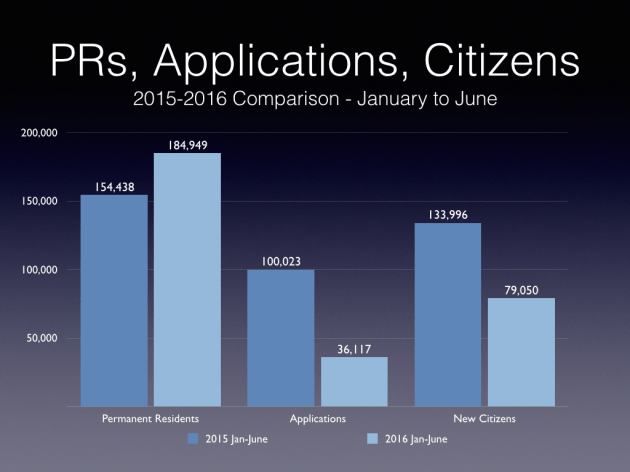 The chart above, year-to-year comparison, shows the expected drop (41 percent) in the number of new citizens following IRCC’s success in 2014 and 2015 in eliminating the backlog (from a high of 323,000 in 2012 to 59,000 on 30 June 2016).

