C-6: Senate bill would let children become citizens separately from parents

The Senate continues to play a larger role in legislation. In this particular case, the comparison countries used are not the usual ones (Australia, NZ, UK, USA) but rather Norway and Denmark.

Interesting, given that overall their citizenship regime is much more restrictive than in Canada, save in this instance:

Tens of thousands of children could benefit from a proposed amendment to the Citizenship Act to allow Canadian residents under the age of 18 to apply on their own for Canadian citizenship, say advocates.

Ontario Senator Victor Oh proposed legislation on Thursday that asks Canada to follow the lead of Norway and make it possible for minors to apply for citizenship separately from their parents.

The proposal would apply to a cross-section of youths in Canada — including asylum seekers, children estranged from their parents, young people with criminal convictions, and minors who don’t want to follow their parents back to nations such as India and China that don’t allow dual passports.

Canadian law currently requires permanent residents who want to apply for citizenship to be at least 18 years of age or to be included in a parent or guardian’s immigration application.

That “places some highly vulnerable minors at risk of removal once they become adults,” says a brief prepared by the senators.

A change in the citizenship law could have significant consequences for thousands of young people in Ontario and B.C., where three out of 10 residents are foreign-born.

In addition, the senators’ amendment is a response to the growing number of unaccompanied minors seeking asylum in Canada, which rose by more than 50 per cent to 3,400 in 2016.

Senator Ho’s motion, which has been supported by B.C. Senator Mobina Jaffer, echoes similar recommendations made last year to an Ottawa citizenship committee by Vancouver East NDP MP Jenny Kwan and Winnipeg Conservative MP Michelle Rempel.

“This would be the biggest push forward for children’s rights in Canada in decades,” said Vancouver immigration lawyer Richard Kurland, who helped the senators draft the proposal.

Currently, the only way that a Canadian resident under 18 can apply for citizenship on their own is on “compassionate” grounds. But that avenue is rarely used.

In contrast, Norway allows citizenship applications from youth who have been in the country for five of the previous seven years. Denmark is open to youths becoming immigrants on their own if they have gone to school in the country for four years.

The background paper accompanying the complex legislative proposal said it would make it possible for the following kinds of young people to become Canadian citizens through their own application process:

• “Unaccompanied minors,” that is young people who arrive in Canada unaccompanied by an adult. The brief argues many are at risk of exploitation and abuse by traffickers.

• Children who have gone into “protective custody” because of physical or sexual abuse by their parents or guardians.

• Children who are orphans, or who have run away from their parents or guardians.

• Children of parents who are permanent residents but who do not meet language requirements to become citizens.

• Children who as young adults become convicted of a criminal offence.

Kurland said the revised application process would also be open to minors whose parents have applied for immigration status but who have worked outside of Canada for so long that the parents fail to meet requirements for citizenship.

In addition, the immigration lawyer said new legislation would allow a youth in Canada to follow a different route from their Canadian-resident parents — who might decide against becoming citizens of Canada because they don’t want to give up the passport of their homeland.

Unlike Canada, China and India, which are two of the largest sources of immigrants to Canada, do not allow dual citizenship.

Source: Senate bill would let children become citizens separately from parents | Vancouver Sun

Trudeau’s Senate representative slams ‘obstructionist’ Conservative delay tactics in new report [e.g., C-6]

The Conservative caucus use of procedural delaying tactics is certainly evident with respect to C-6 Citizenship Act changes:

In a scathing new document, the government’s representative in the Senate slams Conservatives for “zealously” delaying government bills.

In the 21-page “discussion paper,” Sen. Peter Harder says “obstructionist” senators are “time-wasting,” delaying the Liberal government’s agenda and blocking Senate modernization to score their own “partisan points.” He proposes an all-party “business committee” set schedules based on individual bills to ensure House business doesn’t indefinitely stall in the Senate.

The committee idea itself is a “very good” one, says Conservative senator Stephen Greene, but Harder “made the acceptance of the structure a bit difficult on our side because he took a few potshots at Conservatives, and the reaction on our side might not be too pleasant, to put it mildly.”

Greene said Conservatives are using tactics available to any opposition, and that Liberals have used in the past. “Filibustering and delaying tactics are not bad things in and of themselves, if they’re used with restraint,” he said. “From Sen. Harder’s point of view, it might look excessive, but from the Conservative point of view, it’s not.”

The paper, dated Friday, is being circulated to senators this week following further delays for the Liberals’ citizenship bill, C-6. The bill, which repeals major elements of Harper-era citizenship legislation (Bill C-24), has languished in the Senate since last June.

Voting on a third-reading amendment to the bill was delayed throughout the evening last Thursday by various adjournment motions from the Conservatives. It was a longer-than-average evening with lengthy waiting periods in between votes on the motions. At one point, the Independent Senators Group ordered pizza for itself. Greene called the session a “trainwreck.”

“The apparent strategy is to hinder the progress of government bills, even those that seek to enact clear election promises, for as long as possible,” Harder writes in his paper, listing other examples of delays.

“Some Senators would prefer for the Senate to remain stuck in time, available as a platform to advance partisan interests. … Sober second thought has become a game of procedural cat-and-mouse.”

Harder says a business committee would make collaborative decisions on time management with input from leaders of each caucus or group, the bill’s sponsor and critic, and the chair of the committee to which the bill would likely be referred.

Source: Trudeau’s Senate representative slams ‘obstructionist’ Conservative delay tactics in new report | National Post

Court case ruling may allow Britons to keep their EU citizenship and rights | The Independent

Interesting wrinkle:

Britons might be able to keep their EU citizenship and rights to live, work and claim healthcare across Europe, even if Theresa May walks out of the negotiations with no deal.

This could depend on the outcome of a legal case brought by four plaintiffs, who are seeking a ruling from the European Court of Justice over whether Article 50 can be revoked without the permission of other EU states.

The case, brought by the Good Law Project, is an attempt to get a ruling over whether Brexit could be reversible until 29 March 2019.

But it will also be asking whether or not UK citizens would remain EU citizens post Brexit.

The argument is based on Article 20 of the Treaty of Lisbon, which states that EU citizenship is additional and separate to national citizenship.

There are no provisions for removing this citizenship and its associated rights from individuals, regardless of whether their nation leaves the EU.

The case will argue that it is unclear from current legislation whether UK citizens can be stripped of their EU citizenship.

Speaking to Buzzfeed, Jolyon Maugham QC, a lawyer helping to bring the case, said: “There seems to be an assumption – convenient both to a particular type of Brexiter and to those voices in the EU that would rather be shot of the UK – that the citizenship rights of UK nationals can be taken away from us.

“Whether that assumption is right is ultimately a question of EU law. And it’s very unclear to us that it is.

“The question is likely to be of particular importance to those – very often British pensioners – who have made their lives abroad in France or Spain.”

Source: Court case ruling may allow Britons to keep their EU citizenship and rights | The Independent

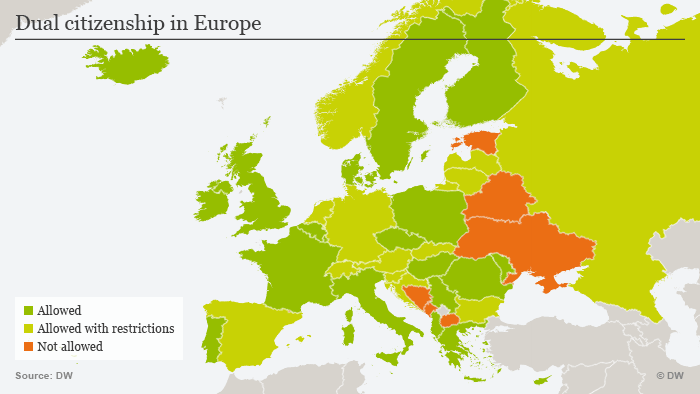
Dual citizenship in Europe: Which rules apply where?

Ongoing German dual citizenship debate, likely prompted by concerns of Turkish campaigning under Erdogan’s authoritarianism, along with a summary of the policies of other EU countries:

Chancellor Angela Merkel’s conservative Christian Democrat Union (CDU) aims to tighten citizenship laws. At the CDU conference last December, party officials launched a debate on possible restrictions on dual citizenship. The subject of the dispute is what is known as the “obligation option,” which means that children of immigrants obtain both nationalities at birth, but must choose one when they reach the age of 23. In 2014, the coalition government agreed that children born and raised in Germany would be allowed to keep both nationalities as adults.

Infografik doppelte Staatsbürgerschaft Europa ENG

German news magazine “Der Spiegel” reports that the CDU plans to campaign against dual citizenship. “We must make far-reaching changes to the policy of the exceptions,” Cemile Giousouf, the chairman of the CDU’s integration network, told the magazine. A paper that will be integrated into the CDU’s election platform suggests that grandchildren of first-generation immigrants may only have German citizenship.

Merkel rejected the demands in December. According to “Spiegel” she is now ready to back a new regulation, probably as a consequence of Recep Tayyip Erdogan’s verbal attacks on German politics and the fact that many Turks living in Germany identify with the Turkish president.

Essen CDU-Bundesparteitag Rede Merkel (picture-alliance/dpa/K. Nietfeld)‘I don’t think we are having an election over dual citizenship,’ said Merkel in December.

France

Most EU states, including France, now allow dual citizenship. French nationals have had the right to dual or multiple nationalities since 1973. In 2009, France stood against the first article of the European Council’s “Convention on the Reduction of Cases of Multiple Nationality and on Military.” The aim of the agreement was to “to reduce as far as possible the number of cases of multiple nationalities, as between member states.”

In France, “jus soli,” meaning birthright citizenship, is practiced. Anyone who is born in France is granted French citizenship regardless of the parents’ nationality.

Sweden

For a long time, Sweden, like Germany, adhered to the “avoidance of dual citizenship” principle. A law adopted in 2001, however, allows Swedish nationals to apply for a different nationality without losing their Swedish passport, provided that the laws of the country permit this. In turn, immigrants in Sweden do not necessarily have to give up their foreign citizenship when they are naturalized.

The sociologist Thomas Faist sees Sweden as a potential role model for other countries. Two passports are seen “not as a problem, but rather as a contribution to integration,” Faist told the German media agency “Integration.” Other Scandinavian countries have similar regulations. In 2014 Denmark passed a law which allows dual citizenship. In Finland, a similar law had already gone into effect in 2003. In Norway, however, dual citizenship is permitted only in exceptional cases.

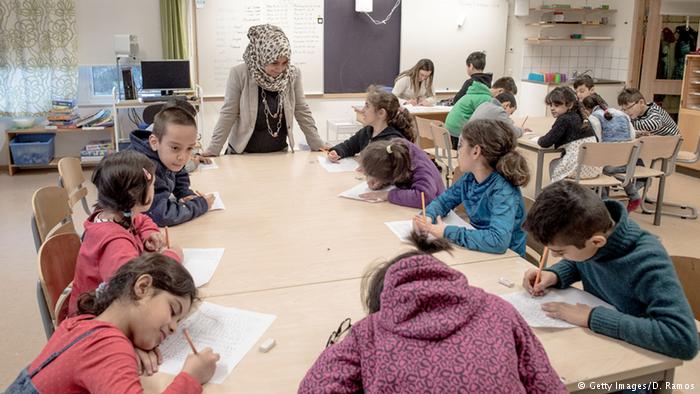
Schweden Integration von Migranten Schulunterricht (Getty Images/D. Ramos)Sweden has long been a country of immigration, but it has tightened its asylum law in recent years

Central and Eastern Europe

Under the nationality law in Poland, Polish citizens cannot be recognized as citizens of other countries at the same time. The possession of a foreign passport, however, is tolerated. Polish citizens cannot avoid civic obligations by using a foreign citizenship to get out of them.

Ukraine does not recognize dual citizenship. Under current laws, newly naturalized Ukrainian citizens must give up other nationalities within two years. Some countries in Eastern and Central Europe, on the other hand, such as the Czech Republic and Romania are open to multiple nationalities. Bulgarian, Serbian and Croatian citizens are entitled to hold dual citizenship, but foreigners wishing to be naturalized must renounce their previous nationality.

Spain

In principle, Spain permits dual citizenship for immigrants from Portugal, Andorra, the Philippines, Equatorial Guinea and Latin American countries with which it has concluded dual citizenship agreements. According to the Spanish constitution, immigrants from other nations must renounce their foreign nationality if they wish to hold Spanish citizenship. Spanish citizens are entitled to dual citizenship if they inform the authorities within three years that they wish to keep their Spanish passport.

Depending on the country, laws differ throughout southern Europe. Monaco and Andorra, for example, prohibit dual nationality but in Portugal, it is permitted.

Source: Dual citizenship in Europe: Which rules apply where? | Germany | DW.COM | 28.03.2017

More federal action needed to restore lost Canadian citizenship rights: Rock and Axworthy

Former Ministers Alan Rock and Lloyd Axworthy argue in favour of the proposed expansion of voting rights for non-resident Canadians in Bill C-33 and repeal of the first generation limit to the transmission of  Canadian citizenship.

The main weaknesses in their arguments:

  • Reinforces a global, more instrumental concept of citizenship, without a meaningful connection to Canada;
  • C-33 only requires a citizen to have been born in Canada in order to have voting rights, irrespective of how little time spent in Canada;
  • Repealing the first generation limit means a further weakening of the meaningfulness of citizenship and connection to Canada, as again the second or subsequent generations could retain citizenship without having lived in Canada;
  • Immigrants wishing to become citizens to be physically present in Canada (four out of six years currently, three out of six as proposed in Bill C-6) and retention after the first generation should, at a minimum, require residency;
  • Like others, they exaggerate the number of Canadians with connections to Canada. Passport data shows about 630,000 active non-resident adult passport holders, not the 2 to 3 million cited. This is a minimal connection test (taxation data shows about 130,000);
  • The exemption to the first generation limit for public servants serving abroad recognizes the fact that they work directly for the government, rotate regularly back to Canada, and pay Canadian taxes. This is quite different from those who spend their entire life abroad, do not return regularly for more than short visits, and for the most part, don’t pay Canadian taxes; and,
  • Largely targeted towards globally mobile professionals, Ministers Rock and Axworthy’s proposal fails to consider the implications for the broader population, whether it be the many non-resident Canadians who simply live their lives abroad without making “important global contributions” or resident Canadians who may feel that granting citizenship without residence devalues the meaning of being Canadian. 

    Their proposal is largely targeted towards those globally mobile professionals without considering the implications to the broader population of non-resident Canadians.

Canada’s former Minister of Democratic Institutions, Maryam Monsef, recently observed that in the 21st century, there are many good reasons why Canadians choose to live overseas, and that there is no reason to create barriers to their participation in democratic processes.

We agree, but would go further. Canadians living and working overseas face government barriers not only in participating in democratic processes, but also in passing along citizenship. These must be addressed.

The occasion for the comments made by Ms. Monsef – recently appointed Minister of Status of Women – was the introduction of legislation to repeal provisions of the federal Fair Elections Act. Adopted in 2014, this statute provides, amongst other things, that Canadians living overseas can vote only within five years of leaving Canada, and must have the stated intention of returning home.

In repealing this provision through Bill C-33, An Act to amend the Canada Elections Act, the federal government will remove one important penalty for Canadians living and working overseas. However, it is overlooking a potentially even greater disincentive.

A little-known 2006 amendment to the Citizenship Act limits Canadian citizenship to just the first-generation of children born to or adopted by Canadians who live outside Canada. Thus, children born to or adopted by Canadian parents who are travelling, studying, or working abroad become citizens of Canada at birth or at the time of adoption, but their children are not entitled to Canadian citizenship if they are born outside Canada.

This is harmful for at least two reasons.

First, the amendment to the Citizenship Act strikes us as discriminatory, and out of step with the principle that “a Canadian is a Canadian is a Canadian,” as articulated by Prime Minister Justin Trudeau. The amendment effectively creates two classes of Canadians: those who can pass along citizenship to their children and those who cannot. Furthermore, the amendment discriminates in favour of federal employees and military personnel who serve outside Canada. Under the current legislation, they are explicitly exempted from the limits on citizenship imposed by the amendment.

Second, Canada is deeply interconnected economically, socially and culturally with communities and countries around the globe. Canadians have a long history of important global contributions in international finance, peacekeeping, United Nations’ service, and humanitarian action, to name a few. We should be encouraging Canadians to venture beyond our borders to contribute to the broader global community, whether this be as students, travellers, or professionals – now, more than ever. Unfortunately, the current provisions of the Citizenship Act may have the opposite effect, by deterring Canadians from going overseas to work.

To date, the government has sought to justify this provision based on “simplicity and transparency.” We respectfully submit that any administrative advantages are substantially outweighed both by the principles of fairness and equity required by Canadian law, and by the importance of maintaining Canada’s standing in, and contributions to, the community of nations.

In terms of scope of impact, it is worth considering that at any point in time, 2-3 million Canadians live, work, or travel overseas. If even 0.5 per cent of these people have children overseas, this would amount to 10,000-15,000 children whose rights are limited and whose options are narrowed by this legislation each year. These numbers underscore the urgency and importance of addressing this matter quickly.

As the Government moves to restore voting rights to Canadians living overseas, it should also restore another fundamental birthright by allowing foreign-born descendants of Canadians who were themselves born outside our country to begin life with Canadian citizenship.

Source: More federal action needed to restore lost Canadian citizenship rights – The Globe and Mail

Fewer Canadians being refused entry at U.S. land border

Always important to have the numbers and data to inform discussion and debate, both the numbers of refusals as well as overall numbers of people crossing the border:

Fewer Canadians are being turned away at the U.S. land border in recent months despite mounting concerns that Donald Trump’s immigration policies are making it much harder to cross, The Canadian Press has learned.

Refusals of Canadians at American land crossings dropped 8.5 per cent between October and the end of February compared with the same five-month period a year earlier, according to U.S. government statistics

The total number of Canadian travellers denied entry also dropped: 6,875 out of 12,991,027 were refused entry, a refusal rate of 0.05 per cent.

Between October 2015 and February 2016, 7,619 out of 13,173,100 Canadian travellers were denied entry to the U.S., a refusal rate of 0.06 per cent.

About 180,000 fewer people attempted to cross the border in the most recent figures.

The figures, confirmed by U.S. Customs and Border Protection, contrast with recent anecdotal reports of Canadians denied entry into the U.S., with many placing the blame on the policies of the Trump administration, including its controversial attempts to ban arrivals from several predominantly Muslim countries.

A further breakdown of the border data shows a sharp drop in Canadian refusals at the U.S. border in the first two months of this year as 2,600 Canadian travellers were denied entry, compared with 3,500 for the same two-month period of 2016.

‘Much more cautious about crossing the border’

But Canadian immigration and civil liberties advocates caution the numbers don’t tell the whole story.

Immigration lawyer Lorne Waldman said he is fielding more calls than ever from people planning a trip to the U.S. and wanting to make sure they have the paperwork they need. The decreased rate of refusal could be just that people are now better prepared than they used to be, and so fewer are being turned away as a result, he said.

“People in Canada used to take it for granted that they could just go to the border . . . but that’s no longer the case,” he said.

Metropolis 2017: Workshops of Interest – Notes

These rough notes capture the sessions that I either organized or attended to give others a sense of the topics and perspectives covered.

Integration – The Search for a New Metaphor: This session, prompted by the Canadian Index for Measuring Integration (CIMI) discussions on the meaning and definition of integration (and my Integration and multiculturalism: Finding a new metaphor – Policy Options) drew a good crowd(60-70 persons).

I opened with my critique of the “two-way street” metaphor by emphasizing that it did not capture the dynamic and ever-evolving nature of immigration, the Hegelian dialectic between thesis (host society) and anti-thesis (newcomers), resulting in a synthesis, and presented my preferred metaphor, harmony/jazz, where harmony represented the underlying framework of laws and institutions, and jazz the improvisation involved in resolving accommodation demands.

Mort Weinfeld of McGill drew from the personal experience of his parents and talking to cab drivers, noting that integration of the second generation was key. His preferred metaphor was the roundabout, with multiple points of entry and exit, with traffic moving smoothly.

Richard Bourhis of UQAM provided a Quebec perspective, looking at how Quebec language policies were characteristic of an assimilationist approach.

Elke Winter of UofOttawa drew from her analysis of European policies and practices and noted a third dimensions, that of outside actors and transnational forces (e.g., other countries, home communities of immigrants), and that integration was more a three-way than two-way process

The presentations prompted considerable discussion (although no one jumped to the defence of the ‘two-way street.’ The particular points I found most interesting were Richard’s noting the advantage of institutional diversity in terms of integration and others noting the need for metaphors and definitions to include indigenous peoples.

Thinking about next year, this is a topic that merits further exploration, perhaps involving some literary descriptions or metaphors (see the notes for Minority Voice, Identity and Inclusion – Media and Literary Expressions).

Citizenship – Factors Underlying a Declining Naturalization Rate: In the only session on citizenship, Elke WInter opened the workshop with an overview of how Canadian citizenship has evolved over the last 150 years, setting out four phases: colonized citizenship (pre-1947), nationalizing citizenship (1947-76), de-ethnicising citizenship (1977-2008) and re-nationalizing citizenship (2009-15) with a possible fifth phase emerging under the Liberal government. She presented some preliminary findings from an interview-based study.

I followed with my usual presentation of citizenship statistics, showing the impact of previous policy and administrative changes along with an assessment of the 2014 Conservative changes and Liberal partial repeal of these changes (currently in the Senate).

Jessica Merolli of Sheridan presented the key MIPEX naturalization indicators and data from the European Social Survey comparing immigrant/non-immigrant attitudes on issues such as self-sufficiency, interests in politics, LGBT acceptance and others and how over time in the country of immigration differences declined. The most striking exception was with respect to interest in politics, where immigrants, no matter how short or long the time, were more interested than non-immigrants.

Questions of note included do we need a citizenship knowledge test given that it presents barriers for some groups, and the impact that the  physical presence requirement has on families when one parent has to work abroad given difficulties in obtaining well-paying work in Canada.

Other workshops that I found particularly of interest included:

Inclusion, engagement partagé, participation – comment en rendre compte: Elke Laur of Quebec’s Minister de l’Immigration, de Latin American Diversity et de l’Inclusion presented their integration strategy and related measurement approach. Quebec has invested considerable time and resources on both aspects.

Of note is their definition below, capturing the complexities and dynamism of integration:

“Une participation réussie résulte d’un partage d’engagement mutuel de la personne et de la société dans son ensemble. Ainsi, la participation des personnes de minorités ethnoculturelles est conceptualisée sous forme d’un espace participatif dans lequel ces deux modalités se croisent dans une matrice. Cette matrice rend compte de l’articulation de différents degrés (allant de faible à fort), d’engagements individuels et de dispositions sociétales.”

Those interested in indicators should check out their report 2016 Mesure de Latin American participation des Québécoises et Québécois des minorités ethnoculturelles, an impressive report.

Enhancing the Potential to Analyze Immigration – Adding the Admission Category to Census Data: Laetitia Martin of Statistics Canada presented the detailed methodology of linking post-1980 IRCC administration data on immigrant admission categories, complemented by Lorna Jantzen of IRCC outlying the potential and challenges. Dan Hiebert of UBC provided an example for refugees of how this linkage could be used to analyze the economic outcomes of refugees, showing that in the long-term, economic outcomes are comparable to the Canadian average.

Minority Voice, Identity and Inclusion – Media and Literary Expressions: A mix of a case study (Punjabi media by Syeda Bukhari where she noted the ethnic media was getting more sophisticated in comparing what politicians said to English and ethnic media and thus holding them to account) and the overall contribution ethnic media does and can make to integration (Madeline Ziniak, current chair of the Canadian Ethnic Media Association (CEMA)).

Myer Siemiatycki of Ryerson gave a fascinating presentation regarding the person and poetry of Julian Tuwin, a Polish Jew (or Jewish Pole) whose loyalty and identity were attacked by both sides.

An example, Tuwin’s Poem, We, Polish Jews (1944)

I am a Pole because I want to be. It’s nobody’s business but my own. I do not divide Poles into pure-stock Poles and alien-stock Poles. I leave such classification to pure and alien-stock advocates of racialism, to domestic and foreign Nazis.

To be a Pole is neither an honor nor a glory nor a privilege. It is like breathing. I have not yet met a man who is proud of breathing.

A Pole – because I have been told so in Polish in my paternal home, because since infancy I have been nurtured in the Polish tongue; because my mother taught me Polish songs and Polish rhymes; because when poetry first seized me, it was in Polish words that it burst forth; because what in my life became paramount — poetical creation — would be unthinkable in any other tongue no matter how fluent I might become in it.”

A Pole – also because the birch and the willow are closer to my heart than palms and citrus trees, and Mickiewicz and Chopin dearer than Shakespeare and Beethoven.

A Pole – because I have taken over from the Poles quite a few of their national faults.

A Pole — because my hatred of Polish Fascists is greater than my hatred of Fascists of other nationalities. And I consider that particular point as a strong mark of my nationality.

He also presented Yolanda Cohen’s deck on the Sephardic press and diaspora identities.

Negotiating “fit” – Connections Between Employer Mindsets/Practices and Labour Market Success of Newcomers: Kelly Thomson of York provided an overview of the issue of “fit” and presented a case study of foreign-trained accountants. Aamna Ashraf of the Peel Newcomer Strategy Group (near Toronto) presented the results of a study on soft barriers, with focused and practical recommendations. Madeline Ng of Autodata and Nancy Moulday of TD Bank presented how their respective organizations encourage and facilitate diversity in their workforces. Unfortunately, Thomson took far to long for her presentation, reducing the time available for discussion with the practitioners.

Fitting In: Identity and belonging among second generation Canadians: Elizabeth Burgess-Pinto of MacEwan University organized  this roundtable discussion focussing on the second generation. A number of second generation (and generation 1.5) participants shared their experiences, challenges and identities.
USA: Bid to Strip Terrorist’s Citizenship May Mark New Trump Way – Bloomberg

While the motivation is revocation for terrorism convictions, the rationale is fraud or misrepresentation in Faris’ citizenship application:

The Department of Justice has taken the rare step of seeking to strip a convicted terrorist of his U.S. citizenship as he serves the last several years of a 20-year prison sentence for plotting to destroy New York’s Brooklyn Bridge.

Some national security experts suggested Tuesday the move might signal a new, tougher line under President Donald Trump.

The case involves Iyman Faris, 47 and born in Pakistan, who was sentenced in 2003 for aiding and abetting the al-Qaida terrorist group with his plan to cut through cables that support the iconic bridge. At the time, it was among the highest profile terrorism cases in the aftermath of the Sept. 11, 2001, attacks that killed nearly 3,000 people.

A 17-page filing Monday in U.S. District Court in southern Illinois where Faris is imprisoned launched a revocation process that is likely to take years. The court filing argues that Faris lied on immigration papers before becoming a naturalized U.S. citizen in 1999 and that his terrorist affiliations demonstrated a lack of commitment to the U.S. Constitution.

Faris, known as Mohammad Rauf before becoming a U.S. citizen and who once worked as a truck driver in Ohio, is scheduled for release from the U.S. Penitentiary at Marion, Illinois, on Dec. 23, 2020, according to the U.S. Bureau of Prisons.

Karen Greenberg, director of the Fordham Law School’s Center on National Security in New York, said the federal government has been aggressive in previous decades about revoking the citizenship of accused Nazis living in the United States. But she says it’s largely unheard of for revocation proceedings to be launched against naturalized U.S. citizens imprisoned for terrorism.

Most Americans would almost certainly back steps to strip citizenship from someone like Faris. Prosecutors have also accused him of meeting with Osama bin Laden in 2000 and alleged that the planned attack on the bridge could have been designed to be part of a second wave of attacks to follow those on 9/11.

But Greenberg said making the revocation of a terrorist’s U.S. citizenship established policy would only add to a trend since 9/11 of treating accused terrorists differently than other suspects. Stripping someone’s citizenship, she said, also appeared to be a way of adding on extra punishment not in the criminal statute itself.

“Why isn’t it enough that we put him in prison and give him the sentence he was given?” she said. She added that the effort against Faris could be seen as another example of how the Trump administration “tinkers with the established way we do things.”

Source: Bid to Strip Terrorist’s Citizenship May Mark New Trump Way – Bloomberg

These are the countries you can ‘buy’ citizenship to – Business Insider

Another good overview of the various schemes, and the relative advantages for those shopping for citizenship:

Most countries offer citizenship (passports) the hard way. But 7 sell them outright, and 3 have “powerful” passports. “Citizenship Planning” is a thing.

For people who need a second citizenship and passport to dodge the long arm of their government, there is something called “citizenship planning,” similar to “financial planning.” But when it comes to just outright buying a citizenship and passport without having to languish for years as mere non-citizen resident, the Huddled Masses need not apply. And not any passport will do. In fact, there are only three for sale that are really good.

Which are the best passports to get?

There are quality standards for everything, especially if it’s costly. The most powerful passports are those that allow visa-free travel to the most countries.

There are other considerations, for example those that drive US citizens nuts when they live overseas, due to the US government’s onerous reporting requirements on them and on banks that do business with them, and due to US taxation of their worldwide income no matter where they live. Few other governments treat their citizens that way.

In terms of visa-free travel, here are the 25 countries with the most powerful passports, according to a new ranking by Henley & Partners, which is into “citizenship planning.” But among them is only – Austria – one whose citizenship can be bought (more on that in a moment):

  1. Germany: visa-free travel to 176 countries.
  2. Sweden: 175 countries
  3. Denmark, Finland, Italy, Spain, and the US: 174 countries.
  4. Austria, Belgium, France, Luxembourg, Netherlands, Norway, Singapore, UK: 173 countries
  5. Republic of Ireland, Japan, New Zealand: 172 countries
  6. Croatia, Greece, Portugal, Switzerland: 171 countries
  7. Australia, South Korea: 170 countries
  8. Iceland: 169 countries.

And how do you get one of those passports?

In most countries, the hard way: Legally immigrate and obtain residency, and then fulfill the residency requirements to get citizenship and that second passport, which takes years. Most countries, including the US, have special programs for “investors” to obtain residency, such as a green card, essentially on the spot, but even then it takes years to obtain citizenship and a passport. If it’s possible at all, such as in Germany.

Then there’s the direct way: Buy a citizenship and the passport that comes along with it. These citizenship-by-investment programs are not for folks on a tight budget. According to Henley & Partners, only seven countries offer this convenient route, only three have powerful passports, and only one is in the top of the heap above.

Passports from EU countries are the best. If you’re from Russia or China or Iraq and become a citizen of one of the 28 EU countries, you’ll get a country-specific EU passport that allows you to live and do business anywhere in the EU. There are all sorts of offshore benefits. And travel around the world is a breeze.

But citizenship in most EU countries is not for sale. You can buy only residency, similar to programs in the US. But there are three exceptions:

Austria

Citizenship is almost impossible to get for normal foreigners already legally in Austria. But the super-rich and famous have a way. The government, through paragraph 10, section 6 of the Citizenship Act, can confer citizenship “because of the services already provided by the foreigner and the extraordinary achievements still to be expected of him in the special interest of the Republic.” This usually involves a big direct investments of unspecified magnitude plus some other “extraordinary” contribution, such as being famous or creating jobs. Few succeed. In some years, none succeed.

They’re playing hard to get. But the rewards are huge for the few that succeed, including an impeccable EU passport with visa-free travel to 173 countries.

Cyprus

In 2012, as the EU-part of the divided island was veering toward bankruptcy, it offered citizenship through a “fast-track” scheme to dodge the normal residency requirements. But the price tag was €10 million in direct investment. Too expensive for the average oligarch.

In 2013, Cyprus became desperate. Its offshore financial industry, the main breadwinner of the economy, had collapsed in a cesspool of corruption. The banks had taken much of the foreign money – particularly Russian money – down with them. Cyprus needed some moolah. It slashed the price of citizenship to €3 million of direct investment. Russians who’d lost at least €3 million in the collapse would also be eligible for citizenship.

Since then, the price was further slashed, to as low as €2 million. And it’s fast: about three months for citizenship and an EU passport, with visa-free travel to 159 countries. And that €3-million investment can be sold after three years. An adequate house would likely do.

Malta

The tiny EU member state with 417,000 residents spread over three islands is convenient for foreigners, with English being one of the two official languages. In 2013, during the still rough waters of the euro debt crisis, Parliament passed legislation that put Maltese citizenship up for sale at €650,000. A spouse costs another €25,000; unmarried children between 18 and 25 and dependent parents cost €50,000 each. There are no residency or investment requirements. The money goes into government funds.

This citizenship is a product to be marketed. If it sells 100 per year at €650,000 a pop, it would generate annual revenues of €65 million – or 1.75% of total 2016 revenues (€3.7 billion). Given the limits on budget deficits under EU Treaties, everything counts.

This Maltese product includes an EU passport with visa-free travel to 166 countries. Folks can stop by, jump through some bureaucratic hoops, pay, get their citizenship and passport, and settle in Germany or wherever. At the time, Simon Busuttil, leader of the opposition Nationalist Party, warned that Malta could end up being compared to shady tax havens in the Caribbean. And that’s our last stop.

Source: These are the countries you can ‘buy’ citizenship to – Business Insider

The Trouble With India’s New Citizenship Bill | The Diplomat

Look forward to some comments from those more familiar with India and Indian politics than I:

Granting citizenship to Hindu refugees and making India “a natural home for persecuted Hindus” were among the promises made by Prime Minister Narendra Modi in his election manifesto. Modi, in a 2014 election rally, specifically promised citizenship to Hindu-Bangladeshis, saying that they would be removed from the migrant camps. Since then, the current government has taken many steps which may seem majoritarian and anti-Muslim.

Against this backdrop, the Citizenship (Amendment) Bill, 2016 seems to be aimed toward making India a haven for Hindus, Sikhs, Buddhists, Jains, Parsis, and Christians from neighboring countries such as Afghanistan, Bangladesh, and Pakistan. A closer look at the provisions indicates that the current government is attempting to increase its Hindu voter count. The BJP government’s website about Hindutva ideology clearly draws from Israel’s law of return and aims to do the same for Hindus in India. This policy in the Indian context would be contrary to the ideals of secularism and pluralism and thus unconstitutional.

The provisions of the bill would affect over 200,000 Hindus from Pakistan and Bangladesh and their migration into the border states of India would change the voter demographics in the region. The BJP government came to power in Assam in 2016, for the first time in 15 years, by using the agenda of ending illegal migration from Bangladesh. According to the Census of India (2011), 34.2 percent of Assam’s population is Muslim and the census shows that there has been a 4 percent rise in Muslim population over the past five years. The BJP government used the data as the basis of their campaign to gain votes in the region. If the Citizenship (Amendment) Bill is passed, in its current form, then the border regions would face an influx of Hindu migrants, which would change the voter demographics in the region.

The bill aims to save religious minorities from violence and blasphemy laws in Pakistan, Bangladesh, and Afghanistan. The rationale for selecting just these three countries, which are Muslim-dominated countries, is a cause for concern. The bill at first glance seems like a humanitarian effort to help persecuted minorities but it only seeks to help Hindus, Sikhs, Buddhists, Jains, Parsis, and Christians from the neighboring Muslim countries. Muslim minority communities facing oppression in other countries have been completely ignored. If the bill was really an attempt to provide a safe haven for minorities facing violence in their countries then it should also offer the same provisions to the minority Muslim communities in China and Myanmar as well. The Rohingya Muslims in Myanmar, Uyghur Muslims in China, and the Ahmaddiya Muslims in Pakistan and Bangladesh have been facing persecution for years. Further, Myanmar’s Hindus have also been ignored in the bill.

India is not a signatory of the United Nation Refugee Convention; therefore it is not required to provide safe haven to people seeking asylum from persecution in other countries. No attempts have been made by the government to debate the issue of joining the United Nation Refugee Convention. That would have been the natural step to take if the government was indeed interested in formulating a humanitarian refugee policy. Further, the provisions of refugee protection cater to all minorities fleeing countries due to a humanitarian crisis but, in this bill, India is offering citizenship based on religious predilections. The bill, if passed in its current form, seeks to give preference to Hindu refugees over Muslim refugees migrating to India, which is unconstitutional as, the preamble of the Constitution confirms India as a secular state.

The refugees who will actually benefit from this policy are living in abject poverty with no sanitation and infrastructure facilities. The government, instead of using a blanket refugee policy, has made this a communal issue with a veiled political agenda, which would be counterproductive to the seemingly humanitarian goal of the bill.

A member of the ruling Pakistan Muslim League-Nawaz (PML-N), Dr. Ramesh Kumar Vankwani, revealed in the National Assembly that around 5,000 Hindus migrate from Pakistan to India every year. In 2015, the BJP government approved citizenship for 4,230 Hindus and Sikhs from Pakistan and Afghanistan who sought refuge in India. The BJP had earlier claimed that they had granted Indian citizenship to 4,300 Pakistani nationals during 2014-15. However, a response to a query filed under the Right to Information by Seemant Lok Sanghthan showed that only 289 Pakistani Hindus were granted Indian citizenship in this period. This furthers the argument that the BJP’s political agenda supersedes its humanitarian goals.

It is also interesting to note that BJP’s stance on refugees has completely turned around in the last decade. In 2003 when 213 “Bangladeshi citizens” were stranded in the no man’s land between India and Bangladesh, neither country accepted them. Yet the BJP, in 2014, declared itself as a “natural home for persecuted Indians” and extended long-term visas in various states and provided citizenship to Hindus from Pakistan and Afghanistan. The constant emphasis on granting refuge on the basis of religion is in keeping with the Hindutva ideology popularly advocated by the current government.

The bill, if passed and made into an act, could be challenged and struck down by the judiciary later because of its unconstitutional nature — the provisions go against the secularism enshrined under the preamble. The government’s stance of helping refugees only if they fall under the category of persecuted religious minorities is heavily biased.

The Citizenship (Amendment) Bill 2016 may be presented as a move to protect the religious minorities in other countries from being persecuted but, the underlying issue clear: the bill is meant to address the BJP’s stated objective of making India the “Hindu Homeland.” The provisions blatantly ignore Muslims in the protection clauses and mention only religious minorities in Muslim-dominated countries. Further, the bill will change the demographics of the border states. The Bill adds to an ominous trend of a government which is not afraid of pushing a religious ideology, even when it is in contravention of the Constitution, in order to further its own political agenda.

Source: The Trouble With India’s New Citizenship Bill | The Diplomat