No plans to change citizenship laws for children born in Ireland to foreign parents, says Justice Minister

Consistent with most of Europe:

There are no plans to change citizenship laws for children born in Ireland to foreign parents.

Justice Minister Charlie Flanagan says the current rules that someone born here to foreign parents does not get automatic citizenship were approved by a majority of people in a 2004 referendum.

It follows the case of a Co Wicklow nine-year-old who faces deportation to China after being born and raised here.

Eric Zhi Ying Xue, who is in 4th class in St Cronan’s school in Bray, was born and has lived all his life in Ireland.

His mother has had her application to remain in the State rejected.

Justice Minister Charlie Flanagan says the government won’t be taking another look at the laws around deportation orders.

“I see no plans,” said Mr Flanagan. “I have no plans at present to revisit the 27th Amendment of Bunreacht na hÉireann which was passed by an overwhelming majority of the people back in 2004.

“The changes made to the legislation after the referendum, these were put through the Dáil and the Seanad at the time.

“What they did do, was to bring Ireland into line with the vast majority of states across the European Union.”

Source: No plans to change citizenship laws for children born in Ireland to foreign parents, says Justice Minister

Swiss citizenship fees vary widely across country: report

Most aspects of citizenship procedures are administered at the cantonal level with considerable variation between cantons:
Swiss citizenship doesn’t come cheap. While the cost of filing an application with federal authorities is relatively low (100 Swiss francs for an adult, or 150 francs for a couple), cantonal and communal authorities also charge non-refundable administrative fees which can seriously mount up.

Those administrative fees can vary depend on factors including age, place of birth, and marital status, but also differ significantly depending on place of residence as a new study carried out by Swiss weekly Le Matin Dimanche shows.

This is despite attempts to bring these administrative costs in line across the country back in 2006.

The study reveals that administrative costs can range from 500–1,600 francs in the canton of Jura to 1,800–3,000 francs in Fribourg, depending on which commune you live in.

Costs in other cantons include 550 to 800 francs in canton Vaud, 1,000 francs in Valais and a fixed rate of 1,250 francs for adults over 25 in Geneva.

For the canton of Zurich, the cost is listed on the cantonal homepage as 1,200 francs for foreign-born adults aged over 25. However, the canton also notes there are additional cantonal costs to be factored in. According to Le Matin Dimanche, the fees in Zurich total 1,700 francs.

Contacted by Le Matin Dimanche, authorities in Fribourg said there was no political motivation behind the high administrative costs associated with citizenship in that canton. A spokesperson said costs of individual applications were calculated based on actual costs incurred.

The office of Swiss price watchdog, Stefan Meierhans, is now looking into the matter.

Source: Swiss citizenship fees vary widely across country: report

Tax evasion: blacklist of 21 countries with ‘golden passport’ schemes published

Will see if this leads to curbing this citizenship for sale practice:

A blacklist of 21 countries whose so-called “golden passport” schemes threaten international efforts to combat tax evasion has been published by the west’s leading economic thinktank.

Three European countries – Malta, Monaco and Cyprus – are among those nations flagged as operating high-risk schemes that sell either residency or citizenship in a report released on Tuesday by the Organisation for Economic Cooperation and Development.

The Paris-based body has raised the alarm about the fast-expanding $3bn (£2.3bn) citizenship by investment industry, which has turned nationality into a marketable commodity.

In exchange for donations to a sovereign trust fund, or investments in property or government bonds, foreign nationals can become citizens of countries in which they have never lived. Other schemes, such as that operated by the UK, offer residency in exchange for sizable investments.

The programme operated by Malta is particularly popular because as a European member state its nationals, including those who buy citizenship, can live and work anywhere in the EU. The country has, since 2014, sold citizenship to more than 700 people, most of them from Russia, the former Soviet bloc, China and the Middle East.

But concern is growing among political leaders, law enforcement and intelligence agencies that the schemes are open to abuse by criminals and sanctions-busting business people.

Transparency International and Global Witness, in a joint report published last week, described how the EU had gained nearly 100,000 new residents and 6,000 new citizens in the past decade through poorly managed arrangements that were “shrouded in secrecy”.

Also on the OECD blacklist are a handful of Caribbean nations that pioneered the modern-day methods for the marketing of citizenship. These include Antigua and Barbuda, the Bahamas, Dominica, Grenada, St Lucia, and St Kitts and Nevis, which has sold 16,000 passports since relaunching its programme in 2006.

After analysing residence and citizenship schemes operated by 100 countries, the OECD says it is naming those jurisdictions that attract investors by offering low personal tax rates on income from foreign financial assets, while also not requiring an individual to spend a significant amount of time in the country.

Second passports can be misused by those wishing to “hide assets held abroad”, according to the thinktank. Its flagship initiative is a framework for countries to cooperate in the fight against tax evasion by sharing information. Known as the Common Reporting Standard, the framework allows for details of bank accounts an individual might hold abroad to be sent to their home tax office.

The OECD believes the ease with which the wealthiest individuals can obtain another nationality is undermining information sharing. If a UK national declares themselves as Cypriot, for example, information about their offshore bank accounts could be shared with Cyprus instead of Britain’s HM Revenue and Customs.

“Schemes can potentially be abused to misrepresent an individual’s jurisdiction of tax residence,” the OECD warned.

The final names on the list are Bahrain, Colombia, Malaysia, Mauritius, Montserrat, Panama, Qatar, Seychelles, Turks and Caicos Islands, United Arab Emirates and Vanuatu.

Together with the results of the analysis, the OECD is also publishing practical guidance that will enable financial institutions to identify and prevent cases of avoidance through the use of such schemes, by making sure that foreign income is reported to the actual jurisdiction of residence.

Source: Tax evasion: blacklist of 21 countries with ‘golden passport’ schemes published

A separate article on Cyprus’s scheme: Cyprus Has Revised Its Citizenship Program: Is It Too Little, Too Late?

‘Would you like to come to Canada?’ What officials are doing for Canadians held in Syria over ISIS allegations

While I suppose the Canadian government has to offer some form of consular assistance, never seen anything to indicate that “Jihadi Jack” had any substantive connection to Canada except for the genes from his father as he spent most of his life in the UK and thus substantively, if not legally, is the UK’s responsibility.

So while I remain opposed to revoking citizenship in cases of terrorism or treason, no great efforts should be expended on consular support in such cases even if I understand that parents will explore all opportunities for their child:

“I’m from the government of Canada. Do you want assistance from us?”

“Yes,” Jack Letts, replied.

“If so, what kind?”

“Please get me out of this place.”

With that, a Canadian consular official began an hour-long online exchange with Letts, a British 22-year-old with Canadian citizenship who is imprisoned by Kurdish forces in Syria.

A transcript of the conversation, which Global Affairs Canada sent to his parents, who then shared it with Global News along with other documents, offers a rare look at how Ottawa is handling such cases.

They show that Canadian consular officials have been trying to find out where the Canadians are being detained in order to give them consular assistance.

The officials have communicated with the Kurdish authorities over concerns about torture allegations and medical attention for the detainees, the documents show.

But they also told the parents in an email that while they would try to get Letts to a third country, likely Turkey, they could not make any promises.

Jack Letts, who is British but has Canadian citizenship through his father, is being held by Kurdish forces in northeast Syria.

Hundreds of ISIS foreign fighters, as well as ISIS wives and their children, have been captured by the U.S.-backed Syrian Democratic Forces.

The Canadian government has said little about how it is assisting at least 13 Canadian detainees, who are being held in prisons and camps in northeast Syria.

But the transcript of a January 10 conversation between Letts and Global Affairs Canada shows that while officials have reached out to some of the detainees, they have also cautioned there’s not be much they can do.

“If it would be possible, would you like to come to Canada? Back to the U.K.?” the consular official asked.

“I want to live a normal life. I want to come to Canada,” Letts replied.

A Muslim convert, Letts traveled to Syria in 2014, leading the British press to dub him Jihadi Jack. But while he was in ISIS-controlled territory, he has denied being an ISIS member and his parents said there was no evidence he ever joined the terrorist group. Because the U.K. has shown no interest in assisting him and he is Canadian through his father, Ottawa has taken on the case.

Jack Letts said he was imprisoned near Qamishli, the hub of the Syrian Democratic Forces.

“Can u help me,” Letts wrote to the consular official.

He said he was imprisoned near Qamlishi, the hub of the Kurdish-controlled region of Syria known as Rojava. He said he had been there 10 months.

“We have limited capacity to provide consular service in Syria but we will try to help you,” the official responded.

The consular official asked Letts whether he had been charged, how he spent his days, what he ate, when he last saw a doctor, whether he was taking medications and had access to the Internet.

“Are they going to kill us,” Letts wanted to know.

“As I said, we have no access in Syria at the moment, but are working on your case.”

Letts asked the official if he intended to get him to Canada.

“I promise not to blow anyone up with fertaliser [sic] or however they do it,” Letts wrote, adding “that was a joke.”

“We have the intention to help you,” the official wrote.

“Obviously I’m not going to blow anyone up.”

“Canada is an option,” said the official.

Letts then said he was “going insane” and had tried to hang himself. He said he was experiencing kidney problems but had not seen a doctor in seven months.

“I made a mistake coming here, I know that. If you want to put me in prison, I understand that I do not mind,” Letts told the official.

“I have made mistakes, probably prison is good for me. But just not here. The situation here is terrible.”

“Tell my mum I am sorry. Tell my dad I am sorry. Tell them if I ever get out of this place I am going to try and be a better person.”

Towards the end of the exchange, the official assured Letts the government was working on his case, but within limits.

“We don’t have people in Syria and it is a complex environment so I can’t give you definitive timelines, but we are working on your case.”

Global News revealed last week that high-profile Canadian ISIS member Muhammad Ali had been captured by Kurdish forces. His wife, former Vancouver resident Rida Jabbar, and their two kids were also detained, along with women from Toronto and Montreal who married ISIS foreign fighters, and their five children.

Letts and a Montreal man are also being held.

A Kurdish official told Global News there had been “dialogue” with Canada over the detainees, including a meeting in Iraq, but that “suddenly the Canadian government stopped this process and we don’t know why.”

Asked to comment on the transcript, Global Affairs Canada said it was aware that Canadians were detained in Syria but its “ability to provide consular assistance in any part of Syria is extremely limited.”

In a podcast, national security law expert Craig Forcese said that because the Canadians were detained abroad, the government could not facilitate their return to Canada.

The best they could do was negotiate the conditions of their detention, he said, adding the matter was complicated because the Canadians were held by insurgents rather than a state.

But even engaging with their captors diplomatically could cause problems for Canada, he said. Turkey views the Kurdish forces as part of the PKK terrorist group. “So it’s a very difficult consular dance.”

Conservative foreign affairs critic Erin O’Toole said the government’s primary focus should be public safety.

“I’m very, very reluctant to repatriate known ISIS fighters, unless they’re charged and imprisoned in conjunction with their return,” he said.

He also said he supported the revocation of citizenship for terrorism and treason.

“You know, unfortunately these people made very bad decisions and demonstrated that they were a risk to the public and that’s how they should be treated.”

But NDP public safety critic Matthew Dubé said that while public safety is paramount, Canada was obliged to take responsibility for its citizens.

“As much as we may loathe what these people stand for and what they’re doing in some cases, I think that putting them into prisons here and having them go through the Canadian justice system is obviously at the core of a society that’s rules-based and respects the rule of law,” he said.

“Again, it’s not to condone in any way these atrocities. Quite the contrary. I believe that if we truly believe that this is wrong then we should be making sure that they are seeing justice through the Canadian system.”

Dubé also said Ottawa should bring back Canadian wives of ISIS fighters and their children. “It doesn’t sound like that’s the case at the moment, but I would hope that they would make every effort to bring the women and children back.”

Source:‘Would you like to come to Canada?’ What officials are doing for Canadians held in Syria over ISIS allegations

A Suicidal Nanny, an Underground Industry and 3 Babies Stabbed (New York City)

Gripping and horrific reporting of some low-cost birth hotels in Queen’s. Haven’t heard of comparable horror stories from Richmond birth hotels:

Dark circles formed like warning signs beneath Yu Fen Wang’s eyes as she worked 12-hour graveyard shifts in a Queens maternity center that operated on the margins of legality. Her family said she had grown gaunt, could not sleep and told her husband she no longer wanted to live.

Her employers, however, said they needed her to work. And her family needed the money. She earned less than $100 a day, they said, working in a private house that had been converted into a combined nursery and hotel for newborn babies and their mothers.

An open secret in the Flushing community, the center was part of an underground industry catering to a demanding clientele: local mothers resting after childbirth and Chinese visitors coming to have their babies in the United States, a practice known as “birth tourism.”

On Sept. 21, at 3:40 a.m., these dangers collided to near-fatal effect when, the police say, Mrs. Wang stabbed three babies sleeping in bassinets on the first floor — all girls — and two adults. She then turned the knife on her own neck and wrists.

The victims all survived. But the horrific act turned a spotlight on a pocket of immigrant New York, where a loose network of businesses tend to mothers and infants in the crucial, fragile month after childbirth but operate without any government oversight. The center, Mei Xin Care, is one of dozens in the area that vary widely in amenities and quality, leaving workers with few avenues for complaint, and families with little to guide them other than word of mouth, internet advertisements and blind trust.

“There are victims at all sides of the spectrum,” said Assemblyman Ron Kim, a Democrat who represents Queens.

Centers like this one — which was alternately known as Mei Bao, or “beautiful baby” in Chinese — provide two services. The first is for newly-arrived immigrant mothers practicing a Chinese tradition some 1,000 years old in which they recuperate for a month after childbirth while other women, often called “aunties,” care for their infants. Authorities said the centers also provide assistance to women from China who wish to give birth in the United States in order to obtain instant citizenship for their children, which is legal under immigration law.

There are some 40 such maternity centers — in private homes and apartments — advertising their services online in the New York and New Jersey area, and nearly 20 in the Flushing neighborhood.

At Mei Xin Care, employees were paid off the books, Mrs. Wang’s family said. One of its nannies, Darong Wang, 63, got the job despite being arrested in May for promoting prostitution at a massage parlor in downtown Flushing. She was slashed in the attack, requiring 20 stitches on her face; a father of one of the children was stabbed in the leg and wrist.

The crime took place in a three-floor brick apartment house with white metal lattice balconies on the outskirts of Flushing. Its only advertisement existed on the internet, on a Craigslist of sorts for the local Chinese immigrant community.

Mei Xin Care appears to be a combination of the names of two owners: Meiying Gao and Xuexin Lin. Local employment agencies said the owners had been in the business for about a decade but opened their latest location in 2016, when city records show they bought the building for $1.5 million. Reached by phone, the owners declined to comment.

One neighbor said in an interview that she saw a steady stream of clients arriving, sometimes in fancy cars.

Some of them would have been following the custom of a monthlong rest after childbirth. The period culminates in a “red egg celebration” to mark the baby’s survival of its fragile first weeks, said Margaret M. Chin, a professor of sociology in the Asian American Studies program at Hunter College.

The centers are an alternative to obtaining visas so family members can fly to the United States, or returning to China, where health care is often less sophisticated. For several thousand dollars, new mothers have access to 24-hour nannies and cooks.

Michael Cheng and his Shanghai-born wife, who live in Flushing, considered using the center for her recuperation period. They toured the facility twice in the spring and were quoted a fee of $4,800 — in cash.

Mr. Cheng said babies were sleeping on the first floor, while their mothers slept in small bedrooms on the second and third floors.

He remembered seeing five to six workers, whom he estimated to be in their 40s and 50s. “They were working 24 hours in shifts,” he said. “I can imagine that it was a very high-stress job.”

Mr. Cheng said his wife, who did not want to give her name, spoke with some of the residents on the upper floors, one from China and another who was a New Yorker. “Before we walked out, I was like, ‘Are you sure you like this place?’ to my wife,” Mr. Cheng said in an interview. “To me, it felt stuffy in there.”

He was skeptical and asked to see a license. The owners sent a copy of a generic business operation certificate and another for maternity nutrition.

“In hindsight,” he said, “if there was more talk about these places, and people knew if you go to one of these centers that they had to hang their licenses right out in front, some kind of regulations around that, maybe it would help.”

Ultimately, the couple felt uneasy about Mei Xin Care and opted to spend the month at Mr. Cheng’s parents’ home on Long Island after their daughter was born. They got their $800 deposit back when another mother quickly filled the spot.

After the stabbings occurred, Flushing was in an uproar. At temples, in food courts and on the streets beneath bright signs in Chinese, residents worried that the incident would stir up anti-immigrant attitudes toward their community.

Others decried the center’s second purpose, easing the path for birth tourism. “They should not come through loopholes,” said Catherine Chan, 50, a bar owner in Queens who used to work on Wall Street. She came to the United States from China when she was 6, after a long process involving family sponsorship, she said. “There is no shortcut.”

Birth tourism is a well-known phenomenon. In recent years, it has drawn mostly well-off mothers from China, Korea, Russia, Turkey, Egypt and Nigeria to the United States for birthright citizenship, which President Trump has vowed to eliminate.

It can be legal, as long as pregnant foreigners applying for visas state their intention to give birth when they are in the United States and prove that they can cover the cost. If they conceal their real purpose for traveling they could be subject to visa fraud.

Once United States citizens turn 21, they are eligible to sponsor a parent for a green card, giving their parents the option of eventually settling there. Parents do not always use that opportunity, and immigration officials could deny a green card, claiming the parents had willingly defrauded the American government.

Many are more concerned about securing the future of their children who, as American citizens, have the option of schooling in the United States or in competitive private Chinese schools that have lower entry standards for foreign students. They can travel to other countries without having to apply for a visa. It is seen as a status symbol in China.

For Chinese birth tourists, Los Angeles is the marquee destination. Centers compete with each other by advertising stays at plush hotels, shopping extravaganzas in nearby malls, and state-of-the-art hospitals. Fees can range from $50,000 to $80,000.

In 2015, immigration enforcement authorities raided the Los Angeles centers, saying owners had avoided paying taxes.

Still, the raids did not deter business owners who saw an opportunity. As Chinese internet services like Weibo and WeChat expanded, so did advertisements for birth tourism services in New York.

In the New York metropolitan area, more upscale maternity centers tend to exist in New Jersey and Long Island suburbs. The ones in Flushing appear to be smaller, and less expensive, options, where mothers stay in rooms that often have been subdivided.

Annie Gao, the owner of one upscale birth center in Center Moriches, on Long Island, expressed disdain for the cramped and somewhat secretive operations of the Flushing centers.

Ms. Gao, who opened her center in Flushing in 2004, said that several years ago she tried to convince other owners to join an association that could self-regulate and keep out cut-rate, potentially unsafe, centers. Ms. Gao thought that some centers skimped on food quality and cleaning services, noting that ones she had seen looked “dirty.”

An advertisement for Mei Xin Care, also known as Mei Bao, claims the center has been legally registered for more than 10 years and provides five meals a day to new mothers.Credit

But those owners disagreed, she said.

These centers elude city and state licensing categories and zoning codes. They do not qualify as day care centers because mothers are on-site; they do not need a medical license because owners offer Chinese nutritional practices.

“There isn’t a real category for these type of activities, and they were able to leverage it and apply for a general business license and pretend that was O.K. for their clients,” Mr. Kim, the assemblyman, said.

Although neighbors of Mei Xin Care filed complaints that it was operating as a hotel, city buildings inspectors were denied access three times, which automatically closes the complaint. Neighbors can file an affidavit to warrant a full inspection, but city records show that did not happen.

The state Office of Child and Family Services, the city’s administration for Children’s Services, the state Department of Health and the city Department of Health all said such centers did not fall under their purview.

The police shut down Mei Xin Care after the stabbing, but less than three weeks later, the center seemed to have reopened. Women could be seen through the windows, and a pile of diapers sat outside…

ICYMI: Sajid Javid ‘taking UK down dangerous road’ by expanding citizenship stripping

Further undermining of citizenship through expanded revocation beyond terror or treason:

The home secretary, Sajid Javid, is taking the UK down a “very dangerous road” with plans to expand powers to strip dual citizens of their British citizenship, a leading human rights group has warned.

Suspected terrorists have previously had their UK citizenship taken away – most often while they are abroad – and the move does not require prior approval from a judge or parliament.

In his speech at the Conservative party conference, Javid proposed extending the reach of the power to cover serious criminals, citing child grooming gangmasters as an example.

Corey Stoughton, acting director of Liberty, the human rights and civil liberties group, said: “The home secretary is taking us down a very dangerous road. Few will sympathise with the people this power has been used against – but making our criminals someone else’s problem is not responsible, effective policymaking. It’s the government washing its hands of its responsibilities.

“Accepting citizenship stripping as a legitimate punishment could see us all sleepwalking into a future where the list of ‘serious’ crimes gets ever longer and the government uses this extreme measure more and more frequently. Banishment belongs in the dark ages and has no place in the UK in 2018.”

From 2010 to 2015, 33 people were stripped of their British citizenship, all of them dual nationals, on terrorism grounds. Figures for 2015 onward have not been made available.

Javid has made tackling child sexual exploitation a key issue for his department. He recently announced an extra £21.5m to help investigators who say they are facing a “constant uphill struggle” to track down offenders.

A Home Office spokesperson said: “Any British citizen may be deprived of his or her citizenship if the secretary of state is satisfied that it would be conducive to the public good. It is a power used for extreme and exceptional cases.

“Deprivation on conducive grounds can be used where individuals pose a threat to national security, or have been involved in war crimes, serious and organised crime and unacceptable behaviours such as extremism or glorification of terrorism.”

Diane Abbott, the shadow home secretary, said citizenship stripping was discriminatory against minority communities. “Stripping dual nationals of British citizenship is inherently discriminatory and risks creating yet another ‘hostile environment’ not for illegality but for Britain’s many minority communities,” she said.

“The Conservatives’ inability to learn from past mistakes beggars belief, even when mealy mouthed apologies are barely dry on the page. Why not punish Britons according to their crimes rather than their origins?”

In his conference speech, Javid said: “The home secretary has the power to strip dual citizens of their British citizenship. It is a power used for extreme and exceptional cases. It should be used with great care and discretion – but also determination.

“In recent years we have exercised this power for terrorists who are a threat to the country. Now, for the first time, I will apply this power to some of those who are convicted of the most grave criminal offences. This applies to some of the despicable men involved in gang-based child sexual exploitation.”

Source: Sajid Javid ‘taking UK down dangerous road’ by expanding citizenship stripping

How Canada became an international surrogacy destination [another form of birth tourism]

Just as I am working on my article on birth tourism, another example of “reproductive tourism” emerges.

The same issues larger apply in terms of abuse of birthright citizenship.

In addition, given that Canadian surrogate mothers use Canadian healthcare, there is an effective subsidy to foreign parents engaging a Canadian surrogate. Not right (and appears Canada is one of the few countries that allows intended parents living outside the country.

Hard to understand the rationale for continuing this other form of birth tourism:

Here’s an arresting statistic: Almost half of the babies born to Canadian surrogates in the province of British Columbia in 2016 and 2017 were for intended parents who lived outside the country. That’s 45 of the 102 babies born to surrogates there – 44 per cent.

What’s the national tally on such outbound babies? We don’t know. Rather, we aren’t told. The number could presumably be calculated, since individual physicians carry out the procedures and bill for them, and provinces issue birth certificates. But the information is not publicly available. Then again, we should hardly be surprised: In Canada, we don’t even know the total number of babies born to surrogates for any parent, Canadian or otherwise. I and others have been asking around for some time now.

Those B.C. numbers come to us thanks to the hard work of Pamela White, at the Kent Law School in Britain, who had to put in an access to information request with the B.C. government. She tried the province of Ontario, too, but they said they don’t collect data on residency. In the United States, such information is collected by law and published by the Centers for Disease Control and Prevention.

Prof. White, a former Statistics Canada director and data analyst, argues that Canadians deserve that level of transparency, too. She is absolutely right. Without real data, available for scrutiny, how can we make informed public policy decisions? We can’t.

Anecdotal reports and incomplete data suggest that the number of intended parents (IPs) from outside Canada has been growing in recent years. At the annual meeting of the Canadian Fertility & Andrology Society (CFAS) last month, Karen Busby, a professor in the faculty of law at the University of Manitoba, who co-authored a forthcoming paper on the topic with Prof. White, discussed why Canada is becoming an international surrogacy magnet and whether it is desirable.

The backdrop, Prof. Busby says, is that worldwide demand is huge. Many people want to be parents and can’t do so without surrogacy, but they live in countries where surrogacy is either prohibited entirely, or prohibited for them. China, Japan and many European and predominantly Muslim countries have restrictions, she says. People in such places who decide to pursue surrogacy must look beyond their own borders.

Coupled with this growing demand is shrinking supply. In the last few years, India, Nepal, Thailand and Mexico – former international surrogacy hotspots – have closed their doors to non-residents.

So why Canada? For one thing, Prof. Busby says, Canada is one of the few jurisdictions left in the world that both allows surrogacy and allows foreign participation in it. Countries such as Britain, South Africa and Israel, she says, permit surrogacy, but not for foreigners. The only other places that allow foreigners to access surrogacy within their borders, apart from a couple of completely unregulated jurisdictions, are Greece, Ukraine, Russia, Georgia and a few U.S. states.

For a number of reasons, Canada stacks up well against these others. Russia and Ukraine, for instance, only allow married heterosexual couples to participate. Canada, by contrast, does not allow discrimination on the basis of marital status or sexual orientation, Prof. Busby says.

Canada is also fairly efficient about granting legal parental rights. It varies by province, but generally speaking, IPs can be declared legal parents without a lot of hassle in just a few days, and they can be issued a birth certificate within weeks. Also, any child born in Canada has the right to citizenship, so a passport can be issued, and in short order, the families can head home and start their new lives.

Financially, Canada also compares well. Women in Canada enjoy high quality, publicly funded health care throughout the pregnancy, during the delivery and after the birth. This is as true for a woman carrying a baby for someone from France or China as it is for a woman carrying a baby for herself. Our neonatal care is also top-notch – and also publicly funded. Another perk, Prof. Busby says, is that if a Canadian surrogate has a job, then she may also qualify for employment insurance benefits following birth – to a maximum of $6,500.

Here’s another interesting twist. In Canada, it’s illegal – a criminal offence, according to the Assisted Human Reproduction Act – to pay a woman to carry a baby for you, or to pay someone else to arrange for her to do so. Since the law first passed in 2004, this prohibition has caused enormous hand-wringing for Canadian would-be parents looking to form their families with the help of a surrogate. They rightly fear that they could be prosecuted for paying a surrogate, and the penalty is steep: up to 10 years in prison and $500,000 in fines. The prohibition has reportedly driven some Canadian families to leave the country to seek surrogates elsewhere.

Ironically, this prohibition, which was designed to deter commercial surrogacy, may actually be stimulating it – and may favour foreign IPs over domestic ones. Domestic IPs may be reluctant to offer money or will only offer it under the table, but because the law is not applied to acts committed outside the country, Prof. Busby says, foreign IPs can offer money openly, so long as it changes hands somewhere else. It’s conceivable that, given the choice between being paid and not being paid, Canadian surrogates – who are legally allowed to accept the money – may opt to be paid. So foreign IPs may actually be more attractive to Canadian surrogates than domestic IPs. (There’s no data on that, of course, since there’s no data.)

It is true that foreign IPs coming to Canada will still be subject to our other prohibitions, such as paying for local egg or sperm donations or performing sex selection. But, as Prof. Busby points out, most Canadians live near the U.S. border and have easy access to the services offered there. This ability to enjoy the best of both systems only adds to Canada’s appeal.

All of these factors help to explain why Canada has become a go-to place for surrogacy. I’ll add one more that Prof. Busby did not explicitly mention: There are Canadian doctors, lawyers and agencies who actively recruit IPs from around the world. If foreign parents weren’t already aware of Canada’s considerable merits, representatives of the industry are more than happy to point them out. In fact, the newly minted president of the CFAS himself, alongside the CEO of the country’s top surrogacy agency, was recently in London, promoting Canada as a premier surrogacy destination.

And they are right: For all of the above reasons, Canada is a great place to do surrogacy. Loads of people already want to come here and we can only expect that number will grow.

Not everything about this picture is rosy, however. A big question is whether Canadians need to think about recovering medical costs. Pregnancy care, even for an uneventful pregnancy, costs money. So does birth. The average uncomplicated birth in Canada rings in at between $3,000 and $6,000, depending on whether it’s a vaginal or surgical delivery. Complications can increase that figure considerably. Neonatal care can also be pricey. For instance, according to the Canadian Institute of Health Information, care for a baby born at 29 weeks weighing less than kilogram costs an average of $91,946. One baby.

“I am pretty sure that if you asked the average Canadian whether or not the Canadian health-care system should pay for any of the health-care costs incurred in order to produce a child for a non-resident IP, the answer would be no,” Prof. Busby told the CFAS meeting. “In fact, I think it would be an emphatic no.” I suspect she’s right.

As far as Prof. Busby is aware, no province has put in place laws or policies to recover the cost of surrogate pregnancy care from foreign IPs. (A few Ontario hospitals have started charging for infant care, if the infants are for out-of-province parents.) Prof. Busby says governments could consider measures such as asking IPs for money up front or not issuing a birth certificate or passport until the bill is settled.

That’s a lot of work. It would involve co-ordination across departments and even, in some scenarios, levels of government. Another option, she says, would be to follow the lead of other countries and create residency restrictions, stipulating that only people who live in Canada can work with a surrogate here. That option would, in one fell swoop, alleviate the shortage of surrogates available to work with Canadians and eliminate the cost-recovery conundrum.

That would be a tidy solution, and, all things considered, maybe the most workable one. The cost-recovery issue is challenging. Access to surrogates by Canadians is challenging, too. There are other problems. Our country is struggling under a 14-year-old law that still hasn’t rolled out the meat of its regulatory details. We are woefully lacking in transparency about surrogacy – and assisted reproduction in general. Finally, although preliminary findings are reassuring, we have not yet done nearly enough research to establish that Canadian women who act as surrogates are not exploited.

I am not hopeful, given Canada’s track record in this sphere, that we will crack these tough problems any time soon, or ever. But let’s imagine we did – no cost to the Canadian public, adequate numbers of surrogates to work with Canadian families, effective laws for and public scrutiny of the process and confidence that women were treated fairly. Then, it seems to me, Canada would be an excellent place for international surrogacy. Surely the ideal is for surrogates and babies to have quality medical care, for IPs to be free from discrimination, for parentage issues to be resolved quickly.

If we did somehow get our house in order, I’d be the first to ask: If you believe that surrogacy is a legitimate way of achieving parenthood, what would be the argument against welcoming it here?

Source: How Canada became an international surrogacy destination: Alison Motluck

One year later, Citizenship Act improvements lead to more new citizens – The numbers

Almost one year after the changes to residency requirements (from 4 to 3 years) and fewer applicants having to be tested for language and knowledge (from 14-64 to 18-54), the number of applications has increased.

As noted before, the residency requirement change is a one time impact, with this year being a “double year” with 3 and 4 year cohorts combined. The reduced testing requirements, primarily the 55-64 year olds, has both a one-time impact (those who put off getting citizenship) as well as ongoing.

The new “normal” will be known with the 2019 numbers:

This year, Citizenship Week (October 8 to 14, 2018) will be celebrated with 72 special citizenship ceremonies across the country. Citizenship Week also marks the 1 year anniversary of Bill C 6, which brought in important changes to the Citizenship Act, helping qualified applicants get citizenship faster.

The changes from Bill C 6 came into effect on October 11, 2017, and provided those wanting to become Canadian citizens with greater flexibility to meet the requirements. In particular, the changes reduced the time permanent residents must be physically present in Canada before applying for citizenship from 4 out of 6 years to 3 out of 5 years.

By the end of October 2018, an estimated 152,000 people will have obtained Canadian citizenship since the changes came into effect, an increase of 40%, compared to the 108,000 people who obtained citizenship in the same period the year before.

Bill C 6 has allowed more permanent residents to apply for citizenship. In the 9 month period from October 2017 to June 2018, Immigration, Refugees and Citizenship Canada (IRCC) received 242,680 applications, more than double the 102,261 applications that were received in the same period the year before. Despite the increase in applications, processing times for routine citizenship applications remain under 12 months.

…

Source: Taking Canadian Citizenship to New Heights This Citizenship Week

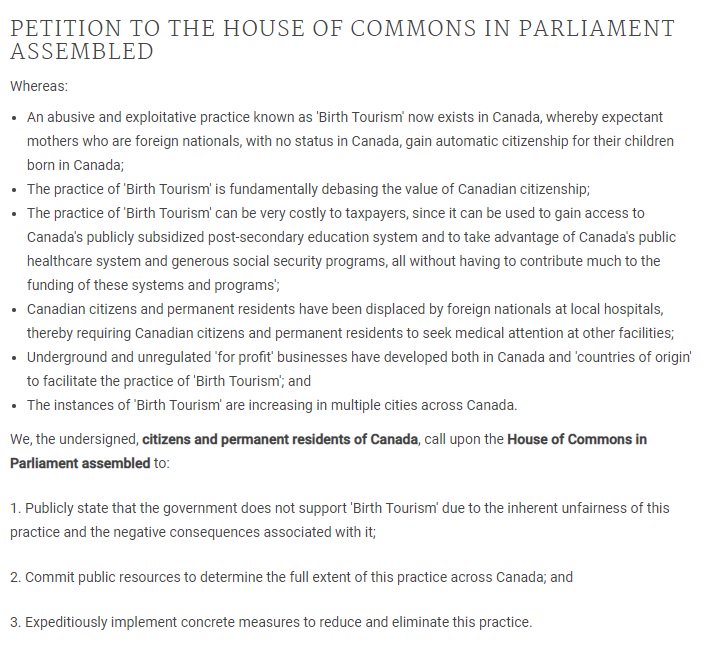
Yet another petition on birth tourism

Likely a political response to the tensions in Richmond, where over 20 percent of live births are to non-resident mothers and positioning given the Conservative party resolution calling to limit birthright citizenship to offspring of Canadian citizens or permanent residents.
Working on an article with more accurate and. spoiler alert, higher numbers which should be out later this month or early November:

US seeks to reduce waivers for immigration fees

Consistent with other restrictive measures (Canada does not offer a waiver to lower income immigrants despite the 5 fold increase in citizenship fees in 2014-15):

United States Citizenship and Immigration Services is proposing changing the eligibility for fee waivers for lower-income immigrants on the path to legal permanent residency and U.S. citizenship.Immigration advocates say the move is like building an “invisible wall.”

USCIS announced the change Friday in the Federal Register. Receiving means-tested public benefits from the states would no longer result in automatic USCIS fee waivers, the proposal states. Instead, fee waivers would only be tied to two criteria: the federal poverty threshold or particular financial hardships.

The change is necessary, USCIS said, because “eligibility for these benefits can vary from state to state, depending on the state’s income level guidelines,” meaning that “individuals who would not otherwise qualify under the poverty-guideline threshold and financial hardship criteria have been granted fee waivers.”

In 2017, USCIS approved 285,009 fee waiver applications, totaling $173 million.

The new proposal restricts waivers only to applicants who are at or below 150 percent of the federal poverty threshold or financial hardship.

“It’s a significant narrowing of those who would be eligible for the fee waiver. Our estimates indicate that this would reduce the total population of those eligible for a fee waiver by two-thirds,” said Jill Marie Bussey, advocacy director for the Catholic Legal Immigration Network. “It’s an extremely troubling proposal for our network.”

CLINIC’s 330 affiliates provide pro bono immigration services to thousands of low-income immigrants across the United States. Bussey said 95 percent of CLINIC’s affiliates assist with fee waiver applications.

In California, where 20 percent of the population is foreign born, the federal poverty threshold to claim state benefits is 200 percent.

For 2018, a four-person family in California is eligible for means-tested state benefits with a household income at or below $50,200. Thus, an immigrant household at that income level and receiving state means-tested benefits are currently eligible for a USCIS fee waiver.

But with the proposed change, that same four-person Californian household would only be eligible for the USCIS fee waiver if household income was at or below $37,650.

USCIS is like the U.S. Postal Service in that most of its funding comes from fees paid for its services, rather than from U.S. taxpayers.

USCIS fees for immigrants to use its services can run into the thousands. The application for a “green card”, formally known as the “application to register permanent residence,” costs $1,140. The application for naturalization to become a U.S. citizen costs $640.

The waiver proposal is an attempt to reverse a change to immigration policy under President Barack Obama. In 2011, USCIS standardized a process of using means-tested benefits as a way to prove eligibility for its fee waivers.

“When this agency waives fees, it’s hurtful to the quality of the agency and it pushes fees off from one population to another. If you can’t get fees from group A, then you have to run up the fees for groups B, C, and D. So there is a reason to be careful with waivers,” said David North, a fellow at the Center for Immigration Studies, a Washington, D.C., think tank advocating for low immigration.

“The change works against and secures some fee money from the near poor while leaving the poor untouched. So this is not a program that rolls back benefits for the really poor people, it rolls back benefits for some of the working poor and the income level above that,” North said.

CLINIC’s Bussey said the proposal is like an “invisible wall,” “a back-door way of limiting family immigration and reunification.” She fears it will suppress naturalization rates

“And that hurts us all. Studies really show that low-income immigrants are able to improve their financial status through naturalization. They have access to better jobs, educational opportunities and resources,” she said. “So limiting access to naturalization through limiting this fee waiver creates a poverty loop.”

North said the fees make sense because U.S. legal status brings “admission to the labor market, for instance, where you can make as much money as you want or can.”

The proposed change is open for comment until Nov. 27. Public comments have to be taken into consideration when finalizing a federal government rule change but may not necessarily be incorporated into its outcome.

Source: US seeks to reduce waivers for immigration fees