More coverage on the increase of interest among American residents:
…Canada’s move is unusual at a time when many countries are tightening requirements for citizenship. A year ago, Italy passed a law restricting citizenship to the descendants of an Italian-born parent or grandparent, rather than the previous rule, which had no generational limit.
In 2024 Finland increased the required time living in the country before applying for citizenship to eight years from five. The change was said to promote integration by focusing on language skills and long-term residency. Sweden is considering a similar move to take effect this year.
As expected but still early to know whether PBO and IRCC estimates of about 20,000 annually are accurate or low:
Interest in Canadian citizenship by descent among citizens in a handful of countries — especially the United States — surged after the federal government passed a new law clarifying the rules.
C-3, which took effect on Dec. 15, 2025, allows someone born outside Canada to a Canadian parent who also was born outside Canada to file a citizenship claim — as long as the parent spent at least three years in Canada before their child’s birth or adoption.
The law was drafted and passed in response to a 2023 Ontario Superior Court order that found a law on citizenship by descent passed by Stephen Harper’s government was unconstitutional.
That Harper-era law said Canadians who were born abroad could only pass down their citizenship if their children were born in Canada.
The Liberal government under then-prime minister Justin Trudeau, which did not appeal the 2023 ruling, faced a deadline to either pass legislation on new citizenship by descent rules or see the rules thrown out with no alternative.
Government officials, including then-immigration minister Marc Miller, told parliamentary committees studying the law that an unknown number of people would automatically become citizens without a legislated alternative in place.
Immigration, Refugees and Citizenship Canada reports receiving more than 12,000 citizenship by descent applications between Dec. 15, 2025 and the end of January.
While the December to January period saw a higher than normal number of applications, a department spokesperson said the government does not expect to see a “significant” uptick in applications.
The parliamentary budget officer estimated about 115,000 people would be eligible for citizenship under the bill.
The department approved almost 6,300 citizenship by descent applications between Dec. 15, 2025 and the end of January. Only 1,480 of them were approved under C-3; the remainder were approved through other laws.
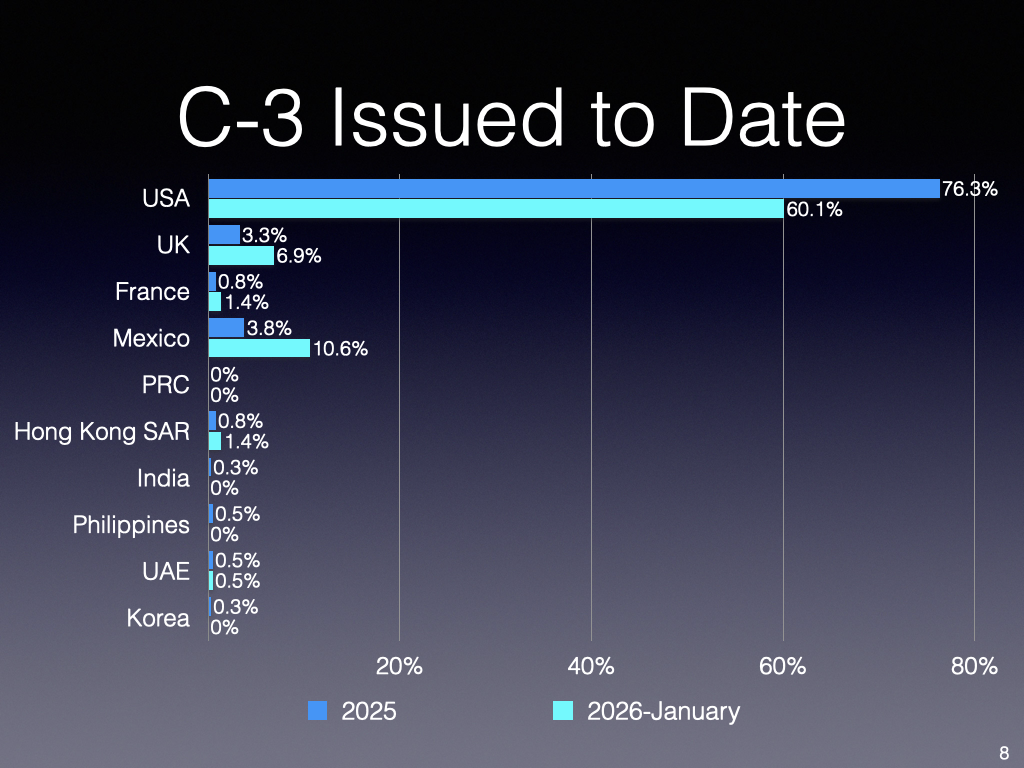
U.S. citizens accounted for the largest national share of those applications. Nearly 2,500 Americans were approved in January alone.
Jacqueline Bart, a Toronto-based immigration lawyer, said there’s been a frenzy of interest among Americans looking to get a Canadian passport.
She said some of those applicants — including LGBTQ+ individuals and people with children requiring gender affirming medical care — are looking to move to Canada “right away.”
“It’s just been absolutely insane to the point where I can’t keep up with the work. I’m having to refer people to other lawyers,” Bart said.
Bart said while most of the inquiries are coming from lawyers looking for access to a second passport, she is beginning to get more inquiries from non-lawyers in the U.S.
“I think some of our inquiries are kind of spilling over into a more general sphere,” she said. “But the overwhelming majority of my clients are American. I would say maybe five per cent come from other countries, at most.”
While January 2026 saw a higher-than-average number of American citizenship by descent approvals, it only ranked third in terms of U.S. approvals in a single month in the last year. March 2025 saw more than 2,800 approvals out of the United States, while May saw almost 2,700.
The number of approvals from the U.K. — the country with the second highest level of interest in Canadian citizenship by descent — was also above average in January, at 290.
People from France saw 140 approvals in January. Other countries in the top 10 for citizenship by descent approvals include China, Hong Kong, India, Australia, the Philippines, the U.A.E. and Germany — they ranged between 75 and 120 approvals in January.
The vast majority of countries outside the top 10 saw no significant shifts in approval numbers — with the exceptions of Mexico and Belize.
Mexico was the source of 235 approved applications for citizenship by descent in January 2026; Mexican citizens received 610 approvals in all of 2025. Ninety applications out of Mexico were approved in December 2025 — a notable jump over the 2025 monthly average of 50 citizenship approvals.
While Belize accounted for only 45 approvals throughout 2025, it registered 40 in January of this year alone.
The immigration department issued about 82,500 approvals for citizenship by descent throughout 2025, with the United States generating the most — about 24,500 approvals.
The other countries in the top 10 accounted for only a combined 11,600 approvals in 2025.
This report by The Canadian Press was first published April 16, 2026.
Latest numbers and demand resulting for C-3, suggesting possible higher numbers than presented by IRCC and PBO, and a reminder how overly generous it is compared to other countries. From Washington Post, indicating interest given large numbers of American residents affected:
….Late last year, the Canadian government amended the Citizenship Act to grant Canadian citizenship to a wider pool of people seeking dual citizenship through their family lineage. Before the revised law went into effect on Dec. 15, the country limited Canadian citizenship to the first-generation children of a Canadian parent. Now, all generations who were born outside of Canada and have direct Canadian ancestry can become Canadian citizens, as long as they possess the correct documents andfall within the correct legal provisions.
“The grandkids can get citizenship, and the great-grandkids can get citizenship from Canada, even if they never set foot in Canada,” said Basil Mohr-Elzeki, managing partner at Henley & Partners, a firm that specializes in residency and citizenship planning.
The rule stems from a December 2023 decision by the Ontario Superior Court of Justice that deemed the first-generation cutoff unconstitutional. The law restores citizenship to those beyond the first generation born abroad….
A surge of applications
Since the change in qualifications, Immigration, Refugees and Citizenship Canada (IRCC) has experienced a bump in applications. In January, the agency said it received 8,897 applications, up from 5,940 a year ago. Between Dec. 15, 2025, and Jan. 31, it processed about 6,280 applications, out of 12,430 received, and confirmed 1,480 new citizens by descent under the new act.
“The IRCC said the processing period is about 10 months. Bart said more complicated cases, such as ones requiring DNA testing and assistance from the firm’s staff genealogist, can stretch for years. A straightforward application takes about a year or more, unless it is expedited, in which case it can take as little as a few weeks. Bart warned, however, that the wait time could grow exponentially with the recent high demand.
“Processing is really becoming backlogged because so many people are wanting to qualify,” she said.
The government agency, which posts the estimated processing time online, also shares the number of people awaiting a decision — 56,300 on April 7.
If Canadians are worried about an influx of new citizens, they shouldn’t be. Peter Spiro, a law professor at Temple University in Philadelphia, does not anticipate a rush of newly minted Canadians crossing the border.
Spiro, who specializes in international, immigration and constitutional law, describes dual citizenship as a form of insurance. You may never have to use your second citizenship, he said, but in case you need it, Canada will always welcome you home.”
…In Quebec, official documents dating back to 1621 and up to 100 years ago are kept by the Bibliothèque et Archives nationales du Québec (BAnQ), with more recent records available through the Directeur de l’état civil.
Sarah Hanahem, an archivist with the BAnQ office in Montreal, said while there’s always been an interest from Americans looking into their ancestry, requests for certified copies have exploded.
“In January 2025, we had 32 requests for certified copies of vital records and this year in January 2026, we’ve had over 1,000,” she said, adding most of those requests were made by Americans.
In statements to CBC, other archives across the country, including New Brunswick, British Columbia, Newfoundland and Ontario, have also seen a sizable increase in requests from the same time last year.
Because of the sudden surge in demand, Hanahem warned that international applicants should expect delays.
The priority, she said, is to fulfil requests by Quebec residents.“BAnQ is a government entity and we are paid with Quebec tax dollars.”
But more than that, Hanahem said the process itself is lengthy and can involve a lot of research.
There are sometimes discrepancies with the spelling of names, some of which might have changed over time, she said. Other times, critical information like which parish someone was born in, is unknown or key dates are approximate when actual dates are required.
“We have to go back to the original register,” Hanamen said, explaining some of the bound volumes are very old and need to be handled carefully. …
Interesting how this view has emerged that this possibility was not raised in any substantive way during the parliamentary and other discussions of C-3 and predecessor bills, with discussion focused on retroactive application to the second generation born abroad, not earlier generations. Examples include Idées | Après la loi C-3, un réveil franco-américain, and the CBC article below this commentary, both with respect to early waves of Quebec emigration to the USA.
As the CBC story makes clear, considerable work is still required to document the family links, which I can appreciate having done some genealogy myself. IRCC may face challenges in verification.
As in all cases of “lost Canadians,” the degree to which individuals will wish to avail themselves of Canadian citizenship will likely be significantly less than the overall number of Canadian expatriates in the second generation and beyond. But given that most descendants of Canadians reside in the USA, there appears to be a Trump push factor.
2027 data will provide an indication:
…Stakeholders in citizenship law are now wondering how the new law will be interpreted and applied. An increasing consensus is emerging that the potential beneficiaries could include anyone who has an ancestor who was born in Canada, no matter how far back – even before 1867. It may be that many people in New England (who have ancestors from the Maritimes) or even Louisiana (who can trace their lineage back to the expulsion of Acadians in the 18th century) may now have claims to Canadian citizenship.
Not included in Bill C-3 are any requirements for security checks on those who would claim citizenship under the new rules. Nor are they required to provide police certificates or pass language or knowledge tests. According to the Act, “Canadians who are currently born citizens by descent are not required to undergo security or criminality screenings in order to be or remain citizens.”
Moreover, a committee briefing from the Standing Committee on Citizenship and Immigration notes that most people currently excluded from citizenship because of the first-generation limit were born after 2009, when it came into force. This cohort consists largely of minors aged 16 and under in 2025 and are generally deemed to be lower risk for security or criminality purposes.
In fact, Bill C-3 opens the door to citizenship for many people born before as well as after 2009. Among them are many people who might give rise to security concerns. But since they are now deemed Canadian citizens by law rather than by grant, they do not need to submit to security checks. This raises serious concerns in an increasingly dangerous world.
Equally important is the broader issue of what makes a person Canadian. By opening the citizenship door so widely, it diminishes the importance of an inherited history and a shared stake in the future.
While the government aimed for prospective uniformity, by sidestepping retroactive changes it may have inadvertently bolstered the case that Canada truly is “the first post-national state.”
Randolph Hahn is a partner with Garson Immigration Law and has practiced exclusively in citizenship and immigration law for many years. He is a former chair of the Citizenship and Immigration Section of the Ontario Bar Association and is the associate editor of the Immigration Law Reporter. He has authored many professional papers.
Millions of Americans can now claim Canadian citizenship by descent. But they have to prove it
…In Quebec, official documents dating back to 1621 and up to 100 years ago are kept by the Bibliothèque et Archives nationales du Québec (BAnQ), with more recent records available through the Directeur de l’état civil.
Sarah Hanahem, an archivist with the BAnQ office in Montreal, said while there’s always been an interest from Americans looking into their ancestry, requests for certified copies have exploded.
“In January 2025, we had 32 requests for certified copies of vital records and this year in January 2026, we’ve had over 1,000,” she said, adding most of those requests were made by Americans.
In statements to CBC, other archives across the country, including New Brunswick, British Columbia, Newfoundland and Ontario, have also seen a sizable increase in requests from the same time last year.
Because of the sudden surge in demand, Hanahem warned that international applicants should expect delays.
The priority, she said, is to fulfil requests by Quebec residents.“BAnQ is a government entity and we are paid with Quebec tax dollars.”
But more than that, Hanahem said the process itself is lengthy and can involve a lot of research.
There are sometimes discrepancies with the spelling of names, some of which might have changed over time, she said. Other times, critical information like which parish someone was born in, is unknown or key dates are approximate when actual dates are required.
“We have to go back to the original register,” Hanamen said, explaining some of the bound volumes are very old and need to be handled carefully. …
One of the frustrations during C-3 hearings on the removal of the first-generation citizenship transmission restriction was the weak data presented by the government and the overly general but nevertheless useful PBO analysis.
IRCC did, however, indicate some 4,000 interim applications had been received and shared the data regarding these applications: gender, age, country of residence.
This working paper presents the analysis for citizenship data nerds.
Articles and opinions related to citizenship that I found of interest in March:
Idées | Après la loi C-3, un réveil franco-américain
This is the second article that has focussed on potential applicants from early waves of Canadian francophone emigrants to the USA. This possibility was never raised I believe in either House or Senate hearings on C-3 and its predecessors, and the focus and discussion was on second generation, not earlier generations (Indian media did flag possibility). I will be making a data request in 2027 and have asked IRCC whether their data collection will distinguish between second and earlier generations:
…“Pour comprendre l’onde de choc, il faut revenir au fameux « plafond » : la limite de première génération. En clair, les enfants nés à l’étranger de parents canadiens pouvaient être citoyens canadiens, mais ne pouvaient pas transmettre automatiquement leur citoyenneté à leurs propres enfants si eux aussi naissaient à l’étranger. La chaîne s’arrêtait après une génération née hors du pays.
Une décision rendue en Ontario en décembre 2023 a jugé ce régime inconstitutionnel dans certains cas, ce qui a forcé Ottawa à corriger le tir. C-3 permet donc la citoyenneté au-delà de la première génération née à l’étranger, mais en posant une condition de « lien substantiel » : la citoyenneté peut circuler plus loin dans la chaîne familiale à condition qu’il y ait une ancre réelle au pays, démontrée par 1095 jours — trois ans — de présence physique cumulative au Canada.
Et voilà ce qui change tout : pour beaucoup, il ne s’agit pas de « demander » la citoyenneté comme un privilège, mais de faire reconnaître un statut qui s’appuie maintenant sur des règles précises afin d’obtenir une preuve de citoyenneté. Psychologiquement, ce n’est pas la même posture.”
Pourquoi la Nouvelle-Angleterre s’enflamme
Si cette loi fait battre le cœur de la Nouvelle-Angleterre, ce n’est pas un hasard. Entre 1830 et 1970, près d’un million de Québécois ont traversé la frontière — surtout vers les villes industrielles — pour travailler dans les filatures et les manufactures. Le résultat démographique est immense : leurs descendants représentent aujourd’hui près de dix millions d’Américains.
Cette diaspora a longtemps été racontée comme une épopée ouvrière : un peuple qui quitte la terre, cherche du travail, construit des quartiers, des paroisses, des clubs, fondent des journaux. Mais c’est aussi une histoire de hiérarchie sociale : des Canadiens français devenus main-d’œuvre bon marché, comme tant d’autres groupes dans l’Amérique industrielle. Ce double héritage explique la charge émotionnelle du moment : la loi C-3 ne touche pas seulement un cas juridique ; elle réveille une mémoire.
Surtout, elle arrive des années après qu’une fierté franco-américaine s’est reconstruite « par en bas » : balados, blogues, festivals, initiatives locales. Parmi ceux qui s’activent aujourd’hui, il y a des amis à moi qui animent un balado franco-américain très écouté, d’autres qui ont fondé le PoutineFest du New Hampshire — devenu assez solide pour essaimer, avec des éditions à Burlington, au Vermont, et dans “le Maine — et d’autres encore qui tiennent depuis longtemps des blogues franco-américains. La fierté n’a pas attendu Ottawa. Mais l’accès, lui, oui.
L’Amérique pousse, le Québec attire
Pourquoi maintenant ? Parce que l’Amérique inquiète. Dans mes échanges, je sens moins une mode qu’une fatigue : fatigue politique, fatigue institutionnelle, fatigue culturelle. La citoyenneté canadienne devient un filet de sécurité pour certains : un passeport, oui, mais surtout une option familiale.
Mais réduire ce mouvement à une fuite serait une erreur. Beaucoup ne parlent pas d’abord de soins de santé ou d’élections. Ils parlent de langue. Ils parlent d’immersion. Ils parlent d’un désir de vivre — enfin — dans un endroit où le français n’est pas un folklore, mais un espace public.
Plusieurs se disent fièrement Franco-Américains. D’autres se décrivent carrément comme « Québécois », avec ce mélange de fierté et d’envie : envie d’une société qu’ils perçoivent comme plus cohérente, plus collective, moins brutale. Et ils sont lucides : tous ne pourront pas transférer leur carrière ici. Les avocats, les fiscalistes, ceux qui ont des professions encadrées le savent. Pourtant, ils avancent, parce que ce n’est pas seulement une équation économique : c’est une trajectoire.
Bienvenue chez vous »… mais préparons-nous
Soyons francs : cette loi a un impact particulier — et probablement disproportionné — sur les descendants de Québécois aux États-Unis. Elle ne déclenchera pas automatiquement une migration de masse. Les démarches restent exigeantes : prouver la filiation, retrouver les bons documents, faire valider les chaînes.
Mais la direction du courant est claire. Et le Québec doit regarder cette réalité en face : une partie de cette diaspora va frapper à sa porte, non pas comme des étrangers, mais comme des « revenants » — avec une attache réelle, un imaginaire familial, parfois un français brisé, parfois un français intact.
La question n’est donc pas seulement de savoir combien viendront, mais comment on les accueillera. Oui, la citoyenneté donne des droits. Mais l’installation au Québec implique aussi des devoirs, des choix, un ancrage. Et si une partie de cette vague devient une immigration durable, elle peut aussi être un gain : démographique, économique, culturel — et, franchement, linguistique, si ces nouveaux arrivants viennent précisément chercher le français.
Alors, oui : Québécois et Canadiens français, préparez-vous à dire « bienvenue chez vous ». Mais disons-le intelligemment : avec des parcours d’accueil réalistes, des ponts de francisation adaptés et un discours public qui évite de transformer des cousins en boucs émissaires.
Parce qu’au fond, C-3 ne fait pas que corriger une incohérence juridique. Elle réactive une vieille histoire : celle d’un peuple parti travailler ailleurs… et dont les descendants, un siècle plus tard, demandent non pas la permission, mais la reconnaissance de revenir toucher le fil.”
Rémi Francœur Franco-Américain, l’auteur est analyste politique et ancien directeur de campagnes politiques au New Hampshire. Il est installé à Montréal depuis 2015.
…”To understand the shock wave, we must return to the famous “ceiling”: the first generation limit. Clearly, children born abroad to Canadian parents could be Canadian citizens, but could not automatically transmit their citizenship to their own children if they were also born abroad. The channel stopped after a generation born outside the country.
A decision rendered in Ontario in December 2023 ruled this regime unconstitutional in some cases, forcing Ottawa to correct the situation. C-3 therefore allows citizenship beyond the first generation born abroad, but by placing a condition of “substantial link”: citizenship can circulate further in the family chain provided that there is a real anchor in the country, demonstrated by 1095 days – three years – of cumulative physical presence in Canada.
And this is what changes everything: for many, it is not a question of “asking” citizenship as a privilege, but of having a status recognized that is now based on precise rules in order to obtain proof of citizenship. Psychologically, it’s not the same posture.”
Why New England is on fire
If this law makes the heart of New England beat, it is no coincidence. Between 1830 and 1970, nearly a million Quebecers crossed the border — mainly to industrial cities — to work in spinning mills and factories. The demographic result is immense: their descendants now represent nearly ten million Americans.
This diaspora has long been told as a workers’ epic: a people who leave the earth, look for work, build neighborhoods, parishes, clubs, found newspapers. But it is also a story of social hierarchy: French Canadians who have become cheap labor, like so many other groups in industrial America. This double legacy explains the emotional charge of the moment: Law C-3 does not only affect a legal case; it awakens a memory.
Above all, it comes years after a Franco-American pride has rebuilt itself “from the bottom”: podcasts, blogs, festivals, local initiatives. Among those who are active today, there are friends of mine who host a much listened to Franco-American podcast, others who founded the PutinFest of New Hampshire – which has become solid enough to swarm, with editions in Burlington, Vermont, and in “Maine – and others who have long held Franco-American blogs. Pride did not wait for Ottawa. But access, yes.
America is pushing, Quebec attracts
Why now? Because America is worried. In my exchanges, I feel less a fashion than a fatigue: political fatigue, institutional fatigue, cultural fatigue. Canadian citizenship becomes a safety net for some: a passport, yes, but above all a family option.
But reducing this movement to a leak would be a mistake. Many do not first talk about health care or elections. They speak language. They talk about immersion. They speak of a desire to live – finally – in a place where French is not a folklore, but a public space.
Many proudly call themselves Franco-Americans. Others describe themselves flatly as “Quebecers”, with this mixture of pride and envy: desire for a society that they perceive as more coherent, more collective, less brutal. And they are lucid: not all will be able to transfer their career here. Lawyers, tax specialists, those who have supervised professions know it. However, they move forward, because it is not just an economic equation: it is a trajectory.
Welcome home”… but let’s get ready
Let’s be frank: this law has a particular — and probably disproportionate — impact on the descendants of Quebecers in the United States. It will not automatically trigger a mass migration. The steps remain demanding: prove filiation, find the right documents, have the channels validated.
But the direction of the current is clear. And Quebec must face this reality: part of this diaspora will knock on its door, not as foreigners, but as “revenants” – with a real attachment, a family imagination, sometimes a broken Frenchman, sometimes an intact Frenchman.
The question is therefore not only how many will come, but how they will be welcomed. Yes, citizenship gives rights. But settling in Quebec also implies duties, choices, an anchorage. And if part of this wave becomes sustainable immigration, it can also be a gain: demographic, economic, cultural – and, frankly, linguistic, if these newcomers come precisely for French.
So, yes: Quebecers and French Canadians, get ready to say “welcome home”. But let’s say it intelligently: with realistic welcome paths, adapted francization bridges and a public discourse that avoids turning cousins into scapegoats.
Because basically, C-3 does not only correct a legal inconsistency. It reactivates an old story: that of a people who have gone to work elsewhere… and whose descendants, a century later, ask not for permission, but the recognition of returning to touch the thread.”
Rémi Francœur Franco-American, the author is a political analyst and former director of political campaigns in New Hampshire. It has been based in Montreal since 2015.
Canadians living abroad are calling for increased turnout among overseas voters and arguing that barriers to casting a ballot could be affecting election results.
Looking forward the PROC report and recommendations. In contrast to the USA with relatively strong Republicans and Democrats Abroad, Canadian political parties do not appear to have the same interest although the Liberals seem to have a greater focus that the Conservatives (https://www.conservativesabroad.ca). The Liberals have the expansive multi-generational interpretation of C-3. As in the case of “Lost Canadians” and previous elections, the number who may be interested and vote is likely smaller than advocates believer.
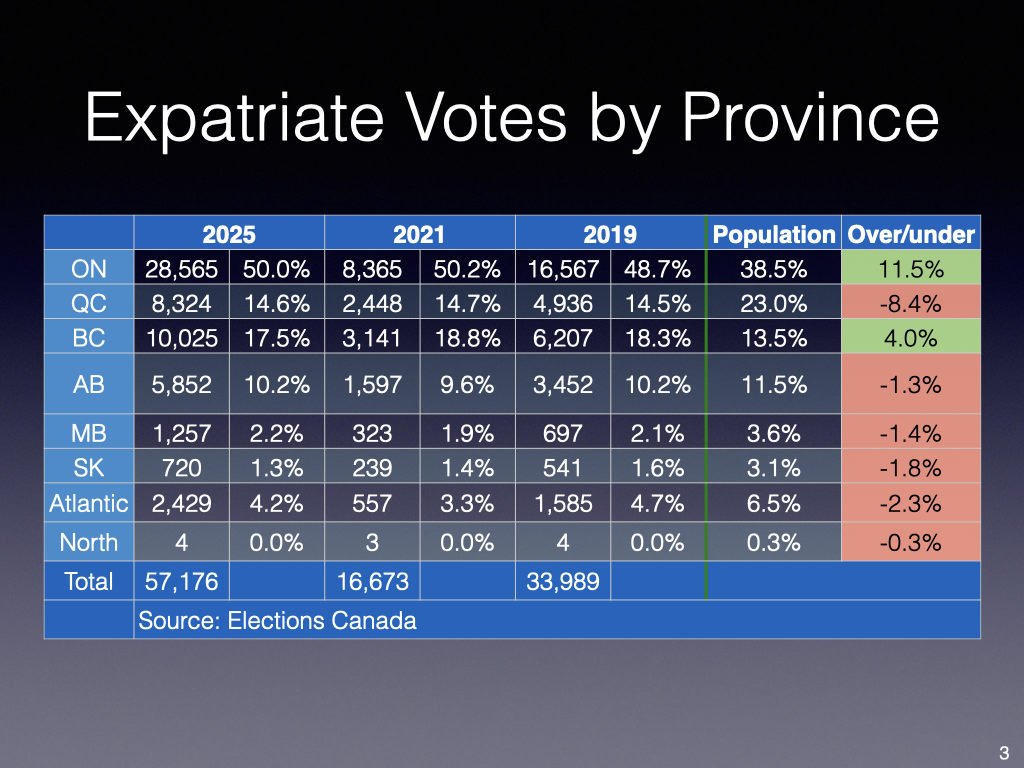
Upcoming analysis on the provincial and country breakdowns for the 2025 election, sample below, Ontario and British Columbia have higher proportions than other provinces:
Timothy Veale, the director of Grits Abroad — an organization aimed at connecting Canadian Liberal voters living worldwide — said nearly five million Canadians live outside the country and roughly 3.5 million of them are eligible to vote.
Veale said the share of non-resident Canadians voting in federal elections is mired in the low single digits. He said the causes include mail-only voting, compressed timelines, uncertainty about ballot arrival and delivery and a lack of outreach from party campaigns.
Daniel Scuka, a member of Grits Abroad living in Germany, said parties need to “wake up” and encourage Canadians overseas to vote. He said Elections Canada could also be directed to do more to support overseas voting.
Veale said federal parties should see overseas voters as an opportunity.
“I’d like to see a politician ask us for their vote,” he said. “In the last election … I don’t think anybody courted any of the five million people living overseas.”
Veale said the system “needs modernization” and Canadians should be able to vote in person at an embassy, consulate or high commission. He also pointed out that several countries allow online voting.
“We have the right to vote and a 37-day election was not designed for people abroad to apply to vote,” he said. “If you get approval, then you have to wait for the ballot to be sent to you, then you have to send it back. And imagine having to navigate over 200 different national postal systems around the world.
“We’ve seen how other countries operate and we can do way better than this. It’s just a matter of will, as I see it.”
Elections Canada said in an email that 101,690 voting kits were issued to electors living outside of Canada in the last general election. Of those, 57,440 were returned on time and tallied….
As Americans in Canada prepare U.S. tax filings, lower citizenship renunciation fee offers a way out
Not to be cynical but given that Democrats abroad tend to be larger than Republicans….
The U.S. government’s decision to decrease its citizenship renunciation fee by more than 80 per cent may result in more Americans in Canada giving up their U.S. citizenship, cross-border tax experts say, as the deadline for Americans abroad to file their taxes approaches.
Earlier this month, the U.S. State Department announced that the consular services fee charged to Americans giving up their citizenship will drop to US$450, down from US$2,350, effective April 13.
Unlike Canada and most other countries, the U.S. bases its tax system on citizenship rather than residency. That means a U.S. citizen must file a U.S. tax return every year regardless of where they live. In addition, the U.S. requires Americans to report on their foreign financial accounts annually.
The deadline for filing a U.S. tax return is April 15, but Americans living abroad receive an automatic filing and payment extension until June 15, and a possible further extension to Oct. 15, if they request it. To avoid interest charges, any taxes are still due by April 15….
Definitely a theoretical possibility but in practice, given that most parents will not have met the residency requirement needed for the second and third generation to claim citizenship will likely be a small percentage. But proof data will show the extent of any increase but only broken down by country:
…Bill C-3 allows citizenship to flow beyond the first generation born or adopted abroad, ultimately recognizing an entire chain of descendants, as long as there is a Canadian citizen who anchors the chain with at least 1,095 days (three years) of cumulative physical presence in Canada. The descendants will automatically be new citizens, able to obtain proof of Canadian citizenship, rather than having to apply for citizenship.
Patrick White, a journalism professor at the Université du Québec à Montréal, points to significant interest in obtaining Canadian citizenship by the descendants of French Canadians who migrated from Quebec to New England.
“I see a genuine interest in Facebook groups associated to Franco Americans,” White said in an email to National Post. One group, based in Maine, posted news about the new legislation in early February.
“Close to one million French Canadians left Québec between 1840 and 1930,” says White, citing Franco-American historian, David Vermette, who described the migration in his book, Distinct Alien Race: The Untold Story of Franco-Americans.
Their descendants “now represent almost 10 million Americans,” says White. “The current climate in the U.S. is leading many of them to inquire about the possible acquisition of Canadian citizenship because of the changes made here in December. This is a ‘Plan B’ for them.”
Though, “it’s too early to say” if there how many will be applying, he adds.”
Time for my looking back piece, even if a bit self-indulgent.
Most of my time was spent on an analysis of the 2025 election results from a diversity analysis with Jerome Black, highlighting how representation of visible minorities had increased while that of women and Indigenous had stalled. A second area of major work was following and participating in C-3 citizenship discussions and debates. Annual updates on public service diversity and birth tourism, and setting the baseline for appointments that will be made by PM Carney.
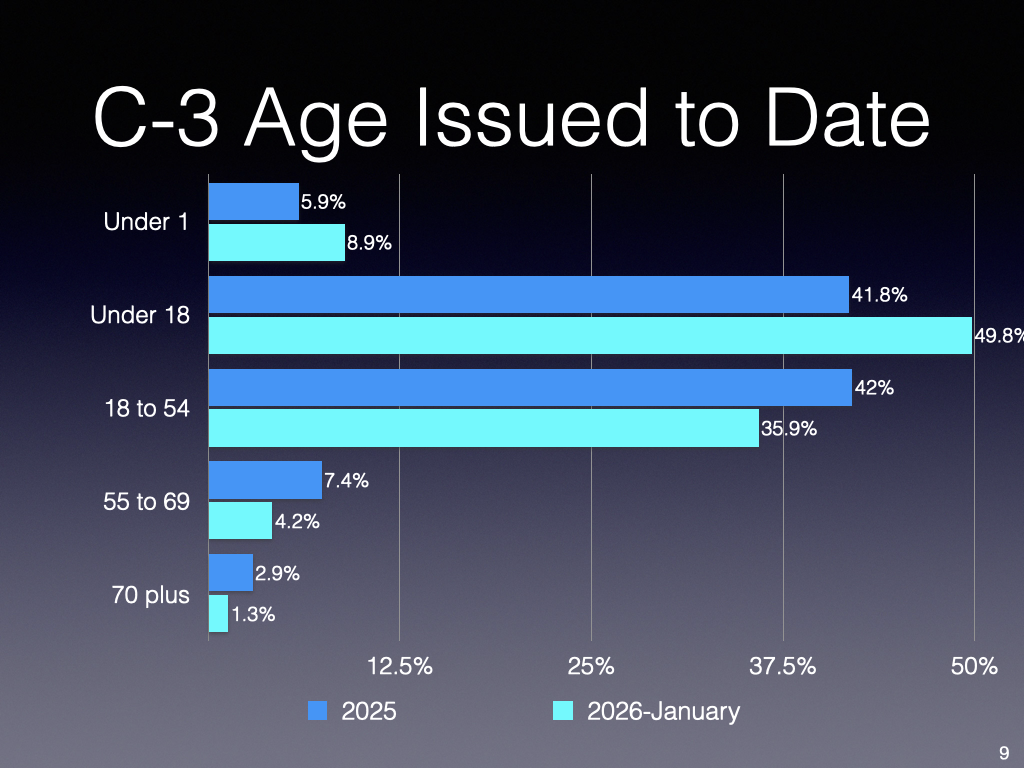
2026 will continue with my various annual updates. Jerome Black and I have an analysis in train on the intersectionality of women and visible minority candidate in competitive ridings. I will be analysing the impact of C-3 in relation to age, gender, and country of origin and comparing that with expatriate voting data, given that the latter has grown significantly and the number of expatriate votes cast exceeds the winning margin in a number of ridings. No doubt other issues of interest will emerge.
Lots to keep me busy and engaged, along with maintaining my blog.
Best wishes for the holidays, whichever ones you celebrate.
…How do officials count generations in applying the new rule?
According to the Immigration Department, the first generation is defined as the first person born or adopted outside Canada to a Canadian citizen.
Whether a Canadian parent was born in Canada or is a naturalized citizen, their children born abroad are counted as first generation and considered Canadian by descent. The children born outside Canada to a first-generation person are now Canadian provided their first-generation parents meet the three-year physical residency requirement before their births.
This is also how officials count generations for people who are adopted and apply for a direct grant of citizenship.
What if you were born or adopted on or after Dec. 15, 2025?
People born outside Canada in the second generation or later may be Canadian if their parent was also born or adopted outside Canada to a citizen and that same parent spent at least three years in Canada before the birth.
Adopted people are likely eligible to apply directly for Canadian citizenship if they were born and adopted outside Canada in the second generation or later, and if that same parent meets the residency requirement before the adoption.
How about those who were born or adopted before the new law?
In most cases they are automatically a Canadian citizen if they were born before Dec. 15, 2025, outside Canada to a Canadian parent. The new rule also applies to those who were born to someone who became Canadian by descent because of the rule changes.
Adopted people should be eligible to apply directly for citizenship if they were born and adopted outside Canada in the second generation or later before that date.
What if you have a pending citizenship application under an interim measure?
In December 2023, after the court ruled the two-generation citizenship cut-off rule unconstitutional, Ottawa put in a temporary initiative to offer discretionary grant of citizenship by descent to certain affected groups while it worked on new legislation to make the citizenship law Charter-compliant. It resulted in more than 4,200 applications.
Any pending application under this measure will be processed under the new rules, and no new citizenship certificate application is required.
How do you prove your Canadian citizenship?
Those who believe they are eligible for citizenship by descent under the new rules should apply for a citizenship certificate as proof of citizenship if they became a citizen automatically. They will be assessed accordingly.