Nicolas: Doctrine de la découverte

More important to focus on concrete issues but understand the importance:

Le pape François est venu au Canada cette semaine tenir un discours qui ne correspond pas tout à fait à ce qui était demandé dans le rapport de la Commission de vérité et réconciliation de 2015. En arrivant à Edmonton, le pape s’est excusé pour les actes de « plusieurs chrétiens » et « membres de communautés religieuses », mais pas au nom de l’Église comme telle. Le discours papal a déploré la collaboration de certains catholiques aux projets d’assimilation et de destruction culturelle pilotés par les gouvernements, mais n’a pas admis la responsabilité de l’Église, comme institution, dans la direction de ces projets. Légalement, politiquement, et même spirituellement, la nuance est majeure. C’est aux survivants des pensionnats et à leurs proches de réagir à ce choix de mots, et d’omissions.

Mais quoi qu’en dise le pape François, l’Église catholique a joué un rôle central dans la dépossession territoriale des peuples autochtones à travers les Amériques. C’est pourquoi dans les derniers jours, plus de 4800 gazouillis incluant le mot-clé #DoctrineofDiscovery ont été lancés dans la twittosphère canadienne. À l’initiative de plusieurs personnalités autochtones, la mobilisation en ligne cherche à obtenir un commentaire du pape sur la doctrine de la découverte, un concept de droit international vieux de plus de 500 ans, durant les jours qui lui reste à passer au Canada.

Alors, qu’est-ce c’est, au juste, la doctrine de la découverte ? Il s’agit d’un concept émanant de la bulle papale Inter caetera, émise en 1493 par le pape Alexandre VI à la demande des monarques d’Espagne, après que leur émissaire, Christophe Colomb, a atteint les Caraïbes.

Une bulle (ou édit) papale précédente avait donné au monarque du Portugal le « droit » de s’approprier le continent africain, ou plus précisément « la pleine et entière faculté d’attaquer, de rechercher, de capturer, de vaincre, de soumettre tous les sarrasins et les païens et les autres ennemis du Christ où qu’ils se trouvent […] et de réduire leurs personnes en servitude perpétuelle ».

Dans le contexte, les monarques espagnols cherchent donc à avoir la bénédiction de l’Église pour faire de même sur le « nouveau » continent. La bulle de 1493 trace essentiellement une ligne dans l’Atlantique, laissant toutes les terres « découvertes » à l’ouest aux Espagnols (la majorité des Amériques) et celles à l’est aux Portugais (l’Afrique et ce qui deviendra Brésil).

En 1533, le monarque français François 1er réussit à faire spécifier par le nouveau pape, Clément VII, que la bulle de 1493 ne concernait que les terres déjà « découvertes » à l’époque. L’Église instaure en quelque sorte une règle du « premier arrivé, premier servi » pour toutes les terres non chrétiennes encore inconnues des Européens. C’est dans ce contexte que Jacques Cartier est envoyé par la France l’année suivante, et plante une croix dans la péninsule de Gaspé pour « prendre possession » du territoire au nom de son roi. Ainsi, on peut tracer une ligne directe entre l’autorité papale et le déni de la souveraineté autochtone sur les terres d’Amériques, y compris sur le territoire canadien.

Parmi les personnalités qui parlent de la doctrine de la découverte ces jours-ci, on compte le juge et sénateur à la retraite Murray Sinclair, qui a présidé à la Commission de vérité et réconciliation. En plus des excuses du pape, le rapport de la commission demandait « aux intervenants de toutes les confessions religieuses et de tous les groupes confessionnels qui ne l’ont pas déjà fait de répudier les concepts utilisés pour justifier la souveraineté européenne sur les terres et les peuples autochtones, notamment la doctrine de la découverte et le principe de terra nullius ».

C’est que dans les siècles qui ont suivi ces décisions de l’Église, le droit international a continué de se construire sur les mêmes bases. On s’est demandé, par exemple, si le pape avait l’autorité de décider qui pouvait prendre possession des terres des peuples autochtones — plutôt que de seulement organiser leur conversion massive. Certains ont cru qu’il valait mieux ne s’approprier que les territoires inhabités, dit « terra nullius », et chercher à conquérir le reste par des traités.

En réponse, des penseurs influents (dont le philosophe John Locke) se sont affairés à développer une définition de la terra nullius incluant toutes les terres qui n’étaient pas occupées… à l’européenne — soit sur un mode sédentaire, agricole, puis industriel. Ces débats ont eu une forte influence sur le développement du droit canadien, alors que bien des Premières Nations au mode de vie traditionnel nomade ont dû aller devant les tribunaux « prouver » une occupation ancestrale du territoire.

En 1792, Thomas Jefferson a décrété que la doctrine de la découverte formait une base du droit international et s’appliquait aussi à la nouvelle république des États-Unis d’Amérique. Et en 1823, la Cour suprême américaine s’est appuyée explicitement sur cette doctrine pour arbitrer un conflit entre deux citoyens prétendant posséder une terre. L’un l’ayant acquis auprès de la communauté autochtone locale, l’autre auprès du gouvernement, le tribunal donnera raison au dernier.

Au fil des décennies, les tribunaux canadiens se sont appuyés sur cette décision américaine pour construire leurs propres traditions légales. C’est pourquoi plusieurs experts de la question croient qu’il serait très complexe, mais aussi éminemment nécessaire, de refonder le contrat politique et légal entre le gouvernement du Canada et les peuples autochtones afin de se dissocier, pour de bon, de la doctrine de la découverte. Ce serait là la seule façon de cesser, en tout point, d’asseoir la légitimité de l’État sur un principe colonial dont la généalogie remonte aux papes de la Renaissance.

Il serait, disons, extrêmement optimiste de croire que la mobilisation actuelle autour de la doctrine de la découvertesera commentée par le pape actuel d’ici la fin de son périple. Mais la campagne informelle contribue déjà efficacement à attirer l’attention publique sur cette question fondamentale pour les Amériques.

Source: Doctrine de la découverte
The U.S. is reckoning with its troubled past of Indian boarding schools

Long overdue. Having an Indigenous head of the Dept of Interior makes a difference:

When the U.S. federal government began its Indian Boarding School Initiative in the mid-19th century, the goal was clear: to erase Indigenous cultures through a process of forced assimilation.

Now, the head of the Department of the Interior hopes to address the generations-long fallout from those policies.

On Wednesday, Interior Secretary Deb Haaland advocated for a Truth and Healing Commission to examine past U.S. government efforts to eradicate the languages, identities and cultural practices of Native Americans, Alaska Natives, and Native Hawaiians. Her comments came as she updated the U.S. Senate Committee on Indian Affairs on her department’s ongoing investigation into federal boarding schools, which released its first report last month.

Haaland told the committee the story behind the federal boarding schools is “a part of America’s story we must tell.”

“While we cannot change that history, I believe that our nation will benefit from a full understanding of the truth of what took place and a focus on healing the wounds of the past,” she said.

The U.S. government operated hundreds of Indian boarding schools

Between 1819 and 1969, the federal government operated more than 400 boarding schools across the country and provided support for more than 1,000 others, according to the department’s investigation. It also counted 53 schools with marked and unmarked burial sites of children, a number it says will likely increase as the investigation continues.

Haaland was speaking in support of the Truth and Healing Commission on Indian Boarding School Policies Act, which could allow Congress to issue subpoenas to non-federal entities to obtain more detailed information about the locations of the burial sites. It would also help trace the identities of the children back to their families, work with tribal leaders to arrange repatriation in a culturally-appropriate manner, and end removal of Indigenous children from their families by state adoption, social service, and foster care agencies.

Haaland introduced the legislation in the U.S. House in 2020, before her appointment to the Cabinet. A Senate version is now being sponsored by Sen. Elizabeth Warren, D-Mass. Haaland told the committee she hoped it could work alongside existing efforts by the Interior Department to help Native American communities heal from the impacts of the policies.

She also requested $7 million in additional congressional funding– the same amount as last year– to continue the Interior Department’s work documenting and cataloging grave sites, as well as to create a “road to healing” that will work directly with tribal communities to document stories and assess their needs. She emphasized the need for the federal government to act in a holistic way.

“I believe that our obligations to Native communities mean that federal policies should fully support and revitalize Native health care, education, Native languages, and cultural practices that prior federal Indian policies, like those supporting Indian boarding schools, sought to destroy,” she said.

Haaland says she is a product of these policies

In her remarks, Haaland, who is a member of Laguna Pueblo, said her position as the first Native American cabinet secretary places her in a “unique position” to address the impacts of the U.S. government’s policies towards Native children.

“Like all Native people, I am a product of these horrific assimilation-era policies, as my grandparents were removed from their families to federal Indian boarding schools when they were only eight years old and forced to live away from their parents, culture, and Pueblos until they were 13 years old,” she said.

A group of other leaders from around the country, who also testified in support of the bill, described the impacts of the boarding school policies on their people, which they said have included physical, mental, and emotional traumas over the course of generations. Several described their own work to document those today.

Sandra White Hawk is president of the Minneapolis-based National Native American Boarding School Healing Coalition, which has been working to survey boarding school survivors and their descendants, and has found high rates of depression, PTSD, and suicide attempts among respondents. She said the truth and healing commission could provide an opportunity to allow people’s stories to be heard by a wider audience.

“It’s one thing to share your stories within your home, or in your community,” she said, “but it’s another place to share it, where it’s going to be validated with the outside entities that brought this on.”

Sen. Brian Schatz, D-Hawaii, who is the committee’s chairperson, said the boarding school era was a “dark period” in U.S. history and a “painful example” of how U.S. policy has failed Native Americans, Alaska Natives, and Native Hawai’ians.

“We must do all we can to right this wrong,” he said.

Committee vice chairperson Lisa Murkowski, R-Alaska, pointed to the conditions at the boarding schools, where the Interior Department report noted children were subjected to emotional, physical, and sexual abuse as well as malnutrition, unsanitary conditions, and forced labor.

“And we know it just scratches the surface of what actually happened,” Murkowski said.

A pathway for stories from the elders who experienced the schools

La Quen Náay Liz Medicine Crow, president of the Anchorage-based First Alaskans Institute, called the government policies “intentional and purposeful”. And, she said, tribal elders are some of the only ones who will be able to tell the complete story about what really happened there. She described hearing her grandmother asked to recount experiences in boarding schools.

“And my grandmother responded, ‘I can tell you what happened physically, but I’m still not able to tell you what happened inside,'” Medicine Crow said, gesturing to her heart.

“This commission will open up a pathway where these stories, from people – who are now elders – will be heard,” she said. “Time is of the essence. We cannot waste any more of their precious life [by] not giving them a forum to share their lived experiences.”

Source: The U.S. is reckoning with its troubled past of Indian boarding schools

Parkin, Triandafyllidou, Aytac: Newcomers to Canada are supportive of Indigenous Peoples and reconciliation

Particularly relevant on National Indigenous Peoples Day and current high levels of immigration:

Public education about Canada’s treatment of Indigenous Peoples is an important component of the process of reconciliation.

Knowing the history can better help citizens understand current challenges and equip them with the tools to work respectfully with Indigenous Peoples to build a better future, in keeping with the section on “education for reconciliation” in the Truth and Reconciliation Commission’s final report

Much of this public education occurs in schools, through the media and even via discussions among friends and within families. But new immigrants to Canada might miss some of this socialization (depending on their age of arrival) because they’ll have less exposure to Canadian schools and media in their formative years. 

This could affect their attitudes to Indigenous Peoples and support for the process of reconciliation itself. Given that one in five Canadians was born abroad, this would pose a significant political risk. 

Alternatively, it’s possible that, despite less exposure to Canadian schools and media, immigrants might be more supportive of Indigenous Peoples because they could be more aware of the legacies of colonialism worldwide, more open to learn about their new country or more conscious of their responsibility as newcomers to learn Canadian history.

Supportive of Indigenous Peoples

The question of how immigrants perceive Indigenous Peoples in Canada, and vice versa, is therefore relevant but rarely explored. 

But data from the Confederation of Tomorrow 2021 survey, conducted by the Environics Institute and including sufficiently large samples of both immigrants and Indigenous Peoples, allows us to examine these issues.

Specifically, we can explore perceptions of immigrants towards Indigenous Peoples and reconciliation, and look at responses to three questions: 

  1. How familiar do you feel you are with the history of Indian Residential Schools in Canada?
  2. In your opinion, have governments in Canada gone too far or have they not gone far enough in trying to advance reconciliation with Indigenous peoples?
  3. Do you believe that individual Canadians do, or do not, have a role to play in efforts to bring about reconciliation between Indigenous and non-Indigenous people? 

The survey results generally show that, despite less familiarity or certainty about these issues among new immigrants compared to those born in Canada, they are more likely to support Indigenous Peoples.

Gap in knowledge

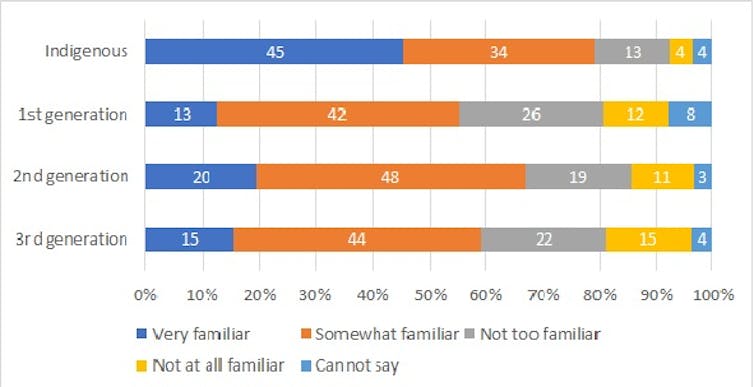
The survey shows a big gap between how familiar Indigenous Peoples and non-Indigenous people — both immigrants to Canada and non-immigrants — are with the history of Indian Residential schools.

The findings suggest first-generation immigrants are less likely than non-Indigenous Canadians to say they’re “very familiar” with this history, and are more likely to express no opinion.

These results indicate that first-generation immigrants don’t know as much as other Canadians about the history of Indian Schools in Canada. It is notable, however, that second-generation Canadians are more likely than third-generation Canadians to feel “very familiar” with the history of Indian Residential Schools.

A graph shows how familiar immigrants to Canada feel they are with the history of Indian Residential Schools in Canada compared to Indigenous Peoples.
A graph shows how familiar newcomers to Canada feel they are with the history of Indian Residential Schools in Canada compared to Indigenous Peoples. Author provided, Author provided

This lesser familiarity among first-generation immigrants, however, does not translate into lower support for efforts to advance reconciliation. 

Government response

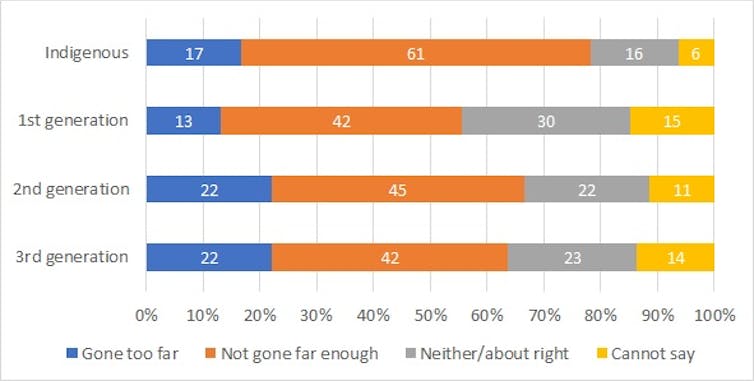
This support is evident when they were asked about whether governments have gone too far, or not far enough, to advance reconciliation. 

The most striking difference — not surprisingly — is that Indigenous Peoples are much more likely than non-Indigenous Canadians to say that governments have failed to go far enough to advance reconciliation. 

But first-generation immigrants are just as likely to hold this view than second- or third-generation Canadians. First-generation immigrants are also less likely to say that governments have gone too far in their efforts to promote reconciliation — a result that’s significant when controlling for education (which is an important step since first-generation immigrants are more likely to be university-educated than the rest of the population). 

First-generation immigrants are also less likely to take a definitive position either way, and are more likely to say “neither” or “cannot say.”

A graph shows whether Canadians believe governments have gone far enough in trying to advance reconciliation with Indigenous Peoples.
A graph shows whether Canadians believe governments have gone far enough in trying to advance reconciliation with Indigenous Peoples. Author provided, Author provided

The role of Canadians

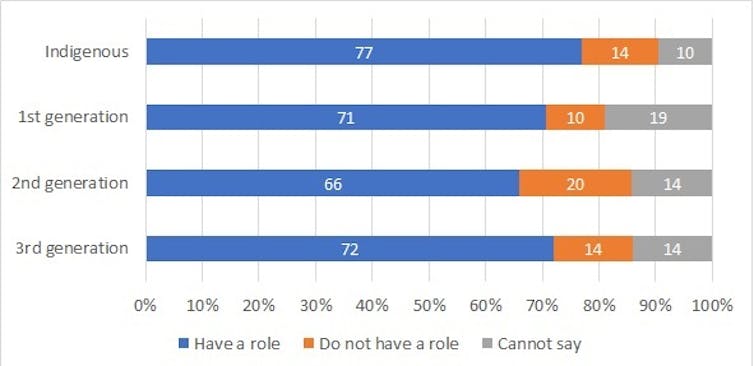
Similarly, Indigenous Peoples are unsurprisingly the most likely to say that individual Canadians have a role to play in reconciliation. 

But first-generation immigrants are just as likely as second- or third-generation Canadians to hold this view (although first-generation immigrants are also more likely to have no opinion on this question). 

A graph shows whether individual Canadians have a role to play to bring about reconciliation between Indigenous and non-Indigenous Peoples.
A graph shows whether individual Canadians have a role to play to bring about reconciliation between Indigenous and non-Indigenous Peoples. Author provided, Author provided

These results are encouraging because they suggest that even if immigrants aren’t socialized in Canada at a young age, that’s not an obstacle to building understanding and support for reconciliation. 

Indigenous support for immigration

Interestingly, the survey also allows us to explore the other side of the relationship between immigrants and Indigenous Peoples in Canada, namely support among Indigenous Peoples for immigration. 

This is a potentially contentious issue. On the one hand, diverse sources of immigration in the post-Second World War period have already disrupted the narrative of Canada as a nation of two founding peoples (British and French). That in turn suggests a view of Canada that is not only multicultural but multi-national, and inclusive of Indigenous Peoples and nations. 

In this sense, the interests of immigrants and Indigenous Peoples could be aligned. But at the same time, the ongoing arrival of newcomers can be seen as a continuation of the settler/colonization process. 

Thoughts on immigration

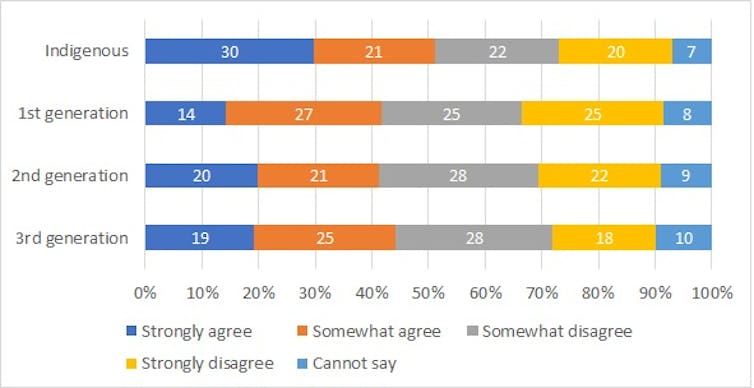
We can explore this issue by referring to a question in the survey asking Canadians whether they agree or disagree that “overall, there is too much immigration to Canada.” 

The results show that there are significant differences in attitudes about immigration between the general population and Indigenous Peoples. Thirty per cent of Indigenous peoples “strongly agree” with the statement, the highest proportion among all groups. 

A graph shows whether Canadians and Indigenous people believe there is too much immigration to Canada.
A graph shows whether Canadians and Indigenous people believe there is too much immigration to Canada.Author provided, Author provided

However, this general difference about immigration levels is driven in large part by the difference in views between Indigenous Peoples and first-generation immigrants. While Indigenous Peoples, compared to first-generation immigrants, are more likely to strongly agree than strongly disagree that there is too much immigration to Canada, there are no statistically significant differences between Indigenous Peoples and second- or third-generation Canadians.

This suggests that the key factor influencing attitudes towards immigration might not be Indigenous identity, but being born in Canada.

Nonetheless, this finding is important because it’s a reminder to proponents of more immigration that they should be open to and engage with Indigenous Peoples’ perspectives on this issue. Immigration, as a policy objective, should be pursued with an eye on how it might be perceived by those who were displaced by the earlier arrival of settlers.

Source: Newcomers to Canada are supportive of Indigenous Peoples and reconciliation

Canada’s first Indigenous citizenship judge uses ‘best job in the world’ to champion Indigenous issues

Of interest:

With the Canadian flag, a portrait of the Queen, and a bright orange “Every Child Matters” T-shirt in her Zoom background, Suzanne Carrière, LLB’03, gets emotional when she talks about her work as a citizenship judge with Immigration, Refugees and Citizenship Canada.

“I still choke up sometimes delivering my speech, no matter if the ceremony is on Zoom or in-person, because you can see in the participants’ faces that the moment is so meaningful for them,” she says. “You can see some of them crying, hugging their children, and you can see that they’re thinking about their journey. It’s so special and a constant reminder of how lucky and privileged we are to be Canadian.”

Suzanne Carrière, LLB’03, is Canada’s first Indigenous citizenship judge.

Since being appointed in 2018 as Canada’s first Indigenous citizenship judge — Carrière is Red River Métis from Manitoba — she has presided over more than 1,300 ceremonies and has sworn in more than 65,000 new Canadians. She also presided the first virtual oath-taking in Canadian history when the COVID-19 pandemic shut down in-person ceremonies, and, in June 2021, Carrière presided over the first ceremony in the country using a revised Oath of Citizenshiprecognizing the rights of First Nations, Inuit and Métis peoples, a moment she considers a career highlight.

Growing up, Carrière never had any intention to pursue law. She studied Indigenous issues, criminology and psychology in her undergraduate studies at the University of Manitoba. While completing a field course on alternative justice initiatives in Indigenous communities, her supervisor asked her about her plans for her future. After telling him she was contemplating doing a master’s in criminology, he encouraged her to pursue a law degree.

When she questioned him about it, he said to her, “Anything you can do with a master’s degree, you can do with a law degree. You’re a woman, you’re bilingual and you’re Métis — with a law degree, there’s nothing you can’t do.”

“And that made sense to me,” Carrière says. “And he was right.”

Hearing stories from 200 residential school survivors 

After graduating from UCalgary Law, Carrière worked for a few years on the legal team at WestJet, but ultimately knew corporate law wasn’t what she wanted to do. When she eventually moved back to Manitoba to start her family, a friend told her that the federal Department of Justice (DOJ) was hiring lawyers to do work related to Canada’s residential school system. It was a no-brainer for Carrière as she knew that this work that would be incredibly fascinating, historic and important. She applied and was hired, and, for five years, she was involved in the Independent Assessment Process to resolve claims of abuse suffered at residential schools.

Through that claimant-centred, non-adversarial process, Carrière estimates she heard approximately 200 first-hand accounts from residential school survivors about the abuse they suffered and how it impacted their lives.

You don’t do that kind of work without it changing you and your life.

As for the conflicted feelings she had at times about representing the Government of Canada in that forum, she says she had to remind herself that it’s important to have Indigenous people in all spaces and arenas. “You need people with empathy and compassion doing that work, and it was a real honour for me to be there and to bear witness on behalf of the government,” Carrière says.

After the residential school work ended, she stayed with DOJ’s Aboriginal Legal Services team for another three years. However, she no longer felt fulfilled by the work she was doing. A friend showed her a posting for a citizenship judge and suggested she apply.

Still a champion of Indigenous issues

“I had some hesitation about leaving the Department of Justice to become a citizenship judge because my passion had always Indigenous issues and Indigenous culture. But I knew I was no longer happy at DOJ,” Carrière says. “Thankfully, I got the appointment, and the biggest surprise has been how there is still room within my role as a citizenship judge to champion Indigenous issues in my own small way.”

Each June, Canadians commemorate National Indigenous History Month to recognize the rich history, heritage, resilience and diversity of First Nations, Inuit and Métis peoples across Canada.

Indigenous Peoples are the first peoples of this land. They were here since time immemorial, and ultimately, Indigenous history is Canadian history.

“At the same time, it’s not just history. Indigenous People are still here and they’re still contributing to our society. It’s important to celebrate the beauty of Indigenous Peoples, cultures and languages — and the contributions, heritage and the unique stories that we gain from Indigenous people so that we can all move forward together with better understanding, compassion and relationships.

“I have a bit of a platform as a citizenship judge. I can talk about my Métis heritage, reconciliation and how that fits in with newcomers to Canada. I’m talking about these important issues more, meeting more Indigenous people and I feel like I’m making more of a difference now, with a different, and very receptive, audience. It’s been an incredible four years so far, and I truly feel I have the best job in the world!”

Source: Canada’s first Indigenous citizenship judge uses ‘best job in the world’ to champion Indigenous issues

Coates: Condemning historical figures like Ryerson and John A. Macdonald must not distract us from true reconciliation

Condemnation and renaming are easy compared to addressing the substantive issues, where action is more needed, not to mention the regrettable lack of nuance in understanding history and context:

With the decision to rename itself Toronto Metropolitan University, the former Ryerson University — known briefly as “University X” — fumbled the opportunity to use public criticism of Egerton Ryerson as a learning opportunity, instead bowing to the passionate protests of activists who believe that condemning a handful of historical figures is one way to address generations of discrimination and paternalism. 

Attacking the reputation of Ryerson, one of the most effective educational reformers in Canadian history, requires a narrow reading of his career. Regardless, he is now a dead letter in Canadian public life, and efforts to expunge his name from schools, monuments and other public facilities will no doubt continue apace. 

The number one target in the country is now Canada’s first Prime Minister, John A. Macdonald — like Ryerson, singled out for his role in Indigenous residential schools. Across the country, statues in Macdonald’s honour have been removed or doused in red paint, and public bodies are having earnest discussions about removing his name from schools and other facilities. 

There is nothing wrong with calling out or re-examining the public memory of historical figures for their actions. However, reading history reductively, losing sight of context, and misreading personal responsibility do not help us to understand the past. 

Right now, for good reason, the country is focused on a specific policy — residential schools — with the belief that by removing the tributes to the architects of the school movement we can turn a page. This approach is seriously misguided. 

Residential school education was horrific, its multi-generational negative effects still not fully understood. A system purportedly designed to provide personal opportunity to Indigenous students was instead used to attack Indigenous cultures, undermine centuries-old languages, destroy Indigenous families, and assimilate Aboriginal peoples. Dealing with the long-term impact of the residential schools has rightly become a national priority. 

We must, however, remember that the residential school concept was not foisted on an unwilling nation by its government. Virtually all non-Indigenous Canadians of that time, led by the Christian churches and supported by non-Indigenous advocates for Indigenous peoples, favoured residential schools. As late as the 1960s and 1970s, many non-Indigenous Canadians still defended the schools as clearly being a “good thing” and a sign of the benevolent state. 

Most Canadians did not know — or did not want to know — what happened in the schools. They neither expected nor countenanced the violence and brutality, but encouraged teachers and principals to undermine Indigenous language and culture, believing this was in Indigenous people’s best interests.

In today’s efforts to assign accountability for wrongs of the past, the tendency to focus on individuals — whatever their roles in establishing the institutions — simply misses the point. It was racism and a nationwide sense of cultural superiority that backstopped all of Canada’s aggressive actions against Indigenous peoples. If dismantling a statue or renaming a school (or university) serves some, it also deflects attention from where responsibility properly rests: with society at large. 

Criticizing early promoters of residential schools misses the historical mark. 

With Ryerson’s name now removed from a campus, and Macdonald’s image being assailed across Canada, where next? There are thousands of targets, including the political leaders, government and church officials, and public supporters who expanded the residential school system, including its rapid acceleration after the Second World War. 

Let’s consider two potential targets, modern-era political leaders who espoused simple ideas of potentially destructive impact on Indigenous peoples. They wanted to eliminate the Indian Act and Indian status, break up the reserves, abandon treaties, and integrate Indigenous peoples into the Canadian mainstream. Their stated goal sounded honourable to some — producing “real” equality among all Canadians — and there had been consultations, of a sort, with Indigenous groups. 

The 1969 White Paper was one of the most aggressive Indigenous policy initiatives in Canadian history, designed to remove barriers between peoples and overcome decades of discrimination and state paternalism. The response from First Nations was ferocious. Indigenous leaders organized protests and demanded the federal government retract its policy. The government did so, to the dismay of many non-Indigenous Canadians who wanted to remove the “special status” afforded Indigenous peoples. The contemporary Indigenous rights movement in Canada owes a great deal to the reaction to this ill-conceived and assimilationist strategy. 

The Prime Minister was Pierre Elliott Trudeau. His minister of Indian and Northern Affairs was future prime minister Jean Chrétien. They were the architects of the White Paper of 1969. Trudeau believed “no society can be built on historical might-have-beens,” and opposed Indigenous land claim negotiations, modern treaties, and the concept of historical redress. 

The Trudeau government’s much-touted “Just Society” had a blind spot when it came to Indigenous peoples. The government’s preference for state intervention and the inherent paternalism of federal policy in the 1960s and 70s arguably accelerated the decline of Indigenous language and culture, fostering a culture of welfare dependency in Indigenous communities. 

Would it be appropriate for critics of government policy to focus their anger on Trudeau and Chrétien, leading to more monument destruction and renaming? Absolutely not; we can use our time and effort much better. Besides, when faced with sustained Indigenous anger, the Liberal government backed down. Unlike residential schools, which had major effects across generations, the White Paper brought to the surface the core ideas and values of the government of the day.

The past is a complicated place. It should not be reduced to memes and social-media messages. Historical leaders are people, with personal foibles, living in and reflecting their places and times. Democracies hold leaders accountable during their political lives. Historians and the public determine their legacy. Attitudes toward the leaders and their actions change over time, as the debate about John A. Macdonald demonstrates. But these discussions should be handled with caution. 

The piecemeal and reactive redoing of historical nomenclature, however well meaning, produces distortions of history. This said, Canada is desperately overdue for a rethinking of the many people and events we memorialize. 

Names and monuments should not be fixed for all time. New Zealand, now also known as Aotearoa, and Australia have both ventured down this road, with considerable achievement. New Zealanders are increasingly comfortable with both Maori names and cultural references in public affairs; Australia’s newly elected prime minister, Anthony Albanese, was introduced on a stage where the Australian flag shared pride of place with the flags of Aboriginal Peoples and Torres Strait Islanders.

There is so much to recognize and celebrate in Indigenous cultures that Canada should get on with it. Indigenous peoples, cultures and knowledge need to be more prominently recognized across Canada. The same holds for women, minority groups, and events either poorly or inaccurately represented in our historical nomenclature. A cautious renaming process in Canada could actually produce the most thoughtful and comprehensive historical and cultural reuniting in the nation’s history. 

Reconciliation with Indigenous peoples requires thoughtful and engaged reflection. Changing the names of institutions and tearing down monuments might gratify some, but there is a better way. Toronto Metropolitan University will hardly provide a rallying cry for a nation seeking real healing with Indigenous peoples. 

If Canada is to find common ground with First Nations, Métis and Inuit people, the country must reverse the lens, begin to view history from Indigenous perspectives and listen respectfully to elders and knowledge keepers. 

This reckoning will take more than attacks on historical figures. The problem rests not with a few individuals but with the profound sense of racial superiority that animated public policy for generations, underpinning a suite of government initiatives that marginalized and overwhelmed Indigenous peoples. For all of our condemnation of historical decisions that are now seen as egregious and destructive, Canadians remain largely oblivious to the paternalism and discrimination toward Indigenous people that is part of our national reality.

Canada is, by international standards, a remarkably successful country, even if it is built significantly on the displacement and domination of First Nations, Métis, and Inuit peoples. They were sacrificed in the interests of the nation, with most non-Indigenous peoples truly believing that assimilation and cultural domination was the only legitimate path forward. This position, dangerously and tragically wrong, animated the government for a century and a half, to be replaced in our time by a more evolved but still paternalistic approach to Indigenous affairs. 

This country needs to devote a great deal of effort to improving relationships with Indigenous communities. To Canada’s collective good fortune, Indigenous peoples remain open to such discussions and to rebuilding Confederation, despite the painful destruction of the past. 

We can do much more than try to eliminate historical guilt by changing a few names and sloshing paint on some statues. Instead, the country needs to listen closely to First Nations, Métis and Inuit peoples and build a policy agenda inspired by Indigenous priorities, a deep understanding of the multi-generational impacts of racism, and a real commitment to lasting reconciliation. 

Ken Coates is a Distinguished Fellow at the Macdonald-Laurier Institute, and a professor and Canada Research Chair at the University of Saskatchewan.

Source: Condemning historical figures like Ryerson and John A. Macdonald must not distract us from true reconciliation

Prison service must do more to remove barriers for Indigenous, Black offenders: AG

Of note. Another ongoing issue, one not easy to resolve but one would hope to see some ongoing progress:

The federal auditor general says Canada’s prison service has not given offenders timely access to programs to help ease them back into society, including courses specific to women, Indigenous people and visible minorities.

Auditor general Karen Hogan found Black and Indigenous offenders experienced poorer outcomes than any other groups in the federal correctional system and faced greater barriers to a safe and gradual return to the outside world.

Hogan pointed out her office raised similar issues in audits in 2015, 2016 and 2017, yet the correctional service has done little to change the policies, practices, tools and approaches that produce these differing outcomes.

Hogan says disparities were present from the moment offenders entered federal institutions.

The process for selecting security classifications saw Indigenous and Black offenders assigned to maximum-security institutions at twice the rate of other groups of offenders.

They also remained in federal custody longer and at higher levels of security before their release.

The audit found that timely access to correctional programs continued to decline across all groups of offenders. Access to programming, which teaches crucial skills like problem solving and goal setting, worsened during the COVID-19 pandemic.

Of men serving sentences of two to four years who were released from April to December 2021, 94 per cent had not completed the correctional programs they needed before they were first eligible to apply for day parole.

“This is a barrier to serving the remainder of their sentences under supervision in the community,” the report says.

The prison service needs to find a different way to organize programming, because “that timely access is so critical to an offender’s successful path forward,” Hogan said Tuesday at a news conference.

Correctional service efforts to support greater equity, diversity and inclusion in the workplace also fell short, leaving persistent barriers unresolved, the report says.

Close to one-quarter of management and staff had not completed mandatory diversity training a year after the deadline.

In addition, the prison service had not established a plan to build a workforce that reflects the diversity of its offender populations, which has particular relevance for institutions with high numbers of Indigenous and Black offenders, the report says.

Hogan noted the correctional service has acknowledged systemic racism in the system, initiating an anti-racism framework to identify and remove systemic barriers.

The service has agreed to act on the auditor general’s recommendations to remedy the various issues she identified.

Public Safety Minister Marco Mendicino stressed efforts toward “rooting out racism in all of its forms” by diversifying the prison service’s workforce, improving our training and collecting data to inform policies. “And we know we’ve got a long way to go.”

Mendicino noted he recently directed the correctional service head to create a new position of deputy commissioner for Indigenous corrections, saying it will ensure the overrepresentation of Indigenous offenders in the system, especially women, is addressed.

Source: Prison service must do more to remove barriers for Indigenous, Black offenders: AG

USA: Haaland seeks healing for Native American boarding school survivors

Of note:

The Interior Department found that the U.S. operated or actively supported more than 400 American Indian boarding schools between 1819 and 1969 – a history that affects the agency’s own leader.

Secretary Deb Haaland, the first Native American to serve as a Cabinet secretary, tells NPR’s All Things Considered that she had grandparents who were taken from their homes and placed in these schools.

“[Those are] formidable years in a child’s life,” she says. “It’s devastating. It’s important that our country realizes and understands this history because I think it’s important for every single American to know what happened.”

The department’s findings came after an investigation into these schools and the role the federal government played in sustaining them.

Much like in Canada, Native children who attended these schools were forcibly taken from their families to be “assimilated,” as it was described at the time.

Many children reported brutal conditions. Others never returned home.

U.S. officials identified at least 53 schools with marked or unmarked burial sites with the remains of children who died there.

In an effort to confront this history, Haaland says she plans to meet with boarding school survivors across the country in a tour called “The Road to Healing.”

“I always enjoy visiting with people in Indian Country. We’re all relatives,” she says. “Above all, I just need to hear those stories myself.”

This interview has been edited and condensed for clarity.

On why this is the first documentation by the U.S. government on the prevalence of Indian boarding schools:

Perhaps part of it stems from the fact that we haven’t had a lot of Native American leadership in our country. Representation matters. And that’s one of the reasons why I felt it was important for me to raise this issue.

On the lingering effects of these boarding schools on Indigenous communities:

There are current impacts in drug addiction and poverty and the lack of economic development, and health disparities. When people are invisible, you don’t have to pay attention. We should care about every single community in this country. So bringing all of these things to light; it will make us become a better country.

On the idea that bringing up painful history is divisive:

These are real people, and these are their lives. I think it’s important that we heal as a country. Everyone’s experience in the boarding school system, whether they’re a survivor or a descendant, that pain is real. And it’s incumbent on me to ensure that I am paying attention to that and that I am doing all I can to make sure that we can heal and get people past that pain.

Source: Haaland seeks healing for Native American boarding school survivors

ICYMI – Nicolas: Des langues et des choix

Reality intrudes. Harder to dismiss Indigenous concerns:

Tout le monde en parlait, cet hiver. Fin février, le rappeur anichinabé Samian s’est retrouvé exclu du Festival international de la chanson de Granby, parce que sa performance se serait déroulée majoritairement en anichinabémowin. Le festival, qui promeut la chanson francophone depuis plus de 50 ans, a refusé de faire une exception et de permettre un spectacle en langue autochtone.

Le festival avait indiqué être « sincèrement désolé de la tournure des événements », mais le mal était fait. À Tout le monde en parle, Samian avait dénoncé une mentalité « colonialiste », qui considère les langues autochtones comme une menace pour le français. Les messages de soutien avaient alors fusé d’un peu partout au Québec. Oui, il faut protéger le français, disait-on. Mais pas en nuisant aux langues autochtones ni à l’autodétermination des peuples. En matière de relations publiques, le Festival de Granby avait de toute évidence perdu la manche.

En me rappelant comment le message de Samian avait été entendu, il y a à peine quelques mois, je me dis qu’une bonne partie de la population serait aussi prête à écouter les critiques que de nombreux leaders autochtones font du projet de loi 96 depuis son dépôt par le gouvernement du Québec.

Mardi, à l’Assemblée nationale, plusieurs chefs ont réitéré leur inquiétude face à cette nouvelle politique linguistique, qui aurait de nombreuses implications pour les Premières Nations et les Inuits au Québec. Ghislain Picard, chef de l’Assemblée des Premières Nations Québec-Labrador (APNQL), a dit craindre que l’adoption du projet loi 96 force « l’exode de nos étudiants vers d’autres avenues, d’autres écoles à l’extérieur du Québec ». Il a ajouté qu’il trouvait « d’une ironie renversante que, finalement, les premiers occupants du territoire au Québec soient forcés d’aller étudier à l’extérieur de leur territoire ».

M. Picard fait ici référence aux nouvelles exigences de cours de français au niveau collégial incluses dans le projet de loi. Ses mots sont forts, donc il est important d’expliquer leur contexte. Avec le travail des missionnaires, puis avec les pensionnats, et enfin avec le système scolaire contemporain, cela fait déjà plusieurs générations que les peuples autochtones au Québec et ailleurs au Canada se font imposer une éducation dans une ou deux langues coloniales. Les premières langues du territoire en sont donc aujourd’hui fortement menacées — certaines plus que d’autres —, et la transmission culturelle et l’existence même des peuples autochtones en tant que groupes distincts sont menacées avec elles.

Les Inuits et certaines Premières Nations, comme les Micmacs et les Mohawks, se sont surtout fait imposer l’anglais, historiquement. Le gouvernement québécois, dans sa volonté d’affirmation nationale, travaille pour asseoir le français comme langue officielle et langue commune sur son territoire. Avec le projet de loi 96, on vient donc exiger de certains étudiants autochtones la maîtrise d’une deuxième langue « étrangère » dans un système d’éducation qui refuse de faire une place sérieuse à leurs langues et à leurs cultures.

Nos écoles sont déjà perçues comme des milieux de vie aliénants par une partie de la jeunesse autochtone, ce qui contribue aux taux de réussite scolaire plus faibles de plusieurs communautés. Par conséquent, on craint d’aggraver les risques de décrochage ou d’encourager le départ de certains élèves vers les provinces limitrophes si les étudiants autochtones étaient soumis à la loi 96.

J’utilise le verbe « soumis » avec une conscience aiguë du poids de ce mot. Car c’est bien de cela qu’il est question ici : de soumission. Plusieurs journalistes et élus se demandent pourquoi on ferait tout un plat pour trois cours de français supplémentaires au collégial — ou encore pourquoi on semble vouloir défendre l’éducation en anglais, une autre langue coloniale et certainement pas autochtone. La réponse formulée par plusieurs des intervenants lors de la conférence de presse de mardi se situe ailleurs.

On refuse simplement que le gouvernement du Québec dicte la langue d’apprentissage des jeunes autochtones. On ne veut pas se faire imposer le français, ni l’anglais d’ailleurs ; on veut être libre de choisir pour soi-même. Un principe élémentaire qui va de pair avec la Déclaration des Nations unies sur les droits des peuples autochtones que le Canada s’est engagé à respecter dans toutes ses lois. Un principe qu’avait aussi défendu Samian, à sa manière, quand il avait dénoncé la « mentalité colonialiste » d’un festival qui cherchait à lui imposer une langue. Principe que bien des Québécois avaient alors compris.

Il est toutefois important de dire une chose : l’autodétermination des peuples autochtones et la liberté de choisir sa langue demeurent théoriques à moins que de véritables options soient offertes. Si les programmes d’étude de niveau postsecondaires en langues autochtones n’existent à peu près pas au Québec, est-ce que le jeune micmac ou mohawk fait vraiment le « choix » de l’anglais au cégep ou à l’université ? Est-ce qu’une ado huronne ou abénaquise, dont la langue ancestrale est particulièrement menacée, fait le « choix » d’une éducation en français dès le primaire ?

Bien sûr que non. Pour que les jeunes autochtones soient véritablement libres d’apprendre leur propre langue, en plus du français, de l’anglais ou de toute autre langue, il faut une revitalisation des langues autochtones, dont les défis et les avancées varient largement d’une communauté à l’autre. Et cette revitalisation ne peut pas non plus être imposée par un gouvernement qui voudrait unilatéralement « sauver » les premières langues du territoire. L’autonomie et le respect mutuel sont ici les clés du succès.

Pour avancer et se comprendre, le dialogue et l’écoute sont nécessaires. Si le projet de loi 96 est adopté comme tel, alors que les amendements de l’APNQL ont été balayés du revers de la main par le gouvernement, il sera désormais encore plus difficile de s’entendre, malheureusement.

Source: Des langues et des choix

Indigenous leaders say Quebec’s language bill colonial, paternalistic

Of interest and a reminder that Indigenous rights can collide with Quebec linguistic and other policies:

Indigenous leaders in Quebec say the government’s French-language bill is destructive, paternalistic and could put the survival of First Nations languages at risk.

Bill 96 would push Indigenous students to pursue higher education outside the province, Ghislain Picard, chief of the Assembly of First Nations Quebec-Labrador, told reporters Tuesday in Quebec City.

“It’s a staggering irony, that the first inhabitants of the land in Quebec are being forced to study outside their territory; that’s something we find unacceptable,” Picard said at the legislature.

Bill 96 makes several amendments to Quebec’s signature language law, known as Bill 101. If passed, it would reinforce rules about the use of French in workplaces, the civil service and the justice system. The bill would also require students at the province’s English-language junior colleges to take three additional classes in French.

John Martin, chief of the Mi’kmaq council of Gesgapegiag, on the Gaspé peninsula, said many Indigenous communities were historically forced to speak English and that requiring young people to master a third language — French — would make it more difficult for them to succeed.

“If our communities are going to be able to flourish, education is a key component, but remember also that education has been used as one of the key factors in the assimilation of our people and the destruction of our cultures and the destruction of our languages, and that is why this government needs to sit down and listen to us,” Martin said.

“It is a destructive bill. It is a continuation of the kind of colonialism, paternalist and extinguishment activities that governments successively have conducted since their establishment on these territories.”

Kahsennenhawe Sky-Deer, grand chief of the Mohawk Council of Kahnawake, located near Montreal, said the bill could also impact access to justice.

“We do not want to see this bill move forward without any kind of exemption or consideration of Indigenous people, our languages, our cultures that have been here since time immemorial,” she said. “The way that this government is conducting itself is very dismissive and it disregards us and our long history and our presence on these lands.”

Sky-Deer said the Indigenous leaders want a meeting with Justice Minister Simon Jolin-Barrette, the minister responsible for the legislation. She said if the minister doesn’t meet with Indigenous leaders, community members will have to resort to taking other actions.

The Indigenous leaders were invited to the Quebec legislature by the opposition Liberals and Québec solidaire. While the Liberals have said they plan to vote against the bill, Québec solidaire co-spokesperson Manon Massé said her party plans to vote for it.

Source: Indigenous leaders say Quebec’s language bill colonial, paternalistic

Helping A.I. to Learn About Indigenous Cultures

Interesting:

In September 2021, Native American technology students in high school and college gathered at a conference in Phoenix and were asked to create photo tags — word associations, essentially — for a series of images.

One image showed ceremonial sage in a seashell; another, a black-and-white photograph circa 1884, showed hundreds of Native American children lined up in uniform outside the Carlisle Indian Industrial School, one of the most prominent boarding schools run by the American government during the 19th and 20th centuries.

For the ceremonial sage, the students chose the words “sweetgrass,” “sage,” “sacred,” “medicine,” “protection” and “prayers.” They gave the photo of the boarding school tags with a different tone: “genocide,” “tragedy,” “cultural elimination,” “resiliency” and “Native children.”

The exercise was for the workshop Teaching Heritage to Artificial Intelligence Through Storytelling at the annual conference for the American Indian Science and Engineering Society. The students were creating metadata that could train a photo recognition algorithm to understand the cultural meaning of an image.

The workshop presenters — Chamisa Edmo, a technologist and citizen of the Navajo Nation, who is also Blackfeet and Shoshone-Bannock; Tracy Monteith, a senior Microsoft engineer and member of the Eastern Band of Cherokee Indians; and the journalist Davar Ardalan — then compared these answers with those produced by a major image recognition app.

For the ceremonial sage, the app’s top tag was “plant,” but other tags included “ice cream” and “dessert.” The app tagged the school image with “human,” “crowd,” “audience” and “smile” — the last a particularly odd descriptor, given that few of the children are smiling.

The image recognition app botched its task, Mr. Monteith said, because it didn’t have proper training data. Ms. Edmo explained that tagging results are often “outlandish” and “offensive,” recalling how one app identified a Native American person wearing regalia as a bird. And yet similar image recognition apps have identified with ease a St. Patrick’s Day celebration, Ms. Ardalan noted as an example, because of the abundance of data on the topic.

As Mr. Monteith put it, A.I. is only as good as the data it is fed. And data on cultures that have long been marginalized, like Native ones, are simply not at the levels they need to be. “Clearly, there’s a bias represented,” he said.

The workshop was the initiative of Intelligent Voices of Wisdom, or IVOW, a tech start-up that Ms. Ardalan, an executive producer of audio at National Geographic, founded to preserve culture through A.I. and to counter those biases.

“The internet is not representative of the entire population, and when people are represented, it may not be accurate because of stereotypes and hate speech,” said Percy Liang, an associate professor of computer science at Stanford University and director of the school’s Center for Research on Foundation Models.

To counter this tendency, Ms. Ardalan, who is an Iranian American of Bakhtiari and Kurdish descent, wants IVOW to develop tools to create “cultural engines” for underrepresented groups so they can generate, and take ownership of, their data. “The cultural engine cannot be a data scientist in Philadelphia trying to create data sets for a tribe in Arizona,” she said.

More representative, accurate data is beneficial not only to the groups it represents, but also to A.I. systems at large, said W. Victor H. Yarlott, an A.I. researcher at Florida International University, a member of the Crow Tribe of Montana and an IVOW collaborator.

“Lacking this knowledge just makes your system worse,” he said. “You’re not really representing human intelligence or human knowledge unless your system can handle it from a broad range of cultures.”

The participation of Indigenous people in the project was critical. Mr. Monteith, who led the effort to enter the Cherokee writing system into Microsoft Office, said he’s been working on building trust for technology, and more recently A.I., in his Native communities for decades. “I knew without me doing this that we would be in a worse spot in terms of literacy, and our culture,” he said.

The team at IVOW, along with a group of volunteer collaborators and advisers, has been developing proofs of concept for these cultural engines — smart data sets that can feed more inclusive A.I. tools, including chatbots and image recognition apps.

One such tool is IVOW’s Indigenous Knowledge Graph, or IKG, a cultural engine in early development that is focused on storytelling about Indigenous recipes and culinary practices. After meeting the IVOW team in 2018, Mr. Yarlott pitched the IKG, a sort of visualization of a data set, to capture Indigenous knowledge.

“You know in dramas, you see the person trying to unravel a mystery and they have the corkboard and the little notes and the string between them?” Mr. Yarlott said. “That’s basically what the IKG is, but for cultural knowledge.”

The first step was to gather the data. The team chose a culinary focus because it is a part of life that all people share. They collected recipes and related stories from both the public domain and team members.

Mr. Monteith chose to enter the story of the Three Sisters stew, a recipe created from symbiotic crops (corn, beans and squash) that he said is known among Indigenous peoples wherever those ingredients grow. The story of the Three Sisters, he said, is not only a recipe but a way to teach sustainability practices, such as the preservation of water. “It’s just a great metaphor for what we need to do as a society and as a people across the world,” Mr. Monteith said.

Using Neo4J, a graph database management system, the recipes were broken down into components (title, ingredients, instructions and related stories) and tagged with information, like the tribe of origin or whether the recipe was contemporary or historical, or had roots in folklore. This data set was then entered into Dialogflow, a natural language processing platform, so it could be fed into a chatbot — in this case, Sina Storyteller, the Siri-like conversational agent designed by IVOW. Currently, anyone can interact with the early version through Google Assistant.

The tools and techniques to create the IKG were designed to be basic enough that anyone, not just those with a background in computer science, could use them. And IKG uses only information that is widely available or that the team had permission to use from their own tribes, bands and nations.

There are challenges, though. The process is labor intensive and expensive; IVOW is a self-funded enterprise, and the work of the collaborators is voluntary.

“It’s a little bit of a chicken and an egg problem because you need the data to really build a big system that demonstrates value,” Mr. Yarlott said. “But to get all the data, you need money, which only really starts to come when people realize that there’s substantial value here.”

Mr. Liang said that while this kind of “artisanal” data is important, it is difficult to scale, and that more emphasis should be placed on improving foundation knowledge — models that are trained on large-scale data sets.

For years, computer scientists have warned Ms. Ardalan that cultivating this sort of data is a tedious process. She doesn’t disagree, which is why she says the time to start is now.

“The future is going to be these cultural engines that communities create that are relevant to their heritage,” she said, adding that the notion that A.I. will be all-encompassing is wrong. “Machines cannot replace humans. They can only be there with us around the campfire and inform us.”

Source: Helping A.I. to Learn About Indigenous Cultures