Dalhousie student criticizes ‘anti-Canadian’ student-union motion – The Globe and Mail

The alternative, and IMO more balanced view, to the activists featured in ’Our existence is our resistance’: How young women of colour took to the forefront of social activism in Halifax:

A student at Dalhousie University is speaking out against what she calls an “anti-Canadian” motion passed by the school’s student union, saying it has ignited racial tensions on campus.

Mehak Saini said Monday she’s standing up for voices silenced during an acrimonious debate that engulfed the Halifax university after the student union pulled out of Canada 150 celebrations in solidarity with Indigenous Peoples.

 “As an immigrant, I celebrate this country and its values and the freedom of speech,” said Saini, who immigrated to Brampton, Ont., from northern India when she was nine years old. “I’m proud of this country.”

Student leader Masuma Khan tabled a motion to opt out of Canada Day festivities, calling the celebration an act of ongoing colonialism.

In response to criticism, the student council executive said on social media she would not stand with “privileged white people,” or be proud of “over 400 years of genocide,” with the hashtag “whitefragilitycankissmyass.”

Khan’s comments sparked controversy and prompted a complaint against her, which the university has since dropped, in part due to concerns about violent and hateful messages she was receiving.

Many people on campus and beyond defended Khan’s freedom of expression and political speech, including the Ontario Civil Liberties Association and a group of 25 law professors from Dalhousie’s Schulich School of Law.

But Saini said some students disagreed with Khan but refrained from voicing their dissent out of fear of being labelled a racist.

“She’s using discrimination and power as a tool to silence us,” she said in an interview. “There is no place for racism, period. Not from a minority, not from a majority.”

Saini added: “We should criticize the past and colonialism. But to criticize a whole race and say they can kiss your ass is not the way to go about it.”

The second-year physics student is calling on the Dalhousie Student Union to hold a new election for the position of vice-president academic and external, which Khan currently holds.

Saini has penned an open letter to the university ombudsman entitled “Not My VP,” which now has 42 signatures.

The letter outlines her position against Khan, who she says “blatantly insulted the entire race of white people.”

“Not only did she disrespect the student body by suggesting an anti-Canadian motion, but also she then attacked an entire race of students by implying that all white people are fragile in nature,” Saini said in the letter.

“Being an immigrant, I found the ban on celebrating Canada Day a violation of the rights of students to celebrate the country that has provided them with a great life, an excellent education, world-class facilities, and their individualistic freedom of expression.”

Khan said she already went through an impeachment process in September and the council voted to keep her.

“I’m not going to say a student can’t do this because I want to encourage students to hold their representatives accountable,” she said.

However, Khan said she is baffled that the student union’s support of Indigenous People could be construed as “anti-Canadian.”

“Standing in solidarity with Indigenous People is the last thing from being anti-Canadian,” she said. “What I have said is anti-white supremacy.”

As a daughter of immigrants, Khan said she recognizes that she has been afforded privileges in Canada and that “this land has given me so much.”

“But it’s important to recognize that immigrants themselves are given more privileges than the Indigenous People of this land,” she said. “We flee from war, we flee from unsafe places. We come here to find safety but there is a whole community that doesn’t have safety.”

While Saini said she is open to criticism about Canada’s past, she said she worries that the tone of the debate could legitimize racist speech or create division between students of different backgrounds.

“There is no compassion, there is no unification, there is just division between us,” she said. “I want to be on the side of love and compassion and unification. I don’t want to be on the side of division and hatred and bigotry or discrimination.”

Saini added: “This fight is for equality for all regardless of your colour, ethnicity or religion.”

Source: Dalhousie student criticizes ‘anti-Canadian’ student-union motion – The Globe and Mail

The Daily — Aboriginal peoples in Canada: Key results from the 2016 Census

The Daily’s summary of the Census findings regarding Indigenous peoples (assume StatsCan will eventually shift to that term):

Today, Statistics Canada is releasing its first results on First Nations people, Métis and Inuit from the 2016 Census of Population. Information about past and future releases from the census can be found through the 2016 Census Program release schedule.

Aboriginal peoples have lived in what is now Canada long before the arrival of the first European settlers. Indeed, the history of Canada would be incomplete without the stories of First Nations people, Métis and Inuit. The same is true of its future.

Past censuses have emphasized two key characteristics of the Aboriginal population: that Aboriginal peoples are both young in age and growing in number. The 2016 Census reaffirmed these trends. New data also reveal both the changing nature and the diversity of the First Nations, Métis and Inuit populations.

In 2016, there were 1,673,785 Aboriginal people in Canada, accounting for 4.9% of the total population. This was up from 3.8% in 2006 and 2.8% in 1996.

Since 2006, the Aboriginal population has grown by 42.5%—more than four times the growth rate of the non-Aboriginal population over the same period. According to population projections, the number of Aboriginal people will continue to grow quickly. In the next two decades, the Aboriginal population is likely to exceed 2.5 million persons.

Two main factors have contributed to the growing Aboriginal population: the first is natural growth, which includes increased life expectancy and relatively high fertility rates; the second factor relates to changes in self-reported identification. Put simply, more people are newly identifying as Aboriginal on the census—a continuation of a trend over time.

The First Nations, Métis and Inuit populations continue to be significantly younger than the non-Aboriginal population, with proportionally more children and youth and fewer seniors. However, they too are aging—in 2016, those 65 years of age and older accounted for a larger share of the Aboriginal population than in the past.

The data provide a portrait of the rich diversity of First Nations, Métis and Inuit populations. More than 70 Aboriginal languages were reported in the 2016 Census. Growth was observed in the Aboriginal population in urban areas, as well as First Nations people living on reserve and Inuit in Inuit Nunangat. Aboriginal children were more likely to live in a variety of family settings, such as multi-generational homes, where both parents and grandparents are present.

Rapid population growth among First Nations people, Métis and Inuit

The Aboriginal peoples of Canada—First Nations people, Métis and Inuit—include a diverse range of histories, cultures and languages.

The First Nations population—including both those who are registered or treaty Indians under the Indian Act and those who are not—grew by 39.3% from 2006 to reach 977,230 people in 2016.

The Métis population (587,545) had the largest increase of any of the groups over the 10-year span, rising 51.2% from 2006 to 2016.

The Inuit population (65,025) grew by 29.1% from 2006 to 2016.

The Aboriginal population is young but also aging

The Aboriginal population is young. The average age of the Aboriginal population was 32.1 years in 2016—almost a decade younger than the non-Aboriginal population (40.9 years).

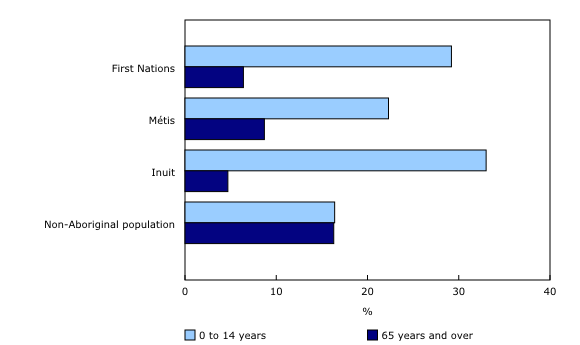
Chart 1  Chart 1: Share (in percentage) of the population aged 0 to 14 years and 65 years and over by Aboriginal identity, Canada, 2016
Share (in percentage) of the population aged 0 to 14 years and 65 years and over by Aboriginal identity, Canada, 2016

Chart 1: Share (in percentage) of the population aged 0 to 14 years and 65 years and over by Aboriginal identity, Canada, 2016

As shown in the 2016 Census release on age and sex, seniors outnumbered children for the first time in Canada. This was not the case among Aboriginal peoples.

Around one-third of First Nations people (29.2%) were 14 years of age or younger in 2016—over four times the proportion of those 65 years of age and older (6.4%). For Métis, 22.3% of the population was 14 years of age or younger, compared with 8.7% who were 65 years of age and older. Among Inuit, one-third (33.0%) were 14 years of age or younger, while 4.7% were 65 years of age and older.

While the Aboriginal population is younger than the rest of the population in Canada, it is also aging. In 2006, 4.8% of the Aboriginal population was 65 years of age and older; by 2016, this proportion had risen to 7.3%. According to population projections, the proportion of the First Nations, Métis and Inuit populations 65 years of age and older could more than double by 2036.

First Nations population growing both on and off reserve

First Nations people possess a rich cultural heritage of diverse languages, histories and homelands. There are more than 600 unique First Nations/Indian Bands in Canada. The First Nations population includes those who are members of a First Nation/Indian Band and those who are not, as well as those with and without registered or treaty Indian status under the Indian Act.

The number of First Nations people with registered or treaty Indian status rose by 30.8% from 2006 to 2016. There were 744,855 First Nations people with registered or treaty Indian status in 2016, accounting for just over three-quarters (76.2%) of the First Nations population. The other 23.8%, which did not have registered or treaty Indian status, has grown by 75.1% since 2006 to 232,375 people in 2016.

Among the 744,855 First Nations people with registered or treaty Indian status, 44.2% lived on reserve in 2016, while the rest of the population lived off reserve. There was growth for both on reserve (+12.8%) and off reserve (+49.1%) First Nations populations from 2006 to 2016.

Over half of First Nations people live in the western provinces

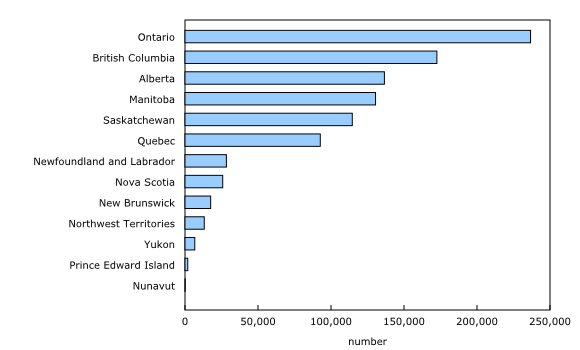
The First Nations population was concentrated in the western provinces, with more than half of First Nations people living in British Columbia (17.7%), Alberta (14.0%), Manitoba (13.4%) and Saskatchewan (11.7%). By comparison, 30.3% of the non-Aboriginal population lived in the western provinces.

Almost one-quarter (24.2%) of the First Nations population lived in Ontario, the largest share among the provinces, while 9.5% lived in Quebec.

A further 7.5% of the First Nations population lived in the Atlantic provinces and 2.1% lived in the territories.

While First Nations people accounted for 2.8% of the total population of Canada, they accounted for one-tenth of the population in Saskatchewan (10.7%) and Manitoba (10.5%), and almost one-third of the population in the Northwest Territories (32.1%).

First Nations people accounted for a smaller share of the population in Quebec (1.2%), Ontario (1.8%) and the Atlantic provinces (3.2%).

Chart 2  Chart 2: First Nations population by provinces and territories, Canada, 2016
First Nations population by provinces and territories, Canada, 2016

Chart 2: First Nations population by provinces and territories, Canada, 2016

First Nations population doubles in Atlantic Canada

While the First Nations population in the Atlantic provinces is relatively small (73,655 or 7.5% of the total First Nations population), it more than doubled (+101.6%) from 2006 to 2016. A significant part of this increase most likely stemmed from changes in self-reported identification, that is, people newly identifying as First Nations on the census.

Over this 10-year period, the First Nations population grew by 48.7% in Ontario and 37.5% in Quebec.

While the First Nations population grew at the slowest pace in Western Canada (+32.2%), the region saw the largest total increase in the First Nations population (+134,550) in Canada.

Ontario has the largest Métis population

Métis hold a unique cultural and historic place among the Aboriginal peoples in Canada, with distinct traditions, culture and language (Michif). Today, the Métis population is present in every province, territory and city in Canada.

There were 587,545 Métis in Canada in 2016, accounting for 1.7% of the total population.

Most (80.3%) of the Métis population lived in Ontario and the western provinces. For the first time, Ontario had the largest Métis population in Canada at 120,585, up 64.3% from 2006 and accounting for one-fifth (20.5%) of the total Métis population.

The Métis population grew by 32.9% in the western provinces from 2006 to 2016, to 351,020 people.

Alberta had the largest Métis population in the western provinces, accounting for 19.5% of the total Métis population. About the same number of Métis lived in Manitoba and British Columbia (15.2%), while Saskatchewan was home to 9.9% of the Métis population.

There were 69,360 Métis living in Quebec in 2016, accounting for 11.8% of the total Métis population. Meanwhile, 7.2% of the Métis population lived in the Atlantic provinces and 0.8% lived in the territories.

Chart 3  Chart 3: Métis population by provinces and territories, Canada, 2016
Métis population by provinces and territories, Canada, 2016

Chart 3: Métis population by provinces and territories, Canada, 2016

The Métis population grew at the fastest pace in Quebec (+149.2%) and the Atlantic provinces (+124.3%) from 2006 to 2016. Meanwhile, the Métis population grew by 64.3% in Ontario and by 32.9% in the western provinces. In the territories, the size of the Métis population was relatively unchanged from 10 years earlier.

Nearly two-thirds of Métis live in a metropolitan area

Of the three Aboriginal groups, Métis were the most likely to live in a city, with 62.6% living in a metropolitan area of at least 30,000 people.

There were eight metropolitan areas with a population of more than 10,000 Métis in 2016: Winnipeg, Edmonton, Vancouver, Calgary, Ottawa–Gatineau, Montréal, Toronto and Saskatoon. Combined, these areas accounted for just over one-third (34.0%) of the entire Métis population.

Winnipeg had the largest Métis population at 52,130 in 2016, up 28.0% from a decade earlier.

Almost three-quarters of Inuit live in Inuit Nunangat

Inuit are the original people of the North American Arctic. In Canada, Inuit have inhabited communities stretching from the westernmost Arctic to the eastern shores of Newfoundland and Labrador for uncounted generations. This area, known as Inuit Nunangat, refers not only to the land, but also to the surrounding water and ice, which Inuit consider to be integral to their culture and way of life. For more information, please visit the Inuit Tapiriit Kanatami website.

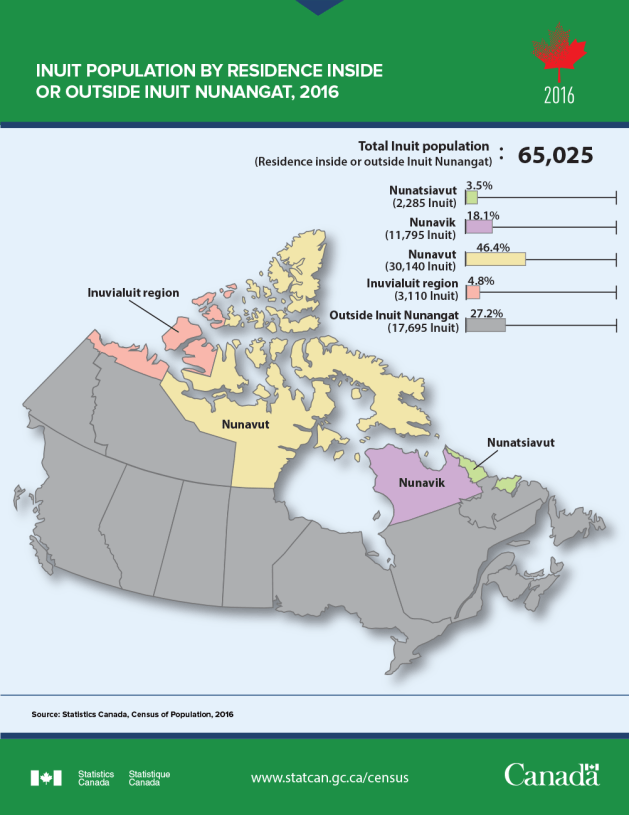
There were 65,025 Inuit in Canada in 2016, up 29.1% from 2006. Close to three-quarters (72.8%) of Inuit lived in Inuit Nunangat.

Map 1  Thumbnail for map 1: Inuit population by residence inside or outside Inuit Nunangat, 2016
Inuit population by residence inside or outside Inuit Nunangat, 2016

Thumbnail for map 1: Inuit population by residence inside or outside Inuit Nunangat, 2016

Among Inuit in Inuit Nunangat, the majority (63.7% or 30,140) lived in Nunavut in 2016, while one-quarter (24.9%) lived in Nunavik, whose communities encircle the western, northern and northeastern coastlines of Quebec. Another 6.6% lived in the Inuvialuit region, which is located in the Western Arctic, while 4.8% lived in the communities of Nunatsiavut, along the northeastern coast of Newfoundland and Labrador.

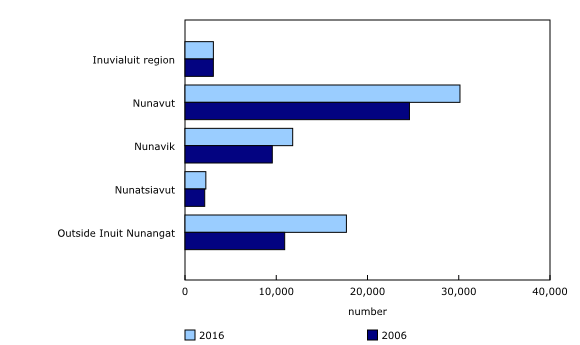
Chart 4  Chart 4: Inuit population by Inuit area of residence, 2006 and 2016
Inuit population by Inuit area of residence, 2006 and 2016

Chart 4: Inuit population by Inuit area of residence, 2006 and 2016

Inuit population growing inside and outside Inuit Nunangat

From 2006 to 2016, the Inuit population grew by 20.1% inside Inuit Nunangat. Outside of Inuit Nunangat, the Inuit population grew by 61.9%.

Among the four regions of Inuit Nunangat, the Inuit population grew the fastest in Nunavik (+23.3%) and Nunavut (+22.5%) over the 10-year period. In Nunatsiavut, the Inuit population grew by 6.0%, while in the Inuvialuit region the population was relatively unchanged.

Outside of Inuit Nunangat, the highest proportion of Inuit lived in the Atlantic provinces (30.6%). Most Inuit in the Atlantic provinces lived in Newfoundland and Labrador (23.5%), which accounted for almost one-quarter of the population of Inuit outside of Inuit Nunangat.

Over one in five Inuit (21.8%) outside of Inuit Nunangat lived in Ontario, while 28.7% lived in the western provinces. Just over 1in 10 (12.1%) lived in Quebec, while 6.8% lived in the Northwest Territories (not including the Inuvialuit region) and Yukon.

Many Inuit, outside of those living in Inuit Nunangat, lived in a city. Outside of Inuit Nunangat, 56.2% of Inuit lived in a metropolitan area of at least 30,000 people. Of Inuit living outside of Inuit Nunangat, the largest Inuit populations were in Ottawa–Gatineau (1,280), Edmonton (1,110) and Montréal (975).

The Aboriginal population living in metropolitan areas is growing

The increase in the urban population of Aboriginal peoples has been taking place for decades in Canada. This change has often been misunderstood simply as the movement by First Nations people away from reserves and into cities. In fact, the First Nations population continues to grow both on and off reserve.

Like the overall population growth of First Nations people, Métis and Inuit, the urbanization of Aboriginal peoples in Canada is due to multiple factors—including demographic growth, mobility and changing patterns of self-reported identity.

In 2016, 867,415 Aboriginal people lived in a metropolitan area of at least 30,000 people, accounting for over half (51.8%) of the total Aboriginal population. From 2006 to 2016, the number of Aboriginal people living in a metropolitan area of this size increased by 59.7%.

The census metropolitan areas (CMAs) of Winnipeg (92,810), Edmonton (76,205), Vancouver (61,460) and Toronto (46,315) had the largest Aboriginal populations. Among all CMAs, Aboriginal people accounted for the highest proportion of the population in Thunder Bay (12.7%), Winnipeg (12.2%) and Saskatoon (10.9%).

Chart 5  Chart 5: Number of First Nations people, Métis and Inuit by selected census metropolitan areas, 2016
Number of First Nations people, Métis and Inuit by selected census metropolitan areas, 2016

Chart 5: Number of First Nations people, Métis and Inuit by selected census metropolitan areas, 2016

The Aboriginal population more than doubled in seven CMAs from 2006 to 2016: St. John’s, Halifax, Moncton, Québec, Saguenay, Sherbrooke and Barrie. Among all CMAs, the Aboriginal population grew the fastest in St. John’s (+237.3%), Halifax (+199.0%) and Moncton (+197.9%).

Over the same period, Aboriginal population growth was slowest in Regina (+26.4%), Winnipeg (+37.1%) and Saskatoon (+45.4%). However, even in Regina, where Aboriginal population growth was the slowest among all CMAs, the Aboriginal population grew at a faster pace than the non-Aboriginal population.

Aboriginal children more likely to live in a family with at least one grandparent

Understanding the characteristics of young children aged 0 to 4 years is important, as early childhood experiences influence not only current but also future well-being.

There were 145,645 Aboriginal children aged 0 to 4 years enumerated in the 2016 Census, accounting for 8.7% of the total Aboriginal population. Of this group, 60.1% lived with two parents.

Just over one-third (34.0%) of Aboriginal children aged 0 to 4 years lived with a lone parent. First Nations children aged 0 to 4 years (38.9%) were the most likely to live with a lone parent, followed by Métis (25.5%) and Inuit (26.5%) children in the same age group. However, many children living with a lone parent also lived with grandparent(s). In 2016, 10.5% of Aboriginal children aged 0 to 4 were living with a lone parent and grandparent(s).

About one in six (17.9%) Aboriginal children aged 0 to 4 lived with grandparent(s) in 2016, either with a parent present or without. Inuit children in this age group were most likely to live with grandparent(s) (22.8%), followed by First Nations (21.2%) and Métis (10.5%) children.

For more information on the family characteristics of young Aboriginal children, see the article “Diverse family characteristics of Aboriginal children aged 0 to 4“.

More than 70 Aboriginal languages reported

Language both shapes and is shaped by the culture to which it belongs. Aboriginal languages—grouped into 12 language families—have been central to the history of First Nations people, Métis and Inuit in Canada and continue to play a vital role to this day.

There is a great diversity of Aboriginal languages in Canada. There were more than 70 distinct Aboriginal languages reported in the 2016 Census, more than 30 of which had at least 500 speakers.

There were 260,550 Aboriginal people who could speak an Aboriginal language in 2016, up 3.1% from 2006.

In general, the number of First Nations people, Métis and Inuit who could speak an Aboriginal language was higher than the number with an Aboriginal mother tongue. This suggests that people are learning an Aboriginal language as a second language.

The article “The Aboriginal languages of First Nations people, Métis and Inuit” contains more information on the diversity of Aboriginal languages in Canada.
Source: The Daily — Aboriginal peoples in Canada: Key results from the 2016 Census

ICYMI: Halloween stores starting to get the ‘appropriation’ message

Hard to see this being that being a priority issue for most Indigenous peoples given other more pressing concerns but interesting nevertheless to see how legitimate concerns over representation trickle down:

Halloween costume stores seem to be getting the message about cultural appropriation, but some are still stocking offensive costumes, says an Indigenous social media activist.

Chippewa woman Alicia BigCanoe’s social media campaign, #IAmNotACostume, has been spreading awareness for several years about how costumes depicting Indigenous stereotypes during Halloween negatively affect First Nations, Métis and Inuit people.

“[I feel] a little bit of anxiety around [Halloween], especially knowing that children see these images and First Nations, Inuit and Métis children still see themselves being romanticized in these costumes,” she said.

However, this year is little different, she said.

“The intensity is not as strong as it has been in previous years. I think that’s because of the amount of spotlight that has been put on this issue. It seems that as each year passes more and more folks are starting to ask questions,” said BigCanoe, who posts a picture of herself yearly in traditional Indigenous garb, along with her #IAmNotACostume hashtag.

Beginnings of change

Some costume stores say they’re doing their best to make sure their costumes are inclusive and don’t appropriate from Indigenous and other cultures.

“People want Pocahontas costumes, people want Mexican ponchos, people want stuff that really isn’t appropriate,” said Alana Sambey, manager of Malabar Limited in downtown Toronto.

In the two years Sambey has been stocking Malabar for Halloween, she said she has actively put a hold on purchasing products that appropriate other cultures.

“People need to recognize that it is in fact culture, not costume,” Sambey said.

“I think it’s really important that people do not wear for costume or for fun something that is from a culture that is not their own because it dehumanizes that culture,” she added.

The manager from the LaSalle, Que., location of Halloween Depot, a corporate chain, told CBC he is not stocking his shelves with costumes that appropriate Indigenous cultures this year.

Across the country in Kelowna, B.C., Deborah Lawless, store manager of Halloween Alley — another line of franchised stores — said her location is also not stocking Indigenous costumes this year, although she noted they have in the past.

“We have a lot of respect for different cultures and this should be a fun time of year for everyone,” said Lawless.

Not all stores agree

In Peterborough, Ont., a staff member from the local costume shop K&C Costumes confirmed by phone the shop carries “Native American” costumes for men, women and children.

CBC called another store in Vancouver to inquire whether it was stocking Indigenous costumes.

“We sell everything. We’re a costume store,” said the manager of the Vancouver Costume Store.

A staff member from a local costume store in Guelph, Ont., said it carries Indigenous costume items, including tomahawks, spears, and bows and arrows.

Algonquin teen Maddie Resmer said she and her friends went to a Spirit Halloween store in Kitchener, Ont., in September.

There, the 17-year-old found six full costumes based on Indigenous stereotypes that left her both enraged and heartbroken.

The costumes were labelled with the names “Native American Princess,” “Indian Warrior” and “Noble Warrior,” but Resmer said the worst offender, “Reservation Royalty,” left a particularly bad impression on her.

“No Native child wishes to spend their life on the reservation that imprisoned their ancestors, and yet they have no choice. They boil their drinking water, they walk 35 kilometres to get to school, they watch their friends, family, community members fade away into alcoholism, abuse, and suicide — this is the way of the Canadian reservation,” said Resmer.

“There is no ‘reservation royalty.'”

Franchisee’s choice

A pop-up location for a different Spirit Halloween location in downtown Toronto displayed no Indigenous costumes on the walls.

The store manager, who said she has been told by her head office not to identify herself to media, confirmed to CBC the store would not be stocking its shelves with Indigenous-based costumes this season.

Another staff member told CBC the store had trouble in the past with displays of Indigenous-based costumes being repeatedly torn down.

Spirit Halloween’s head office was not available for comment by phone and did not respond to email requests by CBC about the costumes found in the Kitchener location.

However, it did send CBC a statement in 2016 about the Indigenous costumes they carry.

“Since 1983, at Spirit Halloween, we have offered a wide and balanced range of Halloween costumes that are inspired by, celebrate and appreciate numerous cultures, make-believe themes and literary figures,” a spokesperson from the company said in a statement.

“We have not directed any of our Spirit Halloween stores to remove Indigenous-themed costumes from our shelves, nor do we plan to have these costumes removed.”

Source: Halloween stores starting to get the ‘appropriation’ message – CBC News | Indigenous

Christie Blatchford: Toronto school board declares war on ‘chief’ and all sense 

Blatchford has a point (apart from the opening two paras):

If there were any doubt, there is no more: Canada is the stupidest country ever.

The evidence, already all around, is now irrefutable.

The Toronto District School Board, in its efforts to remain ahead of the Ontario government curve on all gender-cultural-political sensitivities, is not only contenting itself with following Education Minister Mitzie Hunter’s directive of early this year to review all potentially indigenous-offensive team names and mascots, but also has declared war on the word “chief.”

“I can confirm that the title ‘chief’ is being phased out in various departments at the TDSB,” board spokesman Ryan Bird told Postmedia in an email Tuesday.

“It’s part of the ongoing work that the school board does through the TDSB’s Aboriginal Education Centre with regards to Truth and Reconciliation (Commission, or the TRC, which produced its massive final report in 2015).”

While apparently some key titles at the board were changed a few years ago, such as chief financial officer, among the recent casualties is the sign on the door to the office of Chief Caretaker Karen Griffith at Glenview Public School in the city’s affluent north end.

There, last week, staff noticed that the word “chief” had been blacked out on the door.

(Apparently, no thought or consideration had been given to how students of colour might react to the notion that a bad sign could be simply blacked out, and whether this is tantamount to cultural erasure.)

Presumably, board chair John Malloy will have to review and correct his C.V., where he is still described as former Chief Student Achievement Officer for the provincial education ministry.

Presumably, the board’s chief technology officer and chief information officer and chief social worker will all have to do the same. Etc., etc.

Attempts to find out precisely where in the TRC’s Calls to Action section there is any cry for the de-chiefing of the language in Canadian schools went unanswered. The board spokesman, Bird, tried hard on Postmedia’s behalf to get someone to respond but to no avail.

The best he could do, he said, was to suggest that the move didn’t necessarily come out of the TRC itself, but was “an aspect of a larger conversation staff have had” since the report was issued. Bird said he consulted with a TDSB elder who told him that probably “every Aboriginal person has been referred to as ‘chief’” in a derogatory way at some point in his or her life.

But the fact of the matter is that the word is Latin in origin and comes from the Latin “caput,” meaning head or leader, via the French, where chef is short for chef de cuisine, or boss of the kitchen.

If many people understand that caricatures such as Chief Wahoo, the mascot of the Cleveland Indians, might be offensive to Indigenous ears and eyes, it’s a struggle to get the notion that a non-Indigenous word such as “chief” is equally insulting.

Bird said the remaining board staff with offensive titles were notified verbally last month. Because there’s no formal motion or document describing corrective action, it’s impossible to know what precisely staff were told to do.

Source: Christie Blatchford: Toronto school board declares war on ‘chief’ and all sense | National Post

Fonctionnaires autochtones: insatisfaction, discrimination et harcèlement | Maxime Bergeron | Politique canadienne

Haven’t seen this covered in English media. Worrisome (although it would be useful to have some comparative data for other groups):

Alors qu’Ottawa multiplie les appels à la «réconciliation» avec les peuples issus des Premières Nations, une enquête menée auprès de 2189 fonctionnaires fédéraux autochtones révèle un pourcentage élevé d’insatisfaction, de même que de nombreux cas de «discrimination» et de «harcèlement» au travail.

L’enquête menée par le groupe-conseil Quorus au profit du ministère de la Sécurité publique, obtenue par La Presse, indique aussi que 40% des employés autochtones songent à quitter leur poste d’ici deux à trois ans. Des conclusions qui ne surprennent pas du tout Magali Picard, vice-présidente exécutive à l’Alliance canadienne de la fonction publique (AFCP) pour le Québec et porte-parole du Cercle national des peuples autochtones.

«Je ne vous ferai pas croire qu’il n’y a pas de discrimination au gouvernement du Canada, ce n’est pas vrai. Ce que ça fait, souvent, c’est que les gens ne restent pas en poste.»

Mme Picard, membre de la nation huronne-wendate, dit avoir elle-même vécu plusieurs situations troublantes alors qu’elle était employée du gouvernement fédéral. Elle entend encore régulièrement les problèmes de fonctionnaires autochtones pendant des «cercles fermés» de discussion, où ils ne craignent pas les représailles.

«Pas plus tard qu’en mai dernier, j’ai entendu des histoires d’horreur, où des gestionnaires venaient juger les us et coutumes qui sont pratiqués dans les réserves ou les familles, en disant que c’était dépassé ou du folklore, que les gens devraient être gênés, raconte la dirigeante syndicale. On entend aussi tous les stéréotypes : vous ne payez pas vos taxes, votre électricité. C’est aberrant.»

«Sentiment de discrimination»

Parmi les conclusions du sondage de Quorus, remis en mai dernier au gouvernement, on apprend que 42% des autochtones jugent l’accès à des possibilités d’apprentissage et de perfectionnement «inégal». Questionnés sur les plus grandes difficultés rencontrées dans leur emploi, 18% ont mentionné un «manque de respect pour la culture autochtone» et 17%, un «sentiment de discrimination».

«Ceux qui ont une expérience négative à l’égard de leur environnement de travail ont abordé les aspects suivants : la discrimination, le harcèlement, l’intimidation et le manque de respect en milieu de travail», peut-on lire dans le rapport de 123 pages.

«Dans certains cas, on a rapporté des attaques insidieuses, et dans d’autres, des situations de discrimination directe.»

Le sondage souligne que 56% des fonctionnaires issus des Premières Nations sont «satisfaits ou très satisfaits» de leur emploi. Mais 40% pensent à quitter leur poste d’ici deux ou trois ans, une proportion plus élevée que pour l’ensemble des employés de la fonction publique fédérale (26%), d’après des données citées dans l’étude.

Amélioration

Selon la syndicaliste Magali Picard, la situation des autochtones se serait dégradée dans la fonction publique pendant la décennie du règne des conservateurs, entre 2006 et 2015. «Oui, on a vu une recrudescence des comportements de harcèlement, d’intimidation, d’abus de pouvoir, de commentaires qui sont vraiment très difficiles à croire dans les années auxquelles nous sommes rendues, et ce, de la part de l’employeur le plus important au pays.»

Les choses auraient toutefois commencé à s’améliorer depuis la passation des pouvoirs à Ottawa, soutient Mme Picard. «Même si ça ne va pas à la vitesse qu’on voudrait, l’attitude est différente, le respect est là, et la volonté de rétablir des liens, on la sent. Ça, ça ne peut que nous aider à améliorer les conditions des employés de la fonction publique.»

Réponse d’Ottawa

Au cabinet de Scott Brison, président du Conseil du Trésor qui chapeaute la fonction publique canadienne, on a souligné hier avoir pris un « engagement fondamental » en vue de « renouveler la relation avec les peuples autochtones ».

«Il nous reste bien du travail en matière de recrutement et de rétention des employés autochtones», affirme Jean-Luc Ferland, attaché de presse du président du Conseil du Trésor Scott Brison.

Pour tenter d’attirer davantage de jeunes autochtones, Ottawa a lancé en 2016 un programme de stages d’été destiné aux étudiants, considéré comme «un pas significatif dans la bonne direction». Le nombre de participants a triplé entre la première et la deuxième année, avance le Conseil du Trésor.

Selon des chiffres de mars 2016, quelque 5,2% des 259 000 employés du gouvernement fédéral sont issus des peuples autochtones. Il s’agit d’une surreprésentation par rapport au taux de disponibilité des autochtones au sein de la population active, qui s’élève à 3,4%, indique une autre étude d’Ottawa.

Source: Fonctionnaires autochtones: insatisfaction, discrimination et harcèlement | Maxime Bergeron | Politique canadienne

Why I quit the Art Gallery of Ontario: former Canadian-art curator Andrew Hunter explains

Interesting commentary on the challenge of making collections reflect current as well as earlier society. The National Gallery in Ottawa mixes Indigenous art with non-Indigenous art in its Canadian galleries in a compelling narrative:

An image greets visitors as they enter Every. Now. Then: Reframing Nationhood, my final exhibition for the Art Gallery of Ontario.

It’s called The Edge of a Moment and the artist, Meryl McMaster, is seen pausing at the lip of Head-Smashed-In Buffalo Jump, a sheer cliff face in Southern Alberta: Treaty 7 territory, her ancestors’ homeland. As she moves north, her face, masked with white paint, turns toward me, away from the cliff.

She’s not looking at me, of course, but the image makes me feel conspicuous and so very present: McMaster, a strong voice within an emerging generation of Indigenous artists, moves with a confidence tinged with anxiety and sadness as she calls her “ancestors to travel with her into the future” — a future weighed down by the presence of my ancestors and our colonial legacy.

I had the honour to co-curate Every. Now. Then. with Anique Jordan, an artist, activist and independent curator based in Toronto. It was our critical response to Canada 150, designed to be a catalyst for significant change within an institution that remains (like so many others in this country) burdened by, and seemingly committed to, a deeply problematic and divisive history defined by exclusion and erasure.

Carried by the confident voices of many artists, Every. Now. Then. embodies the momentum of transformation that so many of us felt was powerful and real. Its reception, both publicly and critically, has been remarkable and moving; it confirmed for me that this messy, problematic initiative is in sync with this moment.

So my decision to give up my senior position at the AGO during the run of this exhibition has come as a surprise to many. Why leave now?

My choice rests in a disappointment: not in what we achieved, but the fragility of its ability to persist. As I leave, I worry about an institution wavering in its commitment to make space for new voices — voices traditionally excluded from senior roles at public cultural institutions in Canada.

It rests in issues that have informed my work as a curator, artist, writer and educator for almost three decades: the elitist, colonial roots of public museums, what being a public institution truly means, and who controls and is allowed to speak in these nominally “public” realms.

I have always been concerned about the role art museums play in the wider world, about how truly engaged they are with the critical issues of our times. I’m fortunate to be able to teach regularly on museum and curatorial practice (currently in the graduate program at OCAD University). We often begin with the origins of the contemporary museum, which was born out of the private collections of wealthy Europeans who had built their fortunes on the extraction of resources, and people, from the most vulnerable nations in the world.

Out of this dubious practice evolved public educational institutions, or so they self-described. Really, they were outward displays of power that reinforced class division and validated the corporate and colonial systems that had made their founders rich. From wealth came power and then cultural dominance: museums set social rules, coercing the broader public toward shared values they deemed to be “acceptable.”

Despite everything, for most institutions, that’s the model that remains: “Value” is decided by the very few and then presented to the many. When I look at the AGO and so many of its peers, I see an institution guided not by public participation, but by the generic, elite consensus that rules the global art market, which sees product over public good.

I see institutions that look for leadership and to fill critical content roles outside of this community and country (a remarkable community, by the way, of cultural professionals with diverse and distinct voices that has been deeply invested here for decades). At the AGO, the curatorial department is becoming dominated (at various levels) by individuals from, or primarily trained in, the United States. It has become abundantly clear to me that it is highly unlikely that the currently vacant position of chief curator — a critical role, from which many content decisions flow — will be filled by a Canadian.

I see too many who lack true knowledge of this place. I see those same people committed to sustaining dated academic divisions that wrongly take priority over the kinds of interdisciplinary, cross-cultural, community-focused work that is desperately needed for our culture to adapt and evolve.

The current program of reinstalling the permanent collections of European and Modern art, called Look: Forward, lays bare this disconnect: it lacks any deep engagement with Canada, Canadian art or the diversity of this community.

I see overgrown institutions grounded in a corporate model that appears uncritically committed to expansion at a time when we should all be making it a priority to question its role in the public conversation here, and acting against the destructive impulse of such generic “world class” aspirations.

The star system of the contemporary “art world” and the hierarchical corporate model create divisive, competitive, unhealthy environments for work. For Indigenous peoples, people of colour and many youth, these institutions remain unwelcoming spaces of trauma — spaces where their marginalization remains at the core of the institutions’ mission.

At the AGO, there have been some major contemporary exhibitions by compelling international artists in recent years (Theaster Gates and Hurvin Anderson, for example). But as with the new permanent collection program, very little has been done to ground these projects and make meaningful connections to the local, or break out of the rigidly defended curatorial silos. In these two examples specifically, opportunities for local engagement abounded; instead, they remained closed off by the barriers imposed by the global art world model, inoculated from real engagement.

Worse, they consistently overshadow, in profile and financial commitment, the work of leading artists in this region, who have significant, and long established, national and international careers. There are exceptions — Song Dong’s Communal Courtyard, initiated by former AGO chief curator Stephanie Smith, had a rich program of local content developed collaboratively across the institution and with community partners — but they’re all too rare.

Engaging with diversity has to mean more than just expanding an audience for an established model, to be more than some insidious missionary program of converting more to have faith in these institutions, and drawing communities into a program of their own marginalization and erasure.

These debates were front and centre when I was a student in the 1980s. The key critical texts of that time continue to be primary references, three decades on, confirming that little has changed.

Reading again the words of James Baldwin, who offered searing criticisms of the deep, systemic racial barriers of his day, I find his words familiar and offering a kind of radical hope. At the close of No Name in the Street, from 1972, he writes of a crisis, of racism and colonialism, a “global, historical crisis” not about to resolve itself soon. “An old world is dying,” Baldwin declares, “and a new one, kicking in the belly of its mother, time, announces that it is ready to be born. This birth will not be easy, and many of us are doomed to discover that we are exceedingly clumsy midwives. No matter, so long as we accept that our responsibility is to the newborn: the acceptance of responsibility contains the key to the necessarily evolving skill.”

And so I return to The Edge of a Moment, to that image of Meryl McMaster moving across that sublime landscape. I imagine her turning away and continuing on as I struggle to keep up. She walks with her ancestors into the future while I plead with mine to stay behind, to give up and give back this space. Undepleted.

Source: Why I quit the Art Gallery of Ontario: former Canadian-art curator Andrew Hunter explains | Toronto Star

Toronto’s Indigenous consultant resigns, files human rights complaint

From a reasonable accommodation standpoint, her right to practice smudging would need to be weighed against the overall ban against smoking and the effects of second hand smoke.

Will be interesting to see how complaint will be resolved:

The woman hired to help city hall improve its relations with Indigenous communities has resigned and filed a human rights complaint against the city, Metro has learned.

Lindsay Kretschmer, a Mohawk Wolf Clan member, was hired last March as a full-time Indigenous Affairs consultant in the city’s Equity, Diversity and Human Rights division. Part of her job was to liaise with local Indigenous communities and provide the city with expert policy advice, in line with the city’s efforts to respond to the Truth and Reconciliation Commission report.

But her stint was short-lived. In early July, Kretschmer tendered her resignation over what she calls “disrespectful” treatment of the Indigenous file. She has since filed a complaint at the Ontario Human Rights Tribunal, claiming the city violated her right to practise smudging, an Indigenous ceremony that involves burning sacred medicines.

“I waited for three months but I was never allowed to smudge in that building,” she said. She wanted Indigenous people to have a specific room at city hall where smudging can be performed, like the prayer/meditation room where members of any religion can pray.

City spokesperson Wynna Brown did not discuss specifics of the case with Metro but wrote in an email that the city has responded to Kretschmer’s application and “looks forward to the opportunity to present its case through the tribunal process.”

Kretschmer said she was later told she could smudge inside one of the managers’ offices — a response she regarded as “not dignified” because of the lack of privacy and personal space. One colleague even suggested she smudge outside.

“In 2017 you’re forbidding me from practising my culture. That’s essentially a repeat of colonization behaviour,” she said. “It’s just really bad to work there as an Indigenous person.”

Mayor John Tory has committed to increasing Indigenous presence at city hall, and the hiring of Kretchmer was seen as the first step. The city recently started acknowledging Toronto’s position on traditional Indigenous land at council and committee meetings. Indigenous flags fly on a permanent basis, and there’s a plan to give councillors and staff cultural competency training.

Tory’s spokesperson Don Peat referred Metro to strategic communications for answers on the case, adding the mayor “is committed to continuing to build positive relationships with Toronto’s Indigenous communities. He recognizes there is still much work to be done.”

At its meeting next Monday, the Aboriginal Affairs Committee will discuss the recruitment of a new consultant as they continue to work on the creation of an Aboriginal Office at city hall.

Kretschmer now believes that’s all “glamour” because there’s no concrete plan to promote Indigenous communities across the city. She says her hiring was just for show.

“It was a token position to make themselves look good, but they are doing nothing on the Indigenous file,” she said, adding there’s no Indigenous employment strategy and no budget to train staff.

“They are very far behind on that file. People are very upset with them. They’ve failed in so many ways it’s not even funny.”

Source: Toronto’s Indigenous consultant resigns, files human rights complaint | Toronto Star

B.C.’s First Chief Judge [Begbie] haunts Law Society

The risks of hasty decisions and lack of fulsome discussion:

The ghost of pioneering B.C. justice, Sir Matthew Begbie — the Hanging Judge to some — has come back to haunt the Law Society of B.C.

The professional regulator’s benchers this spring unanimously exorcised from its lobby a statue of the legendary chief judge.

And they scrubbed references to him from the society’s image as offensive to Indigenous people.

But the colonial-era jurist who brought law-and-order to the two colonies that were the cornerstones of the province has not gone quietly into that good night.

And the decision to disown Begbie may yet prove to be just as controversial as moves in the U.S. to remove public symbols of the Confederacy or East Coast attempts to eliminate memorials of Halifax founder Edward Cornwallis, who issued a bounty on Aboriginal people.

The profession’s blue-chip journal, The Advocate, has rallied to defence of the province’s first chief justice.

In its unsigned editorial column entitled Entre Nous — Between Us, the august publication this month says that the move is “perhaps even a step in the wrong direction — than a purposeful and reasoned step toward reconciliation.”

“By removing the Begbie statue from the Law Society lobby, our governing body is now telling us that Begbie’s legacy has but a single dimension which is antithetical to truth and reconciliation,” asserts the magazine that goes to every lawyer in the province.

It added: “With great respect to the intentions of the parties, we think the recommendation to remove the Begbie statue and the acceptance of that recommendation are both misguided. … We fear that the rush to reconciliation has trampled a principled approach with one unintended consequence being estrangement rather than reconciliation of interested parties.”

Editor Michael Bain said many lawyers have already told him they want the society to revisit the issue as it was forced to do over its initial approval of a law school at Trinity Western University.

“I’ve had a lot of interesting conversations and a lot of reaction to it,” said the Vancouver lawyer. “It has definitely struck a nerve … and the impact of it happening on the profession I think has been to give people pause as to what the benchers are doing or how they are doing it.”

Published by the Vancouver Bar Association since 1943, the magazine’s masthead bears a who’s who of the profession — Christopher Harvey, Q.C. David Roberts, Q.C., Court of Appeal Justice Mary Saunders, Peter J. Roberts and Provincial Court Judge William F.M. Jackson.

The editorial acknowledged a certain amount of anxiety about wading in on the issue “but just as the first tentative steps into the ice-cold mountain lake can result in a terrified skip back up the slope, usually it is the icy plunge itself that yields the better reward.”

It then proceeds to kick the intellectual stuffing out of the society’s decision — citing the historical record to show the renowned legalist was ahead of his time and a supporter of Indigenous people.

A Cambridge-educated Chancery barrister and member of Lincoln’s Inn, Begbie arrived in what is now B.C. in 1858 at the age of 39.

“He learned a number of Indigenous dialects and even conducted trials in those languages. He had great friendships with a number of chiefs … he was clearly sympathetic when it came to trying to impose colonial law on Indigenous people. He recognized the concept of Aboriginal marriage and allowed an oath for truth-telling that recognized Aboriginal beliefs. In fact, he was surprisingly enlightened for a 19th-century Englishman when it came to understanding and interacting with Aboriginal peoples.”

Nevertheless, the Law Society indicted Begbie for presiding over four trials in which six of nine accused Tsilhqot’in warriors were convicted by juries for murdering white road-builders.

Indigenous people have long insisted the executed chiefs were freedom fighters protecting traditional territories from the encroachment of settlers.

Moreover, the chiefs surrendered only after threats to slaughter Indigenous women and children.

In 1993 the NDP Attorney General apologized for the hangings and in 2014 Liberal Premier Christy Clark confirmed the exoneration of the chiefs.

“The whole affair seems quite unseemly — indeed, Begbie’s contemporaneous writings reveal his decided unease about the outcome — but we are still trying to grasp what it is that Begbie did wrong,” the editorial maintains.

“He did not pass judgment himself but he did pronounce the mandatory sentence as the law required him to do.”

There is another Begbie icon outside the New Westminster courthouse and three mountains, two lakes, a creek, an elementary school, streets and other sites across B.C. bear his name.

The society made its decision to erase Begbie without consulting the membership, though it noted many lawyers would disagree with the move.

“I’m not sure it’s the proper road towards reconciliation in my view,” Bain said. “I would have thought more dialogue would have been helpful rather than less.”

Source: B.C.’s First Chief Judge haunts Law Society | Vancouver Sun

ICYMI: Rewriting history? That’s how history is written in the first place – Macleans.ca

Worth reading – the counterpoint to some earlier commentary:

If you’ve been following the debate over whether Sir John A. Macdonald—prime minister, lawyer, architect of Confederation, corrupt politician, and functional alcoholic—should have his name removed from schools and buildings in Ontario, you’ve likely encountered histrionic reactions from those who decry such efforts as erasing history or re-writing our past or genetically engineering political correctness into Canadians.

The “history is under attack!” responses are predictable, but that’s not their critical deficiency. No, the greatest weakness in that argument is that it fetishizes a particular account of history, ignoring what history is, what it represents, and what it does. Many of the quickest takes about the “problem with re-writing history” are sops for old-school culture, mopping up buckets of indignation from those whose historical experiences and values seem rather well-represented in our official accounts of our past, as well as our acknowledgements and celebrations of events and figures.

This all started last week when the Elementary Teachers’ Federation of Ontario (ETFO) cracked open Pandora’s box by passing a motion to “examine and rename schools and buildings named after Sir John A. Macdonald.” The impetus for dropping the sometimes-beloved whiskey-soaked codger? “[H]is central role as the architect of genocide against Indigenous peoples.” I’d say the punishment fits the crime here, except it doesn’t; being structurally complicit in the deaths of many peoples and their culture while initiating an ongoing history of violence against the descendants of those peoples seems to warrant a rather more severe reprimand. But let’s set that aside.

This debate has been a long time coming. We should have had it in earnest a long time ago, given changes to the makeup of Canadian society and the longstanding injustices that remain woefully and shamefully under-addressed or unaddressed entirely, especially our relationship with Indigenous peoples. But the debate thus far hasn’t sufficiently acknowledged one crucial consideration: revisiting our history—reassessing it and how we think about it—is central not only to correcting the record in some cases, but also to moving forward as a country. History is not a static moment or series of moments; history is an ongoing project that connects past generations to the present, and it is built by human beings who make choices about what we admit to, what we ignore, what we celebrate, and what we condemn.

The preferences, norms, and values of a society change over time; the present is a reflection of what we want to represent us, right now—and so it is perfectly reasonable, and often necessary, for a country to revisit what in its history it chooses to emphasize and celebrate. This is, after all, how history is written in the first place.

Now, no one is suggesting that we completely strike Macdonald and other historical figures who are implicated in practices or actions we now find unacceptable or abhorrent from the history books. No one is arguing that we should forget Macdonald’s legacy as a critical part of Confederation. We’re not turning the porch light off and pretending we’re not home should he pop by.

All the ETFO and others are suggesting is that in some instances, we should choose not to celebrate and honour Macdonald by naming schools and buildings after him, which seems rather reasonable given that he was complicit in the abusive and murderous residential schools system as well as other (what we would now call) crimes against Indigenous peoples. If a democratic society chooses to live its history by shifting who and what it emphasizes and celebrates, then bully for it—especially if a shift in focus is used to foreground and address historical and contemporary injustices and to renew efforts at healing persistent wounds. This reassessment of the past and how we live in the present is only controversial if your understanding of history is static and your commitment to your country is monolithic.

Historian Sean Carleton captured this line of argument well, reminding us that history is always political and never objective, and that while facts are objective, history is not. “We need to remember that both naming and renaming are political things that need debate,” Carleton said in a piece that ran in the Calgary Herald. “Names are not neutral and that’s what I think is somewhat frustrating about the claim that changing the name is erasing history.” Precisely.

Cherie Dimaline, a Métis woman, wrote in Today’s Parent that history is indeed political, as well as ongoing and alive in the present, especially the Canadian history of violence against Indigenous peoples. “It strikes me as particularly ironic that they’re worried about history being lost. After all, the very fact that we send our children to schools named after the architect of Indigenous genocide through the residential schools attempts to remove our story, negate our well-being and ignore our continued survival,” she writes. “It is, in fact, a push to actively lose history….I hear all the time that colonization happened 400 years ago, that it’s so far gone that we shouldn’t be so sensitive…. Colonization didn’t happen 400 years ago; it began 400 years ago and continues today. Right now.”

Carleton and Dimaline remind us that history is ongoing and disputed; as we live, and make choices about how we remember and view our own histories, we create history anew, whether we care to acknowledge that or not. Those who oppose dropping Macdonald’s name from schools and buildings smuggle in a comfort with a broad conceit of history that isn’t universally shared, one that carries water for some but not for others; one person’s “re-writing of history” may be another’s rectification of history. A sophisticated understanding of where we come from takes this understanding of history for granted as a starting point and accepts that the past is more than a series of fixed written records, and our conception of it certainly isn’t objective.

As long as we humans have had history, we’ve been re-writing it. In fact, our history is the history of “erasing”—that is, revisiting and revising—our past. Canada is no exception to this practice, and nor should we be. Indeed, it may be the case that the best way to continue as a country is through an ongoing and vigorous debate about who we are, where we come from, what we value, and what we choose to celebrate, emphasize, and honour in our public spaces.

Source: Rewriting history? That’s how history is written in the first place – Macleans.ca

John Ivison: Liberals turn against seafood producer in name of Indigenous reconciliation

Competing claims. Funny how the government has been criticized for symbolism and “empty words” and then is also criticized when it proposes something substantive which affects the interests of others, particularly in this case, private sector interests:

In its annual report, Clearwater Seafoods warns shareholders that its international operations are subject to economic and political risk. The domestic operations were obviously not considered precarious — after all, what could go wrong when you have a friend in the prime minister?

A year ago, Justin Trudeau was pictured in Hangzhou, China with Alibaba Group founder Jack Ma, waving around a Clearwater lobster that had recently been made available for sale on Ma’s e-commerce site T-Mall.

But politics is a fickle mistress. Promoting a growing Canadian seafood producer in Asia was a top priority when the cameras were rolling in China, but those ties have been severed now that Clearwater is an impediment to a project even closer to the prime minister’s heart: Indigenous reconciliation.

Last Thursday, the Department of Fisheries put out an innocuous-looking press release that said it will use 25 per cent of the existing total allowable catch of Arctic surf clams to issue a new license that will be open to expressions of interest from “Indigenous entities” from the four Atlantic provinces and Quebec.

Fisheries minister Dominic LeBlanc said that by “enhancing access” to the surf clam fishery for Indigenous groups, “we are taking a powerful step toward reconciliation.”

But one group’s “enhanced access” is another’s lost business.

Surf clams Clearwater Seafoods

Clearwater has, to this point, controlled all the quota available, meaning that its clam business — providing those brilliant red tongues that look so appealing in sushi — is about to shrink by a quarter.

The company is keeping its own counsel — it would say only that it was reviewing the decision — but Rex Matthews, the mayor of Grand Bank, Nfld., where Clearwater has a processing plant, did not mince his words.

In a letter to LeBlanc, he said he had received the news “with a sense of shock, disbelief, disappointment and discouragement.”

His town is “reeling and flabbergasted” that the government would take nearly 10,000 tonnes of allowable catch from a quota that has been granted to Clearwater for years, he said.

“This decision by your department has shattered the dreams of those employees who will see harvesting vessels tied up early in the year and their plant closed for at least four to five months of the year. These employees will now be forced onto the payroll of the federal government through the EI system, whereas before they were productive, contributing and proud members of society.”

The mayor goes a little far when he accuses the government of “expropriating” Clearwater’s quota. It is, after all, a public resource and quota does not confer property rights to the fishery or the fish.

But Clearwater deserves credit for developing the Arctic surf clam fishery into a $92-million market through continuous investment.

Clearwater successfully harvested its full quota in 2016 for the first time because it added a new $70-million factory-at-sea vessel to its existing fleet of three. Further, it is in the process of building a new $70-million harvesting vessel as replacement for one of the older ships.

You don’t make those kinds of investments if you think you are about to lose the right to fish.

LeBlanc said in an interview in St. John’s Tuesday that discussions to open up the market have been going on for over a year.

“It’s not a surprise,” he said — which will apparently come as news to the mayor of Grand Bank.

Earlier this summer, the government decided not to increase the current quota, a move that would have allowed new entrants and one that, ironically, Clearwater opposed.

LeBlanc said that his hope is that at some point, the data will show the stock is healthy enough to increase the quota. He said the government hasn’t taken existing quota from anyone yet — it has simply called for proposals from Indigenous groups to see whether any are prepared to come forward, potentially in partnership with an experienced offshore operator, to profit from the clam fishery. “We want to see if commercially and operationally, it’s viable. It’s an expensive undertaking to go 120 miles offshore with a large vessel,” said LeBlanc.

Quite who might be prepared to invest $70-million or so in a new clam-fishing vessel is not clear. Calls to Membertou First Nation in Sydney, N.S., one of the likely applicants, were not returned. One potential partner, Louisbourg Seafoods of Nova Scotia, said it would not partner in a venture where it would not be the majority shareholder.

Source: John Ivison: Liberals turn against seafood producer in name of Indigenous reconciliation | National Post