The bridges Canada must build, right here at home: John Ralston Saul

Nice long read on the links between Indigenous peoples and immigration:

To the extent that the Canadian system works, it is on one side thanks to a policy, a department, an expert civil service; and on the other side to tens of thousands of engaged citizens, many of them involved in volunteer organizations. Without one half or the other, the whole system would collapse. Our system has given itself one important psychological advantage – a clear understanding that the primary purpose of immigration is to become a citizen, as fast as possible. The sooner immigrants are citizens, the sooner they can help carry the burden of making society function.

Yet, no matter how successful the Canadian system, it cannot work in the long run if it – we – function in denial of reality. For half a millennium, immigration to Canada has been intimately tied to the Indigenous peoples. They welcomed newcomers for hundreds of years. Their welcome and openness, their support and sharing, shaped what our immigration policy would come to look like at its best. They were betrayed, particularly from the 1860s on. That is why there is growing debate over how to handle the role of historic Canadian leaders in this wrongdoing. One thing is clear, after a long struggle: Indigenous peoples are on their way back to a position of great influence.

We all agree that our system of immigration and citizenship is not perfect. I would argue that its fragility lies in our denial of the central role of Indigenous peoples. That is the original Canadian conversation – between those who were here and those who came. Deep within our reality, it is still the essential Canadian conversation. To deny this is to deny our history, but also our structures of injustice.

We now all know that the bricks and mortar of that injustice is underfunded and below-standard schooling, a dearth of Indigenous-language programs, social programs, medical services, clean drinking water, housing. And much more. We know changes are coming. But too slowly.

We know that evil was done through state schools, the public administration system, policing and the courts. And all of this was enabled by our parliament and provincial legislatures. Apologies have been made. But apologies are neither actions, nor money, nor programs. We talk endlessly about reconciliation. But reconciliation is nothing without restitution.

All these elements represent the as-yet unbuilt bridges necessary for respectful human relationships.

Some Indigenous people do not see themselves as Canadians. Some do. Some see themselves as both Indigenous and Canadian. That is their business. And that is a reminder of how clearly we must reject the Westphalian model, its monolithic mythologies and its 19th-century pastiche imitations of what makes a proper nation-state. So when we talk about diversity or multiculturalism or interculturalism we are talking about an important philosophical difference with standard Western ideas of how societies function. These are not just words or conveniences. They are ideas which can reshape human relationships.

That is why the concept of rivers as the bridges of this place is so important. It is a very different idea of human relationships, which is not based on fear of the other or on the exclusive ideas of difference, or on equally exclusive ideas of oneness. All of this is carefully laid out in Indigenous philosophies, which embrace complexity as central to how human beings embrace their differences and their relationships with each other.

This involves concepts of how humans relate to place, concepts that take us off our controlling pedestal and make us part of the place, with responsibilities rather than ownership as the key factor. Richard Atleo. Read Leroy Little Bear. Read Jean Teillet. Read Taiaiake Alfred. Read Lee Maracle. Read Niigaan Sinclair. Read dozens of other Indigenous thinkers. You will see what I mean. More important, you will see what they mean.

I have written before that the only roots I can find for the degree of comfort in our attitudes toward immigration and diversity are Indigenous. We owe a debt of gratitude for this. And for our comfort with complexity we owe a deep debt of gratitude, in particular to the example set by the Métis Nation and its people. They demonstrated that, with complexity, you can build a civilization.

It is curious. Most of us will agree that great evil has been done; that our apologies were right and necessary. Most of us will agree that the resulting injustices must be faced and dealt with, whatever the cost. More and more we understand that our governments must stop fighting in the courts against justice for Indigenous peoples. And that treaty negotiations must be dealt with expeditiously, and not as if our negotiators were divorce lawyers.

But it doesn’t seem to occur to us that when you owe a great debt of gratitude, one of the first things you do is show respect by saying thank you. That is how bridges begin to be built.

Source: The bridges Canada must build, right here at home – The Globe and Mail

Historians say removal not the only way to deal with racist relics

Thoughtful commentary by Granatstein, Stagg and Blackstock on Canadian monuments on alternatives to removal.

Not convinced that moving controversial monuments to museums, as Gabaccia suggests, is preferred approach as it removes and isolates history, rather than exposing history to the broader public:

The trend to remove those memorials — many of which are displayed in prominent public places featuring figures in heroic poses, such as riding on horseback — has provoked strong emotions and violent clashes.

But leading historian and author Jack Granatstein said that rather than allowing these sites to become flashpoints for racial divisions, they should be displayed with contextual information to help people understand, interpret and learn from the past.

“It’s probably inflaming the situation,” Granatstein said of the push to eliminate memorials. “I think we need to remember that history happened, and you don’t simply change it by taking a name off a building or taking down a statue.

“I think what is better than that is to have an explanation for why someone is being honoured for what he or she did in that time, and that explanation can go in to context of what they did.”

Granatstein said taking down monuments allows the wrong people to seize control over the interpretation of history, referring to those who have staged demonstrations protesting their removal, including white supremacists.

“In the American context and to some extent the Canadian context, you give an opportunity to people whose views we don’t particularly enjoy: fascists, Nazis, racists,” he said. “I don’t want them pretending to defend history. The history they are trying to create is not the history I would prefer to see memorialized, or honoured or understood by the public.”

String of controversies

White nationalists protesting the planned removal of a statue memorializing Robert E. Lee, a Confederate top general, clashed violently with counter-demonstrators in Charlottesville, Va., last weekend. One woman was killed and another 20 people were injured.

It was the latest in a growing number of controversies that have erupted over plans to take down Confederate symbols in the U.S. and to change names of sites offensive to Indigenous people in Canada.

With a growing push to remove historical memorials and monikers, Granatstein asked where it would stop.

He noted that in Canada, CBC listeners called Tommy Douglas the greatest Canadian of all time, yet in the 1930s the former premier of Saskatchewan and father of medicare held a then popular belief in eugenics and wanted to sterilize people with mental impairments.

“Attitudes change, and it seems to me that one of the tasks of historians and politicians is to remind people that today’s values are different than past values, and the future’s values will probably be different than ours,” Granatstein said.

Trump emboldens protesters

Ron Stagg, a history professor at Toronto’s Ryerson University, said removing statues of Confederate heroes, which are now interpreted as symbols of slavery and oppression, draws the ire of a certain segment of the white population who see it as an erosion of their rights. Provocative statements from U.S. President Donald Trump have served to embolden these people, who may not have spoken out in the past.

Stagg sees the situation unfolding in the U.S. as different from that in Canada, where most disputes are not fraught with such deep divisions and “intense feelings” on both sides.

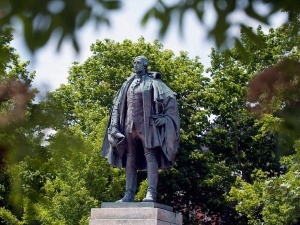
Halifax Cornwallis Statue 20151213

A statue of Edward Cornwallis stands facing England – with his back to Halifax – in Cornwallis Park. (Canadian Press)

In Canada, most of the controversies have been around Indigenous people in the context of reconciliation.

Conflict recently erupted in Nova Scotia over a plan to take down a statue of Edward Cornwallis, a British military officer and one of the founders of Halifax, who in his day had offered a bounty for the scalps of Mi’kmaq.

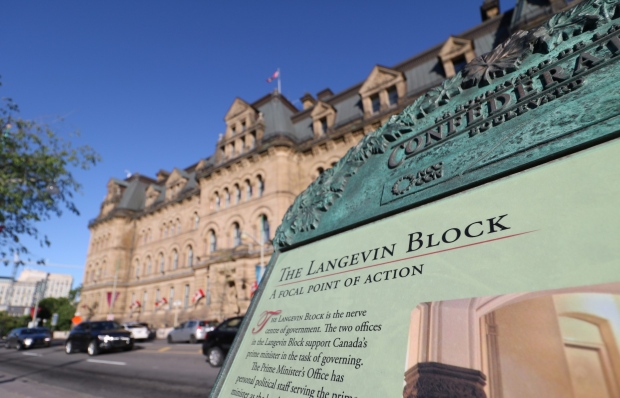
The federal government also recently removed the name of Hector Langevin from a government building, after Indigenous groups complained that it paid tribute to a man who played a role in the residential schools program.

Stagg called that name removal a “token” gesture by Prime Minister Justin Trudeau, and said it may open the floodgates to other requests for change.

langevin block ottawa parliament hill june 21 2017

The Langevin Block in Ottawa is seen on June 21, 2017 — the same day that Prime Minister Justin Trudeau announced it would be renamed because Hector-Louis Langevin, a father of Confederation, proposed the creation of the residential school system. (Trevor Pritchard/CBC)

“I think we’re going to try and be politically correct in terms of trying to erase aspects of the past that we find offensive,” he said. “I think that’s wrong in the broad sense. I think it’s going to continue to happen and there’s going to be a backlash just as there has been in the States.”

Indigenous child welfare advocate Cindy Blackstock has successfully fought for revised wording on plaques commemorating certain people who had a role in the residential schools program. She said while in some cases symbols such as swastikas must be eliminated, she said most memorials should remain up in order to teach visitors about the past, provided they tell the full story.

“By erasing the monument you can erase the historical lessons, contributing even more to the rampant historical amnesia that feeds discrimination and immorality,” said Blackstock, who is also a professor of social work at McGill University.

Museums as mediators

Donna Gabaccia, a history professor at the University of Toronto who organized a weekend demonstration in Toronto to protest white nationalism and the violence in Charlottesville, said memorials could be taken down and moved to museums where they could be understood in proper context.

“I see museums as important mediators of cultural controversies, where many voices can be and must be heard if the controversies are to be resolved,” she said. “Monuments become controversial when public opinion and historical context changes around them, which is inevitable. Contestation over the meaning of museums can only be resolved when all sides begin to understand the differences between the past that created the monuments and the present that inevitably seeks new meaning in them.”

Granatstein said context about the people being memorialized — including polarizing figures deemed by some to have been heroes in their day — is critical to understanding history.

“Every country has its heroes and most of those heroes have feet of clay or maybe a toe or two of clay. A country without heroes is a country without a past. I’d prefer to have heroes and a past,” he said.

Source: Historians say removal not the only way to deal with racist relics – Politics – CBC News

Langevin Renaming: Memo raises doubts about who was ‘architect’ of residential schools

Good analysis and advice by the public service, with apparent overly hasty political symbolism by government:

Federal officials raised doubts about accusations Hector-Louis Langevin was an architect of the residential school system four months before his name was ignominiously stripped from the prime minister’s building, as the Liberal government acceded to complaints from Indigenous groups.

An internal briefing note says Langevin had a “complex” relationship with Canada’s Indigenous peoples and even tried to spare the life of Métis leader Louis Riel, who was hanged in 1885 for leading a rebellion in Western Canada.

The Feb. 27 memo for Public Services Minister Judy Foote reveals the government grappling with a troublesome tangle of historical accuracy, Indigenous grievances over the tragedy of residential schools, and the symbolic significance of public building names.

Langevin

Hector-Louis Langevin, a Father of Confederation, was a prominent member of John A. Macdonald’s cabinet. In 1883, as public works minister, he allocated $43,000 for the construction of three schools for Indigenous boys, linking him to the residential school system. (Library and Archives Canada)

“While he has been referred to in the media as an architect of the Indian residential school system, a historian at Indigenous and Northern Affairs Canada indicates that his relationship with Indigenous peoples is more complex,” says the memo, obtained by CBC News under the Access to Information Act.

“Various histories and academic articles written on residential schools make no mention of his role or impact in the development or execution of the residential schools policy.”

“Moreover, during the 1885 Northwest Rebellion and the subsequent trial of Louis Riel, he attempted to intercede with the prime minister for Riel’s clemency and the commutation of his sentence.”

The memo, signed by deputy minister Marie Lemay, was triggered after National Chief Perry Bellegarde of the Assembly of First Nations wrote to Foote asking that the Langevin Block, the building at 80 Wellington St. in downtown Ottawa that houses the Prime Minister’s Office, be renamed.

4 Indigenous MPs seek removal

Bellegarde’s Feb. 6 letter said that “key architects of the devastating Indian residential school system include prominent leaders of the past such as Hector Langevin.”

Ten days later, four Indigenous MPs also wrote to Foote, pressing for the removal of the name because “Langevin was also the creator of residential schools.”

“We do not believe this way of thinking should be celebrated by naming a building after Langevin,” said the letter, signed by the NDP’s Georgina Jolibois, Liberal Don Rusnak, the NDP’s Roméo Saganash and Hunter Tootoo, formerly a Liberal and now an Independent.

The memo to Foote suggested preserving the name of Langevin on the building, but adding a plaque about his contributions to Canada “while also highlighting the contested aspects of his legacy.”

‘It is reasonable to anticipate opposition.’— Memo from deputy pubic services minister

Lemay also said the name could be changed to that of an Indigenous person, a non-Indigenous person, a place or an event in Canada’s past.

“It is reasonable to anticipate opposition from those who wish to preserve the commemoration of the name and contributions of Sir Hector-Louis Langevin, as well as support from those who want the name changed, including Indigenous groups,” she wrote.

Government officials declined to release to CBC News material from the historian at Indigenous Affairs who is cited in the memo as unable to find evidence of any role Langevin played in establishing residential schools.

Source: Memo raises doubts about who was ‘architect’ of residential schools – Politics – CBC News

Une version « décolonisée » de l’histoire – Including Indigenous history and culture

Interesting and thoughtful approach to increasing awareness and understanding of Indigenous peoples:

Où étaient les autochtones avant l’arrivée des Européens ? Comment vivent-ils aujourd’hui  ? Connaissez-vous des artistes autochtones ?

Ce sont des questions auxquelles les élèves du collège John Abbott sont désormais confrontés. Depuis un an, un groupe de sept enseignants de ce cégep anglophone de Sainte-Anne-de-Bellevue a entrepris un projet visant à « décoloniser » son programme.

« La décolonisation consiste à défaire les effets de la colonisation, désapprendre la pensée dominante colonialiste, inclure du contenu autochtone dans le curriculum, en apprendre davantage sur eux et reconnaître leur contribution dans la société », résume Debbie Lunny, enseignante en philosophie qui a dirigé le projet.

L’initiative a commencé de façon informelle. Les sept enseignants se sont rassemblés pour échanger des lectures et parler de différentes manières de décoloniser l’éducation au cégep. Par la suite, ils ont consulté des élèves et des experts autochtones pour connaître leur avis. Le projet était lancé.

« Dans le domaine de l’enseignement, la décolonisation consiste à questionner les relations de pouvoir, les hypothèses eurocentriques qui privilégient les perspectives eurocanadiennes. »

Dans ses cours, Debbie Lunny demande à ses élèves de nommer leur chanteur autochtone préféré, leur personnage de télévision autochtone préféré, leur auteur autochtone préféré. La plupart d’entre eux remettent une page blanche.

« On invite les élèves à réfléchir à travers des questions. Ce n’est pas que ces artistes n’existent pas, c’est qu’ils sont marginalisés des médias et de la société canadienne », estime l’enseignante.

UNE MEILLEURE COMPRÉHENSION

Lizzie Tukai est une élève inuite qui vient d’Inukjuak, au Nunavik. Elle vient d’obtenir son diplôme en sciences sociales à John Abbott. Pour elle, la mise en place de la décolonisation dans les cours permet aux élèves de mieux comprendre la réalité des autochtones. « Il y a souvent des gens qui sont mal informés, dit-elle. Ça cause des préjugés. »

Pour Lizzie, 41 ans, cette initiative est une occasion de réconciliation entre les autochtones et les allochtones.

« Lorsqu’on révèle la vérité de l’histoire, cela redonne du pouvoir à toutes les parties impliquées. »

« Ils nous ont appris l’histoire telle qu’elle s’est produite, révélé des choses qui étaient cachées, nous en ont appris davantage sur l’histoire des autochtones », dit-elle à propos de ses enseignants.

Les instigateurs du projet tâchent d’inclure dans la matière qu’ils enseignent des éléments des cultures autochtones. « Les autochtones ont besoin de trouver leur sens de soi, ils ont besoin de passer à travers la valorisation au lieu de l’humiliation », estime Jimena Marquez, enseignante en anthropologie qui fait partie de l’initiative. D’ailleurs, elle commence ses cours en reconnaissant la valeur de la chasse et de la lecture des étoiles, des valeurs importantes pour ces peuples.

UNE INITIATIVE À RÉPÉTER ?

Le cabinet de la ministre de l’Éducation et de l’Enseignement supérieur, Hélène David, estime que l’initiative du cégep John Abbott est une bonne façon d’encourager les élèves des Premières Nations à se sentir inclus dans le système scolaire. Toutefois, aucune réponse n’a été fournie par le Ministère quant à l’application de mesures décolonialistes dans l’ensemble des établissements scolaires québécois.

Source: Une version « décolonisée » de l’histoire – La Presse+

Insistence on French for SCC judges could block historic appointment of first Indigenous judge – The Lawyer’s Daily

Hard one to balance:

The Trudeau government’s pledge to fill the Supreme Court of Canada’s impending western vacancy with a bilingual jurist who can function in French is liable to block the historic appointment of its first Indigenous judge, lawyers say.

The Indigenous Bar Association (IBA) has pressed Ottawa for years to make an Indigenous appointment to the 142-year-old court and will do so again for the spot that is opening  up when Chief Justice Beverley McLachlin retires Dec. 15, said IBA president Koren Lightning-Earle of Maskwacis, Alta.

However the Trudeau government’s insistence that all its Supreme Court appointees be able to read and understand French, without translation, is an additional and unfair hurdle for Indigenous candidates and a “detriment to Canada,” Lightning-Earle told The Lawyer’s Daily.

If the government “starts to think outside the box on what the language prerequisite actually means to Indigenous people, and [to] truly understand history and reconciliation … then they’ll understand why the [French] language prerequisite is ridiculous,” she explained. “Our first language is our Indigenous language. And then we were sent to residential school where we were told we were not allowed to speak our language, and we were forced to speak a colonial language [English]. And now we have to speak another colonial language — just to get a seat at the table!”

The Trudeau government vowed during the election to appoint only Supreme Court judges able to function in both English and French. This was in response to concerns expressed by Quebecers, Acadians and other francophones outside Quebec that it does a disservice to their appeals when the top court’s anglophone judges can’t understand nuanced French oral argument (because interpretation is not always perfect) or read French written briefs and supporting materials (which are usually not translated).

However Lightning-Earle points out the prime minister and his government have also committed to reconcile with Indigenous peoples, as a top priority. “You don’t just get to put up a barrier and say ‘Well this is our requirement’ — without acknowledging the history — which is the spirit and intent [of] the reconciliation that the government supposedly signed on to,” she remarked.

Certainly the language prerequisite is a major obstacle for Indigenous candidates. There are, at most, a handful of Supreme Court-calibre Indigenous jurists in the west who are able to understand and read French without translation. Saskatchewan provincial court judge Mary Ellen Turpel-Lafond, who is Cree, is one, as is Vancouver litigator and Indigenous law expert Jean Teillet, who is Métis.

“There are barriers that Aboriginal lawyers and judges face that non-Aboriginal people don’t face,” Teillet told The Lawyer’s Daily. “And language is always one of those things. And so putting that kind of qualification on a Supreme Court appointment … will mean, as a fact, that we will have not an Aboriginal judge on the Supreme Court of Canada for a very long time. It won’t be because there are not really excellent Aboriginal lawyers and judges who are capable — more than capable — of doing the job. It will be because of the language barrier.”

Among those who appear to be affected is internationally acclaimed Indigenous law scholar John Borrows, 54 — who many see as a star candidate.

A member of the Chippewas of the Nawash First Nation on Georgian Bay, Borrows is currently in immersion French studies in Montreal. He is a visiting professor at McGill University’s faculty of law where he is learning about the civil law while on sabbatical leave from his post as Canada research chair in Indigenous law at the University of Victoria’s faculty of law, where he is co-developing the first joint program in Canadian common law/Indigenous law, expected to start up in 2018.

Osgoode Hall Law School dean Lorne Sossin believes Borrows “would be an outstanding choice to join the court.” He should not be blocked as he gets his French up to speed, Sossin opined.

Source: Insistence on French for SCC judges could block historic appointment of first Indigenous judge – The Lawyer’s Daily

Is ‘assimilate’ offensive? Legal battle pits Star Trek fan against Indigenous activists | National Post

Both sides make valid arguments in sharing their perspectives.

But understand for Indigenous peoples the particular sensitivity regarding the word assimilate given Canada’s history.

For immigrants, of course, the long standing Canadian approach is based upon integration, not assimilation:

At issue is a legal battle that has just been launched that pits the right of a Star Trek fan to have it on his licence plate against Indigenous groups opposed to the word.

The Justice Centre for Constitutional Freedoms has filed a lawsuit on behalf of Nick Troller, a Winnipeg man whose licence plate — ASIMIL8 — was rescinded by the provincial government for being offensive to Indigenous people.

“It’s another case that pits the Charter freedom of expression against the new, phoney right not to be offended,” said JCCF President John Carpay, a former Alberta Wildrose party candidate.

Carpay said he can understand why the plate might offend someone, but the word still shouldn’t be censored.

“There’s a difference between words that are inherently offensive regardless of how you use them, such as vulgarities, obscenities, four-letter words, versus words like ‘war’ or ‘assimilate,’ which can have positive or negative connotations,” he said.

Troller said the licence plate is clearly a reference to the Borg, a fictional race from Star Trek that forcibly assimilates other cultures. The plate holder says, “WE ARE THE BORG” and “RESISTANCE IS FUTILE.”

“The word ‘assimilate’ is just a word — it is neither good nor bad. We assimilate nutrients into our bodies in order to live,” Troller said in his affidavit.

But Indigenous activists say Canadians should do more to understand why the word could be considered offensive.

Anishinaabe Nation member and University of Manitoba assistant professor Niigaan Sinclair called free speech a “bogus argument” and said that Indigenous people are having “a very understandable reaction.”

“If Indigenous peoples feel triggered by a licence plate or a sports logo, or the name of a historical figure on a building, Canadians would be best served to listen to why Indigenous peoples are triggered, and show some care and sensitivity when they express themselves,” he said.

“You can’t just say whatever you want to say without any worries of consequence or responsibility.”

Source: Is ‘assimilate’ offensive? Legal battle pits Star Trek fan against Indigenous activists | National Post

Indigenous advocates slam Trudeau for comments about Patrick Brazeau

Ironic that the most balanced reaction to the PM’s comments appears to come  from Brazeau, not the activists. Brazeau had built up his personal narrative along the lines the PM stated and was a controversial figure to many Indigenous activists and others:

Indigenous advocates are denouncing Prime Minister Justin Trudeau’s recent comments about Senator Patrick Brazeau in Rolling Stone magazine, saying his remarks could damage the Liberal government’s relationship with aboriginal people.

In the U.S. magazine’s August cover story, which asks “Why Can’t He Be Our President?,” Mr. Trudeau describes his surprise victory in a 2012 charity boxing match against Mr. Brazeau, a former Conservative who hails from the Kitigan Zibi First Nation in Quebec.

“I wanted someone who would be a good foil, and we stumbled upon the scrappy tough-guy senator from an Indigenous community. He fit the bill, and it was a very nice counterpoint,” Mr. Trudeau says in the article. “I saw it as the right kind of narrative, the right story to tell.”

First Nations leaders say the Prime Minister’s remarks about Mr. Brazeau fly in the face of his government’s commitment to a renewed relationship with Indigenous people.

“I was actually shocked to read that coming from someone who’s been speaking about reconciliation and repairing relationships,” said Pam Palmater, an associate professor and chair in Indigenous governance at Ryerson University in Toronto.

“To read this super-arrogant, super-racist comment was really disgusting.”

Assembly of First Nations regional chief Roger Augustine, who represents New Brunswick and Prince Edward Island, said Mr. Trudeau’s comments about Mr. Brazeau could undermine his government’s message.

“To describe him like that is demeaning,” Mr. Augustine said. “It’s not a professional way for anyone to talk.”

Cindy Blackstock, a First Nations’ children’s advocate and social-work professor at McGill University, said Mr. Trudeau’s comments play into a narrative about colonialization “where Indigenous peoples are the savages and the non-Indigenous people are the civilized.”

“It’s unfortunate,” Prof. Blackstock said. “He’s using Indigenous peoples to try and emphasize the good qualities about himself.

“That really reinforces a lot of negative stereotypes about Indigenous peoples,” she added.

She said Mr. Trudeau’s remarks lead to more questions about the Prime Minister’s commitment to an equal relationship with Canada’s Indigenous peoples. Mr. Trudeau recently suggested the government is not providing First Nations with the same level of funding for child welfare and health services available off-reserve because native communities do not yet know how they would spend additional funds.

“As a pattern, it’s concerning,” Prof. Blackstock said. She called on Mr. Trudeau to clarify his remarks to ensure they aren’t repeated in the future.

Robert Jago, a First Nations activist and writer, said many minority men are familiar with the stereotyping that Mr. Brazeau faced because of his race.

“It’s sad to see Trudeau not just buying into that stereotype, but using it for political gain,” he wrote in an e-mail. “If Trudeau believed in reconciliation, I’d think that he would be striving to show common cause with his fellow parliamentarians of Indigenous ancestry, not objectifying them as he has Brazeau.”

A spokesman for the Prime Minister’s Office said Mr. Trudeau’s commitment to reconciliation can be measured by his actions. “He has made it clear that there is no relationship more important to him – and to our government – than reconciliation with Indigenous peoples,” spokesman Cameron Ahmad said in an e-mail. This includes launching a national inquiry into missing and murdered Indigenous women, which is now seen by many as troubled, as well as billions of new dollars promised for education, health and social development on reserves.

“We are fully committed to a renewed nation-to-nation relationship and to reconciliation,” Mr. Ahmad said.

Mr. Brazeau declined an interview request. In a message to the Aboriginal Peoples Television Network last week about the Rolling Stone article, he wrote, “I’ll take it as a compliment.”

Source: Indigenous advocates slam Trudeau for comments about Patrick Brazeau – The Globe and Mail

Canada wasn’t — and isn’t — ready for an Indigenous governor general: Robert Jago

An overly negative take or a realistic one?

Did Indigenous-origin provincial lieutenant governors such as Ontario’s James Bartlemen make a difference or not?

Jago is correct to note the dangers of assuming that such an appointment signals the end of racism and discrimination, as in his citing of Obama. But do symbols have no value? Can they not contribute to greater awareness and thus lead to some measure of change, or help enable change?:

While it’s good to see these views present in the governing party, and good to see Indigenous MPs free to speak publicly in support of this position, their conclusion — that the appointment of an Indigenous governor general would be a positive symbol of a changing Canada — is wrong.

Sure, an Indigenous governor general would be a symbol, but primary one to non-Natives — to white Canada — and a dangerous one that could derail reconciliation, at that.

Canada might receive its first Indigenous governor general in much the same way that the U.S. received its first black president. When Barack Obama was elected back in 2008, the message to American people of colour was that change was possible and that we’re powerful enough to elect one of our own: a person who knows our struggles and our ambitions, and who can help to pave the way for others.

But while a symbol of hope and change to black America, Obama was also a symbol to many in white America that racism had been conquered. In a 2008 Forbes Magazine article entitled “Racism in America is Over,” Manhattan Institute fellow John McWhorter wrote: “Our proper concern is not whether racism still exists, but whether it remains a serious problem. The election of Obama proved, as nothing else could have, that it no longer does.”

In the same vein, I have no doubt whatsoever that had an Indigenous person been appointed as governor general, Canada’s mostly white commentariat would be falling over themselves to declare that racism in Canada is “over,” too. Especially since, even now, the idea that racism in Canada never really existed is mainstream enough to be given space in a newspaper. In the Vancouver Sun, for example, Douglas Todd recently wrote, “It’s hard to think of a more treacherous single story about B.C. than the one alleging racism is alive and well.”

Racism clearly exists in Canada today, and it is far from over. The week that Payette was named governor general was the same week that Barbara Kentner — a victim of what many Indigenous people see as a racially motivated murder — was buried. At the time of writing, Thunder Bay police has yet to file murder charges in her death (the only charges laid so far have been of aggravated assault).

And while many non-Natives work to downplay the existence of racism in Canada, Kentner’s death, along with that of Colten Boushie in Saskatchewan, and of Cindy Gladue in Alberta, are just a few recent examples of what Indigenous people see as racially motivated killings.

These acts of racism demand urgent action, and signalling to white Canada that the job of reconciliation is done, and racism is over, is not the urgent action required. Instead it is a window dressing: camouflage for a state of affairs that treats Indigenous lives cheaply, and one in which the change that Indigenous people need is no closer than it was under the Stephen Harper regime.

All of the symbolism, none of the power

Unlike in the case of the first black president, the first Indigenous governor general would have no power to make any changes whatsoever. True, some past governors general have been able to highlight or bring greater attention to certain issues, but they can’t direct funding, write policy or introduce new laws. He or she would have all of the symbolism with none of the power.

The Trudeau administration has burdened Indigenous peoples with one symbolic gesture after another. As with the failed inquiry into missing and murdered Indigenous women and girls, these symbolic gestures have stripped important issues of urgency in the imagination of the non-Native public. Changing the name of Langevin block does not restore clean drinking water to one First Nations home; seeing Justin Trudeau in his buckskin fringe acknowledging unceded Algonquin territory does not prevent one suicide. When it comes to “real change” on the ground, this government is short on results.

There will come a time when Canada is ready for an Indigenous governor general, but that appointment should be a capstone to mark real achievements toward equality; not just another symbolic gesture that gives the illusion of progress, while distracting people from the real work we all have to do.

Source: Canada wasn’t — and isn’t — ready for an Indigenous governor general – CBC News | Opinion

Alt-right’s jocular façade attempt to deny responsibility: Southey, Proud Boys’ behaviour goofy, but hardly ‘deplorable’: Blatchford

Interesting contrast between Tabatha Southey’s description of the “Proud Boys” and Christie Blatchford’s.

Starting with Southey:

The Halifax incident made national headlines, as a story like this should, particularly as all the men involved – who later celebrated at a local Halifax pub, posting pictures of themselves making the “okay” symbol with one hand, a beer in the other – turned out to be members of Canada’s Armed Forces. As a nation, we are now forced to ask ourself the question “Who the hell are these jokers?” and, always anxious to serve, I present A Brief History of Slime, the story of the Proud Boys.

It’s best to think of the Proud Boys as a group of guys possessed of a seriously shaky grasp of history and a burning desire to wear the same shirt as the guy next to them, who want a white supremacist to tell them when they are allowed to masturbate.

It’s not a fetish I’ve encountered before, but were the Proud Boys not also a far-right group of self-described “Western Chauvinists who will no longer apologize for creating the modern world,” who are against “racial guilt” and who “venerate the housewife” and believe “that the last 50 years have been a disaster for women” (one doesn’t have to be Alan Turing to break thatcode), I wouldn’t kink-shame.

As it is, I have concerns.

The Proud Boys were launched and are headed by Gavin McInnes, Vice magazine co-founder (although they parted long ago) and current contributor to The Rebel Media, the right-wing website founded by Ezra Levant; and yes, a strict limit on masturbation is one of their many peculiarities.

They “believe that this energy,” the energy spent masturbating, “is better spent … getting married, and having children,” and I suppose that’s their call but I can’t help thinking that if you truly believe that by not masturbating you’ll be able to save enough energy to raise a child, you are doing one of these things very, very badly.

Some of you may remember Mr. McInnes as the man who made a bit of a splash with neo-Nazis in March when a number of videos he recorded on a recent trip to Israel were posted.

In these videos, one of which was called “10 things I Hate About the Jews,” Mr. McInnes variously put the word “Holocaust” in air quotes, complained that Jews, who he said “are ruining the world with their lies and their money and their hooked-nose, bagel-eating faces,” have a “whiny paranoid fear of Nazis.” He repeatedly spoke in a grotesque cartoon Jewish accent and said that people in Israel spit when they talk and that “Middle Easterners reek.”

Ensconced in his hotel room in Israel, which he believes was likely paid for, along with the rest of his “propaganda tour,” by private Israeli donors and the Israeli government, Mr. McInnes told viewers that while they “assume we’re going to listen to all this shit we get fed” it’s “having the reverse effect on me: I’m becoming anti-Semitic.”

“Well, we’re at the Holocaust museum, and we’re being told, ‘The Germans did this. The Germans are horrible people …’” he sulked, apparently irritated that Holocaust deniers might not be getting a fair hearing at Yad Vashem, the Holocaust memorial.

“Well, they never said it didn’t happen,” he said, in an attempt to remedy this perceived injustice. “What they’re saying is it was much less than six million and that they starved to death and they weren’t gassed …”

Mr. McInnes was quick to ask that the viewer not “take that clip out of context.” He’s not saying “it wasn’t gassing” – that’s just what the “far-right nuts are saying” and, being “sick of so much brainwashing,” he felt compelled to articulate the theories of said nuts.

Mr. McInnes worries that we’re too caught up on the Holocaust in general. “There’s been a lot of genocides,” he says, most notable to him being the Soviet Holodomor, of which he says, “I think it was 10 million Ukrainians who were killed. That was by Jews. That was by Marxist, Stalinist, left-wing, commie, socialist Jews.”

It seems that the major distinction between the alt-right and Mr. McInnes’s preferred “alt-light” is that the former are very concerned about “Judeo-Bolshevism,” the Nazi conspiracy theory that Jews were secretly behind the rise of communism; and the latter just wish to inform you that the Soviet Union (or at least the more genocidal aspects of it) was secretly run by Jews.

Jews have been very busy in the Proud Boy’s founder’s bizarre understanding of history. When not engineering the downfall of the Russian Czar, they were “disproportionately” influencing the Treaty of Versailles, forcing terribly unfair terms of surrender on Germany. The treaty “sucked and the Germans hated it” Mr. McInnes says, indicating that “Jewish intellectuals” were, at least in part, responsible for the Second World War, and the Holocaust, such as it was.

If this sounds extreme, anti-Semitic, or perhaps dangerous to you, it’s okay: Mr. McInnes chortles when he says these things, allowing his fans to assure us that it’s just harmless comedy.

If much of what you see on the alt-right side looks and sounds so ridiculous, such jocular goose-stepping, these days, that’s deliberate. Share a photograph of you and your be-polo-shirted buddies flashing the Nazi salute, and the popular discourse knows just what to do with you. Substitute the “okay” gesture – unofficially but lovingly adopted by this crowd – and anyone who points out the white-supremacist imagery is just a crazy leftist snowflake who probably thinks a cartoon frog is a hate symbol too.

What we’re seeing here, and in Halifax, is white supremacy painted over with a coat of irony, euphemism and plausible deniability. All of that just barely thick enough that Mr. McInnes still gets airtime on CBC’s Power & Politics. He used this airtime, speaking in his capacity as the Proud Boys’ founder and leader, to ask the host “Can you see why Cornwallis issued a bounty on Mi’kmaqs?” and spread, pretty much unchallenged, a number of hateful and damaging historical inaccuracies about the Mi’kmaqs. (The CBC has since apologized for the segment.)

Source: The alt-right’s jocular façade is an attempt to deny responsibility – The Globe and Mail

Blatchford’s alternative universe:

A small crowd was gathered around the statue, one of them carrying an upside-down Canadian flag with the word “decolonize” written on it, there to mark the various atrocities committed against Indigenous people while Chief Grizzly Mamma, who is originally from British Columbia, shaved her head.

According to what McInnes later told the CBC, the five were in a bar on July 1, heard rumours of an anti-Canada protest, and decided to go check it out.

Also for the record, the men were well-spoken, polite and respectful; they were met by a young woman, from the protesters, who was equally polite and respectful. The men explained they were curious and wanted to see what was going on; she said they’d be welcome to listen quietly if they didn’t disrupt things.

But a couple of other protesters were not similarly inclined.

One snarled, “This is a fucking genocide.” Someone else said, “This is Mi’kmaq territory, to which one of the Proud Boys replied, “This is Canada.” Members of each side tossed about historically inaccurate facts in the manner of the young and unschooled. Another young woman bristling with hostility kept moving closer to one of the men until she was practically touching him. “You don’t seem to like me standing so close,” she said. “You’re very close,” he replied calmly.

But then the Proud Boys left, having been chastised for their pronunciation of Mi’kmaq and for their disrespectful tone, or, as a protester put it, got “the —- out of here.”

There were no harsh words from the Proud Boys. There was even some humour; once, told by a protester to speak more softly, one of the men said, in effect, “What? This is a library now?” But he did as he was asked.

Not a blow was struck. Not a disrespectful word was uttered, unless, of course, one counts the mere questioning of Indigenous protest as disrespectful. Not a gram of cereal was consumed or thrown.

Source: Christie Blatchford: Proud Boys’ behaviour might be goofy, but is hardly ‘deplorable’


Egerton Ryerson doesn’t deserve an anti-Indigenous label: Smith

Good historical account of Ryerson’s life and relationships with some Indigenous persons by Don Smith:

A variant of the line “those who forget history are condemned to repeat it” could be “those who are ignorant of history are condemned to ignorance:”

As a Canadian historian of nearly half a century’s standing, I find the current controversy over Egerton Ryerson, the namesake of Ryerson University, totally baffling. I wonder how deeply his critics have probed into the past of the founder of the modern Ontario public-school system. Their portrayal of him as anti-Indigenous misrepresents the man completely.

Egerton Ryerson (1803-1882) was a Christian minister. Perhaps this is the central problem. As the University of British Columbia anthropologist Kenelm Burridge said so well in his book, In the Way: A Study of Christian Missionary Endeavours (1991): “Whatever missionaries do or have done will be perceived as good by some, otherwise by others.”

At the Credit Mission, located in what is now Mississauga, young Egerton set out in 1826/27 to learn Ojibway. As he later wrote: “I must now acquire a new language, to teach a new people.” The first Methodist (now the United Church) minister to the Mississauga (Ojibwa, or Anishinabeg) acquired a basic speaking knowledge. The future Mississauga chief, Kahkewaquonaby (Sacred Feathers), known in English as Peter Jones, became a close life-long friend. The Credit Mississauga liked Ryerson. He rolled up his sleeves, worked beside them in the fields, ate and lived with them. He gained their respect. At a council meeting in December, 1826, they gave him the Ojibway name of one of their deceased chiefs: “Cheechock” or “Chechalk.” The name meant “Bird on the Wing.”

A decade later, Ryerson did his best to advance the studies of Henry Steinhauer or Shahwahnegizhik, an Ojibwa from the Lake Simcoe area, at the Methodist College that is now Victoria University in the University of Toronto. In the 1850s, Ryerson, as the superintendent of education for Canada West, welcomed Allen Salt, a Mississauga from the Rice Lake area near Peterborough to the Toronto Normal (teacher training) School, the predecessor of what is now Ryerson University.

So grateful was Steinhauer for his assistance and encouragement that he named one of his sons Egerton Ryerson Steinhauer. At Rev. Salt’s last mission on Parry Island (Wasauksing) on Georgian Bay, the mission day school bore the name Ryerson. Only recently was the First Nations day school renamed, to Wasauksing Kinomaugewgamik.

As educational historian Robin Harris wrote in 1959: “Ryerson was Christian, first, last, and all the time; his religious principles were his first principles.” Yes, he had a Christian agenda, but he also supported the Credit Mississauga’s fight for a title deed to their Credit River reserve and their efforts to build a strong economic base for their community.

Ryerson was not the creator of the Indian residential-school system. The Final Report of the Truth and Reconciliation Commission of Canada, vol. 1. The History, Part 1. Origins to 1939 (Montreal and Kingston: McGill-Queen’s University Press, 2015), pp. 75-78, clarifies his outlook toward Indigenous education. In 1847, he did write a short report on Indian boarding schools where older male students could learn European-style agriculture.

In preindustrial Ontario, farming was the motor of the economy. As his educational model, he favoured the respected Hofwyl School for the Poor near Berne, Switzerland.

Jones and Ryerson were true friends, perhaps best described as “blood brothers.” Toronto’s Dundas Square borders Victoria Street. The site ofRyerson’s home 150 years ago is located toward the eastern end of the urban park. Its actual site is now under Dundas Street East.Ryerson welcomed Mr. Jones and his wife to stay with his family for a month in the spring of 1856 while Ryerson sought the best medical advice to restore Jones’s health. After the attempt to find a cure failed, Jones returned to his home in Brantford, where he died two weeks later. As Jones had requested while he stayed at the Ryerson’s that spring, Ryerson gave the eulogy at his funeral on July 1, 1856.

To describe Egerton Ryerson, or Chechalk as the Mississauga called him, as anti-Indigenous misses the mark. Back to you, Ryerson Students’ Union, for further study.

Source: Egerton Ryerson doesn’t deserve an anti-Indigenous label – The Globe and Mail