Black and Indigenous people are dramatically overrepresented in drug charges recommended by Vancouver police, an analysis of new data shows.
The police say, and some experts agree, that these findings are not evidence of racial bias in the Vancouver Police Department, but instead reflect inequalities and failings in broader Canadian society. Others say those wider problems don’t absolve police in Vancouver or elsewhere of a need to confront racism within their own institutions.
The new data, obtained through a freedom of information request, shows Black people accounted for 6.4 per cent of drug trafficking and possession charges recommended by Vancouver police since 2014, yet they make up only one per cent of the city’s population. Indigenous people faced almost 18 per cent of drug charges but are just 2.2 per cent of the city’s population.
However, the figures show criminal charges for simple possession of illicit drugs have dropped significantly over the last five years. That trend is in line with the approach of decriminalizing substance use while targeting traffickers, a position taken last month by the Canadian Association of Chiefs of Policebut supported for years by successive police chiefs in Vancouver.
These findings emerge from data obtained from the VPD and provided to Postmedia by a University of B.C. PhD student, Ryan Moyer, who said he filed the FOI request “to better investigate the disproportionate impacts of punitive drug policy.”
“While we cannot infer that the overrepresentation of Indigenous and Black communities in drug-related crimes is due to racism specifically,” Moyer said, the “disproportionately frequent interactions” with these populations is concerning and shows the need for more cultural training and more dialogue with leaders of these communities.
In B.C., police do not decide on charges. Instead they make recommendations to Crown counsels, who then decide whether to approve charges. Moyer’s FOI records include 1,268 files where VPD recommended a range of drug charges, 76 per cent of which were approved and went to court, 17 per cent were pending or unknown and seven per cent were not approved by Crown.
In mid-June, Vancouver Police Chief Adam Palmer talked to Postmedia about racism and policing. Palmer said that while he believes systemic racism doesn’t exist in Canadian policing, racism is still a problem in Canada.
VPD officers undergo more extensive training than other B.C. police agencies on issues including implicit bias, cultural competency and sensitivity, and Indigenous culture, Palmer said then.
Palmer also pointed to broader societal problems that can precede the point in a person’s life when they encounter a cop: “The police officer (is) sometimes dealing with the end result of 20 years of trouble that that person has gone through.”
Palmer is not wrong there, said University of Toronto criminologist Akwasi Owusu-Bempah.
“The chief makes a great point: The police are left to deal with many of society’s failures, and if those societal failures have racially disparate outcomes, then policing is going to have racially disparate outcomes as well,” said Owusu-Bempah.
However, he was surprised Palmer so forcefully denied systemic racism in Canadian policing, considering “the police are a microcosm of society.”
The stakes are high, Owusu-Bempah said, because drug charges, even those resulting in acquittals, can have long-lasting affects on a person’s prospects for employment, education and housing. This adds urgency, he said, to calls to decriminalize, or as he’d prefer, fully legalize all drugs in Canada.
On that point, the data show drug possession charges in Vancouver have fallen sharply in recent years: VPD recommended 142 possession charges in 2015 but only 36 last year, a 75 per cent reduction. In the first half of this year, only 10 possession charges recommended.
“I think (the VPD) should be commended for that approach. But it raises questions of who doesn’t benefit from that?” Owusu-Bempah said. “It seems like decriminalization’s in practice for some, but not for others.”
It’s a good thing this data has now been made public through Moyer’s FOI request, Owusu-Bempah said, “because if they don’t make it public, we can’t identify problems.”
The public should be careful of drawing the wrong conclusions from this data, said VPD spokeswoman Simi Heer.
“It’s simplistic to compare the percentages related to the data in the spreadsheet based on ethnicity,” without taking into account several “long-standing, complex issues,” Heer said.
“Canada has a troubling history of systemic discrimination against Indigenous Peoples,” Heer said. “We recognize that this discrimination continues to perpetuate significant problems today, including overrepresentation in all aspects of the criminal justice system, the homeless population, and more recently, the number of overdoses during the fentanyl crisis.”
“The VPD’s approach on drug issues has been to target the most serious harms to society, as the number of deaths in our communities related to the fentanyl crisis have reached crisis proportions,” Heer said. “This means we’ve been targeting drug trafficking, drug production and organized crime.”
Heer also pointed to the preliminary findings of Metro Vancouver’s homeless count released this week, showing Black and Indigenous people were significantly overrepresented in the region’s homeless population.
The overrepresentation of Black and Indigenous people in both drug charges and homeless populations are “totally connected,” said Neil Boyd, a lawyer and Simon Fraser University professor of criminology.
Boyd said he can’t say racism definitely doesn’t exist in the VPD, but these statistics don’t definitively prove that it does.
“The disproportionate numbers, there might be people who would want to argue that reflects a kind of racism, but I think if it’s racism, it’s not racism within the police department, it’s the racism of our culture, in which we see such an overrepresentation of Indigenous and Black people on the street,” said Boyd.
People from all walks of Canadian society buy, sell, and use drugs, but the police are more likely to come into contact with people with fewer resources, and especially less access to private space, Boyd said. In other words, officers are far more likely to come across a homeless person selling opioids to support his own addiction than an affluent person in a Yaletown condo buying cocaine for a night out.
Others say these racial disparities underscore how much work remains to be done to combat racism and oppression in Canada.
“What we’re seeing is a continuation of oppression,” said Patricia Vickers, a psychotherapist and the First Nations Health Authority’s former director of mental health and wellness services. “Nothing has really changed all that much, as far as our relationships go. When we look at reconciliation, we’re not really seeing what that means in society.”
“The incarceration of Indigenous people is just another symptom of this continuation of domination, control, oppression,” Vickers said. “This is just one of the pieces of evidence we have.”
Harsha Walia, executive director of the B.C. Civil Liberties Association, said these numbers are “not surprising, but it’s still deeply disturbing.”
Racial inequalities exist in many aspects of Canadian society, including the economy, education, health care and more, Walia said. “It’s also not accurate that somehow the armed institutions of the state … are somehow immune from this either.”
“We have study after study that shows over-criminalization and over-incarceration of Black and Indigenous people is absolutely both a symptom and a cause of systemic racism in other institutions,” Walia said. “It’s not a linear A leads to B, it’s a cyclical process.”
In June, B.C. Public Safety Minister Mike Farnworth announced the NDP government plans to modernize the province’s Police Act, “with a specific focus on systemic racism.”
While the characterization of colonization and the lack of consultation with Indigenous peoples regarding immigration, Bauder is unclear on what that would mean in concrete terms.
The TRC immigration-related recommendations are relatively straightforward to implement, but he fails to provide specifics regarding the objectives and impact of a greater Indigenous role in immigration policy and programs:
The outrage against systemic racism following the death of George Floyd in Minneapolis has once again brought into sharp focus the violence experienced by Indigenous people in Canada.
A key responsibility of Canadian settler society is to address a root problem of centuries of colonialization that underlies this violence: the settling of the land through immigration without Indigenous consent or consultation.
Last year, the National Inquiry into Missing and Murdered Indigenous Women and Girls concluded that colonial structures continue to be a source of violence and genocide.
Earlier, in 2015, the Truth and Reconciliation Commission had drawn attention to immigration. The Commission’s Calls to Action contained 94 recommendations, the final two of which covered the topic “Newcomers to Canada:”
Recommendation No. 93 calls “upon the federal government, in collaboration with the national Aboriginal organizations, to revise the information kit for newcomers to Canada and its citizenship test to reflect a more inclusive history of the diverse Aboriginal Peoples of Canada, including information about the Treaties and the history of residential schools.”
And Recommendation No. 94 asks “to replace the Oath of Citizenship” with a new one that acknowledges Canada’s “Treaties with Indigenous Peoples” and the responsibility of new Canadians to honour these treaties.
Although the current federal government is working on implementing these two recommendations, they fail to address the ongoing colonialism ingrained in Canada’s immigration system.
When I reflect on my own immigration experience as a setter in Canada, I become painfully aware of how colonialism continues to work through our immigration system.
After I left my native Germany in the early 1990s and began university studies in Canada, I received a student visa because the Canadian government deemed me a desirable student. While I completed doctoral studies at Wilfrid Laurier University, I had enough education to qualify under Canada’s points system to immigrate.
A few years later, I met the residency and other requirements to become a Canadian citizen. The terms of qualifying for a student visa, receiving immigration status, and eventually being naturalized were entirely those of the Canadian settler state. Indigenous communities had no say in the process.
Had I come to Turtle Island on the invitation of Indigenous peoples and became a settler on Indigenous terms, I suspect the conditions for immigration and naturalization would have been very different.
Would I have been required to speak English or French? Would it have mattered that I was an advanced student in an educational system that was responsible for the horrors of residential schools? Would I have been required to swear allegiance to Queen Elizabeth II and her heirs and successors? I don’t think so.
Indigenous people are sidelined when it comes to deciding who settles on this land. The entire immigration system — from initial entry to naturalization — remains steeped in colonialism. This system fails to foster a setter community that affirms the rights of Indigenous people as the original occupants of the land and that honours the treaties Indigenous people have made with the settlers.
Instead, current immigration policies disproportionately emphasize the value of newcomers to Canada’s economy, which does not counteract the ongoing colonialization and environmental degradation of the land.
Canadian immigration policy must be decolonized. Including Indigenous voices in the decisions about who is invited to immigrate and under what terms they are allowed to settle on Turtle Island would be a significant step toward demolishing underlying structures of colonialism in Canada.
Not surprising. The 2021 Census will also include religion (done every 10 years):
The 2021 census will for the first time count transgender Canadians and include questions designed to get better data on Indigenous communities, linguistic minorities and ethnic groups.
According to federal officials, the new census questionnaires will address long-standing requests from groups who said the previous census questionnaire did not count everyone in their communities or that the numbers were imprecise.
In particular, the changes will affect the way Statistics Canada counts members of Indigenous communities, ethnic communities such as Jews, transgender Canadians and members of anglophone and francophone minorities. In the case of linguistic minorities, the new short-form and long-form census questionnaires are designed to improve their access to public schools, as guaranteed under the Charter of Rights and Freedoms.
The Globe and Mail is not identifying the federal officials because they were not authorized to speak about the matter before the new questionnaires are made public in the Canada Gazette on Friday afternoon.
While the 2016 census asked people to list their sex as male or female, the officials said the 2021 census will ask a question about the respondent’s sex at birth and another question about the person’s current gender, marking the first time the census has counted transgender Canadians.
It will also aim to provide more data on Indigenous groups, who will no longer be referred to in the document as Aboriginal. For example, the new questions will help identify the beneficiaries of Inuit land-claims agreements and determine the number of members of the Métis Nation.
Officials said the government will also address criticism from Jewish groups who said a change to the question about ethnic identity in the 2016 census left them drastically underrepresented. With the omission of “Jewish” as one of the listed examples of ethnic ancestry, the official count of Canada’s Jewish population fell from about 309,000 in 2011 to little more than 143,000 in 2016. As a result, the government will add a significant number of examples of ethnic origin to the 2021 census, which will once again include “Jewish” as a possible answer.
After coming to power in 2015, the Trudeau government made it mandatory for recipients of the long-form census to fill out the questionnaire, reversing a decision by the Harper government.
A new law adopted in 2017 gave Statistics Canada more independence, but the power to determine census questions remains in the hands of the government, with Innovation Minister Navdeep Bains acting as the lead minister on the file.
Federal officials said cabinet recently approved changes to both the short-form census questionnaire, which goes to 80 per cent of households, and the more detailed long-form questionnaire, which goes to the remaining 20 per cent. Statistics Canada had set this month as the deadline for the final versions to be approved in order to be ready for next year’s census.
Both will include new questions about education history as part of an effort to determine precisely how many Canadian children are eligible to go to an English-language school in Quebec or a French-language school in the rest of the country.
The proponents of the census changes have argued that provinces and school boards currently lack the necessary data to plan the construction of new schools, leading to a shortage of spaces in many parts of the country. They say the new questions will help them obtain an exact count of Canadians known as “rights-holders,” who have the right to send their children to either French- or English-language public schools.
By making all Canadians answer questions about language skills and schooling history, Ottawa will be providing linguistic minorities with another victory on the education front. Last month, the Supreme Court of Canada ruled that, even when their numbers are relatively small, linguistic minorities have a right to their own high-quality schools.
Yet one more historical practice with unfortunate results falls:
The Ontario government has issued a policy directive that orders children’s aid societies in the province to cease the controversial practice of issuing birth alerts.
Birth alerts are notifications issued by hospitals in the province regarding an expectant parent when the societies believe the child may be in need of protection after delivery.
The alert prompts the hospital to contact the society when the baby is born regardless if hospital staff have independently developed concerns regarding a parent’s ability to care for their infant.
Children Minister Jill Dunlop told The Globe and Mail that the Ontario government is issuing the directive as part of efforts to address systemic racism including in the province’s child-welfare system.
Child protection services in the province are delivered by children’s aid societies, Ms. Dunlop said, adding that birth alerts are not required under any provincial legislation or policy.
The ministry does not track their use specifically, she added, but she said in the past 12 months 442 children were removed from their mother within seven days of birth and their first birthday, and that 50 per cent of referral sources were from medical staff at a hospital.
The government heard through consultations with First Nations organizations that birth alerts have regularly affected members of communities particularly near Thunder Bay, Hamilton and Brantford, she said.
“We know it is unacceptable,” Ms. Dunlop said. “This is why we are ending the practice across the province.”
She said the government has also heard from families that birth alerts cause trauma, including to children, adding that she hopes other provinces will end the practice.
Provinces such as British Columbia and Manitoba have also put an end to the practice of birth alerts that have been the subject of concern from advocates and the national inquiry on Missing and Murdered Indigenous Women and Girls.
Last June, the inquiry, among other things, called upon provincial and territorial governments and child-welfare services to put an immediate end to the practice of “targeting and apprehending infants (hospital alerts or birth alerts) from Indigenous mothers right after they give birth.”
In January, Manitoba announced the end of birth alerts, and B.C. said in September, 2019, that it would end the practice immediately, citing the call from the inquiry.
In a statement, B.C. conceded at the time that birth alerts were primarily used for marginalized women and disproportionately for Indigenous women.
The directive from Ontario’s assistant deputy minister David Remington says the intent of the new policy order is to provide guidance on ceasing the practice in the province and to ensure there is collaboration with local hospitals, prenatal and postnatal services and other health care professionals.
Among the new requirements, societies must halt the practice by Oct. 15 and prepare to do so in the interim. Societies also must confirm in writing to the ministry that it has implemented requirements by that month.
The Ontario Native Women’s Association has told the government that 450 Indigenous families a year will benefit from the ending of birth alerts based on the programs they administer and sites they have, Ms. Dunlop’s office said.
The province’s child-welfare system has also been the subject of consultations since last August, including with youth who have been in care, family members and organizations, the minister added.
She said that “fundamental change” will be announced in the coming weeks, adding that the review of the child-welfare system includes the overrepresentation of Indigenous, Black and other racialized children and youth.
The government is focused on prevention and early intervention and working with families about services they receive, she added.
“We know that birth alerts do the exact opposite [with families],” Ms. Dunlop said. “This is a key starting point for us.”
To watch and see whether the model used for Indigenous peoples is needed or applicable to some or all visible minority groups:
Canada’s statistics agency is working with an expert advisory committee to better collect race-based data, but it is too early to say whether it will hire more racialized on-the-ground statisticians and researchers to help, says one official.
Marc Lachance, acting director of health, justice, diversity, and populations with Statistics Canada, acknowledged in an interview last week that while the country has made some strides in collecting Indigenous data, figures for some ethno-cultural groups are lagging.
“We have put in place a committee of experts that could specifically provide us guidance on—you know, we never really did a lot of work on the Black populations before, how do we do this?” said Mr. Lachance in a phone interview July 9.
In July 2019, the agency established the Centre for Indigenous Statistics and Partnerships, which consolidated “long-standing working relationships” with communities and organizations across the country into one centre. All research at the agency involving Indigenous people is “channeled through” this centre, which helps “provide relevant expertise and co-ordinate outreach to partners,” a July 6 statement from the agency read.
Included in the centre are 11 Indigenous liaison advisors, some of whom, according to Mr. Lachance, might work on reserves, and most of whom identify as Indigenous. The agency did not provide an exact breakdown, nor a dollar figure of cost, for these positions. The program began in the 1980s and positions are currently funded through the centre, said StatsCan spokesperson Peter Frayne in a July 10 email. The officers’ salaries and non-salary needs like travel are covered. “Funding may vary from year to year based on the level of activities and engagement, but typically peaks during the conduct of the census,” Mr. Frayne added.
They are stationed across the country and look after a particular region, said Mr. Lachance. A StatsCan webpage lists advisors as covering Atlantic provinces, Manitoba, Inuit Nunangat, and others. “That program is probably one of our most established programs to engage communities such as the Indigenous [one] on Indigenous data,” he said.
“Their role is very key, specifically in ensuring there is trust with the data and a good rapport and relationship with StatsCan.” When the agency starts work for its census, for example, these officers act as ambassadors who promote it and in some cases seek permission to be able to go into communities, or at least notify Indigenous leadership about the agency’s intentions.
Mr. Lachance said it is too soon to say whether the agency will bring in Black community researchers to help it gather better race-based data.
“We’re working with experts right now. The plan is in the fall, we do more consultations with racialized communities, specifically to get their input on new approaches on how we can disseminate information” to those communities, he said.
Statistics Canada received $4.2-million over three years through the government’s anti-racism strategy last year. A portion of that funding was to allow the agency to set up an advisory committee on ethno-cultural and immigration statistics. That advisory committee will guide the body in setting up a “conceptual framework on ethnocultural diversity and inclusion as well as families of indicators to be able to track relevant ‘inclusion’ indicators over time,” according to a July 6 statement from the agency, which also said the committee had been formed and already met once, with another meeting slated for last week.
Mr. Lachance said it’s possible that the agency will create other “ambassador”-like roles for other racial groups, but he said “we haven’t made that decision yet, we’re just building those relationships.”
His comments come in the wake of an influx of public calls for better race-based data collection. The COVID-19 pandemic has harmed Black people in the United States at a greater rate than it has white people. Canada has not tracked pandemic outcomes by race or ethnic background.
To better understand the pandemic’s disproportionate impact on some communities, the agency has already made a push to collect more disaggregated data. It has been releasing a series of voluntary questionnaires, which change about every two weeks, and tap into a range of topics like parenting during the pandemic and the impact faced by those living with disabilities.
“How we continue this relationship depends on what the community needs and how we want to work closer with them,” said Mr. Lachance.
“We are accountable to Canadians about the data. The data is about what individuals are telling us about themselves, and they’re taking the time to answer the questionnaire and surveys.”
Some experts who spoke to The Hill Times this month noted that authorities and government institutions might face an uphill battle as they go about collecting race-based data, thanks in part to “longstanding disparities” in areas like housing, healthcare, and food insecurity in these communities.
Anna Banerji, a director of global and Indigenous health at the University of Toronto’s faculty of medicine, noted in an earlier interview that “there’s a lot of information that’s out there that’s partially used or distorted in the usage, and there’s no underlying [questioning of] what are the contributors to this.” She noted that in some cases, data has been used to justify racism and discrimination, a fact that Public Safety Minister Bill Blair (Scarborough Southwest, Ont.) also acknowledged this month.
Mr. Lachance said Statistics Canada’s researchers are well aware of this history.
“When we come to the analysis [stage], we need to ensure that the analysis that we do and analytical products [we put out] are sensitive to the perspectives of the communities,” he said, adding StatsCan consults national Indigenous organizations in creating or testing the Aboriginal Peoples Survey, which gathers figures to track the “social and economic conditions” of those living off reserve. Groups consulted include the Assembly of First Nations, Inuit Tapiriit Kanatami, and the Metis National Council, he said.
The agency said that in 2017, Indigenous people were hired as interviewers and guides during the collection period, and organizations promoted and reviewed the analytical findings of the Aboriginal Peoples Survey.
“This ensures that findings are presented in an appropriate manner and ultimately results in stories that are balanced and include essential contextual information,” said a statement from the agency, which also noted that those interviewers and guides help to improve the reliance and quality of the analysis.
A lack of consultation has created barriers for Indigenous communities in the past, according to a January 2019 report prepared for Indigenous Services Canada and the AFN. In 2006, for example, the AFN withdrew its support for the Aboriginal Peoples Survey over concerns that it infringed on their right to control and govern that information.
In 2019, Statistics Canada shared data on suicide among Indigenous populations, a sensitive topic, as part of an effort to engage communities about the data it is collecting, said Mr. Lachance.
“Usually, we can go ahead and just print the suicide rates, but without the proper context and proper process…that report can also have some unintended consequences, because it does provide sometimes a negative picture,” he said.
That report, shared in June 2019, comes with an introduction that references intergenerational trauma and the effects of colonization and ongoing marginalization, specifically “the loss of land, traditional subsistence activities and control over living conditions” and a “suppression of belief systems.”
“We always feel that we’re accountable to our respondents, so the trust comes in different levels,” said Mr. Lachance. “It comes from the fact that the data that people provide us is confidential … and [in the assurance] of the quality and statistical rigour that we are bringing to the data,” he said.
Jeff Latimer, director general and strategic adviser for health data with Statistics Canada, told the House Health Committee last week that a lack of standards between provinces and territories, for instance, makes it difficult to get other data like figures around deaths in the country. Part of that is because some jurisdictions still rely on paper-based processes for death registrations, making it difficult for the agency to paint a complete national picture, as it relies on these authorities to filter up data to the federal government through the Public Health Agency of Canada.
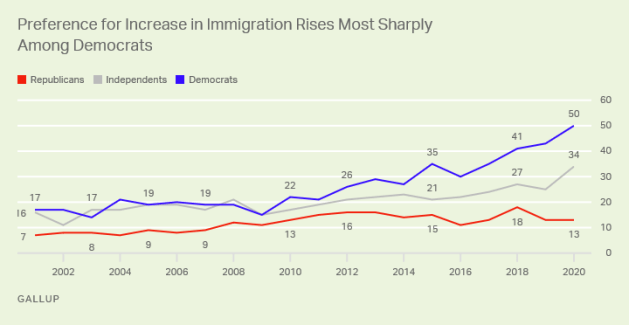
Behind all the extreme partisanship and polarization, and political gridlock, a significant finding from Gallup, coming closer to mirroring the Canadian pattern of thirds (one third for more, one third for less, one third for about the same), with of course the Republicans not having changed their anti-immigration beliefs:
Thirty-four percent of Americans, up from 27% a year ago, would prefer to see immigration to the U.S. increased. This is the highest support for expanding immigration Gallup has found in its trend since 1965. Meanwhile, the percentage favoring decreased immigration has fallen to a new low of 28%, while 36% think it should stay at the present level.
This marks the first time in Gallup’s trend that the percentage wanting increased immigration has exceeded the percentage who want decreased immigration.
Line graph. The rate of those who want immigration increase reaches historic high of 34%. 28% of Americans want immigration decrease, and 36% want immigration kept at current levels.
These results are from a Gallup poll conducted May 28-June 4 and predate the Donald Trump administration’s recent decision to halt issuing any new H-1B and other worker visas through the end of the year. It also preceded the Supreme Court’s recent ruling that invalidated the Trump administration’s action to end the Deferred Action for Childhood Arrivals Act, which offers legal protection for undocumented immigrants who came to the U.S. as children. In terms of a public focus, the topic of immigration may have currently taken a sideline to issues of race relations, but just two years ago, Americans cited it as the most important problem facing the country.
Desire for More Immigrants Rises Among Democrats and Independents
Support for increased immigration is at historic highs this year among both Democrats and political independents. Republicans’ views on increasing immigration have not changed much over the past decade. The rise among Democrats and independents coincides with a period of time when Republican leadership has attempted to limit immigration via physical barriers or changes to visa restrictions and de jure bans of immigrants from over 10 countries.
Line graph. Half of Democrats prefer to see immigration increased in US; 13% of Republicans agree. 34% of independents also favor higher levels of immigration.
Most Say Immigration Is Good for America
Nearly 8 in ten (77%) Americans think immigration is a good thing for their country. When measured in this more general sense, public support for immigration shows far less of a partisan divide, and both parties express a more generally positive view of immigration.
Line graph. Nearly 8 in 10 Americans say immigration is a good thing for America. This is virtually unchanged since 2018.
Bottom Line
Gallup’s 2020 update on Americans’ views about immigration finds that public attitudes toward immigration remain mostly positive overall, and support for expanding it is rising noticeably among Democrats and independents.
Immigration has been a key topic for President Trump since he arrived on the political scene. Yet many of his efforts, such as building a physical barrier across the border and opposing a path to citizenship for DACA immigrants, have failed to garner widespread support beyond his political base. But Trump may not be as concerned with getting majority support for his policies as he is in using the issue to energize his political base.
Trump’s policies and rhetoric on the issue are likely accomplishing that goal but may also be serving to make people outside his base more positive toward immigration.
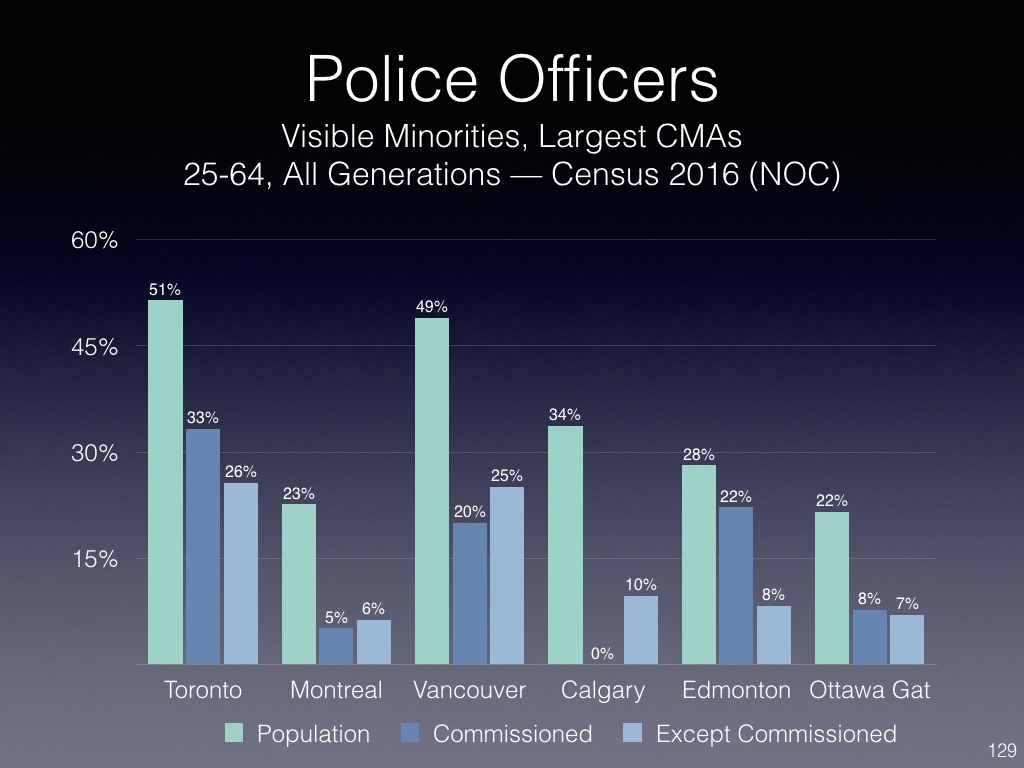
Above chart shows diversity data based upon the 2016 Census.
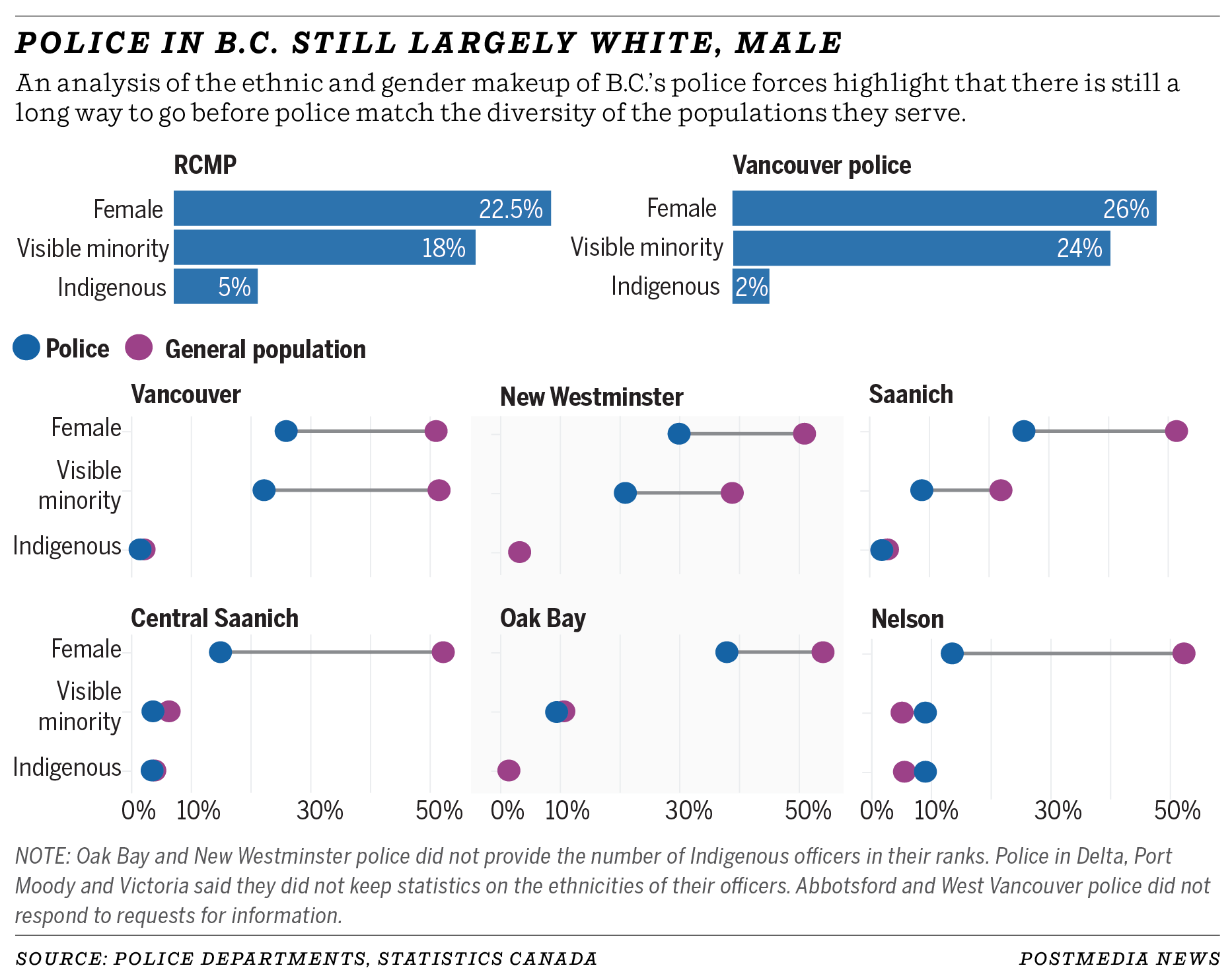
Good look at the diversity of British Columbia police forces:
As a growing number of protests in the U.S. and Canada call for reimagining how police are funded and structured, we wondered how closely B.C.’s various departments reflect the demographics of the people they serve.
We asked B.C.’s 12 municipal police agencies and the RCMP, which has jurisdiction in the rest of the province, how many of their officers identify as visible minorities and how many are women.
Eight agencies gave us full answers. The other five either do not keep diversity statistics or did not respond to our questions.
What we discovered is that within the eight full-disclosure police forces, which collectively employ more than 92 per cent of the officers in B.C., an average of 23 per cent of their cops identify as a visible minority or as an Indigenous person.
That is much lower than the 36 per cent of British Columbians who identified as visible minority or Indigenous during the 2016 census, the most up-to-date figures available.
The significance of these numbers varies widely depending on who you ask.“Overall, I’d say it’s good to have these kinds of statistics. However, even if we made a lot of progress in terms of having RCMP and local city forces more reflective of the general population in B.C. in terms of proportions of visible minorities, I’m not sure how much actual change we could expect,” said Samir Gandesha, director of the institute for humanities at Simon Fraser University.
There needs to be a cultural shift within law enforcement, Gandesha argued, that addresses “deep-seated” inequities around racism and sexism. “Talking about the demographics, I think, is a great place to start, but there are some much harder questions.”
Protesters demanding a different type of policing have marched on local streets since the May 25 death of George Floyd in Minneapolis, after a white officer knelt on the Black man’s neck for nearly nine minutes. Many local activists want the police to be “defunded,” a concept that would allocate some — or all — of hefty law-enforcement budgets to social workers or psychologists better equipped to respond to mental health calls.
For Sgt.-Maj. Sebastien Lavoie, a Black Mountie based in Surrey, the statistics mean the RCMP needs to find new, innovative ways to hire qualified officers from varied backgrounds, especially from communities in which recruitment has been challenging. The video of Floyd’s agonizing death was sickening to Lavoie, but he believes the vast majority of police officers are good people, and says sensitivity and cultural training of new recruits is “a million light years” ahead of when he went through the process 20 years ago.
“We do want to represent the society as best we can in terms of demographics,” said Lavoie, whose job is to advise rank-and-file members about decisions made by management, while also bringing officers’ concerns to the higher-ups.“So the challenge is how do we get the good candidates from those demographics coming to us? We want to get the quality and the equality. … For me the biggest focus has to be to reach out to the communities and bridge the gap and actually have people interested in policing in those communities.”
‘Not an overnight fix’
The RCMP polices large areas of the province, including parts of Metro Vancouver and most of rural B.C. It employs nearly three-quarters of B.C.’s 9,500 police. The RCMP says 18 per cent of its officers are visible minorities and another five per cent are Indigenous persons.
Those statistics come close to reflecting the demographics of a rural city like Prince George, where 24 per cent of the population identifies as one of those two groups, the census says, or in Kelowna, where the two groups comprise just 16 per cent of the population. But the statistics are out of whack for diverse cities such as Richmond, where visible minorities and Indigenous peoples represent 77 per cent of residents, or in Surrey, where they represent 61 per cent.
The Vancouver Police Department employs the second largest number of officers in B.C., and says 26 per cent of its 1,340 officers are visible minorities or Indigenous, which is one of the highest percentages in the province. However, the 2016 Census found twice that amount — 54 per cent — of Vancouver’s population identified as one of those two groups.
Vancouver police Chief Adam Palmer agreed it is important for his department to reflect the community, and suggested it is “on the path” towards that, but cautioned “it’s not an overnight fix.” He said each recruiting class today is far more diverse than the officers who are retiring, that his officers speak a combined 50 languages, and that a quarter of the force is female.“I think a lot of people would think that, ‘Oh, policing in Vancouver, it’s a bunch of six-foot-tall, 200-pound white guys running around,’ when that’s not the case,” Palmer said.
He added, though, that hiring cannot be focused on demographics alone. “Diversity is important, but it’s also important to get the right person, the right temperament and background and just the right personality and mindset to be a police officer.”
Palmer, who is also president of the Canadian Association of Chiefs of Police, denied this week there is systematic racing in Canadian policing. His department, though, is falling under increasing scrutiny.Vancouver Mayor Kennedy Stewart asked the province for a “comprehensive review” of policing in B.C., including investigating the “systemic racism and disproportionate violence” faced by Black and Indigenous peoples. Stewart, who chairs the police board, has also said he wants Vancouver police to end the practice of street checks, when people are randomly stopped and their identification often recorded, because the checks have disproportionately targeted Indigenous and Black people in his city.
On Thursday, the B.C. Civil Liberties Association, the B.C. Union of Indian Chiefs and the Hogan’s Alley Society echoed calls for street checks to end, after alleging racist and other inappropriate behaviour by two Vancouver police officers.And Vancouver Coun. Pete Fry has introduced a motion asking council to support a “community-based crisis management strategy” that would send mental-health experts, rather than police, to help people in crisis.
Also this week, trustees with the Vancouver and Victoria school boards voted unanimously to review the use of police liaison officers, who often work with at-risk youth and sometimes coach sports teams.
‘Change in a radical way’
Meenakshi Mannoe, criminalization and policing campaigner with Pivot Legal Society, co-wrote a letter last week to B.C.’s attorney general and the RCMP’s B.C. commander, calling for immediate action to address issues such as the disproportionate policing of some groups and low-income communities.
Mannoe does not, though, believe the answer is hiring more Indigenous or visible-minority officers, but rather a defunding of law-enforcement budgets, with the money routed to areas that can “prevent a crisis,” such as housing, medical care, a safe drug supply, peer counselling and cultural programs.
“We are in a moment where people are really talking about change within the police in a radical way,” said Mannoe, a trained social worker.“If we address inequalities at their core, we wouldn’t need to over-police communities like the Downtown Eastside or communities with people who experience homelessness or use drugs.”
She rejects the argument that policing in B.C. is not as racist as south of the border and therefore doesn’t need a major rethink, pointing to several local police incidents involving visible minorities. In 2014, Tony Du, a schizophrenic man waving a piece of wood, was shot dead in a Vancouver intersection. And last December, police handcuffed an Indigenous man, Maxwell Johnson, and his 12-year-old granddaughter outside a Vancouver bank after tellers questioned the pair’s identification.
These high-profile incidents are not just happening in Vancouver, of course. This week, University of B.C. Okanagan nursing student Mona Wang sued the RCMP, alleging a Kelowna officer dragged her out of her apartment, kicked her in the stomach and shouted phrases like “stupid idiot” during a wellness check.
B.C.’s policing rules outdated: Minister
The province has not yet responded to Mannoe’s letter. But earlier this month, Public Safety Minister Mike Farnworth promised to set up an all-party committee to modernize B.C.’s 45-year-old Police Act, “with a specific focus on systemic racism.” He added the “outdated” act is “out of step with our government’s approach” on issues including harm reduction and mental health.
Policing in B.C. is a patchwork quilt, with the RCMP taking up most of the fabric. Eleven municipal departments oversee 12 cities and communities, while the Transit Police patrols the SkyTrain, bus routes, the SeaBus and the West Coast Express.
After the two largest agencies, the RCMP and Vancouver, here is how the rest of the departments report on the combined percentage of visible minority and Indigenous officers they employ, based on statistics they supplied to Postmedia:
Transit Police: 31 per cent of officers are visible minorities or Indigenous, the highest percentage in B.C. It provided the most detailed breakdown of its officers’ ethnicities, which included three Indigenous and two Black officers.
New Westminster: 21 per cent of officers in a city where 42 per cent of the population identifies as visible minority or Indigenous. The agency is trying to recruit more diverse applicants through social media, community liaison officers, and lower application expenses for underprivileged people, said Sgt. Jeff Scott.Saanich: 11 per cent of officers compared to 25 per cent of the general population that is a visible minority or Indigenous. It provided detailed five-year data, which showed a slight improvement over 2016, when nine per cent of officers belonged to those two groups.
Central Saanich: It has one visible minority and one Indigenous officer, representing seven per cent of its 27-member department, numbers that have stayed roughly the same for a decade in a small community where 10 per cent of the population identifies as one of those two groups. “We are consulting with the Greater Victoria diversity committee to identify ways to reach a greater, more diverse audience” when the department is ready to hire new officers, said Sgt. Paul Brailey.
Nelson: It has two Indigenous officers but no visible-minority officers, representing nine per cent of its 22-officer department. Chief Paul Burkart noted his community is unique in B.C., because the census says its overall population of visible minorities and Indigenous people is only 11 per cent of the total.
Oak Bay: Like Nelson, nine per cent (two) of its 22 officers identify as visible minorities, compared to 12 per cent of the general population. It is seeking ways to find more diverse officers, but only hires from other departments, which limits its pool of potential candidates, said spokesperson Lindsay Anderson.
Victoria, the second largest department after Vancouver, and smaller Port Moody do not keep ethnicity statistics and did not explain why they don’t. Neither does Delta, but it “believes there may be value in collecting this data,” so in 2018 started asking recruits to volunteer this information. Since then, half of its new employees have identified as visible minorities, said Delta spokesperson Cris Leykauf.Abbotsford did not respond to requests for the data, and West Vancouver did not provide it by deadline.
To find more ethnically diverse officers, the VPD held information sessions for LGBTQ2S+ candidates, and attended events like Hoobiyee, National Indigenous People’s Day, the Chinese New Year Parade and Vaisakhi, said Simi Heer, public affairs director. The RCMP attends career fairs and cultural events, and has also launched a pilot program to help Inuit people navigate the recruitment process, said Staff Sgt. Janelle Shoihet.
‘This is the worst I’ve ever seen it’
The fallout from Floyd’s “heartbreaking” death and the public’s animosity toward police hit local Mounties harder than any other similar case that has been in the news, said the RCMP’s Lavoie.
“This is the worst I’ve ever seen it. We have seen family members turn on each other, spouses turn on their spouse,” he said. “This is one of the most emotional topics that I’ve seen in my 20 years. It’s been really bad.”
He believes the RCMP does good work and is trying to make up for past errors with modern-day efforts to change. For example, before officers respond to a major situation involving Indigenous people, such as the Wet’suwet’en pipeline protests, Lavoie says he reminds them of the Mounties’ role in seizing children to force them into residential schools and that officers need to be sensitive about this history.
“We need to own exactly what we have done, and I think we are doing a much better job of this than ever before. And that is critical,” he said.Lavoie added he has not felt racism directed at him by anyone in the RCMP, noting he was promoted while on the emergency response team and into his position today with no consideration of the colour of his skin.
Gandesha, the SFU prof, argued that hiring more racialized, or ethnically diverse, people or even having them in positions of power is not a quick fix on its own, unless everyone in the organization believes in change. For example, Minneapolis has a Black police chief, but that didn’t stop a white officer from kneeling on Floyd’s neck until he died.
He notes police budgets have risen as crime has fallen in Canada, and believes there should be a rebalance that results in more investment in social services. Then when someone is in distress, as happened west of Toronto on the weekend when Ejaz Choudry, who had schizophrenia, was shot dead by Peel police, social workers or psychologists would ideally respond to the call, not armed officers, Gandesha said.
‘It raises an eyebrow’
Another statistic we requested from B.C.’s police departments was the number of female officers they employed. That ranged widely, including 30 per cent in New Westminster, 26 per cent in the VPD, 23 per cent within the RCMP, and 15 per cent in Port Moody.
“It raises an eyebrow” that, in 2020, women are not closer to representing half of the police officers in the province, said Genevieve Fuji Johnson, an SFU political science professor who just published a study on the “whiteness” of the upper echelons of Canadian universities.She wonders about the retention rate of women in policing careers, if they perhaps leave prematurely if they don’t feel valued. Earlier this year, for example, an estimated 2,000 former female employees of the RCMP won final court approval to proceed with a multimillion-dollar class-action lawsuit against the force over gender-based abuse and discrimination.
Another question to ask these departments, she said, is whether women and visible minorities have a proportional number of high-ranking jobs or if they mainly fill the lower ranks.“Our police departments, and the RCMP, you want them to look, to the extent that’s possible, like the people they are serving. So you want that representation for a whole range of reasons,” said Fuji Johnson, who is not sure that substantive change will happen soon.
“Right now there are tons of demonstrations going on and people are making noise and I think that is super important. But is anything going to change? I don’t know.”
In a letter posted on the Stl’atl’imx website this month to the people of the St’at’imc Nation, near Lillooet, Doss-Cody wrote that many police agencies have promised to check past behaviour and build a better relationship with the people they serve.
“I wish them all of the best, but like you, I can only believe that this change can come about if there is a serious effort to deal with the systemic racism that has existed that has led to much strife with our people, including our interaction with police,” the police chief wrote.
Of note even if the government has made considerable efforts to increase diversity of judicial appointments. My unofficial running total compared to the 2016 baseline:
Women
Visible Minorities
Indigenous
2016 Baseline
35.6%
2.0%
0.8%
New Appointments
56.2%
7.2%
2.9%
The Supreme Court’s chief justice is calling for more diversity in Canada’s legal system as protests mount around the world over anti-Black and anti-Indigenous racism.
During an end-of-session news conference in Ottawa today, Richard Wagner said the top court has wrestled with cases that have underscored racial bias and the use of degrading stereotypes — and that a lack of diversity in the justice system is part of the problem.
“All Canadians should be able to see themselves reflected in their justice system. Justice should not make a person feel like an outsider or an ‘other’ when they confront it,” he said.
“I also think there is a growing awareness of the need for our courts, including our highest court, to reflect the diversity of Canadians. I certainly would welcome the insights and perspectives this could bring.”
Canada’s judiciary has become more diverse, with more women, visible minorities, LBGT and Indigenous people on the bench, but the number of Indigenous judges remains low compared to other demographic groups.
No Indigenous justice has ever been appointed to the Supreme Court of Canada.
The Liberal government overhauled the judicial appointments system in October 2016 in an attempt to recruit a more diverse array of candidates and make the selection process more transparent.
Cases show discrimination, bias
Wagner today cited some recent cases the Supreme Court has dealt with involving racism, including the case of Jeffrey Ewert, a Métis inmate who was convicted of the murder and attempted murder of two young women. The top court ruled that Canada’s prison service was using security tests that discriminate against Indigenous offenders and keep them behind bars longer and in more restrictive environments.
Wagner also cited the case of Ontario trucker Bradley Barton, which unleashed public outrageover how Indigenous victim Cindy Gladue was treated by Canada’s criminal justice system. During the trial, Gladue was described repeatedly as “native” and a “prostitute.”
Justice Michael Moldaver, who wrote for the majority in that case, said judges must do more to fight stereotypes against Indigenous victims of violence.
“As an additional safeguard going forward, in sexual assault cases where the complainant is an Indigenous woman or girl, trial judges would be well advised to provide an express instruction aimed at countering prejudice against Indigenous women and girls,” he wrote.
No call on systemic racism
Asked today if there is systemic racism in Canada’s justice system, Wagner declined to make a definitive statement. He said it’s the job of judges to weigh the facts in individual cases and speak through their judgments, while it’s up to elected officials and others to make more broad statements.
“As judges, we decide where evidence is brought forward,” he said. “We don’t issue broad statements generally without having a case to be decided upon.”
Lori Thomas, president of the Canadian Association of Black Lawyers, said she was disappointed by Wagner’s comments on systemic racism.
“The resistance to acknowledge systemic racism means that it will continue to be pervasive within the justice system,” she said.
“The fact that the perception by the community is that Black and Indigenous people are underserved or may not be given full justice in the justice system gives to mind that there is obviously a concern of systemic racism, and I can say that includes those acting in the legal community.”
Thomas said there is implicit bias within the justice system, especially given the small number of Black and Indigenous judges.
Even though Wagner said judges receive training to recognize and respond to bias and systemic discrimination, Thomas said that does not make up for a lack of diversity on the bench.
Indigenous people have long been over-represented in Canada’s courts and correctional system.
“The rate is too high. It reveals a serious problem. And so far as the judiciary is concerned, I think that the court has a role to play whenever the case is presented to the court to decide those issues,” Wagner said at the time.
As a Cree man, the outrage that has followed the police killing of George Floyd in Minneapolis resonates with my experience and my people’s demands for justice. Canadians cannot ignore the dangerous parallels that exist in how Canadian police officers interact with people of different ethnicities and how a distressingly high percentage of First Nations men and women end up either injured or dead at the hands of the people we expect to help and protect us.
Last week, a young mother, Chantel Moore, was killed by a local Edmunston, N.B. policeman who was supposed to be making a wellness check on her. She was reported to be holding a knife and in some emotional distress, but how a knock on the door turned into a confrontation in which the officer felt the need to discharge his weapon five times is hard to imagine. A day later came news that Chief Allan Adam was badly beaten and his wife roughed up during a routine traffic stop by RCMP officers in Fort McMurray in March. The pictures of Chief Adam’s battered face were disturbing, but it is the officers’ voices captured on tape and the speed with which the police escalated the confrontation that should alarm everyone. And Friday night, another First Nations man was shot dead by the Mounties, this time near Miramichi, N.B. The circumstances are always unique, but the resulting escalation and violent confrontation is not.
Until Friday, when Commissioner Brenda Lucki finally admitted her police force has a problem, the RCMP had insisted that its officers respond to situations in the same ways, regardless of whether the civilian on the other side is white, Black or First Nation. But the statistics simply don’t support this claim. Worse, the sentiment among police and First Nations youth is now rife with contempt and distrust.
Let’s spare ourselves another futile debate over whether systemic racism exists in Canada. There have been countless reports over the past 50 years, and the conclusion is always the same: First Nations face systemic racism in every aspect of life and from every institution of Canadian society. This is a fact. It should be clear to everyone by now that Canada’s unwillingness to address systemic racism is killing people. It’s killing Black people and it’s killing First Nations, Inuit and Métis people. We have to move past this unnecessary debate about whether or not systemic racism exists and we have to do it now.
While Prime Minister Justin Trudeau has made considerable efforts toward reconciliation and creating economic opportunities for First Nations, his government remains notably silent on dealing with systemic racism within the justice and corrections systems. Restorative justice delayed is restorative justice denied. It is clear this is not a problem that will heal itself.
Canadians spend so much money on policing despite knowing that it can’t solve the pressing social problems facing marginalized communities. In recent days, there have been mounting calls all over the world to “defund the police.” My question is this: When our young First Nations, in distress, call for help, are the police the right people to answer?
As a country, our focus must be on peace and justice more than law and order. Some would try to argue that the difference between those two philosophies is minimal, but I believe it is the difference between life and death. Instead of putting more guns and armoured cars in the hands of police forces, let’s try funding better schools and after-school sports programs that are proven to successfully reduce drug use and gang violence. Instead of more police officers, let’s focus on ones that are better trained, with higher compensation available to retain those with the best records for de-escalating conflict and not harming those they’re supposed to be helping.
The memory of Martin Luther King has been evoked many times over the past few weeks. One thing he said has always stood out to me: “The ultimate measure of a man is not where he stands in moments of comfort and convenience, but where he stands at times of challenge and controversy.” It is hard to imagine more challenging times than these, yet it is precisely now that we need Mr. Trudeau and his team to finish the job that they started.
I expect part of the reason has to do with the shrinking newsrooms and employment insecurity compared to the stable number of teachers and job security that provide more time for these discussions:
If there’s one thing The Skin We’re In by Desmond Cole makes clear, it is how integral racism is to Canadian life. It winds its way through the justice system, military decisions, child welfare, the education system and of course, the media, and leaves in its wake a trail of destruction for many, but particularly cruelly for Black, First Nations, Inuit and Métis people.
The burden of educating society always falls on those with the least — not just the least amount of wealth but the least social capital, too. The people society is accustomed to ignoring have to make themselves heard, be taken seriously and then force a change in behaviour. This is gargantuan cross-generational work, and Cole’s national bestseller, much like Robyn Maynard’s Policing Black Lives, is also an ode to that resistance.
One example of that resistance, the work of influencing change, that The Skin We’re In inspired, was a series of conversations among Ontario teachers.
Colinda Clyne, an Anishinaabe woman and curriculum lead at the Upper Grand District School Board, had read the book and appreciated how Cole wove together colonial history and anti-Indigenous racism with anti-Black racism. “There are many great resources to support one or the other, but not often together, and rarely with the Canadian context,” she said. Late in March, she sent out feelers to see if fellow teachers would be interested in a discussion based on this book, expecting a discussion involving about 10 people.
Instead, she ended up hosting a weekly panel titled “Anti-Racist Educator Reads” on VoicEd Radio, an educational broadcast/podcast site, with more than 500 listeners on the fifth and final week, May 13, that featured Cole himself. (For those who missed the discussions, the episodes are online.)
The people tuning in, Clyne said, were “mostly white educators with thoughtful reflections on the learning and unlearning they were doing with the book and our conversations, and the actions they were willing to commit to. It gave me a boost of hope for this anti-racism work in a way that I have not felt in a long time.”
The discussions ran deep, including the impact of police presence in schools, how Canada’s “humble colonialism” plays out in society and schools, what ignorance on racism looks like and the easily dismissed but vital role of anger to bring about change.
I listened with envy to these conversations between Clyne and other leaders in anti-racism education from various Ontario school boards such as Debbie Donsky, Pamala Agawa, Melissa Wilson, Tisha Nelson and Camille Logan.
The education system is nowhere near where it should be in terms of nurturing all students with care. But teachers are at least engaging in these critical and uncomfortable reflections. Clyne also seeks an action that teachers can commit to. While I’m not one to pat people for being at the “at least it’s a start!” stage, I raise it to make the point that other sectors are not even there.
A case in point is my own industry. Journalists are duty bound to demand accountability — but this is rarely focused inward. Race and attendant issues are an extra or an “inclusion” issue, maybe even as a new-fangled lens of discussion that could bring in new audiences. It’s why solutions look like hiring a journalist of colour or two, using images of racialized people to suggest representation or speaking to a few sources of colour.
As a journalist, Cole makes extensive references to media in his book. Of course, he mentions his fallout with the Toronto Star. His blunt reporting on CBC and CTV reporters’ rude — and chiefly arrogant — questioning of Indigenous elders and activists at a 2017 press conference on the inquiry into Missing and Murdered Indigenous Women and Girls in Canada (MMIWG), should at least make every journalist squirm.
But I don’t hear of critical inquiry-based collective reflections in newsrooms based on that or on Cole’s highly contextualized reporting of Black Lives Matter shutting down the Pride Parade in 2016. For instance, “What role did white supremacy play in guiding our coverage on it?”
Or, “Did media, with our overwhelming whiteness, have the authority or even a balanced perspective in declaring the MMIWG inquiry’s conclusion of genocide as wrong?” Or, “Whose voices did we privilege in the Wet’suwet’en pipeline protests?”
No, journalists are supposed to be a bunch of eye-rolling cynics, the know-it-alls above self-reflection. There are, after all, “real” crises to be dealt with every day. Discussions on racism are usually held among journalists of colour, on the sidelines to the main business of journalism. In newsroom after newsroom, these journalists tell me, they struggle to be heard.
That explains why it’s taken weeks after Canada was hit by the global pandemic for media to start waking up to who was most badly hit — Indigenous and racialized people — and that too after relentless advocacy by rights groups and by the bravery of those risking everything to tell their stories.
In education, too, one of the issues raised through the VoicEd Radio episodes, “are the barriers constantly put in place in our systems, a big one being denial of white supremacy and that folks ‘aren’t ready’ to have the conversations and do the work of anti-racism,” Clyne said.
It’s worth reflecting, across sectors, on who these folks who aren’t ready are, and why, when lives are at stake, we feel compelled to wait for them at all.



/https://www.thestar.com/content/dam/thestar/opinion/star-columnists/2020/05/19/desmond-coles-book-sparked-deep-conversations-among-teachers-about-racism-where-is-the-introspection-in-media/colinda_debbie.jpg)


