Order of Canada Appointments: 2013-20

With the second batch of 2020 appointments announced, I have updated my analysis of the appointments looking at diversity from the angle of women, visible minorities, Indigenous peoples, province, and area of activity.

While the percentage of women appointed in 2019 was lower than average, this rose to a more typical one-third of appointments in 2020. Representation of visible minorities was higher than previous years, representation of Indigenous peoples also rose from 2019 but remained lower than 2017 and 2018, but still higher than previous years.

There is a certain subjectivity with respect to area of activity. For example, activist, academic, public service or business and philanthropy. I have tried to be as consistent as possible.

The presentation below provides the details.

Groundbreaking investigation shows ‘pervasive racism’ against Indigenous people in B.C. health-care system

Of note:

Racism against Indigenous people is pervasive in British Columbia’s health-care system, concludes an investigation that is being touted as the first complete review of racism in a Canadian medical system.

It’s racism that is hurting the health of Indigenous people and leaving them more harshly affected by health crises in the province, including the opioid crisis and the COVID-19 pandemic, finds the newly released report.

“What it looks like are abusive interactions at the point of care; verbal and physical abuse; denial of service,” Mary Ellen Turpel-Lafond, a well-known Indigenous lawyer and former B.C. advocate for children and youth, who led the investigation at the request of the provincial government, said Monday.

“We have a major problem with Indigenous-specific racism and prejudice in B.C. health care.”

Turpel-Lafond said her team’s recommendations could provide a blueprint for the rest of the country for rooting out racism and discrimination.

The B.C. probe was initiated in June, after B.C. Health Minister Adrian Dix said he found out about allegations that health-care workers in an emergency room had played a game in which they guessed the blood-alcohol level of largely Indigenous patients before they received treatment.

Métis Nation British Columbia told CBC that health-care staff called the game “The Price Is Right.”

Turpel-Lafond said the investigation did not find evidence of an organized “Price is Right” game, but that it unearthed an even more insidious picture of a system rife with racism and prejudice, that is making the B.C. health-care system an unsafe place for Indigenous people to seek care.

The report, called In Plain Sight, is based on input from 9,000 people, including Indigenous people and health-care workers.

Turpel-Lafond said a second report, a data-analysis of Indigenous-specific health outcomes, will be released in the next month.

The report’s 24 recommendations deal with implementing systems and cultural expectations to root our implicit and explicit racism in B.C.’s health-care system, including the creation of a B.C. Indigenous officer of health and an associate deputy minister of Indigenous health at the provincial government.

Dix on Monday offered an “unequivocal” apology for the findings of racism in the report, and vowed to implement recommendations immediately, including by introducing new Indigenous health liaisons in each of the province’s health authorities.

Indigenous leaders were quick to express their support for the recommendations, saying they were especially urgent in view of the ongoing pandemic.

“There is no time to wait; the current COVID-19 pandemic necessitates constant engagement by First Nations with the health care system, and we categorically demand a safe health care system for our people at this time and going forward,” reads a portion of a statement by the First Nations Leadership Council.

The treatment of a Quebec woman in hospital earlier this year also served to highlight the barriers Indigenous people face to getting care.

Joyce Echaquan, an Atikamekw mother of seven, died soon after she filmed herself from her hospital bed in late September while she was in clear distress and pleading for help. Toward the end of the video, which was streamed live, two female hospital staff enter her room and are heard making degrading comments, including calling her stupid and saying she’d be better off dead.

The video has created widespread indignation, several inquiries and a lawsuit from Echaquan’s family against the hospital where she died in Joliette, Que.

Source: Groundbreaking investigation shows ‘pervasive racism’ against Indigenous people in B.C. health-care system

Ousted from Labrador Inuit government, ex-politician questions ‘blood quantum’ method

“Blood quantum” was a central part of US slavery and discrimination and Lawrence Hill, in Blood, captures some of the inhumanity (and is critical of the Indigenous focus on blood):

A former member of Labrador’s Inuit government is questioning the methods used to quantify whether he is sufficiently Indigenous after he was removed from his government roles last week.

Edward Blake Rudkowski said he was informed Nov. 20 that he was no longer a beneficiary of the Labrador Inuit Land Claims Agreement after a review of his status determined he had just 17 per cent Inuit blood. According to the land claims agreement, beneficiaries must have at least 25 per cent “blood quantum,” as it’s called, to be registered as Labrador Inuit, Blake Rudkowski said.

“This development is entirely related to a group of people throwing darts at a genealogy board,” he said in an interview Friday. “You can sit there with your membership for over three decades — over three decades — and then someone says, ‘Hey man, you’re not in anymore?’”

Blood quantum is a controversial practice of determining the percentage of one’s Indigenous ancestry. Blake Rudkowski calls it “junk science” and says his predicament is an example of how it’s an inadequate and inaccurate measure of who belongs and who doesn’t.

He said he’s been a beneficiary under the claims agreement for 34 years, and in all that time, nobody questioned his status as a Labrador Inuk. His family has a long, respected history in Goose Bay, in central Labrador, and his grandfather was one of two Inuit families in Sheshatshiu, an Innu community about 40 kilometres north of Goose Bay, he said.

“The footprints of my grandparents are all over Labrador, and my great-grandparents, and my great-great-grandparents,” he said.

He now lives in Toronto. In a 2017 byelection, he won a seat as an ordinary member in the Nunatsiavut Assembly representing Labrador Inuit who live outside the land claim area in Nunatsiavut, and outside the Upper Lake Melville area in central Labrador where many beneficiaries live. He won the seat again in 2018 in the regular election. In 2017, he was also appointed Speaker of the assembly.

On Friday, after he was told he was no longer a beneficiary, he says he got a call from Nunatsiavut president Johannes Lampe, who said he could no longer hold his seat in the Nunatsiavut Assembly nor his role as the assembly’s Speaker — only Labrador Inuit can be members of the assembly.

“I feel raw, I feel disappointed, I feel distraught, I feel upset,” he said. “Obviously there’s a whole myriad of negative emotions that get associated with a life event like this.”

In a statement Monday announcing Blake Rudkowski’s removal, the Nunatsiavut government said it “plays no role whatsoever in determining the membership of any individual,” and the beneficiary enrolment process is independent from the Nunatsiavut government.

Nobody from the Nunatsiavut government was available Friday to speak about its decision to remove Blake Rudkowski from government, or about the blood quantum determination process.

Blake Rudkowski said the documents he received indicating his status was under review showed the review was triggered by a political opponent.

“I had to apply as anyone who never had any experience with Nunatsiavut would have to apply,” he said. “It’s as if that previous 34 years didn’t exist.” As required, he included extensive details of his family history in his application.

“Their determination was that my blood quantum was 17.4, or it might be 17.3 . . . . So you would think with a number that precise would imply there was an empirical calculation . . . to arrive at that output. And for love nor money, I couldn’t tell you what the process was,” he said.

Blake Rudkowski said he hasn’t been offered any means to appeal the decision. He wonders what kind of precedent the decision sets. “If it could happen to me, then who’s next?” he said.

As for his own next steps, Blake Rudkowski said he hasn’t yet figured those out but he’s not defeated.

“I feel a calling to public service, and my days in the political arena aren’t over,” he said. “I’m really upset that my path with Nunatsiavut came to a halt the way it did, especially when it came to questions of my heritage, which are not questionable in my mind.”

Source: Ousted from Labrador Inuit government, ex-politician questions ‘blood quantum’ method

Saskatchewan election: MLA diversity

Saskatchewan 2020 Election MLA Diversity

With the election results and new Cabinet appointments, the above chart shows the representation of women, visible minorities, and Indigenous peoples in relation to the overall population and the two parties.

Most striking to me is the significant under-representation of Indigenous peoples overall, with only the NDP having its elected MLAs largely reflecting the overall population (but not with respect to visible minorities.

Will update British Columbia once Cabinet appointed.

Australia: If that is not who we are, then who are we?

Bitingly sharp critique of the phrase “This is not who we are,” written mainly but not exclusively from an Indigenous perspective. While over the top, more than a kernel of truth in terms of the various divisions and fault lines that apply more broadly than Australia and Indigenous issues:

After news of Australian war crimes in Afghanistan made headlines, it was only a matter of time before a politician uttered the words “This is not who we are”

Australia has been trying very hard for a very long time to have its cake and eat it too when it comes to the idea of ‘we’.

It has tried to create the impossible, or at least the grossly contradictory and hypocritical, by aggressively separating and dividing people across every imaginable line while simultaneously appealing to an idealised sense of ‘we’ whenever it is convenient or expedient.

We are separated across state lines, a fact which has never been clearer than when watching our Prime Minister first attack Victorians and then try to steal their achievement as his own.

We are separated across racial lines with racist dog whistling from media and politics, and more overt racism from everyday white supremacists.

We have simultaneously rejected Indigenous rights, rejected multiculturalism, and embraced assimilation in a way that allows racism to be framed as only a problem when someone complains about it and not when someone enacts it. The divisive act, separating we into usand them, is the acknowledgement of mistreatment rather than the mistreatment itself – “Why do they always have it to make it about race?” they ask, to an elusive ‘them’ who they like to imagine make everything about race.

We are separated across political lines with a renewed animosity and disdain aimed not just between our political parties, but from our politicians to the people they are meant to represent.

We work hard to separate ourselves with all sorts of real and imagined differences; AFL or NRL, Ford or Holden, devon or fritz, potato scollops or potato cakes, and while many of these are a bit of a laugh, some have still led to more than a few playground/pub punch ons over the years.

We also separate ourselves in ways that actively dehumanise those of us who are not we so that we are less concerned about about their human rights being denied (which is of course the point of dehumanising someone in the first instance); homeless, unemployed, incarcerated, lower income, asylum seekers, Indigenous peoples – if only they’d worked a little harder, not jumped the cue, not made it about ‘us and them’, not been mean to me once in primary school, then they’d be one of us, then they’d deserve dignity, respect and basic human rights.

And amongst all of that division there is a singular unified theory of ‘We’ that transcends time and space and all of reality.

The mythical ‘We’ who arrived on the First Fleet, even though it was not us who committed the massacres. That is not who we are!

And the we who were already here for thousands of years before we are not us but they, but only because they always make it about race by playing the race card, and they didn’t even invent the wheel so they should be thankful it was us who invaded and not some other them, not that it was even an invasion to begin with… and on it goes.

It is the We who wins gold medals at the Olympics, or beats India at the cricket, or New Zealand in the rugby, but it is not us if they refuse to sing the anthem, or if they take a knee, or dare to wear an Aboriginal flag, or throw an imaginary spear. That is divisive! That is not who we are!

It is the We who fought bravely in every war (except the frontier wars which never happened) so that we can celebrate our veterans, our beloved ANZACs, with alcoholism, gambling and sacred biscuits once a year. We forget they even exist outside our imagined dreams of past national glory even as we all mindlessly chant ‘Lest we forget’. And when they return different from when they left and in need of our support, we pass the buck yet again because it is not us who fail our returned service men and women just as it is not us who committed the war crimes – that is not who we are.

We is an impossible dream but still one that many feel is worth pursuing, personally I could take it or leave it, especially since that dream has been turned into a nightmare by those who exploit us by using we as a convenient scapegoat allowing them to pick and choose not just who is we, but when we are we. We push them away for not being we enough, we thin the ranks of we by declaring that all of us who do wrong in our name were never really we to begin with – they are unWe. They are not the real We. They are not who we are.

But either it is who we are, because we share a sense of collective identity, and accept collective responsibility for both the good and the bad, or if it is not then we, the collective embodiment of Australia, does not exist as anything other than a system of ever changing rules that benefit a select few, that denies Indigenous people justice, and that locks up brown people for trying to exercise our legal right to seek asylum.

We are the greatest nation on earth, because we only accept collective responsibility for all the good stuff while denying any responsibility for the bad stuff, though we will still happily keep the land and resources that were gained through doing the bad things that we didn’t do.

But here is the long and short of it for all of us.

If we want to have “Australia won a gold medal at the Olympics” then we also have to take “Australia committed war crimes”.

Of course we did not all individually do all the bad things anymore than we all collectively did the good things, for that is what being a collective is all about – collective responsibility.

And we do not need to stand for an anthem or salute a flag or be suitably proficient in English to do that, we just need to acknowledge problems where they exist and strive to make them better and never turn a blind eye or shirk our collective responsibilities to ourselves, to each other, or to our fellow human beings regardless of where we come from.

There is strength in the collective ‘we’, but there is a danger when we let them decide who weare and who we are not.

The modern incarnation of jingoistic, patriotic, racist as fuck, white ethnostate loving nationalism has its roots in the Howard/Hanson era, but of course is merely an adaption of the same white ethnostate ideal that Australia was built on. Once the idea of a Whites Only nation was put to bed, Australia was either going to embrace true multiculturalism or it was going begrudgingly accept that not everyone can be white while demanding that they damn sure do their best to act it anyway. This is where the origin of ‘One Nation’ comes from, for before it was a racist political party it was part of a strategy aimed at getting people to accept multiculturalism.

As Andrew Jakubowicz explains:

Multiculturalism may well be supported by 80% of Australians, but this level drops when anxiety about border security rises. So, multiculturalism’s opponents have much to gain from heightened public concern about “Muslim immigration”.

Hanson’s election has helped clarify the sides of the debate around how Australians have “imagined community” for more than 30 years, since Geoffrey Blainey first shaped the opposition arguments. There is one nation with many cultures, which was Bob Hawke’s 1989 definition of multiculturalism. And then there should be only one culture albeit followed by many races, which is Hanson’s conceptualisation – though wrongly labelled as “One Nation”.

The first sees Australia as a civic nation in which reciprocity and difference, supported by core commitments to democracy and equality, provide the architecture for creativity and cohesion.

The second sees Australia as an (Anglo-Christian) ethnic (multicoloured) monocultural nation in which assimilation into an imagined singular worldview drives calls for cohesion and claims of social strength.

We have never really reconciled which of the above ‘we’ we mean when we talk about ‘we’, and until we do we will be incapable of working out where we are heading because not only do we not know where we are, we apparently don’t even know who we are, even if some of us want to pretend to know who we aren’t.

Source: If that is not who we are, then who are we?

What the Public Service Employee Survey breakdowns of visible minority and other groups tell us about diversity and inclusion

My companion piece to the earlier https://policyoptions.irpp.org/magazines/october-2020/what-new-disaggregated-data-tells-us-about-federal-public-service-diversity/:

PSES data supports the view that the government has considerable work to improve the workplace organizational culture to reduce harassment and discrimination for both visible minority and Indigenous groups. 

Black employees report being a victim of discrimination the most, generally and with respect to race and colour. But all groups report significantly higher discrimination than all employees, according to data analyzed by Andrew Griffith. 

Following the 2019 Employment Equity Report provision of disaggregated representation for visible minorities, Indigenous people, and persons with disabilities, the 2019 Public Service Employee Survey (PSES) similarly lays out these breakdowns for the four employment equity categories along with LGBTQ2 persons, to assess whether or not the public service is inclusive to all groups.

With the availability of disaggregated data, we now can compare the experiences of different visible minority and Indigenous groups, using the helpful summary tables available at Open Data.

For ease in analysis, I have separated indicators pertaining more to organizational culture (employee engagement, senior management, workplace well-being, empowerment, career development, diversity and inclusion) from those of personal experience (harassment and discrimination).

Figure 1 contrasts the results for the 22 organizational culture questions for women, visible minorities, Indigenous peoples, persons with disabilities (PwD) and LGTBQ2, highlighting those with a variance of five per cent better or worse compared to all employees. Overall, the major issues appear to be with respect to PwD across virtually all indicators followed by Indigenous employees with respect to diversity and inclusion. Visible minorities and LGBTQ2 are largely similar to all employees, with the exception of higher stress due to discrimination for visible minorities. However, visible minorities also indicated being more satisfied with senior management and less stressed after the workday.

Figure 2 compares the harassment and discrimination indicators across the categories. The results are as one would expect for each category. While visible minorities are comparable to all employees with respect to harassment, they are more likely to have encountered discrimination based on their race, ethnic origin, colour, or religion. Indigenous people are more likely to feel excluded and encounter discrimination based on their race. Once again, PwD are more likely to encounter harassment, whether being subject to excessive control, being excluded, humiliated or encountering interference in their work, and being discriminated against in their disability. LGBTQ2 people encounter more sexual comment or gesture harassment, along with greater discrimination on sexual orientation or gender identity.

Visible minorities

Figure 3 contrasts the responses for the different visible minority groups for the organizational culture indicators compared to all employees. Generally, employee engagement indicators show comparable results across all groups to all employees with minor variations. Most groups are more satisfied with senior management than all employees, particularly with respect to information flow. Workplace well-being indicators are generally more positive than for all employees, with the notable exception of harassment- and discrimination-induced stress. While empowerment indicators generally are similar to all employees, Black, Japanese, and Korean feel the least empowered. Career development indicators are also generally comparable, with the exception of more negative perceptions by Japanese, Black, South Asian, and West Asian employees responding that discrimination has adversely affected their career progress. While diversity and inclusion indicators are generally comparable across groups, Japanese employees have the lowest satisfaction along with Black employees regarding support for a diverse workplace.

Overall, Filipinos have the highest levels of satisfaction of all groups consistently across all indicators.

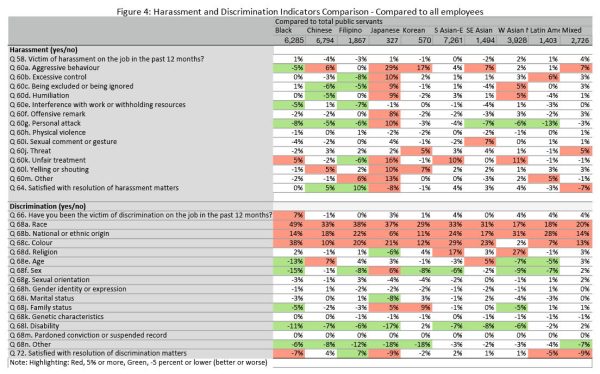
Figure 4 contrasts the responses for the different visible minority groups for the harassment and discrimination indicators compared to all employees. Black, Filipino, and Chinese employees report lower harassment for most indicators than other groups. Aggressive behaviour is highest among some Asian groups, along with yelling or shouting. Perceived unfair treatment is common to most groups, save Filipino and Southeast Asian.

Overall, Japanese employees report the greatest harassment and least satisfaction regarding harassment resolution and Filipinos the least harassment and greatest satisfaction with resolution, followed by Chinese employees.

Black employees report being a victim of discrimination the most, generally and with respect to race and colour. But all groups report significantly higher discrimination than all employees, whether by race, ethnic origin or colour, save for West Asians/Arab. However, Southeast Asian and West Asians/Arab report high levels of religious discrimination, most likely related to Islam. Interestingly, both Chinese and Southeast Asian employees report higher levels of age discrimination, and family status discrimination is highest among Japanese. Discrimination resolution satisfaction is highest with Filipinos and lowest with Black, Japanese, Latin American and mixed.

Indigenous groups

Figure 5 contrasts the responses of the three Indigenous groups for the organizational culture indicators compared to all employees. Overall, Inuit have higher levels of satisfaction across the vast majority of these indicators, with Métis having the lowest levels with respect to employee engagement, the highest work-related stress and the lowest levels of empowerment. North American Indian/First Nations and Métis employees rate the psychological health lower than all employees and all three groups report higher levels of discrimination-induced stress.

Figure 6 contrasts the responses with respect to harassment and discrimination. All Indigenous groups report harassment over the past 12 months, being excluded or ignored. Inuit have higher rates of being humiliated or being subject to offensive remarks while Métis report being subject to excessive control and personal attacks. Only Inuit are satisfied with harassment resolution while Métis are least satisfied. With respect to discrimination, all have experienced higher levels of discrimination than all employees, with very high levels based on race for First Nations and Inuit and high levels with respect to nation or ethnic origin. As in the case of harassment resolution, only Inuit are as satisfied as all employees while Métis are least satisfied.

While it appears that the experience of visible minorities is worse than Indigenous peoples, PSES data supports the view that the government has considerable work to improve the workplace organizational culture to reduce harassment and discrimination for both visible minority and Indigenous groups. This needs to take place at the general and the specific group levels by each department given the variances between the individual groups.

As in the case of disaggregated data with respect to employment equity groups, the increased granularity of the PSES provides a richer evidence base for managers and human resources to develop measures to improve inclusion in the public service at the departmental and organizational levels.

Methodology:

This analysis is based upon the TBS abridged PSES data table, 2019 PSES —Diversity and Inclusion Tables. The data tables contain comparisons of the 2019 PSES results between certain demographic groups or sub-types of designated groups under the Employment Equity Act and the rest of the public service. As the PSES is a voluntary survey, open to core public administration (Schedule I and IV) and separate agencies (Schedule V), the responses cover a broader range of organizations than TBS Employment Equity reports which only apply to core public administration. Responses for categories and groups were contrasted with all responses, save for the general question on harassment and discrimination for women which is a direct comparison with men. TBS weighs the responses based on workforce demographics. The response numbers by group were taken from the  2019 Public Service Employee Survey open dataset.

A threshold of five per cent to flag significant differences was used, with red indicating worse and green better.

Larger format tables (pdf):

Source: https://www.hilltimes.com/2020/11/02/what-the-public-service-employee-survey-breakdowns-of-visible-minority-and-other-groups-tell-us-about-diversity-and-inclusion/270120?utm_source=Subscriber+-++Hill+Times+Publishing&utm_campaign=952f203e8a-EMAIL_CAMPAIGN_2020_11_03_11_00&utm_medium=email&utm_term=0_8edecd9364-952f203e8a-90755301&mc_cid=952f203e8a&mc_eid=685e94e554

A shot in the dark and 185 megabytes of data: How I investigated a system of bias in Canada’s prison system

Good account of Tom Cardoso’s data journalism and the processes involved in the Globe’s excellent analysis of racial disparities in incarceration (Bias behind bars: A Globe investigation finds a prison system stacked against Black and Indigenous inmates). Puts my small efforts in perspective:

A little over two years ago, I dropped a letter in the mail.

I had begun to wonder, after a series of high-profile criminal cases had ended in acquittals earlier that year – Gerald Stanley and Raymond Cormier’s trials, specifically – if I could collect any data on the racial composition of juries. I shot off a few e-mails to lawyers and activists, and quickly learned this data likely didn’t exist.

But, as part of my poking around, I realized I might be able to look at something else: sentencing. I figured sentences must be tracked in a structured way by correctional authorities; if not, they wouldn’t know when to release inmates. Given the overrepresentation of Indigenous people in the correctional system, it’d be worthwhile to examine sentencing data by race – so I pivoted, from jury composition to sentencing.

Though freedom of information requests are often a shot in the dark, I typed up a letter asking for 20 years of records from the Correctional Service of Canada’s (CSC) database, which I’d learned about by e-mailing yet another set of people. On Aug. 30, 2018, I mailed them my request, and then almost immediately forgot about it.

Weeks later, I heard back from the CSC’s freedom of information officers, and began a months-long negotiation for release of the data I’d requested. In April, 2019, I finally received a CD in the mail, and went to open the spreadsheet it contained.

Microsoft Excel booted up, and then immediately crashed. The spreadsheet the CSC had disclosed was 185 megabytes. In my hands, I realized, was an enormous data set unlike any I’d ever worked with, recording the lives of nearly 50,000 people in the CSC’s custody between 2012 and 2018. I used a statistical programming language called R to open the file, and began digging around.

It often takes me a while to become “comfortable” with new data, and it was especially true now given this file’s size. I had no idea what kinds of patterns it contained, or how best to summarize it. In my mind, I often picture this phase in any analysis as the point at which I “crawl inside” a data set.

To start, I blindly summarized it, curious to see what it’d tell me. I figured I needed a second opinion, so I sat down with Patrick White, a colleague who’d extensively covered the federal prison system, and showed him some of the charts I’d cooked up. “There’s almost too much interesting stuff in here,” I told him, “and I’m not sure where to start.”

After spending some time with the materials I’d pulled together, he asked simply: “What about these risk assessments?”

From there, exploring the data became easier, and I quickly uncovered some disturbing patterns. Indigenous and Black people seemed to be receiving worse scores across a range of assessments much more frequently than other groups. Two scores in particular, the “offender security level” and “reintegration potential” score, sounded especially important. But I had no idea what these scores were supposed to represent, how they were calculated or what impact they had on an inmate’s time in prison.

By now, it was December, 2019, and I began reaching out to anyone I knew who could tell me whether – and how – these scores mattered. At the end of each call, I’d ask them if there was anyone else they’d recommend I speak with. Over a period of 10 months, my network grew from a small handful to nearly 70 people.

With each conversation, I tightened my methodology and honed my analysis. Eventually, after being inspired by a U.S. news outlet’s investigation on risk assessments, I realized I needed to disambiguate the impact of race from everything else using statistical modelling. So once again I went back to my Rolodex, e-mailing academics, statisticians and data scientists who could help me. Over the winter, spring and summer, guided by their advice, I built the kinds of statistical models I’d need for the analysis.

As I was doing that, I also began looking for inmates who could tell me about their experiences. Finding people who’d speak with me wasn’t easy, given I was looking at something as arcane and specific as risk assessments. I met Nick Nootchtai, for instance, after e-mailing a contact. They put me in touch with someone, who led me to someone else, who finally told me they knew of a person I might want to speak with. The first time I met Nick, at a Tim Horton’s in downtown Toronto, he handed me a plastic bag full of his correctional records, which shed light on the process and made it clear how critical these scores were.

My model’s findings were damning – so much so that I spent months trying to find an error in my code that could account for the discrepancies. When dealing with data-driven stories of this size, The Globe has a process for independently verifying findings. This meant handing over my entire analysis to a fellow data journalist, Chen Wang, and a Globe data scientist, Jeremy Gray. Our head of visuals, Matt Frehner, served as a sounding board for the investigation’s major findings.

I began to report the story in earnest in the spring, but the COVID-19 pandemic quickly became a priority. Months later, I was able to return to it, interviewing dozens of academics and experts in the field. Occasionally, I’d get a phone call from an unknown number – an inmate calling me from behind bars.

According to the CSC’s data, in 2018 an average of two inmates each day started serving a two-year sentence. That’s the threshold for sending them to federal prison, where risk assessments undoubtedly left their mark. The odds are good, then, that someone went to prison the same day I dropped my letter in the mail. Today, they are walking free.

Their experiences, along with those of so many others, are what you see today.

Source: https://www.theglobeandmail.com/canada/article-risk-backstory/

Senator criticizes Alberta proposal to shield younger students from lessons on residential schools

One of the better articles soon the Alberta proposed revised curriculum, reminding me of some of the internal discussion regarding the citizenship guide, Discover Canada, steered by the same political staffer to Jason Kenney:

The former chair of the commission on residential schools says a proposal from government-appointed advisers in Alberta to shield younger children from that dark history would be a “terrible mistake” that would leave them with a distorted view of the mistreatment of Indigenous people in Canada.

Senator Murray Sinclair, who led the Truth and Reconciliation Commission, said children can handle information about the difficult topic of residential schools when it is presented in an appropriate way. If the education system waits until they are older, as contemplated in a leaked curriculum proposal, he said that will perpetuate a “wall of mythology” about Indigenous people and their history that will be next to impossible to undo.

“It’s not only a terrible mistake, but it would be an act of discrimination against the Indigenous people,” Mr. Sinclair told The Globe and Mail.

“It would be, in fact, a continuation of the white supremacy which the residential schools and the public schools have historically perpetrated against the Indigenous people of this country. And we should call it what it is and we should fight it when we can.”

An advisory panel appointed by the United Conservative Party government has presented the Education Minister with a package of recommendations, published Wednesday by the CBC, for the kindergarten-to-Grade 4 social studies curriculum. The document argues that information about residential schools should not be taught to children in Grade 3.

Instead, the document says that material should wait until students are older, potentially in Grade 9, and with residential schools presented as one example of “harsh schooling.”

“The ugliness of Dickensian schooling, boarding schools, 19th-century discipline methods, and residential schooling that applied to some Indigenous kids can probably best be saved for later when learners are more mature and are less emotionally vulnerable to traumatic material,” the document says.

“For example, there could be a Grade 9 unit about benign vs. harsh schooling in the past, inclusive of all cultures not only Indigenous, but with regard to the particular problematic of residential schooling even if it applied only to a minority of Indigenous children.”

Mr. Sinclair rejected that idea, and said it is possible to present the history of residential schools in a way that that is appropriate for young children.

“We’re not asking them to start holding up bloody pictures and demanding that they cry,” he said. “What we’re saying is, talk about it from the perspective of children. Talk about it in ways that they can understand, that they can utilize. It can easily be done.”

Mr. Sinclair, who has called on provincial education ministries to ensure students learn about residential schools, said young children already learn about potentially upsetting topics, such as wars.

Education Minister Adriana LaGrange stressed the ideas in the document are merely recommendations. She said residential schools would be taught in elementary school but she declined to say at what age that would start or how that information would be presented.

“We are absolutely committed to truth and reconciliation and to ensuring that the truth about residential schools is in our K-6 curriculum. That is non-negotiable,” she told reporters at the provincial legislature in Edmonton.

She noted that a larger working group that will include teachers will examine the curriculum this fall and a draft will be ready for public feedback next year.

Richard Feehan, the Opposition New Democrats’ critic for Indigenous relations, said teaching all students about residential schools should be non-negotiable.

“They worry that young children can’t hear that story, and yet here we are approaching Nov. 11, when we go into every grade in school and talk about the history of World War One and the history of World War Two,” he said.

“But somehow, when we talk about Indigenous children being harmed or being killed, it’s somehow too much for children to handle. It doesn’t make sense to me.”

The Truth and Reconciliation Commission’s report in 2015 described the Canadian government’s long-running policy of removing Indigenous children from their communities as cultural genocide.

The report also found that abuse was rampant within the residential school system.

“Child neglect was institutionalized, and the lack of supervision created situations where students were prey to sexual and physical abusers,” the report said.

The commission called on ministers of education across the country to include the history and legacy of residential schools in kindergarten-to-Grade 12 curriculums. In 2014, the Progressive Conservative government of the day publicly committed to ensure students at all grade levels learn about the legacy of residential schools.

When it comes to First Nations, the proposed curriculum document focuses on teaching young children about the life and customs of Indigenous people, particularly before contact with Europeans. Topics include the structure of First Nations leadership, farming, hunting, Arctic survival and “warfare.”

While the document argues lessons about residential schools would be traumatic, it also proposes that students in Grade 3 be taught about ancient Rome, battles of the Middle Ages and slavery in the Ottoman Empire.

Source: https://www.theglobeandmail.com/canada/alberta/article-senator-criticizes-alberta-proposal-to-shield-younger-students-from/

What new disaggregated data tells us about federal public service diversity

My latest in Policy Options, taking advantage of disaggregated employment equity data:

Just how diverse is the federal public service? This question recently has attracted more scrutiny, particularly when it comes to the inclusion of Black Canadians in the bureaucracy. Before February, no Black person had made it to the deputy minister rank of the public service – Caroline Xavier is now associate deputy minister of immigration, refugees and citizenship. The speech from the throne included a commitment to “Implementing an action plan to increase representation in hiring and appointments, and leadership development within the public service.”

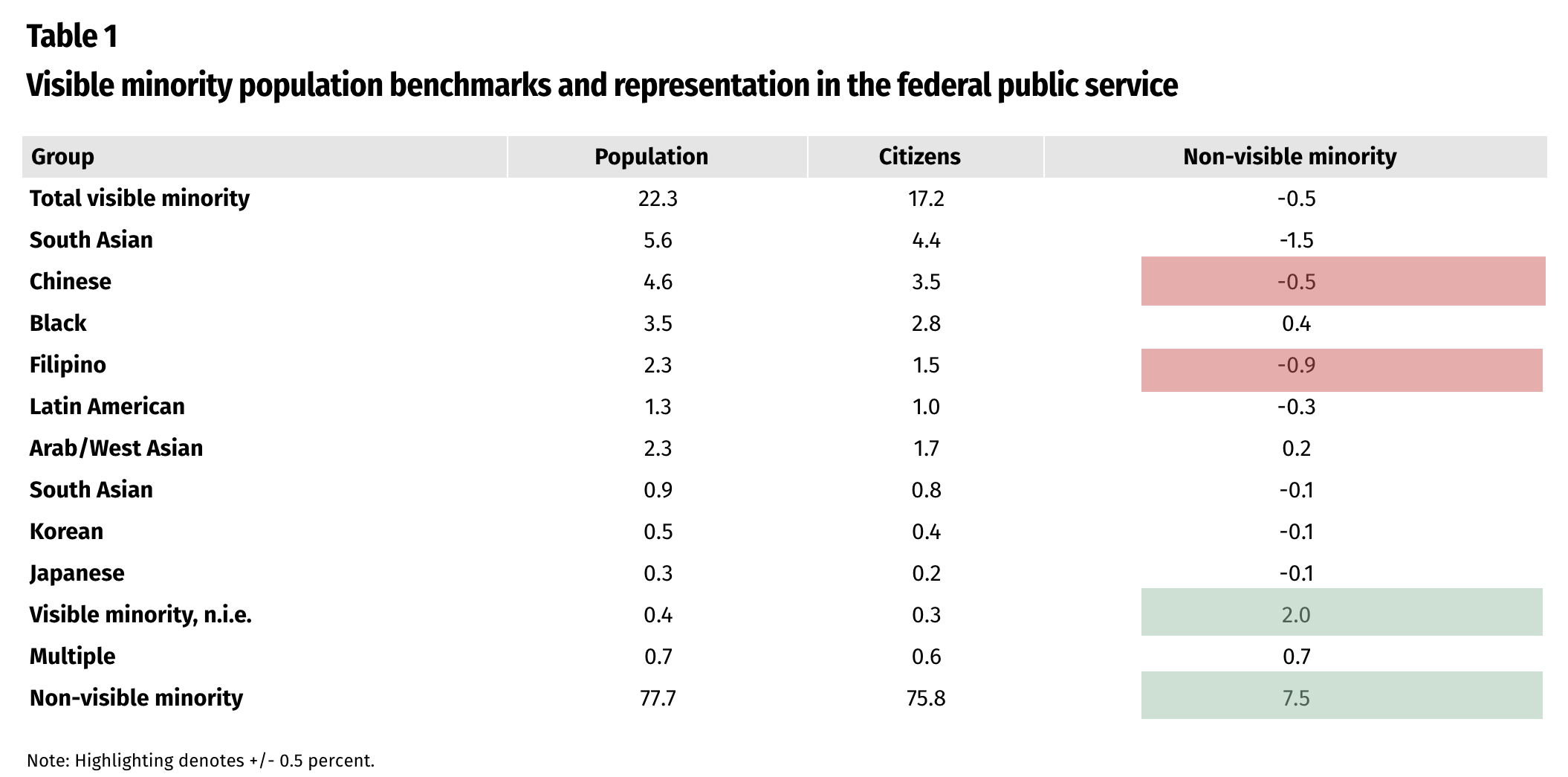
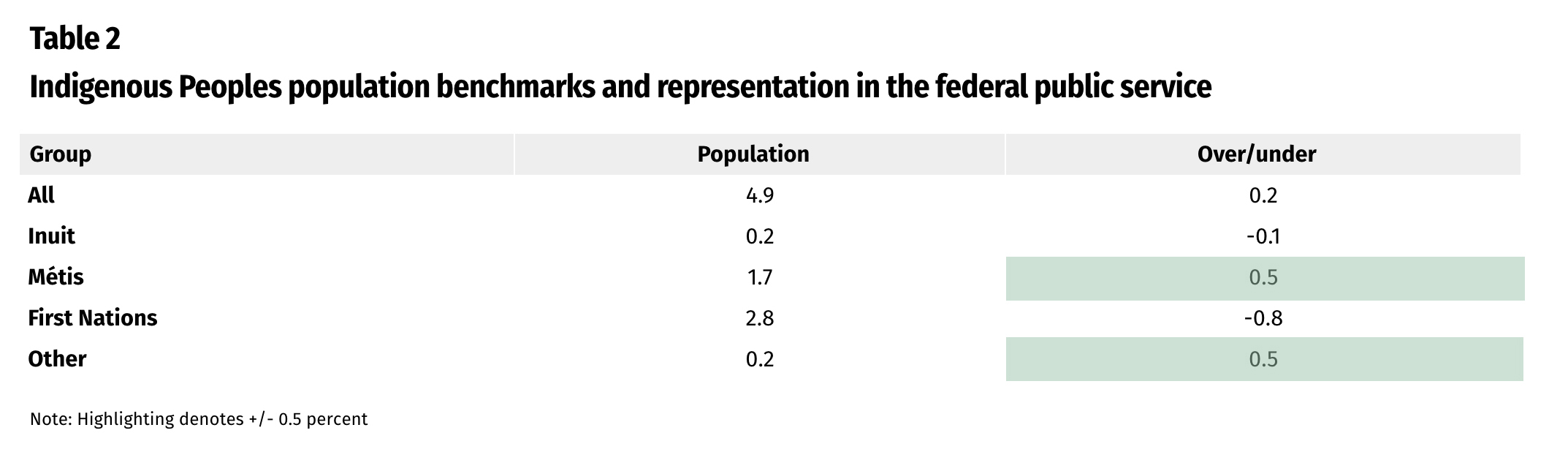
Now, for the first time, the federal government is providing disaggregated data related to the diversity of the public service as part of its Employment Equity Report. The Treasury Board Secretariat’s (TBS) report looks at the three fiscal years from 2016-19 by occupational group. Previously, disaggregated data for visible minority and Indigenous individuals employed in federal public administration (excluding the military) was only available through census data every five years. We now have the tools to do a more granular analysis of visible minority representation in each occupational group and see where work remains to be done. Table 1 looks at the overall visible minority representation in Canada, the visible minority population that are citizens, and the numbers shared in the government’s equity report. The citizenship number is taken here as a benchmark, since citizens are given preference in government staffing processes. This gives us a picture of the degree to which there is under-representation of certain groups compared to the citizenship-based benchmark. A note about the terminology: I have used the term visible minority, as do Statistics Canada and the Treasury Board Secretariat. Indigenous Peoples are their own category for data purposes, and do not fall under visible minority. While the visible minority group definitions are similar to those used by Statistics Canada, TBS groups Arab and West Asians together under “non-white West Asian, North African or Arab.” “Mixed Origin” refers to those with one visible minority parent. The representation of most groups is relatively close to their share of the citizenship population, with South Asian, Chinese and Filipino public servants less represented.Table 2 takes the same approach with respect to Indigenous representation with the exception that total and citizenship-based populations are identical, showing relative under-representation of First Nations and Inuit people.Table 3 compares the representation of each visible minority by occupational group, expressed as the percentage difference with non-visible minority, non-Indigenous employees for the three-year period 2017-19. For most groups, relative representation has not shifted dramatically from 2017 to 2019, with general under-representation in the executive, technical and operational categories.Among executives, no group has improved its representation by one percent or more from 2017 to 2019, with only individuals of mixed origins showing an increase of 0.6 percent, and Black, Filipino and Southeast Asian people showing marginal increases (0.1, 0.3 and 0.1 percent respectively). Table 4 similarly compares the representation of each Indigenous group by occupational groups, expressed as the percentage difference with non-visible minority, non-Indigenous employees for the three-year period 2017-19 (for the executive and technical occupational groups, there are fewer than five Inuit public servants, and thus the federal government does not provide numbers out of concern for privacy).While this analysis highlights the differences in visible minority and Indigenous representation among the different occupational categories, it does not break it down by seniority level. TBS declined to provide a disaggregated breakdown for assistant deputy ministers (level EX4-5) and directors and directors general (level EX1-3) given that breaking down the numbers to those subgroups would present a privacy risk. But TBS did say that of the 335 ADMs, 30 are visible minority (9.0 percent) and nine Indigenous (2.7 percent). Black Canadians are the visible minority group with the strongest numbers in the public service compared to their share of the citizen population, but their representation is overwhelmingly in the two administrative categories. This is not unique – there is significant under-representation among Latin American, Chinese, Filipino and South East Asian groups in the executive ranks of the public service. A similar general pattern can be found with Indigenous public service representation. With this type of disaggregated data in hand, policy discussions and responses can be based more solidly on evidence rather than relying on examples and anecdotes about who works in the public service. With better data, the government can hopefully build a more representative and inclusive public service at all levels.

Source: What new disaggregated data tells us about federal public service diversity

For those interested, the TBS dataset used can be found here: Employment Equity Sub-Group Population in the Public Service of Canada

Overcoming the diversity deficit on federal courts

Actually, compared to the previous Conservative government, the record in federal judicial appointments to the federal and provincial courts is strong:: 56.2% women compared to 35.6%, 7.8% vismin compared to 2%, 2.8% Indigenous compared to 0.8%.

I sometimes question whether advocates for increased representation have looked at the data before asserting that more needs to be done.

And yes, more should be done to encourage more lawyers from minorities to submit their names along with other efforts and it should be possible to learn from the experience of the last 5 years:

Federal justice minister David Lametti knows that the federally-appointed bench isn’t diversifying quickly enough, and he’s vowing to do something about it.

“It is going in the right direction, I’m pleased at the direction in which it’s going,” says Lametti. “Is there more work to do? Absolutely. We need to make more good appointments, but I think we’re doing a decent job, and we’re getting better at it, and hopefully it will continue to improve over time.”

But merely calling on lawyers from under-represented groups — BIPOC [Black, Indigenous, People of Colour], women and the LGBT community — to put their names forward hasn’t been doing the trick. Members of legal organizations representing diversity on the bar say that this approach may have run its course.

“If you just keep doing things the same old way, they’re clearly not reaching people and then people aren’t applying,” says Brad Regehr, president of the Canadian Bar Association, and a member of the Peter Ballantyne Cree Nation in Saskatchewan, who is based in Winnipeg. “It’s going to take some innovation in terms of reaching people.”

There is ample evidence that women and other minorities will self-select themselves out of an application process for a position on the bench because they don’t feel that they could be chosen based on the established profile of the judiciary, which makes the notion of application problematic.

“We know that people’s sense of how qualified they are varies according to gender and racialization, and other experiences that people may have had,” says Martha Jackman, a law professor at the University of Ottawa, and co-chair of the National Association of Women and the Law (NAWL).

“To apply, by definition, you have to think that you’re qualified. But you also have to feel like you’re appointable, and there are many qualified applicants that may well understand that they are extremely meritorious – even more meritorious than others – but they have a strong sense, that is probably accurate, that they won’t be appointed, so they don’t apply,” says Jackman. “There is a typical profile for who is appointed.”

Lori Anne Thomas, president of the Canadian Association of Black Lawyers, agrees that people who don’t see themselves on the bench will avoid applying. “Why put yourself through the torture for a job that’s probably not going to happen?” asks Thomas.

Both Thomas and Jackman also point to how opaque the federal application process can be, making it another barrier for application.

“You’re applying for a position that may or may not exist,” says Thomas. “You’ll never know when the decision will be made, and as soon as the decision is made, you’re no longer a lawyer – you plan for a future that may never happen or can happen in the next minute. It’s a very odd situation.”

At least in the Ontario Court of Justice application process, Thomas notes, there are interviews that tell applicants they have reached that stage in the process. That doesn’t happen federally, and lawyers don’t necessarily have access to someone who has been through the process before to reassure them.

Thomas recommends that the government make the process “more transparent and welcoming to everybody who applies.”

“These are professional people, and if they have the qualifications, they should know where they are,” she says adding that it would be worthwhile for the Judicial Advisory Committee to take the time to offer some encouraging words not to give up.

According to Jackman, any systemically discriminatory forces at play in society and within the profession will be reflected and reinforced in an appointment process.

“I think there is a legitimate perception that this is an insider’s opaque process where there are certain individuals who already have a big head-start, and why would you bother?” she says.

Lametti says he’s aware that people will take themselves out of the running, and that the “process is onerous.” But for a reason: “It’s onerous because it’s introspective,” says Lametti. “Whatever the outcome, you actually understand yourself a whole lot better when you’re done, and it is an in-depth application process because we want people to realize that we want them to write about their experiences. We want them to tell us about what has made them unique, and that’s onerous. But if we were more superficial about it, […] we wouldn’t get the quality outcomes that we’re looking for.”

Lametti says that the government is making headway with its appointments. Of the 74 appointments made since the October 2019 election, 44 have been women, two have been Indigenous, 14 were visible minorities, and six identified as LGBT. He hopes that record will help more lawyers from diverse backgrounds see themselves on the bench.

Thomas, however, is wary of the statistics that don’t differentiate Black appointments from other visible minorities.

“What they fail to understand is that people of colour and Black are not necessarily the same thing,” says Thomas. “Black people can be included in people of colour, but given that both Indigenous and Black persons are over-represented in the criminal justice system, when somebody who’s Black or Indigenous comes in and they see someone who is South Asian or Asian, that doesn’t make them feel that this person understands my lived experience.”

And what if, instead of waiting on people of diverse backgrounds to apply, the judicial advisory committees were to be more proactive in targeting lawyers by nominating them?

“Clearly, we are in a position where things have been done a certain way for a long time, and then we’re getting the complaint that people aren’t applying,” says Regehr. Then I say give it a try.”

According to Jackman, being tapped by someone in government will give the potential applicant the impression that they are qualified.

Thomas agrees that nominations are an idea to consider. “I can say that CABL has an open relationship with the federal government, as well as provincial governments, in terms of talking about these issues, but it is hard when the process is so difficult,” says Thomas.

It’s a fair point, says Lametti, but he doesn’t want to bring back nominations at the cost of ensuring that the process is transparent and fair.

“We’ve put in a variety of application processes to become transparent and fair, but every time I’m out since I became minister, in speaking to various parts of the legal community, I’ve told people to apply,” says Lametti. “I’ve told people not only to become judges, but to apply to be members of the JAC, because they are representative in their composition in order to get better readings of the files.”

Troy Riddell, a political science professor at the University of Guelph, who studies judicial appointments, says that the government could alleviate concerns around transparency by outlining a public list of criteria.

“As long as there was an understanding that, if the [Judicial Affairs] Commissioner’s office directly encouraged an application, that application would have to go through the same vetting process as other candidates, I would not see a problem with that approach,” says Riddell.

Lametti is also keen to emphasize the value of mentorship to get more diverse lawyers to apply to the bench.

“We all have a role to play, where you see good colleagues and you think ‘you really ought to do this. You should be thinking about this, and you should be preparing yourself to apply,’ or helping edit or draft the application, or giving feedback, or whatever,” says Lametti. “We all have an obligation to do that, and I think we’ll get a better bench if we do.”

Regehr agrees that reaching out and talking to lawyers about applying for the bench helps. But he also preaches tenacity. “Being a lawyer is a busy occupation,” he says. “Sometimes you’re getting 100 emails every day, and it gets buried. That can be part of the problem, too. It requires some rethinking in terms of how we advertise for these jobs, and how government and Judicial Affairs can reach out to people.”

Black and Indigenous professionals who have been elevated to the bench also have a role to play, says Thomas. But because there are so few of them, it can be a burden.

“It places a lot of the responsibility on associations such as ours, where we are trying to reach out to our membership and encourage them to apply,” she says. “But that’s from our point of view – not necessarily the judiciary or the federal government.” More outreach on their part “could be enough to encourage people to apply.”

Several legal groups have written letters to Lametti, calling on him to fill vacancies on the Federal Court with BIPOC judges, including the CBA. Only two currently sit on the court.

Lametti says that he hasn’t yet formally responded to the letters. However, he did want to set the record straight that candidates other than those seeking appointment to the Supreme Court of Canada need not be bilingual in both official languages.

“Bilingualism is an asset but is not a requirement or a baseline requirement for either the Federal Court judges or the federally-appointed superior court judges in Canada,” he says.

He also noted that federal judges often have to move to the Ottawa-Gatineau region. That, coupled with the subject-matter needs of the court, further complicate matters.

“The Federal Court has subject area jurisdiction in Indigenous matters, in administrative law, in intellectual property, as examples, and you do want people with expertise in those areas for those courts,” says Lametti. “That being said, we do our best to make sure that candidates from diverse backgrounds are considered for Federal Court appointments, and I think we’re getting better in that regard as well.”

Jackman notes that there will soon be two Ontario vacancies on the Supreme Court. There won’t be any excuse for passing over appointments from unrepresented groups, she says.

“There’s a burden of justification for both of those appointments,” says Jackman. “And there’s no possible explanation why the justice minister and the prime minister cannot appoint very meritorious individuals who have a lived experience that is different from the dominant culture.”

Source: Overcoming the diversity deficit on federal courts