Canada should pull out of refugee pact with U.S. over Trump policies, says former Liberal foreign minister [Axworthy]

Not surprising that Axworthy would make that call. Substantively correct, of course, on his assessment of USA Trump administration policies. But impact would be huge and already dwarf the immigration and asylum systems, already subject to backlogs and considerable strain:

Former Liberal foreign minister Lloyd Axworthy says Canada should pull out of a long-standing refugee pact with the United States that leads to most asylum seekers arriving at the Canadian border being turned back. 

Mr. Axworthy, who is standing down as chair of the World Refugee & Migration Council on Thursday, said in an interview that President Donald Trump’s erosion of the rights of migrants in the U.S. means the country should no longer be considered a safe country for Canada to return asylum seekers to.

The Safe Third Country Agreement with the U.S. took effect in 2004 and was later expanded to include not just official ports of entry but the entire land border. Under its terms, asylum seekers must claim refugee protection in the first of the two countries they arrive in. 

Most asylum seekers will be sent back if they arrive at the Canadian border after having first gone to the U.S., although there are exceptions, including forpeople facing the death penalty. 

Mr. Axworthy said Canada no longer has shared values with the U.S. under Mr.Trump. He said that “evidence is produced daily on every American newscast” that it is no longer a safe country for asylum seekers to return to.

“I mean, massive deportations without any due process. Clearly, major restrictions on who can come, a system in which there is virtually no appeal. The whole process of law has been shelved, if not totally put in the dumpster,” he said. …

Source: Canada should pull out of refugee pact with U.S. over Trump policies, says former Liberal foreign minister

Canada needs a smaller, more capable, more affordable public service | MacDougall

Agree on potential to improve service and that public sector unions would be better off focussing on how it can and should be used to improve service to the public as well as reduce administrative costs in such areas as finance, HR and others:

…Now, I happen to think the promise of AI is vastly oversold. But it is also the kind of technology that should be able to empower public servants to deliver public services more effectively. It should help a smaller federal workforce deliver exactly the same level of service, if not better. Given the country is staring at red ink and increased debt service charges as far as the eye can see, a little trimming of the federal workforce, like taxes for the general population, is the price we pay for civil society.

Imagine if — just once — a federal public sector union put their hand up and acknowledged some need for cuts and/or reform? Imagine if the public service unions had the humility to acknowledge imperfection and their extremely privileged position vis-à-vis the vast majority of Canadians with lower salaries and cubic zirconium-plated pensions (if they have any pension savings at all)? Imagine if a public service union were a part of the solution instead of part of the problem? The country doesn’t need any more blocks on reform. It needs a smaller, more capable, more affordable public service.

Which isn’t to denigrate the role of unions. I’m sure Mark Carney’s blind trusts are full of investments in the kinds of companies that have chipped away all manner of worker protections to increase investor profits, as are many of our pension funds. I wouldn’t want to be an Uber driver or an Amazon fulfillment centre worker any more than you do, even if I benefit from their services. That hypocrisy is a prime example of why the people who most need union representation are not those in the public sector. What’s more, if recalcitrant public sector unions are the only remaining examples of union stewardship, their function will engender more anger than sympathy amongst the general population.

More to the point, the modernization of the public service can only happen effectively if the unions and government work together. Again, what the public service unions need to realize and accept is that this government might be the last one that approaches the task with a scalpel instead of a chainsaw.

Source: Canada needs a smaller, more capable, more affordable public service | Opinion

Parkin: Spot the backlash [DEI]

More interesting analysis that bucks some of the commentary:

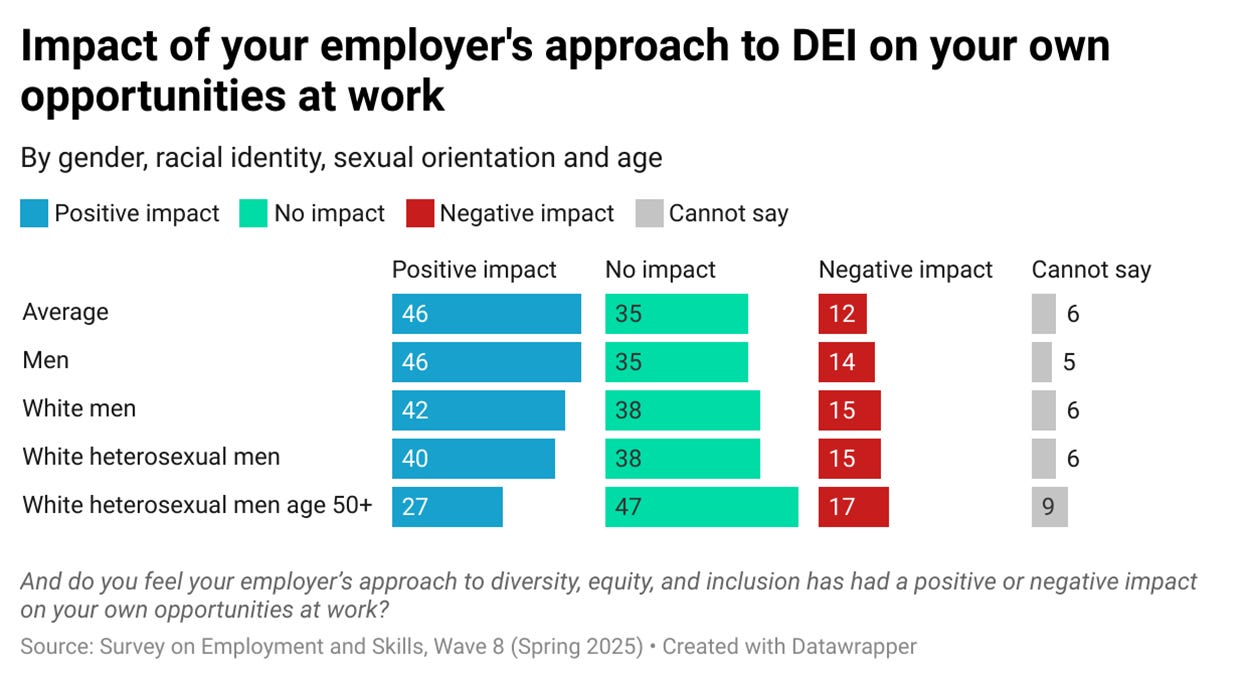
…But maybe we’re not looking closely enough. Thanks to the support of our survey partners at the Diversity Institute and the Future Skills Centre, the survey sample allows us to narrow the focus. Follow along in the chart below, which starts with the responses for employed adults in general, but then zeroes in on gender, racial identity, sexual orientation and age.2

Can you see the backlash taking shape? No, me neither.

Certainly, opinions are influenced by age. Older people are less likely to say that they’ve been positively affected by DEI policies (this holds true for older people in general, not just older white men). But opinions mostly shift to the neutral position (no impact). The proportion of white, heterosexual men age 50 and older who say their own opportunities have suffered as a result of DEI is only five percentage points higher than the average.

Source: Spot the backlash

May: Leadership Signals – Take it as permission to simplify

Her weekly posts are required reading. This week’s except that I liked:

…Small things can be transformative, says Allen Sutherland, president of the Institute on Governance. Such as: the steady signals Carney and Sabia send about not letting process or the “web of rules” get in the way. Streamline. Simplify.

“If there is some transformation in the public service day to day — where public servants act with more commitment to implementation and less focus on simply being rule followers — then I’d say that’s very transformative.”

In short, leadership signals can drive change and behaviour across the public service.

For Michael Wernick, who once sat in Sabia’s chair as clerk, the budget falls short on real transformation. It has aspirational reforms, but none of the legislative fixes, structural pruning, or deep investment in public-service capacity needed.

For Sahir Khan, the budget is like a solid mid-term grade. But “the final mark will depend entirely on execution — and that burden falls squarely on the public service,” says Khan, vice president at OttawaU’s Institute of Fiscal Studies and Democracy.

One senior bureaucrat summed it up: Carney’s approach isn’t about transforming the institution or rethinking its principles. It’s pragmatic: the public service is being reshaped by being told to deliver on priorities.

“That’s the Carney transformation. You don’t waste time on a grand plan. You set aspirational goals and tell them to get it done.”

Another added: “The government isn’t focused on institutional theory but on practical, delivery-focused fixes. Carney isn’t interested in changing the public service to be different — he’s interested in it changing to deliver something he wants done differently. The focus is on results.”

This approach of skipping grand plans is concentrating attention and decision-making in the PMO and PCO on departments tied to top priorities. Some bureaucrats worry that political staff will jump in to fill gaps if public servants can’t move fast enough. That would blur accountability. It also raises questions about whether departments not directly tied to top priorities are getting enough attention.

Source: May: Leadership Signals – Take it as permission to simplify

Keller: Mark Carney is already struggling with Justin Trudeau’s immigration legacy

Captures the challenge and the resulting disruption well:

…The challenge is that for three years the Trudeau government opened the door to what was effectively an unlimited number of notionally temporary immigrants. They came “temporarily” with the aim of staying permanently. (And who can blame them?) They paid tuition to a fly-by-night college and accepted minimum wage jobs in the hope of parlaying that into citizenship.

In the year 2000, there were 67,000 people holding a temporary work permit. By the end of 2024, there were 1,499,000

In 2000, there were 123,000 student visa holders. By the end of 2023, there were more than one million.

Between 2011 and 2015, the number of refugee claims made in Canada averaged about 17,000 a year. Last year, there were 190,000. This year, claims are on pace to hit 110,000.

In 2015, there were 10,000 people in Canada who had applied for refugee status and were awaiting a decision. The figure is now 296,000….

Source: Mark Carney is already struggling with Justin Trudeau’s immigration legacy

C-3 Senate Hearing 17 November: My Submission

My submission, focussing on the Liberal/NDP agreement to remove the recommendations by the House Immigration Committee is below.

While removal and the unlikely to withstand legal challenges to language, knowledge and security/criminality proposals makes sense, removal of a time limit of five-years to meet the residency requirement of 1,095 days does not.

More puzzling is the removal of the requirement for annual reporting on the number of persons reclaiming their citizenship. The Minister and officials appeared weak when discussing the numbers and expected impacts, underlying the need for IRCC to share this data on open data or annual reports as they will be collecting it anyway:

China rolls out its version of the H-1B visa to attract foreign tech workers

Reminder of increased competition for talent:

Vaishnavi Srinivasagopalan, a skilled Indian IT professional who has worked in both India and the U.S., has been looking for work in China. Beijing’s new K-visa program targeting science and technology workers could turn that dream into a reality. 

The K-visa rolled out by Beijing last month is part of China’s widening effort to catch up with the U.S. in the race for global talent and cutting edge technology. It coincides with uncertainties over the U.S.’s H-1B program under tightened immigrations policies implemented by President Donald Trump.

“(The) K-visa for China (is) an equivalent to the H-1B for the U.S.,” said Srinivasagopalan, who is intrigued by China’s working environment and culture after her father worked at a Chinese university a few years back. “It is a good option for people like me to work abroad.”

The K-visa supplements China’s existing visa schemes including the R-visa for foreign professionals, but with loosened requirements, such as not requiring an applicant to have a job offer before applying.

Stricter U.S. policies toward foreign students and scholars under Trump, including the raising of fees for the H-1B visa for foreign skilled workers to $100,000 for new applicants, are leading some non-American professionals and students to consider going elsewhere.

“Students studying in the U.S. hoped for an (H-1B) visa, but currently this is an issue,” said Bikash Kali Das, an Indian masters student of international relations at Sichuan University in China. 

China wants more foreign tech professionals

China is striking while the iron is hot.

The ruling Communist Party has made global leadership in advanced technologies a top priority, paying massive government subsidies to support research and development of areas such as artificial intelligence, semiconductors and robotics. 

“Beijing perceives the tightening of immigration policies in the U.S. as an opportunity to position itself globally as welcoming foreign talent and investment more broadly,” said Barbara Kelemen, associate director and head of Asia at security intelligence firm Dragonfly….

Source: China rolls out its version of the H-1B visa to attract foreign tech workers

Moffatt | Mark Carney’s promise on housing was to build build build. What happened?

It is both supply and demand that need to be matched which was not the case under the Trudeau government, save for the correction that started under Minister Miller:

…The message in the Budget could not be any clearer: the government is increasingly relying on reduced population growth, rather than building more, to address Canada’s housing shortage. This comes at a high cost, as newcomers to Canada do much to add to the social, economic, and cultural fabric of our country, and the changes in immigration rhetoric risk painting newcomers as the cause of housing shortages, when often they are its biggest victims.

Source: Opinion | Mark Carney’s promise on housing was to build build build. What happened?

Japanese immigrants fought for Canada during WW I while denied the right to vote 

Part of our less proud history:

For the first time the faces of Japanese Canadian veterans who fought in the First World War are on display on the streets of Vancouver after a century largely unrecognized.

A community historian spent more than 15 years digging through archives, tracking down descendants and uncovering heroic acts to bring this group of forgotten soldiers’ stories to life and push for the recognition she says they deserve.

“These were young men who gave their whole lives and no one remembers them,” Debbie Jiang told CBC News.

“I feel like I’m bringing back to life that person and their names that would otherwise be unknown.”

Jiang calls it a “travesty” that a dark chapter in Canadian history overshadowed their service and kept their stories hidden not only from the public, but in many cases their families, too. 

During the Second World War, Canada labelled all Japanese Canadians including veterans “enemy aliens” and forced thousands in B.C. into internment camps, seized their property and sold their belongings. 

Kelly Shibata says it wasn’t until he spoke to Jiang that he started learning more details about his grandfather’s remarkable military career. 

“That is the mystery of all of it — we had virtually no information about his time in the military,” Shibata said. 

His grandfather, retired private Otoji Kamachi, was part of a distinct group of Japanese Canadian soldiers who enlisted during the First World War in Canada’s military…

Source: Japanese immigrants fought for Canada during WW I while denied the right to vote

Le Devoir editorial: Dialogue de sourds [immigration]

Biting editorial that notes the substantive convergence despite the ongoing politicization:

Les gouvernements d’Ottawa et de Québec parlent tout à coup la même langue en matière d’immigration. Après des années de profonds désaccords, entre l’accueil pléthorique obstiné du fédéral et les inquiétudes québécoises ignorées, tous deux s’entendent désormais, sous la gouverne recadrée du premier ministre canadien Mark Carney, sur les objectifs à cibler et les correctifs à apporter. Une soudaine convergence qui n’a toutefois pas mis fin à leur dialogue de sourds entêté.

La présentation des cibles d’immigration fédérales dans le premier budget de Mark Carney aurait pu être rédigée par le gouvernement caquiste de François Legault lui-même. Le « nouveau gouvernement du Canada », comme il prend encore le soin de se qualifier près de sept mois après son élection, reconnaît que le système d’immigration fédéral « n’est plus viable ». Le rythme d’accueil des dernières années « a commencé à dépasser la capacité habituelle du Canada à absorber et soutenir les nouveaux arrivants ». « Nous reprenons le contrôle », annoncent les libéraux, afin de ramener les seuils « à des niveaux acceptables ». Un choix de mots qui aurait été perçu par ces mêmes libéraux, il y a à peine un an, comme un désaveu de leurs valeurs et de leur ADN.

Or, en cette nouvelle ère, au fédéral comme au Québec, cette réduction de l’accueil passe par les nouveaux immigrants temporaires, tandis que l’accueil d’immigrants économiques permanents et la pérennisation de résidents temporaires déjà sur place sont privilégiés.

Qu’importe cette nouvelle harmonie idéologique, la Coalition avenir Québec de François Legault n’allait tout de même pas renoncer à une énième salve à l’endroit d’Ottawa, surtout dans le contexte de ses déboires actuels. Le choix de Québec de retenir le scénario de réduction de son immigration le plus modéré fut donc imputé au toujours commode adversaire fédéral, au lieu qu’il reconnaisse franchement, comme cela avait été entendu en commission parlementaire, qu’une réduction radicale des niveaux d’immigration en deçà de la cible retenue de 45 000 admissions permanentes (par rapport à 61 000 cette année) aurait été malavisée dans le présent contexte économique.

Québec s’inquiète, à juste titre, du plafond de 10 % de travailleurs à bas salaire imposé par Ottawa à toutes les entreprises, y compris en région, et déplore le fait que sa demande de droit acquis hors Montréal ou Laval n’a toujours pas été acceptée. La ministre fédérale de l’Immigration, Lena Diab, brille certes par son absence, et le bureau de M. Carney s’illustre dans ce dossier par son indolence. En coulisses, la CAQ et Ottawa s’entendent pourtant sur l’urgence de protéger ces emplois et les entreprises qui en dépendent en région. Ce qu’il reste à ficeler, c’est la solution.

Or, reconnaître la complexité de la situation aurait été plus ardu et moins payant que de marquer des points politiquement. D’autant que la CAQ évite ainsi d’avoir à justifier que ses seuils d’immigration permanente ne bougent à peu près pas, au bout du compte — outre la réduction découlant de l’élimination du Programme de l’expérience québécoise (PEQ) —, pour ne se chiffrer qu’à peine en dessous de la précédente cible de 50 000 admissions.

D’autres gouvernements, avant la CAQ, ont ciblé l’accueil d’immigrants permanents selon le secteur et la région d’emploi — comme le prévoit le Programme de sélection des travailleurs qualifiés se substituant au PEQ et désormais comptabilisé à même la cible annuelle. Le gouvernement Legault devra néanmoins dissiper les craintes de délais en contrepartie exacerbés.

L’arithmétique créative est par ailleurs la même du côté d’Ottawa, où la « stabilisation » de l’immigration permanente est en fait une augmentation camouflée. Le plafond de 380 000 nouveaux résidents permanents par année, de 2026 à 2028, est plus élevé que l’était la cible de 365 000 prévue pour 2027 par l’ancien premier ministre Justin Trudeau. Seuil d’accueil auquel Mark Carney ajoute de surcroît 148 000 résidents permanents sur deux ans, en offrant ce statut à 115 000 réfugiés et 33 000 travailleurs temporaires. De part et d’autre, chacun fait bien dire ce qu’il veut à ses tableaux de colonnes de chiffres.

Quant à l’immigration temporaire, Ottawa la sabre de presque moitié (370 000 admissions d’ici 2028), tandis que Québec, qui l’inclut enfin à sa planification pluriannuelle, annonce qu’il la retranchera quelque peu, de 13 % par rapport à 2024 (quoique cette cible de 175 000 admissions dans quatre ans ne soit en réalité inférieure que de près de 1000 par rapport à cette année). Là encore, Québec modère son resserrement non pas en avouant répondre ainsi aux gens d’affaires qui ne peuvent s’en passer, mais plutôt en prétextant une réduction fédérale réclamée à grands cris, mais jugée trop importante aujourd’hui.

La CAQ et les libéraux fédéraux 2.0 se rejoignent davantage que ne veulent l’admettre les troupes de François Legault. Il ne leur reste plus qu’à se parler pour mieux s’arrimer. Si tant est que, pour les caquistes, améliorer l’accueil en terre québécoise, et non pas leur propre sort, soit réellement ce qui leur tient le plus à cœur.

Source: Dialogue de sourds

The Ottawa and Quebec governments suddenly speak the same language when it comes to immigration. After years of profound disagreements, between the obstinate reception of the federal government and the ignored Quebec concerns, both now agree, under the guidance of Canadian Prime Minister Mark Carney, on the objectives to be targeted and the corrections to be made. A sudden convergence that, however, did not end their dialogue of deaf-stubborn.

The presentation of federal immigration targets in Mark Carney’s first budget could have been written by François Legault’s Caquist government itself. The “new government of Canada”, as it still takes care to qualify itself almost seven months after its election, recognizes that the federal immigration system “is no longer viable”. The pace of reception in recent years “has begun to exceed Canada’s usual ability to absorb and support newcomers”. “We are regaining control,” the Liberals announce, in order to reduce the thresholds “to acceptable levels”. A choice of words that would have been perceived by these same liberals, just a year ago, as a disavowal of their values and DNA.

However, in this new era, both in federal and Quebec, this reduction in reception goes through new temporary immigrants, while the reception of permanent economic immigrants and the perpetuation of temporary residents already on site are preferred.

No matter this new ideological harmony, François Legault’s Coalition avenir Québec was still not going to give up yet another salvo against Ottawa, especially in the context of its current setbacks. Quebec’s choice to retain the most moderate immigration reduction scenario was therefore attributed to the always convenient federal opponent, instead of frankly recognizing, as had been heard in the parliamentary committee, that a radical reduction in immigration levels below the target of 45,000 permanent admissions (compared to 61,000 this year) would have been misreceived in the current economic context.

Quebec is rightly concerned about the 10% ceiling for low-wage workers imposed by Ottawa on all businesses, including in the region, and deplores the fact that its application for rights acquired outside Montreal or Laval has still not been accepted. The Federal Minister of Immigration, Lena Diab, certainly shines with her absence, and the office of Mr. Carney is distinguished in this file by his indolence. Behind the scenes, however, the CAQ and Ottawa agree on the urgency of protecting these jobs and the companies that depend on them in the region. What remains to be tied up is the solution.

However, recognizing the complexity of the situation would have been more difficult and less rewarding than scoring politically. Especially since the CAQ thus avoids having to justify that its permanent immigration thresholds do not move, in the end of the day — in addition to the reduction resulting from the elimination of the Quebec Experience Program (PEQ) — to be just below the previous target of 50,000 admissions.

Other governments, before the CAQ, targeted the reception of permanent immigrants by sector and region of employment — as provided for in the Skilled Worker Selection Program replacing the PEQ and now counted against the annual target. The Legault government will nevertheless have to dispel fears of exacerbated delays in return.

Creative arithmetic is also the same on the Ottawa side, where the “stabilization” of permanent immigration is in fact a camouflaged increase. The ceiling of 380,000 new permanent residents per year, from 2026 to 2028, is higher than the target of 365,000 set for 2027 by former Prime Minister Justin Trudeau. Reception threshold to which Mark Carney adds an additional 148,000 permanent residents over two years, offering this status to 115,000 refugees and 33,000 temporary workers. On both sides, everyone makes his tables of columns of numbers say what he wants.

As for temporary immigration, Ottawa knows it by almost half (370,000 admissions by 2028), while Quebec City, which finally includes it in its multi-year planning, announces that it will subtract it somewhat, by 13% compared to 2024 (although this target of 175,000 admissions in four years is actually only almost 1,000 lower than this year). Again, Quebec is moderating its tightening not by confessing to responding to business people who cannot do without it, but rather by pretexting a federal reduction that was called for, but considered too important today.

The CAQ and the Federal Liberals 2.0 join more than François Legault’s troops want to admit. All they have to do is talk to each other to better get together. If only, for the Caquistes, improving the welcome in Quebec land, and not their own fate, is really what is most important to them.