‘Rising problem’ of ghost consultancies hits man who lost $12K trying to get Canadian visa for wife

Another example:

Krishan Jogia turned to an immigration consultancy before landing in Toronto in 2023, only to realize later — after spending thousands of dollars — that he had been dealing with a “ghost” consultancy apparently operating illegally in Canada.

Jogia, a dual Canadian-Australian citizen, sought the services of Canada Global Migration Consultants (GMC) for a Canadian visitor visa for his wife, Luana Cabral de Carvalho. They eventually received it, but things didn’t go as smoothly when they tried again for her spousal visa.

WELCOME TO CANADAIs it worth immigrating to Canada? These newcomers say it comes at a cost
IN DEPTHRegulator taking too long to rule on ‘bad actor’ immigration consultants, critics say
“Canada GMC visually, like if you’ve seen their YouTube, Instagram and website, comes off as very polished,” Jogia said. “When you call them, you get a proper help desk with hold music and everything.”

However, in early 2024, Jogia said, their consultant “just disappeared.” For months, he said, the consultancy kept ignoring them and shuffled them around to different colleagues. The two were able to get hold of that consultant, who is a registered immigration consultant, directly. He told them, in an email seen by CBC News, that they left Canada GMC due to “their unethical work practices.”

“We started really aggressively trying to pursue a refund, and that’s when they just stopped replying and just ignored us,” Jogia said.

Source: ‘Rising problem’ of ghost consultancies hits man who lost $12K trying to get Canadian visa for wife

Todd: 10 reasons fewer newcomers are becoming Canadian citizens

Good overview:

The pandemic mattered, somewhat
COVID might account for 40 per cent of the decline in naturalization rates in the five years before the 2021 census, estimate Fou and Picot. But Fou emphasizes that, even after removing the pandemic effect, “the citizenship rate declined at a faster pace from 2016 to 2021 than during any other five-year period since 1996.”

Canada has lost comparative advantage
With Canada performing poorly in the past decade in regard to GDP per capita, the country isn’t offering the solid wages it once did. Meanwhile, many other countries are doing better than they did in the past.

It’s revealing that the immigrants most likely to apply for citizenship are from countries with grim economies and severe civil strife, including such as Iran and Pakistan. Citizenship take-up is lower among newcomers from countries such as Britain and India.

Andrew Griffith, a former immigration department director now with the Institute for Canadian Citizenship (ICC), adds that many migrants with high-tech skills are using Canada as a stopover, where they can build up their credentials to eventually access the U.S. marketplace, which is harder to get into but has much higher-paying jobs.

Housing crisis
“Unaffordable housing is the top reason not to naturalize,” said Daniel Bernhard, CEO of the ICC. “This suggests that it’s a question of optimism about the future. If Canadians aren’t optimistic about our future overall, we shouldn’t be surprised that non-citizen residents of Canada feel the same way.”

Canadian citizenship has been devalued
Separate from debates over whether too many Canadian politicians have been overstressing the problematic aspects of the nation’s identity and history, migration specialists point to specific signs of devaluation.

Griffith believes Ottawa’s move to shift most citizenship ceremonies online has been discouraging for some.

He also thinks Canadian citizenship was diminished when the country moved to “unlimited voting rights for expatriates.” It used to be that non-resident citizens couldn’t vote after being out of the country for five years, but now it’s possible for millions to vote in federal elections regardless of how long they’ve been outside the country.

Ottawa has also “removed preferential hiring of citizens in the public service,” said Griffith. One now need only be a permanent resident to apply.

China is making things tougher
China has been among the top three sources of newcomers to Canada, where immigrants make up one out of four residents. But retired immigration lawyer Samuel Hyman notes China has been lately forcing its citizens to choose “whether they want to continue to have access to their wealth and assets in China” or be prepared to become Canadian citizens and struggle with far fewer rights in the homeland.

Lack of dual citizenship can discourage
Relatedly, the appeal of Canadian citizenship could be decreasing for people from nations like China and India in part because they don’t allow dual citizenship. As Hyman said by way of example, a migrant from India who becomes a Canadian citizen loses the right to inherit or buy property in India.

Citizenship uptake
Popular internet discussion forums, such as on Reddit, are devoted to foreign nationals in Canada discussing the financial and social-services consequences of obtaining citizenship in Canada while losing it in one’s homeland.

International tax scrutiny has expanded
The government of Stephen Harper stepped up tax scrutiny of offshore wealth, said Hyman. That put pressure on people with luxury lifestyles to report to the Canada Revenue Agency on how and where they made their money. It may have contributed, Hyman said, to Canada losing its appeal to some high-net-worth individuals.

Overemphasis on self-interest
While many commentators now highlight the value of Canadian pride and loyalty, some immigration advisers stress mere transactional self-interest. They advise clients that if they become citizens they can spend more time outside the country, and that a Canadian passport will allow them to travel to more countries. It can make the country less appealing.

Citizenship fees increased
On a bureaucratic note, some suggest it’s significant that the government has for a decade steadily hiked the fees that permanent residents must pay to obtain citizenship. [Note: Fees were increased by the Harper government in 2014-15 and have been frozen ever since. Liberal electoral platforms promised to eliminate fees in 2019 and 2021 but this was never implemented.]

Lack of encouragement
Canada used to put more effort into encouraging would-be immigrants to learn Canadian history, laws and values, Griffith said, culminating in an often-emotional in person ceremony. He recommends the immigration department begin to devote two per cent of its [Note: settlement services] budget to “citizenship preparation courses.”

Source: 10 reasons fewer newcomers are becoming Canadian citizens

Immigration matters in health care

Good communications initiative by IRCC, applied across different sectors. Of course, only emphasizes the positive and not the extra demand that a larger population creates but still useful reference for those covering immigration and other sectors:

More than 1.9 million people work in Canada’s health care sector and many more will be needed in the coming years to ensure continued access to high-quality care.

Over 420,000 workers in the health care sector are over the age of 55, and most of these will be retiring in the next decade or so. In addition, there are existing recruitment challenges from everywhere in Canada for nurses, residential care staff and home health care staff. There’s a clear opportunity for immigrants to play an important role in ensuring there are enough people working in the health care sector.

The sustainability and effectiveness of the Canadian health care system depends on an integrated and diverse workforce. We value the important contribution of immigrants to our health care system and welcome them to Canada!

Claire Betker, RN, MN, PhD, CCHN(C), Former President of the Canadian Nurses Association

Impact of immigration

  • Immigrants account for 1 in 4 health care sector workers.
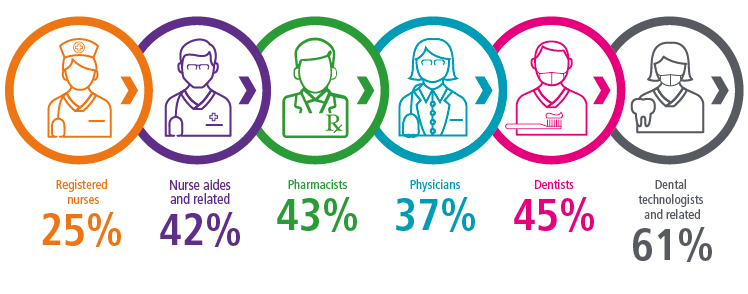
  • In Canada, immigrants make up
    • 25% of registered nurses
    • 42% of nurse aides and related occupations
    • 43% of pharmacists
    • 37% of physicians
    • 45% of dentists
    • 61% of dental technologists and related occupations
  • More than 40% of newcomers to Canada between 2016 and 2021 who were working in the health care sector were employed in the important areas of nursing and residential care facilities, as well as home health care services.

Unless otherwise noted, all statistics are from the Statistics Canada 2021 Census.

Source: Immigration matters in health care

Mooney: I’m the Canadian who was detained by Ice for two weeks. It felt like I had been kidnapped

Horrific example of bureaucracy at work, implementing the cruel and flawed policies of the Trump administration:

There was no explanation, no warning. One minute, I was in an immigration office talking to an officer about my work visa, which had been approved months before and allowed me, a Canadian, to work in the US. The next, I was told to put my hands against the wall, and patted down like a criminal before being sent to an Ice detention center without the chance to talk to a lawyer….

And that’s when I made a decision: I would never allow myself to feel sorry for my situation again. No matter how hard this was, I had to be grateful. Because every woman I met was in an even more difficult position than mine.

There were around 140 of us in our unit. Many women had lived and worked in the US legally for years but had overstayed their visas – often after reapplying and being denied. They had all been detained without warning.

If someone is a criminal, I agree they should be taken off the streets. But not one of these women had a criminal record. These women acknowledged that they shouldn’t have overstayed and took responsibility for their actions. But their frustration wasn’t about being held accountable; it was about the endless, bureaucratic limbo they had been trapped in.

The real issue was how long it took to get out of the system, with no clear answers, no timeline and no way to move forward. Once deported, many have no choice but to abandon everything they own because the cost of shipping their belongings back is too high.

I met a woman who had been on a road trip with her husband. She said they had 10-year work visas. While driving near the San Diego border, they mistakenly got into a lane leading to Mexico. They stopped and told the agent they didn’t have their passports on them, expecting to be redirected. Instead, they were detained. They are both pastors.

I met a family of three who had been living in the US for 11 years with work authorizations. They paid taxes and were waiting for their green cards. Every year, the mother had to undergo a background check, but this time, she was told to bring her whole family. When they arrived, they were taken into custody and told their status would now be processed from within the detention center.

Another woman from Canada had been living in the US with her husband who was detained after a traffic stop. She admitted she had overstayed her visa and accepted that she would be deported. But she had been stuck in the system for almost six weeks because she hadn’t had her passport. Who runs casual errands with their passport?

One woman had a 10-year visa. When it expired, she moved back to her home country, Venezuela. She admitted she had overstayed by one month before leaving. Later, she returned for a vacation and entered the US without issue. But when she took a domestic flight from Miami to Los Angeles, she was picked up by Ice and detained. She couldn’t be deported because Venezuela wasn’t accepting deportees. She didn’t know when she was getting out.

There was a girl from India who had overstayed her student visa for three days before heading back home. She then came back to the US on a new, valid visa to finish her master’s degree and was handed over to Ice due to the three days she had overstayed on her previous visa.

There were women who had been picked up off the street, from outside their workplaces, from their homes. All of these women told me that they had been detained for time spans ranging from a few weeks to 10 months. One woman’s daughter was outside the detention center protesting for her release….

The reality became clear: Ice detention isn’t just a bureaucratic nightmare. It’s a business. These facilities are privately owned and run for profit.

Companies like CoreCivic and GEO Group receive government funding based on the number of people they detain, which is why they lobby for stricter immigration policies. It’s a lucrative business: CoreCivic made over $560m from Ice contracts in a single year. In 2024, GEO Group made more than $763m from Ice contracts.

The more detainees, the more money they make. It stands to reason that these companies have no incentive to release people quickly. What I had experienced was finally starting to make sense.

This is not just my story. It is the story of thousands and thousands of people still trapped in a system that profits from their suffering. I am writing in the hope that someone out there – someone with the power to change any of this – can help do something.

The strength I witnessed in those women, the love they gave despite their suffering, is what gives me faith. Faith that no matter how flawed the system, how cruel the circumstances, humanity will always shine through.

Even in the darkest places, within the most broken systems, humanity persists. Sometimes, it reveals itself in the smallest, most unexpected acts of kindness: a shared meal, a whispered prayer, a hand reaching out in the dark. We are defined by the love we extend, the courage we summon and the truths we are willing to tell.

Source: I’m the Canadian who was detained by Ice for two weeks. It felt like I had been kidnapped

TRUMP WANTS TO SELL CITIZENSHIP TO RICH PEOPLE. TAKE IT FROM OTHER COUNTRIES — IT’S A BAD IDEA

Indeed:

In his agonizingly long recent address to Congress, President Trump floated a plan to create a new “gold card” visa. For the low price of $5 million, immigrants would be able to buy a pathway to citizenship.

Of course, Trump cannot create a new visa without the help of Congress. But just as importantly, this is a bad idea. It’s not only been tried before — it’s also failed to a degree that has made dozens of countries roll back similar policies in recent years.

A Global Phenomenon

The rich have long enjoyed access to so-called “golden visas” or “golden passports,” schemes where foreigners are given access to residency or even citizenship in exchange for purchasing property or making investments in a new country.

Upwards of 100 countries have offered similar investment migration deals in the past, but in recent years that number has begun to dwindle.

One of the main reasons countries are phasing out these programs? To tackle rising housing prices. Critics argue that the wealthy migrants who take advantage of these visas distort housing markets by paying far over market value for living spaces.

Spanish Prime Minister Pedro Sánchez announced last year that the program that allowed non-European Union citizens to obtain residency by investing $540,000 in cash in real estate would be eliminated explicitly to tackle skyrocketing housing prices.

The phenomena of residency by investment programs first appeared in the late 1980s as a way to attract foreign investment. The United States, for example, adopted the EB-5 visa in 1990, offering permanent residence to foreigners who invest between $1 and $2 million in job-creating businesses.

Some of the most popular programs are the ones in Europe — primarily because of the benefits that residency or citizenship in the region can grant, like ease of travel within the Schengen Zone and access to top-notch medical treatment and education. Over 130,000 people have received residency or citizenship in the European Union through similar programs.

These investment schemes — offered at one point or another by Cyprus, Estonia, Greece, Hungary, Ireland, Italy, Latvia, Luxemburg, Malta, the Netherlands, Portugal, and Spain — sprung up at the beginning of the 2010s as a way to bring in foreign investment to overcome the financial crisis.

The world’s ultra wealthy obliged.

Former Google CEO Eric Schmidt quietly applied for Cypriot citizenship in 2020, allowing him free movement around a Europe that was largely shut down for outsiders during the pandemic. Cyprus shuttered its program mere months afterwards and ended up stripping citizenship from 222 investors, including many Russian oligarchs linked to the conflict in Ukraine.

Spain issued an estimated 6,200 visas in exchange for property investments between 2013 and 2023. Portugal has issued12,718 since 2012. In both countries, the most visas were granted to Chinese citizens.

Even European countries without explicit golden visas brokered similar deals with the wealthy — Snapchat founder Evan Spiegel became a French citizen in 2018 for contributing to the country’s “influence.”

And the rich haven’t limited themselves to European deals.

The most infamous is the case of former PayPal CEO and reactionary political activist Peter Thiel, who in 2011 was grantedcitizenship in New Zealand after only 12 days in the country.

More recently, Open AI CEO Sam Altman was given Indonesia’s first ever “Golden Visa.” In a press release, the government said they expect Altman to “contribute to developing artificial intelligence in Indonesia.”

Rolling Back the Tide

But have countries benefited from this influx of wealthy investors?

New research has suggested that the economic gains are minor. A 2022 report from the Melbourne-based Grattan Institute found that investors granted residency in Australia brought limited benefits to the country because they tended to be older and didn’t contribute much in taxes. Many of them ended up costing the state more in public services than they pay in taxes. Australia axed its investment program, launched in 2012, earlier this year.

There may also be negative knock-on effects, like inviting and even encouraging the wealthy to snap up properties,crowding out working residents from the housing market — think gentrification on a country-level. Lawmakers in Spain and Portugal both cited the role of investment for visa programs in spiking housing prices when scrapping and revising their programs this year, respectively. Research on the Portuguese case backs up the link to housing stocks.

To be clear, migrants writ-large have minimal impacts on rising housing prices. The issue is with exorbitantly wealthy newcomers, who distort markets and force working-class people out of their homes. The problem isn’t restricted to foreign billionaires — investors in the U.S. have also driven up prices by treating the housing stock like a commodity.

Rethinking Migration Restrictions

Governments worldwide appear to be wising up on the reality of golden visas. Spain, Portugal, Australia, and Cyprus have all recently modified or scrapped their investment for residency or citizenship schemes.

Ireland shut down its program after 11 years in 2023, citing concerns that it could be facilitating Russian money laundering. The United Kingdom did the same the year prior.

Greece raised the investment needed to qualify for residency from €500,000 to €800,000 in popular areas in response to spiking housing prices. Cyprus and Bulgaria scrapped their programs at around the same time over concerns about Russian oligarchs abusing the rules for money laundering and tax evasion.

Instead of creating a new “gold card” scheme in the United States, we should rethink restrictions on movement in general.

That ease with which the world’s wealthy can traverse borders should be expanded to the rest of us. Freedom of movement is a right we should all have, a right that people had for tens of thousands of years before the rise of the modern nation state. Reducing barriers to migration will only become more important as climate change and resource depletion make regions inhospitable.

A just immigration system should neither reward you for being rich nor punish you for being poor.
Source: TRUMP WANTS TO SELL CITIZENSHIP TO RICH PEOPLE. TAKE IT FROM OTHER COUNTRIES — IT’S A BAD IDEA

Lisée: Identité canadienne, après l’éclipse [change of emphasis and tone, citizenship ceremonies]

Lisée also notes Poilievre’s commitment to restore in person citizenship ceremonies, a welcome change given that the vast majority are virtual:

….Poilievre a dégainé le premier, dans son discours de refondation de ses thèmes électoraux, le 15 février, sous le slogan « Canada d’abord ». Il fut question de pipelines et de baisses d’impôt, mais pas seulement de ça. Il a annoncé la fin de « la guerre contre notre histoire », en particulier la guerre contre le fondateur du pays, John A. Macdonald, qui a eu le grand mérite d’être conservateur. Son successeur, s’il est élu, veut « renforcer les sanctions contre ceux qui détruisent ou dégradent nos symboles ». Il annonce aussi le retour des héros et des symboles canadiens sur les pages de notre passeport, évincés comme on le sait par l’équipe postnationale de Justin.

Il peste, avec raison, contre l’introduction par le désormais ancien régime de cérémonies d’assermentation à la citoyenneté à distance. Non seulement il rétablira l’obligation de se présenter en personne, mais il ajoutera un passage au serment. Le voici : « Je témoigne ma gratitude à ceux qui ont travaillé, se sont sacrifiés et ont donné leur vie pour défendre la liberté dont je me réjouis aujourd’hui et pour bâtir le pays que j’appelle maintenant mon chez-moi. Comme eux, je m’engage à remplir mes devoirs de citoyen canadien. »

Pour mémoire, car c’est difficile d’y croire, le serment actuel est : « Je jure que je serai fidèle et porterai sincère allégeance à Sa Majesté le roi Charles III, roi du Canada, à ses héritiers et successeurs ; que j’observerai fidèlement les lois du Canada, y compris la Constitution, qui reconnaît et confirme les droits ancestraux ou issus de traités des Premières Nations, des Inuits et des Métis, et que je remplirai loyalement mes obligations de citoyen canadien. »

Avouez que cette simple lecture fait douter de l’existence d’une identité canadienne, du moins autre qu’indigène et royale.

Mark Carney n’a pas voulu être en reste. Dès son premier jour, il a créé un ministère de l’Identité canadienne. Pour un pays qui n’en avait officiellement aucune la veille, la chose est immense. Parmi ses premiers mots prononcés, notre nouveau chef de gouvernement a affirmé que « notre identité bilingue et la langue française enrichissent notre culture », car le Canada est « un pays construit sur le roc de trois peuples : indigène, français et britannique ». Le mot « multiculturalisme » ne fut pas prononcé. C’est à peine si fut mentionnée, au passage, la diversité. On sent donc une réelle volonté de se recentrer sur les fondamentaux. D’autant que Carney a de suite pris l’avion vers les trois pôles identitaires désignés : Paris, Londres et Iqaluit.

Mais à part nous annoncer que nous avons désormais une « identité bilingue », en quoi consiste celle-ci ? Il a choisi un Québécois, Steven Guilbeault, pour chapeauter le nouveau ministère, qui n’a pas dans son intitulé la responsabilité des langues officielles, mais qui y gagne au change, car il obtient la gestion des parcs du Canada. Le lien avec l’identité vous échappe ? Pas au premier ministre, qui explique que « la question de l’identité canadienne est beaucoup plus large que seulement les langues officielles. C’est beaucoup plus que notre héritage. Nous construisons l’identité canadienne, et c’est vraiment la clé ». Oui, car, dit-il, elle « inclut la nature ». Le ministre Guilbeault est chargé de « mettre ensemble toutes les responsabilités qui concernent la nature, les océans, la biodiversité, et de s’assurer que toutes ces choses sont protégées et promues ».

Résumons. Notre identité est bilingue, assise sur un roc, alliage de riches veines françaises, britanniques et indigènes, mais inclut la nature, les océans et la biodiversité. Cela fait un peu bouillabaisse, convenons-en. Mais on campe résolument dans l’anti-postmoderne, ce qui est archinouveau, non ? Reste à insérer le tout dans le serment.

On sent que Steven Guilbeault va bientôt s’ennuyer d’un dossier bien plus simple : rendre vert un pays producteur de pétrole.

Source: Identité canadienne, après l’éclipse

…. Poilievre drew the first, in his speech of refoundation of his electoral themes, on February 15, under the slogan “Canada first”. There was talk of pipelines and tax cuts, but not only that. He announced the end of “the war against our history”, in particular the war against the founder of the country, John A. McDonald’s, who had the great merit of being conservative. His successor, if elected, wants to “strengthen sanctions against those who destroy or degrade our symbols”. He also announces the return of Canadian heroes and symbols on the pages of our passport, ousted as we know by Justin’s post-national team.

He rightly plagues against the introduction by the now old regime of ceremonies of oathing to remote citizenship. Not only will he reinstate the obligation to appear in person, but he will add a passage to the oath. Here it is: “I express my gratitude to those who worked, sacrificed themselves and gave their lives to defend the freedom I look forward to today and to build the country that I now call my home. Like them, I am committed to fulfilling my duties as a Canadian citizen. ”

For the record, because it is hard to believe, the current oath is: “I swear that I will be faithful and pledge sincere allegiance to His Majesty King Charles III, King of Canada, to his heirs and successors; that I will faithfully observe the laws of Canada, including the Constitution, which recognizes and confirms the ancestral or treaty rights of First Nations, Inuit and Métis, and that I will faithfully fulfill my duties as a Canadian citizen. ”

Admit that this simple reading makes us doubt the existence of a Canadian identity, at least other than indigenous and royal.

Mark Carney didn’t want to be left behind. From his first day, he created a Canadian Ministry of Identity. For a country that officially had none the day before, the thing is immense. Among his first words, our new head of government said that “our bilingual identity and the French language enrich our culture”, because Canada is “a country built on the rock of three peoples: indigenous, French and British”. The word “multiculturalism” was not pronounced. It is hardly if diversity was mentioned, in passing. We therefore feel a real desire to refocus on the fundamentals. Especially since Carney immediately flew to the three designated identity poles: Paris, London and Iqaluit.

But apart from announcing that we now have a “bilingual identity”, what does it consist of? He chose a Quebecer, Steven Guilbeault, to oversee the new ministry, which does not have responsibility for official languages in its title, but which wins in exchange, because it obtains the management of Canada’s parks. Does the link with identity escape you? Not to the Prime Minister, who explains that “the issue of Canadian identity is much broader than just official languages. It’s much more than our legacy. We’re building Canadian identity, and that’s really the key.” Yes, because, he says, it “includes nature”. Minister Guilbeault is responsible for “putting together all the responsibilities that concern nature, the oceans, biodiversity, and ensuring that all these things are protected and promoted”.

Let’s summarize. Our identity is bilingual, sitting on a rock, an alloy of rich French, British and indigenous veins, but includes nature, oceans and biodiversity. It’s a little bouillabaisse, let’s agree. But we camp resolutely in the anti-postmodern, which is arch-new, right? It remains to insert everything into the oath.

We feel that Steven Guilbeault will soon get bored of a much simpler file: making an oil-producing country green.

Canada’s temporary resident population declines for the first time in 3 years

Corrective action working, although Skuterud notes not enough:

The number of temporary residents in Canada has declined for the first time in three years, in the wake of a series of policy changes introduced by Ottawa last year to reduce immigration levels.

New data from Statistics Canada shows that there were roughly 30,000 fewer non-permanent residents in the country as of Jan. 1, 2025, compared to Oct. 1, 2024.

The total number of non-permanent residents stood at just over three million people, or 7.3 per cent of the population, down from 7.4 per cent the previous quarter.

The decrease in the number of temporary residents is causing overall population growth to slow. In the fourth quarter of 2024, the population grew by 0.2 per cent to roughly 41.5 million people, the slowest rate of growth since late 2020, when many border restrictions were in place because of the pandemic.

Canada’s population is still increasing, just not at the rate it did in 2022 and 2023….

Achieving Ottawa’s 5-per-cent non-permanent resident target is less realistic now than a year ago, according to Mikal Skuterud, an economist at the University of Waterloo. Prof. Skuterud estimates that in order to meet the target, the number of temporary residents will have to decline by almost 32 per cent in two years.

If that happens, the Canadian population will subsequently decline by 0.4 per cent over two years, Prof. Skuterud’s calculations show….

Source: Canada’s temporary resident population declines for the first time in 3 years

Court denies certification of $2.5-billion Black civil servants class action lawsuit

Successful in raising the profile and issue, but ultimately failed at court. And the plaintiffs assertion that “they deserve real change” discounts the overall improvement among Black public servants in terms of hirings, promotions and separations:

A Federal Court judge on Monday dismissed a motion to certify a proposed class action lawsuit that was launched by Black public servants in 2020 who alleged there was systemic racism within the public service.

In an “order and reasons” document, Justice Jocelyne Gagne said the case did not sufficiently meet the class action requirement that the claims raise common issues.

Gagne also said the scope of the plaintiffs’ claim “simply makes it unfit for a class procedure.”

Filed in 2020, the class action sought $2.5 billion in damages because of lost salaries and promotion.

The Black Class Action Secretariat, a group created as a result of the lawsuit, is seeking long-term solutions to address systemic racism and discrimination in the public service, including compensation and the appointment of a Black equity commission.

Gagne said the court acknowledges the “profoundly sad ongoing history of discrimination suffered by Black Canadians” and that plaintiffs have faced challenges in the public service.

However, she said the plaintiffs didn’t present an adequate litigation plan and that they failed to present a ground for the court to assert jurisdiction over the case.

The document also said there are several class actions against individual federal departments and agencies alleging racial discrimination, which “overlap significantly with the present action.”

Proposed class members, the judge said, “would therefore be included in the class definition of these other class proceedings.”

The Black Class Action Secretariat said in a news release Monday that the ruling was a “major disappointment, but it is not the end of our fight for justice.”

“For five years, this has been a David vs. Goliath battle, and while today’s outcome is frustrating, it only strengthens our resolve,” the organization said.

The news release said systemic anti-Black racism has long been recognized by the federal government and that the plaintiffs will meet with their legal team to “explore next steps.”

In 2023, a grievance ruling by the Treasury Board Secretariat found that the Canadian Human Rights Commission discriminated against its Black and racialized employees. In 2024, an internal report found that public servants working at the Privy Council Office were subject to racial stereotyping, microaggressions and verbal violence.

“For decades, Black public service workers have faced systemic discrimination, and today’s decision does nothing to change that reality,” Thompson said.

A Federal Court hearing took place last fall to help determine whether the class-action lawsuit could proceed.

At the time, the federal government filed a motion to strike, asking the judge to dismiss the case. The government argued that Black public servants could file grievances or human rights complaints.

The government also called to remove Canadian Armed Forces and RCMP members, as well as Department of National Defence and Correctional Service Canada employees as class members because of similar class action lawsuits against those departments.

Thompson says the government used procedural barriers to “avoid addressing the merits of this case, rather than standing on the side of fairness and accountability.” The government has spent around $10 million fighting the class action.

“Black workers deserve more than recognition of past harms — they deserve real change,” he said.

Source: Court denies certification of $2.5-billion Black civil servants class action lawsuit

Présence illégale au Canada: Record d’expulsions de ressortissants étrangers l’an dernier

Of interest:

Selon les statistiques publiées le 25 février dernier par l’Agence des services frontaliers du Canada (ASFC) compilant pour la première fois l’ensemble de l’année 2024, le Canada a effectué en un an 16 860 renvois de ressortissants étrangers. Et la tendance à la hausse se poursuivra dans les prochaines années, annonce par courriel un porte-parole de l’ASFC, puisque l’organisme fédéral souhaite atteindre les 20 000 renvois par année d’ici 2027.Plus de 80 % des ordres de renvoi ont visé des demandeurs d’asile. On reproche à ces 13 527 personnes de ne pas avoir, de façon plutôt vague, respecté la Loi sur l’immigration et la protection des réfugiés.

Aucune précision n’est cependant apportée quant à la nature exacte de ces infractions. On sait toutefois qu’il ne s’agit pas de criminalité ou de fausses déclarations, des critères d’inadmissibilité qui font l’objet d’un décompte distinct et pour lesquels on rapporte respectivement 860 et 145 cas en 2024.

Avant Trump

Pour la première fois depuis 2019, c’est le Québec plutôt que l’Ontario qui a renvoyé le plus de personnes en 2024, soit 6832. Il s’agit encore ici d’un record alors qu’en 2023, lors du précédent sommet, on avait rapporté 6021 renvois.

Source: Présence illégale au Canada Record d’expulsions de ressortissants étrangers l’an dernier

HESA: The Future of Equity, Diversity, and Inclusion in Canadian Higher Education

Interesting and likely realistic take:

…There are, furthermore, two big differences between Canada and the US with respect to EDI that are worth keeping in mind. The first is that EDI in Canada had very little to do with the composition of the student body; unlike the US, students from racialized backgrounds are substantially over-represented (as compared to the general population) in the student body up here. This is not to say that students from all racialized backgrounds are over-represented, but more are than are not (see back here for more on this). As a result, EDI in Canada tends to be much more about representation at the staff level, and specifically—given the politics of the institution—about academic staff. And to the extent that diversity in hiring, pay and promotion is at the heart of Canadian EDI efforts, current practice in academia is not all that far off the standard in the Canadian private sector, where diversity initiatives have been the norm for quite some time. This is why there aren’t that many Boards of Governors, even in Conservative places like Alberta, that have really blinked at EDI hiring initiatives.

The second is that the prominent presence of Indigenous peoples and the legacy of Truth and Reconciliation add a complicating layer to the whole issue. Indigenous peoples are generally not included in most EDI processes because it is recognized that, for historical and Treaty reasons, they absolutely should not be lumped in with other under-represented groups in terms of process, even if both are deserving of and would benefit from greater efforts at inclusion. Having two separate processes is complicated and can at a superficial level look a bit wasteful and politically complicated, but at the end of the day, that complication works in favour of EDI, institutionally speaking. No one—and I mean no one—is going to try and reverse Indigenization initiatives at Canadian universities. And because at least some of the aims of EDI & Indigenization are parallel (ish), going after one but not the other is hard to justify. 

So, given all of that, what is the future of EDI in Canada? Well, it depends a bit on which part of EDI we are talking about. I don’t think we are going to reverse course on equity in hiring. Cluster hires will probably continue for a little while yet for the simple reason that alternatives simply have not been very effective at moving the needle on racial equity (we’ve been doing that with female profs for about 40 years now, and while we are getting closer to parity, it has taken an unconscionable amount of time to get there). Neither do I think many institutions are going to change tack in terms of trying to create more welcoming environments: in an era of tight budgets, universities and colleges are going to do all they can to be seen as good employers on non-financial stuff.

Where I suspect we will see change will be in the tendency to add staff positions for the specific purpose of addressing issues of Equity, Diversity and Inclusion. This is a place where a larger set of suspicions both in government and the professoriate about “bureaucratization” and “administrative bloat” will be decisive. This won’t necessarily reduce the amount of work to be done, so it probably will mean that more of it is done off the side of someone’s desk. I also suspect that institutions will look less favourably on equity groups’ requests for separate university events (e.g. Lavender Graduation ceremonies). 

Will this result in a tamping down of the (muted) culture wars in Canadian higher education? No. Some people will remain opposed to things like land acknowledgements, and the aging white guy irritation with Canadian history departments being insufficiently “positive” about Canada (meaning, in practice, centering narratives on any groups other than white settlers) isn’t going to go away either. Culture wars never end. Friction will continue.

And so too, broadly, will EDI. Words and tactics might soften or change, and a variety of other institutional challenges (mainly but not exclusively financial) may mean that the issue will never again be quite as central to university policy as it was in 2020 and 2021. But we’re not headed in the same direction as the US.

Source: The Future of Equity, Diversity, and Inclusion in Canadian Higher Education