Regg Cohn: Peel school board should learn a lesson in controversy over Nakba Day

Peel SB has a habit of controversial policies and stands. Money quote: “A better way for educators to navigate modern times and historical legacies would be to always remain mindful of unity in diversity — and the reality of complexity. Find ways to bring people together rather than drive them apart:”

Nakba Day is coming to schools in two of Ontario’s biggest cities.

Not familiar with the term?

It takes place on May 15, the day after the anniversary of Israel’s founding day in 1948 — not celebrating but commiserating over the Jewish state’s creation.

Al-Nakba is an Arabic term that translates as “the catastrophe.” Yasser Arafat, in his heyday as head of the Palestinian Authority, declared it an official day of mourning across the West Bank and Gaza in 1998.

Now, the Peel District School Board is bringing it from the Middle East into schools it controls across the GTA — in Brampton, Caledon and Mississauga.

The revelation of Peel’s preoccupations has stirred fresh controversy — including demands that the board rescind its move and counterdemands to keep it in place. That very controversy tells the story of why it’s such a bad idea to keep bringing back the world’s problems to the modern multicultural metropolis that is Greater Toronto.

To be clear, there is not much about Nakba Day that is contentious for Palestinians or disputed by historians. It marks the undeniably catastrophic impact of Israel’s creation on hundreds of thousands of people whose lives were ended or upended in 1948.

How you see the world’s epochal events — and historical terminology — depends on who you are, where you live and when you’re talking.

When the late Arafat belatedly proclaimed Nakba Day, I was the Star’s Middle East correspondent, watching him work hand-in-glove with Israel. Their shared goal was two states for two peoples.

Today, on the streets of the GTA, you don’t hear protesters talk much of two states. You’ll hear slogans such as, “From the river to the sea, Palestine will be free” — implying a new Palestinian state should displace the old Jewish state from the Jordan River to the Mediterranean Sea, dismantling the so-called colonial enterprise they believe Israel to be.

The world has changed, and political agendas have changed with them. Which brings us back to the Peel school board.

As part of its multicultural mission, it has a committee that curates a long list detailing “days of significance” for “secular and creed-based days.” It begins with Canada Day last year and ends with Boxing Day this year.

In between those bookends, the list catalogues celebrations of relevance and reverence in chronological (not spiritual) order — Hinduism, Jainism, Buddhism, Bahaism, Islam, Zoroastrianism, Judaism, Wicca, Christianity and so on. And then there are worldly listings for Emancipation Day, Labour Day, Literacy Day and the like.

Since Canada Day is top of the list, let’s consider the Canadian context.

Some bemoan any recognition of Confederation, condemning it as a celebration of colonization; some have absented themselves from July 1 fireworks events in solidarity with Indigenous critics. That said, I cannot imagine the Peel school board voting to recognize a Canada Catastrophe Day on July 1, for it would surely spark disagreement and disunity.

That tension — between celebration and condemnation — reminds us that the creation of one nation can easily diminish another people at home and abroad. The point is that it should be possible to be both pro-Canada and pro-Indigenous, pro-Israeli and pro-Palestinian, to be mindful and respectful of people on both sides, all sides.

As for Israel, it emerged from a vote of the United Nations, which partitioned the Holy Land into two nations, Jewish and Arab (retaining special status for Jerusalem). History tells us that Arabs rejected that compromise, and the resulting catastrophe was undeniable; historians have also documented episodes of ethnic cleansing, although Arab minorities endured in Israel and gained citizenship.

In the aftermath, Nakba Day makes perfect sense in Palestinian schools, but it is surely misplaced in Peel schools. For unless the board is about to declare a day of celebration for the creation of Israel on May 14 — and I don’t see it on the list, nor do I foresee it down the line — why must Peel pick a side?

When the UN General Assembly decided in 2022 to formally mark Nakba Day — three quarters of a century after birthing the state of Israel — Canada joined many nations in opposing the gesture. What qualifies Peel’s school board to reach the opposite conclusion?

A better way for educators to navigate modern times and historical legacies would be to always remain mindful of unity in diversity — and the reality of complexity. Find ways to bring people together rather than drive them apart.

Source: Peel school board should learn a lesson in controversy over Nakba Day
Nicolas | Compétitions traumatiques

Good arguments on the risks of avoiding blind spots (which we all have to varying degrees) and the risks of leaving such debates to political partisans or single interest groups with little to no curiosity for other perspectives and experiences:

Je suis d’accord avec Paul St-Pierre Plamondon sur au moins une chose : il est indéniable que le colonialisme britannique et sa violence ont profondément marqué, voire forgé, l’histoire du Canada.

Il y aurait beaucoup de choses à dire sur la maladresse avec laquelle le chef du Parti québécois a fait rejaillir cette question dans l’espace public, appel du pied (dog-whistle) en prime. On y reviendra.

Mais plusieurs observateurs lui ont aussi reproché le simple fait de parler du passé. « Il ressasse de vieilles histoires », « le Québec est rendu ailleurs », lui a-t-on rétorqué. Je comprends et respecte le réflexe. Cette chronique s’adresse à ceux que l’héritage du colonialisme britannique intéresse.

Ma vie professionnelle me donne l’occasion de sillonner le pays. Partout, je cherche à comprendre comment les gens voient le Canada ou leur province, leur histoire familiale, les liens qu’ils font entre leur récit personnel et les récits nationalistes. Et partout, dès qu’on gratte un peu, la question du colonialisme britannique ressort, explicitement ou implicitement, dans les rapports que les gens entretiennent les uns aux autres, avec le territoire et l’État.

Ce que je constate toutefois, c’est que la compréhension qu’on a de l’histoire canadienne est souvent prise dans des angles morts qui suivent à peu près les trous dans les curriculums d’histoire de nos provinces respectives.

Je vais me souvenir toute ma vie d’une conversation surréelle avec une personnalité politique pourtant sénior de l’Ouest canadien qui associait systématiquement le français au Québec — seulement le Québec. Je lui avais demandé si l’agacement des Prairies à l’endroit de la différence québécoise pouvait être un héritage de la violence d’État envers les Métis, les Premières Nations et les francophones de l’Ouest à la suite de la pendaison de Louis Riel. Comme si, après avoir « travaillé » si fort à stigmatiser la différence locale, on s’étonnait qu’une autre partie du pays ose la revendiquer. Elle n’y avait jamais réfléchi.

C’est aussi là une démonstration de la manière dont on peut atteindre les plus hauts postes politiques dans l’Ouest et parler de « l’aliénation » des gens de l’Ouest (en vertu de l’exigence de bilinguisme à Ottawa) sans jamais s’être demandé pourquoi l’Ouest n’est-il pas plus bilingue, ou multilingue, et comment cela est-il advenu 

L’absence de réflexion témoignait d’un important angle mort. En associant la francophonie canadienne exclusivement au Québec, on s’était privé d’une clé de compréhension centrale pour sa propre région. Parce que les gens, fondamentalement, cherchent à se comprendre eux-mêmes, mes questions ne pouvaient être reçues autrement qu’avec beaucoup d’ouverture.

De la même manière, j’espère qu’on a assez de recul pour sourire de la façon dont la génération de leaders qui a mené la saga constitutionnelle des années 1980 et 1990 s’est étonnée de voir la perspective autochtone surgir, un peu comme un cheveu sur la soupe, dans son bras de fer entre « peuples fondateurs ». Quel ne fut pas l’émoi collectif lorsqu’Elijah Harper, leader cri et député de l’Assemblée législative du Manitoba, a bloqué l’adoption de l’Accord du lac Meech, qui n’incluait aucune reconnaissance constitutionnelle pour les Premiers Peuples. On avait cru pouvoir régler la place du Québec dans le Canada sans qu’aucun Autochtone ne lève le doigt pour dire : et nous ?

C’est incroyable, quand même, avec le recul. L’épisode reste un symbole du trou béant dans l’éducation politique et historique de nos dirigeants de l’époque.

Je pourrais donner encore beaucoup d’exemples. Les perspectives autochtones, celles des communautés immigrantes provenant d’autres ex-colonies britanniques, celles des communautés noires et asiatiques qui ont encaissé de plein fouet le racisme de l’Empire, celles immigrant du sud ou de l’est de l’Europe qui ont essuyé le chauvinisme protestant, des familles irlandaises et écossaises qui avaient déjà une longue histoire avec Londres avant de débarquer au Canada viennent compléter les récits familiaux qui continuent de circuler dans bien des familles francophones et acadiennes.

Mais il est rare que l’on considère ces mémoires et ces perspectives comme des éléments qui se complètent. J’ai souvent l’impression que chacun tient à son bout de casse-tête régional, linguistique ou culturel et tente de démontrer aux autres l’importance du morceau qu’il a en main. Très rares sont ceux qui cherchent à développer une vue d’ensemble du casse-tête.

Ainsi, les mémoires traumatiques entrent en compétition : chacune tire la couverture, personne ne s’écoute véritablement. Et on normalise une vision de la politique où la seule manière d’être respecté, c’est de faire la démonstration de sa force, quitte à écraser plus petit que soi comme on craint soi-même de se faire écraser.

Je ne sais pas si on comprend que chaque fois qu’on dit que la seule manière d’être respecté, c’est de redessiner les cartes pour se créer un espace majoritaire, on avoue implicitement ne pas croire qu’il puisse exister un pays où chaque groupe est respecté, peu importe son nombre. Il y a bien sûr plusieurs raisons de vouloir fonder un pays. Mais lorsque l’on justifie son désir par une aspiration à jouir à son tour de la force du majoritaire, le message est bien entendu par les gens qui resteront minoritaires. J’avais dit que j’allais revenir à l’appel du pied.

Je pense qu’un exercice de dialogue sur les cicatrices laissées un peu partout par l’histoire de ce pays est nécessaire pour que chacun puisse mieux se comprendre et mieux se respecter. Il se fait d’ailleurs déjà tranquillement, au fil de rencontres portées par la société civile — souvent loin des parlements, des caméras et des réseaux sociaux. Vous me permettrez toutefois d’avoir peu confiance en la réussite d’un exercice aussi délicat lorsqu’il est accaparé par la politique partisane ou par des gens qui démontrent peu de curiosité pour l’ensemble du casse-tête.

Source: Chronique | Compétitions traumatiques

Canada’s plan to overhaul its temporary foreign worker program revealed

Good overview:

The federal government is looking to roll out a new temporary foreign worker regime starting next year that would add protections for workers and simplify the current program.

The new program would cover more year-round occupations in agriculture and food processing.

It would also allow migrant workers to change employers within the same industry, so they wouldn’t be beholden to a potentially exploitative workplace, according to a copy of the proposal obtained by the Star.

Under the proposal, the four existing worker streams would be reduced to two — for workers covered under bilateral agreements with their home countries and an “open-source” category for those from other places where there are no such government deals with Canada.

Canadian farm owners, fisheries and food processing companies have faced chronic labour shortages and must rely on the import of foreign workers to fill jobs that tend to be physically demanding, sometimes seasonal in nature, and located in rural and remote areas.

The pandemic underlined the importance of securing the country’s food supply chain, and exacerbated and exposed the poor working and housing conditions experienced by some migrant workers….

While details of the plan have to be finalized after consultation with employers, workers, community groups and foreign governments, the proposal says the key features are “likely” to include:

  • Introducing sector-specific work permits that give workers job mobility within a sector for up to two years;
  • Granting employers permits to hire workers to fill reoccurring seasonal work over a two-year period; 
  • Reforming the existing wage and deduction structure to better reflect current housing rates and employer costs;
  • Updating employer-provided housing requirements to ensure greater protections and safety to workers.

The plan also assures agriculture and food processing employers that there continues to be no cap on the percentage of foreign workers at a worksite, and an exemption from the $1,000 processing fee for authorization to hire workers for farm work….

Source: Canada’s plan to overhaul its temporary foreign worker program revealed

Human-rights groups outraged at plan to detain immigrants in federal prison

Expected:

Human-rights groups are expressing outrage at government plans to lock up immigrants who have not been convicted of a crime in federal prisons.

Tuesday’s federal budget proposes changes to the law to allow people facing deportation deemed to be high risk – including posing a potential flight risk or a threat to public safety – to be incarcerated in federal prison.

The move follows the decision by provinces to end immigration-detention agreements with the Canada Border Services Agency (CBSA) to house immigrants in their jails this year…

Source: Human-rights groups outraged at plan to detain immigrants in federal prison

And the Minister’s response:

Immigration Minister Marc Miller confirmed to Radio-Canada that the federal government will be using its penitentiaries to hold some foreign nationals for immigration purposes.

He said those detainees will be separated from the prison population, but that both groups could be sharing services.

“It would be separate housing and it would not be in the general population, because they are not criminals,” Miller said, following Radio-Canada’s story on the government’s proposal buried at the bottom of the federal budget tabled Tuesday.

The Trudeau government wrote it wants to “enable the use of federal correctional facilities for the purpose of high-risk immigration detention.”

The statement has angered human rights organizations, some calling the plan “completely unacceptable,” as reported by Radio-Canada Wednesday.

Source: Immigration minister responds to critics over plan to detain migrants in penitentiaries

Budget 2024: Statement on Gender, Diversity, and Inclusion, varia

Definitely worth a look, for the richness of the data as well the insights into the government’s diversity and inclusion priorities and how it stitches the narrative together with political and Canadian public priorities.

Intro has the key messages:

  • “Early Learning and Child Care, which is supporting better economic outcomes for women, by making it possible for more women to participate in the workforce, while securing access to quality child care and learning, thus contributing to positive childhood development and the future well-being of children.
  • The interim Canada Dental Benefit has helped hundreds of thousands of children get the oral health care they need, and once fully implemented in 2025, the new Canadian Dental Care Plan will improve the long-term health of 9 million Canadians, who may have previously been unable to visit an oral health professional due to the cost.
  • The National Action Plan to End Gender-Based Violence provides targeted action to protect Canadians who experience or are at risk of experiencing violence because of their sex, gender, gender identity, gender expression, or perceived gender.
  • The Federal 2SLGBTQI+ Action Plan advances the rights and equality for Two-Spirit, lesbian, gay, bisexual, transgender, queer, intersex, and other sexually and gender diverse people in Canada.
  • The Implementation of the National Action Plan to End the Tragedy of Missing and Murdered Indigenous Women and Girls is providing targeted, culturally-appropriate supports to Indigenous women, girls, and 2SLGBTQQIA people, while working to address the root causes of the violence they face.

In Budget 2024, the government is making investments to close the divide between generations. For younger Canadians, the government is taking new action to reduce tax advantages that benefit the wealthy, is investing to build more homes, faster, is strengthening Canada’s social safety net, and is boosting productivity and innovation to grow an economy with better-paying opportunities.

These efforts will improve the lives of all younger Canadians, and their impacts will be greatest for lower-income and marginalized younger Canadians, who will benefit from new pathways to unlock a fair chance at building a good middle class life.

This starts with a focus on housing. Resolving Canada’s housing crisis is critical for every generation and the most vulnerable Canadians. The government is building more community housing to make rent more affordable for lower-income Canadians, including through:

  • The $618.2 million Federal Community Housing Initiative;
  • The $15 billion Affordable Housing Fund, including a $1 billion top-up in Budget 2024;
  • The $1.5 billion Co-Operative Housing Development Program; and,
  • The $4.4 billion Housing Accelerator Fund, including a $400 million top-up in

These investments provide Canadians and younger generations with opportunity ––finding an affordable home to buy or rent; having access to recreational spaces, amenities, and schools to raise families.

Having a place to call home creates a broad range of benefits. When survivors of domestic partner violence can find affordable housing, this creates a safe home base for their children to break cycles of violence and poverty. When Indigenous people can find affordable housing that meets their specific needs that means they can access culturalsupports to help heal from the legacy of colonialism. When persons with disabilities are able to find low-barrier or barrier-free housing, this enables them to utilize the entirety of their homes.

To ensure that young people and future generations benefit from continued actions for sustained and equitable prosperity for all, this budget makes key investments to guarantee access to safe and affordable housing, help Canadians have a good quality of life while dealing with rising costs, and  provide economic stability through good-paying jobs and opportunities for upskilling.”

Interestingly, no mention of the employment equity task force and its recommendations, although it is mentioned in the Budget.

Immigration aspects are limited to “continued funding for immigration and refugee legal aid” (but the Budget has significant funding for immigration and reflects the government’s pivot away from unlimited temporary workers and international students and post 2015 ending annual increases).

The Budget also has a reference to “Permit the Financial Transactions and Reports Analysis Centre of Canada (FINTRAC) to disclose financial intelligence to provincial and territorial civil forfeiture offices to support efforts to seize property linked to unlawful activity; and, Immigration, Refugees and Citizenship Canada to strengthen the integrity of Canada’s citizenship process (with little to no detail).”

No surprise, but the 2019 and 2021 election platform commitments to eliminate citizenship fees remain unmet.

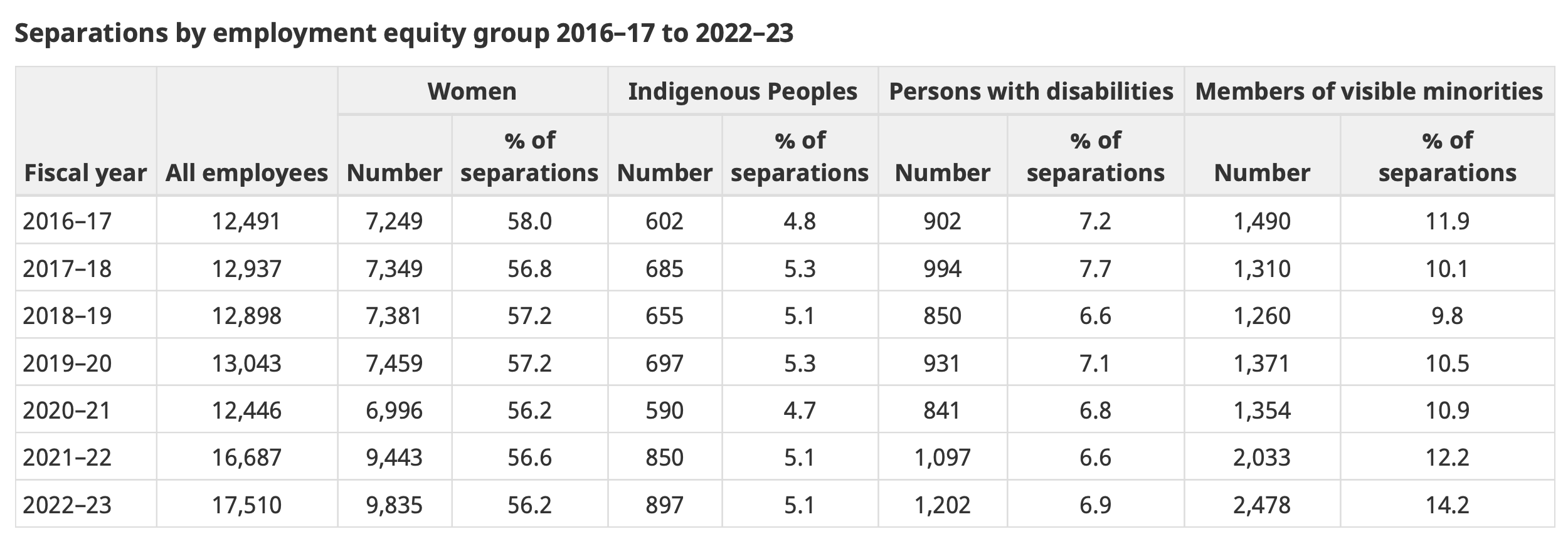
The Government’s proposed reduction in the public service by 5,000 public servants over four years (1,250 per year) is meaningless as the 2022-22 EE report shows annual separations more than 10 times that:

One thought that crossed my mind while browsing this close to 40 page document is whether this level of detail and effort would survive a change in government. Unlikely IMO, given the pressure to reduce spending and the CPC general aversion to excessive employment equity reporting and measures.

Source: Budget 2024, Statement on Gender Equality, Diversity, and Inclusion

Century Initiative:Great budget, Ottawa, but how to execute it when Canada fails to retain talent?

The latest from CI, still maintaining their focus on population growth but more attentive to other issues. But arguably some of the failings of immigration policy and integration have resulted in retention issues, with churn as immigrants pursue opportunities elsewhere.

On foreign credential recognition, count me cynical but this is a perennial issue that neither the previous or current government have made significant progress on beyond consultations and process. At the provincial level, however, where professions and trades are regulated, there has been some significant progress to temper my cynicism.

And of course, like the budget itself, the belated recognition of the links between housing and immigration:

…As one example, there have been positive steps in building the Indigenous economy, including higher rates of new business creation among Indigenous peoples compared with the population over all. We need to build on this progress with government, business and labour exploring further opportunities for partnership and Indigenous-led development.

The need to expand work-force participation and economic opportunity extends across demographics and can be addressed in three specific areas.

First, skills development. In a destabilizing year for the postsecondary institutions, work with provinces and territories to support expanded program delivery, particularly in health care, technology and skilled trades, is urgently needed. Employers, who share an interest in investing in their work force’s development, should also be given incentives for work-integrated training programs.

Second, retention. We have enormous untapped potential among Canadians who are already here. And the plain truth is the longer it goes untapped, the greater the risk that talent leaves. Indeed, 0.7 per cent of our population leaves for the United States every year, with independent research showing tech workers are paid more than 46 per cent more in the U.S.

Clearly, we need policies that encourage growth and scale for our own innovators, expanding their ability to offer competitive pay. Additionally, pathways should be created for temporary foreign workers to secure permanent positions and residency. These measures must be coupled with investments that enhance quality of life, such as affordable housing, health care and child-care capacity.

Third, fixing the credential mismatch. More than 25 per cent of immigrants with foreign degrees end up in jobs that they are overqualified for, with an RBC studysuggesting that credential inefficiencies cost the Canadian economy as high as $50-billion annually. We must do far more to ensure that immigrants find employment that matches their skills and qualifications, including exploration of mutual credential recognition agreements with prominent source countries.

Budget 2024 lays out a vision for Canadian housing, affordability and job creation, with a wide-ranging slate of new programs and investments. If we want them to succeed, they must be coupled with a vision for a skilled, resilient and adaptive work force.

A made-in-Canada pathway to prosperity begins and ends with talent – let’s ignite that talent with the vital boost it needs.

Lisa Lalande is chief executive officer of Century Initiative.

Source: Great budget, Ottawa, but how to execute it when Canada fails to retain talent?

Minister preemptively shuts down Calgary proposal to let permanent residents vote

Right call, given that Canadian citizenship has reasonable requirements (high fees perhaps excepted) and that backlogs largely eliminated:

A Calgary city council motion to extend municipal voting rights to permanent residents has been stopped in its tracks by Alberta’s municipal affairs minister.

The motion is set to be introduced by councillors Walcott, Wong, Dhaliwal, Mian, and Penner on Tuesday.

However, in a post to X on Saturday, Minister Ric McIver said he’ll “save us all some time.”

“Only citizens of Canada can vote in municipal elections. That will not be changing,” he said.

The motion calls for an amendment to the Local Authorities Election Act, which determines who has the right to vote in municipal elections. 

Because municipalities exist due to provincial legislation, the Alberta government would have to decide to amend the Local Authorities Election Act.

The councillors argued in their motion that all levels of government make decisions that affect residents’ daily lives, regardless of their citizenship status. 

“Municipalities are unique, as the only order of government that is not constitutionally defined. The opportunity to extend voting rights to more members of our local communities would represent a significant shift to ensure our local communities are representative of the people who call them home,” reads the motion.

The procedure on Tuesday is to ensure that the motion is written properly, Wong told True North in an interview. The motion will not be debated until the next regular council meeting on Apr. 30.

Wong said he is eager to hear more about the pros and cons of the motion, including its virtues and benefits, and how it aligns with federal and provincial criteria for voting eligibility

“Our responsibility as municipalities extends to all… who call our communities home, who contribute to civic life, who work here, raise families here, and use city services, should have a democratic right to vote in our municipalities,” reads the motion.

Wong said that councillors have been canvassing their constituents, both citizens and permanent residents.  

The perspectives presented have been varying. Some have said that citizenship is a vital voting criterion.

“We’ve also heard people saying, ‘We’re newcomers. We want to be able to be a citizen.’ There are reasons why it’s been delayed, whether it’s in their control or not. But they also feel that they’d like to have a voice in municipal governance because they are users of our services as well as people who pay taxes,” said Wong.

He added that one of the most pressing questions is the many different types of permanent residents there are and what would determine voting eligibility.

“The nuance of that has to be discovered by the province, and the province needs to make the system fair across the province because this is not just a Calgary-based request,” said Wong.

The Calgary councillor was not surprised at McIver’s response, he said. He added that McIver is very involved and understands Alberta and Calgary’s multiculturalism. 

“I know that he wouldn’t dismiss it just because of personal feelings about us. He would weigh the arguments presented by all municipalities,” said Wong.

“All members of council are always amenable to persuasion, and therefore nobody’s cast a vote as of yet. And I think Calgarians need to understand that.”.

True North reached out to McIver for additional comment. His office said he has nothing more to add to his previous post to X. 

Source: Minister preemptively shuts down Calgary proposal to let permanent residents vote

Keller: Is the Trudeau government overselling how much housing it can build? Yes

Indeed, particularly in the next few years if not more. Likely will not help their electoral prospects given time required to build new housing:

…When CIBC economist Benjamin Tal updated the CMHC estimate earlier this year, to account for recent unprecedented population growth because of immigration, he pegged the shortfall at closer to seven million homes.

If that’s true, then getting to housing affordability doesn’t just mean a doubling of the pace of home building. It would take a quadrupling.

The Trudeau government’s sudden burst of furious housing announcements – plus the suggestion that the resistance of some provinces is all that stands between Canada and sweet affordability – may deliver political dividends in the run-up to a 2025 election.

However, the overnight erection of a glittering skyline of new housing policies comes after the government spent years ignoring the growing stresses caused by its immigration choices. That’s partly what got us here.

The Liberals are now saying a lot of the right things on both housing and immigration. It’s a start. But to quote a handwritten note from the PM’s chief of staff, Katie Telford, which was entered into evidence last week at the foreign interference inquiry: “Bragging is not doing.”

Source: Is the Trudeau government overselling how much housing it can build? Yes

Gurski: Trudeau government shows it’s not serious about foreign election-meddling

Of note:

There is much to take away from all the recent analysis and counter-analysis of foreign interference in Canada’s elections — and none of it is good.

In summary, our government minimized the threat to our electoral process, admitting that while there “may” have been “some minor” efforts to sway voter intention, when all was said and done the results were not affected. (I am waiting for someone to explain how this conclusion was drawn: does the government know the reasons individual Canadians voted and the reasons for their choice of party/candidate?)

From an intelligence angle, while not much new was introduced at the Foreign Interference Commission last week, a few takeaways need re-emphasis.

1. Canada’s “intelligence culture” is worse than I feared. Politicians and senior bureaucrats do not understand, appreciate or know how to use the information provided by The Canadian Security Intelligence Service (CSIS) and others to help them identify threats to our national security and counteract them.

2. The prime minister does not read intelligence reports (or does he? There were mixed messages on that front) but prefers to be “orally briefed.” In theory there is nothing wrong with that as long as those doing the briefing have a background, preferably a strong operational background, in intelligence. Relying on “advisers” with no experience at the spy coalface to tell you about the nature of intelligence and its meaning is akin to asking your cousin Clem about your lung cancer rather than going to a qualified medical source. Not a great strategy.

3. Our leader arrogantly dismissed CSIS intelligence — which was provided on at least 34 (34!) occasions over the past few years — on People’s Republic of China shenanigans as “inadequate” and uninteresting. Accusations such as “it was not evidence” expose a significant ignorance of what intelligence is and is not.

No, it is not collected to an evidentiary standard (and is not normally used in court cases) but what is eventually provided to the prime minister and his team has been very carefully analyzed, corroborated, debated, checked and double-checked and is subject to intense scrutiny before it leaves the building. Is it perfect? No, nothing is.  But based on what I saw over 32 years at the Communications Security Establishment (CSE) and CSIS, the product is damn good. It is as accurate as can be given the sources and the fact that investigations leading to useful intelligence are in constant motion.

Where do we go from here, then? While the inquiry did provide the average Canadian with a peek into the shadows of espionage and counter espionage, under the guise of what foreign powers are doing on our soil to harm our democracy, this commission report will be relegated to the usual filing cabinet, like the results of other inquiries. In other words, thanks for coming and testifying but there is nothing to see here, so please move along.

The other sad fact is that national security issues are rarely, if ever, important on the campaign trail. Voters care more about inflation, interest rates, the housing crisis and what can be done to help a Canadian team win the Stanley Cup (31 years and counting). What the PRC and others are doing to threaten diasporas, steal votes and seek a government that will do its bidding simply does not register. Yes, these other challenges resonate more, but if you cannot ensure a free and fair election, what does your democracy stand on?

My normally optimistic self notes that we have seen this movie before and will see it again, unless we take major steps to prevent it. We need a national security adviser with real intelligence experience, not a part-time bureaucrat. We need the prime minister to meet regularly with the heads of CSIS, CSE and the RCMP.

We need a government to take intelligence and threats seriously.

Source: Gurski: Trudeau government shows it’s not serious about foreign election-meddling

Link to Canada’s security needed to bar suspected spies under immigration law: court

Of interest, await some commentary from the security researchers:

People can be barred from Canada under espionage-related provisions of the immigration law only when their activities have a clear link to Canadian security, the Federal Court of Appeal has ruled.

The finding came in a pair of decisions involving men from Ethiopia who were deemed inadmissible to Canada for being members of an organization that had engaged in spying.

The Immigration and Refugee Protection Act bars permanent residents and foreign nationals who engage in espionage that is directed against Canada or contrary to Canada’s interests.

The prohibition also applies to members of organizations involved in these activities.

At issue in the two cases was how to define the phrase “contrary to Canada’s interests.”

Medhanie Aregawi Weldemariam and Abel Nahusenay Yihdego are Ethiopian citizens and former employees of the African country’s Information Network Security Agency, a state security and intelligence organization.

Weldemariam says his work at the agency involved developing air defence simulation software for training military members. He left in mid-2014 to pursue graduate studies in Sweden, returning to Ethiopia two years later.

Weldemariam came to Canada in 2017 and made a refugee claim, alleging he was at risk of persecution by Ethiopian security forces that had targeted him after his return from Sweden.

Yihdego worked at the intelligence agency as a protocol analyst and network engineer. He claims he was pressured to join the agency’s decryption unit, facing threats and harassment when he refused to do so.

Yihdego resigned in 2014, enrolling in graduate studies outside of Ethiopia. He claims that on his return to Ethiopia in 2017, he was detained by security services because of his political activities.

He came to Canada on a temporary resident visa, later seeking refugee protection.

The men’s refugee claims were put on hold while the immigration division of the Immigration and Refugee Board weighed their admissibility to Canada.

The division found the Ethiopian intelligence agency gathered information using offensive cybercapabilities and surveillance malware, targeting journalists and political dissidents.

There was no evidence that either Weldemariam or Yihdego were personally involved in the agency’s espionage activities, only that they were members of the organization.

In each case, the immigration division found that the espionage at issue was “contrary to Canada’s interests,” even though it lacked a nexus to Canada’s national security or security interests.

In 2020, the Federal Court concluded the division’s interpretation of the law was unreasonable on the basis a connection to Canada’s security interests was indeed required.

The court quashed the decisions and sent the cases back to the immigration division for reconsideration.

The federal government appealed the court rulings.

In both cases, the Court of Appeal sided with the men, saying there was no suggestion any of the journalists targeted by the Ethiopian intelligence agency lived in Canada.

The court also found no evidence the agency’s acts were directed at Ottawa or Canadian companies, institutions or individuals, including members of the Ethiopian diaspora.

As a result, the court saw no need to send the cases back to the immigration division for redetermination.

Source: Link to Canada’s security needed to bar suspected spies under immigration law: court