Keller: Here’s a crazy idea: How about a student visa program whose main beneficiary is Canada

Not crazy and worth having this more extreme approach as a basis to compare current and future policies:

….Turning things around calls for doing far more than what federal Immigration Minister Marc Miller announced last month.

Allowing visa students to work an unlimited number of hours off-campus fed the business model for unscrupulous educational operators. Mr. Miller says that in the spring, he may reduce the work limit to 30 hours a week. He needs to go much farther. To end the tuition-for-minimum-wage-work trade, he has to end the right of visa students to work, with the exception of those in highly-paid jobs.

Similarly, post-graduation work permits should only go to those who’ve been offered a highly-paid job. All other graduates will have to leave Canada on graduation, their tuition having purchased education but nothing more. If you have a job offer paying at least, say, $75,000, you get the work permit. If not, you don’t.

One more thing: the feds should raise the cost of a student visa. It currently costs just $150. How about $5,000?

Those three simple steps would separate Canada’s educational wheat from the chaff. And it would do so without provinces and the feds having to micromanage which programs of study are worthy of student visas or work visas or post-graduation visas – a system rife with lobbying and the potential for corruption.

What I’m proposing would put the weakest institutions, public and private, out of the student-visa business. But it would strengthen the strongest and highest-quality institutions, including skilled-trades training programs, and even open new doors for them….

Source: Here’s a crazy idea: How about a student visa program whose main beneficiary is Canada

Immigration lawyers could help curb rejected Canadian visas [African students]

Different if perhaps self-interested take on different approval rates:

African students applying for Canadian study visas stand a better chance of getting the permits when they do so through legal representatives based in the country. Using Canadian immigration lawyers who also directly act for universities they plan to enrol in helps international students better navigate their immigration journey with trust and transparency at the core of the process.

This is contrary to using sub-agents based in African countries who act for aggregator recruitment firms acting for the institutions, a Canadian international students’ migration expert told University World News in reaction to reports of concerns over alarming study visa refusal rates for African students.

Support for international students during the visa application process could become more pressing following an announcement of a 35% cut in the number of student visas Canada will issue.

University World News reported that in an effort to deal with the politically explosive housing and affordability crises that experts say are exacerbated by the more than 800,000 international students in the country, Marc Miller, the minister of immigration, refugees and citizenship, announced the cut, expected to result in a decrease of 364,000 international students coming to Canada this year and next.

University World News also reported earlier that, between 2018 and 30 April 2023, officials at Immigration, Refugees and Citizenship Canada (IRCC) rejected 59% of the visa applications from English-speaking Africans and 74% from French-speaking Africans seeking to study at Canada’s colleges and universities.

The lawyers are available in online platforms that are easy for students to engage with and offer high-quality legal guidance and application review, ensuring that students present their strongest and most comprehensive applications, Michael Pietrocarlo, head of marketing at BorderPass said.

Expert, affordable help

Immigration lawyers such as BorderPass, he claimed, make Canada more accessible to African students “by offering online study permit applications with Canadian legal review – all at a very low cost”. He said they provide better protection for students and ongoing guidance about Canadian immigration laws. The result is that more African students’ applications are successful.

Pietrocarlo denied claims of racial bias in the visa denials, saying it was hard to make a judgment as Canada remained largely supportive of diversity. “In our experience, applications made by African students through BorderPass have high rates of success – just as successful as those from other regions.”

Falsified and fraudulent applications in which the information required is either inaccurate or poorly filled out contribute to rejections, although this does not seem to be a problem with African applications.

“Agents face conflicts of interest, which can lead to misrepresentation aimed at boosting acceptance rates. This ultimately harms the students involved, as shown by the recent Canadian Federal Court decision. Students should be cautioned against relying on agents to submit their study permit applications,” Pietrocarlo cautioned.

Canada’s Federal Court decreed that it was a student’s obligation to ensure the accuracy of the contents of their Canadian study permit. This was after an international student from India was issued a study permit based on a falsified letter of acceptance (LOA), subsequently entering, and studying in Canada, but at a different school from the one listed on the falsified document.

Although the student claimed she was unaware the LOA was false, the Federal Court ruled it unreasonable for an international student to not review or verify the authenticity of their documents.

Students should verify applications

The court further confirmed that students, themselves, are responsible for reviewing and verifying their visa applications and made it clear that students who “rely on foreign agents – who are unaccountable under Canadian law – will be held responsible for misrepresentations, even if made unintentionally, by their agent, or unbeknown to the student”.

According to Pietrocarlo, however, most fraudulent cases have come from outside of Africa, but this is largely because, until recently, Canada was not a major destination for African students. “Nonetheless, the extent of misrepresentation by fraudulent agents was not insignificant and IRCC is instituting stringent oversight as a result, identifying 1,500 cases of suspected fraud in a recent investigation,” he said.

He added that the extent of misrepresentation by lone agents often goes undetected, but cases like the recent one decided by the Federal Court illustrate the harm to students – even if students are unaware of the misrepresentation. “This is why it’s important for students to rely on Canadian legal counsel.

“Based on our research and information from our institutional partners, about 50% of applicants from Africa don’t come through agents and, thus, are left on their own to handle the visa and immigration process – often leading to mistakes or incomplete applications,” he noted.

While the quality of African students seeking to enrol in Canadian universities was as good as that of any other country and met the admissions criteria, the problem often lay with the immigration application, noted another BorderPass official, Max Donsky.

Many agents’ speciality and strength lay in recruitment and admissions, while visa application and the whole migration and stay process was better handled by immigration lawyers, something that was not common in Africa.

“It would be good if agents handled recruitment and admissions and left the migration part to experts,” he told University World News. This, he added, would save students thousands charged by unqualified people posing as migration experts but with little knowledge and ability to guide the students.

“From our own experience in places like Nigeria, Ghana and Kenya, the success rate for getting study permits rises to as high as 80% up from a low of 30%-35% where migration lawyers are used to apply for the permit,” Donsky disclosed.

“Of course, we are not saying we 100% guarantee admission, but our legal teams guide and support them throughout the process, including during their stay, with far better than usual outcomes,” he said.

Rejections blamed on high volume

The high study permit refusal rate was recently blamed on increases in the volume of applications as a result of a recruitment model that invites mass applications and on inexperienced downstream recruitment agents, according to an expert in the field.

The trend extended beyond Africa and has been affecting students in Asia, Latin America and some parts of Europe in the recent past, Earl Blaney, of the Canadian study and residency firm Study2Stay told University World News in an earlier interview.

He suggested that the overseas education agents authorise immigration practitioners as one way of helping to solve the problem of escalating refusal rates, which would also assist with student support throughout students’ stay, and dramatically improve the prospects of skills retention to support Canada’s economic class immigration goals.

While Blaney could not rule out racism as a reason for the refusal rate, he said the refusal rate could be due to the increasingly common aggregator model which entails universities contracting companies to recruit international students.

The companies, in turn, sub-contract agents around the world who are tasked with recruiting as many students as possible. The volume of applications means that, despite high visa refusal rates, diligent students do manage to ultimately
enrol.Source: Immigration lawyers could help curb rejected Canadian visas

David Fine: Pushing boundaries? Why would a festival not stand behind its decision to support free expression of ideas?

More on the cancel culture in the arts and its uneven application:

Cancelling a challenging and thought-provoking work such as The Runner is no less antithetical to exactly what PuSh rightfully stands for. PuSh originally stood by the production after it had been cancelled by the Belfry Theatre in Victoria, but capitulated when another PuSh invitee threatened to pull his work if The Runner was performed.

The artist, U.K.-based Palestinian Basel Zaraa, was presenting a work titled Dear Laila, which speaks vividly of the Palestinian experience. How inappropriate it would have been if the shoe were on the other foot and Morris had demanded the cancellation of this vital work by a Palestinian artist.

How can one artist can demand a festival remove a work already agreed upon and planned? Why would a festival not stand behind its decision to support free expression of ideas, especially challenging ones dealing with issues that are especially relevant right now?

There was also an open letter signed by “concerned members of Vancouver’s multiracial communities” seeking to pressure PuSh to cancel the play. The letter is a detailed critique of character and narrative, but it goes further, making the shocking claim that the widely corroborated rape and torture of Israeli women were “sensationalistic and unproven allegations of sexual violence by Palestinian fighters.”

Besides seeking to cancel The Runner, the letter also seeks to sanitize the horror of Oct. 7, referring to the Hamas terrorists who committed the atrocities of that day as “Palestinian fighters.”

Denying and sanitizing the horror of Oct. 7 is shocking, and I truly hope that this letter was not instrumental in forming PuSh’s decision, but the letter writers are certainly claiming victory anyway, and that is worrying.

The Runner is not an instrument of Israeli propaganda — in fact it is said to question Israeli policy. It has been described by one critic as “one of the finest plays I’ve had the honour to write about. It unsettles as art should.” Indeed, art should unsettle.

Both The Runner and Dear Laila are exactly the kind of works that should be shown, discussed, criticized and challenged. That’s what makes PuSh vital and relevant. I resist the term “cancel culture” because that is the domain of the reactionary right. This is an attempt to demonize an Israeli perspective, even in the context of a work such as this, which is not meant to glorify  or support Israeli policy. At least as I understand from other comments and reviews. I can’t speak to this directly because I have been deprived of the opportunity to see the play myself.

Vancouver Coun. Sarah Kirby Young shared her intention not to attend PuSh because of the decision. The city of Vancouver supports PuSh and I hope they might have a conversation about policy and censorship. I do not want PuSh to be cancelled. That would be completely hypocritical, but I do hope that parties who support PuSH might encourage a dialogue in the hope that they might review the decision — albeit after the fact — to abruptly cancel a production because another invitee demanded it.

Morris shared his disappointment in a statement on PuSh’s blog: “It’s unsettling when Canadian theatres cannot be a space for the public to engage in a dynamic exchange of ideas. I believe theatre must be a place where contrasting perspectives are programmed and celebrated. Now more than ever, we need to listen to each other, engage in different viewpoints, and find our shared humanity.”

At the same time, he was also unbelievably gracious: ”If removing  The Runner  is the only way Canadians can hear Basel’s crucial voice, then there is value in stepping aside.”

I wish Zaraa and the PuSh Festival might have shown the same grace.

David Fine is a filmmaker in Vancouver. 

Source: David Fine: Pushing boundaries? Why would a festival not stand behind its decision to support free expression of ideas?

Task force rejects calls for special employment status for Jewish, Muslim public servants

Of note. Curious that the report mentioned the Muslim Federal Employees Network (MFEN) but not that of the Jewish Public Service Network (JPSN). Conscious or inadvertent? I made a submission that was not listed, perhaps being deemed not a”comprehensive written submissions.” (Link: https://multiculturalmeanderings.wordpress.com/wp-admin/post.php?post=56715&action=edit). 

That being said, inclusion of religious minorities would prove a challenge and require religious self-identification and analysis would require deep intersectionality to be meaningful. Census data provides some insights but haven’t had time yet to analyze 2021 data:

Months before the eruption of the Israel-Hamas war ramped up ethnic and religious tensions in many Canadian communities, a government task force rejected requests to recognize Muslim and Jewish public servants as separate groups facing systemic workplace barriers, CBC News has learned.

Muslim and Jewish public servants asked to be designated as employment equity groups under the Employment Equity Act nearly two years ago in submissions to the task force, set up by Employment and Social Development Canada.

CBC News obtained the Muslim Federal Employees Network (MFEN) submission through an access to information request, and the one from the Jewish Public Service Network (JPSN) by asking for a copy.

“The inclusion of religious minorities would provide obligations on behalf of the employer toward removing barriers to religious minorities in the public service, so that they may bring their whole selves to work, including Jews,” says the JPSN’s submission, which also asked that Jews be identified both as an ethno-cultural group and as a religious group under the law.

“Discrimination and socio-economic barriers continue to exist for Canadian Muslims. These barriers will not disappear without intervention,” said the MFEN’s submission. “We recommend that Muslims are added to the Employment Equity Act as a designated employment equity group.”

The Employment Equity Act (EEA) was introduced in 1986 to knock down employment barriers facing four marginalized groups: women, Indigenous people, people with disabilities and members of visible minorities.

The legislation requires that federally regulated employers with more than 100 employees use data collection and proactive hiring to ensure that these groups are not under-represented in their workforces. No designated employment equity groups have been added to the EEA since its creation.

The MFEN and JPSN submissions were prepared in spring 2022, long before the latest deadly conflict erupted between Israel and Hamas in October of last year.

Labour Minister Seamus O’Regan shared the task force’s findings with the media last December, after his office initially received them in April 2023.

The task force said it decided “not to recommend the creation of a separate category for some or all religious minorities at this time,” but encouraged further study.

Jewish, Muslim employees report discrimination

In its submission, the JPSN cited Statistics Canada figures showing Jews were the group most often targeted by hate crimes between 2017 and 2019.

It quoted a B’nai Brith Canada audit in 2021 that reported a “733 per cent increase of violent anti-Semitic incidents.”

In its submission, the JPSN presented anonymous testimony from Jewish public servants. One Jewish employee said they were told they “really bring new meaning to Jews having a lot of money,” after mentioning their background. Several Jewish employees also said they have been called “cheap.”

The submission cited workplace barriers too, such as important meetings being scheduled on religious holidays, excluding observant Jews, or “managers scrutinizing and questioning the validity of leave requests for Jewish holidays.”

The Muslim Federal Employees Network, meanwhile, pointed out that the EEA’s protection for visible minorities won’t protect Muslims.

“There are non-racialized Muslims such as Eastern European Bosniaks, Indigenous Muslims and white converts,” it said in its submission. “In some cases, it may not be possible to determine if someone is Muslim without them disclosing it first. For example, not all Muslim women wear a hijab.”

The MFEN said Muslim federal employees face various forms of Islamophobia. In its submission, it cited reports of Muslim women being subjected to comments “about their ability to do their federal public jobs because they wear a hijab,” and of Muslim men “who are seen to be terrorists and perpetrators of violence.”

It said Muslim federal employees have sometimes struggled to obtain security clearances “because of biases around their countries of origin or their names.”

In its report, the task force did not mention the JPSN’s request, although it cited the MFEN report and two other submissions from the Canadian Council of Muslim Women and the Sikh Public Service Network.

The task force recommended designating 2SLGBTQI+ and Black workers as employment equity groups. It said it had been told by the minister’s office to consider adding those two groups, which allowed it to obtain targeted funding for community consultations.

“In contrast, despite our extensive consultations, we did not receive representations from many of the concerned groups in the broad population beyond the federal public service who wanted us to consider adding religious minorities,” the task force said.

Final decisions on adding more groups to the legislation will be made by O’Regan.

In a statement, O’Regan’s office said it might consider further changes to the EEA.

“These initial commitments are only our first steps in our work to transform Canada’s approach to employment equity,” it said.

The statement said O’Regan “will continue to engage affected communities, including religious minority communities.”

The office said it looks forward to tabling new government legislation but did not offer a timeline.

It said it’s also working to arrange meetings between O’Regan and Amira Elghawaby, the federal government’s special representative on combating Islamophobia, and Deborah Lyons, special envoy on Holocaust remembrance and combating antisemitism.

Source: Task force rejects calls for special employment status for Jewish, Muslim public servants

John Ivison: University instructor fights back after being suspended for daring to denounce Hamas

Contrast:

….I wrote about Finlayson late last year. He has been teaching at Guelph-Humber for 13 years, has no disciplinary record and no history as a political activist.

In a social media post that he admits may have been a little too blistering, he said that an academic in Pakistan calling for Palestine to be free “from the river to the sea” was a “pro-Nazi zealot.” Finlayson said he stands with Israel, against antisemitism and against Hamas, which he said takes millions meant for health and education and uses the money to make war. “You stand with Palestine means you stand with Hitler.”

Hitler references aside, it was all fairly standard stuff.

…[complainant] Surely this could not be Dr. Wael Ramadan, professor of project management at Sheridan College’s Pilon School of Business?

I’m told it is. I wrote about Ramadan a week or so after Finlayson. He had called Israel “an apartheid state committing genocide” but he was not suspended by Sheridan — in my opinion, quite rightly, since it is not the college’s place to protect the delicate ears of generation Z from opinions with which it may disagree.

Ramadan did not respond to requests for comment then or now, but I am told that the man whose right to free speech I defended is at the centre of the effort to shut down Finlayson’s right to the same, and get him fired in the process.

Academia is in a shocking state when the desire to root out anything that a complainant disagrees with, or considers “unsafe” is gratified by academic bureaucrats.

People far beyond Guelph-Humber are starting to take an interest in this case, aware of the chilling effect on academic speech it will have if it is not challenged.

The university has made a mistake. It should admit as much and reinstate Finlayson.

Source: John Ivison: University instructor fights back after being suspended for daring to denounce Hamas

Clark: It’s too late for universities and colleges to complain about the foreign student cap

Indeed. They and others should have seen this coming as it was untenable:

Canada’s universities and colleges sent an open letter to Immigration Minister Marc Miller this week about the cap he has imposed on new foreign students.

The gist was this: Please no, don’t do this yet, wait, hold on, we’re not ready, this is too sudden, can you give us a break?

Mr. Miller’s answer should be, in a word, no.

The warnings were ignored for too long – by the feds, by provincial governments especially in Ontario and British Columbia, and by colleges and universities. That left no option apart from ripping the Band-Aid off.

Source: It’s too late for universities and colleges to complain about the foreign student cap

Prime Minister Trudeau failed to follow his own advice on temporary foreign workers

Always easier in opposition than in government but valid reminder of how soon they forget once in government. Trudeau in 2014 had it right:

Massive growth in Canada’s non-permanent resident streams of immigration (including temporary foreign workers and international students) has led to growing calls on the Trudeau government to reform the system. Immigration Minister Marc Miller recently announced a two-year reduction to student visas. The government has so far been silent on possible reforms to the temporary foreign workers stream. 

One unlikely source of advice on such reforms might be Prime Minister Justin Trudeau himself. In 2014, the then-Liberal Party leader wrote a scathing op-ed in the Toronto Star that excoriated the Harper government for the growth of the Temporary Foreign Workers Program (TFWP) under its administration and highlighted the need to “scale it back dramatically.”

He wrote: 

“As a result [of Harper-era policies], the number of short-term foreign workers in Canada has more than doubled, from 141,000 in 2005 to 338,000 in 2012. There were nearly as many temporary foreign workers admitted into the country in 2012 as there were permanent residents — 213,573 of the former compared to 257,887.

At this rate, by 2015, temporary worker entries will outnumber permanent resident entries.

This has all happened under the Conservatives’ watch, despite repeated warnings from the Liberal Party and from Canadians across the country about its impact on middle-class Canadians: it drives down wages and displaces Canadian workers.”

Fast forward a decade and the Trudeau government’s own record on the TFWP has failed to adhere to these sensible insights. 

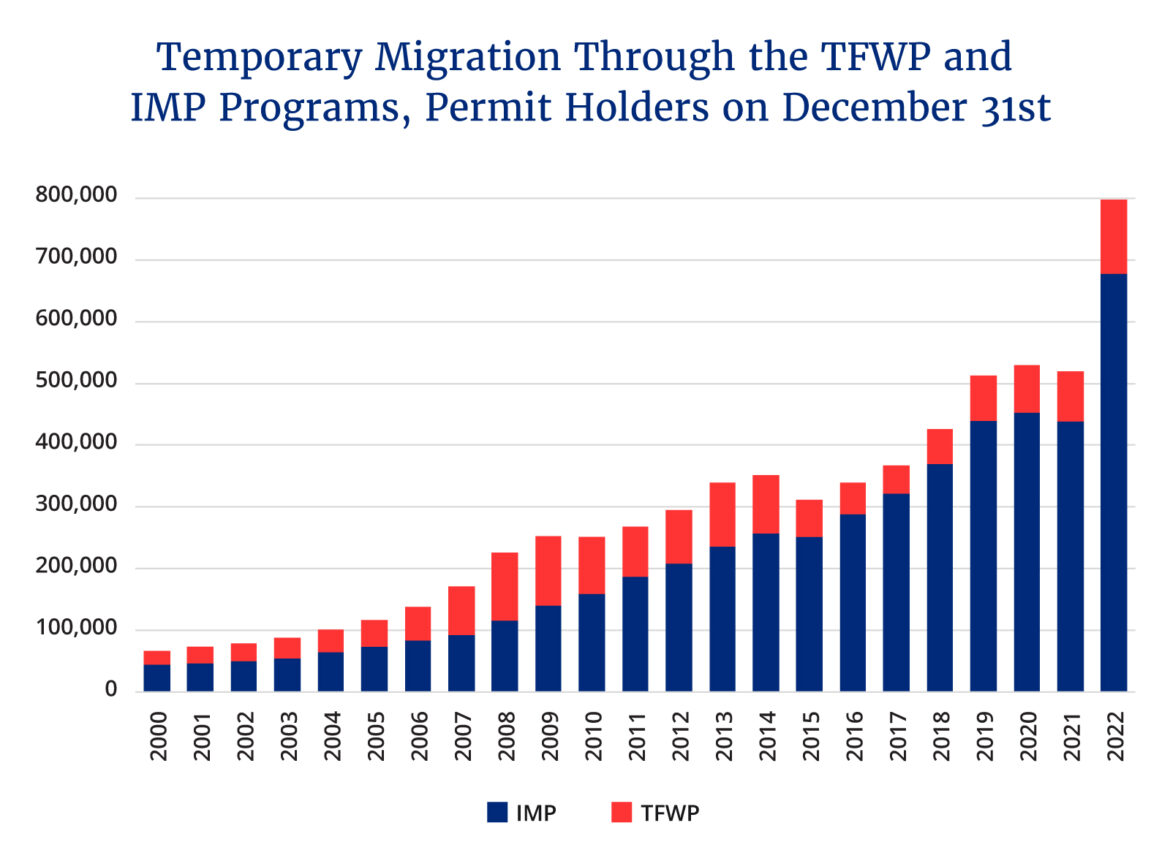
The figure below displays the number of work permit holders at the end of 2022 through Canada’s two temporary labour migration streams—the TFWP and the International Mobility Program (IMP). The TFWP covers migration programs that require a Labour Market Impact Assessment to receive a work permit such as the live-in caregiver program and various agricultural programs. The IMP does not require labour market assessments and includes individuals working on visas related to trade agreements such as the Canada-U.S.-Mexico Trade Agreement, individuals on post-graduate work permits, and so on. 

Mr. Trudeau was correct in 2014 to observe that there was a more than doubling of the program under the Conservatives before a slight reduction owing to policy changes later that year that included a partial moratorium on new permits and visas.

Graphic credit: Janice Nelson.

Under Trudeau’s tenure as prime minister, however, the number of temporary work permits has grown dramatically—far outstripping those during the Harper government. In 2015, there were a little more than 310,000 temporary work permits. By 2022, the number had more than doubled to almost 800,000. Partial data from 2023 indicate that there was a further increase last year. 

One way to understand this massive increase in the number of temporary foreign workers is to use Trudeau’s own standard of the share relative to permanent residents. He warned in 2014 that the ratio was approaching 1:1. In 2022, there were roughly 440,000 permanent residents admitted into Canada compared to the almost 800,000 working on temporary visas.

This significant growth not only conflicts with Trudeau’s chief recommendation in his op-ed that the TFWP needed to be constrained but also his broader concerns about the risks of an over reliance on temporary foreign workers. 

He concluded: 

“It cuts to the heart of who we are as a country. I believe it is wrong for Canada to follow the path of countries who exploit large numbers of guest workers, who have no realistic prospect of citizenship. It is bad for our economy in that it depresses wages for all Canadians, but it’s even worse for our country. It puts pressure on our commitment to diversity, and creates more opportunities for division and rancour.

We can and must do better.”

Source: Prime Minister Trudeau failed to follow his own advice on temporary foreign workers

Cuenco: Canada’s immigration backlash is far from populist

Useful distinction although over emphasizes important of Laurentian elite as this general view is common to all regions:

As the United States and Texas state governments clash over the Mexican border, a very different kind of immigration crisis is taking place elsewhere in North America. Unlike in the divided US, Canada is supposed to be one of the world’s most solidly pro-immigration societies. More than just another self-satisfied Justin Trudeau facade, this attitude has been attested to by historically high levels of public support.

However, an unfolding shift in public sentiment may now change that. Amid a housing crunch and soaring costs of living, Canadians are turning against the prospect of welcoming more immigrants. And the Trudeau government has slowly started to bend under this pressure.

But unlike the rest of the West, Canadians are not advancing this argument via populist rabblerousers or angry mass protests. Instead, Canada’s turnaround is being led by cadres of respectable, credentialed and, for the most part, small-l liberal experts and commentators, who are making the case for immigration reduction in terms that are academic and utilitarian, rather than emotive and atavistic. And, while there has been a rise in populism in recent years, within the Conservative Party and elsewhere, these forces have been unable or unwilling to capitalise on anti-immigration sentiment.

This unique set of circumstances has led to a distinct form of restrictionism, a “polite backlash”, with stereotypically Canadian characteristics. Being driven by educated elites, it plays out in the rarefied spaces of establishment opinion, where opposition to Ottawa’s temporary migrant policies (which has seen more explosive growth than the permanent stream) has materialised.

For instance, the editorial pages of the newspaper of record, The Globe and Mail, have recently featured pleas for “aggressive action to reduce the number of temporary migrants”, along with warnings that businesses “should not be subsidised through the import of cheap labour”. Similar sentiments were heard in the CBC’s nightly news program, which hosted a debate on the question: “Housing crisis vs. immigration: Is it time to slow things down?” Twitter, meanwhile, abounds with commentary by housing experts calling for Ottawa to “substantially reduce the number of visas for both international students and [foreign workers]”. A respected former Bank of Canada governor likewise criticised the fixation on juicing up growth through immigration, which retarded productivity: “On a per-person basis, the economy has been shrinking.”

These objections to the status quo amount to what the Globe describes as “practical concerns about the current pace of immigration, not ideological opposition” to immigration itself, which most (if not all) of these thought leaders continue to support in principle. We are seeing that rare thing: a pragmatic, context-driven response among segments of Canada’s expert class that also matches recent shifts in public opinion.

Because data from the country’s major polling firms, collected over the last few months, all show overwhelming support for cutting immigration numbers as a response to cost-of-living challenges: “68% agree — Canada should put a cap on international students until the demand for affordable housing eases” (Ipsos-Reid); “An increasing proportion of Canadians [61%] want Canada to accept fewer immigrants in 2024” (Nanos Research); “Canadians… believe that immigrants are contributing to the housing crisis (75%) and putting pressure on the health care system (73%)” (Leger). This convergence of views across large swathes of Canadian society has proved unignorable.

Last week, Trudeau’s minister for immigration, Marc Miller, announced cuts to the country’s intake of international students, which has seen exorbitant growth in the last year, and now accounts for a staggering 1 million people, or 2.5% of Canada’s population. (To put the figure in perspective: this means that Canada is hosting almost as many international students as US institution, despite the US population being roughly nine times bigger.) This comes after Statistics Canada figures revealed that “as many as 1 in 5 study permit holders in Canada are not actually studying at the institutions to which they have been accepted”, demonstrating how education has become a back door to the job market.

The new policy will see international undergraduate visas capped at 360,000 in 2024, a one-third reduction from last year, and a rationing of these visas among the provinces, along with changes to the “Post-Graduate Work Program”, widely regarded as a pathway to permanent residency for students. Beyond policy details, this volte-face amounts to an admission of a longstanding truth: the existing system has served as a cash cow for tuition-hungry schools and rent-hungry landlords, as well as a source of cheap labour for employers. The new changes are expected to offer some temporary relief to runaway rents prices (though economists disagree by how much).

Though these changes don’t go far enough for some (including this author), at the very least, it is a signal that Trudeau’s Liberals are willing to act on a problem they ignored for so long: it represents a meaningful, if modest, policy victory for the polite backlash and its arguments for numbers reduction.

Conversations among thought leaders, however, have so far been largely limited to the temporary resident stream. It will be a measure of the experts’ and the government’s determination to correct course once they start considering cuts to the permanent resident stream, currently set at roughly 1.5 million newcomers by 2026. This is one case where public opinion is ahead of them, since the polling data indicates that most Canadians also want these targets to be scaled back as well. In any event, it is important to understand the deeply entrenched nature of the status quo that prompted this polite backlash, for even Miller’s moderate reforms have invited a backlash of its own from the powerful interests whose income has been threatened by the announced cuts.

The outcry is loudest from higher-education institutions, especially in Ontario, the largest province and epicentre of the crisis. These institutions stand to lose the most as they have relied excessively on international tuitions to compensate for their chronically underfunded budgets. This in turn is the fault of the Tory provincial government of Doug Ford, which carried out the budget cuts and had been aware of this over-reliance on foreign students but nonetheless persisted in letting it fester. It also maintained a lax approach to the growth of dubious for-profit “strip mall colleges”, which attracted large shares of international students. Ford’s government, therefore, shares responsibility with Trudeau’s for the severity of the problem, with parties of the Right and the Left found equally complicit.

Meanwhile, the Century Initiative, an influential business-linked group that advocates for immigration maximalism, issued an anodyne statement on the cuts, appearing to assent to them but nonetheless arguing for the 1.5 million permanent resident targets to be retained — even though these are precisely the numbers that must be cut if Ottawa is serious about easing affordability. What is likely to follow is a protracted debate between two segments of expert opinion on the future of immigration, one that will largely take place within the bounds of elite discourse, confirming the closed nature of political decision-making in Canada. As John Ibbitson put it in his account of the country’s “Laurentian elite”: “On all of the great issues of the day, this Laurentian elite debated among themselves… But much of the debate was held behind closed doors: in faculty clubs, the hallways of legislatures, in dining rooms in [tony neighbourhoods like] Toronto’s Annex, Ottawa’s Glebe, Montreal’s Outremont.”

But the progress of this debate still begs the question: what happened to Canada’s populists, who ought to be challenging the elite conversation from outside the system? For some reason, they have counted themselves out of the immigration issue. Federal Tory leader Pierre Poilievre is a case in point: widely described as populist in style and outlook, he is Trudeau’s arch-foe. But he has avoided criticising the government’s immigration targets in any substantive way (a few recent vague comments about matching immigration numbers to housing construction notwithstanding). Even more strangely, he has sought to gain favour with the international students, meeting with themand trying to turn them against Trudeau, claiming they’d get a better deal under him. This is an incredibly naïve and dangerous proposition that will simply give the students false hope for a path to residency, when in fact such expectations should be lowered, not raised. This poor judgement on Poilievre’s part suggests he won’t be any more serious on immigration than Trudeau’s government.

Further to the Right, the People’s Party has, in the past, been incredibly vocal about the need to restrict immigration. But after failing to re-enter parliament multiple times, its leader Maxime Bernier has faded into obscurity. On the Left, the New Democratic Party, nominally the party of organised labour, has abdicated the issue as well, even though as recently as 2014 it led the charge to limit low-skill immigration in the name of defending working-class jobs and wages. Only in Quebec are restrictionist parties still prevalent, but this has more to do with its idiosyncratic language politics than with material economic factors.

A populist revolt over immigration is therefore unlikely in Canada. But the country might have won something better: the expert-driven push to control immigration, with its emphasis on policy over passion, may prove to be a more effective and rational approach to the challenge than the theatrical (but toothless) populisms of Trump, Farage, Le Pen, Wilders and the rest. Canadians should hope that it succeeds in restoring balance to the system eventually, because should the polite backlash fail to do the job, the next backlash will be anything but.

Source: Canada’s immigration backlash is far from populist

Black-only swim times, Black-only lounges: The rise of race segregation on Canadian universities

Sigh, hard to see how this will improve social integration and inclusion:

…While the idea of explicitly race-segregated spaces at Canadian universities would have been unthinkable only a few years ago, recent months have seen a wave of Black-only lounges, study spaces and events at Canadian post-secondary institutions.

The University of British Columbia recently cut the ribbon on a Black Student Space featuring showers, lockers and even a nap room.  To gain access, students must apply and affirm that they are one of the following: “Black African descent, African-American, African-Canadian, Afro-Caribbean, Afro-Latinx, and Afro-Indigenous.”

Toronto Metropolitan University, formerly Ryerson, opened a Black Student Lounge in 2022. The space is intended as a shelter from “the harms of institutional racism.” In multiple public statements, TMU has referred to itself as a hotbed of colonialist institutional oppression, and the lounge is intended as a place where students can “heal” and “recharge” from said oppression, and “promote Black flourishing.”

The University of Toronto maintains a distinctive office of Black Student Engagement that curates a series of Black-only frosh and orientation events. While there are university-sanctioned “engagement” programs for Latin American and Southeast Asian students, these are mostly limited to mentorship appointments and workshops.

And it’s not just U of T pursuing Black-only frosh events. As noted in a feature by VICE, as recently as 2015 Canada didn’t feature a single Black-only frosh. But after Ottawa universities debuted BLK Frosh that year, the practice soon became commonplace….

Source: Black-only swim times, Black-only lounges: The rise of race segregation on Canadian universities

Le Devoir Éditorial | L’immigration et les petits calculs politiciens

Malheureusement:

Si les enjeux d’immigration présentent des défis planétaires de plus en plus aigus et compliqués, ces défis gagneraient indubitablement en clarté si les gouvernements de tout acabit évitaient d’en instrumentaliser les côtés sombres à des fins politiques et électorales. Prenons seulement l’actualité récente en Grande-Bretagne, en France et aux États-Unis. Trois pays dont les gouvernements embrument le débat et cultivent les méfiances xénophobes en cédant aux sirènes du populisme.

Au premier ministre britannique, Rishi Sunak, armé d’un slogan alarmiste (« Stop the boats »), revient la palme de la déshumanisation des migrants pour son projet de transfert de demandeurs d’asile vers le Rwanda. Fondé sur un accord signé avec l’autoritaire Paul Kagame il y a près de deux ans, le projet de loi adopté le 18 janvier dernier par la majorité conservatrice aux Communes vise à décourager les migrants de traverser la Manche — ils ont été environ 30 000 à le faire en 2023, au péril de leur vie. Sunak entend procéder bien que la Cour suprême britannique ait désavoué le projet en estimant que le Rwanda peut difficilement être considéré comme un « pays sûr ». 

Outre qu’il est loin d’être acquis que les expulsions ralentiraient les arrivées par « petits bateaux », les chiffres montrent noir sur blanc que la croisade de M. Sunak, qui est largement menotté par l’aile droite du parti, tient du délire. Le fait est qu’entre juin 2022 et juin 2023, la migration a été essentiellement légale au Royaume-Uni, répondant aux besoins urgents du marché de l’emploi, particulièrement en santé. Les migrants en situation irrégulière ont représenté 7,7 % de la totalité des  682 000 entrées. Qu’à cela ne tienne : à la traîne dans les sondages face aux travaillistes, M. Sunak n’a pas seulement décidé de faire de son « projet Rwanda » le socle de sa politique contre l’immigration clandestine, il compte aussi en faire l’un des ressorts principaux de sa stratégie de campagne aux législatives de janvier 2025.

En France, des mois de controverse autour de la nouvelle loi sur l’immigration ont obéi à de semblables petits calculs, permettant in fine à Marine Le Pen, cheffe du Rassemblement national, de crier à une « grande victoire idéologique » — du moins jusqu’à ce que le Conseil constitutionnel ne censure une grande partie de la législation la semaine dernière. C’est ainsi qu’en cheval de Troie, le concept de « préférence nationale », si cher à l’extrême droite, s’est imposé de façon inédite dans un texte législatif français, avec le soutien de la droite traditionnelle (Les Républicains) et de la majorité macroniste. Résultat : les Français auront vécu une saga où Emmanuel Macron aura moins cherché à penser une politique migratoire réformée avec clairvoyance, à l’abri des dérives, qu’à enregistrer un succès législatif à n’importe quel prix, lui dont la présidence ne va nulle part à six mois du rendez-vous des élections européennes.

Aux États-Unis, Donald Trump s’emploie ces temps-ci à saboter un projet d’accord migratoire entre sénateurs démocrates et républicains pour empêcher coûte que coûte que sa conclusion ne fasse bien paraître le président Joe Biden en cette année de scrutin présidentiel. Sur le fond, le projet repose pourtant sur des mesures étroitement punitives et tout à fait au goût des républicains. Seraient sensiblement élargis, en vertu de cette entente, les pouvoirs d’expulsion manu militari dont disposent les agents frontaliers. Dans l’espoir à courte vue de raplomber sa popularité, M. Biden se trouve ainsi à jouer le jeu de la droite dure anti-immigration. Il est d’autant plus piégé par cette dynamique que le clan trumpiste au Congrès lie l’augmentation de l’aide militaire à l’Ukraine, pièce maîtresse de sa politique étrangère, à l’adoption de mesures radicales de refoulement à la frontière mexico-américaine.

En Europe comme aux États-Unis, sur fond de stagnation législative, la « pression migratoire » ne diminue pas. Ils ont été 267 000 migrants à débarquer aux frontières méridionales de l’Union européenne l’année dernière et 2800 à se noyer en Méditerranée ; ils ont été 300 000 pendant le seul mois de décembre dernier à cogner à la porte des États-Unis. Des nombres records. Des années de politiques d’endiguement et d’externalisation des contrôles n’y ont rien changé, bien au contraire, de la même manière que la fermeture du chemin Roxham — c’était écrit dans le ciel — n’a rien réglé.

À prétendre qu’il y a des réponses simples à des problèmes compliqués ; à faire l’économie des faits et à laisser prospérer les faussetés ; à trop peu investir, en amont des mouvements de migration, dans le développement des pays du Sud ; à faire depuis toujours, aux États-Unis, l’impasse sur une réforme du système d’immigration, on se trouve trop souvent à laisser la réflexion autour des enjeux de géopolitique migratoire, d’une portée pourtant capitale sur la vie des sociétés partout dans le monde, à se conclure sur des décisions politiciennes prises à la petite semaine.

Source: Éditorial | L’immigration et les petits calculs politiciens