Jesse Kline: Liberal immigration plan exposes the folly of big government

Bit of a stretch to link the flawed immigration plan to the “folly of big government” as bad immigration policy can also be the “folly of small government.” And of course, the vast majority of immigrants have the ” potential to contribute to the tax base for the next three or four decades” as any cursory analysis of the data shows:

It is becoming clear to an increasing number of Canadians that the rapid influx of new immigrants brought in by the federal Liberals is exposing cracks in a country with an overburdened health system, a massive social safety net and a bureaucracy that stifles the economy and prevents housing and infrastructure from keeping up with population growth.

A series of recent polls found that 44 per cent of the country thinks immigration levels are too high, with even higher levels of dissatisfaction in Liberal strongholds such as Vancouver (49 per cent) and the Greater Toronto Area (57 per cent).

Source: Jesse Kline: Liberal immigration plan exposes the folly of big government

Canada is curbing immigration — but this lawyer says newcomers still drive our economy – Toronto Star

I rely more on labour economists like Mikal Skuterud than immigration lawyers for assessing impact of immigration on the economy, particularly productivity and GDP per capita growth:

The engine driving Canada’s economic growth isn’t cars, crude or softwood lumber — it’s immigration. In spite of lagging productivity compared with other economic superpowers, like the United States or China, Canada has propped up its aging labour force with newcomers.

Last year, Canada’s population grew by nearly one million people, according to Statistics Canada. Almost all of them were newcomers: refugees fleeing persecution, post-secondary students in pursuit of a Canadian diploma and job experience, farm workers with the country’s agricultural temporary foreign worker program.

Just last summer, months after U.S. tech giants like Meta and Amazon were laying off thousands of qualified tech professionals, then-immigration minister Sean Fraser launched a program to give U.S. H1-B visa holders a shot at Canadian work permits. Within 48 hours, 10,000 applications had been submitted.

But Ottawa appears to be tapping the brakes on its ambitious immigration targets. Earlier this month, the federal government announced it would “stabilize” immigration levels at 500,000 per year starting in 2026, despite years of continually raising its target. Meanwhile, Northern College, an Ontario post-secondary institution, has revoked around 700 acceptance letters from international students over the past year due to what it described as a lack of local jobs and housing.

These decisions come in the face of stubbornly high housing and food costs affecting everyone living on Canadian soil: permanent residents, citizens and undocumented alike. Stephen Green, managing partner at immigration law firm Green and Spiegel, spoke to the Star about the current economic — and educational — landscape for immigrants from his Toronto office earlier this week:

There is an argument that amid competition for housing and jobs in Canada, immigration at our current level is unsustainable. Do you buy this argument?

I don’t buy that at all. First, unlike some countries like the U.S., where they have a lottery system based on country of origin, we have a really rigorous and thought-out selection system based on “human capital.” They look at a newcomer’s age, their education, whether they’ve worked or studied in Canada, whether they have family in Canada, whether they can speak English and French — that sort of stuff. We’re selecting immigrants based on a model that economists and various policy experts have said are considered very important factors.

I think the only major issue is that a lot of people in their forties have a very difficult time immigrating to Canada because of the point system. An applicant’s age is about 30 per cent of it. So if you are 45 years old, you run a really successful business outside of Canada and you want to come here, you’re going to have a tough time. But I don’t buy the notion about jobs. Even at my firm, we’ve been trying to find some skilled workers for over two years. We can’t find people. And I’m hearing from the construction industry that there are no workers. We have a really serious problem finding carpenters and plumbers — and these are the people who are supposedly going to help us with our housing crisis.

So how do those folks fare in Canada’s immigration system?

It’s very difficult for them under the point system. A lot of those skilled workers don’t speak great English and don’t have a great education. The trades have a very difficult time immigrating, and the government has always known that, and they’ve struggled to try to make the system better. But the real problem is that the provinces are responsible for licensing, and the feds are responsible for bringing people in. There are situations where you may have a carpenter that will make it through the immigration system, but then they can’t get their licence as a carpenter.

Look at doctors. Look at nurses. We make it so difficult for these people to get the proper licence. You can’t tell me that a doctor that’s graduated from Harvard and wants to practise in Canada — or a pharmacist from Europe — has to go through a horrendous licensing process. It’s wrong, and that was really holding up the ability of individuals that immigrate to our country to really perform their professions.

During the first years of the pandemic, there was some talk about getting more doctors from abroad into Canada’s health-care system. It sounds like the issues haven’t improved.

It’s a little better. They’re moving way too slow. It’s interesting, on the medical side — it costs the province more money to license more doctors. And the doctors want to protect their turf a bit. But I think Canadians have had it. You have people that can’t find family doctors, that can’t find specialists, and they’re saying there’s no reason why doctors should go through such craziness to get licensed.

International students have gotten a lot of attention from the federal government recently. First there was last summer’s acceptance letter scam, then Northern College’s recent revocation of 700 international student acceptances. Can you explain what’s going on?

Former immigration minister Jason Kenney once said foreign students were the best future immigrants to Canada. Why? They pay for their own education. It’s a funny word — but they become Canadianized much easier than other immigrants. Our foreign students fund my kids. They pay $40,000 to $50,000 a year to go to the University of Toronto, when Canadian-born students pay $7,000 to $8,000. But the federal government only let foreign students go to schools that have been designated “learning institutions” — by provinces. And the provinces have failed Canadians by designating far too many that don’t deserve it.

As for the fraudulent letters — the issue is that post-secondary institutions have asked for help finding students in foreign countries, and there is no compliance on them. I was in Chandigarh in India recently. It would blow your mind. Massive billboards by immigration consultants promising to get students into schools. The problem is that the Canadian government knows about it, but they can’t enforce anything because it’s happening in a foreign country. The foreign country can’t do anything.

What’s made it worse is that the Canadian government lifted a requirement that immigration consultants be permanent residents or citizens. Now, if I’m living in India, I can take an online course to become an immigration consultant and the college regulating immigration consultants can’t go after me.

Do you think more institutions will start reneging on international student acceptances, as Northern College has done?

I don’t know. But I hope the provinces will look at those institutions and make them understand what they did to these students. You have to understand that in places like Chandigarh, the parents of these students are selling everything possible to make their child’s life better than theirs. If you get accepted to this college that you mentioned and you’ve got your plane ticket, you’ve booked everything — and they say sorry, you can’t come? I mean, that’s bad.

Have you noticed an increasing reluctance by international students to come to Canada?

Our government has made some statements against certain countries in the Parliament of Canada, and I think it has tremendously affected the way they look at Canada now. So we’ll have to see how the government is going to manage that. I think, regardless of whatever India may or may not have done, I think there were different ways to handle that.

We depend on immigration for economic growth. If Canada decided to flatten or even lower immigration targets, what kind of effect do you think that would have on our economy?

It would be disastrous. Here’s something that most Canadians don’t have a clue about. Do you know what a fellow in a hospital is?

No, I don’t.

That’s someone who is an expert in their area of medicine from abroad, or even in Canada. Our medical system relies so heavily on these doctors from abroad, but we pay them 70 per cent less than what a doctor in Canada makes. Five years ago, the Saudi government pulled 800 fellows home after a dispute with us, and the Canadian government worried the medical system would crash.

Immigration is so important to Canada. It is a very emotional area of the law because, a lot of the time, people don’t understand the effects. They make decisions based on what they think is happening — that an immigrant is taking their job, or that temporary agriculture workers get paid less than Canadians. They aren’t.

Temporary foreign workers are tied to specific employers, and it can be very difficult for them to report labour violations. Is the federal government trying to change that?

On the one hand, the government has a compliance regime that puts a lot of stress on workers — on the other hand, they have to ensure there is an employer-employee relationship, and ensure there are parameters on what workers will do. It’s a difficult balance, and the government is aware of that. They’ve heard those concerns. Like all of us, they want to make the system better. But some people take advantage of it, and we have to look at how to prevent abuses. Maybe, for now, a restricted work permit is the best way to prevent the abuses in our system.

Source: Canada is curbing immigration — but this lawyer says newcomers still drive our economy – Toronto Star

The Census Bureau sees an older, more diverse America in 2100 in three immigration scenarios

Of note:

By the end of the century, the U.S. population will be declining without substantial immigration, older adults will outnumber children and white, non- Hispanic residents will account for less than 50% of the population, according to projections released Thursday by the U.S. Census Bureau. 

The population projections offer a glimpse of what the nation may look like at the turn of the next century, though a forecast decades into the future can’t predict the unexpected like a global pandemic

The projections can help the U.S. prepare for change, from anticipating the demands of health care for seniors to providing insight into the number of schools that need to be built over the coming decades, said Paul Ong, a public affairs professor at UCLA.

“As most demographers realize, population projection is not an inevitable destiny, just a glimpse into a possible future,” Ong said. “Seeing that possibility also opens up opportunities for action.”

Population changes due to births and deaths, which are more predictable, and immigration, which is more uncertain. Because of that, the Census Bureau offers three different projections through 2100 based on high, medium and low immigration.

Under the low-immigration scenario, the U.S. population shrinks to 319 million people by 2100 from the current population of 333 million residents. It grows to 365 million people at the end of the century under the medium immigration scenario and to 435 million residents with high immigration. In each immigration scenario, the country is on track to become older and more diverse. 

Americans of college age and younger are already part of a majority-minority cohort.

Aliana Mediratta, a 20-year-old student at Washington University in St. Louis, welcomes a future with a more diverse population and believes immigration “is great for our society and our economy.”

But that optimism is tempered by existential worries that things seem to be getting worse, including climate change and gun violence.

“I feel like I have to be optimistic about the future since, if I’m pessimistic, it disables me from doing things that I want to do, that are hard, but morally right to do,” Mediratta said.

Here’s a look at how the U.S. population is expected to change through 2100, using the medium immigration scenario.

2020s

By 2029, older adults will outnumber children, with 71 million U.S. residents aged 65 and older and 69 million residents under age 18.

The numeric superiority of seniors will mean fewer workers. Combined with children, they’ll represent 40% of the population. Only around 60% of the population that is of working age — between 18 and 64 — will be paying the bulk of taxes for Social Security and Medicare.

2030s

“Natural increase” in the U.S. will go negative in 2038, meaning deaths outpacing births due to an aging population and declines in fertility. The Census projects 13,000 more deaths than births in the U.S., and that shortfall grows to 1.2 million more deaths than births by 2100.

2050s

By 2050, the share of the U.S. population that is white and not Hispanic will be under 50% for the first time.

Currently, 58.9% of U.S. residents are white and not Hispanic. By 2050, Hispanic residents will account for a quarter of the U.S. population, up from 19.1% today. African Americans will make up 14.4% of the population, up from 13.6% currently. Asians will account for 8.6% of the population, up from 6.2% today.

Also in the 2050s, Asians will surpass Hispanics as the largest group of immigrants by race or ethnicity.

2060s

The increasing diversity of the nation will be most noticeable in children. By the 2060s, non-Hispanic white children will be a third of the population under age 18, compared to under half currently.

2080s

Under that medium immigration scenario, the U.S. population peaks at more than 369 million residents in 2081. After that, the Census Bureau predicts a slight population decline, with deaths outpacing births and immigration. 

2090s

By the end of the 2090s, the foreign population will make up almost 19.5% of U.S. residents, the highest share since the Census Bureau started keeping track in 1850. The highest rate previously was 14.8% in 1890. It currently is 13.9%.

FOREIGN BORN AND IMMIGRATION

Experts say that predicting immigration trends is more difficult than in the past when migration was tightly linked to the pull of economic opportunity in the U.S. 

When immigration is instead driven by the push of climate change, social tensions exacerbated by authoritarian rulers and gangs, as well as fluctuating anti-immigrant sentiment in the U.S., it is harder to predict, said Manuel Pastor, a professor of sociology and American Studies & Ethnicity at the University of Southern California.

“In the past we would say we get immigration from economics, and you can make some reasonable projections,” Pastor said. “Now, we have these push pressures for people to come to the U.S., and we have a further racialized reaction to migration, we have a much wider band or error, or the potential to make mistakes.”

RELIABILITY

How reliable will the numbers be, especially as race and ethnic definitions change, and immigration levels are hard to predict?

While there is an extreme level of uncertainty projecting almost eight decades into the future, it is a good starting point, said Ong, the UCLA professor.

“Over 80 years, birth and death rates, fertility rates and migration rates can be changed through policies, programs and resources,” Ong said.

Mediratta, the college student, imagines that 20-year-olds like her two centuries ago were also concerned about the future, but they didn’t have TikTok or Instagram to amplify their worries. 

“It seems like things are bad all the time,” Mediratta said. “I feel that things were probably bad all the time 200 years ago, but nobody could tell everyone about it.”

Source: The Census Bureau sees an older, more diverse America in 2100 in three immigration scenarios

Advocates in Geneva to denounce discrimination against Canada’s Black public servants

A reminder that the data they use is less solid than presented, based upon the past 6 years of disaggregated data for employee groups and EX, with Black public servants doing as well or in some cases, better than other visible minority groups:

How well is the government meeting its diversity targets? An intersectionality analysis

A delegation from Amnesty International Canada is in Geneva, Switzerland, this week to highlight the country’s human rights failings, including the systemic discrimination of Black workers in the federal public service.

The team is speaking about the issues with various countries ahead of Canada’s participation in the fourth Universal Periodic Review (UPR) on Friday. The UPR is a peer-review process where UN Member States have the opportunity to review the human rights records of others. At the UPR, Canada will be required to share the progress it has made on recommendations provided at the last UPR in 2018.

“Tomorrow, Canada will hear recommendations from all member states,” said Ketty Nivyabandi, secretary general of Amnesty International Canada’s English-speaking section on Thursday. “As of yesterday, there were 164 countries who wanted to speak and wanted to make a recommendation to Canada.”

Discrimination within the public service is an issue that has been top of mind for unions and organizations for the past several years, with a class-action lawsuit filed by thousands of Black public service workers in 2020, alleging workers faced decades of employee exclusion and discriminatory hiring practices.

The Employment Equity in the Public Service of Canada for Fiscal Year 2021 to 2022 report found that Black employees represented 20.6 per cent of the visible minority population, or 4.2 per cent of the entire core public service. Despite growing numbers of workers in equity groups, those employees were over-represented in the lowest salary levels and under-represented at the highest. Though not included as an equity group, the report found that Black employees were disproportionately earning salary ranges below $75,000.

Most recently, a report released by the office of Canada’s auditor general last month, found that government departments and agencies weren’t doing enough to measure inequalities and improve the experiences of racialized employees in the workplace. Despite having established equity, diversity, and inclusion action plans, the report found that the organizations weren’t effectively reporting on progress, sufficiently using data to identify barriers faced by staff and that, at the manager level, there was not enough accountability for behavioural and cultural change.

Nivyabandi said the issue of Black public servants is one of several issues that it’s raising, on top of the rights of Indigenous peoples, migrants and women. She said the organization is also calling for better oversight of how human rights obligations are implemented in Canada.

“We’re very concerned and very little progress has been made,” Nivyabandi said, adding that Amnesty International Canada prepared its own review titled “Canada: Human Rights in Peril” ahead of the UPR. She added that, since the last cycle, Canada has only fully implemented five of the almost 100 recommendations that were made.

“Progress is stalling and we’re here to talk to other member states to make sure that they add pressure on Canada to ensure that Canada finally takes its obligations more seriously.”

Representatives from the Indigenous Nations of Pessamit and Wet’suwet’en as well as Nicholas Marcus Thompson, executive director of the Black Class Action Secretariat (BCAS) joined Amnesty International Canada’s delegation.

Thompson said one of his main goals during the trip was to bring attention to the “egregious conduct” of the Canadian Human Rights Commission, the government agency responsible for dealing with complaints of discrimination in employment which itself was found earlier this year to have discriminated against its own employees.

“Our position is that the Canadian Human Rights Commission needs to be held accountable for its human rights violations and that it is violating the Paris Principles which it’s required to adhere to as a human rights body,” Thompson said.

During a speech on Wednesday, Thompson announced BCAS was submitting a complaint to the Global Alliance of National Human Rights Institutions, a body that has the power to decertify or downgrade human rights commissions’ ratings, looking to review the CHRC’s accreditation. Thompson said a formal complaint will soon be filed.

“We’re essentially talking to as many member states as possible, bringing to their attention Canada’s human rights track records, the Canadian Human Rights Commission violating human rights, its poor standing essentially, before the member states deliver recommendations on Friday,” Thompson said.

Action is needed now to address discrimination in the public service, said Thompson, noting the lack of representation in executive positions and little opportunity for workers to advance within the government. And while the federal government recently announced a new panel to help address discrimination in the public service, which is expected to write a public report on its findings in early 2024, a statement from BCAS said there is a need for “immediate and critical policy changes,” rather than more studies.

BCAS is also calling for Canada to release of the Employment Equity Act review, for its recommendations to be implemented, and for the appointment of a special representative to combat anti-Black racism, said Thompson.

“The case of anti-Black racism in the federal public service is very very powerful and emblematic one precisely because it’s happening within the public service where the state has the greatest possibility and opportunity to rectify it,” Nivyabandi said. “It’s very telling when you have a situation of anti-Black racism that has been raised over and over again, it’s still not being resolved.”

“We’re here to make sure that Canada finally takes action.”

After the UPR process takes place on Friday, Canada will have until March to decide what recommendations it will commit to and implement over the next five years.
Source: Advocates in Geneva to denounce discrimination against Canada’s Black public servants

Ontario to ban Canadian work experience requirement in job postings

Significant:

Ontario plans to ban employers from requiring Canadian work experience in job postings or application forms.

Labour Minister David Piccini says newcomers deserve a meaningful chance to contribute in their respective fields, and this change would stop employers from screening out certain workers before the interview process.

Piccini says the new rule will be contained in legislation with a slew of labour law changes he will introduce on Tuesday, including requiring employers to disclose salary ranges in job postings and boosting benefits for injured workers.

Two years ago, the Ontario government passed a law prohibiting certain non-health professions from requiring Canadian work experience for licensing.

The new legislation would also increase the number of international students in Ontario eligible to apply to the Ontario Immigrant Nominee Program by revising eligibility requirements for one-year college graduate certificate programs.

As well, it would change how regulated professions such as accounting, architecture and geoscience use third-party organizations to assess international qualifications, which the government says would improve oversight and accountability.

Source: Ontario to ban Canadian work experience requirement in job postings

Les cibles fédérales d’immigration francophone sont «nettement insuffisantes», selon l’Assemblée nationale

No surprise. But given that Quebec sets its levels, bit churlish to complain when RoC does the same:

Les nouvelles cibles fédérales d’immigration francophone sont « nettement insuffisantes pour favoriser l’essor du français au Canada », selon les élus du Québec.

L’Assemblée nationale a adopté mercredi à l’unanimité une motion demandant que la cible pour l’année prochaine, qui s’élève à 6 %, « soit portée à 12 % » en « solidarité avec l’ensemble des communautés francophones au Canada ainsi qu’avec la Fédération des communautés francophones et acadienne du Canada (FCFA) ».

Contacté par Le Devoir, le ministre fédéral de l’Immigration, Marc Miller, n’a pas souhaité réagir.

Il a annoncé début novembre que sa cible d’immigration francophone hors Québec passerait à 6 % en 2024, puis à 7 % en 2025 et 8 % en 2026. Il dit avoir été « ambitieux avec ces nouvelles cibles », car Ottawa n’a atteint pour la première fois qu’en 2022 — « de peine et de misère » — sa cible d’immigration précédente, fixée à 4,4 % en 2003.

Mais la FCFA n’est pas du même avis. Elle réclame depuis plus d’un an, tout comme d’autres associations francophones du pays, une cible progressive commençant à 12 % en 2024 et allant jusqu’à 20 % en 2036, ce qui permettrait à terme de rétablir le poids démographique de la francophonie hors Québec à 4,4 %.

Depuis la modernisation en juin de la Loi canadienne sur les langues officielles, le gouvernement fédéral doit rétablir le poids démographique des communautés francophones en situation minoritaire à ce qu’il était en 1971, soit 6,1 %.

« Une cible de 6 %, ça nous maintient dans le déclin. À 8 %, on est à peu près dans la stabilité, mais certainement pas dans la croissance », avait déclaré par voie de communiqué la présidente de la FCFA, Liane Roy.

La motion a été déposée sans préavis par le libéral Monsef Derraji, conjointement avec le chef du Parti québécois, Paul St-Pierre Plamondon, le solidaire Guillaume Cliche-Rivard et les députés indépendants Frédéric Beauchemin et Marie-Claude Nichols.

Source: Les cibles fédérales d’immigration francophone sont «nettement insuffisantes», selon l’Assemblée nationale

Canada: Quebec Immigrant Investor Program to Reopen in January with Some Stricter Eligibility Requirements

Sigh, in the past, backdoor entry to Vancouver and other cities in English Canada:

  • The Ministry of Immigration, Francisation and Integration will officially reopen Quebec’s Immigrant Investor Program (QIIP) on January 1, 2024, with changes to criteria and requirements.

  • Key changes include stricter French language requirements, residence requirements and financial contributions in Quebec, and a new Work Permit step.

  • On the other hand, the program will ease some measures such as eliminating quotas and relaxing the applicant selection process.

  • The QIIP program will offer foreign investors an additional pathway to permanent residence in Quebec.

Source: Canada: Quebec Immigrant Investor Program to Reopen in January … – Fragomen

Do you know what Canadians think about immigration? 

Nice breakdown on relative immigration category priorities and related analysis:

If you follow the news, you’ll have seen coverage of our new report on attitudes toward immigration in Canada. Our Focus Canada survey (in partnership with Century Initiative) included a wider range of questions than most – not all of which could fit into the initial coverage. Here’s one that should not get overlooked.

For the first time,* this year’s survey asked about six different categories of immigration as follows:

Each year, Canada accepts immigrants under different categories. Please tell me whether you personally believe the government should place a high priority, a medium priority or a low priority on accepting each of the following categories of immigrants?

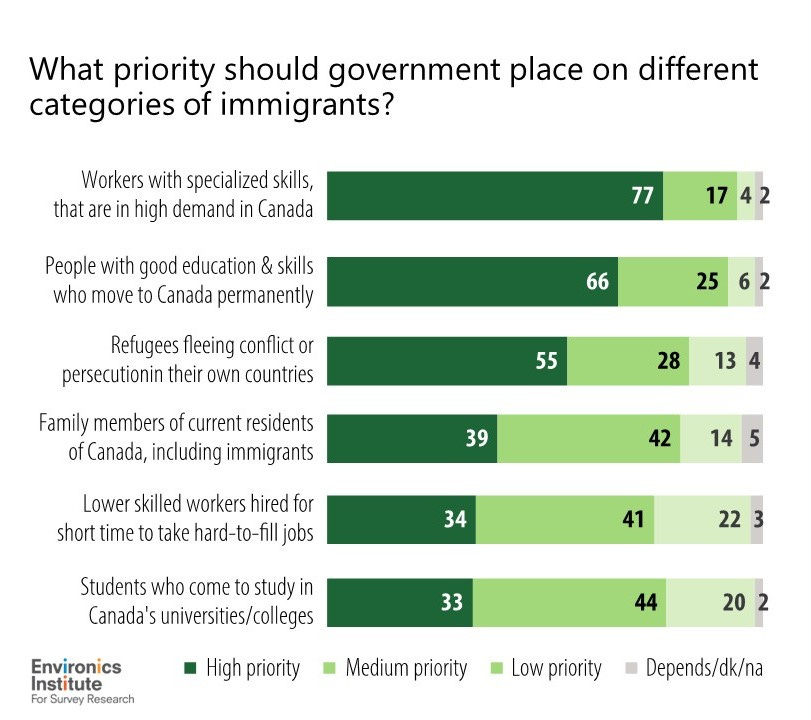
Here are the overall results:

The public is most likely to prioritize skilled workers (whether those with specialized skills in high demand, or new permanent residents arriving with a good education). This may not seem surprising, but that’s precisely the point: it’s now widely accepted that our economy needs more skilled workers than we can produce at home. Theoretically, it would have been possible for people to see highly skilled immigrants as rivals who threaten to take away the best jobs from Canadian-born workers. But this is not the case. This type of immigration is seen as a win-win and not a zero-sum scenario.

Read the full survey report

The next striking finding is that refugees are fairly high up on the list of top priorities (while not quite as popular as skilled immigrants, a majority of Canadians say that accepting refugees should be a high priority). It remains the case that many Canadians continue to value the humanitarian goals of our immigration system, and not just the economic ones.

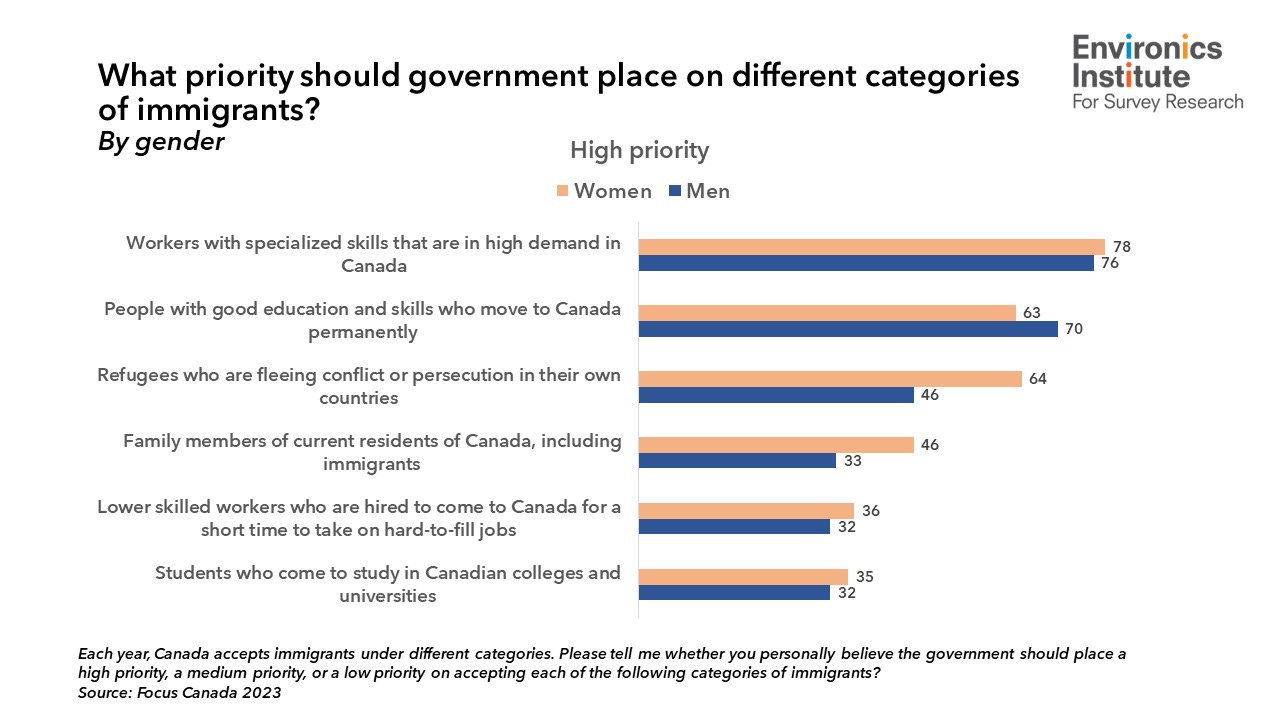
Next comes family reunification. It’s worth noting that there is a significant gender gap on both this item and the previous one about refugees. Women are significantly more likely than men to say that the government should place a high priority on bringing in family members of current residents, and accepting refugees.

Last on the list of high priorities are two types of temporary immigrants: lower-skilled workers and students – something that’s notable at a time when these categories are the ones that have seen the most unexpected increases. Personally, I was surprised to see international students at the bottom of the list; I wonder if the heads of universities and colleges are too.

So much for the high priorities; it’s just as interesting the look at the results the other way around. Relatively few Canadians think any of these six types of immigrants should actually be a low priority. The highest figures come in the cases of lower skilled temporary workers (22%) and students (20%) – but even here, only about one in five say the government should place a low priority on accepting these categories of immigrants.

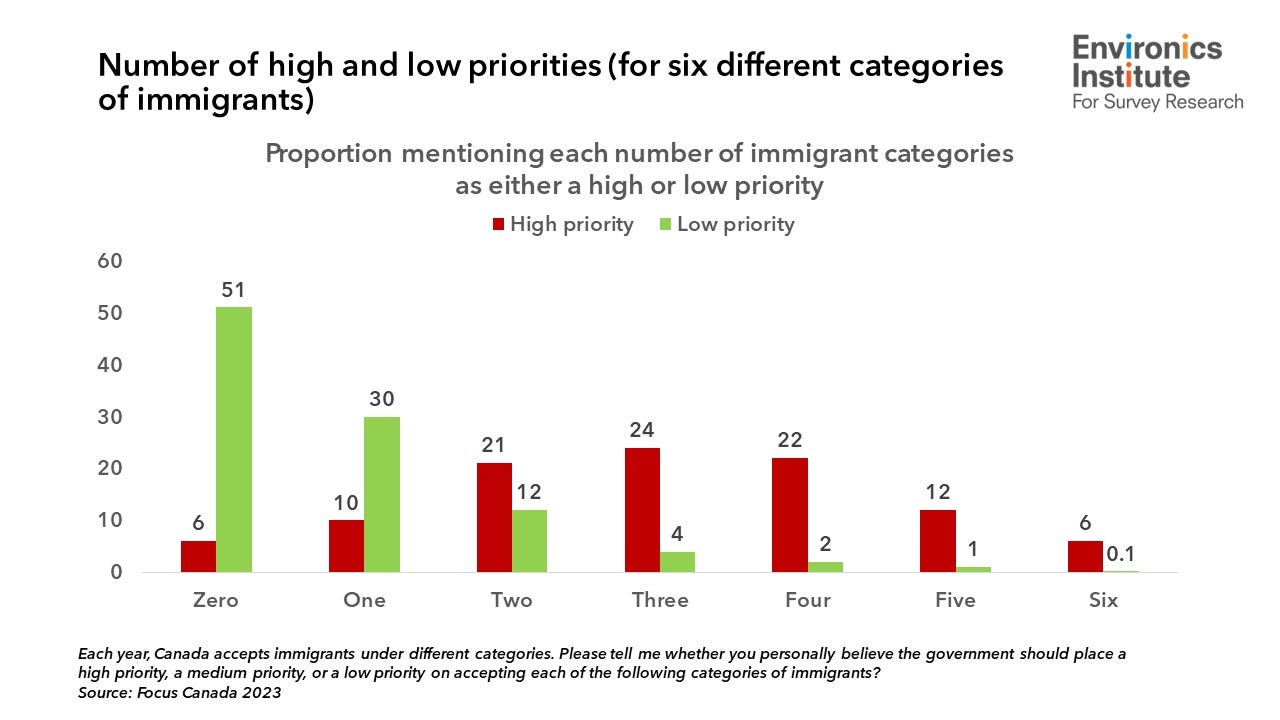
The continuing openness of Canadians to immigration becomes even more apparent if we count up how many of each of the six categories mentioned in the survey are seen as high or low priorities. The count of high priorities has a nice normal distribution: most people are in the middle (66% name two, three or four high priority types of immigrant) and relatively few people are at either end of the spectrum (16% name zero or one high priorities, and 17% name five or six).

The picture is very different when we count low priorities. One in two Canadians do not answer “low priority” for any of the six categories of immigrant. Four in five (81%) name no more than one. Only three percent list at least four of the six categories as low priorities. In a survey of 2,002 Canadians, a grand total of three people (0.1%) think all six categories should be a low priority for the government.

This is important context for interpreting the main headline from the survey, which is that there has been a big jump in the past year in the proportion of Canadians who agree there is currently too much immigration (from 27% in 2022 to 44% in 2023). This is certainly an expression of anxiety about the current state of the economy in general, and housing availability and affordability in particular. But it’s not an expression of growing opposition to the idea of Canada as a country that welcomes immigrants.

To back up this interpretation, consider the following additional findings:

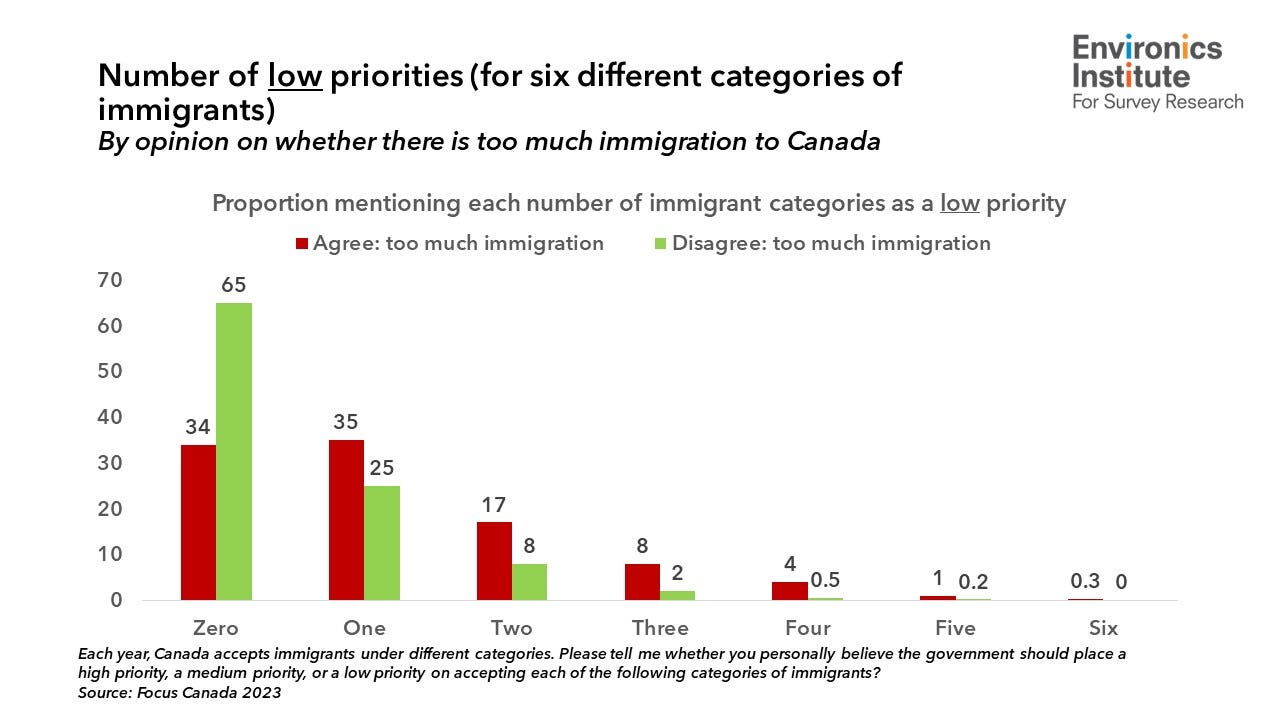
  • First, a majority of those who agree that there is too much immigration to Canada nonetheless say that the government should place a highpriority on accepting each of the two categories of skilled immigrants mentioned in the survey. 
  • Second, and more generally, 91 percent of those who agree that there is too much immigration to Canada nonetheless say that the government should place a high priority on accepting at least one of the six categories of immigrants mentioned in the survey. 
  • Finally, only 14 percent of those who agree that there is too much immigration to Canada say that the government should place a lowpriority on accepting at least three of the six categories of immigrants mentioned in the survey. 

In other words, while a lot of Canadians have concerns about the details of current immigrant policy, very few think it’s time to raise the drawbridge.

Source: Do you know what Canadians think about immigration?

Un premier observatoire sur l’immigration francophone au Canada

Small change compared to the CERC grant of close to $100 million…

Le premier observatoire en immigration francophone au Canada a été inauguré mercredi. Examinant un sujet souvent politisé, l’organisme cherchera à favoriser le développement de connaissances et à « avoir une portée sur le milieu gouvernemental, communautaire et universitaire ».

L’observatoire « contribuera aux efforts menés par le Canada pour favoriser l’accueil et l’intégration des immigrants francophones », a déclaré par voie de communiqué le ministre canadien de l’Immigration, Marc Miller, soulignant que « l’immigration francophone joue un rôle clé pour soutenir la vitalité et la croissance des communautés francophones hors Québec ».

M. Miller a également annoncé un investissement de près de 85 000 $ auprès de l’Université de l’Ontario français (UOF) pour la « mise en place » de cet observatoire, dont la cérémonie d’inauguration a eu lieu en fin d’après-midi au Centre francophone de Toronto.

« Là, on a un financement d’Immigration, Réfugiés et Citoyenneté Canada [IRCC] pour le démarrage. On espère que le financement va se poursuivre au fil des ans pour pouvoir assurer la viabilité de cette initiative », indiquait plus tôt au Devoir la professeure de l’UOF qui a mené le projet, Linda Cardinal.

Dans les 20 dernières années, plusieurs initiatives de recherche s’intéressant à l’immigration francophone se sont essoufflées par manque de financement ou de structure institutionnelle, explique-t-elle.

Les membres de l’Observatoire en immigration francophone sont encore en train d’en « confirmer » les objectifs, mais l’organisme compte notamment organiser des ateliers éducatifs, ainsi que produire et « mettre en valeur » des données, explique Mme Cardinal.

Une première activité aura lieu dès jeudi, se réjouit-elle. Il s’agit d’une « école d’automne », au cours de laquelle 25 doctorants, professeurs, représentants de groupes communautaires et fonctionnaires seront « initiés à la statistique linguistique, en particulier en matière d’immigration ». Des recherches porteront également sur la perception qu’ont les immigrants de la francophonie au Canada, ainsi que sur la « notion d’accueil ».

« Politisation » de l’immigration

L’observatoire espère aussi participer aux discussions sur la mise en oeuvre de la nouvelle politique en immigration francophone d’Ottawa. Depuis la réforme de la Loi sur les langues officielles, IRCC doit « adopter une politique en matière d’immigration francophone visant à favoriser l’épanouissement des minorités francophones au Canada, notamment en assurant le rétablissement et l’accroissement de leur poids démographique ».

C’est dans cette lignée qu’ont été présentées les nouvelles cibles d’immigration francophone hors Québec, qui passeront de 4,4 % actuellement à 6 % en 2024, 7 % en 2025, puis 8 % en 2026. Des taux « ambitieux », selon le ministre Miller, mais qui ne suffiront pas à « renverser le déclin de la francophonie », si l’on écoute la Fédération des communautés francophones et acadienne, qui réclame une hausse progressive commençant à 12 % en 2024 et allant jusqu’à 20 % en 2036.

Un sondage publié fin octobre indique toutefois que l’appui aux cibles d’immigration actuelles est en chute libre : 44 % des Canadiens affirment que « le Canada accueille trop d’immigrants », soit une croissance record de 17 points par rapport à 2022.

« Ces statistiques, c’est un portrait du moment. […] Ce qu’on entend, c’est des gens qui politisent la question de l’immigration parce qu’il y a des élections qui s’en viennent. Il y a des enjeux réels dans les services sociaux, en matière de logement, mais ces enjeux existaient avant les débats sur l’immigration », explique-t-elle.

Mais il n’y a « personne au Canada qui dit qu’il est contre l’immigration », ajoute-t-elle. « Un observatoire comme le nôtre pourrait contribuer [au débat] de façon à mieux faire comprendre la situation […] à distance de la politisation. »

Plusieurs consultations

Celle qui est aussi vice-rectrice adjointe à la recherche de l’établissement inauguré en 2021 affirme que, depuis sa création, l’UOF souhaitait faire de la question de l’immigration l’« un de ses créneaux d’excellence ».

Pour mener à bien le projet, Mme Cardinal a consulté des chercheurs afin de « connaître leurs priorités ». « L’idée, c’était d’héberger cette initiative à l’UOF, mais avec une portée pancanadienne », ajoute-t-elle. L’Université d’Ottawa, l’Université Simon Fraser, l’Université de Moncton et la Chaire d’excellence en recherche du Canada sur la migration et l’intégration, à l’Université métropolitaine de Toronto, sont ainsi des partenaires de l’observatoire.

« En recherche, il faut toujours travailler en collaboration pour avoir un impact et pour susciter l’adhésion — et aussi pour s’assurer qu’en francophonie canadienne, notamment, on crée une relève, soutient-elle. On responsabilise nos universités à l’importance du thème de l’immigration. Depuis les années 2000, l’immigration fait partie de la redéfinition même de ce qu’est la francophonie en contexte minoritaire. »

Les travaux de l’observatoire porteront surtout sur l’immigration francophone en contexte minoritaire. Or, le Québec sera « une base de comparaison très intéressante », indique Mme Cardinal. Et l’Ontario a aussi « des choses à dire au Québec, notamment sur la notion d’accueil. […] On espère que le Québec va s’intéresser à nous ».

Source: Un premier observatoire sur l’immigration francophone au Canada

Globe editorial: Canada’s prosperity problem points to a lower-wage future

Money quote:

In 1993, Canada’s real GDP per capita was 106 per cent of the OECD average. The C.D. Howe Institute forecasts that in 2024 Canada will be just 89 per cent of the average of advanced economies. Canada has also fallen compared with the United States: In 2023, this country’s GDP per capita is forecast to be less than three-quarters that of the U.S. (Those statistics are relatively generous to Canada, since the institute has adjusted them for domestic purchasing power.)

Source: Canada’s prosperity problem points to a lower-wage future