Nudging the way to better public policy

More on nudging but too much on process and number of units rather than concrete examples, both successes and failures:

In 2013, Rotman School of Management professor Dilip Soman argued governments should use a behavioural approach to design public policy. Building on the concept of “nudging” introduced by Richard Thaler and Cass Sunstein, Soman suggested this approach could lead to real policy change. Nine years later, we can see how this approach appears to be working in the design and implementation of public policies across Canada. This is why policymakers should consider using it more frequently.

The idea behind nudging is simple. By creating a “choice architecture” – simple, beneficial options that people can opt in or out of – policymakers can improve access to public services and help people achieve their goals in life. Nudging makes it easier for people to get what they need from government without taxing their time and energy.

Key to this approach is finding small tweaks with big impact, backed by scientific methods like randomized controlled trials (RCTs). Nudging helps policymakers learn what works and what doesn’t.

It’s an easy idea to get behind. Too often, citizens find that interacting with government challenges their patience and sucks up their time. Renewing a driver’s licence should take a few clicks on a website ­– not hours in line at an administrative office staring at walls painted “greige.”

Many Canadians might wonder if service delivery could be improved. It can – and nudging is a mechanism that can lead to improvement. In recent years, governments have shown their ability to improve the service experience, reduce burden on citizens and increase uptake of important programs.

Consider organ donation. Survey data shows that 90 per cent of Canadians support organ donation. Yet uptake is dismally low for this critical, life-saving act – just 32 per cent of Canadians are registered donors. In Ontario, a complicated enrollment process meant that many residents didn’t know how to sign up, or simply forgot to do it. In 2016, Ontario’s “nudge unit” worked with Service Ontario to insert a prompt in the health card renewal process. The nudge considerably enhanced uptake.

The benefits are clear, but the politics aren’t always so simple. At its best, nudging can help citizens access public services. This is especially important for those who have been marginalized or excluded by government.

But concerns about the ethics of nudging are well documented, with particular attention to the idea that well-intentioned interventions could give way to outright manipulation. Further, some of the issues that nudging touches can be viewed as political such as organ donation, vaccine uptake and recruitment for the Canadian Armed Forces.

In recent years, nudging has given way to a more structured approach: the application of behavioural insights (BI). BI relies on expertise in public policy and behavioural science and recognizes that data-driven experimentation isn’t always the first-best option. If nudging improves policy implementation, BI goes that extra step to include policy design – doing the work in advance to ensure citizens can access services without wasting their time and energy.

One strength of BI is its transparency. It makes clear assumptions, and its proponents are committed to testing those assumptions through rigorous evaluation. Earlier this year, BI practitioners collaborated with researchers from Berkeley. Together, they published the results of 126 studies covering 23-million individuals. In a world of scientific uncertainty and mixed results, they found strong evidence that behaviorally informed public policy can work. Overall, nudge interventions improved target behaviours by eight per cent.

In real terms, this results in social and economic benefits. When it succeeds, BI can help citizens avoid feeling regret from making under-informed or myopic decisions based on intuition and emotion, rather than deliberation and reasoned analysis. When it fails, it provides quality evidence for policymakers to find alternatives – and quickly.

What does BI in Canada look like now? Since Soman’s piece was published in Policy Options in 2013, the federal government has introduced the Impact and Innovation Unit (IIU) in the Privy Council Office. The interdisciplinary team consists of policy experts with a variety of educational backgrounds ranging from education to neuroscience. The stated goal of is to reduce barriers to innovation within government and to “leverage the benefits of impact measurement to support evidence-based decision-making.”

While the IIU works in tandem with other departments on a contract basis to pilot and implement RCTs around discrete policy problems, small BI enclaves have also emerged in other departments such as Immigration, Refugees and Citizenship Canada and Canada Revenue Agency. The IIU also supports a broader agenda around policy innovation and responsiveness with projects such as the Impact Canada Initiative and COVID-19 snapshot monitoring (COSMO).

At the provincial level, the governments of British Columbia and Ontario have also established BI units – the former within the B.C. Public Service Agency and the latter in the Treasury Board Secretariat. Similar work (though not a standalone unit) was found in Alberta’s CoLab (though the unit was dismantled in 2020).

Together, provincial and federal ministries have reported 59 BI trials (see Figure 1) with many more in the works. The majority (39 out of 59) of the trials fall into one of three policy areas: government operations, health, or social welfare.

Cities have also taken up the challenge with projects like City Studio (Vancouver) or Civic Innovation (Toronto) that focus on improvements to service delivery and increasing citizen participation.

Governments aren’t the only actors in the BI game either. The Canadian Behavioural Insights Team (BIT), established in 2014, emerged from the original “Nudge Unit” in the British government, which was founded in the Cabinet Office in 2010. It uses a consultancy model to support government and the not-for-profit sector to support BI policy interventions.

BIT is a major player. It has offered advice and conducted hundreds of RCTs in policy domains ranging from health and social policy to natural resources and government operations. In 2019, BIT opened its first Canadian office, headquartered in Toronto. Since then, BIT Canada has helped lead pathbreaking work on tax benefit claimsemployment services and other pressing issues.

One of the interesting features of BI in Canada is the collaborative approach embedded in BI units. Not only is the work indicative of the many cross-cutting relationships across government, but it highlights the ability of government and academia to form meaningful partnerships. They bring together a variety of financial and human resources to drive evidence-based policy change

Chief among them is the relationships BI units have formed with academics. They include the Behavioural Economics in Action at Rotman and the Decision Insights for Business and Societyteams.

Looking at the context of nudging in present-day policymaking, it appears we may have arrived at a new equilibrium. Some were skeptical about nudging. There are concerns that it’s threatened to overtake policymaking with novel, experimental methods or that it would be used unethically to trick people or undermine their self-interest. There are also concerns that it would somehow cheapen or gamify policy development.

However, BI now occupies a useful, if modest, place among policymakers’ tools. We consider this success not just in the number of BI units, but in its incremental application across policy areas where the tool is well positioned to improve policy design and implementation.

As Soman noted, the behavioural approach to public policy is reflective of a set of guiding principles for policymakers even if a “grand unified theory” is not yet on the books. But perhaps one is not necessary. Nudging has grown – perhaps not prolifically – but it now appears to be an accepted tool to promote policy compliance and enhance policy uptake.

Source: Nudging the way to better public policy

Paul: Ninety Years Ago, This Book Tried to Warn Us

Lessons and warnings from history:

The power of some classic realist novels, like Zola’s “Germinal” and Steinbeck’s “The Grapes of Wrath,” lies in the way they wholly capture their era. Others endure because they continue to feel remarkably prescient, like Eliot’s “Middlemarch” and William Dean Howells’s “A Hazard of New Fortunes,” which took on the perils of surviving financially in Gilded Age New York.

Then there are novels that are simultaneously very much of their time and yet almost clairvoyant about the future.

Lion Feuchtwanger’s 1933 novel “The Oppermanns,” which is being rereleased this month with a revised translation of James Cleugh’s original by the Pulitzer Prize-winning novelist Joshua Cohen, is one of those books. It’s been nearly 90 years since its publication, but reading it now is like staring into the worst of next week. It’s all there: The ways in which a country can lose its grip on the truth. The ways in which tribalism — referred to in “The Oppermanns” as “anthropological and zoological nonsense” — is easily roused to demonize others. The ways in which warring factions can be abetted by the media and accepted by a credulous populace.

The novel reads like a five-alarm fire because it was written that way, over a mere nine months, and published shortly after Hitler became chancellor, only lightly fictionalizing events as they occurred in real time. In “Buddenbrooks” fashion, the story follows the declining fortunes and trials of a family, the German Jewish Oppermanns, prosperous merchants and professionals, as they scramble to hold on while fascism takes hold of their country. It’s a book that fairly trembles with foreboding and almost aches with sorrow.

“How do you know when to sound the alarm?” asked Cohen, who also wrote an introduction to the new edition, when I reached him by phone on book tour in Italy. It’s easy to slam someone for overreacting, he explained. But we would do well to remember the instances in which a strong reaction is justified: “There’s an enormous bravery that comes with writing about the present, an enormous risk and an enormous thrill. You have to ask yourself: ‘What if I’m wrong?’ And also: ‘What if I’m right?’”

Feuchtwanger was willing to place that bet, working off fury as well as considerable access to journalistic, governmental and undercover sources within Germany. But unlike much overtly political fiction, his book is imbued with all the humor, humanity and sweep of a 19th-century epic. The result, Fred T. March noted in his 1934 review in The Times, “is addressed to the German people, who will not be allowed to read it, urging them to open their eyes. And it is addressed to the world outside bearing the message, ‘Wake up! The barbarians are upon us.’”

Consider the misbegotten assumptions Feuchtwanger took on then that continue to threaten today:

Populist ignorance cannot prevail in an enlightened world. Just as New Yorkers scoffed at the idea that Donald Trump, lead buffoon of the tabloid ’80s, could be taken seriously as a presidential candidate, so do the bourgeois intelligentsia of “The Oppermanns” chortle over “Mein Kampf,” a work they find impossible to reckon with in the land of Goethe: “A nation that had concerned itself for centuries so intensively with books, such as those they saw around them, could never allow itself to be deceived by the nonsense in the ‘Protocols’ and in ‘Mein Kampf.’”

Direct engagement confers legitimacy. When Edgar Oppermann, a doctor, faces antisemitic attacks in the newspapers, his boss advises silence. “The whole of politics is nothing but a pigsty. Unless one cannot help doing otherwise, one should simply ignore them. That’s what annoys the pigsty crowd most.” To confront the forces of illiberalism is only to sully oneself, Edgar believes. Those in the press who propagate such lies “ought to be put into an asylum, not brought before a court of law.”

Technology will out disinformation. At each turn, the Oppermanns and their milieu have trouble believing that propaganda will take hold. “How could they expect to get away with such a monstrous, clumsy lie?” Gustav Oppermannthe central figure in the novel, asks himself after the Nazis blame the burning of the Reichstag on communists. “Nero might have put over such cheap stuff in burning Rome. But things like that were impossible today, in the era of the telephone and printing press.” Of course, the era of Twitter and TikTok has shown that advances in technology still amplify falsehoods.

If you ignore it, it will go away. In the novel, two bourgeois Germans foresee a grim future but fall back on complacency. One describes the first world war as “only a curtain-raiser” with “a century of destruction” to follow, predicting, as he puts it, “a military power beyond conception, a judiciary power with severe, restrictive laws and a school system to educate senseless brutes in the ecstasy of self-sacrifice.” His companion merely replies: “All right, if that’s your opinion. But perhaps you’ll have another cognac and a cigar before it happens.”

It’s up to the next generation. The novel’s most tragic figure is the teenage Berthold Oppermann, a student guilty only by ethnicity and familial association. Berated by a Nazi schoolteacher for delivering an allegedly anti-German paper, Berthold says he is “a good German” and refuses to apologize. “You are a good German, are you?” his Nazi teacher sneers. “Well, will you be so good as to leave it to others to decide who is a good German and who is not?” While classrooms today are a far cry from those in Nazi-era Germany, one needn’t reach far for contemporary parallels, with students increasingly operating in an atmosphere of fear and conformity — of their peers, depending on location, on the right or the left — while the adults too often abdicate responsibility, whether out of complicity or fear.

The situation was inevitable. In the Oppermanns’ world, escalating problems are viewed as uniquely German, unique to their time and to a particular regime. “Our opponents have one tremendous advantage over us; their absolute lack of fairness,” explains a lawyer at one point. “That is the very reason why they are in power today. They have always employed such primitive methods that the rest of us simply did not believe them possible, for they would not have been possible in any other country.”

Wrong again.

As for Feuchtwanger, the same year that “The Oppermanns” was published, the German Jewish author was stripped of his citizenship and had his property in Berlin seized and his books burned. He was banned from ever publishing in Germany again.

By the time the book was published, Feuchtwanger had already settled in France, where he was later imprisoned following the German invasion. He ultimately escaped to the United States, where he lived for the last 17 years of his life.

Is this still the same country where he’d find refuge?

Source: Ninety Years Ago, This Book Tried to Warn Us

Trichur: Why Danby’s CEO is worried about refugee sponsorship as Canada teeters toward a recession

Of note, including the warning regarding the impact of a possible economic slump:

At a time when business leaders are bracing for a recession, Jim Estill is concerned about more than just his company’s bottom line.

The chief executive officer of Danby Appliances, a Guelph, Ont.-based manufacturer and distributor of household appliances, is also worried that an economic slump will further complicate efforts to sponsor and settle refugees.

Not only is the Canadian economy slowing, it has shed jobs for three consecutive months. Companies are still hiring, but the unemployment rate has climbed to 5.4 per cent.

That’s why Mr. Estill – who in conjunction with Danby, has sponsored hundreds of refugees since 2015 – is watching the cooling labour market with trepidation. After helping people from all over the world – including Syria, Congo, Myanmar, Venezuela, Afghanistan and Ukraine – he knows a recession will make it harder for refugees to find work and start new lives in Canada.

“If we end up with an unemployment rate that was higher, I could see people in the general population resenting refugees‚” he said during an interview at The Globe and Mail’s Growth Camp event for Canada’s top-growing companies.

As Mr. Estill points out, he and others faced little societal resistance to bringing in refugees when this country appeared to be swimming in unfilled jobs.

“Nobody was coming and taking your job. Because, okay, did you want the job at McDonald’s? No, there’s no lineup to take the job,” Mr. Estill said.

But social sentiments can shift during tougher economic times.

Sure, some of it is rooted in racism – but those people would have a problem with refugees even if GDP growth was going gangbusters.

Other folks, though, worry about the availability of jobs and affordable housing for their relatives and friends in a sputtering economy. That means a widely expected recession is shaping up to be a critical moment for refugee sponsorship and settlement in Canada.

History teaches us that newcomers often struggle to find and keep jobs during economic contractions. The COVID-19 downturn, for instance, disproportionately affected immigrant women in low-wage jobs.

“Immigrants often have more negative labour market outcomes during recessions than those born domestically,” a 2022 study by Statistics Canada states. It also notes that entering the labour market during a recession can result in a “scarring effect” that hurts immigrants’ earnings for years.

There’s not much research that focuses on refugees. But a 2019 Statistics Canada studydid track outcomes for 830,000 refugees from 13 countries.

Although it found “substantial” employment rates five years after their arrival, it also concluded their earnings varied based on their countries of origin.

“Ten years after entering Canada, the refugee groups with the highest earnings (i.e., from the former Yugoslavia, Poland and Colombia) earned roughly double what those with the lowest earnings did (i.e., from Somalia, Afghanistan, Pakistan and China),” the study said.

separate Statscan paper, published in 2020, found that privately sponsored refugees – such as those helped by Mr. Estill – tend to have higher employment rates and earnings than government-assisted refugees – even if they have lower levels of education.

Although Mr. Estill does not permanently employ every adult he sponsors, Danby’s 90-day program provides them with short-term work, English lessons, assistance with résumé writing and finding job coaches.

”It’s not government money that is that is paying for these people, it’s private money. It’s my money that’s paying to settle them, so it doesn’t cost taxpayers,” Mr. Estill said.

That underscores the importance of private refugee sponsorships, including those undertaken by individual entrepreneurs and corporations.

Danby is not alone in its efforts to help displaced people.

Companies including Alimentation Couche-Tard Inc., National Bank of Canada, Bombardier Inc., KPMG Canada and Stingray Group Inc. have committed to sponsoring Ukrainian refugees displaced by the Russian invasion – but so many others also need help.

Mr. Estill, for one, is calling on the federal government to allow more refugees to enter the country.

Canada was the first country to introduce a private sponsorship program more than 40 years ago. But even so, getting privately sponsored refugees into the country can take years, which is why Mr. Estill advises other executives the program will not address their company’s short-term hiring needs.

He’s right to encourage others to think about the long-term benefits to Canada.

After all, some former refugees, such as Rola Dagher, a Lebanese-Canadian who is currently global channel chief at Dell Technologies, have gone on to make great strides in the business world. She came to Canada via Cyprus.

That brings us back to Corporate Canada. Which companies will be next to offer refugees a lifeline during these uncertain times?

“My problems are very first-world problems,” Mr. Estill explains. “It’s that we might be going into a recession. Oh no, my sales might not be as high as I’d like them to be. But they’re first-world problems.”

Thank you, sir. Well said.

Source: Why Danby’s CEO is worried about refugee sponsorship as Canada teeters toward a recession

Canada’s Immigration Problem: Not Enough Homes for Newcomers

A classic example of immigration policy failing to account for its impact on other sectors. IRCC’s annual report to Parliament on immigration is largely silent on these. Externalities in economist jargon, intersectionality in social science jargon.

Canada’s bid to attract a record number of immigrants, required to fill job openings and drive economic growth, has run into a bottleneck: There aren’t enough residences to accommodate these newcomers.

Immigration into Canada is on pace to hit a record high in 2022 of 431,000, following the entry of about 405,000 the previous year, and the country is targeting entry of another 900,000 newcomers in 2023 and 2024 combined. Because of immigration, Canada’s population over the past half-decade grew at almost twice the pace of its Group of Seven peers, Statistics Canada said.

The aggressive intake, though, has had repercussions for Canada’s housing market, which among G-7 countries has the lowest number of dwellings per capita, economists at Bank of Nova Scotia calculate.

Population growth, a shortage of housing stock and low interest rates helped push up house prices in Canada’s biggest centers, prompting would-be buyers to look farther afield and drive up prices in smaller, far-flung communities unaccustomed to housing booms. The cost of a single-family detached dwelling has doubled over the past decade, according to data from the Canadian Real Estate Association. Data collected by the Federal Reserve Bank of Dallas indicate Canada had, until recently, recorded some of the fastest growth in house prices among major developed economies.

And the pressure from immigration on housing keeps coming. In the second quarter, Canada recorded the fastest population growth over a three-month period since 1949, when Newfoundland and Labrador joined the country as its 10th province. Immigration accounted for 95% of that growth. Overall, Canada’s population sits at 38.9 million, up from 34.7 million a decade ago, with immigrants representing more than one-fifth of the populace.

“We can’t keep up with the amount of immigration coming to the country,” said Christopher Alexander, president of the Canadian unit of Re/Max Holdings Inc., the global real-estate listing company with 140,000 agents worldwide.

A rush is now under way among Canadian officials to build housing units and ease supply constraints. “There was a lack of forward thinking, lack of planning on the housing side, on what the actual [housing] need was going to be,” said Abe Oudshoorn, a professor at Western University’s nursing school in London, Ontario, and leader of a research group that since 2016 tracked the arrival of 51 immigrant families into Canada and their path to acquiring housing. He said the families his research group tracked remain stuck in housing that is either too costly or too small for their growing families.

Kanishka Noorzai and his wife, his four sons, his parents and his younger sister arrived here in February, from Afghanistan via Albania, and settled in the Waterloo region, an urban center of a half-million people west of Toronto. After a monthslong search that took him to apartments, townhouses and other domiciles, he found a three-bedroom bungalow—at a cost of nearly $3,000 a month for a one-year lease, or “really, really above our budget,” said Mr. Noorzai, 43 years old. He is currently working part time as a security guard but is seeking full-time hours.

“I really was surprised,” he said, “because I did not think it would be that difficult to find a house in Canada. It was a nightmare.” He has heard from friends who fled Afghanistan to the U.S., where they found reasonably priced housing. The bungalow he settled on isn’t ideal, Mr. Noorzai said, “but at least it’s better than a hotel,” where a local immigration agency had put his family up during their housing search.

Real-estate agents, home builders and economists say housing starts—which last year hit their highest level in over four decades—have to accelerate further to deal with immigration-fueled demand, against a backdrop of higher material costs and a labor shortage in the construction industry.

Mike Moffatt, senior policy director at the University of Ottawa’s Smart Prosperity Institute, a think tank, said one reason housing starts lagged is because regional and local officials underestimated population growth and overestimated the amount of housing stock. “Our zoning laws were set for a slow-population-growth country. When our population started growing, our regulatory environment didn’t adapt to that reality,” he added.

The national housing agency, Canada Mortgage and Housing Corp., said the country will require 3.5 million additional homes above current home-building projections by 2030 to restore housing affordability.

“It takes multiple years to increase housing supply to accommodate the sudden increase in immigration,” said Aled ab Iorwerth, CMHC’s deputy chief economist.

Representatives for Canada’s immigration and housing ministers said officials work closely with provincial and municipal governments in setting annual immigration targets, and the government has provided financing to help regions deal with immigrant-fueled housing pressures.

“Newcomers play a crucial role in the future of our communities and our economy, and we do everything we can to set them up for success,” the spokespeople said.

Canada intends to spend 10 billion Canadian dollars, or the equivalent of about $7.3 billion, to help double home construction over the next decade. Some of the money will be used to encourage municipalities to change zoning laws. Ottawa also wants to tie access to funding for municipalities for services such as public transit and wastewater management to a pledge to increase housing supply. The city of Toronto, a magnet for immigrants, recently allowed the building of self-contained, residential dwellings in backyards, or so-called garden suites, to help alleviate the housing crunch.

Hefty Bank of Canada rate increases this year have triggered a sharp decline in real-estate activity and a deceleration in annual house-price growth, though economists say immigration, and a trend toward smaller households as the population ages, will put a floor on the current price drop.

As for Canada’s rental market, it is tightening in major urban centers, reflecting immigration trends and house prices still at elevated levels. The average rent for all property types across Canada in August rose 11.1% from a year ago to nearly C$2,000, or the highest level in three years, according to data from Rentals.ca.

“Immigration has to be throwing gasoline on the on-fire rental market,” said Scott Ingram, a Toronto-based real-estate agent. Annual rent increases in Toronto and its suburbs and exurbs range from 10% to 26%, said Rentals.ca.

The Toronto Region Board of Trade calculates that one-third of Canada’s immigrants settle in Toronto, the country’s largest metropolitan area with 6.2 million residents. For every two immigrants who arrive in Toronto, at least one resident leaves because of high housing costs and limited supply, said Craig Ruttan, the board’s policy director.

“We’re sort of in a Catch-22. We need the immigration because of the labor shortages and the need for new workers,” Mr. Ruttan said. “At the same time, we’re hearing and seeing the shortage in housing.”

Benjamin Tal, an economist at CIBC Capital Markets who researches real-estate trends, said he is worried Canada lacks the labor capacity to build the required housing. Canada’s focus has been in attracting educated, high-skilled immigrants, he said. “We need to rethink immigration in the sense we also need a segment of newcomers to be lower skilled—because that’s what the shortage is.”

The most recent Statistics Canada data indicate the construction sector had roughly 82,000 vacancies, for a vacancy rate of 6.5%, or above the national 5.4% average. BuildForce Canada, labor-market data provider, anticipates nearly a quarter of home-building workers will retire by the end of 2031, requiring companies to recruit over 100,000 new workers to fill the gap.

“The competition for workers is going to be incredibly intense,” said Bill Ferreira, BuildForce’s executive director.

Source: Canada’s Immigration Problem: Not Enough Homes for Newcomers

Canada to temporarily allow international students to work more hours due to labour shortage

More and more, study permits are becoming effectively work permits, and the education objectives are being diminished:

Immigration Minister Sean Fraser says Canada will temporarily allow international students to work more than 20 hours a week to help address ongoing labour shortages.

Speaking at a coffee shop in Ottawa this morning, Fraser says the changes will start on Nov. 15 and be in effect until the end of 2023.

The labour market remains exceptionally tight, with nearly one million job vacancies reported in the second quarter of 2022.

Fraser also announced a pilot program to help automate the application process for students to extend their study permits.

That will allow for some applications to be automatically approved, but the new process will not automatically reject claims.

Fraser says the pilot is aimed at reducing immigration backlogs and freeing up officers to work on more complex applications.

Source: Canada to temporarily allow international students to work more hours due to labour shortage

Ottawa working on program to regularize status of 500,000 immigrants

Hopefully, the government is not only consulting with advocacy groups (CBA is the only one quoted with some concerns):

The federal government is aiming to create a program that will provide a path to permanent residency for up to 500,000 immigrants who are working in Canada but do not have official standing.

The program would have unprecedented scope and apply to people whose visa or work permits had expired, and to those whose refugee applications may have been denied or blocked due to a moratorium on deportations to their country, according to Radio-Canada.

“We’re looking into ways to regularize people who live in Canada with a precarious status,” a government source, speaking on condition of anonymity, told Radio-Canada.

Up to 500,000 people could be eligible, according to the source, who was not authorized to speak publicly on the matter.

In his mandate letter to Immigration Minister Sean Fraser late last year, Prime Minister Justin Trudeau asked Fraser to “further explore ways of regularizing status for undocumented workers who are contributing to Canadian communities.”

Immigration Ministry spokesperson Rémi Larivière confirmed that work to complete that mandate “is underway,” and that the ministry is consulting with university researchers, experts and industry advocates.

Ministry officers have approached several advocacy groups in recent weeks and over the summer to consult them on the program, Larivière said. Potential criteria and a launch date are still unknown.

“We’re hoping for an inclusive program that will help many people, but it’s still vague,” said Hady Anne, a spokesperson for the Montreal-based Solidarity Without Borders.

While there have been programs to regularize the status of immigrant groups before, none have included so many people, says Rivka Augenfeld, a lifelong refugee advocate and the former president the Table de concertation des organismes au service des personnes réfugiées et immigrantes, a working table of Quebec immigration organizations

“It’s never been seen,” Augenfeld said of the forthcoming program’s expected scope. But she warned that for it to be effective, the program will need “the will of a good minister as well as the prime minister’s support.”

Temporary workers and asylum seekers would not be able to apply — including the thousands who have crossed at Roxham Road in Lacolle, Que., an unofficial crossing point increasingly popular among migrants entering Canada from the United States.

There is a large backlog in processing asylum applications, meaning many people wait years before even having a chance to tell their story before an Immigration and Refugee Board judge.

Lisa Middlemiss, the president of the Canadian Bar Association, says that while the new program would be a positive step for people with precarious status who’ve lived and worked in the country for years, it could appear unfair to migrants who have temporary status in Canada without the possibility of obtaining permanent residency.

“It’s ambitious and interesting, but it could generate a lot of frustrations,” Middlemiss said.

Larivière, the ministry spokesperson, said Ottawa would “continue to support inclusive immigration programs that meet Canada’s economic needs and fuel our growth.”

Would Quebec buy in?

Advocates such as Augenfeld and Anne fear Quebec’s government could intervene to limit the program within the province.

During the pandemic, when the federal government created a program allowing asylum seekers working in health care to apply for permanent residency, Premier François Legault’s government objected to expanding the criteria to workers who did not directly care for patients, such as cooking staff and cleaners.

The move excluded thousands and was strongly condemned by immigration advocates.

In the spring of 2021, Legault also declined to participate in another federal program offering essential workers and graduates a new pathway to permanent residency.

Legault was re-elected on Monday with a resounding majority of 90 out of 125 seats in the National Assembly.

He came under fire leading up to the election after he associated immigration with violence and extremism and later said it would a “bit suicidal” for Quebec to increase its immigration levels, insisting that accepting more immigrants entails a threat to the French language.

“We’re worried Quebec will complicate things,” said Anne of Solidarity Against Borders.

Augenfeld also raised the possibility that Quebec could “throw a wrench” into the plan for immigrants in the province.

Because the program is expected to include people from countries for which Canada has moratoriums on deportations, Haitian nationals, largely based in Quebec, could qualify.

Frantz André, who has helped hundreds of Haitians apply for asylum in the province, hopes Legault will be more open this time around.

“We’re hoping he’ll be more generous,” André said. “These people have been living in system that is broken for too long. They’ve demonstrated that they are real citizens.”

Reached by Radio-Canada, the Quebec premier’s office declined to answer questions on the topic.

“We’ve had no information from the federal government on the subject,” a spokesperson said.

Source: Ottawa working on program to regularize status of 500,000 immigrants

IRCC Settlement Services Statistics 2018-2022 to date

I recently received settlement service data from IRCC (open data tables date from 2019). Some highlights below.

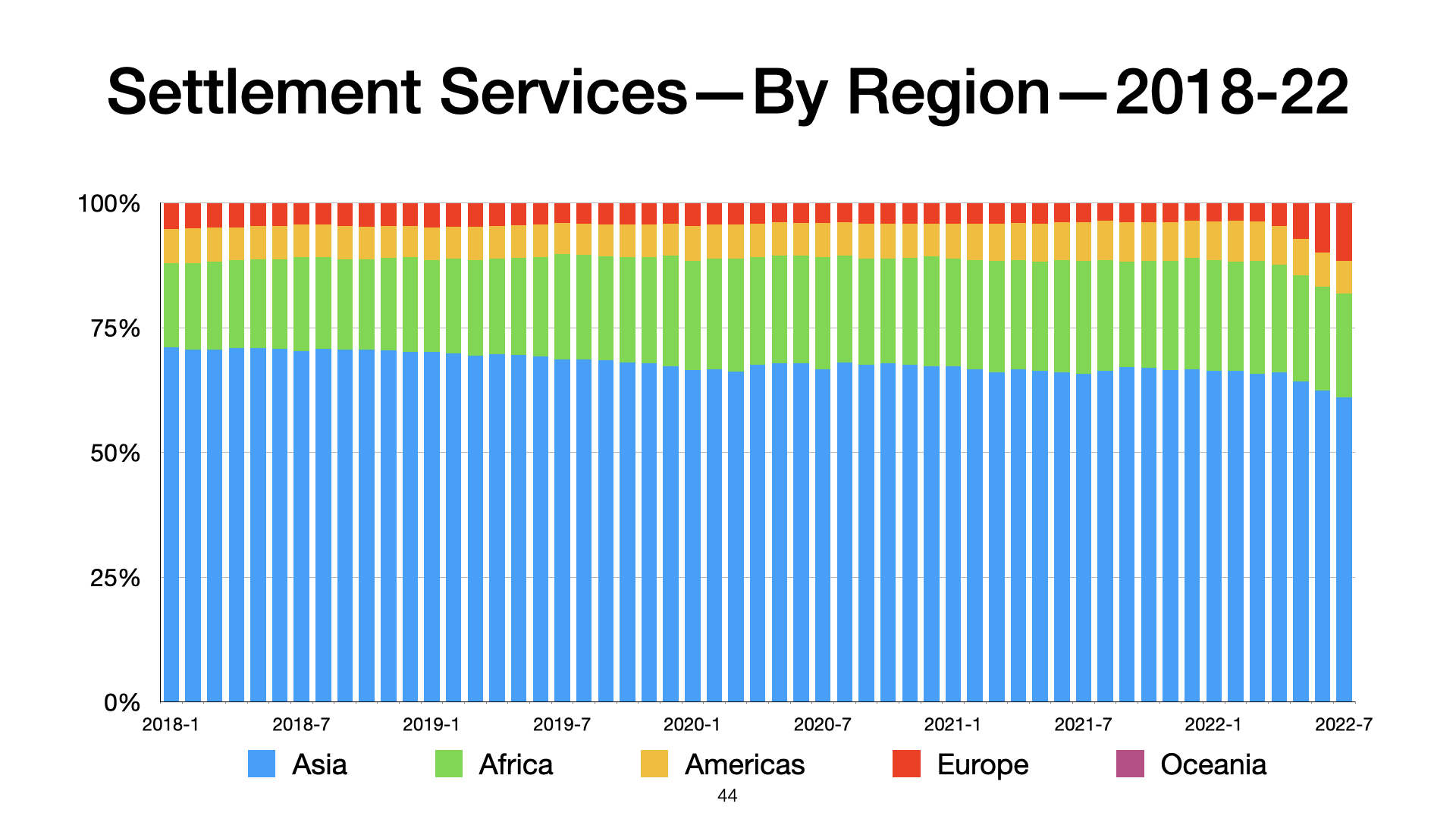
Starting with the monthly data by service type, the effect of COVID can clearly be seen with levels having largely caught up with the pre-pandemic period, albeit during higher immigration levels.

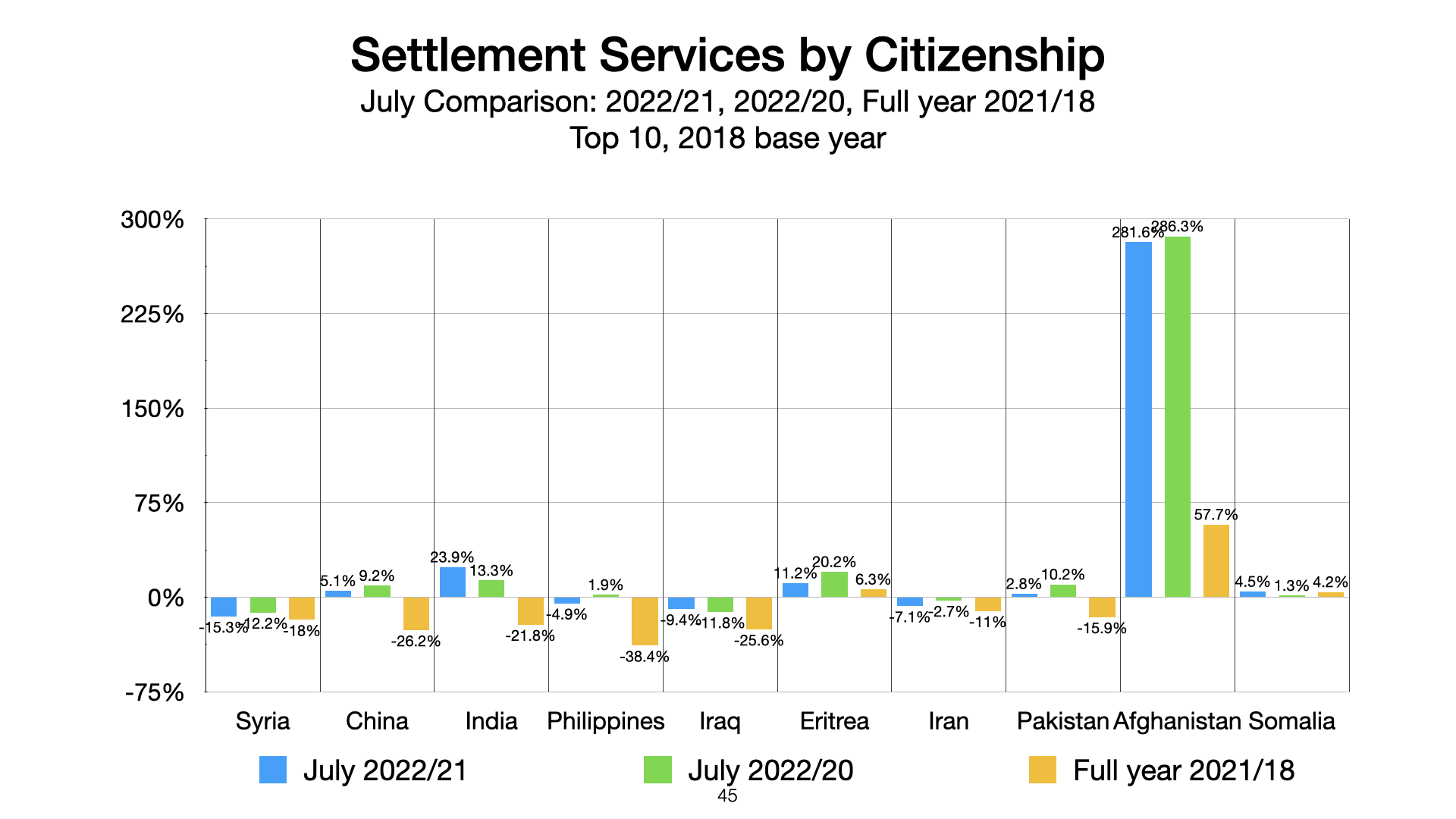
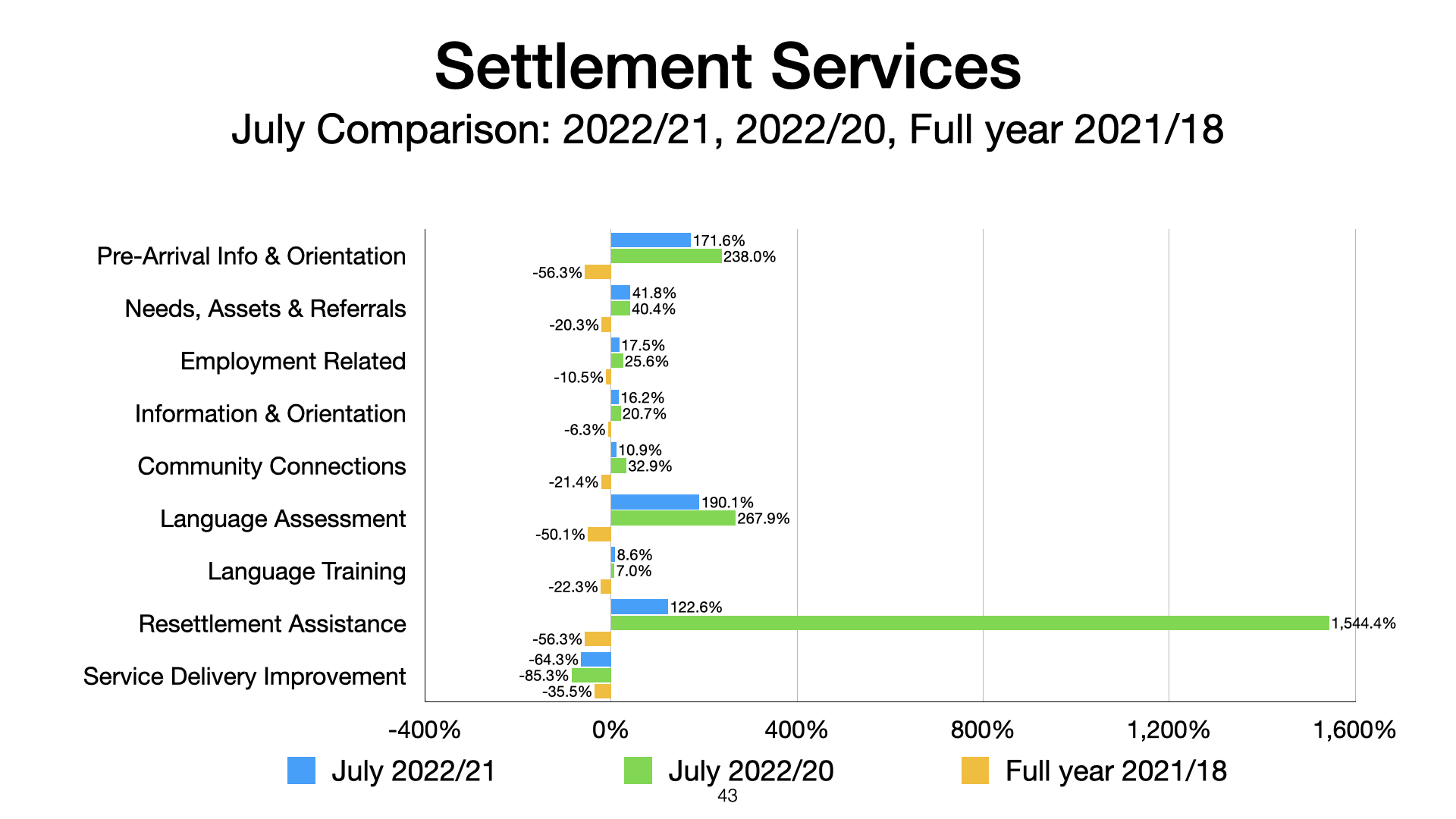
The second chart compares the current July 2022 period with July 2021 and July 2020 periods, along with full-year 2021 with full year 2018, highlighting the increase on a monthly basis and the overall decrease compared to pre-pandemic levels.

Again, given that immigration has increased significantly since 2018, this understates the decline from 2018.

While the regional breakdown has generally been fairly stable, the recent increase in the share of European-origin users of settlement services reflects increased Ukrainian users while the decline in Asia reflects declines from Syria, China, India and Afghanistan.

Of the top 10 countries, Afghan users have increased the most following the Taliban takeover and consequent refugees. Ukrainian users, not shown, increased about 10 fold following the Russian war and consequent migration flows.

The last chart compares users by province with Alberta showing the greatest monthly increases and Atlantic Canada the only region showing an increase compared to 2018.

New online immigration system’s many glitches are putting applicants’ futures at risk, say critics

Ouch. Hopefully just teething pains:

Having a tough time logging into your immigration application portal? Running out of space to fill out your information? Failing to upload a document because it’s oversized, or finding you can’t examine the files you just uploaded?

These are some examples of the frustrations that immigration applicants and lawyers say they have encountered in filing applications through the federal government’s online portals, as Ottawa forges ahead trying to modernize and digitize its antiquated system.

On Sept. 23, the immigration department kicked off its transition to mandatory electronic applications for most permanent-resident programs; people can no longer submit paper applications unless they are exempted due to an accessibility issue. However, some of the technical headaches predate that switch.

The stakes are high. A flawed application can be sent back months later for missing documents, omitted information or missed deadlines — delaying and jeopardizing a migrant’s chances for permanent residence.

Canadian immigration lawyers are urging Immigration Minister Sean Fraser to roll back the change and continue to accept paper applications at least until the system is perfected or proper technical support is put in place to assist users who need help.

“The government is … moving very quickly and the technology has not kept the pace,” said Lisa Middlemiss, chair of the Canadian Bar Association’s immigration law section, who spoke to the Star in her personal capacity.

“The online PR (permanent resident) portal and online PR representative portal are fraught with technical glitches. And these glitches impede counsel or applicants from submitting their applications.”

The COVID-19 pandemic has greatly hampered Canada’s capacity to process immigration applications because officials had to work from home, with limited access to traditional paper files and documents.

As of the end of July, there were 2.4 million immigration applications in the system, 1.3 million of which have already exceeded the standard wait times.

In response to surging backlogs, Fraser’s department ramped up the effort to expand its online applications beyond its temporary immigration programs (visitor visas, study permits, work permits) and what’s known as Express Entry, a management system to process permanent residence for selected skilled immigrants.

Last year, officials soft-launched several new online portals to accept electronic applications for a string of permanent-residence programs for family reunification and skilled workers. The government is spending $428.9 million over five years to deliver a new, departmentwide digital platform — but online applications remained optional until now.

Immigration department spokesperson Isabelle Dubois said officials have taken the necessary time to ensure the successful transition to online applications by thoroughly testing the platform, training employees and deploying it in a phased approach. A small-scale controlled group of applicants was used to test, adapt and improve the user experience before expanding it to a wider audience.

“Checks and balances were in place to make sure that any issues are identified and fixed before the system is rolled out more broadly,” said Dubois, adding that officials also closely monitor performance to avoid any system crashes.

She said there has been only one outage impacting clients, in June 2022, since the launch of the permanent residence portal.

Officials did identify an issue with the portal for authorized paid representatives, which prevented some representatives from receiving a confirmation email after submitting a payment and application, an issue Dubois said the department is trying to fix.

Ottawa immigration lawyer Tamara Mosher-Kuczer said some of the technical issues preceded the new portals but they have multiplied because now every application must be done online. Despite the department’s efforts to assist applicants, the online guidance for users is confusing to say the least, she said.

For instance, there are online forms that one has to actually fill out within the portal, and there are regular paper forms. However, the new guidelines say that those regular paper forms must now be signed digitally (using an encrypted and authenticated electronic fingerprint created by the signer).

“They say they must be signed in different places electronically, but they don’t exist on the form. On one of the forms, it says, ‘sign it digitally and type your name here.’ The instruction is on the form and not in the guide,” said Mosher-Kuczer.

“There’s no explanation of what digital means. So does it mean typing your name? Does it mean … print a PDF and then attach the electronic signature with a stamp in it? And then on one of the forms that now must be signed electronically, you can’t actually type in the signature.”

She said many lawyers have raised these issues with immigration officials over the past year but the majority of the problems have not been addressed. To safeguard the interests of clients, lawyers have to screenshot every page along the process for their records in case of disputes, which means an “insane” duplication of work, said Mosher-Kuczer.

The immigration department’s Dubois said applicants and their legal representatives can find answers to their questions on the department’s FAQ page. If no solution is found, they can ask for help through a web form.

In one recent post on the Canadian Immigration Lawyers Association’s website, a Toronto lawyer said she submitted numerous web forms looking for help regarding an issue with the portal. Instead of responding to the questions, officials simply replied by emailing links to a web form.

The lawyer finally got a reply from the department, informing that her client had missed the deadline to submit a permanent-resident application. Officials apologized via email for the mishap “due to a technical issue with our online tools.”

Mosher-Kuczer said it can take weeks for people to get a response from immigration this way, if they get a response at all.

“Officials have been very clear that this is just their initial iteration and they will be building on these portals and making them better,” Mosher-Kuczer said. “But I don’t think you can force people and make it mandatory to use minimum viable products that have not been properly tested.”

There are also other issues such as the limit in some forms on the number of characters allowed, and problems with filing supplementary information without omitting something, creating grounds for applicants to be refused or pursued by officials for potential misrepresentation.

The system also restricts the size of documents one can upload, which becomes particularly problematic for complex cases, said Ronalee Carey, another immigration lawyer based in Ottawa.

“The new portal has no ability to upload (more) documents once it’s submitted. It’s basically an electronic courier service. They don’t communicate with you through that portal,” said Carey.

“You can only send an initial application. You can’t use it to submit any supplementary documentation.”

As it is, she said, the system is a “stopgap” way of accepting electronic applications, so immigration call-centre staff can manually determine which office is responsible for an inquiry.

Carey understands immigration officials must forge ahead with the digitization plan to address the backlog issue but tech support has to be there to support users 24/7, especially for overseas applicants in different time zones.

“My biggest issue is not being able to get into my portal. They need to stabilize the old system so that it’s not going offline so often and we’re not getting all of these error-403 messages,” said Carey, who was unable to access her own portal for over two weeks earlier this year, with requests (via web form) for help going unanswered.

Middlemiss said these problems are system-wide and her members are frustrated because immigration applications are time-sensitive; supporting documentations must be filed by deadlines or applicants might face devastating consequences.

“There are so many bugs and errors with the system. It also slows down everyone’s work enormously and it provides uncertainty. It would be better if we could continue with the paper-based option till all these problems are fixed,” said Middlemiss.

Source: New online immigration system’s many glitches are putting applicants’ futures at risk, say critics

Nicolas: Legault’s win reveals a Quebec split in two

Good overview and interesting parallel between the Harper years and Legault:

Montreal is an island. This is a geographical fact, but now more than ever, it is also a social and political reality. Montreal is an island of red and orange, floating in an endless ocean of blue. Or so it appears, if you looked at the electoral map of Quebec the morning after the last provincial campaign.

Urban and rural voting habits tend to differ across the country – not just in Quebec. But a new phenomenon is at play here. Not so long ago, when the Liberals and the Parti Québécois were the dominant forces in Quebec politics, neither could find a pathway to a majority without a decent representation in the metropolis.

Even Maurice Duplessis, who ruled over Quebec with an iron fist during the 1940s and 50s, used to hold more ridings in Montreal than Premier François Legault now has. This is saying a lot, given that there were fewer ridings in the city, and fewer ridings overall back then.

Last Monday night, it felt accurate to speak of a tale of two Quebecs. The differences between Montreal and the “régions” have always existed, as have those between young people and their elders, French Canadians and Quebeckers of other origins. But the divisions seem to have been exacerbated by the province’s recent political debates. There is now Mr. Legault’s Quebec, and the Quebec of those who struggle to see themselves represented in his Coalition Avenir Québec party’s nationalism. Big city dwellers, immigrants and their families, anglophones and young people more generally are struggling to find their place under Mr. Legault’s leadership.

In 2018, Mr. Legault’s CAQ managed to form a majority government with only two members of the National Assembly on the island, both minor players in his caucus. The Premier, who is, interestingly enough, originally a Montrealer himself, knows he doesn’t need Montreal to govern. And it shows.

At the beginning of this first mandate, Mr. Legault put forward Bill 21. The ban on religious symbols for judges, police officers and teachers panders to Quebeckers who hardly, if ever, come in daily contact with religious diversity – while only bearing real, negative consequences for those who do. If this tension between small town and urban Quebec wasn’t already obvious, Mr. Legault stressed it after the adoption of the law. “In Quebec, this is how we live,” he felt necessary to say. To whom, one might ask, if not predominately Montrealers?

In the first year of his mandate, Quebec’s Minister of Immigration also attempted to cancel 18,000 permanent residency applications, mostly coming from newcomers who were already living in the province. The government was forced to backtrack after an intervention by the courts, but many of the applicants caught in this political storm still had to start their permanent residency process all over again, and wait years to get approved. The immigration file, once again, disproportionally affects Montreal.

During the pandemic, Mr. Legault imposed a curfew that disproportionally affected families crammed in small, urban apartments deprived of backyards. The consequences of his policy on the most vulnerable in Montreal did not move him. We learned, after the worst of the crisis was over, that Montreal’s public-health authority had had a difficult relationship with the province on a number of issues. No one was surprised.

And this year’s debate around the adoption of Bill 96, which strengthens the province’s language legislation, also implicitly frames Montreal as a problem. There’s hardly anyone in Quebec who doesn’t understand the vulnerability of French in North America. Yet not all Quebeckers agree on the best means to ensure French continues to thrive.

Those who are in daily contact with linguistic diversity – predominantly Montrealers, once again – are concerned with the sections of Bill 96 that could hinder the human rights of Quebec’s linguistic minorities. For several CAQ supporters, however, opposing parts of Bill 96 is to oppose Quebec, period. The exclusive discourse has made many in the Montreal region feel more isolated and rejected than ever.

In this context, it is not surprising that on Monday night, Mr. Legault’s CAQ made inroads everywhere, except Montreal. During the campaign, some of the Premier’s comments on immigration generated a lot of commentary – and frankly, outrage.

The day after he linked immigration to violent extremism during a press conference, Mr. Legault apologized.

After his Minister for Immigration, Jean Boulet, falsely claimed 80 per cent of immigrants don’t speak French and don’t work, Mr. Legault apologized again.

When addressing the Montreal Chamber of Commerce, the Premier argued that welcoming more than 50,000 immigrants to Quebec a year would be “suicidal.” And during the last weekend of the Quebec campaign, Mr. Legault told journalists, who were asking him about the critiques he had received for his comments, that he would not apologize for defending French and “Quebec values.”

Then on the night of the election, he insisted in his victory speech that he will be the Premier of “all Quebeckers,” including those of “all regions,” and “all origins.”

Confused? You are not alone. Will those who have been deeply wounded by his campaign declarations accept this week’s olive branch? It would have been more likely if Monday’s victory speech had not been preceded by his track record of the past four years.

What’s next for that “other Quebec” – the one that doesn’t see its values represented in some of the CAQ’s nationalism, essentially urban Quebec, diverse Quebec and younger Quebec?

On Tuesday morning, many blamed the first-past-the-post electoral system for the lack of representation at the National Assembly. It is also worth mentioning that ridings in the Montreal region tend to include more voters than those in remote areas. This is because with each review of the electoral map, authorities hesitate to compensate ever-growing urbanization with a widening of the already-gigantic territory of rural ridings.

The easier solution would be having more than a 125 MNAs sitting at the National Assembly. This might help reduce the distortion in how votes are weighted, as least while the Legault government remains firm in its resolve to not embark on an electoral reform.

Another way forward is to essentially remain patient. The CAQ’s base is mostly strong in the 55-plus cohort. As younger generations – and the different notion of “Quebec values” they tend to put forward – increase their weight in the electorate, the political order in the province is bound to shift as well.

That generation is already better represented in the province’s municipal leadership. Big city mayors have played an important role during the campaign, for example, in putting the issues of climate change adaptation and public transportation on the political agenda.

In the next four years, opposition to Mr. Legault will be present, but greatly underrepresented at the National Assembly. It will also be found, however, in city leadership, and most probably in civil society, as well as among Quebec’s culture and media personalities.

Like the unnamed resistance that emerged in urban, central Canada during the majority Harper years, you might see an informal coalition working to push to bring the values of The Other Quebec – big city dwellers, immigrants and young people – to the forefront.

Source: Legault’s win reveals a Quebec split in two

Raj: Ottawa should scrap the logistical and political nightmare that is the Safe Third Country Agreement

Interesting that while the government defends the STCA, a “senior” IRCC official is quoted as saying “in our estimation, it might not change that much, because what would happen is you wouldn’t have a Roxham Road, the people could cross at the ports of entry and they might therefore go to different ports of entry.”

Politically, of course, it appears to undermine the assertion that immigration is managed and controlled, a point that the Conservatives have hammered in the past before IRCC backlogs became a top issue:

It challenges our conception of who we are as a country, questions the values core to the Liberal Party of Canada and yet, Thursday, the federal government is expected to be at the Supreme Court defending a longstanding agreement with the United States that it should have ditched years ago.

The Safe Third Country Agreement (STCA) aims to reduce the number of refugees crossing into Canada from the United States. By blocking access to asylum seekers at official ports of entries, however, it encourages them to use a back door, known to most of us as Roxham Road. That loophole is becoming untenable politically, especially in Quebec, and it’s causing logistical nightmares and year-long delays in refugee processing that even the government’s own immigration department suggests could be alleviated if the deal was scrapped.

Under the STCA, asylum seekers arriving by land at official crossings are turned away and handed back to U.S. authorities, where they often end up in detention in questionable conditions — unless they fall in specific exemption categories (e.g. if they have family in Canada, are an unaccompanied minor, or face the death penalty in the U.S.).

That’s at the core of the case before the Supreme Court. Does handing asylum seekers back to the United States — where they are detained, reportedly in freezing conditions without proper food, where they have fewer chances of being accepted as a refugee, and can face persecution when returned to their homeland — breach the Canadian Charter of Rights and Freedoms? 

Refugee advocates say yes. The government says no. In fact, Ottawa has been unsuccessfully trying to get Washington to expand the STCA all across the border to address Canada’s current asylum crisis — a miniature one the Biden administration must envy.

The STCA came into effect in 2004, but it wasn’t until Donald Trump became president of the United States in 2017 and started deporting undocumented immigrants that people began to pay much attention. 

Eight days into Trump’s presidency, Prime Minister Justin Trudeau tweeted: “To those fleeing persecution, terror & war, Canadians will welcome you, regardless of your faith. Diversity is our strength #WelcomeToCanada.”

It was on-brand for Trudeau and the Liberals who were elected two years earlier on a promise to bring in tens of thousands of Syrian refugees fleeing persecution.

The welcome mat was laid out at Roxham Road. This illegal border crossing is really a ditch at the Quebec-New York border that’s now surrounded by infrastructure to handle the thousands of people arriving there each month. It’s a well-publicized route to enter the country quickly and have your case heard (not so quickly) with the tiny wrinkle that you must break the law (in a consequence-free manner) to cross into Canada.

There are no statistics for RCMP interceptions of asylum claimants on the government’s website prior to 2017. But that year, the numbers in Quebec jumped from 245 in January to 1,916 in December. In total, 18,836 persons were apprehended crossing the border irregularly into Quebec. That yearly trend continued up until the COVID-19 pandemic shut down Roxham Road and the Canada-U.S. border in 2020 and asylum seekers were told to wait to make their claims. In December 2021, the numbers were back up and so far this year, 23,196 irregular migrants have been intercepted at the Quebec border — more than any other year. Perhaps, it’s pent-up demand from the pandemic, or perhaps it’s just the new normal settling in.

It’s no wonder Quebec politicians are alarmed. Coupled with Premier François Legault’s focus on identity politics and concerns over the survival of the French language, provincial politicians fervently denounced the situation on the election trail, demanding the road be closed.

Parti Québécois Leader Paul St-Pierre Plamondon, for example, suggested the federal government left Roxham Road open purposefully to “destabilize” Quebec society. 

Ottawa is uninterested in closing Roxham Road. It argues blocking access would lead asylum seekers to more dangerous crossings and could line the pockets of organized crime. Making it an official crossing would have the same impact — and is unlikely since the U.S. would have to agree to place agents there. (Imposing the STCA on the entire border would also lead migrants to find underground routes, but I digress.)

Instead, an official in Public Safety Minister Marco Mendicino’s office said the situation is “difficult, but it’s also not unmanageable.”

Right now, the system is breaking down. It gives the appearance of queue-jumping (it’s not), but does reward for circumventing the law. It’s also costing Ottawa hundreds of millions of dollars — so far more than $761 million in accommodation, security, health and transportation costs. It’s squeezing Quebec’s resources too, and a lack of personnel is forcing asylum seekers to wait nearly a year or more before obtaining a work permit and many years before having their cases heard. 

In court, the federal government has argued scrapping the STCA would lead to a flood of asylum claims at Canada’s official ports of entry. 

But a senior official from Immigration and Citizenship, speaking to the Star Wednesday, said that while Ottawa is contingency planning in case that happens, “in our estimation, it might not change that much, because what would happen is you wouldn’t have a Roxham Road, the people could cross at the ports of entry and they might therefore go to different ports of entry.”

In fact, suspending the STCA might relieve the bottleneck at the Quebec crossing and spread the burden of supporting asylum seekers across provinces.

“It might help a bit,” the official said, noting that bringing Roxham Road migrants who intended to go to Ontario to that province had helped them get their interviews faster.

Of course, scrapping the deal won’t solve everything. “The numbers are such that even if they were spread across the country, it would still lead to some problems,” the official noted.

Canadians have shown themselves ready to do more to respond to refugee crises around the world. But the system must be seen to be fair. People must be processed quickly, and given the tools to help them support themselves.

In the meantime, if the government’s own department doesn’t believe there is pent-up demand beyond what we’re already seeing, why is the Liberal government insisting on defending the status quo?

Source: Ottawa should scrap the logistical and political nightmare that is the Safe Third Country Agreement