Canadians are seeking asylum in US due to Trudeau’s Covid policies

Funny and sad that some think they can apply for asylum in the USA given COVID-related restrictions. At least the lawyer involved is reasonable honest about the likelihood of success (while pocketing his fees). “True” North is not exactly innocent in promoting such beliefs:

Buffalo immigration lawyer Matthew Kolken has filed asylum applications for at least half a dozen Canadians who hope to flee the country permanently due to Prime Minister Justin Trudeau’s pandemic policies. 

In an exclusive interview with True North, Kolken, who is a former director of the Board of Governors of the American Immigration Lawyers Association, explained that his clients fear being persecuted for being unvaccinated should they return to Canada.

“If you just don’t want to go back to Canada, you actually need to fear that you will be the victim of targeted persecution by the Government of Canada or by groups within the country that the government either can’t or won’t protect you from,” said Kolken. 

“(The application) says they’ve either expressed some sort of political speech or a member of a particular social group like unvaccinated individuals that have faced persecution before either through seizing of bank accounts, or loss of employment, or forced quarantines, things of that nature.”

According to US Citizenship and Immigration Services, those seeking asylum must apply within one year of arriving in the country. Groundsfor seeking asylum include suffering persecution due to race, religion, nationality, membership in a particular social group or political opinion. 

An application filed by Kolken in January for one client cited the Liberal government’s crackdown on the Freedom Convoy in February. To deal with the situation, Trudeau took the unprecedented step of invoking the Emergencies Act which enabled the government to freeze the bank accounts of protesters.

Kolken stated that his clients were also “scared to death” of being singled out by the Trudeau government for speaking out against vaccine mandates or have their employment opportunities limited. 

“They’re scared to death that if they go back to Canada they will be singled out and isolated by the Government of Canada, they will be unable to travel,” said Kolken.

“They’re afraid they wouldn’t get onto a plane in Canada and they will be trapped within their own country and that their abilities to obtain employment are limited there.”

Although the Liberals lifted travel mandates which prohibited unvaccinated Canadians from boarding a plane and train domestically or abroad, public health officials have not ruled out re-introducing restrictions in the future. 

“[If] COVID-19 takes a turn for the worst and we need to readjust and go back to a different regime, maybe similar to what we might have had before, we’re ready to do that,” said Deputy Chief Public Health Officer Dr. Howard Njoo in June. “We have no idea what the long term success rate is but I counsel my clients over the phone, the applications that clearly are justifiable under the law and regulations. They set forth a bonafide non-frivolous case.”

He also warned those seeking asylum that the Safe Third Country Agreement which dictates asylum applications between Canada and the US could be used against them. 

“The Safe Third Country Agreement cannot differentiate either country’s treaty obligations to accept asylees from one of the two contracting countries. You can’t say that because of the Safe Third Country Agreement that nobody who is a Canadian citizen can’t apply for asylum in the United States.”

Source: Canadians are seeking asylum in US due to Trudeau’s Covid policies
CILA: Expansion Of Post Graduate Work Permits for Career Colleges Not Needed

Agree. The sector and policies are in need of a fundamental rethink and questioning, rather than the “addiction” to the money it brings. Adding private vocational colleges is just a back-door immigration program.

CILA is one of the rare organizations that questions the current approach to international students and immigration, and raises some of the trade-offs involved between programs and applicants:

Current immigration policy and regulations allow foreign students who graduate from Canadian universities and publicly funded colleges to obtain a Post Graduate Work Permit (PGWP) upon graduation. The PGWP is pushing the boundaries of immigration even during the COVID-19 pandemic. From January to November 2021, Immigration, Refugees and Citizenship Canada (IRCC) issued more than 126,000 PGWPs (Government of Canada). The National Association of Career Colleges (NACC), whose members run private vocational colleges, is now putting pressure on IRCC to extend the availability of PGWP to their diploma and certificate graduates.

This expansion would raise significant concerns, due to the level of education of the graduates and it would mean exponential growth in the number of PGWPs issued annually. NACC member colleges offer courses as short as six months in anything ranging from liberal arts to public relations management. This expansion would attract a huge number of foreign students to those colleges, looking to learn something that is not challenging so they can find an entry level position and obtain permanent residence. Unlike university graduates, their goal would not be to start a career, but rather find a quick and easy way to obtain residency. Foreign students would pay a hefty price for their dream of residency.

Foreign students are often “steered” by unscrupulous agents and unlicensed consultants who receive a commission from educational institutions and misrepresent the feasibility of obtaining residency. When foreign students become aware that they are not eligible for PGWP, the agents often blame the career colleges, or a change in government policy, and let them deal with the fallout.

Even publicly funded colleges and universities pay millions of dollars in commissions to agents overseas with a flat fee per student or based on first year tuition fees. (CBC News, April 2019). “College fairs” are advertised in every country to attract foreign students. This has led close to 600,000 foreign students coming to Canada annually (Canadian Bureau for International Education,2021). This number is already too high in many study disciplines, eliminating the need for advertising or recruitment agents. The best recruiting tools are the quality of education imparted, and word of mouth from graduates who enjoyed a positive educational experience.

Even if career college students are genuinely looking to learn practical courses, this raises the question of whether the labour market can absorb them. The labour market is in short supply of skilled trades in manufacturing, construction, engineering and other professions and trades, as the older cohort of Canadian workers are retiring. Employers trying to recruit skilled workers are often faced with the difficulties posed by a tight labour market, while at the same time, receiving hundreds of resumes from unqualified individuals. There is a disconnect between the labour market and the availability of workers in many positions.

Colleges and universities have become too dependent on foreign student tuition fees, which are often triple those of Canadian residents. Also, the large influx of foreign students from countries where English or French are not the languages of instruction, may have caused admission standards to be lowered and many courses to require less stringent writing ability. While foreign students may have taken the International English Language Test (IELTS) or the Test d’Évaluation de Français (TEF), many still lack the necessary language skills to function at a university level.

IRCC should prioritize foreign students pursuing studies in science, technology, engineering and mathematics and computer science (STEM) disciplines or apprenticeships in trades, instead of those studying business, humanities, health, arts, social science, education (BHASE) who may not have good employment prospects. There should be a discussion about the economic cost and benefit of the foreign student program,  as Canada is quickly reaching the point in which the number of foreign college student graduates in BHASE vastly outnumbers the number of college graduates in STEM (Statistics Canada, 2021). Authorities should consider whether all foreign students should obtain residency or prioritize only those students involved in STEM disciplines. Any extension of the PGWP to career college graduates would be detrimental to the overall program.

The numbers cannot continue to increase because they are crowding out other immigration streams and competing for processing resources. Consider the fate of the Express Entry Foreign Skilled Worker Program (“FSWP”) permanent resident stream, suspended since December 2020, at a time when foreign workers with experience are needed by many employers, rather than entry-level workers.  Impeding the permanent resident processing of federal skilled workers from overseas is ill-advised and penalizes some of the best and brightest foreign workers who have excellent educational credentials and worldwide experience.

Source: Expansion Of Post Graduate Work Permits for Career Colleges Not Needed

Klein: I Didn’t Want It to Be True, but the Medium Really Is the Message

Good long read on the impact of social media, harking back to McLuhan (and Innis) on how the medium and means of communications affects society:

It’s been revealing watching Marc Andreessen, the co-founder of the browsers Mosaic and Netscape and of A16Z, a venture capital firm, incessantly tweet memes about how everyone online is obsessed with “the current thing.” Andreessen sits on the board of Meta and his firm is helping finance Elon Musk’s proposed acquisition of Twitter. He is central to the media platforms that algorithmically obsess the world with the same small collection of topics and have flattened the frictions of place and time that, in past eras, made the news in Omaha markedly different from the news in Ojai. He and his firm have been relentless in hyping crypto, which turns the “current thing” dynamics of the social web into frothing, speculative asset markets.

Behind his argument is a view of human nature, and how it does, or doesn’t, interact with technology. In an interview with Tyler Cowen, Andreessen suggests that Twitter is like “a giant X-ray machine”:

You’ve got this phenomenon, which is just fascinating, where you have all of these public figures, all of these people in positions of authorityin a lot of cases, great authoritythe leading legal theorists of our time, leading politicians, all these businesspeople. And they tweet, and all of a sudden, it’s like, “Oh, that’s who you actually are.”

But is it? I don’t even think this is true for Andreessen, who strikes me as very different off Twitter than on. There is no stable, unchanging self. People are capable of cruelty and altruism, farsightedness and myopia. We are who we are, in this moment, in this context, mediated in these ways. It is an abdication of responsibility for technologists to pretend that the technologies they make have no say in who we become. Where he sees an X-ray, I see a mold.

Over the past decade, the narrative has turned against Silicon Valley. Puff pieces have become hit jobs, and the visionaries inventing our future have been recast as the Machiavellians undermining our present. My frustration with these narratives, both then and now, is that they focus on people and companies, not technologies. I suspect that is because American culture remains deeply uncomfortable with technological critique. There is something akin to an immune system against it: You get called a Luddite, an alarmist. “In this sense, all Americans are Marxists,” Postman wrote, “for we believe nothing if not that history is moving us toward some preordained paradise and that technology is the force behind that movement.”

I think that’s true, but it coexists with an opposite truth: Americans are capitalists, and we believe nothing if not that if a choice is freely made, that grants it a presumption against critique. That is one reason it’s so hard to talk about how we are changed by the mediums we use. That conversation, on some level, demands value judgments. This was on my mind recently, when I heard Jonathan Haidt, a social psychologist who’s been collecting data on how social media harms teenagers, say, bluntly, “People talk about how to tweak it — oh, let’s hide the like counters. Well, Instagram tried — but let me say this very clearly: There is no way, no tweak, no architectural change that will make it OK for teenage girls to post photos of themselves, while they’re going through puberty, for strangers or others to rate publicly.”

What struck me about Haidt’s comment is how rarely I hear anything structured that way. He’s arguing three things. First, that the way Instagram works is changing how teenagers think. It is supercharging their need for approval of how they look and what they say and what they’re doing, making it both always available and never enough. Second, that it is the fault of the platform — that it is intrinsic to how Instagram is designed, not just to how it is used. And third, that it’s bad. That even if many people use it and enjoy it and make it through the gantlet just fine, it’s still bad. It is a mold we should not want our children to pass through.

Or take Twitter. As a medium, Twitter nudges its users toward ideas that can survive without context, that can travel legibly in under 280 characters. It encourages a constant awareness of what everyone else is discussing. It makes the measure of conversational success not just how others react and respond but how much response there is. It, too, is a mold, and it has acted with particular force on some of our most powerful industries — media and politics and technology. These are industries I know well, and I do not think it has changed them, or the people in them (myself included), for the better.

But what would? I’ve found myself going back to a wise, indescribable book that Jenny Odell, a visual artist, published in 2019. In “How to Do Nothing: Resisting the Attention Economy,” Odell suggests that any theory of media must first start with a theory of attention. “One thing I have learned about attention is that certain forms of it are contagious,” she writes.

When you spend enough time with someone who pays close attention to something (if you were hanging out with me, it would be birds), you inevitably start to pay attention to some of the same things. I’ve also learned that patterns of attention — what we choose to notice and what we do not — are how we render reality for ourselves, and thus have a direct bearing on what we feel is possible at any given time. These aspects, taken together, suggest to me the revolutionary potential of taking back our attention.

I think Odell frames both the question and the stakes correctly. Attention is contagious. What forms of it, as individuals and as a society, do we want to cultivate? What kinds of mediums would that cultivation require?

This is anything but an argument against technology, were such a thing even coherent. It’s an argument for taking technology as seriously as it deserves to be taken, for recognizing, as McLuhan’s friend and colleague John M. Culkin put it, “we shape our tools, and thereafter, they shape us.”

There is an optimism in that, a reminder of our own agency. And there are questions posed, ones we should spend much more time and energy trying to answer: How do we want to be shaped? Who do we want to become?

Source: I Didn’t Want It to Be True, but the Medium Really Is the Message

Are you waiting for the confirmation of your extended work permits? It may be in a stranger’s inbox

Perfect juxtaposition with the future oriented Accenture article, highlighting yet another operational issue in the present:

Do you know of a Sehajpreet Singh Aulakh or Yelim Lee? How about Patricia Kaye Mendoza Castrence or Gurinder Singh?

If so, please let them know the immigration department has finally approved their work permit extensions. However, their confirmation letters — and personal information such as mailing addresses and as well as client and application numbers — are in someone else’s hands.

As officials are rushing to renew more than 93,000 expired and expiring work permits by the end of this year, some applicants are shocked to find in their email and immigration accounts the documents that belong to someone they don’t know.

What’s more, the department has explicitly warned in the letter and on its website to “not email us to ask questions” to avoid penalties. So some are resorting to social media to find the real owners of the documents.

“I’m confused and worried at the same time because my document could be sent to another person by mistake and I would never know,” said Dennis Dominique Maniquez of Toronto, who got an attached letter Wednesday addressed to a Gurinder Singh in Surrey, B.C.

“I know how Mr. Singh is feeling now. We all know how stressful it is. We have all been waiting for this work permit extension for a long time.”

Due to skyrocketing backlogs that have reached 2.7 million applications during the COVID-19 pandemic, officials suspended the intake of some skilled immigration programs until last month.

This has left many skilled international students — who would otherwise have been able to apply for permanent residence — with no status and expired work permits.

On Tuesday, Immigration Minister Sean Fraser finally rolled out interim measuresto allow international students who have been caught up in this immigration limbo to stay and work legally in this country.

The special policy covers former international students with expired or expiring post-graduation work permits, and those who applied under the “temporary resident to permanent resident pathway” last year but have either run out or are running out of work authorization — while waiting for updated status from Sept. 20, 2021, to Dec. 31, 2022. Their work permits will be extended for up to 18 months.

However, within a day of the Aug. 2 launch, posts started popping up in social media groups by shocked — and frustrated — applicants looking for help to return the documents to their rightful owners.

“If you are or know anybody having the same name, PM me: Name: SEHAJPREET SINGH AULAKH,” said one post on Facebook that also included the person’s partially redacted client and application numbers.

Another read: “Hi guys if you know the person! Pls let his (sic)/her know! Applicant name: YELIM LEE.”

A third, attached with a copy of the government letter, said, “Looking for Patricia Kaye Mendoza Castrence. I got your OWP (open work permit) extension letter.”

The immigration department said it was made aware of the privacy breach on Aug. 3 and is investigating. Once all affected people have been identified, they will be sent an email with the correct information.

“A separate email will be sent to affected clients informing them of the privacy breach. We are advising clients NOT to share the incorrect email with others and to delete the email from their inbox,” a department spokesperson told the Star in an email.

Vaibhavi Gaur, a graduate from Sheridan College, was thrilled when she got an email Wednesday from Immigration with an attached confirmation of work permit extension. Only when her partner spotted the name on the document did she realize it was intended for a woman from Iran.

Gaur, originally from India, said she was very surprised because the name, application and client numbers of the person were not even close to hers.

And there’s a line at the bottom of the document that said, “If you email this address for any reason, you will be automatically removed from our list of applicants who are eligible to be mailed a new work permit. This will ensure that we can provide new work permits as fast as possible.”

(The special policy’s webpage initially also stated: “Do not email us to ask questions. If you email us for any reason, you’ll be removed from our list of applicants who are eligible to be mailed a new work permit in round 1.” The line has since been removed.)

So instead of jeopardizing her own case, Gaur, who works in advertising, took it upon herself to search for and contact a person with the same unique name on Instagram.

“Immigration explicitly mentioned that you cannot contact us or we’ll remove you from the automatic (work permit) renewal system. I’m in this dilemma. What am I supposed to do?” asked the Toronto woman, who has yet to get a response from the person she contacted.

It’s not known how many of the extended work permit confirmations have been sent to the wrong people or how it happened, but migrants advocate Vilma Pagaduan has already received four such inquiries this week from members of her Facebook group.

She said they included intended recipients in British Columbia, Ontario and Saskatchewan through email or direct delivery into people’s secured personal accounts with the immigration department. Applicants who contacted her were scared of being taken off the automatic renewal system if they informed immigration officials about it.

“It’s a threat. And it’s very derogatory and discriminatory. It’s like, ‘Hey, I don’t want to see your face. I don’t want to hear any complaints from you.’ This didn’t come from a friend. It’s on the government website and in its letter,” said Pagaduan.

“My concern is, to clear the backlog, the immigration department keeps opening new public policies but they’re not addressing the issue. The issue is permanent residency for everybody. I have people waiting for PR since 2015 and they are still waiting for approval. To solve the problem, they open yet another program.”

Vancouver East MP Jenny Kwan, the NDP’s immigration critic, said what happened is a serious privacy breach and the government should know these errors have seriously consequences.

“Despite the immigration minister’s claim that the system is working, the department continues to be in complete chaos,” said Kwan. “They are putting people in perpetual distress. I can’t believe that the government has resorted to this kind of scare tactics.

“With this kind of communication, they are telling people that they are unimportant and they are not welcomed. The Liberals are completely forgetting that immigration services can impact someone for the rest of their lives. They are putting Canada’s reputation in jeopardy.”

Immigration officials said the department established a process for clients to contact IRCC at the email address provided in the correspondence, only if they were opting out of receiving a work permit. The dedicated email address help create a list of eligible candidates, so new work permits can be delivered quickly.

“The intent of the line, that has since been deleted, was to ensure that clients did not accidentally opt out of getting a new work permit. It was removed in response to client concerns,” said the immigration department spokesperson.

Source: Are you waiting for the confirmation of your extended work permits? It may be in a stranger’s inbox

Accenture: A digital transformation can make Canada’s immigration system world-class

Although by one of the companies likely vying for contracts under the various modernization initiatives, valid high level arguments. But the article is largely silent on the policy and program simplification and streamlining necessary to success of digital transformation, the harder aspect given the various stakeholder interests involved, both in and outside government.

Also less convinced of the need for “faster” policy development. Think better policy development and operational implementation is the greater issue.

Worked with Accenture and other consultants at Service Canada 2004-7 and was impressed with their competence and expertise and how they were able to provide a different and needed perspective to some of the issues we were dealing with:

A digitally empowered, efficient, strategic and fair immigration system will be essential for Canada to meet its ambitious immigration target of 1.2 million new residents between 2021 and 2023.

Immigration, Refugees and Citizenship Canada (IRCC) is well on its way to making that happen. It was one of the first federal departments to work with the Canadian Digital Service (CDS) and to express enthusiasm for digital transformation. The COVID pandemic was a catalyst to move faster and address backlogs while responding to new travel and entry requirements.

In recognition of the department’s ongoing work internally and with partner organizations such as the Canadian Border Services Agency (CBSA), IRCC has been recognized as a winner of the Canadian digital government community awards 2022, including excellence in innovation for its online citizenship test; excellence in open government for its digital application status trackers; and excellence in product management for its permanent residence digital intake portal.

However, ongoing travel and border restrictions and other global concerns have slowed momentum. The federal government is investing hundreds of millions to modernize IRCC’s IT infrastructure to ensure those targets can be met in the face of these new realities.

Finland, the United States and Australia have all had success modernizing their immigration systems. Canada could look to their example for inspiration.

Finland: Ten years ago, the Finnish Immigration Service was experiencing process inefficiencies and significant backlogs, inspiring the start of its transformation journey. The service decided to develop a modern case-management tool to meet its demands. The result was the end-to-end electronic immigration case-management system.

The system integrates every process within the immigration, citizenship and asylum workflow. It moves from digital electronic submission through processing and communication to electronic archiving. There are 15,000 potential users based in Finnish government locations and offices across the globe. Authorities consider this project a best-in-class immigration management system.

It was subsequently expanded through the implementation of “EnterFinland” – an online self-service portal, designed for both residence permits and citizenship cases.

EnterFinland is a testament to cross-government collaboration, with solutions that have introduced supplementary chatbots and artificial intelligence applications into workflows across departments. Importantly, many departments had to come on board with the new system for it to be successful.

The United States: United States Citizenship and Immigration Services (USCIS) has been on a mission to become fully digital. Several programs were put in place to achieve that goal: the end-user experience design (EUXD) program and “myUSCIS” program. The EUXD program puts application users at the centre of design efforts. Working with the community helped enhance user experience, define proper project requirements and increase user adoption and satisfaction.

The myUSCIS program transforms the immigration process with a digital portal and digitized forms for paperless processing. The driving goal was to allow users to track progress during their immigration journey.

A recurring theme of each digital transformation was understanding that it would take more than a single technology or going paperless. It required a business transformation and cultural shift within the organization.

Accordingly, in Canada, by framing digital transformation efforts in terms of people, process and policy, IRCC will optimize its own transformation efforts.

Australia: Australia has kept its annual immigration target intake steady at more than 160,000 per year for a number of years. A decade ago, it embarked on a modernization effort. The “seamless traveler” vision was created in response to an increase in citizenship and online visa applications, increased processing times, resource challenges and security threats.

What officials learned was that digitizing processes weren’t enough to achieve operational efficiencies. New processes needed to be intuitive, and human-centred to empower the workforce. In October 2020, Australia introduced its reusable permissions capability, a platform that provides consistent processing, approvals and decision-making for departments who issue visas, permits, accreditation, licences and registrations.

The Australian Department of Home Affairs streamlined processes at the border by digitizing existing Incoming passenger cards. This included collecting additional health-related declarations and passenger contact information to support the national COVID response and speed up processing times.

There are three keys to success in Canada – people, process and policy.

People

Starting with the experience of the end user is essential. Technology adoption must be about meeting the applicants’ needs from their vantage point – pivoting existing processes to user-centric digital experiences, and then adopting the latest technologies that can deliver on those goals.

When thinking about a world-class immigration system from the perspective of those wishing to become Canadian, a system must be fast and efficient with information that is timely, and each step of the process well thought-out. It should be easy to use, with services and processes that are intuitive and accessible, and it should be able to understand and accommodate the needs of the applicant. The processes should also be fair and transparent, so applicants know the status of their file as it progresses.

Also, the right stakeholder groups must be included. The countries that had the greatest successes valued co-ordination.

Grouping and classifying cases that are related – such as various categories relating to families – will mean that they can be processed more efficiently and will potentially address any biases. Government can then respond with digital systems that take into consideration variables including diversity, equity and inclusion, among others.

Process 

To realize a user-first vision, the government must fully embrace digital culture, tools and capabilities. This is no longer just an IT exercise. Every directorate and organization must become a digital organization for a workforce that is seamless in adopting new approaches and sharing information. As workforces become increasingly hybrid in nature, building the right digital culture and skills in the end-to-end organization will be essential.

Policy

Even if we fix technologies and create the best digital experience, none of that is useful unless the policy supports it. Given the transformative and disruptive nature of digital transformation, flexible policy is paramount to capture and respond to input from competing and changing priorities.

In Canada, we need to find a faster way to update policy. For instance, in the U.K., the government’s open innovation teamfollows a “policy at pace” style to actively engage citizen users.

Canada has a strong foundation and clear will to improve the ways it manages immigration and delivers user-centric digital experiences to newcomers as they navigate each step of their immigration journey. By considering lessons from around the globe, we can achieve a truly modern, innovative and world-class immigration system.

Source: A digital transformation can make Canada’s immigration system world-class

Computational analysis of 140 years of US political speeches reveals more positive but increasingly polarized framing of immigration | Proceedings of the National Academy of Sciences

Really interesting analysis on the shifts over time, both general and partisan, along with group specific attitudes. A comparable Canadian study would likely show some historical parallels, with less political polarization than in the USA, with a focus on different groups (e.g., contrasting Mexican and Chinese immigration makes sense for the USA while for Canada early attitudes towards Chinese immigration paralleled USA attitudes, a better comparator for later attitudes would be Middle Eastern immigrants):
Immigration is one of the most important and divisive topics in American public life. From the rise of vocal antiimmigrant politicians in recent years, it is tempting to conclude that attitudes toward immigration are more negative—or at least more polarized—than ever before. However, resistance to newcomers has always been a central part of our public discourse about immigration. From anti-Chinese fearmongering in the 1880s to concerns about Southern and Eastern European immigrants in the 1920s to the antiimmigration rhetoric of the Trump administration (2017 to 2020), claims that certain types of immigrants can never truly join American society have been a perennial part of our discourse. For example, Senator Henry Cabot Lodge, an architect of antiimmigrant legislation, declared a century ago, “[Immigration] is bringing to the country people whom it is very difficult to assimilate” (1, p. 35) because immigrants are from “races most alien to the body of the American people” (1, p. 32).
We seek to move beyond individual anecdotes to ask, how have attitudes toward immigrants in the United States changed over the past century? How does recent political debate over immigration compare to the long sweep of US history? This question is a challenge because public opinion polls that asked about attitudes toward immigration only began in the 1960s and were then only asked about immigration sporadically until recent years. We instead turn to the Congressional Record and other sources of political speech, using quantitative text analysis methods to systematically investigate the language used in congressional and presidential speeches about immigration over the past 140 y.
Our paper considers the full corpus of more than 17 million congressional speeches from 1880 to the present, of which we identify ∼200,000 speeches relevant to the topic of immigration. We also incorporate presidential communications from the same time period, making this a comprehensive quantitative analysis of American political speech about immigration at the federal level, covering the entire time period from the Chinese Exclusion Act of 1882 to the present day.
Numerous studies have analyzed the political history of US immigration using qualitative approaches and historical archives (27); quantitative work on immigration has also used data such as migration and census records (8, 9). Rhetorical aspects of immigration debates have been studied qualitatively—especially the use of dehumanizing language and metaphors such as “vermin” and “cargo” (1013)—but these authors have not rigorously quantified how common such language is over time. Last, other scholars have applied computational methods from natural language processing to study coverage of immigration in news media and Congress (1418), but none have used these tools to investigate such a long time span or comprehensive corpus of speeches about US immigration with a consistent methodology.
Our analysis is based on a combination of methods. To identify relevant speeches, along with a corresponding tone (proimmigration, antiimmigration, or neutral), we make use of automated text classification based on extensive human annotations. Using a semiautomated process, we also curate and apply a set of lexicons for analyzing relevant frames (i.e., ways of characterizing immigrants and immigration). Finally, to quantify implicit dehumanizing metaphors in speeches, we develop an approach using neural contextual embedding models to measure if references to immigrants are suggestive of various metaphorical categories (Materials and Methods).
We find that political speeches about immigration today are far more likely to be positive than in the past, with the shift from negative to positive mostly taking place between World War II (WWII) and the passage of the 1965 Immigration and Nationality Act, and being net positive on average in nearly all sessions of Congress since the early 1950s. Extending this analysis to presidential communications, we find President Trump to be a stark exception, as the first president in modern American history to express sentiment toward immigration that is more negative than the average member of his own party. As with many political issues, the two parties have become increasingly polarized over time, and we find a linear increase in polarization on immigration, beginning in the late 1970s under President Carter. Today, Democrats are unprecedentedly positive about immigration, whereas Republicans are as negative as the average legislator was in the 1920s during the push for strict immigration quotas. This divergence is clearly part of a broader trend toward polarization on many issues (Discussion); for immigration specifically, our analysis reveals the beginnings of this, predating the rise in generic political polarization observed in Gentzkow et al. (19) by more than a decade.
Along with the polarization by party, nationality of immigrants continues to matter greatly, with speeches mentioning Mexican immigration being consistently more negative than the average (dramatically so in comparison to European groups). Moreover, there is a striking similarity between how Mexican immigrants are framed today and how Chinese immigrants were framed during the period of Chinese exclusion in the 19th century: more negative in tone; greater explicit emphasis on frames such as “crime,” “labor,” and “legality”; and significantly greater use of implicit dehumanizing metaphors, in comparison to European groups.
Thus, while far more members of Congress today express favorable attitudes toward immigration than in the past, there remains a strong and growing strain of antiimmigration speech, especially among Republicans, along with perennial references to threats, legality, and crime. Despite the elimination of country-specific immigration quotas in the 1960s, expressed opinions toward immigrants still vary greatly by country of origin, and enduring rhetorical strategies continue to be deployed against more marginalized groups.

Results

Tone of Immigration Speeches.

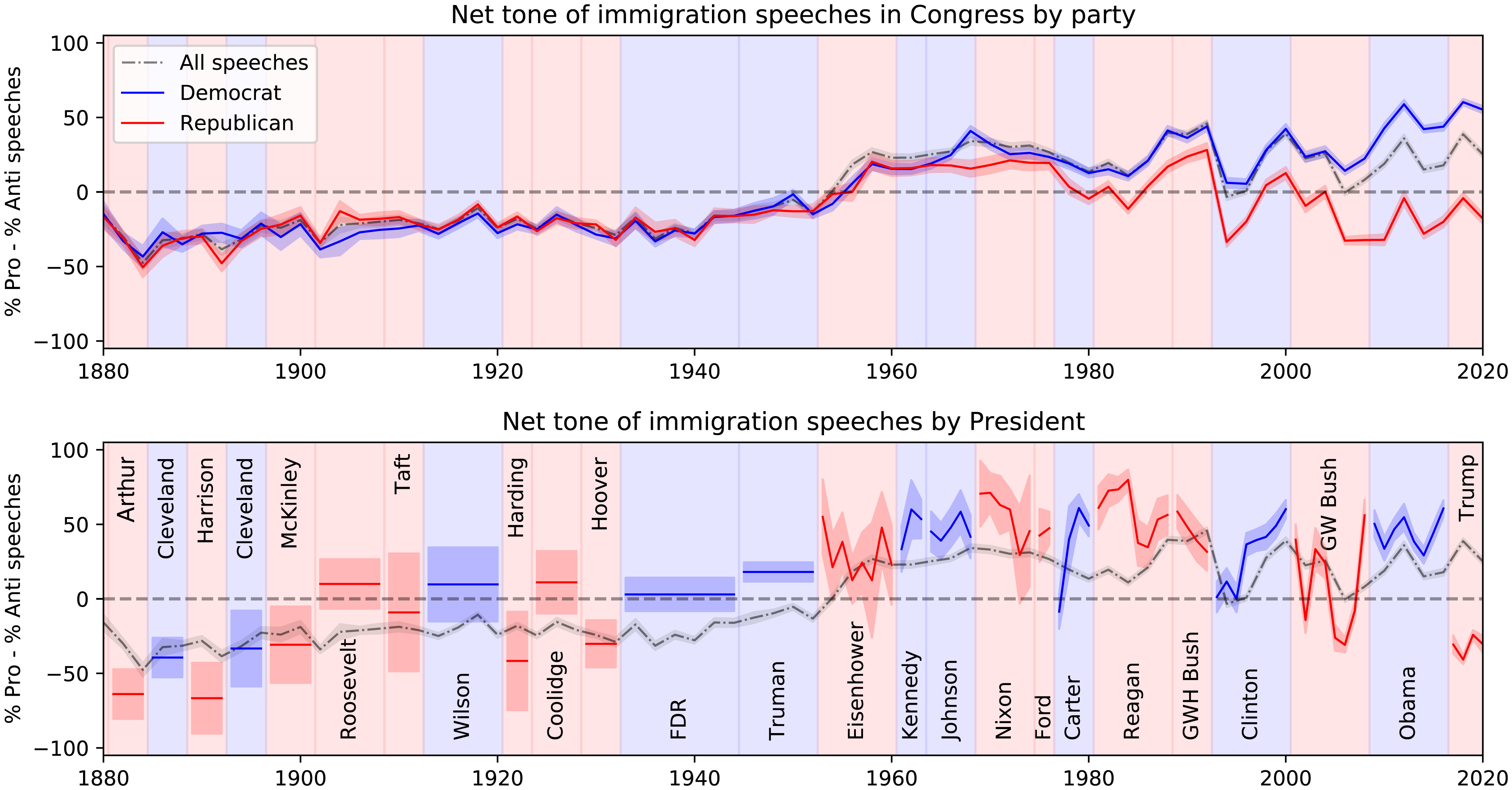
Starting with the complete record of 17 million congressional speeches from 1880 to 2020 (Data), we collected human annotations and trained machine learning classifiers to identify speeches relevant to immigration, along with an accompanying tone (proimmigration, antiimmigration, or neutral; Classification). Both panels of Fig. 1 show the average tone (percent proimmigration minus percent antiimmigration) expressed in congressional speeches over this time period (black line).* The trends for congressional speeches by Democrats and Republicans are also shown in Fig. 1, Top. A comparable time series for presidents is shown in Fig. 1, Bottom, by applying the same models to all presidential communications collected by the American Presidency Project (20). For alternative models, validity checks, and variation within parties, refer to SI Appendix.
Fig. 1.
Evolution of attitudes toward immigration expressed in congressional speeches and presidential communications. Average tone is computed as the percentage of proimmigration speeches minus the percentage of antiimmigration speeches, where proimmigration means valuing immigrants and favoring less restricted immigration and vice versa. Top and Bottom show the overall tone using all congressional speeches about immigration (black dashed line, with bands showing plus or minus two SDs based on the estimated proportions and number of speeches). Top also shows separate plots for speeches by Democrats and Republicans in Congress. (Due to limitations of the data, about 15% of speeches do not have a named speaker or party affiliation.) Bottom shows the corresponding estimates for each president, showing the overall average for a president’s tenure when there are insufficient data to show annual variation. Note that most modern presidents have been more favorable toward immigration than the average member of Congress. By contrast, Donald Trump appears to be the most antiimmigration president in nearly a century. Similarly, congressional Republicans over the past decade have framed immigration approximately as negatively as the average member of Congress did a century earlier.
OPEN IN VIEWEROPEN IN VIEWER
We begin by documenting a number of findings about political speech related to immigration. First, average sentiment toward immigration in Congress and the executive branch is negative throughout the late 19th and early 20th centuries, from the passage of the Chinese Exclusion Act (1882) through the advent of strict immigration quotas in the 1920s. The pervasiveness of negative sentiment can help make sense of the political context that gave rise to a suite of increasingly restrictive immigration regulations. It is particularly noteworthy that we do not find a rise in negative speeches leading up to the Emergency Quota Act of 1921. Rather, we find that political sentiment in Congress was staunchly antiimmigration for more than 4 decades, which is consistent with the political history that has recounted the many congressional attempts to pass antiimmigration legislation, all of which were struck down by the president, in the years before the successful passage of quotas (21). Second, attitudes toward immigration became more positive around the start of WWII, rising steadily from 1940 until the end of the Johnson administration (1969). The average tone in Congress has essentially been proimmigration since the beginning of the Eisenhower administration (1953), consistent with efforts by postwar presidents to reframe the public understanding of immigration as positive for the country.
Third, beginning about a decade after the reopening of the border with the 1965 Immigration and Nationality Act, there has been a growing partisan divide, larger year-to-year variations, and an overall decline in sentiment toward immigration among Republicans. Democrats, by contrast, have grown more positive about immigration over time, especially under Presidents Obama and Trump, with the exception of a temporary bipartisan drop in proimmigration speeches in the early 1990s, coinciding with the end of the Cold War and the passage of the North American Free Trade Agreement (NAFTA). By contrast, Republican legislators are now approximately as overtly antiimmigration in their speeches as the average legislator was during the Age of Mass Migration from Europe and the 1920s quota periods.
The trends for presidential attitudes toward immigration should be treated more cautiously as there is less text available from presidents overall and because these estimates involve a slight domain shift (from congressional speeches, on which our models were trained, to more varied types of presidential communications). Nevertheless, we document a similar pattern, whereby early presidents were more antiimmigration than modern presidents. In recent years, presidents have been uniformly more proimmigration than the average member of Congress, including both Republicans like Ronald Reagan and Democrats like Jimmy Carter. In historical comparison, President Trump was a stark exception: by his utterances, he was the most antiimmigration president to sit in office over the past 140 y, relative to the average attitude of the time expressed in Congress.
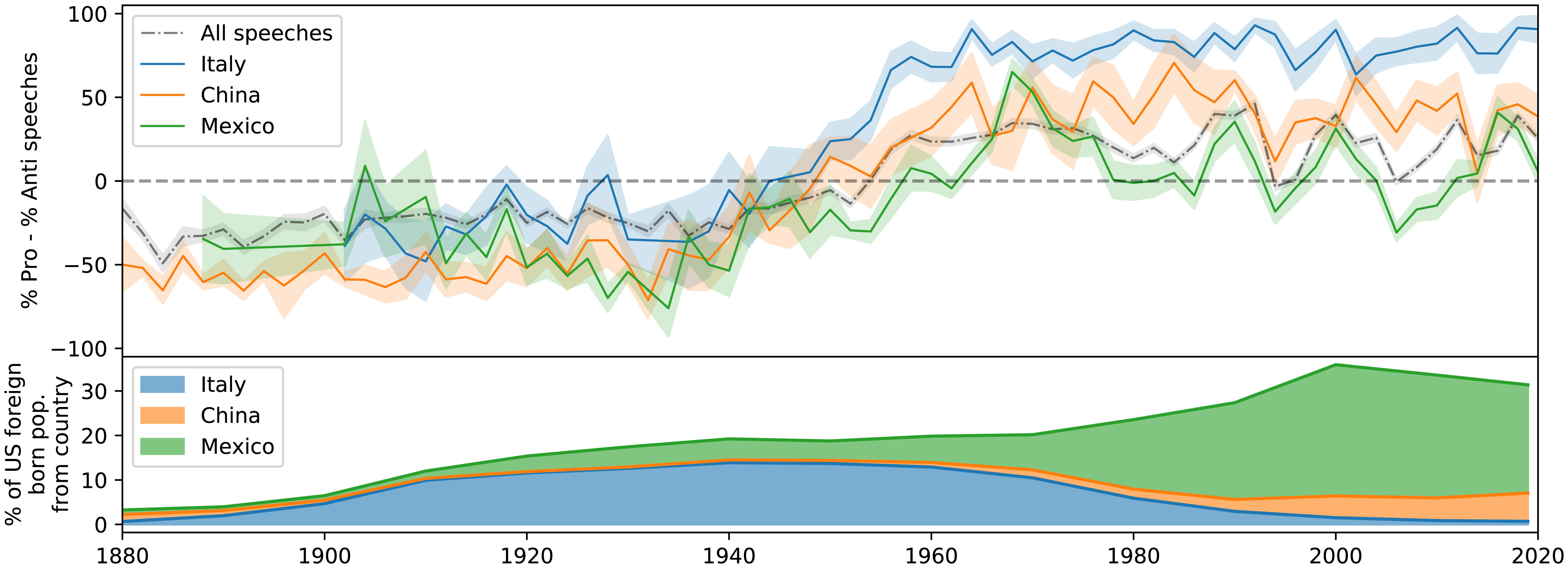
Although the difference in tone between the parties today is larger than at any point in the past, tone also varies dramatically depending on which groups of immigrants are being discussed. Fig. 2 shows the average tone when considering only those speeches that mention each of the three most commonly mentioned nationalities in immigration speeches—Mexican, Chinese, and Italian (Identifying Groups).
Fig. 2.
Average tone of immigration speeches when considering only those speeches that mention the country or nationality for each of the three most frequently mentioned nationalities (Top) and the percent of the US foreign-born population from each of these countries over time (Bottom). Despite the midcentury increase in proimmigration attitudes applying to all groups, a gap in tone by group persists to the present day, with Mexican immigrants being consistently framed more negatively than others and Italian immigrants being framed especially positively. These trends are mirrored in broader regional patterns for Europe, Asia, and Latin American and the Caribbean (SI Appendix).

Source: Computational analysis of 140 years of US political speeches reveals more positive but increasingly polarized framing of immigration | Proceedings of the National Academy of Sciences

Hospital staff shortages: Immigration backlog leaves professionals on sidelines

Of note, appears that the bottleneck more immigration-related than credential recognition delays:

As hospitals across the country struggle under the weight of major staffing shortages, an immigration backlog described by lawyers as the worst they have ever seen is leaving qualified health professionals sitting on the sidelines.

In Februrary 2021, Sharlene Ullani applied for a permanent resident card after years spent working in Canada as a caregiver for children. Eighteen months later, the internationally trained nurse with more than seven years experience hasn’t heard anything from Immigration Canada about her application status.

Online, the government estimates the processing time for new permanent residence cards is 2.6 months, or 81 days, as of Aug. 2.

“I’ve been sending emails two times a month and the answer is always the same: ‘You have to wait, thank you for your patience. We have this pandemic’,” she told CTV National News.

Ullani currently holds a temporary work permit, but it does not allow her to switch jobs — even from a caregiver for children to a caregiver for adults — without losing status. In the months since she filled an application for permanent residency, Ullani has written exams and completed the paperwork necessary to get her foreign credentials translated into a valid licence to work in Ontario as a registered practical nurse.

“It is heartbreaking to see nurses working so hard and we are here, willing to help,” she said. “We are willing to help, but we cannot do so because of our status.”

The Registered Nurses’ Association of Ontario said there are roughly 26,000 nurses “ready and waiting” to work in Ontario, 14,000 of those are registered nurses. CEO Doris Grinspun says the great majority of those people are waiting for their international qualifications to get approved by the college, but thousands have already passed their exams and are waiting for their immigration status to change so they can work.

“The big impact of the backlog for patients is that they are either being short changed in the quality of care or they are not getting care all together,” she said. “If you look at home care, they are likely not getting care all together. If you look at ICU or ER that are closing down or shrinking, even in an emergency, it is desperation.”

Recently, Grinspun worked with the federal government to approve the immigration applications of 26 nurses. Given the health care staffing crisis across the country, Grinspun said the government should prioritize applications filed on behalf of applicants with backgrounds in health care, especially nurses.

“Having internationally trained nurses, RPN … able to join the workforce when they are ready to work in Ontario, and especially those who have already passed their exams and are just waiting on work permits by the feds, move them on. Move them on because nurses and patients need them desperately,” she said.

Speaking at a press conference in Ottawa on Thursday, NDP leader Jagmeet SIngh echoed Grinspun’s calls, saying he has called on Ottawa to implement a fast track immigration system for qualified health-care workers. Singh said he does not know why Ottawa has not yet followed through.

“There is no excuse for this,” Singh said. “I can’t understand why the government is not willing to do this… We need to respond in an urgent way because these are folks who can work here and want to work here.”

In June, the immigration department said more than 2.4 million applications were in the backlog, up from 2.1 million in June. CTV News reached out to the department multiple times for updated figures, but did not hear back at the time of publishing. The department said it usually takes five business days to process and gather statistical data.

Toronto Immigration lawyer Chantal Desloges attributes the backlog to a “perfect storm” of factors related to the early days of the COVID-19 pandemic, when many embassies and consulates closed and immigration staff started working from home.

“When everyone else was doing business online, it wasn’t that easy for the government to pivot,” she said. Desloges added that when offices were closed, applications were still being submitted, but nobody was there to process them.

“All of these things happening at the same time just made a toxic soup of circumstances.”

To speed up the process, Desloges said immigration staff who can’t do 100 per cent of their job from home should be ordered back into the office. She also suggests the government could expedite the approval process by reducing the number and frequency of applicant interviews.

“It is really hard to predict how long it is going to take to sort this mess out, if ever,” she said.

On Tuesday, Immigration, Refugees and Citizenship Canada (IRCC) introduced new measures to speed up the processing of applications for foreign nationals with expired or expiring post-graduation work permits, and for temporary resident to permanent residence pathway applicants. Under the change, individuals in either of those cases will have their current work permits extended while their applications are being processed.

Director of Policy at CanadaVisa.com Kareem El-Assal applauded the change, but said it should have been implemented back in 2020.

“This is a solution that should have been adopted since the start of the pandemic and would have saved applicants a lot of heartache and would have actually saved the canadian government a lot of time as well,” he said.

As delays drag on, applicants like post doctoral researcher Julie Ottoy are left in llimbo, unable to leave the country or attend international conferences for work.

“It is very frustrating,” she said. “It’s been close to five months now not hearing from IRCC and interestingly, last year I submitted this application around the same time and the exact same renewal was approved in two weeks.”

Source: Hospital staff shortages: Immigration backlog leaves professionals on sidelines

Diversity of UK senior civil service falls, rises at lower grades

Of note. Canadian figures by way of comparison, all visible minorities 18.9 percent, executives 12.4 percent, EX-4 10.1 percent, EX-5 9.2 percent (EX-4 and 5 likely equivalent to senior UK public servants):

The percentage of UK civil servants from an ethnic minority background is at a record high, according to the latest figures, but the proportion in top jobs has fallen for the first time since 2015.

Official figures for 2022 revealed that, of those with a known ethnicity, the percentage of government officials who are from an ethnic minority background is at a record high of 15.0% – up from 14.3% in 2021, and 9.3% a decade ago.

There was a year-on-year increase at all grades, with the exception of the senior civil service – the group of officials who run government departments or hold other top posts. In this group, there was a year-on-year decline from 10.6% in 2021 to 10.3% in 2022.

Percentage of civil servants from an ethnic minority background by grade 2012 to 2022

Civil Service Statistics 2022

The government had previously pledged to increase the percentage of senior civil servants who are from an ethnic minority year-on-year to reach 13.2% in the three year period from 2022 to 2025. However, in its Diversity and Inclusion Strategy: 2022 to 2025, published earlier this year, the government said it had stopped using targets to measure progress. “We will mainstream our success measures with our broader organisational priorities, such as Places for Growth [the plan to move officials out of London and into the regions of the UK], senior civil service workforce planning, talent schemes and recruitment priorities. Rather than relying on standalone targets, our ambitions will be embedded in these key deliverables designed to improve our delivery for citizens. Where our data indicates progress is not being made, action will be taken,” the strategy said.

The strategy made only one mention of people from ethnic minority backgrounds, stating: “We will make sure that people from minority ethnic backgrounds, those living with disabilities and those who have experienced disadvantage in their early lives can flourish in public service.”

Source: Diversity of UK senior civil service falls, rises at lower grades

What duty of care does Canada have? Joly denies abandoning Ukrainian embassy staff

This is another embarrassing episode for the government in general, and Global Affairs and Minister Joly in particular. Hopefully any review of “duty of care” will start with a review of relevant historical examples such as Vietnam, Yugoslavia, Iran (1980 and 2012), Afghanistan, and analyse the similarities and differences, along with the policy rationales. But before the report, this letter to the editor provides a sharp contrast to what happened in former Yugoslavia in 1999:
When NATO bombed Yugoslavia in 1999, the Milosevic regime threatened the Serbian staff of member country embassies, labelling them as collaborators from whom retribution would be exacted. Before evacuating the Canadian staff of the embassy in Belgrade, we advanced six months’ salary to all local staff and the immigration section issued visas to them and their immediate families. None of this was directed by what was then Foreign Affairs in Ottawa. Since ambassadors have plenipotentiary powers, I was able to make the necessary decisions sur place. Had we waited for instructions, I am afraid little would have been done. That same inability to act promptly in a crisis may have been the underlying reason for Global Affairs Canada abandoning our local staff in Kyiv. Raphael Girard Former ambassador to Yugoslavia; Montreal
Source: Different time
The Canadian government says it is reviewing its duty to local staff members at missions abroad following a media report that its Ukrainian employees in Kyiv were not alerted to the threats against them and were left to fend for themselves with the Russian invasion looming. On Wednesday, Foreign Affairs Minister Mélanie Joly was asked if her office was aware of the intelligence that Ukrainian staff for foreign embassies were allegedly on Russia’s list of targeted individuals — and deliberately withheld the information from the local staff at the mission. “Never did I or the department have any information targeting locally engaged Canadian staff. We never got that information, nor me or my team or the department,” Joly told reporters at a joint news conference with her visiting German counterpart, Annalena Baerbock, after the two met to discuss the energy and food security crises as well as trade. “I know we have a specific duty of care. I know this is in conversations within the department whether that duty of care applies to locally engaged staff. I would say that morally we have an obligation toward locally engaged staff.” This week, the Globe and Mail reported that the Canadian embassy in Kyiv received a secret briefing from allies in January that the Russian invasion was imminent and that Ukrainians working for western countries could face arrest or execution. The Canadian staff members were also reportedly warned not to share the information with their Ukrainian colleagues. Joly said she had spoken “directly” with the locally engaged staff about their safety and security during her visits in Ukraine in January before the war and followed up with the department and Canadian ambassador in Kyiv, Larisa Galadza, on this issue, throughout, including on Feb. 24, when the war was declared. “Ukraine is a war-torn country, we wanted to make sure that they had options. They were offered options to come to Canada. Some of them have decided to come. Some of them have decided to stay,” said Joly, who praised the contributions of the local Ukrainian staff members. “They were also given full payment and compensation and benefits, although for some time the diplomats were outside of the country.” Joly said a review process called the “Future of Diplomacy” has already been launched to study the issues surrounding the duty of care for local employees in time of crises. The alleged abandonment of the Ukrainian local staff has called into question how Canada applies its duty of care to local staff at diplomatic missions abroad. In Afghanistan, for instance, Ottawa introduced a special immigration program for current and former Afghan employees and contractors, as well as their families, in anticipation of the takeover of Kabul by the Taliban last year. Experts on consular services say evacuations of locally engaged staff are inconsistently applied based on the quality of risk assessments. Local employees are crucial to consular operations, especially in a crisis. “There is no straight line in diplomacy and there is no straight line in security,” said Ferry de Kerckhove, a career Canadian diplomat who was ambassador in Indonesia during the 2002 Bali terrorist bombings and in Egypt between 2008 and 2011 during the Arab Spring movement. De Kerckhove, who spent 38 years in foreign service, said whether to evacuate local staff or not is decided by the ambassador in consultation with Ottawa. The assessment is complex and involves Global Affairs Canada, the immigration department and other ministries. Although he is not privy to the intelligence or circumstances on the ground in Kyiv, he said, generally, unless there’s a really dire situation, the government would need those staff on the ground. “I would assume that if there was a situation in Kyiv that would become really worrisome, we would probably consider bringing in the staff the same way we bring refugees in,” said de Kerckhove, now a senior fellow in public and international affairs at the University of Ottawa. “I don’t think there is a prima facie case of saying yes or no. It would be on a case-by-case basis.” Any evacuation involving Canadian and domestic staff is taken seriously because it’s an onerous and time-sensitve process and officials are often hesitant to let go of the essential staff. He said there are also concerns by officials over “opening the floodgate” in terms of eligibility and access. “The consistency comes from the quality of the analysis of the assessment of the given situation. It’s the situation at any given time that determines the quality of the assessment,” said de Kerckhove. “So any consular manual rule would allow enough leeway to be able to make an assessment based on changing circumstances.” Earlier this year, the Senate committee on foreign affairs and international trade initiated a review of the Canadian foreign service. In May, Joly announced the review to modernize the department and adapt to the changing geopolitical environment. Global Affairs Canada officials said discussions over the duty-of-care issue have been part of that review. Patricia Fortier, an expert on consular services with the Canadian Global Affairs Institute, said the inclusion of the issue in the review is timely. “There is a need for people to understand the balance that’s needed. And if this results in a more balanced approach to duty of care, this will really be helpful,” said the retired Canadian diplomat, who was most recently assistant deputy minister for security, consular and emergency management in Global Affairs Canada. “Right now, the problem of taking duty of care to its logical end is you end up (being) totally risk-averse. Diplomacy requires always a certain amount of risk. You can’t keep everybody under lock and key and not go places that are risky.” Fortier said actions required in response to a crisis are never straightforward and there are no cookie-cutter solutions. While the United States, Canada and Britain withdrew their embassy staff in Kyiv in the buildup of the Russian war, other allies opted to stay. “I’m not sure what kind of thinking went into the decisions, but what I want to address is intelligence. Anybody within the foreign service for any length of time can get a lot of stuff across their desk. And all intelligence needs to be assessed,” said Fortier. “Sometimes it’s right. A lot of times it’s not right. Nothing happens. So one of the questions I have is, how serious was this?” Carleton University international affairs professor David Carment said there’s no indication that Kyiv is going to be under any form of attack except for missile strikes, which target assets such as arms shipments that the Russians deem important to the Ukrainian war effort. If the locally engaged staff have been engaged in work and activities related to the war effort such as collecting intelligence, which would certainly put their lives at risk, a strong argument could then be made for their evacuation to Canada, he said. “We don’t know the details on that. But to automatically assume that the Russians are going to capture them and torture them just because they happen to be on the Canadian side is problematic,” noted Carment, a senior fellow with the Institute for Peace & Diplomacy, a non-partisan think tank based in Toronto. The issue is beyond just securing the safety of individual foreign service officers, but ensuring Canada has a credible presence in countries that are risky, he said. “One of the questions that needs to be considered is whether this duty-of-care approach is an effort to convince Canadians who might want to be foreign service officers to serve abroad where they’re more likely to be at risk,” said Carment. “So it is a bigger argument. It’s one that has to be placed in the context of having a strong diplomatic presence.” Source: What duty of care does Canada have? Joly denies abandoning Ukrainian embassy staff

Shafiq: Getting more immigrants to run for political office means paving the way for active citizenship

Of interest:

Kristyn Wong-Tam just made history. They became the first Asian-Canadian, queer and non-binary person elected to Ontario’s legislature, significantly expanding the vision of what a politician looks like in this country. 

Wong-Tam joins other recent Canadian political “firsts,” including Bhutila Karpoche, the first elected official in North America of Tibetan descent, and Doly Begum, the first Bangladeshi-Canadian woman to be elected in the country.

These leaders share a similar journey that first began with meaningful participation in civic engagement and community work, increasing political engagement, culminating in the decision to run for elected office.

Why does the political engagement of people like Wong-Tam, Karpoche and Begum matter so much?

Seeing a visibly powerful immigrant woman or non-binary person in an elected, decision-making role in the political arena empowers others to do the same. Emerging research shows that visibility and role modelling increases political participation and results in a stronger democracy from more diversified representation.

Higher engagement from traditionally under-represented groups strengthens our social and political fabric, creating more trust in our institutions. This is particularly important now when our democracy is threatened by the rise of misinformation, low voter turnout and a growing distrust of authorities and institutions.

So how can we support civic engagement for future trailblazers like Wong-Tam? In our recent academic and community-based research on civic participation of immigrants and refugees in Canada at the Journeys to Active Citizenship project, we found that the journey starts first with community involvement.

We found newcomers often become involved in local community-based activities before engaging in formal political activities like voting and running for office.

Unsurprisingly, voter turnout amongst immigrants is higher the longer someone has been in Canada. Elections Canada even acknowledges that language can be a barrier to voting for new Canadians, alongside a lack of knowledge of the election process, less awareness of early voting opportunities and a lack of trust in the Canadian political process. However, once immigrants and refugees overcome settlement challenges, they are more likely to vote.

Immigrant women in the past have been less likely to participate in formal political processes, however, they are much more likely to participate in informal civic activities, which often act as a critical stepping-stone to formal participation through actions like voting, writing to your elected representative or running for office.

So how can we bolster opportunities for formal and informal civic participation for immigrants, and particularly immigrant women?

Building social networks has been proven to strengthen integration and belonging and is critical to help immigrants establish trust with fellow Canadians. Enabling community engagement is another key piece of the puzzle.

Creating and strengthening civic education and engagement that is tailored to newcomers, particularly women, would be important to build the skills, knowledge, capacity and confidence that would enable newcomers to engage more fully in Canada’s democracy.

In our interviews and group sessions with immigrants and refugees over the last two years, we found three recurring sources of community: religious spaces, community-based organizations and post-secondary institutions. 

Academic literature also tells us that community-based organizations may act as mobilizing agents for civic participation. Delivering programs through these places of community important to newcomers in their early years would be critical for success.

Supporting programs that bolster opportunities for newcomers to engage in a wide range of community initiatives, such as volunteering, participating in local community events, or joining social clubs, will help foster a sense of trust and belonging in our political processes and institutions, and ultimately lead to an increase in formal political participation.

Canada already benefits greatly from the labour of immigrant women — something that has been highlighted throughout the pandemic. It’s time we included their voices, expertise and experiences in the political process. 

Source: Getting more immigrants to run for political office means paving the way for active citizenship