Elghawaby: Report unpacks why too many Arab women are struggling professionally

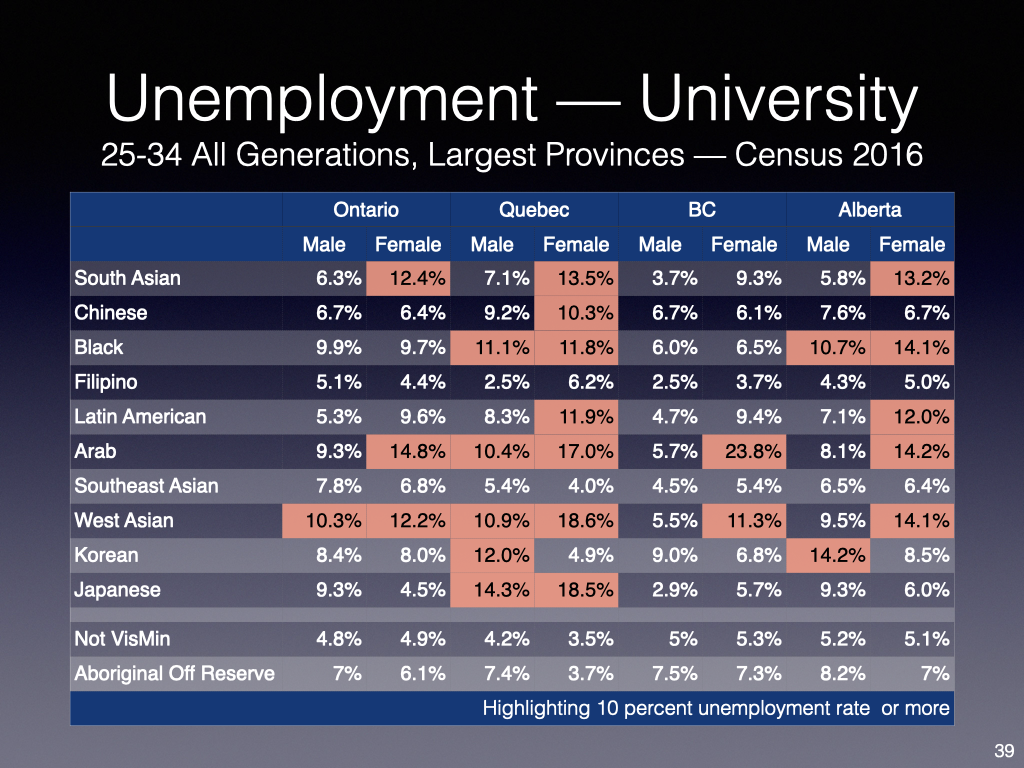
For some context, 2016 census data (not public opinion research) for the younger 25-34 year old cohort. Some of the issues flagged in the study are common to other visible minority groups. Income data is relatively strong for Arab women, lower participation may reflect the impact of family caring, with higher unemployment reflecting in part bias. Regional variations, in particular the relatively poor outcomes for women in Quebec, are notable:

The Canadian Arab Institute released a report last week that attempts to explain why some Arab women aren’t succeeding in Canada’s workforce. It’s compelling reading for anyone invested in the nation’s overall prosperity and success.

The new study titled, “Employment barriers facing Arab Women in Canada”, combines surveys collected by Abacus Data, focus groups and interviews conducted in Ontario, Quebec, and Alberta (provinces with the highest populations of Arab-Canadians). The result is a helpful list of recommendations that would help any newcomer or immigrant trying to navigate the job market.

“Overall, social exclusion describes a state in which individuals are unable to participate fully in economic, social, political and cultural life,” points out the United Nations.

Some Arab-Canadians are having a hard time participating economically, despite the historic presence of these diverse communities in Canada dating as far back as 1882, as chronicled by academic Houda Asal in her book, “Identifying as Arab in Canada: a Century of Immigration History.”

As one of the fastest growing immigrant communities in the country, with seven out of 10 who are first generation immigrants, dreams of success are too often stalled by systemic barriers threatening to “push Arab-Canadians further into poverty and social isolation,” notes the report. 

During the fall of 2020, Arab-Canadians had one of the highest unemployment rates in the country at 17.9 per cent, compared to a national unemployment rate of 9 per cent. Fast forward to today, Arab-Canadians continue to be among those with the highest unemployment rates, according to the March 2022 Labour Force Survey.

And Arab women are among the worst off.

“ … why do Arab women have a higher unemployment rate than most non-Arab women?” question the report’s authors. “Our main objective in this study is to understand the knowledge gaps behind the ever-increasing employment barriers facing Arab women and filling these gaps with evidence that inform policy recommendations.”

The researchers approached the question by dividing an individual’s career into different chronological stages. The result is helpful in understanding how those seeking work tend to experience obstacles at various junctures in their journey — information gathering about the local labour market, looking for job opportunities, during the recruitment process, while gaining work experience and being better integrated in the workplace, and in further career development and future growth.

The most significant impediments identified included inadequate employment services, lack of recognition of foreign credentials and opportunities to upgrade, lack of opportunities to gain Canadian experience, language/communication obstacles (not based on proficiency in either of the official languages, but due to a lack of knowledge of industry-specific terms), and discrimination based on one’s identity. 

The report’s concluding recommendations would improve the chances of most newcomers and immigrants in finding and retaining employment commensurate with their professional skill-set. These include:

  • Creating central portals of information about the labour market so it’s easier to access information about the job market.
  • Encouraging the federal government to work with the provinces to provide information to immigrants about degree equivalency processes before their arrival to Canada so they can better prepare.
  • Encouraging workplaces to implement standardized performance evaluations to remove concerns about bias in performance reviews and fears of reprisals when individuals report microaggressions or blatant discrimination. 
  • More funding for organizations that provide mentorship and social networking for newcomer and racialized women.
  • Tailored communication and soft skills training opportunities in industry-specific terms and language.
  • Measuring the success of employment support services not on whether newcomers or immigrants have secured survival jobs, but whether employment matches the skills of their clients. 

These recommendations won’t come as a major surprise to those who have long worked with immigrant and newcomer communities. What should surprise all of us is how long it’s taking to address these hurdles.

Source: Report unpacks why too many Arab women are struggling professionally

Hate-motivated crimes up 22 per cent annually in Toronto, police say

Unfortunately, not limited to Toronto:

Toronto police say there has been a 22 per cent increase in hate crimes in the city.

The force says there were 257 hate-motivated incidents in 2021, up from 210 such incidents the year before.

Police say the pandemic and geopolitical events are believed to be contributing factors in the increase.

The force says religion, ethnic or national origin were the dominant motivating factors in the incidents.

It says east and southeast Asian communities were the most targeted.

Toronto police say they are expanding their hate crime unit.

Police Chief James Ramer says hate crimes are increasing year over year.

“Hate crimes victimize not only the person, but also the communities they identify with and the negative effects can be long-lasting,” Ramer said in a written statement.

“We know hate crimes often go unreported and we are committed to working alongside our community partners to break down barriers and develop relationships so that more people will feel comfortable coming forward to report these crimes.”

East and southeast Asian communities were the predominant victims of assaults, followed by the Black community while Jewish and Black communities were the predominant groups targeted for mischief incidents, police said.

Black and LGBTQ communities were the dominant group for being threatened, the force said.

Source: Hate-motivated crimes up 22 per cent annually in Toronto, police say

Governments have undercounted the COVID-19 death toll by millions, the WHO says

Similar analysis to that of The Economist. Biggest surprise to me is the inclusion of the USA in the top 10 – but perhaps I shouldn’t be:

The COVID-19 pandemic directly or indirectly caused 14.9 million deaths in 2020 and 2021, the World Health Organization said on Thursday, in its newest attempt to quantify the outbreak’s terrible toll.

That’s around 2.7 times more than the 5.42 million COVID-19 deaths the WHO says were previously reported through official channels in the same 2-year period.

Here’s a rundown of four main points in WHO’s report:

Overall, deaths are far higher than those in official reports

In its tally, WHO aims to quantify “excess mortality,” accounting for people who lost their lives either directly, because of contracting COVID-19, or indirectly, because they weren’t able to get treatment or preventive care for other health conditions. The figure also takes into account the deaths that analysts say were prevented because of the pandemic’s wide-ranging effects, such as curtailing traffic and travel.

The pandemic’s current reported death toll is 6.2 million, according to Johns Hopkins University’s COVID-19 tracker.

India is seen suffering a much deeper loss than reported — a finding that India disputes

In some cases, WHO’s figures depict a shockingly wide gulf between official figures and its experts’ findings. That’s particularly true for India, where WHO says millions more people died because of the pandemic than has been officially reported.

India reported 481,000 COVID-19 deaths in 2020 and 2021. But William Msemburi, technical officer for WHO’s department of data and analytics, said on Thursday that the toll is vastly higher, with 4.74 million deaths either directly or indirectly attributable to the pandemic — although Msemburi said that figure has a wide “uncertainty interval,” ranging from as low as 3.3 million to as high as 6.5 million.

The data behind the staggering figures promise to expand the understanding of the pandemic’s true effects. But the findings are also a flashpoint in debates over how to account for unreported coronavirus deaths. India, for instance, is rejecting WHO’s findings.

India “strongly objects to use of mathematical models for projecting excess mortality estimates,” the country’s health ministry said on Thursday, insisting that WHO should instead rely on “authentic data” it has provided.

10 countries accounted for a large share of deaths

Deaths were not evenly distributed around the world. The WHO says about 84% of the excess deaths were concentrated in three regions: Southeast Asia, Europe and the Americas.

And about 68% of the excess deaths were identified in just 10 countries. WHO listed them in alphabetical order: Brazil, Egypt, India, Indonesia, Mexico, Russia, South Africa, Turkey and the United States.

Overall, WHO found the number of excess deaths was much closer to reported COVID-19 deaths in high-income countries than in lower income countries.

Many countries still lack reliable health statistics

The WHO says it relied on statistical models to derive its estimates, looking to fill in gaps in official data.

“Prior to the pandemic, we estimate that 6 out of every 10 deaths were unregistered” worldwide, said Stephen MacFeely, director of WHO’s department of data and analytics. “In fact, more than 70 countries do not produce any cause of death statistics. In the 21st century, this is a shocking statistic.”

By creating its report on excess mortality, WHO is pursuing several goals, such as urging governments to improve their health-care interventions for vulnerable populations and to adopt more rigorous and transparent reporting standards.

“Knowing how many people died due to the pandemic will help us to be better prepared for the next,” said Samira Asma, WHO’s assistant director-general for data and analytics.

Source: Governments have undercounted the COVID-19 death toll by millions, the WHO says

Govender: B.C.’s new anti-racism legislation allows us to turn intersectional data into systemic change

From BC’s Human Rights Commissioner:

The “grandmother perspective” to data collection, which I first learned from Gwen Phillips of the Ktunaxa Nation, suggests that government should collect data as a grandmother would collect information about her family: to better care for them, rather than exercise control with a big-brother mentality. This perspective formed the basis for the recent recommendations on disaggregated data collection from British Columbia’s Office of the Human Rights Commissioner to the provincial government.

A grandmother collects her grandchildren’s stories like pencil marks on the wall, measuring their growth. Data can also tell a story – one that helps us to understand people’s needs at a community level. Policy makers, too, need good information to design good law, policy and services.

This week, the B.C. government introduced the Anti-Racism Data Act, new legislation to collect disaggregated demographic data. The new law, if passed, facilitates the collection of personal information for the purposes of identifying systemic racism and advancing racial equity.

Disaggregated demographic data are information based on different aspects of our identities: for example, information broken down by race, gender or educational status. While the Statistics Canada census already collects disaggregated data in relation to the general population, this new law will facilitate the collection of such data in relation to government policies, practices and services, such as health care. Comparing statistics based on these two datasets can reveal patterns and inequalities. Information about inequalities, in turn, can help us design better policies to tackle systemic discrimination. We can’t act on what we don’t know.

B.C. opens consultation on anti-racism legislation as groups praise data collection

Importantly, data must be collected on more than just racism in order to be effective. If we can’t understand how gender, race, age and other factors work together or intersect to inform our experiences in the world – and more accurately, how sexism, racism, ageism, ableism and so on inform our experiences – then we won’t be able to create good public policy that meets people’s real needs.

Race-based data only tell part of the story. For example, we know that in Canada, racialized men earn 78 cents for every dollar earned by white men, according to a 2019 Canadian Centre for Policy Alternatives report. But that gap widens significantly for racialized women, Indigenous women, transgender women and women with disabilities. Indeed, racialized women earn only 59 cents for every dollar earned by white men.

Treating all racialized people as a homogenous group not only obscures the problem, but it also reinforces it by leading to solutions that are only tailored to the experiences of the dominant subgroup within that category.

We may identify racist stereotypes as being one of the barriers contributing to the wage gap. But we also need to understand that stereotypes of racialized women may be quite different than stereotypes of racialized men. Ignoring these gendered differences silences and omits the experiences of racialized women. We need to truly understand the scope and complexity of the wage gap in order to solve it; intersectional data collection and analysis is key to that end.

However, there is a serious downside to collecting all this information. Despite its power to focus the gaze of policy makers on real world inequities, data also have the power to reinforce negative stereotypes, and some people have legitimate concerns about sharing this information.

In recent recommendations from my office, we called on the provincial government to put control over data in the hands of those from whom the data are being collected. For example, disaggregated demographic data about a First Nation should only be collected in service of that community and upon the consent of that Nation, and used at their direction. The new legislation creates advisory roles for those who are directly impacted to embed this democratic approach to data and to counter any harms it may cause.

For decades, racialized communities, scholars and activists have been calling for this kind of legislation. Over the last two years, the public calls for disaggregated-data collection have grown louder. Protests against police brutality, a growing awareness of the ways in which racism impacts health outcomes, including those of COVID-19, and a movement to push back on the mainstream emergence of white nationalism have brought systemic racism into the consciousness of the masses. While data may not be the most glamorous call to action, they may be one of the most fruitful.

The new legislation is an important marker of our growth toward a more equal society. However, data collection is just one pencil mark on the wall; the next milestone to measure will be whether we are able to use it to create real social change. Implementation requires using intersectional data and a meaningful community governance model to turn information into action.

Kasari Govender is British Columbia’s first independent Human Rights Commissioner. BC’s Office of the Human Rights Commissioner exists to address the root causes of inequality, discrimination and injustice in the province by shifting laws, policies, practices and cultures.

Source: B.C.’s new anti-racism legislation allows us to turn intersectional data into systemic change

Cohen: U.S. Supreme Court abortion ruling throws away a half-century of law

Good column:

Well, why should we be surprised? Who on God’s green earth did not expect — given the ideology and origins of the majority of justices on the United States Supreme Court — that it would, at its first opportunity, vote to end a woman’s right to abortion? Do you think this just fell from the sky?

It didn’t. The decision — a draft of which was leaked Monday, confirmed Tuesday and will be issued in June, perhaps in different words with the same effect — has been a generation in the making. It is a triumph of the conservative movement that never supported Roe v. Wade, the judgement that established a woman’s right to abortion in 1973, and has denied it ever since.

One by one, judge by judge, social conservatives put in place the majority that will, this time, reverse the decision. First came Justice Clarence Thomas, appointed by George H. W. Bush; Samuel Alito, appointed by George W. Bush; then Neil Gorsuch, Brett Kavanaugh and Amy Coney Barrett, appointed by Donald Trump.

Conservatives cheered their nominations, if not proposed them, knowing that one day they would get their wish. They were aided by Republicans in the Senate happy to deny a Democratic president (Barack Obama) his opportunity to fill a vacancy, and later to jam through another nomination (Barrett) days before a general election that ousted a Republican (Trump).

Of course, when asked about abortion, those nominees said they would not touch precedent. They persuaded moderate Republican senators who supported abortion that it was safe to put them on the bench.

The most gullible was Susan Collins of Maine, who was under pressure in 2018 to oppose Kavanaugh. She voted for him. She believed that Kavanaugh would not overturn the abortion ruling because, after all, he’d told her “many times” the decision was settled law. She said the same about Neil Gorsuch.

We don’t know with certainty whether Gorsuch and Kavanaugh will rescind the right, but we certainly assume they will vote with their conservative colleagues.

Poor Collins, as naïve as her critics said, who got up on her low horse Tuesday and said, gee, if the draft ruling stands, it would “be completely inconsistent” with what they told her personally in her office and in the hearings.

Well, yes, it would be, but it would reflect their judicial philosophy, which is the reason they were appointed by Trump, applauded lustily by the Federalist Society and opposed mightily by Democrats and pro-choice women’s groups. All knew what Collins did not.

Now we know the old rules no longer apply. A high court of the United States no longer seeks consensus, or honours precedent or a half-century of law. It ends a constitutional right with a leak — and a shrug.

A president rejects the results of a democratic election and foments an insurrection and walks away unpunished. He is twice impeached and twice acquitted. Senate Republicans eviscerate a black jurist of impeccable credentials, turning her nomination for the Supreme Court into a circus. Their unhinged cousins in the House of Representatives attack America’s support for Ukraine.

All this is tolerated. All is normal. Meanwhile, Republicans in the states put in place the people and rules to overturn the vote in 2024, beginning with the mid-term elections in 2022. Trump awaits, America’s strong man, vowing to make Joe Biden’s presidency an interregnum. (His man, author J.D. Vance, who wants to fire federal bureaucrats and replace them with Trump acolytes, won the GOP nomination Tuesday and is likely to be the new senator from Ohio.)

It may be that ending abortion will send angry women into the streets. It may be that this is the moment a somnolent people sees the threat from a reactionary court, which may now undo contraception and same-sex rights. When Americans understand minority rule is creating an autocracy. It can happen here.

Maybe. If so, and there really is a struggle of values between red and blue states, then the end of legal abortion this spring will be seen as the Fort Sumter of America’s new civil war.

Source: Cohen: U.S. Supreme Court abortion ruling throws away a half-century of law

McWhorter: Don’t sleep: Linguistically, Black Americans can walk and chew gum at the same time

Of interest:

In March, at the annual Conference on College Composition and Communication, one panel presentation was of particular interest: It concerned requirements in first-year college composition classes and discussed the idea that for students whose home dialect is Black English, or another nonstandard dialect, requiring them to write in standard English is a potentially unjust, if not flatly racist imposition, forcing some students to suppress their true selves in favor of a hegemonic artificiality. This school of thought holds that writing instructors should allow — encourage — such freshmen to write either purely in their home dialect or to engage in “code-meshing,” mixing the home dialect and the standard.

It’s an approach that accomplishes the feat of both underserving Black English speakers and diminishing Blackness.

During the panel’s Q. and A., an attendee presented this question: “What do we do when the resistance to code-meshing, for example, in our writing classrooms, comes from our BIPOC students? I ask because, of my attempts to encourage students to use their home dialects in writing, Black students in particular often resist those practices as setting them up for failure. Which only reflects how ingrained they are in a system that is inherently racist.”

The question and the panelists’ answers were quite revealing, including one from Asao Inoue, a rhetoric and composition professor at Arizona State University, who responded that when he hears that kind of objection from a student, he asks himself:

Is it that I have to say, or I have to create a classroom, and a learning experience, that demeans the linguistic history of that student in order for that student to go into the world and go into unfair racist, white supremacist systems and succeed? … Because if that student says, “You’re setting me up for failure,” what they’re saying is, “I want to succeed in that unfair system. I want to game that system.”

But, Inoue continued:

You’re always still going to be Black, or you’re always still going to be Latinx, or you’re always still going to be something else. … you can mouth the words that are white, but they’re coming from a body that’s something else, and you may be read that way. And so, for me, my goal as an educator is to change the system.

Because, he said:

What they’ve been exposed to is capitalist-inflected [expletive] about education being the way in which we, you, become a nice little cog in the system and you get skills. So you can go out in the world and make Microsoft more money.

While not all writing professors would go that far, in terms of appending a critique of capitalist reality to teaching freshman composition, just the notion that standard English is exterior to Black students’ real selves requires a closer look, because it tracks with worrisome currents in the way we are encouraged to think about race, especially lately.

Few familiar with today’s academic world will find Inoue’s opinions especially surprising. The idea in education circles that standard English functions as an unjust “gatekeeper,” holding back students of color, has been around for a long time. Related has been the idea that at the grade-school level, Black students whose home dialect is Black English should be taught as bilinguals of a sort. Adherents of this philosophy don’t say standard English should be withheld but suggest that standard English and Black English should be presented as different languages, as it were. Recall the “Ebonics” debate that gained national attention in the 1990s.

In 1993, English Leadership Quarterly, a publication of the National Council of Teachers of English, published a piece by two Indiana University of Pennsylvania English professors, Donald A. McAndrew and C. Mark Hurlbert, arguing that:

Writers should be encouraged to make intentional errors in standard form and usage. Attacking the demand for standard English is the only way to end its oppression of linguistic minorities and learning writers. We believe this frontal assault is necessary for two reasons: (1) it affords experienced writers, who can choose or not choose to write standard English, a chance to publicly demonstrate against its tyranny and (2) if enough writers do it regularly, our culture’s view of what is standard and acceptable may widen just enough to include a more diverse surface representation of language, creating a more equitable distribution not only of the power in language and literacy but also, ultimately, of the power in economics and politics that language and literacy allow.

Later, as The Washington Times reported in 1995, the N.C.T.E. discussed eliminating “English” from its name. That year, a delegate to its annual convention said, “If we are to offer diversity, there can be a conversation about language arts, but not about English.”

But in the same way that the idea of eliminating references to “English” strikes most as overboard, the idea that for Black people standard English is something wholly apart is simply inaccurate. For most Black Americans, both Black and standard English are part of who we are; our English is, in this sense, larger than many white people’s. In “The Souls of Black Folk,” W.E.B. Du Bois wrote, “I sit with Shakespeare and he winces not … I summon Aristotle and Aurelius and what soul I will, and they come all graciously with no scorn nor condescension.” On a less exalted level, a great many Black people toggle endlessly between standard and Black English, day in and day out — we code-switch. I always liked how Gloria Naylor was able to get this across, as in this scene from her novel “Mama Day”:

“We ain’t staying long,” Ruby says, pulling up a chair. “But I thought it would be nice for us to meet Cocoa’s new husband.”“It’s a pleasure,” George says.“Doubly mine,” says Ruby. “And this here is my new husband, Junior Lee.”“Pleasssurre.” Junior Lee manages a nod. “Hear you a big railroad man.”“No, I’m an engineer.”

In that exchange, the characters aren’t dipping in and out of what they think of as a cold, alien dialect. They are sounding subtly different notes according to which dialect they render each thought or gesture in. Standard English forms are as much theirs as Black English ones.

Communicating in this way, Black Americans are doing what other people do worldwide, living between two varieties of a language. Swiss people’s formal Hoch Deutsch is almost a different language from the Swiss German they speak informally. The Arabic speaker typically controls both the Modern Standard Arabic derived from the language of the Qur’an and used in formal settings and a local dialect used for real life, like Egyptian or Moroccan.

People in these countries and beyond would find familiar Maya Angelou’s observation in “I Know Why the Caged Bird Sings,” couched as completely unremarkable:

In the classroom we all learned past participles, but in the streets and in our homes the Blacks learned to drop s’s from plurals and suffixes from past-tense verbs. We were alert to the gap separating the written word from the colloquial. We learned to slide out of one language and into another without being conscious of the effort. At school, in a given situation, we might respond with “That’s not unusual.” But in the street, meeting the same situation, we easily said, “It be’s like that sometimes.”

To give some credence to those freshman-comp panelists, we might say that Angelou could have turned away from the “That’s not unusual” and that Du Bois could have considered that in real life Shakespeare, Aristotle and Marcus Aurelius might have looked down on him as some kind of “Aethiope.”

But subordinated and even despised people can, over time, with full awareness of the unjustness of racism, embrace even a foreign language, as opposed to a dialect, that is initially forced upon them. They can come to process it as a part of who they are, as people existing at a particular time, amid a dynamic synergy between the then and the now, the us and the them, the imposition and the resilience.

Many Indians, for instance, cherish English as one facet of the expression of modern Indianness, despite its imposition under colonial rule. Not long ago, I took in Netflix’s Bollywood romantic comedy “Love Per Square Foot,” in which the characters speak “Hinglish,” a neat blend of English and Hindi, a common linguistic phenomenon among many people in India and throughout the Indian diaspora. In the movie, there is nary a suggestion that the English feels to the characters like a spritz of cold water on every second sentence from a mustachioed British imperialist. In the same way, Congolese people go back and forth between French, their African lingua francas such as Lingala (memorably featured in, for example, the documentary “When We Were Kings”) and local indigenous languages few have heard of beyond where they are used.

Too often, what we’re presented with as authentically Black is a kind of essentialization. The idea that people’s authenticity stops at their home dialect does not reflect how people operate linguistically or their experience. Foisted on Black Americans, this idea of the standard dialect as a quiet menace, whatever its progressive intentions, is limiting. Even if the idea is not to ban the standard from a curriculum, if standard English is presented with an eye roll as the province of The Man, this is based in a conception of Blackness needlessly smaller than the reality of it.

Linguistically, Black Americans can and do walk and chew gum at the same time, like countless people around the world — and like it.

Source: McWhorter: Don’t sleep: Linguistically, Black Americans can walk and chew gum at the same time

Why Judges Are Basically in Charge of U.S. Immigration Policy Now

Of note. Reflects ongoing political failure:

When Texas Attorney General Ken Paxton filed a new lawsuit against the Biden Administration last week challenging the allegedly “unlawful” move to grant asylum officers authority to decide some asylum cases, no one was surprised. It’s the 11th immigration-related lawsuit Paxton has filed against the Administration since President Biden took office.

But the Texas attorney general is hardly alone in his enthusiasm for litigation. Because Congress has failed to act meaningfully since the 1990s to reform the U.S. immigration system, immigration policy has been increasingly shaped by court challenges. In recent years, liberal and conservative attorneys general, nonprofit organizations, and individual plaintiffs have filed an avalanche of immigration-related suits in federal courts, resulting in a profusion of complex and often-contradictory court rulings, experts tell TIME. With Congress on the sidelines, federal judges are now on the frontlines of interpreting and dictating the scope of executive actions, federal guidelines and agency rules—thereby determining how U.S. immigration policy actually works.
[time-brightcove not-tgx=”true”]

“This is a manifestation of our broken immigration system,” Stephen Yale-Loehr, professor of immigration law at Cornell University, tells TIME. Congress’s failure to pass comprehensive immigration reform has resulted in an explosion of agency rules and executive actions—which, in turn, lead to more legal challenges, he says. “Today, almost every executive action on immigration is being challenged in the courts.”

This ad-hoc system has resulted, both at the U.S.-Mexico border and within government agencies, in “peak confusion,” says Theresa Cardinal Brown, managing director of immigration and cross-border policy at the Bipartisan Policy Center (BPC), a Washington think tank. New federal rules or guidances are often blocked, terminated, or forcefully reinstated, sometimes with additional restrictions or requirements, just days or weeks after they were announced. Government officials, immigration lawyers, and lay people are often baffled about the contours of U.S. law, says Elora Mukherjee, professor of law at Columbia University and director of the school’s Immigrants’ Rights Clinic.

Giving judges so much power to determine immigration policy also puts the U.S. judicial system in a delicate spot, Yale-Loehr says. Federal judges are often wary of being drawn into issues of national sovereignty or of ruling in a way that impinges on the executive branch’s authority to conduct foreign policy. But, these days, they often have no choice. “Courts are loath to weigh in,” Yale-Loehr says.

Recently, Supreme Court Justice Stephen Breyer questioned the role of his own court in deciding a case about the Trump-era policy, Migrant Protection Protocols (MPP), which requires the Biden Administration to negotiate with the Mexican government over sending migrants back to Mexico to await asylum hearings. During April 26 oral arguments, Breyer warned his fellow justices to move gingerly. “Foreign affairs is involved,” he said. “And, Judges, this is above your pay grade, okay? Stay out of it as much as you can.”

How did we get here?

Immigration-related litigation has been around for decades, but many experts point to a moment, in 2016, when the floodgates opened.

On June 23, 2016, the Supreme Court voted 4-4 on a case brought by Texas challenging whether a key Obama Administration executive action known as Deferred Action for Parents of Americans and Lawful Permanent Residents (DAPA), could move forward. (Justice Antonin Scalia, who died in February 2016, had yet to be replaced.) DAPA, an expanded version of Deferred Action for Childhood Arrivals (DACA), would have granted some parents of those who arrived unlawfully in the U.S. as children protection from deportation. The tie vote meant the lower court’s decision blocking DAPA remained in place—a very high-profile win for Texas. The victory provided a key roadmap for other attorneys general in the years that followed.

When President Donald Trump was inaugurated, it was the liberals’ turn at bat. Within days of Trump taking office, the ACLU brought a suit challenging the new Administration’s ban on foreign nationals from seven predominantly Muslim countries from visiting the U.S. Over the course of his tenure, the Trump Administration was sued hundreds of times over immigration policies. Overall, the Trump Administration was sued 110 times by then California Attorney General Xavier Bacerra, a Democrat, according to an analysis by CalMatters, and at least 400 times by the ACLU in lawsuits. The lawsuits contested a range of immigration, environmental, and other types of executive policies.

Another reason for the recent explosion of court challenges was the pace at with the Trump Administration moved on immigration issues. Over the course of his presidency, he enacted 472 immigration policy changes according to the Migration Policy Institute, a bipartisan research institution. That “unprecedented pace” begot an unprecedented wave of new lawsuits. “That really accelerated the legal challenges,” Yale-Loehr says.

After President Biden was inaugurated, conservatives picked up where liberals had left off. “Conservative states are suing every chance they get to challenge everything that the Biden Administration is doing on immigration,” Yale-Loehr says.

An explosion of confusion at U.S. borders

Texas Attorney General Paxton’s most recent lawsuit targets the Biden Administration’s tweak to asylum processing designed to eliminate immigration court backlogs. The idea is that, by allowing asylum officers to decide straightforward asylum cases, rather than always relying on an immigration judge, authorities can drop the wait time for asylum cases from an average few years to a few months. The Department of Homeland Security (DHS) and the Department of Justice (DOJ) first announced the shift on March 24, saying it would go into effect on May 31. Texas filed suit on April 28.

The asylum tweak coincides with the Administration’s attempt to end Title 42, a controversial COVID-19 health measure implemented in March 2020 that the government has used to immediately expel thousands of migrants, including those planning to claim asylum. Title 42 expulsions are slated to end on May 23, and DHS says it expects an uptick in migration flows as a result, including an increase in people seeking asylum. Granting asylum officers the authority to decide some cases, DHS says, will help address growing migration at the U.S.-Mexico border.

But at this point, that entire policy—the Administration’s move to end Title 42, as well as its move to mitigate the effects of ending Title 42—are mired in court. On April 4, Louisiana, Missouri, and Arizona sued to block the Administration from ending Title 42 at all. The states’ challenge came on the heels of another lawsuit, brought by the ACLU and other organizations, demanding that the Biden Administration end Title 42 immediately.

This fog of judicial warfare has resulted in a confusing patchwork of temporary policies. On March 4, the D.C. Circuit Court of Appeals ruled that DHS can expel migrants under Title 42, but could not return families to a country where they faced fear of persecution or torture. That same day, Texas District Court Judge Mark Pittman ruled that the Biden Administration can’t exempt unaccompanied migrant children from Title 42 expulsions.

“That kind of back and forth is just terrible for any sort of consistency or continuity in any policy,” Cardinal Brown says.

Meanwhile, the Supreme Court will weigh in this summer on whether the Biden Administration can end MPP, also known as “Remain in Mexico” policy.

Congress fails to pass any real immigration reform

President Joe Biden sent an immigration reform bill to Congress on his first day in office, but it hasn’t gone anywhere. On Sunday, Democratic Sen. Bob Menendez of New Jersey, the bill’s lead sponsor, told Politico that there is “zero” chance immigration reform will come this year, even though Democrats hold a slim majority in the House and Senate.

The odds of passing Biden’s comprehensive immigration reform bill may worsen after the midterms, when Democrats are widely expected to lose seats.

Last week, a bipartisan group of Senators including Dick Durbin, Ill., Alex Padilla, Calif., Thom Tillis, N.C., and John Cornyn, Texas, resumed discussions of passing immigration measures, according to Roll Call. Even their efforts are unlikely to go anywhere, many Americans may be happy to see that discussions are taking place. According to a 2020 Pew Research Center survey, 75% of Americans say they support Congress creating a legal pathway to citizenship for undocumented people, including 57% of Republicans or those who lean Republican, and 89% of Democrats or those who lean Democratic.

“The American public overwhelmingly supports immigration,” Mukherjee of Columbia says. “The challenge is that our Congress is not functional.”

Source: Why Judges Are Basically in Charge of U.S. Immigration Policy Now

Automatic for the people [immigration focus]

Of note. Given volumes and resources, no realistic alternative but care need to eliminate biases (either pro or con):

If there was ever any doubt the federal government would use automation to help it make its administrative decisions, Budget 2022 has put that to rest. In it, Ottawa pledges to change the Citizenship Act to allow for the automated and machine-assisted processing of a growing number of immigration-related applications.

In truth, Immigration, Refugees and Citizenship Canada has been looking at analytics systems to automate its activities and help it assess immigrant applications for close to a decade. The government also telegraphed its intention back in 2019, when it issued a Directive on Automated Decision-Making (DADM), which aims to build safeguards and transparency around its use.

“[T]he reference to enable automated and machine-assisted processing for citizenship applications is mentioned in the budget to ensure that in the future, IRCC will have the authority to proceed with our ambition to create a more integrated, modernized and centralized working environment.” said Aidan Stickland, spokesperson for Immigration, Refugees and Citizenship minister Sean Fraser, in an emailed reply.

“This would enable us to streamline the application process for citizenship with the introduction of e-applications in order to help speed up application processing globally and reduce backlogs,” Stickland, added. “Details are currently being formalized.”

But to live a life of ambition requires taking risks. So the DADM comes with an algorithmic impact assessment tool. According to Teresa Scassa, a law professor at the University of Ottawa, it creates obligations for any government department or agency that plans to adopt automated decision-making, either in whole or as a system that makes recommendations. It is a risk-based framework to determine the obligation to be placed on the department or agency.

“The citizenship and immigration context is one where what they’re looking at is that external client,” Scassa says. “It does create this governance framework for those types of projects.”

Scassa says that the higher the risk of impact on a person’s rights, or the environment, the more obligations are placed on the department or agency using it, such as requirements for peer review, monitoring outputs to ensure the system remains consistent with the objectives or that it doesn’t demonstrate improper bias.

“It governs things like what kind of notice should be given,” Scassa says. “If it’s very low-risk, it might be a very general notice, like something on a web page. If it’s high risk, it will be a specific notice to the individual that automated decision-making is in use. Depending on where the project is in the risk framework, there is a sliding scale of obligations to ensure that individuals are protected from adverse impacts.”

Scassa suspects that IRCC may use automated decision-making to determine if someone qualifies for citizenship, which can mean different things.

It could be a triage system, for example, drawing information from applications before using AI to determine which applicants clearly qualify for citizenship. “Everything else [would fall] into a different basket where it needs to be reviewed by an officer,” Scassa says.

Such a system would be relatively low-risk as any decisions would be positive for the applicant, while all others go to a human for review, which would speed up overall processing times.

“That may be less problematic than a system that makes all of the decisions, and people have to figure out why they got rejected, and you have to ask how transparent is the algorithm, and what are your rights to have the decision reviewed,” Scassa adds. “There is the question of how it will be designed, and how impactful the AI tool will be on individuals. On the other hand, a triage system like this could have automation bias where files get flagged. Maybe the human reviewing them approaches them with a particular mindset because they haven’t been considered to be automatically accepted. The automation bias may make the human less likely to approve them.”

Scassa notes that the Open Government platform shows an algorithmic impact assessment for a tool developed for spousal analytics, a form of triage tool, which gives a sense of what kinds of tools the department is contemplating.

Scassa also notes that under the Citizenship Act, a provision allows for the delegation of the minister’s powers to any person authorized in writing. She suspects that the proposed legislative change could be to specifically allow some of the decisions to be made on a fully-automated basis.

When it comes to reviewing decisions, the DADM and its risk framework appears to apply administrative law principles, including procedural fairness protections.

Paul Daly, also a law professor at the University of Ottawa, adds that the administrative law principles apply regardless of whether this type of automated decision-making has been authorized in the statute.

“It’s a common concern for officials using sophisticated machine-learning technology to want legal authority,” Daly says. “Really, that’s only one part of the picture. There’s a whole body of legal principles from administrative law, the Charter, and the [DADM] that have to be complied with when you start to actually use the systems,” Daly says.

Lex Gill, a fellow at Citizen Lab, co-authored a report called “Bots at the Gate,” which looks at the human rights impacts of automated decision-making in Canada’s citizenship and immigration system. She acknowledges there are serious backlogs within the immigration system. But she cautions that faster isn’t always better, particularly when the error rates associated with AI disproportionately affect certain groups who are already treated unfairly.

“Sometimes we adopt technologies that will allow us to believe that we are doing something more scientific, methodical or fair, when really what we are doing is reproducing the status quo, but faster and with less transparency,” Gill says. “That is always my concern when we talk about automating these kinds of administrative processes.”

Gill notes there is a spectrum of technologies available for automated and machine-assisted processing, some of which are not problematic, while others are worrying and raise human rights issues. Still, it is hard to know what we may be dealing with without more information from the minister.

“When we talk about using automated or machine-assisted technology to do things like risk scoring, that’s an area where we know that it’s highly discretionary,” Gill says. “There is an entire universe of academic study that demonstrates that those technologies tend to replicate existing forms of bias and discrimination and profiling that already exists within administrative systems.”

Gill says that these systems tend to learn from existing practices. The result tends to exacerbate discriminatory outcomes and makes them more difficult to challenge because there is the additional layer of perceived scientific or technical neutrality layered on top of a system that demonstrated bias.

“When the government is imagining adopting these kinds of technologies, is it imagining doing that in a way that is enhancing transparency, accountability, and reviewability of decisions?” asks Gill. “Efficiency is clearly an important goal, but the rule of law, accountability and control of administrative discretion also require friction—they require a certain degree of scrutiny, the ability to slow things down, the ability to review things, and the ability to understand why and how a decision was made.”

Gill says that unless these new technologies come with oversight, review and transparency mechanisms, she worries that they will take a system that is already discretionary, opaque, and has the ability to change the direction of a person’s life, and render it even more so.

“If you’re going to start adopting these kinds of technologies, you need to do it in a way that maximally protects a person’s Charter rights, and which honours the seriousness of the decisions at stake,” Gill says. “Don’t start with decisions that engage the liberty interests of a person. Start with things like whether or not this student visa application is missing a supporting document.”

Source: Automatic for the people

Todd: Immigrants have long hungered to own property, Other takes by Punwasi, Mason, Ibbitson and Anglin linking housing and immigration

Starting with Todd’s piece, with the money quote being from Dan Hiebert: “First and foremost, immigration policy is, essentially, also a form of housing policy.”

My apologies for the long compilation but wanted to bring the various threads together.

In one sense, housing, like climate change, healthcare, and infrastructure is one of the major externalities that most advocates for increased and high levels of immigration either fail to address or do so inadequately:

In 1891 the government of Canada awarded the first Ukrainian immigrants to Canada, Ivan Pylypiw and Vasyl Eleniak, 160 acres of land to farm.

They were among millions of struggling newcomers from Ukraine, Scotland, Iceland, Russia, France, Italy and elsewhere who responded to young Canada’s offer in the 1800s and early 1900s to homestead so-called free land to log, ranch or cultivate. Many other newcomers snapped up better-quality land for $1 an acre.

Those original quarter-section grids of land are still in existence on land-title and zoning maps from Nova Scotia to Vancouver Island. They serve as a reminder of the way Canada used old-fashioned advertising to get out the word more than 200 million acres of land were available to willing homesteaders.

Those parcels of dirt, some of which had been processed through Indigenous treaties and others not, served as tantalizing beacons to many people who had never been allowed in their homelands — because of poverty or discrimination — to buy property.

That quest for land continues today, serving as one of the key drivers of the world’s property markets.

And Canada’s immigration story dovetails with global history, as outlined in Simon Winchester’s best-selling new book, Land: How the Hunger for Ownership Shaped the Modern World. It details how the lure of obtaining property — in Europe, Africa, North America and the South Pacific — has for millennia shaped societies.

While all kinds of people want to own dwellings and land, studies show immigrants are even more convinced their future lies in property. An Angus Reid Institute poll found 59 per cent of Canadians believe it is “important to own a home to feel like a real Canadian,” but the proportion jumps to 75 per cent for recent immigrants.

Several Canadian academic studies reveal the rapidity with which immigrants invest in the housing market, the majority doing so in Toronto, Montreal and Vancouver. Newcomers also spend considerably more, on average, on housing than Canadian-born.

recent Vivintel consumer survey, for instance, found South Asians in Canada (nine out of 10 of whom are born outside the country) are four times more likely than the average Canadian to buy a home.

“Home ownership is very important to South Asians. There’s prestige with owning land, being a homeowner. A few years after you arrive in Canada, it’s also seen as a key way to grow income,” says Vivintel director Rahul Sethi, 38, who came to Canada with his family.

Numerous studies show buyers from China have been eager to obtain high-end property in Canada. Vivintel has found the country’s 1.8 million ethnic Chinese residents are predisposed to luxury purchases. Two reasons people from China seek property in Canada are they don’t trust their own government and there is no private ownership of land, only leasing, in China.

Despite Canada’s long history as a destination for those who yearn for a better life and more prosperity, real-estate analysts judged it “controversial” only a few years ago to suggest that immigrants put pressure on housing and real-estate prices. But it’s now universally acknowledged, including by the development industry.

Even Prime Minister Justin Trudeau, who has increased immigration levels to a record of more than 400,000 a year, said this month: “One of the challenges we’re facing in Canada is our population, with immigration and other things has been growing over the past years and housing construction hasn’t kept up, which is a real problem.”

Andy Yan, director of Simon Fraser University’s City Program, confirms “the idea of being able to own land” is what has brought immigrants to Canada for a long time.

“There’s freedom and economic and social security in owning. Compared to being a renter, ownership gives you a new sense of privilege.” When democracies began emerging in the 1800s Yan recalls how many countries did not initially allow tenants to vote.

Home ownership, Yan said, appeals to many, both domestic and foreign-born, because it’s a form of wealth that can be passed down through generations, and homes provide collateral to take out more loans to buy more properties.

Canadian real-estate agent Sahil Jaggi, 36, an immigrant from India, recently made the news for leveraging his initially small purchase of a detached home into an empire in which he now holds 17 rental properties. Going against his own self-interest, Jaggi said governments should be placing surcharges on property investors like himself.

Canadian studies by UBC’s Markus Moos, Queen’s Andrejs Skaburskis, SFU’s Josh Gordon and others show immigrants on average move quickly after arriving into home ownership. Some buy Canadian properties at least in part with money brought from their homelands, which the scholars say can create a “decoupling” between local housing prices and average wages.

In ground-breaking studies, UBC geographer Daniel Hiebert found the typical value of a detached Metro Vancouver home owned by a new immigrant is $2.3 million, compared to $1.5 million for that of a Canadian-born person.

Home ownership is “an important milestone for immigrants in the path towards social and economic integration,” Hiebert said in his report, echoing others who maintain a stream of foreign capital into a relatively small number of high-end properties in Metro Vancouver has had a trickle-down effect, raising prices on most of the city’s dwellings.

Forty-one per cent of the population of Metro Vancouver are immigrants. The difference between the property values of long-term immigrants (a category which includes people who came to Canada before 1980) and “Canadian-born” owners is not as extreme as it is between those who arrived since 2009.

Still, Statistics Canada researchers Guy Gellatly and Rene Morissette found that the average price of a detached Metro Vancouver home owned by a long-term immigrant was 17 per cent higher than the average price of a house owned by a native-born resident.

The history of Canada, and the world, leaves no doubt immigration has a major impact on the availability and affordability of property. As Hiebert says in one of his studies: “First and foremost, immigration policy is, essentially, also a form of housing policy.”

Source: Immigrants have long hungered to own property 

Punwasi provocatively writes about a “snow job:”

Times are wild. Canadian home prices are so out of control that prices in Orillia, Ontario (at an average of more than $900,000) are now on par with house prices in Los Angeles. You can buy a single-family home in the entertainment capital of the world, with its legendary sandy beaches and near perfect weather, or spend the same to live in Orillia, which has several Tim Horton’s and that sweet casino. This is a point I made earlier this month in a now viral tweet that was meant to be a lighthearted poke at the housing issue. Millennials and other aspiring homebuyers felt it nailed their growing frustrations about the real estate market.

But some felt the need to explain that prices will continue to rise due to immigration. It’s something we’ve all heard before — millions of immigrants over the next decade will come for more opportunity. Often people will say Canada is getting half a million more per year going forward, as if the Prime Minister can just pop into the immigrant store and pick up a few hundred thousand. The assumption is Canada has been a great place to immigrate to in the past, and it will be going forward. Is that actually true?

Many believe Canada is still a great place to live with lots of opportunity and free health care. But the truth is, Canada’s reputation as a place of opportunity is fading. It’s prohibitively expensive to live here, wages aren’t stellar, and lots of other places have quality health care. Even so, Canadians assume immigrants will come at any cost. Somehow they have endless cash to drive home prices, but also don’t have any option other than Canada. Let’s take a look at this once-in-a-lifetime opportunity immigrants can’t pass up.

Anyone who’s thinking of buying or selling a home, or has read a newspaper, knows Canadian home prices are outrageous. Last week’s interest rate hike doesn’t change the reality that home prices just increased at the fastest rate in four decades, outpacing that of any of our G7 peers. National Bank of Canada estimates the median urban home price was $732,600 in the last quarter of 2021. By their calculations, a minimum household income of $147,000 is needed to carry the mortgage. That’s nearly double the median household income, already a hurdle for professional couples. It’s a near impossible task for young adults or recent immigrants.

The sky-high cost of real estate is just one part of the issue. The cost of living in general is a problem, and it’s not about to recede, as inflation hits a three-decade high. The Institute for Canadian Citizenship (ICC) recently surveyed newcomers on their experience. The immigration advocacy group found that one in five plan to leave within two years. This is primarily due to the cost of living, which 64 per cent felt would be a barrier for future immigrants.

Put bluntly, Canada’s ambitious immigration growth plans are based on a country that no longer exists, a place where you can settle and enjoy social class mobility. Immigrants are finding themselves in a similar situation to Canada’s young adults. Signs of diminishing opportunity and bleak economic growth have begun to appear. At the same time, countries where immigrants traditionally arrive from are starting to catch up and offer greater social mobility.

Pressure makes diamonds, right? Defenders of the status quo argue that a high failure rate is the cost of buying into a hypercompetitive economy. Sure, many immigrants have an entrepreneurial spirit and will take a calculated risk. Does that describe Canada and will it in the future?

There’s no doubt Canada has historically been a great opportunity for immigrants. It boasts of its gross domestic product (GDP) growth rate, which frequently tops the G7. It sounds impressive if you don’t understand that Canada is the smallest member and that small numbers are easier to grow. Without adjusting for size, it’s unclear if the output of people grew or the number of people did. By measuring GDP per capita, we see this more clearly.

From 2000 to 2007, Canada was booming. The real GDP per capita averaged 1.6 per cent per year — remarkable growth for a relatively mature economy. It narrowly beat the U.S. by 0.1 points, topping the G7 at the time.

This was the Golden Age if you were young or immigrating to Canada. Housing was the most affordable in the past 40 years, and the country had the best economic progress in the G7. Moving here was like getting in on the IPO without having to do the turbulent seed rounds in the ’80s.

It’s not hard to understand why. A smaller share of income on shelter means more money for investment or consumption, and one person’s spending is another person’s income. Shelter is, by definition, a non-productive asset. It doesn’t matter if you spend $100 or $1 million; the home does the same thing for the user after it’s built. Investment and spending, in contrast, is how economies grow and wealth circulates.

The Great Recession is where Canada’s low rate addiction sent it spiralling. Our GDP per capita fell to 0.8 per cent per year between 2008 and 2020, failing to outperform the OECD average. Canada placed in the middle of the G7 for performance. It’s fairly common for people to think Canada managed this period better due to the lack of a housing crash. Most don’t realize real home prices in cities like Toronto had yet to recover from the early ’90s high. Home prices didn’t fall much because they hadn’t recovered from the last crash yet.

The opportunity for young adults and immigrants began to close during this period. Low rates were arguably needed to mitigate the Great Recession’s economic risks. However, Canada became addicted to cheap and superficial growth.

The Bank of Canada (BoC) has worked very hard to reduce interest costs: Traditional logic is that lower interest rates mean smaller payments and more cash flow. There’s only one hitch — that only applies to rational players in a balanced market. In reality, people’s emotions can get the best of them.

The BoC twice demonstrated they misunderstood the relationship between low rates and home prices. The first time was in the 2021 revisions to its primary forecast model. Like a Christopher Columbus of monetary policy, it had apparently discovered that credit influences home prices. They must have missed that whole U.S. housing bubble-thing.

The BoC reinforced the impact of low rates on rising home prices in a December speech. Looking at the past 30 years of home prices and mortgages, they found a trend. Mortgage rates consistently fell, but the cost of housing continued to rise. When “interest rates fall, many households simply adjust by borrowing more,” explained Deputy Gov. Paul Beaudry to a provincial regulator last November.

Best-case scenario, they had no clue what they were doing. This is a point I explained in further detail to Canadian Parliament’s Finance Committee, when invited to explain Canada’s high inflation.

What does monetary policy have to do with immigration? A lot.

If capital has improperly incentivized use, it creates economic inefficiencies. One example is residential investment, the portion of the economy covering home construction, major renovation, and land transfer costs — which reached 9.56 per cent of GDP in Q4, the last financial quarter of 2021. For context, this is almost 50 per cent higher than the U.S. at the peak of its real estate bubble. It’s accepted that the share of the U.S. economy devoted to building more housing during this time was reckless.

Here is a telling statistic: About 1 in 59 working adults in Toronto are realtors. Think of how many public schools you see in a week. Now realize you’re more likely to meet a realtor than a public-school teacher in the city.

Real estate investment has also diverted capital from the country’s real productivity. One area where this is showing up, often associated with the immigrant experience, is self-employment. The segment recently fell to the smallest share of employed people since the 1980s (13.7 per cent, as of March). Why spend capital on a risky business that can create jobs when you can, if you’re lucky, buy a condo?

The shift from fostering productivity to non-productive assets is attracting international attention. The OECD’s forecast for Canada shows GDP growth per capita of 0.7 per cent per year from 2020 to 2030 — significantly below the U.S. rate (42 per cent lower) as well as the OECD average (46 per cent lower). Canada would occupy the spot Greece held after the global financial crisis, which is a fun fact that won’t make the immigration brochure.

The slow growth has already set off alarms in Canada’s business community.

“Past generations of young Canadians entering the workforce could look forward to favourable tailwinds lifting real incomes over their working lives. That’s no longer the case,” said David Williams, who heads the Business Council of British Columbia (BCBC). 

“If the OECD’s long-range projections prove correct, young people entering the workforce today will not feel much of a tailwind at all,” he wrote in an analysis this past February. “Rather, they face a long period of stagnating average real incomes that will last most of their working lives.”


Canada’s openness to immigration is pitched as civic-minded global leadership. When you dig into the data, it looks more like a bait and switch — a cover for inbound colonialism.

Policy-makers are focused on the benefits immigrants provide to older Canadians. They often cite strong housing demand, and tax revenues to help with demographics. These aren’t selling points to come to Canada — they’re the reason Canada needs immigrants.

Canada’s historically endless supply of immigrants might dry up in the not-so-distant future. The country’s largest source of immigrants by far is India, the source of a third of arrivals. A distant second is China, followed by the Philippines and Nigeria. It turns out PwC has forecast those countries will be larger and wealthier economies in less than 30 years. The most sought-after talent wants an economy looking to foster and support them. An economy looking for half their income for taxes and a third for rent isn’t as competitive as you might think.

Yes, 30 years is a long time. Not as long as it might sound, though, and competition for Canada’s immigration pool will emerge quickly. In India, the World Economic Forum forecasts that 80 per cent of households will be middle class by 2030, and drive 70 per cent of the economy. The government is fostering a “founder’s mentality,” which will build the entrepreneurial mindset. As a result, the country will become a “playground for growth and innovation.”

China may have an even faster trajectory, according to The Economist. The country is forecast to pass the World Bank’s threshold for high-income countries by next year. If it does so, that would be declared in the mid-2024 update. That’s right around the corner.

These are just a couple of countries Canada draws immigrants from. It would be silly to think other countries aren’t competing for the same pool of talent. It’s downright naive to think they aren’t scouting Canada’s domestic talent too.

Canada was a great place to immigrate and can be once again with a little more planning. However, the country needs to stop treating immigrants as commodities. At some point in the not-so-distant future immigrants might start to feel like they’re being catfished with an early 2000s picture of Canada.

Instead, the country should focus on an environment where young adults thrive. Foster a healthy business and innovation environment, and Canada won’t need the hard sales pitch. People will flock here.

Ignore the environment and sell an opportunity that no longer exists? Forget about attracting immigrants. By 2030, Canada might be trying to figure out how to just retain its young adults.

Stephen Punwasi is a data analyst and the co-founder of the housing news site Better Dwelling.

Source: The Great Canadian Snow Job: With sky-high real estate and soaring inflation, is Canada selling immigrants on an opportunity that no longer exists?

Gary Mason’s short take on immigration and housing:

There are other issues that aren’t easily fixable. More than 100,000 people poured into B.C. in the last year. You’re never going to build enough housing quickly enough to satiate the soaring demand those kind of immigration levels create.

Supply issues do result in rising prices. Immigration is the lifeblood of this country, but it will continue to come at a cost, surging house prices among them.

Canada’s politicians know that it will take various complex solutions to make real inroads in addressing our housing crisis. But it seems they’re too gutless to go there.

Source: Politicians are selling us a myth on housing: that more supply will be our salvation

Lastly, John Ibbitson’s short take with a bizarre and frankly unworkable suggestion to address the contradiction between increased immigration levels for parents and grandparents and addressing an aging population:

Fifth, immigration levels should be kept high, with an annual intake above 1 per cent of population or higher, and skewed heavily in favour of younger workers. International students, temporary foreign workers – anyone young and willing to fill a vacant job should be offered permanent residence. Family-class immigration should be restricted to bringing in the people needed to keep economic-class immigrants from returning home.

Sixth, because those immigrants need somewhere to live, we need to increase the housing supply. The number of high-rise apartments grew faster than other forms of housing over the past five years. Since the census also slows strong population growth in city centres, this suggests densification efforts are working.

Those efforts should continue, as should efforts to expand the stock of low-rise apartments and of suburban houses, many with granny flats. As our immigration intake increases, we will need more of everything.

Mostly, we should be honest with each other. We’re old and getting older. Let’s admit it and deal with it, now.

Source: The 2021 census tells us Canada’s population isn’t aging – it’s aged. Here are six ways we can adapt

Lastly, a reminder by Howard Anglin, former senior staffer to Jason Kenney at both the federal and provincial levels, of the significant links between housing and immigration:

The important questions of politics rarely change, we just change the way we talk about them.

Consider housing prices: in the 1970s, politicians understood that the problem was, at its most basic level, one of supply and demand. Today, it seems we only ever hear about inadequate supply. Politicians talk about the need for more houses, but they’ve stopped talking about why we need them. What happened to demand?

With starter homes in Vancouver and Toronto selling for 14 times the average income, the concern is especially acute right now, but it’s not new. In 1976, economist Gordon Soules interviewed two young Vancouver politicians for a book on rising house prices. See if you can guess who they are:

Concerned Politician 1: “First, it is essential that we relate both the local and the national housing problems to our immigration laws. Are we in fact merely trying to create new housing, as well as new employment opportunities, just to keep pace with the yearly average of 200,000 immigrants that Canada is admitting every year?”

Concerned Politician 2: “Foreign investors, many speculatively, are driving up home prices beyond the reach of British Columbians,” and in an “ideal” world “most land would be owned by the government and leased to the people.”

Surprisingly, the first quote was from Mike Harcourt, the future mayor of Vancouver and NDP premier; the second, promoting socialized real estate, was from future Social Credit premier Bill Vander Zalm. Even more surprising, there was consensus across political lines that immigration policy was a factor in rising housing prices. Vancouver’s progressive mayor Art Phillips chimed in, telling Soules: “I maintain that the primary approach to solving the housing problem in the Greater Vancouver area lies in the immediate reduction and future control of immigration.”

Sometime between then and now, we forgot about the demand side of that most basic of economic equations. In the meantime, Vancouver has added 1.5 million new residents, and house prices keep climbing. That doesn’t mean that there aren’t other factors involved.

Construction feeszoning rulessocial housing policiesregulations, and commodity prices have all played a part, as have internal migration and federal monetary policy, but it’s magical thinking to imagine that doubling the city’s population hasn’t been a major factor.

The air of unreality extends to federal politics. At the same time economists are warning us about an over-inflated housing market, and the Governor of the Bank of Canada is worrying openly that “recent rapid increases in home prices are not normal,” the federal government is planning an historically large surge in immigration.

For most of the last decade, the federal government under both Conservatives and Liberals admitted an average of 275,000 new permanent residents to Canada each year, and about twice that number of temporary residents. Now, against consistent public opinion, the Liberals are promising to raise the number to more than 420,000. That is the equivalent of adding a new Halifax every year, or a new Alberta over the next decade.

Except, of course, that with most newcomers gravitating to the largest cities, it really means more demand in the places that already have the most expensive housing markets.

At some point, we forgot about the demand side of that most basic of economic equations.

It doesn’t have to be this way. Immigration levels are not a force of nature beyond our control. Each year, the federal minister of immigration tables a “levels plan” in parliament announcing the total number of permanent residents his ministry will process that year. There is hardly any policy discussion about the optimal level inside government, and even less outside.

Considerations like housing or infrastructure or health care don’t enter into it. In its 41-page immigration levels plan for 2020, the Trudeau government didn’t mention either of these issues. Nor did it note, let alone discuss, the environmental and ecological impact of moving so many people to the one of the most carbon intensive countries in the world — a concern that once led David Suzuki to declare that “Canada is full.”

A new Public Policy Forum report by the economist and former head of the B.C. public service, Don Wright, corrects these blind spots. The report offers several ways the federal government can raise the Canadian middle-class standard of living, including by shifting “from immigration policy that is focused merely on increasing GDP to one focused on increasing GDP per capita” and by reversing the downward pressure on Canadian wages and the rising pressure on housing caused, in part, by current levels.

The report’s discussion begins, as all such discussions invariably do in Canada, with the assurance, in so many words, that the author is not Donald Trump. In a country that took public policy seriously this disclaimer wouldn’t be necessary, but this is Canada where, as Wright accurately observes, “the promoters of large immigration numbers are quick to label as racist, parochial or small-minded any questioning of larger immigration numbers.”

The accusations are nonsensical, of course. Justin Trudeau’s immigration policy in 2016 wasn’t racist because the annual level was lower than it is today, nor is the current level xenophobic because next year it will be even higher. And when Pierre Trudeau cut annual immigration in half between 1967 and 1972 and then by 60 percent between 1974 and 1978, he wasn’t being “parochial or small-minded,” it was just part of the normal fluctuations in immigration levels that used to track economic and political conditions.

Wright believes that “the optimal level of immigration” is not only “a legitimate question of public policy debate,” but it should offer “a much more nuanced set of policy ideas than ‘more people mean a bigger GDP.’”

It should, for example, include discussion of things like “GDP per capita and how income is distributed” — things that matter because they directly affect our quality of life. Things like the cost of housing, which is the single largest expense for Canadian families and determines how long they have to climb the property ladder before they can afford to settle somewhere and help build the neighbourhood relationships that are so important for personal happiness and the communities that are necessary for social solidarity.

It won’t come as a surprise to residents in Vancouver and Toronto, but it is still shocking to read that their cities are, according to a study by Demographia cited by Wright, “more unaffordable than any American city.” Of Canadian cities, Vancouver, Toronto, Montreal, and Ottawa fall into the study’s worst category of “severely unaffordable,” while Calgary is “seriously unaffordable” and the homes of lucky Edmontonians are “only moderately unaffordable.”

According to Wright, “[t]here are multiple reasons why Canada’s housing has become so unaffordable, but it defies credulity to argue that high levels of immigration will not exacerbate the growing unaffordability of housing in Canada.” This is because “[i]mmigration levels of between 400,000 and 425,000 per year (the current target of the federal government) means an additional demand for approximately 170,000 new homes each year.” And, of course, “[c]lose to 75 percent of immigrants settle in these six major cities.” Supply, meet demand.

Nowhere is it written that Canada’s population must increase, year on year, forever.

In response to sluggish real wages and rising housing prices, Wright commits Laurentian blasphemy and wonders “[c]ould it not be better in the near term to lower the level of immigration, while significantly improving support to new immigrants, giving them a better chance to more easily integrate into the economic mainstream?” He doesn’t get into specific numbers, but it is remarkable enough that he even asks the question.

Wright’s proposal is modest, the kind of plan that would have received broad bipartisan support in Canada until quite recently, and still would in most of our peer countries. It wasn’t long ago that respected figures on the left like Bernie Sanders denounced high levels of immigration as serving the interests of big business rather than domestic workers, and in 2017 progressive darling Jacinda Ardern ran on a platform of cutting immigration to New Zealand by up to 40 percent, in part to address housing pressures. (She didn’t keep her promise, but her government is once again talkingabout reforming post-Covid migration policy to relieve the pressure on housing, infrastructure, and the environment.)

An even more ambitious plan, one that would tackle the housing crisis head on, would aim explicitly for population stability.

Nowhere is it written that Canada’s population must increase, year on year, forever. It isn’t ordained in the constitution that Toronto and Vancouver must absorb hundreds of thousands of newcomers every year, or that their downtowns must bristle with cranes and condo towers and their suburbs sprawl a little further each year up the mountainsides, along the lakeshore, and into surrounding farmland and greenbelts. Relentless urban growth is the result of political decisions made each year in Ottawa. It is a choice, but it isn’t the only choice.

In two articles, from 2012 and 2017, Anatole Romaniuk, the former director of the Demographic Division at Statistics Canada, offered his vision of what a stable population would look like and how it would work.

Romaniuk begins by challenging the assumptions of “the populationist agenda which postulates that growing and large populations are the forces that move economies forward and project a nation’s international might.” Chasing “relevance” — one of the undefined goals of the Trudeau government’s Century Initiative — is a mug’s game. We will never come close to matching the populations of China and India and our international reputation has never have been based on our population. Besides, the government’s job is to boost domestic quality of life, not diplomats’ egos or the interests of the bankers and global management consultants advising it.

Like Wright, Romaniuk takes pains to establish that his proposal is not anti-immigration per se and certainly not anti-immigrant. Romaniuk, an immigrant himself, believes that “[a] liberal society by its very nature cannot be a closed society” and “[w]hile immigration is not a solution to all our social and economic problems, it can be a part of it.” He simply wants us to consider, probably for the first time in a generation, what is it we want immigration to do, and then design a policy to achieve it. In other words, he wants us to think of immigration policy as policy, the same way we think about taxes or research funding, rather than as a feel-good commitment without real-world effects.

Romaniuk runs through the data, well-known to most demographers and immigration experts but rarely acknowledged by our politicians and pundits, deflating the commonly assumed benefits of our current high — and the even higher proposed — annual immigration levels.

For example, multiple studies have showed that there is little, if any, link between increasing immigration and per capita GDP growth; that the earning gap between new immigrants and the Canadian-born has persisted or widened since 1980; that the poverty level of new immigrants is more than twice that of the Canadian-born (and has almost certainly gotten worse during the pandemic); and, contrary to the most popular justification — keeping our pension Ponzi scheme afloat — it has only a modest impact on population aging (according to StatCan, even the high assumption on immigration levels would only lower our average age by one year by 2036).

This is the sort of stubborn data that our politicians either ignore or dismiss in favour of inspirational stories of individual success, but which no amount of wishful optimism can refute.

Reviewing Romaniuk’s 2017 article, Dr. Roderic Beaujot of Western University suggests that it would be possible to stabilize our population through a mix of slightly higher birthrates and slightly lower, but still not insubstantial, annual immigration: specifically, “a cohort fertility of about 1.7 and a net annual immigration of about 0.6 per cent [would] produce about zero population growth in the long run.”

Such a policy would only require us to reduce permanent immigration to 225,000 a year — about the number of the late Chrétien years and still much higher than the G7 average — and would draw on recent pro-familypolicy proposals to modestly increase the Canadian birthrate to about where it was in 2010, or where it is now in the United States. It may even be that, by cooling the demand for housing, and thereby removing one of the reasons young Canadians often cite for putting off starting or having families, lowering immigration might itself play a small part in increasing birthrates.

Population stability alone wouldn’t solve the housing crisis. There would still be a need for some of the supply-side solutions that have been proposed, such as zoning for fewer detached houses, more infills, shared living spaces, and clearing away regulatory barriers to allow us to just build more, more, more, anywhere and everywhere.

But a future of denser, taller, more crowded, and smaller living units isn’t everyone’s idea of an affordable housing solution. So, as we work on the perennial problem of supply, perhaps we can remember a time, not long ago, when politicians talked seriously about the demand side of the equation as well.

Source: https://thehub.ca/2021-07-23/howard-anglin-the-one-factor-in-the-housing-bubble-that-our-leaders-wont-talk-about/

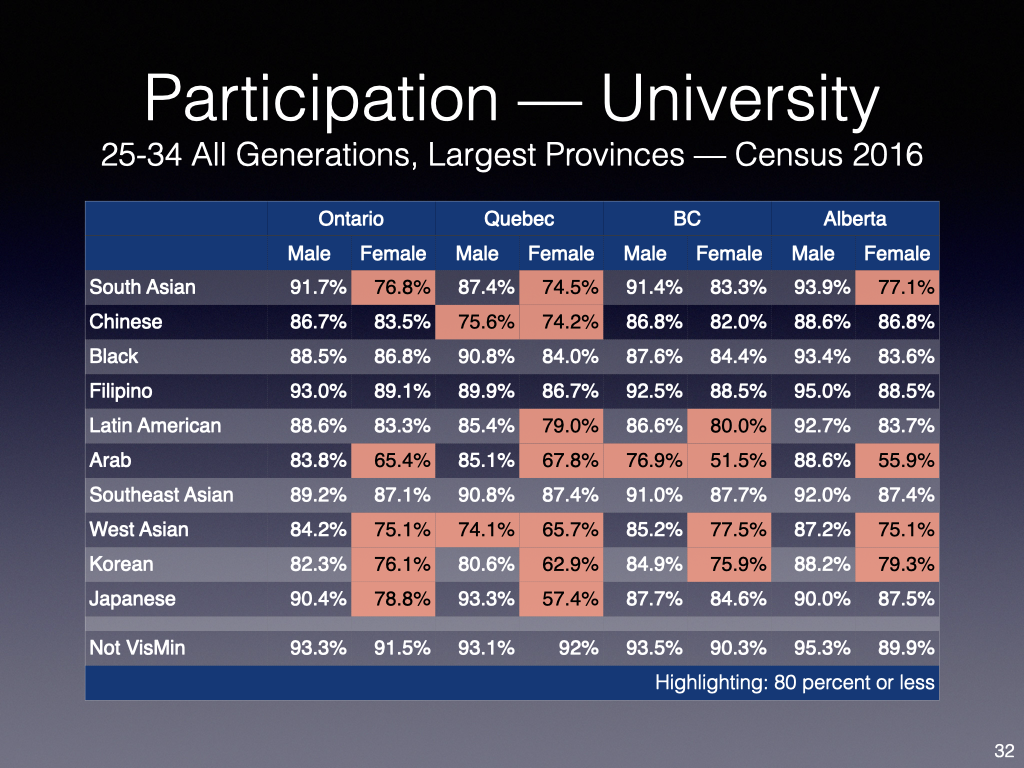
Immigration Cannot Significantly Reduce Inflation

Of note. Many of the arguments also apply to the Canadian context:

Many immigration advocates have recently called for increasing the number of immigrants allowed into the country to fill lower-wage jobs in order to decrease wages by increasing the supply of workers, thereby lessening inflation. In this post, we attempt to roughly estimate the possible impact of immigration-induced reductions in wages on consumer prices. We focus our analysis on the lower-wage sectors of the economy that primarily employ workers without a bachelor’s degree (the less-educated) because many of those advocating for more immigration have specifically called for more workers in these sectors. Our analysis shows that reducing wages for the less-educated is not an effective means of controlling inflation because such workers earn relatively little and as a result account for only a modest share of economic output. There is also the equally important question of whether reducing the wages of workers who are the lowest-paid is sound public policy.

Among our findings:

  • Reflecting their relatively modest average compensation, workers without a bachelor’s degree account for an estimated 25 percent of GDP. This means that even a substantial reduction of 10 percent in their wages could likely reduce consumer prices by only an estimated 2.5 percent. More educated workers and capital account for most of the economy.
  • If we look at just lower-wage occupations done primarily by those without a bachelor’s degree, we find that they account for only 22 percent of GDP. As a result, a 10 percent reduction in wages in these occupations could reduce prices by only an estimated 2.2 percent.1
  • It might be possible to reduce wages in specific occupations by dramatically increasing the number of workers in relatively few occupations. But since individual lower-paid occupations account for only a tiny share of the economy, the impact on overall consumer prices would be correspondently tiny. For example, the compensation earned by construction and extraction workers is only 2.2 percent of GDP, for cleaning and maintenance it is 1 percent, for food preparation and serving it is 1.1 percent, and for healthcare support it is 0.9 percent.
  • Prior to Covid, workers, including those without a bachelor’s degree, have generally seen their wages decline or grow very little for more than two decades, so reducing their wages by admitting more immigrants can be seen as unfair and unwise.
  • More than one in seven of these less-educated workers are currently eligible to receive cash payments from the Earned Income Tax Credit and Additional Child tax Credit — the nation’s largest cash assistance programs for low-wage workers. Reducing the wages of such workers could undo some of these important efforts to help low-income workers.
  • Nearly two-thirds of all children in poverty in America are dependent on a worker who does not have a bachelor’s degree. Using immigration to reduce wages for less-educated workers has significant negative implications for American’s low-income children.

Source: Immigration Cannot Significantly Reduce Inflation