Ryerson University releases report card on student diversity. Which faculties pass, which receive a failing grade and how the school plans to improve

Kudos to Ryerson for collecting and presenting this data with an impressive response rate.

Reading this article, made me question whether and when Ryerson may have to broaden its diversity efforts not only in cases where women, visible minorities and Indigenous peoples are under-represented but also in programs where non-visible minorities are under-represented (e.g., arts, communications, community service, management):

Ryerson University graded its programs on student diversity and most faculties are skating by with Cs.

At a glance, some of the most under-represented groups in the school’s total population were Indigenous students, students with disabilities and racialized graduate students. 

And a further report-card-style breakdown of individual programs and faculties shows just how these equity groups are spread out across the university. 

Ryerson University graded its programs on student diversity and most faculties are skating by with Cs.

At a glance, some of the most under-represented groups in the school’s total population were Indigenous students, students with disabilities and racialized graduate students. 

And a further report-card-style breakdown of individual programs and faculties shows just how these equity groups are spread out across the university. SKIP

The school’s first ever breakdown of student identities, “The Student Diversity Self-ID Report” compares student representation from 2019 with the makeup of the GTA and Ontario across five equity groups: women, racialized people, Indigenous peoples, people with disabilities and LGBTQ people.

Ryerson is one of few Canadian universities that has collected and published this sort of information. Students and advocates have called for disaggregated data to better address equity gaps on campus for years. 

For undergraduate programs, the faculties’ average diversity scores were between 54 and just over 72 per cent. Graduate programs scored between 40 to 75 per cent.

The faculty averages give an overview, but the breakdown by programs reveals a detailed look at the exact programs where certain groups are severely under-represented.

For instance, Black students are 7 per cent of the undergraduate population in total, which is close to the GTA population. But some programs like accounting and finance, interior design, nutrition and most engineering programs scored Ds for Black student representation. 

And while women are 55 per cent of the overall student population, they are under-represented in business, computer science and engineering programs. 

“It provides a snapshot from 2019, to let us know where we are and where we need to go,” said Denise O’Neil Green, Ryerson’s vice-president of equity and community inclusion.

Green said the school’s long-term goal is “to see greater alignment with the community representation by 2030.”

How the report works

Students were able to share via an online questionnaire whether they identify with any of Ryerson’s five equity groups: women, racialized students, Indigenous students, students with disabilities and LGBTQ students.

The survey had a 96 per cent response rate with more than 40,000 students participating. 

Each program was then awarded a report-card-like letter grade for each equity group category with the racialized category further broken down to Black, Chinese and South Asian. 

Programs were awarded an A+ if the proportion of the students met or was greater than its population in the GTA or Ontario — although that grade won’t stop the university from continuing efforts to improve. The grades A to D+ show how much improvement is needed for the equity groups to be representative of the rest of the population. 

Based on the data, each program and faculty received an average percentage rating of its overall diversity across equity groups.

“The report is there to help inform our community and to help drive decision making and to help develop strategies, so that we can make education more inclusive for everyone,” Green told the Star.

There are more details in the report taking a detailed look at the Black student experience, the role financial barriers play in accessing education and how to measure the experiences and graduation rate of these students. 

It also outlines plans to create working groups to assess what supports, like scholarships and mentoring programs can be put in place to create more pathways for students. 

The need for disaggregated data

Disaggregated data collection has been long desired by students and equity advocates, but schools have been slow to move. 

In 2019, Universities Canada surveyed schools across the country about their equity, diversity and inclusion practices.When it came to student data collection, schools were more likely to collect data on age, gender and Indigeneity, but less likely to collect statistics on sexuality, ability or race more widely. 

In 2017, the CBC conducted an investigation where it asked Canadian universities if they collected data on how their students identify racially — 63 out of 73 did not, Ryerson included. 

Universities have been more likely to keep data on faculty and staff, in order to meet legislative requirements, like the Ontario Human Rights Code and Federal Contractors Program. 

But without a clear picture of what the student body looks like, it is less likely that schools will make structural changes to make post-secondary schools more accessible and inclusive once these students arrive.

Carl James, a York University professor and senior equity adviser, said he finds it ironic that most universities, which are research institutions, had not been using this sort of student data to inform their programs and policies.

Data collection, he said, is a useful advocacy tool, keeps institutions accountable and allows them to keep track of change from year to year. But the most important part he said is how it is used and interpreted. 

“Keep taking data for data sake,” without using it to bring about the necessary change “that’s not a good use of data,” he said. “How are you going to use it in the interest of the people?” 

James also points out that students had been advocating for disaggregated data collection for years.

In 2015, Black students at the University of Toronto and Ryerson University formed Black Liberation Collectives in solidarity with U.S. students at University of Missouri. One of many demands they made of administration was to collect race-based data on students, which U of T agreed to begin in 2016.

Elsewhere in the GTA, University of Toronto created a survey in November 2020 to collect data for a student diversity census.York University listed intentions to do so in a June 2020statement addressing anti-Black racism. These initiatives came after George Floyd’s death sparked a widespread reckoning on anti-Black racism. 

For schools collecting this data, James’ question is: “Now that you know, what are you going to do about it?”

Source: https://www.thestar.com/news/gta/2021/04/07/ryerson-university-releases-report-card-on-student-diversity-which-faculties-pass-which-receive-a-failing-grade-and-how-the-school-plans-to-improve.html
A Novel Effort to See How Poverty Affects Young Brains

Interesting study and experiment:

New monthly payments in the pandemic relief package have the potential to lift millions of American children out of poverty. Some scientists believe the payments could change children’s lives even more fundamentally — via their brains.

It’s well established that growing up in poverty correlates with disparities in educational achievement, health and employment. But an emerging branch of neuroscience asks how poverty affects the developing brain.

Over the past 15 years, dozens of studies have found that children raised in meager circumstances have subtle brain differences compared with children from families of higher means. On average, the surface area of the brain’s outer layer of cells is smaller, especially in areas relating to language and impulse control, as is the volume of a structure called the hippocampus, which is responsible for learning and memory.

These differences don’t reflect inherited or inborn traits, research suggests, but rather the circumstances in which the children grew up. Researchers have speculated that specific aspects of poverty — subpar nutrition, elevated stress levels, low-quality education — might influence brain and cognitive development. But almost all the work to date is correlational. And although those factors may be at play to various degrees for different families, poverty is their common root. A continuing study called Baby’s First Years, started in 2018, aims to determine whether reducing poverty can itself promote healthy brain development.

“None of us thinks income is the only answer,” said Dr. Kimberly Noble, a neuroscientist and pediatrician at Columbia University who is co-leading the work. “But with Baby’s First Years, we are moving past correlation to test whether reducing poverty directly causes changes in children’s cognitive, emotional and brain development.”

Dr. Noble and her collaborators are examining the effects of giving poor families cash payments in amounts that wound up being comparable to those the Biden administration will distribute as part of an expanded child tax credit.

The researchers randomly assigned 1,000 mothers with newborns living in poverty in New York City, New Orleans, the Twin Cities and Omaha to receive a debit card every month holding either $20 or $333 that the families could use as they wished. (The Biden plan will provide $300 monthly per child up to age 6, and $250 for children 6 through 17.) The study tracks cognitive development and brain activity in children over several years using a noninvasive tool called mobile EEG, which measures brain wave patterns using a wearable cap of 20 electrodes.

The study also tracks the mothers’ financial and employment status, maternal health measures such as stress hormone levels, and child care use. In qualitative interviews, the researchers probe how the money affects the family, and with the mothers’ consent, they follow how they spend it.

The study aimed to collect brain activity data from children at age 1 and age 3 in home visits, and researchers managed to obtain the first set of data for around two-thirds of the children before the pandemic struck. Because home visits are still untenable, they extended the study to age 4 and will be collecting the second set of brain data next year instead of this year.

The pandemic, as well as the two stimulus payments most Americans received this past year, undoubtedly affected participating families in different ways, as will this year’s stimulus checks and the new monthly payments. But because the study is randomized, the researchers nonetheless expect to be able to assess the impact of the cash gift, Dr. Noble said.

Baby’s First Years is seen as an audacious effort to prove, through a randomized trial, a causal link between poverty reduction and brain development. “It is definitely one of the first, if not the first” study in this developing field to have direct policy implications, said Martha Farah, a cognitive neuroscientist at the University of Pennsylvania and director of the Center for Neuroscience and Society who studies poverty and the brain.

Professor Farah concedes, however, that social scientists and policymakers often discount the relevance of brain data. “Are there actionable insights we get by bringing neuroscience to bear, or are people just being snowed by pretty brain images and impressive-sounding words from neuroscience? It’s an important question,” she said.

Skeptics abound. James Heckman, a Nobel Prize-winning economist at the University of Chicago who studies inequality and social mobility, said he didn’t see “even a hint that a policy would come out of it, other than to say, yes, there’s an imprint of a better economic life.”

“And it still remains a question what the actual mechanism is” through which giving parents cash helps children’s brains, he said, adding that targeting such a mechanism directly might be both cheaper and more effective.

Samuel Hammond, director of poverty and welfare policy at the Niskanen Center, who worked on a child allowance proposal by Senator Mitt Romney, agrees that tracking the source of any observed cognitive benefits is tricky. “I have trouble disentangling the interventions that actually help the most,” he said. For example, policy experts debate whether certain child care programs directly benefit a child’s brain or simply free up her caregiver to get a job and increase the family’s income, he said.

Yet that is exactly why providing disadvantaged families with cash might be the most potent way to test the link to brain development, Dr. Noble said. “It’s quite possible that the particular pathways to children’s outcomes differ across families,” she said. “So by empowering families to use the money as they see fit, it doesn’t presuppose a particular pathway or mechanism that leads to differences in child development.”

Neuroscience has a track record for transforming societal thinking and influencing policy. Research showing that the brain continues to mature past adolescence and into a person’s mid-20s has reshaped policies relating to juvenile justice.

In another example, research on brain and cognitive development in children who grew up in Romanian orphanages from the mid-1960s into the 1990s changed policy on institutionalization and foster care, in Romania and worldwide, said Charles Nelson, a neuroscientist at Harvard and Boston Children’s Hospital who co-led that work.

Those studies demonstrated that deprivation and neglect diminish IQ and hinder psychological development in children who remain institutionalized past age 2, and that institutionalization profoundly affects brain development, dampening electrical activity andreducing brain size.

But that work also underscores how consumers of research, policymakers among them, are prone to give more weight to brain data than to other findings, as other studies show. When Professor Nelson presents these findings to government or development agency officials, “I think they find it the strongest ammunition to implement policy changes,” he said. “It is a very powerful visual, more so than if we said, well, they have lower IQs, or their attachment isn’t as strong.” (He is an adviser for Baby’s First Years.)

The vividness of such data isn’t necessarily bad, Dr. Noble said. “If we find differences and the brain data make those differences more compelling to stakeholders, then that’s important to include,” she said. Moreover, brain data provides valuable information in its own right, particularly in infants and young children, for whom behavioral tests of cognition are often inaccurate or impossible to conduct, she said. Brain differences also tend to be detectable earlier than behavioral ones, she said.

The field may simply be too young to clock its contributions to policy, Professor Farah said. But increasing understanding of how specific brain circuits are affected by poverty, along with better tools for gauging such circuits, may yield science-based interventions that get taken up at a policy level, she said.

Meanwhile, Baby’s First Years hopes to address a broader question that is already relevant at the policy level: whether cash aid to parents helps their children’s brains develop in a way that helps them for a lifetime.

Claims of Uyghur genocide in China are ‘lies,’ adviser to B.C. premier says

Sigh. Needs to go:

A member of a committee that advises B.C. Premier John Horgan is under fire for referring to accusations of Uyghur genocide in China as “lies.”

Bill Yee, a retired provincial court judge and a member of B.C.’s Chinese-Canadian Advisory Committee, made the comments during an interview on the Toronto-based Chinese-language radio station A-1.

Those statements have a Canadian organization that advocates for democracy in Hong Kong calling on Horgan to dismiss Yee from his advisory role.

During the March 31 interview, Yee dismissed allegations that a genocide is being conducted against Uyghurs by the Chinese government.

“They use these lies, and those politicians, but what kind of legal basis do they have to prove China has committed genocide?” he said. “That doesn’t make sense.”

In the past year, the Chinese government has faced accusations of genocide from think tanks, non-governmental organizations and journalists who have documented human rights abuses in the country’s Xinjiang Uyghur Autonomous Region. Those stories include allegations of systematic rape, forced birth control, forced labour and internment camps targeting Muslim Uyghurs and other Turkic minorities.

On Feb. 22 Canada’s House of Commons passed a motion to formally recognize that a genocide is taking place in the region. The motion passed by a vote of 266-0, with most members of Prime Minister Justin Trudeau’s cabinet abstaining.

Last summer, witnesses who included victims of human rights abuses in the region testified before the House foreign affairs subcommittee on international human rights. The subcommittee subsequently declared that a genocide is happening in the region, and was recently sanctioned by the Chinese government, along with MP Michael Chong.

Pressed during the radio interview by host Andrea Chun, Yee said the allegations about events in Xinjiang are “made up” and “lies.”

Yee, who is a past president of the Chinese Benevolent Association in Vancouver, accused Canadian politicians of having “ulterior motives,” according to a translation of the interview done by the Star.

“The so-called evidence from some people, does that mean they’re fact? It needs to be objective,” Yee said. “Many people have ulterior motives, so have you thought about that?”

The Star requested an interview with Yee through Horgan’s director of communications, as well as through the Chinese Canadian Museum, which lists him as a member of its board of directors, and was told the messages would be passed on to him.

He did not reply to the requests.

The radio interview did not mark the first time Yee has made controversial comments about China’s human rights record.

In 1993, the Vancouver Sun reported that Yee had said there may be another “perspective” to the Tiananmen Square massacre, and that Vancouver’s pro-democracy activists may have a “hidden agenda” regarding the 1989 event.

“It’s very clear that this man is repeating the same talking points that the Chinese Communist Party has been broadcasting,” said Cherie Wong, executive director of the pro-democracy group Alliance Canada Hong Kong. “What’s worrisome is this is happening on a provincial level of politics.”

She said Yee should be dismissed from the committee, calling it a “choice John Horgan must make.”

The Star reached out to Horgan’s office about Yee’s comments last week and received a response back from Minister of State for Trade George Chow’s office that said Yee had been expressing “personal opinions” during the radio interview.

“The mandate of the advisory committee was set up to provide inputs to the government on domestic community issues and does not include foreign affairs,” the statement from Chow’s office said. “Therefore, Mr. Bill Yee has been asked to not identify himself as a member of the advisory committee when expressing personal opinions.”

The statement also said the B.C. government supports Ottawa’s stance on the issue.

But Wong said the response isn’t good enough.

“Why is it that the B.C. NDP party has an adviser who is blatantly not only echoing propaganda but also actively dismissing the lived experience of Uyghur Canadians?” Wong said. “He is not representative of what Chinese Canadians in Canada are asking for.”

She said it’s “ridiculous” to even discuss whether Yee still has a place on the committee.

Douglas Chiang, a past president of the Canadian Taiwanese Association, said he’s concerned Yee serves Horgan in an advisory role, given his comments on Xinjiang.

“It is not good news for Taiwanese people, not good news for Canadian people” he said. “I don’t know why he is an adviser for the premier.”

Chiang said all Canadian leaders should be concerned about human rights and freedoms.

Source: Claims of Uyghur genocide in China are ‘lies,’ adviser to B.C. premier says

US weighs joint approach to Beijing Olympics with allies

Of note and needed. Hopefully, enough countries will have the sense to boycott and not provide a propaganda triumph for the Chinese regime:

The State Department said Tuesday the Biden administration is consulting with allies about a joint approach to China and its human rights record, including how to handle the upcoming Beijing Winter Olympics.

The department initially suggested that an Olympic boycott to protest China’s rights abuses was among the possibilities but a senior official said later that a boycott has not yet been discussed.

The official said the U.S. position on the 2022 Games had not changed but that the administration is in frequent contact with allies and partners about their common concerns about China. Department spokesman Ned Price said earlier the consultations were being held in order to present a united front.

“Part of our review of those Olympics and our thinking will involve close consultations with partners and allies around the world,” Price told reporters.

Human rights groups are protesting China’s hosting of the Games, which are set to start in February 2022. They have urged a diplomatic or straight-up boycott of the event to call attention to alleged Chinese abuses against Uyghurs, Tibetans, and residents of Hong Kong.

Price declined to say when a decision pm the Olympics might be made, but noted there is still almost a year until the Games are set to begin.

“These Games remain some time away. I wouldn’t want to put a timeframe on it, but these discussions are underway,” he said. “It is something that we certainly wish to discuss and it is certainly something that we understand that a approach will be not only in our interest, but also in the interest of our allies and partners. So this is one of the issues that is on the agenda, both now and going forward.”

The Beijing Winter Olympics open on Feb. 4, 2022 and China has denied all charges of human rights abuses. It says “political motives” underlie the boycott effort.

Rights groups have met with the International Olympic Committee and have been told the Olympic body must stay politically “neutral.” They have been told by the IOC that China has given “assurances” about human rights conditions.

Both the IOC and the U.S. Olympic and Paralympic Committee have said in the past they oppose boycotts.

In March, IOC president Thomas Bach said history shows that boycotts never achieve anything. “It also has no logic,” he said. “Why would you punish the athletes from your own country if you have a dispute with a government from another country? This just makes no real sense.”

The USOPC has questioned the effectiveness of boycotts. “We oppose Games boycotts because they have been shown to negatively impact athletes while not effectively addressing global issues,” it said. “We believe the more effective course of action is for the governments of the world and China to engage directly on human rights and geopolitical issues.”

Source: US weighs joint approach to Beijing Olympics with allies

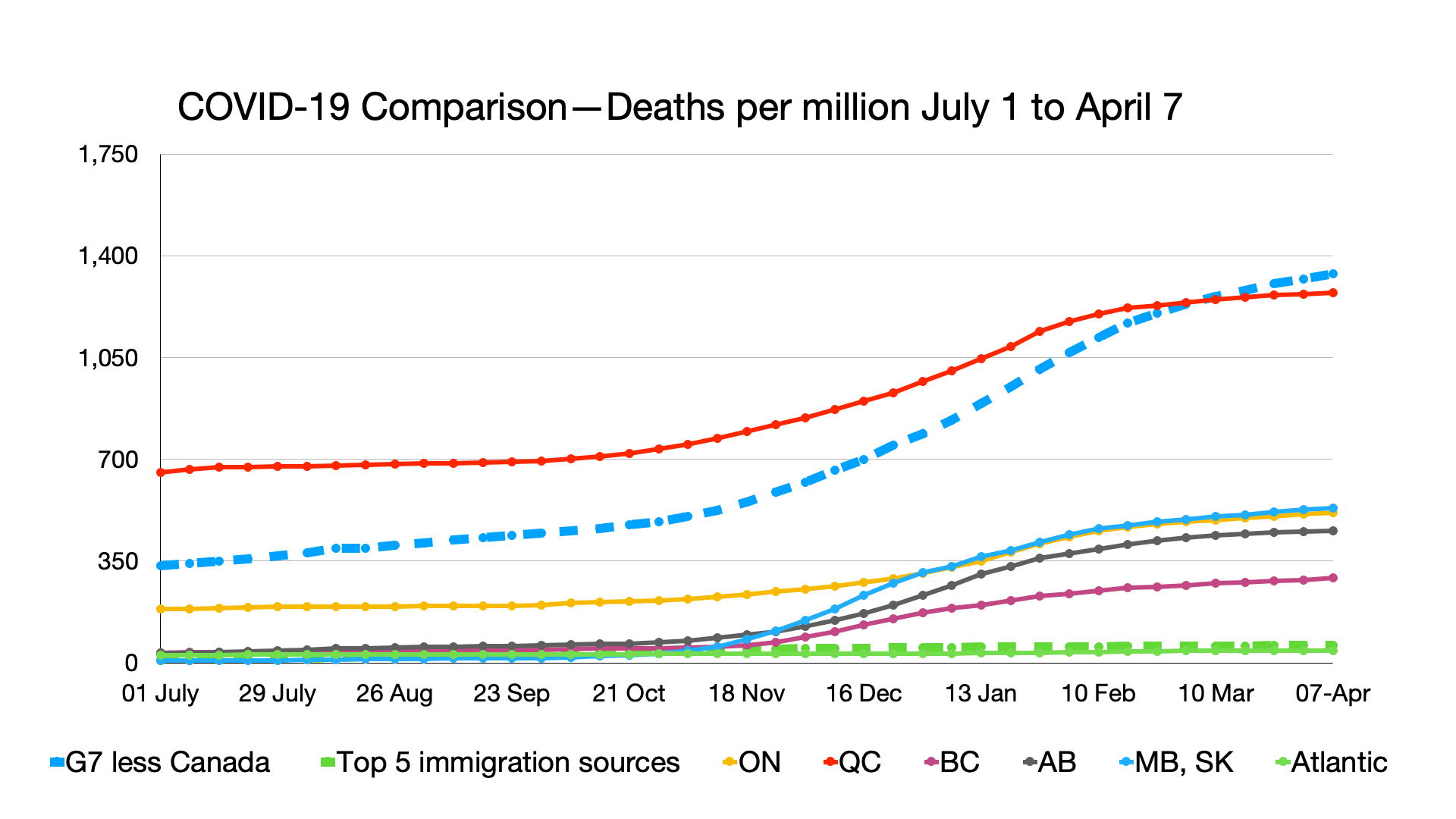
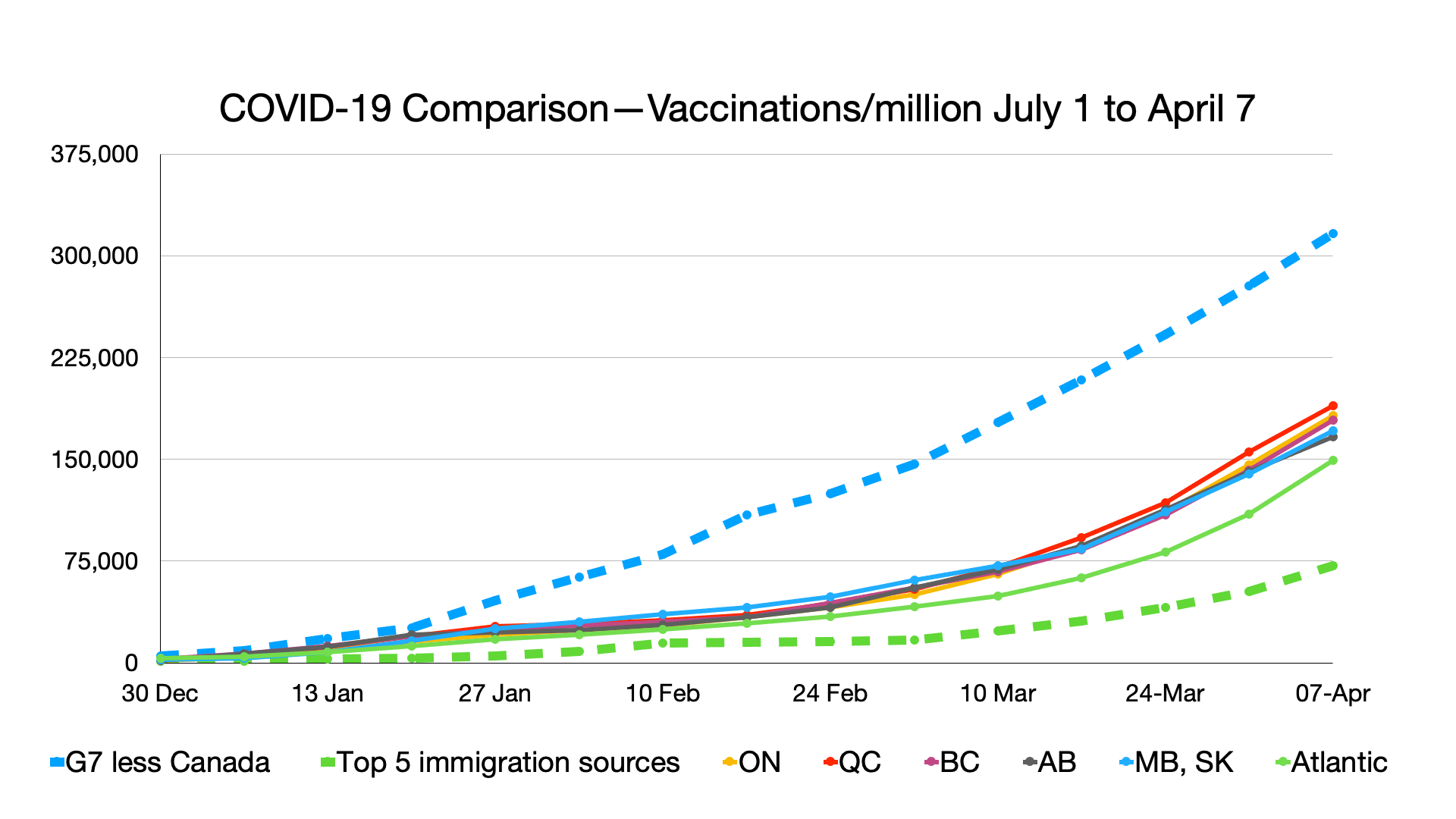
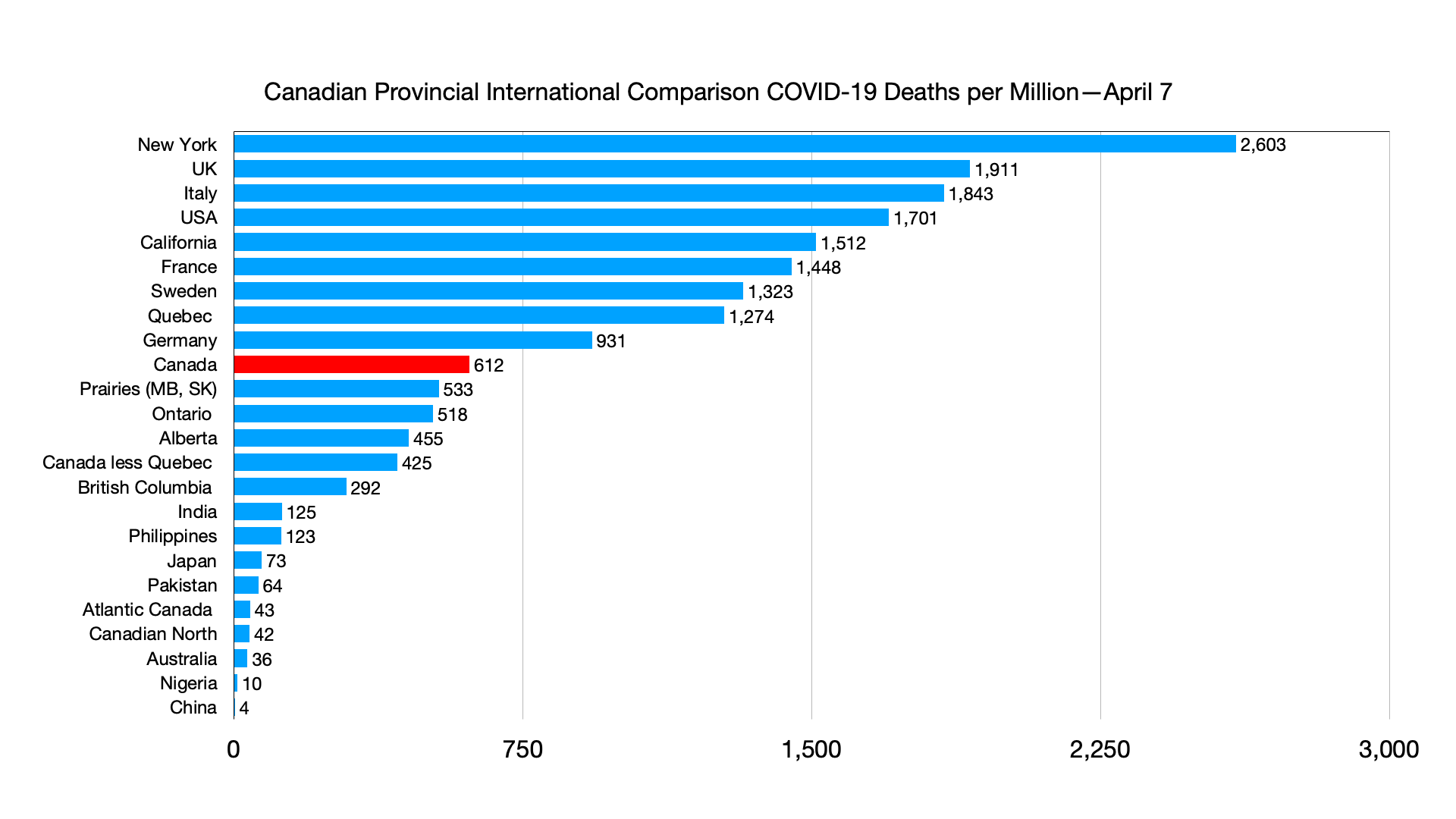
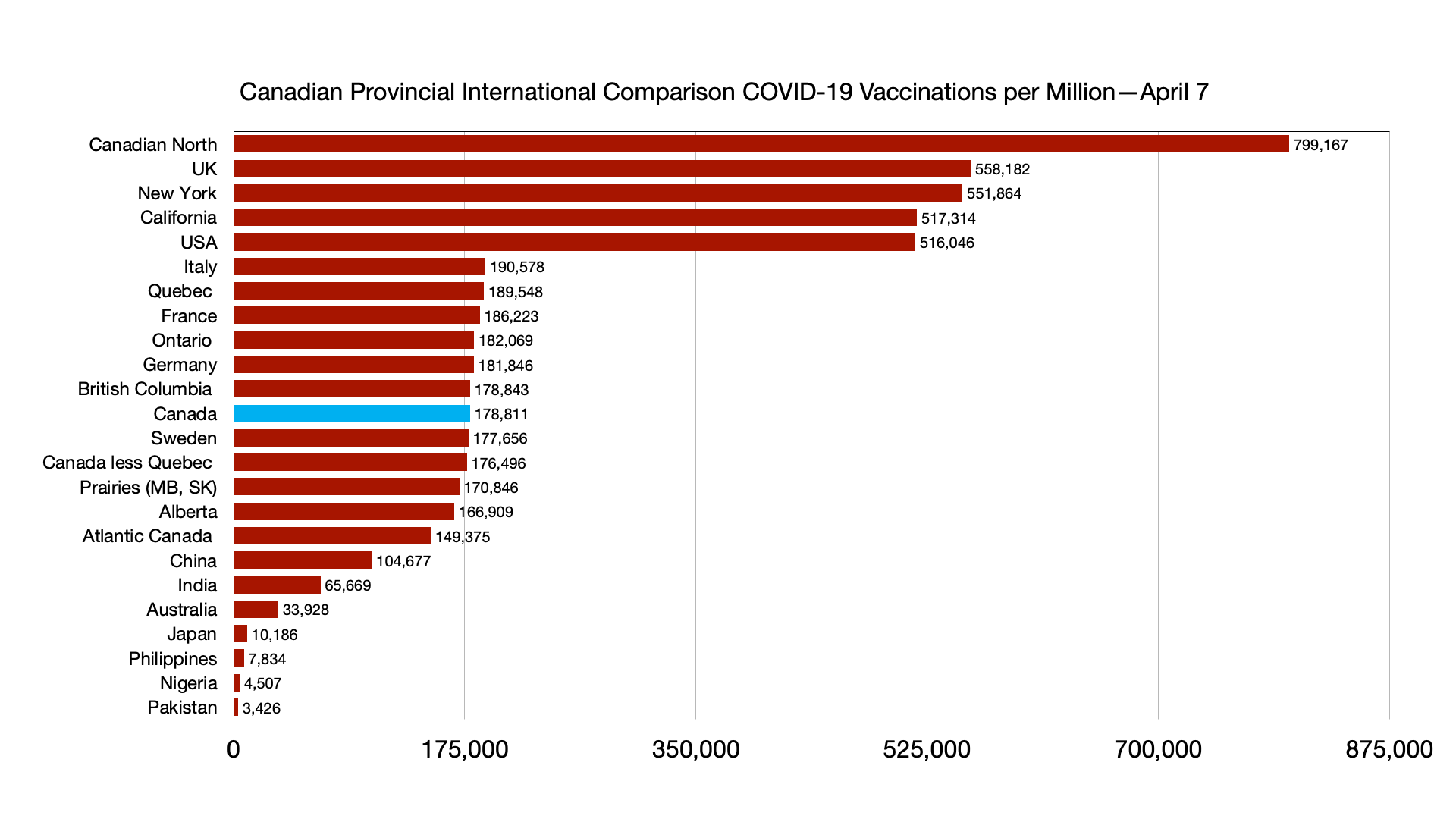
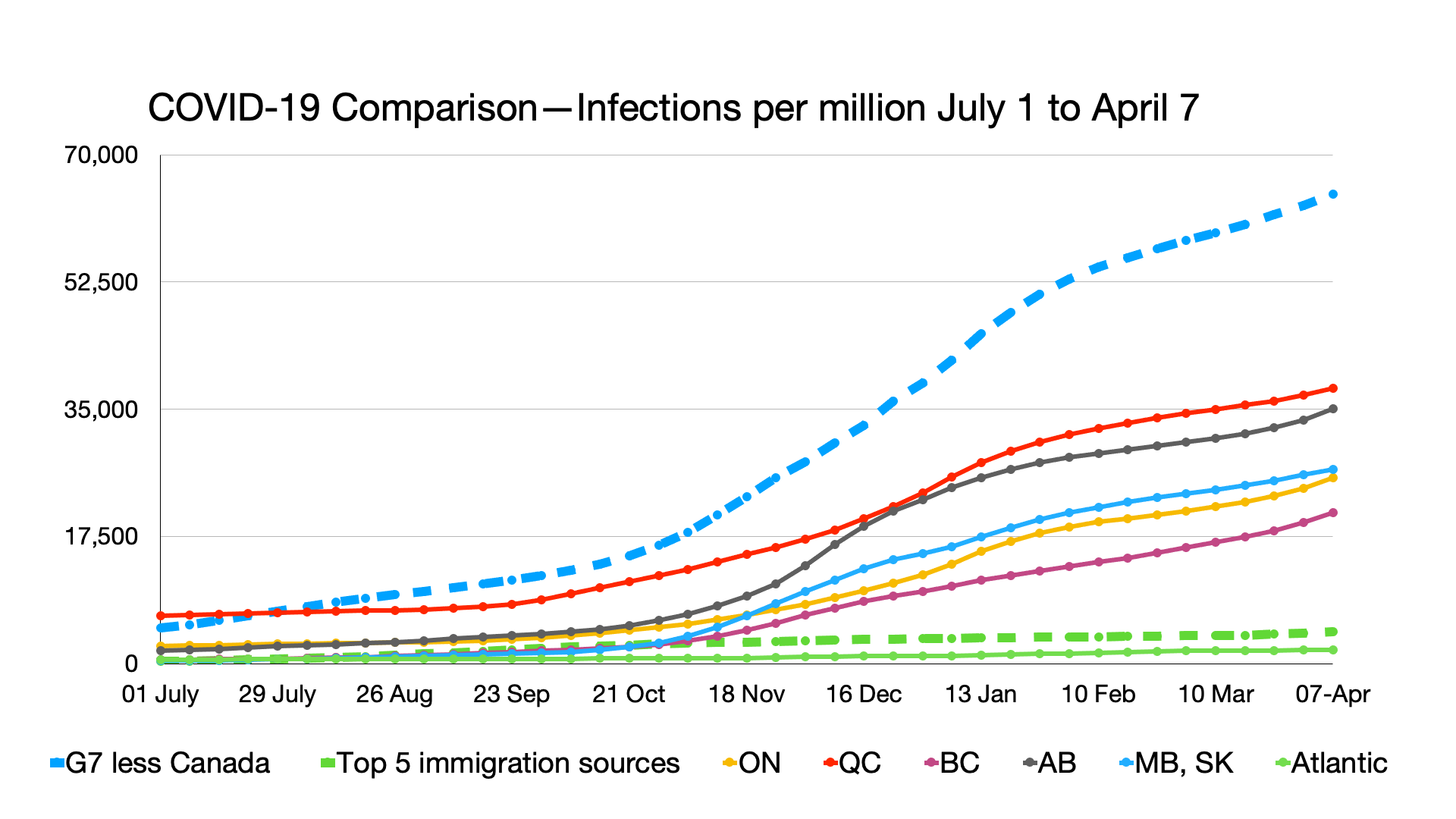
#COVID-19: Comparing provinces with other countries 31 March Update

The latest charts, compiled 7 April as the third wave has started.

Vaccinations: Change from last week: Some Canadian provinces doing slightly better than EU countries. Quebec ahead of France, Ontario ahead of Germany, British Columbia and Canada ahead of Sweden,  Prairies ahead of Alberta.

Trendline charts

Infections per million: Overall steady increase of infections in most provinces but better than G7 less Canada.

Deaths per million: No major changes.

Vaccinations per million: While the gap between G7 and Canada remains, the rate has largely approached other G7 countries. Of note is the increase in vaccination rates of immigration source countries (China and India).

Weekly

Infections per million: Some minor shifts: Alberta ahead of Germany, Canada ahead of Prairies.

Deaths per million: No relative change.

Input from public sector leaders needed in shaping a post COVID future

Reasonable call and consultation. However, I would hope that the focus would not just be at the deputy and ADM level, but executives and others closer to the front-line.

We have recently seen the disconnect between top levels and greater expertise in PHAC decisions and for such a survey to be more useful, it needs to draw on the deeper policy and subject expertise than in senior leaders who understandably have to focus more on policy management:

In a time of tremendous uncertainty, information overload and misinformation, Canadians are getting reams of advice and opinion on everything from how to manage the pandemic to the Supreme Court decision on climate change. The commentary comes from pundits, political actors, academics and interest groups, all important contributors to democratic debate. Some of it is informed, some of it is not.

Canadians are not hearing from those who, on a daily basis, are managing the challenges, developing the policies, implementing the programs and responding to the ever-changing political, legal and public opinion winds blowing on any given issue.

We are referring to senior, respected, professional public service executives who support elected municipal, provincial and federal representatives on complex challenges each and every day.

Who are these individuals?  Public sector executives and their organisations who are responsible for nearly 40 per cent of Canada’s GDP and an estimated 20 per cent of the country’s workforce.  They are distinguished by a ‘calling to serve’ and have a sense of duty to the community and a responsibility to help make things better.  They put collective interest over personal interest. While reasonably compensated it is often lower than the market compensation of their private sector counterparts.  And that’s okay.  These committed leaders are tireless in their pursuit of service and often burn the midnight oil through weekends and family events to help decision-makers make the best choices with the best advice.

These professional public servants wield tremendous influence on the quality of life we enjoy by advising, delivering services and providing effective stewardship of public resources to serve the priorities of democratically elected leadership.

Public sector leaders today are both driving and being driven by change. Facing paradigm shifts of seismic proportions, these experts and informed leaders are on the front line, supporting democratic institutions and governments, battling the pandemic, climate change and social polarization.  Public service executives are having to adapt, innovate and transform government organizations and services at top speed.

As we begin to consider what life will be like after the pandemic, and at a time when Canadian society is becoming increasingly polarized and diverse, and conflicts between different interest groups – including racialized tensions – are on the rise, the weight placed on the shoulders of this cadre of professional executives is unprecedented.  The pandemic and the difficult economic times are further straining public trust and governments will need to develop and enact policies and programs that address ongoing complex issues in a way that fosters better confidence in public institutions.

The chief administrative officer of a large metropolitan city or the deputy minister of a provincial or federal department has tremendous responsibility, knowledge and expertise.  They are impacted by changes to Canadian society, declining trust in government and concerned about whether or not their respective public institutions are equipped to deal with new, yet-to-be defined modern public administration practices.

Canadians need to hear from this informed cadre of dedicated experts. As vanguards of the public interest, they possess a unique knowledge, perspectives, and insights to the forces shaping society.  There is a need to give voice to, and share learnings from, the experience of public sector leaders regarding today’s issues and future challenges.

The Institute on Governance, with the support of the Mulroney Institute of Government, will be interviewing influential public sector leaders across the country and at all levels of government to collect their insights, learnings and assessments of the challenges and opportunities on the near and far horizons.  Knowing what is top of mind of this class of executives will offer an informed perspective to the important debates over Canada’s future and the role of governments in getting us there.

Toby Fyfe is the president of the Institute on Governance.  Stephen Van Dine is the senior vice president of public governance at the Institute on Governance.

Source: Input from public sector leaders needed in shaping a post COVID future

USA: African Immigrant Health Groups Battle A Transatlantic Tide Of Vaccine Disinformation

Of note:

Switching between Swahili and English, Dr. Frank Minja asked the African immigrants on the Zoom call if they had any questions about the COVID-19 vaccine.

Minja, who is originally from Tanzania, was asked how to get the vaccine, how it works, whether it’s safe.

Then one person asked him about a video promoting the conspiracy theory that the vaccine is part of a plot to reduce the Black race.

“That’s the realm of nonsense and misinformation,” he said.

Minja’s Q & A was hosted by the organization, African Family Holistic Health Organization (AFHHO), in Portland, Oregon. It’s one of a number of grassrootsorganizations across the country that are helping Africans in the U.S. get vaccinated.

In the United States, skepticism about the vaccine can be found in all segments of the population, including African Americans. However, efforts to address hesitancy among Black people often overlook African immigrants, who get much of their information from their countries of origin.

Minja has been paying close attention to threads of COVID-19 disinformation coming from Africa.

“We’ve seen the whole gamut of misinformation that basically started with the fact that Africans and people of African ancestry are not susceptible to COVID,” he said in an interview following the Zoom session.

Minja said many African immigrants do not rely on American media as trusted sources of information. Some do not speak English well enough yet. Others are used to getting information from friends and family back home through social media platforms, such as WhatsApp.

Chioma Nnaji, a health worker and community organizer for African immigrants and the wider Black community in Massachusetts, said it’s important to take into account that “certain communities live and operate in two spaces.”

“This is usually applicable to immigrants and refugees where they still have connections to their home countries while they are resettling in a new country,” she added.

A lot of what they hear from back home is helpful, she said. For example, traditional herbal remedies are popular. Minja said those can be useful for treating symptoms of non-severe forms of COVID-19.

However, there’s also quite a bit of misleading information about the vaccine that is spread through these channels, Minja said.

“And a lot of it is really about just planting the seeds of distrust,” he said.

For African immigrants, the distrust is partly rooted in the memory of being exploited by western countries, said Dr. Ifeanyi Nsofor. He’s a global health expert from Nigeria, who has also been battling vaccine misinformation on the continent.

“It’s almost like anything that you say is coming from the white man, people look at it with lots of suspicion, based on that experience of colonialism,” he said.

And that experience did not end with independence. Over the years, global health advocates have accused multinational pharmaceutical firms of using African countries as living laboratories for clinical trials of experimental drugs. In 1996, 11 children died and dozens were left disabled in Nigeria after being given an experimental anti-meningitis drug created by Pfizer — the developer of one of the COVID vaccines.

A year later, the U.S. government was accused sponsoring studies that gave pregnant women in developing countries a placebo during tests of the effectiveness of an antiviral drug for HIV.

And in April 2020, two French doctors sparked outrage when they suggested that a potential treatment for COVID-19 should be tested in Africa. The director of the World Health Organization, Tedros Adhanom Ghebreyesus, condemned the suggestion as a “hangover from a colonial mentality.”

“All this fear comes from a history,” said Haika Mushi, a health worker at AFHHO. She is also originally from Tanzania and moved to the U.S. 12 years ago. She has been helping organize the group’s Zoom calls since the pandemic began.

When the vaccine became available, AFHHO started helping people sign up for appointments. At first, it brought in a white doctor to answer questions, and people were still skeptical. She says the group had more success when it brought in Minja and a doctor from Zimbabwe. They also have translators speaking French, Swahili and Tigrinya.

“It makes sense to hear from our own,” she said.

Another type of disinformation that is being spread, according to Nnaji, is that immigration status affects a person’s ability to get the vaccine. She says that is why community-based organizations who can help people sign up for vaccinations, such as AFHHO, are so important.

AFHHO hopes that its sessions will also help curb disinformation in the countries of origin, too.

“We feel like if the people here are well enough educated about the vaccine, they will be able to educate our families back home — our friends, neighbors back home,” Mushi said.

Source: African Immigrant Health Groups Battle A Transatlantic Tide Of Vaccine Disinformation

Mélanie Joly: révolutionner la fonction publique pour freiner l’érosion du français

Will be interesting to see the details and how this understandable push will be balanced with efforts to increase representation at senior levels of Indigenous peoples and visible minorities:

Aux prises avec une fonction publique qui ne respecte « pas toujours » la Loi sur les langues officielles et un réseau diplomatique anglicisé, la ministre Mélanie Joly dit avoir donné un « coup de barre » et montré une« volonté politique claire » pour freiner l’érosion du français dans la machine fédérale, au pays et dans le monde. Passées plutôt inaperçues lors du dépôt de son « document de réforme » sur le français, des propositions spécifiques au secteur public pourraient, si elles se réalisent, créer une petite révolution au sein du gouvernement.

« Les gens savent très bien qu’il y a une culture qui fait en sorte que, normalement, quand une personne parle anglais autour de la table et qui ne parle pas français, tout le monde s’ajuste », dit la ministre Mélanie Joly pour illustrer des problèmes bien ancrés dans la culture de l’administration publique. En entretien téléphonique avec Le Devoir, celle qui a hérité du portefeuille des langues officielles fin 2019 dit vouloir envoyer un message aux fonctionnaires : cette culture doit changer.

Lors du dépôt, en février, de son « document de réforme », que la ministre appelle parfois son « livre blanc », le gros de l’attention médiatique a été consacré au fait que le gouvernement libéral exprime son désir d’utiliser désormais la Loi sur les langues officielles pour protéger le français aussi auQuébec, et non seulement comme langue minoritaire dans le reste du pays. Cela, pour atteindre une « égalité réelle » entre le français et l’anglais d’un océan à l’autre.

Or, de nombreux passages du document de 30 pages laissent entrevoir un changement assez radical dans la manière dont les deux langues sont appelées à être mises sur un pied d’égalité au sein des bureaux du gouvernement fédéral, dont presque la moitié des employés francophones des régions bilingues disent qu’ils se sentent mal à l’aise de s’exprimer en français. De grandes sections sont aussi consacrées à l’importance du rôle du français dans la conduite de la diplomatie canadienne dans le monde, après qu’une enquête du Devoir eut révélée que la haute direction d’Affaires mondiale Canada est constituée essentiellement d’anglophones faisant accéder d’autres anglophones aux postes les plus importants.

Exigence du français

Selon la vision de la ministre Joly, le gouvernement doit abolir le double standard des exigences linguistiques entre, d’une part, les francophones desquels on exige une excellente maîtrise de l’anglais écrit pour accéder à des postes de gestion et, d’autre part, les anglophones pour qui un français simplement fonctionnel peut très bien faire l’affaire. Pour ce faire, les exigences linguistiques sont appelées à être rehaussées, et plus de formation doit être offerte pour mettre à niveau les fonctionnaires. « Il faut aussi une bonne maîtrise du français écrit [en plus de la bonne maîtrise de l’anglais]. C’est ça, l’idée. C’est ça, le réel bilinguisme », explique Mélanie Joly.

Encore faut-il assurer un suivi auprès des différentes branches administratives du gouvernement fédéral. « Le problème qu’on avait, c’est que c’était une loi [sur les langues officielles] qui n’était pas toujours respectée », dit la ministre. Puisqu’ils sont isolés chacun dans leur coin, les ministères ont pris la mauvaise habitude de ne pas prendre toujours au sérieux leurs obligations en matière de langues officielles, a-t-elle constaté, rapports administratifs à l’appui. « C’est comme si, chaque fois, il fallait que j’appelle mes collègues pour savoir s’ils avaient fait le suivi, ou [comme si] l’équipe et moi voyions dans leurs propositions qu’il y avait des choses quine fonctionnaient pas au niveau des langues officielles », se rappelle-t-elle.

Dans sa nouvelle version, promise d’ici la fin de l’année 2021, la Loi sur les langues officielles devrait bénéficier non seulement d’un commissaire qui aura plus de pouvoirs pour faire appliquer ses recommandations, mais aussi d’une « unité » au sein du Conseil du Trésor qui aura pour mission de faire respecter la loi auprès de tous les employés.

« Il faut être capable de trouver une façon pour que, lorsqu’on est francophone, on puisse exercer notre travail en français au sein de notre fonction publique », fait valoir Mélanie Joly. Se basant sur les grands progrès réalisés au cours des 50 dernières années pour rendre l’État fédéral bilingue, alors qu’il peinait autrefois à donner des services en français, la ministre Joly croit que son document de travail donne un « coup de barre » à l’administration, lui indiquant les orientations du prochain chantier visant à l’égalité au sein des employés.

« Maintenant, on sait que le système n’est pas parfait, et on peut bâtir à partir de nos acquis pour nous assurer qu’il n’y a pas d’érosion du français au sein de notre fonction publique, alors que ce sont de nouvelles générations de fonctionnaires qui rejoignent les rangs des ministères et qu’elles ont eu accès à des cours d’immersion en français [au Canada anglais]. »

Dans le reste du monde

Le 18 mars dernier, les quatre sous-ministres d’Affaires mondiales Canada ont conjointement signé une lettre, envoyée à tous les employés, qui réaffirme que « le bilinguisme fait partie intégrante du Canada » et que l’organisation « a le rôle unique de représenter les intérêts et les valeurs du pays sur la scène internationale dans les deux langues officielles ».

« Nous incitons tous les employés à utiliser davantage le français et nous demandons à tous les gestionnaires de donner l’exemple dans leurs propres communications », peut-on lire dans le courriel obtenu par Le Devoir. Il ne s’agit pas d’un hasard. La conduite de la diplomatie en français est explicitée à de nombreuses reprises dans le document de réforme que la ministre Joly a présenté en février. « Ça a des impacts et c’est normal que notre fonction publique réagisse. Elle voit venir [les changements] et elle s’adapte parce qu’on a dit qu’on allait déposer un projet de loi », indique la ministre.

Tout en faisant le constat d’« une migration vers l’anglais pour tout le monde, pour tous les peuples », Mélanie Joly souhaite essentiellement tirer profit du caractère bilingue du Canada dans les relations avec les autres pays, ainsi que contribuer davantage aux instances internationales qui en font la promotion, comme l’Organisation internationale de la Francophonie (OIF).

« On est dans un monde où, essentiellement, on a tout avantage à développer des accords de libre-échange, des ententes culturelles, à créer des ponts entre les nations. Si on ne le fait pas, d’autres vont le faire. Donc, pourquoi ne pas utiliser nos racines, ce qui nous unit comme francophonie ? »

Mélanie Joly précise que les nombreux éléments abordés dans son document de réforme ne se retrouveront pas nécessairement tous dans la nouvelle Loi sur les langues officielles promise par le gouvernement Trudeau, qu’ils pourraient prendre d’autres formes. Par exemple, le souhait de donner un coup de pouce à la vie en français dans la capitale, Ottawa, sera plutôt traduit par des aides financières. Il est également toujours trop tôt pour savoir si le droit de travailler en français dans les entreprises privées de compétence fédérale au Québec sera inclus au projet de loi ou s’il fera partie d’une éventuelle réforme du Code canadien du travail. Un groupe d’experts mandaté pour se pencher sur la question doit remettre ses conclusions le 8 mai.

Source: Mélanie Joly: révolutionner la fonction publique pour freiner l’érosion du français

GPHIN: Top scientists propose moving pandemic warning system outside government

Understand and share the concerns, but I would prefer to address these and related problems at PHAC identified by media coverage and the recent OAG report.

The WHO also had its issues, relying too much on Chinese government information (or lack thereof).

But hopefully this initiative will increase government focus and attention that COVID has brought to current weaknesses:

A group of top scientists concerned about the decline of the federal pandemic early warning system in the years before COVID-19 emerged have proposed relocating the operation to a university where it can work independently of government.

The proposal is aimed at restoring the Global Public Health Intelligence Network to its former status as an internationally respected pandemic surveillance system. Documents outlining the plan were submitted to an independent panel in Ottawa that is reviewing the system’s future.

According to the documents, GPHIN would work with the World Health Organization and be based at the University of Ottawa’s Bruyère Research Institute. The university and the WHO back the idea, says the proposal, which was reviewed by The Globe and Mail.

“We propose the creation of a Canadian-based WHO collaborating centre for global health intelligence,” the proposal states. Such a move “would provide a new, stable and cost-effective environment for the future management of GPHIN.

“GPHIN must be guaranteed freedom from government influence or interference. To achieve independence of any future government influence, bias or interference, GPHIN must be situated outside of government.”

A Globe and Mail investigation last year found that GPHIN’s capabilities had been allowed to erode over the past decade as priorities within the government changed, and senior officials in the Public Health Agency of Canada (PHAC) sought to deploy its resources elsewhere.

Some of the core functions of the system, which provided crucial intelligence before and during the 2003 SARS crisis and 2009 H1N1 outbreak, were silenced in 2018 and 2019. With no pandemic threats apparent, management in the department sought to shift resources to areas that didn’t involve outbreak surveillance.

The proposal to partner with the WHO is being led by Ron St. John, a former top federal epidemiologist who helped create GPHIN in the 1990s, and other current and former top federal scientists. If it succeeds, the operation would run as a non-profit, funded in part by the federal government, and also able to seek science and technology grants from other sources, which it currently cannot do.

That new funding would be used to rebuild GPHIN’s operations and expand the system’s technical capabilities, taking some of the financial burden off the government, the documents say. GPHIN’s annual budget is around $3-million, and federal documents show it lacked the resources needed to update or grow its surveillance capacity, particularly as the system was allowed to erode.

The proposal argues that the environment needed to properly run the pandemic early warning system no longer exists inside Public Health, due to a drain of scientific and medical expertise over the past decade.

“Meeting these principles and operational conditions is not possible within the current managerial environment that exists in PHAC,” the document states. “We cannot wait for these changes to happen, as waiting will result in irreversible degradation of GPHIN and further depriving users within the global public health surveillance community of an essential tool to detect and monitor public health threats.”

WHO collaborating centres around the world are a way for member countries to contribute resources to the WHO by offering skills or technology they have. The Bruyère Research Institute is already home to one such collaborating centre, which focuses on technology used to track global health equity.

At one time, GPHIN provided the WHO with as much as 20 per cent of its epidemiological intelligence, according to Ottawa’s records. The proposal documents say GPHIN would remain one of Canada’s key contributions to the WHO, with the government providing funding for the system’s analysts to work.

Health Minister Patty Hajdu ordered an independent review in September of how PHAC handled the system after a Globe investigation last summer detailed many of the problems.

A report by the Auditor-General of Canada issued two weeks ago also found that the federal government did not use the pandemic early warning system appropriately in the early days of the COVID-19 outbreak, and that GPHIN failed to issue alerts. This contributed a series of faulty risk assessments as the virus began to spread around the world.

The independent review is expected to issue its final report in May, and the government won’t comment on its progress.

This is not the first time the idea of a WHO collaborating centre has been proposed for GPHIN. The proposal documents say the WHO has supported the idea since the SARS crisis, and has held talks on the subject six times, but those negotiations never came to fruition.

In 2005, talks were put on hold amid management changes inside Public Health. In 2009, similar discussions were halted due to the H1N1 outbreak. In 2012, another proposal was frozen during the Harper government’s deficit reduction plan. Similarly, talks in 2013, 2017, and 2018 never progressed due to internal restructuring in the Public Health Agency that resulted in management changes, and no further steps were taken.

The push to rebuild GPHIN comes at a time when other countries have identified the need to build their own early warning systems to help the international community detect major threats early and better contain outbreaks. The U.K. government and the Biden administration in the United States have signalled plans to bolster such capacities in recent months. An independent review examining the WHO’s pandemic preparedness is also expected to highlight the importance of such systems in its final report, expected this spring.

The epidemiologists behind the proposal say they want to restore Canada’s leadership in pandemic early warning and detection.

“GPHIN has achieved world-wide recognition as a rapid provider of accurate information regarding a variety of global events of public health importance,” the proposal says. “Future versions of GPHIN must build on and maintain this pre-eminent position. It’s Canadian origin and Canadian support during its lifetime is recognized and should be retained.”

Source: https://www.theglobeandmail.com/canada/article-top-scientists-propose-moving-pandemic-warning-system-outside/?utm_medium=email&utm_source=Morning%20Update&utm_content=2021-4-6_7&utm_term=Morning%20Update:%20Top%20scientists%20propose%20moving%20pandemic%20warning%20system%20outside%20government&utm_campaign=newsletter&cu_id=%2BTx9qGuxCF9REU6kNldjGJtpVUGIVB3Y

Akyol: It Is Time To Revive The Islamic Enlightenment

Akyol’s commentary always relevant and interesting:

ISIS, Al Qaeda, Boko Haram… Beheadings, terrorist attacks, massacres in the name of Islam… Do these grim episodes show that there is something wrong in the Muslim world today?

In the West, there are two popular answers to this question, which are diametrically opposite: The first is that these terrorists reveal “the true face of Islam,” which is a hopelessly violent and intolerant religion. The second answer is that, quite the contrary, these terrorists “have nothing to do with Islam,” which is only a religion of peace, while all troubles are created by socio‐​economic problems or foreign interventions.

As a Muslim myself who has been struggling with issues of freedom, human rights, and tolerance in the contemporary world of Islam, I believe both answers are wrong.

The first answer is wrong—and awfully unfair—because terrorists acting in the name of Islam are extremely marginal among the world’s 1.6 billion Muslims, most of which are peaceful people with normal lives. So, those terrorists are “extremists” indeed.

However, the second answer is also wrong, because the terrorists in question have something to do with Islam: they are referring to certain verdicts in Islamic jurisprudence—the interpretation of the Sharia—only by taking them to new heights.

Look at how ISIS justifies massacring Shiites: by declaring them “apostates.” In return, mainstream Islamic authorities condemn ISIS, by typically saying, “No, you can’t declare fellow Muslims apostates.” But most of these authorities don’t say that no apostate should ever be targeted—because they still believe in the authoritativeness of a dubious narration from the Prophet Muhammad: “Whomever leaves his religion, kill him.”

Or look at how Al Qaeda justifies killing “blasphemers”—people such as Charlie Hebdo cartoonists. They rely on medieval Islamic jurists who defined sabb al‐​rasul, or “insulting the prophet,” as a capital crime. In return, mainstream Islamic authorities oppose Al Qaeda, typically by saying, “No you can’t punish blasphemy on a vigilante basis, especially in a non‐​Muslim county.” That is helpful, but most of these mainstream authorities still see blasphemy as a capital crime. Hence they do not oppose the harsh blasphemy laws in Pakistan, Saudi Arabia, Iran, and many other Muslim‐​majority countries.

Here is the underlying problem that modern‐​day Muslims need to frankly face: Islam, as a religion, found political power right at its birth. Therefore, most early Muslims did not see anything wrong with using coercive power to advance their faith—just as their contemporaries, such as the Byzantines or the Sassanids, were also doing. This coercive power included military conquests; a political order based on the supremacy of Muslims over non‐​Muslims; the enforcement of piety; and the violent suppression of blasphemy, apostasy, and heresy.

None of these were shocking in the pre‐​modern world, when Islam in fact often seemed to be a more lenient religion than Christianity, whose own marriage with power was reflected in the horrors of the Crusades or the tortures of the Inquisition. No wonder, in that pre‐​modern world, many Jews fled from Christendom to the Muslim Ottoman Empire to find safety and freedom.

Yet the world has changed dramatically in the past few centuries, with the rise of liberal democracies and universal human rights. Christianity—and Judaism—adopted to these modern values, by revising some of their illiberal doctrines. But Islamic jurisprudence, and the mindset beneath, has not changed much.

Therefore, mainstream Islam indeed needs that much‐​discussed transformation: a major reform. The right analogy in Western history is not the Protestant Reformation, though, which has been often referenced, but only inappropriately.

The right analogy is the Enlightenment, in particular the kind of Enlightenment advocated by John Locke, who offered a new interpretation of Christianity—not a rejection of it—to save it from its own centuries‐​old marriage with coercive power.

In fact, this has been realized since the 19th century—in the late Ottoman Empire, Arab World, and India—by self‐​declared “Islamic liberals.” Their efforts led to liberal constitutions, feminist reforms, and religious reinterpretations. Recently, British historian Christopher de Bellaigue has summarized these significant efforts as the “Islamic Enlightenment.”

Yet this very drive provoked “Islam’s counter‐​Enlightenment,” spearheaded by a wide range of Salafis, Islamists, and rigid conservatives. (The terrorists mentioned above represent their most extreme fringe.)

My new book, Reopening Muslim Minds: A Return to Reason, Freedom, and Tolerance, is meant to be an intervention into this big crisis of Islam. It aims to revive and advance the Islamic Enlightenment, by presenting a comprehensive argument for it—and, perhaps more importantly, by dismantling the theological roadblock that obstructs it.

The main challenge is simple, but also a big one: Can Islam give up coercive power? Can it be a religion that proposes its truth claims, but does not imposethem?

Many Muslims, who are happy to live in free societies or aspire for them, already say “yes.”

Yet there are others who emphatically say “no.”

Their zealotry threatens the future of liberty. It also threatens the future Muslim societies, and, in fact, the future of the Islamic faith—my faith—as well.

Hence I wrote this book to show why they are wrong, and why there is a better way to understand Islam.

A way where faith is reconciled with reason, expressed in freedom, and crowned with tolerance.

Source: It Is Time To Revive The Islamic Enlightenment